

A high-performance speech neuroprosthesis
Open accessPublished version of a preprint
The DOI matches its Crossref record; 60 of the 60 references it cites were found in a registry or an index; 28 of the 35 sources its claims cite were checked for support.
Abstract
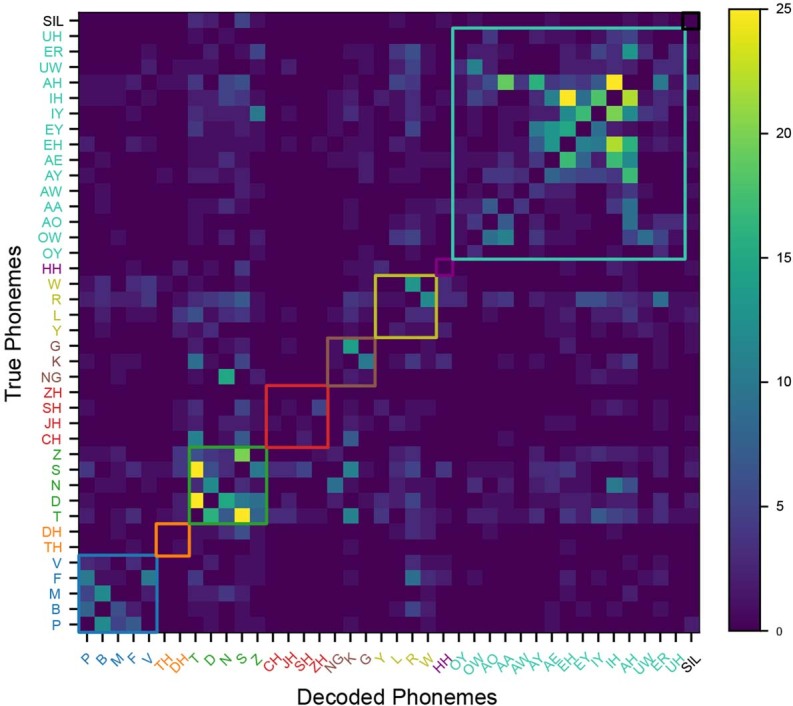
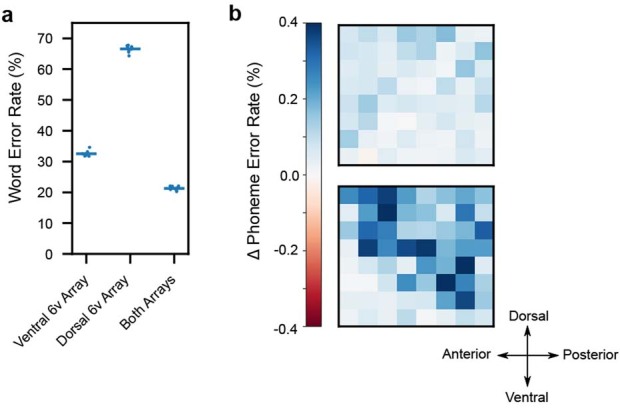
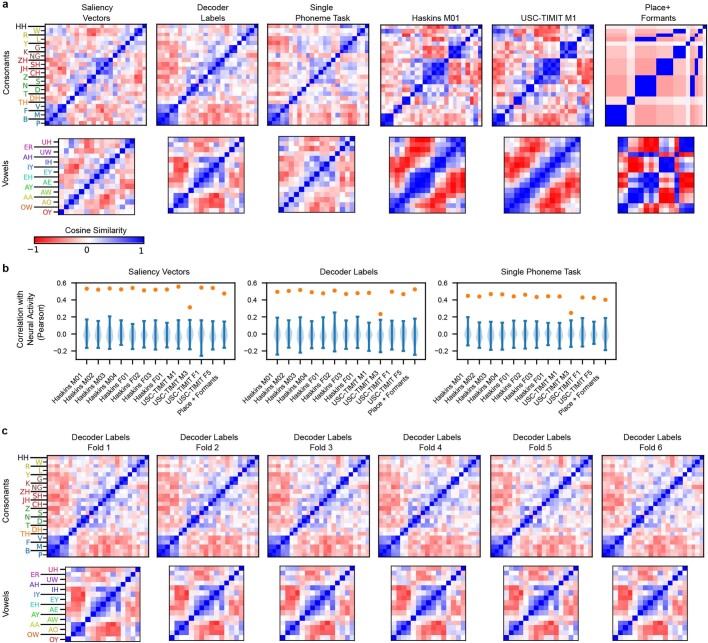
Abstract Speech brain–computer interfaces (BCIs) have the potential to restore rapid communication to people with paralysis by decoding neural activity evoked by attempted speech into text 1,2 or sound 3,4 . Early demonstrations, although promising, have not yet achieved accuracies sufficiently high for communication of unconstrained sentences from a large vocabulary 1–7 . Here we demonstrate a speech-to-text BCI that records spiking activity from intracortical microelectrode arrays. Enabled by these high-resolution recordings, our study participant—who can no longer speak intelligibly owing to amyotrophic lateral sclerosis—achieved a 9.1% word error rate on a 50-word vocabulary (2.7 times fewer errors than the previous state-of-the-art speech BCI 2 ) and a 23.8% word error rate on a 125,000-word vocabulary (the first successful demonstration, to our knowledge, of large-vocabulary decoding). Our participant’s attempted speech was decoded at 62 words per minute, which is 3.4 times as fast as the previous record 8 and begins to approach the speed of natural conversation (160 words per minute 9 ). Finally, we highlight two aspects of the neural code for speech that are encouraging for speech BCIs: spatially intermixed tuning to speech articulators that makes accurate decoding possible from only a small region of cortex, and a detailed articulatory representation of phonemes that persists years after paralysis. These results show a feasible path forward for restoring rapid communication to people with paralysis who can no longer speak.
Overview
CoChat Summary
TL;DR
A speech-to-text brain–computer interface using intracortical microelectrode arrays in one participant with ALS decoded attempted speech at 62 words per minute, with 9.1% word error rate on a 50-word vocabulary and 23.8% on a 125,000-word vocabulary. The study also reports spatially intermixed articulator tuning in area 6v and a preserved articulatory representation of phonemes years after paralysis.
Key findings
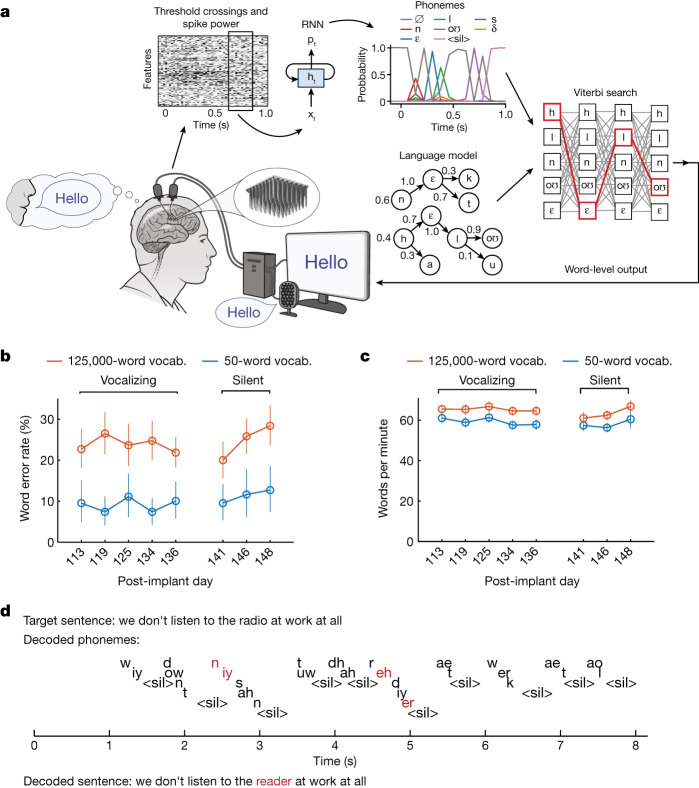
- The participant achieved a 9.1% word error rate on a 50-word vocabulary when vocalizing (11.2% silent) and a 23.8% word error rate on a 125,000-word vocabulary when vocalizing (24.7% silent); the 50-word result was 2.7 times fewer errors than the previous state-of-the-art speech BCI.
- Attempted speech was decoded at 62 words per minute, described as 3.4 times as fast as the previous record and approaching natural conversation at 160 words per minute.
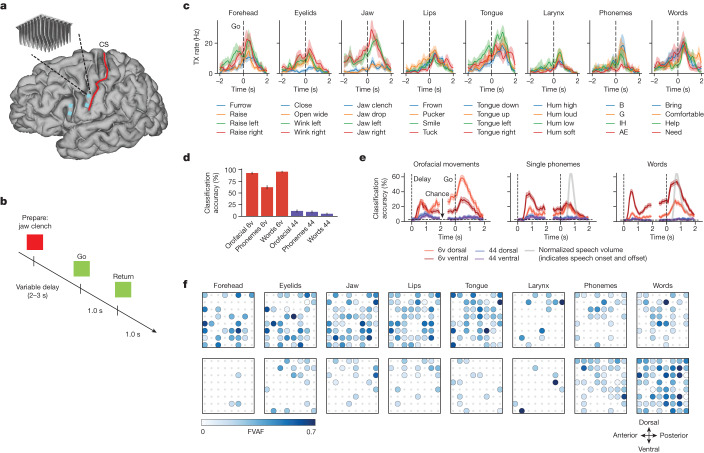
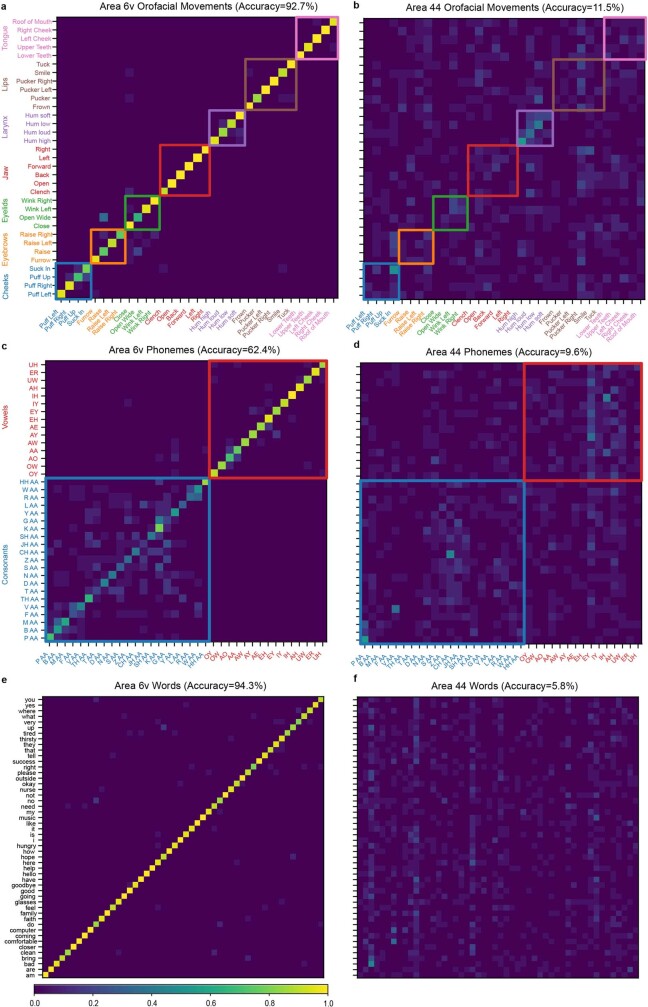
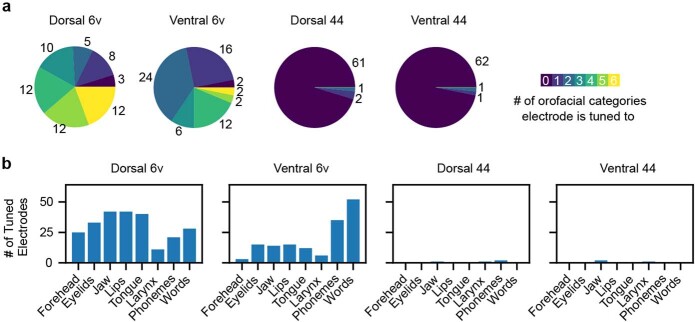
- Area 6v contained strong speech-related information: naive Bayes decoding from 1 s of neural activity reached 92% accuracy for 33 orofacial movements, 62% for 39 phonemes, and 94% for 50 words; area 44 showed classification accuracy below 12%.
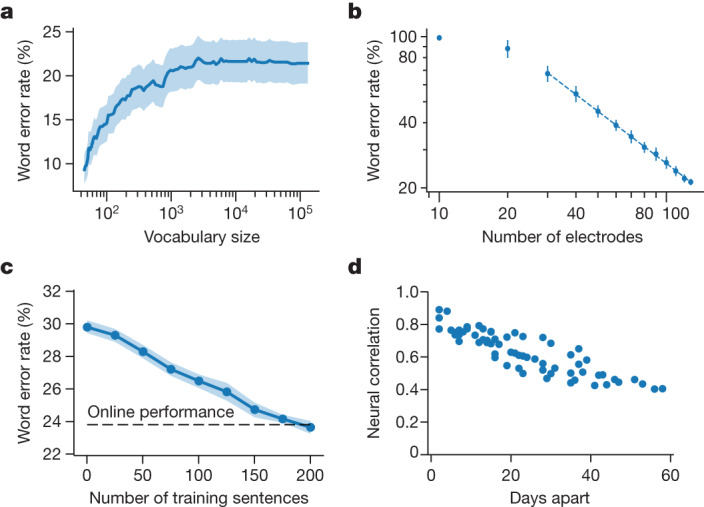
- Offline analyses reduced 125,000-word word error rate from 23.8% to 17.4% with an improved language model and to 11.8% with an improved language model plus a proximal test set; doubling electrode count cut word error rate by nearly half (factor of 0.57), and word error rate was 30% with no retraining on the evaluation day.
Methods
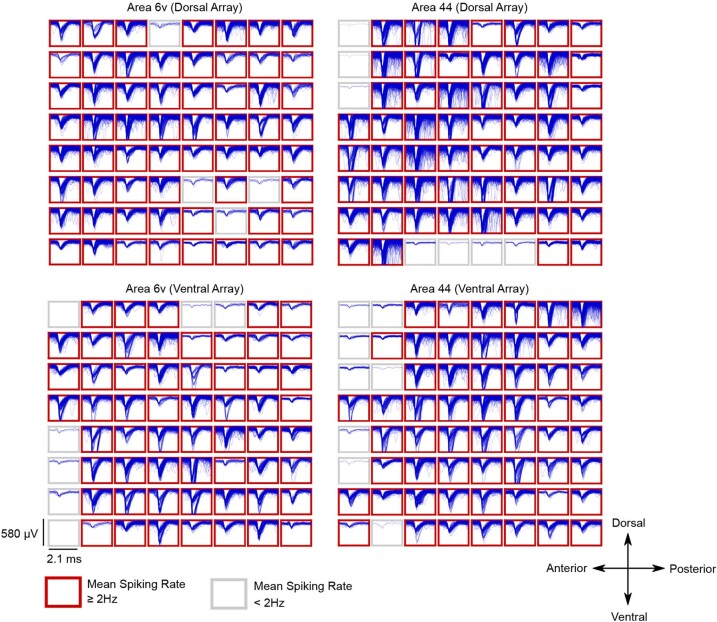
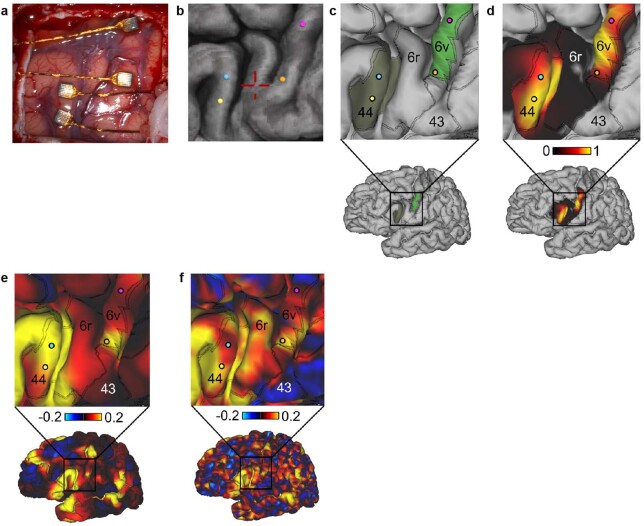
- Single participant T12 in the BrainGate2 pilot clinical trial, with bulbar-onset ALS, limited orofacial movement and vocalization but no intelligible speech; four intracortical microelectrode arrays were implanted, two in area 6v and two in area 44.
- Tasks included attempted individual orofacial movements, single phonemes, single words, and sentences; evaluation used 5 vocalized speech days and 3 silent speech days, with sentences from the Switchboard corpus for the 125,000-word vocabulary and the word set/test sentences from Moses et al. for the 50-word vocabulary.
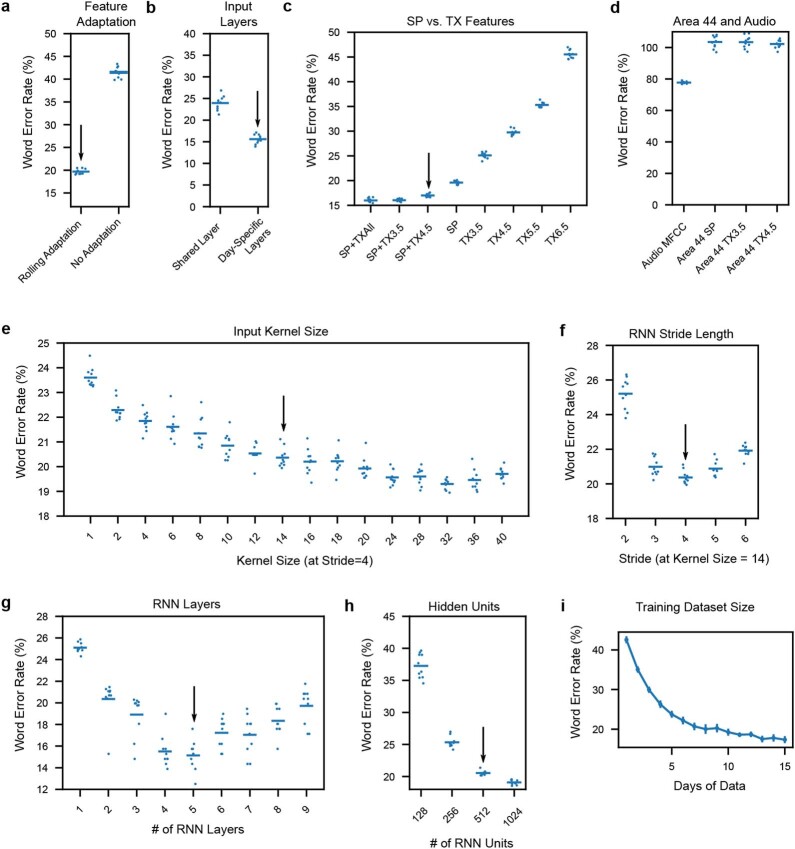
- A five-layer gated recurrent unit RNN emitted phoneme probabilities every 80 ms, combined with a custom 125,000-word trigram language model in Kaldi; training used 260–480 sentences per day, reaching 10,850 total sentences by the final day, with unique input layers per day and rolling feature adaptation. Additional analyses used naive Bayes classifiers, RNN saliency vectors, electromagnetic articulography comparisons, and offline language-model and electrode-count manipulations.
Limitations
- The paper states that this is a proof of concept and not yet a complete, clinically viable system; work remains to reduce decoder training time and adapt to across-day neural changes without requiring the user to pause and recalibrate.
- The paper states that results must be confirmed in additional participants, generalizability to people with more profound orofacial weakness remains open, brain anatomy variability is a concern, and intracortical microelectrode array technology still needs further demonstrations of longevity and efficacy.
- The paper states that a 24% word error rate is probably not yet sufficiently low for everyday use, compared with 4–5% for state-of-the-art speech-to-text systems; evident from the text, the study reports one participant, and the best 11.8% word error rate came from offline analyses rather than online real-time decoding.
Model-written summary. Check it against the paper before relying on it.
Integrity signals
Registry
Cites
Statistics
Figures
Verification
Claims the paper makes
11 Valid · 1 Not valid · 4 Not checked · 52 Own results and interpretations
At least one cited source doesn’t support this claim or points to a different paper, and none confirmed it — see the verdicts below.
In the paper
“which is 3.4 times as fast as the previous record8”
- Also stated in: § Decoding attempted speech · plain
“which more than triples the speed of the previous state of the art for any type of BCI (18 words per minute for a handwriting BCI8)”
§ A high-performance speech neuroprosthesis > Abstract
What the sources say
- Disputedcites [8] Willett, F. R., Avansino, D. T., Hochberg, L. R., Henderson, J. M. & Shenoy, K. V. High-performance brain-to-text communication via handwriting. Nature 593, 249–254 (2021). sourceExperimental — accuracy not yet measured
The Discussion (page unavailable) reports 90 characters per minute for this BCI and 60 characters per minute for an earlier EEG speller. That makes the reported speed 1.5 times the earlier rate, not 3.4 times the previous record for any type of BCI. (LLM, conf=0.88)
Checked by a reasoning model — may be wrong.
plainSingle case- Asserted: passes — The authors put it forward as true.
- Checkable: passes — It can be checked against evidence.
- Load-bearing: passes — The paper’s conclusions depend on it.
- Based: passes — The paper gives a reason why it holds.
- Also stated in: § Decoding attempted speech · plain
The cited sources support only part of this claim — read each source’s verdict below.
In the paper
“Recently, BCIs based on hand movement activity have enabled typing speeds of between eight and 18 words per minute in people with paralysis8,29.”
§ A high-performance speech neuroprosthesis > Discussion
What the sources say
- Supportedcites [8] Willett, F. R., Avansino, D. T., Hochberg, L. R., Henderson, J. M. & Shenoy, K. V. High-performance brain-to-text communication via handwriting. Nature 593, 249–254 (2021). source
The Discussion reports 90 characters per minute for the paper’s handwriting BCI in a person with tetraplegia, while “Temporal variety improves decoding” reports 40 characters per minute for prior point-and-click BCIs. At five characters per word, those rates correspond to 18 and eight words per minute. No page numbers are available in our copy. (LLM, conf=0.90)
- Partly supportedcites [29] Pandarinath, C. et al. High performance communication by people with paralysis using an intracortical brain-computer interface. eLife 6, e18554 (2017). sourceExperimental — accuracy not yet measured
The Introduction’s Figure 1 caption describes recordings from the hand area of motor cortex, and the Discussion reports copy-typing rates in people with paralysis reaching 7.8 words per minute—approximately eight. This paper does not report an 18-word-per-minute typing rate, so it supports the lower end of the cited range but not the upper end. (LLM, conf=0.88)
plainstates a cause- Asserted: passes — The authors put it forward as true.
- Checkable: passes — It can be checked against evidence.
- Load-bearing: passes — The paper’s conclusions depend on it.
- Based: passes — The paper gives a reason why it holds.
- Supported
Every source the paper cites for this claim was checked and supports it.
In the paper
“Furthermore, we found that neural activity changed at a gradual rate over time, suggesting that unsupervised algorithms for updating decoders to neural changes should be feasible24–27 (Fig. 4d).”
§ A high-performance speech neuroprosthesis > Design considerations for speech BCIs
What the sources say
- Supportedcites [24] Dyer, E. L. et al. A cryptography-based approach for movement decoding. Nat. Biomed. Eng. 1, 967–976 (2017). source
The Discussion (page unavailable) proposes DAD, an unsupervised decoding approach, as a way to re-align a decoder and suggests extending it to reduce the labeled data needed for calibration. That supports the citing sentence’s qualified claim that unsupervised decoder updates should be feasible; the observation that neural activity changed gradually is the citing authors’ own finding, not a claim attributed to this source. (LLM, conf=0.86)
- Supportedcites [25] Farshchian, A. et al. Adversarial domain adaptation for stable brain-machine interfaces. Preprint at https://doi.org/10.48550/arXiv.1810.00045 (2019). source
Section 4.2.3 (p. 5) says ADAN aligns neural recordings across days in an unsupervised manner. The Introduction (p. 2) reports that this adaptation stabilizes a fixed decoder despite changes in neural recordings, supporting the cited suggestion that unsupervised updating is feasible. (LLM, conf=0.91)
- Supportedcites [26] Degenhart, A. D. et al. Stabilization of a brain–computer interface via the alignment of low-dimensional spaces of neural activity. Nat. Biomed. Eng. https://doi.org/10.1038/s41551-020-0542-9 (2020). source
The section ‘Stabilization can outperform supervised recalibration’ says the stabilizer is updated without estimating user intent and can counteract neural recording instabilities. The Methods section ‘Stabilization and decoder’ describes updates using neural activity collected during online BCI use, supporting the feasibility of unsupervised adaptation to neural changes. The citing authors’ observation that changes were gradual is their own finding, not a finding attributed to this source. (LLM, conf=0.88)
- Supportedcites [27] Karpowicz, B. M. et al. Stabilizing brain-computer interfaces through alignment of latent dynamics. Preprint at bioRxiv https://doi.org/10.1101/2022.04.06.487388 (2022). source
The Introduction describes unsupervised recalibration as a way to compensate for neural-interface instabilities using data collected during normal use. In “Potential Future Applications,” the paper reports that its completely unsupervised NoMAD alignment stabilized decoding for weeks to months, supporting the claim that such updating is feasible. (LLM, conf=0.92)
hedgedSingle case- Asserted: passes — The authors put it forward as true.
- Checkable: passes — It can be checked against evidence.
- Load-bearing: passes — The paper’s conclusions depend on it.
- Based: passes — The paper gives a reason why it holds.
- Supported
The cited sources support only part of this claim — read each source’s verdict below.
In the paper
“Early demonstrations, although promising, have not yet achieved accuracies sufficiently high for communication of unconstrained sentences from a large vocabulary1–7.”
- Also stated in: § Discussion · plain
“Speech BCIs have the potential to restore natural communication at a much faster rate but have not yet achieved high accuracies on large vocabularies (that is, unconstrained communication of any sentence the user may want to say)1–7.”
§ A high-performance speech neuroprosthesis > Abstract
What the sources say
- Supportedcites [1] Herff, C. et al. Brain-to-text: decoding spoken phrases from phone representations in the brain. Front. Neurosci. 9, 217 (2015). source
The Conclusion (section 4.4; page unavailable) says the system reconstructs phrases with a limited dictionary and describes communication with scalable vocabularies as an eventual possibility. The Results (section 3.2; page unavailable) report 75% word recognition with a 10-word dictionary. Together, these support the claim that this early demonstration had not achieved sufficiently accurate communication of unconstrained sentences from a large vocabulary. (LLM, conf=0.88)
- Partly supportedcites [2] Moses, D. A. et al. Neuroprosthesis for decoding speech in a paralyzed person with anarthria. N. Engl. J. Med. 385, 217–227 (2021). sourceExperimental — accuracy not yet measured
The Methods (Word and Sentence Task Design; page unavailable) describe decoding 50 preset sentences using a 50-word vocabulary, and the Results (Sentence Decoding; page unavailable) report a median word error rate of 25.6% with language modeling. This supports the narrower point that this demonstration did not establish communication using unconstrained sentences and a large vocabulary. The paper does not establish that insufficient accuracy is the reason such communication had not been achieved across early demonstrations. (LLM, conf=0.82)
- Supportedcites [3] Anumanchipalli, G. K., Chartier, J. & Chang, E. F. Speech synthesis from neural decoding of spoken sentences. Nature 568, 493–498 (2019). source
The Discussion (page not provided) says previous speech-decoding strategies were limited in their ability to scale to larger vocabularies and communication rates. The Synthesis performance section (page not provided) describes this paper’s sentence-transcription test as closed-vocabulary, using pools of 25 or 50 words. Together, these passages support the claim that early demonstrations had not established accurate communication of unconstrained, large-vocabulary sentences. (LLM, conf=0.88)
- Partly supportedcites [4] Herff, C. et al. Generating natural, intelligible speech from brain activity in motor, premotor, and inferior frontal cortices. Front. Neurosci. 13, 1267 (2019). sourceExperimental — accuracy not yet measured
The Results report 66.1% word identification in a four-option listening test and estimate 36% intelligibility for transcription; the Limitations section says usable speech BCIs remain a long way off. These findings support the limitation for this demonstration, but the paper does not establish that early demonstrations generally failed to achieve sufficient accuracy for unconstrained, large-vocabulary sentences. (LLM, conf=0.84)
- Supportedcites [5] Kellis, S. et al. Decoding spoken words using local field potentials recorded from the cortical surface. J. Neural Eng. 7, 056007 (2010). source
The Introduction reports classification of finite sets of up to 10 words and says the breadth of decoded language is inherently limited. The Conclusion describes the result as enabling limited communication, while Future work identifies improving accuracy for larger dictionaries as an open task. This demonstration therefore did not achieve communication of unconstrained sentences from a large vocabulary. (LLM, conf=0.88)
- Supportedcites [6] Pei, X., Barbour, D. L., Leuthardt, E. C. & Schalk, G. Decoding vowels and consonants in spoken and imagined words using electrocorticographic signals in humans. J. Neural Eng. 8, 046028 (2011). source
The Results (§3.1) report roughly 36–41% accuracy for decoding vowels and consonants, not unconstrained sentences. The Discussion (§4) says further work is needed to improve accuracy and extend decoding to more vowel and consonant categories, supporting the claim as applied to this early demonstration. (LLM, conf=0.91)
- Supportedcites [7] Mugler, E. M. et al. Direct classification of all American English phonemes using signals from functional speech motor cortex. J. Neural Eng. 11, 035015 (2014). source
The Introduction says early whole-word speech-decoding results were preliminary and could not be extrapolated to more complex speech. The Discussion states that this study’s word-identification accuracy was insufficient for communication and describes whole-word decoding from a broader set of words as a future step. The supplied passages do not give page numbers. (LLM, conf=0.91)
plain- Asserted: passes — The authors put it forward as true.
- Checkable: passes — It can be checked against evidence.
- Load-bearing: passes — The paper’s conclusions depend on it.
- Based: passes — The paper gives a reason why it holds.
- Also stated in: § Discussion · plain
The cited sources support only part of this claim — read each source’s verdict below.
In the paper
“These results indicate that substantial gains in performance are probably still possible with further language model improvements and more robust decoding algorithms that generalize better to non-stationary data (for example, unsupervised methods that track non-stationarities without the requirement for new training data24–27).”
§ A high-performance speech neuroprosthesis > Decoding attempted speech
What the sources say
- Partly supportedcites [24] Dyer, E. L. et al. A cryptography-based approach for movement decoding. Nat. Biomed. Eng. 1, 967–976 (2017). sourceExperimental — accuracy not yet measured
The Results describe DAD as an unsupervised decoder that worked across recording days without changing model parameters, supporting its use without new paired training data. But the paper does not show the method tracking non-stationarities; the Discussion treats accounting for drift in neural properties as a potential improvement not included in DAD. (LLM, conf=0.82)
- Partly supportedcites [25] Farshchian, A. et al. Adversarial domain adaptation for stable brain-machine interfaces. Preprint at https://doi.org/10.48550/arXiv.1810.00045 (2019). sourceExperimental — accuracy not yet measured
The Methods (p. 5) describe an unsupervised approach to aligning neural recordings across days, supporting the example of a method that addresses non-stationarity. But the Results (p. 7) say domain adaptation with ADAN requires a small new training set—prediction accuracy saturates at about one minute of data—so this source does not support the claim that no new training data is required. It does not address language-model improvements. (LLM, conf=0.88)
- Supportedcites [26] Degenhart, A. D. et al. Stabilization of a brain–computer interface via the alignment of low-dimensional spaces of neural activity. Nat. Biomed. Eng. https://doi.org/10.1038/s41551-020-0542-9 (2020). source
The cited paper supports the parenthetical example, not the citing authors’ prediction about language-model gains. Its Methods (‘Stabilization and decoder’; page unavailable) describe updating the stabilizer with neural data collected during ongoing BCI use, and its results (‘Stabilization can outperform supervised recalibration’; page unavailable) state that stabilization does not require an estimate of user intent. The paper also reports recovery from recording instabilities without a new supervised calibration session. (LLM, conf=0.89)
- Supportedcites [27] Karpowicz, B. M. et al. Stabilizing brain-computer interfaces through alignment of latent dynamics. Preprint at bioRxiv https://doi.org/10.1101/2022.04.06.487388 (2022). source
The citation supports the parenthetical example, not the sentence's separate prediction about language-model improvements. In “Potential Future Applications” (page unavailable), the paper says NoMAD's alignment is completely unsupervised and uses only a small initial supervised training dataset; the reaching-task section describes unsupervised alignment of later sessions before applying the original decoder. (LLM, conf=0.91)
hedgedstates a possible causeSingle case- Asserted: passes — The authors put it forward as true.
- Checkable: passes — It can be checked against evidence.
- Load-bearing: passes — The paper’s conclusions depend on it.
- Based: passes — The paper gives a reason why it holds.
- Partly supported
48 more claims · 4 with their cited sources checked
Create a free account to see all 68 claims and every source verdict.
- Probably not a substantial claim. 6
- It may state two separate claims as one. 8
- The quote only partly states this claim. 1
Claims other papers make about this one
Each is checked against this paper’s own text: does it say what the citing paper says it does?
The cited source doesn’t support the claim as written.
In the citing paper
“we also targeted one array each into two areas which, to our knowledge, have not previously been recorded from with multielectrode arrays”
From An Accurate and Rapidly Calibrating Speech Neuroprosthesis (2024) · cites this paper as [21]
Checked by a reasoning model — may be wrong.
Experimental — accuracy not yet measuredThe source backs part of the claim, not all of it — or backs it for a different population, condition or comparison.
In the citing paper
“They have shown significant efficacy in improving the quality of life for those suffering from a range of conditions, including but not limited to Parkinson’s disease, ALS (Willett et al., 2023), movement disorders, epilepsy, and mental health issues (Fisher and Velasco, 2014; Bergfeld et al., 2016; França et al., 2022).”
From Comparative analysis of energy transfer mechanisms for neural implants (2024) · cites this paper as Willett et al., 2023
Experimental — accuracy not yet measuredThe source backs part of the claim, not all of it — or backs it for a different population, condition or comparison.
In the citing paper
“Current speech-decoding applications from brain activity are primarily aimed at restoring communication to individuals with both limb and vocal-tract paralysis14–16.”
From The speech neuroprosthesis (2024) · cites this paper as [15]
Experimental — accuracy not yet measuredThe source backs part of the claim, not all of it — or backs it for a different population, condition or comparison.
In the citing paper
“Interestingly, at the neuronal level, locations on the anterior precentral gyrus in orofacial or hand areas contain single neurons tuned to movements of the whole body, including key speech articulators15,51,52.”
From The speech neuroprosthesis (2024) · cites this paper as [15]
Experimental — accuracy not yet measuredThe source backs part of the claim, not all of it — or backs it for a different population, condition or comparison.
In the citing paper
“Recent studies have also achieved high-performance speech-decoding results15,16 by measuring relevant single-unit and multi-unit neuronal activity from multiple small (4 × 4 mm2 (ref. 83)) cortical regions on the anterior precentral gyrus15,16,52,98.”
From The speech neuroprosthesis (2024) · cites this paper as [15]
Experimental — accuracy not yet measured
20 more claims about this paper
Create a free account to see every claim other papers make about this one.
Self-check
Percentages, sums and reported differences re-computed from the paper’s own numbers.
Each contradiction between two passages listed here was confirmed by an independent check.
Rated minor: it would not touch a result — a value no result rests on, a p-value that stays on the same side of the significance level, or a conflict that is clerical, resolved elsewhere in the paper, or outside its own findings.
In the paper
§ A high-performance speech neuroprosthesis > Decoding attempted speech
“At the beginning of each RNN performance-evaluation day we first recorded training data during which T12 attempted to speak 260–480 sentences at her own pace”
§ A high-performance speech neuroprosthesis > Design considerations for speech BCIs
“Finally, in this demonstration we used a large amount of training data per day (260–440 sentences).”
Citations
Cites
BERT: Pre-training of Deep Bidirectional Transformers for Language Understanding
Devlin, J., Chang, M.-W., Lee, K., & Toutanova, K. (2018) · arXiv · doi:10.48550/arxiv.1810.04805 · Cited by 73,173
Language Models are Few-Shot Learners
Brown, T. B., Mann, B., Ryder, N., Subbiah, M., Kaplan, J., Dhariwal, P., Neelakantan, A., Shyam, P., Sastry, G., Askell, A., et al. (2020) · arXiv · doi:10.48550/arxiv.2005.14165 · Cited by 23,372
Brainard, D. H. (1997) · Spatial Vision · doi:10.1163/156856897x00357 · Cited by 19,702
Hinton, G., Deng, L., Yu, D., Dahl, G., Mohamed, A.-R., Jaitly, N., Senior, A., Vanhoucke, V., Nguyen, P., Sainath, T., et al. (2012) · IEEE Signal Processing Magazine · doi:10.1109/msp.2012.2205597 · Cited by 10,260
Speech recognition with deep recurrent neural networks
Graves, A., Mohamed, A.-R., & Hinton, G. (2013) · 2013 IEEE International Conference on Acoustics, Speech and Signal Processing · doi:10.1109/icassp.2013.6638947 · Cited by 8,893
Graves, A., Fernández, S., Gomez, F., & Schmidhuber, J. (2006) · Proceedings of the 23rd international conference on Machine learning - ICML '06 · doi:10.1145/1143844.1143891 · Cited by 5,370
A multi-modal parcellation of human cerebral cortex
Glasser, M. F., Coalson, T. S., Robinson, E. C., Hacker, C. D., Harwell, J., Yacoub, E., Ugurbil, K., Andersson, J., Beckmann, C. F., Jenkinson, M., et al. (2016) · Nature · doi:10.1038/nature18933 · Cited by 5,111
Self-citationTHE POPULATION FREQUENCIES OF SPECIES AND THE ESTIMATION OF POPULATION PARAMETERS
GOOD, I. J. (1953) · Biometrika · doi:10.1093/biomet/40.3-4.237 · Cited by 3,437
SWITCHBOARD: telephone speech corpus for research and development
Godfrey, J. J., Holliman, E. C., & McDaniel, J. (1992) · [Proceedings] ICASSP-92: 1992 IEEE International Conference on Acoustics, Speech, and Signal Processing · doi:10.1109/icassp.1992.225858 · Cited by 2,134
An Integrated Brain-Machine Interface Platform With Thousands of Channels
Musk, E., & Neuralink (2019) · Journal of Medical Internet Research · doi:10.2196/16194 · Cited by 1,206
Research works printed but not linked: 1
- Broca, P. Nouvelle observation d’aphemie produite par une lesion de la troisieme circonvolution frontale. Bull. Soc. Anat. 2, 398–407 (1861).
Cited by
A somato-cognitive action network alternates with effector regions in motor cortex
Gordon, E. M., Chauvin, R. J., Van, A. N., Rajesh, A., Nielsen, A., Newbold, D. J., Lynch, C. J., Seider, N. A., Krimmel, S. R., Scheidter, K. M., et al. (2023) · Nature · doi:10.1038/s41586-023-05964-2 · Cited by 592
Large language models in medical and healthcare fields: applications, advances, and challenges
Wang, D., & Zhang, S. (2024) · Artificial Intelligence Review · doi:10.1007/s10462-024-10921-0 · Cited by 246
An accurate and rapidly calibrating speech neuroprosthesis
Card, N. S., Wairagkar, M., Iacobacci, C., Hou, X., Singer-Clark, T., Willett, F. R., Kunz, E. M., Fan, C., Vahdati Nia, M., Deo, D. R., et al. (2023) · doi:10.1101/2023.12.26.23300110 · Cited by 244
Self-citationAn Accurate and Rapidly Calibrating Speech Neuroprosthesis
Card, N. S., Wairagkar, M., Iacobacci, C., Hou, X., Singer-Clark, T., Willett, F. R., Kunz, E. M., Fan, C., Vahdati Nia, M., Deo, D. R., et al. (2024) · New England Journal of Medicine · doi:10.1056/nejmoa2314132 · Cited by 268
Self-citationAdvanced Energy Harvesters and Energy Storage for Powering Wearable and Implantable Medical Devices
Gao, Z., Zhou, Y., Zhang, J., Foroughi, J., Peng, S., Baughman, R. H., Wang, Z. L., & Wang, C. H. (2024) · Advanced Materials · doi:10.1002/adma.202404492 · Cited by 231
Eaton, S. E. (2023) · International Journal for Educational Integrity · doi:10.1007/s40979-023-00144-1 · Cited by 190
Brain–computer interfaces: the innovative key to unlocking neurological conditions
Zhang, H., Jiao, L., Yang, S., Li, H., Jiang, X., Feng, J., Zou, S., Xu, Q., Gu, J., Wang, X., et al. (2024) · International Journal of Surgery · doi:10.1097/js9.0000000000002022 · Cited by 169
“A study published in Nature con fi rmed the high ef fi - ciency and stability of a BCI system capable of decoding speech commands over a period of 3 months without needing recali-bration, thus af fi rming the practical viability and effectiveness of BCI technology [148] .”
BackgroundCurrent State and Future Directions in the Therapy of ALS
Tzeplaeff, L., Wilfling, S., Requardt, M. V., & Herdick, M. (2023) · Cells · doi:10.3390/cells12111523 · Cited by 148
The state of clinical trials of implantable brain–computer interfaces
Patrick-Krueger, K. M., Burkhart, I., & Contreras-Vidal, J. L. (2024) · Nature Reviews Bioengineering · doi:10.1038/s44222-024-00239-5 · Cited by 125
“The latter has mainly been driven by advances in signal processing and the application of new machine learning and deep learning algorithms, including large language models used in speech iBCIs 12,13 .”
Silva, A. B., Littlejohn, K. T., Liu, J. R., Moses, D. A., & Chang, E. F. (2024) · Nature Reviews Neuroscience · doi:10.1038/s41583-024-00819-9 · Cited by 103
“MEAs typically record high-fidelity signals from a small (a few square millimetres) area of cortex.”
InfluentialA neural speech decoding framework leveraging deep learning and speech synthesis
Chen, X., Wang, R., Khalilian-Gourtani, A., Yu, L., Dugan, P. C., Friedman, D. J., Doyle, W., Devinsky, O., Wang, Y., & Flinker, A. (2024) · Nature Machine Intelligence · doi:10.1038/s42256-024-00824-8 · Cited by 152
“Specifically, two recent studies have provided robust speech decoding in a few chronic patients implanted with intracranial ECoG 19 or a Utah array 46 that leveraged a large amount of data available in one patient in each study.”
Angrick, M., Luo, S., Rabbani, Q., Candrea, D. N., Shah, S., Milsap, G., Anderson, W. S., Gordon, C. R., Rosenblatt, K. R., Clawson, L., et al. (2024) · Scientific Reports · doi:10.1038/s41598-024-60277-2 · Cited by 117
A memristor-based adaptive neuromorphic decoder for brain–computer interfaces
Liu, Z., Mei, J., Tang, J., Xu, M., Gao, B., Wang, K., Ding, S., Liu, Q., Qin, Q., Chen, W., et al. (2025) · Nature Electronics · doi:10.1038/s41928-025-01340-2 · Cited by 138
“Furthermore, rapid growth in brain–machine links 19–22 , commands 23,24 and decoding algorithm complexity 3,4 creates challenges for conventional silicon chips based on the von Neumann architecture 25 to decode the increasing volume of brain signals.”
An instantaneous voice-synthesis neuroprosthesis
Wairagkar, M., Card, N. S., Singer-Clark, T., Hou, X., Iacobacci, C., Miller, L. M., Hochberg, L. R., Brandman, D. M., & Stavisky, S. D. (2025) · Nature · doi:10.1038/s41586-025-09127-3 · Cited by 148
Self-citationNeural interfaces: Bridging the brain to the world beyond healthcare
Xu, S., Liu, Y., Lee, H., & Li, W. (2024) · Exploration · doi:10.1002/exp.20230146 · Cited by 116
A streaming brain-to-voice neuroprosthesis to restore naturalistic communication
Littlejohn, K. T., Cho, C. J., Liu, J. R., Silva, A. B., Yu, B., Anderson, V. R., Kurtz-Miott, C. M., Brosler, S., Kashyap, A., Hallinan, I. P., et al. (2025) · Nature Neuroscience · doi:10.1038/s41593-025-01905-6 · Cited by 131
“Finally, we demonstrate offline that our sequence modeling architectures generalize to multiple silent-speech interfaces, namely single-unit recordings from another participant with paralysis 21 and vocal tract surface electrodes measuring movement from a healthy speaker’s silently mimed speech 32 .”
InfluentialWillsey, M. S., Shah, N. P., Avansino, D. T., Hahn, N. V., Jamiolkowski, R. M., Kamdar, F. B., Hochberg, L. R., Willett, F. R., & Henderson, J. M. (2025) · Nature Medicine · doi:10.1038/s41591-024-03341-8 · Cited by 116
“A similar observation was made using iBCIs for speech decoding 39 , where a projected word error rate decrease from 23.8% to 8.4% was projected moving from a 128-to 256-electrode system, which was realized when a 2.5–9.8% word error rate was achieved with 256 electrodes 40 .”
InfluentialSelf-citationRepresentation of internal speech by single neurons in human supramarginal gyrus
Wandelt, S. K., Bjånes, D. A., Pejsa, K., Lee, B., Liu, C., & Andersen, R. A. (2024) · Nature Human Behaviour · doi:10.1038/s41562-024-01867-y · Cited by 74
“More recently, speech neuroprosthetics were built from small-scale microelectrode arrays located in the motor cortex 20,21 , premotor cortex 22 and supramarginal gyrus (SMG) 23 , demonstrating that vocalized speech BMIs can be built using neural signals from localized regions of cortex.”
BackgroundDecoding the brain: From neural representations to mechanistic models
Mathis, M. W., Rotondo, A. P., Chang, E. F., Tolias, A. S., & Mathis, A. (2024) · Cell · doi:10.1016/j.cell.2024.08.051 · Cited by 129
A generic non-invasive neuromotor interface for human-computer interaction
Kaifosh, P., Reardon, T. R., Labs, C.-L. A. R., Allen, B. D., Anderson, C., Arnoud, S., Arora, R., Atray, M., Awad, L., Ayerbe, F., et al. (2025) · Nature · doi:10.1038/s41586-025-09255-w · Cited by 230
“In recent years, intracortical neural interfaces that directly interface with brain tissue have advanced the premise 2,5 , demonstrating translation of thought into language at bandwidth rates comparable with conventional computer input systems 3,4 .”
Single-neuronal elements of speech production in humans
Khanna, A. R., Muñoz, W., Kim, Y. J., Kfir, Y., Paulk, A. C., Jamali, M., Cai, J., Mustroph, M. L., Caprara, I., Hardstone, R., et al. (2024) · Nature · doi:10.1038/s41586-023-06982-w · Cited by 91
Brain control of bimanual movement enabled by recurrent neural networks
Deo, D. R., Willett, F. R., Avansino, D. T., Hochberg, L. R., Henderson, J. M., & Shenoy, K. V. (2024) · Scientific Reports · doi:10.1038/s41598-024-51617-3 · Cited by 86
Self-citationEthical considerations for the use of brain–computer interfaces for cognitive enhancement
Gordon, E. C., & Seth, A. K. (2024) · PLOS Biology · doi:10.1371/journal.pbio.3002899 · Cited by 64
Decoding motor plans using a closed-loop ultrasonic brain–machine interface
Griggs, W. S., Norman, S. L., Deffieux, T., Segura, F., Osmanski, B.-F., Chau, G., Christopoulos, V., Liu, C. Y., Tanter, M., Shapiro, M. G., et al. (2023) · Nature Neuroscience · doi:10.1038/s41593-023-01500-7 · Cited by 90
Longevity of a Brain–Computer Interface for Amyotrophic Lateral Sclerosis
Vansteensel, M. J., Leinders, S., Branco, M. P., Crone, N. E., Denison, T., Freudenburg, Z. V., Geukes, S. H., Gosselaar, P. H., Raemaekers, M. A. H., Schippers, A., et al. (2024) · New England Journal of Medicine · doi:10.1056/nejmoa2314598 · Cited by 90
“In addition, several reports have recently shown fast communication rates using implantable BCI technology 6,7 .”
BackgroundCortico-basal ganglia plasticity in motor learning
Roth, R. H., & Ding, J. (2024) · Neuron · doi:10.1016/j.neuron.2024.06.014 · Cited by 85
The unbearable slowness of being: Why do we live at 10 bits/s?
Zheng, J., & Meister, M. (2024) · Neuron · doi:10.1016/j.neuron.2024.11.008 · Cited by 103
“A speech BCI can decode intended speech up to 62 words per minute, half the rate of the typist [57].”
Application and Development of EEG Acquisition and Feedback Technology: A Review
Qin, Y., Zhang, Y., Yan, Z., Liu, S., & Guo, X. (2023) · Biosensors · doi:10.3390/bios13100930 · Cited by 64
“Several commonly used EEG classifi-cation algorithms include support vector machines (SVM), K-nearest neighbors (KNN), random forests, convolutional neural networks (CNN), and recurrent neural networks RNN) [106–113].”
BackgroundMethodInner speech in motor cortex and implications for speech neuroprostheses
Kunz, E. M., Abramovich Krasa, B., Kamdar, F., Avansino, D. T., Hahn, N., Yoon, S., Singh, A., Nason-Tomaszewski, S. R., Card, N. S., Jude, J. J., et al. (2025) · Cell · doi:10.1016/j.cell.2025.06.015 · Cited by 55
Self-citationBergeron, D., Iorio‐Morin, C., Bonizzato, M., Lajoie, G., Gaucher, N. O., Racine, É., & Weil, A. G. (2023) · Journal of Child Neurology · doi:10.1177/08830738231167736 · Cited by 60
Brain–computer interface digital prescription for neurological disorders
Chai, X., Cao, T., He, Q., Wang, N., Zhang, X., Shan, X., Lv, Z., Tu, W., Yang, Y., & Zhao, J. (2024) · CNS Neuroscience & Therapeutics · doi:10.1111/cns.14615 · Cited by 54
Saway, B. F., Palmer, C., Hughes, C. L., Triano, M. J., Suresh, R. E., Gilmore, J., George, M. S., Kautz, S. A., & Rowland, N. C. (2024) · Neurotherapeutics · doi:10.1016/j.neurot.2024.e00337 · Cited by 58
Silva, A. B., Liu, J. R., Metzger, S. L., Bhaya-Grossman, I., Dougherty, M. E., Seaton, M. P., Littlejohn, K. T., Tu-Chan, A., Ganguly, K., Moses, D. A., et al. (2024) · Nature Biomedical Engineering · doi:10.1038/s41551-024-01207-5 · Cited by 67
“However, speech-BCI advancements have largely focused on decoding a single language, primarily English or Dutch, owing to study-population sampling 3,5–8 , 10– Approximately two-thirds of the world population are bilingual, that is, they proficiently speak two or more languages 18 .”
A generic noninvasive neuromotor interface for human-computer interactionPreprint
Labs, C.-L. A. R., Sussillo, D., Kaifosh, P., & Reardon, T. R. (2024) · bioRxiv (Cold Spring Harbor Laboratory) · doi:10.1101/2024.02.23.581779 · Cited by 44
Seven technologies to watch in 2024
Eisenstein, M. S. (2024) · Nature · doi:10.1038/d41586-024-00173-x · Cited by 47
Biohybrid neural interfaces: improving the biological integration of neural implants
Boulingre, M., Lara, R. P., & Green, R. A. (2023) · Chemical Communications · doi:10.1039/d3cc05006h · Cited by 43
Pan, H., Ding, P., Wang, F., Li, T., Zhao, L., Nan, W., Fu, Y., & Gong, A. (2024) · Frontiers in Human Neuroscience · doi:10.3389/fnhum.2024.1429130 · Cited by 56
BRAND: a platform for closed-loop experiments with deep network models
Ali, Y. H., Bodkin, K., Rigotti-Thompson, M., Patel, K., Card, N. S., Bhaduri, B., Nason-Tomaszewski, S. R., Mifsud, D. M., Hou, X., Nicolas, C., et al. (2024) · Journal of Neural Engineering · doi:10.1088/1741-2552/ad3b3a · Cited by 32
Self-citationDecoding and geometry of ten finger movements in human posterior parietal cortex and motor cortex
Guan, C., Aflalo, T., KADLEC, K. H., Gámez, J., Rosario, E. R., Bari, A., Pouratian, N., & Andersen, R. A. (2023) · Journal of Neural Engineering · doi:10.1088/1741-2552/acd3b1 · Cited by 41
The 2023 yearbook of Neurorestoratology
Huang, H., Bach, J. R., Sharma, H. S., Chen, L., Wu, P., Sarnowska, A., Otom, A. H., Xue, M., Saberi, H., He, X., et al. (2024) · Journal of Neurorestoratology · doi:10.1016/j.jnrt.2024.100136 · Cited by 37
Brain-computer interface paradigms and neural coding
Tai, P., Ding, P., Wang, F., Gong, A., Li, T., Zhao, L., Su, L., & Fu, Y. (2024) · Frontiers in Neuroscience · doi:10.3389/fnins.2023.1345961 · Cited by 46
Schiff, N. D., Diringer, M. N., Diserens, K., Edlow, B. L., Gosseries, O., Hill, N. J., Hochberg, L. R., Ismail, F., Meyer, I. A., Mikell, C. B., et al. (2024) · Neurocritical Care · doi:10.1007/s12028-023-01924-w · Cited by 40
“For example, emerging methods that allow speech synthesis [115] and tools that identify the ability to activate Broca’s area with silent speech [116] may become alternative or complementary substrates in individual patients.”
Self-citationNeural electrodes for brain‐computer interface system: From rigid to soft
Yang, D., Tian, G., Chen, J., Liu, Y., Fatima, E., Qiu, J., Malek, N. A. N. N., & Qi, D. (2025) · BMEMat · doi:10.1002/bmm2.12130 · Cited by 41
A wireless subdural-contained brain–computer interface with 65,536 electrodes and 1,024 channels
Jung, T., Zeng, N., Fabbri, J. D., Eichler, G., Li, Z., Zabeh, E., Das, A., Willeke, K. F., Wingel, K., Dubey, A., et al. (2025) · Nature Electronics · doi:10.1038/s41928-025-01509-9 · Cited by 58
“It is also timely, given recent advances in the performance of BCI systems for speech and motor control 65,66 .”
The Layer 7 Cortical Interface: A Scalable and Minimally Invasive Brain–Computer Interface Platform
Hettick, M., Ho, E., Poole, A. J., Monge, M., Papageorgiou, D., Takahashi, K., LaMarca, M., Trietsch, D., Reed, K., Murphy, M., et al. (2022) · doi:10.1101/2022.01.02.474656 · Cited by 31
Overcoming failure: improving acceptance and success of implanted neural interfaces
Dalrymple, A. N., Jones, S. T., Fallon, J. B., Shepherd, R. K., & Weber, D. J. (2025) · Bioelectronic Medicine · doi:10.1186/s42234-025-00168-7 · Cited by 44
“…et al. 2017; Barry et al. 2023; Collinger et al. 2013; Deo et al. 2024; Drew 2024; Flesher et al. 2021; Hosman et al. 2023; Rastogi et al. 2021; Willett et al. 2023, 2021); Endovascular electrode array: (Mitchell et al. 2023; Oxley et al. 2020); Epidural spinal cord stimulation (Angeli et al.…”
Canny, E., Vansteensel, M. J., van der Salm, S. M. A., Müller-Putz, G., & Berezutskaya, J. (2023) · Journal of NeuroEngineering and Rehabilitation · doi:10.1186/s12984-023-01272-y · Cited by 42
Restoring Speech Using Brain–Computer Interfaces
Stavisky, S. D. (2025) · Annual Review of Biomedical Engineering · doi:10.1146/annurev-bioeng-110122-012818 · Cited by 51
Chisco: An EEG-based BCI dataset for decoding of imagined speech
Zhang, Z., Ding, X., Bao, Y., Zhao, Y., Liang, X., Qin, B., & Liu, T. (2024) · Scientific Data · doi:10.1038/s41597-024-04114-1 · Cited by 59
TCANet: a temporal convolutional attention network for motor imagery EEG decoding
Zhao, W., Lu, H., Zhang, B., Zheng, X., Wang, W., & Zhou, H. (2025) · Cognitive Neurodynamics · doi:10.1007/s11571-025-10275-5 · Cited by 36
“Brain-computer interfaces (BCIs) offer a direct communication pathway from the brain to external devices, independent of neuromuscular functions (Willett et al. 2023).”
Covert cortical processing: a diagnosis in search of a definition
Young, M. J., Fecchio, M., Bodien, Y. G., & Edlow, B. L. (2024) · Neuroscience of Consciousness · doi:10.1093/nc/niad026 · Cited by 29
Perna, A., Angotzi, G. N., Berdondini, L., & Ribeiro, J. F. (2023) · Frontiers in Neuroscience · doi:10.3389/fnins.2023.1275908 · Cited by 38
Endovascular Brain-Computer Interfaces in Poststroke Paralysis
Brannigan, J., Fry, A., Opie, N. L., Campbell, B. C. V., Mitchell, P. J., & Oxley, T. J. (2023) · Stroke · doi:10.1161/strokeaha.123.037719 · Cited by 35
Bhadra, K., Giraud, A., & Marchesotti, S. (2025) · Communications Biology · doi:10.1038/s42003-025-07464-7 · Cited by 33
“This is due to different challenges and limitations 13,14,16,17,23 , the dif fi culty in precisely identifying the onset of speech imagery 23 , inter-individual differences in the ability to control the BCI 24,25 , and the technique employed to record brain activity.”
Wu, S., Bhadra, K., Giraud, A., & Marchesotti, S. (2024) · Brain Sciences · doi:10.3390/brainsci14030196 · Cited by 37
“Such technical efforts might appear marginal as compared to recent advances in decoding attempted speech from intracranial implants, with rates approaching half of normal speech [4,6].”
ResultLarge-scale foundation models and generative AI for BigData neuroscience
Wang, R., & Chen, Z. S. (2024) · Neuroscience Research · doi:10.1016/j.neures.2024.06.003 · Cited by 34
Wu, X., Wellington, S., Fu, Z., & Zhang, D. (2024) · Journal of Neural Engineering · doi:10.1088/1741-2552/ad593a · Cited by 28
Wyse‐Sookoo, K., Luo, S., Candrea, D. N., Schippers, A., Tippett, D. C., Wester, B. A., Fifer, M. S., Vansteensel, M. J., Ramsey, N. F., & Crone, N. E. (2024) · Journal of Neural Engineering · doi:10.1088/1741-2552/ad5c02 · Cited by 27
Zhong, G., Liu, Q., Huang, Y., Geng, H., & Xu, T. (2025) · Advanced Materials · doi:10.1002/adma.202508206 · Cited by 27
Neural Data Transformer 2: Multi-context Pretraining for Neural Spiking ActivityPreprint
Ye, J., Collinger, J., Wehbe, L., et al. (2023) · bioRxiv · doi:10.1101/2023.09.18.558113 · Cited by 100
Comparative analysis of energy transfer mechanisms for neural implants
Miziev, S., Pawlak, W. A., & Howard, N. (2024) · Frontiers in Neuroscience · doi:10.3389/fnins.2023.1320441 · Cited by 21
“They have shown significant efficacy in improving the quality of life for those suffering from a range of conditions, including but not limited to Parkinson’s disease, ALS (Willett et al., 2023), movement disorders, epilepsy, and mental health issues (Fisher and Velasco, 2014; Bergfeld et al., 2016; França et al., 202…”
BackgroundAngrick, M., Luo, S., Rabbani, Q., Candrea, D. N., Shah, S., Milsap, G. W., Anderson, W. S., Gordon, C. R., Rosenblatt, K. R., Clawson, L., et al. (2023) · doi:10.1101/2023.06.30.23291352 · Cited by 95
Disclosing Results of Tests for Covert Consciousness: A Framework for Ethical Translation
Young, M. J., Kazazian, K., Fischer, D. B., Lissak, I. A., Bodien, Y. G., & Edlow, B. L. (2024) · Neurocritical Care · doi:10.1007/s12028-023-01899-8 · Cited by 24
Candrea, D. N., Shah, S., Luo, S., Angrick, M., Rabbani, Q., Coogan, C. G., Milsap, G., Nathan, K., Wester, B. A., Anderson, W. S., et al. (2024) · Communications Medicine · doi:10.1038/s43856-024-00635-3 · Cited by 30
Pun, T. K., Khoshnevis, M., Hosman, T., Wilson, G. H., Kapitonava, A., Kamdar, F. B., Henderson, J. M., Simeral, J. D., Vargas-Irwin, C. E., Harrison, M. T., et al. (2024) · Communications Biology · doi:10.1038/s42003-024-06784-4 · Cited by 33
“…performance” and “Correlation to performance increases by combining neural features and decoder outputs” (Figures 1 and 2, respectively), we can observe a reversed effect of testing different features to compute the MINDFUL score correlation to the median angle error (AE) in the two participants.”
Self-citationPatterned electrical brain stimulation by a wireless network of implantable microdevices
Lee, A., Lee, J.-H., Leung, V., Larson, L. E., & Nurmikko, A. V. (2024) · Nature Communications · doi:10.1038/s41467-024-54542-1 · Cited by 31
“Major advances have been made in recording cortical signals, which once successfully decoded, have enabled recent demonstrations of paralyzed people communicating via keyboard commands 7 – 9 and translating verbal motor intentions to machine-generated speech 10 – 12 .”
Acoustic Inspired Brain-to-Sentence Decoder for Logosyllabic Language
Feng, C., Cao, L., Wu, D., Zhang, E., Wang, T., Jiang, X., Zhou, C., Chen, J., Wu, H., Lin, S., et al. (2025) · Cyborg and Bionic Systems · doi:10.34133/cbsystems.0257 · Cited by 27
de Borman, A., Wittevrongel, B., Dauwe, I., Carrette, E., Meurs, A., Roost, D. V., Boon, P., & Hulle, M. M. V. (2024) · Communications Biology · doi:10.1038/s42003-024-06518-6 · Cited by 24
“P1 – 16 and Supplementary Table 4.”
InfluentialEmerging Medical Technologies and Their Use in Bionic Repair and Human Augmentation
Manero, A. C., Rivera, V., Fu, Q., Schwartzman, J. D., Gibbs, H. P., Shah, N., Gandhi, D. A., White, E., Crawford, K. E., & Coathup, M. J. (2024) · Bioengineering · doi:10.3390/bioengineering11070695 · Cited by 28
“Further, Willett et al. [44] developed a speech-to-text BCI that recorded spiking activity from intracortical microelectrode arrays and demonstrated that in a patient who could no longer speak due to amyotrophic lateral sclerosis, 2.7 times fewer errors (a 9.8% word rate) on a 50-word vocabulary,…”
BackgroundInfluentialA brain-to-text framework for decoding natural tonal sentences
Zhang, D., Wang, Z., Qian, Y., Zhao, Z., Liu, Y., Hao, X., Li, W., Lu, S., Zhu, H., Chen, L., et al. (2024) · Cell Reports · doi:10.1016/j.celrep.2024.114924 · Cited by 32
Fan, C., Hahn, N., Kamdar, F., Avansino, D., Wilson, G. H., Hochberg, L., Shenoy, K. V., Henderson, J. M., & Willett, F. R. (2023) · arXiv · doi:10.48550/arxiv.2311.03611 · Cited by 19
Self-citationA 2.46-mm2 Miniaturized Brain-Machine Interface (MiBMI) Enabling 31-Class Brain-to-Text Decoding
Shaeri, M., Shin, U., Yadav, A., Caramellino, R., Rainer, G., & Shoaran, M. (2024) · IEEE Journal of Solid-State Circuits · doi:10.1109/jssc.2024.3443254 · Cited by 25
Brain–Computer Interface—A Brain-in-the-Loop Communication System
Gao, X., Wang, Y., Chen, X., Liu, B., & Gao, S. (2025) · Proceedings of the IEEE · doi:10.1109/jproc.2025.3600389 · Cited by 32
Hettick, M., Ho, E., Poole, A. J., Monge, M., Papageorgiou, D., Takahashi, K., LaMarca, M., Trietsch, D., Reed, K., Murphy, M. E., et al. (2025) · Nature Biomedical Engineering · doi:10.1038/s41551-025-01501-w · Cited by 55
“In addition, in the context of brain–computer interfaces, neural decoding performance from penetrating electrodes has been shown to be less stable over time than neural decoding based on surface electrodes 19,20 .”
Towards decoding individual words from non-invasive brain recordings
d’Ascoli, S., Bel, C., Rapin, J., Banville, H. J., Benchetrit, Y., Pallier, C., & King, J.-R. (2025) · Nature Communications · doi:10.1038/s41467-025-65499-0 · Cited by 75
Brain and Cognitive Science Inspired Deep Learning: A Comprehensive Survey
Zhang, Z., Ding, X., Liang, X., Zhou, Y., Qin, B., & Liu, T. (2025) · IEEE Transactions on Knowledge and Data Engineering · doi:10.1109/tkde.2025.3527551 · Cited by 28
Speech motor cortex enables BCI cursor control and click
Singer-Clark, T., Hou, X., Card, N. S., Wairagkar, M., Iacobacci, C., Peracha, H., Hochberg, L. R., Stavisky, S. D., & Brandman, D. M. (2025) · Journal of Neural Engineering · doi:10.1088/1741-2552/add0e5 · Cited by 25
Self-citationBrain–computer interface control with artificial intelligence copilots
Lee, J. Y., Lee, S., Mishra, A., Xu, Y., McMahan, B., Gaisford, B., Kobashigawa, C., Qu, M., Xie, C., & Kao, J. C. (2025) · Nature Machine Intelligence · doi:10.1038/s42256-025-01090-y · Cited by 64
“Recent studies have demonstrated high-performance intracortical BCI communication by decoding speech 60–62 .”
Innovating beyond electrophysiology through multimodal neural interfaces
Ramezani, M., Ren, Y., Cubukcu, E., & Kuzum, D. (2024) · Nature Reviews Electrical Engineering · doi:10.1038/s44287-024-00121-x · Cited by 32
“This ability has notably contributed to the field of brain–computer interfaces (BCIs) and has initiated a transformative era in neural prosthetics 51,52 .”
Qiu, Y., Liu, H., & Zhao, M. (2025) · Applied Sciences · doi:10.3390/app15010392 · Cited by 30
Artificial Intelligence in Science and Society: The Vision of USERN
Dorigo, T., Brown, G. D., Casonato, C., Cerdà, A., Ciarrochi, J., Lio, M. D., D’Souza, N., Gauger, N. R., Hayes, S. C., Hofmann, S. G., et al. (2025) · IEEE Access · doi:10.1109/access.2025.3529357 · Cited by 27
Real-time decoding of full-spectrum Chinese using brain-computer interface
Qian, Y., Liu, C., Yu, P., Ran, X., Li, S., Yang, Q., Liu, Y., Xia, L., Wang, Y., Qi, J., et al. (2025) · Science Advances · doi:10.1126/sciadv.adz9968 · Cited by 30
Polymer Bioelectronics: A Solution for Both Stimulating and Recording Electrodes
Cuttaz, E. A., Bailey, Z., Chapman, C. A. R., Goding, J. A., & Green, R. A. (2024) · Advanced Healthcare Materials · doi:10.1002/adhm.202304447 · Cited by 19
Brain–Computer Interfaces for Restoring Communication
Chang, E. F. (2024) · New England Journal of Medicine · doi:10.1056/nejme2407363 · Cited by 23
Brain‐Controlled Augmented Hearing for Spatially Moving Conversations in Multi‐Talker Environments
Choudhari, V., Han, C., Bickel, S., Mehta, A. D., Schevon, C. A., McKhann, G. M., & Mesgarani, N. (2024) · Advanced Science · doi:10.1002/advs.202401379 · Cited by 23
Applying the IEEE BRAIN neuroethics framework to intra-cortical brain-computer interfaces
Soldado-Magraner, J., Antonietti, A., French, J., Higgins, N., Young, M. J., Larrivee, D., & Monteleone, R. (2024) · Journal of Neural Engineering · doi:10.1088/1741-2552/ad3852 · Cited by 16
EEG2Text: Open Vocabulary EEG-to-Text Translation with Multi-View Transformer
Liu, H., Hajialigol, D., Antony, B., Han, A., & Wang, X. (2024) · IEEE International Conference on Big Data (BigData) · doi:10.1109/bigdata62323.2024.10825980 · Cited by 65
Calibration-Free and Hardware-Efficient Neural Spike Detection for Brain Machine Interfaces
Zhang, Z., Feng, P., Oprea, A., & Constandinou, T. G. (2023) · IEEE Transactions on Biomedical Circuits and Systems · doi:10.1109/tbcas.2023.3278531 · Cited by 22
SCALO: An Accelerator-Rich Distributed System for Scalable Brain-Computer Interfacing
Sriram, K., Pothukuchi, R. P., Gerasimiuk, M., Ugur, M., Ye, O., Manohar, R., Khandelwal, A., & Bhattacharjee, A. (2023) · Proceedings - International Symposium on Computer Architecture/Proceedings · doi:10.1145/3579371.3589107 · Cited by 20
Interfacing Neuron-Motor Pathways with Stretchable and Biocompatible Electrode Arrays
Jiang, Z., Zhu, M. J., & Chen, X. (2024) · Accounts of Chemical Research · doi:10.1021/acs.accounts.4c00215 · Cited by 18
Using large language models to accelerate communication for eye gaze typing users with ALS
Cai, S., Venugopalan, S., Seaver, K., Xiao, X., Tomanek, K., Jalasutram, S., Morris, M. R., Kane, S. K., Narayanan, A., MacDonald, R. L., et al. (2024) · Nature Communications · doi:10.1038/s41467-024-53873-3 · Cited by 55
“…via brain signals becomes possible and is allowing disabled users to type at increasingly higher rates through imagined speech or hand movements 11,12 , however these methods require invasively-implanted electrodes in the cerebral cortex and hence are not as widely tested or adopted as eye-gaze…”
Yan, P., Akhoundi, A., Shah, N. P., Tandon, P., Muratore, D. G., Chichilnisky, E. J., & Murmann, B. (2023) · IEEE Transactions on Biomedical Circuits and Systems · doi:10.1109/tbcas.2023.3292058 · Cited by 15
The rise of brain-reading technology: what you need to know
Drew, L. (2023) · Nature · doi:10.1038/d41586-023-03423-6 · Cited by 15
Mind-Controlled Optical Manipulation
Peng, L., Yao, J., Bai, Y., Sun, Y., Zeng, J., Ren, Y., Xie, J., Hu, Z., Zhang, Q., & Yang, Y. (2024) · ACS Photonics · doi:10.1021/acsphotonics.3c01732 · Cited by 18
Dohle, E., Swanson, E., Jovanović, L., Yusuf, S., Thompson, L., Horsfall, H. L., Muirhead, W. R., Bashford, L., & Brannigan, J. (2025) · Advanced Science · doi:10.1002/advs.202501912 · Cited by 30
Whole-brain dynamics of articulatory, acoustic and semantic speech representations
Verwoert, M., Amigó-Vega, J., Gao, Y., Ottenhoff, M. C., Kubben, P., & Herff, C. (2025) · Communications Biology · doi:10.1038/s42003-025-07862-x · Cited by 21
“Speech BCIsaim torestorecommunicationinindividualswhohave fi cation of speech features 8,20 – 25 .”
Invasive Brain–Computer Interface for Communication: A Scoping Review
Khan, S., Kallis, L., Mee, H., Hadwe, S. E., Barone, D. G., Hutchinson, P. J., & Kolias, A. G. (2025) · Brain Sciences · doi:10.3390/brainsci15040336 · Cited by 24
“However, whilst these allow users to communicate at a rate of approximately 62 words/min [21], it still falls short of natural speech production which averages 120–150 words/min.”
InfluentialCancer neuroscience in head and neck: interactions, modulation, and therapeutic strategies
Wang, H., Song, X., Shen, H., Liu, W., Wang, Y., Zhang, M., Yang, T., Mou, Y., Ren, C., & Song, X. (2025) · Molecular Cancer · doi:10.1186/s12943-025-02299-6 · Cited by 21
“Furthermore, breakthroughs in brain-computer interface technology have opened new avenues for alleviating neurological symptoms and addressing speech disorders in patients with HNC [289].”
Review of Neural Interfaces: Means for Establishing Brain–Machine Communication
Khuntia, P. K., & Manivannan, P. V. (2023) · SN Computer Science · doi:10.1007/s42979-023-02160-x · Cited by 17
Visual tracking brain-computer interface
Huang, C., Shi, N., Miao, Y., Chen, X., Wang, Y., & Gao, X. (2024) · iScience · doi:10.1016/j.isci.2024.109376 · Cited by 19
Metadata
- Authors
- Willett, F. R., Kunz, E. M., Fan, C., Avansino, D. T., Wilson, G. H., Choi, E. Y., Kamdar, F., Glasser, M. F., Hochberg, L. R., Druckmann, S., Shenoy, K. V., & Henderson, J. M.
- Affiliations
- Howard Hughes Medical Institute (US)
- Stanford University (US)
- Stanford Medicine (US)
- Washington University in St. Louis (US)
- Harvard University (US)
- Corresponding author
- Willett, Francis R.
- ORCID
- Venue
- Nature
- Published
- 2023-08-23
- Volume
- 620
- Issue
- 7976
- Pages
- 1031-1036
- ISSN
- 0028-0836 (ISSN-L)
- 1476-4687
- PMC
- PMC10468393
- OpenAlex
- W4386091044
- Semantic Scholar
- f95f33b05683dd8172afa9d08e71e924bed9c5f3
- Cited by
- 581
- References
- 38
- Citations by year
- 2026: 175 · 2025: 207 · 2024: 155 · 2023: 42
- FWCI
- 86.49
- Type
- journal article
- Language
- en
- Open access
- hybrid
- doi.org
- Licence
- cc-by
- creativecommons.org/licenses/by/4.0 (tdm)
- creativecommons.org/licenses/by/4.0 (vor)
- Locations
- Nature (publishedVersion, cc-by)
- bioRxiv (Cold Spring Harbor Laboratory) (acceptedVersion)
- PubMed Central (publishedVersion, cc-by)
- PubMed (publishedVersion)
- PubMed Central (submittedVersion)
- Digital Commons@Becker (Washington University School of Medicine) (submittedVersion, cc-by)
- RePEc: Research Papers in Economics (submittedVersion)
- Funders
- U.S. Department of Veterans Affairs (A2295R)
- Office of Research and Development
- National Institutes of Health (5u01dc017844-06)
- Wu Tsai Neurosciences Institute, Stanford University
- National Institute of Mental Health (R01MH060974)
- National Institute on Deafness and Other Communication Disorders (DC017844, U01DC019430, U01- DC017844)
- Topics
- Life Sciences › Neuroscience › Cognitive Neuroscience › EEG and Brain-Computer Interfaces
- Life Sciences › Neuroscience › Cellular and Molecular Neuroscience › Neuroscience and Neural Engineering
- Life Sciences › Neuroscience › Cognitive Neuroscience › Tactile and Sensory Interactions
- Keywords
- amyotrophic lateral sclerosis, paralysis, intracortical microelectrode arrays, speech articulators, communication restoration
About these checks
Registry, retraction, Cites and statistics results are computed, not judged, with one exception: a printed reference that no index lists is read once by a model before it counts as a citation error. Claims are extracted by a model and kept only when their quote appears verbatim in the text; each cited source is then checked, with a model’s help, for whether it says what the claim relies on. Those verdicts can be wrong — read the claim’s quote and the cited source before relying on one.
The claim verdicts this report counts are experimental: their accuracy is not yet measured.
A language model drew the claims from the paper on 2026-10-10, under version 3 of the claim definition (model deepseek-v4.1-flash, prompt extract-v3).
A second model labelled each claim on 2026-10-10 (model jev-1.13-20260917, definition revision gold-guideline-v0.2).
Cited sources are checked with a language model’s help (gpt-6-sol).
Statistics and arithmetic are recomputed, not judged.
Confidence bands are shown only for fields calibrated on our annotated test set. None is calibrated yet, so no band is shown.
What counts as a claim ›How we measure confidence ›How we check this ›
Are you an author, or do you see a problem with this page? Request a review
Data sources
Bibliographic data: Semantic Scholar, OpenAlex, Crossref.
Contains information from the Semantic Scholar Academic Graph Datasets, made available under the ODC Attribution License (ODC-BY 1.0).
Semantic Scholar’s data is described in: Kinney, R., et al. (2023). The Semantic Scholar Open Data Platform. arXiv:2301.10140.
