Student or educator? Sign up with your school email and get 6 months of Pro free.
CoChat

The DOI matches its Crossref record; 100 of the 100 references it cites were found in a registry or an index.

High-fidelity parallel entangling gates on a neutral-atom quantum computer

Open access

Abstract

The ability to perform entangling quantum operations with low error rates in a scalable fashion is a central element of useful quantum information processing 1 . Neutral-atom arrays have recently emerged as a promising quantum computing platform, featuring coherent control over hundreds of qubits 2,3 and any-to-any gate connectivity in a flexible, dynamically reconfigurable architecture 4 . The main outstanding challenge has been to reduce errors in entangling operations mediated through Rydberg interactions 5 . Here we report the realization of two-qubit entangling gates with 99.5% fidelity on up to 60 atoms in parallel, surpassing the surface-code threshold for error correction 6,7 . Our method uses fast, single-pulse gates based on optimal control 8 , atomic dark states to reduce scattering 9 and improvements to Rydberg excitation and atom cooling. We benchmark fidelity using several methods based on repeated gate applications 10,11 , characterize the physical error sources and outline future improvements. Finally, we generalize our method to design entangling gates involving a higher number of qubits, which we demonstrate by realizing low-error three-qubit gates 12,13 . By enabling high-fidelity operation in a scalable, highly connected system, these advances lay the groundwork for large-scale implementation of quantum algorithms 14 , error-corrected circuits 7 and digital simulations 15 .

Overview

The claims and statistics of this paper haven’t been checked yet.

Free: it reads the open-access text and checks the first 5 claims that cite a source we can check. Create a free account to check every claim.

A few free checks a day · papers already verified open instantly · results are public

Integrity signals

Registry

Crossref · 10.1038/s41586-023-06481-y

Cites

100 of 100 references verified0 citation errors · 0 not checkable

Statistics

Figures

Fig. 1 Parallel implementation of high-fidelity entangling gates on a neutral-atom quantum computer. a, Entangling gates are implemented by arranging atoms into designated gate sites in which they interact by means of Rydberg-blockade interactions when pulsing global Rydberg lasers. Two-qubit or three-qubit gates are performed by modulating the Rabi frequency Ω(t) and phase ϕ(t) profiles of the laser driving the first leg of the two-photon Rydberg excitation. Inset, atoms in the qubit state |1⟩ are excited to the Rydberg state |r⟩ through an intermediate excited state |e⟩, whereas atoms in |0⟩ are not excited. The main gate error sources include Rydberg-state decay γr, intermediate-state scattering γe and Rydberg dephasing T2^(*). b, Numerical comparison of average bright and dark state populations during the Rydberg gate. Choosing opposite intermediate-state (Δ) and two-photon (δ) detuning signs at the beginning of the gate maximizes population in the dark state, which minimizes the intermediate-state scattering error. c, Entangling gates are implemented with a single Rydberg laser pulse with smooth phase modulation ϕ(t), whose slope corresponds to a two-photon detuning δ(t). Several global parameters characterize the gate, allowing for a family of possible gate implementations, including a parameterized version of the time-optimal CZ gate8 and a smooth-amplitude CZ gate. d, Example gate calibration sequence. Tuning individual parameters of the parameterized time-optimal gate phase profile ϕ(t) = Acos(ωt − φ) + δ0t allows for fast and simple global calibration (see Extended Data Fig. 5 for further experimental data). Error bars represent 68% confidence intervals.
Fig. 1 Parallel implementation of high-fidelity entangling gates on a neutral-atom quantum computer. a, Entangling gates are implemented by arranging atoms into designated gate sites in which they interact by means of Rydberg-blockade interactions when pulsing global Rydberg lasers. Two-qubit or three-qubit gates are performed by modulating the Rabi frequency Ω(t) and phase ϕ(t) profiles of the laser driving the first leg of the two-photon Rydberg excitation. Inset, atoms in the qubit state |1⟩ are excited to the Rydberg state |r⟩ through an intermediate excited state |e⟩, whereas atoms in |0⟩ are not excited. The main gate error sources include Rydberg-state decay γr, intermediate-state scattering γe and Rydberg dephasing T2^(*). b, Numerical comparison of average bright and dark state populations during the Rydberg gate. Choosing opposite intermediate-state (Δ) and two-photon (δ) detuning signs at the beginning of the gate maximizes population in the dark state, which minimizes the intermediate-state scattering error. c, Entangling gates are implemented with a single Rydberg laser pulse with smooth phase modulation ϕ(t), whose slope corresponds to a two-photon detuning δ(t). Several global parameters characterize the gate, allowing for a family of possible gate implementations, including a parameterized version of the time-optimal CZ gate8 and a smooth-amplitude CZ gate. d, Example gate calibration sequence. Tuning individual parameters of the parameterized time-optimal gate phase profile ϕ(t) = Acos(ωt − φ) + δ0t allows for fast and simple global calibration (see Extended Data Fig. 5 for further experimental data). Error bars represent 68% confidence intervals.CC BY · PubMed Central
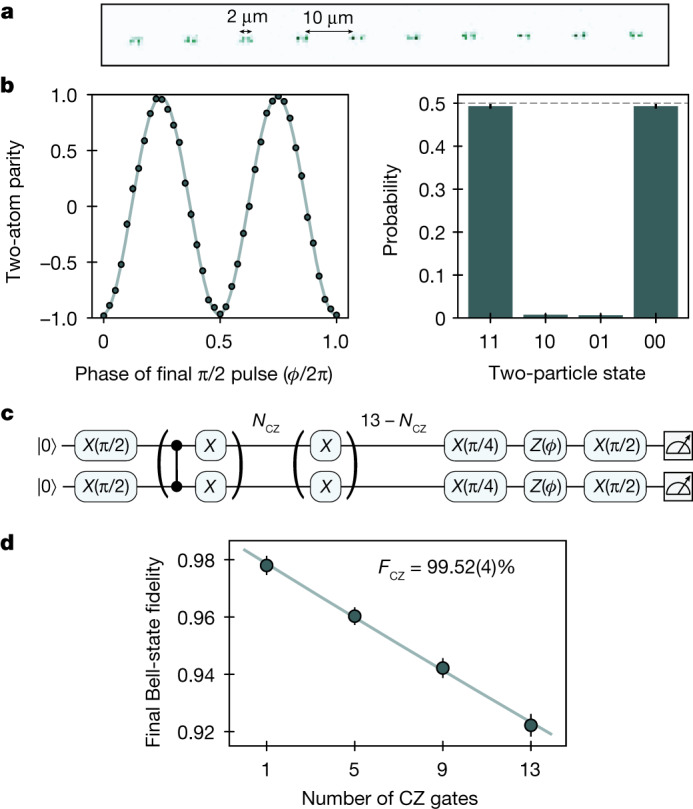
Fig. 2 High-fidelity CZ gates characterized with Bell states. a, Parameterized time-optimal CZ gates are implemented on 20 atoms in parallel. b, Raw Bell-state measurements on application of a single CZ gate, with raw Bell-state fidelity of 98.0(2)%. We estimate a SPAM-corrected fidelity of 99.4(4)% (not plotted; see Methods for details). c, Circuit used to benchmark two-qubit gate fidelity by making a Bell state after an odd number of CZ gates interleaved with single-qubit X gates. d, Decay of Bell-state fidelity after applying a variable number of CZ gates. A fidelity of 99.52(4)% per CZ gate is extracted from an exponential fit. The y axis is rescaled by a SPAM correction factor that does not affect the extracted gate fidelity (Methods). Note that the same number of single-qubit gates is performed for each point, so that no normalization of single-qubit errors is necessary, which thereby results in a reduced y-axis intercept. Error bars represent 68% confidence intervals.
Fig. 2 High-fidelity CZ gates characterized with Bell states. a, Parameterized time-optimal CZ gates are implemented on 20 atoms in parallel. b, Raw Bell-state measurements on application of a single CZ gate, with raw Bell-state fidelity of 98.0(2)%. We estimate a SPAM-corrected fidelity of 99.4(4)% (not plotted; see Methods for details). c, Circuit used to benchmark two-qubit gate fidelity by making a Bell state after an odd number of CZ gates interleaved with single-qubit X gates. d, Decay of Bell-state fidelity after applying a variable number of CZ gates. A fidelity of 99.52(4)% per CZ gate is extracted from an exponential fit. The y axis is rescaled by a SPAM correction factor that does not affect the extracted gate fidelity (Methods). Note that the same number of single-qubit gates is performed for each point, so that no normalization of single-qubit errors is necessary, which thereby results in a reduced y-axis intercept. Error bars represent 68% confidence intervals.CC BY · PubMed Central
Fig. 3 Global randomized benchmarking of the CZ gate. a, Circuit used to benchmark two-qubit gate fidelity with global randomized benchmarking, in which random rotations Rrand are sampled from a Haar-random distribution (Methods) and a final rotation Rf is precomputed to return population to the initial product state |00⟩ in the absence of gate errors. All 21 single-qubit rotations are applied for each data point, such that the number of single-qubit operations is independent of the number of two-qubit gates. b, Benchmarking CZ gates on 20 atoms in parallel. We plot the probability of return to the initial product state as a function of the number of applied CZ gates for both the parameterized time-optimal gate and the smooth-amplitude gate, extracting fidelities of 99.54(2)% and 99.55(3)%, respectively. c, The extracted time-optimal gate fidelity is consistent within statistical error across the ten gate sites. d, Scaling to larger systems, we measure a comparable fidelity of 99.48(2)% for the time-optimal gate implemented on 60 qubits in parallel. e, Site-by-site analysis reveals homogeneous, high-fidelity gate performance across the two rows.
Fig. 3 Global randomized benchmarking of the CZ gate. a, Circuit used to benchmark two-qubit gate fidelity with global randomized benchmarking, in which random rotations Rrand are sampled from a Haar-random distribution (Methods) and a final rotation Rf is precomputed to return population to the initial product state |00⟩ in the absence of gate errors. All 21 single-qubit rotations are applied for each data point, such that the number of single-qubit operations is independent of the number of two-qubit gates. b, Benchmarking CZ gates on 20 atoms in parallel. We plot the probability of return to the initial product state as a function of the number of applied CZ gates for both the parameterized time-optimal gate and the smooth-amplitude gate, extracting fidelities of 99.54(2)% and 99.55(3)%, respectively. c, The extracted time-optimal gate fidelity is consistent within statistical error across the ten gate sites. d, Scaling to larger systems, we measure a comparable fidelity of 99.48(2)% for the time-optimal gate implemented on 60 qubits in parallel. e, Site-by-site analysis reveals homogeneous, high-fidelity gate performance across the two rows.CC BY · PubMed Central
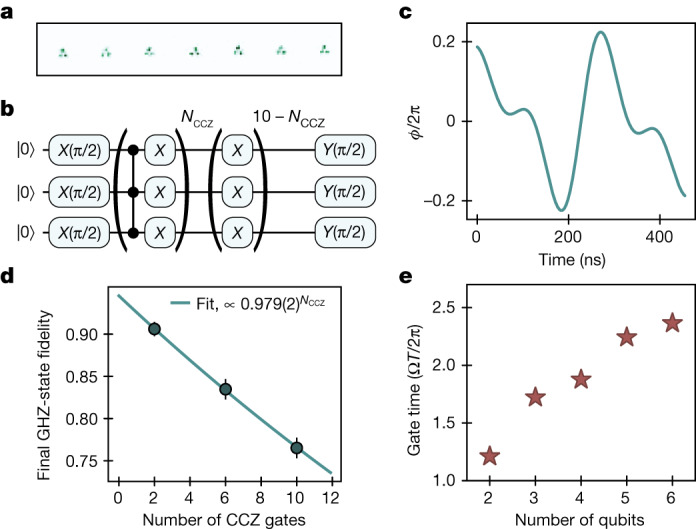
Fig. 4 Realizing fast CCZ gates. a, Entangling zone comprising three-qubit gate sites, with 21 qubits in total. The triangular configuration enables strong, symmetric interactions between three qubits. b, Circuit used to calibrate the CCZ gate, by generating GHZ states (∣000⟩+∣111⟩)/√2 after applying two, six and ten CCZ gates. c, Phase profile used for implementing a parameterized CCZ gate with a single, fixed-amplitude pulse. d, Raw GHZ-state fidelity as a function of CCZ gates applied, with an exponential decay fit ∝0.979(2)^NCCZ (see Extended Data Fig. 9d for example GHZ-state characterization). e, Theoretical scaling of gate duration as a function of the number of qubits for native Rydberg-blockade multi-qubit gates (see Extended Data Fig. 9b for corresponding phase profiles).
Fig. 4 Realizing fast CCZ gates. a, Entangling zone comprising three-qubit gate sites, with 21 qubits in total. The triangular configuration enables strong, symmetric interactions between three qubits. b, Circuit used to calibrate the CCZ gate, by generating GHZ states (∣000⟩+∣111⟩)/√2 after applying two, six and ten CCZ gates. c, Phase profile used for implementing a parameterized CCZ gate with a single, fixed-amplitude pulse. d, Raw GHZ-state fidelity as a function of CCZ gates applied, with an exponential decay fit ∝0.979(2)^NCCZ (see Extended Data Fig. 9d for example GHZ-state characterization). e, Theoretical scaling of gate duration as a function of the number of qubits for native Rydberg-blockade multi-qubit gates (see Extended Data Fig. 9b for corresponding phase profiles).CC BY · PubMed Central
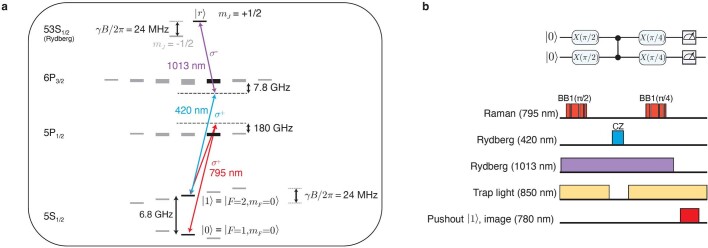
Extended Data Fig. 1 Atomic-level diagram and pulse sequence. a, Level diagram showing key levels of 87Rb used in our quantum circuits. The clock states, |0⟩ and |1⟩, are the qubit states used in this work. Excitation to the Rydberg state between |1⟩ and |r⟩ is carried out by a two-photon transition driven by 420-nm and 1,013-nm lasers. Single-qubit rotations are realized with an amplitude-modulated 795-nm laser that drives Raman rotations between the mF = 0 clock states. A DC magnetic field of 8.5 G is applied throughout this work. The Rydberg detuning signs and polarization signs are carefully selected for various optimizations: for suppressing 420-induced differential light shift between |0⟩ and |1⟩, we red-detuned the 6P3/2 transition; for using dark-state physics (nominally the phase profile corresponds to a certain sign of two-photon detuning), we thereby choose positive two-photon detuning, which—in turn—then suppresses coupling to mJ = − 1/2 by being primarily on the upper side of mJ = +1/2; and, finally, the 1,013-nm light shift is lower (by about 30%) at this single-photon detuning sign, as there is a magic wavelength of about 1 GHz red-detuned of 6P3/2 for the |1⟩ → 53S1/2 transition98. Two downsides of this detuning choice are that this choice of 420-nm polarization and detuning causes a vector light shift in the hyperfine ground-state manifold that causes the mF levels to be pushed closer together, as opposed to further apart, which could exacerbate effects arising from 420-induced vector light shifts coupling adjacent mF states in the ground-state manifold (although negligible here), and the other downside is that the mJ = −1/2 Rydberg pair states are closer detuned to the two-photon excitation and so we require a larger interaction strength to suppress their excitation, although the matrix element to these states is smaller. b, Example pulse sequence, here for making a ∣Φ⁺⟩ Bell state between two qubits. Traps are pulsed off for a few hundred ns during the Rydberg gate to avoid both antitrapping of the Rydberg state and inhomogeneous light shifts that broaden the transition, and the ground-state atoms are then recaptured for roughly 3 μs between consecutive gate applications.
Extended Data Fig. 1 Atomic-level diagram and pulse sequence. a, Level diagram showing key levels of 87Rb used in our quantum circuits. The clock states, |0⟩ and |1⟩, are the qubit states used in this work. Excitation to the Rydberg state between |1⟩ and |r⟩ is carried out by a two-photon transition driven by 420-nm and 1,013-nm lasers. Single-qubit rotations are realized with an amplitude-modulated 795-nm laser that drives Raman rotations between the mF = 0 clock states. A DC magnetic field of 8.5 G is applied throughout this work. The Rydberg detuning signs and polarization signs are carefully selected for various optimizations: for suppressing 420-induced differential light shift between |0⟩ and |1⟩, we red-detuned the 6P3/2 transition; for using dark-state physics (nominally the phase profile corresponds to a certain sign of two-photon detuning), we thereby choose positive two-photon detuning, which—in turn—then suppresses coupling to mJ = − 1/2 by being primarily on the upper side of mJ = +1/2; and, finally, the 1,013-nm light shift is lower (by about 30%) at this single-photon detuning sign, as there is a magic wavelength of about 1 GHz red-detuned of 6P3/2 for the |1⟩ → 53S1/2 transition98. Two downsides of this detuning choice are that this choice of 420-nm polarization and detuning causes a vector light shift in the hyperfine ground-state manifold that causes the mF levels to be pushed closer together, as opposed to further apart, which could exacerbate effects arising from 420-induced vector light shifts coupling adjacent mF states in the ground-state manifold (although negligible here), and the other downside is that the mJ = −1/2 Rydberg pair states are closer detuned to the two-photon excitation and so we require a larger interaction strength to suppress their excitation, although the matrix element to these states is smaller. b, Example pulse sequence, here for making a ∣Φ⁺⟩ Bell state between two qubits. Traps are pulsed off for a few hundred ns during the Rydberg gate to avoid both antitrapping of the Rydberg state and inhomogeneous light shifts that broaden the transition, and the ground-state atoms are then recaptured for roughly 3 μs between consecutive gate applications.CC BY · PubMed Central
Extended Data Fig. 2 Dark-state physics in two-photon Rydberg gates. a, In the far-detuned limit, the three-level system can be effectively described as a two-level system with a ‘dark’ state |D⟩ and a ‘bright’ state |B⟩. The population in the excited state |E⟩ is suppressed by a factor ∝ Δ−4 and does not participate in system dynamics. b, The Hamiltonian of the bare atomic system and the effective two-level system, in which α is the (time-dependent) ratio between the blue and red Rabi frequencies and α. is its time derivative. c, Intermediate-state population during the parameterized time-optimal gate in the dark and bright configurations together with their Bloch-sphere trajectories in the {|D⟩, |B⟩} basis. d, Intermediate-state population during the smooth-amplitude gate and its Bloch-sphere trajectory in the instantaneous {|D⟩, |B⟩} basis. The simulation parameters correspond to those mentioned in Extended Data Fig. 3a and Extended Data Table 1.
Extended Data Fig. 2 Dark-state physics in two-photon Rydberg gates. a, In the far-detuned limit, the three-level system can be effectively described as a two-level system with a ‘dark’ state |D⟩ and a ‘bright’ state |B⟩. The population in the excited state |E⟩ is suppressed by a factor ∝ Δ−4 and does not participate in system dynamics. b, The Hamiltonian of the bare atomic system and the effective two-level system, in which α is the (time-dependent) ratio between the blue and red Rabi frequencies and α. is its time derivative. c, Intermediate-state population during the parameterized time-optimal gate in the dark and bright configurations together with their Bloch-sphere trajectories in the {|D⟩, |B⟩} basis. d, Intermediate-state population during the smooth-amplitude gate and its Bloch-sphere trajectory in the instantaneous {|D⟩, |B⟩} basis. The simulation parameters correspond to those mentioned in Extended Data Fig. 3a and Extended Data Table 1.CC BY · PubMed Central
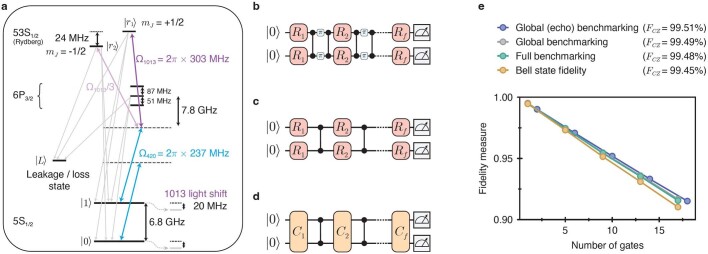
Extended Data Fig. 3 Atomic physics error-level diagram and numerical comparison of benchmarking methods. a, Level diagram shows the eight states assumed in the simulation. We assume a 88-μs Rydberg-state lifetime (based on measured T1 with 1,013-nm scattering lifetime subtracted) and a 110-ns lifetime for the intermediate states. We assume the following branching ratios for the intermediate states99: ηe→L = 0.6142, ηe→1 = 0.2504, ηe→0 = 0.1354, and the following ones for the Rydberg states100: ηr→L = 0.894, ηr→1 = 0.053, ηr→0 = 0.053. We use the branching ratios between different channels of intermediate-state scattering as reported in ref. 99 and we also assume a simplified model in which all indirect paths (through 4D and 6S) populate the ground-state manifold uniformly. The Rydberg lifetime has both radiative decay (170 μs) and black-body decay (128 μs) components, which we obtain by rescaling the values in ref. 100 to n = 53. The microwave component results purely in atom loss and we assume that the radiative decay populates the ground-state manifold uniformly. We note that a more accurate treatment of the decay channels36 could increase error modelling precision in future work. b, Benchmarking of the CZ-π-CZ sequence with global random rotations, which is insensitive to the single-particle phase. c, Benchmarking a standalone CZ gate with global random rotations, which enables separate calibration of the single-particle phase. d, The usual interleaved randomized benchmarking method using random two-qubit Clifford gates (not performed in this work). e, Numerical simulation of the presented benchmarking methods and the Bell-state-preparation method, using the realistic error model developed in this work. All approaches give consistent results, with the Bell-state fidelity measurement lower-bounding the other curves.
Extended Data Fig. 3 Atomic physics error-level diagram and numerical comparison of benchmarking methods. a, Level diagram shows the eight states assumed in the simulation. We assume a 88-μs Rydberg-state lifetime (based on measured T1 with 1,013-nm scattering lifetime subtracted) and a 110-ns lifetime for the intermediate states. We assume the following branching ratios for the intermediate states99: ηe→L = 0.6142, ηe→1 = 0.2504, ηe→0 = 0.1354, and the following ones for the Rydberg states100: ηr→L = 0.894, ηr→1 = 0.053, ηr→0 = 0.053. We use the branching ratios between different channels of intermediate-state scattering as reported in ref. 99 and we also assume a simplified model in which all indirect paths (through 4D and 6S) populate the ground-state manifold uniformly. The Rydberg lifetime has both radiative decay (170 μs) and black-body decay (128 μs) components, which we obtain by rescaling the values in ref. 100 to n = 53. The microwave component results purely in atom loss and we assume that the radiative decay populates the ground-state manifold uniformly. We note that a more accurate treatment of the decay channels36 could increase error modelling precision in future work. b, Benchmarking of the CZ-π-CZ sequence with global random rotations, which is insensitive to the single-particle phase. c, Benchmarking a standalone CZ gate with global random rotations, which enables separate calibration of the single-particle phase. d, The usual interleaved randomized benchmarking method using random two-qubit Clifford gates (not performed in this work). e, Numerical simulation of the presented benchmarking methods and the Bell-state-preparation method, using the realistic error model developed in this work. All approaches give consistent results, with the Bell-state fidelity measurement lower-bounding the other curves.CC BY · PubMed Central
Extended Data Fig. 4 Robust and versatile two-qubit gates. a, Robustness to experimental offsets. For some systematic experimental offsets, such as finite rise time of the 420-nm Rydberg laser pulse, an exact CZ gate can still be found. The relative values of gate parameters for the time-optimal gate are plotted as a function of pulse rise time. For no rise time, the parameter values used here are: A/2π = 0.0988, ω/Ω = 1.3629, φ0 = −2.6082 and δ0/Ω = −0.0187. b, Duration of a controlled-phase gate CPHASE(θ). The CZ gate (θ = π) is the longest in this gate family. Because faster gates are expected to have higher fidelity, an average CPHASE gate should perform even better than the CZ gate reported in this work, which is an exciting perspective for near-term digital simulation. c, Plotting on a log–log plot, we see that, for small angles θ, the gate time decreases with an approximate power law ΩT(θ)/2π = 1.6 × (θ/2π)0.23. This suggests that applying very small phases can be costly and should be taken into account when designing digital simulation schemes. Although these small-angle gates are time-optimal when applying a single, fixed-amplitude pulse, different approaches could perform better. Exploring other exact and approximate gate schemes, such as Rydberg dressing and a detuned 2π pulse, in the small-angle regime is an interesting direction for future work.
Extended Data Fig. 4 Robust and versatile two-qubit gates. a, Robustness to experimental offsets. For some systematic experimental offsets, such as finite rise time of the 420-nm Rydberg laser pulse, an exact CZ gate can still be found. The relative values of gate parameters for the time-optimal gate are plotted as a function of pulse rise time. For no rise time, the parameter values used here are: A/2π = 0.0988, ω/Ω = 1.3629, φ0 = −2.6082 and δ0/Ω = −0.0187. b, Duration of a controlled-phase gate CPHASE(θ). The CZ gate (θ = π) is the longest in this gate family. Because faster gates are expected to have higher fidelity, an average CPHASE gate should perform even better than the CZ gate reported in this work, which is an exciting perspective for near-term digital simulation. c, Plotting on a log–log plot, we see that, for small angles θ, the gate time decreases with an approximate power law ΩT(θ)/2π = 1.6 × (θ/2π)0.23. This suggests that applying very small phases can be costly and should be taken into account when designing digital simulation schemes. Although these small-angle gates are time-optimal when applying a single, fixed-amplitude pulse, different approaches could perform better. Exploring other exact and approximate gate schemes, such as Rydberg dressing and a detuned 2π pulse, in the small-angle regime is an interesting direction for future work.CC BY · PubMed Central
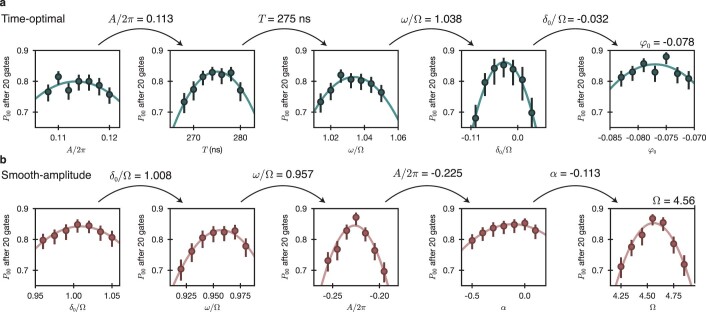
Extended Data Fig. 5 Empirical optimization of two-qubit gate fidelity. a, Calibrating gate parameters for the time-optimal gate, indicating the chronological sequence of calibrations performed before measurement in Fig. 3b. We scan individual gate parameters and measure the probability of return to the initial state after application of 20 entangling gates. b, Analogous calibration of gate parameters for the smooth-amplitude gate, which we performed in the sequence shown before the smooth-amplitude measurement in Fig. 3b. Additional calibration of other gate parameters was performed before these measurements.
Extended Data Fig. 5 Empirical optimization of two-qubit gate fidelity. a, Calibrating gate parameters for the time-optimal gate, indicating the chronological sequence of calibrations performed before measurement in Fig. 3b. We scan individual gate parameters and measure the probability of return to the initial state after application of 20 entangling gates. b, Analogous calibration of gate parameters for the smooth-amplitude gate, which we performed in the sequence shown before the smooth-amplitude measurement in Fig. 3b. Additional calibration of other gate parameters was performed before these measurements.CC BY · PubMed Central
Extended Data Fig. 6 CZ gate single-particle phase calibration and benchmarking. a, Digital circuit for global randomized benchmarking method used to calibrate single-particle phase, in which a Z rotation can be performed after each CZ gate to compensate for the acquired phase. Rrand are single-qubit rotations sampled from a Haar-random distribution and the five rotations Rf are computed to return the atom pair to the initial product state in the absence of gate errors. For the 0 CZ gates point, 20 random rotations are applied, as well as a final rotation precomputed to return population to the initial state. b, Experimental data used for calibrating the single-particle phase by optimizing the return probability P|00⟩ after 20 CZ gates (inset). For the optimal choice of ϕ, we extract a 99.48(2)% CZ gate fidelity, fitting to an exponential decay.
Extended Data Fig. 6 CZ gate single-particle phase calibration and benchmarking. a, Digital circuit for global randomized benchmarking method used to calibrate single-particle phase, in which a Z rotation can be performed after each CZ gate to compensate for the acquired phase. Rrand are single-qubit rotations sampled from a Haar-random distribution and the five rotations Rf are computed to return the atom pair to the initial product state in the absence of gate errors. For the 0 CZ gates point, 20 random rotations are applied, as well as a final rotation precomputed to return population to the initial state. b, Experimental data used for calibrating the single-particle phase by optimizing the return probability P|00⟩ after 20 CZ gates (inset). For the optimal choice of ϕ, we extract a 99.48(2)% CZ gate fidelity, fitting to an exponential decay.CC BY · PubMed Central
Extended Data Fig. 7 Correlated errors in experimental shots. a, Distribution of errors in each experimental shot as a function of the number of CZ gates applied for the 20-atom data in Fig. 3, showing qualitative agreement with a Poisson distribution centred at the experimental mean for the number of errors in a shot. b, Histogram of the number of errors in a shot, averaging over all numbers of gates for the 20-atom data. We compare to one model assuming a Poissonian distribution of errors about the mean, finding some deviation from our data. In a second model, we consider that, in each shot, there is a slightly different gate fidelity, sampled from a Gaussian distribution with a mean of 99.54% and standard deviation of 0.3%. This second model seems to better capture our data. c, Repeating the analysis for the 60-atom data in Fig. 3, we notably find no shot (out of the 5,053 total repetitions) with 18 or more errors out of the 30 gate sites. Again, the data are qualitatively similar to a Poisson distribution model. d, Averaging over the 60-atom data for all numbers of gates, we find again a small quantitative deviation between the data and a model with a Poisson distribution of errors in each shot. The data seem to be better described by a model in which, in each shot, we sample fidelities from a Gaussian distribution with a mean of 99.5% and a standard deviation of 0.3%.
Extended Data Fig. 7 Correlated errors in experimental shots. a, Distribution of errors in each experimental shot as a function of the number of CZ gates applied for the 20-atom data in Fig. 3, showing qualitative agreement with a Poisson distribution centred at the experimental mean for the number of errors in a shot. b, Histogram of the number of errors in a shot, averaging over all numbers of gates for the 20-atom data. We compare to one model assuming a Poissonian distribution of errors about the mean, finding some deviation from our data. In a second model, we consider that, in each shot, there is a slightly different gate fidelity, sampled from a Gaussian distribution with a mean of 99.54% and standard deviation of 0.3%. This second model seems to better capture our data. c, Repeating the analysis for the 60-atom data in Fig. 3, we notably find no shot (out of the 5,053 total repetitions) with 18 or more errors out of the 30 gate sites. Again, the data are qualitatively similar to a Poisson distribution model. d, Averaging over the 60-atom data for all numbers of gates, we find again a small quantitative deviation between the data and a model with a Poisson distribution of errors in each shot. The data seem to be better described by a model in which, in each shot, we sample fidelities from a Gaussian distribution with a mean of 99.5% and a standard deviation of 0.3%.CC BY · PubMed Central
Extended Data Fig. 8 Correlations between gate sites. a, Covariance matrices for the 20-atom data in Fig. 3b after 0 gates and 20 gates, in which local correlations appear after 20 gates. b, Covariance averaged over all neighbours, next nearest neighbours and next next nearest neighbours, as a function of the number of CZ gates applied. As a guide to the eye, data are fit to quadratic curves. c, Covariance matrices for 60-atom data in Fig. 3d for 0 gates and 20 gates. d, Plotting covariance for neighbouring sites for the 60-atom data. Once again, the covariance between nearby sites exhibits small growth throughout the 20 CZ gates applied, in particular for the nearest-neighbour sites.
Extended Data Fig. 8 Correlations between gate sites. a, Covariance matrices for the 20-atom data in Fig. 3b after 0 gates and 20 gates, in which local correlations appear after 20 gates. b, Covariance averaged over all neighbours, next nearest neighbours and next next nearest neighbours, as a function of the number of CZ gates applied. As a guide to the eye, data are fit to quadratic curves. c, Covariance matrices for 60-atom data in Fig. 3d for 0 gates and 20 gates. d, Plotting covariance for neighbouring sites for the 60-atom data. Once again, the covariance between nearby sites exhibits small growth throughout the 20 CZ gates applied, in particular for the nearest-neighbour sites.CC BY · PubMed Central
Extended Data Fig. 9 Time-optimal pulses for multi-qubit controlled phase gates and GHZ-state data. a, The execution time of a CNZ blockade gate as a function of the number of qubits. The N-qubit gates are realized by applying a phase flip to the (∣0⟩)^(⊗N) state, which is not equivalent to the method of ref. 8 for N > 2. For the CCZ gate, applying a π phase to the |111⟩ state (|111⟩ → −|111⟩), while leaving all other basis states invariant, is related by a global bit-flip to applying a relative π phase to the |000⟩ state; however, the two implementations are not equivalent up to a global Z rotation, contrary to the two-qubit case. The time-optimal CCZ gate using the second approach realizes the CCZ gate about 34% faster with (ΩT/2π) = 1.72, as compared with (ΩT/2π) = 2.61 from the first approach. The two approaches are different because the relative phase of π is accumulated between different basis states, which have different rates of phase accumulation. In the case of applying |111⟩ → −|111⟩, the states with the slowest relative rate are |111⟩ and |011⟩, which are driven with the Rabi frequencies of √3Ω and √2Ω, respectively, resulting in the phase accumulation rate proportional to (√3−√2)Ω≈0.32Ω. By contrast, when the relative phase is applied on the state |000⟩, the smallest accumulation rate is given by the |001⟩ state, which is driven with the Rabi frequency Ω. In general, an arbitrary global single-qubit rotation at the end of the gate can be included to incorporate all of the above approaches in the optimization procedure. b, Time-optimal phase profiles (without analytic parameterization) for the CNZ gates up to six qubits realized by applying a phase flip to the (∣0⟩)^(⊗N) state. c, Circuit used to generate the GHZ state (∣000⟩+∣111⟩)/√((2)) after two CCZ gates. d, GHZ states measured experimentally on applying this circuit to seven three-qubit groups in parallel, with populations in |000⟩ and |111⟩ of 92.9(3)% and a parity contrast of 89(1)%, giving a raw GHZ-state fidelity of 90.9(6)%.
Extended Data Fig. 9 Time-optimal pulses for multi-qubit controlled phase gates and GHZ-state data. a, The execution time of a CNZ blockade gate as a function of the number of qubits. The N-qubit gates are realized by applying a phase flip to the (∣0⟩)^(⊗N) state, which is not equivalent to the method of ref. 8 for N > 2. For the CCZ gate, applying a π phase to the |111⟩ state (|111⟩ → −|111⟩), while leaving all other basis states invariant, is related by a global bit-flip to applying a relative π phase to the |000⟩ state; however, the two implementations are not equivalent up to a global Z rotation, contrary to the two-qubit case. The time-optimal CCZ gate using the second approach realizes the CCZ gate about 34% faster with (ΩT/2π) = 1.72, as compared with (ΩT/2π) = 2.61 from the first approach. The two approaches are different because the relative phase of π is accumulated between different basis states, which have different rates of phase accumulation. In the case of applying |111⟩ → −|111⟩, the states with the slowest relative rate are |111⟩ and |011⟩, which are driven with the Rabi frequencies of √3Ω and √2Ω, respectively, resulting in the phase accumulation rate proportional to (√3−√2)Ω≈0.32Ω. By contrast, when the relative phase is applied on the state |000⟩, the smallest accumulation rate is given by the |001⟩ state, which is driven with the Rabi frequency Ω. In general, an arbitrary global single-qubit rotation at the end of the gate can be included to incorporate all of the above approaches in the optimization procedure. b, Time-optimal phase profiles (without analytic parameterization) for the CNZ gates up to six qubits realized by applying a phase flip to the (∣0⟩)^(⊗N) state. c, Circuit used to generate the GHZ state (∣000⟩+∣111⟩)/√((2)) after two CCZ gates. d, GHZ states measured experimentally on applying this circuit to seven three-qubit groups in parallel, with populations in |000⟩ and |111⟩ of 92.9(3)% and a parity contrast of 89(1)%, giving a raw GHZ-state fidelity of 90.9(6)%.CC BY · PubMed Central

Verification

Claims the paper makes

The claims and statistics of this paper haven’t been checked yet.

Free: it reads the open-access text and checks the first 5 claims that cite a source we can check. Create a free account to check every claim.

A few free checks a day · papers already verified open instantly · results are public

Claims other papers make about this one

Each is checked against this paper’s own text: does it say what the citing paper says it does?

5 more claims about this paper

Create a free account to see every claim other papers make about this one.

See all claims — free account

Self-check

Percentages, sums and reported differences re-computed from the paper’s own numbers.

The self-check needs the paper’s full text.

Citations

Cites

Show all 97 references

Research works printed but not linked: 7

  1. Kalinowski, M., Maskara, N. & Lukin, M. D. Non-Abelian Floquet spin liquids in a digital Rydberg simulator. Phys. Rev. X 13, 031008 (2023).
  2. Shende, V. V. & Markov, I. L. On the CNOT-cost of TOFFOLI gates. Quantum Inf. Comput. 9, 461–486 (2009).
  3. Ma, S. et al. Universal gate operations on nuclear spin qubits in an optical tweezer array of 171Yb atoms. Phys. Rev. X 12, 021028 (2022).
  4. Brown, M. O., Thiele, T., Kiehl, C., Hsu, T.-W. & Regal, C. A. Gray-molasses optical-tweezer loading: controlling collisions for scaling atom-array assembly. Phys. Rev. X 9, 011057 (2019).
  5. Chang, T. H., Wang, T. N., Jen, H. H. & Chen, Y. C. High-fidelity Rydberg control-Z gates with time-optimal pulses. Preprint at https://arxiv.org/abs/2303.16395 (2023). · arXiv
  6. Khazali, M. & Mølmer, K. Fast multiqubit gates by adiabatic evolution in interacting excited-state manifolds of Rydberg atoms and superconducting circuits. Phys. Rev. X 10, 021054 (2020).
  7. Singh, K., Anand, S., Pocklington, A., Kemp, J. T. & Bernien, H. Dual-element, two-dimensional atom array with continuous-mode operation. Phys. Rev. X 12, 011040 (2022).

Cited by

See all 974

Metadata

Authors
Evered, S. J., Bluvstein, D., Kalinowski, M., Ebadi, S., Manovitz, T., Zhou, H., Li, S. H., Geim, A. A., Wang, T. T., Maskara, N., Levine, H., Semeghini, G., Greiner, M., Vuletić, V., & Lukin, M. D.
Affiliations
  • Harvard University (US)
  • Massachusetts Institute of Technology (US)
Corresponding author
Lukin, Mikhail D.
Venue
Nature
Published
2023-10-11
Volume
622
Issue
7982
Pages
268-272
ISSN
  • 0028-0836 (ISSN-L)
  • 1476-4687
OpenAlex
W4387542025
Cited by
522
References
97
Citations by year
2026: 134 · 2025: 229 · 2024: 138 · 2023: 21
FWCI
60.51
Type
journal article
Language
en
Open access
Licence
Locations
  • Nature (publishedVersion, cc-by)
  • PubMed Central (publishedVersion, cc-by)
  • PubMed (publishedVersion)
  • arXiv (Cornell University) (submittedVersion)
  • OSTI OAI (U.S. Department of Energy Office of Scientific and Technical Information) (submittedVersion)
  • FIU - Digital Commons (Florida International University) (submittedVersion)
  • Florida International University Digital Commons (Florida International University) (submittedVersion, cc-by)
  • RePEc: Research Papers in Economics (submittedVersion)
  • arXiv (Cornell University)
Funders
  • National Science Foundation (1745303, W911NF-20-1-0082)
  • U.S. Department of Energy (DESC0021013, DESC0021110, 7568717)
  • Defense Advanced Research Projects Agency (W911NF2010021)
  • National Defense Science and Engineering Graduate
  • Multidisciplinary University Research Initiative (W911NF2010082)
  • Center for Ultracold Atoms, Massachusetts Institute of Technology
  • Army Research Office (W911NF-20-1-0082, W911NF)
Topics
  • Physical Sciences › Physics and Astronomy › Atomic and Molecular Physics, and Optics › Cold Atom Physics and Bose-Einstein Condensates
  • Physical Sciences › Computer Science › Artificial Intelligence › Quantum Computing Algorithms and Architecture
  • Physical Sciences › Physics and Astronomy › Atomic and Molecular Physics, and Optics › Quantum Information and Cryptography
Keywords
neutral atom quantum computing, entangling gates, Rydberg interactions, gate fidelity, three-qubit gates, optimal control, dark states, atom cooling, Rydberg excitation, error sources, scalable quantum hardware

About these checks

Registry, retraction, Cites and statistics results are computed, not judged, with one exception: a printed reference that no index lists is read once by a model before it counts as a citation error. Claims are extracted by a model and kept only when their quote appears verbatim in the text; each cited source is then checked, with a model’s help, for whether it says what the claim relies on. Those verdicts can be wrong — read the claim’s quote and the cited source before relying on one.

Statistics and arithmetic are recomputed, not judged.

Confidence bands are shown only for fields calibrated on our annotated test set. None is calibrated yet, so no band is shown.

What counts as a claim ›How we measure confidence ›How we check this ›

Are you an author, or do you see a problem with this page? Request a review

How to cite

Cite CoChat for the checks on this page, and the paper for its own findings.

This page
CoChat. (2026). Citation check: High-fidelity parallel entangling gates on a neutral-atom quantum computer. https://app.cochat.ai/papers/10.1038/s41586-023-06481-y
The paper
Evered, S. J., Bluvstein, D., Kalinowski, M., Ebadi, S., Manovitz, T., Zhou, H., Li, S. H., Geim, A. A., Wang, T. T., Maskara, N., Levine, H., Semeghini, G., Greiner, M., Vuletić, V., & Lukin, M. D. (2023). High-fidelity parallel entangling gates on a neutral-atom quantum computer. Nature. https://doi.org/10.1038/s41586-023-06481-y

Data sources

Bibliographic data: Semantic Scholar, OpenAlex, Crossref.

Contains information from the Semantic Scholar Academic Graph Datasets, made available under the ODC Attribution License (ODC-BY 1.0).

Semantic Scholar’s data is described in: Kinney, R., et al. (2023). The Semantic Scholar Open Data Platform. arXiv:2301.10140.