

The DOI matches its Crossref record; 54 of the 54 references it cites were found in a registry or an index.
Illuminating protein space with a programmable generative model
Open accessPublished version of a preprint
Abstract
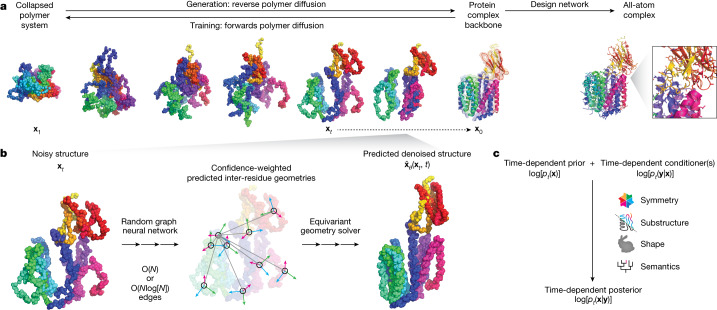
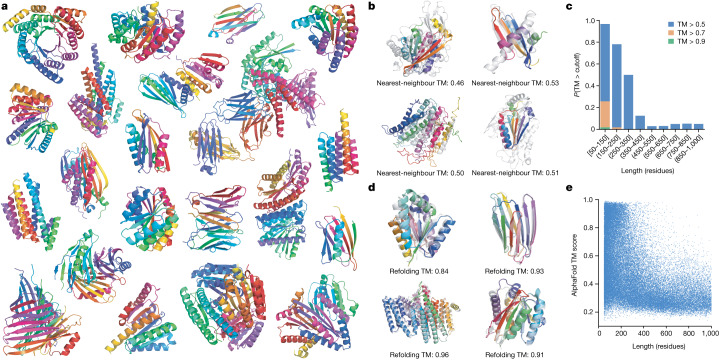
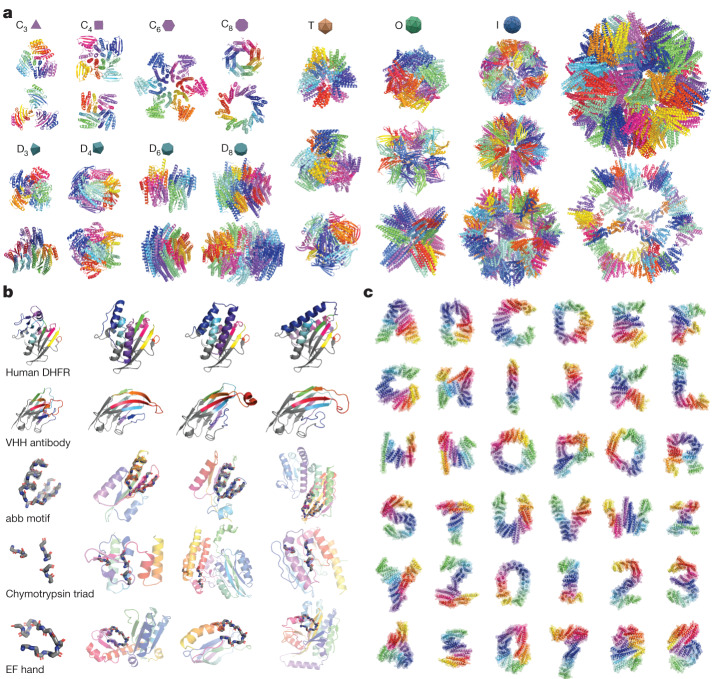
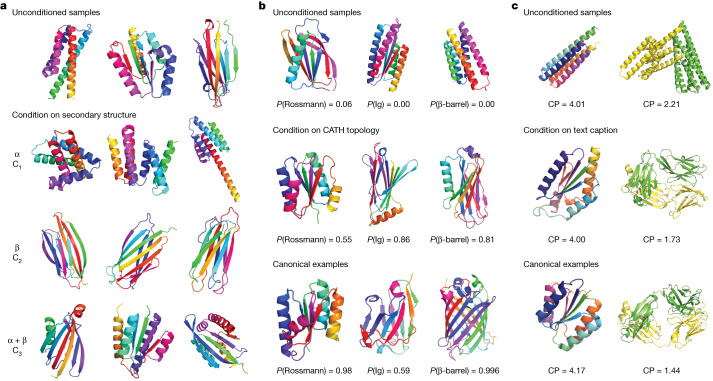
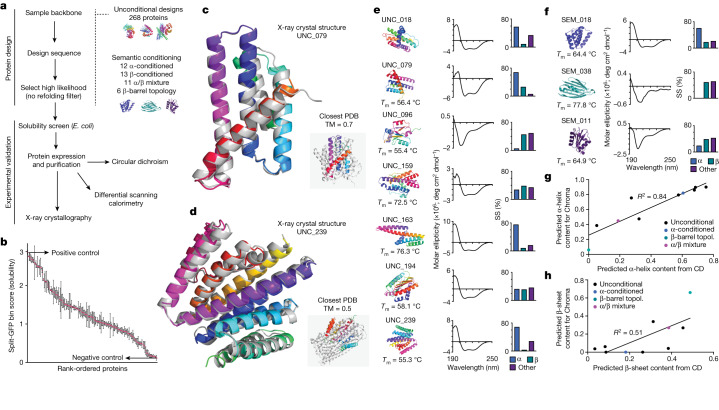
Three billion years of evolution has produced a tremendous diversity of protein molecules 1 , but the full potential of proteins is likely to be much greater. Accessing this potential has been challenging for both computation and experiments because the space of possible protein molecules is much larger than the space of those likely to have functions. Here we introduce Chroma, a generative model for proteins and protein complexes that can directly sample novel protein structures and sequences, and that can be conditioned to steer the generative process towards desired properties and functions. To enable this, we introduce a diffusion process that respects the conformational statistics of polymer ensembles, an efficient neural architecture for molecular systems that enables long-range reasoning with sub-quadratic scaling, layers for efficiently synthesizing three-dimensional structures of proteins from predicted inter-residue geometries and a general low-temperature sampling algorithm for diffusion models. Chroma achieves protein design as Bayesian inference under external constraints, which can involve symmetries, substructure, shape, semantics and even natural-language prompts. The experimental characterization of 310 proteins shows that sampling from Chroma results in proteins that are highly expressed, fold and have favourable biophysical properties. The crystal structures of two designed proteins exhibit atomistic agreement with Chroma samples (a backbone root-mean-square deviation of around 1.0 Å). With this unified approach to protein design, we hope to accelerate the programming of protein matter to benefit human health, materials science and synthetic biology.
Overview
The claims and statistics of this paper haven’t been checked yet.
Run the check — free, no account needed. It reads the open-access text and checks the sources it cites.
Integrity signals
Registry
Cites
Statistics
Figures
Verification
Claims the paper makes
The claims and statistics of this paper haven’t been checked yet.
Run the check — free, no account needed. It reads the open-access text and checks the sources it cites.
Self-check
Percentages, sums and reported differences re-computed from the paper’s own numbers.
The self-check needs the paper’s full text.
Citations
Cites
Highly accurate protein structure prediction with AlphaFold
Jumper, J., Evans, R., Pritzel, A., Green, T., Figurnov, M., Ronneberger, O., Tunyasuvunakool, K., Bates, R., Žídek, A., Potapenko, A., et al. (2021) · Nature · doi:10.1038/s41586-021-03819-2 · Cited by 43,764
UMAP: Uniform Manifold Approximation and Projection
McInnes, L., Healy, J., Saul, N., & Großberger, L. (2018) · Journal of Open Source Software · doi:10.21105/joss.00861 · Cited by 9,826 · cited 3×
“13, we present samples from Chroma and a set of native structures with global topology descriptors derived from knot theory 43,44 and embed them into two dimensions with UMAP 45 .”
BackgroundMethodDenoising Diffusion Probabilistic Models
Ho, J., Jain, A., & Abbeel, P. (2020) · arXiv · doi:10.48550/arxiv.2006.11239 · Cited by 8,712
UniProt: the universal protein knowledgebase in 2021
The UniProt Consortium, Bateman, A., Martin, M.-J., Orchard, S., Magrane, M., Agivetova, R., Ahmad, S., Alpi, E., Bowler-Barnett, E. H., Britto, R., et al. (2021) · Nucleic Acids Research · doi:10.1093/nar/gkaa1100 · Cited by 6,372
Evolutionary-scale prediction of atomic level protein structure with a language model
Lin, Z., Akin, H., Rao, R., Hie, B., Zhu, Z., Lu, W., Smetanin, N., Verkuil, R., Kabeli, O., Shmueli, Y., et al. (2022) · doi:10.1101/2022.07.20.500902 · Cited by 5,990
TM-align: a protein structure alignment algorithm based on the TM-score
Zhang, Y. (2005) · Nucleic Acids Research · doi:10.1093/nar/gki524 · Cited by 3,774
A hierarchical O(N log N) force-calculation algorithm
Barnes, J., & Hut, P. (1986) · Nature · doi:10.1038/324446a0 · Cited by 3,733
Diffusion Models Beat GANs on Image Synthesis
Dhariwal, P., & Nichol, A. (2021) · arXiv · doi:10.48550/arxiv.2105.05233 · Cited by 3,362
Rives, A., Meier, J., Sercu, T., Goyal, S., Lin, Z., Liu, J., Guo, D., Ott, M., Zitnick, C. L., Ma, J., et al. (2021) · Proceedings of the National Academy of Sciences · doi:10.1073/pnas.2016239118 · Cited by 3,286
Rives, A., Meier, J., Sercu, T., Goyal, S., Lin, Z., Liu, J., Guo, D., Ott, M., Zitnick, C. L., Ma, J., et al. (2019) · doi:10.1101/622803 · Cited by 3,280
Research works printed but not linked: 6
- Ramesh, A., Dhariwal, P., Nichol, A., Chu, C. & Chen, M. Hierarchical text-conditional image generation with CLIP latents. Preprint at https://arxiv.org/abs/2204.06125 (2022). · arXiv
- Ingraham, J., Garg, V., Barzilay, R. & Jaakkola, T. Generative models for graph-based protein design. In Proc. Advances in Neural Information Processing Systems 32 (eds Wallach, H. et al.) (NeurIPS, 2019).
- Anand, N. & Huang, P.-S. Generative modeling for protein structures. In Proc. Advances in Neural Information Processing Systems 31 (eds Bengio, S. et al.) (NeurIPS, 2018).
- Lin, Z., Sercu, T., LeCun, Y. & Rives, A. Deep generative models create new and diverse protein structures. In Machine Learning in Structural Biology Workshop at the 35th Conference on Neural Information Processing Systems (MLSB, 2021).
- Gilmer, J., Schoenholz, S. S., Riley, P. F., Vinyals, O. & Dahl, G. E. Neural message passing for quantum chemistry. In Proc. 34th International Conference on Machine Learning (eds Precup, D. et al.) 1263–1272 (PMLR, 2017).
- Jing, B., Eismann, S., Suriana, P., Townshend, R. J. L. & Dror, R. Learning from protein structure with geometric vector perceptrons. In International Conference on Learning Representations (eds Hofmann, K. et al.) (OpenReview.net, 2021).
Cited by
Sorted by citations
Items 301–400 of 447
De Novo Protein Design Enables Targeting of Intractable Oncogenic Protein–Protein Interfaces
Prakash, V., Najy, Y., Garrett, K., Edwards, B. F. P., & Kidder, B. L. (2026) · Biologics · doi:10.3390/biologics6010009 · Cited by 1
AI-Driven De Novo Binder Design: From Structure Prediction to Closed-Loop Optimization
Li, X., Fan, Z., Yang, J., Jiang, R., Cao, F., Li, J., Xie, D., Meng, X., Sun, M., & Wang, L. (2026) · Computational and Structural Biotechnology Journal · doi:10.34133/csbj.0070 · Cited by 1
Fast and Distributed Equivariant Graph Neural Networks by Virtual Node Learning
Zhang, Y., Cen, J., Han, J., & Huang, W. (2026) · IEEE Transactions on Pattern Analysis and Machine Intelligence · doi:10.1109/tpami.2026.3684569 · Cited by 1
Wu, J., Wang, C., Zeng, Y., Song, Y.-Y., Xu, S., Nie, J., Wang, T.-X., Ma, J.-C., Feng, J., & Wu, L.-H. (2026) · Cell Reports · doi:10.1016/j.celrep.2026.117275 · Cited by 3
Shen, R., Zhao, M., Wang, W., & Dong, H. (2026) · The Journal of Physical Chemistry Letters · doi:10.1021/acs.jpclett.6c00485 · Cited by 1
Self-citationJiao, G., Peng, H., Yang, Y., Liu, Y., Liu, X., Hu, Y., Dai, Y., Li, Z., & Zhao, Q. (2026) · Molecular Cancer · doi:10.1186/s12943-026-02685-8 · Cited by 1
From DNA to drug discovery AI models for cardiovascular precision medicine
Kodera, S., & Takeda, N. (2026) · Journal of Cardiology · doi:10.1016/j.jjcc.2026.06.007 · Cited by 3
Zhu, Z., & Song, C. (2026) · Journal of Chemical Information and Modeling · doi:10.1021/acs.jcim.6c00617 · Cited by 1
Niu, Z., Zhao, W., Jackson, L., Cai, Q., Pinfield, V. J., Lin, W.-F., Wu, B., Luo, K., & Wang, Y. (2026) · 中国科学通报:英文版 · doi:10.1016/j.scib.2026.07.036 · Cited by 1
Lombard, V., Van, J. N., Grudinin, S., & Laine, É. (2026) · Acta Crystallographica Section D Structural Biology · doi:10.1107/s2059798326006054 · Cited by 4
Generative artificial intelligence for enzyme design and biocatalysis
Middendorf, L., & Ferruz, N. (2026) · Current Opinion in Chemical Biology · doi:10.1016/j.cbpa.2026.102728 · Cited by 3
Property guidance for protein sequence generative models with ProteinGuide
Xiong, J., Gaur, I., Lukarska, M., Nisonoff, H. M., Oltrogge, L. M., Savage, D. F., & Listgarten, J. (2026) · Nature Biotechnology · doi:10.1038/s41587-026-03207-z · Cited by 5
Computational navigation of constrained multidimensional protein fitness landscapes
Kaushik, R., Piroozmand, F., & Re, S. (2026) · FEBS Letters · doi:10.1002/1873-3468.70442 · Cited by 1
Design of programmable molecular interfaces for synthetic biology and therapeutic applications
Nickel, L., Pyatova, E., & Correia, B. E. (2026) · Current Opinion in Chemical Biology · doi:10.1016/j.cbpa.2026.102759 · Cited by 1
Assessing the laboratory performance of AI-generated enzymes
Zelezniak, A., Yang, K. K., & Johnson, S. J. (2024) · Nature Biotechnology · doi:10.1038/s41587-024-02239-7 · Cited by 1
Beck, T. (2024) · Nachrichten aus der Chemie · doi:10.1002/nadc.20244143087 · Cited by 1
Synthetic Protein Nanoparticles via Photoreactive Electrohydrodynamic Jetting
Berardi, A. J., Francisco, S. D., Chang, A., Zelaya, J., Raymond, J. E., & Lahann, J. (2024) · Macromolecular Rapid Communications · doi:10.1002/marc.202400349 · Cited by 1
He, S., Taher, N. M., Simard, A. R., Hvorecny, K. L., Ragusa, M. J., Bahl, C. D., Hickman, A. B., Dyda, F., & Madden, D. R. (2024) · Nucleic Acids Research · doi:10.1093/nar/gkae889 · Cited by 1
Explicit description of viral capsid subunit shapes by unfolding dihedrons
Toyooka, R., Nishimoto, S., Tendo, T., Horiyama, T., Tachi, T., & Matsunaga, Y. (2024) · Communications Biology · doi:10.1038/s42003-024-07218-x
An Artificial Intelligence Model for Translating Natural Language into Functional De Novo Proteins
Riley, T. P., Parsa, M. S., Kalantari, P., Naderi, I., Azimian, K., Begloo, N., Matusovsky, O. S., Osher, E., Prabhakaran, D., Yadav, R., et al. (2026) · ACS Synthetic Biology · doi:10.1021/acssynbio.6c00246 · Cited by 3
Creating bottom-up RNA transfer vehicles from synthetic protein assemblies
Schuhmacher, M. K., Gruber, C., Lang, C. M. R., Ruijpers, R., Mazneykova, L., Beinsteiner, B., Krus, A., Tremmel, B., Reinhardt, F., Kadletz, K., et al. (2026) · Nature · doi:10.1038/s41586-026-10952-3 · Cited by 1
TopoDiff: Improving Protein Backbone Generation with Topology-aware Latent EncodingPreprint
Zhang, Y., Ma, Z., & Gong, H. (2023) · bioRxiv (Cold Spring Harbor Laboratory) · doi:10.1101/2023.12.13.571602 · Cited by 1
Editorial: Machine Learning for Structural Biology
Corso, G., Nesr, G. E., & Wayment-Steele, H. K. (2024) · PRX Life · doi:10.1103/prxlife.2.040001 · Cited by 1
Scratch That? De Novo Antibody Design Enters the AI Drug Discovery Toolbox
Lin, F. (2025) · GEN Biotechnology · doi:10.1089/genbio.2025.0025 · Cited by 1
Hu, Q., Tian, X., Li, Y., Zhou, R., Wang, Z., Meng, J., Wang, S., Guo, J., Li, W., Zheng, L., et al. (2025) · bioRxiv (Cold Spring Harbor Laboratory) · doi:10.1101/2025.07.19.665668 · Cited by 1
Designing Rigid Protein Fiducials to Visualize GPCR Conformational StatesPreprint
Vo, A. V., Sun, Y.-E., English, J. G., & Robertson, M. J. (2026) · bioRxiv (Cold Spring Harbor Laboratory) · doi:10.64898/2026.01.24.701540 · Cited by 1
Rational design of synthetic proteins using a genome-scale CRISPR screenPreprint
Burrell, W. H., Mueller, S. J., Daniloski, Z., Doyle, P. D., Rovsing, A. B., James, C., Drabkin, M., Chou, C.-Y., So, H. Y. A., Katgara, L., et al. (2026) · bioRxiv (Cold Spring Harbor Laboratory) · doi:10.64898/2026.02.19.706875 · Cited by 2
Co-designing sequence and structure of functional de novo enzymes with EnzyGen2Preprint
Song, Z., Liu, H., Zhao, Y., Yang, Y., & Li, L. (2026) · bioRxiv (Cold Spring Harbor Laboratory) · doi:10.64898/2026.03.02.709205 · Cited by 1
IDPForge: deep learning of proteins with global and local regions of disorder
Castro, S. D., Zhang, O., Liu, Z. H., Forman-Kay, J. D., & Head-Gordon, T. L. (2026) · Nature Communications · doi:10.64898/2026.03.25.714313 · Cited by 4
A high-level programming language for generative biology with ProtoPreprint
Merchant, A. T., Guo, D., Viggiano, B., Brennan-Almaraz, L., Hur, E., Mai, T., Yin, P., King, S. H., Ashley, E. A., & Hie, B. (2026) · bioRxiv (Cold Spring Harbor Laboratory) · doi:10.64898/2026.06.22.733870 · Cited by 5
Agentic campaign control for high-throughput de novo binder designPreprint
Jeon, M., Song, J., Kim, J., & Zhong, E. D. (2026) · bioRxiv (Cold Spring Harbor Laboratory) · doi:10.64898/2026.09.22.753604 · Cited by 1
Synthetic Dreams Data and AI Catalyze Drug Innovation
Géoui, T. (2024) · Genetic Engineering & Biotechnology News · doi:10.1089/gen.44.01.03
He, S., Taher, N. M., Hvorecny, K. L., Ragusa, M. J., Bahl, C. D., Hickman, A. B., Dyda, F., & Madden, D. R. (2024) · bioRxiv (Cold Spring Harbor Laboratory) · doi:10.1101/2024.01.16.572601
Matinyan, S., Filipčík, P., van Genderen, E., & Abrahams, J. P. (2024) · bioRxiv (Cold Spring Harbor Laboratory) · doi:10.1101/2024.02.15.580528
Albanese, K. I., Barbe, S., Tagami, S., Woolfson, D. N., & Schiex, T. (2025) · Nature Reviews Methods Primers · doi:10.1038/s43586-025-00383-1 · Cited by 104
A Unified Framework of Scaffold-Lab for Critical Assessment of Protein Backbone Generation MethodsPreprint
Chen, H., Zheng, Z., Zhang, B., Zhong, B., Liu, K., Li, Z., Zhu, J., Yu, J.-L., & Wei, T. (2024) · Research Square · doi:10.21203/rs.3.rs-4249839/v1
Matinyan, S., Filipčík, P., van Genderen, E., & Abrahams, J. P. (2024) · Frontiers in Molecular Biosciences · doi:10.3389/fmolb.2024.1386963
Comparative Simulative Analysis and Design of Single-Chain Self-Assembled Protein Cages
Xiao, F., Luo, L., Liu, X., Ljubetič, A., Jin, N., Jerala, R., & Hu, G. (2024) · The Journal of Physical Chemistry B · doi:10.1021/acs.jpcb.4c01957
Chen, H., Zhang, B., Liu, K., Zheng, Z., Zhu, J., Li, Z., Liu, Y., Mu, J., & Wei, T. (2024) · Research Square · doi:10.21203/rs.3.rs-5450034/v1
Molecular Denoising Using Diffusion Models with Physics-Informed Priors
Nadkarni, I., Cordeiro, J., & Aluru, N. R. (2025) · The Journal of Physical Chemistry Letters · doi:10.1021/acs.jpclett.5c00274
From atoms to fragments: a coarse representation for efficient and functional protein design
Castorina, L. V., Wood, C. W., & Subr, K. (2026) · Bioinformatics · doi:10.1093/bioinformatics/btag172
The diffusion model and its applications in bioinformatics
Wu, Z., Fu, Y., Chen, J., Ma, J., Wu, W., & Deng, M. (2025) · Scientia Sinica Mathematica · doi:10.1360/ssm-2024-0316
Clustering Diffusion Model for Improving Protein Structure Prediction Performance
Zhong, W., Zhang, X., & Yu, N. (2025) · International Conference on Artificial Intelligence and Big Data (ICAIBD) · doi:10.1109/icaibd64986.2025.11082075
ALD-Net: Adaptive Local Diffusion Network for Ethnic Pattern Synthesis
Zheng, Y., Liang, H., Yan, X., Ye, F., & Li, W. (2025) · Lecture notes in computer science · doi:10.1007/978-981-96-9863-9_3
Computational Design of Soluble CCR8 Analogues with Preserved Antibody BindingPreprint
Nguyen, T., Liu, S., Li, Y., Cong, L., Shek, R., Lee, T. H., Li, Y., & Greisen, P. J. (2025) · bioRxiv (Cold Spring Harbor Laboratory) · doi:10.1101/2025.08.18.670068
The Darwin–Gödel Drug Discovery Machine (DGDM): A Self-Improving AI FrameworkPreprint
Wu, X., Zhang, X., Kang, Y., Xu, Q., Wang, H.-G., & Chen, Z. (2025) · bioRxiv (Cold Spring Harbor Laboratory) · doi:10.1101/2025.08.21.671415
Xu, Y. (2025) · International Conference on Educational Digitalization and Computer Science in the Guangdong-Hong Kong-Macao Greater Bay Area · doi:10.1145/3746469.3746569
Protein A-like peptide generation based on generalized diffusion model
Zhou, T., Zhang, S., Song, H., He, Q., Fang, C., & Lin, X. (2025) · Journal of Computer-Aided Molecular Design · doi:10.1007/s10822-025-00653-w
Zeng, W., Zou, H., Li, X., Dou, Y., Wang, X., & Peng, S. (2025) · bioRxiv (Cold Spring Harbor Laboratory) · doi:10.1101/2025.09.02.673615 · Cited by 1
Generative models for drug design
Zhou, Y., & Wang, Y. (2025) · Elsevier eBooks · doi:10.1016/b978-0-44-332908-1.00015-5
The 76th Mosbacher Colloquium: AI-driven (r)evolution in structural biology and protein design
Höcker, B., Koch, I., & Hennig, J. (2025) · Biological Chemistry · doi:10.1515/hsz-2025-0184
Efficient Protein Engineering via Integrated Language Models and Bayesian OptimizationPreprint
Meehl, J., & Siddavatam, P. (2025) · bioRxiv (Cold Spring Harbor Laboratory) · doi:10.1101/2025.09.30.679490 · Cited by 1
Flow Autoencoders are Effective Protein TokenizersPreprint
Dilip, R., Zhang, E., Varshney, A., & Valen, D. V. (2025) · bioRxiv (Cold Spring Harbor Laboratory) · doi:10.1101/2025.10.01.679645 · Cited by 3
Leveraging protein representations to explore uncharted fold spaces with generative modelsPreprint
Miao, Y., Pačesa, M., Georgeon, S., Schmidt, J. H., Lu, T., Huang, P., & Correia, B. E. (2025) · bioRxiv (Cold Spring Harbor Laboratory) · doi:10.1101/2025.10.10.681606
Constrained Diffusion for Protein Design with Hard Structural ConstraintsPreprint
Christopher, J. K., Seamann, A., Cui, J., Khare, S. D., & Fioretto, F. (2025) · bioRxiv (Cold Spring Harbor Laboratory) · doi:10.1101/2025.10.15.682365 · Cited by 4
All-atom protein design via SE(3) flow matching with ProteinZenPreprint
Li, A. J., & Kortemme, T. (2025) · bioRxiv (Cold Spring Harbor Laboratory) · doi:10.1101/2025.10.18.683228
StrucTrace: Fourier Watermarking for Traceable Bio-molecular AssetsPreprint
Wang, X. W., Huang, T.-Y., Wang, Y., & Yuan, Y. (2025) · bioRxiv (Cold Spring Harbor Laboratory) · doi:10.1101/2025.10.18.683214
De novo protein design enables targeting of intractable oncogenic interfacesPreprint
Prakash, V. R., Najy, Y., Garrett, K., Edwards, B. F. P., & Kidder, B. L. (2025) · bioRxiv (Cold Spring Harbor Laboratory) · doi:10.1101/2025.10.22.683953
Leveraging protein representations to explore uncharted fold spaces with generative modelsPreprint
Correia, B. E., Miao, Y., Pačesa, M., Georgeon, S., Schmidt, J. H., Lu, T., & Huang, P. (2025) · Research Square · doi:10.21203/rs.3.rs-7827245/v1
Spontaneous Emergence of Symmetry in a Generative Model of Protein StructurePreprint
Oresten, A., Sato, K., Stålmarck, A., Billera, L., Nordlinder, H. N., Ryder, J. C., Kaduk, M., & Murrell, B. (2025) · bioRxiv (Cold Spring Harbor Laboratory) · doi:10.1101/2025.11.03.686219
The interaction between nanoscale MIL-53(Fe) and Fzd6 protein drives enhanced bone regeneration
Wu, J., Liu, L., Hu, J., Zhang, L., Jia, S., Wang, C., Cui, H., Zhang, Y., He, Y., Li, K., et al. (2025) · Materials & Design · doi:10.1016/j.matdes.2025.115248
Liao, G., Tao, S., Nagahara, M., Kurihara, K., Umezawa, K., Arai, R., & Hecht, M. H. (2025) · bioRxiv (Cold Spring Harbor Laboratory) · doi:10.64898/2025.12.09.693225
Bioengineering hybrid artificial life
Sibanda, I., & Nitschke, G. (2025) · Frontiers in Bioinformatics · doi:10.3389/fbinf.2025.1676359
There and back again: a cell biologist’s journey from organelles to molecules
Fenech, E. J., & Bykov, Y. S. (2025) · Biological Chemistry · doi:10.1515/hsz-2025-0185
AI in the discovery and development of antibody therapeutics
Peckner, R., Visweswaraiah, J., & Higginson-Scott, N. (2025) · Elsevier eBooks · doi:10.1016/b978-0-443-29808-0.00034-0
Applications of large‐scale artificial intelligence models in bioinformatics
Li, M., Shang, Q., Dong, Z., You, Z. S., Zhang, L., & Xiao, M. (2025) · Quantitative Biology · doi:10.1002/qub2.70026
Protein design and RNA design: Perspectives
Chen, X., Dai, X., & Lu, P. (2025) · Quantitative Biology · doi:10.1002/qub2.70029
A Generative Foundation Model for Cryo-EM DensitiesPreprint
Li, Y., Yuan, J., Zhou, Y., Wang, Z., Chen, S. C., Yang, F., Ling, H., Kovalsky, S. Z., Zheng, X., & Gu, Q. (2025) · bioRxiv (Cold Spring Harbor Laboratory) · doi:10.64898/2025.12.29.696802
Bailey, R., Kahoekapu, K., To, A., Mayerlen, L. I., Kae, H., Manninen, G., Haun, B. K., Berestecky, J. M., Shikuma, C., Lehrer, A. T., et al. (2026) · Vaccines · doi:10.3390/vaccines14010058
Kassab, R., Krishnan, K., & Verkhivker, G. M. (2026) · bioRxiv (Cold Spring Harbor Laboratory) · doi:10.64898/2026.01.06.698033
Designability of α-Helical Protein Filaments
Das, A. K., & Conticello, V. P. (2026) · Sub-cellular biochemistry/Subcellular biochemistry · doi:10.1007/978-3-032-05273-5_15 · Cited by 1
LocAlign: Local Protein Structural Alignment with Geometric Deep LearningPreprint
Ravid, H., Tubiana, J., & Wolfson, H. J. (2026) · bioRxiv (Cold Spring Harbor Laboratory) · doi:10.64898/2026.01.24.701262
Verkhivker, G. M., Kassab, R., & Krishnan, K. (2026) · Biomolecules · doi:10.3390/biom16020209
Transformers as a substrate for structural biology
Malik, A. J., Portelli, S., & Ascher, D. B. (2026) · Current Opinion in Structural Biology · doi:10.1016/j.sbi.2025.103218
Understanding biology with machine learning: compression, intelligibility, and dependency
Lawrence, E., Elshazly, A. R., Seal, S., Joshi, C. K., Liò, P., Bender, A., Singh, S., Sormanni, P., Spjuth, O., & Greenig, M. (2026) · Artificial Intelligence in the Life Sciences · doi:10.1016/j.ailsci.2026.100161
Wu, J., Dong, L., Jia, N., Li, L., & Zhang, H. (2026) · bioRxiv (Cold Spring Harbor Laboratory) · doi:10.64898/2026.02.05.701726
Generative Modeling of Entangled Polymers with a Distance-Based Variational Autoencoder
Chiarantoni, P., Serra, O., Mowlaei, M. E., Choutipalli, V. S. K., DelloStritto, M. J., Shi, X. M., Klein, M. L., & Carnevale, V. (2026) · Journal of Chemical Theory and Computation · doi:10.1021/acs.jctc.5c01953
ProtNHF: Neural Hamiltonian Flows for Controllable Protein Sequence GenerationPreprint
Raghavan, B., & Rogers, D. O. W. (2026) · bioRxiv (Cold Spring Harbor Laboratory) · doi:10.64898/2026.03.04.709305
NodeNAR: Non-Autoregressive Graph Generation via Masked Sequence Modeling
Yang, Q., Wang, X., Liang, X., Ma, Y., Luo, G., & Zhu, Y. (2025) · IEEE ... International Conference on Data Mining workshops · doi:10.1109/icdmw69685.2025.00130
Adaptive Multimodal Protein Plug-And-Play With Diffusion-Based Priors
Banerjee, A., Xu, X., Moosmüller, C., & Lee, H. (2025) · IEEE International Workshop on Computational Advances in Multi-Sensor Adaptive Processing · doi:10.1109/camsap66162.2025.11423984
Kolanović, D., BRAUN, M. J., Pasupuleti, R., Mlynek, G., Wallner, J., Oberdorfer, G., & Wiltschi, B. (2026) · Journal of Biotechnology · doi:10.1016/j.jbiotec.2026.03.011
Generative design of synthetic gene circuits for functional and evolutionary properties
Gallup, O., & Steel, H. (2026) · npj Systems Biology and Applications · doi:10.1038/s41540-026-00683-6 · Cited by 1
Trust-Region Noise Search for Black-Box Alignment of Diffusion and Flow Models
Schweiger, N., Ram, K., & Cremers, D. (2026) · Lecture notes in computer science · doi:10.1007/978-3-032-37261-1_29
Recent advances in multimodal-driven protein AI
Yang, Y., Huang, H., Zhang, J., Li, W., & Wang, W. (2026) · Biophysics Reviews · doi:10.1063/5.0273453
Self-citationZhang, L., Wang, L., Sun, X., Tang, W., Su, H., Qian, Y., Yang, Q., Li, Q., Tang, Z., Sun, H., et al. (2026) · bioRxiv (Cold Spring Harbor Laboratory) · doi:10.64898/2026.04.03.716272
Harnessing Artificial Intelligence for Knowledge Management in Medicine
Dowejko, J., Tylkowska-Drożdż, J., Petriczko, J., & Dowejko, J. (2026) · IFIP advances in information and communication technology · doi:10.1007/978-3-032-18920-2_44
Odoom, A., Obeng, E. M., & Dzuvor, C. K. O. (2026) · Proceedings of the National Academy of Sciences · doi:10.1073/pnas.2516376123
A deep learning predictor of bindable protein surfaces to guide generative synthetic biologyPreprint
Almeida-Souza, L. (2026) · bioRxiv (Cold Spring Harbor Laboratory) · doi:10.64898/2026.04.16.718848
Protein Design Enters the Artificial Intelligence Era: Foundations, Tools, and Emerging Paradigms
Mi, Y., Shukla, A., Tangney, M., Tabirca, S., & Yallapragada, V. V. B. (2026) · Computational and Structural Biotechnology Journal · doi:10.34133/csbj.0105
Machine learning approaches in protein-protein and protein-drug binding
Schlichthaerle, T. (2026) · Elsevier eBooks · doi:10.1016/b978-0-323-99507-8.00061-5
Rahimzadeh, F., Khanli, L. M., Salehpour, P., & Golabi, F. (2026) · Expert Systems with Applications · doi:10.1016/j.eswa.2026.132559 · Cited by 1
Generative Protein Design: From Deep Learning Algorithms to Translational Applications
Luo, S., & Zhou, B. (2026) · International Journal of Molecular Sciences · doi:10.3390/ijms27093917 · Cited by 1
Artificial Intelligence for Research (AI4R): From Success Stories to Principles
Yu, X., & Xia, J. (2025) · International Conference on Intelligent Education and Intelligent Research (IEIR) · doi:10.1109/ieir67391.2025.11491020
KI‐gestütztes Proteindesign in der molekularen Pharmakologie/Trendbericht Biochemie 2026 2/4
Schlichthaerle, T. (2026) · Nachrichten aus der Chemie · doi:10.1002/nadc.20264156444
Qian, Q., Peng, J., Ma, D., Liu, K., Cheng, Y., Deng, Y., Zhao, J., Su, S., Yao, Y., Qu, Y., et al. (2026) · bioRxiv (Cold Spring Harbor Laboratory) · doi:10.64898/2026.05.06.721822 · Cited by 2
LLM-S2KG: LLM-Based Semantic–Structural Dual Knowledge Graph
Jiang, J., & Jiang, X. (2026) · Applied Sciences · doi:10.3390/app16104720 · Cited by 1
MuseDrift: Navigating protein evolutionary manifolds with conditional discrete diffusionPreprint
Wang, C.-Y., & Wang, Y.-Q. (2026) · bioRxiv · doi:10.64898/2026.05.11.724439
Bayesian-Steered Structure Prediction of Mechanical Biomolecules Using Twisted DiffusionPreprint
Klaus, C., & Sotomayor, M. M. (2026) · bioRxiv (Cold Spring Harbor Laboratory) · doi:10.64898/2026.05.11.724187
CatIF-RL: Activity-Oriented Enzyme Sequence Design by Steered Inverse Protein FoldingPreprint
Li, Y.-H., Xiong, J.-L., Zhang, Y.-X., Cai, T., Fu, C., Li, S.-T., Xu, W., Lyu, R., Chen, Z.-Y., Guo, Z., et al. (2026) · bioRxiv · doi:10.64898/2026.05.11.724288 · Cited by 1
Machine-guided design for bioengineering gene therapy vectors: Where are we and what lies ahead?
Rodrigues, A. F., Ferraz, L., & Pesquita, C. (2026) · Biotechnology Advances · doi:10.1016/j.biotechadv.2026.108925
Metadata
- Authors
- Ingraham, J. B., Baranov, M., Costello, Z., Barber, K. W., Wang, W., Ismail, A., Frappier, V., Lord, D. M., Ng-Thow-Hing, C., Van Vlack, E. R., Tie, S., Xue, V., Cowles, S. C., Leung, A., Rodrigues, J. V., Morales-Perez, C. L., Ayoub, A. M., Green, R., Puentes, K., Oplinger, F., Panwar, N. V., Obermeyer, F., Root, A. R., Beam, A. L., Poelwijk, F. J., & Grigoryan, G.
- Corresponding author
- Grigoryan, Gevorg
- ORCID
- Venue
- Nature
- Published
- 2023-11-15
- Volume
- 623
- Issue
- 7989
- Pages
- 1070-1078
- ISSN
- 0028-0836 (ISSN-L)
- 1476-4687
- PMC
- PMC10686827
- OpenAlex
- W4388694364
- Cited by
- 444
- References
- 45
- Citations by year
- 2026: 152 · 2025: 147 · 2024: 125 · 2023: 20
- FWCI
- 39.56
- Type
- journal article
- Language
- en
- Open access
- hybrid
- doi.org
- Locations
- Nature (publishedVersion, cc-by)
- PubMed Central (publishedVersion, cc-by)
- PubMed (publishedVersion)
- Topics
- Life Sciences › Biochemistry, Genetics and Molecular Biology › Molecular Biology › Protein Structure and Dynamics
- Life Sciences › Biochemistry, Genetics and Molecular Biology › Molecular Biology › Machine Learning in Bioinformatics
- Life Sciences › Pharmacology, Toxicology and Pharmaceutics › Drug Discovery › Computational Drug Discovery Methods
- Keywords
- protein design, generative models, diffusion models, protein complexes, protein structure prediction, Bayesian inference, protein folding, natural language prompts, color intensity
- MeSH terms
- Machine Learning, Algorithms, Bayes Theorem, Computer Simulation, Humans, Models, Molecular, Protein Conformation, Proteins, Semantics, Protein Folding, Directed Molecular Evolution, Synthetic Biology
About these checks
Registry, retraction, Cites and statistics results are computed, not judged, with one exception: a printed reference that no index lists is read once by a model before it counts as a citation error. Claims are extracted by a model and kept only when their quote appears verbatim in the text; each cited source is then checked, with a model’s help, for whether it says what the claim relies on. Those verdicts can be wrong — read the claim’s quote and the cited source before relying on one.
Statistics and arithmetic are recomputed, not judged.
Confidence bands are shown only for fields calibrated on our annotated test set. None is calibrated yet, so no band is shown.
What counts as a claim ›How we measure confidence ›How we check this ›
Are you an author, or do you see a problem with this page? Request a review
