

The DOI matches its Crossref record; 54 of the 54 references it cites were found in a registry or an index.
Illuminating protein space with a programmable generative model
Open accessPublished version of a preprint
Abstract
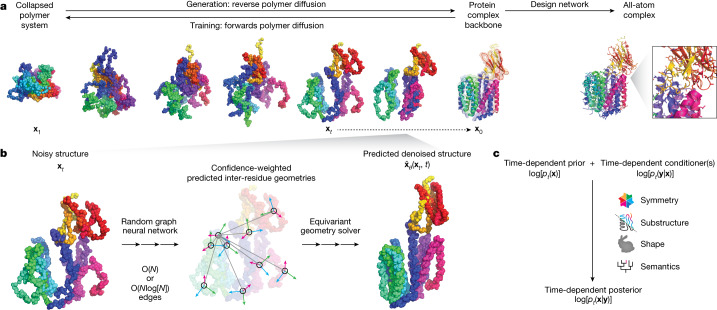
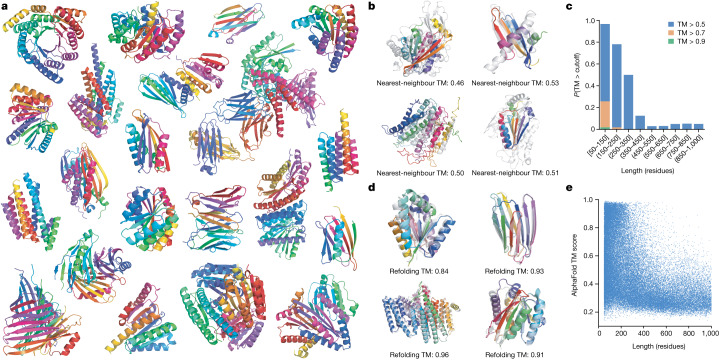
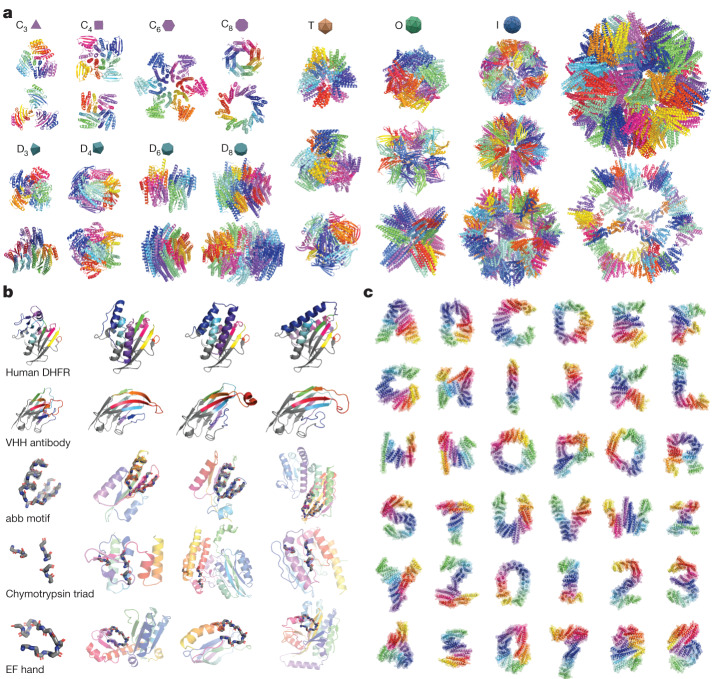
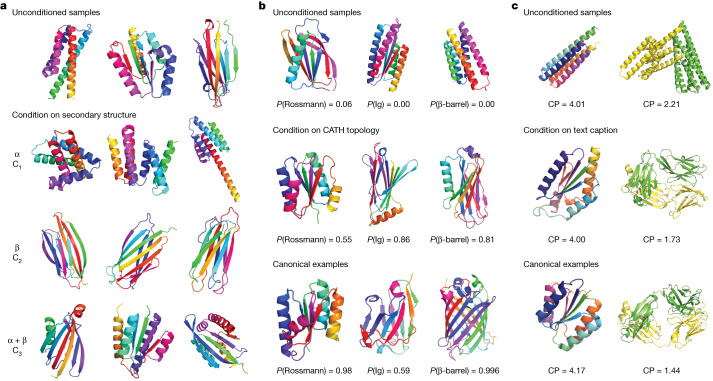
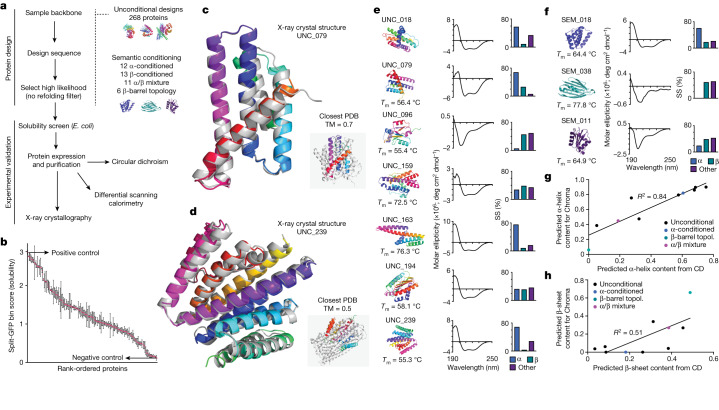
Three billion years of evolution has produced a tremendous diversity of protein molecules 1 , but the full potential of proteins is likely to be much greater. Accessing this potential has been challenging for both computation and experiments because the space of possible protein molecules is much larger than the space of those likely to have functions. Here we introduce Chroma, a generative model for proteins and protein complexes that can directly sample novel protein structures and sequences, and that can be conditioned to steer the generative process towards desired properties and functions. To enable this, we introduce a diffusion process that respects the conformational statistics of polymer ensembles, an efficient neural architecture for molecular systems that enables long-range reasoning with sub-quadratic scaling, layers for efficiently synthesizing three-dimensional structures of proteins from predicted inter-residue geometries and a general low-temperature sampling algorithm for diffusion models. Chroma achieves protein design as Bayesian inference under external constraints, which can involve symmetries, substructure, shape, semantics and even natural-language prompts. The experimental characterization of 310 proteins shows that sampling from Chroma results in proteins that are highly expressed, fold and have favourable biophysical properties. The crystal structures of two designed proteins exhibit atomistic agreement with Chroma samples (a backbone root-mean-square deviation of around 1.0 Å). With this unified approach to protein design, we hope to accelerate the programming of protein matter to benefit human health, materials science and synthetic biology.
Overview
The claims and statistics of this paper haven’t been checked yet.
Run the check — free, no account needed. It reads the open-access text and checks the sources it cites.
Integrity signals
Registry
Cites
Statistics
Figures
Verification
Claims the paper makes
The claims and statistics of this paper haven’t been checked yet.
Run the check — free, no account needed. It reads the open-access text and checks the sources it cites.
Self-check
Percentages, sums and reported differences re-computed from the paper’s own numbers.
The self-check needs the paper’s full text.
Citations
Cites
Highly accurate protein structure prediction with AlphaFold
Jumper, J., Evans, R., Pritzel, A., Green, T., Figurnov, M., Ronneberger, O., Tunyasuvunakool, K., Bates, R., Žídek, A., Potapenko, A., et al. (2021) · Nature · doi:10.1038/s41586-021-03819-2 · Cited by 43,764
UMAP: Uniform Manifold Approximation and Projection
McInnes, L., Healy, J., Saul, N., & Großberger, L. (2018) · Journal of Open Source Software · doi:10.21105/joss.00861 · Cited by 9,826 · cited 3×
“13, we present samples from Chroma and a set of native structures with global topology descriptors derived from knot theory 43,44 and embed them into two dimensions with UMAP 45 .”
BackgroundMethodDenoising Diffusion Probabilistic Models
Ho, J., Jain, A., & Abbeel, P. (2020) · arXiv · doi:10.48550/arxiv.2006.11239 · Cited by 8,712
UniProt: the universal protein knowledgebase in 2021
The UniProt Consortium, Bateman, A., Martin, M.-J., Orchard, S., Magrane, M., Agivetova, R., Ahmad, S., Alpi, E., Bowler-Barnett, E. H., Britto, R., et al. (2021) · Nucleic Acids Research · doi:10.1093/nar/gkaa1100 · Cited by 6,372
Evolutionary-scale prediction of atomic level protein structure with a language model
Lin, Z., Akin, H., Rao, R., Hie, B., Zhu, Z., Lu, W., Smetanin, N., Verkuil, R., Kabeli, O., Shmueli, Y., et al. (2022) · doi:10.1101/2022.07.20.500902 · Cited by 5,990
TM-align: a protein structure alignment algorithm based on the TM-score
Zhang, Y. (2005) · Nucleic Acids Research · doi:10.1093/nar/gki524 · Cited by 3,774
A hierarchical O(N log N) force-calculation algorithm
Barnes, J., & Hut, P. (1986) · Nature · doi:10.1038/324446a0 · Cited by 3,733
Diffusion Models Beat GANs on Image Synthesis
Dhariwal, P., & Nichol, A. (2021) · arXiv · doi:10.48550/arxiv.2105.05233 · Cited by 3,362
Rives, A., Meier, J., Sercu, T., Goyal, S., Lin, Z., Liu, J., Guo, D., Ott, M., Zitnick, C. L., Ma, J., et al. (2021) · Proceedings of the National Academy of Sciences · doi:10.1073/pnas.2016239118 · Cited by 3,286
Rives, A., Meier, J., Sercu, T., Goyal, S., Lin, Z., Liu, J., Guo, D., Ott, M., Zitnick, C. L., Ma, J., et al. (2019) · doi:10.1101/622803 · Cited by 3,280
Research works printed but not linked: 6
- Ramesh, A., Dhariwal, P., Nichol, A., Chu, C. & Chen, M. Hierarchical text-conditional image generation with CLIP latents. Preprint at https://arxiv.org/abs/2204.06125 (2022). · arXiv
- Ingraham, J., Garg, V., Barzilay, R. & Jaakkola, T. Generative models for graph-based protein design. In Proc. Advances in Neural Information Processing Systems 32 (eds Wallach, H. et al.) (NeurIPS, 2019).
- Anand, N. & Huang, P.-S. Generative modeling for protein structures. In Proc. Advances in Neural Information Processing Systems 31 (eds Bengio, S. et al.) (NeurIPS, 2018).
- Lin, Z., Sercu, T., LeCun, Y. & Rives, A. Deep generative models create new and diverse protein structures. In Machine Learning in Structural Biology Workshop at the 35th Conference on Neural Information Processing Systems (MLSB, 2021).
- Gilmer, J., Schoenholz, S. S., Riley, P. F., Vinyals, O. & Dahl, G. E. Neural message passing for quantum chemistry. In Proc. 34th International Conference on Machine Learning (eds Precup, D. et al.) 1263–1272 (PMLR, 2017).
- Jing, B., Eismann, S., Suriana, P., Townshend, R. J. L. & Dror, R. Learning from protein structure with geometric vector perceptrons. In International Conference on Learning Representations (eds Hofmann, K. et al.) (OpenReview.net, 2021).
Cited by
Sorted by citations
De novo design of protein structure and function with RFdiffusion
Watson, J. L., Juergens, D., Bennett, N. R., Trippe, B. L., Yim, J., Eisenach, H. E., Ahern, W., Borst, A. J., Ragotte, R. J., Milles, L. F., et al. (2023) · Nature · doi:10.1038/s41586-023-06415-8 · Cited by 2,325
Generalized biomolecular modeling and design with RoseTTAFold All-Atom
Krishna, R., Wang, J., Ahern, W., Sturmfels, P., Venkatesh, P., Kalvet, I., Lee, G. R., Morey-Burrows, F. S., Anishchenko, I., Humphreys, I. R., et al. (2024) · Science · doi:10.1126/science.adl2528 · Cited by 978
Simulating 500 million years of evolution with a language model
Hayes, T., Rao, R., Akin, H., Sofroniew, N. J., Oktay, D., Lin, Z., Verkuil, R., Tran, V. Q., Deaton, J., Wiggert, M., et al. (2025) · Science · doi:10.1126/science.ads0018 · Cited by 937
Self-Driving Laboratories for Chemistry and Materials Science
Tom, G., Schmid, S. P., Baird, S. G., Cao, Y., Darvish, K., Hao, H., Lo, S., Pablo-García, S., Rajaonson, E. M., Skreta, M., et al. (2024) · Chemical Reviews · doi:10.1021/acs.chemrev.4c00055 · Cited by 707
Sequence modeling and design from molecular to genome scale with Evo
Nguyen, E., Poli, M., Durrant, M. G., Kang, B., Katrekar, D., Li, D. B., Bartie, L. J., Thomas, A. W., King, S. H., Brixi, G., et al. (2024) · Science · doi:10.1126/science.ado9336 · Cited by 580
Corso, G., Stark, H., Jegelka, S., Jaakkola, T., & Barzilay, R. (2024) · Nature Reviews Methods Primers · doi:10.1038/s43586-024-00294-7 · Cited by 530
De novo protein design—From new structures to programmable functions
Kortemme, T. (2024) · Cell · doi:10.1016/j.cell.2023.12.028 · Cited by 383
Atomic context-conditioned protein sequence design using LigandMPNN
Dauparas, J., Lee, G. R., Pecoraro, R. J., An, L., Anishchenko, I. V., Glasscock, C. J., & Baker, D. A. (2025) · Nature Methods · doi:10.1038/s41592-025-02626-1 · Cited by 341
Machine learning for functional protein design
Notin, P., Rollins, N. J., Gal, Y., Sander, C., & Marks, D. S. (2024) · Nature Biotechnology · doi:10.1038/s41587-024-02127-0 · Cited by 304
A review of large language models and autonomous agents in chemistry
Ramos, M. C., Collison, C. J., & White, A. D. (2025) · Chemical Science · doi:10.1039/d4sc03921a · Cited by 274
Opportunities and challenges in design and optimization of protein function
Listov, D., Goverde, C. A., Correia, B. E., & Fleishman, S. J. (2024) · Nature Reviews Molecular Cell Biology · doi:10.1038/s41580-024-00718-y · Cited by 212
Computational and artificial intelligence-based methods for antibody development
Kim, J., McFee, M., Fang, Q., Abdin, O., & Kim, P. M. (2023) · Trends in Pharmacological Sciences · doi:10.1016/j.tips.2022.12.005 · Cited by 178
State-specific protein–ligand complex structure prediction with a multiscale deep generative model
Qiao, Z., Nie, W., Vahdat, A., Miller, T. F., & Anandkumar, A. (2024) · Nature Machine Intelligence · doi:10.1038/s42256-024-00792-z · Cited by 210
Unsupervised evolution of protein and antibody complexes with a structure-informed language model
Shanker, V. R., Bruun, T. U. J., Hie, B., & Kim, P. S. (2024) · Science · doi:10.1126/science.adk8946 · Cited by 174
Diffusion models in bioinformatics and computational biology
Guo, Z., Liu, J., Wang, Y., Chen, M., Wang, D., Xu, D., & Cheng, J. (2023) · Nature Reviews Bioengineering · doi:10.1038/s44222-023-00114-9 · Cited by 193
AI-Driven Deep Learning Techniques in Protein Structure Prediction
Chen, L., Li, Q., Nasif, K. F. A., Xie, Y., Deng, B., Niu, S., Pouriyeh, S., Dai, Z., Chen, J., & Xie, Y. (2024) · International Journal of Molecular Sciences · doi:10.3390/ijms25158426 · Cited by 152
Multistate and functional protein design using RoseTTAFold sequence space diffusion
Lisanza, S. L., Gershon, J. M., Tipps, S. W. K., Sims, J. N., Arnoldt, L., Hendel, S. J., Simma, M. K., Liu, G., Yase, M., Wu, H., et al. (2024) · Nature Biotechnology · doi:10.1038/s41587-024-02395-w · Cited by 189
Sparks of function by de novo protein design
Chu, A. E., Lu, T., & Huang, P. (2024) · Nature Biotechnology · doi:10.1038/s41587-024-02133-2 · Cited by 131
Markus, B., Gruber Christian, C., Andreas, K., Kummer, A., Stefan, L., Oberdorfer, G., Elina, S., & Šnajdrová, R. (2023) · ACS Catalysis · doi:10.1021/acscatal.3c03417 · Cited by 121
A new age in protein design empowered by deep learning
Khakzad, H., Igashov, I., Schneuing, A., Goverde, C. A., Bronstein, M. M., & Correia, B. E. (2023) · Cell Systems · doi:10.1016/j.cels.2023.10.006 · Cited by 121
Ghafarollahi, A., & Buehler, M. J. (2024) · Digital Discovery · doi:10.1039/d4dd00013g · Cited by 167
Protein codes promote selective subcellular compartmentalization
Kilgore, H. R., Chinn, I., Mikhael, P. G., Mitnikov, I., Van Dongen, C., Zylberberg, G., Afeyan, L., Banani, S. F., Wilson-Hawken, S., Lee, T. I., et al. (2025) · Science · doi:10.1126/science.adq2634 · Cited by 99
An all-atom protein generative model
Chu, A. E., Kim, J., Cheng, L., Nesr, G. E., Xu, M., Shuai, R. W., & Huang, P. (2024) · Proceedings of the National Academy of Sciences · doi:10.1073/pnas.2311500121 · Cited by 104
Ni, B., Kaplan, D. L., & Buehler, M. J. (2023) · Chem · doi:10.1016/j.chempr.2023.03.020 · Cited by 92
Koh, H. Y., Zheng, Y., Yang, M., Arora, R., Webb, G. I., Pan, S., Li, L., & Church, G. M. (2025) · Nature Reviews Bioengineering · doi:10.1038/s44222-025-00349-8 · Cited by 117
BoltzGen: Toward Universal Binder DesignPreprint
Stark, H., Faltings, F., Choi, M., Xie, Y., Hur, E., O’Donnell, T. J., Bushuiev, A., Uçar, T., Passaro, S., Mao, W., et al. (2025) · bioRxiv (Cold Spring Harbor Laboratory) · doi:10.1101/2025.11.20.689494 · Cited by 153
Generative artificial intelligence for de novo protein design
Winnifrith, A., Outeiral, C., & Hie, B. (2024) · Current Opinion in Structural Biology · doi:10.1016/j.sbi.2024.102794 · Cited by 103
Scalable protein design using optimization in a relaxed sequence space
Frank, C., Khoshouei, A., Fuβ, L., Schiwietz, D., Putz, D., Weber, L., Zhao, Z., Hattori, M., Feng, S., de Stigter, Y., et al. (2024) · Science · doi:10.1126/science.adq1741 · Cited by 88
Unlocking de novo antibody design with generative artificial intelligencePreprint
Shanehsazzadeh, A., McPartlon, M., Kasun, G. W., Steiger, A. K., Sutton, J. M., Yassine, E., McCloskey, C. M., Haile, R. G., Shuai, R. W., Alverio, J., et al. (2023) · bioRxiv (Cold Spring Harbor Laboratory) · doi:10.1101/2023.01.08.523187 · Cited by 87
CD19 CAR antigen engagement mechanisms and affinity tuning
He, C., Mansilla‐Soto, J., Khanra, N., Hamieh, M., Bustos, V., Paquette, A. J., Angus, A. G., Shore, D. M., Rice, W. J., Khelashvili, G., et al. (2023) · Science Immunology · doi:10.1126/sciimmunol.adf1426 · Cited by 83
Deep learning generative model for crystal structure prediction
Luo, X., Wang, Z., Gao, P., Lv, J., Wang, Y., Chen, C., & Ma, Y. (2024) · npj Computational Materials · doi:10.1038/s41524-024-01443-y · Cited by 96
Comprehensive evaluation of the capacities of microbial cell factories
Kim, G. B., Kim, H. R., & Lee, S. Y. (2025) · Nature Communications · doi:10.1038/s41467-025-58227-1 · Cited by 82
Guarra, F., & Colombo, G. (2023) · Journal of Chemical Theory and Computation · doi:10.1021/acs.jctc.3c00513 · Cited by 82
Diffusion models in protein structure and docking
Yim, J., Stärk, H., Corso, G., Jing, B., Barzilay, R., & Jaakkola, T. (2024) · Wiley Interdisciplinary Reviews Computational Molecular Science · doi:10.1002/wcms.1711 · Cited by 87
Deep learning for cross-region streamflow and flood forecasting at a global scale
Zhang, B., Ouyang, C., Cui, P., Xu, Q., Wang, D., Fei, Z., Li, Z., Fan, L., Lovati, M., Liu, Y., et al. (2024) · The Innovation · doi:10.1016/j.xinn.2024.100617 · Cited by 77
De novo design of drug-binding proteins with predictable binding energy and specificity
Lü, L., Gou, X., Tan, S. K., Mann, S. I., Yang, H., Zhong, X., Gazgalis, D., Valdiviezo, J., Jo, H., Wu, Y., et al. (2024) · Science · doi:10.1126/science.adl5364 · Cited by 78
A survey of geometric graph neural networks: data structures, models and applications
Han, J., Cen, J., Wu, L., Li, Z., Kong, X., Jiao, R., Yu, Z., Xu, T., Wu, F., Wang, Z., et al. (2025) · Frontiers of Computer Science · doi:10.1007/s11704-025-41426-w · Cited by 104
Harnessing generative AI to decode enzyme catalysis and evolution for enhanced engineering
Xie, W. J., & Warshel, A. (2023) · National Science Review · doi:10.1093/nsr/nwad331 · Cited by 69
Computer-Aided Drug Discovery for Undruggable Targets
Sun, Q., Wang, H., Xie, J., Wang, L., Mu, J., Li, J., Ren, Y., & Lai, L. (2025) · Chemical Reviews · doi:10.1021/acs.chemrev.4c00969 · Cited by 72
CodonTransformer: a multispecies codon optimizer using context-aware neural networks
Fallahpour, A., Gureghian, V., Filion, G. J. P., Lindner, A. B., & Pandi, A. (2025) · Nature Communications · doi:10.1038/s41467-025-58588-7 · Cited by 70
Generative models for protein sequence modeling: recent advances and future directions
Mardikoraem, M., Wang, Z., Pascual, N., & Woldring, D. (2023) · Briefings in Bioinformatics · doi:10.1093/bib/bbad358 · Cited by 61
Revolutionizing protein–protein interaction prediction with deep learning
Zhang, J., Durham, J., & Cong, Q. (2024) · Current Opinion in Structural Biology · doi:10.1016/j.sbi.2024.102775 · Cited by 58
Code to complex: AI-driven de novo binder design
Fox, D., Taveneau, C., Clement, J., Grinter, R., & Knott, G. J. (2025) · Structure · doi:10.1016/j.str.2025.08.007 · Cited by 62
A text-guided protein design framework
Liu, S., Li, Y., Li, Z., Gitter, A., Zhu, Y., Lu, J., Xu, Z., Nie, W., Ramanathan, A., Xiao, C., et al. (2025) · Nature Machine Intelligence · doi:10.1038/s42256-025-01011-z · Cited by 97
Responsible AI in biotechnology: balancing discovery, innovation and biosecurity risks
Wheeler, N. E. (2025) · Frontiers in Bioengineering and Biotechnology · doi:10.3389/fbioe.2025.1537471 · Cited by 63
Kæstel-Hansen, J., de Sautu, M., Saminathan, A., Scanavachi, G., Bango Da Cunha Correia, R. F., Juma Nielsen, A., Bleshøy, S. V., Tsolakidis, K., Boomsma, W., Kirchhausen, T., et al. (2025) · Nature Methods · doi:10.1038/s41592-025-02665-8 · Cited by 51
Generative design of novel bacteriophages with genome language modelsPreprint
King, S. H., Driscoll, C. L., Li, D. B., Guo, D., Merchant, A. T., Brixi, G., Wilkinson, M. E., & Hie, B. (2025) · bioRxiv (Cold Spring Harbor Laboratory) · doi:10.1101/2025.09.12.675911 · Cited by 50
Target-Specific De Novo Peptide Binder Design with DiffPepBuilder
Wang, F., Wang, Y. X., Feng, L., Zhang, C., & Lai, L. (2024) · Journal of Chemical Information and Modeling · doi:10.1021/acs.jcim.4c00975 · Cited by 53
Liu, Y., Wang, S., Dong, J., Chen, L.-H., Wang, X., Wang, L., Li, F., Wang, C., Zhang, J., Wang, Y., et al. (2024) · Nature Methods · doi:10.1038/s41592-024-02437-w · Cited by 55
The Nobel Prize in Chemistry: past, present, and future of AI in biology
Abriata, L. A. (2024) · Communications Biology · doi:10.1038/s42003-024-07113-5 · Cited by 49
The design and engineering of synthetic genomes
James, J. S., Dai, J., Chew, W. L., & Cai, Y. (2024) · Nature Reviews Genetics · doi:10.1038/s41576-024-00786-y · Cited by 52
Dual-use capabilities of concern of biological AI models
Pannu, J., Bloomfield, D., MacKnight, R., Hanke, M. S., Zhu, A. W., Gomes, G., Cicero, A. J., & Inglesby, T. V. (2025) · PLoS Computational Biology · doi:10.1371/journal.pcbi.1012975 · Cited by 66
Zero-shot antibody design in a 24-well platePreprint
Chai Discovery Team, Boitreaud, J., Dent, J., Geisz, D., McPartlon, M., Meier, J., Qiao, Z., Rogozhnikov, A., Rollins, N., Wollenhaupt, P., et al. (2025) · bioRxiv (Cold Spring Harbor Laboratory) · doi:10.1101/2025.07.05.663018 · Cited by 56
Ma, B., Liu, D., Wang, Z., Zhang, D., Jian, Y., Zhang, K., Zhou, T., Gao, Y., Fan, Y., Ma, J., et al. (2024) · Journal of Medicinal Chemistry · doi:10.1021/acs.jmedchem.4c00828 · Cited by 52
Scaling Unlocks Broader Generation and Deeper Functional Understanding of Proteins
Bhatnagar, A., Jain, S., Beazer, J., Curran, S. C., Hoffnagle, A. M., Ching, K., Martyn, M., Nayfach, S., Ruffolo, J. A., & Madani, A. (2025) · neural information processing systems · doi:10.52202/085713-1536 · Cited by 55
SciToolAgent: a knowledge-graph-driven scientific agent for multitool integration
Ding, K., Yu, J., Huang, J., Yang, Y., Zhang, Q., & Chen, H. (2025) · Nature Computational Science · doi:10.1038/s43588-025-00849-y · Cited by 73
Peptide-based drug design using generative AI
Ekambaram, S., & Dokholyan, N. V. (2025) · Chemical Communications · doi:10.1039/d5cc04998a · Cited by 53
Generative artificial intelligence for enzyme design: Recent advances in models and applications
Wen, S., Zheng, W., Bornscheuer, U. T., & Wu, S. (2025) · Current Opinion in Green and Sustainable Chemistry · doi:10.1016/j.cogsc.2025.101010 · Cited by 47
AI-driven de novo enzyme design: Strategies, applications, and future prospects
Cui, X.-C., Zheng, Y., Liu, Y., Yuchi, Z., & Yuan, Y. (2025) · Biotechnology Advances · doi:10.1016/j.biotechadv.2025.108603 · Cited by 44
Rapid and automated design of two-component protein nanomaterials using ProteinMPNN
de Haas, R. J., Brunette, N., Goodson, A., Dauparas, J., Yi, S. Y., Yang, E. C., Dowling, Q., Nguyen, H., Kang, A., Bera, A. K., et al. (2024) · Proceedings of the National Academy of Sciences · doi:10.1073/pnas.2314646121 · Cited by 42
Applications of artificial intelligence to lipid nanoparticle delivery
Yuan, Y., Wu, Y., Cheng, J., Yang, K., Xia, Y., Wu, H., & Pan, X. (2023) · Particuology · doi:10.1016/j.partic.2023.11.014 · Cited by 43
AI models for protein design are driving antibody engineering
Chungyoun, M., & Gray, J. J. (2023) · Current Opinion in Biomedical Engineering · doi:10.1016/j.cobme.2023.100473 · Cited by 40
Seven technologies to watch in 2024
Eisenstein, M. S. (2024) · Nature · doi:10.1038/d41586-024-00173-x · Cited by 43
Jin, S., Zeng, Z., Xiong, X., Huang, B., Tang, L., Wang, H., Ma, X., Tang, X., Shao, G., Huang, X., et al. (2025) · Communications Biology · doi:10.1038/s42003-025-08282-7 · Cited by 43
Predicting absolute protein folding stability using generative models
Cagiada, M., Ovchinnikov, S., & Lindorff‐Larsen, K. (2024) · Protein Science · doi:10.1002/pro.5233 · Cited by 38
AI for organic and polymer synthesis
Hong, X., Yang, Q., Liao, K., Pei, J., Chen, M., Mo, F., Lu, H., Zhang, W.-B., Zhou, H., Chen, J., et al. (2024) · Science China Chemistry · doi:10.1007/s11426-024-2072-4 · Cited by 41
XU, S. L., Chen, Z., Qin, M., Cai, B., Li, W., Zhu, R., Xu, C. G., & Xiang, X. ‐. (2024) · npj Computational Materials · doi:10.1038/s41524-024-01386-4 · Cited by 45
Electron flow matching for generative reaction mechanism prediction
Joung, J. F., Fong, M. H., Casetti, N., Liles, J. P., Dassanayake, N. S., & Coley, C. W. (2025) · Nature · doi:10.1038/s41586-025-09426-9 · Cited by 58
Wang, J., Watson, J. L., & Lisanza, S. L. (2024) · Cold Spring Harbor Perspectives in Biology · doi:10.1101/cshperspect.a041472 · Cited by 43
Advances in stress-tolerance elements for microbial cell factories
Kuang, Z., Yan, X., Yuan, Y., Wang, R., Zhu, H., Wang, Y., Li, J., Ye, J., Yue, H., & Yang, X. (2024) · Synthetic and Systems Biotechnology · doi:10.1016/j.synbio.2024.06.008 · Cited by 37
AI approaches for the discovery and validation of drug targets
Wenteler, A., Cabrera, C., Wei, W., Neduva, V., & Barnes, M. R. (2024) · Cambridge Prisms Precision Medicine · doi:10.1017/pcm.2024.4 · Cited by 38
Simultaneous enhancement of multiple functional properties using evolution-informed protein design
Fram, B., Su, Y., Truebridge, I., Riesselman, A. J., Ingraham, J. B., Passera, A., Napier, E., Thadani, N. N., Lim, S., Roberts, K., et al. (2024) · Nature Communications · doi:10.1038/s41467-024-49119-x · Cited by 34
Self-citationKim, D. N., McNaughton, A. D., & Kumar, N. (2024) · Bioengineering · doi:10.3390/bioengineering11020185 · Cited by 35
Protein‐Based Controllable Nanoarchitectonics for Desired Applications
Li, L., Zhang, Y., Wu, Y., Wang, Z., Cui, W., Zhang, C., Wang, J., Liu, Y., & Yang, P. (2024) · Advanced Functional Materials · doi:10.1002/adfm.202315509 · Cited by 31
Accurate and robust protein sequence design with CarbonDesign
Ren, M., Yu, C., Bu, D., & Zhang, H. (2024) · Nature Machine Intelligence · doi:10.1038/s42256-024-00838-2 · Cited by 30
Artificial Intelligence Technology Assists Enzyme Prediction and Rational Design
Wang, Y., Han, S., Wang, Y., Liang, Q., & Luo, W. (2025) · Journal of Agricultural and Food Chemistry · doi:10.1021/acs.jafc.4c13201 · Cited by 29
Design of linear and cyclic peptide binders from protein sequence information
Li, Q., Vlachos, E. N., & Bryant, P. (2025) · Communications Chemistry · doi:10.1038/s42004-025-01601-3 · Cited by 46
Peptide design through binding interface mimicry with PepMimic
(2025) · doi:10.1038/s41551-025-01507-4 · Cited by 30
Generative models for protein structures and sequences
Hsu, C., Fannjiang, C., & Listgarten, J. (2024) · Nature Biotechnology · doi:10.1038/s41587-023-02115-w · Cited by 32
Space group informed transformer for crystalline materials generation
Cao, Z., Luo, X., Lv, J., & Wang, L. (2025) · 中国科学通报:英文版 · doi:10.1016/j.scib.2025.09.035 · Cited by 81
Learning Joint 2-D and 3-D Graph Diffusion Models for Complete Molecule Generation
Huang, H. K., Sun, L., Du, B., & Lyu, W. (2024) · IEEE Transactions on Neural Networks and Learning Systems · doi:10.1109/tnnls.2024.3416328 · Cited by 69
gRNAde: Geometric Deep Learning for 3D RNA inverse designPreprint
Joshi, C. K., Jamasb, A. R., Viñas, R., Harris, C., Mathis, S. V., Morehead, A., Anand, R., & Lió, P. (2024) · bioRxiv (Cold Spring Harbor Laboratory) · doi:10.1101/2024.03.31.587283 · Cited by 37
Protein Language Models: Is Scaling Necessary?Preprint
Fournier, Q., Vernon, R. M., van der Sloot, A. M., Schulz, B., Chandar, S., & LANGMEAD, C. J. (2024) · bioRxiv (Cold Spring Harbor Laboratory) · doi:10.1101/2024.09.23.614603 · Cited by 42
Gao, H., Guan, F.-F., Luo, B.-Y., Zhang, D., Liu, W., Shen, Y., Fan, L., Xu, G.-Q., Wang, Y., Tu, T., et al. (2025) · Nature Communications · doi:10.1038/s41467-025-64378-y · Cited by 26
McCoy, K. M., Ackerman, M. E., & Grigoryan, G. (2024) · Protein Science · doi:10.1002/pro.5127 · Cited by 27
Self-citationHarnessing hyperaccumulator plants to recover technology‐critical metals: where are we at?
Rylott, E. L., & van der Ent, A. (2025) · New Phytologist · doi:10.1111/nph.20449 · Cited by 32
Artificial intelligence-driven computational methods for antibody design and optimization
Vecchietti, L. F., Wijaya, B. N., Armanuly, A., Hangeldiyev, B., Jung, H., Lee, S., Cha, M., & Kim, H. M. (2025) · mAbs · doi:10.1080/19420862.2025.2528902 · Cited by 32
From traditional to AI-driven: The evolution of intelligent enzyme engineering for biocatalysis
Lv, F., Zhang, J., You, S., & Qi, W. (2025) · Biotechnology Advances · doi:10.1016/j.biotechadv.2025.108788 · Cited by 31
ChromoGen: Diffusion model predicts single-cell chromatin conformations
Schuette, G., Lao, Z., & Zhang, B. (2025) · Science Advances · doi:10.1126/sciadv.adr8265 · Cited by 27
CryoDRGN-AI: neural ab initio reconstruction of challenging cryo-EM and cryo-ET datasets
Levy, A., Raghu, R., Feathers, J. R., Grzadkowski, M., Poitevin, F., Johnston, J. D., Vallese, F., Clarke, O. B., Wetzstein, G., & Zhong, E. D. (2025) · Nature Methods · doi:10.1038/s41592-025-02720-4 · Cited by 25
IgGM: A Generative Model for Functional Antibody and Nanobody DesignPreprint
Wang, R., Wu, F., Gao, X., Wu, J., Zhao, P., & Yao, J. (2024) · bioRxiv (Cold Spring Harbor Laboratory) · doi:10.1101/2024.09.19.613838 · Cited by 27
AI-driven antibody design with generative diffusion models: current insights and future directions
He, X., Li, J.-R., Xu, J., Shan, H., Shen, S.-Y., Gao, S.-H., & Xu, H. E. (2024) · Acta Pharmacologica Sinica · doi:10.1038/s41401-024-01380-y · Cited by 28
Reading the repertoire: Progress in adaptive immune receptor analysis using machine learning
O’Donnell, T. J., Kanduri, C., Isacchini, G., Limenitakis, J. P., Brachman, R. A., Alvarez, R. A., Haff, I. H., Sandve, G. K., & Greiff, V. (2024) · Cell Systems · doi:10.1016/j.cels.2024.11.006 · Cited by 24
Generative AI for the Design of Molecules: Advances and Challenges
Sun, Y., Chen, L., Jing, Z., Li, Y. Y., Kim, D., Gao, J.-Y., Noroozi, R., Yi, G. Y., Feugmo, C. G. T., Klinkova, A., et al. (2025) · Journal of Chemical Information and Modeling · doi:10.1021/acs.jcim.5c02234 · Cited by 29
Generative AI for graph-based drug design: Recent advances and the way forward
Garg, V. (2024) · Current Opinion in Structural Biology · doi:10.1016/j.sbi.2023.102769 · Cited by 26
Rationally seeded computational protein design of ɑ-helical barrels
Albanese, K. I., Petrenas, R., Pirro, F., Naudin, E. A., Borucu, U., Dawson, W., Scott, D. A., Leggett, G. J., Weiner, O. D., Oliver, T. A. A., et al. (2024) · Nature Chemical Biology · doi:10.1038/s41589-024-01642-0 · Cited by 30
Emerging frontiers in protein structure prediction following the AlphaFold revolution
Rennie, M. L., & Oliver, M. R. (2025) · Journal of The Royal Society Interface · doi:10.1098/rsif.2024.0886 · Cited by 34
Bond-centric modular design of protein assemblies
Wang, S., Favor, A., Kibler, R. D., Lubner, J. M., Borst, A. J., Coudray, N., Redler, R. L., Chiang, H. T., Sheffler, W., Hsia, Y., et al. (2025) · Nature Materials · doi:10.1038/s41563-025-02297-5 · Cited by 22
Metadata
- Authors
- Ingraham, J. B., Baranov, M., Costello, Z., Barber, K. W., Wang, W., Ismail, A., Frappier, V., Lord, D. M., Ng-Thow-Hing, C., Van Vlack, E. R., Tie, S., Xue, V., Cowles, S. C., Leung, A., Rodrigues, J. V., Morales-Perez, C. L., Ayoub, A. M., Green, R., Puentes, K., Oplinger, F., Panwar, N. V., Obermeyer, F., Root, A. R., Beam, A. L., Poelwijk, F. J., & Grigoryan, G.
- Corresponding author
- Grigoryan, Gevorg
- ORCID
- Venue
- Nature
- Published
- 2023-11-15
- Volume
- 623
- Issue
- 7989
- Pages
- 1070-1078
- ISSN
- 0028-0836 (ISSN-L)
- 1476-4687
- PMC
- PMC10686827
- OpenAlex
- W4388694364
- Cited by
- 444
- References
- 45
- Citations by year
- 2026: 152 · 2025: 147 · 2024: 125 · 2023: 20
- FWCI
- 39.56
- Type
- journal article
- Language
- en
- Open access
- hybrid
- doi.org
- Locations
- Nature (publishedVersion, cc-by)
- PubMed Central (publishedVersion, cc-by)
- PubMed (publishedVersion)
- Topics
- Life Sciences › Biochemistry, Genetics and Molecular Biology › Molecular Biology › Protein Structure and Dynamics
- Life Sciences › Biochemistry, Genetics and Molecular Biology › Molecular Biology › Machine Learning in Bioinformatics
- Life Sciences › Pharmacology, Toxicology and Pharmaceutics › Drug Discovery › Computational Drug Discovery Methods
- Keywords
- protein design, generative models, diffusion models, protein complexes, protein structure prediction, Bayesian inference, protein folding, natural language prompts, color intensity
- MeSH terms
- Machine Learning, Algorithms, Bayes Theorem, Computer Simulation, Humans, Models, Molecular, Protein Conformation, Proteins, Semantics, Protein Folding, Directed Molecular Evolution, Synthetic Biology
About these checks
Registry, retraction, Cites and statistics results are computed, not judged, with one exception: a printed reference that no index lists is read once by a model before it counts as a citation error. Claims are extracted by a model and kept only when their quote appears verbatim in the text; each cited source is then checked, with a model’s help, for whether it says what the claim relies on. Those verdicts can be wrong — read the claim’s quote and the cited source before relying on one.
Statistics and arithmetic are recomputed, not judged.
Confidence bands are shown only for fields calibrated on our annotated test set. None is calibrated yet, so no band is shown.
What counts as a claim ›How we measure confidence ›How we check this ›
Are you an author, or do you see a problem with this page? Request a review
