

The DOI matches its Crossref record; 54 of the 54 references it cites were found in a registry or an index.
Illuminating protein space with a programmable generative model
Open accessPublished version of a preprint
Abstract
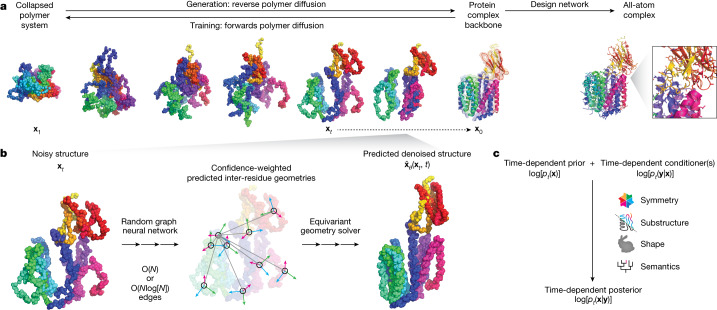
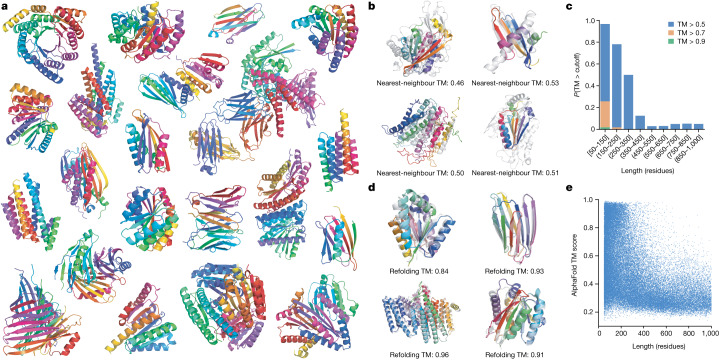
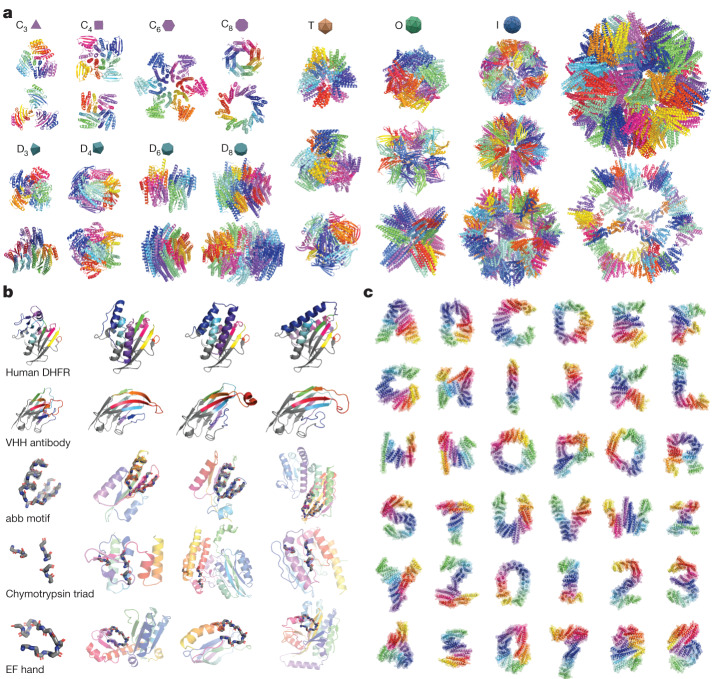
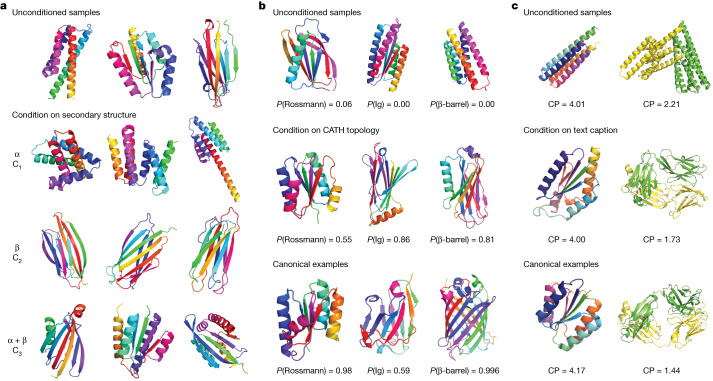
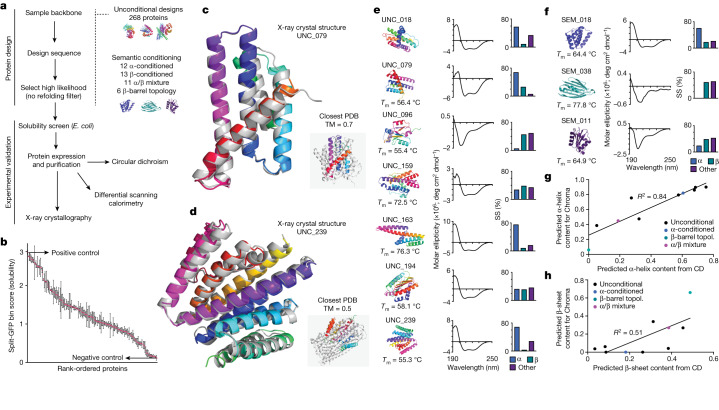
Three billion years of evolution has produced a tremendous diversity of protein molecules 1 , but the full potential of proteins is likely to be much greater. Accessing this potential has been challenging for both computation and experiments because the space of possible protein molecules is much larger than the space of those likely to have functions. Here we introduce Chroma, a generative model for proteins and protein complexes that can directly sample novel protein structures and sequences, and that can be conditioned to steer the generative process towards desired properties and functions. To enable this, we introduce a diffusion process that respects the conformational statistics of polymer ensembles, an efficient neural architecture for molecular systems that enables long-range reasoning with sub-quadratic scaling, layers for efficiently synthesizing three-dimensional structures of proteins from predicted inter-residue geometries and a general low-temperature sampling algorithm for diffusion models. Chroma achieves protein design as Bayesian inference under external constraints, which can involve symmetries, substructure, shape, semantics and even natural-language prompts. The experimental characterization of 310 proteins shows that sampling from Chroma results in proteins that are highly expressed, fold and have favourable biophysical properties. The crystal structures of two designed proteins exhibit atomistic agreement with Chroma samples (a backbone root-mean-square deviation of around 1.0 Å). With this unified approach to protein design, we hope to accelerate the programming of protein matter to benefit human health, materials science and synthetic biology.
Overview
The claims and statistics of this paper haven’t been checked yet.
Run the check — free, no account needed. It reads the open-access text and checks the sources it cites.
Integrity signals
Registry
Cites
Statistics
Figures
Verification
Claims the paper makes
The claims and statistics of this paper haven’t been checked yet.
Run the check — free, no account needed. It reads the open-access text and checks the sources it cites.
Self-check
Percentages, sums and reported differences re-computed from the paper’s own numbers.
The self-check needs the paper’s full text.
Citations
Cites
Highly accurate protein structure prediction with AlphaFold
Jumper, J., Evans, R., Pritzel, A., Green, T., Figurnov, M., Ronneberger, O., Tunyasuvunakool, K., Bates, R., Žídek, A., Potapenko, A., et al. (2021) · Nature · doi:10.1038/s41586-021-03819-2 · Cited by 43,764
UMAP: Uniform Manifold Approximation and Projection
McInnes, L., Healy, J., Saul, N., & Großberger, L. (2018) · Journal of Open Source Software · doi:10.21105/joss.00861 · Cited by 9,826 · cited 3×
“13, we present samples from Chroma and a set of native structures with global topology descriptors derived from knot theory 43,44 and embed them into two dimensions with UMAP 45 .”
BackgroundMethodDenoising Diffusion Probabilistic Models
Ho, J., Jain, A., & Abbeel, P. (2020) · arXiv · doi:10.48550/arxiv.2006.11239 · Cited by 8,712
UniProt: the universal protein knowledgebase in 2021
The UniProt Consortium, Bateman, A., Martin, M.-J., Orchard, S., Magrane, M., Agivetova, R., Ahmad, S., Alpi, E., Bowler-Barnett, E. H., Britto, R., et al. (2021) · Nucleic Acids Research · doi:10.1093/nar/gkaa1100 · Cited by 6,372
Evolutionary-scale prediction of atomic level protein structure with a language model
Lin, Z., Akin, H., Rao, R., Hie, B., Zhu, Z., Lu, W., Smetanin, N., Verkuil, R., Kabeli, O., Shmueli, Y., et al. (2022) · doi:10.1101/2022.07.20.500902 · Cited by 5,990
TM-align: a protein structure alignment algorithm based on the TM-score
Zhang, Y. (2005) · Nucleic Acids Research · doi:10.1093/nar/gki524 · Cited by 3,774
A hierarchical O(N log N) force-calculation algorithm
Barnes, J., & Hut, P. (1986) · Nature · doi:10.1038/324446a0 · Cited by 3,733
Diffusion Models Beat GANs on Image Synthesis
Dhariwal, P., & Nichol, A. (2021) · arXiv · doi:10.48550/arxiv.2105.05233 · Cited by 3,362
Rives, A., Meier, J., Sercu, T., Goyal, S., Lin, Z., Liu, J., Guo, D., Ott, M., Zitnick, C. L., Ma, J., et al. (2021) · Proceedings of the National Academy of Sciences · doi:10.1073/pnas.2016239118 · Cited by 3,286
Rives, A., Meier, J., Sercu, T., Goyal, S., Lin, Z., Liu, J., Guo, D., Ott, M., Zitnick, C. L., Ma, J., et al. (2019) · doi:10.1101/622803 · Cited by 3,280
Research works printed but not linked: 6
- Ramesh, A., Dhariwal, P., Nichol, A., Chu, C. & Chen, M. Hierarchical text-conditional image generation with CLIP latents. Preprint at https://arxiv.org/abs/2204.06125 (2022). · arXiv
- Ingraham, J., Garg, V., Barzilay, R. & Jaakkola, T. Generative models for graph-based protein design. In Proc. Advances in Neural Information Processing Systems 32 (eds Wallach, H. et al.) (NeurIPS, 2019).
- Anand, N. & Huang, P.-S. Generative modeling for protein structures. In Proc. Advances in Neural Information Processing Systems 31 (eds Bengio, S. et al.) (NeurIPS, 2018).
- Lin, Z., Sercu, T., LeCun, Y. & Rives, A. Deep generative models create new and diverse protein structures. In Machine Learning in Structural Biology Workshop at the 35th Conference on Neural Information Processing Systems (MLSB, 2021).
- Gilmer, J., Schoenholz, S. S., Riley, P. F., Vinyals, O. & Dahl, G. E. Neural message passing for quantum chemistry. In Proc. 34th International Conference on Machine Learning (eds Precup, D. et al.) 1263–1272 (PMLR, 2017).
- Jing, B., Eismann, S., Suriana, P., Townshend, R. J. L. & Dror, R. Learning from protein structure with geometric vector perceptrons. In International Conference on Learning Representations (eds Hofmann, K. et al.) (OpenReview.net, 2021).
Cited by
Sorted by citations
Items 401–447 of 447
Chou, C.-H., Hong, X., & Xu, J. (2026) · bioRxiv (Cold Spring Harbor Laboratory) · doi:10.64898/2026.05.11.724213
RetractedFourier vs. Attention: A Re-look at Protein Sequence Generation Models
Shah, R. R., Jawagal, R. K., Rajpurohit, S., Venkat, N., Achyuthan, N., & Das, B. (2026) · Communications in computer and information science · doi:10.1007/978-3-032-26028-4_2
Tools For Building Artificial Biological Nanostructures
Bradford, T. S., Hutchings, S., Liston, J. D., Pakosz, Z., Sanderson, A., Shaukat, A., Bentham, A. R., Lin, T., Stępień, P., & Heddle, J. G. (2026) · ACS Nano · doi:10.1021/acsnano.5c14315
Design and Structure of Protein Cages Based on Helical Fusion and Machine Learning
Segundo‐Acosta, P. S., Coq, J. L., Boskovic, J., Aglietti, R. A., Bowers, P., Yeates, T. O., & Castells‐Graells, R. (2026) · Journal of the American Chemical Society · doi:10.1021/jacs.6c11491
International perspectives on AI-driven pharmaceutical IP challenges
Wang, G. Y., Hao, J.-M., & Chen, J. (2026) · Frontiers in Digital Health · doi:10.3389/fdgth.2026.1774406
ComplexDesign: sequence-hallucination design of protein binders bridging multiple proteinsPreprint
Xu, J. Q., Ren, M., Qi, N., Zhang, X., He, Z., Yu, C., & Bu, D. (2026) · bioRxiv (Cold Spring Harbor Laboratory) · doi:10.64898/2026.06.21.733655 · Cited by 1
Coluzza, I. (2026) · Elsevier eBooks · doi:10.1016/b978-0-323-99507-8.00090-1
Expanding all-α-helical protein space through rational computational designPreprint
Albanese, K. I., Chubb, J. J., Gutierrez-Rus, L. I., Leng, X., Kurgan, K. W., Mylemans, B., Ożga, K., Petrenas, R., Romanyuk, A. V., Acevedo‐Jake, A. M., et al. (2026) · bioRxiv (Cold Spring Harbor Laboratory) · doi:10.64898/2026.07.03.736327
Automating De Novo Protein Design via LLM-Based Multi-agent Systems
Abdelaziz, K., Pester, A., Andres, F., & Mostafa, N. A. (2026) · Lecture notes in electrical engineering · doi:10.1007/978-3-032-20235-2_2
149Chapter 8 AI in Biomanufacturing: Unlocking Efficiency and Innovation
Sheikh, I., Saini, P., Ali, A., Yaqoob, S. I., Sharma, V., Sharma, A. V., Sharma, A. V., Bansal, P., Sharma, V., Sharma, J. K., et al. (2026) · De Gruyter eBooks · doi:10.1515/9783112214275-008
An, X., Li, F., Xia, C., Li, Y., Li, H., & Xie, F. (2026) · In Silico Pharmacology · doi:10.1007/s40203-026-00701-9
(2026) · Nature Computational Science · doi:10.1038/s43588-026-01031-8
PathFold: Predicting the Entire Protein Folding Pathway from Protein Sequence AlonePreprint
Zhang, Z., Ibtehaz, N., Kagaya, Y., Xu, Z., Punuru, P., & Kihara, D. (2026) · bioRxiv (Cold Spring Harbor Laboratory) · doi:10.64898/2026.08.26.747321
State-selective inhibition of alpha-synuclein aggregation by de novo oligomer-binding proteinsPreprint
Zhang, Y., Han, H. L., Ortigosa-Pascual, L., Miles, U. Z., Wei, J., Berkowicz, L. E., Snow, F., Tu, D., Meisl, G., Sansaria, S., et al. (2026) · bioRxiv (Cold Spring Harbor Laboratory) · doi:10.64898/2026.07.13.738012 · Cited by 1
CatIF-RL: Activity-Oriented Enzyme Sequence Design by Steered Inverse Protein Folding
Li, Y., Xiong, J., Zhang, Y., Cai, T., Fu, C., Li, S., Xu, W., Lyu, R., Chen, Z., Guo, Z., et al. (2026) · Journal of Chemical Information and Modeling · doi:10.1021/acs.jcim.6c01587 · Cited by 1
De Novo Design of Protein Nanopores: From Minimal Peptides to AI-Driven Design
Vorobieva, A. A., Samanta, R., & Thillo, T. V. (2026) · Chemical Reviews · doi:10.1021/acs.chemrev.5c00990
Explainable AI reveals the allosteric blind spot in protein-ligand binding predictions
Parikh, V., Foley, B., Gatlin, W., Ludwick, M., Turano, L., & Verkhivker, G. M. (2026) · Cell Reports Physical Science · doi:10.1016/j.xcrp.2026.103448 · Cited by 1
Li, W., Cadet, X. F., Medina-Ortiz, D., Davari, M. D., Sowdhamini, R., Bessafi, M., Damour, C., Li, Y., Miranville, A., de Brevern, A. G., et al. (2026) · International Journal of Molecular Sciences · doi:10.3390/ijms27167151
Yoon, H., Han, R., Kim, J.-W., & Lee, Y. (2026) · Briefings in Bioinformatics · doi:10.1093/bib/bbag421
Petrosyan, G., Altunyan, V., Ghukasyan, T., Abramyan, T. M., Arakelov, G., Davtyan, A., Aghajanyan, T., Nakipov, I., Navasardyan, G., Fahradyan, A., et al. (2026) · bioRxiv (Cold Spring Harbor Laboratory) · doi:10.64898/2026.08.03.742480
Hu, R.-E., & Ng, I. (2026) · Chemical Engineering Journal · doi:10.1016/j.cej.2026.180351
EnerBridge-DPO: Energy-Aware Markov Bridge Inverse Folding for Protein Sequence Design
Rong, D., Lu, H., Zhang, X., Zheng, W., Zhang, F., Zheng, S., & Liu, N. (2026) · Journal of Chemical Information and Modeling · doi:10.1021/acs.jcim.6c01697 · Cited by 4
Ma, B., Wang, Z., Jian, Y., Mi, Y., Chen, S., Hu, H., & Li, X. (2026) · Research · doi:10.34133/research.1420
Discovery and design of potent cell surface display elements
Fang, Z., Saskin, J., Lee, S.-H., Zou, C., Xin, S., Huang, X., Pan, X., Dong, C., Abiri, A., Feng, Y., et al. (2026) · Nature Biotechnology · doi:10.1038/s41587-026-03144-x
Random repeats open a route into folded protein space.
Murray, J. W. (2026) · Proceedings of the National Academy of Sciences of the United States of America · doi:10.1073/pnas.2620768123
Alternative Decomposed Message Passing for Efficient Geometric GNNs
TAŞCI, K., & Kuppannagari, S. R. (2026) · IEEE International Symposium on Parallel & Distributed Processing, Workshops and Phd Forum · doi:10.1109/ipdpsw71298.2026.00137
Universal pipeline for high-resolution GPCR structure determination
Kojima, A., Kawakami, K., Kobayashi, N., Kobayashi, K., Matsui, T. E., Uemoto, K., Gu, Y., Narita, T. J., Kugawa, M., Fukuda, M., et al. (2026) · Nature Structural & Molecular Biology · doi:10.1038/s41594-026-01869-6 · Cited by 2
Scalable Production of a De Novo SARS-CoV-2 Antiviral Miniprotein in Escherichia coli
Shin, J., Kim, E.-M., Jang, J.-H., Jee, S.-W., Kim, S.-H., Yu, S. G., Yoon, M., Craig, D., Swoyer, R., Patel, S., et al. (2026) · Pharmaceutics · doi:10.3390/pharmaceutics18091110
Extremozymes for food fermentation: Integrating AI, metagenomics, and protein engineering.
Ansari, S. K., Shah, N. H., Elboughdiri, N., Chaudhary, A., Ali, M. A. M., & Wani, A. K. (2026) · International Journal of Biological Macromolecules · doi:10.1016/j.ijbiomac.2026.154351
BAGEL-CAR: Reflections on the Bits to Binders CompetitionPreprint
Lála, J., & Angioletti‐Uberti, S. (2026) · bioRxiv (Cold Spring Harbor Laboratory) · doi:10.64898/2026.09.02.748856
Deep generative models in biological sequence and structure analysis and design
Palizban, F., Sarbishegi, M. M., Qu, H., Saeidian, A. H., Mehrmohamadi, M., Glessner, J., & Hakonarson, H. H. (2026) · Biotechnology Advances · doi:10.1016/j.biotechadv.2026.109039
Sinha, S. (2026) · Journal of Medicinal Chemistry · doi:10.1021/acs.jmedchem.6c00933
Recent advances in AI-driven biotherapeutic discovery using protein generative models
Kim, H., Lee, H., Song, J., & Lee, J. (2026) · Digital Discovery · doi:10.1039/d6dd00222f
Reconstructing hidden GPCR conformations and ligand binding modes through integrative DEER modeling.
Belyaeva, J., & Elgeti, M. (2026) · Structure · doi:10.1016/j.str.2026.09.003
Kitaygorodsky, A., Hostallero, D. E., Broom, A., Layne, E., Hwang, S., Kanawaty, A. K., Babej, T., Butterfoss, G. L., & Fingerhuth, M. (2026) · bioRxiv (Cold Spring Harbor Laboratory) · doi:10.64898/2026.09.23.753608
Artificial Intelligence for Therapeutic Peptide Discovery and Development
Ventura, S. (2026) · Biomolecules · doi:10.3390/biom16101445
Joint protein, mRNA and DNA sequence design and optimization with nucleotide-level Potts modelsPreprint
Banaszewski, B., Dornfeld, L., Chen, D., Borgwardt, K. M., & Milles, L. F. (2026) · bioRxiv (Cold Spring Harbor Laboratory) · doi:10.64898/2026.10.05.756407
De novo protein design in an expanded chemical spacePreprint
Li, Y., Jing, Y., Su, Y., Ren, W., Zhang, J., & Liu, T. (2026) · bioRxiv (Cold Spring Harbor Laboratory) · doi:10.64898/2026.10.08.757794
The rise of agentic AI in drug discovery from static tools to autonomous virtual scientists
Zhao, D., Fang, M., Mao, L., Zhu, Y., Su, Q., Shi, H., Xu, H., Li, L., Hou, T., & Hsieh, C.-Y. (2026) · npj Drug Discovery. · doi:10.1038/s44386-026-00075-0
Programming biological behavior with AI-guided de novo protein design
Huettemann, P., & Kortemme, T. (2026) · Molecular Cell · doi:10.1016/j.molcel.2026.08.027 · Cited by 2
Toward a lab-in-the-loop AI platform for RNA therapeutics
Li, G., & Li, B. (2026) · Cambridge Materials Health · doi:10.1017/s2978170126000038
Role of machine learning in drug discovery and therapeutic protein design
Ibrahim, S. (2026) · Elsevier eBooks · doi:10.1016/b978-0-443-44536-1.00014-6
Machine learning and artificial intelligence in protein design
Madala, B. P., & Kumar, R. (2026) · Elsevier eBooks · doi:10.1016/b978-0-443-44536-1.00013-4
DESIGN: a framework for generative AI-enabled crop molecular design-driven breeding
Xu, F., Fu, R., Cheng, Q., Jiang, S., Yan, J., & Wang, X. (2026) · Science China Life Sciences · doi:10.1007/s11427-025-3406-3 · Cited by 1
Reliable and Efficient Agentic Protein Design with Toolset HarnessingPreprint
Butcher, J., Chen, J., Hunt, A., Haas, C. M., Dai, W., Sharma, S., Mitra, R., Salike, S., Koob, J. G., Muraishi, A., et al. (2026) · bioRxiv (Cold Spring Harbor Laboratory) · doi:10.64898/2026.10.19.759896 · Cited by 2
Programmable design of functional proteins from natural language
Dai, F., You, S., Zhu, Y., Gao, Y., Fu, L., Zhou, X., Su, J., Wang, C., Fan, Y., Tan, Q., et al. (2026) · Nature · doi:10.1038/s41586-026-11205-z · Cited by 21
Liu, B., Liu, H., Jia, Y., He, J., Wang, Y., 姜海燕, Xue, Z., Guo, S., Zhu, Y., Kong, L., et al. (2026) · Marine Drugs · doi:10.3390/md24110375
Metadata
- Authors
- Ingraham, J. B., Baranov, M., Costello, Z., Barber, K. W., Wang, W., Ismail, A., Frappier, V., Lord, D. M., Ng-Thow-Hing, C., Van Vlack, E. R., Tie, S., Xue, V., Cowles, S. C., Leung, A., Rodrigues, J. V., Morales-Perez, C. L., Ayoub, A. M., Green, R., Puentes, K., Oplinger, F., Panwar, N. V., Obermeyer, F., Root, A. R., Beam, A. L., Poelwijk, F. J., & Grigoryan, G.
- Corresponding author
- Grigoryan, Gevorg
- ORCID
- Venue
- Nature
- Published
- 2023-11-15
- Volume
- 623
- Issue
- 7989
- Pages
- 1070-1078
- ISSN
- 0028-0836 (ISSN-L)
- 1476-4687
- PMC
- PMC10686827
- OpenAlex
- W4388694364
- Cited by
- 444
- References
- 45
- Citations by year
- 2026: 152 · 2025: 147 · 2024: 125 · 2023: 20
- FWCI
- 39.56
- Type
- journal article
- Language
- en
- Open access
- hybrid
- doi.org
- Locations
- Nature (publishedVersion, cc-by)
- PubMed Central (publishedVersion, cc-by)
- PubMed (publishedVersion)
- Topics
- Life Sciences › Biochemistry, Genetics and Molecular Biology › Molecular Biology › Protein Structure and Dynamics
- Life Sciences › Biochemistry, Genetics and Molecular Biology › Molecular Biology › Machine Learning in Bioinformatics
- Life Sciences › Pharmacology, Toxicology and Pharmaceutics › Drug Discovery › Computational Drug Discovery Methods
- Keywords
- protein design, generative models, diffusion models, protein complexes, protein structure prediction, Bayesian inference, protein folding, natural language prompts, color intensity
- MeSH terms
- Machine Learning, Algorithms, Bayes Theorem, Computer Simulation, Humans, Models, Molecular, Protein Conformation, Proteins, Semantics, Protein Folding, Directed Molecular Evolution, Synthetic Biology
About these checks
Registry, retraction, Cites and statistics results are computed, not judged, with one exception: a printed reference that no index lists is read once by a model before it counts as a citation error. Claims are extracted by a model and kept only when their quote appears verbatim in the text; each cited source is then checked, with a model’s help, for whether it says what the claim relies on. Those verdicts can be wrong — read the claim’s quote and the cited source before relying on one.
Statistics and arithmetic are recomputed, not judged.
Confidence bands are shown only for fields calibrated on our annotated test set. None is calibrated yet, so no band is shown.
What counts as a claim ›How we measure confidence ›How we check this ›
Are you an author, or do you see a problem with this page? Request a review
