

The DOI matches its Crossref record; 54 of the 54 references it cites were found in a registry or an index.
Illuminating protein space with a programmable generative model
Open accessPublished version of a preprint
Abstract
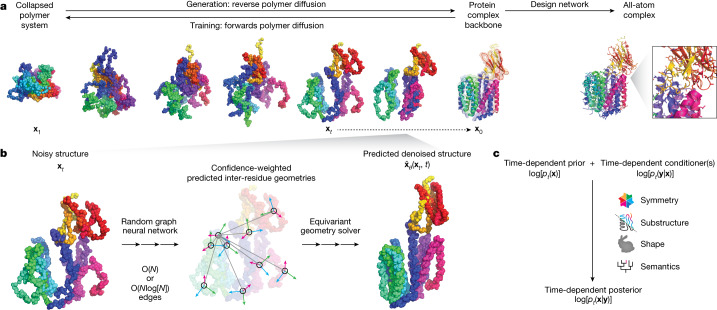
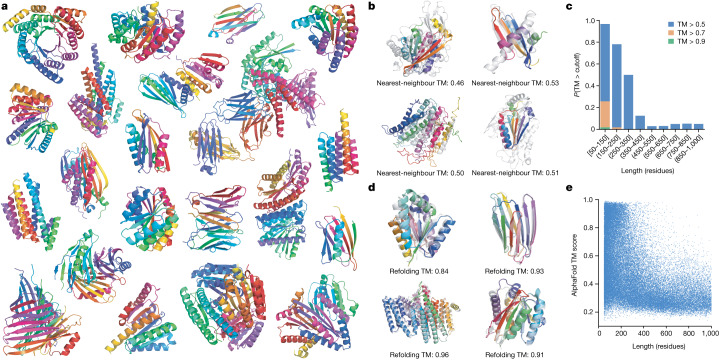
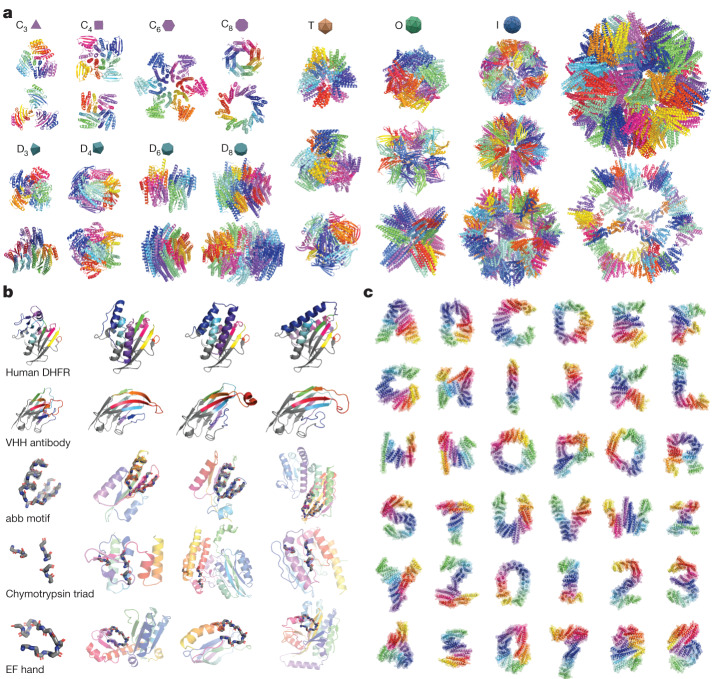
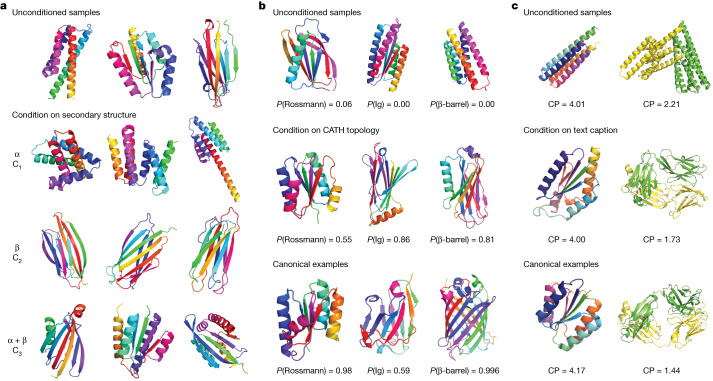
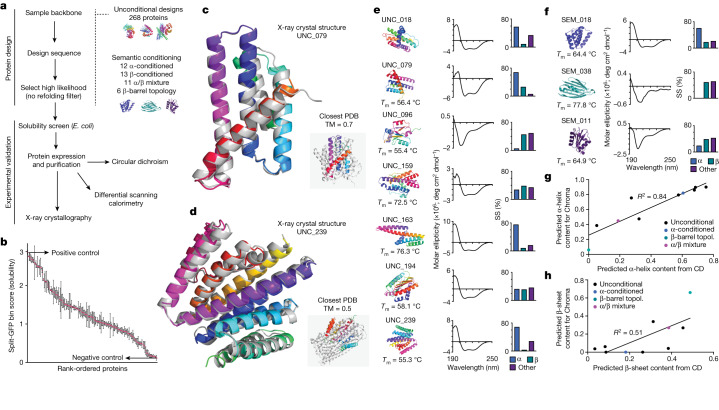
Three billion years of evolution has produced a tremendous diversity of protein molecules 1 , but the full potential of proteins is likely to be much greater. Accessing this potential has been challenging for both computation and experiments because the space of possible protein molecules is much larger than the space of those likely to have functions. Here we introduce Chroma, a generative model for proteins and protein complexes that can directly sample novel protein structures and sequences, and that can be conditioned to steer the generative process towards desired properties and functions. To enable this, we introduce a diffusion process that respects the conformational statistics of polymer ensembles, an efficient neural architecture for molecular systems that enables long-range reasoning with sub-quadratic scaling, layers for efficiently synthesizing three-dimensional structures of proteins from predicted inter-residue geometries and a general low-temperature sampling algorithm for diffusion models. Chroma achieves protein design as Bayesian inference under external constraints, which can involve symmetries, substructure, shape, semantics and even natural-language prompts. The experimental characterization of 310 proteins shows that sampling from Chroma results in proteins that are highly expressed, fold and have favourable biophysical properties. The crystal structures of two designed proteins exhibit atomistic agreement with Chroma samples (a backbone root-mean-square deviation of around 1.0 Å). With this unified approach to protein design, we hope to accelerate the programming of protein matter to benefit human health, materials science and synthetic biology.
Overview
The claims and statistics of this paper haven’t been checked yet.
Run the check — free, no account needed. It reads the open-access text and checks the sources it cites.
Integrity signals
Registry
Cites
Statistics
Figures
Verification
Claims the paper makes
The claims and statistics of this paper haven’t been checked yet.
Run the check — free, no account needed. It reads the open-access text and checks the sources it cites.
Self-check
Percentages, sums and reported differences re-computed from the paper’s own numbers.
The self-check needs the paper’s full text.
Citations
Cites
Highly accurate protein structure prediction with AlphaFold
Jumper, J., Evans, R., Pritzel, A., Green, T., Figurnov, M., Ronneberger, O., Tunyasuvunakool, K., Bates, R., Žídek, A., Potapenko, A., et al. (2021) · Nature · doi:10.1038/s41586-021-03819-2 · Cited by 43,764
UMAP: Uniform Manifold Approximation and Projection
McInnes, L., Healy, J., Saul, N., & Großberger, L. (2018) · Journal of Open Source Software · doi:10.21105/joss.00861 · Cited by 9,826 · cited 3×
“13, we present samples from Chroma and a set of native structures with global topology descriptors derived from knot theory 43,44 and embed them into two dimensions with UMAP 45 .”
BackgroundMethodDenoising Diffusion Probabilistic Models
Ho, J., Jain, A., & Abbeel, P. (2020) · arXiv · doi:10.48550/arxiv.2006.11239 · Cited by 8,712
UniProt: the universal protein knowledgebase in 2021
The UniProt Consortium, Bateman, A., Martin, M.-J., Orchard, S., Magrane, M., Agivetova, R., Ahmad, S., Alpi, E., Bowler-Barnett, E. H., Britto, R., et al. (2021) · Nucleic Acids Research · doi:10.1093/nar/gkaa1100 · Cited by 6,372
Evolutionary-scale prediction of atomic level protein structure with a language model
Lin, Z., Akin, H., Rao, R., Hie, B., Zhu, Z., Lu, W., Smetanin, N., Verkuil, R., Kabeli, O., Shmueli, Y., et al. (2022) · doi:10.1101/2022.07.20.500902 · Cited by 5,990
TM-align: a protein structure alignment algorithm based on the TM-score
Zhang, Y. (2005) · Nucleic Acids Research · doi:10.1093/nar/gki524 · Cited by 3,774
A hierarchical O(N log N) force-calculation algorithm
Barnes, J., & Hut, P. (1986) · Nature · doi:10.1038/324446a0 · Cited by 3,733
Diffusion Models Beat GANs on Image Synthesis
Dhariwal, P., & Nichol, A. (2021) · arXiv · doi:10.48550/arxiv.2105.05233 · Cited by 3,362
Rives, A., Meier, J., Sercu, T., Goyal, S., Lin, Z., Liu, J., Guo, D., Ott, M., Zitnick, C. L., Ma, J., et al. (2021) · Proceedings of the National Academy of Sciences · doi:10.1073/pnas.2016239118 · Cited by 3,286
Rives, A., Meier, J., Sercu, T., Goyal, S., Lin, Z., Liu, J., Guo, D., Ott, M., Zitnick, C. L., Ma, J., et al. (2019) · doi:10.1101/622803 · Cited by 3,280
Research works printed but not linked: 6
- Ramesh, A., Dhariwal, P., Nichol, A., Chu, C. & Chen, M. Hierarchical text-conditional image generation with CLIP latents. Preprint at https://arxiv.org/abs/2204.06125 (2022). · arXiv
- Ingraham, J., Garg, V., Barzilay, R. & Jaakkola, T. Generative models for graph-based protein design. In Proc. Advances in Neural Information Processing Systems 32 (eds Wallach, H. et al.) (NeurIPS, 2019).
- Anand, N. & Huang, P.-S. Generative modeling for protein structures. In Proc. Advances in Neural Information Processing Systems 31 (eds Bengio, S. et al.) (NeurIPS, 2018).
- Lin, Z., Sercu, T., LeCun, Y. & Rives, A. Deep generative models create new and diverse protein structures. In Machine Learning in Structural Biology Workshop at the 35th Conference on Neural Information Processing Systems (MLSB, 2021).
- Gilmer, J., Schoenholz, S. S., Riley, P. F., Vinyals, O. & Dahl, G. E. Neural message passing for quantum chemistry. In Proc. 34th International Conference on Machine Learning (eds Precup, D. et al.) 1263–1272 (PMLR, 2017).
- Jing, B., Eismann, S., Suriana, P., Townshend, R. J. L. & Dror, R. Learning from protein structure with geometric vector perceptrons. In International Conference on Learning Representations (eds Hofmann, K. et al.) (OpenReview.net, 2021).
Cited by
Sorted by citations
Items 101–200 of 447
Unified modeling of 3D molecular generation via atomic interactions with PocketXMol
Peng, X., Guo, R., Guo, F., Wang, Z., Sun, J., Guan, J., Jia, Y., Xu, Y., Huang, Y., Zhang, M., et al. (2026) · Cell · doi:10.1016/j.cell.2026.01.003 · Cited by 22
An integrative approach to protein sequence design through multiobjective optimization
Hong, L., & Kortemme, T. (2024) · PLoS Computational Biology · doi:10.1371/journal.pcbi.1011953 · Cited by 25
Leveraging large language models for peptide antibiotic design
Guan, C., Fernandes, F. C., Franco, O. L., & de la Fuente‐Núñez, C. (2024) · Cell Reports Physical Science · doi:10.1016/j.xcrp.2024.102359 · Cited by 23
Generative Artificial Intelligence for Advancing Discovery and Design in Biomateriomics
Pugliese, R., Badini, S., Frontoni, E., & Regondi, S. (2025) · Intelligent Computing · doi:10.34133/icomputing.0117 · Cited by 23
Cheng, A., Ser, C. T., Skreta, M., Guzmán-Cordero, A., Thiede, L., Burger, A., Aldossary, A., Leong, S. X., Pablo‐García, S., Strieth‐Kalthoff, F., et al. (2024) · Faraday Discussions · doi:10.1039/d4fd00153b · Cited by 22
A suite of designed protein cages using machine learning and protein fragment-based protocols
Meador, K., Castells-Graells, R., Aguirre, R., Sawaya, M. R., Arbing, M. A., Sherman, T., Senarathne, C., & Yeates, T. O. (2024) · Structure · doi:10.1016/j.str.2024.02.017 · Cited by 19
The Role of AI-Driven De Novo Protein Design in the Exploration of the Protein Functional Universe
Zhang, G., Liu, C., Lu, J., Zhang, S., & Zhu, L. (2025) · Biology · doi:10.3390/biology14091268 · Cited by 22
Soleymani, F., Paquet, E., Viktor, H. L., & Michalowski, W. (2024) · Computational and Structural Biotechnology Journal · doi:10.1016/j.csbj.2024.06.021 · Cited by 17
Local structural flexibility drives oligomorphism in computationally designed protein assemblies
Khmelinskaia, A., Bethel, N. P., Fatehi, F., Mallik, B. B., Antanasijevic, A., Borst, A. J., Lai, S.-H., Chim, H. Y., Wang, J. Y. ‘., Miranda, M. C., et al. (2025) · Nature Structural & Molecular Biology · doi:10.1038/s41594-025-01490-z · Cited by 18
Assessing Generative Model Coverage of Protein Structures with SHAPES
Lu, T., Liu, M., Chen, Y., Kim, J., & Huang, P. (2025) · Cell Systems · doi:10.1016/j.cels.2025.101347 · Cited by 18
Applying Spatiotemporal Modeling of Cell Dynamics to Accelerate Drug Development
Chen, X., Xu, S., Chu, B., Guo, J., Zhang, H.-K., Sun, S.-Y., Song, L., & Feng, X. (2024) · ACS Nano · doi:10.1021/acsnano.4c12599 · Cited by 16
Recent progress and future challenges in structure-based protein-protein interaction prediction
Yuan, R., Zhang, J., Zhou, J., & Cong, Q. (2025) · Molecular Therapy · doi:10.1016/j.ymthe.2025.04.003 · Cited by 25
Generation of protein dynamics by machine learning
Janson, G., & Feig, M. (2025) · Current Opinion in Structural Biology · doi:10.1016/j.sbi.2025.103115 · Cited by 21
Generative design of bacteriophages with genome language models
King, S. B., Driscoll, C. L., Li, D. B., Guo, D., Merchant, A. T., Brixi, G., Wilkinson, M. E., & Hie, B. (2026) · Science · doi:10.1126/science.aec2657 · Cited by 87
An outlook on structural biology after A lpha F old: tools, limits and perspectives
Rosignoli, S., Pacelli, M., Manganiello, F., & Paiardini, A. (2024) · FEBS Open Bio · doi:10.1002/2211-5463.13902 · Cited by 21
Artificial intelligence-guided strategies for next-generation biological sequence design
Zhang, P., Wei, L., Li, J., & Wang, X. (2024) · National Science Review · doi:10.1093/nsr/nwae343 · Cited by 20
Accurate Conformation Sampling via Protein Structural Diffusion
Fan, J., Li, Z., Alcaide, E., Ke, G., Huang, H., & E, W. (2024) · Journal of Chemical Information and Modeling · doi:10.1021/acs.jcim.4c00928 · Cited by 17
Foundation models of protein sequences: A brief overview
Bjerregaard, A., Groth, P. M., Hauberg, S., Krogh, A., & Boomsma, W. (2025) · Current Opinion in Structural Biology · doi:10.1016/j.sbi.2025.103004 · Cited by 16
Accurate Generation of Conformational Ensembles for Intrinsically Disordered Proteins with IDPFold
Zhu, J., Li, Z., Zheng, Z., Zhang, B., Zhong, B., Bai, J., Hong, X., Wang, T., Wei, T., Yang, J., et al. (2025) · Advanced Science · doi:10.1002/advs.202511636 · Cited by 18
How artificial intelligence is reengineering protein engineering
Listgarten, J., & Jiang, H. (2026) · Science · doi:10.1126/science.aec8444 · Cited by 20
Porous protein crystals: synthesis and applications
Jones, A. A., & Snow, C. D. (2024) · Chemical Communications · doi:10.1039/d4cc00183d · Cited by 16
Barghout, R. A., Xu, Z.-Q. J., Betala, S., & Mahadevan, R. (2023) · Current Opinion in Biotechnology · doi:10.1016/j.copbio.2023.103007 · Cited by 16
A comprehensive overview of recent advances in generative models for antibodies
Meng, F., Zhou, N., Guangchun, H., Liu, R., Zhang, Y., Jing, M., & Hou, Q. (2024) · Computational and Structural Biotechnology Journal · doi:10.1016/j.csbj.2024.06.016 · Cited by 17
Wu, F., Huang, Y. H., Yang, G., Ye, S., Mukamel, S., & Jiang, J. (2024) · Proceedings of the National Academy of Sciences · doi:10.1073/pnas.2409257121 · Cited by 14
Proteome-wide determinants of co-translational chaperone binding in bacteria
Galmozzi, C. V., Tippmann, F., Wruck, F., Auburger, J. J., Kats, I., Günnigmann, M., Till, K., O’Brien, E. P., Tans, S. J., Krämer, G., et al. (2025) · Nature Communications · doi:10.1038/s41467-025-59067-9 · Cited by 15
Co-design protein sequence and structure in discrete space via generative flow
Yang, S., Ju, L., Cheng, P., Zhou, J., Cai, Y., & Feng, D. (2025) · Bioinformatics · doi:10.1093/bioinformatics/btaf248 · Cited by 14
AI sheds new light on genome editing
Qin, Z. S., Deng, Z., Li, C., Wang, D., Ji, X., & Chen, Z. (2025) · Trends in biotechnology · doi:10.1016/j.tibtech.2025.07.011 · Cited by 15
Click, Compute, Create: A Review of Web‐based Tools for Enzyme Engineering
Tripp, A., Braun, M., Wieser, F., Oberdorfer, G., & Lechner, H. (2024) · ChemBioChem · doi:10.1002/cbic.202400092 · Cited by 17
The art of designed coiled-coils for the regulation of mammalian cells
Plaper, T., Rihtar, E., Ramuta, T. Ž., Forstnerič, V., Jazbec, V., Ivanovski, F., Benčina, M., & Jerala, R. (2024) · Cell chemical biology · doi:10.1016/j.chembiol.2024.06.001 · Cited by 15
Knowledge-augmented Graph Machine Learning for Drug Discovery: A Survey
Zhong, Z., Barkova, A., & Mottin, D. (2025) · ACM Computing Surveys · doi:10.1145/3744237 · Cited by 20
Programmable design of functional proteins from natural languagePreprint
Dai, F.-Y., You, S.-Y., Zhu, Y.-D., Gao, Y., Fu, L.-H., Zhou, X.-B., Su, J., Wang, C.-T., Fan, Y.-L., Tan, Q.-S., et al. (2026) · bioRxiv · doi:10.1101/2024.08.01.606258 · Cited by 30
Foundation models in plant molecular biology: advances, challenges, and future directions
Xu, F., Wu, T., Qian, C., Wang, X., & Yan, J. (2025) · Frontiers in Plant Science · doi:10.3389/fpls.2025.1611992 · Cited by 14
Accelerating protein design by scaling experimental characterization
Qian, J., Milles, L. F., Wicky, B. I. M., Ragotte, R. J., Motmaen, A., Borst, A. J., Skotheim, R., Ols, S., Coventry, B., Li, X., et al. (2026) · Nature Communications · doi:10.1038/s41467-026-76740-9 · Cited by 25
Wang, Z., & Zhu, X. (2024) · ACS Applied Nano Materials · doi:10.1021/acsanm.4c00255 · Cited by 13
Generative artificial intelligence in chemical engineering spans multiple scales
Decardi‐Nelson, B., Alshehri, A. S., & You, F. (2024) · Frontiers in Chemical Engineering · doi:10.3389/fceng.2024.1458156 · Cited by 18
Exploring “dark-matter” protein folds using deep learning
Harteveld, Z., Van Hall-Beauvais, A., Morozova, I., Southern, J., Goverde, C., Georgeon, S., Rosset, S., Defferrard, M., Loukas, A., Vandergheynst, P., et al. (2024) · Cell Systems · doi:10.1016/j.cels.2024.09.006 · Cited by 13
ProtGO: universal protein function prediction utilizing multi-modal gene ontology knowledge
Wang, B., Geng, Y.-A., Cheng, X., Chen, B., Bei, Z., Wang, W., Tang, J., & Song, L. (2025) · Bioinformatics · doi:10.1093/bioinformatics/btaf390 · Cited by 15
Self-citationIlluminating the universe of enzyme catalysis in the era of artificial intelligence
Yang, J., Li, F.-Z., Long, Y., & Arnold, F. H. (2025) · Cell Systems · doi:10.1016/j.cels.2025.101372 · Cited by 18
FlowBack: A Generalized Flow-Matching Approach for Biomolecular Backmapping
Jones, M. S., Khanna, S., & Ferguson, A. L. (2025) · Journal of Chemical Information and Modeling · doi:10.1021/acs.jcim.4c02046 · Cited by 13
Toward deep learning sequence–structure co-generation for protein design
Wang, C., Alamdari, S., Domingo-Enrich, C., Amini, A. P., & Yang, K. (2025) · Current Opinion in Structural Biology · doi:10.1016/j.sbi.2025.103018 · Cited by 18
Protein design accelerates the development and application of optogenetic tools
Zhu, L., Wang, Y., Wu, X., Wu, G., Zhang, G., Liu, C., & Zhang, S. (2025) · Computational and Structural Biotechnology Journal · doi:10.1016/j.csbj.2025.02.014 · Cited by 13
PXDesign: Fast, Modular, and Accurate De Novo Design of Protein BindersPreprint
Protenix Team, Ren, M., Sun, J., Guan, J., Liu, C., Gong, C., Wang, Y. X., Wang, L., Cai, Q., Ma, W., et al. (2025) · bioRxiv (Cold Spring Harbor Laboratory) · doi:10.1101/2025.08.15.670450 · Cited by 14
Villegas-Morcillo, A., Weber, J. M., & Reinders, M. J. T. (2024) · PRX Life · doi:10.1103/prxlife.2.033012 · Cited by 11
Deep learning-based design and experimental validation of a medicine-like human antibody library
Rajagopal, N., Choudhary, U., Tsang, K., Martin, K., Karadag, M., Chen, H.-T., Kwon, N.-Y., Mozdzierz, J., Horspool, A. M., Li, L., et al. (2024) · Briefings in Bioinformatics · doi:10.1093/bib/bbaf023 · Cited by 12
Dhoriyani, J., Bergman, M. T., Hall, C. K., & You, F. (2025) · PNAS Nexus · doi:10.1093/pnasnexus/pgae572 · Cited by 12
Artificial intelligence in de novo protein design
Yao, J., & Wang, X. (2025) · Medicine in Novel Technology and Devices · doi:10.1016/j.medntd.2025.100366 · Cited by 14
MSBack: Multiscale Backmapping of Highly Coarse-Grained Proteins Using Constrained Diffusion
Waltmann, C., Wang, Y., Yang, C., Kim, S., & Voth, G. A. (2025) · Journal of Chemical Theory and Computation · doi:10.1021/acs.jctc.5c00459 · Cited by 11
Niazi, S. K. (2025) · Pharmaceuticals · doi:10.3390/ph18070951 · Cited by 11
Data-driven molecular design and simulation in modern chemical engineering
Gartner, T. E., Ferguson, A. L., & Debenedetti, P. (2024) · Nature Chemical Engineering · doi:10.1038/s44286-023-00010-4 · Cited by 10
Fang, M., Wang, C., Shi, J., Lian, F., Jin, Q., Wang, Z., Zhang, Y., Chen, P., Cui, Z., Wang, Y., et al. (2025) · bioRxiv (Cold Spring Harbor Laboratory) · doi:10.1101/2025.11.08.686881 · Cited by 18
Efficient protein structure generation with sparse denoising models
Jendrusch, M., & Korbel, J. O. (2025) · Nature Machine Intelligence · doi:10.1038/s42256-025-01100-z · Cited by 10
Wang, Y., Ma, Y., Chang, Y.-H., Yan, J., Zhang, J., Cai, M.-Y., & Wei, K. (2025) · Biology · doi:10.3390/biology14121665 · Cited by 11
Zero-shot design of drug-binding proteins via neural iterative selection−expansion
Fry, B. N., Slaw, K., & Polizzi, N. F. (2026) · Nature · doi:10.1038/s41586-026-10670-w · Cited by 24
Validation and analysis of 12,000 AI-driven CAR-T designs in the Bits to Binders competition
Kosonocky, C. W., Abel, A. M., Feller, A. L., Rieffer, A. C., Woolley, P. R., Lála, J., Barth, D. S., Gardner, T., Competitors, B. T. B., Acosta, D., et al. (2026) · Molecular Systems Biology · doi:10.1038/s44320-026-00246-1 · Cited by 12
Invariant point message passing for protein side chain packing
(2024) · doi:10.1002/prot.26705 · Cited by 10
All‐Atom Protein Sequence Design Based on Geometric Deep Learning
Liu, J., Guo, Z., You, H., Zhang, C., & Lai, L. (2024) · Angewandte Chemie International Edition · doi:10.1002/anie.202411461 · Cited by 10
Protein Design by Integrating Machine Learning and Quantum-Encoded Optimization
Panizza, V., Hauke, P., Micheletti, C., & Faccioli, P. (2024) · PRX Life · doi:10.1103/prxlife.2.043012 · Cited by 10
The need for adaptability in detection, characterization, and attribution of biosecurity threats
Mo, W., Vaiana, C. A., & Myers, C. J. (2024) · Nature Communications · doi:10.1038/s41467-024-55436-y · Cited by 14
Design of peptides with noncanonical amino acids using flow matching
Lee, J. S., & Kim, P. M. (2026) · Bioinformatics · doi:10.1093/bioinformatics/btag654 · Cited by 12
P( all-atom ) Is Unlocking New Path For Protein DesignPreprint
Qu, W., Guan, J., Ma, R., Zhai, K., Wu, W., & Wang, H. (2024) · bioRxiv (Cold Spring Harbor Laboratory) · doi:10.1101/2024.08.16.608235 · Cited by 16
Programmability and biomedical utility of intrinsically-disordered protein polymers
Giraldo-Castaño, M. C., Littlejohn, K. A., Avecilla, A. R. C., Barrera-Villamizar, N., & Quiroz, F. G. (2024) · Advanced Drug Delivery Reviews · doi:10.1016/j.addr.2024.115418 · Cited by 8
Koga, N., & Koga, R. (2024) · Journal of Molecular Biology · doi:10.1016/j.jmb.2024.168791 · Cited by 9
Generating Multistate Conformations of P-type ATPases with a Conditional Diffusion Model
Xu, J., & Wang, Y. (2024) · Journal of Chemical Information and Modeling · doi:10.1021/acs.jcim.4c01519 · Cited by 9
Growing ecosystem of deep learning methods for modeling protein–protein interactions
Rogers, J. R., Nikolényi, G., & AlQuraishi, M. (2023) · Protein Engineering Design and Selection · doi:10.1093/protein/gzad023 · Cited by 12
Selection pressures on evolution of ribonuclease H explored with rigorous free–energy–based design
Hayes, R. L., Nixon, C. F., Marqusee, S., & Brooks, C. L. (2024) · Proceedings of the National Academy of Sciences · doi:10.1073/pnas.2312029121 · Cited by 8
Shen, Y., Chen, Z., Mamalakis, M., Liu, Y., Li, T., Su, Y., He, J., Lió, P., & Wang, Y. G. (2024) · IEEE International Conference on Bioinformatics and Biomedicine (BIBM) · doi:10.1109/bibm62325.2024.10822695 · Cited by 10
Challenges and compromises: Predicting unbound antibody structures with deep learning
Greenshields‐Watson, A., Vavourakis, O., Spoendlin, F. C., Cagiada, M., & Deane, C. M. (2025) · Current Opinion in Structural Biology · doi:10.1016/j.sbi.2025.102983 · Cited by 9
Artificial Intelligence in Cancer Immunotherapy: Navigating Challenges and Unlocking Opportunities
Xiang, W., Yu, L., Chen, X. S., & Herold, M. J. (2024) · Engineering · doi:10.1016/j.eng.2024.12.014 · Cited by 8
Data and AI-driven synthetic binding protein discovery
Li, Y., Duan, Z., Li, Z., & Xue, W. (2025) · Trends in Pharmacological Sciences · doi:10.1016/j.tips.2024.12.002 · Cited by 8
AI4Protein: transforming the future of protein design
Wang, D., Tan, Z., Gao, J., Zhang, S., Shen, J., & Lu, Y. (2025) · Science China Life Sciences · doi:10.1007/s11427-024-2906-3 · Cited by 12
End-to-end cryo-EM complex structure determination with high accuracy and ultra-fast speed
Wang, J., Tan, C., Gao, Z., Zhang, G., Zhang, Y., & Li, S. Z. (2025) · Nature Machine Intelligence · doi:10.1038/s42256-025-01056-0 · Cited by 8
ProtTeX: Structure-In-Context Reasoning and Editing of Proteins with Large Language Models
Ma, Z., Fan, C., Wang, Z., Chen, Z., Lin, X., Li, Y., Feng, S., Cao, Z., Zhang, J., & Gao, Y. Q. (2025) · Journal of Chemical Information and Modeling · doi:10.1021/acs.jcim.5c00585 · Cited by 14
HighMPNN: A Graph Neural Network Approach for Structure-Constrained Cyclic Peptide Sequence Design
Xu, W., Zhang, C., Shang, T., Mao, Q., Guo, J., & Duan, H. (2026) · IEEE Journal of Biomedical and Health Informatics · doi:10.1109/jbhi.2025.3620163 · Cited by 8
Enhancing functional proteins through multimodal inverse folding with ABACUS-T
Liu, Y., Wu, R., Wang, X., Wang, S., Chen, L.-H., Li, F., Chen, Q., & Liu, H. (2025) · Nature Communications · doi:10.1038/s41467-025-65175-3 · Cited by 9
Engineering complexity into protein-based biomaterials for biomedical applications
Gregorio, N. E., Haas, C. M., King, N. P., & DeForest, C. A. (2025) · Nature Reviews Materials · doi:10.1038/s41578-025-00861-8 · Cited by 11
Artificial intelligence‐enabled digital biomedical engineering
Song, P., Tang, X., Lv, X., Reis, R. L., Chen, X., Bai, L., & Su, J. (2025) · BMEMat · doi:10.1002/bmm2.70049 · Cited by 9
Experiment-guided AlphaFold3 resolves measurement-consistent protein ensembles
Maddipatla, A., Sellam, N. B., Bojan, M., Masalitin, V., Vedula, S., Schanda, P., Marx, A., & Bronstein, A. M. (2026) · Nature Biotechnology · doi:10.1038/s41587-026-03166-5 · Cited by 20
Obi, P., GC, J. B., Mariasoosai, C., Diyaolu, A., & Natesan, S. (2024) · Journal of Chemical Theory and Computation · doi:10.1021/acs.jctc.4c00315 · Cited by 8
Before LUCA: unearthing the chemical roots of metabolism
Carbonell, P., & Peretó, J. G. (2025) · Philosophical Transactions of the Royal Society B Biological Sciences · doi:10.1098/rstb.2024.0292 · Cited by 8
Improved motif-scaffolding with SE(3) flow matchingPreprint
Yim, J., Campbell, A., Mathieu, É., Foong, A. Y. K., Gastegger, M., Jiménez-Luna, J., Lewis, S., Satorras, V. G., Veeling, B. S., Noé, F., et al. (2024) · PubMed · doi:10.48550/arxiv.2401.04082 · Cited by 34
Versatile Deep Learning Pipeline for Transferable Chemical Data Extraction
Alshehri, A. S., Horstmann, K. A., & You, F. (2024) · Journal of Chemical Information and Modeling · doi:10.1021/acs.jcim.4c00816 · Cited by 9
Multi-Modal CLIP-Informed Protein Editing
Yin, M., Zhou, H., Zhu, Y., Lin, M., Wu, Y., Wu, J., Xu, H., Hsieh, C., Hou, T., Chen, J., et al. (2024) · Health Data Science · doi:10.34133/hds.0211 · Cited by 13
Artificial intelligence in therapeutic antibody design: Advances and future prospects
Park, S., Jeong, W., Kim, Y., Lee, C., & Seok, C. (2025) · Current Opinion in Structural Biology · doi:10.1016/j.sbi.2025.103084 · Cited by 7
Generative AI techniques for conformational diversity and evolutionary adaptation of proteins
Brownless, A.-L. R., Yehorova, D., Welsh, C. L., & Kamerlin, S. C. L. (2025) · Current Opinion in Structural Biology · doi:10.1016/j.sbi.2025.103135 · Cited by 9
Bera, P., & Mondal, J. (2025) · The Journal of Chemical Physics · doi:10.1063/5.0279756 · Cited by 7
Hoffnagle, A. M., Herold, R. A., Tsai, C.-Y., Shiau, A. A., Britt, R. D., & Tezcan, F. A. (2025) · Journal of the American Chemical Society · doi:10.1021/jacs.5c13813 · Cited by 10
Approaches for accelerating microbial gene function discovery using artificial intelligence
Palsson, B. Ø., Lee, S. Y., & Kim, G. B. (2026) · Nature Microbiology · doi:10.1038/s41564-025-02214-1 · Cited by 8
De novo enzyme design: Controlling structure to design function
Listov, D., & Fleishman, S. J. (2026) · Current Opinion in Structural Biology · doi:10.1016/j.sbi.2026.103252 · Cited by 10
Closing the Execution Gap in Generative AI for Chemicals and Materials: Freeways or Safeguards
Subramanian, A., Gao, W., Barzilay, R., Grossman, J. C., Jaakkola, T., Jegelka, S., Li, M., Li, J., Matusik, W., Olivetti, E., et al. (2024) · An MIT Exploration of Generative AI · doi:10.21428/e4baedd9.92e511e3 · Cited by 7
Denoising Probabilistic Diffusion Models for Synthetic Healthcare Image Generation
Iuliano, A., Lió, P., Manfredi, G., & Romaniello, F. (2024) · IEEE International Workshop on Metrology for Living Environment (MetroLivEnv) · doi:10.1109/metrolivenv60384.2024.10615511 · Cited by 9
Harnessing Deep Learning Methods for Voltage-Gated Ion Channel Drug Discovery
Mateos, D. L., Harris, B. J., González, A. H., Narang, K., & Yarov-Yarovoy, V. M. (2024) · Physiology · doi:10.1152/physiol.00029.2024 · Cited by 9
PD-1 Targeted Antibody Discovery Using AI Protein Diffusion
Ford, C. T. (2024) · Technology in Cancer Research & Treatment · doi:10.1177/15330338241275947 · Cited by 7
Engineering conditional protein-protein interactions for dynamic cellular control
Stohr, A. M., Ma, D., Chen, W., & Blenner, M. (2024) · Biotechnology Advances · doi:10.1016/j.biotechadv.2024.108457 · Cited by 7
Unified Sampling and Ranking for Protein Docking With DFMDock
Chu, L., Sarma, S., Xu, D., & Gray, J. J. (2026) · Proteins: Structure, Function, and Bioinformatics · doi:10.1002/prot.70160 · Cited by 7
Zhang, Z., Jin, R., Liu, J., Xu, G., Wang, X., Žitnik, M., Zhao, H., Cong, L., & Wang, M. (2024) · bioRxiv (Cold Spring Harbor Laboratory) · doi:10.1101/2024.10.23.619960 · Cited by 9
Zero-shot design of drug-binding proteins via neural selection-expansionPreprint
Fry, B. N., Slaw, K., & Polizzi, N. F. (2025) · bioRxiv (Cold Spring Harbor Laboratory) · doi:10.1101/2025.04.22.649862 · Cited by 7
Why cellular computations challenge our design principles
Grozinger, L., Cuevas-Zuviría, B., & Goñi‐Moreno, Á. (2025) · Seminars in Cell and Developmental Biology · doi:10.1016/j.semcdb.2025.103616 · Cited by 7
GeoEvoBuilder: A deep learning framework for efficient functional and thermostable protein design
Liu, J., You, H., Guo, Z., Xu, Q., Zhang, C., & Lai, L. (2025) · Proceedings of the National Academy of Sciences · doi:10.1073/pnas.2504117122 · Cited by 7
Metadata
- Authors
- Ingraham, J. B., Baranov, M., Costello, Z., Barber, K. W., Wang, W., Ismail, A., Frappier, V., Lord, D. M., Ng-Thow-Hing, C., Van Vlack, E. R., Tie, S., Xue, V., Cowles, S. C., Leung, A., Rodrigues, J. V., Morales-Perez, C. L., Ayoub, A. M., Green, R., Puentes, K., Oplinger, F., Panwar, N. V., Obermeyer, F., Root, A. R., Beam, A. L., Poelwijk, F. J., & Grigoryan, G.
- Corresponding author
- Grigoryan, Gevorg
- ORCID
- Venue
- Nature
- Published
- 2023-11-15
- Volume
- 623
- Issue
- 7989
- Pages
- 1070-1078
- ISSN
- 0028-0836 (ISSN-L)
- 1476-4687
- PMC
- PMC10686827
- OpenAlex
- W4388694364
- Cited by
- 444
- References
- 45
- Citations by year
- 2026: 152 · 2025: 147 · 2024: 125 · 2023: 20
- FWCI
- 39.56
- Type
- journal article
- Language
- en
- Open access
- hybrid
- doi.org
- Locations
- Nature (publishedVersion, cc-by)
- PubMed Central (publishedVersion, cc-by)
- PubMed (publishedVersion)
- Topics
- Life Sciences › Biochemistry, Genetics and Molecular Biology › Molecular Biology › Protein Structure and Dynamics
- Life Sciences › Biochemistry, Genetics and Molecular Biology › Molecular Biology › Machine Learning in Bioinformatics
- Life Sciences › Pharmacology, Toxicology and Pharmaceutics › Drug Discovery › Computational Drug Discovery Methods
- Keywords
- protein design, generative models, diffusion models, protein complexes, protein structure prediction, Bayesian inference, protein folding, natural language prompts, color intensity
- MeSH terms
- Machine Learning, Algorithms, Bayes Theorem, Computer Simulation, Humans, Models, Molecular, Protein Conformation, Proteins, Semantics, Protein Folding, Directed Molecular Evolution, Synthetic Biology
About these checks
Registry, retraction, Cites and statistics results are computed, not judged, with one exception: a printed reference that no index lists is read once by a model before it counts as a citation error. Claims are extracted by a model and kept only when their quote appears verbatim in the text; each cited source is then checked, with a model’s help, for whether it says what the claim relies on. Those verdicts can be wrong — read the claim’s quote and the cited source before relying on one.
Statistics and arithmetic are recomputed, not judged.
Confidence bands are shown only for fields calibrated on our annotated test set. None is calibrated yet, so no band is shown.
What counts as a claim ›How we measure confidence ›How we check this ›
Are you an author, or do you see a problem with this page? Request a review
