

The DOI matches its Crossref record; 78 of the 78 references it cites were found in a registry or an index.
Targeted protein degradation via intramolecular bivalent glues
Open accessPublished version of a preprint
Abstract
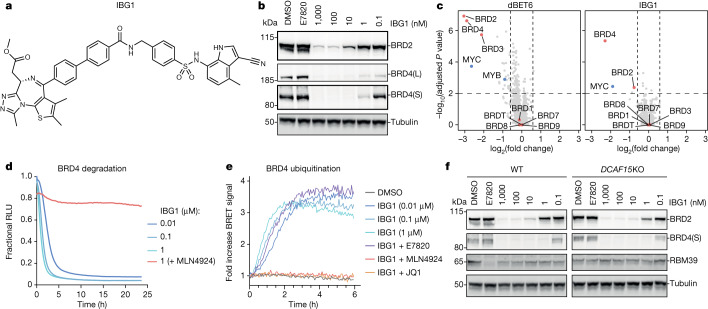
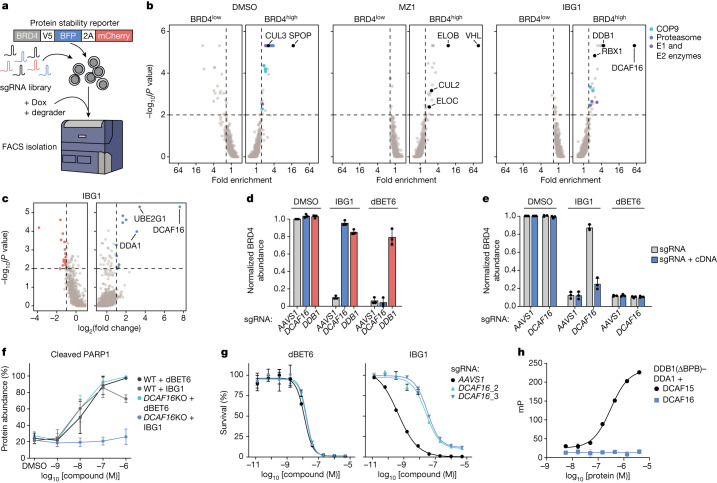
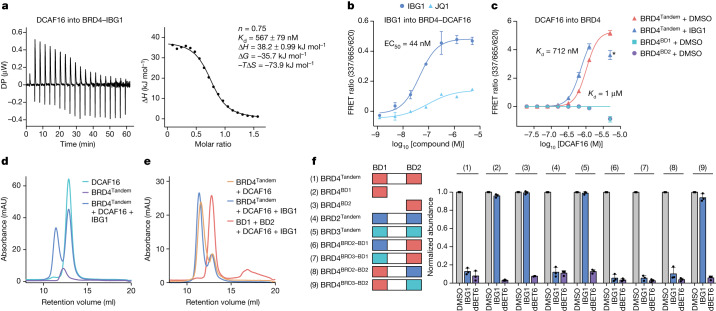
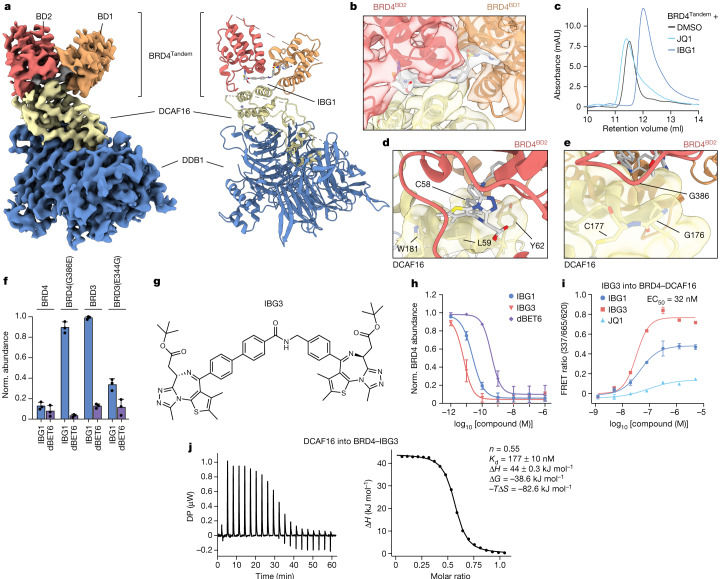
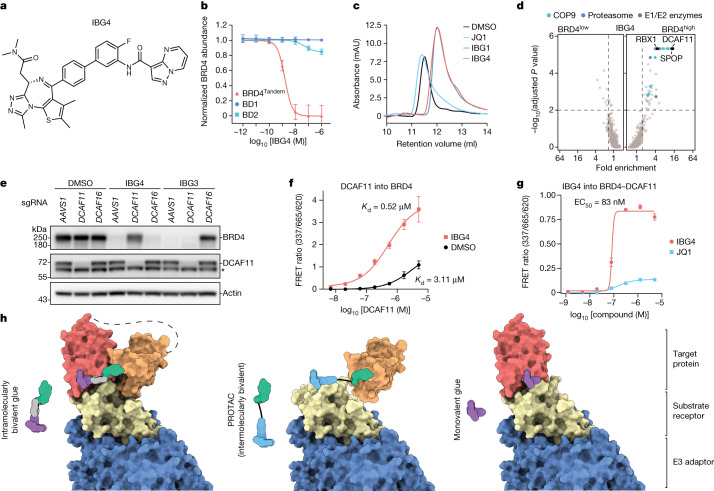
Targeted protein degradation is a pharmacological modality that is based on the induced proximity of an E3 ubiquitin ligase and a target protein to promote target ubiquitination and proteasomal degradation. This has been achieved either via proteolysis-targeting chimeras (PROTACs)—bifunctional compounds composed of two separate moieties that individually bind the target and E3 ligase, or via molecular glues that monovalently bind either the ligase or the target 1–4 . Here, using orthogonal genetic screening, biophysical characterization and structural reconstitution, we investigate the mechanism of action of bifunctional degraders of BRD2 and BRD4, termed intramolecular bivalent glues (IBGs), and find that instead of connecting target and ligase in trans as PROTACs do, they simultaneously engage and connect two adjacent domains of the target protein in cis . This conformational change ‘glues’ BRD4 to the E3 ligases DCAF11 or DCAF16, leveraging intrinsic target–ligase affinities that do not translate to BRD4 degradation in the absence of compound. Structural insights into the ternary BRD4–IBG1–DCAF16 complex guided the rational design of improved degraders of low picomolar potency. We thus introduce a new modality in targeted protein degradation, which works by bridging protein domains in cis to enhance surface complementarity with E3 ligases for productive ubiquitination and degradation.
Overview
The claims and statistics of this paper haven’t been checked yet.
Run the check — free, no account needed. It reads the open-access text and checks the sources it cites.
Integrity signals
Registry
Cites
Statistics
Figures
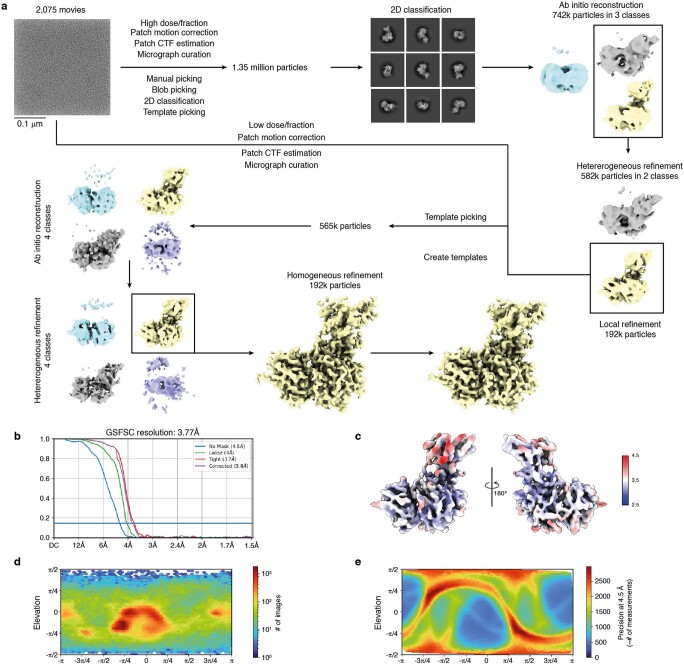
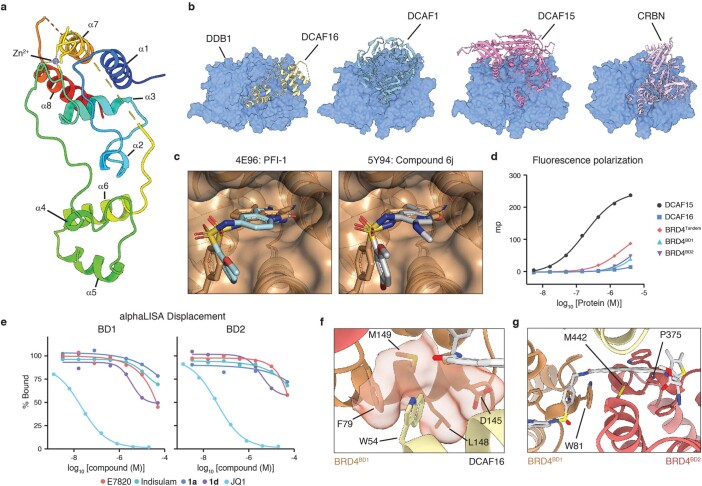
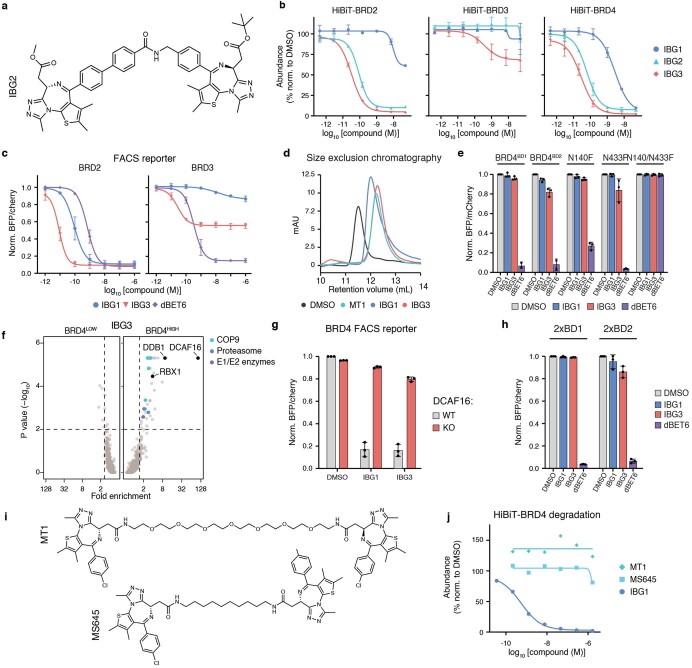
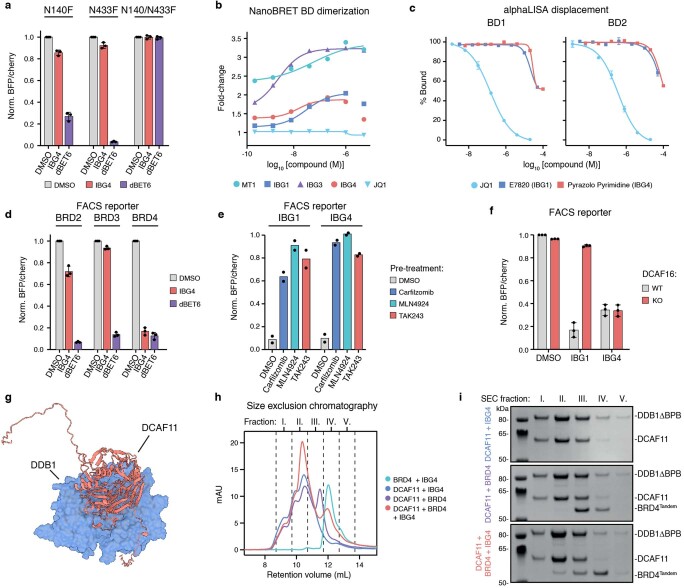
Verification
Claims the paper makes
The claims and statistics of this paper haven’t been checked yet.
Run the check — free, no account needed. It reads the open-access text and checks the sources it cites.
Claims other papers make about this one
Each is checked against this paper’s own text: does it say what the citing paper says it does?
The source backs part of the claim, not all of it — or backs it for a different population, condition or comparison.
In the citing paper
“Similarly, tR-FRet and fluorescence polarization (FP) assays offer robust scalable formats for detecting molecular glue-induced interactions in vitro (Simonetta et al. 2019;wang et al. 2021;Hsia et al. 2024;Kozicka et al. 2024).”
From From serendipity to strategy: molecular glue degraders in cancer therapeutics (2025) · cites this paper as Hsia et al. 2024
Experimental — accuracy not yet measuredThe source backs part of the claim, not all of it — or backs it for a different population, condition or comparison.
In the citing paper
“techniques using NanoBit®, NanoBRet® and HiBit® technologies enable sensitive detection of ternary complex formation and/or target degradation, both in live cells and cell extracts, making them particularly well-suited for identifying glue-induced degradation events (Bell et al. 2024;Hsia et al. 2024;ismail et al. 2024).”
From From serendipity to strategy: molecular glue degraders in cancer therapeutics (2025) · cites this paper as Hsia et al. 2024
Experimental — accuracy not yet measured
Self-check
Percentages, sums and reported differences re-computed from the paper’s own numbers.
The self-check needs the paper’s full text.
Citations
Cites
Highly accurate protein structure prediction with AlphaFold
Jumper, J., Evans, R., Pritzel, A., Green, T., Figurnov, M., Ronneberger, O., Tunyasuvunakool, K., Bates, R., Žídek, A., Potapenko, A., et al. (2021) · Nature · doi:10.1038/s41586-021-03819-2 · Cited by 43,764
Coot : model-building tools for molecular graphics
Emsley, P., & Cowtan, K. (2004) · Acta Crystallographica Section D Biological Crystallography · doi:10.1107/s0907444904019158 · Cited by 30,571
cryoSPARC: algorithms for rapid unsupervised cryo-EM structure determination
Punjani, A., Rubinstein, J. L., Fleet, D. J., & Brubaker, M. A. (2017) · Nature Methods · doi:10.1038/nmeth.4169 · Cited by 11,626
UCSF ChimeraX : Structure visualization for researchers, educators, and developers
Pettersen, E. F., Goddard, T. D., Huang, C. C., Meng, E. C., Couch, G. S., Croll, T. I., Morris, J. H., & Ferrin, T. E. (2020) · Protein Science · doi:10.1002/pro.3943 · Cited by 9,521
ColabFold - Making protein folding accessible to all
Mirdita, M., Schütze, K., Moriwaki, Y., Heo, L., Ovchinnikov, S., & Steinegger, M. (2021) · doi:10.1101/2021.08.15.456425 · Cited by 9,391
Universal sample preparation method for proteome analysis
Wiśniewski, J. R., Zougman, A., Nagaraj, N., & Mann, M. (2009) · Nature Methods · doi:10.1038/nmeth.1322 · Cited by 8,352
Liebschner, D., Afonine, P. V., Baker, M. L., Bunkóczi, G., Chen, V. B., Croll, T. I., Hintze, B., Hung, L.-W., Jain, S., McCoy, A. J., et al. (2019) · Acta Crystallographica Section D Structural Biology · doi:10.1107/s2059798319011471 · Cited by 7,953
The PRIDE database resources in 2022: a hub for mass spectrometry-based proteomics evidences
Perez-Riverol, Y., Bai, J., Bandla, C., García-Seisdedos, D., Hewapathirana, S., Kamatchinathan, S., Kundu, D. J., Prakash, A., Frericks-Zipper, A., Eisenacher, M., et al. (2022) · Nucleic Acids Research · doi:10.1093/nar/gkab1038 · Cited by 6,125
Optimized sgRNA design to maximize activity and minimize off-target effects of CRISPR-Cas9
Doench, J. G., Fusi, N., Sullender, M., Hegde, M., Vaimberg, E. W., Donovan, K. F., Smith, I., Tothova, Z., Wilen, C., Orchard, R., et al. (2016) · Nature Biotechnology · doi:10.1038/nbt.3437 · Cited by 4,637
Selective inhibition of BET bromodomains
Filippakopoulos, P., Qi, J., Picaud, S., Shen, Y., Smith, W. B., Fedorov, O., Morse, E. M., Keates, T., Hickman, T. T., Felletar, I., et al. (2010) · Nature · doi:10.1038/nature09504 · Cited by 4,262
Cited by
Sorted by citations
Targeted protein degradation: from mechanisms to clinic
Tsai, J. M., Nowak, R. P., Ebert, B. L., & Fischer, E. S. (2024) · Nature Reviews Molecular Cell Biology · doi:10.1038/s41580-024-00729-9 · Cited by 438
Targeted protein degradation for cancer therapy
Hinterndorfer, M., Spiteri, V. A., Ciulli, A., & Winter, G. E. (2025) · Nature reviews. Cancer · doi:10.1038/s41568-025-00817-8 · Cited by 263
Self-citationProximity-Based Modalities for Biology and Medicine
Liu, X., & Ciulli, A. (2023) · ACS Central Science · doi:10.1021/acscentsci.3c00395 · Cited by 206
Self-citationRational Chemical Design of Molecular Glue Degraders
Toriki, E. S., Papatzimas, J. W., Nishikawa, K., Dovala, D., Frank, A. O., Hesse, M. J., Danková, D., Song, J.-G., Bruce-Smythe, M., Struble, H., et al. (2023) · ACS Central Science · doi:10.1021/acscentsci.2c01317 · Cited by 202
Molecular glues for protein-protein interactions: Progressing toward a new dream
Konstantinidou, M., & Arkin, M. R. (2024) · Cell chemical biology · doi:10.1016/j.chembiol.2024.04.002 · Cited by 200
Metadata
- Authors
- Hsia, O., Hinterndorfer, M., Cowan, A. D., Iso, K., Ishida, T., Sundaramoorthy, R., Nakasone, M. A., Imrichova, H., Schätz, C., Rukavina, A., Husnjak, K., Wegner, M., Correa-Sáez, A., Craigon, C., Casement, R., Maniaci, C., Testa, A., Kaulich, M., Dikic, I., Winter, G. E., & Ciulli, A.
- Affiliations
- University of Dundee (GB)
- Austrian Academy of Sciences (AT)
- Goethe University Frankfurt (DE)
- Corresponding author
- Winter, Georg E.
- Ciulli, Alessio
- ORCID
- Hsia, Oliver
- Hinterndorfer, Matthias
- Cowan, Angus D.
- Iso, Kentaro
- Ishida, Tasuku
- Sundaramoorthy, Ramasubramanian
- Nakasone, Mark A.
- Imrichova, Hana
- Schätz, Caroline
- Rukavina, Andrea
- Husnjak, Koraljka
- Wegner, Martin
- Correa-Sáez, Alejandro
- Craigon, Conner
- Casement, Ryan
- Maniaci, Chiara
- Testa, Andrea
- Kaulich, Manuel
- Dikic, Ivan
- Winter, Georg E.
- Ciulli, Alessio
- Venue
- Nature
- Published
- 2024-02-21
- Volume
- 627
- Issue
- 8002
- Pages
- 204-211
- ISSN
- 0028-0836 (ISSN-L)
- 1476-4687
- PMC
- PMC10917667
- OpenAlex
- W4391994105
- Cited by
- 222
- References
- 78
- Citations by year
- 2026: 68 · 2025: 86 · 2024: 58
- FWCI
- 28.86
- Type
- journal article
- Language
- en
- Open access
- hybrid
- doi.org
- Locations
- Nature (publishedVersion, cc-by)
- bioRxiv (Cold Spring Harbor Laboratory) (acceptedVersion, cc-by)
- PubMed Central (publishedVersion, cc-by)
- PubMed (publishedVersion)
- RePEc: Research Papers in Economics (submittedVersion)
- Discovery Research Portal (University of Dundee) (submittedVersion, cc-by)
- Publication Server of Goethe University Frankfurt am Main (Goethe University Frankfurt) (submittedVersion, cc-by)
- Funders
- GlaxoSmithKline
- McGill University
- University of Dundee
- Wellcome Trust (223816/Z/21/Z)
- European Federation of Pharmaceutical Industries and Associations (FP7/20072013, 875510)
- Foghorn Therapeutics
- European Commission (223816, 2007–2013, FP7 2007-2013, HORIZON2020, H2020-MSCA-IF-2020, H2020, 101024945, FP7/2007, H2020‐MSCA‐IF, 875510, H2020-MSCA, 851478)
- European Synchrotron Radiation Facility (ID23-2)
- Österreichischen Akademie der Wissenschaften (IF-2020, P7909, P32125)
- Austrian Science Fund (P31690, P 32125, P7909)
- Universität Wien
- Eisai
- Medizinische Universität Wien
- Innovative Medicines Initiative (FP7/2007‐2013, 875510, H2020)
- Horizon 2020 Framework Programme (FP7/2007-2013, H2020-MSCA, H2020-MSCA-IF-2020, 875510)
- Medical Research Council
- H2020 Marie Skłodowska-Curie Actions (H2020-MSCA-IF-2020, H2020, H2020-MSCA-IF, MSCA-IF-2020, FP7/2007-2013, H2020-MSCA, HORIZON2020)
- Topics
- Life Sciences › Biochemistry, Genetics and Molecular Biology › Molecular Biology › Protein Degradation and Inhibitors
- Life Sciences › Biochemistry, Genetics and Molecular Biology › Molecular Biology › Ubiquitin and proteasome pathways
- Physical Sciences › Chemistry › Organic Chemistry › Chemical Synthesis and Analysis
- Keywords
- targeted protein degradation, PROTACs, molecular glues, BRD4, BRD2, E3 ubiquitin ligase, ubiquitination, proteasomal degradation, ternary complex structure, bromodomain proteins
- MeSH terms
- Protein Domains, Bromodomain Containing Proteins, Proteolysis Targeting Chimera, Nuclear Proteins, Protein Binding, Substrate Specificity, Transcription Factors, Drug Design, Cell Cycle Proteins, Ubiquitin-Protein Ligases, Proteasome Endopeptidase Complex, Ubiquitination, Proteolysis
About these checks
Registry, retraction, Cites and statistics results are computed, not judged, with one exception: a printed reference that no index lists is read once by a model before it counts as a citation error. Claims are extracted by a model and kept only when their quote appears verbatim in the text; each cited source is then checked, with a model’s help, for whether it says what the claim relies on. Those verdicts can be wrong — read the claim’s quote and the cited source before relying on one.
Statistics and arithmetic are recomputed, not judged.
Confidence bands are shown only for fields calibrated on our annotated test set. None is calibrated yet, so no band is shown.
What counts as a claim ›How we measure confidence ›How we check this ›
Are you an author, or do you see a problem with this page? Request a review
