

A multimodal generative AI copilot for human pathology
Open accessThe DOI matches its Crossref record; 80 of the 80 references it cites were found in a registry or an index.
Abstract
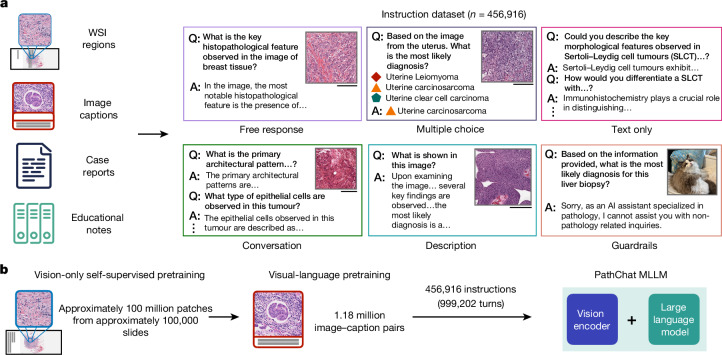
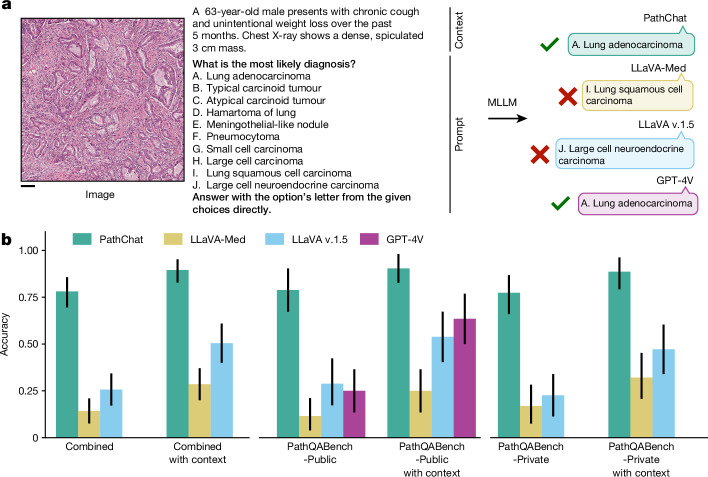
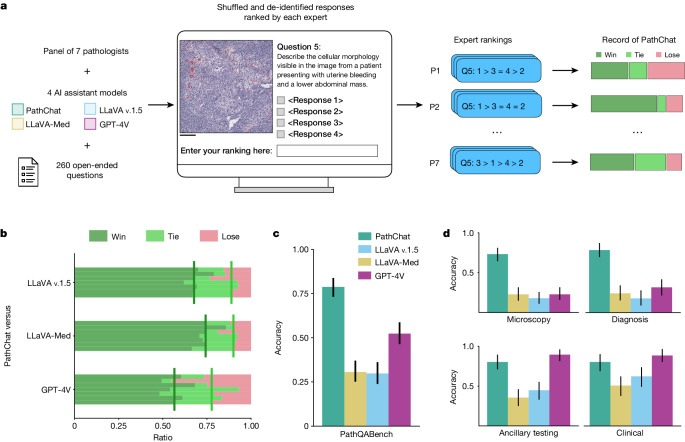
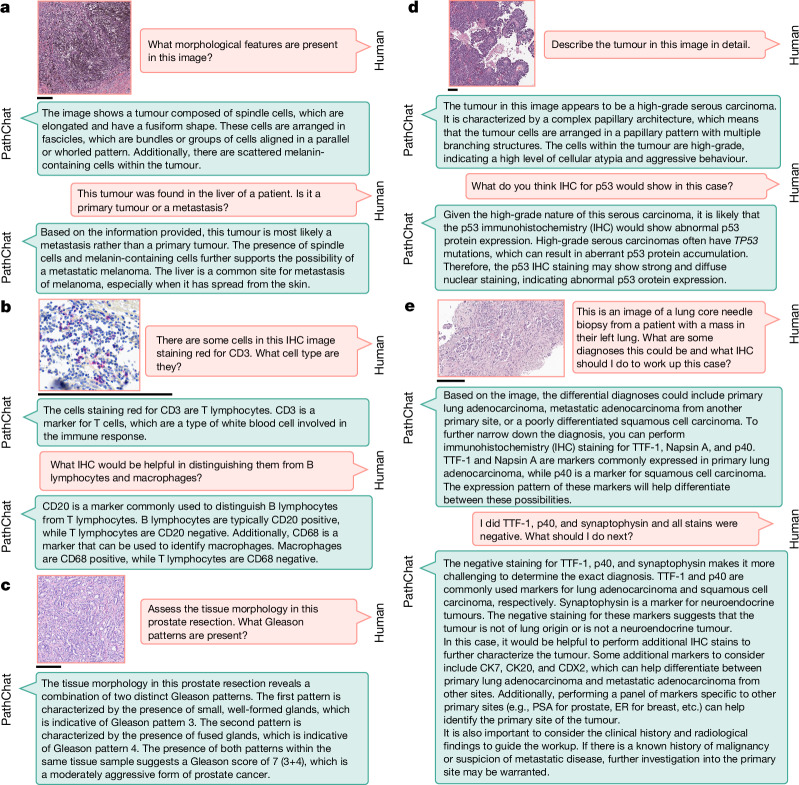
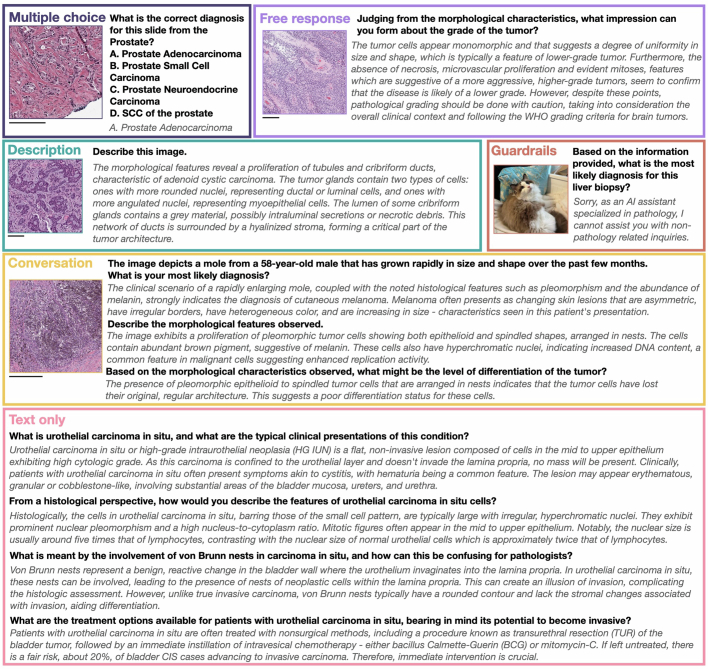
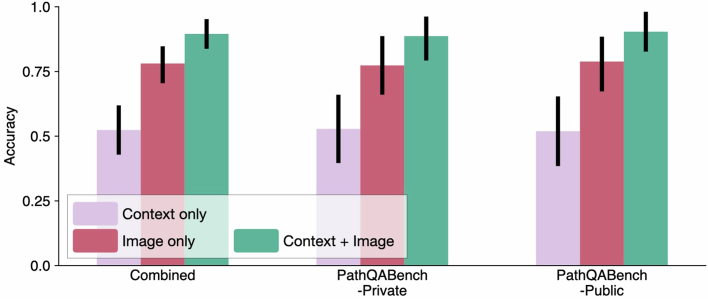
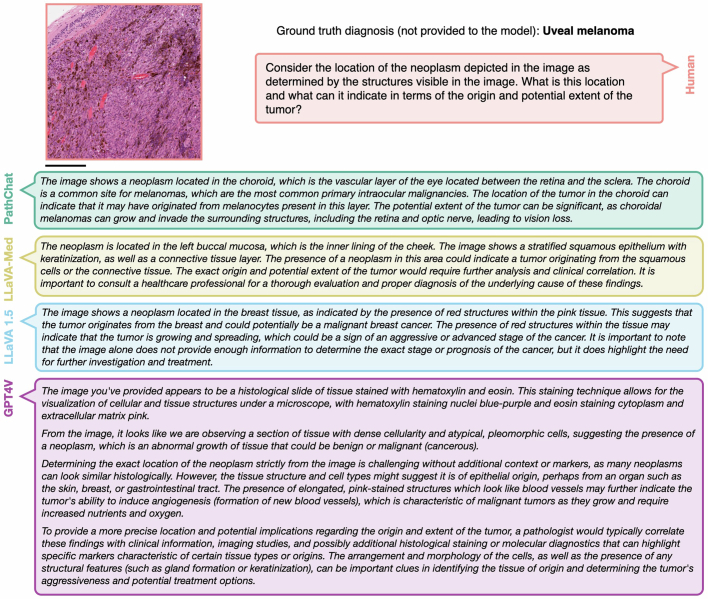
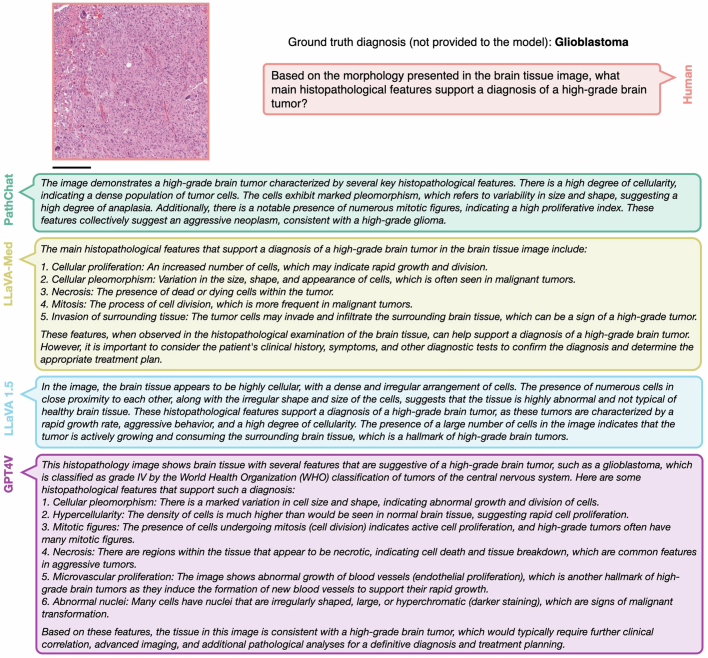
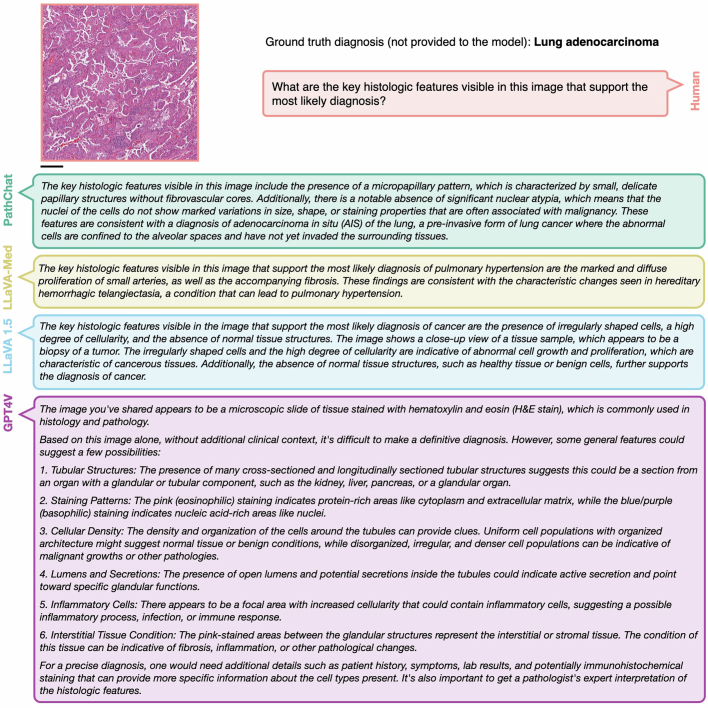
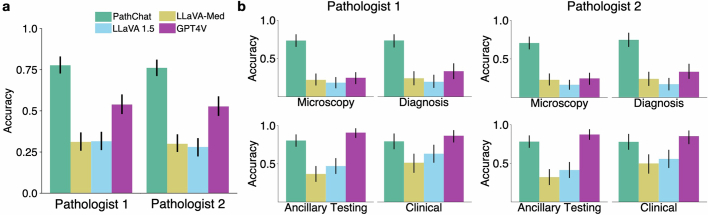
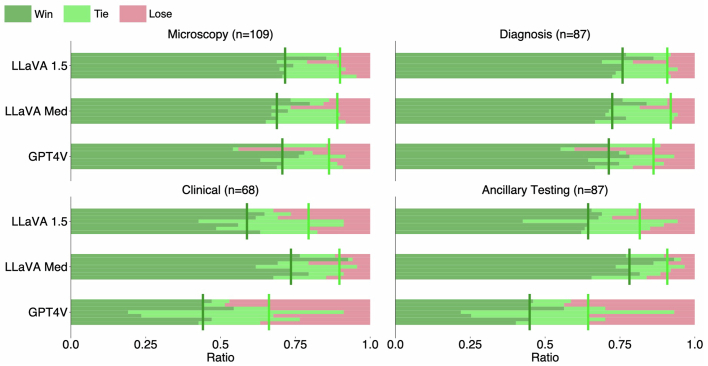
Computational pathology 1,2 has witnessed considerable progress in the development of both task-specific predictive models and task-agnostic self-supervised vision encoders 3,4 . However, despite the explosive growth of generative artificial intelligence (AI), there have been few studies on building general-purpose multimodal AI assistants and copilots 5 tailored to pathology. Here we present PathChat, a vision-language generalist AI assistant for human pathology. We built PathChat by adapting a foundational vision encoder for pathology, combining it with a pretrained large language model and fine-tuning the whole system on over 456,000 diverse visual-language instructions consisting of 999,202 question and answer turns. We compare PathChat with several multimodal vision-language AI assistants and GPT-4V, which powers the commercially available multimodal general-purpose AI assistant ChatGPT-4 (ref. 6 ). PathChat achieved state-of-the-art performance on multiple-choice diagnostic questions from cases with diverse tissue origins and disease models. Furthermore, using open-ended questions and human expert evaluation, we found that overall PathChat produced more accurate and pathologist-preferable responses to diverse queries related to pathology. As an interactive vision-language AI copilot that can flexibly handle both visual and natural language inputs, PathChat may potentially find impactful applications in pathology education, research and human-in-the-loop clinical decision-making.
Overview
The claims and statistics of this paper haven’t been checked yet.
Free: it reads the open-access text and checks the first 5 claims that cite a source we can check. Create a free account to check every claim.
Integrity signals
Registry
Cites
Statistics
Figures
Verification
Claims the paper makes
The claims and statistics of this paper haven’t been checked yet.
Free: it reads the open-access text and checks the first 5 claims that cite a source we can check. Create a free account to check every claim.
Claims other papers make about this one
Each is checked against this paper’s own text: does it say what the citing paper says it does?
The source backs part of the claim, not all of it — or backs it for a different population, condition or comparison.
In the citing paper
“The synthetic region-level captions can easily be generated with the generative AI model to provide a wealth of text guidance88,127.”
From A multimodal whole-slide foundation model for pathology (2025) · cites this paper as [88]
Experimental — accuracy not yet measured
Self-check
Percentages, sums and reported differences re-computed from the paper’s own numbers.
The self-check needs the paper’s full text.
Citations
Cites
Microsoft COCO: Common Objects in Context
Lin, T.-Y., Maire, M., Belongie, S., Hays, J., Perona, P., Ramanan, D., Dollár, P., & Zitnick, C. L. (2014) · Lecture Notes in Computer Science · doi:10.1007/978-3-319-10602-1_48 · Cited by 45,460
Language Models are Few-Shot Learners
Brown, T. B., Mann, B., Ryder, N., Subbiah, M., Kaplan, J., Dhariwal, P., Neelakantan, A., Shyam, P., Sastry, G., Askell, A., et al. (2020) · arXiv · doi:10.48550/arxiv.2005.14165 · Cited by 23,372
Learning Transferable Visual Models From Natural Language Supervision
Radford, A., Kim, J. W., Hallacy, C., Ramesh, A., Goh, G., Agarwal, S., Sastry, G., Askell, A., Mishkin, P., Clark, J., et al. (2021) · arXiv · doi:10.48550/arxiv.2103.00020 · Cited by 15,293
QuPath: Open source software for digital pathology image analysis
Bankhead, P., Loughrey, M. B., Fernández, J. A., Dombrowski, Y., McArt, D. G., Dunne, P. D., McQuaid, S., Gray, R. T., Murray, L. J., Coleman, H. G., et al. (2017) · Scientific Reports · doi:10.1038/s41598-017-17204-5 · Cited by 8,908
Training language models to follow instructions with human feedback
Ouyang, L., Wu, J., Jiang, X., Almeida, D., Wainwright, C. L., Mishkin, P., Zhang, C., Agarwal, S., Slama, K., Ray, A., et al. (2022) · arXiv · doi:10.48550/arxiv.2203.02155 · Cited by 4,208
Large Language Models Encode Clinical Knowledge
Singhal, K., Azizi, S., Tu, T., Mahdavi, S. S., Wei, J., Chung, H. W., Scales, N., Tanwani, A., Cole-Lewis, H., Pfohl, S., et al. (2022) · arXiv · doi:10.48550/arxiv.2212.13138 · Cited by 4,083
Large language models encode clinical knowledge
Singhal, K., Azizi, S., Tu, T., Mahdavi, S. S., Wei, J., Chung, H. W., Scales, N., Tanwani, A., Cole-Lewis, H., Pfohl, S., et al. (2023) · Nature · doi:10.1038/s41586-023-06291-2 · Cited by 4,083
Ehteshami Bejnordi, B., Veta, M., Johannes van Diest, P., van Ginneken, B., Karssemeijer, N., Litjens, G., van der Laak, J. A. W. M., and the CAMELYON16 Consortium, Hermsen, M., Manson, Q. F., et al. (2017) · JAMA · doi:10.1001/jama.2017.14585 · Cited by 3,293
Retrieval-Augmented Generation for Knowledge-Intensive NLP Tasks
Lewis, P., Perez, E., Piktus, A., Petroni, F., Karpukhin, V., Goyal, N., Küttler, H., Lewis, M., Yih, W.-T., Rocktäschel, T., et al. (2020) · arXiv · doi:10.48550/arxiv.2005.11401 · Cited by 3,101
Coudray, N., Ocampo, P. S., Sakellaropoulos, T., Narula, N., Snuderl, M., Fenyö, D., Moreira, A. L., Razavian, N., & Tsirigos, A. (2018) · Nature Medicine · doi:10.1038/s41591-018-0177-5 · Cited by 2,930
Research works printed but not linked: 1
- Tsuneki, M. & Kanavati, F. Inference of captions from histopathological patches. In Proc. International Conference on Medical Imaging with Deep Learning (Konukoglu, E. et al.) 1235–1250 (PMLR, 2022).
Cited by
Items 101–200 of 563
Emulating human-like adaptive vision for efficient and flexible machine visual perception
Wang, Y., Yang, Y., Yue, Y., Wang, H., Jiang, H., Han, Y., Ni, Z., Pu, Y., Shi, M., Lu, R., et al. (2025) · Nature Machine Intelligence · doi:10.1038/s42256-025-01130-7 · Cited by 39
“12 and 13 for the representative examples of our trials.”
An agentic framework for autonomous scientific discovery in cancer pathology
Trost, F., Zhang, B., Aring, I., Bauer, M., Glamann, L., Wessolly, M., Johnson, K., Göbel, H., Lerbs, T., Sangenne, T., et al. (2026) · Nature Medicine · doi:10.1038/s41591-026-04357-y · Cited by 32
“Even vision-language models (VLMs), which combine image and text understanding, currently struggle to provide reliable answers to even simple quantitative or reasoning-based questions 18–21 .”
Large language models in traditional Chinese medicine: a systematic review
Chen, Z., Wang, H., Li, C., Liu, C., Yang, F., Zhang, D., Fauci, A. J., & Zhang, J. (2025) · Acupuncture and Herbal Medicine · doi:10.1097/hm9.0000000000000143 · Cited by 26
“The use of GAI to assist in clinical decision-making in clinical practice could reduce the clinical workload and human error; however, compared with enhancing clinical diagnostics and treatment performance, it is still subject to ethical restrictions [25–27] .”
HumanVLM: Foundation for Human-Scene Vision-Language Model
Dai, D., Xu, L., Li, Y., Zhang, Y., & Xia, S. (2025) · Information Fusion · doi:10.1016/j.inffus.2025.103271 · Cited by 27
Haixian, L., Shu, P., Zhao, L., Chunfeng, L., & Lun, L. (2025) · Frontiers in Oncology · doi:10.3389/fonc.2025.1576461 · Cited by 21
Advances in computational nephropathology
Hölscher, D. L., Bülow, R. D., Strauch, M., & Boor, P. (2025) · Kidney International · doi:10.1016/j.kint.2025.06.029 · Cited by 20
Nie, G., Fang, X., Tang, G., Xiao, Y., Li, J., Liu, B., Li, H., & Hong, S. (2026) · ACM SIGKDD Conference on Knowledge Discovery and Data Mining (KDD) · doi:10.1145/3770855.3818911 · Cited by 30
A Systematic Review and Implementation Guidelines of Multimodal Foundation Models in Medical ImagingPreprint
Huang, S.-C., Jensen, M., Yeung, S. Y., Lungren, M. P., Poon, H., & Chaudhari, A. S. (2025) · Research Square · doi:10.21203/rs.3.rs-5537908/v1 · Cited by 24
Scott, I. A., Reddy, S., Kelly, T., Miller, T., & van der Vegt, A. H. (2025) · The Medical Journal of Australia · doi:10.5694/mja2.70057 · Cited by 20
“41”
Cheng, H., & Wong, C. C. (2025) · Journal of Experimental & Clinical Cancer Research · doi:10.1186/s13046-025-03592-4 · Cited by 19
“In 2024, Mahmood’s team [90] released PathChat, a generalist AI assistant that integrates UNI with large language models (LLMs) to deliver versatile and comprehensive support.”
InfluentialDu, W., Jin, X., Harris, J. C., Brunetti, A., Johnson, E., Leung, O. J., Li, X., Walle, S., Yu, Q., Zhou, X. L., et al. (2024) · Annals of Diagnostic Pathology · doi:10.1016/j.anndiagpath.2024.152392 · Cited by 20
Luo, Y., Li, Y., Fang, M., Wang, S., Shao, L., Zou, R., Dong, D., Liu, Z., Wei, J., & Tian, J. (2024) · Intelligent Oncology · doi:10.1016/j.intonc.2024.10.003 · Cited by 19
Digital pathology in veterinary clinical pathology: A review
Piccione, J., Anderson, S. N., Neal, S. V., & Varvil, M. S. (2025) · Veterinary Pathology · doi:10.1177/03009858251334340 · Cited by 17
Shirmohammadi, S., Wang, F., & Hsu, C.-H. (2025) · IEEE Open Journal of Instrumentation and Measurement · doi:10.1109/ojim.2025.3621742 · Cited by 17
Zeng, W., Sun, Y., Ma, C., Tan, W., & Yan, B. (2025) · ACM International Conference on Multimedia (ACM MM) · doi:10.1145/3746027.3755187 · Cited by 29
From Traditional Machine Learning Models to Multimodal Large Models: A Review of Aquaculture
Liu, S., Du, Z., Wang, G., Zhang, P., Xu, W., Yu, J., & Li, D. (2025) · Reviews in Aquaculture · doi:10.1111/raq.70111 · Cited by 19
Julian, D. R., Bahramy, A., Neal, M., Pearce, T. M., & Kofler, J. (2025) · American Journal Of Pathology · doi:10.1016/j.ajpath.2024.12.018 · Cited by 17
Panzeri, D., Laohawetwanit, T., Akpınar, R., Carlo, C. D., Belsito, V., Terracciano, L., Aghemo, A., Pugliese, N., Chirico, G. G., Inverso, D., et al. (2025) · Hepatology Communications · doi:10.1097/hc9.0000000000000695 · Cited by 19
WiseMind: a knowledge-guided multi-agent framework for accurate and empathetic psychiatric diagnosis
Wu, Y., Wan, G., Li, J., Zhao, S., Ma, L., Ye, T., Zhang, M., Pop, I., Zhang, Y., & Chen, J. (2026) · npj Digital Medicine · doi:10.1038/s41746-026-02559-9 · Cited by 22
“Yet current LLM knowledge-integration methods represent information as fl at or lightly tagged text 25 , overlooking this tree-like structure and producing reactive, prompt-driven behavior that increases the risk of omissions, disorganized dialog, and missed exclusion criteria 26 – 28 .”
Shao, A., Liu, X., Shen, W., Li, Y., Wu, H., Pan, X., Yang, Z., Xu, Y., Zhu, T., Wang, Y., et al. (2025) · npj Digital Medicine · doi:10.1038/s41746-025-01759-z · Cited by 16
“…in generative AI have signi fi cantly expanded its application in medicine, yielding promising results in assisting physicians with interpreting different medical images, enhancing human-in-the-loop clinical decision-making and supporting disease diagnosis and prognosis prediction 5 – 7 .”
A new era in computational pathology: A survey on foundation and vision-language models
Chanda, D., Aryal, M., Ganji, M., Parwani, A. V., & Soltani, N. Y. (2026) · Journal of Pathology Informatics · doi:10.1016/j.jpi.2026.100714 · Cited by 22
“…[32], [26], [24] Metastasis Detection [31], [33] Organ Transplant Assessment [31] Mutation Detection/Prediction [38], [31], [32], [33] VQA [40], [37], [36] Report Generation [39], [36] Survival Analysis [22], [36], [33] Conversational Agent [40], [37] 2) KNN Probing: This is yet another…”
InfluentialSelf-citationIncidental Prompt Injections on Vision–Language Models in Real-Life Histopathology
Clusmann, J., Schulz, S., Ferber, D., Wiest, I. C., Fernandez, A., Eckstein, M., Lange, F., Reitsam, N. G., Kellers, F., Schmitt, M. P., et al. (2025) · NEJM AI · doi:10.1056/aics2500078 · Cited by 20
The effect of medical explanations from large language models on diagnostic accuracy in radiology
Spitzer, P., Hendriks, D., Rudolph, J., Schlaeger, S., Ricke, J., Kühl, N., Hoppe, B. F., & Feuerriegel, S. (2026) · npj Digital Medicine · doi:10.1038/s41746-026-02619-0 · Cited by 21
“In thethreetreatmentgroups,physiciansreceivedadvicethroughdifferent typesofexplanationsgeneratedbyGPT-4,astate-of-the-artmulti-modal LLM 35,36 .”
Luan, H., Yang, K., Hu, T., Hu, J., Liu, S., Li, R., He, J., Yan, R., Guo, X., Qian, N., et al. (2024) · Future Generation Computer Systems · doi:10.1016/j.future.2024.107578 · Cited by 19
The Application of artificial intelligence in periprosthetic joint infection
Li, P., Wang, Y., Zhao, R., Hao, L., Chai, W., Jiying, C., Feng, Z., Ji, Q., & Zhang, G. (2025) · Journal of Advanced Research · doi:10.1016/j.jare.2025.03.039 · Cited by 18
“For instance, Lu and colleagues developed a multimodal generative AI copilot, PathChat, based on a large multimodal language model, capable of understanding both pathological images and clinical backgro und texts, and responding to complex pathological queries [139].”
How artificial intelligence is transforming pathology
Kwon, D. (2025) · Nature · doi:10.1038/d41586-025-01576-0 · Cited by 15
Medical multimodal large language models: A systematic review
Hu, Y., Xu, C., Lin, B., Yang, W., & Tang, Y. Y. (2025) · Intelligent Oncology · doi:10.1016/j.intonc.2025.09.005 · Cited by 14
Comparing the accuracy of large language models and prompt engineering in diagnosing realworld cases
Yao, G., Zhang, W. D., Zhu, Y., Wong, U.-K., Zhang, Y., Cui, Y., Shen, G., Li, Z., & Gao, H. Y. (2025) · International Journal of Medical Informatics · doi:10.1016/j.ijmedinf.2025.106026 · Cited by 17
Ding, W., Zhang, J.-X., Jin, Z., Hua, H. J., Zu, Q., Yang, S., Wang, W., Liu, S., Zhou, H.-F., & Shi, H.-B. (2025) · Discover Oncology · doi:10.1007/s12672-025-03254-z · Cited by 16
“Interactive visual-language intelligent assistant models like PathChat [68] and PathAsst [69], known as “real-time pathology assistants,” are also gaining prominence.”
Generative Artificial Intelligence: Applications and Future Prospects in Dentistry
Ma, Z., Du, C., Lao, Q., & Xie, X. (2025) · International Dental Journal · doi:10.1016/j.identj.2025.108276 · Cited by 17
Generalist biological artificial intelligence in modeling the language of life
Rao, V. M., Zhang, S., Plosky, B. S., Hsu, P. D., Wang, B., Zou, J., Žitnik, M., Topol, E. J., & Rajpurkar, P. (2026) · Nature Biotechnology · doi:10.1038/s41587-026-03064-w · Cited by 21
Computational biomedical imaging: AI innovations and pitfalls
Sun, H., & Wang, J. (2025) · Medicine Plus · doi:10.1016/j.medp.2025.100081 · Cited by 14
Self-citationPreliminary evaluation of ChatGPT model iterations in emergency department diagnostics
Wang, J., Shue, K., Liu, L., & Hu, G. (2025) · Scientific Reports · doi:10.1038/s41598-025-95233-1 · Cited by 16
Self-citationSon, M., & Lee, S. (2025) · Applied Sciences · doi:10.3390/app15073992 · Cited by 20
Foundation models in biomedical imaging: turning hype into reality
Muneer, A., Zhang, K., Hamdi, I., Qureshi, R., Waqas, M., Fouad, S., Ali, H., Anwar, S. M., & Wu, J. (2026) · Nature Biomedical Engineering · doi:10.1038/s41551-026-01762-z · Cited by 18
“More recently, biomedical adaptations of generalist VLMs such as Med-PaLM 44 , LLaVA-Med 50 , GatorTron-MoL 51 , MedGemma 52 , PathChat 53 and the recently published RadFM 54 have enabled open-ended, instruction-tuned VQA grounded in a clinical context.”
AI-Driven Digital Pathology: Deep Learning and Multimodal Integration for Precision Oncology
Jang, H., & Lee, S. H. (2025) · International Journal of Molecular Sciences · doi:10.3390/ijms27010379 · Cited by 14
“By combining a pathology-specific vision encoder with a LLM, PathChat can perform a variety of language-based pathology tasks, including answering diagnostic questions [47].”
Applications of artificial intelligence in digital pathology for gastric cancer
Chen, S., Ding, P., Guo, H., Meng, L., Zhao, Q., & Li, C. (2024) · Frontiers in Oncology · doi:10.3389/fonc.2024.1437252 · Cited by 16
Liang, B., Gao, Y., Wang, T., Zhang, L., & Wang, Q. (2025) · International Journal of Surgery · doi:10.1097/js9.0000000000002234 · Cited by 13
“Recent studies [ 6 ] have also revealed their capacity to simulate stepwise clinical reasoning processes to some extent, indicating their applicability in diverse medical scenarios.”
Chen, H., Chen, Y., Yan, Z., Ding, M., Li, C., Qin, F., Zhang, D., & Zhu, Z. (2026) · Biomedical Signal Processing and Control · doi:10.1016/j.bspc.2026.110798 · Cited by 13
A vision of human–AI collaboration for enhanced biological collection curation and research
Stenhouse, A., Fisher, N., Lepschi, B. J., Schmidt‐Lebuhn, A. N., Rodríguez, J., Turco, F., Reeson, A. F., Paris, C. L., & Thrall, P. H. (2025) · BioScience · doi:10.1093/biosci/biaf021 · Cited by 15
Ullah, E., Baig, M. M., Waqas, A., Rasool, G., Singh, R. P., Shandilya, A., GholamHossieni, H., & Parwani, A. V. (2025) · Advances in Anatomic Pathology · doi:10.1097/pap.0000000000000498 · Cited by 17
Self-citationCost-effective instruction learning for pathology vision and language analysis
Chen, K., Liu, M., Yan, F., Ма, Л., Shi, X., Wang, L., Wang, X., Zhu, L., Wang, Z., Zhou, M., et al. (2025) · Nature Computational Science · doi:10.1038/s43588-025-00818-5 · Cited by 19
“The large-scale resources from the literature (PMC-15M [22]), social media (PLIP [24] and Quilt-1M [23]), accessible textbooks [21] and private hospital data [25, 34] provide critical data support for domain-specific multi-modal models.”
Deman, F., Palmieri, S., Broeckx, G., Berghe, T. V. D., Zlobec, I., Schirmacher, P., Oliveira, S. P., Tommaso, L. D., Zerbe, N., L’Imperio, V., et al. (2025) · Archiv für Pathologische Anatomie und Physiologie und für Klinische Medicin · doi:10.1007/s00428-025-04291-3 · Cited by 13
Gindra, R. H., Palla, G., Nguyen, M., Wagner, S., Tran, M., Theis, F. J., Saur, D., Crawford, L. A., & Peng, T. (2025) · IEEE International Conference on Computer Vision Workshops · doi:10.1109/iccvw69036.2025.00128 · Cited by 19
“Recent advances in biomedical representation learning have enabled joint modeling of pathology images with reports [29, 45], bulk gene expression [22], and x-ray scans with clinical notes [18], largely driven by large-scale curated datasets and robust training paradigms [12, 30, 46].”
TC-SSA: Token Compression via Semantic Slot Aggregation for Gigapixel Pathology Reasoning
(135585), Z. C., Yang, X., & Xu, L. (2026) · Lecture notes in computer science · doi:10.1007/978-3-032-38059-3_58 · Cited by 16
Li, L., Dinh, L., Hu, S., & Hemphill, L. (2024) · Research Square · doi:10.21203/rs.3.rs-4887385/v1 · Cited by 14
Yager, K. G. (2024) · Digital Discovery · doi:10.1039/d4dd00178h · Cited by 12
LEME: open large language models for ophthalmology with advanced reasoning and clinical validation
Kim, H., Ai, X., Srinivasan, S., Gilson, A., Singer, M., Pushpanathan, K., Xie, Q., Park, J., Applebaum, S. S., Yang, G. D., et al. (2026) · npj Digital Medicine · doi:10.1038/s41746-026-03104-4 · Cited by 12
Hofman, P. M., Ourailidis, I., Romanovsky, E., Ilié, M., Budczies, J., & Stenzinger, A. (2025) · Lung Cancer · doi:10.1016/j.lungcan.2025.108110 · Cited by 12
Hassell, L. A., Forsythe, M. L., Bhalodia, A. R., Lan, T., Rashid, T., Powers, A. S., Bui, M. M., Brickman, A., Gu, Q., Bychkov, A., et al. (2025) · Modern Pathology · doi:10.1016/j.modpat.2025.100765 · Cited by 12
Natural language processing in veterinary pathology: A review
Stimmer, L., Kuiper, R., Polledo, L., Ressel, L., Rodriguez, J. M. M., Veiga, I. B., Williams, J. M., & Herder, V. (2025) · Veterinary Pathology · doi:10.1177/03009858251347529 · Cited by 12
“55,60,71 For instance, NLPs have been used to analyze genomics data from published articles available on MEDLINE to establish connections between drug responses and disease treatment, thus accelerating drug repurposing.”
Evaluation of general-purpose large language models as diagnostic support tools in cervical cytology
Laohawetwanit, T., Apornvirat, S., Asaturova, A. V., Li, H., Lami, K., & Bychkov, A. (2025) · Pathology - Research and Practice · doi:10.1016/j.prp.2025.156159 · Cited by 12
Hundred-layer photonic deep learning
Zhou, T., Jiang, Y., Xu, Z., Xue, Z., & Fang, L. (2025) · Nature Communications · doi:10.1038/s41467-025-65356-0 · Cited by 15
MouseGPT: A Large-scale Vision-Language Model for Mouse Behavior AnalysisPreprint
Xu, T. G., Zhou, T., Wang, Y., Yang, P., Tang, S., Shao, K., Tang, Z., Liu, Y., Chen, X., Liu, Y., et al. (2025) · bioRxiv (Cold Spring Harbor Laboratory) · doi:10.1101/2025.03.27.645630 · Cited by 18
Self-citationAfzaal, U., Su, Z., Sajjad, U., Stack, T., Lü, H., Niu, S., Akbar, A., Gürcan, M. N., & Niazi, M. K. K. (2025) · Patterns · doi:10.1016/j.patter.2025.101284 · Cited by 15
“77 In addition, weakly supervised training of foundation models for histopathology has also been explored, 63,78,79 along with LLMs 80 and MLLMs. 9,52,53 Furthermore, for visual instruction fine-tuning, LLMs such as ChatGPT 36 /GPT-4 37 have been lever-aged to transform image-text pairs, where the…”
Artificial Intelligence Algorithm Predicts Response to Immune Checkpoint Inhibitors
Fa’ak, F., Coudray, N., Jour, G., Ibrahim, M., Illa-Bochaca, I., Qiu, S., Quiros, A. C., Yuan, K., Johnson, D. B., Rimm, D. L., et al. (2025) · Clinical Cancer Research · doi:10.1158/1078-0432.ccr-24-3720 · Cited by 12
“In addition to HPC 22, the measured AUCs for HPCs 24, 29, and 31 also shows consistent negative AUCs correlated to response to treatment for all datasets.”
InfluentialThe Rise of AI-Assisted Diagnosis: Will Pathologists Be Partners or Bystanders?
El‐Khoury, R., & Zaatari, G. S. (2025) · Diagnostics · doi:10.3390/diagnostics15182308 · Cited by 15
“These generative AI systems are capable of identifying histopathological features, suggesting differential diagnoses, proposing ancillary testing and immunohistochemical (IHC) stains, and providing a final diagnosis, all in an interactive manner with a medical professional [78].”
InfluentialHoncharuk, V., Zainab, A., Horimoto, Y., Takemoto, K., Díez, D., Kawaoka, S., & Vandenbon, A. (2025) · Nucleic Acids Research · doi:10.1093/nar/gkaf1117 · Cited by 14
“Although the promise of AI-assisted annotation of histopathology images has been demonstrated [ 39 ], and these predictions can help interpret the spatial transcriptomics patterns, they need to be treated with care.”
Zhang, Y., Zhang, X., Qi, X., Wu, X., Chen, F., Yang, G., & Fu, H. (2025) · IEEE Reviews in Biomedical Engineering · doi:10.1109/rbme.2025.3619086 · Cited by 17
“5-7B within approximately 10 hours using 4 NVIDIA A100 GPUs, PathChat [18] required a more resource-intensive multi-stage process, including 32 hours on 32 A100 GPUs for pretraining and an additional 39 hours on 8 A100 GPUs for fine-tuning and joint training.”
InfluentialFoundation models in medical image analysis: A systematic review and quantitative analysis
Rajendran, P., Safari, M., He, W., Hu, M., Shah, K. D., Wang, S., Zhou, J., & Yang, X. (2026) · Medical Image Analysis · doi:10.1016/j.media.2026.104293 · Cited by 15
Artificial intelligence in genitourinary pathology
Patel, A., Parwani, A. V., & Satturwar, S. P. (2025) · Histopathology · doi:10.1111/his.70020 · Cited by 12
“177 Such suggests a future where pathologists routinely engage conver-sationally with a foundational ‘chatbot’ AI model during case sign-outs to achieve greater diagnostic accuracy and efficiency.”
Self-citationImran, M., & Lee, Y. (2026) · IEEE Access · doi:10.1109/access.2026.3656368 · Cited by 15
Choi, J. Y., & Yoo, T. K. (2026) · Discover Health Systems · doi:10.1007/s44250-026-00343-w · Cited by 15
“For instance, an MLLM may simultaneously evaluate a radiographic image along-side a pathology report using image encoders and optical character recognition where appropriate, thereby generating a more comprehensive interpretation than would be possible with text or image alone [19].”
Foundation models in medical imaging: A review
Chen, Q., Liu, A., Zhang, J., Yang, C., & Zhang, Y. (2026) · EngMedicine · doi:10.1016/j.engmed.2026.100123 · Cited by 15
Borat, S., & Chowdhury, S. (2026) · In Silico Research in Biomedicine · doi:10.1016/j.insi.2026.100265 · Cited by 14
de Lima, R. C., & Quaresma, J. A. S. (2025) · Computers · doi:10.3390/computers14050202 · Cited by 13
Zhou, H.-Y., Li, Y., Li, J., Meng, J., & Wu, A. (2024) · The Innovation Medicine · doi:10.59717/j.xinn-med.2024.100091 · Cited by 19
Liu, Y., Shen, R., Zhou, L., Xiao, Q., Yuan, J., & Li, Y. (2025) · Briefings in Bioinformatics · doi:10.1093/bib/bbaf312 · Cited by 13
Artificial Intelligence for Bone: Theory, Methods, and Applications
Yuan, D., Zhang, H., Tong, L., & Chen, D. (2025) · Advanced Intelligent Discovery · doi:10.1002/aidi.202500070 · Cited by 13
Wang, Y., Gu, Y., Zhang, X., Wang, B., Wang, R., Li, X., Liu, Y., Qu, F., Ren, F., Yan, R., et al. (2025) · Chinese Medical Journal · doi:10.1097/cm9.0000000000003790 · Cited by 10
“[46] The authors combined a visual encoder for pathology with a pretrained large language model, and subsequently fine-tuned the system with over 456,000 visual-language instructions.”
Multimodal analysis of whole slide images in colorectal cancer
Jonnagaddala, J., Shulajkovska, M., Gradišek, A., Jue, T. R., Zhou, Q., Guo, Y., Chayeb, J. M. E., Li, R., Lipková, J., Kather, J. N., et al. (2025) · npj Digital Medicine · doi:10.1038/s41746-025-02095-y · Cited by 12
“PathChat 36 and CONCH 20 are notable examples of models which use contrastive learning.”
Chang, L., Li, H., Wu, W., Liu, X., Yan, J., Chen, Z., Wu, H., & Song, S. (2025) · Journal of Translational Medicine · doi:10.1186/s12967-025-07591-z · Cited by 10
“Importantly, these tools are designed to support human experts rather than replace them [81].”
Zhao, S., Zhou, H., Lin, S., Cao, R., & Yang, C. (2024) · Biomedical Optics Express · doi:10.1364/boe.538148 · Cited by 10
“WSI plays a significant role in revealing both local and global spatial tissue and cell interactions [6,7], thereby providing crucial insights for clinical diagnosis.”
BackgroundShen, I. Z., & Zhang, L. (2025) · Journal of Clinical and Translational Pathology · doi:10.14218/jctp.2025.00007 · Cited by 15
“9,22,32 It is particularly concerning that we do not know who should be held primarily responsible when a DAIP algorithm makes a wrong diagnosis or influences a pathologist to make an incorrect decision.”
InfluentialFoundation models for exploration geophysics
Liu, Q., Chen, Z., & Ma, J. (2025) · Geophysics · doi:10.1190/geo2024-0916.1 · Cited by 11
Artificial Intelligence in Pathology: Advancing Large Models for Scalable Applications
Xiao, Z., Feng, B., Yang, J., Sun, G., Shen, Y., Xu, S., Yang, L., Xu, H., Zhang, M., & Wang, S. (2025) · Annual Review of Biomedical Data Science · doi:10.1146/annurev-biodatasci-103123-095814 · Cited by 11
Xiong, L., Zeng, Q., Luo, W., & Liu, R. (2025) · International Journal of Nursing Sciences · doi:10.1016/j.ijnss.2025.10.005 · Cited by 11
“Multimodal extensions, such as PathChat [20], further integrate histopathology imaging with textual reports, and Sli-deChat [21] for whole-slide pathology Image Understanding, highlighting the evolving capabilities of Med-LLMs in real-world clinical workflows.”
Specialized foundation models for intelligent operating rooms
Özsoy, E., Pellegrini, C., Bani-Harouni, D., Yuan, K., Keicher, M., & Navab, N. (2026) · npj Digital Medicine · doi:10.1038/s41746-026-02631-4 · Cited by 13
“In pathology, multimodal LLMs are trained on histopathology slides and associated diagnostic notes to provide interpretive guidance and triage [12].”
Xu, P. J., Kan, S. X., Jin, J., Zhang, Z. J., Gu, Y. X., Zhang, B., & Zhou, Y. L. (2025) · Neurocomputing · doi:10.1016/j.neucom.2025.131817 · Cited by 9
Marengo, A., & Santamato, V. (2025) · IEEE Access · doi:10.1109/access.2025.3636388 · Cited by 9
“…models, even in scenarios with limited availability of annotated data, have achieved performance comparable to specialized systems, suggesting the validity of the cross-domain approach and the strategic value of efficiently reusing Foundation Models in high-complexity healthcare settings [3], [4].”
Qu, L., Zhang, C., Hou, Y., Tang, F., Sheng, W., Huang, D., & Song, Z. (2026) · Advanced Science · doi:10.1002/advs.202510931 · Cited by 12
Das, D., Roy, A. D., Dasgupta, S., & Roy, R. D. (2024) · Indian Journal of Microbiology Research · doi:10.18231/j.ijmr.2024.027 · Cited by 9
Fedoriw, Y. D., Silva, O., Znaor, A., & Macintyre, E. A. (2024) · Histopathology · doi:10.1111/his.15340 · Cited by 11
“42,43 This “computational pathology” approach with visual language foundational models such as CONtrastive learning from Captions for Histopathology (CONCH) has the potential to be revolutionary, in particular in tissue-based lymphoma diagnostics.”
Ren, Y., Kang, Y., Cao, S., Meng, F., Zhang, J., Liao, R., Li, X., Chen, Y., Wen, Y., Wu, J., et al. (2025) · BMJ Open · doi:10.1136/bmjopen-2024-097528 · Cited by 9
Ahmad, Z., Alzubaidi, M. S., Al-Thelaya, K., Calì, C., Boughorbel, S., Schneider, J., & Agus, M. (2025) · Journal of Pathology Informatics · doi:10.1016/j.jpi.2025.100454 · Cited by 11
“Publications in high-impact journals like Nature Biomedical Engineering , Nature Methods , and Nature Communications ( n = 2 each) underscore the quality of research.”
Adibi, A., Cao, X., Ji, Z., Kaur, J. N., Chen, W., Healey, E., Nuwagira, B., Ye, W., Woollard, G., Xu, M., et al. (2025) · arXiv (Cornell University) · doi:10.48550/arxiv.2502.06693 · Cited by 11
“Generative AI and foundation models at the molecular and tissue scales are openly available (Takeda et al., 2023; Ingraham et al., 2023; Wohlwend et al., 2024; Chen et al., 2024; Hayes et al., 2024; Lu et al., 2024; M. Bran et al., 2024; Batatia et al., 2024).”
MEDSQ: Towards personalized medical education via multi-form interaction guidance
Ouyang, Y., Gao, W., Wang, H., Chen, L., Wang, J., & Zeng, Y. (2024) · Expert Systems with Applications · doi:10.1016/j.eswa.2024.126138 · Cited by 9
Self-citationFrei, A. L., Khan, A., Oberson, R., Reinhard, S., Banz, Y., Meeuwsen, F. C., Janowczyk, A. R., Grobholz, R., Dawson, H., Lugli, A., et al. (2025) · Archiv für Pathologische Anatomie und Physiologie und für Klinische Medicin · doi:10.1007/s00428-025-04163-w · Cited by 9
Virtual Histological Staining as a Tool for Extending Renal Segmentation Across Stains
Denholm, J., Hamidinekoo, A., Burlutskiy, N., Setyo, L. C., Zhang, I., Yousefi, F., Mortimer, J., Huix, J. P., Bagnall, C. J., Lewis, A. R., et al. (2025) · Modern Pathology · doi:10.1016/j.modpat.2025.100842 · Cited by 8
Aligning computational pathology with clinical practice for colorectal cancer
Baumann, E., Carreño-Martínez, J. F., Frei, A. L., García-Baroja, J., Gwerder, M., Khan, A., Mehmeti, R., Hanimann, J., Zens, P., Dawson, H., et al. (2025) · npj Precision Oncology · doi:10.1038/s41698-025-01119-w · Cited by 8
“In this context, it is important to acknowledge that the recent advances in AI have powered the development of chatbots 84 , or computer vision tools that can work as an end-to-end diagnostic system or even predict patient survival 85 .”
AI-Powered Histology for Molecular Profiling in Brain Tumors: Toward Smart Diagnostics from Tissue
Sakaguchi, M., Yoshizawa, A., Masui, K., Sakai, T., & Komori, T. (2025) · Cancers · doi:10.3390/cancers18010009 · Cited by 10
“These large-scale, pre-trained networks are pre-trained on millions of diverse pathology images to learn broadly transferable representations [83,90], offering improved adaptability and robustness across datasets and institutions [91,92] (Figure 1).”
Gao, G., Yan, R., Song, A. H., Hsieh, H.-C., Barner, L. A. E., Wang, F., Brenes, D., Chow, S. S. L., Wang, R., Bishop, K. W., et al. (2026) · Nature Biomedical Engineering · doi:10.1038/s41551-026-01760-1 · Cited by 8
Self-citationAlsanie, I., Qannam, A., Bello, I. O., & Khurram, S. A. (2025) · Journal of Oral Pathology and Medicine · doi:10.1111/jop.70002 · Cited by 11
Multi-Resolution Pathology-Language Pre-training Model with Text-Guided Visual Representation
Albastaki, S., Sohail, A., Ganapathi, I. I., Alawode, B., Khan, A. A., Javed, S., Werghi, N., Bennamoun, M., & Mahmood, A. (2025) · IEEE Computer Society Conference on Computer Vision and Pattern Recognition/Proceedings - IEEE Computer Society Conference on Computer Vision and Pattern Recognition/Proceedings · doi:10.1109/cvpr52734.2025.02413 · Cited by 14
“The latest VLMs in CPath such as PathChat [73] Quilt-LLAVA [81], specifically designed for visual question-answering tasks.”
Wang, Y., Chen, K., Zeng, Y. W., Meng, C., Pan, C., & Tang, Z. (2025) · Brain Hemorrhages · doi:10.1016/j.hest.2025.10.004 · Cited by 10
“Across diverse medical applications, MLLMs demonstrate the capacity to provide valuable differential diagnoses from input images, generate preliminary structured reports, characterize lesions, evaluate disease burden, and recommend appropriate treatment and follow-up protocols [23, 24, 25, 26, 27].”
Ayhan, M. S., Ong, A. Y., Ruffell, E., Wagner, S. K., Merle, D. A., & Keane, P. A. (2026) · Ophthalmology Science · doi:10.1016/j.xops.2025.100934 · Cited by 7
Shi, Y., Wang, Y., Li, X., Chen, J., Li, Y., He, S., Ren, M., & Fang, J. (2025) · Analytical Chemistry · doi:10.1021/acs.analchem.5c02321 · Cited by 7
The path to biotechnological singularity: Current breakthroughs and outlook
Wen, Z., Yang, D., Yang, Y., Hu, J., Parviainen, A., Chen, X., Li, Q., VanDeusen, E. A., Ma, J., & Tay, F. R. (2025) · Biotechnology Advances · doi:10.1016/j.biotechadv.2025.108667 · Cited by 8
Voice-based AI Agents: Filling the Economic Gaps in Digital Health Delivery
Wen, B., Wang, C. Y., Han, Q., Norel, R., Liu, J. C., Stappenbeck, T. S., & Rogers, J. L. (2025) · IEEE International Conference on Digital Health (ICDH) · doi:10.1109/icdh67620.2025.00040 · Cited by 11
Liu, K., Luo, Z., Zhang, W., Pan, Q., Su, X., Yang, Z., Zhang, Q., Wang, B., Tang, B., he, Z., et al. (2026) · Molecular Cancer · doi:10.1186/s12943-026-02589-7 · Cited by 8
“PathChat specializes in integrating WSIs with text, supporting tasks such as diagnostic report generation and medical question answering [91, 92].”
Metadata
- Authors
- Lu, M. Y., Chen, B., Williamson, D. F. K., Chen, R. J., Zhao, M., Chow, A. K., Ikemura, K., Kim, A., Pouli, D., Patel, A., Soliman, A., Chen, C., Ding, T., Wang, J. J., Gerber, G., Liang, I., Le, L. P., Parwani, A. V., Weishaupt, L. L., & Mahmood, F.
- Affiliations
- Broad Institute (US)
- Brigham and Women's Hospital (US)
- The Ohio State University Wexner Medical Center (US)
- Mayo Clinic (US)
- Harvard University (US)
- Corresponding author
- Mahmood, Faisal
- ORCID
- Venue
- Nature
- Published
- 2024-06-12
- Volume
- 634
- Issue
- 8033
- Pages
- 466-473
- ISSN
- 0028-0836 (ISSN-L)
- 1476-4687
- PMC
- PMC11464372
- OpenAlex
- W4399567248
- Semantic Scholar
- 15074299f9b3cfd1230f29fca3a26236dc8681b8
- Cited by
- 461
- References
- 68
- Citations by year
- 2026: 189 · 2025: 229 · 2024: 43
- FWCI
- 64.68
- Type
- journal article
- Language
- en
- Open access
- hybrid
- doi.org
- Licence
- cc-by
- creativecommons.org/licenses/by/4.0 (tdm)
- creativecommons.org/licenses/by/4.0 (vor)
- Locations
- Nature (publishedVersion, cc-by)
- PubMed Central (publishedVersion, cc-by)
- PubMed (publishedVersion)
- Digital Access to Scholarship at Harvard (DASH) (Harvard University) (submittedVersion, cc-by)
- RePEc: Research Papers in Economics (submittedVersion)
- Funders
- National Institute of General Medical Sciences (R35GM149270)
- Topics
- Physical Sciences › Computer Science › Computer Vision and Pattern Recognition › Multimodal Machine Learning Applications
- Health Sciences › Medicine › Health Informatics › Artificial Intelligence in Healthcare and Education
- Physical Sciences › Computer Science › Artificial Intelligence › AI in cancer detection
- Keywords
- vision-language models, computational pathology, large language models, pathology education, clinical decision support, human-in-the-loop
- MeSH terms
- Clinical Decision-Making, Artificial Intelligence, Diagnostic Imaging, Female, Humans, Language, Male, Natural Language Processing, Pathology
About these checks
Registry, retraction, Cites and statistics results are computed, not judged, with one exception: a printed reference that no index lists is read once by a model before it counts as a citation error. Claims are extracted by a model and kept only when their quote appears verbatim in the text; each cited source is then checked, with a model’s help, for whether it says what the claim relies on. Those verdicts can be wrong — read the claim’s quote and the cited source before relying on one.
Statistics and arithmetic are recomputed, not judged.
Confidence bands are shown only for fields calibrated on our annotated test set. None is calibrated yet, so no band is shown.
What counts as a claim ›How we measure confidence ›How we check this ›
Are you an author, or do you see a problem with this page? Request a review
Data sources
Bibliographic data: Semantic Scholar, OpenAlex, Crossref.
Contains information from the Semantic Scholar Academic Graph Datasets, made available under the ODC Attribution License (ODC-BY 1.0).
Semantic Scholar’s data is described in: Kinney, R., et al. (2023). The Semantic Scholar Open Data Platform. arXiv:2301.10140.
