

A multimodal generative AI copilot for human pathology
Open accessThe DOI matches its Crossref record; 80 of the 80 references it cites were found in a registry or an index.
Abstract
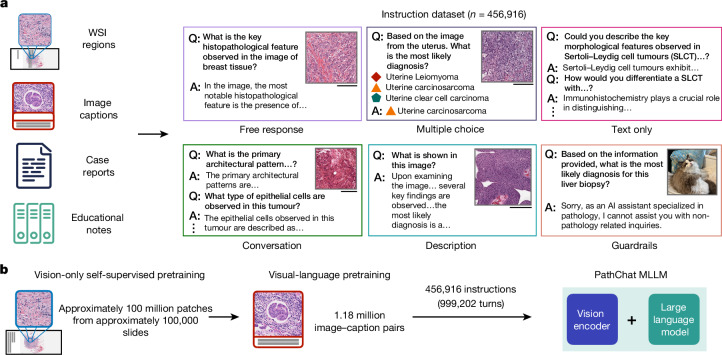
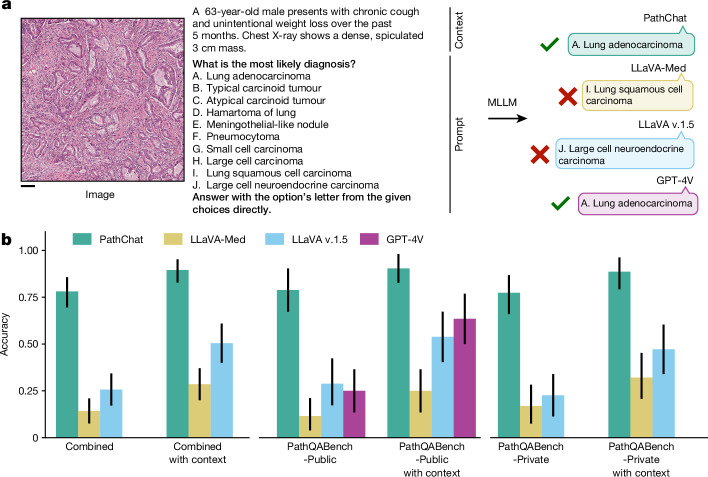
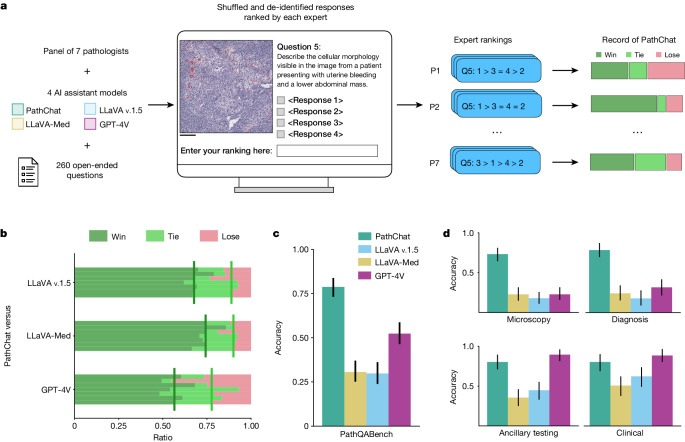
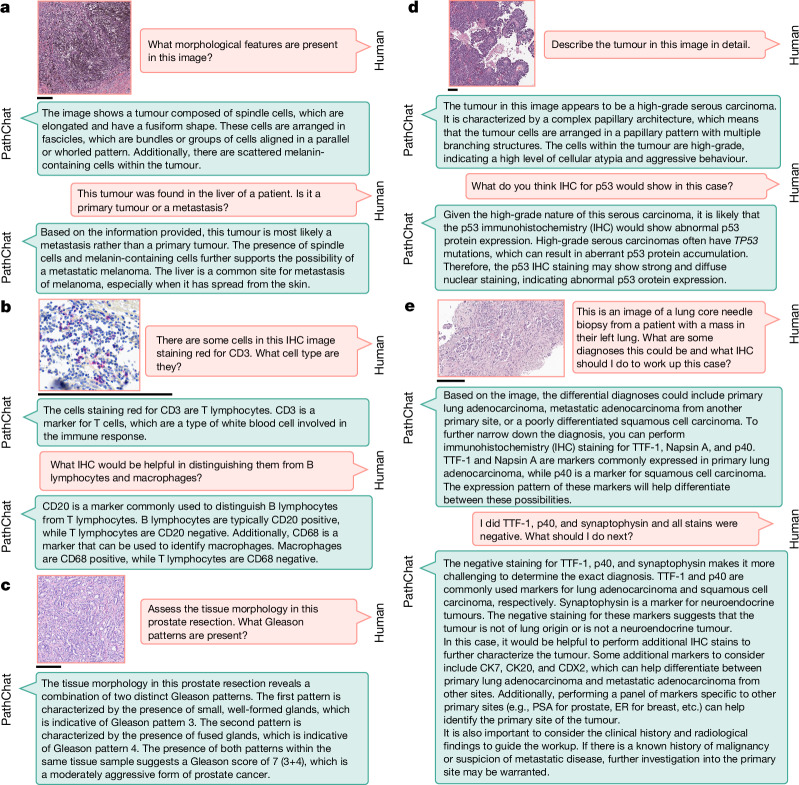
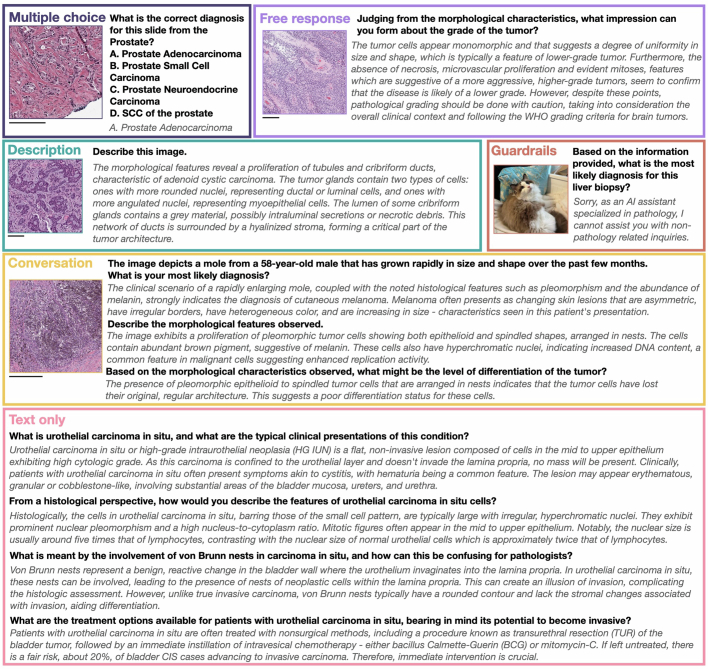
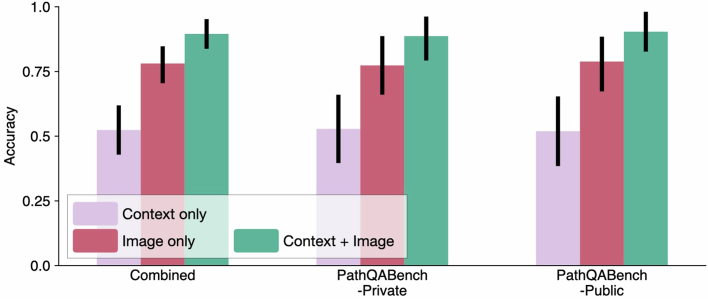
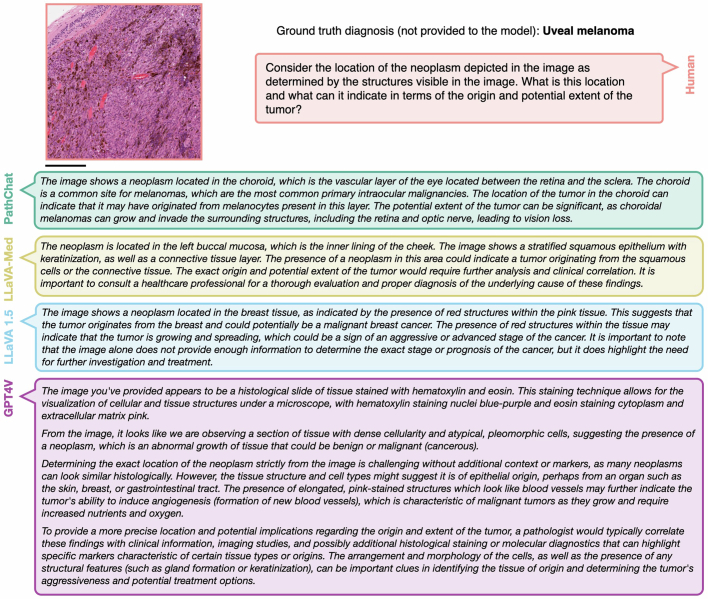
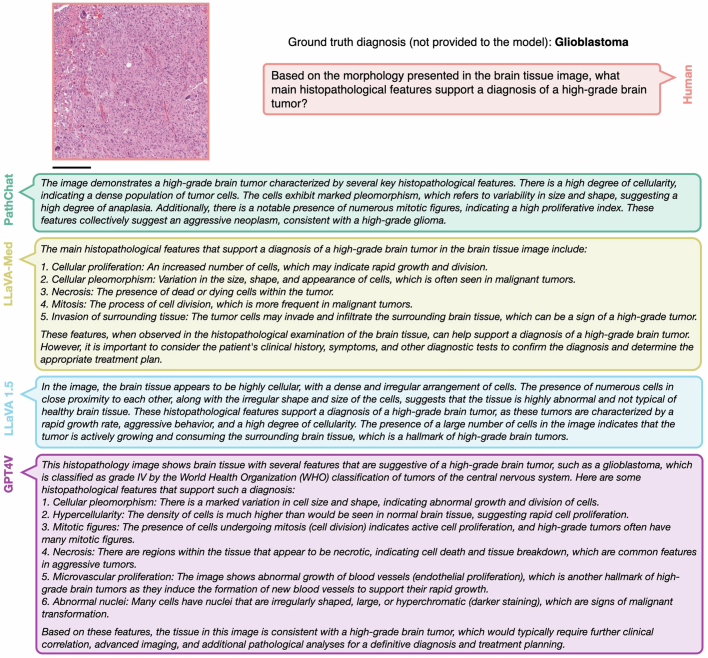
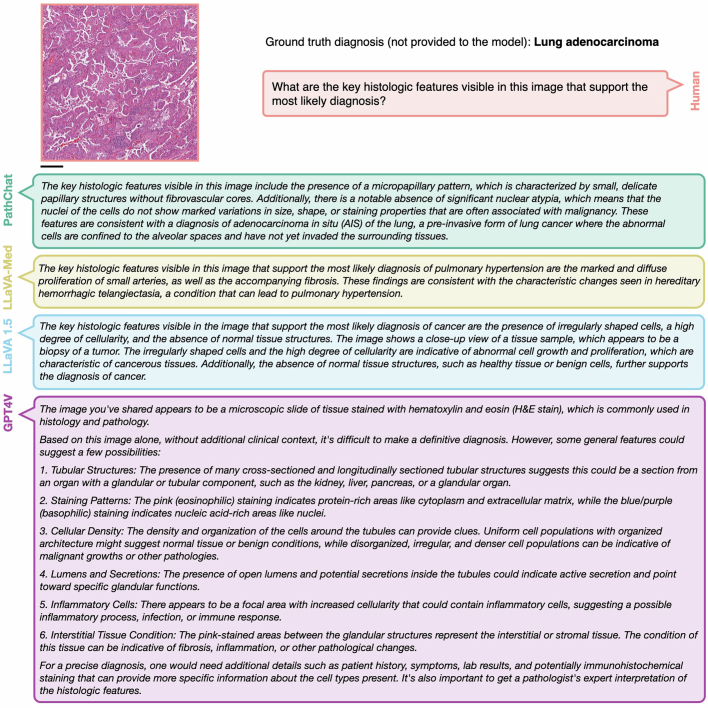
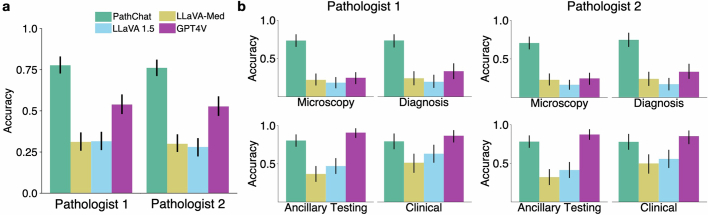
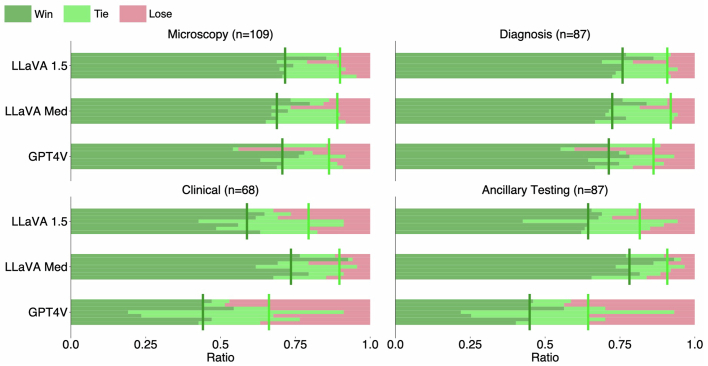
Computational pathology 1,2 has witnessed considerable progress in the development of both task-specific predictive models and task-agnostic self-supervised vision encoders 3,4 . However, despite the explosive growth of generative artificial intelligence (AI), there have been few studies on building general-purpose multimodal AI assistants and copilots 5 tailored to pathology. Here we present PathChat, a vision-language generalist AI assistant for human pathology. We built PathChat by adapting a foundational vision encoder for pathology, combining it with a pretrained large language model and fine-tuning the whole system on over 456,000 diverse visual-language instructions consisting of 999,202 question and answer turns. We compare PathChat with several multimodal vision-language AI assistants and GPT-4V, which powers the commercially available multimodal general-purpose AI assistant ChatGPT-4 (ref. 6 ). PathChat achieved state-of-the-art performance on multiple-choice diagnostic questions from cases with diverse tissue origins and disease models. Furthermore, using open-ended questions and human expert evaluation, we found that overall PathChat produced more accurate and pathologist-preferable responses to diverse queries related to pathology. As an interactive vision-language AI copilot that can flexibly handle both visual and natural language inputs, PathChat may potentially find impactful applications in pathology education, research and human-in-the-loop clinical decision-making.
Overview
The claims and statistics of this paper haven’t been checked yet.
Free: it reads the open-access text and checks the first 5 claims that cite a source we can check. Create a free account to check every claim.
Integrity signals
Registry
Cites
Statistics
Figures
Verification
Claims the paper makes
The claims and statistics of this paper haven’t been checked yet.
Free: it reads the open-access text and checks the first 5 claims that cite a source we can check. Create a free account to check every claim.
Claims other papers make about this one
Each is checked against this paper’s own text: does it say what the citing paper says it does?
The source backs part of the claim, not all of it — or backs it for a different population, condition or comparison.
In the citing paper
“The synthetic region-level captions can easily be generated with the generative AI model to provide a wealth of text guidance88,127.”
From A multimodal whole-slide foundation model for pathology (2025) · cites this paper as [88]
Experimental — accuracy not yet measured
Self-check
Percentages, sums and reported differences re-computed from the paper’s own numbers.
The self-check needs the paper’s full text.
Citations
Cites
Microsoft COCO: Common Objects in Context
Lin, T.-Y., Maire, M., Belongie, S., Hays, J., Perona, P., Ramanan, D., Dollár, P., & Zitnick, C. L. (2014) · Lecture Notes in Computer Science · doi:10.1007/978-3-319-10602-1_48 · Cited by 45,460
Language Models are Few-Shot Learners
Brown, T. B., Mann, B., Ryder, N., Subbiah, M., Kaplan, J., Dhariwal, P., Neelakantan, A., Shyam, P., Sastry, G., Askell, A., et al. (2020) · arXiv · doi:10.48550/arxiv.2005.14165 · Cited by 23,372
Learning Transferable Visual Models From Natural Language Supervision
Radford, A., Kim, J. W., Hallacy, C., Ramesh, A., Goh, G., Agarwal, S., Sastry, G., Askell, A., Mishkin, P., Clark, J., et al. (2021) · arXiv · doi:10.48550/arxiv.2103.00020 · Cited by 15,293
QuPath: Open source software for digital pathology image analysis
Bankhead, P., Loughrey, M. B., Fernández, J. A., Dombrowski, Y., McArt, D. G., Dunne, P. D., McQuaid, S., Gray, R. T., Murray, L. J., Coleman, H. G., et al. (2017) · Scientific Reports · doi:10.1038/s41598-017-17204-5 · Cited by 8,908
Training language models to follow instructions with human feedback
Ouyang, L., Wu, J., Jiang, X., Almeida, D., Wainwright, C. L., Mishkin, P., Zhang, C., Agarwal, S., Slama, K., Ray, A., et al. (2022) · arXiv · doi:10.48550/arxiv.2203.02155 · Cited by 4,208
Large Language Models Encode Clinical Knowledge
Singhal, K., Azizi, S., Tu, T., Mahdavi, S. S., Wei, J., Chung, H. W., Scales, N., Tanwani, A., Cole-Lewis, H., Pfohl, S., et al. (2022) · arXiv · doi:10.48550/arxiv.2212.13138 · Cited by 4,083
Large language models encode clinical knowledge
Singhal, K., Azizi, S., Tu, T., Mahdavi, S. S., Wei, J., Chung, H. W., Scales, N., Tanwani, A., Cole-Lewis, H., Pfohl, S., et al. (2023) · Nature · doi:10.1038/s41586-023-06291-2 · Cited by 4,083
Ehteshami Bejnordi, B., Veta, M., Johannes van Diest, P., van Ginneken, B., Karssemeijer, N., Litjens, G., van der Laak, J. A. W. M., and the CAMELYON16 Consortium, Hermsen, M., Manson, Q. F., et al. (2017) · JAMA · doi:10.1001/jama.2017.14585 · Cited by 3,293
Retrieval-Augmented Generation for Knowledge-Intensive NLP Tasks
Lewis, P., Perez, E., Piktus, A., Petroni, F., Karpukhin, V., Goyal, N., Küttler, H., Lewis, M., Yih, W.-T., Rocktäschel, T., et al. (2020) · arXiv · doi:10.48550/arxiv.2005.11401 · Cited by 3,101
Coudray, N., Ocampo, P. S., Sakellaropoulos, T., Narula, N., Snuderl, M., Fenyö, D., Moreira, A. L., Razavian, N., & Tsirigos, A. (2018) · Nature Medicine · doi:10.1038/s41591-018-0177-5 · Cited by 2,930
Research works printed but not linked: 1
- Tsuneki, M. & Kanavati, F. Inference of captions from histopathological patches. In Proc. International Conference on Medical Imaging with Deep Learning (Konukoglu, E. et al.) 1235–1250 (PMLR, 2022).
Cited by
Items 301–400 of 563
Virtual medicine: medical AI in human health and diseases
Zhang, C., Wang, F.-X., Tang, X., Li, J.-L., Ding, N., Hong, Y., Song, P., Bai, L., & Su, J. (2026) · Military Medical Research · doi:10.1016/j.mmr.2026.100012 · Cited by 4
Yu, W., Sun, S., Wang, H., Cheng, Y., & Yu, D. (2026) · Digital Health · doi:10.1177/20552076261446519 · Cited by 2
Artificial intelligence in cancer diagnostics: a primer for clinicians and scientists
Rizwan, A. M., Makhlouf, H. R., Bharti, S., Dey, S. M., Ossandon, M. R., Robustelli, C. E., Samant, M., Robles, A. I., Sorg, B. S., & Harris, L. N. (2026) · JNCI Journal of the National Cancer Institute · doi:10.1093/jnci/djag143 · Cited by 3
Decoding (digital) histopathology: The building blocks for computational researchers
Dammak, S., Caputo, A., Montezuma, D., L’Imperio, V., Oliveira, S. P., & on behalf of the European Society of Digital and Integrative Pathology (ESDIP) (2026) · PLOS Digital Health · doi:10.1371/journal.pdig.0001148 · Cited by 2
Enhancing Pathological VLMs with Cross-Scale Reasoning
Phan, C., Zhang, T., Xue, Q., Wu, Y., Hu, D., Liu, Z., Wang, S., & Jin, Y. (2026) · Lecture notes in computer science · doi:10.1007/978-3-032-38062-3_19 · Cited by 2
Generative Artificial Intelligence and Large Language Models in Clinical Oncology
Yu, Y., Zhao, Z., Wang, Z., Lin, R., Tan, Y., Chen, Y., Li, T., Baptista‐Hon, D. T., Zhang, X., Wu, C., et al. (2026) · MedComm · doi:10.1002/mco2.70833 · Cited by 4
“Generative AI can effectively integrate heterogeneous data, such as medical images and clinical texts, to extract key diagnostic features, generate structured diagnostic reports, answer clinical queries, and support personalized treatment decision-making [ 185 ].”
Saez-Diez, M. G., Chung, J., Wolsky, A. D., Lanzalotto, G., Knox, D., Mummolo, J., Stewart, B. M., & Russakovsky, O. (2026) · Lecture notes in computer science · doi:10.1007/978-3-032-37520-9_20 · Cited by 3
Corso, F., Zec, A., Favali, M., Ligero, M., Hilgers, L., Invernizzi, L. M., Mazzeo, L., Morales, A. M., Müller‐Franzes, G. A., Machado, I. P., et al. (2026) · Cell Reports Medicine · doi:10.1016/j.xcrm.2026.102966 · Cited by 3
An autonomous multimodal AI agent for evidence-grounded ophthalmic diagnosis
Zhao, K., Sun, Q., Kang, D., Yu, T., Han, W., (205074), R. Y., Agrawal, R. V., Ying, G., Grzybowski, A. E., & Jin, K. (2026) · Cell Reports Medicine · doi:10.1016/j.xcrm.2026.102969 · Cited by 5
“16,17 Despite these strides, general-purpose multimodal LLMs remain limited in clinical ophthalmology, 18,19 where subtle morphologic features (e.g., early epiretinal membranes or shallow detachments) and cross-modality correlations critically influence diagnosis and management.”
MTBBench: A Multimodal Sequential Clinical Decision-Making Benchmark in Oncology
Vasilev, K., Misrahi, A., Jain, E., Cheng, P. F., Liakopoulos, P., Michielin, O. A., Moor, M., & Bunne, C. (2025) · neural information processing systems · doi:10.52202/085713-0368 · Cited by 4
Qi, X. S., Wang, Y., Yang, X., Ren, L., Liu, W., Benedict, S., Xiao, Y., Xing, L., & Naqa, I. M. E. (2026) · Medical Physics · doi:10.1002/mp.70616 · Cited by 3
“93,95 For example,LLMs can interpret clinical notes, radiology reports,and pathology findings to provide contextual information that guides and refines image-based segmentation.”
Agentic systems in computational pathology: architectures, evidence, and translational challenges
Lu, X., Li, Q., Gao, Y., Wei, D., Lyu, M., Ma, S., Li, J., Wu, Y., Cai, L., Zhang, T., et al. (2026) · Journal of Translational Medicine · doi:10.1186/s12967-026-08829-0 · Cited by 2
“Quilt-1 M provided large-scale image-text pairs at patch level [20]; PathAlign supported slide-level report generation [21]; and Path-Chat combined histology images with language-based interaction [22].”
MetaPath Chat: multimodal generative artificial intelligence chatbot for clinical pathology
Chen, H., Lin, R., & Yu, Y. (2024) · MedComm · doi:10.1002/mco2.769 · Cited by 2
Aligning Multimodal Biomedical Images and Language via One Large Vision-Language Model
Zhang, H., Zeng, M., Ding, J., Liang, Y., Zheng, R., Qu, Z., Li, M., & Kan, S. (2024) · IEEE International Conference on Bioinformatics and Biomedicine (BIBM) · doi:10.1109/bibm62325.2024.10822357 · Cited by 2
The Evolution of Digital Pathology in Infrastructure, Artificial Intelligence and Clinical Impact
Jung, C. K. (2025) · International Journal of Thyroidology · doi:10.11106/ijt.2025.18.1.6 · Cited by 2
Patología digital: Una aproximación crítica a sus implicaciones bioéticas
Castro, Y. X. A., Robles, C. M. G., Cruz, E. R. B., & Contino, C. G. D. (2025) · Revista San Gregorio · doi:10.36097/rsan.v1i62.3688 · Cited by 2
Zhang, X., Huang, C., Huang, X., Xu, Q., Fu, A.-Q., Cai, J., Lai, J., & Yin, X. (2025) · European Journal of Surgical Oncology · doi:10.1016/j.ejso.2025.110295 · Cited by 2
ChatGPT® and Knowledge of Brazilian Dental Ethics and Legislation
da Nóbrega, J. B. M., Gusmão, C. L. V., Laureano, I. C. C., & Santiago, B. M. (2025) · Pesquisa Brasileira em Odontopediatria e Clínica Integrada · doi:10.1590/pboci.2026.010 · Cited by 2
Yang, Z., Huang, T., Huang, L., Yao, J., Jiang, L., Wu, W., Xie, X., Xu, M. T., & Zhang, X. (2026) · Current Medical Imaging Formerly Current Medical Imaging Reviews · doi:10.2174/0115734056437835260214191655 · Cited by 2
I-Viewer: An Online Digital Pathology Analysis Platform with Agentic-RAG AI CopilotPreprint
Rong, R., Luo, D., Gu, Z., Quan, P., Villanueva-Miranda, I., Wang, J., Yang, S., Chi, Z., Leavey, P. J., Yang, D. M., et al. (2024) · Research Square · doi:10.21203/rs.3.rs-5404747/v1 · Cited by 3
Self-citationMultimodal Generative AI in Diagnostics: Bridging Medical Imaging and Clinical ReasoningPreprint
Maleki, M., & Ghahari, S. (2025) · Preprints.org · doi:10.20944/preprints202508.1425.v2 · Cited by 4
Guan, R., Liang, S., Weng, J., Gu, X., Weng, J., Liu, D., Pan, D., Zhang, Q., Liang, X., Ding, W., et al. (2026) · arXiv (Cornell University) · doi:10.48550/arxiv.2607.05311 · Cited by 3
“In broader biomedical AI, vision-language and generalist biomedical models have shown the feasibility of aligning medical images and text for segmentation, classification, question answering, or report-oriented reasoning [55, 66, 69, 97, 98, 104, 114, 118, 123].”
Computer vision methods under rapid evolution for pathology image tasks
Maher, N. G., Scolyer, R. A., & Liu, S. (2024) · Histopathology · doi:10.1111/his.15352 · Cited by 1
“20 This represents a domain-specific evolution from agnostic AI copilot models such as ChatGPT, which was recently evaluated in Histopathology by Oon et al .”
Best practice for supply chain in LLM-assisted medical applications
Zhao, S., & Wang, J. (2025) · ACM SIGSOFT International Symposium on Software Testing and Analysis (ISSTA) · doi:10.1145/3713081.3731748 · Cited by 1
Self-citationScaling down, Powering up: A Survey on the Advancements of Small Vision-Language Models
Ahmed, S. I., Hasan, M. Z., Niloy, A. J., Monsur, S. M., & Albert, M. V. (2025) · Information Fusion · doi:10.1016/j.inffus.2025.103805 · Cited by 5
Bellocq, J., & Fetique, D. (2025) · Annales de Pathologie · doi:10.1016/j.annpat.2025.08.004 · Cited by 1
The use of artificial intelligence methods in pathology
Damian, V., Palichenka, U., Koblížek, M., Škapa, P., & Zámečník, J. (2025) · Česko-slovenská pediatrie · doi:10.55095/cspediatrie2025/043 · Cited by 1
The shrinking workforce of pathologists: implications for healthcare and possible solutions
Carbone, F. G. (2025) · Pathologica · doi:10.32074/1591-951x-n1156 · Cited by 1
“Recently introduced AI models could serve as an effective assistant for pathologists, engaging with them through natural language and human interactions while demonstrating impressive accuracy 10 .”
Research progress of universalvision foundation models in computational pathology
Fu, Z., Da, Q., Wang, W., Wang, C., Zhong, D., Wang, S., & Wang, L. (2025) · Chinese Science Bulletin (Chinese Version) · doi:10.1360/csb-2025-5045 · Cited by 1
Fan, R., & Wang, Y. (2025) · Electronics · doi:10.3390/electronics14244921 · Cited by 1
Subtype classification of gastric spindle cell tumors in whole slide images
Lee, H., Lee, Y. J., Kim, E., Lee, J., Ahn, S., & Lee, S. H. (2025) · Computers in Biology and Medicine · doi:10.1016/j.compbiomed.2025.111410 · Cited by 1
Artificial Intelligent Assistants in Support of Trauma Surgery
Wachs, J. P., Zhuo, Y., & Kirkpatrick, A. W. (2026) · Hot topics in acute care surgery and trauma · doi:10.1007/978-3-032-09357-8_7 · Cited by 1
Yaqin, 唐. T., Yuxiang, 高. G., Kaikai, 马. M., Chenxu, 刘. L., & Alifu, 努. N. (2026) · Chinese Journal of Lasers · doi:10.3788/cjl250877 · Cited by 1
Gupta, P., Zhang, Z., Song, M., Michalowski, M., Hu, X., Štiglic, G., Peltonen, L. M., & Topaz, M. (2026) · CIN Computers Informatics Nursing · doi:10.1097/cin.0000000000001485 · Cited by 1
MedBLINK: Probing Basic Perception in Multimodal Language Models for Medicine
Bigverdi, M., Ikezogwo, W. O., Zhang, K., Jeong, H., Lu, M., Cho, S., Shapiro, L. G., & Krishna, R. (2025) · IEEE International Conference on Computer Vision Workshops · doi:10.1109/iccvw69036.2025.00132 · Cited by 5
Self-citationFrom Cosmos to Clinic: Interpretable Spatial Statistics for Histopathology Prognosis
Barna, A., Kilim, O., & Csabai, I. (2025) · IEEE International Conference on Computer Vision Workshops · doi:10.1109/iccvw69036.2025.00100 · Cited by 2
“…relevance propagation provides positive/negative evidence distinction [9], and PathChat demonstrates sophisticated multimodal AI assistance [14]—these approaches remain fundamentally limited to identifying “where the model looks” rather than quantifying “how spatial tissue organization…”
Adaptive diagnostic reasoning framework for pathology with multimodal large language models
Hong, Y., Kao, K.-C., Edwards, L., Liu, N. T., Huang, C., Oliveira-Kowaleski, A., Hsieh, C.-J., & Lin, N. Y. C. (2026) · Communications Medicine · doi:10.1038/s43856-026-01491-z · Cited by 3
“In parallel, recent breakthroughs in multimodal large language models (MLLMs) 26 – 32 demonstrate strong image understanding and emerging reasoning skills.”
Yang, Z., Wang, L., Zhou, Z., Jiang, S., Li, Y., & Chen, C. (2026) · Array · doi:10.1016/j.array.2026.100767 · Cited by 1
Self-citationYousef, E. M., Bolgova, O., Yaqinuddin, A., Shaikh, A. A., & Mavrych, V. (2026) · Anatomical Sciences Education · doi:10.1002/ase.70209 · Cited by 1
Empowering Patients Through AI Technologies: Contextualize and Personalize Patient Care
Sasmal, B., Saha, R., Dhal, K. G., Pandit, D., Saif, S., & Khan, G. (2026) · Springer optimization and its applications · doi:10.1007/978-3-032-15092-9_19 · Cited by 1
Challenges and Barriers in Implementing AI for Clinical Applications in Anatomic Pathology
Littlefield, N. G., Bao, R., Rong, X., Ullah, E., Parwani, A. V., & Gu, Q. (2026) · Advances in Anatomic Pathology · doi:10.1097/pap.0000000000000537 · Cited by 1
Self-citationReinPath: A Multimodal Reinforcement Learning Approach for Pathology
Zhou, K., Jiang, J., Zhang, Q., Zheng, S., Li, Q. P., & Xu, S. (2026) · IEEE International Conference on Acoustics Speech and Signal Processing · doi:10.1109/icassp55912.2026.11463211 · Cited by 1
Tang, K., Zhou, Y., Chen, G., Hu, H., & Wang, B. (2026) · Surgical Endoscopy · doi:10.1007/s00464-026-12868-5 · Cited by 1
GROSSO, A. A., BACKER, P. D., KOWALWSKI, K. F., BELENCHON, I. R., PULIATTI, S., Piazza, P., Baekelandt, L., Taratkin, M. S., Kozikowski, M., Kutchukian, S., et al. (2026) · Minerva Urology and Nephrology · doi:10.23736/s2724-6051.26.07062-x · Cited by 1
The emerging future of healthcare simulation with artificial intelligence integration
Karaçay, P., & Göktaş, P. (2026) · Teaching and learning in nursing · doi:10.1016/j.teln.2026.04.019 · Cited by 1
HiAdapter: Histopathology-Induced Adapter for Pathology Foundation Models
Liu, Q., Xie, P., Dai, Z., & Bai, X. (2026) · IEEE Transactions on Medical Imaging · doi:10.1109/tmi.2026.3694387 · Cited by 2
“[20] that integrate images with text annotations, and multi-modal models [21], [22], incorporating images, text, molecular profiles, and immunohistochemical findings.”
PathLens: A lightweight multimodal reasoner for in-depth pathology insights
Zhu, Z., Chen, H., Yan, Z., Zhang, D., Wu, Y., Zhan, Y., Cheng, W., Zhao, M., Gu, W., Chen, Y., et al. (2026) · Knowledge-Based Systems · doi:10.1016/j.knosys.2026.116261 · Cited by 2
Self-citationFoundation Models in Cancer Pathology: Techniques, Applications, and Future Directions
Zhang, B., Cui, V. Y., Wu, T., Su, G., Huang, Q., Shang, B., Kong, M., Yu, W., Yuan, Y., & Tu, H. (2026) · Research · doi:10.34133/research.1332 · Cited by 2
Cai, L., Meng, B., Huang, J., Ding, G., Ju, M., Wang, W.-W., Shi-jie, D., Lai, L., Wang, J., Yang, C.-X., et al. (2026) · LabMed discovery. · doi:10.1016/j.lmd.2026.100130 · Cited by 1
Self-citationHenkel, L., Bamarni, A., Braun, S. A., Busik, V., Haenssle, H. A., Rietz, S., Schmidle, P., Schuh, S., Seitz, A., Sitaru, S., et al. (2026) · JDDG Journal der Deutschen Dermatologischen Gesellschaft · doi:10.1111/ddg.70365x · Cited by 1
“In initial studies, they have already demonstrated the ability to respond to questions about histopathological sections, 60 or to automatically generate diagnostics reports, for instance for basal cell carcinoma.”
Intelligent three-dimensional imaging in pathology: Applications and developments
Si, W., Zhao, F., Kuang, D., Zhao, Y., Liu, Y., Sun, M., Duan, Y. Q., Fei, P., & Wang, G. (2026) · Chinese Medical Journal · doi:10.1097/cm9.0000000000004176 · Cited by 1
Clinical large language model centered on electronic medical records
Zhuang, Y., Wang, B., Yin, C., Zhang, J., Meng, F., Zhao, J., Su, Q., Zhao, X., Li, X., Hu, P., et al. (2026) · npj Digital Medicine · doi:10.1038/s41746-026-02509-5 · Cited by 1
Semantic-Anchored Evidential Fusion for Domain-Robust Whole-Slide Survival Analysis
Xing, Y., Huang, L., Liu, P., Ma, J. Y., Xu, J., He, K., & Feng, M. (2026) · Lecture notes in computer science · doi:10.1007/978-3-032-37520-9_9 · Cited by 1
Retrieval-augmented large multimodal models for pathology
Chu, X., Sun, Y., Zhou, B., & Sun, L. J. (2026) · Discover Computing · doi:10.1007/s10791-026-10263-1 · Cited by 1
“Building on these advances, several domain-specific LMMs have been developed for targeted clinical applications, including Med-Flamingo [37], LLaVA-Med [38], PathAsst [39], PathGen-LLaVA [33], Quilt-LLaVA [40], and PathChat [41].”
Gao, M., Ouyang, G., Liu, Y., Chen, S. T., & Xu, K. (2026) · Frontiers in Immunology · doi:10.3389/fimmu.2026.1856163 · Cited by 1
“Contrastive learning, established for general vision by Contrastive Language – Image Pre-training (CLIP) (41), now underpins medical foundation models that align images with clinical text or with molecular pro fi les (42, 43).”
Zhong, L., Qian, K., Zhao, W., Shen, T., Xu, S., Li, J., & Wang, G. (2026) · Medical Image Analysis · doi:10.1016/j.media.2026.104177 · Cited by 1
Marchevsky, A. M., & Walts, A. E. (2026) · Annals of Diagnostic Pathology · doi:10.1016/j.anndiagpath.2026.152677 · Cited by 1
Ensemble Machine Learning Framework for Sewer Pipe Condition Assessment
Rouhi, M., Najafi, M., Kaushal, V., & Yu, J. (2026) · Journal of Pipeline Systems Engineering and Practice · doi:10.1061/jpsea2.pseng-2011 · Cited by 1
OmniPathoVQA: Benchmarking pathology vision–language models with Encyclopedia-scale knowledge
Chen, K., Wei, L., Rui, S., Yuan, Y., Zhang, X., Du, Z., He, P., Wang, Y., Liu, M., Zhou, M., et al. (2026) · Medical Image Analysis · doi:10.1016/j.media.2026.104196 · Cited by 3
Henkel, L., Bamarni, A., Braun, S. A., Busik, V., Haenssle, H. A., Rietz, S., Schmidle, P., Schuh, S., Seitz, A., Sitaru, S., et al. (2026) · JDDG Journal der Deutschen Dermatologischen Gesellschaft · doi:10.1111/ddg.70365 · Cited by 1
Niu, Z., Zhao, W., Jackson, L., Cai, Q., Pinfield, V. J., Lin, W.-F., Wu, B., Luo, K., & Wang, Y. (2026) · 中国科学通报:英文版 · doi:10.1016/j.scib.2026.07.036 · Cited by 1
Gao, Y., Ma, T., Li, L., Ding, Y., Qi, R., Cui, X., & Gao, X. (2026) · Chinese Medical Journal · doi:10.1097/cm9.0000000000004154 · Cited by 1
Peng, N., Wang, M. Y., Song, S. J., Lai, J. C., Hui, V. W., Wong, V. W., Wong, G. L., Bhat, M., & Yip, T. C. (2026) · Clinical and Molecular Hepatology · doi:10.3350/cmh.2026.0258 · Cited by 1
“22 An evolution from discriminative to generative AI in digital pathology has been observed.”
Bilal, K. H., Gibson, J., Kim, D., LEVI, A. W., Nassar, A., Oen, H. O., Robila, V., Saieg, M. A., Shi, Q., Torous, V. F., et al. (2026) · Cancer Cytopathology · doi:10.1002/cncy.70134 · Cited by 1
Self-citationPractical applications of computational pathology: bridging technology and clinical practice
Hanna, M. G., Rashidi, H., & Pantanowitz, L. (2026) · Pathology · doi:10.1016/j.pathol.2026.06.012 · Cited by 1
Chen, Y., Ma, C., Li, Q., Yan, F., Chen, Y., Li, T., Ye, J., Hu, M., Lin, Y., Li, Y., et al. (2026) · Nature Cancer · doi:10.1038/s43018-026-01220-4 · Cited by 2
“No statistical methods were used to predetermine sample sizes, but our sample sizes were similar to those reported in previous publications 8,14,24 .”
A single-cell spatiotemporal manifold of tissue morphology and dynamics
Haus, E., Santella, A., Xu, Y., Ren, R., Wang, D., & Bao, Z. (2026) · Cell Reports Methods · doi:10.1016/j.crmeth.2026.101606 · Cited by 1
Agentic T-STROBE: a front-shifted STROBE paradigm for observational research
Bo, C., Li, R., 赵敬华, Feng, S., Ji, X., & Xue, F. (2026) · Statistics Innovation · doi:10.48130/stati-0026-0014 · Cited by 1
Tinjauan Literatur Seputar Revolusi AI dalam Pendidikan Anak Usia Dini
Faizah, A., Ramadhani, A. P., Amelia, E., Nur’Aeni, F., Nurmala, I., Ruhiyat, S., Sabila, W. A., & Mashudi, E. A. (2026) · Child Kingdom. · doi:10.53961/childom.v4i1.358 · Cited by 1
Del Ars Magna a la inteligencia artificial generativa
Llavori, R. B. (2025) · Revista de Senología y Patología Mamaria · doi:10.1016/j.senol.2024.100663 · Cited by 1
Wu, T.-H., Chiu, H., Wu, J.-J., Yang, W., Cheng, K., Hsu, C., Wang, S.-H., Uyboco, J. T., Tsai, H.-W., & Chung, P. (2025) · IEEE Journal of Biomedical and Health Informatics · doi:10.1109/jbhi.2025.3556709 · Cited by 1
Xu, Y., Dai, H., Feng, J., Xu, K., Wang, Q., Gao, P., & Zuo, C. (2025) · Frontiers in Genetics · doi:10.3389/fgene.2025.1566675 · Cited by 1
Kshirsagar, J., & Shirmohammadi, S. (2025) · IEEE Instrumentation & Measurement Magazine · doi:10.1109/mim.2025.11021344 · Cited by 1
“Systems like PathChat [2] which is a vision-language AI assistant for human pathology, CHIEF [3] which is a general-purpose machine learning framework for cancer evaluation, and RETFound [4] which detects diseases from retinal images, typically process medial images with specially trained vision…”
Generations of Generating a Cytology Report
Wellman, M. L., Radin, M. J., & Neal, S. V. (2025) · Veterinary Clinical Pathology · doi:10.1111/vcp.70074 · Cited by 1
Generative AI-assisted Peer Review in Medical Publications: Opportunities Or Trap (Preprint)Preprint
Li, Z., Shen, C., Cao, F., Xiang, C. J., Fei, Y., & Liu, J. (2024) · doi:10.2196/preprints.66022 · Cited by 1
Stimmer, L., Kuiper, R., Polledo, L., Ressel, L., Rodríguez, J. M. M., Veiga, I. B., Williams, J. M., & Herder, V. (2025) · Veterinary Pathology · doi:10.1177/03009858251343215 · Cited by 1
Cotte, F., Schmude, M., Bode, P., Suliman, O., Lourenço, F. D., Pereira, M. P., Kini, N., Hartenstein, V., Muscoloni, A., Stroux, L., et al. (2025) · medRxiv · doi:10.1101/2025.09.20.25336227 · Cited by 1
Chinese expert opinion on AI-based identification of lymph node metastases in solid tumors
Wang, X., Tang, H., Chen, Y., Zhang, X., Liu, X., Zhu, M., Ni, C.-R., & Yu, G. (2025) · Journal of Histotechnology · doi:10.1080/01478885.2025.2580157 · Cited by 1
“…image features to predict patient prognosis and treatment response [18]; serving as an ‘AI co-pilot’ to provide interactive diagnostic assistance [15]; and, combined with high-throughput imaging technologies like IMC (imaging mass cytometry), enabling in-depth analysis of the tumor…”
LLMartini: Seamless and Interactive Leveraging of Multiple LLMs through Comparison and CompositionPreprint
Shi, Y., Yang, J., Wang, Y., Yin, Y., Li, H., Gao, K., & Yu, C. (2025) · arXiv (Cornell University) · doi:10.48550/arxiv.2510.19252 · Cited by 1
“Extensive exploration has also been conducted on user-LLM collaboration in specific contexts [22] such as healthcare [47, 62, 75], education [26, 35, 54], management [55], writing [37], and programming [63, 85].”
Query-driven generative AI synthesizes multi-modal spatial omics from histologyPreprint
Pang, M., Roy, T. K., Wu, X., & Tan, K. (2025) · bioRxiv (Cold Spring Harbor Laboratory) · doi:10.64898/2025.12.11.693669 · Cited by 1
Parameter Efficient Multimodal Instruction Tuning for Romanian Vision Language ModelsPreprint
Dima, G.-A., Smădu, R.-A., & Cercel, D.-C. (2025) · arXiv (Cornell University) · doi:10.48550/arxiv.2512.14926 · Cited by 1
“PathChat [Lu et al., 2024a] is a chat-based assistant for histopathology built on top of LLaVA-1.”
Moonemans, S. P. J., Ram, S. R., Meeuwsen, F., Lems, C. M., van der Laak, J. A. W. M., Litjens, G., & Ciompi, F. (2025) · arXiv (Cornell University) · doi:10.48550/arxiv.2512.17326 · Cited by 1
Harness Behavioural Analysis for Unpacking the Bio-Interpretability of Pathology Foundation ModelsPreprint
Hu, Y., Batchkala, G., Gaitskell, K. L., Domingo, E., Li, B., Zhang, T., Li, Z., Friedrich, M., Woodcock, D. J., Verrill, C. L., et al. (2026) · Research Square · doi:10.21203/rs.3.rs-8090378/v1 · Cited by 1
Foundation models in pathology and the challenge of clinical time
Jaume, G. (2026) · Annals of Oncology · doi:10.1016/j.annonc.2026.03.004 · Cited by 3
SlideFlame: A data-efficient vision-language model for anatomically grounded pathology reportingPreprint
Kather, J. N., Sainath, S., Lenz, T., Reitsam, N. G., Foersch, S., Hewitt, K., Wölflein, G., Meneghetti, A. R., Liang, J., Wolf, F., et al. (2026) · Research Square · doi:10.21203/rs.3.rs-9625986/v1 · Cited by 1
SlideBank: A Persistent Hierarchical Evidence Bank for Consistent Whole-Slide ReasoningPreprint
Zhao, B., Huang, G., Zhang, C., Li, A., Tan, Y., Zhou, C., Wang, G., Gao, Z., & Li, X. (2026) · arXiv (Cornell University) · doi:10.48550/arxiv.2609.00342 · Cited by 2
PathJev: Decision-Native Vision-Language Modelling for HistopathologyPreprint
Tommasino, C., & Rinaldi, A. M. (2026) · arXiv (Cornell University) · doi:10.48550/arxiv.2610.32478 · Cited by 1
“Contrastive pathology models return similarity scores whose scale is arbitrary [1], and generative assistants return free text whose confidence is a token probability [2]; calibration studies of medical vision–language models find the problem particularly severe in pathology [3, 4].”
Leveraging evidence-guided LLMs to enhance trustworthy depression diagnosis
Yuan, Y., Ben Tamo, J., Nnamdi, M. C., Wang, Y., & Wang, M. D. (2025) · 2025 IEEE EMBS International Conference on Biomedical and Health Informatics (BHI) · doi:10.1109/bhi67747.2025.11269522
“1) Evidence-Guided Diagnostic Reasoning (EGDR) extracts 2) Diagnosis confidence scoring verifies these claims”
Chen, J. H., Elmelech, L., Tang, A. L., & Hacohen, N. (2024) · Current Opinion in Immunology · doi:10.1016/j.coi.2024.102463
Code instructions for Humans vs AIPreprint
Ignise, A., & Vahi, Y. (2024) · doi:10.36227/techrxiv.172840790.06184137/v1
Xue, P., Wang, Y., Cui, V. Y., Ye, Z., Pan, Q., Zhang, X., Yao, Y., & Qiao, Y. (2024) · doi:10.2196/preprints.67720
Lammert, J., Tschochohei, M., Jansen, H., Mathes, S., Schatz, U. A., Bronger, H., Boeker, M., & Kiechle, M. B. (2024) · Die Gynäkologie · doi:10.1007/s00129-024-05297-9
Peng, 费. F., Wentian, 思. S., & Minchao, 张. Z. (2024) · Acta Optica Sinica (Online) · doi:10.3788/aosol240448 · Cited by 1
Henderson, E. R., Gracias, D. H., Ramakrishnan, V. M., Tiomkin, S., Wachs, J. P., & Wollin, D. A. (2025) · Molecular-Guided Surgery: Molecules, Devices, and Applications · doi:10.1117/12.3049646
“AI Copilots 67 will augment and perform diagnostic testing, providing physical examinations and serving as robotic nurses.”
Ciaccio, E. J., Bhagat, G., & Green, P. H. (2025) · Gastrointestinal Endoscopy Clinics of North America · doi:10.1016/j.giec.2025.02.011
Künstliche Intelligenz im Krebsscreening
Schneider, C. V., Brinker, T. J., Foersch, S., Truhn, D., Hann, A., & Kather, J. N. (2025) · Die Onkologie · doi:10.1007/s00761-025-01719-y
Wang, X. (2025) · Research Square · doi:10.21203/rs.3.rs-6551928/v1 · Cited by 1
The use of artificial intelligence in bladder cancer: a histopathologic perspective
Koeller, M. C., Wasinger, G., & Compérat, É. (2025) · Diagnostic histopathology · doi:10.1016/j.mpdhp.2025.04.004 · Cited by 1
Gan, F., chen, L., Qin, W., Long, X., Fan, H., Li, X., Yu, H., Zhang, J., Cao, J., & You, Z. (2025) · SSRN Electronic Journal · doi:10.2139/ssrn.5256382
Big data and machine learning-based future chemical management strategy
Liu, W., Wang, H., He, J., Bai, X., Bi, G., & Chen, J. (2025) · Chinese Science Bulletin (Chinese Version) · doi:10.1360/tb-2025-0221
Metadata
- Authors
- Lu, M. Y., Chen, B., Williamson, D. F. K., Chen, R. J., Zhao, M., Chow, A. K., Ikemura, K., Kim, A., Pouli, D., Patel, A., Soliman, A., Chen, C., Ding, T., Wang, J. J., Gerber, G., Liang, I., Le, L. P., Parwani, A. V., Weishaupt, L. L., & Mahmood, F.
- Affiliations
- Broad Institute (US)
- Brigham and Women's Hospital (US)
- The Ohio State University Wexner Medical Center (US)
- Mayo Clinic (US)
- Harvard University (US)
- Corresponding author
- Mahmood, Faisal
- ORCID
- Venue
- Nature
- Published
- 2024-06-12
- Volume
- 634
- Issue
- 8033
- Pages
- 466-473
- ISSN
- 0028-0836 (ISSN-L)
- 1476-4687
- PMC
- PMC11464372
- OpenAlex
- W4399567248
- Semantic Scholar
- 15074299f9b3cfd1230f29fca3a26236dc8681b8
- Cited by
- 461
- References
- 68
- Citations by year
- 2026: 189 · 2025: 229 · 2024: 43
- FWCI
- 64.68
- Type
- journal article
- Language
- en
- Open access
- hybrid
- doi.org
- Licence
- cc-by
- creativecommons.org/licenses/by/4.0 (tdm)
- creativecommons.org/licenses/by/4.0 (vor)
- Locations
- Nature (publishedVersion, cc-by)
- PubMed Central (publishedVersion, cc-by)
- PubMed (publishedVersion)
- Digital Access to Scholarship at Harvard (DASH) (Harvard University) (submittedVersion, cc-by)
- RePEc: Research Papers in Economics (submittedVersion)
- Funders
- National Institute of General Medical Sciences (R35GM149270)
- Topics
- Physical Sciences › Computer Science › Computer Vision and Pattern Recognition › Multimodal Machine Learning Applications
- Health Sciences › Medicine › Health Informatics › Artificial Intelligence in Healthcare and Education
- Physical Sciences › Computer Science › Artificial Intelligence › AI in cancer detection
- Keywords
- vision-language models, computational pathology, large language models, pathology education, clinical decision support, human-in-the-loop
- MeSH terms
- Clinical Decision-Making, Artificial Intelligence, Diagnostic Imaging, Female, Humans, Language, Male, Natural Language Processing, Pathology
About these checks
Registry, retraction, Cites and statistics results are computed, not judged, with one exception: a printed reference that no index lists is read once by a model before it counts as a citation error. Claims are extracted by a model and kept only when their quote appears verbatim in the text; each cited source is then checked, with a model’s help, for whether it says what the claim relies on. Those verdicts can be wrong — read the claim’s quote and the cited source before relying on one.
Statistics and arithmetic are recomputed, not judged.
Confidence bands are shown only for fields calibrated on our annotated test set. None is calibrated yet, so no band is shown.
What counts as a claim ›How we measure confidence ›How we check this ›
Are you an author, or do you see a problem with this page? Request a review
Data sources
Bibliographic data: Semantic Scholar, OpenAlex, Crossref.
Contains information from the Semantic Scholar Academic Graph Datasets, made available under the ODC Attribution License (ODC-BY 1.0).
Semantic Scholar’s data is described in: Kinney, R., et al. (2023). The Semantic Scholar Open Data Platform. arXiv:2301.10140.
