

Accurate predictions on small data with a tabular foundation model
Open accessThe DOI matches its Crossref record; 64 of the 64 references it cites were found in a registry or an index; 1 of the 31 sources its claims cite were checked for support.
Abstract
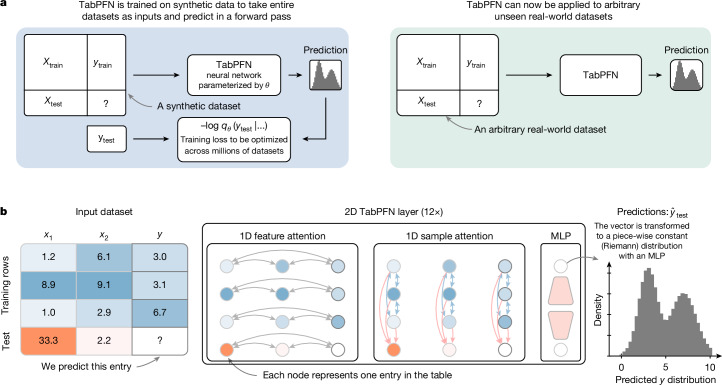
Tabular data, spreadsheets organized in rows and columns, are ubiquitous across scientific fields, from biomedicine to particle physics to economics and climate science 1,2. The fundamental prediction task of filling in missing values of a label column based on the rest of the columns is essential for various applications as diverse as biomedical risk models, drug discovery and materials science. Although deep learning has revolutionized learning from raw data and led to numerous high-profile success stories 3–5, gradient-boosted decision trees 6–9 have dominated tabular data for the past 20 years. Here we present the Tabular Prior-data Fitted Network (TabPFN), a tabular foundation model that outperforms all previous methods on datasets with up to 10,000 samples by a wide margin, using substantially less training time. In 2.8 s, TabPFN outperforms an ensemble of the strongest baselines tuned for 4 h in a classification setting. As a generative transformer-based foundation model, this model also allows fine-tuning, data generation, density estimation and learning reusable embeddings. TabPFN is a learning algorithm that is itself learned across millions of synthetic datasets, demonstrating the power of this approach for algorithm development. By improving modelling abilities across diverse fields, TabPFN has the potential to accelerate scientific discovery and enhance important decision-making in various domains.
Overview
CoChat Summary
TL;DR
TabPFN is a tabular foundation model pretrained on millions of synthetic datasets that uses in-context learning to outperform prior methods on small- to medium-sized tabular data up to 10,000 samples and 500 features. It delivers strong classification and regression performance in a single forward pass and also supports fine-tuning, data generation, density estimation, reusable embeddings, and interpretability.
Key findings
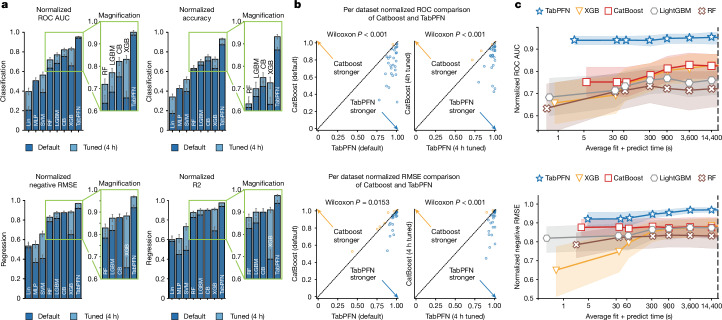
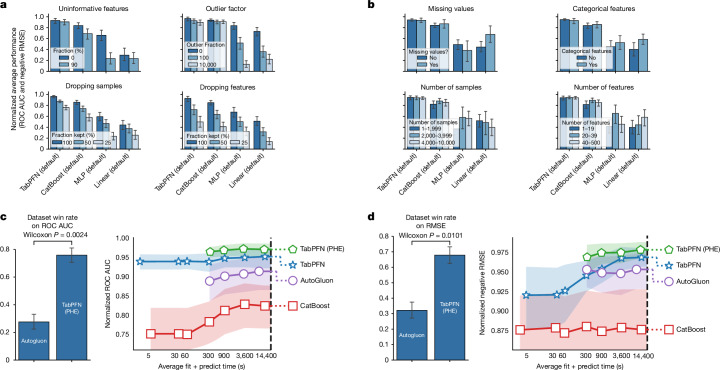
- On benchmarks with 29 classification and 28 regression datasets up to 10,000 samples, 500 features, and 10 classes, TabPFN outperformed tuned baselines. Classification normalized ROC AUC: TabPFN default 0.939 vs CatBoost default 0.752; tuned TabPFN 0.952 vs tuned CatBoost 0.822. Regression normalized RMSE: TabPFN default 0.923 vs CatBoost default 0.872; tuned TabPFN 0.968 vs tuned CatBoost 0.875.
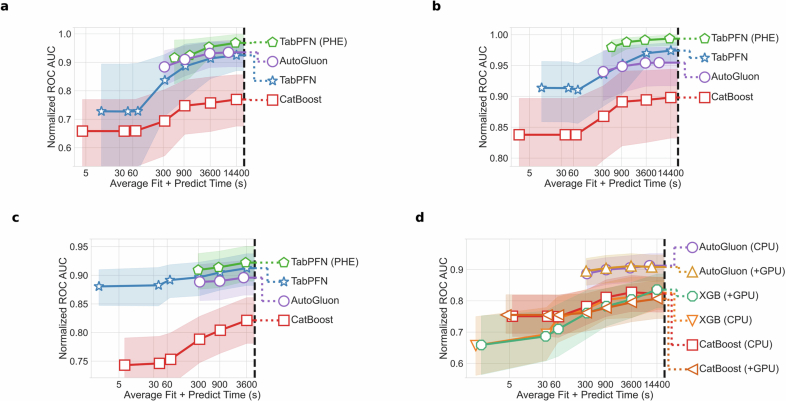
- TabPFN default took 2.8 s for classification and 4.8 s for regression on average, outperforming baselines tuned for 4 h—a speedup of 5,140× for classification and 3,000× for regression. TabPFN (PHE) reached average normalized ROC AUC 0.971 vs 0.939 for TabPFN default and 0.914 for AutoGluon; for regression, TabPFN (PHE) outperformed AutoGluon allowed 4 h after a 300 s tuning budget, a 48× speedup.
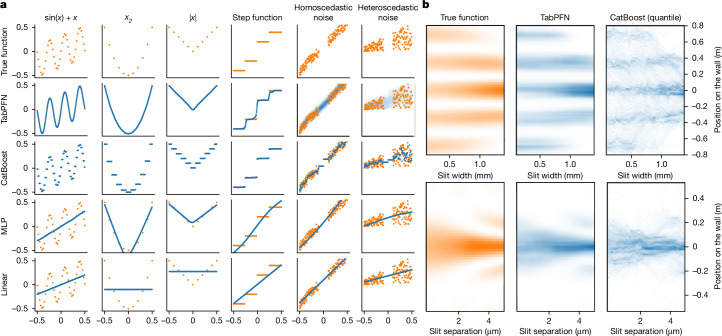
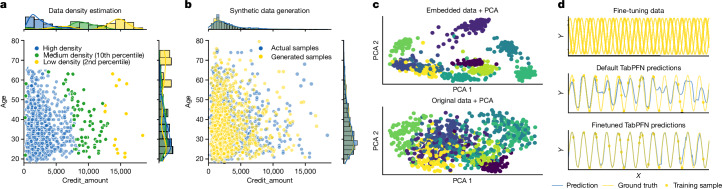
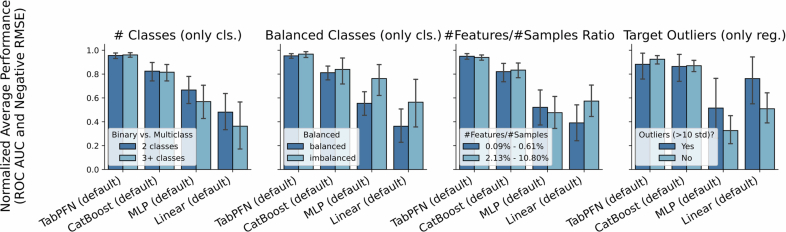
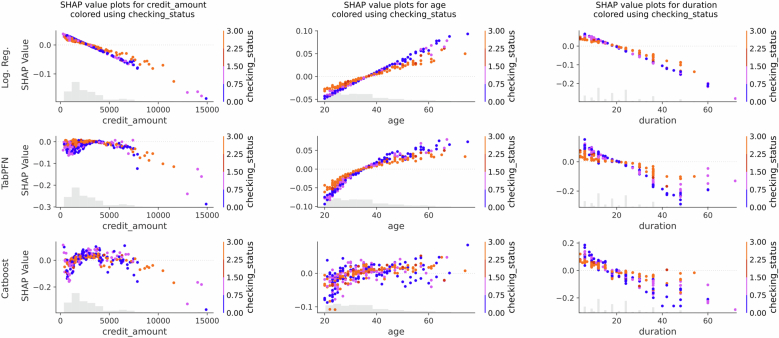
- TabPFN was robust to uninformative features and outliers, and with half the samples it performed as well as the next best method using all samples. It also demonstrated foundation-model abilities including density estimation, synthetic data generation, learned embeddings, fine-tuning, and SHAP-based feature importance.
Methods
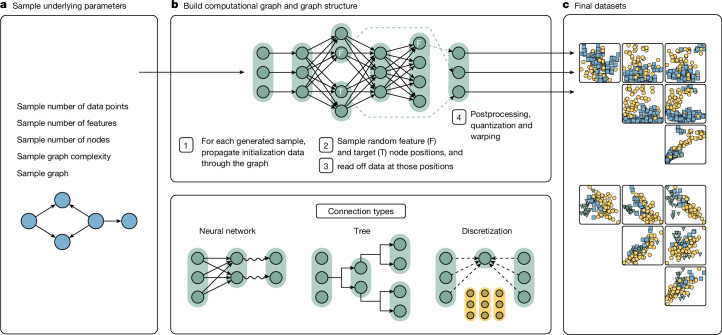
- TabPFN was pretrained on synthetic tabular datasets generated from structural causal models: around 100 million synthetic datasets per model training, with final models trained for approximately 2,000,000 steps at batch size 64 datasets, corresponding to around 130,000,000 synthetically generated datasets each.
- The architecture is a transformer encoder variant that treats each table cell as a separate position and uses two-way attention: each cell attends to other features in its row, then to the same feature across its column. At inference, training samples are provided as context and predictions are made in a single forward pass via in-context learning; train-state caching enables reuse for multiple test inferences.
- Evaluation used the AutoML Benchmark and OpenML-CTR23, with 29 classification and 28 regression datasets up to 10,000 samples, 500 features, and 10 classes. Each dataset and method was run for 10 repetitions with different random seeds and 90% train/10% test splits; hyperparameters were tuned by random search with five-fold cross-validation using time budgets from 30 s to 4 h. Metrics were ROC AUC and accuracy for classification, and R² and negative RMSE for regression, normalized per dataset.
Limitations
- The paper states that TabPFN inference may be slower than highly optimized approaches such as CatBoost; memory usage scales linearly with dataset size and can be prohibitive for very large datasets; and evaluation focused on datasets with up to 10,000 samples and 500 features, so scalability to larger datasets requires further study.
- The paper also states TabPFN is not optimized for real-time inference: for a dataset with 10,000 rows and 10 columns, it requires 0.2 s (0.6 s without GPU) to predict one sample, whereas CatBoost default can do so in 0.0002 s.
- The paper notes that for larger datasets and highly non-smooth regression datasets, CatBoost, XGBoost, or AutoGluon are likely to outperform TabPFN, and that natively the method is limited to predicting at most 10 classes unless pretrained on more classes or adapted with approaches such as one-vs-one, one-vs-rest, or ECOC.
Model-written summary. Check it against the paper before relying on it.
Integrity signals
Registry
Cites
Statistics
Figures
Verification
Claims the paper makes
1 Valid · 6 Not valid · 17 Not checked · 72 Own results and interpretations
The sources with a verdict support this claim; the rest weren’t checked yet, have no full text we could read, or their verdicts aren’t rated yet.
In the paper
“For larger datasets and highly non-smooth regression datasets, approaches such as CatBoost9, XGB7 or AutoGluon40 are likely to outperform TabPFN.”
§ Accurate predictions on small data with a tabular foundation model > Methods > User guide
What the sources say
- Check pendingcites [9] Prokhorenkova, L., Gusev, G., Vorobev, A., Dorogush, A. & Gulin, A. CatBoost: unbiased boosting with categorical features. In Proc. 30th International Conference on Advances in Neural Information Processing Systems (eds Bengio, S. et al.) 6639–6649 (Curran Associates, 2018). source
- Supportedcites [7] Chen, T. & Guestrin, C. Xgboost: A scalable tree boosting system. In Proc. 22nd ACM SIGKDD International Conference on Knowledge Discovery and Data Mining (eds Krishnapuram, B. et al.) 785–794 (ACM Press, 2016). source
The citation is offered to identify the system 'XGB' named in the citing sentence, and our copy is that system's paper: the Abstract and Introduction (KDD '16) describe XGBoost as 'a scalable end-to-end tree boosting system' that 'scales beyond billions of examples using far fewer resources than existing systems', used 'to achieve state-of-the-art results on many machine learning challenges'. The Introduction (p.1) further notes 17 of 29 Kaggle winning solutions in 2015 used XGBoost, and the evaluation sections report it running >10x faster than Spark MLLib/H2O on the 1.7-billion-example Criteo data, consistent with the 'larger datasets' framing. The head-to-head comparison against TabPFN and the 'highly non-smooth regression' qualification are the citing authors' own conclusion (TabPFN postdates this source) and are not attributed to this paper, so nothing here is unsupported for the part this citation carries. (LLM, conf=0.85)
- Check pendingcites [40] Erickson, N. et al. Autogluon-tabular: robust and accurate automl for structured data. Preprint at https://arxiv.org/abs/2003.06505 (2020). source
hedgedstates a possible cause- Asserted: passes — The authors put it forward as true.
- Checkable: passes — It can be checked against evidence.
- Load-bearing: unclear — It is unclear whether the paper’s conclusions depend on it.
- Based: passes — The paper gives a reason why it holds.
A result the paper states — it cites no source for it, so there is none to check. The quote shows it is in the paper.
In the paper
“This new supervised tabular learning method can be applied to any small- to moderate-sized dataset and yields dominant performance for datasets with up to 10,000 samples and 500 features.”
§ Accurate predictions on small data with a tabular foundation model > Main
plainstates a causen = 10,000- Asserted: passes — The authors put it forward as true.
- Checkable: passes — It can be checked against evidence.
- Load-bearing: passes — The paper’s conclusions depend on it.
- Based: passes — The paper gives a reason why it holds.
A result the paper reports from its own data — it cites no other source for it, so there is none to check. The quote shows it is in the paper.
In the paper
“We extract and visualize learned embeddings from the mfeat-factors dataset in Fig. 6c, showing improved class separation compared with the raw data on the first two principal components.”
§ Accurate predictions on small data with a tabular foundation model > Foundation model with interpretability
plainstates a cause- Asserted: passes — The authors put it forward as true.
- Checkable: passes — It can be checked against evidence.
- Load-bearing: unclear — It is unclear whether the paper’s conclusions depend on it.
- Based: passes — The paper gives a reason why it holds.
A result the paper reports from its own data — it cites no other source for it, so there is none to check. The quote shows it is in the paper.
In the paper
“we found that pre-processing inputs can help performance”
§ Accurate predictions on small data with a tabular foundation model > Methods > Details on the neural architecture
plainstates a possible cause- Asserted: passes — The authors put it forward as true.
- Checkable: passes — It can be checked against evidence.
- Load-bearing: unclear — It is unclear whether the paper’s conclusions depend on it.
- Based: passes — The paper gives a reason why it holds.
In the paper
“As our models are not fully permutation invariant, for each ensemble member, we shuffle the feature order, approximating order invariance64.”
§ Accurate predictions on small data with a tabular foundation model > Methods > Inference details
What the sources say
- Not checked yetcites [64] Murphy, R. L., Srinivasan, B., Rao, V. A. & Ribeiro, B. Janossy pooling: learning deep permutation-invariant functions for variable-size inputs. In Proc. 7th International Conference on Learning Representations (ICLR, 2019). source
plain- Asserted: passes — The authors put it forward as true.
- Checkable: passes — It can be checked against evidence.
- Load-bearing: passes — The paper’s conclusions depend on it.
- Based: passes — The paper gives a reason why it holds.
25 more claims
Create a free account to see all 96 claims and to verify the 28 references still open.
- Probably not a substantial claim. 32
- It may state two separate claims as one. 47
Self-check
Percentages, sums and reported differences re-computed from the paper’s own numbers.
Each contradiction between two passages listed here was confirmed by an independent check.
Rated minor: it would not touch a result — a value no result rests on, a p-value that stays on the same side of the significance level, or a conflict that is clerical, resolved elsewhere in the paper, or outside its own findings.
In the paper
§ Accurate predictions on small data with a tabular foundation model > Quantitative analysis > Comparison with tuned ensemble methods
“In just 2.8 s, TabPFN (default) outperforms AutoGluon for classification tasks, even if AutoGluon is allowed up to 4 h, a 5.140× speedup.”
§ Accurate predictions on small data with a tabular foundation model > Quantitative analysis > Comparison with state-of-the-art baselines
“The default of TabPFN, taking 2.8 s on average for classification and 4.8 s for regression, outperforms all baselines, even when tuning them for 4 h—a speedup of 5,140× and 3,000×, respectively.”
Rated minor: it would not touch a result — a value no result rests on, a p-value that stays on the same side of the significance level, or a conflict that is clerical, resolved elsewhere in the paper, or outside its own findings.
In the paper
§ Accurate predictions on small data with a tabular foundation model > Quantitative analysis
“TabPFN was pre-trained once using eight NVIDIA RTX 2080 GPUs over 2 weeks”
§ Accurate predictions on small data with a tabular foundation model > Methods > Training details
“One training run requires around 2 weeks on one node with eight Nvidia RTX 2080 Ti GPUs.”
Rated minor: it would not touch a result — a value no result rests on, a p-value that stays on the same side of the significance level, or a conflict that is clerical, resolved elsewhere in the paper, or outside its own findings.
In the paper
§ Accurate predictions on small data with a tabular foundation model > An architecture designed for tables
“This design enables the architecture to be invariant to the order of both samples and features”
§ Accurate predictions on small data with a tabular foundation model > Methods > Inference details
“As our models are not fully permutation invariant, for each ensemble member, we shuffle the feature order, approximating order invariance64.”
Citations
Cites
Breiman, L. (2001) · Machine Learning · doi:10.1023/a:1010933404324 · Cited by 133,538
Vaswani, A., Shazeer, N., Parmar, N., Uszkoreit, J., Jones, L., Gomez, A. N., Kaiser, L., & Polosukhin, I. (2017) · arXiv · doi:10.48550/arxiv.1706.03762 · Cited by 120,404
Distinctive Image Features from Scale-Invariant Keypoints
Lowe, D. G. (2004) · International Journal of Computer Vision · doi:10.1023/b:visi.0000029664.99615.94 · Cited by 62,647 · cited 2×
“Hand-designed features in computer vision, such as SIFT (Scale Invariant Feature Transform) 10 and HOG (Histogram of Oriented Gradients) 11 , have been replaced by learned convolutions; grammar-based approaches in natural language processing have been replaced by learned transformers 12 ; and the design of customized…”
Cortes, C., & Vapnik, V. (1995) · Machine Learning · doi:10.1007/bf00994018 · Cited by 59,421
XGBoost: A Scalable Tree Boosting System
Chen, T., & Guestrin, C. (2016) · Proceedings of the 22nd ACM SIGKDD International Conference on Knowledge Discovery and Data Mining · doi:10.1145/2939672.2939785 · Cited by 54,569
Highly accurate protein structure prediction with AlphaFold
Jumper, J., Evans, R., Pritzel, A., Green, T., Figurnov, M., Ronneberger, O., Tunyasuvunakool, K., Bates, R., Žídek, A., Potapenko, A., et al. (2021) · Nature · doi:10.1038/s41586-021-03819-2 · Cited by 43,764
Histograms of Oriented Gradients for Human Detection
Dalal, N., & Triggs, B. (2005) · 2005 IEEE Computer Society Conference on Computer Vision and Pattern Recognition (CVPR'05) · doi:10.1109/cvpr.2005.177 · Cited by 33,584
Greedy function approximation: A gradient boosting machine
Friedman, J. H. (2001) · The Annals of Statistics · doi:10.1214/aos/1013203451 · Cited by 30,731 · cited 2×
“The list of development datasets can be found in Supplementary Tables 5 and 6.”
Language Models are Few-Shot Learners
Brown, T. B., Mann, B., Ryder, N., Subbiah, M., Kaplan, J., Dhariwal, P., Neelakantan, A., Shyam, P., Sastry, G., Askell, A., et al. (2020) · arXiv · doi:10.48550/arxiv.2005.14165 · Cited by 23,372 · cited 1×
“We build on a preliminary version of TabPFN 23 , which demonstrated the applicability of in-context-learning 17 for tabular data in principle but had many limitations that rendered it inapplicable in most cases.”
Quinlan, J. R. (1986) · Machine Learning · doi:10.1007/bf00116251 · Cited by 21,439
Research works printed but not linked: 11
- van Breugel, B. & van der Schaar, M. Position: why tabular foundation models should be a research priority. In Proc. 41st International Conference on Machine Learning 48976–48993 (PMLR, 2024).
- Akyürek, E., Schuurmans, D., Andreas, J., Ma, T. & Zhou, D. What learning algorithm is in-context learning? Investigations with linear models. In Proc. The Eleventh International Conference on Learning Representations (ICLR, 2023).
- Müller, S., Hollmann, N., Pineda-Arango, S., Grabocka, J. & Hutter, F. Transformers can do Bayesian inference. In Proc.The Tenth International Conference on Learning Representations (ICLR, 2022).
- Kingma, D. & Ba, J. Adam: A method for stochastic optimization. In Proc. International Conference on Learning Representations (ICLR, 2015).
- Bahdanau, D., Cho, K. & Bengio, Y. Neural machine translation by jointly learning to align and translate. In Proc. 3rd International Conference on Learning Representations (eds Bengio, Y. & LeCun, Y.) (ICLR, 2015).
- Gorishniy, Y., Rubachev, I., Khrulkov, V. & Babenko, A. Revisiting deep learning models for tabular data. In Proc. Advances in Neural Information Processing Systems 34 (eds Ranzato, M. et al.) 18932–18943 (NeurIPS, 2021).
- Fischer, S. F., Feurer, M. & Bischl, B. OpenML-CTR23 – a curated tabular regression benchmarking suite. In Proc. AutoML Conference 2023 (Workshop) (AutoML, 2023).
- Lundberg, S. M. & Lee, S.-I. A unified approach to interpreting model predictions. In Proc.Advances in Neural Information Processing Systems (eds Guyon, I. et al.) Vol. 30, 4765–4774 (Curran Associates, 2017).
- Nagler, T. Statistical foundations of prior-data fitted networks. In Proc. 40th International Conference on Machine Learning (eds Krause, A. et al.) Vol. 202, 25660–25676 (PMLR, 2023).
- Müller, S., Feurer, M., Hollmann, N. & Hutter, F. PFNS4BO: in-context learning for Bayesian optimization. In Proc. 40th International Conference on Machine Learning 25444–25470 (PMLR, 2023).
- Loshchilov, I. & Hutter, F. SGDR: Stochastic gradient descent with warm restarts. In Proc. 5th International Conference on Learning Representations (ICLR, 2017).
Cited by
Items 2,101–2,200 of 2,324
HOLMES: In-Context Failure-Center Localization for High-Dimensional Yield EstimationPreprint
Xing, W. W., Zhou, X., Huang, K., Pan, J., Hong, Q., Wang, X., & Shen, S. (2026) · arXiv (Cornell University) · doi:10.48550/arxiv.2608.26758
Wang, X., & Yang, P. (2026) · arXiv (Cornell University) · doi:10.48550/arxiv.2608.27205
Sha, Y., Pan, H., Luo, G., Meng, W., Xu, W., Feng, Z., Xing, A., Weisi, Z., Zhai, X., Tong, H. H. Y., et al. (2026) · Translational Psychiatry · doi:10.1038/s41398-026-04413-8
Liu, L., Li, B., Wang, S., Mao, R., Liu, Y., & Chai, Y. (2026) · Journal of Thoracic Disease · doi:10.21037/jtd-2026-0986
Shi, J. (2026) · Engineering Applications of Artificial Intelligence · doi:10.1016/j.engappai.2026.116112
Topology and multi-objective optimization of automotive front-end structure under frontal crash
Lu, Y., Zhang, C., Yang, J., Zhang, Y., & Liu, B. (2026) · Thin-Walled Structures · doi:10.1016/j.tws.2026.115626
Zambrano-Martínez, J. L., Orellana, M., Cecilia, J. M., & Calafate, C. T. (2026) · SSRN Electronic Journal · doi:10.2139/ssrn.7411768
Psychometric inference without refitting across heterogeneous instruments and populationsPreprint
Tay, A. K., & Chen, J. (2026) · Research Square · doi:10.21203/rs.3.rs-10910303/v1
Descriptor‐Based Zero‐Shot Learning for Predicting Catalytic Constituent Elements
Maki, J., & Kaneko, H. (2026) · ChemistrySelect · doi:10.1002/slct.74428
Summary of the ChinaVoices Challenge 2026: Data, Tasks, Baseline, and MethodsPreprint
Liao, Y., Mu, B., Wang, S., Xue, L., Liu, H., Shi, X., Hu, J., & Xie, L. (2026) · arXiv (Cornell University) · doi:10.48550/arxiv.2609.03471
He, J., Jia, X., Huang, S., Ke, L., Yang, J., & Kitipornchai, S. (2026) · Composite Structures · doi:10.1016/j.compstruct.2026.120855
Song, G. (2026) · Journal of Computer Technology and Applied Mathematics · doi:10.70393/6a6374616d.343334
Zhang, Y., Wang, H., & Zhang, L. (2026) · Medicine · doi:10.1097/md.0000000000050472
GC–MS guided design and study of an electronic nose for non-destructive detection of banana
Li, H., Luo, Y., Du, Y., Xu, Q., Yang, L., Chen, S., Luo, Z., Shi, W., Chen, Z., Wang, Y., et al. (2026) · Microchemical Journal · doi:10.1016/j.microc.2026.119642
万麟, Zhang, Q., Zhu, X., Wu, L., & Zhang, Y. (2026) · Small · doi:10.1002/smll.75674
Kasturi, P. M. R., Ganesan, V., & KIRUBAKARAN, N. (2026) · International Journal of Computer Information Systems and Industrial Management Applications · doi:10.70917/ijcisim-2026-5558
Sun, Z., Li, J., Zhou, Y., Wang, Y., Zhou, R., Meng, J., & Li, J. (2026) · Environmental Science & Technology · doi:10.1021/acs.est.6c09685
Design and Performance Optimization of Machine-Learning-Based Data Classification Models
Jia, X., Wang, S., & Li, C. (2026) · International Conference on Educational Digitalization and Computer Science in the Guangdong-Hong Kong-Macao Greater Bay Area · doi:10.1145/3828183.3828336
Rockburst Intensity Prediction Using TabPFN with Ensemble Consistency-Based Data Quality Screening
Zhao, L., Yuan, Y., Jing, J., Wang, X., & Liu, Z. (2026) · Vibration · doi:10.3390/vibration9030058
Liu, Y., Zhou, M., Sun, F., Sun, B., & Xu, W. (2026) · Industrial & Engineering Chemistry Research · doi:10.1021/acs.iecr.6c01785
Gong, M., Zhou, Y., Chen, S., & Zhang, C. (2026) · Preventive Medicine Reports · doi:10.1016/j.pmedr.2026.103643
Lang, Z., Wang, Y., Xu, P., Li, G., Li, Y., & Cai, F. (2026) · LWT · doi:10.1016/j.lwt.2026.119969
Naffakh, H. A. H. A., Radhi, A. D., Majeed, F. A., & Ghazali, R. (2026) · International journal of intelligent engineering and systems · doi:10.22266/ijies2026.1031.43
Zhang, Z., Yao, K., Jiang, Y., Mu, X., & Li, G. (2026) · Electronics · doi:10.3390/electronics15184326
Lasnick, O. H. M., Park, Y., Mistry, P. K., & Menon, V. (2026) · Journal of Neuroscience · doi:10.1523/jneurosci.2200-25.2026
Pérez-Díaz, V. S., Kashyap, V. L., Ingram, J. D., Fouhey, D. F., Martínez-Galarza, J. R., Protopapas, P., Drake, J. J., Kim, D., & Garraffo, C. (2026) · The Astrophysical Journal · doi:10.3847/1538-4357/ae9f41
Foundation-model-based multi-label phenotyping of combined hyperkinetic movement disordersPreprint
Cif, L., Souei, Z., Demailly, D., Jiménez, M. C., Ortigoza‐Escobar, J. D., Rehman, M. M. U., Dornadic, M., Huby, S., Hariz, G., Hubsch, C. A., et al. (2026) · arXiv (Cornell University) · doi:10.48550/arxiv.2609.22369
Stealing profits: Spread-based temporal hierarchy forecasting for day-ahead electricity marketsPreprint
Lipiecki, A., Kourentzes, N., & Weron, R. (2026) · arXiv (Cornell University) · doi:10.48550/arxiv.2609.23223
A RISKmilk framework for predicting drug and chemical exposure in human milk during breastfeeding
Liu, X., Wang, W., Xiong, P., Wang, N., Zhu, J., Qin, Y., Chen, D., Chen, J., & Ouyang, D. (2026) · Pharmacological Research · doi:10.1016/j.phrs.2026.109639
Huang, J., Kong, L., Wang, Y., & Liu, B. (2026) · Petroleum Research · doi:10.1016/j.ptlrs.2026.09.002
Jnr, E. O.-N., Alhassan, A. S., Osei, P. A., & Ziggah, Y. Y. (2026) · SSRN Electronic Journal · doi:10.2139/ssrn.7518531
NPBoost: Neural Processes with Gradient-Boosted Fixed EffectsPreprint
Nava, A., Rölli, K., Begić, A., & Sigrist, F. (2026) · arXiv (Cornell University) · doi:10.48550/arxiv.2609.28122
Wu, Y., & Lin, X. S. (2026) · Agronomy · doi:10.3390/agronomy16191883
ScalarLens: Numerical Embeddings with Stable Coordinates and Contextual Responses for CTR PredictionPreprint
Yao, H., Liu, T., Shu, Y., He, Y., Yuan, C., Qiu, K., Chen, G., Zhao, J., & Hou, S. (2026) · arXiv (Cornell University) · doi:10.48550/arxiv.2609.29182
Wei, Y., 常正伟, Chen, Y., Tang, W., Meng, F., & Kang, G. (2026) · Algorithms · doi:10.3390/a19090799
Zhang, Z., Huang, X., Cai, D., Yang, S., Yu, T., Lu, L., Xie, Y., Li, Q., & Xing, D. (2026) · Advanced Engineering Informatics · doi:10.1016/j.aei.2026.105327
Generative diffusion-driven phase prediction framework for high-entropy alloy design
KUMAR, P., Banerjee, A., Jain, S., Das, A., & Bhowmik, A. (2026) · Bulletin of Materials Science · doi:10.1007/s12034-026-03764-8
Ma, Y., Wang, M., ZHENG, X., Sun, Y., Wei, L., & Chu, Z. (2026) · IEEE Journal of Selected Topics in Applied Earth Observations and Remote Sensing · doi:10.1109/jstars.2026.3735504
Moon, J., Jun, B.-M., Yoon, Y., & Cho, K. H. (2026) · Desalination · doi:10.1016/j.desal.2026.120853
Enhanced Deep Learning Prediction Framework using Improved Golden Eagle and Fire Hawk Optimization
Priya, P. S. K., & Maheswari, G. U. (2026) · International Journal of Information Technology and Computer Science · doi:10.5815/ijitcs.2026.05.03
Gohlke, F., & Vogt, M. (2026) · Communications in computer and information science · doi:10.1007/978-3-032-39823-9_23
Zhong, L., Tang, Z., Liu, Y., Gao, J., Li, J., Yan, Y., Li, P., Wang, F., & Fei, G. (2026) · Results in Engineering · doi:10.1016/j.rineng.2026.113250
CAFE: Counterfactual Prediction via Fast Posterior EstimationPreprint
Han, X., Lin, X., Zou, H., Zhang, X., Li, B., & Cui, P. (2026) · arXiv (Cornell University) · doi:10.48550/arxiv.2609.32167
Shen, X., Wu, H., Gai, F., Jiang, X., & Guo, C. (2026) · International Heart Journal · doi:10.1536/ihj.25-604
From Data to Program: Fast & Direct Generative Program Inference from Empirical DataPreprint
Klüttermann, S., Ding, X., & Akoglu, L. (2026) · arXiv (Cornell University) · doi:10.48550/arxiv.2609.35348
Dwivedi, A. K., Shukla, A., Narayanaswamy, N. K., & Singh, V. (2026) · IEEE Transactions on Plasma Science · doi:10.1109/tps.2026.3735713
Multi-label Meta-learning for Pipeline Recommendation: The Importance of Pipeline Diversity
Maia, C. M., Amorim, L., Cruz, R. M. O., & Cavalcanti, G. D. C. (2026) · Lecture notes in computer science · doi:10.1007/978-3-032-39895-6_17
Architecture Alignment With Sparse Priors in Tabular Foundation ModelsPreprint
Zhao, T., Zhuang, T., Duan, S., Wang, G., Tan, Y. S., & Zhang, Q. (2026) · arXiv (Cornell University) · doi:10.48550/arxiv.2609.36883
Pavšek, J., Rittig, J. G., & Mitsos, A. (2026) · arXiv (Cornell University) · doi:10.48550/arxiv.2609.36947
Missing-Aware Imbalanced Learning Pathways for Manufacturing Process Quality Assessment
Bi, Q., Sun, Y., Shen, Z., Nie, Z., Lianyun, W., & Yu, X. (2026) · International Conference on Mechanical, Electronics and Electrical and Automation Control (METMS) · doi:10.1109/metms70800.2026.11706171
Li, Z., Chen, Z., Wu, Y., Fang, M., Duan, B., Qin, W., Liu, B., Li, B., & Zhang, W. (2026) · Foods · doi:10.3390/foods15193507
Liu, H., Wei, Y., Xiao, J., Yang, H., Chen, W., & Bai, M. (2026) · Journal of Building Engineering · doi:10.1016/j.jobe.2026.117475
CIDER-FM: Foundation Models for Causal Inference from Diverse Experimental RegimesPreprint
Gao, Y., Reuter, A., Guo, S., Dhir, A., Schölkopf, B., & Weller, A. (2026) · arXiv (Cornell University) · doi:10.48550/arxiv.2609.39523
周后波, Lv, Q., Tan, Y., Shi, L., & Zhao, Y. (2026) · International Journal of Sustainable Development & World Ecology · doi:10.1080/13504509.2026.2736289
Distillation of Tabular Foundation Models into Efficient PredictorsPreprint
Jeong, M., Lee, D., Lee, J., & Yoo, J. (2026) · arXiv (Cornell University) · doi:10.48550/arxiv.2610.01435
Alam, S., Faisal, M., & Bakti, R. Y. (2026) · Journal of Computer Science and Information Technology · doi:10.70248/jcsit.v3i4.4557
Wang, W. H. (2026) · Archivo Digital UPM (Universidad Politécnica de Madrid)
From Behavior to Provenance: Attributing Tabular Foundation Models to Synthetic Pretraining DataPreprint
Bouadi, M., Bouarour, N., Dubey, S., Tanna, A., & Sankarapu, V. K. (2026) · arXiv (Cornell University) · doi:10.48550/arxiv.2610.02347
Makarov, D. M., Kalikin, N. N., Fashchevsky, K. A., & Budkov, Y. A. (2026) · Electrochimica Acta · doi:10.1016/j.electacta.2026.150159
Satellite-Only 3D Digitization of Hundred-Kilometer-Scale High-Voltage Transmission Lines
Zhang, X., Feng, W., Chen, M., & Chen, M. (2026) · Remote Sensing · doi:10.3390/rs18193398
Rethinking Tabular Foundation Models On Data StreamsPreprint
Verma, N., Assis, D. N., Lourenço, A., Bifet, A., Pfahringer, B., Bahri, M., & Lim, N. (2026) · arXiv (Cornell University) · doi:10.48550/arxiv.2610.05352
Guiding chromatographic purification through data-driven condition recommendationsPreprint
Murakami, Y., Cho, N., Egami, K., Yamazaki, H., Ishida, S., Hirano, A., Fukushima, Y., Sumita, M., Kohata, A., Kinbara, K., et al. (2026) · ChemRxiv · doi:10.26434/chemrxiv.15009978/v1
Muslim, M. A., Pertiwi, D. A. A., Unjung, J., Kharisma, S. N., Al-Zahra, G. D., & Salahudin, S. N. (2026) · Journal of Soft Computing Exploration · doi:10.52465/joscex.v7i3.250
Yi, J., Zhou, Y., Zhu, S., Cui, M., & Zhou, M. (2026) · IEEE International Conference on Automation Science and Engineering (CASE) · doi:10.1109/case69030.2026.11704471
Scalable Logistic Gaussian Process Density Regression with Kinetic Langevin SamplingPreprint
Paulin, D., Jung, Á., & Benczúr, A. (2026) · arXiv (Cornell University) · doi:10.48550/arxiv.2610.09591
Spectra: Exact Component Transport for Test-Time Prior Adaptation in Simulation-Based InferencePreprint
Zhao, X., Scherf, N., Trampel, R., Pine, K., & Weiskopf, N. (2026) · arXiv (Cornell University) · doi:10.48550/arxiv.2610.08021
TICDA: Tabular In-Context Data AttributionPreprint
Benihaddadene, Y., Bhan, M., Dugelay, E., Jawhar, M., Wong, B., Chesneau, N., & Nguyen, D. (2026) · arXiv (Cornell University) · doi:10.48550/arxiv.2610.07996
Estimating optical turbulence (Cn2) from global reanalysis datasets using tabular foundation models
Basu, S. (2026) · Unconventional Imaging, Sensing, and Adaptive Optics · doi:10.1117/12.3113810
Li, X., Zhou, Z., Hua, D., Chen, J., Ding, L., Li, Y., Su, Z., Shen, L., Jin, Y., Wang, N., et al. (2026) · Separation and Purification Technology · doi:10.1016/j.seppur.2026.140506
Hu, Y., Zhou, L., Zhao, P., Zhu, Y., Su, C., Liang, H. Y., Cao, Y., & 苏, 德. (2026) · Applied Sciences · doi:10.3390/app16209989
Lefèvre, H., & Bernard, L. (2026) · Mathematical Modeling in Engineering · doi:10.68406/mme.2026.vol7iss3nm6:69-80
Perceiver IO Model for Visual Servoing of Reflective Parts Based on Polarization Camera Feedback
Hirano, P., Kawai, V., & Miyazaki, A. (2026) · Mathematical Modeling in Engineering · doi:10.68406/mme.2026.vol7iss3nm7:81-93
Lin, Z., Wang, J., Chen, H., Bao, Q., Xu, M., Yang, S., Zhang, H., Yang, G., & Sun, P. (2026) · European Radiology Experimental · doi:10.1186/s41747-026-00814-y
TabMF: Learning Dataset Representations with Tabular Foundation ModelsPreprint
Kamel, R., Atienza, N., Fouché, A., Cancedda, N., & Grabocka, J. (2026) · arXiv (Cornell University) · doi:10.48550/arxiv.2610.13818
Peihan, J., Wu, X., Wang, W., Xia, Y., Hou, B., & Xu, W. (2026) · PeerJ Computer Science · doi:10.7717/peerj-cs.4117
Ziqiang, Z., Qian, S., & Sun, B. (2026) · SPE Annual Technical Conference and Exhibition · doi:10.2118/233938-ms
Relational Learning as World ModelingPreprint
Zhang, Z., & Kasneci, G. (2026) · arXiv (Cornell University) · doi:10.48550/arxiv.2610.16763
Characterizing the Separability Gap in Prior-Data Fitted NetworksPreprint
Kobialka, J., Hülskamp, M., Nagler, T., & Rügamer, D. (2026) · arXiv (Cornell University) · doi:10.48550/arxiv.2610.14989
Machine Learning for Binge Drinking Prediction: Comparing Classical and Deep Learning Models
Lindgren, A., & Pettersson, A. (2026) · Lund University Publications Student Papers (Lund University)
Filtjens, B., Adeli, V., Mehraban, S., Sabo, A., Taati, B., & Iaboni, A. (2026) · PLOS Digital Health · doi:10.1371/journal.pdig.0001780
tabby: Tidy Interfaces for Tabular Deep Learning
Kühn, M., & Ruiz, E. (2026) · doi:10.32614/cran.package.tabby
HBM versus TabPFN for quasi-site-specific geotechnical prediction: a cross-database evaluation
Wang, J.-S., Ching, J., Wu, S., & Otake, Y. (2026) · Georisk Assessment and Management of Risk for Engineered Systems and Geohazards · doi:10.1080/17499518.2026.2744727
Learning by Examples: Power Grid Steady State Analysis with a Tabular Foundation ModelPreprint
Arowolo, O., Adedeji, O., Pálenský, P., & Cremer, J. L. (2026) · arXiv (Cornell University) · doi:10.48550/arxiv.2610.20462
When Does Depth Help? Understanding Layerwise Inference in Tabular Foundation ModelsPreprint
Gong, W., Gu, H., Yang, Z., Ma, J., Zhang, H., Wang, Z., Wang, J., Xu, S., & Wang, W. (2026) · arXiv (Cornell University) · doi:10.48550/arxiv.2610.19814
When Does Task-Aware Imputation Matter? An Analysis of Robustness Under Train-Test MismatchPreprint
Salvador, M. V., Sequeira, A. F., & Cardoso, J. S. (2026) · arXiv (Cornell University) · doi:10.48550/arxiv.2610.20342
Xu, H., Li, Z., Li, X., Li, Y., Li, Z., & Nie, P. (2026) · Drones · doi:10.3390/drones10100772
In-Context Preference-Conditioned Pareto Set Learning from Limited Offline DataPreprint
Yao, Y., Zhao, L., & Zhang, Q. (2026) · arXiv (Cornell University) · doi:10.48550/arxiv.2610.21736
StaCOR: Decision-Stable Output Refinement for TabPFN with Noisy Support Labels
Huang, Y., Shi, M., Kong, L., & She, K. (2026) · Electronics · doi:10.3390/electronics15204784
Chaigneau, M., Vadadkar, S. V., Gumbel, U., Nienborg, B., & Velte, A. (2026) · Energy Conversion and Management · doi:10.1016/j.enconman.2026.122286
Schmitz, J., Naue, J., Hoffmann, L., Lange, Z., Ferdinand, S., Lutz‐Bonengel, S., Dette, H., Pfaffelhuber, P., & Heinzel, C. S. (2026) · Research Square · doi:10.21203/rs.3.rs-11172480/v1
Dai, Y., & Lu, R.-S. (2026) · IEEE Access · doi:10.1109/access.2026.3744880
Image Dehazing as In-Context Tabular InferencePreprint
Tran, L.-A. (2026) · arXiv (Cornell University) · doi:10.48550/arxiv.2610.25142
Chandrahas, S. K., Munoz, J., & Bellapu, S. B. (2026) · ACM International Conference on AI in Finance (ICAIF) · doi:10.1145/3858063.3858708
Cagiano, A., Seyhan, M. A., Gangi, F., Zignani, M., & Masseroni, D. (2026) · arXiv (Cornell University) · doi:10.48550/arxiv.2610.26005
Kozyrev, S., & Pakhomova, V. (2026) · Scientific papers of Donetsk National Technical University Series Informatics Cybernetics and Computer Science · doi:10.31474/1996-1588-2026-2-43-48-58
Debiased Prior-Data Fitted Networks for Amortized Bayesian Semi-Parametric InferencePreprint
Melnychuk, V., Javurek, E., & Feuerriegel, S. (2026) · arXiv (Cornell University) · doi:10.48550/arxiv.2610.28314
Training-Free Continual Learning for Multimodal Forecasting via Prompt EvolutionPreprint
Mombaerts, L., Taws, J., Gargano, J., Gaddam, D., George, K., Tiwari, S., & Rajesh, S. (2026) · arXiv (Cornell University) · doi:10.48550/arxiv.2610.27468
When Do LLMs Help with Feature Selection? A Systematic Empirical StudyPreprint
Memar, F., Wang, D., & Agah, A. (2026) · arXiv (Cornell University) · doi:10.48550/arxiv.2610.28556
PriMa-Causa: Causal Prescriptive MaintenancePreprint
Saretzky, F. (2026) · arXiv (Cornell University) · doi:10.48550/arxiv.2610.31147
Manero, J., Upadhyay, D., & Sampalli, S. (2026) · Machine Learning with Applications · doi:10.1016/j.mlwa.2026.101054
Metadata
- Authors
- Hollmann, N., Müller, S., Purucker, L., Krishnakumar, A., Körfer, M., Hoo, S. B., Schirrmeister, R. T., & Hutter, F.
- Affiliations
- University of Freiburg (DE)
- Corresponding author
- Hollmann, Noah
- Müller, Samuel
- Hutter, Frank
- ORCID
- Venue
- Nature
- Published
- 2025-01-08
- Volume
- 637
- Issue
- 8045
- Pages
- 319-326
- ISSN
- 0028-0836 (ISSN-L)
- 1476-4687
- PMC
- PMC11711098
- OpenAlex
- W4406170795
- Semantic Scholar
- 6b238b17e419c7dd3912b9845449496bfb0a571a
- Cited by
- 2,323
- References
- 63
- Citations by year
- 2026: 1829 · 2025: 487
- FWCI
- 417.80
- Type
- journal article
- Language
- en
- Open access
- hybrid
- doi.org
- Licence
- cc-by
- creativecommons.org/licenses/by/4.0 (tdm)
- creativecommons.org/licenses/by/4.0 (vor)
- Locations
- Nature (publishedVersion, cc-by)
- PubMed Central (publishedVersion, cc-by)
- PubMed (publishedVersion)
- RePEc: Research Papers in Economics (submittedVersion)
- Funders
- European Commission (101045765)
- Deutsche Forschungsgemeinschaft (INST 39/963-1, “INST 39/963-1 FUGG”, SFB1597, 417962828, 39/963-1, 499552394)
- Hector Stiftung
- Topics
- Physical Sciences › Computer Science › Artificial Intelligence › Machine Learning and Data Classification
- Physical Sciences › Computer Science › Artificial Intelligence › Neural Networks and Applications
- Physical Sciences › Computer Science › Artificial Intelligence › Domain Adaptation and Few-Shot Learning
- Keywords
- tabular data, tabular foundation models, TabPFN, missing data estimation, small data, generative transformers, synthetic data, fine-tuning, density estimation, embeddings, gradient boosting decision tree, tabular data classification
About these checks
Registry, retraction, Cites and statistics results are computed, not judged, with one exception: a printed reference that no index lists is read once by a model before it counts as a citation error. Claims are extracted by a model and kept only when their quote appears verbatim in the text; each cited source is then checked, with a model’s help, for whether it says what the claim relies on. Those verdicts can be wrong — read the claim’s quote and the cited source before relying on one.
A language model drew the claims from the paper on 2026-11-24, under version 3 of the claim definition (model deepseek-v4.1-flash, prompt extract-v3).
A second model labelled each claim on 2026-11-24 (model jev-1.13-20260917, definition revision gold-guideline-v0.2).
Cited sources are checked with a language model’s help (qwen3.8-omni-flash).
Statistics and arithmetic are recomputed, not judged.
Confidence bands are shown only for fields calibrated on our annotated test set. None is calibrated yet, so no band is shown.
What counts as a claim ›How we measure confidence ›How we check this ›
Are you an author, or do you see a problem with this page? Request a review
Data sources
Bibliographic data: Semantic Scholar, OpenAlex, Crossref.
Contains information from the Semantic Scholar Academic Graph Datasets, made available under the ODC Attribution License (ODC-BY 1.0).
Semantic Scholar’s data is described in: Kinney, R., et al. (2023). The Semantic Scholar Open Data Platform. arXiv:2301.10140.
