

Accurate predictions on small data with a tabular foundation model
Open accessThe DOI matches its Crossref record; 64 of the 64 references it cites were found in a registry or an index; 1 of the 31 sources its claims cite were checked for support.
Abstract
Tabular data, spreadsheets organized in rows and columns, are ubiquitous across scientific fields, from biomedicine to particle physics to economics and climate science 1,2. The fundamental prediction task of filling in missing values of a label column based on the rest of the columns is essential for various applications as diverse as biomedical risk models, drug discovery and materials science. Although deep learning has revolutionized learning from raw data and led to numerous high-profile success stories 3–5, gradient-boosted decision trees 6–9 have dominated tabular data for the past 20 years. Here we present the Tabular Prior-data Fitted Network (TabPFN), a tabular foundation model that outperforms all previous methods on datasets with up to 10,000 samples by a wide margin, using substantially less training time. In 2.8 s, TabPFN outperforms an ensemble of the strongest baselines tuned for 4 h in a classification setting. As a generative transformer-based foundation model, this model also allows fine-tuning, data generation, density estimation and learning reusable embeddings. TabPFN is a learning algorithm that is itself learned across millions of synthetic datasets, demonstrating the power of this approach for algorithm development. By improving modelling abilities across diverse fields, TabPFN has the potential to accelerate scientific discovery and enhance important decision-making in various domains.
Overview
CoChat Summary
TL;DR
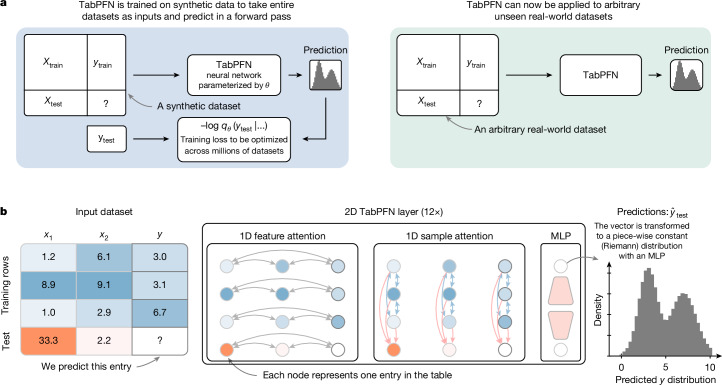
TabPFN is a tabular foundation model pretrained on millions of synthetic datasets that uses in-context learning to outperform prior methods on small- to medium-sized tabular data up to 10,000 samples and 500 features. It delivers strong classification and regression performance in a single forward pass and also supports fine-tuning, data generation, density estimation, reusable embeddings, and interpretability.
Key findings
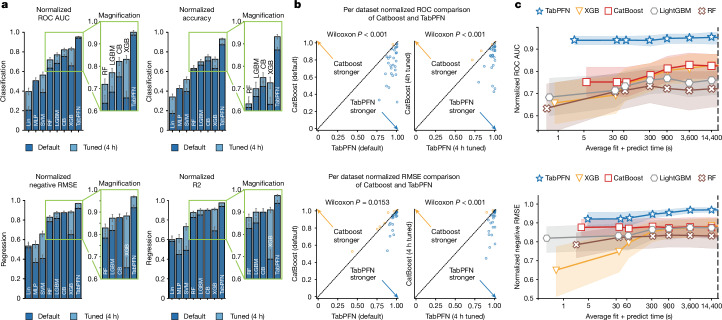
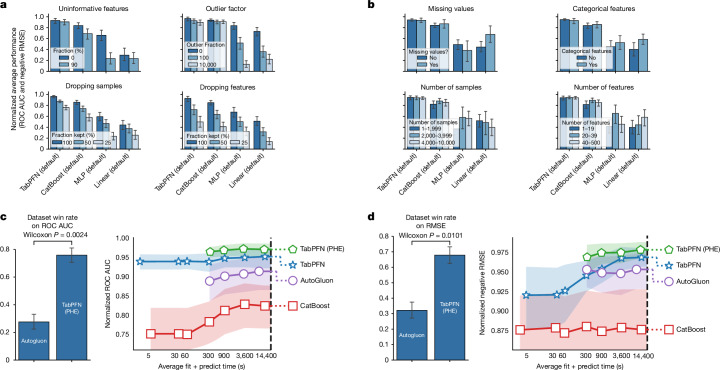
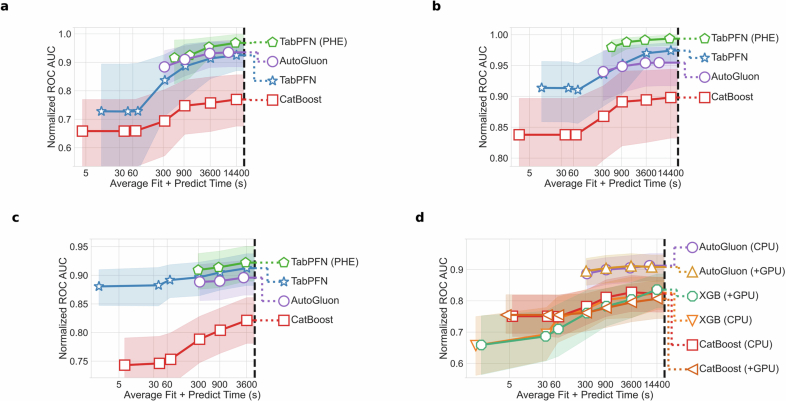
- On benchmarks with 29 classification and 28 regression datasets up to 10,000 samples, 500 features, and 10 classes, TabPFN outperformed tuned baselines. Classification normalized ROC AUC: TabPFN default 0.939 vs CatBoost default 0.752; tuned TabPFN 0.952 vs tuned CatBoost 0.822. Regression normalized RMSE: TabPFN default 0.923 vs CatBoost default 0.872; tuned TabPFN 0.968 vs tuned CatBoost 0.875.
- TabPFN default took 2.8 s for classification and 4.8 s for regression on average, outperforming baselines tuned for 4 h—a speedup of 5,140× for classification and 3,000× for regression. TabPFN (PHE) reached average normalized ROC AUC 0.971 vs 0.939 for TabPFN default and 0.914 for AutoGluon; for regression, TabPFN (PHE) outperformed AutoGluon allowed 4 h after a 300 s tuning budget, a 48× speedup.
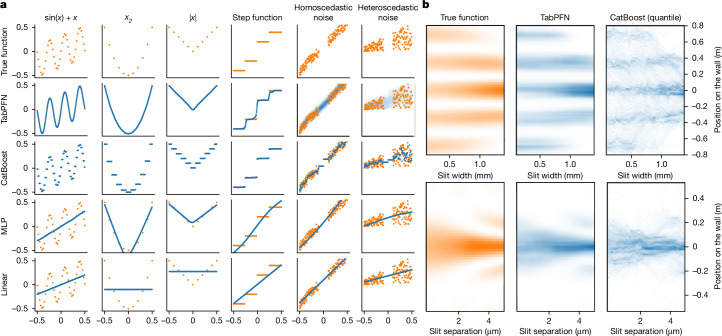
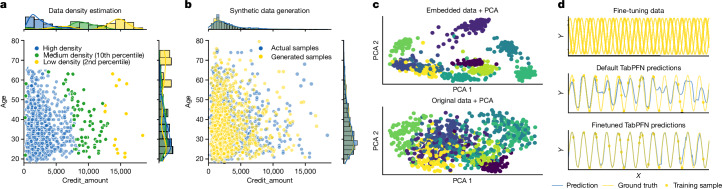
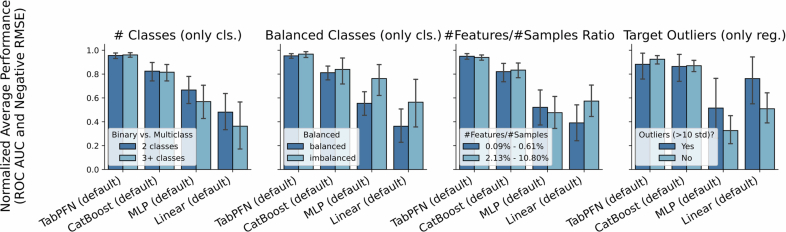
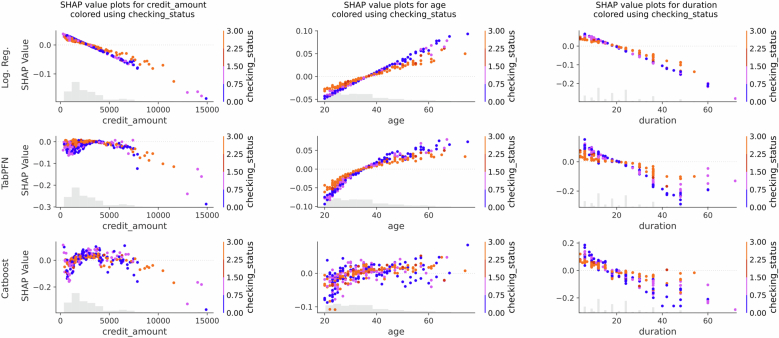
- TabPFN was robust to uninformative features and outliers, and with half the samples it performed as well as the next best method using all samples. It also demonstrated foundation-model abilities including density estimation, synthetic data generation, learned embeddings, fine-tuning, and SHAP-based feature importance.
Methods
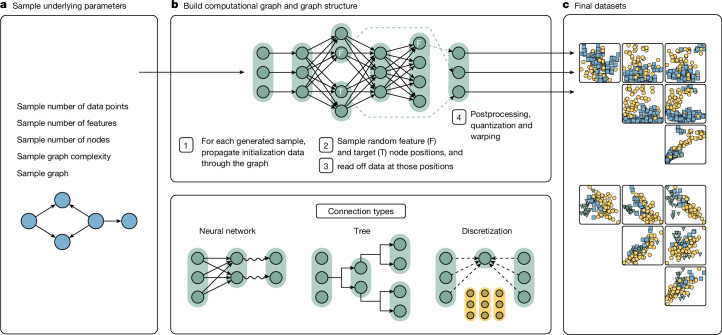
- TabPFN was pretrained on synthetic tabular datasets generated from structural causal models: around 100 million synthetic datasets per model training, with final models trained for approximately 2,000,000 steps at batch size 64 datasets, corresponding to around 130,000,000 synthetically generated datasets each.
- The architecture is a transformer encoder variant that treats each table cell as a separate position and uses two-way attention: each cell attends to other features in its row, then to the same feature across its column. At inference, training samples are provided as context and predictions are made in a single forward pass via in-context learning; train-state caching enables reuse for multiple test inferences.
- Evaluation used the AutoML Benchmark and OpenML-CTR23, with 29 classification and 28 regression datasets up to 10,000 samples, 500 features, and 10 classes. Each dataset and method was run for 10 repetitions with different random seeds and 90% train/10% test splits; hyperparameters were tuned by random search with five-fold cross-validation using time budgets from 30 s to 4 h. Metrics were ROC AUC and accuracy for classification, and R² and negative RMSE for regression, normalized per dataset.
Limitations
- The paper states that TabPFN inference may be slower than highly optimized approaches such as CatBoost; memory usage scales linearly with dataset size and can be prohibitive for very large datasets; and evaluation focused on datasets with up to 10,000 samples and 500 features, so scalability to larger datasets requires further study.
- The paper also states TabPFN is not optimized for real-time inference: for a dataset with 10,000 rows and 10 columns, it requires 0.2 s (0.6 s without GPU) to predict one sample, whereas CatBoost default can do so in 0.0002 s.
- The paper notes that for larger datasets and highly non-smooth regression datasets, CatBoost, XGBoost, or AutoGluon are likely to outperform TabPFN, and that natively the method is limited to predicting at most 10 classes unless pretrained on more classes or adapted with approaches such as one-vs-one, one-vs-rest, or ECOC.
Model-written summary. Check it against the paper before relying on it.
Integrity signals
Registry
Cites
Statistics
Figures
Verification
Claims the paper makes
1 Valid · 6 Not valid · 17 Not checked · 72 Own results and interpretations
The sources with a verdict support this claim; the rest weren’t checked yet, have no full text we could read, or their verdicts aren’t rated yet.
In the paper
“For larger datasets and highly non-smooth regression datasets, approaches such as CatBoost9, XGB7 or AutoGluon40 are likely to outperform TabPFN.”
§ Accurate predictions on small data with a tabular foundation model > Methods > User guide
What the sources say
- Check pendingcites [9] Prokhorenkova, L., Gusev, G., Vorobev, A., Dorogush, A. & Gulin, A. CatBoost: unbiased boosting with categorical features. In Proc. 30th International Conference on Advances in Neural Information Processing Systems (eds Bengio, S. et al.) 6639–6649 (Curran Associates, 2018). source
- Supportedcites [7] Chen, T. & Guestrin, C. Xgboost: A scalable tree boosting system. In Proc. 22nd ACM SIGKDD International Conference on Knowledge Discovery and Data Mining (eds Krishnapuram, B. et al.) 785–794 (ACM Press, 2016). source
The citation is offered to identify the system 'XGB' named in the citing sentence, and our copy is that system's paper: the Abstract and Introduction (KDD '16) describe XGBoost as 'a scalable end-to-end tree boosting system' that 'scales beyond billions of examples using far fewer resources than existing systems', used 'to achieve state-of-the-art results on many machine learning challenges'. The Introduction (p.1) further notes 17 of 29 Kaggle winning solutions in 2015 used XGBoost, and the evaluation sections report it running >10x faster than Spark MLLib/H2O on the 1.7-billion-example Criteo data, consistent with the 'larger datasets' framing. The head-to-head comparison against TabPFN and the 'highly non-smooth regression' qualification are the citing authors' own conclusion (TabPFN postdates this source) and are not attributed to this paper, so nothing here is unsupported for the part this citation carries. (LLM, conf=0.85)
- Check pendingcites [40] Erickson, N. et al. Autogluon-tabular: robust and accurate automl for structured data. Preprint at https://arxiv.org/abs/2003.06505 (2020). source
hedgedstates a possible cause- Asserted: passes — The authors put it forward as true.
- Checkable: passes — It can be checked against evidence.
- Load-bearing: unclear — It is unclear whether the paper’s conclusions depend on it.
- Based: passes — The paper gives a reason why it holds.
A result the paper states — it cites no source for it, so there is none to check. The quote shows it is in the paper.
In the paper
“This new supervised tabular learning method can be applied to any small- to moderate-sized dataset and yields dominant performance for datasets with up to 10,000 samples and 500 features.”
§ Accurate predictions on small data with a tabular foundation model > Main
plainstates a causen = 10,000- Asserted: passes — The authors put it forward as true.
- Checkable: passes — It can be checked against evidence.
- Load-bearing: passes — The paper’s conclusions depend on it.
- Based: passes — The paper gives a reason why it holds.
A result the paper reports from its own data — it cites no other source for it, so there is none to check. The quote shows it is in the paper.
In the paper
“We extract and visualize learned embeddings from the mfeat-factors dataset in Fig. 6c, showing improved class separation compared with the raw data on the first two principal components.”
§ Accurate predictions on small data with a tabular foundation model > Foundation model with interpretability
plainstates a cause- Asserted: passes — The authors put it forward as true.
- Checkable: passes — It can be checked against evidence.
- Load-bearing: unclear — It is unclear whether the paper’s conclusions depend on it.
- Based: passes — The paper gives a reason why it holds.
A result the paper reports from its own data — it cites no other source for it, so there is none to check. The quote shows it is in the paper.
In the paper
“we found that pre-processing inputs can help performance”
§ Accurate predictions on small data with a tabular foundation model > Methods > Details on the neural architecture
plainstates a possible cause- Asserted: passes — The authors put it forward as true.
- Checkable: passes — It can be checked against evidence.
- Load-bearing: unclear — It is unclear whether the paper’s conclusions depend on it.
- Based: passes — The paper gives a reason why it holds.
In the paper
“As our models are not fully permutation invariant, for each ensemble member, we shuffle the feature order, approximating order invariance64.”
§ Accurate predictions on small data with a tabular foundation model > Methods > Inference details
What the sources say
- Not checked yetcites [64] Murphy, R. L., Srinivasan, B., Rao, V. A. & Ribeiro, B. Janossy pooling: learning deep permutation-invariant functions for variable-size inputs. In Proc. 7th International Conference on Learning Representations (ICLR, 2019). source
plain- Asserted: passes — The authors put it forward as true.
- Checkable: passes — It can be checked against evidence.
- Load-bearing: passes — The paper’s conclusions depend on it.
- Based: passes — The paper gives a reason why it holds.
25 more claims
Create a free account to see all 96 claims and to verify the 28 references still open.
- Probably not a substantial claim. 32
- It may state two separate claims as one. 47
Self-check
Percentages, sums and reported differences re-computed from the paper’s own numbers.
Each contradiction between two passages listed here was confirmed by an independent check.
Rated minor: it would not touch a result — a value no result rests on, a p-value that stays on the same side of the significance level, or a conflict that is clerical, resolved elsewhere in the paper, or outside its own findings.
In the paper
§ Accurate predictions on small data with a tabular foundation model > Quantitative analysis > Comparison with tuned ensemble methods
“In just 2.8 s, TabPFN (default) outperforms AutoGluon for classification tasks, even if AutoGluon is allowed up to 4 h, a 5.140× speedup.”
§ Accurate predictions on small data with a tabular foundation model > Quantitative analysis > Comparison with state-of-the-art baselines
“The default of TabPFN, taking 2.8 s on average for classification and 4.8 s for regression, outperforms all baselines, even when tuning them for 4 h—a speedup of 5,140× and 3,000×, respectively.”
Rated minor: it would not touch a result — a value no result rests on, a p-value that stays on the same side of the significance level, or a conflict that is clerical, resolved elsewhere in the paper, or outside its own findings.
In the paper
§ Accurate predictions on small data with a tabular foundation model > Quantitative analysis
“TabPFN was pre-trained once using eight NVIDIA RTX 2080 GPUs over 2 weeks”
§ Accurate predictions on small data with a tabular foundation model > Methods > Training details
“One training run requires around 2 weeks on one node with eight Nvidia RTX 2080 Ti GPUs.”
Rated minor: it would not touch a result — a value no result rests on, a p-value that stays on the same side of the significance level, or a conflict that is clerical, resolved elsewhere in the paper, or outside its own findings.
In the paper
§ Accurate predictions on small data with a tabular foundation model > An architecture designed for tables
“This design enables the architecture to be invariant to the order of both samples and features”
§ Accurate predictions on small data with a tabular foundation model > Methods > Inference details
“As our models are not fully permutation invariant, for each ensemble member, we shuffle the feature order, approximating order invariance64.”
Citations
Cites
Breiman, L. (2001) · Machine Learning · doi:10.1023/a:1010933404324 · Cited by 133,538
Vaswani, A., Shazeer, N., Parmar, N., Uszkoreit, J., Jones, L., Gomez, A. N., Kaiser, L., & Polosukhin, I. (2017) · arXiv · doi:10.48550/arxiv.1706.03762 · Cited by 120,404
Distinctive Image Features from Scale-Invariant Keypoints
Lowe, D. G. (2004) · International Journal of Computer Vision · doi:10.1023/b:visi.0000029664.99615.94 · Cited by 62,647 · cited 2×
“Hand-designed features in computer vision, such as SIFT (Scale Invariant Feature Transform) 10 and HOG (Histogram of Oriented Gradients) 11 , have been replaced by learned convolutions; grammar-based approaches in natural language processing have been replaced by learned transformers 12 ; and the design of customized…”
Cortes, C., & Vapnik, V. (1995) · Machine Learning · doi:10.1007/bf00994018 · Cited by 59,421
XGBoost: A Scalable Tree Boosting System
Chen, T., & Guestrin, C. (2016) · Proceedings of the 22nd ACM SIGKDD International Conference on Knowledge Discovery and Data Mining · doi:10.1145/2939672.2939785 · Cited by 54,569
Highly accurate protein structure prediction with AlphaFold
Jumper, J., Evans, R., Pritzel, A., Green, T., Figurnov, M., Ronneberger, O., Tunyasuvunakool, K., Bates, R., Žídek, A., Potapenko, A., et al. (2021) · Nature · doi:10.1038/s41586-021-03819-2 · Cited by 43,764
Histograms of Oriented Gradients for Human Detection
Dalal, N., & Triggs, B. (2005) · 2005 IEEE Computer Society Conference on Computer Vision and Pattern Recognition (CVPR'05) · doi:10.1109/cvpr.2005.177 · Cited by 33,584
Greedy function approximation: A gradient boosting machine
Friedman, J. H. (2001) · The Annals of Statistics · doi:10.1214/aos/1013203451 · Cited by 30,731 · cited 2×
“The list of development datasets can be found in Supplementary Tables 5 and 6.”
Language Models are Few-Shot Learners
Brown, T. B., Mann, B., Ryder, N., Subbiah, M., Kaplan, J., Dhariwal, P., Neelakantan, A., Shyam, P., Sastry, G., Askell, A., et al. (2020) · arXiv · doi:10.48550/arxiv.2005.14165 · Cited by 23,372 · cited 1×
“We build on a preliminary version of TabPFN 23 , which demonstrated the applicability of in-context-learning 17 for tabular data in principle but had many limitations that rendered it inapplicable in most cases.”
Quinlan, J. R. (1986) · Machine Learning · doi:10.1007/bf00116251 · Cited by 21,439
Research works printed but not linked: 11
- van Breugel, B. & van der Schaar, M. Position: why tabular foundation models should be a research priority. In Proc. 41st International Conference on Machine Learning 48976–48993 (PMLR, 2024).
- Akyürek, E., Schuurmans, D., Andreas, J., Ma, T. & Zhou, D. What learning algorithm is in-context learning? Investigations with linear models. In Proc. The Eleventh International Conference on Learning Representations (ICLR, 2023).
- Müller, S., Hollmann, N., Pineda-Arango, S., Grabocka, J. & Hutter, F. Transformers can do Bayesian inference. In Proc.The Tenth International Conference on Learning Representations (ICLR, 2022).
- Kingma, D. & Ba, J. Adam: A method for stochastic optimization. In Proc. International Conference on Learning Representations (ICLR, 2015).
- Bahdanau, D., Cho, K. & Bengio, Y. Neural machine translation by jointly learning to align and translate. In Proc. 3rd International Conference on Learning Representations (eds Bengio, Y. & LeCun, Y.) (ICLR, 2015).
- Gorishniy, Y., Rubachev, I., Khrulkov, V. & Babenko, A. Revisiting deep learning models for tabular data. In Proc. Advances in Neural Information Processing Systems 34 (eds Ranzato, M. et al.) 18932–18943 (NeurIPS, 2021).
- Fischer, S. F., Feurer, M. & Bischl, B. OpenML-CTR23 – a curated tabular regression benchmarking suite. In Proc. AutoML Conference 2023 (Workshop) (AutoML, 2023).
- Lundberg, S. M. & Lee, S.-I. A unified approach to interpreting model predictions. In Proc.Advances in Neural Information Processing Systems (eds Guyon, I. et al.) Vol. 30, 4765–4774 (Curran Associates, 2017).
- Nagler, T. Statistical foundations of prior-data fitted networks. In Proc. 40th International Conference on Machine Learning (eds Krause, A. et al.) Vol. 202, 25660–25676 (PMLR, 2023).
- Müller, S., Feurer, M., Hollmann, N. & Hutter, F. PFNS4BO: in-context learning for Bayesian optimization. In Proc. 40th International Conference on Machine Learning 25444–25470 (PMLR, 2023).
- Loshchilov, I. & Hutter, F. SGDR: Stochastic gradient descent with warm restarts. In Proc. 5th International Conference on Learning Representations (ICLR, 2017).
Cited by
Items 2,201–2,300 of 2,324
Xiong, L., & Xie, R. (2026) · International Conference on Artificial Intelligence and Digital Finance (AIDF) · doi:10.1145/3844275.3844317
Hierarchical Fault Diagnosis for Data Center Cooling Plants under Incomplete ObservationsPreprint
Gong, C., Zhu, Y., Gu, J., Xu, P., Ma, S., Zhu, H., Yan, B., & Xia, J. (2026) · SSRN Electronic Journal · doi:10.2139/ssrn.7656123
Ditao, N., Du, K., Meng, Z., & Daming, L. (2026) · Construction and Building Materials · doi:10.1016/j.conbuildmat.2026.148473
Yang, L.-J., Wang, S.-N., Shi, X., Deng, N., Zhu, M., Yun-fan, W., & Nie, H. (2026) · JMIR Medical Informatics · doi:10.2196/92211
Finite-Query Coherent Projection of Black-Box Conditional PredictionsPreprint
Wu, Y., Zhou, F., Zhou, J., & Lyu, G. (2026) · arXiv (Cornell University) · doi:10.48550/arxiv.2610.30708
Li, W. (2026) · International Conference on Big Data and Intelligent Medicine (BDIMed) · doi:10.1145/3816325.3843648
Мэньхай, Х., & Викторович, С. И. (2026) · Программные системы и вычислительные методы
Wang, M., Shi, J., 孙, 大., & Zheng, C. (2026) · The Journal of the Acoustical Society of America · doi:10.1121/10.0046925
Wang, T., Li, M., Wang, X. V., & Wang, L. (2026) · Neural Networks · doi:10.1016/j.neunet.2026.109802
State Estimation as In-context Tabular PredictionPreprint
Jolotia, A., & Pareek, P. (2026) · arXiv (Cornell University) · doi:10.48550/arxiv.2610.32487
de Araújo, J. A. P., Oliveira, L. J. D. C., Los, B., Araújo, D. C., Souza, P. H., Rosa, D. D., Katz, A., Assad, D. X., Argolo, D. F. S. D. T. E., Sanches, S. M., et al. (2026) · npj Breast Cancer · doi:10.1038/s41523-026-01065-1
Niu, Z., Mostafaei, H., & Cai, Y. (2026) · Designs · doi:10.3390/designs10060118
Prior-Data Fitted Networks for In-Context Off-Policy EvaluationPreprint
Yu, S., Li, T., & Zhou, F. (2026) · arXiv (Cornell University) · doi:10.48550/arxiv.2610.34035
Beichter, M., Turowski, M., Döring, A., Kreusel, A., Friederich, N., Waczowicz, S., Ordiano, J. Á. G., Iser, A., Hitzel, J., Weschenfelder, R., et al. (2026) · Repository KITopen (Karlsruhe Institute of Technology) · doi:10.5445/ir/1000198461
Fast and Adaptive Multi-Objective Feature Selection for Classification
Ming, F., Xue, B., Zhang, M., & Jin, Y. (2026) · IEEE Congress on Evolutionary Computation (CEC) · doi:10.1109/cec69861.2026.11727294
Kim, J.-D., Chang, S., 강해수, 서중석, Lee, G., & Park, J. S. (2026) · Energy Reports · doi:10.1016/j.egyr.2026.109841
Self‐Adaptive Gradient Interphase Enables Durable Solid‐State Lithium Metal Batteries
Liu, H., Li, R., Lou, Y., Gao, X., Xu, M., Wang, S., Wang, N., Liu, H., Wang, G., & Bai, Z. (2026) · Advanced Functional Materials · doi:10.1002/adfm.79304
Structure-Informed Reconstruction of Sparse Polymer Property Profiles
Si, Z., Ge, B., Hu, J., Wang, C., Yu, H., Liu, D., & Fu, Y. (2026) · CCS Chemistry · doi:10.31635/ccschem.026.202608183
Shahzad, N. (2026) · Journal of Intelligent Decision Making and Information Science · doi:10.17762/jidmis.v3.5533
Learning a Prior-Data Fitted Network for Graph Foundation Models via Structural Causal Model PriorsPreprint
Zhang, Z., Liao, T., Hu, C., Lan, G., Xu, N., Huang, Y., Sun, Q., Zhang, X., Cui, P., & Li, J. (2026) · arXiv (Cornell University) · doi:10.48550/arxiv.2610.38335
No Tree Required: Predicting Post-CTS Clock Timing from Placement Features Alone
Wang, Y., Xing, W. W., & Cheng, Y. (2026) · IFIP/IEEE International Conference on Very Large Scale Integration · doi:10.1109/vlsi-soc70418.2026.11740577
CAP: Learning to Optimize from Sparse Observations of Related TasksPreprint
Fu, L., Fu, S., & Ni, D. (2026) · arXiv (Cornell University) · doi:10.48550/arxiv.2610.41173
Rubal, R., Yadav, N. S., Gupta, A., Ambekar, A., & Thajudeen, T. (2026) · Scientific Reports · doi:10.1038/s41598-026-75029-7
Zuo, X., Han, Y., Zhang, K., Ming, T., Wang, J., Huang, Y., Huang, X., Li, Z., Zhong, Y., & Yan, G. (2026) · Informatics · doi:10.3390/informatics13110183
ElTab: Elastically Looped Tabular TransformersPreprint
Komisarczyk, M., Mathur, S., Kraus, M., Natarajan, S., & Kersting, K. (2026) · arXiv (Cornell University) · doi:10.48550/arxiv.2610.41819
Evaluating TabPFN for Multi-Model Fusion of Day-Ahead Photovoltaic Power Forecasts
Kong, Y., & Yang, D. (2026) · Asia-Pacific Power and Energy Engineering Conference (APPEEC) · doi:10.1109/appeec67771.2026.11750248
Find Which Activation Function Give Better Results for Different Tabular Datasets for TabM Model
Imran, F., Qadri, A., Hassan, A., Khan, M., & zahid, P. (2026) · International Bhurban Conference on Applied Sciences and Technology (IBCAST) · doi:10.1109/ibcast71075.2026.11761666
Liu, M., Zhu, Q., Liao, J., Tian, L., & Zhou, D. (2026) · arXiv (Cornell University) · doi:10.48550/arxiv.2611.01773
Lbath, A., Amini, M.-R., & Okun, V. (2026) · arXiv (Cornell University) · doi:10.48550/arxiv.2611.00944
Wu, Z., Zhang, X., Hao, Z., Cui, Z., Yoo, Y., Zhu, X., & Shi, K. (2026) · arXiv (Cornell University) · doi:10.48550/arxiv.2611.01489
A Common Language for Dynamic Graphs: Interaction Tokenization Enables Foundation ModelsPreprint
Ma, F., Wang, Y., He, X., Zhang, X., Wang, Y., & Wang, X. (2026) · arXiv (Cornell University) · doi:10.48550/arxiv.2611.03246
Versatile Graph Foundation Models from Frozen Time-Series Foundation Models via Parallel FlowsPreprint
Yang, J., & Ji, F. (2026) · arXiv (Cornell University) · doi:10.48550/arxiv.2611.00670
Vu, A.-T., Do, K.-A., Nguyen, T.-T., & Dang, V.-H. (2026) · Structures · doi:10.1016/j.istruc.2026.113323
Why Tabular Foundation Models Excel on Relational Data They Have Never SeenPreprint
Xu, L., Hu, Y., He, J., & Wipf, D. (2026) · arXiv (Cornell University) · doi:10.48550/arxiv.2611.02936
Beyond Foundation Models: PFN Priors Improve Tabular Hyperparameter OptimizationPreprint
Chistyakov, A., Sergazinov, R., & Babenko, A. (2026) · arXiv (Cornell University) · doi:10.48550/arxiv.2611.05141
Structured Priors: Towards an algebra of component priors for prior-data fitted networksPreprint
Bartz–Beielstein, T. (2026) · arXiv (Cornell University) · doi:10.48550/arxiv.2611.04056
Proxy Dependence in Tabular Deep Learning for Audit-Risk Classification
Kasmawi, Mansur, Hidayasari, N., Mahendra, I. G. A. P., & Tedyyana, A. (2026) · Journal of Embedded Systems Security and Intelligent Systems · doi:10.59562/jessi.v7i4.14016
Explainable Foundation Models for Epileptic Seizure Detection in Large-Scale Imbalanced EEG Data
Rodríguez-Dueñas, A., Miranda-Caramé, I., Rodríguez-López, A., & Jiménez-Navarro, M. J. (2026) · Lecture notes in computer science · doi:10.1007/978-3-032-43170-7_7
Energy-Regularized Latent Synthetic Exposure for Open-Set Recognition of Clinical Tabular Data
Tahsin, M. S., Adarbah, H. Y., Rahman, W., & Noore, A. (2026) · IEEE Access · doi:10.1109/access.2026.3750217
Molecular Prior NetworksPreprint
Gomoluch, P., & Bradley, A. (2026) · arXiv (Cornell University) · doi:10.48550/arxiv.2611.05103
윤동현, Kim, H., Park, I.-B., Chung, B., Chang, I. K., & Park, J. (2026) · IEEE Access · doi:10.1109/access.2026.3750391
Krzywanski, J., Lasek, L., Grabowska, K., Żyłka, A., Sosnowski, M., Skrobek, D., Czakiert, T., Mirek, P., Rajczyk, R., Liu, J., et al. (2026) · Energy · doi:10.1016/j.energy.2026.142950
Kou, J., Sun, J., Lyu, Y., Zhang, L., Wang, Y., Xie, Y., Sun, Y., Xing, W. W., & Kang, W. (2026) · ACM/IEEE Design Automation Conference (DAC) · doi:10.1145/3770743.3804163
When, Where, How: Active In-Context Learning for Tabular Foundation ModelsPreprint
Frey, C. M. M. (2026) · arXiv (Cornell University) · doi:10.48550/arxiv.2611.07886
Comparing Cost-Sensitive LightGBM and TabPFN for Imbalanced Coronary Heart Disease Risk Prediction
Himawan, A. J., & Sofro, A. (2026) · CAUCHY Jurnal Matematika Murni dan Aplikasi · doi:10.18860/cauchy.v11i2.45897
StreamTab: Training-Free Temporal Link Prediction with Tabular Foundation ModelsPreprint
Yang, M., & Wu, R. (2026) · arXiv (Cornell University) · doi:10.48550/arxiv.2611.09052
Li, J., Jing, Q., Xiao, F., Shen, H., & Yin, Y. (2026) · Journal of Marine Science and Engineering · doi:10.3390/jmse14212113
Zhu, F., Ma, H., Tang, S., Zou, S., Ma, H., & Guo, H. (2026) · Cureus · doi:10.7759/cureus.119408
Li, W., & Cui, Y. (2026) · arXiv (Cornell University) · doi:10.48550/arxiv.2611.10464
A reusable solvent-response framework for molecular hydration predictionPreprint
Oren, G., Fain, B., & Levitt, M. (2026) · Research Square · doi:10.21203/rs.3.rs-11334582/v1
Polas, I. H. (2026) · arXiv (Cornell University) · doi:10.48550/arxiv.2611.12942
Tabular Foundation Models in Financial PredictionsPreprint
deHaan, E., & Huang, A. (2026) · SSRN Electronic Journal · doi:10.2139/ssrn.7684622
MediPFN: Amortized In-Context Nuisance Learning and Inference for Causal Mediation AnalysisPreprint
Shi, B., & Hu, J. (2026) · SSRN Electronic Journal · doi:10.2139/ssrn.7688319
He, Y., & Huang, X. (2026) · ChemRxiv · doi:10.26434/chemrxiv.15011969/v1
Kim, H. J., & Lee, E. (2026) · Archives of Gerontology and Geriatrics · doi:10.1016/j.archger.2026.106481
GeoPFN: subsecond geological field reconstruction with constrained uncertainty mapsPreprint
Mom, S., Otake, Y., & Wu, S. (2026) · EarthArXiv (California Digital Library) · doi:10.31223/x5jv68
Liu, T. (2026) · Discover Computing · doi:10.1007/s10791-026-10767-w
Zeng, Z., Deng, E., Tan, Y.-K., Zeng, Y.-J., Xie, B., Zhang, Q.-L., Yang, B., & Ni, Y.-Q. (2026) · Computer-Aided Civil and Infrastructure Engineering · doi:10.1016/j.cacaie.2026.100271
Son, B., & Chung, J.-M. (2026) · Scientific Reports · doi:10.1038/s41598-026-79688-4
Qin, T. (2026) · ACM International Conference on AI in Finance (ICAIF) · doi:10.1145/3858063.3858811
Beyond Row-Level Prediction: Evaluating and Learning Composition for Reusable Table RepresentationsPreprint
Younes, A., Ghoorchian, S., Schambach, M., Chalvatzaki, G., & Höhne, J. (2026) · arXiv (Cornell University) · doi:10.48550/arxiv.2611.14697
Manium, M., Geisler, B., Hirschfeld, P. J., & Coldea, A. I. (2026) · arXiv (Cornell University) · doi:10.48550/arxiv.2611.15627
From Forecasting to World Modeling: Can Temporal Foundation Models Recover Causal Response?Preprint
Hong, J., Hwang, M., & Shankar, V. (2026) · arXiv (Cornell University) · doi:10.48550/arxiv.2611.15009
Predicting the Fourth Analogue: Learning Stereochemical Transfer in Cyclic-Peptide PermeabilityPreprint
Chen, M., Chen, M., Zou, G., Song, B., & Saigo, H. (2026) · ChemRxiv · doi:10.26434/chemrxiv.15012172/v1
FADO: Learning Causal Explanations with Prior-Fitted NetworksPreprint
Flaxman, S. R., Carr, J., Jakob, A., Masiak, M., & Sejdinović, D. (2026) · arXiv (Cornell University) · doi:10.48550/arxiv.2611.15607
Subsurface schematisation from sparse CPT data using the tabular foundation model TabPFNPreprint
Saito, T., Montero, F. C., Coelho, B. Z., Teixeira, A. M., Wu, S., Schweckendiek, T., & Otake, Y. (2026) · arXiv (Cornell University) · doi:10.48550/arxiv.2611.16088
PhysICL: In-Context Learning of Physical Fields on Unstructured Meshes from Procedural PriorsPreprint
Casenave, F. (2026) · arXiv (Cornell University) · doi:10.48550/arxiv.2611.15965
Large Payments ModelPreprint
Raman, N., Manoharan, A., Thuniki, V., Kansara, D., Som, A., Firouzi, H., Gourgoulias, K., Hoshing, L., Kanala, S., Reiter, A., et al. (2026) · arXiv (Cornell University) · doi:10.48550/arxiv.2611.15814
Abbas, Y. M., & Zhang, M. (2026) · Journal of Building Engineering · doi:10.1016/j.jobe.2026.117809
Support-Constrained Offline Policy Improvement for Pediatric ECMO from Limited Clinical DataPreprint
Darvishvand, F. G., Mathur, S., Prabhakar, N., Skinner, M. A., Soni, A., Shah, N., Sanford, E. L., Raman, L., & Natarajan, S. (2026) · arXiv (Cornell University) · doi:10.48550/arxiv.2611.17134
Adhikari, U., Charles, N., Rakin, M. H., & Valles, D. (2026) · IEEE Annual Ubiquitous Computing, Electronics & Mobile Communication Conference (UEMCON) · doi:10.1109/uemcon70256.2026.11775518
Stasiowska, D., Kądziołka, B., Wierzbiński, M., Bryś, M. S., Gryboś, A., Dziubak, T., Skowronek, P., Jaremek, M., Cibor, S., Olszewski, K., et al. (2026) · Sensors · doi:10.3390/s26227162
Liu, S., Liu, S., Sang, S., Zheng, S., Zhang, H., Wang, W., Hu, H., & Han, S. (2026) · Fuel · doi:10.1016/j.fuel.2026.141987
Habib, U., Bridge, C. P., Mikamoto, M., Rapalino, O., Kim, A. E., Miller, K. K., Swearingen, B., Jones, P. S., & Tritos, N. A. (2026) · Journal of the Endocrine Society · doi:10.1210/jendso/bvag268
Tian, Y.-C., Liu, S., Shu-xun, S., Zhang, H.-L., Wang, W., Hu, H.-Q., Zheng, S., & Han, S. (2026) · Petroleum Science · doi:10.1016/j.petsci.2026.11.019
Mazumdar, A., Ahmed, M. F., Btissam, C., Shil, H. C., Khan, N., Jamali, M. L., Bashir, M., Aurin, M. M. C., Rabby, S. K. M. A. H., Ray, S., et al. (2026) · Scientific Reports · doi:10.1038/s41598-026-77466-w
A Synthetic Benchmark for Target-Centric Causal Discovery in Industrial ProcessesPreprint
Ziletti, A. (2026) · arXiv (Cornell University) · doi:10.48550/arxiv.2611.17556
LightTAR: Light and Fast Target-Aware Representations for Multimodal Tabular LearningPreprint
Shapira, E., Arazi, A., Grunblat, S., & Reichart, R. (2026) · arXiv (Cornell University) · doi:10.48550/arxiv.2611.17600
MACHINE LEARNING FOR QUANTUM ENERGY STORAGE APPLICATIONS: A SHORT REVIEW
Rao, D. B., Kumar, J. S., Lakshmi, C. K., Reddy, P. V. S. S. S. N., Suresh, J., Nagamani, C., Sravani, T., Kumar, R. S., & Rao, B. V. (2026) · International Journal of Drug Delivery Technology · doi:10.25258/ijddt.16.80s.15
Pair Programming Success Prediction with TabPFN, XGBoost and Feature Engineering
Bezerra, G., Pereira, N., & Neto, A. (2026) · doi:10.29327/1989232.26-475
Ullah, Z., & Khan, W. (2026) · Research Square · doi:10.21203/rs.3.rs-11365365/v1
Predicting continued review activity in grocery e-commerce with a pretrained language model
Fang, L. (2026) · Frontiers in Sustainable Food Systems · doi:10.3389/fsufs.2026.2006716
Hasib, A., Arif, M. T., Akter, F., Rajbongshi, A., & Hosen, M. I. (2026) · Innovations in Intelligent Systems and Applications Conference (ASYU) · doi:10.1109/asyu71790.2026.11772181
Measuring Coherence in Predictive ModelsPreprint
Reason, J., Shirvaikar, V., van der Wilk, M., & Holmes, C. C. (2026) · arXiv (Cornell University) · doi:10.48550/arxiv.2611.20325
Garrido‐Merchán, E. C. (2026) · arXiv (Cornell University) · doi:10.48550/arxiv.2611.19292
Benyahia, A., Araar, I. E., azzououm, A. B., & Benammar, A. (2026) · Biomedical Physics & Engineering Express · doi:10.1088/2057-1976/aec2f4
Automating literature screening and knowledge synthesis with large language modelsPreprint
Li, Z., He, Q., Chen, W., Yang, K., & Gong, K. (2026) · arXiv (Cornell University) · doi:10.48550/arxiv.2611.18588
Go, D., & Song, S. (2026) · Sensors · doi:10.3390/s26227209
Nikzad, M. H., Ansaripour, A., Heidari‐Rarani, M., Rasti, R., & Ebrahimi, N. (2026) · Journal of Materials Engineering and Performance · doi:10.1007/s11665-026-15464-9
How Much Do Foundation Models Add to Gradient Boosting on Financial Event Sequences?Preprint
Relvas, C. E. M., & Bernardo, G. D. G. (2026) · arXiv (Cornell University) · doi:10.48550/arxiv.2611.18914
The Critic Can Hurt: On the Safety of Critics in LLM-Guided AutoML SearchPreprint
Du, G., Liu, X., Zhou, R., Jiang, D., Fu, R., Ding, M., & Cao, D. (2026) · arXiv (Cornell University) · doi:10.48550/arxiv.2611.19037
Bianco, G. D., Campos, J. M., Bernal, R. T. I., Gomes, C. S., Malta, D. C., da Rocha, L. C. D., Almeida, J. M., & Gonçalves, M. A. (2026) · Informatics in Medicine Unlocked · doi:10.1016/j.imu.2026.101841
Yang, P., Li, Y., Peng, J., & 黄啸 (2026) · Journal of Affective Disorders · doi:10.1016/j.jad.2026.122752
Mapping Neurotoxic Mixture Burdens Across European CitiesPreprint
Wang, B., Fu, N., An, S., Yang, S., Qianyi, 王. W., Wu, T., Wang, T., Chen, Z., Lou, X., Zhang, H., et al. (2026) · Research Square · doi:10.21203/rs.3.rs-11693239/v1
Zhuang, X., Tan, K., Zhang, H., Hao, J., Hou, C., Zhang, Z., Zhang, X., Zhu, R., Yang, Q., Xing, Y., et al. (2026) · Research Square · doi:10.21203/rs.3.rs-11266553/v1
Joint Learning of Factual and Counterfactual Worlds for Causal Prior-data Fitted NetworksPreprint
Danisman, F., Zhang, L., Jin, Z., & Kong, D. (2026) · arXiv (Cornell University) · doi:10.48550/arxiv.2611.19710
Weights & Caches: LLMs Can Program Tabular Foundation ModelsPreprint
Hoo, S. B., Buehler, M., Swelam, O., Hutter, F., & Purucker, L. (2026) · arXiv (Cornell University) · doi:10.48550/arxiv.2611.20174
Self-citationTabular Foundation Models as Emulators for Forecasting Terrestrial Ecosystem DynamicsPreprint
Wang, Z., Li, R., Ma, L., Hurtt, G., Jia, X., & Xie, Y. (2026) · arXiv (Cornell University) · doi:10.48550/arxiv.2611.20468
Metadata
- Authors
- Hollmann, N., Müller, S., Purucker, L., Krishnakumar, A., Körfer, M., Hoo, S. B., Schirrmeister, R. T., & Hutter, F.
- Affiliations
- University of Freiburg (DE)
- Corresponding author
- Hollmann, Noah
- Müller, Samuel
- Hutter, Frank
- ORCID
- Venue
- Nature
- Published
- 2025-01-08
- Volume
- 637
- Issue
- 8045
- Pages
- 319-326
- ISSN
- 0028-0836 (ISSN-L)
- 1476-4687
- PMC
- PMC11711098
- OpenAlex
- W4406170795
- Semantic Scholar
- 6b238b17e419c7dd3912b9845449496bfb0a571a
- Cited by
- 2,323
- References
- 63
- Citations by year
- 2026: 1829 · 2025: 487
- FWCI
- 417.80
- Type
- journal article
- Language
- en
- Open access
- hybrid
- doi.org
- Licence
- cc-by
- creativecommons.org/licenses/by/4.0 (tdm)
- creativecommons.org/licenses/by/4.0 (vor)
- Locations
- Nature (publishedVersion, cc-by)
- PubMed Central (publishedVersion, cc-by)
- PubMed (publishedVersion)
- RePEc: Research Papers in Economics (submittedVersion)
- Funders
- European Commission (101045765)
- Deutsche Forschungsgemeinschaft (INST 39/963-1, “INST 39/963-1 FUGG”, SFB1597, 417962828, 39/963-1, 499552394)
- Hector Stiftung
- Topics
- Physical Sciences › Computer Science › Artificial Intelligence › Machine Learning and Data Classification
- Physical Sciences › Computer Science › Artificial Intelligence › Neural Networks and Applications
- Physical Sciences › Computer Science › Artificial Intelligence › Domain Adaptation and Few-Shot Learning
- Keywords
- tabular data, tabular foundation models, TabPFN, missing data estimation, small data, generative transformers, synthetic data, fine-tuning, density estimation, embeddings, gradient boosting decision tree, tabular data classification
About these checks
Registry, retraction, Cites and statistics results are computed, not judged, with one exception: a printed reference that no index lists is read once by a model before it counts as a citation error. Claims are extracted by a model and kept only when their quote appears verbatim in the text; each cited source is then checked, with a model’s help, for whether it says what the claim relies on. Those verdicts can be wrong — read the claim’s quote and the cited source before relying on one.
A language model drew the claims from the paper on 2026-11-24, under version 3 of the claim definition (model deepseek-v4.1-flash, prompt extract-v3).
A second model labelled each claim on 2026-11-24 (model jev-1.13-20260917, definition revision gold-guideline-v0.2).
Cited sources are checked with a language model’s help (qwen3.8-omni-flash).
Statistics and arithmetic are recomputed, not judged.
Confidence bands are shown only for fields calibrated on our annotated test set. None is calibrated yet, so no band is shown.
What counts as a claim ›How we measure confidence ›How we check this ›
Are you an author, or do you see a problem with this page? Request a review
Data sources
Bibliographic data: Semantic Scholar, OpenAlex, Crossref.
Contains information from the Semantic Scholar Academic Graph Datasets, made available under the ODC Attribution License (ODC-BY 1.0).
Semantic Scholar’s data is described in: Kinney, R., et al. (2023). The Semantic Scholar Open Data Platform. arXiv:2301.10140.
