

Mastering diverse control tasks through world models
Open accessThe DOI matches its Crossref record; 56 of the 56 references it cites were found in a registry or an index; 18 of the 56 sources its claims cite were checked for support.
Abstract
DreamerV3 is a general algorithm that outperforms specialized methods across over 150 diverse tasks, with a single configuration. Dreamer learns a model of the environment and improves its behavior by imagining future scenarios. Robustness techniques based on normalization, balancing, and transformations enable stable learning across domains.
Overview
CoChat Summary
TL;DR
DreamerV3 is a general model-based reinforcement-learning algorithm that learns a world model and trains actor and critic in imagination, using robustness techniques to work with fixed hyperparameters across over 150 tasks in 8 domains. It matches or exceeds specialized experts and is, to the authors’ knowledge, the first algorithm to collect diamonds in Minecraft from scratch without human data or curricula.
Key findings
- Across 8 domains and over 150 tasks with fixed hyperparameters, Dreamer matches or exceeds tuned experts and outperforms PPO in all domains: Atari (57 games, 200 million frames) beats MuZero, Rainbow and IQN; ProcGen (16 games, 50 million frames) beats PPG and Rainbow; DMLab (30 tasks, 100 million frames) exceeds IMPALA and R2D2+ at 1 billion steps, a data-efficiency gain of over 1,000%; Atari100k (26 games, 400,000 frames) beats IRIS, TWM, SimPLe and SPR; Proprio Control Suite (20 tasks, 1 million steps) matches DMPO and TD-MPC2; Visual Control Suite (20 tasks) sets state of the art over DrQ-v2 and TD-MPC2; BSuite (23 environments, 468 configurations) sets state of the art over Boot DQN.
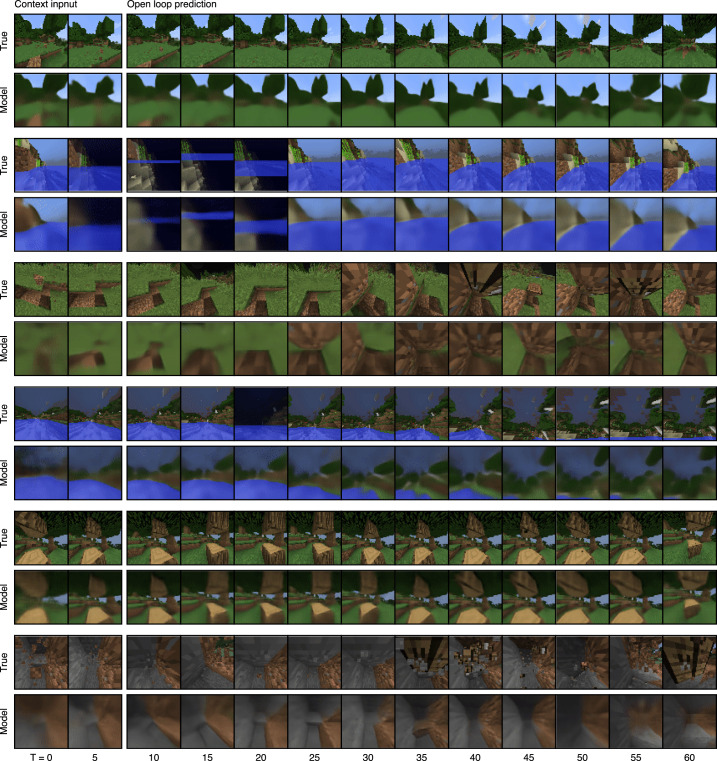
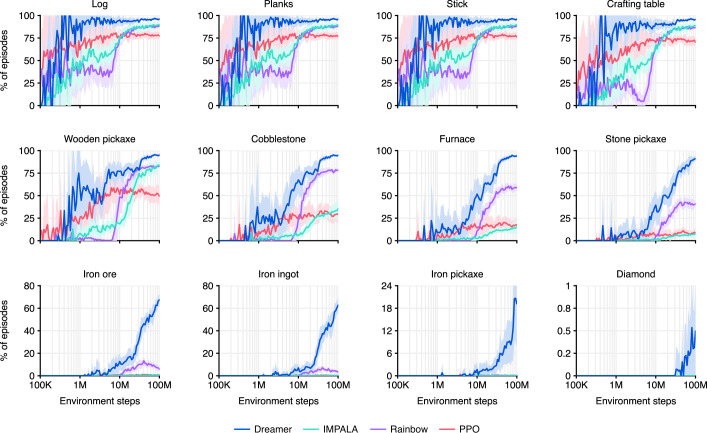
- In Minecraft, all Dreamer agents discover diamonds within 100 million environment steps, completing all 12 milestones from sparse rewards without human data or curricula; Dreamer uses 1 GPU for 9 days, whereas VPT used 720 GPUs for 9 days.
- Ablations on 14 tasks show all robustness techniques contribute, most notably KL balancing and free bits, followed by return normalization and symexp two-hot regression; performance rests predominantly on the unsupervised reconstruction loss of the world model.
- Scaling from 12 million to 400 million parameters increases task performance monotonically and reduces required environment interaction; higher replay ratios also predictably improve performance.
Methods
- DreamerV3 consists of three neural networks trained concurrently from replayed experience: a recurrent state-space world model that encodes sensory inputs into discrete representations, predicts future representations and rewards, and reconstructs inputs; a critic that predicts return distributions; and an actor that selects actions to maximize return.
- Robustness techniques include symlog observation and target transforms, symexp two-hot loss for reward and critic, KL balancing with free bits, 1% unimix for categorical distributions, percentile return normalization, block GRU, RMSNorm, SiLU activations, adaptive gradient clipping, LaProp optimizer, and a uniform replay buffer with online queue; hyperparameters are fixed across all benchmarks.
- Evaluation spans 8 domains with over 150 tasks, comparing against PPO and specialized experts; seeds are 5 per benchmark except 10 for BSuite and Minecraft; all agents train on a single Nvidia A100 GPU. Minecraft uses MineRL v0.4.4, a 64×64×3 first-person image, inventory and scalar observations, 25 categorical actions, sparse rewards for 12 milestones, episodes up to 36,000 steps (30 minutes), and accelerated block breaking.
Limitations
- Stated: DMLab baselines were not designed for data efficiency and were compared at 1 billion steps while Dreamer used 100 million; EfficientZero resets levels early, making comparison difficult. Minecraft uses accelerated block breaking and abstract crafting actions, and the authors did not investigate whether the heart reward is helpful.
- Stated: uniform replay was chosen for ease of implementation even though prioritized replay improved Dreamer; no annealing, prioritized replay, weight decay or dropout were used.
- Evident: Minecraft environment modifications and the categorical action space mean results are not directly comparable to unmodified Minecraft or to VPT/Voyager setups; evaluation budgets were limited by computational cost, such as DMLab at 100 million rather than 10 billion steps and ProcGen at 50 million steps.
Model-written summary. Check it against the paper before relying on it.
Integrity signals
Registry
Cites
Statistics
Figures
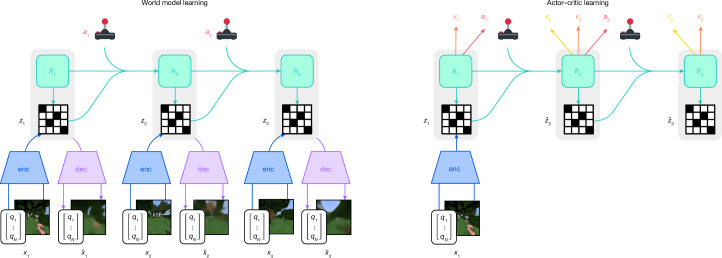

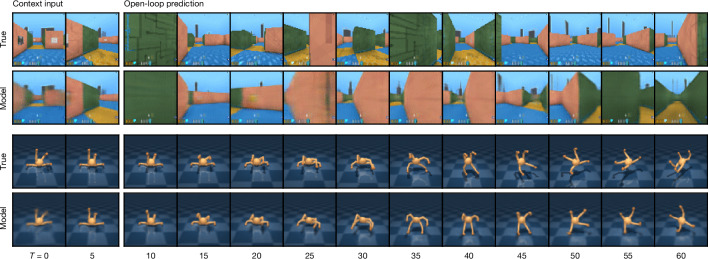

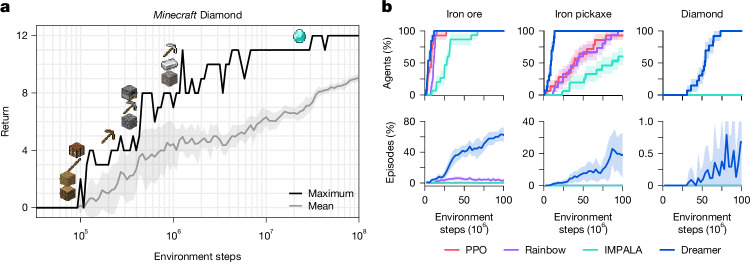
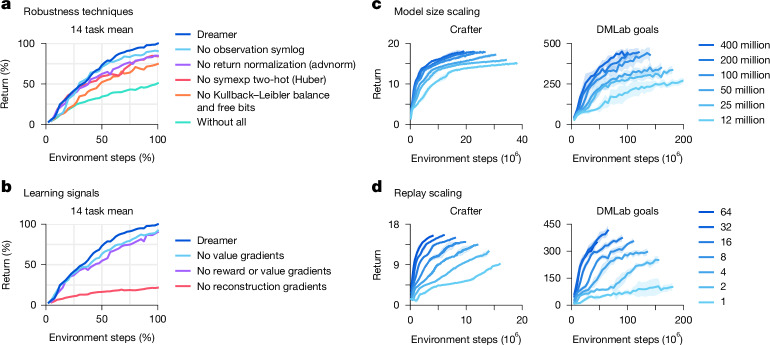
Verification
Claims the paper makes
13 Valid · 7 Not valid · 27 Not checked · 57 Own results and interpretations
Every source the paper cites for this claim was checked and supports it.
In the paper
“Although intuitively appealing, robustly learning and leveraging world models to achieve strong task performance has been an open problem18.”
§ Mastering diverse control tasks through world models > Main
What the sources say
- Supportedcites [18] Kaiser, L. et al. Model-based reinforcement learning for Atari. In Proc.International Conference on Learning Representations (ICLR, 2020). source
The Introduction (p. 1) describes the appeal of learning policies from environment models. The Conclusions (p. 10) identify both lower final scores than leading model-free methods and substantial variation between runs, and name better models and robustness as future work. Together, these support the claim that reliably using world models for strong performance remained an open challenge. (LLM, conf=0.88)
plain- Asserted: passes — The authors put it forward as true.
- Checkable: passes — It can be checked against evidence.
- Load-bearing: passes — The paper’s conclusions depend on it.
- Based: passes — The paper gives a reason why it holds.
- Supported
The cited sources support only part of this claim — read each source’s verdict below.
In the paper
“Dreamer also outperforms the widely used expert algorithms Rainbow36 and IQN37.”
§ Mastering diverse control tasks through world models > Evaluation > Benchmarks
What the sources say
- Supportedcites [36] Hessel, M. et al. Rainbow: combining improvements in deep reinforcement learning. In Proc. Thirty-Second AAAI Conference on Artificial Intelligence and Thirtieth Innovative Applications of Artificial Intelligence Conference and Eighth AAAI Symposium on Educational Advances in Artificial Intelligence 3215–3222 (Association for Computing Machinery, 2018). sourceExperimental — accuracy not yet measured
The citation is attached to “Rainbow” in the citing sentence. The introduction (p. 1) identifies the paper’s agent as Rainbow and reports its performance on 57 Atari games, supporting its use as a citation identifying that algorithm. This source is not being cited for the Dreamer comparison or for IQN. (LLM, conf=0.90)
- Could not verifycites [37] Dabney, W., Ostrovski, G., Silver, D. & Munos, R. Implicit quantile networks for distributional reinforcement learning. In Proc. 35th International Conference on Machine Learning 1096–1105 (PMLR, 2018). sourceExperimental — accuracy not yet measured
The Evaluation on Atari 2600 (pp. 6–7) compares QR-DQN with earlier agents, not Dreamer with Rainbow or IQN. Searches for Dreamer, Rainbow, and IQN found no passage in our copy addressing the claimed comparison. (LLM, conf=0.76)
plainstates a cause- Asserted: passes — The authors put it forward as true.
- Checkable: passes — It can be checked against evidence.
- Load-bearing: passes — The paper’s conclusions depend on it.
- Based: passes — The paper gives a reason why it holds.
- Supported
The cited sources support only part of this claim — read each source’s verdict below.
In the paper
“Owing to these obstacles, previous approaches resorted to using human expert data and domain-specific curricula20,21.”
§ Mastering diverse control tasks through world models > Main
What the sources say
- Could not verifycites [20] Kanitscheider, I. et al. Multi-task curriculum learning in a complex, visual, hard-exploration domain: Minecraft. Preprint at https://arxiv.org/abs/2106.14876 (2021). sourceExperimental — accuracy not yet measured
Our copy of Kanitscheider et al. (2021) contains no statement characterising previous Minecraft approaches as relying on human expert data or domain-specific curricula. The Introduction (p. 2) only says their methods were built on the MineRL platform [1] (a dataset of demonstrations used here as an environment), and the Related work section (p. 11) surveys automated curriculum learning in general (success-probability/regret thresholds, Curiosity Search [2,3]), not prior Minecraft work; the contribution statement (p. 1) even concedes a thorough literature review is missing. Searched: 'human expert data / demonstrations', 'domain-specific curriculum / prior work', 'imitation learning Minecraft', 'handcrafted curriculum obstacles' — no decisive passage. (LLM, conf=0.70)
- Supportedcites [21] Baker, B. et al. Video pretraining (VPT): learning to act by watching unlabeled online videos. In Proc. 36th International Conference on Neural Information Processing Systems 24639–24654 (Association for Computing Machinery, 2022). source
The Related Work section (p. 3) describes prior Minecraft work using automated curriculum learning, and the References (pp. 11–12) identify prior Minecraft studies based on demonstrations. Together, these support the broad characterization of approaches using demonstration data and Minecraft-specific curricula. (LLM, conf=0.82)
plainstates a cause- Asserted: passes — The authors put it forward as true.
- Checkable: passes — It can be checked against evidence.
- Load-bearing: passes — The paper’s conclusions depend on it.
- Based: passes — The paper gives a reason why it holds.
- Could not verify
The cited sources support only part of this claim — read each source’s verdict below.
In the paper
“Dreamer matches the state of the art on this benchmark, such as DMPO31 and TD-MPC243.”
§ Mastering diverse control tasks through world models > Evaluation > Benchmarks
What the sources say
- Partly supportedcites [31] Abdolmaleki, A. et al. Maximum a posteriori policy optimisation. In Proc.International Conference on Learning Representations (ICLR, 2018). sourceExperimental — accuracy not yet measured
Sections 5.1 (p. 7) and 5.1.2 (pp. 8–9) present MPO as a competitive algorithm on Control Suite tasks, and Section 5.2 (p. 9) describes a parallel variant. The cited paper does not identify that variant as DMPO or compare Dreamer with DMPO on the Proprio Control Suite benchmark, so it supports only the broader control-performance context. (LLM, conf=0.81)
- Not matchedcites [43] Hansen, N., Su, H. & Wang, X. TD-MPC2: scalable, robust world models for continuous control. In Proc.International Conference on Learning Representations (ICLR, 2024).
Its entry has no title and year that we can search by.
plainn = 20- Asserted: passes — The authors put it forward as true.
- Checkable: passes — It can be checked against evidence.
- Load-bearing: passes — The paper’s conclusions depend on it.
- Based: passes — The paper gives a reason why it holds.
- Partly supported
A result the paper states — it cites no source for it, so there is none to check. The quote shows it is in the paper.
In the paper
“Notably, larger models not only achieve higher scores but also require less interaction to solve a task, offering practitioners a predictable way to increase performance and data efficiency.”
§ Mastering diverse control tasks through world models > Main
plainstates a cause- Asserted: passes — The authors put it forward as true.
- Checkable: passes — It can be checked against evidence.
- Load-bearing: passes — The paper’s conclusions depend on it.
- Based: passes — The paper gives a reason why it holds.
36 more claims
Create a free account to see all 104 claims and to verify the 19 references still open.
- It may state two separate claims as one. 39
- Probably not a substantial claim. 36
- The quote only partly states this claim. 2
Claims other papers make about this one
Each is checked against this paper’s own text: does it say what the citing paper says it does?
The cited source says what the claim attributes to it.
In the citing paper
“Their latest iteration, DreamerV3 [71], adds robust normalization and balancing techniques, solving over 150 tasks-including diamond collection in Minecraft-without human data or domain-specific tuning.”
From Understanding World or Predicting Future? A Comprehensive Survey of World Models (2026) · cites this paper as [71]
The cited source says what the claim attributes to it.
In the citing paper
“World models predict the effects of candidate actions on subsequent states or outcomes [6-8], enabling prospective evaluation and planning.”
From RSI-Anything: Unlocking Recursive Self-Improvement with World Models (2026) · cites this paper as [7]
The cited source says what the claim attributes to it.
In the citing paper
“World Models [6], MuZero [8], Dreamer [7], and Genie [38] establish predictive environments as a basis for control, planning, and interactive generation.”
From RSI-Anything: Unlocking Recursive Self-Improvement with World Models (2026) · cites this paper as [7]
The check wasn’t confident either way, so it gives no verdict — never disputed.
In the citing paper
“We theoretically prove this encoder is essential for efficient context inference and robust generalization.”
From Dynamics-Aligned Latent Imagination in Contextual World Models for Zero-Shot Generalization (2025) · cites this paper as Hafner et al., 2025
Experimental — accuracy not yet measured
Citations
Cites
Human-level control through deep reinforcement learning
Mnih, V., Kavukcuoglu, K., Silver, D., Rusu, A. A., Veness, J., Bellemare, M. G., Graves, A., Riedmiller, M., Fidjeland, A. K., Ostrovski, G., et al. (2015) · Nature · doi:10.1038/nature14236 · Cited by 30,357
Learning Phrase Representations using RNN Encoder–Decoder for Statistical Machine Translation
Cho, K., van Merrienboer, B., Gulcehre, C., Bahdanau, D., Bougares, F., Schwenk, H., & Bengio, Y. (2014) · Proceedings of the 2014 Conference on Empirical Methods in Natural Language Processing (EMNLP) · doi:10.3115/v1/d14-1179 · Cited by 25,545 · cited 2×
“The input to the GRU at each time step is a linear embedding of the sampled latent z t , of the action a t , and of the recurrent state to allow mixing between blocks.”
Mastering the game of Go with deep neural networks and tree search
Silver, D., Huang, A., Maddison, C. J., Guez, A., Sifre, L., van den Driessche, G., Schrittwieser, J., Antonoglou, I., Panneershelvam, V., Lanctot, M., et al. (2016) · Nature · doi:10.1038/nature16961 · Cited by 15,612
Self-citationContinuous control with deep reinforcement learning
Lillicrap, T. P., Hunt, J. J., Pritzel, A., Heess, N., Erez, T., Tassa, Y., Silver, D., & Wierstra, D. (2015) · arXiv · doi:10.48550/arxiv.1509.02971 · Cited by 10,782 · cited 1×
“These specialized algorithms target the unique challenges posed by different application domains, such as continuous control 8 , discrete actions 9,10 , sparse rewards 11 , image inputs 12 , spatial environments 13 and board games 14 .”
Self-citationProximal Policy Optimization Algorithms
Schulman, J., Wolski, F., Dhariwal, P., Radford, A., & Klimov, O. (2017) · arXiv · doi:10.48550/arxiv.1707.06347 · Cited by 10,625
Mastering the game of Go without human knowledge
Silver, D., Schrittwieser, J., Simonyan, K., Antonoglou, I., Huang, A., Guez, A., Hubert, T., Baker, L., Lai, M., Bolton, A., et al. (2017) · Nature · doi:10.1038/nature24270 · Cited by 9,084 · cited 1×
“These specialized algorithms target the unique challenges posed by different application domains, such as continuous control 8 , discrete actions 9,10 , sparse rewards 11 , image inputs 12 , spatial environments 13 and board games 14 .”
Self-citationSoft actor-critic Off-policy maximum entropy deep reinforcement learning with a stochastic actor
Haarnoja, T., Zhou, A., Abbeel, P., & Levine, S. (2018) · arXiv · doi:10.48550/arxiv.1801.01290 · Cited by 5,594 · cited 1×
“Constrained optimization targets a fixed entropy on average across states 30,31 regardless of achievable returns, which is robust but explores slowly under sparse rewards and converges lower under dense rewards.”
Training language models to follow instructions with human feedback
Ouyang, L., Wu, J., Jiang, X., Almeida, D., Wainwright, C. L., Mishkin, P., Zhang, C., Agarwal, S., Slama, K., Ray, A., et al. (2022) · arXiv · doi:10.48550/arxiv.2203.02155 · Cited by 4,208 · cited 7×
“Aggregated scores on all benchmarks are shown in Extended Data Table 1.”
InfluentialSimple Statistical Gradient-Following Algorithms for Connectionist Reinforcement Learning
Williams, R. J. (1992) · Machine Learning · doi:10.1007/bf00992696 · Cited by 3,416
Schaul, T., Quan, J., Antonoglou, I., & Silver, D. (2015) · arXiv · doi:10.48550/arxiv.1511.05952 · Cited by 3,120
Research works printed but not linked: 17
- Huang, S., Dossa, R. F. J., Raffin, A., Kanervisto, A. & Wang, W. The 37 implementation details of proximal policy optimization. The ICLR Blog Track https://iclr-blog-track.github.io/2022/03/25/ppo-implementation-details/ (2023).
- Ha, D. & Schmidhuber, J. Recurrent world models facilitate policy evolution. In Proc. 32nd International Conference on Neural Information Processing Systems 2455–2467 (Association for Computing Machinery, 2018).
- Kingma, D. P. & Welling, M. Auto-encoding variational Bayes. In Proc.International Conference on Learning Representations (ICLR, 2014).
- Bellemare, M. G., Dabney, W. & Munos, R. A distributional perspective on reinforcement learning. In Proc. 34th International Conference on Machine Learning 449–458 (PMLR, 2017).
- Kapturowski, S., Ostrovski, G., Quan, J., Munos, R. & Dabney, W. Recurrent experience replay in distributed reinforcement learning. In Proc.International Conference on Learning Representations (ICLR, 2018).
- Cobbe, K. W., Hilton, J., Klimov, O. & Schulman, J. Phasic policy gradient. In Proc. 38th International Conference on Machine Learning 2020–2027 (PMLR, 2021).
- Cobbe, K., Hesse, C., Hilton, J. & Schulman, J. Leveraging procedural generation to benchmark reinforcement learning. In Proc. 37th International Conference on Machine Learning 2048–2056 (Association for Computing Machinery, 2020).
- Hansen, N., Su, H. & Wang, X. TD-MPC2: scalable, robust world models for continuous control. In Proc.International Conference on Learning Representations (ICLR, 2024).
- Yarats, D., Fergus, R., Lazaric, A. & Pinto, L. Mastering visual continuous control: Improved data-augmented reinforcement learning. In Proc.International Conference on Learning Representations (ICLR, 2022).
- Hafner, D. Benchmarking the spectrum of agent capabilities. In Proc.International Conference on Learning Representations (ICLR, 2022).
- Samsami, M. R., Zholus, A., Rajendran, J. & Chandar, S. Mastering memory tasks with world models. In Proc.International Conference on Learning Representations (ICLR, 2024).
- Robine, J., Höftmann, M., Uelwer, T. & Harmeling, S. Transformer-based world models are happy with 100k interactions. In Proc.International Conference on Learning Representations (ICLR, 2023).
- Osband, I., Blundell, C., Pritzel, A. & Van Roy, B. Deep exploration via bootstrapped DQN. In Proc.Advances in Neural Information Processing Systems29 (NeurIPS, 2016).
- Brock, A., De, S., Smith, S. L. & Simonyan, K. High-performance large-scale image recognition without normalization. In Proc. 38th International Conference on Machine Learning 1059–1071 (PMLR, 2021).
- Kingma, D. P. & Ba, J. Adam: a method for stochastic optimization. In Proc.International Conference on Learning Representations (ICLR, 2017).
- Schmitt, S., Hessel, M. & Simonyan, K. Off-policy actor–critic with shared experience replay. In Proc. 37th International Conference on Machine Learning 8545–8554 (PMLR, 2020).
- Sharma, S., Srinivas, A. & Ravindran, B. Learning to repeat: fine grained action repetition for deep reinforcement learning. In Proc.International Conference on Learning Representations (ICLR, 2017).
Cited by
Items 101–175 of 175
Li, Z., Wen, Y., Yang, L., Pan, J., & Zhou, P. (2026) · IEEE Transactions on Industrial Informatics · doi:10.1109/tii.2026.3695575
Pavlidis, G. P., Sevetlidis, V., & Arampatzakis, V. (2026) · Heritage · doi:10.3390/heritage9060233
AdaReP: Adaptive Re-planning under Model Mismatch for Neural World-Model Predictive Control
Cheng, Y., Ma, X., Wang, X., Yang, M., Su, R., Liu, H., Chen, X., Li, S., & Li, Q. (2026) · Lecture notes in computer science · doi:10.1007/978-3-032-38404-1_18 · Cited by 3
“Neural world-model methods cover latent-dynamics planning in PlaNet, Dreamer, and DreamerV3 [5,4,6], latent MPC in TD-MPC and TD-MPC2 [8,7], recurrent or object-centric video prediction for manipulation [22,16,1,20,19], and recent transformer, diffusion, and multimodal predictors [25,28,3].”
Learning Visual Control with Privileged State Alignment and Asymmetric Value Estimation
Wang, Z. (2026) · IEEE International Conference on Control, Electronics and Computer Technology (ICCECT) · doi:10.1109/iccect68671.2026.11565354
“Model-based approaches, such as Dreamer [10] and TD-MPC [11], further improve performance by learning latent dynamics models for planning or value estimation.”
Gao, X., & Lu, K. (2026) · doi:10.1109/sgai69026.2026.11566049
“Model-based reinforcement learning (MBRL) reduces real interactions by substituting a learned surrogate [5], [6].”
AI-Driven Smart Manufacturing in the Aluminum Industry: Current Advances and Future Directions
Wang, Y., Xie, M., Chen, C., Liu, P., Zhao, H., & Liu, F. (2026) · Journal of Sustainable Metallurgy · doi:10.1007/s40831-026-01567-z · Cited by 2
“Reinforcement learning, based on Markov decision processes (MDP), learns optimal strategies through agent–environment interactions, demonstrating unique advantages in dynamic process control and parameter optimization [14–16].”
Remote Reinforcement Learning over Unreliable Channels with Homomorphic State Representations
Talli, P., Mason, F., Chiariotti, F., & Zanella, A. (2026) · IEEE Conference on Computer Communications (INFOCOM) · doi:10.1109/infocom59046.2026.11571525
“Hence, we can implement a MBRL approach to learn the optimal policy without explicitly processing s and a , but only ϕ ( s ) and α ( a ) , which strongly reduces training effort [14].”
Jin, Z., Wang, H., Tang, Y., Dong, Z., Feng, C., & Shao, Y. (2026) · SSRN Electronic Journal · doi:10.2139/ssrn.7029004
LeCropFollow: Latent Space Planning for Navigation in Unstructured Crop Fields
Tommaselli, F. A. G., Pinto, F. A. C., Rocha, A., Capezzuto, G., Sivakumar, A. N. V., Chowdhary, G. V., & Becker, M. (2026) · IEEE Robotics and Automation Letters · doi:10.1109/lra.2026.3710052 · Cited by 1
“Model-Based Reinforcement Learning (MBRL) refers to formulations that leverage either known or learned world models to improve training efficiency through synthetic data generation [19] or to enhance decision-making via planning [9], [20].”
PhysMani: Physics-Principled 3D World Model for Dynamic Object Manipulation
Peng, Y., Huang, S., Li, H., Li, J., Wang, J., & Yang, B. (2026) · Lecture notes in computer science · doi:10.1007/978-3-032-37029-7_2 · Cited by 2
Onuki, Y., Tahara, Y., Ohsuga, A., & Sei, Y. (2026) · International Journal of Computer Games Technology · doi:10.1155/ijcg/9867761
ProgressiveDrive: Reconciling fidelity and consistency in world models for autonomous driving
Zhang, D., Zou, Y., Du, G., Sun, W., Lu, P., Zhang, X., & Zhang, J. M. (2026) · Expert Systems with Applications · doi:10.1016/j.eswa.2026.133554
Efficient video captioning annotation: a semi-automated framework via LLM-driven heuristics
Cao, Q., 廖桂心, & Tang, T. (2026) · Multimedia Systems · doi:10.1007/s00530-026-02436-1
“Subsequent PlaNet (2019)[40], Dreamer series (2020-2025)[41–43], and others have been continuously optimized, and Day-Dreamer (2022)[44], DriveDreamer (2024)[45], Genie (2024)[46], and others have been implemented in real-world scenarios.”
Task-Driven State Representation for Long-Horizon World Model
Zhao, T., Huang, J., He, Z., Zhang, H., Liu, J., & Wang, Y. (2026) · Lecture notes in computer science · doi:10.1007/978-981-92-3381-6_48
Li, T., Peng, P., Liu, Q., Zhang, S., & Song, L. (2026) · IEEE Transactions on Cognitive Communications and Networking · doi:10.1109/tccn.2026.3715905
“PlaNet [27] introduced the Recurrent State Space Model (RSSM), and Dreamer series [28], [29], [30] Fig.”
Foundational and World Models in SciML
Bhuyan, B. P., Saadi, A. A., Meraihi, Y., & Ramdane-Chérif, A. (2026) · Springer eBooks · doi:10.1007/978-981-95-7856-6_9
Reusing Multimodal Agents: Efficient Evaluation of Sound Designs in Games
Van, T. N., Khan, I., Dewantoro, M. F., Suntichaikul, P., Pham, H. V., & Thawonmas, R. (2026) · IEEE Transactions on Games · doi:10.1109/tg.2026.3716328
“In model-based approaches, latent representations are primarily learned to capture environment dynamics and support efficient planning, as demonstrated in methods like World Models [17], PlaNet [16], and the Dreamer series [24], [25], [26].”
Dream training for active control of multiphase flow in spray fluidized beds
Li, Z., Xu, Q., Guo, Q., Guan, X., & Yang, N. (2026) · Chemical Engineering Science · doi:10.1016/j.ces.2026.124778
Brain's world model is smarter than we think
Yang, M. A., Kim, H., Kang, J., & Lee, S. W. (2026) · Current Opinion in Behavioral Sciences · doi:10.1016/j.cobeha.2026.101672
Discrete World Models via Regularization
Bizzaro, D., & Serafini, L. (2026) · Lecture notes in computer science · doi:10.1007/978-3-032-31927-2_6
Tembiné, H., & Yongueng, D. N. (2026) · International Conference on Control, Decision and Information Technologies (CoDIT) · doi:10.1109/codit70676.2026.11630851
“While contemporary world models have demonstrated remarkable success in closed, gamified environments [3], [7], they often operate on the premise that the data stream is an isomorphic representation of reality.”
TruKAN-RPO: An Advanced Framework for On-Policy Methods for Continuous Reinforcement Learning
Bayeh, A., Sadaoui, S., & Mouhoub, M. (2026) · International Conference on Control, Decision and Information Technologies (CoDIT) · doi:10.1109/codit70676.2026.11630909
“Finally, the research [16] developed KAN-Dreamer model, by incorporating KAN and FastKAN models into a RL framework based on DreamerV3 [9].”
Intent-driven embodied artificial intelligence
Zheng, N. (2026) · National Science Review · doi:10.1093/nsr/nwag476 · Cited by 1
Observable quotient world models for knowledge-state abstraction under partial observability
Jiao, Y., Ho, P., & Peng, L. (2026) · Knowledge-Based Systems · doi:10.1016/j.knosys.2026.116768
Huertos, F. J., Bañales, O., Álvarez, P., & Cabanes, I. (2026) · Robotics · doi:10.3390/robotics15080156 · Cited by 1
Applications of Reinforcement Learning for Autonomous Surgical Robotics: A Systematic Review
Shahid, M., Abdullah, A., Fatima, Z., Feroze, W., Torres-Ruiz, M. J., Saldaña-Pérez, M., Sanchéz-Mejorada, C. G., & Quintero, R. (2026) · Biomimetics · doi:10.3390/biomimetics11080577 · Cited by 2
Collision avoidance for unmanned surface vehicle in busy waterways based on improved DDPG and IMMKF
廉特, Liu, Q., Wu, D., et al. (2026) · Ocean Engineering · doi:10.1016/j.oceaneng.2026.127464
Evolution of humanoid locomotion control
Gu, Y., Shi, G., Shi, F., Chang, I.-C., Wang, Y., Cheng, Q., Olkin, Z., López-Sánchez, I., Feng, Y., Zhang, J., et al. (2026) · Science Robotics · doi:10.1126/scirobotics.aed3973 · Cited by 8
Collins, G., Evans, O., Williams, N., & Brooks, E. (2026) · International Journal Of Pharmaceutical Research And Allied Sciences · doi:10.51847/xb0rdsqitf
Ma, R. (2026) · International Journal of Humanoid Robotics · doi:10.1142/s0219843626400256
Long-horizon resilience of power systems under climate change
Ruan, J., Li, Y., Gu, C., Jia, Y., Wang, J., Hu, Z., Xu, Z., Su, H., Lie, T. T., & Song, J. (2026) · Nature Reviews Electrical Engineering · doi:10.1038/s44287-026-00322-6 · Cited by 3
Deriving a Data-Efficient, Generalist Agent Through World Models
Kim, J. (2026) · IEEE Access · doi:10.1109/access.2026.3726084
“We compare mae with seven published world-model approaches for data-efficient learning: TWM [23], IRIS [13], DreamerV3 [14], STORM [26], HarmonyDream [27], (cid:49) -IRIS [28], Diamond [4].”
InfluentialMaximum information gain reinforcement learning based on the variational information bottleneck
Chen, X., Yang, M., Meng, H., Tian, S., & Wang, Z. (2026) · Physical Communication · doi:10.1016/j.phycom.2026.103332
Improving Policy Learning via Language-Guided State Representation in World Models
Zhang, L., Kan, M., Shan, S., & Chen, X. (2026) · IEEE Robotics and Automation Letters · doi:10.1109/lra.2026.3728343
“Inspired by this cognitive ability, world models aim to learn compact and predictive representations of environmental dynamics, allowing agents to simulate future states internally for efficient robotics policy learning [2].”
Yao, X., Gao, J., & Xu, C. (2026) · IEEE Transactions on Pattern Analysis and Machine Intelligence · doi:10.1109/tpami.2026.3728426
Mitigating Covariate Shift in Offline Imitation Learning via Trajectory Synthesis
Wang, S., Xia, Y., Mei, Y., Cao, H., Wang, R., Zhang, X., Deng, F. Y., Sun, J. Q., Chen, J., & Wang, G. (2026) · IEEE Transactions on Automation Science and Engineering · doi:10.1109/tase.2026.3729780
“The low-dimensional pipeline (Sections III-B-III-D) integrates three established components-a Dreamer-based world model [24], a PU-learning discriminator [18], [20], and the IQL policy trainer [33]-where our contribution lies in the orchestration of these components for recovery trajectory…”
InfluentialLi, D., & Shi, Y. (2026) · IEEE Access · doi:10.1109/access.2026.3729767
“DDPG, TD3, PPO, SAC, distributional critics, and world-model methods provide different trade-offs among sample efficiency, policy stability, exploration, and computational cost [8], [9], [10], [26], [27], [28], [29].”
A survey of world models for physical AI with uncertainty representation and control
Kirchner, S., Purschke, N., & Knoll, A. (2026) · Discover Artificial Intelligence · doi:10.1007/s44163-026-02122-1 · Cited by 1
Jang, T.-H., Lee, H.-U., & Kim, H. (2026) · IEEE Access · doi:10.1109/access.2026.3730445
“Notably, complex 3D environments like Minecraft have become standard benchmarks for evaluating these agents, driven by competitions like MineRL [27] and advances in world models [28].”
Efficient in-Context Reinforcement Learning via World Model Augmentation
Li, W., & Wang, Z. (2026) · IEEE International Conference on Cybernetics (CYBCONF) · doi:10.1109/cybconf69298.2026.11670288
“This capability allows the agent to generate unlimited imagined trajectories of the form τ = { f k , ˆ s k , a k , ˆ r k } t + H k = t , where H is the imagination horizon, facilitating efficient policy learning in the compact latent space [21, 30].”
Task-Aware Mixture of Experts for Efficient Multi-Task Visual Reinforcement Learning
Liu, F., & Wang, Z. (2026) · IEEE International Conference on Cybernetics (CYBCONF) · doi:10.1109/cybconf69298.2026.11670265
Zhang, H., Kang, Z., & Ning, K. (2026) · Advanced Genetics · doi:10.1002/ggn2.70046
Hybrid Gait Motion Control of Biped-Wheel Robots
Li, Z. (2026) · International Conference on Computer Information Science and Application Technology (CISAT) · doi:10.1109/cisat71030.2026.11682505
“World-model methods have also been explored for improving sample efficiency in physical robot learning [21], [22].”
World-Model-Enhanced UAV Intelligent Inspection Method for Converter Station Valve Halls
Li, Y., Ding, L., He, M., Wei, W., Zhang, L., & Chen, Z. (2026) · International Conference on Computer Information Science and Application Technology (CISAT) · doi:10.1109/cisat71030.2026.11682053
“Recent advances in world-model learning, predictive representation learning, and latent-imagination control demonstrate how structured internal state can support perception, prediction, and action planning in complex environments [1]–[4].”
Wang, J. (2026) · International Conference on Image Processing, Multimedia Technology and Machine Learning (IPMML) · doi:10.1109/ipmml71439.2026.11682717
“Dreamer-style systems show that agents can learn from imagined trajectories generated by latent world models, and recent evidence indicates that such approaches can scale across diverse control tasks [2].”
Ding, T., Zou, Y., Chen, C., Shah, M., & Tian, Y. (2026) · Lecture notes in computer science · doi:10.1007/978-3-032-37038-9_12 · Cited by 17
Emergence of Grid-Cell-Like Representations in World Models for Reinforcement Learning
Araki, T., Ito, T., & Onoda, T. (2026) · Lecture notes in computer science · doi:10.1007/978-3-032-38404-1_4
FIBB: Capturing False Information Beliefs and Behaviors Across Physical and Online Environments
Jia, M. Y., Bhattacharjee, N., Kapadia, A. R., & Wang, D. (2026) · ACM Conference on Human-AI Complementarity and Alignment · doi:10.1145/3834580.3838743
A deep reinforcement learning framework for coastal multi-hazard emergency response
Sanò, M., Ferrario, D. M., Torresan, S., & Critto, A. (2026) · International Journal of Disaster Risk Reduction · doi:10.1016/j.ijdrr.2026.106439
WorldIntent: Belief-State World Models for Intent-Guided Autonomous Driving
Li, S., Chen, D., Xu, H., et al. (2026) · International Conference on Big Data and Information Analytics (BigDIA) · doi:10.1109/bigdia71496.2026.11684597
“Recurrent State-Space Models (RSSMs) [11], [12] factorize latent dynamics into a deterministic recurrent component and a stochastic latent component, enabling imagination over long horizons.”
InfluentialNoori, A., Fishman, N., Fang, A., Fesser, L., & Žitnik, M. (2026) · Cell · doi:10.1016/j.cell.2026.08.032 · Cited by 6
Li, J., Fang, X., Yu, P., & Jiang, L. (2026) · Frontiers in Medicine · doi:10.3389/fmed.2026.1913206 · Cited by 1
World Models for Biomedicine: A Steerability FrameworkPreprint
Xiong, J. (2026) · Qeios · doi:10.32388/gym306 · Cited by 3
Design and control of an enclosed dual-screw robot chassis for soft-terrain locomotion
Sun, Q., Gao, S., & Zeng, X. (2026) · Robotica · doi:10.1017/s0263574726103890
Yang, Y., Feng, H., & Lu, B. (2026) · Sensors · doi:10.3390/s26185944
“BEVDet [59] established a modular camera-to-BEV pipeline, BEVFormer [31] added spatiotemporal attention, BEVFusion [60] fused camera and LiDAR in the same coordinate system, and UniAD [61] carried BEV through detection, tracking, prediction, and planning.”
InfluentialReconstruction-Free Vision-Based Control via Differentiable Long-Horizon Influence
Zhao, C., Tang, W., Huang, H., Li, D., & Zeng, Z. (2026) · IEEE Transactions on Automation Science and Engineering · doi:10.1109/tase.2026.3734242
“• DreamerV3 [6] is adopted as a representative latent world model baseline.”
Sun, C. (2026) · AI and Ethics · doi:10.1007/s43681-026-01400-z
“Robotics, multimodal models that connect vision and language to action, and learned policies for real-world control show that large-scale learning is moving from language and images into action [ 42–46].”
CAG-WM: A Synthetic-Data-Driven Coronary World Model for Autonomous Guidewire Navigation
Cao, Y., Zhang, Z., Peng, X., et al. (2026) · Lecture notes in computer science · doi:10.1007/978-3-032-38236-8_11
Velázquez, C. B., Oviaño, D. G., Ramos, I. S., Sanz, L. L., & Mayol, J. M. (2026) · Journal of Robotic Surgery · doi:10.1007/s11701-026-04000-5
“…culminating in an algorithm that learns by imagining future scenarios and solves more than 150 diverse control tasks with a single configuration [ 9 ], while a parallel line showed that latent actions could be inferred from wholly unlabelled video and then exposed as controllable inputs at…”
Yuan, X., Zhang, J., Yang, J., Yan, J., Xing, X., Gao, M., Song, Y., Zhou, F., & Sheng, W. (2026) · Information Fusion · doi:10.1016/j.inffus.2026.104823
Cho, M., Kang, Y.-J., Choi, S., Park, N., & Noh, Y. (2026) · Journal of Building Engineering · doi:10.1016/j.jobe.2026.117440
Structured Residual Adaptation for Multi-Task World Models
Zheng, Y., Zhang, Z., Li, J., et al. (2026) · International Conference on Automation and Computing (ICAC) · doi:10.1109/icac70325.2026.11712548
“Model-based reinforcement learning (MBRL) is a promising path to data-efficient continuous control by planning within learned world models [1]–[4].”
Modern Trends in Trajectory Planning for Two-Tiered Learning Architectures
Min, J., Lee, H., Ahn, H., et al. (2026) · International Conference on Modelling, Identification and Control · doi:10.1109/icmic70587.2026.11708677
“…PlaNet and Dreamer demonstrated latent planning and imagination from pixels [14], [15]; MuZero showed that a planning model can predict task-relevant quantities without full observation reconstruction [16]; and Dream-erV3 reported broad control performance with a unified WM configuration [17].”
Chen, X., & Cheng, K. (2026) · International Conference on Automation and Computing (ICAC) · doi:10.1109/icac70325.2026.11712323
Ng, W. C., Xie, Q., Lee, Y. K., Tee, W. H., Abdulrab, H. Q. A., Hii, T. C. S., & Ding, T. J. (2026) · Neurocomputing · doi:10.1016/j.neucom.2026.135279
Improving performance in SNN-based deep reinforcement learning via transition-aware embeddings
Takigasaki, H., Iwata, T., Yoshioka, S., & Miki, D. (2026) · Frontiers in Neurorobotics · doi:10.3389/fnbot.2026.1929177
Benbouzid, M. (2026) · Energy and AI · doi:10.1016/j.egyai.2026.100926
Foundation models for dynamical systems: A unified survey of estimation, control, and forecasting
Wang, L., Li, X., Shi, T., Zhang, N., Zhan, G., Gao, H., Yang, R., Zeng, N., & Liu, Q. (2026) · Neurocomputing · doi:10.1016/j.neucom.2026.135322 · Cited by 1
Bridging Offline and Online Multi-Objective Reinforcement Learning
Duan, Y., & Jin, Q. (2026) · Communications in computer and information science · doi:10.1007/978-981-92-5712-6_26
PhotoAgent: A Robotic Photographer with Spatial and Aesthetic Understanding
Che, L., Gan, Z., Chen, Y., Tan, J., & Wang, X. (2026) · Proceedings - IEEE International Conference on Robotics and Automation/Proceedings · doi:10.1109/icra57385.2026.11696515 · Cited by 1
“Approaches like World Models [15] and Dreamer-style latent planners [16]– [18] learn compact latent dynamics to imagine action outcomes.”
Dynamics-Aligned Latent Imagination in Contextual World Models for Zero-Shot Generalization
Röder, F., Benad, J., Eppe, M., & Banerjee, P. (2025) · Advances in Neural Information Processing Systems 38 · doi:10.52202/085713-2438
JEPA-Anything: Learning Predictive Models across Different Worlds
Cui, T., Wang, Z., Xu, X., Liu, W., Yu, Z., Zhang, Y., Gao, Q., Yang, M., Ouyang, W., Heng, P. A., et al. (2026) · arXiv · doi:10.48550/arxiv.2609.20800
Agentic AI Scientists Are Not Built For Autonomous Scientific Discovery
Bisht, H., Kumar, V., Jablonka, K. M., Mausam, & Krishnan, N. M. A. (2026) · arXiv · doi:10.48550/arxiv.2605.08956
Dynamics-Aligned Latent Imagination in Contextual World Models for Zero-Shot Generalization
Röder, F., Benad, J., Eppe, M., & Banerjee, P. K. (2025) · arXiv · doi:10.48550/arxiv.2508.20294
“All hidden layers, including the MLP and attention head, use 256 units and SiLU activation functions, consistent with DreamerV3 [Hafner et al., 2025].”
InfluentialRSI-Anything: Unlocking Recursive Self-Improvement with World Models
Cui, T., Zeng, P., Xu, W., Xiao, H., Xue, S., Gao, Q., Ouyang, W., Heng, P. A., Yin, Z., Wu, Y., et al. (2026) · arXiv · doi:10.48550/arxiv.2610.13912 · Cited by 2
“World Models [6], MuZero [8], Dreamer [7], and Genie [38] establish predictive environments as a basis for control, planning, and interactive generation.”
Metadata
- Authors
- Hafner, D., Pasukonis, J., Ba, J., & Lillicrap, T.
- Affiliations
- University of Toronto (CA)
- Corresponding author
- Hafner, Danijar
- Venue
- Nature
- Published
- 2025-04-02
- Volume
- 640
- Issue
- 8059
- Pages
- 647-653
- ISSN
- 0028-0836 (ISSN-L)
- 1476-4687
- PMC
- PMC12003158
- OpenAlex
- W4409147637
- Cited by
- 189
- References
- 39
- Citations by year
- 2026: 145 · 2025: 44
- FWCI
- 75.21
- Type
- journal article
- Language
- en
- Open access
- hybrid
- doi.org
- Licence
- cc-by
- creativecommons.org/licenses/by/4.0 (tdm)
- creativecommons.org/licenses/by/4.0 (vor)
- Locations
- Nature (publishedVersion, cc-by)
- PubMed Central (publishedVersion, cc-by)
- PubMed (publishedVersion)
- RePEc: Research Papers in Economics (submittedVersion)
- Topics
- Physical Sciences › Computer Science › Artificial Intelligence › Reinforcement Learning in Robotics
- Physical Sciences › Computer Science › Artificial Intelligence › Artificial Intelligence in Games
- Physical Sciences › Computer Science › Artificial Intelligence › Domain Adaptation and Few-Shot Learning
- Keywords
- dreamers, world models, sparse rewards, domain generalization
- MeSH terms
- Algorithms, Artificial Intelligence, Humans, Learning, Problem Solving, Reinforcement, Psychology, Task Performance and Analysis
About these checks
Registry, retraction, Cites and statistics results are computed, not judged, with one exception: a printed reference that no index lists is read once by a model before it counts as a citation error. Claims are extracted by a model and kept only when their quote appears verbatim in the text; each cited source is then checked, with a model’s help, for whether it says what the claim relies on. Those verdicts can be wrong — read the claim’s quote and the cited source before relying on one.
The claim verdicts this report counts are experimental: their accuracy is not yet measured.
A language model drew the claims from the paper on 2026-10-10, under version 3 of the claim definition (model deepseek-v4.1-flash, prompt extract-v3).
A second model labelled each claim on 2026-10-10 (model jev-1.13-20260917, definition revision gold-guideline-v0.2).
Cited sources are checked with a language model’s help (gpt-6-sol and qwen3.8-omni-flash).
Statistics and arithmetic are recomputed, not judged.
Confidence bands are shown only for fields calibrated on our annotated test set. None is calibrated yet, so no band is shown.
What counts as a claim ›How we measure confidence ›How we check this ›
Are you an author, or do you see a problem with this page? Request a review
Data sources
Bibliographic data: Semantic Scholar, OpenAlex, Crossref.
Contains information from the Semantic Scholar Academic Graph Datasets, made available under the ODC Attribution License (ODC-BY 1.0).
Semantic Scholar’s data is described in: Kinney, R., et al. (2023). The Semantic Scholar Open Data Platform. arXiv:2301.10140.
