

The DOI matches its Crossref record; 37 of the 38 references it cites were found in a registry or an index, and 1 are not checked yet.
Towards accurate differential diagnosis with large language models
Open accessAbstract
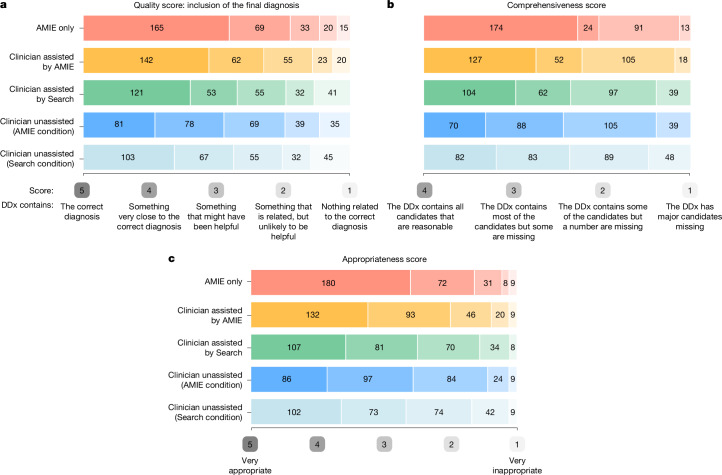
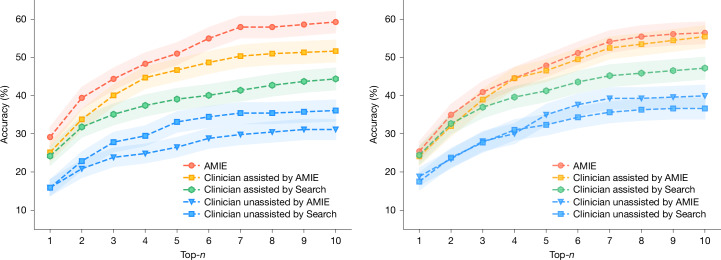
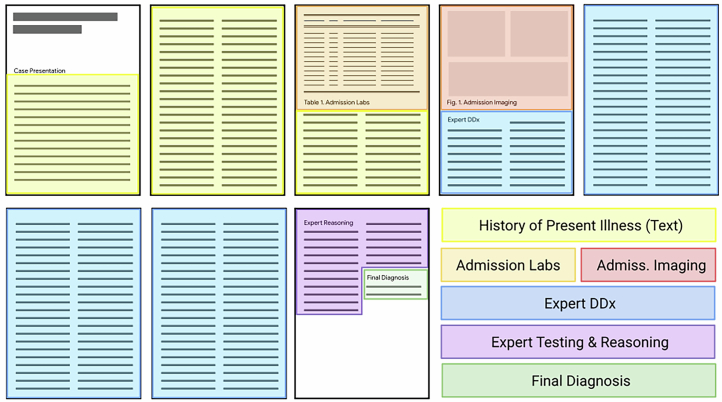
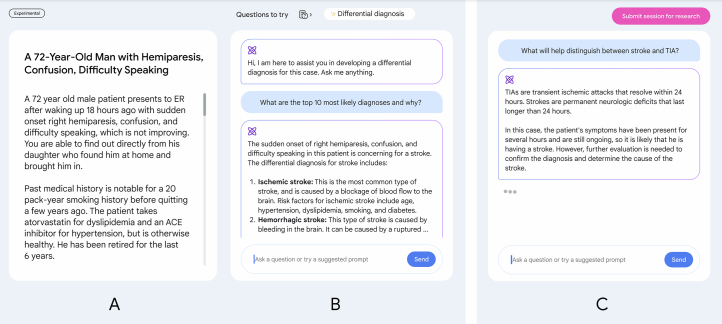
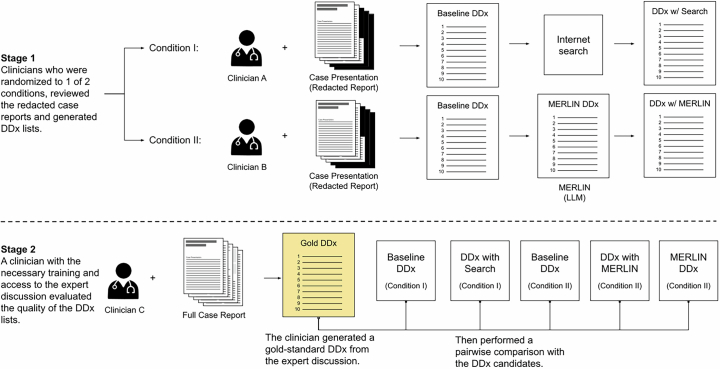
A comprehensive differential diagnosis is a cornerstone of medical care that is often reached through an iterative process of interpretation that combines clinical history, physical examination, investigations and procedures. Interactive interfaces powered by large language models present new opportunities to assist and automate aspects of this process 1 . Here we introduce the Articulate Medical Intelligence Explorer (AMIE), a large language model that is optimized for diagnostic reasoning, and evaluate its ability to generate a differential diagnosis alone or as an aid to clinicians. Twenty clinicians evaluated 302 challenging, real-world medical cases sourced from published case reports. Each case report was read by two clinicians, who were randomized to one of two assistive conditions: assistance from search engines and standard medical resources; or assistance from AMIE in addition to these tools. All clinicians provided a baseline, unassisted differential diagnosis prior to using the respective assistive tools. AMIE exhibited standalone performance that exceeded that of unassisted clinicians (top-10 accuracy 59.1% versus 33.6%, P = 0.04). Comparing the two assisted study arms, the differential diagnosis quality score was higher for clinicians assisted by AMIE (top-10 accuracy 51.7%) compared with clinicians without its assistance (36.1%; McNemar’s test: 45.7, P < 0.01) and clinicians with search (44.4%; McNemar’s test: 4.75, P = 0.03). Further, clinicians assisted by AMIE arrived at more comprehensive differential lists than those without assistance from AMIE. Our study suggests that AMIE has potential to improve clinicians’ diagnostic reasoning and accuracy in challenging cases, meriting further real-world evaluation for its ability to empower physicians and widen patients’ access to specialist-level expertise.
Overview
The claims and statistics of this paper haven’t been checked yet.
Run the check — free, no account needed. It reads the open-access text and checks the sources it cites.
Integrity signals
Registry
Cites
Statistics
Figures
Verification
Claims the paper makes
The claims and statistics of this paper haven’t been checked yet.
Run the check — free, no account needed. It reads the open-access text and checks the sources it cites.
Claims other papers make about this one
Each is checked against this paper’s own text: does it say what the citing paper says it does?
The source backs part of the claim, not all of it — or backs it for a different population, condition or comparison.
In the citing paper
“Previous health-related benchmarks graded short responses, extracted fixed entities from responses, or used weakly correlated natural language generation metrics (Jain et al., 2021; Fleming et al., 2024; McDuff et al., 2025).”
From HealthBench: Evaluating Large Language Models Towards Improved Human Health (2025) · cites this paper as McDuff et al., 2025
Experimental — accuracy not yet measured
Self-check
Percentages, sums and reported differences re-computed from the paper’s own numbers.
The self-check needs the paper’s full text.
Citations
Cites
The Measurement of Observer Agreement for Categorical Data
Landis, J. R., & Koch, G. G. (1977) · Biometrics · doi:10.2307/2529310 · Cited by 81,148
MIMIC-III, a freely accessible critical care database
Johnson, A. E. W., Pollard, T. J., Shen, L., Lehman, L.-W. H., Feng, M., Ghassemi, M., Moody, B., Szolovits, P., Anthony Celi, L., & Mark, R. G. (2016) · Scientific Data · doi:10.1038/sdata.2016.35 · Cited by 8,141
Dissecting racial bias in an algorithm used to manage the health of populations
Obermeyer, Z., Powers, B., Vogeli, C., & Mullainathan, S. (2019) · Science · doi:10.1126/science.aax2342 · Cited by 7,137 · cited 1×
“Deep learning tools have shown considerable promise in many areas of medicine, but are overwhelmingly used as assistive rather than autonomous tools 24 , given the safety-critical nature of medical practice and the many issues of robustness 25 and fairness 26–28 seen in deployment.”
Large language models encode clinical knowledge
Singhal, K., Azizi, S., Tu, T., Mahdavi, S. S., Wei, J., Chung, H. W., Scales, N., Tanwani, A., Cole-Lewis, H., Pfohl, S., et al. (2023) · Nature · doi:10.1038/s41586-023-06291-2 · Cited by 4,083
Self-citationLarge Language Models Encode Clinical Knowledge
Singhal, K., Azizi, S., Tu, T., Mahdavi, S. S., Wei, J., Chung, H. W., Scales, N., Tanwani, A., Cole-Lewis, H., Pfohl, S., et al. (2022) · arXiv · doi:10.48550/arxiv.2212.13138 · Cited by 4,083
Self-citationLlama 2: Open Foundation and Fine-Tuned Chat Models
Touvron, H., Martin, L., Stone, K., Albert, P., Almahairi, A., Babaei, Y., Bashlykov, N., Batra, S., Bhargava, P., Bhosale, S., et al. (2023) · arXiv · doi:10.48550/arxiv.2307.09288 · Cited by 2,604
Reasoning Foundations of Medical Diagnosis
Ledley, R. S., & Lusted, L. B. (1959) · Science · doi:10.1126/science.130.3366.9 · Cited by 998
LLaVA-Med: Training a Large Language-and-Vision Assistant for Biomedicine in One Day
Li, C., Wong, C., Zhang, S., Usuyama, N., Liu, H., Yang, J., Naumann, T., Poon, H., & Gao, J. (2023) · Advances in Neural Information Processing Systems 36 · doi:10.52202/075280-1240 · Cited by 986
Seyyed-Kalantari, L., Zhang, H., McDermott, M. B. A., Chen, I. Y., & Ghassemi, M. (2021) · Nature Medicine · doi:10.1038/s41591-021-01595-0 · Cited by 928
A deep learning system for differential diagnosis of skin diseases
Liu, Y., Jain, A., Eng, C., Way, D. H., Lee, K., Bui, P., Kanada, K., de Oliveira Marinho, G., Gallegos, J., Gabriele, S., et al. (2020) · Nature Medicine · doi:10.1038/s41591-020-0842-3 · Cited by 853
Self-citation
Research works printed but not linked: 2
- Hong, J., Levine, S. & Dragan, A. Zero-shot goal-directed dialogue via RL on imagined conversations. In Proc. Foundation Models for Decision Making Workshop at NeurIPS 2023 (eds Yang, S. et al.) 77 (NeurIPS, 2023).
- Umapathi, L. K., Pal, A. & Sankarasubbu, M. Med-HALT: medical domain hallucination test for large language models. In Proc. 27th Conference on Computational Natural Language Learning (CoNLL) (eds Jiang, J. et al.) 314–334 (Association for Computational Linguistics, 2023).
Cited by
Sorted by citations
Items 301–378 of 378
AI in Clinical Practice: Examining the Role of LLMs in Medical Decision-Making
BenGhida, R., Benghida, S., BenGhida, S., & Benghida, D. (2026) · Signals and communication technology · doi:10.1007/978-3-032-18834-2_3
CausalFlip: A Benchmark for LLM Causal Judgment Beyond Semantic Matching
Wang, Y., Zhu, Y., & Li, J. (2026) · ACM SIGKDD Conference on Knowledge Discovery and Data Mining (KDD) · doi:10.1145/3770855.3817490
Rajpoot, A. K., Virdee, B., & Khanna, A. (2026) · Lecture notes in networks and systems · doi:10.1007/978-3-032-23317-2_12
Sherson, J. F., Rafner, J. F., Bang, J. B., Berditchevskaia, A., Bjerring, J. C., Chompunuch, S., Daga, E., Dellermann, D., Domanti, U., Emruli, B., et al. (2026) · VBN Forskningsportal (Aalborg Universitet)
Preventive Care Recommendations by Large Language ModelsPreprint
Avnat, E., Yanko, E., Yoran, O., & Abdulnour, R.-E. E. (2026) · arXiv (Cornell University) · doi:10.48550/arxiv.2608.06379
An Agentic Generative Large Language Model for Treatment Planning of Colorectal CancerPreprint
Lyu, M., Peng, C., Jang, T., Li, A., Zhang, M., Chen, Z., Elliott, L. A., Liu, T., Galindo, L., Sainatham, C., et al. (2026) · arXiv (Cornell University) · doi:10.48550/arxiv.2608.09142
Rosa, E. J. D. S., de Oliveira, G. R., Martello, P., Costa, E. A. F., Vian, L. S., Robattini, J. M. K., Silva, T. H. S. E., & Bernardi, G. (2026) · Brazilian Journal of Health Review · doi:10.34119/bjhrv9n4-076
Clinical Reasoning and Diagnostic Agents
Dinç, R., & Ardıç, N. (2026) · Springer eBooks · doi:10.1007/978-3-032-26723-8_11
From Algorithm to Bedside: A Clinician's Framework for AI in Practice
Abdelqader, A., Alkhateeb, M., Al-Marrawi, A., Baianonie, H., & Alahdab, F. (2026) · Avicenna Journal of Medicine · doi:10.1055/s-0046-1827198
Preliminary Benchmarking for Semantic Clinical Artificial Intelligence (SCAI)
Stephens, R., & Elkin, P. L. (2026) · IEEE International Conference on Healthcare Informatics (ICHI) · doi:10.1109/ichi69079.2026.00147
Auditable agentic AI for evidence-grounded thyroid ultrasound diagnosis and reportingPreprint
Li, G., Gong, H., Chen, S., Wang, B., Wang, Y., Wang, S., You, G., Xiong, X., Wang, H., Mao, M., et al. (2026) · Research Square · doi:10.21203/rs.3.rs-10385518/v1
Islam, H., Jayaraman, P., Reid, N., Guckhool, P., Lalich, M. B., Shams, P., Xu, Z., & Cimino, J. J. (2026) · Methods of Information in Medicine · doi:10.1055/a-2937-0980
Dutta, P., Manokaran, J. P. R., Mittal, R., Appleby, R. B., & Ukwatta, E. (2026) · Research Square · doi:10.21203/rs.3.rs-10728055/v1
MEMRL: Aligning Medical Reasoning through Maximum Entropy Implicit Process Supervision
Zhu, X., & He, S. (2026) · IEEE International Conference on Electronics, Energy Systems and Power Engineering (EESPE) · doi:10.1109/eespe68405.2026.11649286
Saurabh, L., Bodetti, V., Gor, K., Nihalani, N., & Aditya, P. (2026) · Indian Journal of Computer Science and Technology · doi:10.59256/indjcst.20260502110
LLMs for Medical Consultation Are Evaluated Too Late: The Preformulation GapPreprint
Hua, Y., Ayubcha, C., Na, H., Lian, L., Gorenshtein, A., Barash, Y., & Klang, E. (2026) · arXiv (Cornell University) · doi:10.48550/arxiv.2608.17330
Artificial intelligence agents and agentic artificial intelligence applied to precision medicine
Costa, F. F. (2026) · Drug Discovery Today · doi:10.1016/j.drudis.2026.104781
Corral-Gudino, L., Ramos-Casals, M., Marcos, M., & Rios-Blanco, J. J. (2026) · Medicina Clínica (English Edition) · doi:10.1016/j.medcli.2026.107567
Hu, H., Ran, L. I., Yin, Y., Liu, Y., & Wang, X. (2026) · Frontiers in Industrial Engineering · doi:10.3389/fieng.2026.1854270
Self-citationEvaluating Multiple LLM Generations with Validated Task CoveragePreprint
Bronnec, F. L., & Yokota, R. (2026) · arXiv (Cornell University) · doi:10.48550/arxiv.2608.24228
A domain-enhanced multi-agent framework for trustworthy literature screening in water research
Wang, R., Lin, X., Zhong, B., Li, J., Huang, R., Huang, Y., Cai, Y., Jantarakasem, C., Xiang, Y., Plakas, K. V., et al. (2026) · Water Research · doi:10.1016/j.watres.2026.126813
Kim, J.-W., Yoon, H., Jung, D., Oh, W., Choi, D., Yoon, S.-H., Kim, D.-J., Lee, S.-Y., Kim, B.-N., & Yang, C.-M. (2026) · IEEE Access · doi:10.1109/access.2026.3727881
Hack, S., Kahn, C., García‐Lliberós, A., Rodriguez‐Prado, C., Biadsee, A., Fieux, M., Liu, M., Glikson, E., Takashima, M., Ahmed, O. G., et al. (2026) · World Journal of Otorhinolaryngology - Head and Neck Surgery · doi:10.1002/wjo2.70164
Zhao, J., Ju, M., Dong, M., Zhang, Y., Tang, K., Liu, X., Yang, K., Luo, H., Zhang, C., & Liu, G. (2026) · Journal of Cleaner Production · doi:10.1016/j.jclepro.2026.149322
Kremer, P., Schlicker, N., Hasnaj, R., Bamberger, J., Witte, T., Haase, I., Mayr, A., Schmidt, C., Østerås, N., Baraliakos, X., et al. (2026) · medRxiv · doi:10.64898/2026.08.29.26361715
Artificial Intelligence and Sleep
Schneider, L. D., Hernandez, J., & Heneghan, C. (2026) · Neurologic Clinics · doi:10.1016/j.ncl.2026.07.015
Turky, M., & Dummer, P. M. H. (2026) · International Dental Journal · doi:10.1016/j.identj.2026.109807
Transforming large language models into medical specialists via knowledge injection
Kim, K., Song, J., Kim, D. Y., Nam, Y., Park, S., Shin, K., Jo, W., & Kim, N. (2026) · Cell Reports Medicine · doi:10.1016/j.xcrm.2026.103020
Chen, X., She, Z., Yang, S., Chu, M., & Zhou, Y. (2026) · Journal of Global Health · doi:10.7189/jogh.16.03029
Zhang, W., Li, X., Yuan, R., Zhang, Y., Yang, Y., Xu, Y., Zhong, R., Chen, S., Liu, D., Gao, L., et al. (2026) · Digital Health · doi:10.1177/20552076261487079
Engineering Agentic Systems: Toward Verification-First AIware Engineering
Lu, Q., Hassan, A. E., Lo, D., & Zimmermann, T. (2026) · IEEE Software · doi:10.1109/ms.2026.3697911
Language, power, and access: large language models and equity in medicine
Lashin, H. (2026) · British Journal of Anaesthesia · doi:10.1016/j.bja.2026.08.008
Dorr, D. A., Weiskopf, N. G., Sabile, J. M. G., Young, E., Mathis, D., Weller, S. L., Alex, J., Doerr, K., & Bedrick, S. (2026) · JAMIA Open · doi:10.1093/jamiaopen/ooag175
Handler, J. A., Granda, M. R., Mefford, J. E., McGarvey, J., Podolej, G. S., Klein, C. J., Dalstrom, M., & Bond, W. F. (2026) · arXiv (Cornell University) · doi:10.48550/arxiv.2609.10421
KafkaGPT: On algorithmic bureaucracy and keeping law’s promise
Allen, J. G. (2026) · Cambridge Forum on AI Law and Governance · doi:10.1017/cfl.2026.10047
MDT-guided language-model reasoning for spinal infection diagnosisPreprint
Chen, J., Zhang, R., Xu, C., Li, H., 胡维维, Cai, L., Ma, S., Meng, Y., Li, X., Chen, Y., et al. (2026) · Research Square · doi:10.21203/rs.3.rs-10692703/v1
Large Language Model–Driven Automation of Microbiome Diagnostic Reporting in Clinical Laboratories
Alvarez, M., Herrera, S., Cruz, D., & Castro, A. (2026) · Journal of Medical Sciences and Interdisciplinary Research · doi:10.51847/ttj3atzob6
Sorka, M., Gorenshtein, A., Abramovitch, H., Soontrapa, P., Shelly, S., & Aran, D. (2026) · Journal of the American Medical Informatics Association · doi:10.1093/jamia/ocag143
Dapatkah Large Language Models Melakukan Triase Kasus Layanan Primer di Indonesia Dengan Aman?
Maulana, M. I., Pratiwi, D., & Prayogi, A. (2026) · JINTEN Journal of Intelligent Systems and Digital Science · doi:10.66031/jinten.v1i2.664
Feng, J., Jiao, Y., Xie, H., Wang, J., Li, Y., Xie, L., Peng, W., & Sun, X. (2026) · medRxiv · doi:10.64898/2026.09.24.26363897
Hayakawa, C., Tsuchiya, K., Dodo, Y., Kudo, Y., & Okano, I. (2026) · Research Square · doi:10.21203/rs.3.rs-11044030/v1
The Importance of Personal Medicine in an Era of Efficiency
Mpody, C. (2026) · PEDIATRICS · doi:10.1542/peds.2026-078191
Bold, C., Faizan, R., Hua, C.-H., Kang, S. M., Lee, S., & Kim, S. T. (2026) · International Conference on Advanced Network Technologies and Applications (APAN) · doi:10.1109/apan70967.2026.11709588
Machine learning for pediatric healthcare
Fayyaz, H. (2025) · Library, Museums and Press - UDSpace (University of Delaware)
Prokop, G., Biesalski, A., Krause, M., Rebmann, P. S., Piel, J. H. A., & Schmidt‐Graf, F. (2026) · BMC Medical Education · doi:10.1186/s12909-026-10515-0
Decide, Ask, or Defer: Clinical LLMs under Incomplete EvidencePreprint
Yang, M., & Wu, W. (2026) · arXiv (Cornell University) · doi:10.48550/arxiv.2610.04542
Singh, A. J., Singh, A., Kumar, S., Dhelim, S., & Singh, C. (2026) · International Journal of Medical Informatics · doi:10.1016/j.ijmedinf.2026.106760
Barone, M., Selvaggi, F., Pasquale, V., Nusrath, S., Vashist, Y. K., & Marano, L. (2026) · Journal of Clinical Medicine · doi:10.3390/jcm15207802
Differential Diagnosis Provider using Clinical Case Histories and Discharge Summaries
Shirsat, A., & Haribhakta, Y. V. (2026) · International Conference on Computer, Mechatronics, Robotics & Artificial Intelligence (ICCMRAI) · doi:10.1109/iccmrai67732.2026.11723876
Goel, R., Raza, S., Russell, W. A., Seheult, J. N., Pham, T. D., D’Alessandro, A., Dubey, R., Montemayor, C., Daniel, D. B., Numark, C., et al. (2026) · Transfusion · doi:10.1111/trf.70418
Shadow AI and the Limits of Institutional Agility
Rader, B. M., & Brownstein, J. S. (2026) · Journal of Medical Internet Research · doi:10.2196/112827
Wu, D., Yang, K.-C., Zhang, L., Zhang, L., Wang, S., Ji, Q., Liu, J., Zhang, P., Zheng, L., Jiang, A., et al. (2026) · doi:10.2196/preprints.114435
Clinical AI in 2025–2026 — Six Themes from the SAIL Year in Review
Kim, E., Elia, M. V., Li, M. M., Healey, E., Erdman, L., Chandak, P., Argaw, P., Li, B., Black, K. C., Marwaha, J. S., et al. (2026) · NEJM AI · doi:10.1056/aip2600817
Shujaat, S., Riaz, M., Albrikeet, H., & Ma, H. (2026) · Pathobiology · doi:10.1159/pat/aehag008
AI Consilium: a Benchmark of LLM Clinical Multidisciplinary Second OpinionsPreprint
Bokov, A. A., Panin, I., Nechaev, N. B., Valkov, M. Y., Chernina, V. Y., Gombolevskaya, N., Hussain, A., Agafonov, V. M., Gombolevskiy, V. А., Nesterov, A. V., et al. (2026) · arXiv (Cornell University) · doi:10.48550/arxiv.2610.22298
A scoping review of bias in large AI models for medicine and healthcare
Xiao, Y., Chen, Z., Huang, J.-T., Chen, W., Liu, Y., Li, K., Mousavi, M. R., Dobson, R., & Zhang, J. M. (2026) · Communications Health · doi:10.1038/s44528-026-00041-2
Self-citationWhat if your AI science buddy never sleeps?
HAMROUN, A., Bentegeac, R., Cheungpasitporn, W., Lamer, A., Boyer, L., Boussat, B., & Génin, M. (2026) · Journal of Epidemiology and Population Health · doi:10.1016/j.jeph.2026.203811
Cui, X., Zhang, H., Wang, B., Luo, W., Guo, D., & Liu, X. (2026) · Anaesthesia and Intensive Care · doi:10.1177/0310057x261494610
Angioni, D., Tirotta, D., Bello, F. D., & Montagnani, A. (2026) · Italian Journal of Medicine · doi:10.4081/itjm.2026.2648
Synergizing AI: A Cross-Sectoral Framework for Learning Systems in Health and Academia
(2026) · International Journal of Drug Delivery Technology · doi:10.25258/ijddt.16.76s.73
Medical superintelligence: foundations and aspirations
Liu, X., Daswani, M., Kelly, C. J., Nori, H., Ding, N., Nour, M. M., Rocheteau, E., Sherstan, C., Sounderajah, V., Haimovich, A. D., et al. (2026) · BMJ Digital Health & AI · doi:10.1136/bmjdh-2026-000395
Ji, J., Zhang, H., Liu, W., Zhao, J., Chen, X., & Fan, X. (2026) · Bioengineering · doi:10.3390/bioengineering13111251
Large language models show product name convergence in drug recommendations
Sato, J., Walston, S. L., Takita, H., Mitsuyama, Y., Saito, K., Wu, J., & Ueda, D. (2026) · Nature Health · doi:10.1038/s44360-026-00205-y
Jabbar, S., Bertolim, M. A., & Cruz, C. (2026) · Research Square · doi:10.21203/rs.3.rs-11252270/v1
Konasani, V. R., & Rani, M. R. J. (2026) · Frontiers in Health Informatics
Agentic AI Systems in Radiology: Design, Applications, Evaluation, and Challenges
Blüthgen, C., Veen, D. V., Truhn, D., Kather, J. N., Moor, M., Polacin, M., Chaudhari, A. S., Frauenfelder, T., Langlotz, C. P., Krauthammer, M. O., et al. (2026) · Radiology · doi:10.1148/radiol.253226 · Cited by 1
Kremer, P., Haase, I., Boyadzhieva, Z., & Krusche, M. (2026) · RMD Open · doi:10.1136/rmdopen-2026-007538
Lindskog, J., Oettl, F. C., Yu, Y., Paterno, M. V., Giordano, A. O., Rambaud, A. J. M., Prill, R., Królikowska, A., Samuelsson, K., & Senorski, E. H. (2026) · Journal of Experimental Orthopaedics · doi:10.1002/jeo2.70964
Xu, J., Han, J., Li, L., & Mu, X. (2026) · Journal of Fungi · doi:10.3390/jof12110813
Ko, J. E., Hwang, J. W., Kim, S. M., & Kwon, J. Y. (2026) · Journal of Medical Internet Research · doi:10.2196/94543
NeuroRAG: A Multi-Agent Model for Neurobiological Question Answering
Сергеевич, С. В., Zolin, I., Chukanov, V. S., & Pchitskaya, E. I. (2026) · Big Data and Cognitive Computing · doi:10.3390/bdcc10110372
Zhai, T. (2026) · Research Square · doi:10.21203/rs.3.rs-11347072/v1
Liu, X., Li, X., Zeng, Q., Yang, M., & Xiu, S. (2026) · Abu Dhabi International Petroleum Exhibition & Conference (ADIPEC) · doi:10.2118/235328-ms
The Clinical AI Safety Gap from Correct Answers to Safer DecisionsPreprint
Carrasco, J. A. V. (2026) · doi:10.66977/xsci.2611.000e
Shimizu, T., & Goh, E. (2026) · The Lancet Digital Health · doi:10.1016/j.landig.2026.101124
Alsulmi, M. (2026) · Applied Sciences · doi:10.3390/app162110948
Metadata
- Authors
- McDuff, D., Schaekermann, M., Tu, T., Palepu, A., Wang, A., Garrison, J., Singhal, K., Sharma, Y., Azizi, S., Kulkarni, K., Hou, L., Cheng, Y., Liu, Y., Mahdavi, S. S., Prakash, S., Pathak, A., Semturs, C., Patel, S., Webster, D. R., Dominowska, E., Gottweis, J., Barral, J., Chou, K., Corrado, G. S., Matias, Y., Sunshine, J., Karthikesalingam, A., & Natarajan, V.
- Affiliations
- Google (United States) (US)
- Google (Switzerland) (CH)
- Google (United Kingdom) (GB)
- Corresponding author
- McDuff, Daniel
- Schaekermann, Mike
- Karthikesalingam, Alan
- Natarajan, Vivek
- ORCID
- McDuff, Daniel
- Schaekermann, Mike
- Tu, Tao
- Palepu, Anil
- Wang, Amy
- Singhal, Karan
- Azizi, Shekoofeh
- Cheng, Yong
- Liu, Yun
- Mahdavi, S. Sara
- Prakash, Sushant
- Pathak, Anupam
- Semturs, Christopher
- Patel, Shwetak
- Webster, Dale R.
- Dominowska, Ewa
- Gottweis, Juraj
- Barral, Joelle
- Chou, Katherine
- Corrado, Greg S.
- Matias, Yossi
- Sunshine, Jake
- Karthikesalingam, Alan
- Natarajan, Vivek
- Venue
- Nature
- Published
- 2025-04-09
- Volume
- 642
- Issue
- 8067
- Pages
- 451-457
- ISSN
- 0028-0836 (ISSN-L)
- 1476-4687
- PMC
- PMC12158753
- OpenAlex
- W4409283616
- Cited by
- 311
- References
- 34
- Citations by year
- 2026: 172 · 2025: 108
- FWCI
- 67.40
- Type
- journal article
- Language
- en
- Open access
- hybrid
- doi.org
- Locations
- Nature (publishedVersion, cc-by)
- PubMed Central (publishedVersion, cc-by)
- PubMed (publishedVersion)
- arXiv (Cornell University) (submittedVersion, other-oa)
- arXiv (Cornell University)
- Funders
- Massachusetts Medical Society
- DeepMind
- Topics
- Health Sciences › Medicine › Health Informatics › Artificial Intelligence in Healthcare and Education
- Physical Sciences › Computer Science › Artificial Intelligence › Machine Learning in Healthcare
- Health Sciences › Health Professions › Health Information Management › Artificial Intelligence in Healthcare
- Keywords
- differential diagnosis, large language models, diagnostic reasoning, clinical decision support, clinician performance, AI-assisted diagnosis, medical knowledge retrieval
- MeSH terms
- Case Reports as Topic, Large Language Models, Artificial Intelligence, Diagnosis, Differential, Humans, Language
About these checks
Registry, retraction, Cites and statistics results are computed, not judged, with one exception: a printed reference that no index lists is read once by a model before it counts as a citation error. Claims are extracted by a model and kept only when their quote appears verbatim in the text; each cited source is then checked, with a model’s help, for whether it says what the claim relies on. Those verdicts can be wrong — read the claim’s quote and the cited source before relying on one.
Statistics and arithmetic are recomputed, not judged.
Confidence bands are shown only for fields calibrated on our annotated test set. None is calibrated yet, so no band is shown.
What counts as a claim ›How we measure confidence ›How we check this ›
Are you an author, or do you see a problem with this page? Request a review
