

A foundation model to predict and capture human cognition
Open accessThe DOI matches its Crossref record; 67 of the 68 references it cites were found in a registry or an index.
Abstract
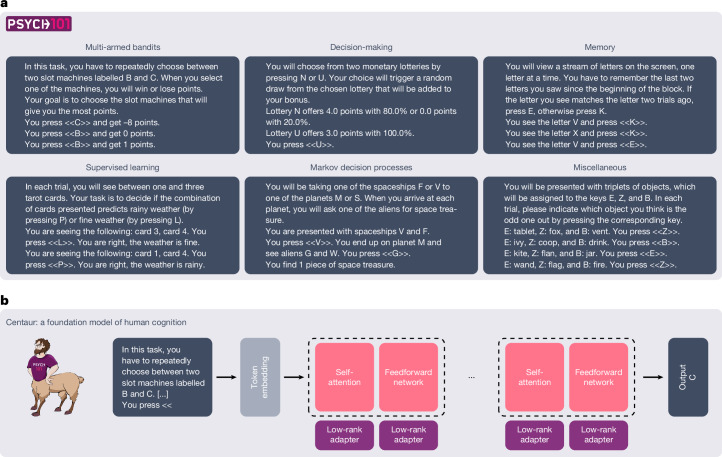
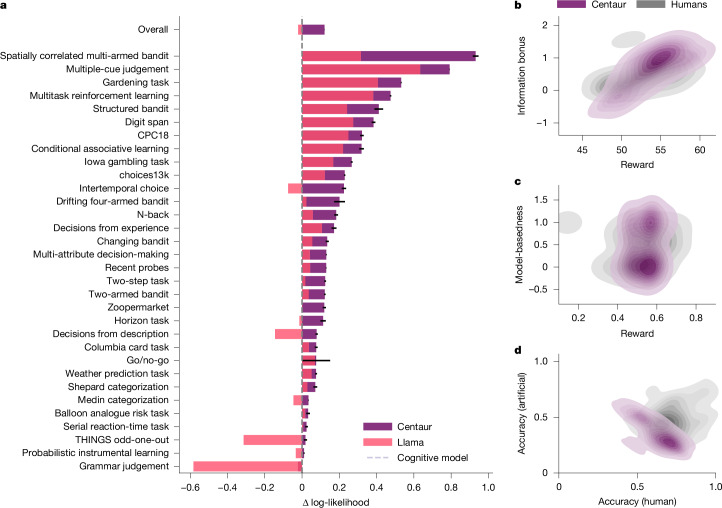
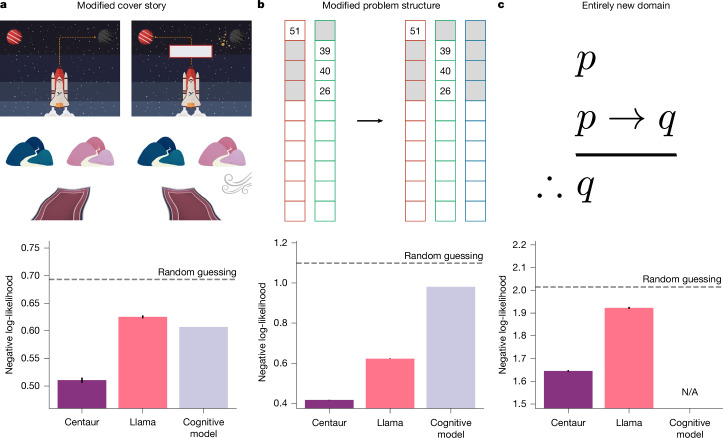
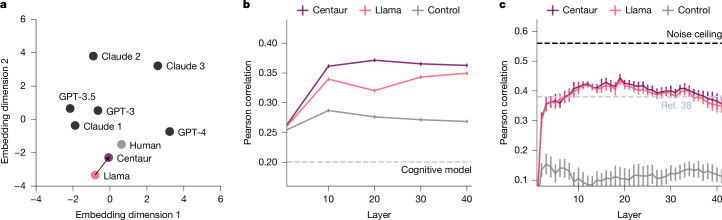
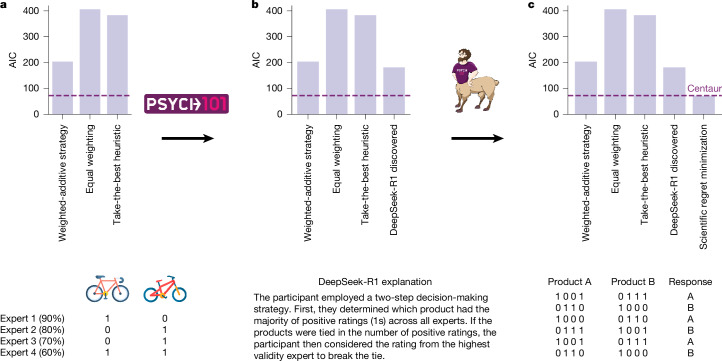
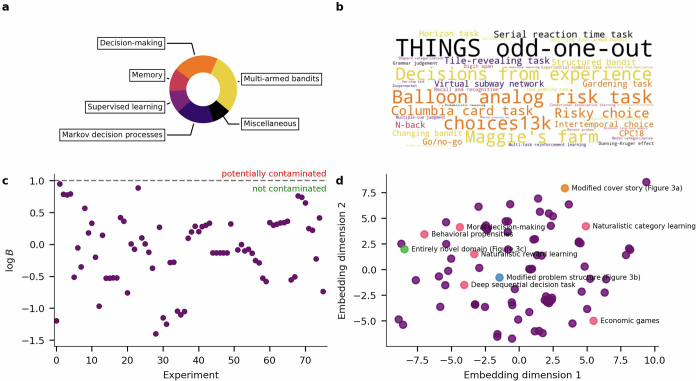
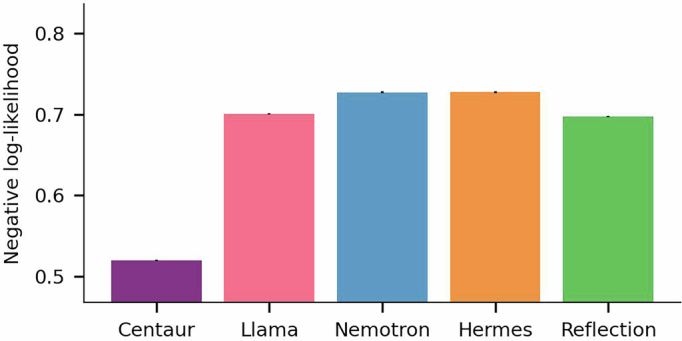
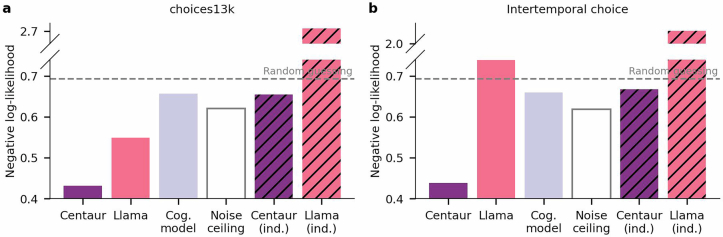
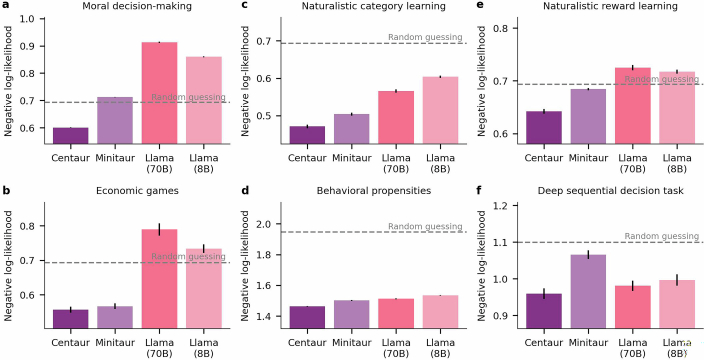
Establishing a unified theory of cognition has been an important goal in psychology 1,2 . A first step towards such a theory is to create a computational model that can predict human behaviour in a wide range of settings. Here we introduce Centaur, a computational model that can predict and simulate human behaviour in any experiment expressible in natural language. We derived Centaur by fine-tuning a state-of-the-art language model on a large-scale dataset called Psych-101. Psych-101 has an unprecedented scale, covering trial-by-trial data from more than 60,000 participants performing in excess of 10,000,000 choices in 160 experiments. Centaur not only captures the behaviour of held-out participants better than existing cognitive models, but it also generalizes to previously unseen cover stories, structural task modifications and entirely new domains. Furthermore, the model’s internal representations become more aligned with human neural activity after fine-tuning. Taken together, our results demonstrate that it is possible to discover computational models that capture human behaviour across a wide range of domains. We believe that such models provide tremendous potential for guiding the development of cognitive theories, and we present a case study to demonstrate this.
Overview
The claims and statistics of this paper haven’t been checked yet.
Free: it reads the open-access text and checks the first 5 claims that cite a source we can check. Create a free account to check every claim.
Integrity signals
Registry
Cites
Statistics
Figures
Verification
Claims the paper makes
The claims and statistics of this paper haven’t been checked yet.
Free: it reads the open-access text and checks the first 5 claims that cite a source we can check. Create a free account to check every claim.
Claims other papers make about this one
Each is checked against this paper’s own text: does it say what the citing paper says it does?
In the citing paper
“LLMs can produce outputs similar to those of humans in structured tasks (8), but the similarity concerns results, not the process.”
From The simulation of judgment in LLMs (2025) · cites this paper as [8]
Self-check
Percentages, sums and reported differences re-computed from the paper’s own numbers.
The self-check needs the paper’s full text.
Citations
Cites
Vaswani, A., Shazeer, N., Parmar, N., Uszkoreit, J., Jones, L., Gomez, A. N., Kaiser, L., & Polosukhin, I. (2017) · arXiv · doi:10.48550/arxiv.1706.03762 · Cited by 120,404
DeepSeek-R1: Incentivizing Reasoning Capability in LLMs via Reinforcement Learning
DeepSeek-AI, Guo, D., Yang, D., Zhang, H., Song, J., Wang, P., Zhu, Q., Xu, R., Zhang, R., Ma, S., et al. (2025) · arXiv · doi:10.48550/arxiv.2501.12948 · Cited by 18,918
Self-citationMastering the game of Go without human knowledge
Silver, D., Schrittwieser, J., Simonyan, K., Antonoglou, I., Huang, A., Guez, A., Hubert, T., Baker, L., Lai, M., Bolton, A., et al. (2017) · Nature · doi:10.1038/nature24270 · Cited by 9,084
The combination of estimates from different experiments
Cochran, W. G. (1954) · Biometrics · doi:10.2307/3001666 · Cited by 5,380 · cited 1×
“We performed an inverse-weighted meta-analysis 39 on the difference in correlations between Centaur and Llama, and this indicated that there was a significant benefit of fine-tuning when pooling across layers ( β = 0.007, 95% confidence interval [0.0002, 0.013], P = 0.045).”
InfluentialfMRIPrep: A robust preprocessing pipeline for functional MRI
Esteban, O., Markiewicz, C. J., Blair, R. W., Moodie, C. A., Isik, A. I., Erramuzpe, A., Kent, J. D., Goncalves, M., DuPre, E., Snyder, M., et al. (2019) · Nature Methods · doi:10.1038/s41592-018-0235-4 · Cited by 3,905 · cited 1×
“63).”
Local-global parcellation of the human cerebral cortex from intrinsic functional connectivity MRI
Schaefer, A., Kong, R., Gordon, E. M., Laumann, T. O., Zuo, X.-N., Holmes, A. J., Eickhoff, S. B., & Yeo, B. T. T. (2018) · Cerebral Cortex · doi:10.1093/cercor/bhx179 · Cited by 3,657 · cited 4×
“Reported Pearson correlation coefficients correspond to the average across all ROIs.”
InfluentialHenrich, J., Heine, S. J., & Norenzayan, A. (2010) · Nature · doi:10.1038/466029a · Cited by 3,441 · cited 1×
“Finally, although we have already included some cross-cultural and meta-studies 52–55 , the current iteration still has a strong bias towards a Western, educated, industrialized, rich and democratic (WEIRD) population 56 .”
Prospect Theory: An Analysis of Decision Under Risk
Kahneman, D., & Tversky, A. (2013) · World Scientific Handbook in Financial Economics Series · doi:10.1142/9789814417358_0006 · Cited by 3,091
Human-level concept learning through probabilistic program induction
Lake, B. M., Salakhutdinov, R., & Tenenbaum, J. B. (2015) · Science · doi:10.1126/science.aab3050 · Cited by 2,817
On the Opportunities and Risks of Foundation Models
Bommasani, R., Hudson, D. A., Adeli, E., Altman, R., Arora, S., von Arx, S., Bernstein, M. S., Bohg, J., Bosselut, A., Brunskill, E., et al. (2021) · arXiv · doi:10.48550/arxiv.2108.07258 · Cited by 2,676
Building machines that learn and think like people
Lake, B. M., Ullman, T. D., Tenenbaum, J. B., & Gershman, S. J. (2017) · Behavioral and Brain Sciences · doi:10.1017/s0140525x16001837 · Cited by 2,550
Building Machines That Learn and Think Like People
Lake, B. M., Ullman, T. D., Tenenbaum, J. B., & Gershman, S. J. (2016) · arXiv · doi:10.48550/arxiv.1604.00289 · Cited by 2,550
On the Rate of Gain of Information
Hick, W. E. (1952) · Quarterly Journal of Experimental Psychology · doi:10.1080/17470215208416600 · Cited by 2,279
Unbiased nonlinear average age-appropriate brain templates from birth to adulthood
Fonov, V., Evans, A., McKinstry, R., Almli, C., & Collins, D. (2009) · NeuroImage · doi:10.1016/s1053-8119(09)70884-5 · Cited by 2,102
Performance-optimized hierarchical models predict neural responses in higher visual cortex
Yamins, D. L. K., Hong, H., Cadieu, C. F., Solomon, E. A., Seibert, D., & DiCarlo, J. J. (2014) · Proceedings of the National Academy of Sciences · doi:10.1073/pnas.1403112111 · Cited by 1,924 · cited 1×
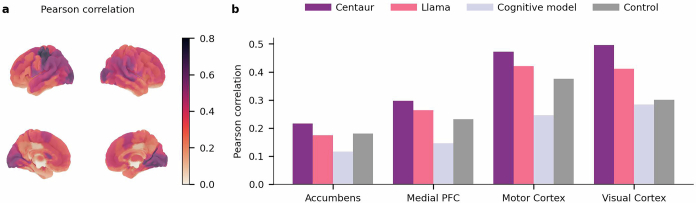
“To check whether this is the case, we conducted two analyses in which we predicted human neural activity using the model’s internal representations 35,36 .”
Awad, E., Dsouza, S., Kim, R., Schulz, J., Henrich, J., Shariff, A., Bonnefon, J.-F., & Rahwan, I. (2018) · Nature · doi:10.1038/s41586-018-0637-6 · Cited by 1,859
Model-based influences on humans’ choices and striatal prediction errors
Daw, N. D., Gershman, S. J., Seymour, B., Dayan, P., & Dolan, R. J. (2011) · Neuron · doi:10.1016/j.neuron.2011.02.027 · Cited by 1,779
Self-citationWarner, B., Chaffin, A., Clavié, B., Weller, O., Hallström, O., Taghadouini, S., Gallagher, A., Biswas, R., Ladhak, F., Aarsen, T., et al. (2024) · arXiv.org · doi:10.48550/arxiv.2412.13663 · Cited by 1,052
TruthfulQA: Measuring How Models Mimic Human Falsehoods
Lin, S., Hilton, J., & Evans, O. (2022) · Proceedings of the 60th Annual Meeting of the Association for Computational Linguistics (Volume 1: Long Papers) · doi:10.18653/v1/2022.acl-long.229 · Cited by 904
Transformer Interpretability Beyond Attention Visualization
Chefer, H., Gur, S., & Wolf, L. (2021) · 2021 IEEE/CVF Conference on Computer Vision and Pattern Recognition (CVPR) · doi:10.1109/cvpr46437.2021.00084 · Cited by 903
TruthfulQA: Measuring How Models Mimic Human Falsehoods
Lin, S., Hilton, J., & Evans, O. (2021) · arXiv · doi:10.48550/arxiv.2109.07958 · Cited by 899
Bayesian model selection for group studies — Revisited
Rigoux, L., Stephan, K. E., Friston, K. J., & Daunizeau, J. (2014) · NeuroImage · doi:10.1016/j.neuroimage.2013.08.065 · Cited by 666
Humans use directed and random exploration to solve the explore–exploit dilemma.
Wilson, R. C., Geana, A., White, J. M., Ludvig, E. A., & Cohen, J. D. (2014) · Journal of Experimental Psychology: General · doi:10.1037/a0038199 · Cited by 580 · cited 2×
“These models include, among others, the generalized context model 17 , a prospect theory model 18 and various reinforcement learning models 19,20 (Methods, ‘Domain-specific cognitive models’).”
Self-citationUsing cognitive psychology to understand GPT-3
Binz, M., & Schulz, E. (2023) · Proceedings of the National Academy of Sciences · doi:10.1073/pnas.2218523120 · Cited by 559 · cited 2×
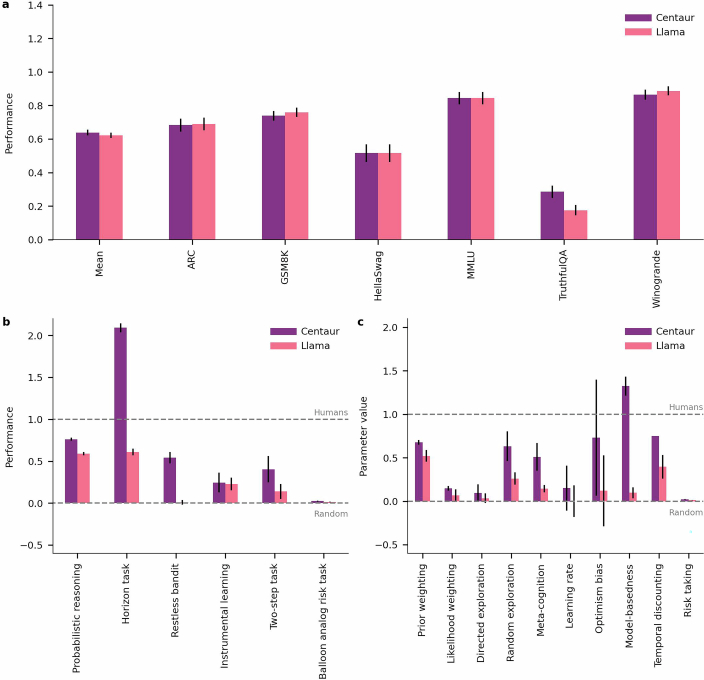
“2b), a pattern that is notably absent in many contemporary language models 12 .”
Self-citationRisk preference shares the psychometric structure of major psychological traits
Frey, R., Pedroni, A., Mata, R., Rieskamp, J., & Hertwig, R. (2017) · Science Advances · doi:10.1126/sciadv.1701381 · Cited by 526
The neural architecture of language: Integrative modeling converges on predictive processing
Schrimpf, M., Blank, I. A., Tuckute, G., Kauf, C., Hosseini, E. A., Kanwisher, N., Tenenbaum, J. B., & Fedorenko, E. (2021) · Proceedings of the National Academy of Sciences · doi:10.1073/pnas.2105646118 · Cited by 517
Grattafiori, A., Dubey, A., Jauhri, A., Pandey, A., Kadian, A., Al-Dahle, A., Letman, A., Mathur, A., Schelten, A., Vaughan, A., et al. (2024) · arXiv · doi:10.48550/arxiv.2407.21783 · Cited by 505
Large-scale analysis of test–retest reliabilities of self-regulation measures
Enkavi, A. Z., Eisenberg, I. W., Bissett, P. G., Mazza, G. L., MacKinnon, D. P., Marsch, L. A., & Poldrack, R. A. (2019) · Proceedings of the National Academy of Sciences · doi:10.1073/pnas.1818430116 · Cited by 489
The Importance of Falsification in Computational Cognitive Modeling
Palminteri, S., Wyart, V., & Koechlin, E. (2017) · Trends in Cognitive Sciences · doi:10.1016/j.tics.2017.03.011 · Cited by 448
Can AI language models replace human participants?
Dillion, D., Tandon, N., Gu, Y., & Gray, K. (2023) · Trends in Cognitive Sciences · doi:10.1016/j.tics.2023.04.008 · Cited by 405 · cited 1×
“It may, for instance, be used for in silico prototyping of experimental studies 47 .”
Local-Global Parcellation of the Human Cerebral Cortex From Intrinsic Functional Connectivity MRIPreprint
Schaefer, A., Kong, R., Gordon, E. M., et al. (2017) · bioRxiv (Cold Spring Harbor Laboratory) · doi:10.1101/135632 · Cited by 379
Integrating explanation and prediction in computational social science
Hofman, J. M., Watts, D. J., Athey, S., Garip, F., Griffiths, T. L., Kleinberg, J., Margetts, H., Mullainathan, S., Salganik, M. J., Vazire, S., et al. (2021) · Nature · doi:10.1038/s41586-021-03659-0 · Cited by 371 · cited 1×
“We think that such a predictive model offers many direct opportunities to obtain a better understanding of the human mind 14,15 and we present a case study that demonstrates this potential.”
Self-citationCatalyzing next-generation Artificial Intelligence through NeuroAI
Zador, A., Escola, S., Richards, B., Ölveczky, B., Bengio, Y., Boahen, K., Botvinick, M., Chklovskii, D., Churchland, A., Clopath, C., et al. (2023) · Nature Communications · doi:10.1038/s41467-023-37180-x · Cited by 300
A meta-analytic review of two modes of learning and the description-experience gap.
Wulff, D. U., Mergenthaler-Canseco, M., & Hertwig, R. (2018) · Psychological Bulletin · doi:10.1037/bul0000115 · Cited by 271
Self-citationUsing large-scale experiments and machine learning to discover theories of human decision-making
Peterson, J. C., Bourgin, D. D., Agrawal, M., Reichman, D., & Griffiths, T. L. (2021) · Science · doi:10.1126/science.abe2629 · Cited by 248
Self-citationIntegrative benchmarking to advance neurally mechanistic models of human intelligence
Schrimpf, M., Kubilius, J., Lee, M. J., Ratan Murty, N. A., Ajemian, R., & DiCarlo, J. J. (2020) · Neuron · doi:10.1016/j.neuron.2020.07.040 · Cited by 233
When Does Model-Based Control Pay Off?
Kool, W., Cushman, F. A., & Gershman, S. J. (2016) · PLOS Computational Biology · doi:10.1371/journal.pcbi.1005090 · Cited by 211 · cited 1×
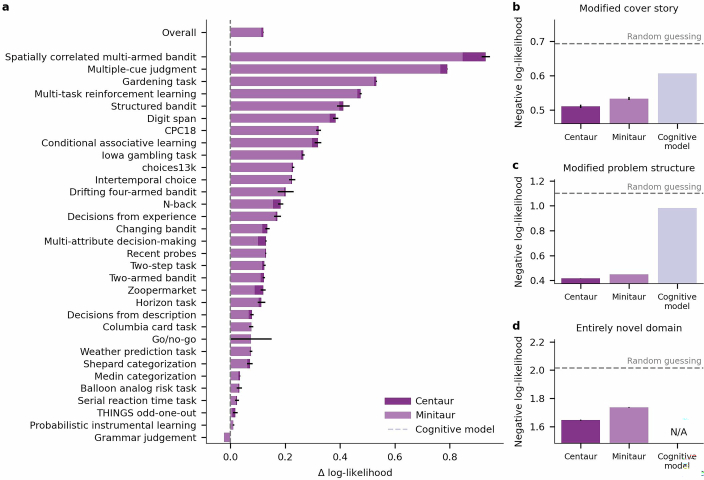
“Importantly, Psych-101 includes experiments using the canonical spaceship cover story 24 but no experiments with the magic-carpet cover story.”
The generalized context model: an exemplar model of classification
Nosofsky, R. M. (2011) · Formal Approaches in Categorization · doi:10.1017/cbo9780511921322.002 · Cited by 171
HelpSteer2-Preference: Complementing Ratings with Preferences
Wang, Z., Bukharin, A., Delalleau, O., Egert, D., Shen, G., Zeng, J., Kuchaiev, O., & Dong, Y. (2024) · International Conference on Learning Representations · doi:10.48550/arxiv.2410.01257 · Cited by 158
Humans primarily use model-based inference in the two-stage task
Feher da Silva, C., & Hare, T. A. (2020) · Nature Human Behaviour · doi:10.1038/s41562-020-0905-y · Cited by 153 · cited 1×
“23, which used the aforementioned two-step task.”
The development of human causal learning and reasoning
Goddu, M. K., & Gopnik, A. (2024) · Nature Reviews Psychology · doi:10.1038/s44159-024-00300-5 · Cited by 143
The neural architecture of language: Integrative modeling converges on predictive processing
(2020) · doi:10.1101/2020.06.26.174482 · Cited by 129
Automating the practice of science: Opportunities, challenges, and implications
Musslick, S., Bartlett, L., Chandramouli, S., Dubova, M., Gobet, F. R., Griffiths, T. L., Hullman, J. R., King, R. D., Kutz, J. N., Lucas, C. G., et al. (2025) · Proceedings of the National Academy of Sciences · doi:10.1073/pnas.2401238121 · Cited by 103
Self-citationA rational model of the Dunning–Kruger effect supports insensitivity to evidence in low performers
Jansen, R. A., Rafferty, A. N., & Griffiths, T. L. (2021) · Nature Human Behaviour · doi:10.1038/s41562-021-01057-0 · Cited by 100
Self-citationPlaying repeated games with Large Language Models
Akata, E., Schulz, L., Coda-Forno, J., Oh, S. J., Bethge, M., & Schulz, E. (2023) · arXiv · doi:10.48550/arxiv.2305.16867 · Cited by 99
Self-citationThe globalizability of temporal discounting
Ruggeri, K., Panin, A., Vdovic, M., Većkalov, B., Abdul-Salaam, N., Achterberg, J., Akil, C., Amatya, J., Amatya, K., Andersen, T. L., et al. (2022) · Nature Human Behaviour · doi:10.1038/s41562-022-01392-w · Cited by 94
Play, Curiosity, and Cognition
Chu, J., & Schulz, L. E. (2020) · Annual Review of Developmental Psychology · doi:10.1146/annurev-devpsych-070120-014806 · Cited by 93
Playing repeated games with large language models
Akata, E., Schulz, L., Coda-Forno, J., Oh, S. J., Bethge, M., & Schulz, E. (2025) · Nature Human Behaviour · doi:10.1038/s41562-025-02172-y · Cited by 91
Self-citationThe past, present, and future of the brain imaging data structure (BIDS)
Poldrack, R. A., Markiewicz, C. J., Appelhoff, S., Ashar, Y. K., Auer, T., Baillet, S., Bansal, S., Beltrachini, L., Bénar, C., Bertazzoli, G., et al. (2024) · Imaging Neuroscience · doi:10.1162/imag_a_00103 · Cited by 85
Visual cognition in multimodal large language models
Schulze Buschoff, L. M., Akata, E., Bethge, M., & Schulz, E. (2025) · Nature Machine Intelligence · doi:10.1038/s42256-024-00963-y · Cited by 83 · cited 1×
“The long-term objective should therefore be to move towards a multimodal data format 59 .”
Self-citationNatural language instructions induce compositional generalization in networks of neurons
Riveland, R., & Pouget, A. (2024) · Nature Neuroscience · doi:10.1038/s41593-024-01607-5 · Cited by 74
Hilbig, B. E., & Moshagen, M. (2014) · Psychonomic Bulletin & Review · doi:10.3758/s13423-014-0643-0 · Cited by 69
Driving and suppressing the human language network using large language models
Tuckute, G., Sathe, A., Srikant, S., Taliaferro, M., Wang, M., Schrimpf, M., Kay, K., & Fedorenko, E. (2024) · Nature Human Behaviour · doi:10.1038/s41562-023-01783-7 · Cited by 69
Value-free random exploration is linked to impulsivity
Dubois, M., & Hauser, T. U. (2022) · Nature Communications · doi:10.1038/s41467-022-31918-9 · Cited by 68
Putting Psychology to the Test: Rethinking Model Evaluation Through Benchmarking and Prediction
Rocca, R., & Yarkoni, T. (2021) · Advances in Methods and Practices in Psychological Science · doi:10.1177/25152459211026864 · Cited by 63
Rethinking model-based and model-free influences on mental effort and striatal prediction errors
da Silva, C. F., Lombardi, G., Edelson, M. G., & Hare, T. A. (2023) · Nature Human Behaviour · doi:10.1038/s41562-023-01573-1 · Cited by 63
Novelty is not surprise: Human exploratory and adaptive behavior in sequential decision-making
He, X., Modirshanechi, A., Lehmann, M. P., Gerstner, W., & Herzog, M. H. (2021) · PLoS Computational Biology · doi:10.1371/journal.pcbi.1009070 · Cited by 62
Self-citationScaling up psychology via Scientific Regret Minimization
Agrawal, M., Peterson, J. C., & Griffiths, T. L. (2020) · Proceedings of the National Academy of Sciences · doi:10.1073/pnas.1915841117 · Cited by 60
Self-citationHermes 3 Technical ReportPreprint
Teknium, R., Quesnelle, J., & Guang, C. (2024) · arXiv.org · doi:10.48550/arxiv.2408.11857 · Cited by 44
Latent motives guide structure learning during adaptive social choice
van Baar, J. M., Nassar, M. R., Deng, W., & FeldmanHall, O. (2021) · Nature Human Behaviour · doi:10.1038/s41562-021-01207-4 · Cited by 31
Heuristics from bounded meta-learned inference.
Binz, M., Gershman, S. J., Schulz, E., & Endres, D. (2022) · Psychological Review · doi:10.1037/rev0000330 · Cited by 31
Self-citationGenerating Computational Cognitive Models using Large Language ModelsPreprint
Rmus, M., Jagadish, A. K., Mathony, M., Ludwig, T., & Schulz, E. (2025) · arXiv (Cornell University) · doi:10.48550/arxiv.2502.00879 · Cited by 21
Self-citationDriving and suppressing the human language network using large language modelsPreprint
Tuckute, G., Sathe, A., Srikant, S., Taliaferro, M., Wang, M., Schrimpf, M., Kay, K., & Fedorenko, E. G. (2023) · bioRxiv (Cold Spring Harbor Laboratory) · doi:10.1101/2023.04.16.537080 · Cited by 20
Vere, S. A. (1992) · Behavioral and Brain Sciences · doi:10.1017/s0140525x00069703 · Cited by 17
CogBench: a large language model walks into a psychology lab
Coda-Forno, J., Binz, M., Wang, J. X., & Schulz, E. (2024) · arXiv · doi:10.48550/arxiv.2402.18225 · Cited by 15
Self-citationRepresenting and Predicting Everyday Behavior
Singh, M., Richie, R., & Bhatia, S. (2022) · Computational Brain & Behavior · doi:10.1007/s42113-021-00121-2 · Cited by 7
LogProber: Disentangling confidence from contamination in LLM responsesPreprint
Yax, N., Oudeyer, P., & Palminteri, S. (2024) · arXiv (Cornell University) · doi:10.48550/arxiv.2408.14352 · Cited by 6
Automating the Practice of Science -- Opportunities, Challenges, and Implications
Musslick, S., Bartlett, L., Chandramouli, S., et al. (2024) · London School of Economics and Political Science Research Online (London School of Economics and Political Science) · doi:10.48550/arxiv.2409.05890 · Cited by 3
Research works printed but not linked: 9
- 1. Anderson, J. The Architecture of Cognition (Harvard Univ. Press, 1983).
- 2. Newell, A. Unified Theories of Cognition (Harvard Univ. Press, 1990).
- 13. Binz, M. & Schulz, E. Turning large language models into cognitive models. In Proc. 12th International Conference on Learning Representations (ICLR, 2024).
- 16. Dettmers, T., Pagnoni, A., Holtzman, A. & Zettlemoyer, L. QLORA: efficient finetuning of quantized LLMs. In Proc. Advances in Neural Information Processing Systems 36 (eds Oh, A. et al.) (NeurIPS, 2023).
- 29. Demircan, C. et al. Evaluating alignment between humans and neural network representations in image-based learning tasks. In Proc. Advances in Neural Information Processing Systems 37 (eds Globerson, A. et al.) (NeurIPS, 2024).
- 34. Kipnis, A., Voudouris, K., Schulze Buschoff, L. M. & Schulz, E. metabench -a sparse benchmark of reasoning and knowledge in large language models. In Proc. 13th International Conference on Learning Representations (ICLR, 2025).
- 48. Huben, R., Cunningham, H., Smith, L. R., Ewart, A. & Sharkey, L. Sparse autoencoders find highly interpretable features in language models. In Proc. 12th International Conference on Learning Representations (ICLR, 2024).
- 61. Loshchilov, I. & Hutter, F. Decoupled weight decay regularization. In Proc. 7th International Conference on Learning Representations (ICLR, 2019).
- 65. Friston, K. J., Ashburner, J. T., Kiebel, S. J., Nichols, T. E. & Penny, W. D. (eds) Statistical Parametric Mapping: The Analysis of Functional Brain Images (Elsevier, 2011).
Cited by
The Challenge of Using LLMs to Simulate Human Behavior: A Causal Inference Perspective
Gui, G., & Toubia, O. (2023) · SSRN Electronic Journal · doi:10.2139/ssrn.4650172 · Cited by 46
A cognitive approach to human–AI complementarity in dynamic decision-making
Gonzalez, C., & Heidari, H. (2025) · Nature Reviews Psychology · doi:10.1038/s44159-025-00499-x · Cited by 57
Large language models can predict the results of social science experiments
Ashokkumar, A., Hewitt, L., Ghezae, I., & Willer, R. (2026) · Nature · doi:10.1038/s41586-026-10742-x · Cited by 95
Scientific production in the era of large language models
Kusumegi, K., Yang, X., Ginsparg, P., de Vaan, M., Stuart, T., & Yin, Y. (2025) · Science · doi:10.1126/science.adw3000 · Cited by 83
Hagendorff, T., Dasgupta, I., Binz, M., Chan, S. C. Y., Lampinen, A., Wang, J. X., Akata, Z., & Schulz, E. (2023) · arXiv · doi:10.48550/arxiv.2303.13988 · Cited by 68
Self-citation
Metadata
- Authors
- Binz, M., Akata, E., Bethge, M., Brändle, F., Callaway, F., Coda-Forno, J., Dayan, P., Demircan, C., Eckstein, M. K., Éltető, N., Griffiths, T. L., Haridi, S., Jagadish, A. K., Ji-An, L., Kipnis, A., Kumar, S., Ludwig, T., Mathony, M., Mattar, M., Modirshanechi, A., Nath, S. S., Peterson, J. C., Rmus, M., Russek, E. M., Saanum, T., Schubert, J. A., Schulze Buschoff, L. M., Singhi, N., Sui, X., Thalmann, M., Theis, F. J., Truong, V., Udandarao, V., Voudouris, K., Wilson, R., Witte, K., Wu, S., Wulff, D. U., Xiong, H., & Schulz, E.
- Affiliations
- Helmholtz Munich (DE)
- University of Tübingen (DE)
- University of Oxford (GB)
- New York University (US)
- Max Planck Institute for Biological Cybernetics (DE)
- Google DeepMind (United Kingdom) (GB)
- Princeton University (US)
- University of California San Diego (US)
- Boston University (US)
- Technische Universität Darmstadt (DE)
- University of Cambridge (GB)
- Georgia Institute of Technology (US)
- University of Basel (CH)
- Corresponding author
- Binz, Marcel
- ORCID
- Binz, Marcel
- Akata, Elif
- Bethge, Matthias
- Brändle, Franziska
- Dayan, Peter
- Eckstein, Maria K.
- Éltető, Noémi
- Griffiths, Thomas L.
- Haridi, Susanne
- Jagadish, Akshay K.
- Kumar, Sreejan
- Ludwig, Tobias
- Mathony, Marvin
- Mattar, Marcelo
- Modirshanechi, Alireza
- Nath, Surabhi S.
- Peterson, Joshua C.
- Rmus, Milena
- Russek, Evan M.
- Sui, Xin
- Thalmann, Mirko
- Theis, Fabian J.
- Truong, Vuong
- Voudouris, Konstantinos
- Witte, Kristin
- Wu, Shuchen
- Wulff, Dirk U.
- Schulz, Eric
- Venue
- Nature
- Published
- 2025-07-02
- Volume
- 644
- Issue
- 8078
- Pages
- 1002-1009
- ISSN
- 0028-0836 (ISSN-L)
- 1476-4687
- PMC
- PMC12390832
- OpenAlex
- W4411932262
- Cited by
- 119
- References
- 57
- Citations by year
- 2026: 84 · 2025: 34
- FWCI
- 66.94
- Type
- journal article
- Language
- en
- Open access
- hybrid
- doi.org
- Licence
- cc-by
- creativecommons.org/licenses/by/4.0 (tdm)
- creativecommons.org/licenses/by/4.0 (vor)
- Locations
- Nature (publishedVersion, cc-by)
- PubMed Central (publishedVersion, cc-by)
- PubMed (publishedVersion)
- MPG.PuRe (Max Planck Society) (submittedVersion, cc-by-nd)
- Apollo (University of Cambridge) (submittedVersion, cc-by)
- MPG.PuRe (Max Planck Society) (submittedVersion)
- Funders
- DeepMind
- Volkswagen Foundation
- Max-Planck-Gesellschaft
- NOMIS Stiftung
- Helmholtz Zentrum München
- Topics
- Life Sciences › Neuroscience › Cognitive Neuroscience › Cognitive Science and Education Research
- Social Sciences › Decision Sciences › General Decision Sciences › Decision-Making and Behavioral Economics
- Physical Sciences › Computer Science › Artificial Intelligence › Psychiatry, Mental Health, Neuroscience
- Keywords
- centaurs, computational cognitive model, human behavior prediction, language model fine-tuning, generalization to unseen tasks
- MeSH terms
- Choice Behavior, Cognition, Computer Simulation, Humans, Language, Male, Models, Psychological
About these checks
Registry, retraction, Cites and statistics results are computed, not judged, with one exception: a printed reference that no index lists is read once by a model before it counts as a citation error. Claims are extracted by a model and kept only when their quote appears verbatim in the text; each cited source is then checked, with a model’s help, for whether it says what the claim relies on. Those verdicts can be wrong — read the claim’s quote and the cited source before relying on one.
Statistics and arithmetic are recomputed, not judged.
Confidence bands are shown only for fields calibrated on our annotated test set. None is calibrated yet, so no band is shown.
What counts as a claim ›How we measure confidence ›How we check this ›
Are you an author, or do you see a problem with this page? Request a review
Data sources
Bibliographic data: Semantic Scholar, OpenAlex, Crossref.
Contains information from the Semantic Scholar Academic Graph Datasets, made available under the ODC Attribution License (ODC-BY 1.0).
Semantic Scholar’s data is described in: Kinney, R., et al. (2023). The Semantic Scholar Open Data Platform. arXiv:2301.10140.
