

A foundation model to predict and capture human cognition
Open accessThe DOI matches its Crossref record; 67 of the 68 references it cites were found in a registry or an index.
Abstract
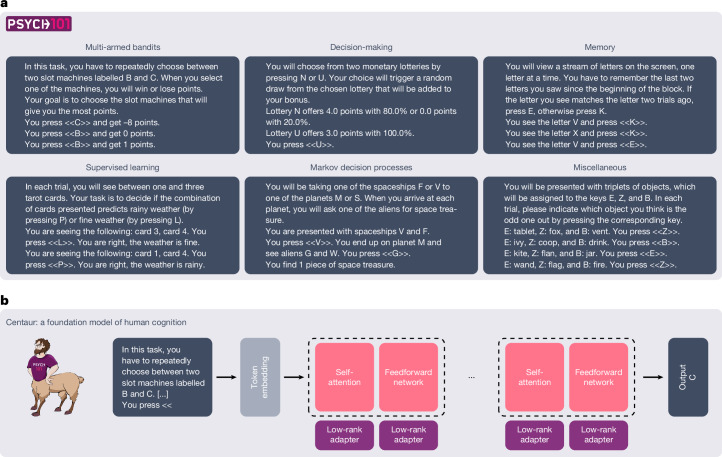
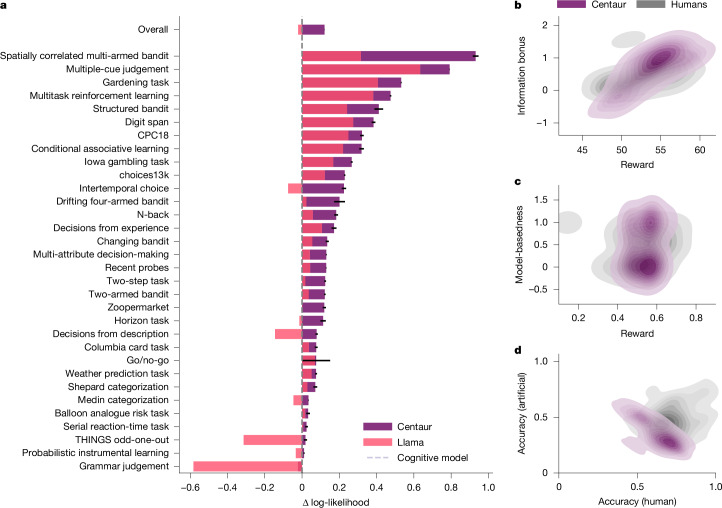
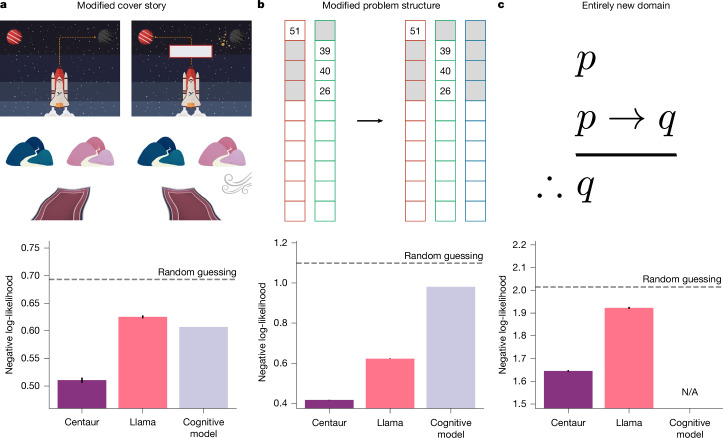
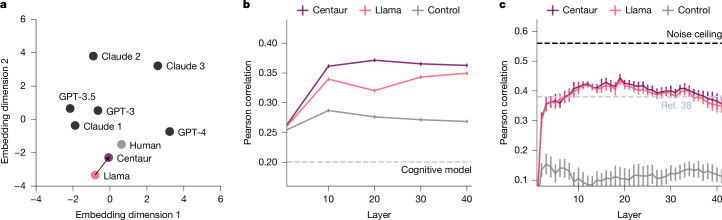
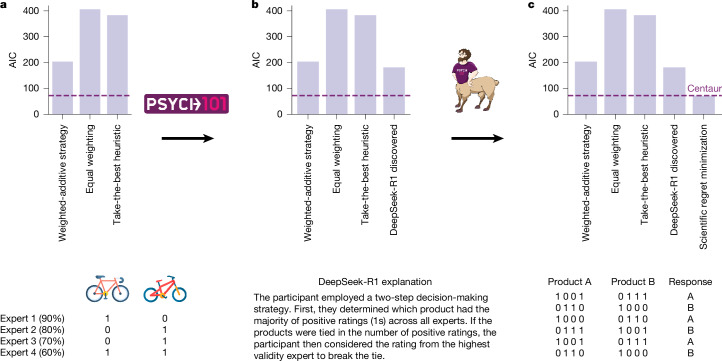
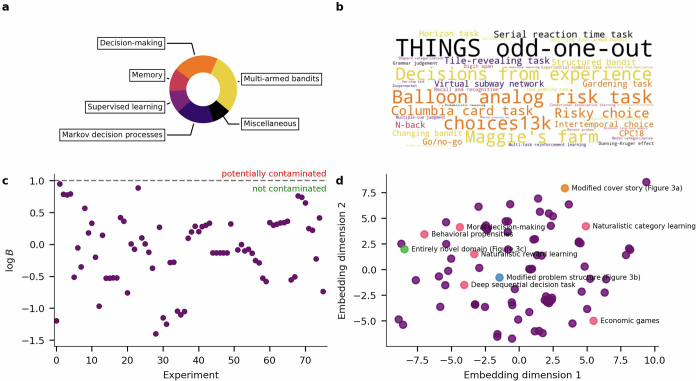
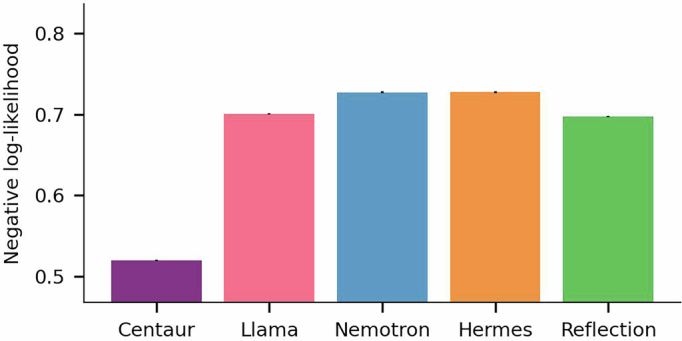
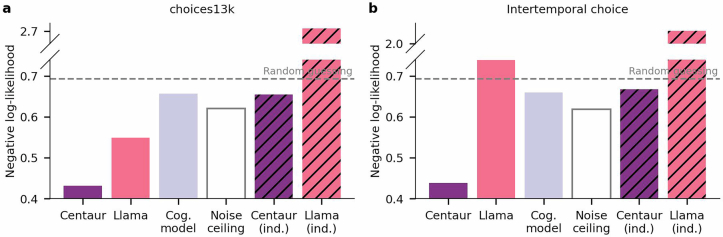
Establishing a unified theory of cognition has been an important goal in psychology 1,2 . A first step towards such a theory is to create a computational model that can predict human behaviour in a wide range of settings. Here we introduce Centaur, a computational model that can predict and simulate human behaviour in any experiment expressible in natural language. We derived Centaur by fine-tuning a state-of-the-art language model on a large-scale dataset called Psych-101. Psych-101 has an unprecedented scale, covering trial-by-trial data from more than 60,000 participants performing in excess of 10,000,000 choices in 160 experiments. Centaur not only captures the behaviour of held-out participants better than existing cognitive models, but it also generalizes to previously unseen cover stories, structural task modifications and entirely new domains. Furthermore, the model’s internal representations become more aligned with human neural activity after fine-tuning. Taken together, our results demonstrate that it is possible to discover computational models that capture human behaviour across a wide range of domains. We believe that such models provide tremendous potential for guiding the development of cognitive theories, and we present a case study to demonstrate this.
Overview
The claims and statistics of this paper haven’t been checked yet.
Free: it reads the open-access text and checks the first 5 claims that cite a source we can check. Create a free account to check every claim.
Integrity signals
Registry
Cites
Statistics
Figures
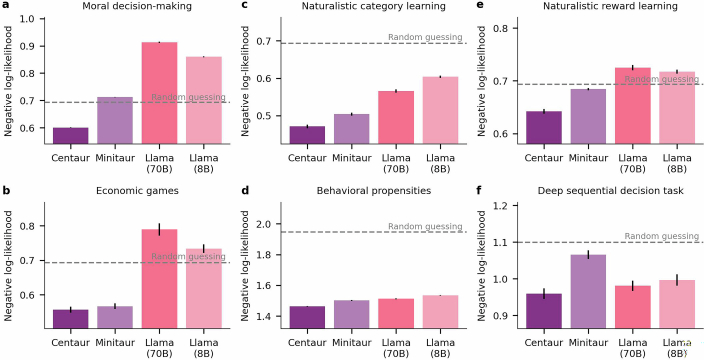
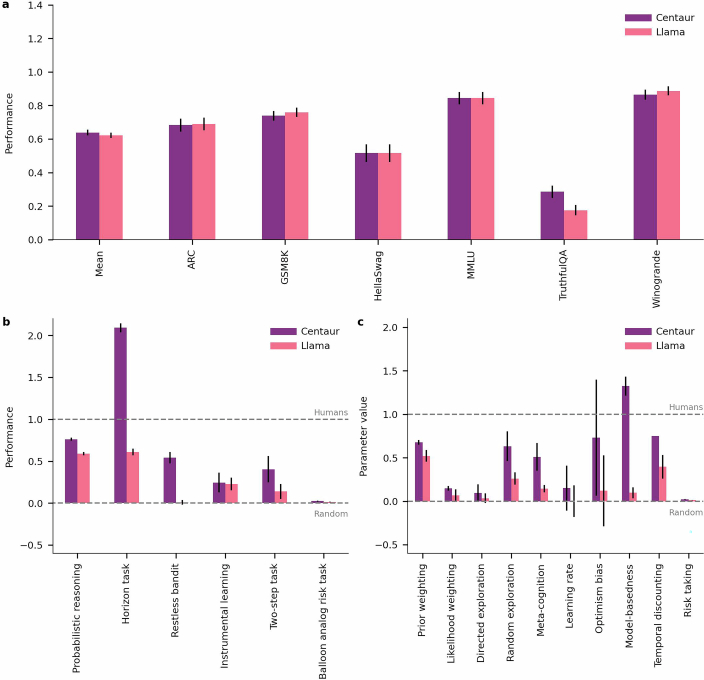
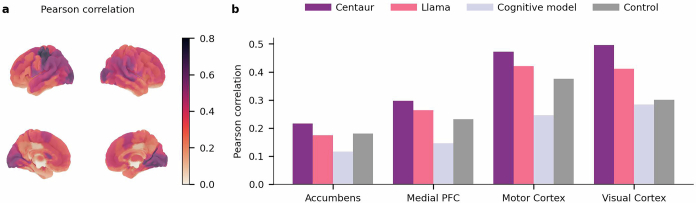
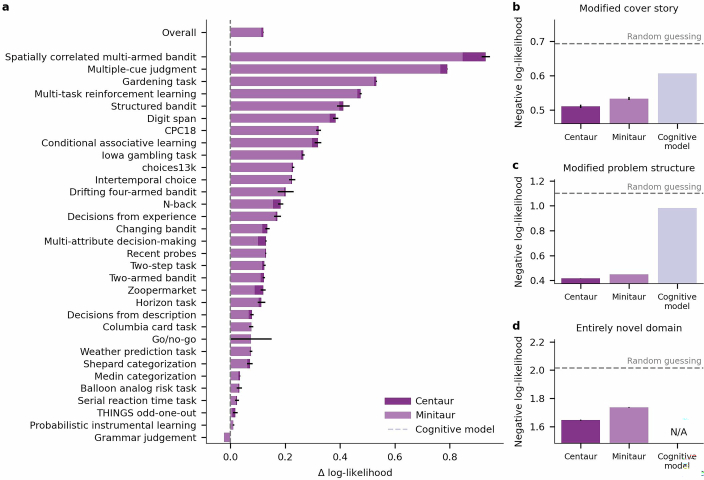
Verification
Claims the paper makes
The claims and statistics of this paper haven’t been checked yet.
Free: it reads the open-access text and checks the first 5 claims that cite a source we can check. Create a free account to check every claim.
Claims other papers make about this one
Each is checked against this paper’s own text: does it say what the citing paper says it does?
In the citing paper
“LLMs can produce outputs similar to those of humans in structured tasks (8), but the similarity concerns results, not the process.”
From The simulation of judgment in LLMs (2025) · cites this paper as [8]
Self-check
Percentages, sums and reported differences re-computed from the paper’s own numbers.
The self-check needs the paper’s full text.
Citations
Cites
Vaswani, A., Shazeer, N., Parmar, N., Uszkoreit, J., Jones, L., Gomez, A. N., Kaiser, L., & Polosukhin, I. (2017) · arXiv · doi:10.48550/arxiv.1706.03762 · Cited by 120,404
DeepSeek-R1: Incentivizing Reasoning Capability in LLMs via Reinforcement Learning
DeepSeek-AI, Guo, D., Yang, D., Zhang, H., Song, J., Wang, P., Zhu, Q., Xu, R., Zhang, R., Ma, S., et al. (2025) · arXiv · doi:10.48550/arxiv.2501.12948 · Cited by 18,918
Self-citationMastering the game of Go without human knowledge
Silver, D., Schrittwieser, J., Simonyan, K., Antonoglou, I., Huang, A., Guez, A., Hubert, T., Baker, L., Lai, M., Bolton, A., et al. (2017) · Nature · doi:10.1038/nature24270 · Cited by 9,084
The combination of estimates from different experiments
Cochran, W. G. (1954) · Biometrics · doi:10.2307/3001666 · Cited by 5,380 · cited 1×
“We performed an inverse-weighted meta-analysis 39 on the difference in correlations between Centaur and Llama, and this indicated that there was a significant benefit of fine-tuning when pooling across layers ( β = 0.007, 95% confidence interval [0.0002, 0.013], P = 0.045).”
InfluentialfMRIPrep: A robust preprocessing pipeline for functional MRI
Esteban, O., Markiewicz, C. J., Blair, R. W., Moodie, C. A., Isik, A. I., Erramuzpe, A., Kent, J. D., Goncalves, M., DuPre, E., Snyder, M., et al. (2019) · Nature Methods · doi:10.1038/s41592-018-0235-4 · Cited by 3,905 · cited 1×
“63).”
Local-global parcellation of the human cerebral cortex from intrinsic functional connectivity MRI
Schaefer, A., Kong, R., Gordon, E. M., Laumann, T. O., Zuo, X.-N., Holmes, A. J., Eickhoff, S. B., & Yeo, B. T. T. (2018) · Cerebral Cortex · doi:10.1093/cercor/bhx179 · Cited by 3,657 · cited 4×
“Reported Pearson correlation coefficients correspond to the average across all ROIs.”
InfluentialHenrich, J., Heine, S. J., & Norenzayan, A. (2010) · Nature · doi:10.1038/466029a · Cited by 3,441 · cited 1×
“Finally, although we have already included some cross-cultural and meta-studies 52–55 , the current iteration still has a strong bias towards a Western, educated, industrialized, rich and democratic (WEIRD) population 56 .”
Prospect Theory: An Analysis of Decision Under Risk
Kahneman, D., & Tversky, A. (2013) · World Scientific Handbook in Financial Economics Series · doi:10.1142/9789814417358_0006 · Cited by 3,091
Human-level concept learning through probabilistic program induction
Lake, B. M., Salakhutdinov, R., & Tenenbaum, J. B. (2015) · Science · doi:10.1126/science.aab3050 · Cited by 2,817
On the Opportunities and Risks of Foundation Models
Bommasani, R., Hudson, D. A., Adeli, E., Altman, R., Arora, S., von Arx, S., Bernstein, M. S., Bohg, J., Bosselut, A., Brunskill, E., et al. (2021) · arXiv · doi:10.48550/arxiv.2108.07258 · Cited by 2,676
Research works printed but not linked: 9
- 1. Anderson, J. The Architecture of Cognition (Harvard Univ. Press, 1983).
- 2. Newell, A. Unified Theories of Cognition (Harvard Univ. Press, 1990).
- 13. Binz, M. & Schulz, E. Turning large language models into cognitive models. In Proc. 12th International Conference on Learning Representations (ICLR, 2024).
- 16. Dettmers, T., Pagnoni, A., Holtzman, A. & Zettlemoyer, L. QLORA: efficient finetuning of quantized LLMs. In Proc. Advances in Neural Information Processing Systems 36 (eds Oh, A. et al.) (NeurIPS, 2023).
- 29. Demircan, C. et al. Evaluating alignment between humans and neural network representations in image-based learning tasks. In Proc. Advances in Neural Information Processing Systems 37 (eds Globerson, A. et al.) (NeurIPS, 2024).
- 34. Kipnis, A., Voudouris, K., Schulze Buschoff, L. M. & Schulz, E. metabench -a sparse benchmark of reasoning and knowledge in large language models. In Proc. 13th International Conference on Learning Representations (ICLR, 2025).
- 48. Huben, R., Cunningham, H., Smith, L. R., Ewart, A. & Sharkey, L. Sparse autoencoders find highly interpretable features in language models. In Proc. 12th International Conference on Learning Representations (ICLR, 2024).
- 61. Loshchilov, I. & Hutter, F. Decoupled weight decay regularization. In Proc. 7th International Conference on Learning Representations (ICLR, 2019).
- 65. Friston, K. J., Ashburner, J. T., Kiebel, S. J., Nichols, T. E. & Penny, W. D. (eds) Statistical Parametric Mapping: The Analysis of Functional Brain Images (Elsevier, 2011).
Cited by
The Challenge of Using LLMs to Simulate Human Behavior: A Causal Inference Perspective
Gui, G., & Toubia, O. (2023) · SSRN Electronic Journal · doi:10.2139/ssrn.4650172 · Cited by 46
A cognitive approach to human–AI complementarity in dynamic decision-making
Gonzalez, C., & Heidari, H. (2025) · Nature Reviews Psychology · doi:10.1038/s44159-025-00499-x · Cited by 57
Large language models can predict the results of social science experiments
Ashokkumar, A., Hewitt, L., Ghezae, I., & Willer, R. (2026) · Nature · doi:10.1038/s41586-026-10742-x · Cited by 95
Scientific production in the era of large language models
Kusumegi, K., Yang, X., Ginsparg, P., de Vaan, M., Stuart, T., & Yin, Y. (2025) · Science · doi:10.1126/science.adw3000 · Cited by 83
Hagendorff, T., Dasgupta, I., Binz, M., Chan, S. C. Y., Lampinen, A., Wang, J. X., Akata, Z., & Schulz, E. (2023) · arXiv · doi:10.48550/arxiv.2303.13988 · Cited by 68
Self-citationYan, L. (2025) · arXiv (Cornell University) · doi:10.48550/arxiv.2508.14825 · Cited by 64
Jones, C., & Bergen, B. K. (2026) · Artificial Intelligence Review · doi:10.1007/s10462-026-11517-6 · Cited by 63
The simulation of judgment in LLMs
Loru, E., Nudo, J., Di Marco, N., Santirocchi, A., Atzeni, R., Cinelli, M., Cestari, V., Rossi-Arnaud, C., & Quattrociocchi, W. (2025) · Proceedings of the National Academy of Sciences · doi:10.1073/pnas.2518443122 · Cited by 57
“LLMs can produce outputs similar to those of humans in structured tasks [8], but the similarity concerns results, not the process.”
Schröder, S., Morgenroth, T., Kuhl, U., Vaquet, V., & Paaßen, B. (2025) · arXiv (Cornell University) · doi:10.48550/arxiv.2508.06950 · Cited by 58
Cognitive Modeling Using Artificial Intelligence
Frank, M. C., & Goodman, N. D. (2025) · Annual Review of Psychology · doi:10.1146/annurev-psych-030625-040748 · Cited by 55
The Threat of Analytic Flexibility in Using Large Language Models to Simulate Human Data
Cummins, J. D. (2026) · Advances in Methods and Practices in Psychological Science · doi:10.1177/25152459261461505 · Cited by 48
The extended hollowed mind: why foundational knowledge is indispensable in the age of AI
Klein, C. R., & Klein, R. (2025) · Frontiers in Artificial Intelligence · doi:10.3389/frai.2025.1719019 · Cited by 41
Taillandier, P., Zucker, J., Grignard, A., Gaudou, B., Huynh, N. Q., Kong, H., & Drogoul, A. (2026) · Frontiers in Artificial Intelligence · doi:10.48550/arxiv.2507.19364 · Cited by 39
A foundation model of vision, audition, and language for in-silico neurosciencePreprint
d’Ascoli, S., Rapin, J., Benchetrit, Y., Brooks, T. L., Begany, K., Raugel, J., Banville, H. J., & King, J.-R. (2026) · arXiv (Cornell University) · doi:10.48550/arxiv.2605.04326 · Cited by 42
Digital Twins as Funhouse Mirrors: Five Key DistortionsPreprint
Peng, T., Gui, G., Brucks, M. S., Merlau, D. J., Fan, G. J., Sliman, M. B., Johnson, E. J., Althenayyan, A., Bellezza, S., Donati, D., et al. (2025) · arXiv (Cornell University) · doi:10.48550/arxiv.2509.19088 · Cited by 39
AI Surrogates and illusions of generalizability in cognitive science
Crockett, M. J., & Messeri, L. R. (2025) · Trends in Cognitive Sciences · doi:10.1016/j.tics.2025.09.012 · Cited by 36
Grading scale impact on LLM-as-a-judge: human-LLM alignment is highest on 0–5 grading scale
Li, W., Zhao, M., Dong, W., Cai, J., Wei, Y., Pocress, M., Li, Y., Yuan, W., Wang, X., Hou, R., et al. (2026) · npj Artificial Intelligence · doi:10.1038/s44387-026-00153-8 · Cited by 34
RecoWorld: Building Simulated Environments for Agentic Recommender Systems
Liu, F., Lin, X., Yu, H., Wu, M., Wang, J., Zhang, Q., Zhao, Z., Xia, Y., Zhang, Y., Li, W., et al. (2026) · International World Wide Web Conference (WWW) · doi:10.1145/3774905.3794661 · Cited by 35
Designing AI-Agents With Personalities: A Psychometric Approach
Huang, M., Zhang, X., Soto, C. J., & Evans, J. A. (2026) · Personality Science · doi:10.48550/arxiv.2410.19238 · Cited by 39
The cost of thinking is similar between large reasoning models and humans
de Varda, A. G., D’Elia, F. P., Kean, H., Lampinen, A. K., & Fedorenko, E. G. (2025) · Proceedings of the National Academy of Sciences · doi:10.1073/pnas.2520077122 · Cited by 33
Large Language Models as Psychological Simulators: A Methodological Guide
Lin, Z. (2026) · Advances in Methods and Practices in Psychological Science · doi:10.1177/25152459251410153 · Cited by 29
Hybrid neural–cognitive models reveal how memory shapes human reward learning
Eckstein, M. K., Summerfield, C., Daw, N. D., & Miller, K. J. (2026) · Nature Human Behaviour · doi:10.1038/s41562-025-02324-0 · Cited by 29
Self-citationPataranutaporn, P., Powdthavee, N., Archiwaranguprok, C., & Maes, P. (2025) · Proceedings of the National Academy of Sciences · doi:10.1073/pnas.2519394122 · Cited by 27
Wulff, D. U., & Mata, R. (2025) · Current Directions in Psychological Science · doi:10.1177/09637214251382083 · Cited by 26
Self-citationBank Run, Interrupted: Modeling Deposit Withdrawals with Generative AI
Kazinnik, S. (2026) · Management Science · doi:10.1287/mnsc.2024.06807 · Cited by 26
Evaluating the Use of Large Language Models as Synthetic Social Agents in Social Science Research
Madden, E. R. (2025) · Journal of Social Computing · doi:10.23919/jsc.2025.0022 · Cited by 26
General Social AgentsPreprint
Manning, B. S., & Horton, J. J. (2025) · SSRN Electronic Journal · doi:10.2139/ssrn.5521881 · Cited by 25
Delusions by design? How everyday AIs might be fuelling psychosis (and what can be done about it)
Morrin, H., Nicholls, L., Levin, M., Yiend, J., Iyengar, U., DelGuidice, F., Bhattacharyya, S., MacCabe, J., Tognin, S., Twumasi, R., et al. (2025) · doi:10.31234/osf.io/cmy7n_v5 · Cited by 24
Aligning LLM with Humans for Travel Choices: A Persona-Based Embedding Learning Approach
Liu, T., Li, M., & Yin, Y. (2026) · Transportation Science · doi:10.1287/trsc.2025.0330 · Cited by 25
Novelty as a drive of human exploration in complex stochastic environments
Modirshanechi, A., Lin, W.-H., He, X., Herzog, M. H., & Gerstner, W. (2025) · Proceedings of the National Academy of Sciences · doi:10.1073/pnas.2502193122 · Cited by 24
Self-citationWhither symbols in the era of advanced neural networks?
Griffiths, T. L., Lake, B. M., McCoy, R. T., Pavlick, E., & Webb, T. W. (2026) · Trends in Cognitive Sciences · doi:10.1016/j.tics.2026.02.003 · Cited by 21
Self-citationMoloch's Bargain: Emergent Misalignment When LLMs Compete for AudiencesPreprint
El, B., & Zou, J. (2025) · arXiv (Cornell University) · doi:10.48550/arxiv.2510.06105 · Cited by 21
Foundation Models Meet Medical Image Interpretation
Jiao, L., Hao, J., Li, R., Li, L., Liu, X., Liu, F., Ma, W., Chen, P., Huang, Z., Yang, J., et al. (2026) · Research · doi:10.34133/research.1024 · Cited by 20
Digital twins are funhouse mirrors: Five systematic distortions
Peng, T., Brucks, M. S., Gui, G., Merlau, D. J., Fan, G. J., Sliman, M. B., Johnson, E. J., Althenayyan, A., Bellezza, S., Donati, D., et al. (2026) · Science Advances · doi:10.1126/sciadv.aeh8260 · Cited by 22
Manning, B. S., & Horton, J. J. (2026) · National Bureau of Economic Research · doi:10.3386/w34937 · Cited by 19
Using LLMs to advance the cognitive science of collectives
Sucholutsky, I., Collins, K. M., Jacoby, N., Thompson, B., & Hawkins, R. D. (2025) · Nature Computational Science · doi:10.1038/s43588-025-00848-z · Cited by 16
Wang, R., Lin, Q., Liu, J., Zong, Q., Zheng, T., Guo, D., Shi, H., Han, P., Wang, W., & Song, Y. (2026) · Conference on Empirical Methods in Natural Language Processing (EMNLP) · doi:10.18653/2026.emnlp-main.534 · Cited by 16
LLM Bidders Preserve the Mechanism-Level Orderings of Human BiddersPreprint
Shah, A., Zhu, K., Jiang, Y., Wang, J. G., Dayi, A. K., Horton, J. J., & Parkes, D. C. (2025) · arXiv (Cornell University) · doi:10.48550/arxiv.2507.09083 · Cited by 16
Delusions by design? How everyday AIs might be fuelling psychosis (and what can be done about it)
Morrin, H., Nicholls, L., Levin, M., Yiend, J., Iyengar, U., DelGuidice, F., Bhattacharyya, S., MacCabe, J., Tognin, S., Twumasi, R., et al. (2025) · doi:10.31234/osf.io/cmy7n_v6 · Cited by 14
AI for science: Progress, challenges, and perspectives
Xu, Y., Shao, Z., Liu, X., Li, Y., An, Z., Fu, C., Huang, C., Zhang, L., Gao, F., Li, J., et al. (2026) · The Innovation · doi:10.1016/j.xinn.2026.101530 · Cited by 16
Delusions by design? How everyday AIs might be fuelling psychosis (and what can be done about it)Preprint
Morrin, H., Nicholls, L., Levin, M. G., Yiend, J., Iyengar, U., DelGuidice, F., Bhattacharyya, S., MacCabe, J. H., Tognin, S., Twumasi, R., et al. (2025) · PsyArXiv (OSF Preprints) · doi:10.31234/osf.io/cmy7n_v4 · Cited by 14
AI for a Planet Under PressurePreprint
Galaz, V., Schewenius, M., Donges, J. F., Fetzer, I., Zhivkoplias, E., Barfuß, W., Delannoy, L., Wang‐Erlandsson, L., Gelbrecht, M., Heitzig, J., et al. (2025) · arXiv (Cornell University) · doi:10.48550/arxiv.2510.24373 · Cited by 13
Closing the Loop to Discover Psychological Theories with an Automated Cognitive ScientistPreprint
Jagadish, A. K., Strittmatter, Y., Jacoby, N., Kachergis, G., Schulz, E., Daw, N. D., Chandramouli, S., & Griffiths, T. L. (2026) · arXiv · doi:10.48550/arxiv.2606.26448 · Cited by 13
Self-citationAI-driven complex systems redefine cognitive science
Wang, P., Sun, X., Zou, L., Law, E. L., & PAAS, F. G. W. C. (2026) · The Innovation · doi:10.1016/j.xinn.2026.101314 · Cited by 12
AI Behavioral SciencePreprint
Jackson, M. O., Mei, Q., Wang, S., Xie, Y., Yuan, W., Benzell, S. G., Brynjolfsson, E., Evans, J. A., Jabarian, B., Kleinberg, J. M., et al. (2025) · SSRN Electronic Journal · doi:10.2139/ssrn.5395006 · Cited by 12
Addressing longstanding challenges in cognitive science with language models
Wulff, D. U., & Mata, R. (2026) · Trends in Cognitive Sciences · doi:10.1016/j.tics.2026.06.016 · Cited by 11
Self-citationThoughtTrace: Understanding User Thoughts in Real-World LLM InteractionsPreprint
Jin, C., Li, B., Xie, H., Fang, C. M., Li, T., Longpre, S., Gu, H., Chen, M., & Shu, T. (2026) · arXiv (Cornell University) · doi:10.48550/arxiv.2605.20087 · Cited by 11
Learning User Simulators with Turing Rewards
Wang, Y. S., Zhang, C. E., Qiu, L., He, Z., Li, P., Pentland, A., LEVY, R. P., & Kim, Y. J. (2026) · Conference on Empirical Methods in Natural Language Processing (EMNLP) · doi:10.18653/2026.emnlp-main.1393 · Cited by 12
Centaur May Have Learned a Shortcut that Explains Away Psychological TasksPreprint
Xie, H., & Zhu, J.-Q. (2025) · PsyArXiv (OSF Preprints) · doi:10.31234/osf.io/u7z4t_v1 · Cited by 10
HumanStudy-Bench: Towards AI Agent Design for Participant SimulationPreprint
Liu, X., Shang, H., Liu, Z., Liu, X., Xiao, Y., Tu, Y., & Jin, H. (2026) · arXiv (Cornell University) · doi:10.48550/arxiv.2602.00685 · Cited by 10
Landry, F. (2026) · doi:10.67291/mzqs9079 · Cited by 10
The AI-powered soft skills renaissance: cultivating human abilities in the digital era
Muthukumar, M., Sitharaj, A., Sundaram, M. M., & Dhananjeiyan, B. (2025) · AI and Ethics · doi:10.1007/s43681-025-00912-4 · Cited by 10
Conde, J., Grandury, M., Fu, T., Arriaga, C., Martínez, G., Clark, T. H., Trott, S., Green, C., Reviriego, P., & Brysbaert, M. (2026) · Behavior Research Methods · doi:10.3758/s13428-026-03129-3 · Cited by 9
Ogg, M., Bose, R., Scharf, J. A., Ratto, C. R., & Wolmetz, M. E. (2026) · iScience · doi:10.1016/j.isci.2026.116400 · Cited by 9
Centaur: A model without a theoryPreprint
Bowers, J. S., Puebla, G., Thorat, S., Tsetsos, K., & Ludwig, C. J. H. (2025) · PsyArXiv (OSF Preprints) · doi:10.31234/osf.io/v9w37_v3 · Cited by 9
Delusions by design? How everyday AIs might be fuelling psychosis (and what can be done about it)Preprint
Morrin, H., Nicholls, L., Levin, M. G., Yiend, J., Iyengar, U., DelGuidice, F., Bhattacharyya, S., MacCabe, J. H., Tognin, S., Twumasi, R., et al. (2025) · PsyArXiv (OSF Preprints) · doi:10.31234/osf.io/cmy7n_v3 · Cited by 9
Large language models replicate and predict human cooperation across experiments in game theoryPreprint
Palatsi, A., Martín-Gutíerrez, S., Cardenal, A. S., & Pellert, M. (2025) · arXiv (Cornell University) · doi:10.48550/arxiv.2511.04500 · Cited by 10
State and capacity in neural models of cognition and consciousness
Wang, P., Liu, H., Ilievski, F., Ganushchak, L., Zou, L., Laureys, S., & Paas, F. (2026) · Trends Open · doi:10.1016/j.treopn.2026.04.004 · Cited by 8
From Prediction to Understanding: Will AI Foundation Models Transform Brain Science?
Serre, T., & Pavlick, E. (2025) · Neuron · doi:10.1016/j.neuron.2025.09.039 · Cited by 7
Visual language models show widespread visual deficits on neuropsychological tests
Tangtartharakul, G., & Storrs, K. R. (2026) · Nature Machine Intelligence · doi:10.1038/s42256-026-01179-y · Cited by 8
Correlations without causation do not support claims of human–LLM reasoning alignment
Vankov, I., Adolfi, F., Heaton, R. F., Puebla, G., & Bowers, J. S. (2026) · Proceedings of the National Academy of Sciences · doi:10.1073/pnas.2536362123 · Cited by 8
Safety and security of large language models in healthcare
Clusmann, J., Freyer, O., Ostermann, M., Ferber, D., Laleh, N. G., Hilgers, L., Kolbinger, F. R., Schneider, C. V., Downing, A., Wekenborg, M., et al. (2026) · Nature · doi:10.1038/s41586-026-10687-1 · Cited by 8
Estimating the threat of AI-agent responding across online survey platforms
Zhang, G., Walatka, R., Chen, S. Y., Moore, A. K., Urminsky, O., Fernandez, K. A., Löw, A., Bogard, J. E., & Fox, C. R. (2026) · Proceedings of the National Academy of Sciences · doi:10.1073/pnas.2606460123 · Cited by 8
Peng, T., Gui, G., Merlau, D. J., Fan, G. J., Sliman, M. B., Brucks, M. S., Johnson, E., Morwitz, V. G., Althenayyan, A., Bellezza, S., et al. (2025) · SSRN Electronic Journal · doi:10.2139/ssrn.5518418 · Cited by 8
Post-training makes large language models less human-likePreprint
Binz, M., Akata, E., Almaatouq, A., Alsobay, M., Ariasov, O., Brändle, F., Broska, D., Burton, J. W., Busch, N., Callaway, F., et al. (2026) · arXiv (Cornell University) · doi:10.48550/arxiv.2605.07632 · Cited by 9
Self-citationHagihara, H., & Miyazawa, K. (2026) · Behavior Research Methods · doi:10.3758/s13428-025-02938-2 · Cited by 7
Human–AI complementarity needs augmentation, not emulation
Lin, Z. (2026) · Nature Reviews Psychology · doi:10.1038/s44159-026-00536-3 · Cited by 7
Beyond computational equivalence: the behavioral inference principle for machine consciousness
Palminteri, S., & Wu, C. M. (2026) · Neuroscience of Consciousness · doi:10.1093/nc/niag002 · Cited by 7
Toward an automated science of the mind
Jagadish, A. K., Rmus, M., Witte, K., Mathony, M., Binz, M., & Schulz, E. (2026) · Neuron · doi:10.1016/j.neuron.2026.09.012 · Cited by 7
Self-citationAffiliation in human-AI interactions is based on shared psychological traits
Castiello, S., Pitliya, R. J., Lametti, D. R., & Murphy, R. A. (2026) · Communications Psychology · doi:10.1038/s44271-026-00433-8 · Cited by 7
Toward a New Science of AI as Cognitive InfrastructurePreprint
Riva, G. (2025) · arXiv (Cornell University) · doi:10.48550/arxiv.2507.22893 · Cited by 7
Not Yet AlphaFold for the Mind: Evaluating Centaur as a Synthetic ParticipantPreprint
Namazova, S., Brondetta, A., Strittmatter, Y., Nassar, M., & Musslick, S. (2025) · arXiv (Cornell University) · doi:10.48550/arxiv.2508.07887 · Cited by 7
Kreuter, F. (2025) · Public Opinion Quarterly · doi:10.1093/poq/nfaf049 · Cited by 6
Impactful environmental psychology needs formal theories
Urai, A. E., Dablander, F., & Bolderdijk, J. W. (2025) · Current Opinion in Behavioral Sciences · doi:10.1016/j.cobeha.2025.101619 · Cited by 6
Beyond representational alignment with brain-guided language models for robust reasoning
Xiao, M., Du, K., & Lin, Z. (2026) · Nature Machine Intelligence · doi:10.1038/s42256-026-01278-w · Cited by 6
Biases of Humans, of AI, and of Humans with AIPreprint
Chen, Y., Kirshner, S. N., Ovchinnikov, A. S., Andiappan, M., & Jenkin, T. A. (2024) · SSRN Electronic Journal · doi:10.2139/ssrn.4943377 · Cited by 7
Leveraging LLMs to Improve Experimental Design: A Generative Stratification ApproachPreprint
Gui, G., & Kim, S. (2025) · SSRN Electronic Journal · doi:10.2139/ssrn.5549285 · Cited by 6
Discovering Differences in Strategic Behavior Between Humans and LLMsPreprint
Wang, C., Kasenberg, D., Stachenfeld, K., & Castro, P. S. (2026) · arXiv (Cornell University) · doi:10.48550/arxiv.2602.10324 · Cited by 6
Li, Z., & Ji, F. (2026) · arXiv (Cornell University) · doi:10.48550/arxiv.2604.02458 · Cited by 6
Kinzinger, L., & Hartmann, J. (2026) · arXiv (Cornell University) · doi:10.48550/arxiv.2606.04592 · Cited by 6
Aparecido, T. D. D., Carrillo, A., Camargo, C. Q., & Stella, M. (2025) · AI · doi:10.3390/ai6100249 · Cited by 5
Chiriatti, M., Ganapini, M. B., Panai, E., & Riva, G. (2026) · Harvard Data Science Review · doi:10.1162/99608f92.53f091e6 · Cited by 5
The AI interviewer: multi-faceted evaluation of adaptive questioning by large language models
Panfilova, A. S., Bolshev, V., Mozikov, M., Латынов, В. В., Vanin, A. V., Nestik, T. A., Nourkova, V. V., Александровна, В. А., Kozin, M., Serohvostov, A., et al. (2026) · Scientific Reports · doi:10.1038/s41598-026-46517-7 · Cited by 5
An expert-level generalist AI for abdominal CT diagnosis
Zhang, Q., Zhang, J., Cao, W., Lu, Z., Chang, W., Ding, H., Chen, C., Li, Z., Xue, X., Wang, S., et al. (2026) · Science · doi:10.1126/science.aec6129 · Cited by 6
Large language models as human proxies
Karetnikov, N., Rahwan, I., & Svetinović, D. (2026) · Nature Computational Science · doi:10.1038/s43588-026-01060-3 · Cited by 6
Cipriani, E., Okopnyi, P., Menicucci, D., & Grassini, S. (2025) · arXiv (Cornell University) · doi:10.48550/arxiv.2512.02910 · Cited by 5
Charting trajectories of human thought using large language modelsPreprint
Nour, M. M., McNamee, D., Fradkin, I., & Dolan, R. J. (2025) · arXiv (Cornell University) · doi:10.48550/arxiv.2509.14455 · Cited by 6
Stable Personas: Dual-Assessment of Temporal Stability in LLM-Based Human SimulationPreprint
Gonnermann-Müller, J., Haase, J., Leins, N., Kosch, T., & Pokutta, S. (2026) · arXiv (Cornell University) · doi:10.48550/arxiv.2601.22812 · Cited by 6
AI-Discovered Cognitive Models Reveal Novel Insights into Human and Animal LearningPreprint
Kasenberg, D., Castro, P. S., Eckstein, M. K., Éltető, N., Dabney, W., Wang, C., Engelcke, M., Mohanta, R., Dev, A., Botvinick, M., et al. (2026) · bioRxiv (Cold Spring Harbor Laboratory) · doi:10.64898/2026.05.18.725921 · Cited by 5
Self-citationSimulating Human Memory with Language ModelsPreprint
Wang, Q., Tomlin, N., Hu, M., Dillon, B., & Linzen, T. (2026) · arXiv (Cornell University) · doi:10.48550/arxiv.2605.25680 · Cited by 5
Exocortex Network for AI-Augmented Human-Led Scientific Expedition
Tsai, E. H. R., & Yager, K. G. (2025) · Photon Science · doi:10.1021/photonsci.5c00009 · Cited by 5
How much neuroscience does a neuroscientist need to know?
Whittington, J. C. R., & Dorrell, W. (2026) · Current Opinion in Neurobiology · doi:10.1016/j.conb.2026.103287 · Cited by 4
Generative Behaviors as Key Targets for Cognitive Models
Fan, J. E. (2026) · Current Directions in Psychological Science · doi:10.1177/09637214261416790 · Cited by 4
Interview-Informed Generative Agents for Product Discovery: A Validation Study
Wang, Z., & Siu, A. F. (2026) · CHI Conference on Human Factors in Computing Systems · doi:10.1145/3772318.3791918 · Cited by 4
The Thing Inside the Cage: On Intelligence, Consciousness, and the Conditions for Coherence
Landry, F. (2026) · doi:10.67291/lela6880 · Cited by 4
Synthetic data can benefit medical research — but risks must be recognized
(2025) · Nature · doi:10.1038/d41586-025-02869-0 · Cited by 4
Not Even Wrong: On the Limits of Prediction as Explanation in Cognitive SciencePreprint
Orr, M., Cranford, D., Ford, K., Gluck, K. A., Hancock, W., Lebiere, C. J., Pirolli, P. L. T., Ritter, F. E., & Stocco, A. (2025) · arXiv (Cornell University) · doi:10.48550/arxiv.2510.03311 · Cited by 4
AI Safety, Alignment, and Ethics (AI SAE)Preprint
Waldner, D. (2025) · arXiv (Cornell University) · doi:10.48550/arxiv.2509.24065 · Cited by 4
A word association network methodology for evaluating implicit biases in LLMs compared to humansPreprint
Abramski, K., Rossetti, G., & Stella, M. (2025) · arXiv (Cornell University) · doi:10.48550/arxiv.2510.24488 · Cited by 5
The $\textit{Silicon Society}$ Cookbook: Design Space of LLM-based Social SimulationsPreprint
Bück-Kaeffer, A., Sarangi, S., Touzel, M. P., Rabbany, R., Yang, Z., & Godbout, J. (2026) · arXiv (Cornell University) · doi:10.48550/arxiv.2605.00197 · Cited by 4
Metadata
- Authors
- Binz, M., Akata, E., Bethge, M., Brändle, F., Callaway, F., Coda-Forno, J., Dayan, P., Demircan, C., Eckstein, M. K., Éltető, N., Griffiths, T. L., Haridi, S., Jagadish, A. K., Ji-An, L., Kipnis, A., Kumar, S., Ludwig, T., Mathony, M., Mattar, M., Modirshanechi, A., Nath, S. S., Peterson, J. C., Rmus, M., Russek, E. M., Saanum, T., Schubert, J. A., Schulze Buschoff, L. M., Singhi, N., Sui, X., Thalmann, M., Theis, F. J., Truong, V., Udandarao, V., Voudouris, K., Wilson, R., Witte, K., Wu, S., Wulff, D. U., Xiong, H., & Schulz, E.
- Affiliations
- Helmholtz Munich (DE)
- University of Tübingen (DE)
- University of Oxford (GB)
- New York University (US)
- Max Planck Institute for Biological Cybernetics (DE)
- Google DeepMind (United Kingdom) (GB)
- Princeton University (US)
- University of California San Diego (US)
- Boston University (US)
- Technische Universität Darmstadt (DE)
- University of Cambridge (GB)
- Georgia Institute of Technology (US)
- University of Basel (CH)
- Corresponding author
- Binz, Marcel
- ORCID
- Binz, Marcel
- Akata, Elif
- Bethge, Matthias
- Brändle, Franziska
- Dayan, Peter
- Eckstein, Maria K.
- Éltető, Noémi
- Griffiths, Thomas L.
- Haridi, Susanne
- Jagadish, Akshay K.
- Kumar, Sreejan
- Ludwig, Tobias
- Mathony, Marvin
- Mattar, Marcelo
- Modirshanechi, Alireza
- Nath, Surabhi S.
- Peterson, Joshua C.
- Rmus, Milena
- Russek, Evan M.
- Sui, Xin
- Thalmann, Mirko
- Theis, Fabian J.
- Truong, Vuong
- Voudouris, Konstantinos
- Witte, Kristin
- Wu, Shuchen
- Wulff, Dirk U.
- Schulz, Eric
- Venue
- Nature
- Published
- 2025-07-02
- Volume
- 644
- Issue
- 8078
- Pages
- 1002-1009
- ISSN
- 0028-0836 (ISSN-L)
- 1476-4687
- PMC
- PMC12390832
- OpenAlex
- W4411932262
- Semantic Scholar
- a4e64dee0d0f284edc160a9a8bc2b4385577249a
- Cited by
- 119
- References
- 57
- Citations by year
- 2026: 84 · 2025: 34
- FWCI
- 66.94
- Type
- journal article
- Language
- en
- Open access
- hybrid
- doi.org
- Licence
- cc-by
- creativecommons.org/licenses/by/4.0 (tdm)
- creativecommons.org/licenses/by/4.0 (vor)
- Locations
- Nature (publishedVersion, cc-by)
- PubMed Central (publishedVersion, cc-by)
- PubMed (publishedVersion)
- MPG.PuRe (Max Planck Society) (submittedVersion, cc-by-nd)
- Apollo (University of Cambridge) (submittedVersion, cc-by)
- MPG.PuRe (Max Planck Society) (submittedVersion)
- Funders
- DeepMind
- Volkswagen Foundation
- Max-Planck-Gesellschaft
- NOMIS Stiftung
- Helmholtz Zentrum München
- Topics
- Life Sciences › Neuroscience › Cognitive Neuroscience › Cognitive Science and Education Research
- Social Sciences › Decision Sciences › General Decision Sciences › Decision-Making and Behavioral Economics
- Physical Sciences › Computer Science › Artificial Intelligence › Psychiatry, Mental Health, Neuroscience
- Keywords
- centaurs, computational cognitive model, human behavior prediction, language model fine-tuning, generalization to unseen tasks
- MeSH terms
- Choice Behavior, Cognition, Computer Simulation, Humans, Language, Male, Models, Psychological
About these checks
Registry, retraction, Cites and statistics results are computed, not judged, with one exception: a printed reference that no index lists is read once by a model before it counts as a citation error. Claims are extracted by a model and kept only when their quote appears verbatim in the text; each cited source is then checked, with a model’s help, for whether it says what the claim relies on. Those verdicts can be wrong — read the claim’s quote and the cited source before relying on one.
Statistics and arithmetic are recomputed, not judged.
Confidence bands are shown only for fields calibrated on our annotated test set. None is calibrated yet, so no band is shown.
What counts as a claim ›How we measure confidence ›How we check this ›
Are you an author, or do you see a problem with this page? Request a review
Data sources
Bibliographic data: Semantic Scholar, OpenAlex, Crossref.
Contains information from the Semantic Scholar Academic Graph Datasets, made available under the ODC Attribution License (ODC-BY 1.0).
Semantic Scholar’s data is described in: Kinney, R., et al. (2023). The Semantic Scholar Open Data Platform. arXiv:2301.10140.
