

In vivo adenine base editing of PCSK9 in macaques reduces LDL cholesterol levels
Open accessThe DOI matches its Crossref record; 74 of the 74 references it cites were found in a registry or an index.
Abstract
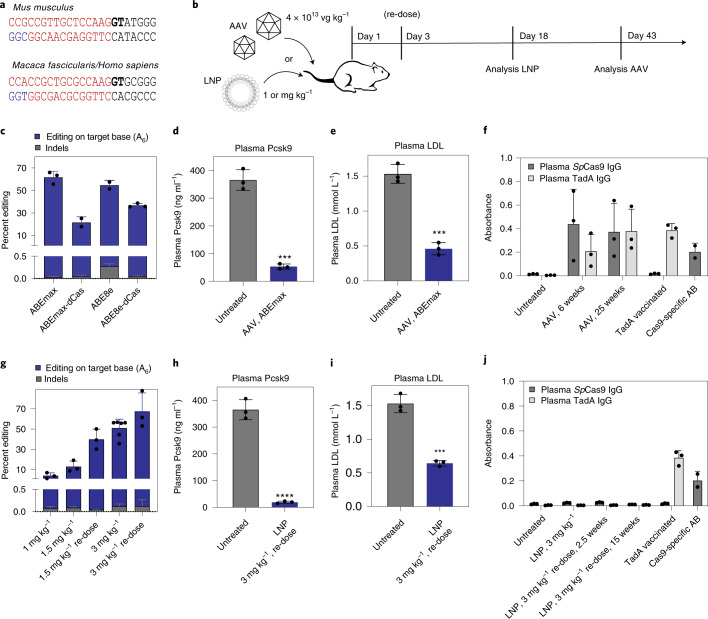
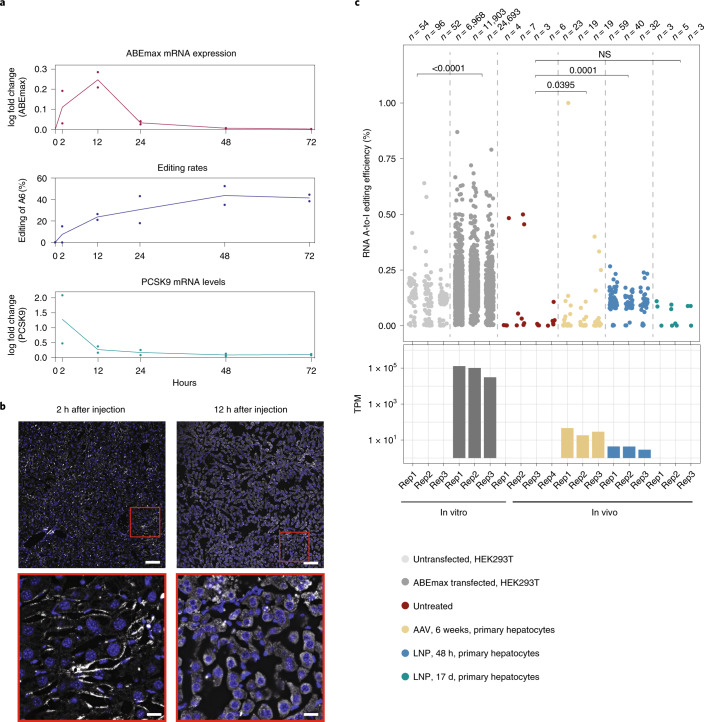
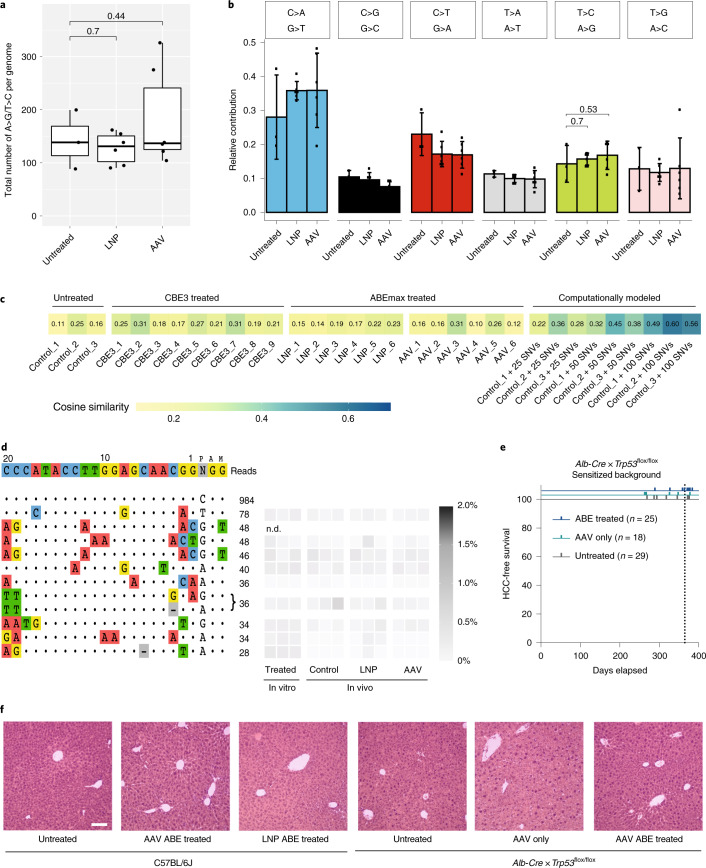
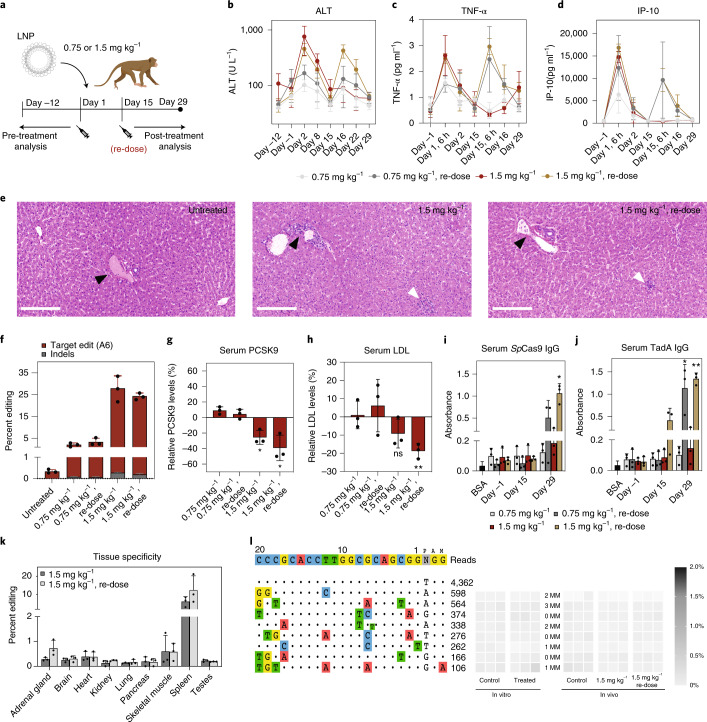
Most known pathogenic point mutations in humans are C•G to T•A substitutions, which can be directly repaired by adenine base editors (ABEs). In this study, we investigated the efficacy and safety of ABEs in the livers of mice and cynomolgus macaques for the reduction of blood low-density lipoprotein (LDL) levels. Lipid nanoparticle–based delivery of mRNA encoding an ABE and a single-guide RNA targeting PCSK9 , a negative regulator of LDL, induced up to 67% editing (on average, 61%) in mice and up to 34% editing (on average, 26%) in macaques. Plasma PCSK9 and LDL levels were stably reduced by 95% and 58% in mice and by 32% and 14% in macaques, respectively. ABE mRNA was cleared rapidly, and no off-target mutations in genomic DNA were found. Re-dosing in macaques did not increase editing, possibly owing to the detected humoral immune response to ABE upon treatment. These findings support further investigation of ABEs to treat patients with monogenic liver diseases.
Overview
The claims and statistics of this paper haven’t been checked yet.
Free: it reads the open-access text and checks the first 5 claims that cite a source we can check. Create a free account to check every claim.
Integrity signals
Registry
Cites
Statistics
Figures
Verification
Claims the paper makes
The claims and statistics of this paper haven’t been checked yet.
Free: it reads the open-access text and checks the first 5 claims that cite a source we can check. Create a free account to check every claim.
Claims other papers make about this one
Each is checked against this paper’s own text: does it say what the citing paper says it does?
The cited source says what the claim attributes to it.
In the citing paper
“base editors yield 61% in vivo gene editing efficacy in the liver of mice compared to 26% in primates8.”
From Human disease models in drug development (2023) · cites this paper as [8]
The cited source says what the claim attributes to it.
In the citing paper
“In fact, PCSK9 has emerged as a key target for the treatment and prevention of FH with successful preclinical studies in macaques132 and human clinical trials for Evolocumab133.”
From Pathways and Molecular Mechanisms Governing LDL Receptor Regulation (2025) · cites this paper as [132]
The check wasn’t confident either way, so it gives no verdict — never disputed.
In the citing paper
“Sequence analysis confirmed that the CRISPR/Cas9 system effectively cleaved and mutated LTR targets.”
From A Review of Research on CRISPR/Cas9 Gene Editing Technology in Disease Treatment (2024) · cites this paper as [12]
Experimental — accuracy not yet measuredThe check wasn’t confident either way, so it gives no verdict — never disputed.
In the citing paper
“CRISPR/Cas9 technology can block the transcriptional expression of the HIV-1 virus or excise latent HIV-1 proviruses directly from the host genome.”
From A Review of Research on CRISPR/Cas9 Gene Editing Technology in Disease Treatment (2024) · cites this paper as [12]
Experimental — accuracy not yet measuredThe check wasn’t confident either way, so it gives no verdict — never disputed.
In the citing paper
“In addition, the system was able to remove internal viral genes from host cell chromosomes.”
From A Review of Research on CRISPR/Cas9 Gene Editing Technology in Disease Treatment (2024) · cites this paper as [12]
Experimental — accuracy not yet measured
1 more claim about this paper
Create a free account to see every claim other papers make about this one.
Self-check
Percentages, sums and reported differences re-computed from the paper’s own numbers.
The self-check needs the paper’s full text.
Citations
Cites
Fiji: an open-source platform for biological-image analysis
Schindelin, J., Arganda-Carreras, I., Frise, E., Kaynig, V., Longair, M., Pietzsch, T., Preibisch, S., Rueden, C., Saalfeld, S., Schmid, B., et al. (2012) · Nature Methods · doi:10.1038/nmeth.2019 · Cited by 66,890
Faul, F., Erdfelder, E., Lang, A.-G., & Buchner, A. (2007) · Behavior Research Methods · doi:10.3758/bf03193146 · Cited by 65,971
Cutadapt removes adapter sequences from high-throughput sequencing reads
Martin, M. (2011) · EMBnet.journal · doi:10.14806/ej.17.1.200 · Cited by 33,889
Wickham, H. (2016) · Use R! · doi:10.1007/978-3-319-24277-4 · Cited by 33,115
A Programmable Dual-RNA–Guided DNA Endonuclease in Adaptive Bacterial Immunity
Jinek, M., Chylinski, K., Fonfara, I., Hauer, M., Doudna, J. A., & Charpentier, E. (2012) · Science · doi:10.1126/science.1225829 · Cited by 17,116
A framework for variation discovery and genotyping using next-generation DNA sequencing data
DePristo, M. A., Banks, E., Poplin, R., Garimella, K. V., Maguire, J. R., Hartl, C., Philippakis, A. A., del Angel, G., Rivas, M. A., Hanna, M., et al. (2011) · Nature Genetics · doi:10.1038/ng.806 · Cited by 11,456
Development and Applications of CRISPR-Cas9 for Genome Engineering
Hsu, P. D., Lander, E. S., & Zhang, F. (2014) · Cell · doi:10.1016/j.cell.2014.05.010 · Cited by 5,762
Programmable editing of a target base in genomic DNA without double-stranded DNA cleavage
Komor, A. C., Kim, Y. B., Packer, M. S., Zuris, J. A., & Liu, D. R. (2016) · Nature · doi:10.1038/nature17946 · Cited by 5,437
Aligning sequence reads, clone sequences and assembly contigs with BWA-MEM
Li, H. (2013) · DROPS (Schloss Dagstuhl – Leibniz Center for Informatics) · doi:10.48550/arxiv.1303.3997 · Cited by 5,159
DNA targeting specificity of RNA-guided Cas9 nucleases
Hsu, P. D., Scott, D. A., Weinstein, J. A., Ran, F. A., Konermann, S., Agarwala, V., Li, Y., Fine, E. J., Wu, X., Shalem, O., et al. (2013) · Nature Biotechnology · doi:10.1038/nbt.2647 · Cited by 4,741
Cited by
Drug delivery systems for RNA therapeutics
Paunovska, K., Loughrey, D., & Dahlman, J. E. (2022) · Nature Reviews Genetics · doi:10.1038/s41576-021-00439-4 · Cited by 1,349
Engineered Virus-like Particles for Efficient in Vivo Delivery of Therapeutic Proteins
Banskota, S., Raguram, A., Suh, S., Du, S. W., Davis, J. R., Choi, E. H., Wang, X., Nielsen, S. C., Newby, G. A., Randolph, P. B., et al. (2022) · Cell · doi:10.1016/j.cell.2021.12.021 · Cited by 668
“In both cases, a standard curve was generated with e5 Cell 185, 250–265.e1–e9, January 20, 2022 ll OPEN ACCESSArticle BE-encoding plasmid standards of known concentration and was used to infer the amount of BE-encoding DNA present in the original samples.”
BackgroundMethodInfluentialPast, present, and future of CRISPR genome editing technologies
Pacesa, M., Pelea, O., & Jinek, M. (2024) · Cell · doi:10.1016/j.cell.2024.01.042 · Cited by 609
“288 Innon-human primates,thisapproachhassignif-icantly decreased PCSK9 levels and serum LDL cholesterol Review without affecting germline tissues, 90,170,288 setting the stage for phase I clinical trials.”
BackgroundTherapeutic in vivo delivery of gene editing agents
Raguram, A., Banskota, S., & Liu, D. R. (2022) · Cell · doi:10.1016/j.cell.2022.03.045 · Cited by 522
The landscape of mRNA nanomedicine
Huang, X., Kong, N., Zhang, X., Cao, Y., Langer, R., & Tao, W. (2022) · Nature Medicine · doi:10.1038/s41591-022-02061-1 · Cited by 511
Lipid-Nanoparticle-Based Delivery of CRISPR/Cas9 Genome-Editing Components
Kazemian, P., Yu, S.-Y., Thomson, S. B., Birkenshaw, A., Leavitt, B. R., & Ross, C. J. D. (2022) · Molecular Pharmaceutics · doi:10.1021/acs.molpharmaceut.1c00916 · Cited by 329
Human disease models in drug development
Loewa, A., Feng, J. J., & Hedtrich, S. (2023) · Nature Reviews Bioengineering · doi:10.1038/s44222-023-00063-3 · Cited by 331
mRNA-based therapeutics: looking beyond COVID-19 vaccines
Parhiz, H., Atochina-Vasserman, E. N., & Weissman, D. (2024) · The Lancet · doi:10.1016/s0140-6736(23)02444-3 · Cited by 279
Self-citationCRISPR technologies for genome, epigenome and transcriptome editing
Villiger, L., Joung, J., Koblan, L., Weissman, J., Abudayyeh, O. O., & Gootenberg, J. S. (2024) · Nature Reviews Molecular Cell Biology · doi:10.1038/s41580-023-00697-6 · Cited by 256
Self-citationDelivery of CRISPR-Cas tools for in vivo genome editing therapy: Trends and challenges
Taha, E. A., Lee, J., & Hotta, A. (2022) · Journal of Controlled Release · doi:10.1016/j.jconrel.2022.01.013 · Cited by 259
AGILE platform: a deep learning powered approach to accelerate LNP development for mRNA delivery
Xu, Y., Ma, S., Cui, H., Chen, J., Xu, S., Gong, F., Golubovic, A., Zhou, M., Wang, K. C., Varley, A., et al. (2024) · Nature Communications · doi:10.1038/s41467-024-50619-z · Cited by 243
“This fi nding is particularly relevant in light of clinical reports associating ALC-0315-based COVID-19 mRNA vaccines (BNT162b2) with cases of autoimmune hepatitis post-vaccination 48 – 50 .”
Lee, R. G., Mazzola, A. M., Braun, M. C., Platt, C., Vafai, S. B., Kathiresan, S., Rohde, E., Bellinger, A. M., & Khera, A. V. (2023) · Circulation · doi:10.1161/circulationaha.122.062132 · Cited by 242
Efficient prime editing in mouse brain, liver and heart with dual AAVs
Davis, J. R., Banskota, S., Levy, J. M., Newby, G. A., Wang, X., Anzalone, A. V., Nelson, A. T., Chen, P. J., Hennes, A. D., An, M., et al. (2024) · Nature Biotechnology · doi:10.1038/s41587-023-01758-z · Cited by 227
Jeong, M., Lee, Y., Park, J., Jung, H., & Lee, H. (2023) · Advanced Drug Delivery Reviews · doi:10.1016/j.addr.2023.114990 · Cited by 220
CRISPR-based genome editing through the lens of DNA repair
Nambiar, T. S., Baudrier, L., Billon, P., & Ciccia, A. (2022) · Molecular Cell · doi:10.1016/j.molcel.2021.12.026 · Cited by 208
Efficient in vivo genome editing prevents hypertrophic cardiomyopathy in mice
Reichart, D., Newby, G. A., Wakimoto, H., Lun, M., Gorham, J. M., Curran, J. J., Raguram, A., DeLaughter, D. M., Conner, D. A., Marsiglia, J. D. C., et al. (2023) · Nature Medicine · doi:10.1038/s41591-022-02190-7 · Cited by 203
In vivo somatic cell base editing and prime editing
Newby, G. A., & Liu, D. R. (2021) · Molecular Therapy · doi:10.1016/j.ymthe.2021.09.002 · Cited by 199
In vivo prime editing of a metabolic liver disease in mice
Böck, D., Rothgangl, T., Villiger, L., Schmidheini, L., Matsushita, M., Mathis, N., Ioannidi, E., Rimann, N., Grisch-Chan, H. M., Kreutzer, S., et al. (2022) · Science Translational Medicine · doi:10.1126/scitranslmed.abl9238 · Cited by 198
Self-citationDavis, J. R., Wang, X., Witte, I. P., Huang, T. P., Levy, J. M., Raguram, A., Banskota, S., Seidah, N. G., Musunuru, K., & Liu, D. R. (2022) · Nature Biomedical Engineering · doi:10.1038/s41551-022-00911-4 · Cited by 192
Targeting proprotein convertase subtilisin/kexin type 9 (PCSK9): From bench to bedside
Bao, X., Liang, Y., Chang, H., Cai, T., Feng, B., Gordon, K., Zhu, Y., Shi, H., He, Y., & Xie, L. (2024) · Signal Transduction and Targeted Therapy · doi:10.1038/s41392-023-01690-3 · Cited by 187
ABCA1 and ABCG1 as potential therapeutic targets for the prevention of atherosclerosis
Matsuo, M. (2022) · Journal of Pharmacological Sciences · doi:10.1016/j.jphs.2021.11.005 · Cited by 174
Wang, Y.-S., Kumari, M., Chen, G.-H., Hong, M.-H., Yuan, J. P.-Y., Tsai, J.-L., & Wu, H.-C. (2023) · Journal of Biomedical Science · doi:10.1186/s12929-023-00977-5 · Cited by 173
“Moreover, the level of plasma PCSK9 was reduced and consequently blood low-density lipoprotein was lowered as well [177].”
BackgroundLoughrey, D., & Dahlman, J. E. (2022) · Accounts of Chemical Research · doi:10.1021/acs.accounts.1c00601 · Cited by 173
Drug delivery systems for CRISPR-based genome editors
Madigan, V., Zhang, F., & Dahlman, J. E. (2023) · Nature Reviews Drug Discovery · doi:10.1038/s41573-023-00762-x · Cited by 172
Lung and liver editing by lipid nanoparticle delivery of a stable CRISPR–Cas9 ribonucleoprotein
Chen, K., Han, H., Zhao, S., Xu, B., Yin, B., Lawanprasert, A., Trinidad, M., Burgstone, B. W., Murthy, N., & Doudna, J. A. (2025) · Nature Biotechnology · doi:10.1038/s41587-024-02437-3 · Cited by 171
PCSK9 Biology and Its Role in Atherothrombosis
Barale, C., Melchionda, E., Morotti, A., & Russo, I. (2021) · International Journal of Molecular Sciences · doi:10.3390/ijms22115880 · Cited by 171
Artificial intelligence-guided design of lipid nanoparticles for pulmonary gene therapy
Witten, J. J., Raji, I. O., Manan, R. S., Beyer, E., Bartlett, S., Tang, Y., Ebadi, M., Lei, J., Nguyen, D., Oladimeji, F. A., et al. (2024) · Nature Biotechnology · doi:10.1038/s41587-024-02490-y · Cited by 239
Shaath, H., Vishnubalaji, R., Elango, R., Kardousha, A., Islam, Z., Qureshi, R., Alam, T., Kolatkar, P. R., & Alajez, N. M. (2022) · Seminars in Cancer Biology · doi:10.1016/j.semcancer.2022.05.013 · Cited by 170
Base editing rescue of spinal muscular atrophy in cells and in mice
Arbab, M., Matuszek, Z., Kray, K. M., Du, A., Newby, G. A., Blatnik, A. J., Raguram, A., Richter, M. F., Zhao, K. T., Levy, J. M., et al. (2023) · Science · doi:10.1126/science.adg6518 · Cited by 139
Mhaimeed, O., Burney, Z. A., Schott, S. L., Kohli, P., Marvel, F. A., & Martin, S. S. (2024) · American Journal of Preventive Cardiology · doi:10.1016/j.ajpc.2024.100649 · Cited by 124
Branched chemically modified poly(A) tails enhance the translation capacity of mRNA
Chen, H., Liu, D., Guo, J., Aditham, A., Zhou, Y., Tian, J., Luo, S., Ren, J., Hsu, A., Huang, J., et al. (2025) · Nature Biotechnology · doi:10.1038/s41587-024-02174-7 · Cited by 125
CRISPR Modeling and Correction of Cardiovascular Disease
Liu, N., & Olson, E. N. (2022) · Circulation Research · doi:10.1161/circresaha.122.320496 · Cited by 117
Microfluidic fabrication of lipid nanoparticles for the delivery of nucleic acids
Prakash, G., Shokr, A., Willemen, N. G. A., Bashir, S. M., Shin, S. R., & Hassan, S. (2022) · Advanced Drug Delivery Reviews · doi:10.1016/j.addr.2022.114197 · Cited by 127
Engineered Cas9 extracellular vesicles as a novel gene editing tool
Osteikoetxea, X., Silva, A., Lázaro‐Ibáñez, E., Salmond, N., Shatnyeva, O., Stein, J., Schick, J., Wren, S., Lindgren, J., Firth, M., et al. (2022) · Journal of Extracellular Vesicles · doi:10.1002/jev2.12225 · Cited by 113
Mukai, H., Ogawa, K., Kato, N., & Kawakami, S. (2022) · Drug Metabolism and Pharmacokinetics · doi:10.1016/j.dmpk.2022.100450 · Cited by 118
Anti-atherosclerotic therapies: Milestones, challenges, and emerging innovations
Hetherington, I., & Totary-Jain, H. (2022) · Molecular Therapy · doi:10.1016/j.ymthe.2022.08.024 · Cited by 128
PCSK9 Inhibition: From Current Advances to Evolving Future
Liu, C., Chen, J., Chen, H., Zhang, T., He, D., Luo, Q., Chi, J., Hong, Z., Liao, Y., Zhang, S., et al. (2022) · Cells · doi:10.3390/cells11192972 · Cited by 101
Tremblay, F., Xiong, Q., Shah, S. S., Ko, C., Kelly, K., Morrison, M. S., Giancarlo, C., Ramírez, R. N., Hildebrand, E. M., Voytek, S. B., et al. (2025) · Nature Medicine · doi:10.1038/s41591-025-03508-x · Cited by 125
Choi, E. H., Suh, S., Foik, A. T., Leinonen, H., Newby, G. A., Gao, X. D., Banskota, S., Hoang, T., Du, S. W., Dong, Z., et al. (2022) · Nature Communications · doi:10.1038/s41467-022-29490-3 · Cited by 96
Soroudi, S., Jaafari, M. R., & Arabi, L. (2024) · Journal of Controlled Release · doi:10.1016/j.jconrel.2024.06.023 · Cited by 102
RNA chemistry and therapeutics
Wang, S., Weissman, D., & Dong, Y. (2025) · Nature Reviews Drug Discovery · doi:10.1038/s41573-025-01237-x · Cited by 119
Self-citationLipid Nanoparticle Delivery Systems to Enable mRNA-Based Therapeutics
Semple, S. C., Leone, R. D., Barbosa, C., Tam, Y. K., & Lin, P. J. C. (2022) · Pharmaceutics · doi:10.3390/pharmaceutics14020398 · Cited by 90
Self-citationTargeted nonviral delivery of genome editors in vivo
Tsuchida, C. A., Wasko, K. M., Hamilton, J. R., & Doudna, J. A. (2024) · Proceedings of the National Academy of Sciences · doi:10.1073/pnas.2307796121 · Cited by 91
Advancing targeted protein degradation for metabolic diseases therapy
Zhou, Q., Xiao, H., Yang, F., Wang, Y., Li, P., & Zheng, Z. (2022) · Pharmacological Research · doi:10.1016/j.phrs.2022.106627 · Cited by 78
Precise genome-editing in human diseases: mechanisms, strategies and applications
Zheng, Y., Li, Y., Zhou, K., Li, T., VanDusen, N. J., & Hua, Y. (2024) · Signal Transduction and Targeted Therapy · doi:10.1038/s41392-024-01750-2 · Cited by 107
Nonhuman Primates in Translational Research
Tarantal, A. F., Noctor, S. C., & Hartigan-O’Connor, D. J. (2022) · Annual Review of Animal Biosciences · doi:10.1146/annurev-animal-021419-083813 · Cited by 86
Gene therapy for liver diseases — progress and challenges
Zabaleta, N., Unzu, C., Weber, N. D., & González‐Aseguinolaza, G. (2023) · Nature Reviews Gastroenterology & Hepatology · doi:10.1038/s41575-022-00729-0 · Cited by 82
Unlocking the Therapeutic Applicability of LNP-mRNA: Chemistry, Formulation, and Clinical Strategies
Huang, X., Ma, Y., Ma, G., & Xia, Y. (2024) · Research · doi:10.34133/research.0370 · Cited by 97
Paunovska, K., Sanchez, A. J. D. S., Lokugamage, M. P., Loughrey, D., Echeverri, E. S., Cristian, A., Hatit, M. Z. C., Santangelo, P. J., Zhao, K., & Dahlman, J. E. (2022) · Nano Letters · doi:10.1021/acs.nanolett.2c03741 · Cited by 82
Sago, C. D., Lokugamage, M. P., Loughrey, D., Lindsay, K. E., Hincapie, R., Krupczak, B. R., Kalathoor, S., Sato, M., Echeverri, E. S., Fitzgerald, J. P., et al. (2022) · Nature Biomedical Engineering · doi:10.1038/s41551-022-00847-9 · Cited by 76
Gene editing therapeutics based on mRNA delivery
Popovitz, J., Sharma, R. K., Hoshyar, R., Kim, B. S., Murthy, N., & Lee, K. (2023) · Advanced Drug Delivery Reviews · doi:10.1016/j.addr.2023.115026 · Cited by 82
LNP-mediated delivery of CRISPR RNP for wide-spread in vivo genome editing in mouse cornea
Mohanna, S. Z. M., Djaksigulova, D., Hill, A. M., Wagner, P. K., Simpson, E. M., & Leavitt, B. R. (2022) · Journal of Controlled Release · doi:10.1016/j.jconrel.2022.08.042 · Cited by 79
Immunological barriers to haematopoietic stem cell gene therapy
Charlesworth, C. T., Hsu, I., Wilkinson, A. C., & Nakauchi, H. (2022) · Nature reviews. Immunology · doi:10.1038/s41577-022-00698-0 · Cited by 74
Lipid Nanoparticles: A Novel Gene Delivery Technique for Clinical Application
Mashima, R., & Takada, S. (2022) · Current Issues in Molecular Biology · doi:10.3390/cimb44100341 · Cited by 78
Gene editing and its applications in biomedicine
Li, G., Li, X., Zhuang, S., Wang, L., Zhu, Y., Chen, Y., Sun, W. C., Wu, Z., Zhou, Z. L., Chen, J., et al. (2022) · Science China Life Sciences · doi:10.1007/s11427-021-2057-0 · Cited by 77
Adenine Base Editing In Vivo with a Single Adeno-Associated Virus Vector
Zhang, H., Bamidele, N., Liu, P., Ojelabi, O., Gao, X. D., Rodríguez, T., Cheng, H., Kelly, K. L., Watts, J. K., Xie, J., et al. (2022) · GEN Biotechnology · doi:10.1089/genbio.2022.0015 · Cited by 70
Cavazza, A., Molina-Estévez, F. J., Reyes, Á. P., Ronco-Díaz, V., Naseem, A., Malenšek, Š., Pečan, P., Santini, A., Heredia, P., Aguilar-González, A., et al. (2025) · Molecular Therapy — Nucleic Acids · doi:10.1016/j.omtn.2025.102457 · Cited by 80
Li, Z., Wang, J., Xu, J.-P., Wang, J., & Yang, X. F. (2023) · Military Medical Research · doi:10.1186/s40779-023-00447-x · Cited by 93
PCSK9: A Multi-Faceted Protein That Is Involved in Cardiovascular Biology
Sundararaman, S. S., Döring, Y., & van der Vorst, E. P. C. (2021) · Biomedicines · doi:10.3390/biomedicines9070793 · Cited by 67
The use of new CRISPR tools in cardiovascular research and medicine
Nishiga, M., Liu, C., Qi, L. S., & Wu, J. C. (2022) · Nature Reviews Cardiology · doi:10.1038/s41569-021-00669-3 · Cited by 73
Xu, W., Zhang, S., Qin, H., & Yao, K. (2024) · Journal of Translational Medicine · doi:10.1186/s12967-024-05957-3 · Cited by 85
Universal Barcoding Predicts In Vivo ApoE-Independent Lipid Nanoparticle Delivery
Sanchez, A. J. D. S., Dobrowolski, C. N., Cristian, A., Echeverri, E. S., Zhao, K., Hatit, M. Z. C., Loughrey, D., Paunovska, K., & Dahlman, J. E. (2022) · Nano Letters · doi:10.1021/acs.nanolett.2c01133 · Cited by 66
Striated muscle-specific base editing enables correction of mutations causing dilated cardiomyopathy
Grosch, M., Schraft, L., Chan, A., Küchenhoff, L., Rapti, K., Ferreira, A.-M., Kornienko, J., Li, S., Radke, M. H., Krämer, C., et al. (2023) · Nature Communications · doi:10.1038/s41467-023-39352-1 · Cited by 64
CRISPR–Cas9 delivery strategies for the modulation of immune and non-immune cells
Alsaiari, S. K., Eshaghi, B., Du, B., Kanelli, M., Li, G., Wu, X., Zhang, L., Chaddah, M., Lau, A., Yang, X., et al. (2024) · Nature Reviews Materials · doi:10.1038/s41578-024-00725-7 · Cited by 70
Nanobiomaterial vectors for improving gene editing and gene therapy
Hu, S. W., Ding, T., Tang, H., Guo, H., Cui, W., & Shu, Y. (2023) · Materials Today · doi:10.1016/j.mattod.2023.04.011 · Cited by 61
Recent advances in therapeutic gene-editing technologies
Liu, D., Cao, D., & Han, R. (2025) · Molecular Therapy · doi:10.1016/j.ymthe.2025.03.026 · Cited by 77
A precise and efficient adenine base editor
Tu, T., Song, Z., Liu, X., Wang, S., He, X., Xi, H., Wang, J., Yan, T., Chen, H., Zhang, Z., et al. (2022) · Molecular Therapy · doi:10.1016/j.ymthe.2022.07.010 · Cited by 56
Rapid and definitive treatment of phenylketonuria in variant-humanized mice with corrective editing
Brooks, D. L., Carrasco, M. J., Qü, P., Peranteau, W. H., Ahrens‐Nicklas, R. C., Musunuru, K., Alameh, M., & Wang, X. (2023) · Nature Communications · doi:10.1038/s41467-023-39246-2 · Cited by 57
Lipid Nanoparticles for Delivery of CRISPR Gene Editing Components
Wu, F., Li, N., Xiao, Y., Palanki, R., Yamagata, H. M., Mitchell, M. J., & Han, X. (2025) · Small Methods · doi:10.1002/smtd.202401632 · Cited by 73
Hypercompact adenine base editors based on a Cas12f variant guided by engineered RNA
Kim, D. Y., Chung, Y., Lee, Y., Jeong, D., Park, K., Chin, H. J., Lee, J. M., Park, S., Ko, S., Ko, J., et al. (2022) · Nature Chemical Biology · doi:10.1038/s41589-022-01077-5 · Cited by 54
Robust, Durable Gene Activation In Vivo via mRNA-Encoded Activators
Beyersdorf, J. P., Bawage, S. S., Iglesias, N., Peck, H. E., Hobbs, R. A., Wroe, J. A., Zurla, C., Gersbach, C. A., & Santangelo, P. J. (2022) · ACS Nano · doi:10.1021/acsnano.1c10631 · Cited by 52
Chen, Y., Luo, S., Hu, Y., Mao, B., Wang, X., Lu, Z., Shan, Q., Zhang, J., Wang, S., Feng, G., et al. (2024) · Cell · doi:10.1016/j.cell.2024.06.020 · Cited by 53
Modern therapeutic approaches to liver-related disorders
Gardin, A., Remih, K., Gonzales, E. M., Andersson, E. R., & Strnad, P. (2022) · Journal of Hepatology · doi:10.1016/j.jhep.2021.12.015 · Cited by 52
PCSK9 in metabolism and diseases
Ajoolabady, A., Pratico, D., Mazidi, M., Davies, I. G., Lip, G. Y. H., Seidah, N., Libby, P., Kroemer, G., & Ren, J. (2025) · Metabolism · doi:10.1016/j.metabol.2024.156064 · Cited by 49
mRNA Display Reaches for the Clinic with New PCSK9 Inhibitor
Iskandar, S. E., & Bowers, A. A. (2022) · ACS Medicinal Chemistry Letters · doi:10.1021/acsmedchemlett.2c00319 · Cited by 55
Delivery of RNAs to Specific Organs by Lipid Nanoparticles for Gene Therapy
Godbout, K., & Tremblay, J. P. (2022) · Pharmaceutics · doi:10.3390/pharmaceutics14102129 · Cited by 53
Continuous directed evolution of a compact CjCas9 variant with broad PAM compatibility
Schmidheini, L., Mathis, N., Marquart, K. F., Rothgangl, T., Kissling, L., Böck, D., Chanez, C., Wang, J. P., Jínek, M., & Schwank, G. (2023) · Nature Chemical Biology · doi:10.1038/s41589-023-01427-x · Cited by 54
Self-citationGenome editing in large animal models
Maynard, L. H., Humbert, O., Peterson, C. W., & Kiem, H. (2021) · Molecular Therapy · doi:10.1016/j.ymthe.2021.09.026 · Cited by 51
An adenine base editor variant expands context compatibility
Xiao, Y., Wu, Y., & Tang, W. (2024) · Nature Biotechnology · doi:10.1038/s41587-023-01994-3 · Cited by 55
Gene therapy and genome editing for lipoprotein disorders
Gurevitz, C., Bajaj, A., Khera, A. V., Do, R., Schunkert, H., Musunuru, K., & Rosenson, R. S. (2025) · European Heart Journal · doi:10.1093/eurheartj/ehaf411 · Cited by 51
Moving toward genome-editing therapies for cardiovascular diseases
Musunuru, K. (2022) · Journal of Clinical Investigation · doi:10.1172/jci148555 · Cited by 51
Recent Therapeutic Gene Editing Applications to Genetic Disorders
Deneault, É. (2024) · Current Issues in Molecular Biology · doi:10.3390/cimb46050255 · Cited by 65
Ravichandran, M., & Maddalo, D. (2023) · Frontiers in Genetics · doi:10.3389/fgene.2023.1273994 · Cited by 53
In Vivo Base Editing of Scn5a Rescues Type 3 Long QT Syndrome in Mice
Qi, M., Ma, S., Liu, J., Liu, X., Wei, J., Lu, W., Zhang, S., Chang, Y., Zhang, Y., Zhong, K., et al. (2023) · Circulation · doi:10.1161/circulationaha.123.065624 · Cited by 49
Peptide codes for organ-selective mRNA delivery
Chang, T., Zheng, Y., Jiang, M., Jia, S., Bai, J., Zheng, Z., Li, S., Guo, J., Wang, Y., Wang, Y., et al. (2025) · Nature Materials · doi:10.1038/s41563-025-02331-6 · Cited by 64
CRISPR-Cas System: The Current and Emerging Translational Landscape
Bhokisham, N., Laudermilch, E., Traeger, L. L., Bonilla, T. D., Ruíz-Estévez, M., & Becker, J. R. (2023) · Cells · doi:10.3390/cells12081103 · Cited by 57
Nanoscale delivery platforms for RNA therapeutics: Challenges and the current state of the art
Rhym, L. H., & Anderson, D. G. (2022) · Med · doi:10.1016/j.medj.2022.02.001 · Cited by 49
Gene therapy for monogenic disorders: challenges, strategies, and perspectives
Zhang, Y., & Wu, Z. (2023) · Journal of genetics and genomics/Journal of Genetics and Genomics · doi:10.1016/j.jgg.2023.08.001 · Cited by 47
The evolving landscape of PCSK9 inhibition in cancer
Oza, P. P., & Kashfi, K. (2023) · European Journal of Pharmacology · doi:10.1016/j.ejphar.2023.175721 · Cited by 44
Bolsoni, J., Liu, D. X., Mohabatpour, F., Ebner, R., Sadhnani, G., Tafech, B., Leung, J., Shanta, S. R., An, K., Morin, T., et al. (2023) · ACS Nano · doi:10.1021/acsnano.3c08644 · Cited by 46
Self-citationKatzmann, J. L., Cupido, A. J., & Laufs, U. (2022) · Metabolites · doi:10.3390/metabo12010070 · Cited by 40
Ilahibaks, N. F., Kluiver, T. A., de Jong, O. G., de Jager, S. C. A., Schiffelers, R. M., Vader, P., Peng, W. C., Lei, Z., & Sluijter, J. P. G. (2024) · Journal of Extracellular Vesicles · doi:10.1002/jev2.12389 · Cited by 45
Rittiner, J. E., Cumaran, M., Malhotra, S., & Kantor, B. (2022) · Frontiers in Bioengineering and Biotechnology · doi:10.3389/fbioe.2022.1035543 · Cited by 45
Minimizing the ratio of ionizable lipid in lipid nanoparticles for in vivo base editing
Chen, Q., Wang, X., Zhang, Y., Tian, M., Duan, J., Zhang, Y., & Yin, H. (2024) · National Science Review · doi:10.1093/nsr/nwae135 · Cited by 43
Rational design of lipid nanoparticles for enabling gene therapies
Brimacombe, C. A., Kulkarni, J. A., Cheng, M. H. Y., An, K., Witzigmann, D., & Cullis, P. R. (2025) · Molecular Therapy — Methods & Clinical Development · doi:10.1016/j.omtm.2025.101518 · Cited by 56
Self-citationmRNA-mediated delivery of gene editing tools to human primary muscle stem cells
Stadelmann, C., Francescantonio, S. D., Marg, A., Müthel, S., Spuler, S., & Escobar, H. (2022) · Molecular Therapy — Nucleic Acids · doi:10.1016/j.omtn.2022.02.016 · Cited by 43
A split and inducible adenine base editor for precise in vivo base editing
Zeng, H., Yuan, Q., Peng, F., Ma, D., Lingineni, A., Chee, K., Gilberd, P., Osikpa, E. C., Sun, Z., & Gao, X. (2023) · Nature Communications · doi:10.1038/s41467-023-41331-5 · Cited by 40
mRNA and gene editing: Late breaking therapies in liver diseases
Zabaleta, N., Torella, L., Weber, N. D., & González‐Aseguinolaza, G. (2022) · Hepatology · doi:10.1002/hep.32441 · Cited by 40
Chasing LDL cholesterol to the bottom — PCSK9 in perspective
Libby, P., & Tokgözoğlu, L. S. (2022) · Nature Cardiovascular Research · doi:10.1038/s44161-022-00085-x · Cited by 47
Genome Editing, A Superior Therapy for Inherited Retinal Diseases
Yan, A. L., Du, S. W., & Palczewski, K. (2022) · Vision Research · doi:10.1016/j.visres.2023.108192 · Cited by 40
Metadata
- Authors
- Rothgangl, T., Dennis, M. K., Lin, P. J. C., Oka, R., Witzigmann, D., Villiger, L., Qi, W., Hruzova, M., Kissling, L., Lenggenhager, D., Borrelli, C., Egli, S., Frey, N., Bakker, N., Walker, J. A., Kadina, A. P., Victorov, D. V., Pacesa, M., Kreutzer, S., Kontarakis, Z., Moor, A., Jinek, M., Weissman, D., Stoffel, M., van Boxtel, R., Holden, K., Pardi, N., Thöny, B., Häberle, J., Tam, Y. K., Semple, S. C., & Schwank, G.
- Affiliations
- University of Zurich (CH)
- Acuitas Therapeutics (Canada) (CA)
- Oncode Institute (NL)
- ETH Zurich (CH)
- Synthego (United States) (US)
- University of Pennsylvania (US)
- University Children's Hospital Zurich (CH)
- Corresponding author
- Semple, Sean C.
- Schwank, Gerald
- ORCID
- Rothgangl, Tanja
- Lin, Paulo J. C.
- Oka, Rurika
- Witzigmann, Dominik
- Villiger, Lukas
- Qi, Weihong
- Kissling, Lucas
- Lenggenhager, Daniela
- Borrelli, Costanza
- Bakker, Noëlle
- Pacesa, Martin
- Kreutzer, Susanne
- Kontarakis, Zacharias
- Moor, Andreas
- Jinek, Martin
- Weissman, Drew
- Stoffel, Markus
- van Boxtel, Ruben
- Holden, Kevin
- Pardi, Norbert
- Thöny, Beat
- Häberle, Johannes
- Tam, Ying K.
- Schwank, Gerald
- Venue
- Nature Biotechnology
- Published
- 2021-05-19
- Volume
- 39
- Issue
- 8
- Pages
- 949-957
- ISSN
- 0733-222X (ISSN-L)
- 1087-0156
- 1546-1696
- PMC
- PMC8352781
- OpenAlex
- W3163681195
- Cited by
- 378
- References
- 71
- Citations by year
- 2026: 48 · 2025: 74 · 2024: 76 · 2023: 76 · 2022: 82 · 2021: 22
- FWCI
- 20.09
- Type
- journal article
- Language
- en
- Open access
- hybrid
- doi.org
- Licence
- cc-by
- creativecommons.org/licenses/by/4.0 (tdm)
- creativecommons.org/licenses/by/4.0 (vor)
- Locations
- Nature Biotechnology (publishedVersion, cc-by)
- PubMed Central (publishedVersion, cc-by)
- PubMed (publishedVersion)
- Pure Amsterdam UMC (publishedVersion, cc-by)
- Data Archiving and Networked Services (DANS) (submittedVersion, other-oa)
- Repository for Publications and Research Data (ETH Zurich) (submittedVersion, cc-by)
- ETH Zürich Research Collection (cc-by)
- Funders
- Schweizerischer Nationalfonds zur Förderung der Wissenschaftlichen Forschung (185293, 176088, 180257, 310030, 320030)
- National Heart, Lung, and Blood Institute (R01HL134839)
- National Institute of Allergy and Infectious Diseases (R01AI124429, U19AI142596)
- Topics
- Life Sciences › Biochemistry, Genetics and Molecular Biology › Molecular Biology › CRISPR and Genetic Engineering
- Life Sciences › Biochemistry, Genetics and Molecular Biology › Molecular Biology › RNA Interference and Gene Delivery
- Life Sciences › Biochemistry, Genetics and Molecular Biology › Molecular Biology › RNA regulation and disease
- Keywords
- adenine base editing, PCSK9, LDL cholesterol, hypercholesterolemia, in vivo gene editing, liver, mRNA delivery, lipid nanoparticles, single guide RNA, cynomolgus macaques, mice, humoral immune response, off-target mutations
- MeSH terms
- Proprotein Convertase 9, Gene Editing, RNA, Guide, CRISPR-Cas Systems, Adenine, Animals, Cholesterol, LDL, Liver, Macaca, Male, Mice, Inbred C57BL, RNA, Guide, Kinetoplastida, Mice
About these checks
Registry, retraction, Cites and statistics results are computed, not judged, with one exception: a printed reference that no index lists is read once by a model before it counts as a citation error. Claims are extracted by a model and kept only when their quote appears verbatim in the text; each cited source is then checked, with a model’s help, for whether it says what the claim relies on. Those verdicts can be wrong — read the claim’s quote and the cited source before relying on one.
Statistics and arithmetic are recomputed, not judged.
Confidence bands are shown only for fields calibrated on our annotated test set. None is calibrated yet, so no band is shown.
What counts as a claim ›How we measure confidence ›How we check this ›
Are you an author, or do you see a problem with this page? Request a review
Data sources
Bibliographic data: Semantic Scholar, OpenAlex, Crossref.
Contains information from the Semantic Scholar Academic Graph Datasets, made available under the ODC Attribution License (ODC-BY 1.0).
Semantic Scholar’s data is described in: Kinney, R., et al. (2023). The Semantic Scholar Open Data Platform. arXiv:2301.10140.
