

Pangenome-based genome inference allows efficient and accurate genotyping across a wide spectrum of variant classes
Open accessPublished version of a preprint
The DOI matches its Crossref record; 89 of the 89 references it cites were found in a registry or an index.
Abstract
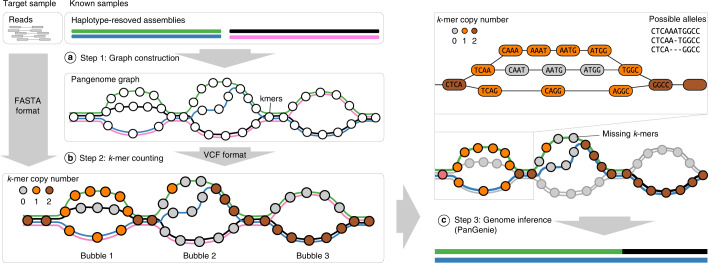
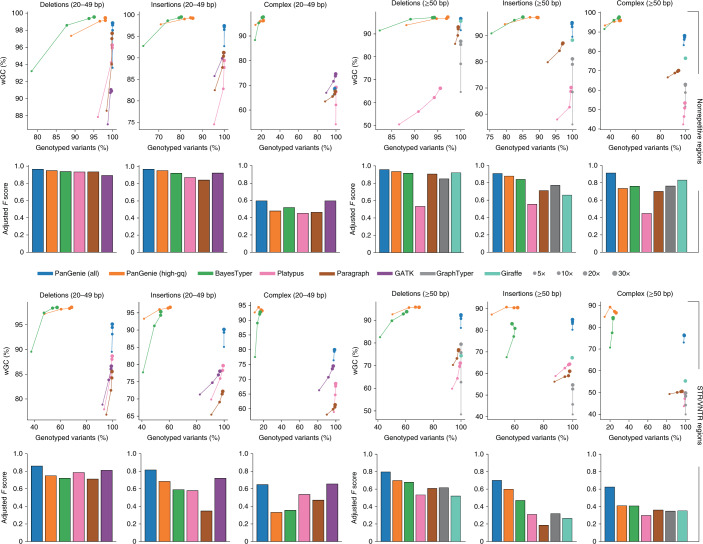
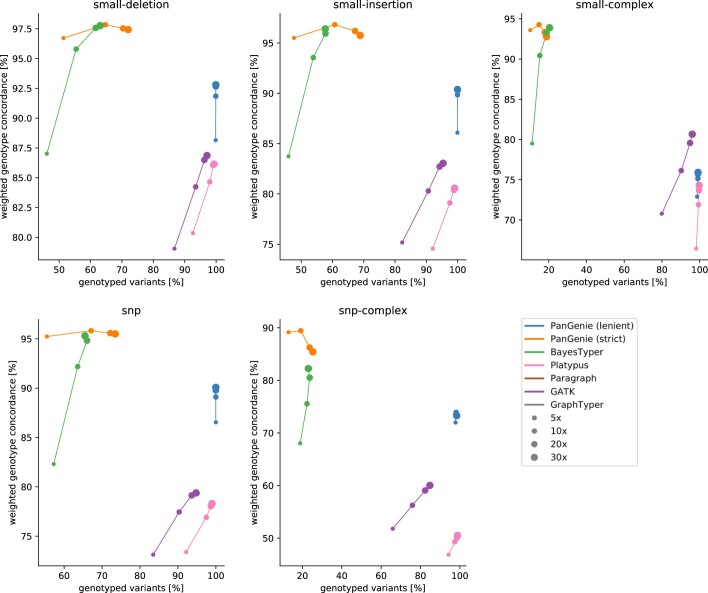
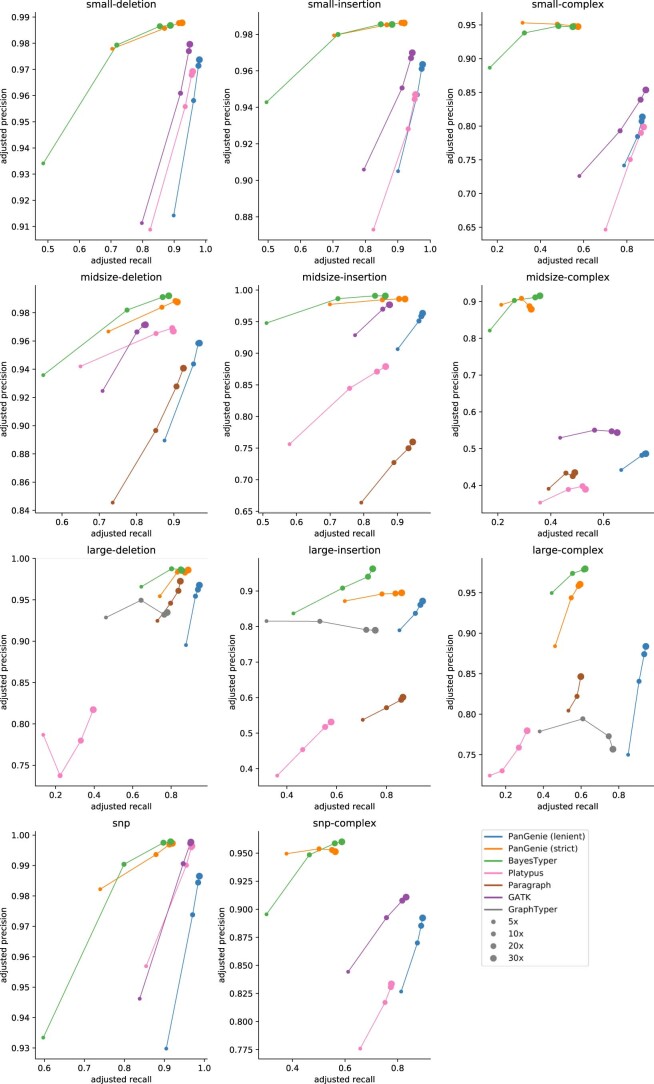
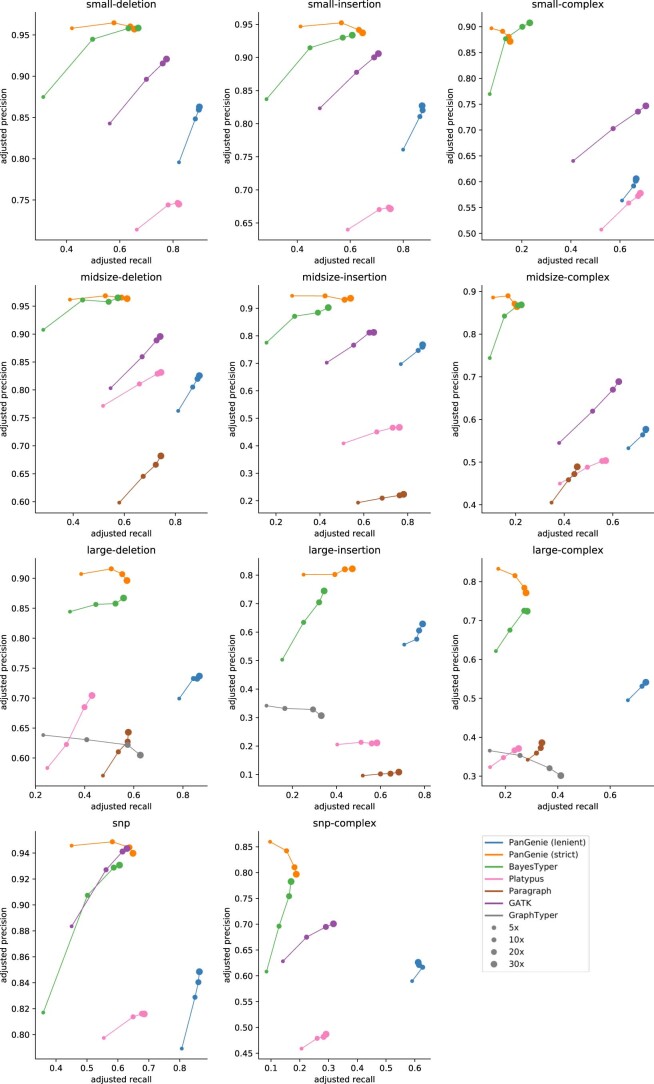
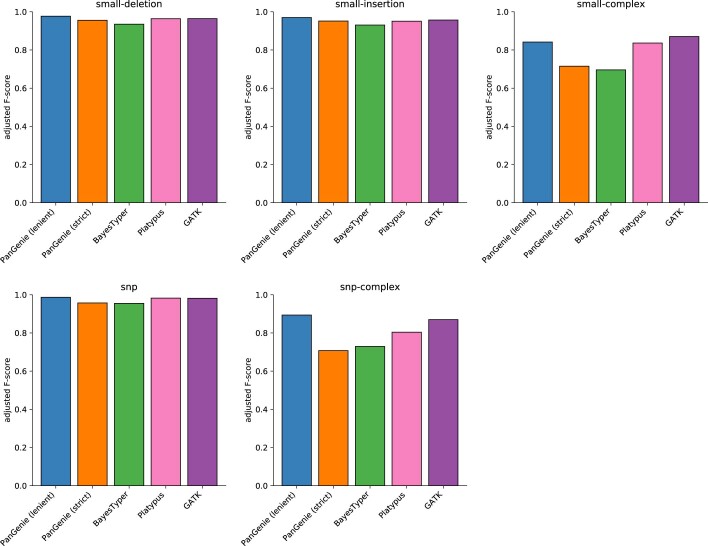
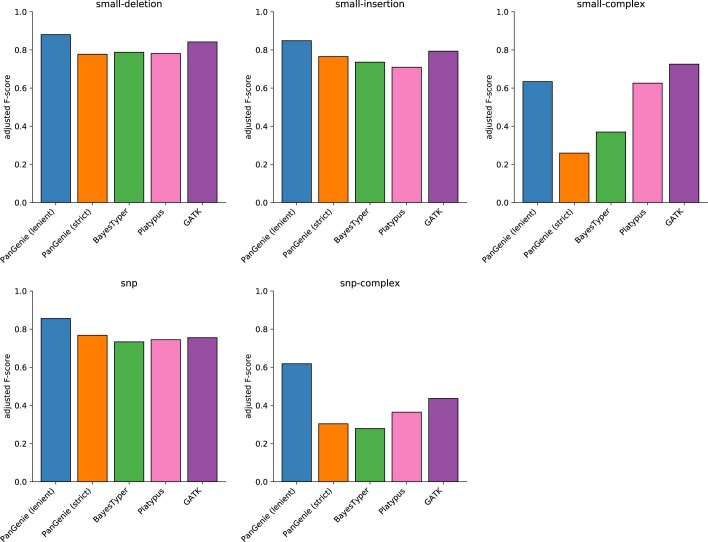
Typical genotyping workflows map reads to a reference genome before identifying genetic variants. Generating such alignments introduces reference biases and comes with substantial computational burden. Furthermore, short-read lengths limit the ability to characterize repetitive genomic regions, which are particularly challenging for fast k -mer-based genotypers. In the present study, we propose a new algorithm, PanGenie, that leverages a haplotype-resolved pangenome reference together with k -mer counts from short-read sequencing data to genotype a wide spectrum of genetic variation—a process we refer to as genome inference. Compared with mapping-based approaches, PanGenie is more than 4 times faster at 30-fold coverage and achieves better genotype concordances for almost all variant types and coverages tested. Improvements are especially pronounced for large insertions (≥50 bp) and variants in repetitive regions, enabling the inclusion of these classes of variants in genome-wide association studies. PanGenie efficiently leverages the increasing amount of haplotype-resolved assemblies to unravel the functional impact of previously inaccessible variants while being faster compared with alignment-based workflows.
Overview
The claims and statistics of this paper haven’t been checked yet.
Free: it reads the open-access text and checks the first 5 claims that cite a source we can check. Create a free account to check every claim.
Integrity signals
Registry
Cites
Statistics
Figures
Verification
Claims the paper makes
The claims and statistics of this paper haven’t been checked yet.
Free: it reads the open-access text and checks the first 5 claims that cite a source we can check. Create a free account to check every claim.
Claims other papers make about this one
Each is checked against this paper’s own text: does it say what the citing paper says it does?
The source backs part of the claim, not all of it — or backs it for a different population, condition or comparison.
In the citing paper
“In addition, the DRAGEN multigenome mapper is already incorporated for SV and CNV calling, something that is not currently possible with any other graph genome implementations because they focus primarily on genotyping variants14,73.”
From Comprehensive genome analysis and variant detection at scale using DRAGEN (2025) · cites this paper as [14]
Experimental — accuracy not yet measuredThe cited source says what the claim attributes to it.
In the citing paper
“In line with previous results5,54, we obtained high genotype concordance across all variant types and genomic contexts (Extended Data Fig. 9).”
From A draft human pangenome reference. (2023) · cites this paper as [54]
The cited source says what the claim attributes to it.
In the citing paper
“The results are shown in Fig. 3a, which shows the weighted genotype concordance 30 across different types of variants, with the Minigraph-Cactus HPRC graphs showing much higher accuracy across all SV variant types than the HGSVC.”
From Pangenome graph construction from genome alignments with Minigraph-Cactus (2024) · cites this paper as [30]
The cited source says what the claim attributes to it.
In the citing paper
“To this end, we have ensured that graphs produced with Minigraph-Cactus are compatible with most state-of-the art pangenome tools (re-engineering the tools as necessary) such as vg 3,6 , Giraffe 3,5,6 , PanGenie 30 and GraphAligner 27 .”
From Pangenome graph construction from genome alignments with Minigraph-Cactus (2024) · cites this paper as [30]
The check wasn’t confident either way, so it gives no verdict — never disputed.
In the citing paper
“Using the current set of 64 haplotypes, DRAGEN outperforms existing pangenome implementations (for example, Giraffe14) not only in accuracy (SNVs: 99.85% versus 99.74% F-measure), but also in scalability and runtime.”
From Comprehensive genome analysis and variant detection at scale using DRAGEN (2025) · cites this paper as [14]
Experimental — accuracy not yet measured
Self-check
Percentages, sums and reported differences re-computed from the paper’s own numbers.
The self-check needs the paper’s full text.
Citations
Cites
Controlling the False Discovery Rate: A Practical and Powerful Approach to Multiple Testing
Benjamini, Y., & Hochberg, Y. (1995) · Journal of the Royal Statistical Society Series B: Statistical Methodology · doi:10.1111/j.2517-6161.1995.tb02031.x · Cited by 109,482
Fast and accurate short read alignment with Burrows-Wheeler transform
Li, H., & Durbin, R. (2009) · Bioinformatics · doi:10.1093/bioinformatics/btp324 · Cited by 58,607
PLINK: a tool set for whole-genome association and population-based linkage analyses.
Purcell, S., Neale, B., Todd-Brown, K., Thomas, L., Ferreira, M. A. R., Bender, D., Maller, J., Sklar, P., de Bakker, P. I. W., Daly, M. J., et al. (2007) · The American Journal of Human Genetics · doi:10.1086/519795 · Cited by 34,089
A global reference for human genetic variation
The 1000 Genomes Project Consortium, authors, C., Auton, A., Abecasis, G. R., Steering committee, Altshuler, D. M., Durbin, R. M., Abecasis, G. R., Bentley, D. R., Chakravarti, A., et al. (2015) · Nature · doi:10.1038/nature15393 · Cited by 18,247
Self-citationThe variant call format and VCFtools
Danecek, P., Auton, A., Abecasis, G., Albers, C. A., Banks, E., DePristo, M. A., Handsaker, R. E., Lunter, G., Marth, G. T., Sherry, S. T., et al. (2011) · Bioinformatics · doi:10.1093/bioinformatics/btr330 · Cited by 16,200
Graph-based genome alignment and genotyping with HISAT2 and HISAT-genotype
Kim, D., Paggi, J. M., Park, C., Bennett, C., & Salzberg, S. L. (2019) · Nature Biotechnology · doi:10.1038/s41587-019-0201-4 · Cited by 15,022
Minimap2: Pairwise alignment for nucleotide sequences
Li, H. (2018) · Bioinformatics · doi:10.1093/bioinformatics/bty191 · Cited by 14,807 · cited 1×
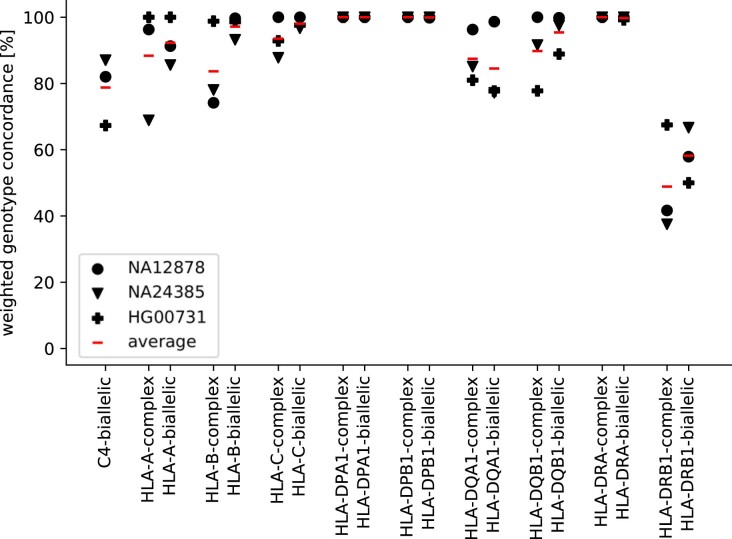
“C , -DQA1 , -DQB1 and -DRB1 ) in all processed input assemblies with one exception ( HLA-DRB1 in NA19238), which was resolved by manual curation with minimap2 53 .”
BackgroundFast and accurate long-read alignment with Burrows-Wheeler transform.
Li, H., & Durbin, R. (2010) · Bioinformatics · doi:10.1093/bioinformatics/btp698 · Cited by 12,063
A framework for variation discovery and genotyping using next-generation DNA sequencing data
DePristo, M. A., Banks, E., Poplin, R., Garimella, K. V., Maguire, J. R., Hartl, C., Philippakis, A. A., del Angel, G., Rivas, M. A., Hanna, M., et al. (2011) · Nature Genetics · doi:10.1038/ng.806 · Cited by 11,456
dbSNP: the NCBI database of genetic variation
Sherry, S. T. (2001) · Nucleic Acids Research · doi:10.1093/nar/29.1.308 · Cited by 7,502
Cited by
Items 201–299 of 299
An Efficient Graph Algorithm for Diploid Local Ancestry InferencePreprint
Jafarzadeh, N., Eizenga, J. M., & Paten, B. (2025) · bioRxiv (Cold Spring Harbor Laboratory) · doi:10.1101/2025.07.05.662656 · Cited by 3
“This includes mapping algorithms for mapping sequences to sequence graphs [3, 4], as well as haplotype inference algorithms [5].”
[The esophageal cardiogram in several rheumatic heart diseases in children].
Garello, L. F., & GATTO, E. (1958) · PubMed
KAGE: Fast alignment-free graph-based genotyping of SNPs and short indelsPreprint
Grytten, I., Rand, K. D., & Sandve, G. K. (2021) · bioRxiv (Cold Spring Harbor Laboratory) · doi:10.1101/2021.12.03.471074
Tang, F. (2021) · Faculty Opinions – Post-Publication Peer Review of the Biomedical Literature · doi:10.3410/f.739619698.793585652
Taming Large-Scale Genomic Analyses via Sparsified GenomicsPreprint
Alser, M., Eudine, J., & Mutlu, O. (2022) · Research Square · doi:10.21203/rs.3.rs-2277358/v1
Leonard, A. S., & Pausch, H. (2022) · World Congress on Genetics Applied to Livestock Production (WCGALP) · doi:10.3920/978-90-8686-940-4_251
Park, H., & Gim, J. (2023) · Research Square · doi:10.21203/rs.3.rs-2580940/v1
Ultra-fast genotyping of SNPs and short indels using GPU accelerationPreprint
Henriksen, J. W., Rand, K. D., Sandve, G. K., & Grytten, I. (2023) · bioRxiv (Cold Spring Harbor Laboratory) · doi:10.1101/2023.04.14.534526
Whole-genome Studies of Malagasy People Uncover Novel Body Composition AssociationsPreprint
Hamid, I., Raveloson, S. N. S., Spiral, G. J., Ravelonjanahary, S., Raharivololona, B. M., Randria, J. M., Zafimaro, M., Randriambola, T. A., Andriantsoa, R. M., Andriamahefa, T. J., et al. (2023) · bioRxiv (Cold Spring Harbor Laboratory) · doi:10.1101/2023.11.21.568192
Furuta, T., & Yamamoto, T. (2023) · DNA Research · doi:10.1093/dnares/dsad027 · Cited by 1
“18 Variations, including SNPs, insertions and deletions (indels), and translocations, represented in the genome graph prevent mismapping and biased mapping.”
BackgroundGraph-Based Genome Inference from Hi-C Data
Shen, Y., Yu, L., Qiu, Y., Zhang, T., & Kingsford, C. (2024) · Lecture notes in computer science · doi:10.1007/978-1-0716-3989-4_8
Mazzarotto, F., Kalay, Ö., Arslan, E., Cinquina, V., Turgut, D., Buchan, R. J., Allouba, M., Bertini, V., Halawa, S., Theotokis, P. I., et al. (2024) · medRxiv · doi:10.1101/2024.11.27.24318059
Guan, C., Liu, Y., Li, Z., Zhang, Y., Liu, Z., Zhu, Q., Zhang, P., Shen, X., Fang, J., Li, J., et al. (2025) · Horticulture Research · doi:10.1093/hr/uhaf001
“0.1) [57].”
InfluentialA Vectorized Sequence-to-Graph Alignment Algorithm
Peng, C., Tang, S., Guo, Y., Xia, Z., Yang, C., & Cui, Y. (2025) · Lecture notes in computer science · doi:10.1007/978-981-96-1525-4_22
A scalable distributed pipeline for reference-free variants calling
Rocco, L. D., & Petrillo, U. F. (2025) · BMC Genomics · doi:10.1186/s12864-025-11722-7
“PanGenie [7], the latest AF framework, incorporates a pangenome graph for a more accurate representation of species variability, although its application is limited by slow runtime and higher memory requirements.”
Pangenomes: Unveiling Genetic Diversity Across Populations and Beyond
Bilal, M., & Battistuzzi, F. U. (2025) · Elsevier eBooks · doi:10.1016/b978-0-443-15750-9.00139-7
Luo, C., Zhou, Z. J., Liu, Y. H., & Zhou, X. (2025) · Genome Research · doi:10.1101/gr.280282.124
Xia, X., Wu, J., Gao, Z., Yuan, P., & Ye, S. (2025) · bioRxiv (Cold Spring Harbor Laboratory) · doi:10.1101/2025.08.07.669060
“Contemporary tools such as Pangie 31 and Paragraph 32 typically identify SVs by aligning short-read sequencing data from individual samples to a curated SV database obtained from long-read assemblies.”
Haplotype-resolved diploid genome inference on pangenome graphsPreprint
Chandra, G., Doan, W. T., & Gibney, D. (2025) · bioRxiv (Cold Spring Harbor Laboratory) · doi:10.1101/2025.11.26.690754 · Cited by 2
“We do not compare our tool with PanGenie [14] or KAGE [21] because they do not account for phasing in the inferred genomes.”
InfluentialDu, Z.-Z., He, J.-B., & Jiao, W.-B. (2024) · Figshare · doi:10.6084/m9.figshare.26703784
Leonard, A. S., Crysnanto, D., Mapel, X. M., Bhati, M., & Pausch, H. (2024) · Figshare · doi:10.6084/m9.figshare.26590973
Wang, J., Wu, J., Sun, Q., Wu, Q., Li, Y., Duan, S., Yang, L., Wu, W., Wang, Z., Liu, Y., et al. (2024) · Figshare · doi:10.6084/m9.figshare.26596664
Yang, L., Yin, H., Bai, L., Yao, W., Tao, T., Zhao, Q., Gao, Y., Teng, J., Xu, Z., Lin, Q., et al. (2024) · Figshare · doi:10.6084/m9.figshare.26717119
Additional file 3 of Inversion polymorphism in a complete human genome assembly
Porubskỳ, D., Harvey, W. T., Rozanski, A. N., Ebler, J., Höps, W., Ashraf, H., Hasenfeld, P., Paten, B., Sanders, A. D., Marschall, T., et al. (2023) · Figshare · doi:10.6084/m9.figshare.22724240
Self-citationLeonard, A. S., Crysnanto, D., Mapel, X. M., Bhati, M., & Pausch, H. (2024) · Figshare · doi:10.6084/m9.figshare.26590976
Leonard, A. S., Crysnanto, D., Mapel, X. M., Bhati, M., & Pausch, H. (2024) · Figshare · doi:10.6084/m9.figshare.26590970
Additional file 2 of KAGE: fast alignment-free graph-based genotyping of SNPs and short indels
Grytten, I., Dagestad Rand, K., & Sandve, G. K. (2022) · Figshare · doi:10.6084/m9.figshare.21273904
Wang, J., Wu, J., Sun, Q., Wu, Q., Li, Y., Duan, S., Yang, L., Wu, W., Wang, Z., Liu, Y., et al. (2024) · Figshare · doi:10.6084/m9.figshare.26596673
Du, Z.-Z., He, J.-B., & Jiao, W.-B. (2024) · Figshare · doi:10.6084/m9.figshare.25566395
Wang, J., Wu, J., Sun, Q., Wu, Q., Li, Y., Duan, S., Yang, L., Wu, W., Wang, Z., Liu, Y., et al. (2024) · Figshare · doi:10.6084/m9.figshare.26596640
Wang, J., Wu, J., Sun, Q., Wu, Q., Li, Y., Duan, S., Yang, L., Wu, W., Wang, Z., Liu, Y., et al. (2024) · Figshare · doi:10.6084/m9.figshare.26596637
Leonard, A. S., Crysnanto, D., Mapel, X. M., Bhati, M., & Pausch, H. (2024) · Figshare · doi:10.6084/m9.figshare.26590994
Additional file 2 of Pig pangenome graph reveals functional features of non-reference sequences
Miao, J., Wei, X., Cao, C., Sun, J., Xu, Y., Zhang, Z., Wang, Q., Pan, Y., & Wang, Z. (2024) · Figshare · doi:10.6084/m9.figshare.25271911
Leonard, A. S., Crysnanto, D., Mapel, X. M., Bhati, M., & Pausch, H. (2024) · Figshare · doi:10.6084/m9.figshare.26590991
Leonard, A. S., Crysnanto, D., Mapel, X. M., Bhati, M., & Pausch, H. (2024) · Figshare · doi:10.6084/m9.figshare.26590997
Leonard, A. S., Crysnanto, D., Mapel, X. M., Bhati, M., & Pausch, H. (2024) · Figshare · doi:10.6084/m9.figshare.26590985
Additional file 1 of KAGE: fast alignment-free graph-based genotyping of SNPs and short indels
Grytten, I., Dagestad Rand, K., & Sandve, G. K. (2022) · Figshare · doi:10.6084/m9.figshare.21273901
Wang, J., Wu, J., Sun, Q., Wu, Q., Li, Y., Duan, S., Yang, L., Wu, W., Wang, Z., Liu, Y., et al. (2024) · Figshare · doi:10.6084/m9.figshare.26596655
Yang, L., Yin, H., Bai, L., Yao, W., Tao, T., Zhao, Q., Gao, Y., Teng, J., Xu, Z., Lin, Q., et al. (2024) · Figshare · doi:10.6084/m9.figshare.26717113
Additional file 1 of Pig pangenome graph reveals functional features of non-reference sequences
Miao, J., Wei, X., Cao, C., Sun, J., Xu, Y., Zhang, Z., Wang, Q., Pan, Y., & Wang, Z. (2024) · Figshare · doi:10.6084/m9.figshare.25271839
Leonard, A. S., Crysnanto, D., Mapel, X. M., Bhati, M., & Pausch, H. (2024) · Figshare · doi:10.6084/m9.figshare.26590982
Wang, J., Wu, J., Sun, Q., Wu, Q., Li, Y., Duan, S., Yang, L., Wu, W., Wang, Z., Liu, Y., et al. (2024) · Figshare · doi:10.6084/m9.figshare.26596634
Wang, J., Wu, J., Sun, Q., Wu, Q., Li, Y., Duan, S., Yang, L., Wu, W., Wang, Z., Liu, Y., et al. (2024) · Figshare · doi:10.6084/m9.figshare.26596682
Du, Z.-Z., He, J.-B., & Jiao, W.-B. (2024) · Figshare · doi:10.6084/m9.figshare.25566294
Smith, T. P. L., Bickhart, D. M., Boichard, D., Chamberlain, A. J., Djikeng, A., Jiang, Y., Low, W. Y., Pausch, H., Demyda-Peyrás, S., Prendergast, J., et al. (2024) · Figshare · doi:10.6084/m9.figshare.26598209
Additional file 1 of Inversion polymorphism in a complete human genome assembly
Porubskỳ, D., Harvey, W. T., Rozanski, A. N., Ebler, J., Höps, W., Ashraf, H., Hasenfeld, P., Paten, B., Sanders, A. D., Marschall, T., et al. (2023) · Figshare · doi:10.6084/m9.figshare.22724234
Self-citationWang, J., Wu, J., Sun, Q., Wu, Q., Li, Y., Duan, S., Yang, L., Wu, W., Wang, Z., Liu, Y., et al. (2024) · Figshare · doi:10.6084/m9.figshare.26596649
Wang, J., Wu, J., Sun, Q., Wu, Q., Li, Y., Duan, S., Yang, L., Wu, W., Wang, Z., Liu, Y., et al. (2024) · Figshare · doi:10.6084/m9.figshare.26596643
Yang, L., Yin, H., Bai, L., Yao, W., Tao, T., Zhao, Q., Gao, Y., Teng, J., Xu, Z., Lin, Q., et al. (2024) · Figshare · doi:10.6084/m9.figshare.26717116
Wang, J., Wu, J., Sun, Q., Wu, Q., Li, Y., Duan, S., Yang, L., Wu, W., Wang, Z., Liu, Y., et al. (2024) · Figshare · doi:10.6084/m9.figshare.26596646
Wang, J., Wu, J., Sun, Q., Wu, Q., Li, Y., Duan, S., Yang, L., Wu, W., Wang, Z., Liu, Y., et al. (2024) · Figshare · doi:10.6084/m9.figshare.26596679
Wang, J., Wu, J., Sun, Q., Wu, Q., Li, Y., Duan, S., Yang, L., Wu, W., Wang, Z., Liu, Y., et al. (2024) · Figshare · doi:10.6084/m9.figshare.26596661
Wang, J., Wu, J., Sun, Q., Wu, Q., Li, Y., Duan, S., Yang, L., Wu, W., Wang, Z., Liu, Y., et al. (2024) · Figshare · doi:10.6084/m9.figshare.26596676
Additional file 1 of Comparing methods for constructing and representing human pangenome graphs
Andreace, F., Lechat, P., Dufresne, Y., & Chikhi, R. (2024) · Figshare · doi:10.6084/m9.figshare.26647815
Wang, J., Wu, J., Sun, Q., Wu, Q., Li, Y., Duan, S., Yang, L., Wu, W., Wang, Z., Liu, Y., et al. (2024) · Figshare · doi:10.6084/m9.figshare.26596658
Wang, J., Wu, J., Sun, Q., Wu, Q., Li, Y., Duan, S., Yang, L., Wu, W., Wang, Z., Liu, Y., et al. (2024) · Figshare · doi:10.6084/m9.figshare.26596652
Yang, L., Yin, H., Bai, L., Yao, W., Tao, T., Zhao, Q., Gao, Y., Teng, J., Xu, Z., Lin, Q., et al. (2024) · Figshare · doi:10.6084/m9.figshare.26717110
Wang, J., Wu, J., Sun, Q., Wu, Q., Li, Y., Duan, S., Yang, L., Wu, W., Wang, Z., Liu, Y., et al. (2024) · Figshare · doi:10.6084/m9.figshare.26596670
Wang, J., Wu, J., Sun, Q., Wu, Q., Li, Y., Duan, S., Yang, L., Wu, W., Wang, Z., Liu, Y., et al. (2024) · Figshare · doi:10.6084/m9.figshare.26596667
Leonard, A. S., Crysnanto, D., Mapel, X. M., Bhati, M., & Pausch, H. (2024) · Figshare · doi:10.6084/m9.figshare.26590988
Leonard, A. S., Crysnanto, D., Mapel, X. M., Bhati, M., & Pausch, H. (2024) · Figshare · doi:10.6084/m9.figshare.26590979
Plant Whole Genome Duplication Mechanisms and Their Breeding Applications
Srinidhi, M., Manoj, M., Sravanalakshmi, M., Kumari, P., Janani, S., Swarnamughi, P., Esakkimuthu, B., & Anand, A. V. (2026) · CABI biotechnology series. · doi:10.1079/9781800628649.0009
Labbancz, J., & Dhingra, A. (2026) · bioRxiv · doi:10.64898/2026.01.20.700718
“The graph contains ~25 million variants, which can be used for genotyping of Pyrus samples (Figure 7), generated from across the genus, enabling calling of all variants, including large structural variants, even using short read data (Ebler et al., 2022).”
Graph pan-genome facilitates crop genetic improvement
Luo, Z., & Yang, N. (2026) · Scientia Sinica Vitae · doi:10.1360/ssv-2025-0256
Structural variant detection across sequencing technologies
Li, G., Liu, Y., Zhang, A., Lin, X., Hu, Z., Liu, B., Qian, L., & Wang, Y. (2026) · Nature Biotechnology · doi:10.1038/s41587-026-03332-9
Liu, P., Hu, K., Mughini‐Gras, L., Zomer, A., Brouwer, M. S. M., Dallman, T. J., & Paganini, J. (2026) · Genomics · doi:10.1016/j.ygeno.2026.111309
Parallel evolution of industrial melanism in the peppered moth: one locus, many allelesPreprint
Whiteford, S., Campagne, P., Hof, A. E. V., Yung, C. J., Berenbrink, M., Tian, S., Todd, F., Delf, J., Monteiro, A., Marec, F., et al. (2026) · bioRxiv (Cold Spring Harbor Laboratory) · doi:10.64898/2026.02.26.707722 · Cited by 1
Kim, K., Pfennig, A., Syed, S. A., Moskwa, N. L., Oliveira, N. A. D. J., Pham, Q.-M., Hallast, P., Yilmaz, F., McDonough, J. A., Norton, H., et al. (2026) · bioRxiv (Cold Spring Harbor Laboratory) · doi:10.64898/2026.03.18.712481
Fast Hashing of Spaced Seeds with DuoHash
Gemin, L., Pizzi, C., & Comin, M. (2026) · Journal of Computational Biology · doi:10.1177/15578666261423555
“As shown in Figure 6(a), DuoHash consistently outperforms MaskJelly across all four tested data-sets.”
Panmap: Scalable phylogeny-guided alignment, genotyping, and placement on pangenomesPreprint
Kramer, A., Zhang, A., Ayala, N., Sanctis, B. D., Karim, L., Hinrichs, A. S., Walia, S., Turakhia, Y., & Corbett-Detig, R. B. (2026) · bioRxiv (Cold Spring Harbor Laboratory) · doi:10.64898/2026.03.29.711974
Analysis of human pangenome graphs : and other k-mer based applications
Andreace, F. (2025) · theses.fr (ABES) · doi:10.70675/4ea0d4daz806cz4c49z9bd9z66ce042dc6bd
Pan1c : a pipeline to easily build chromosome-level pangenome graphsPreprint
Mergez, A., Racoupeau, M., Bardou, P., Linard, B., Legeai, F., Choulet, F., Gaspin, C., & Klopp, C. (2026) · bioRxiv (Cold Spring Harbor Laboratory) · doi:10.64898/2026.04.17.719212
“We developed Pan1C , a unified workflow that integrates two complementary approaches, Future directions include extending Pan1C with additional options for downstream analyses, 177 such as PanGenie [7] for genotyping, VG giraffe [20] for read alignment, and other tools for”
Pangenome Graphs: Concepts, Tools, and Emerging Trends in Genomic Analysis
Ismail, F. N., Amarasoma, S., & Sengupta, A. (2026) · Journal of Genome Biotechnology and Genetics · doi:10.3390/jgbg1010005
Fu, L., Chen, J., Lian, D., Du, S., Wu, D., Yang, C., Wang, Z., Ma, H., Li, Z., Lake, N. J., et al. (2026) · Nature Communications · doi:10.1038/s41467-026-71348-5 · Cited by 4
Self-citationPramitha, L., Rana, S., Jeeva, G., Devasena, N., Aananthi, N., & Muthamilarasan, M. (2026) · Elsevier eBooks · doi:10.1016/b978-0-443-40401-6.00019-4
Dhar, R., Karmakar, A., Badal, A. K., Sahoo, O. S., Paul, P., Goel, I., Nayek, A., Pethusamy, K., Seethy, A., & Karmakar, S. (2026) · Molecular Biology Reports · doi:10.1007/s11033-026-12076-3 · Cited by 1
Critical insights in cassava functional genomics: from haplotypes to genome editing
Wonnapinij, P., Kongsil, P., Suttangkakul, A., Kittipadakul, P., & Vuttipongchaikij, S. (2026) · Critical Insights in Plant Science · doi:10.1080/29932297.2026.2681346
Pangenome-based human genome analysis improves trait association and genomic predictionPreprint
Lu, S., Liao, W., DeGorter, M. K., Goddard, P. C., Ebler, J., Lu, T.-Y. T., Chaisson, M., Marschall, T., Montgomery, S. B., Stitziel, N. O., et al. (2026) · bioRxiv (Cold Spring Harbor Laboratory) · doi:10.64898/2026.07.01.735728 · Cited by 1
“A second advantage is that, unlike other pangenomic approaches that use k-mer counts 4,14 , EdgeDepth uses full read alignment, which is expected to be more accurate in repetitive sequences.”
Self-citationComputational strategies for copy number variation detection, disease association, and beyond
Saeidian, A. H., Sabaie, H., Akbarzadeh, M., Vahidnezhad, H., Youssefian, L., Saadattalab, T., Du, H., Luo, X., Owen, N. M., Zhao, X., et al. (2026) · Genome biology · doi:10.1186/s13059-026-04189-6
“Building on this, the creation of human reference pangenomes that represent diverse populations through genome graphs offers a powerful means to better characterise repetitive regions and complex SVs [299–302].”
The use of artificial intelligence in advancing molecular biology in Africa: a narrative review
Awuah, D., Hounkpe, A., Anane-Asamoah, J., Dakubo, W. K., Adu, I. K., Barnie, P. A., Ansah, E. O., Fosu, K., Aidoo, C. O., Essien, V., et al. (2026) · Molecular Genetics and Genomics · doi:10.1007/s00438-026-02492-2
“…spectrum of variant classes directly from short-read k-mer counts compared against a haplotype-resolved pangenome, bypassing read alignment entirely and showing particular gains for large insertions and variants in repetitive regions that are historically difficult to genotype (Ebler et al. 2022).”
Beyond the linear genome: how reference bias threatens preventive medicine and geroscience
Nagy, G., Munkácsy, G., Murmu, A., Longo, G., López, L. I., Cirigliano, V., & Győrffy, B. (2026) · GeroScience · doi:10.1007/s11357-026-02436-z
Wood, D. P., Vatanparast, M., Galanti, D., Catherine, G., Wheeler, K., Curran, E. V., Yant, L. J., Whittet, R., Nichols, R. A., Buggs, R. J. A., et al. (2026) · Nature Communications · doi:10.1038/s41467-026-77194-9 · Cited by 5
“SV genotyping from short-reads is generally more challenging than for SNPs 104 – 106 , and we are not aware of previous studies estimating allele frequencies of poolseq data mapped to a pangenome graph.”
Long-read low-pass sequencing enhances variant detection in a peanut MAGIC population
Lee, K., Korani, W., Pokhrel, S., Wright, H., Bentz, P. C., Ozias‐Akins, P., Chu, Y., Harkess, A., Vaughn, J., & Clevenger, J. P. (2026) · G3 Genes Genomes Genetics · doi:10.1093/g3journal/jkag196 · Cited by 2
From genomes to graphs: Why macroevolution still matters in the pangenome era
Liu, B. (2026) · Journal of Systematics and Evolution · doi:10.1111/jse.70102
“These representations can improve mapping, genotyping, trait association, and the recovery of non ‐ reference variation (Garrison et al., 2018; Eizenga et al., 2020; Ebler et al., 2022; Edwards & Batley, 2022; Garrison et al., 2024).”
An Icelandic pangenome reference
Holley, G., Eggertsson, H. P., Kristmundsdóttir, S., Beyter, D., Skúladóttir, Á., Moore, K. H. S., Olason, P. I., Gylfason, A., Magnusson, O. T., Oddsson, Á., et al. (2026) · Nature · doi:10.1038/s41586-026-10924-7 · Cited by 3
Bocs, S., Carrette, C., Confais, J., Dubois, S., Duvaux, L., Klopp, C., Lapalu, N., Lasserre‐Zuber, P., Legeai, F., Lemaitre, C., et al. (2026) · Peer Community Journal · doi:10.24072/pcjournal.781 · Cited by 1
A T2T Benchmark Reveals How Reference Choice Shapes Human Genome InterpretationPreprint
Huang, Z., Chu, Y., Tian, Y., Shao, C., Wang, J., Zhang, X., Chen, J., Jia, Z., Li, L., Li, J., et al. (2026) · bioRxiv (Cold Spring Harbor Laboratory) · doi:10.64898/2026.09.07.749735
Privacy-preserving pangenome graphs
Blindenbach, J., Soni, S., & Gürsoy, G. (2026) · Nature Communications · doi:10.1038/s41467-026-77591-0 · Cited by 1
Chen, D., Cohen, K. A., Nguyen, K., Jam, H. Z., Eveloff, R. J., Wang, Y., Guevara, J., Sanches, T. M., Mortazavi, M., Munro, D. B., et al. (2026) · bioRxiv (Cold Spring Harbor Laboratory) · doi:10.64898/2026.09.10.750683
Kumar, K., Khatri, A., & Thakur, I. S. (2026) · Next research. · doi:10.1016/j.nexres.2026.102445
Feulner, H., Švara, A., Zhao, X., Fei, Z., & Khan, A. (2026) · bioRxiv (Cold Spring Harbor Laboratory) · doi:10.64898/2026.09.23.753852
PGpath: recommending population-adapted linear reference genomes from pangenome subpaths
Xue, Z., Wang, X., Yuan, J., Wang, T., Sheng, X., Zhang, T., Wang, J., & Cai, H. (2026) · Briefings in Bioinformatics · doi:10.1093/bib/bbag547
Common centromeric variation associates with molecular and complex traits in humansPreprint
Dong, Y., Cutler, D. J., & Weinstock, J. S. (2026) · medRxiv · doi:10.64898/2026.10.09.26365154
Small variant calling in the era of long-read sequencing
Zheng, Z., Sedlazeck, F. J., & Luo, R. (2026) · Nature Reviews Genetics · doi:10.1038/s41576-026-01020-7
Comparison of clinical sequencing platforms for whole-genome analysis
Budhyanto, V., Jurgens, S., Cicilia, C. O., & Kamaruddin, M. (2026) · Cifra LLC Journals · doi:10.60797/jbg.2026.33.7.1
Budhyanto, V., Jurgens, S., Cicilia, C. O., & Kamaruddin, M. (2026) · Journal of Bioinformatics and Genomics · doi:10.60797/jbg.2026.33.7
Key bioinformatics tools for clinical HiFi WGS analysis
Budhyanto, V., Jurgens, S., Cicilia, C. O., & Kamaruddin, M. (2026) · Cifra LLC Journals · doi:10.60797/jbg.2026.33.7.3
Selected clinically actionable variants of high relevance to Southeast Asian populations
Budhyanto, V., Jurgens, S., Cicilia, C. O., & Kamaruddin, M. (2026) · Cifra LLC Journals · doi:10.60797/jbg.2026.33.7.2
Size dependent loss of structural variant allele counts in pangenome derived VCFsPreprint
Manjunath, M., S, R. V., & Shakunthala, V. (2026) · Research Square · doi:10.21203/rs.3.rs-11373989/v1
Metadata
- Authors
- Ebler, J., Ebert, P., Clarke, W. E., Rausch, T., Audano, P. A., Houwaart, T., Mao, Y., Korbel, J. O., Eichler, E. E., Zody, M. C., Dilthey, A. T., & Marschall, T.
- Affiliations
- Heinrich Heine University Düsseldorf (DE)
- New York Genome Center (US)
- European Molecular Biology Laboratory (DE)
- University of Washington (US)
- Howard Hughes Medical Institute (US)
- University of Cologne (DE)
- Corresponding author
- Marschall, Tobias
- ORCID
- Venue
- Nature Genetics
- Published
- 2022-04
- Volume
- 54
- Issue
- 4
- Pages
- 518-525
- ISSN
- 1061-4036 (ISSN-L)
- 1546-1718
- PMC
- PMC9005351
- OpenAlex
- W4223416923
- Semantic Scholar
- ac7c600024e4af795e0bc2fb9b609fe45dcf6c2d
- Cited by
- 277
- References
- 86
- Citations by year
- 2026: 57 · 2025: 62 · 2024: 66 · 2023: 57 · 2022: 27
- FWCI
- 18.78
- Type
- journal article
- Language
- en
- Open access
- hybrid
- doi.org
- Licence
- cc-by
- creativecommons.org/licenses/by/4.0 (tdm)
- creativecommons.org/licenses/by/4.0 (vor, 10 d)
- Locations
- Nature Genetics (publishedVersion, cc-by)
- bioRxiv (Cold Spring Harbor Laboratory) (acceptedVersion, cc-by-nd)
- PubMed Central (publishedVersion, cc-by)
- PubMed (publishedVersion)
- Kölner Universitäts PublikationsServer (Universität zu Köln) (publishedVersion)
- Funders
- U.S. Department of Health & Human Services | NIH | National Human Genome Research Institute (1U01HG010973, HG010169)
- Bundesministerium für Bildung und Forschung (031L0184, 031L0181A)
- Topics
- Life Sciences › Biochemistry, Genetics and Molecular Biology › Molecular Biology › Genomics and Phylogenetic Studies
- Life Sciences › Biochemistry, Genetics and Molecular Biology › Genetics › Genomic variations and chromosomal abnormalities
- Life Sciences › Biochemistry, Genetics and Molecular Biology › Genetics › Genomics and Rare Diseases
- Keywords
- genotyping, pan-genome, k-mer counts, short-read sequencing, reference bias, repetitive regions, structural variants, variant calling, haplotype-resolved genome assembly
- MeSH terms
- Algorithms, Genotype, Humans, Genetic Variation, Genome, Human, Sequence Analysis, DNA, Genomics, Genome-Wide Association Study, High-Throughput Nucleotide Sequencing
About these checks
Registry, retraction, Cites and statistics results are computed, not judged, with one exception: a printed reference that no index lists is read once by a model before it counts as a citation error. Claims are extracted by a model and kept only when their quote appears verbatim in the text; each cited source is then checked, with a model’s help, for whether it says what the claim relies on. Those verdicts can be wrong — read the claim’s quote and the cited source before relying on one.
Statistics and arithmetic are recomputed, not judged.
Confidence bands are shown only for fields calibrated on our annotated test set. None is calibrated yet, so no band is shown.
What counts as a claim ›How we measure confidence ›How we check this ›
Are you an author, or do you see a problem with this page? Request a review
Data sources
Bibliographic data: Semantic Scholar, OpenAlex, Crossref.
Contains information from the Semantic Scholar Academic Graph Datasets, made available under the ODC Attribution License (ODC-BY 1.0).
Semantic Scholar’s data is described in: Kinney, R., et al. (2023). The Semantic Scholar Open Data Platform. arXiv:2301.10140.
