

Genetic correlates of phenotypic heterogeneity in autism
Open accessPublished version of a preprint
The DOI matches its Crossref record; 113 of the 113 references it cites were found in a registry or an index; 26 of the 60 sources its claims cite were checked for support.
Abstract
The substantial phenotypic heterogeneity in autism limits our understanding of its genetic etiology. To address this gap, here we investigated genetic differences between autistic individuals ( n max = 12,893) based on core and associated features of autism, co-occurring developmental disabilities and sex. We conducted a comprehensive factor analysis of core autism features in autistic individuals and identified six factors. Common genetic variants were associated with the core factors, but de novo variants were not. We found that higher autism polygenic scores (PGS) were associated with lower likelihood of co-occurring developmental disabilities in autistic individuals. Furthermore, in autistic individuals without co-occurring intellectual disability (ID), autism PGS are overinherited by autistic females compared to males. Finally, we observed higher SNP heritability for autistic males and for autistic individuals without ID. Deeper phenotypic characterization will be critical in determining how the complex underlying genetics shape cognition, behavior and co-occurring conditions in autism.
Overview
CoChat Summary
TL;DR
In up to 12,893 autistic individuals, common and high-impact de novo variants showed differential associations with core and associated autism features, co-occurring developmental disabilities, sex, and ID. Autism polygenic scores were linked to lower co-occurring developmental disabilities and were overinherited in autistic females without ID, while SNP heritability was higher in males and in autistic individuals without ID.
Key findings
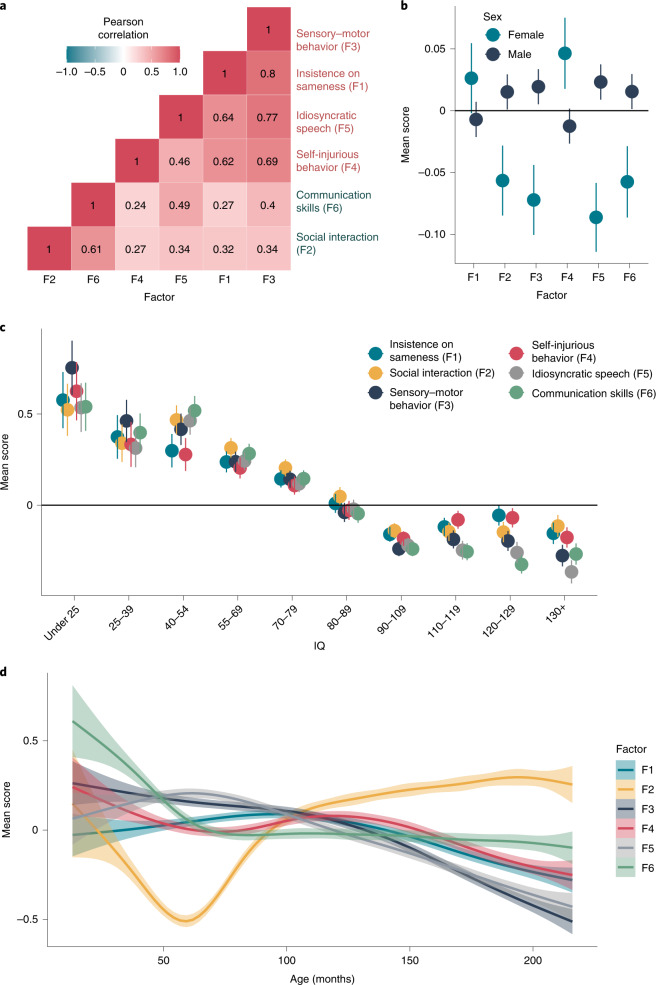
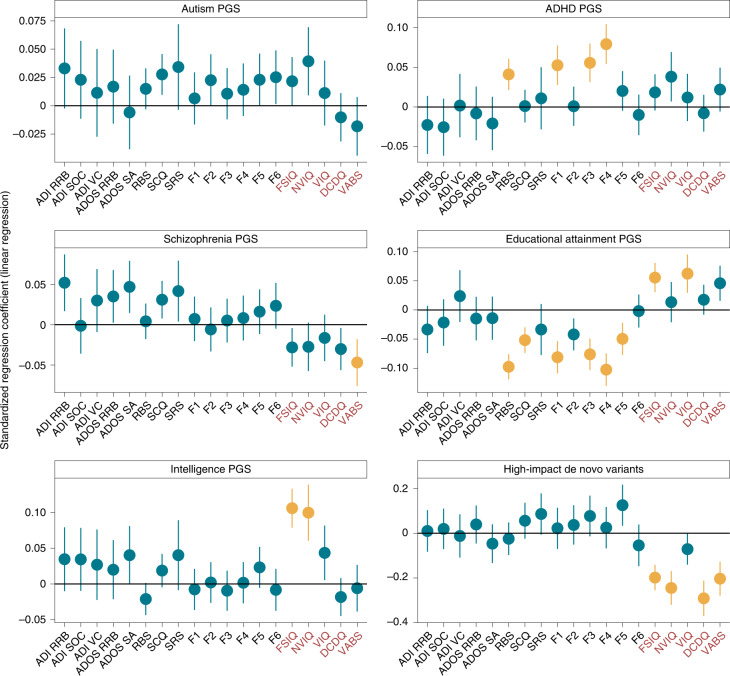
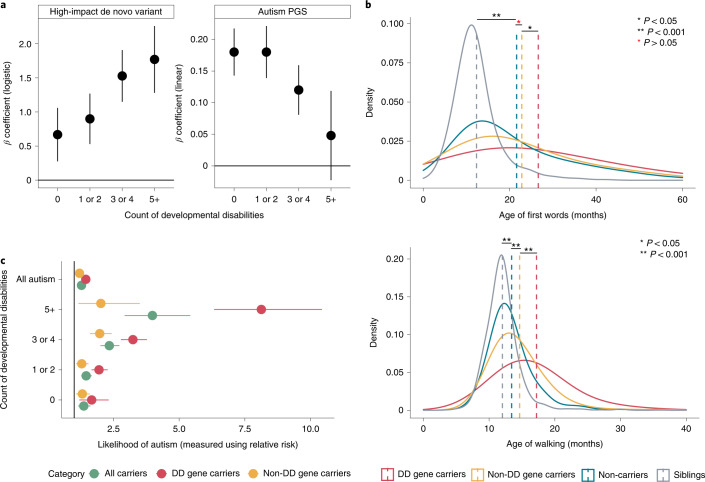
- Factor analysis of SCQ and RBS in 24,420 autistic individuals identified six correlated core autism factors (insistence on sameness, social interaction, sensory–motor behavior, self-injurious behavior, idiosyncratic repetitive speech/behavior, communication skills); common variant PGS were associated with core factors, but high-impact de novo variants were not.
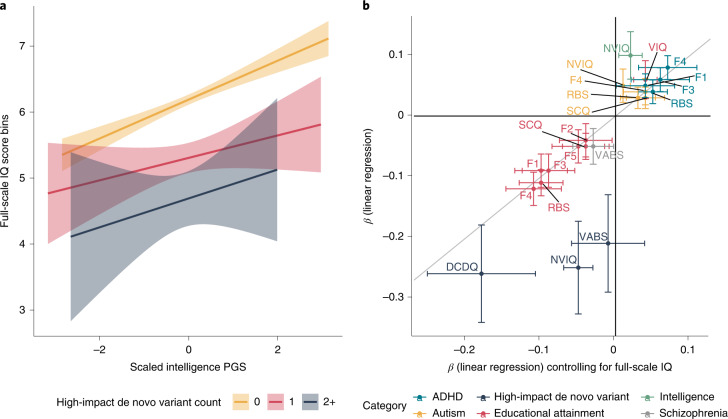
- Higher autism PGS were associated with reduced count of co-occurring developmental disabilities (βPGS = −0.037, s.e. = 0.009, P = 3.91 × 10⁻⁵, n = 13,435), whereas high-impact de novo variants increased them (βde novo = 0.31, s.e. = 0.05, P = 1.55 × 10⁻⁸, n = 3,089).
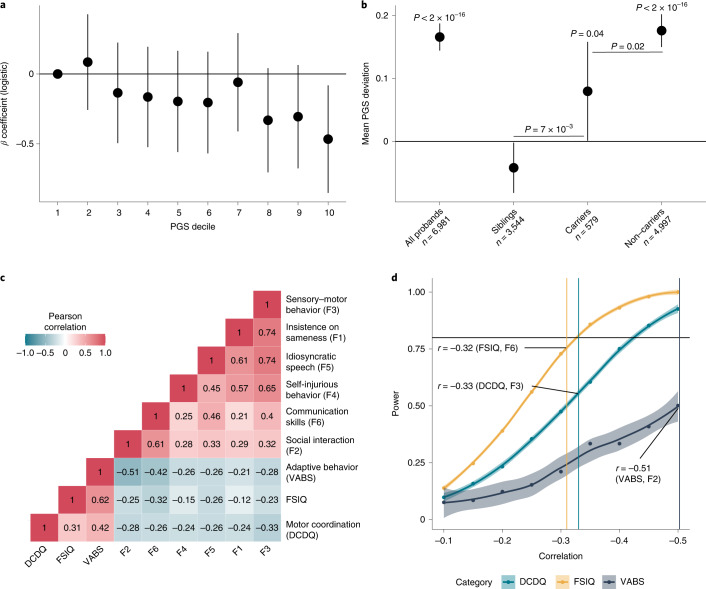
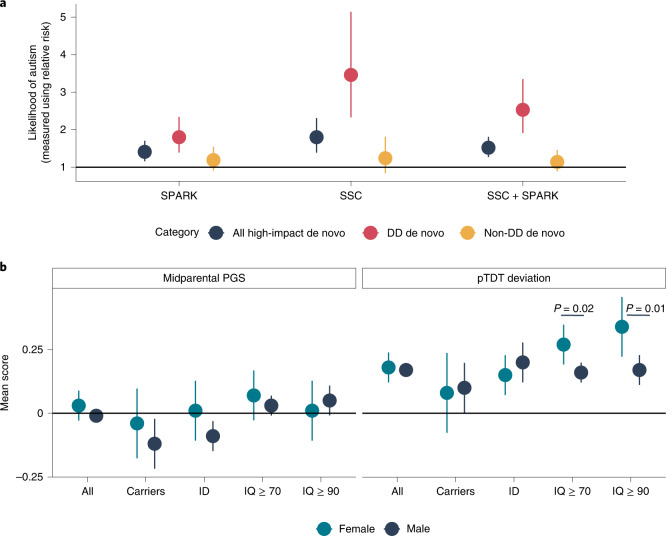
- In autistic individuals without ID, autism PGS were overtransmitted in females ~75% more than males (P = 0.02); after excluding borderline intellectual functioning, females had double the overtransmission (females mean = 0.34, s.e. = 0.06, n = 276; males mean = 0.17, s.e. = 0.03, n = 1,328; P = 0.01).
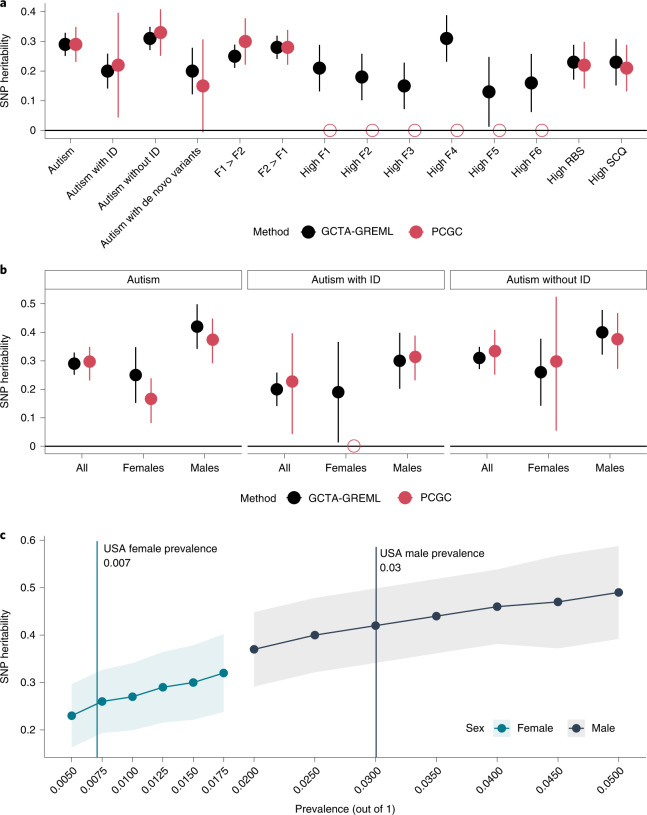
- SNP heritability for autism was h2SNP = 0.29 (GCTA s.e. = 0.02; PCGC s.e. = 0.03), higher in males than females (~70% higher, P = 9.3 × 10⁻³) and higher in autistic individuals without ID than with ID (P = 1.6 × 10⁻³).
Methods
- Combined genetic and phenotypic data from up to 12,893 autistic individuals across SSC, AGRE, AIMS-2-TRIALS LEAP, and SPARK, plus siblings and trios; factor analyses used SCQ and RBS in 24,420 autistic individuals from SSC/SPARK.
- Genetic analyses tested PGS for autism, intelligence, educational attainment, ADHD, schizophrenia, and hair color negative control, and high-impact de novo variants (protein-truncating SNVs/SVs and missense MPC >2 in constrained genes LOEUF <0.37) against 19 core/associated features; used regression, inverse-variance meta-analysis, pTDT, and GREML/PCGC SNP heritability with ABCD population controls.
- Multiple testing corrected with Benjamini–Yekutieli FDR; genetic analyses restricted to European-ancestry individuals passing QC.
Limitations
- Stated: cannot distinguish the female protective effect from diagnostic bias; the negative correlation between high-impact de novo variants and autism PGS may not extend to the general population because only autistic individuals were studied; underpowered (<80%) to detect high-impact de novo variant associations with core autism features.
- Stated: SNP heritability may be affected by fine-scale population stratification, genotyping array differences, and participation bias, though the focus is on subgroup differences.
- Evident: cross-sectional design and caregiver-report measures; the authors note the social interaction factor trajectory likely reflects recall bias, and genetic analyses were restricted to European ancestry, limiting generalizability.
Model-written summary. Check it against the paper before relying on it.
Integrity signals
Registry
Cites
Statistics
Figures
Verification
Claims the paper makes
11 Valid · 2 Not valid · 19 Not checked · 105 Own results and interpretations
Some cited sources support this claim and some don’t — read each source’s verdict below.
In the paper
“yet neither have stratified by ID.”
§ Genetic correlates of phenotypic heterogeneity in autism > Results > Sex differences in common and high-impact de novo variants
What the sources say
- Supportedcites [19] Antaki, D. et al. A phenotypic spectrum of autism is attributable to the combined effects of rare variants, polygenic risk and sex. Nat. Genet.10.1038/s41588-022-01064-5 (2022). PMC9474668 35654974 source
The Methods sections on datasets and behavioral traits describe analyses by case status, cohort, ancestry and sex, but not by intellectual disability (ID). The Results section on behavioral traits likewise lists sex interactions, not ID-stratified analyses. This confirms the claim as it applies to the cited study; this source cannot establish what the other study did. (LLM, conf=0.84)
- Disputedcites [49] Wigdor, E. M. et al. The female protective effect against autism spectrum disorder. Preprint at medRxiv10.1101/2021.03.29.21253866 (2021). sourceExperimental — accuracy not yet measured
The FPE and Sibling Recurrence section says the authors stratified ASD cases by the presence or absence of co-diagnosed intellectual disability. If this paper is one of the two studies meant by “neither,” the claim is contrary to its reported analysis. (LLM, conf=0.90)
Checked by a reasoning model — may be wrong.
plain- Asserted: passes — The authors put it forward as true.
- Checkable: passes — It can be checked against evidence.
- Load-bearing: passes — The paper’s conclusions depend on it.
- Based: passes — The paper gives a reason why it holds.
- Supported
The cited sources support only part of this claim — read each source’s verdict below.
In the paper
“First, existing studies investigating genotype–phenotype associations have been limited to summed scores of core autism features in smaller sample sizes19–21 rather than the underlying latent dimensions.”
§ Genetic correlates of phenotypic heterogeneity in autism > Main
What the sources say
- Partly supportedcites [19] Antaki, D. et al. A phenotypic spectrum of autism is attributable to the combined effects of rare variants, polygenic risk and sex. Nat. Genet.10.1038/s41588-022-01064-5 (2022). PMC9474668 35654974 sourceExperimental — accuracy not yet measured
The Methods section, “Effects of genetic factors on behavioral traits” (page unavailable), says the study tested questionnaire summary scores rather than underlying latent dimensions. But it also included adaptive behavior and motor coordination, not just core autism features. The available text does not establish the claimed smaller sample size; the Results report 37,375 individuals in the overall genetic analysis. (LLM, conf=0.84)
- Partly supportedcites [20] Buja A Damaging de novo mutations diminish motor skills in children on the autism spectrum Proc. Natl Acad. Sci. USA 2018 115 E1859 E1866 10.1073/pnas.1715427115 29434036 PMC5828599 sourceExperimental — accuracy not yet measured
The Methods section lists total scores and other established measures of core autism features, rather than latent dimensions, and reports 2,446 affected children with exome data. But it also says the supplementary analyses examined underlying instrument items, so the study was not strictly limited to summed scores. The paper does not establish that its sample was smaller than the citing study’s. (LLM, conf=0.86)
- Supportedcites [21] Bishop SL Identification of developmental and behavioral markers associated with genetic abnormalities in autism spectrum disorder Am. J. Psychiatry 2017 174 576 585 10.1176/appi.ajp.2017.16101115 28253736 PMC5578709 source
The Methods (Measures; page unavailable) say the study measured core autism features using ADI-R domain total scores, ADOS domain scores, and an overall SRS total score, rather than latent dimensions. The Methods (Genetic Data and Participants; page unavailable) report a matched analysis of 112 probands with high-confidence genetic abnormalities and 112 controls. The paper thus exemplifies the type of study described, though it does not establish that all earlier studies shared those limitations. (LLM, conf=0.88)
plain- Asserted: passes — The authors put it forward as true.
- Checkable: passes — It can be checked against evidence.
- Load-bearing: passes — The paper’s conclusions depend on it.
- Based: passes — The paper gives a reason why it holds.
- Partly supported
The cited sources support only part of this claim — read each source’s verdict below.
In the paper
“Heterogeneity in autism can arise from multiple, partly overlapping sources. This includes differences in core diagnostic features (core features)1,3,4 and associated features such as IQ, adaptive behavior and motor coordination, all of which have an impact on life outcomes3,5,6.”
§ Genetic correlates of phenotypic heterogeneity in autism > Main
What the sources say
- Not checked yetcites [1] Lai M-C Lombardo MV Baron-Cohen S Autism Lancet 2013 383 896 910 10.1016/S0140-6736(13)61539-1 24074734 source
- Supportedcites [3] Lord C Autism spectrum disorder Nat. Rev. Dis. Primers 2020 6 5 10.1038/s41572-019-0138-4 31949163 PMC8900942 source
The Introduction describes ASD as heterogeneous, and Diagnosis, screening and prevention identifies variation across its core diagnostic features. Figure 2 describes heterogeneity in symptom severity, intellectual functioning and daily living skills; Co-occurring disorders identifies motor problems as an associated difficulty. These passages support the attributed description of multiple sources of heterogeneity. (LLM, conf=0.87)
- Partly supportedcites [4] Geschwind DH Advances in autism Annu. Rev. Med. 2009 60 367 380 10.1146/annurev.med.60.053107.121225 19630577 PMC3645857 sourceExperimental — accuracy not yet measured
The Introduction (page unavailable) describes variation in core diagnostic features and IQ among autistic people, and identifies motor abnormalities as common associated features. Our copy does not identify adaptive behavior as a source of heterogeneity or establish that each listed feature affects life outcomes. (LLM, conf=0.84)
- Partly supportedcites [5] Mandell DS Novak MM Zubritsky CD Factors associated with age of diagnosis among children with autism spectrum disorders Pediatrics 2005 116 1480 1486 10.1542/peds.2005-0185 16322174 PMC2861294 sourceExperimental — accuracy not yet measured
The Results and Discussion describe differences among ASD subtypes in symptoms and intellectual functioning, which support part of the heterogeneity claim. The Discussion says IQ was not measured beyond the presence of intellectual disability; our copy does not establish adaptive behavior or motor coordination as sources of heterogeneity, or link these features to life outcomes. (LLM, conf=0.82)
- Not checked yetcites [6] Kanne SM The role of adaptive behavior in autism spectrum disorders: implications for functional outcome J. Autism Dev. Disord. 2011 41 1007 1018 10.1007/s10803-010-1126-4 21042872 source
plainstates a cause- Asserted: passes — The authors put it forward as true.
- Checkable: passes — It can be checked against evidence.
- Load-bearing: passes — The paper’s conclusions depend on it.
- Based: passes — The paper gives a reason why it holds.
Every source the paper cites for this claim was checked and supports it.
In the paper
“However, of the 21 items in the ‘social interaction’ factor, 19 specifically ask about behavior between the ages 4 and 5 years (Methods), and this trajectory likely reflects recall bias, as caregivers are likely to report more severe behaviors retrospectively33.”
§ Genetic correlates of phenotypic heterogeneity in autism > Results > Identifying latent phenotypes in core autism features
What the sources say
- Supportedcites [33] Jones RM How interview questions are placed in time influences caregiver description of social communication symptoms on the ADI-R J. Child Psychol. Psychiatry 2015 56 577 585 10.1111/jcpp.12325 25243378 PMC4369461 source
In Results (Study 3), caregivers rated children’s age-5 symptoms as more severe when recalling them at age 10 than they had when the children were age 5. The Discussion identifies time-dependent recall of symptom severity as a concern for age-related analyses of retrospective ADI-R items; the particular trajectory is the citing authors’ interpretation. (LLM, conf=0.91)
hedgedstates a possible cause- Asserted: passes — The authors put it forward as true.
- Checkable: passes — It can be checked against evidence.
- Load-bearing: unclear — It is unclear whether the paper’s conclusions depend on it.
- Based: passes — The paper gives a reason why it holds.
- Supported
Every source the paper cites for this claim was checked and supports it.
In the paper
“We ran sensitivity analyses using a larger but overlapping list of genes identified from a highly curated database, Developmental Disorder Gene-to-Phenotype45, and identified consistent results (Supplementary Tables 14 and 15).”
§ Genetic correlates of phenotypic heterogeneity in autism > Results > Autism PGS and co-occurring developmental disabilities
What the sources say
- Supportedcites [45] Thormann A Flexible and scalable diagnostic filtering of genomic variants using G2P with Ensembl VEP Nat. Commun. 2019 10 2373 10.1038/s41467-019-10016-3 31147538 PMC6542828 source
The citation identifies the Developmental Disorder Gene-to-Phenotype gene resource used by the citing authors. The Introduction describes DDG2P as a database of known causative developmental-disorder loci, and Methods (LGMDET) describes its clinical and literature-based curation. The sensitivity analyses and consistent results are the citing authors’ own findings, not claims attributed to this source. (LLM, conf=0.92)
plain- Asserted: passes — The authors put it forward as true.
- Checkable: passes — It can be checked against evidence.
- Load-bearing: unclear — It is unclear whether the paper’s conclusions depend on it.
- Based: passes — The paper gives a reason why it holds.
- Supported
79 more claims · 4 with their cited sources checked
Create a free account to see all 137 claims and to verify the 34 references still open.
- It may state two separate claims as one. 38
- Probably not a substantial claim. 20
Claims other papers make about this one
Each is checked against this paper’s own text: does it say what the citing paper says it does?
The cited source says what the claim attributes to it.
In the citing paper
“Polygenic scores for autism, based on the weighted sum of susceptibility alleles present, are increased in autistic females without intellectual disabilities229, in non-autistic mothers and female siblings228, and in mothers with broader subdiagnostic autism phenotypes233.”
From Sex and gender in neurodevelopmental conditions (2023) · cites this paper as [229]
The cited source says what the claim attributes to it.
In the citing paper
“A higher autism polygenic score (PGS) is linked to a lower likelihood of co-occurring developmental disabilities.”
From The Gut–Brain–Microbiota Connection and Its Role in Autism Spectrum Disorders (2025) · cites this paper as [10]
The check wasn’t confident either way, so it gives no verdict — never disputed.
In the citing paper
“Higher autism prevalence (compared with that in the general population) occurs among individuals who have a close autistic female relative and the likelihood of autism increases in later-born offspring siblings of autistic females, compared with autistic males (known as the Carter effect)227–229.”
From Sex and gender in neurodevelopmental conditions (2023) · cites this paper as [229]
Experimental — accuracy not yet measuredThe check wasn’t confident either way, so it gives no verdict — never disputed.
In the citing paper
“Studies investigating the so-called female protective effect in autism have used partly overlapping samples, and independent replication is therefore required225,227–229,236.”
From Sex and gender in neurodevelopmental conditions (2023) · cites this paper as [229]
Experimental — accuracy not yet measuredIn the citing paper
“Molecular genetic studies indicate that autistic females carry more common genetic variants associated with autism than autistic males.”
From Sex and gender in neurodevelopmental conditions (2023) · cites this paper as [229]
3 more claims about this paper
Create a free account to see every claim other papers make about this one.
Self-check
Percentages, sums and reported differences re-computed from the paper’s own numbers.
Each contradiction between two passages listed here was confirmed by an independent check.
Rated minor: it would not touch a result — a value no result rests on, a p-value that stays on the same side of the significance level, or a conflict that is clerical, resolved elsewhere in the paper, or outside its own findings.
In the paper
§ Genetic correlates of phenotypic heterogeneity in autism > Abstract
“genetic differences between autistic individuals (nmax = 12,893)”
§ Genetic correlates of phenotypic heterogeneity in autism > Results > Autism PGS and co-occurring developmental disabilities
“higher PGS for autism was associated with reduced count of co-occurring developmental disabilities (βPGS = −0.037, s.e. = 0.009, P = 3.91 × 10⁻⁵, n = 13,435, quasi-Poisson regression)”
Rated minor: it would not touch a result — a value no result rests on, a p-value that stays on the same side of the significance level, or a conflict that is clerical, resolved elsewhere in the paper, or outside its own findings.
In the paper
§ Genetic correlates of phenotypic heterogeneity in autism > Methods > Genetic analyses
“SNPs with genotyping rate <10% were excluded, or they were excluded if they deviated from Hardy–Weinberg equilibrium (P < 1 × 10⁻⁶).”
§ Genetic correlates of phenotypic heterogeneity in autism > Methods > Heritability analyses
“we excluded multi-allelic SNPs and SNPs with minor allele frequency difference of >5% between the three datasets and, in the combined dataset, were not in Hardy–Weinberg equilibrium (P > 1 × 10⁻⁶) or had genotyping rate <99%.”
Rated minor: it would not touch a result — a value no result rests on, a p-value that stays on the same side of the significance level, or a conflict that is clerical, resolved elsewhere in the paper, or outside its own findings.
In the paper
§ Genetic correlates of phenotypic heterogeneity in autism > Methods > Factor analyses
“nine items from the SCQ”
§ Genetic correlates of phenotypic heterogeneity in autism > Methods > Factor analyses
“(items 8, 11, 12 and 14–18)”
Rated minor: it would not touch a result — a value no result rests on, a p-value that stays on the same side of the significance level, or a conflict that is clerical, resolved elsewhere in the paper, or outside its own findings.
In the paper
§ Genetic correlates of phenotypic heterogeneity in autism > Methods > Genetic analyses
“PGS were generated for three phenotypes using polygenic risk scoring with continuous shrinkage (PRS-CS)84”
§ Genetic correlates of phenotypic heterogeneity in autism > Results > Common genetic variants are associated with core autism features
“PGS for autism, ADHD, schizophrenia, educational attainment and intelligence”
Citations
Cites
Diagnostic and Statistical Manual of Mental Disorders
American Psychiatric Association (2013) · doi:10.1176/appi.books.9780890425596 · Cited by 116,369
lavaan : An R Package for Structural Equation Modeling
Rosseel, Y. (2012) · Journal of Statistical Software · doi:10.18637/jss.v048.i02 · Cited by 27,955
A global reference for human genetic variation
The 1000 Genomes Project Consortium, authors, C., Auton, A., Abecasis, G. R., Steering committee, Altshuler, D. M., Durbin, R. M., Abecasis, G. R., Bentley, D. R., Chakravarti, A., et al. (2015) · Nature · doi:10.1038/nature15393 · Cited by 18,247
Self-citationUMAP: Uniform Manifold Approximation and Projection
McInnes, L., Healy, J., Saul, N., & Großberger, L. (2018) · Journal of Open Source Software · doi:10.21105/joss.00861 · Cited by 9,826
Lord, C., Rutter, M., & Le Couteur, A. (1994) · Journal of Autism and Developmental Disorders · doi:10.1007/bf02172145 · Cited by 9,065
GCTA: a tool for genome-wide complex trait analysis
Yang, J., Lee, S. H., Goddard, M. E., & Visscher, P. M. (2011) · The American Journal of Human Genetics · doi:10.1016/j.ajhg.2010.11.011 · Cited by 8,279
Baio, J., Wiggins, L., Christensen, D. L., Maenner, M. J., Daniels, J., Warren, Z., Kurzius-Spencer, M., Zahorodny, W., Robinson, C., Rosenberg, et al. (2018) · MMWR. Surveillance Summaries · doi:10.15585/mmwr.ss6706a1 · Cited by 6,078
Common SNPs explain a large proportion of the heritability for human height
Yang, J., Benyamin, B., McEvoy, B. P., Gordon, S., Henders, A. K., Nyholt, D. R., Madden, P. A., Heath, A. C., Martin, N. G., Montgomery, G. W., et al. (2010) · Nature Genetics · doi:10.1038/ng.608 · Cited by 4,446
Next-generation genotype imputation service and methods
Das, S., Forer, L., Schönherr, S., Sidore, C., Locke, A. E., Kwong, A., Vrieze, S. I., Chew, E. Y., Levy, S., McGue, M., et al. (2016) · Nature Genetics · doi:10.1038/ng.3656 · Cited by 3,808
Maenner, M. J., Shaw, K. A., Baio, J., EdS1, Washington, A., Patrick, M., DiRienzo, M., Christensen, D. L., Wiggins, L. D., Pettygrove, S., et al. (2020) · MMWR. Surveillance Summaries · doi:10.15585/mmwr.ss6904a1 · Cited by 3,780
Cited by
Sex and gender in neurodevelopmental conditions
Bölte, S., Neufeld, J., Marschik, P. B., Williams, Z. J., Gallagher, L., & Lai, M.-C. (2023) · Nature Reviews Neurology · doi:10.1038/s41582-023-00774-6 · Cited by 249
Self-citationGenomic findings in schizophrenia and their implications
Owen, M. J., Legge, S. E., Rees, E., Walters, J. T. R., & O’Donovan, M. C. (2023) · Molecular Psychiatry · doi:10.1038/s41380-023-02293-8 · Cited by 180
“…carriers who present with schizophrenia also have an elevated burden of common risk alleles for the disorder [108 – 110] while rare coding variant carriers with ASD have elevated burdens of common risk alleles for ASD and this associates differentially with the observed phenotypic features [111].”
BackgroundRobust estimation of cortical similarity networks from brain MRI
Sebenius, I., Seidlitz, J., Warrier, V., Bethlehem, R. A. I., Alexander‐Bloch, A. F., Mallard, T. T., Romero-García, R., Bullmore, E. T., & Morgan, S. E. (2023) · Nature Neuroscience · doi:10.1038/s41593-023-01376-7 · Cited by 184
Self-citationThe contributions of rare inherited and polygenic risk to ASD in multiplex families
Cirnigliaro, M., Chang, T. S., Arteaga, S. A., Pérez‐Cano, L., Ruzzo, E. K., Gordon, A., Bicks, L. K., Jung, J.-Y., Lowe, J. K., Wall, D. P., et al. (2023) · Proceedings of the National Academy of Sciences · doi:10.1073/pnas.2215632120 · Cited by 151
Self-citationDecomposition of phenotypic heterogeneity in autism reveals underlying genetic programs
Litman, A., Sauerwald, N., Snyder, L. G., Foss‐Feig, J. H., Park, C. Y., Hao, Y., Dinstein, I., Theesfeld, C. L., & Troyanskaya, O. G. (2025) · Nature Genetics · doi:10.1038/s41588-025-02224-z · Cited by 161
The Foundations of Autistic Flourishing
Pellicano, E., & Heyworth, M. (2023) · Current Psychiatry Reports · doi:10.1007/s11920-023-01441-9 · Cited by 115
Phenotypic effects of genetic variants associated with autism
Rolland, T., Cliquet, F., Anney, R., Moreau, C. A., Traut, N., Mathieu, A., Huguet, G., Duan, J., Warrier, V., Portalier, S., et al. (2023) · Nature Medicine · doi:10.1038/s41591-023-02408-2 · Cited by 108
Self-citationWarrier, V., Stauffer, E.-M., Huang, Q. Q., Wigdor, E. M., Slob, E. A. W., Seidlitz, J., Ronan, L., Valk, S. L., Mallard, T. T., Grotzinger, A. D., et al. (2023) · Nature Genetics · doi:10.1038/s41588-023-01475-y · Cited by 91
Self-citationMental health challenges faced by autistic people
Lai, M. (2023) · Nature Human Behaviour · doi:10.1038/s41562-023-01718-2 · Cited by 99
Self-citationDougherty, J. D., Marrus, N. M., Maloney, S. E., Yip, B. H. K., Sandin, S., Turner, T. N., Selmanovic, D., Kroll, K. L., Gutmann, D. H., Constantino, J. N., et al. (2022) · Neuron · doi:10.1016/j.neuron.2022.06.020 · Cited by 90
Genetic architecture of childhood speech disorder: a review
Morgan, A. T., Amor, D. J., John, M. S., Scheffer, I. E., & Hildebrand, M. S. (2024) · Molecular Psychiatry · doi:10.1038/s41380-024-02409-8 · Cited by 50
Mouse population genetics phenocopies heterogeneity of human Chd8 haploinsufficiency
Tabbaa, M., Knoll, A., & Levitt, P. (2023) · Neuron · doi:10.1016/j.neuron.2023.01.009 · Cited by 45
Chromosome X-wide common variant association study in autism spectrum disorder
de Aquino, M. M., Chen, D., Engchuan, W., Leal, T. P., Thiruvahindrapuram, B., Trost, B., Howe, J., Pellecchia, G., Nalpathamkalam, T., Alexandrova, R., et al. (2024) · The American Journal of Human Genetics · doi:10.1016/j.ajhg.2024.11.008 · Cited by 53
Self-citationThe Gut–Brain–Microbiota Connection and Its Role in Autism Spectrum Disorders
Młynarska, E., Barszcz, E., Budny, E., Gajewska, A., Kopeć, K., Wasiak, J., Rysz, J., & Franczyk, B. (2025) · Nutrients · doi:10.3390/nu17071135 · Cited by 44
“Additionally, nearly half of the individuals with CNVs who did not meet the full diagnostic criteria for ASD exhibited elevated autistic traits, suggesting a continuum between the autism spectrum and the general population [9,10].”
Kim, S.-W., Lee, H., Song, D. Y., Lee, G., Ji, J., Park, J. W., Han, J. H., Lee, J., Byun, H. J., Son, J. H., et al. (2024) · Genome Medicine · doi:10.1186/s13073-024-01385-6 · Cited by 43
Self-citationPolit, L. D., Eidhof, I., McNeill, R. V., Warre-Cornish, K. M., Ohki, C. M. Y., Walter, N. M., Sala, C., Verpelli, C., Radtke, F., Galderisi, S., et al. (2023) · Neuroscience Applied · doi:10.1016/j.nsa.2023.101125 · Cited by 35
Self-citationGodel, M., Robain, F., Kojovic, N., Franchini, M., de Wilde, H. W., & Schaer, M. (2022) · Frontiers in Psychiatry · doi:10.3389/fpsyt.2022.835580 · Cited by 36
More, R. P., Warrier, V., Brunel, H., Buckingham, C., Smith, P. L., Allison, C. L., Holt, R., Bradshaw, C. R., & Baron‐Cohen, S. (2023) · Molecular Psychiatry · doi:10.1038/s41380-022-01938-4 · Cited by 26
Self-citationDigital interventions for autism spectrum disorders: A systematic review and meta‐analysis
Wang, T., Ma, Y., Du, X., Li, C., Peng, Z., Wang, Y., & Zhou, H. (2024) · Pediatric Investigation · doi:10.1002/ped4.12417 · Cited by 41
Rethinking Our Concepts and Assumptions About Autism
Lombardo, M. V., & Mandelli, V. (2022) · Frontiers in Psychiatry · doi:10.3389/fpsyt.2022.903489 · Cited by 31
Functional neurogenomics in autism spectrum disorders: A decade of progress
Bicks, L. K., & Geschwind, D. H. (2024) · Current Opinion in Neurobiology · doi:10.1016/j.conb.2024.102858 · Cited by 33
Self-citationBidirectional genetic overlap between autism spectrum disorder and cognitive traits
Hope, S., Shadrin, A. A., Lin, A., Bahrami, S., Rødevand, L. N., Frei, O., Hübenette, S. J., Cheng, W., Hindley, G., Nag, H. E., et al. (2023) · Translational Psychiatry · doi:10.1038/s41398-023-02563-7 · Cited by 30
A comprehensive analysis towards exploring the promises of AI-related approaches in autism research
Pandya, S., Jain, S., & Verma, J. P. V. (2023) · Computers in Biology and Medicine · doi:10.1016/j.compbiomed.2023.107801 · Cited by 37
Contribution of autosomal rare and de novo variants to sex differences in autism
Koko, M., Satterstrom, F. K., Aleksić, B., Artomov, M., Barbosa, M., Benetti, E., Betancur, C., Biscaldi-Schafer, M., Børglum, A. D., Brand, H., et al. (2025) · The American Journal of Human Genetics · doi:10.1016/j.ajhg.2025.01.016 · Cited by 23
Self-citationProfiles of minimally verbal autistic children: Illuminating the neglected end of the spectrum
Pizzano, M., Shire, S. Y., Shih, W., Levato, L., Landa, R. J., Lord, C., Smith, T. H., & Kasari, C. L. (2024) · Autism Research · doi:10.1002/aur.3151 · Cited by 26
Vitrac, A., Leblond, C. S., Rolland, T., Cliquet, F., Mathieu, A., Maruani, A., Delorme, R., Schön, M., Grabrucker, A. M., van Ravenswaaij‐Arts, C. M. A., et al. (2023) · European Journal of Medical Genetics · doi:10.1016/j.ejmg.2023.104732 · Cited by 24
Self-citationRecognising and responding to physical and mental health issues in neurodivergent girls and women
Kelly, C. A., Martin, R., Taylor, R., & Doherty, M. (2024) · British Journal of Hospital Medicine · doi:10.12968/hmed.2023.0337 · Cited by 29
A Genetic Bridge Between Medicine and Neurodiversity for Autism
Leblond, C. S., Rolland, T., Barthome, E., Mougin, Z., Fleury, M., Ecker, C., Bonnot-Briey, S., Cliquet, F., Tabet, A., Maruani, A., et al. (2024) · Annual Review of Genetics · doi:10.1146/annurev-genet-111523-102614 · Cited by 24
Self-citationHalliday, A. R., Vucic, S. N., Georges, B., LaRoche, M., Mendoza Pardo, M. A., Swiggard, L. O., McDonald, K., Olofsson, M., Menon, S. N., Francis, S. M., et al. (2024) · Frontiers in Psychiatry · doi:10.3389/fpsyt.2024.1474003 · Cited by 20
“However, autistic individuals have substantial genotypic as well as phenotypic variability (17).”
BackgroundStott, J., WRIGHT, T. E., Holmes, J., Wilson, J. C., Griffiths‐Jones, S., Foster, D., & Wright, B. (2023) · PLoS ONE · doi:10.1371/journal.pone.0287131 · Cited by 24
Kim, H., Kim, D., Cho, Y., Kim, K., Roh, J. D., Kim, Y., Yang, E., Kim, S. S., Ahn, S., Kim, H., et al. (2022) · Nature Communications · doi:10.1038/s41467-022-32748-5 · Cited by 22
Self-citationThe genetics of autism and steroid-related traits in prenatal and postnatal life
Tsompanidis, A., Warrier, V., & Baron‐Cohen, S. (2023) · Frontiers in Endocrinology · doi:10.3389/fendo.2023.1126036 · Cited by 22
Self-citationAutism under the umbrella of ESSENCE
Fernell, E., & Gillberg, C. (2023) · Frontiers in Psychiatry · doi:10.3389/fpsyt.2023.1002228 · Cited by 21
Genetic advances in neurodevelopmental disorders
Gao, S., Shan, C., Zhang, R., & Wang, T. (2024) · Medical Review · doi:10.1515/mr-2024-0040 · Cited by 31
The Importance of Large-Scale Genomic Studies to Unravel Genetic Risk Factors for Autism
Nóbrega, I. D. S., Silva, A. L. T. E., Yokota-Moreno, B. Y., & Sertie, A. L. (2024) · International Journal of Molecular Sciences · doi:10.3390/ijms25115816 · Cited by 19
Kisaretova, P., Tsybko, A., Bondar, N., & Reshetnikov, V. (2023) · Biomedicines · doi:10.3390/biomedicines11020289 · Cited by 13
The DCIDE framework: systematic investigation of evolutionary hypotheses, exemplified with autism
Hunt, A., & Jaeggi, A. V. (2025) · Biological reviews/Biological reviews of the Cambridge Philosophical Society · doi:10.1111/brv.70010 · Cited by 17
Interactions of genetic risks for autism and the broad autism phenotypes
Dong, L., Wang, Y., Wang, X., Luo, T., Zhou, Q., Zhao, G., Li, B., Xia, L., Xia, K., & Li, J. (2023) · Frontiers in Psychiatry · doi:10.3389/fpsyt.2023.1110080 · Cited by 14
Peter, B., Bruce, L., Finestack, L. H., Dinu, V., Wilson, M. A., Klein‐Seetharaman, J., Lewis, C. R., Braden, B. B., Tang, Y., Scherer, N. J., et al. (2023) · American Journal of Speech-Language Pathology · doi:10.1044/2023_ajslp-22-00205 · Cited by 15
Structural models of genome-wide covariance identify multiple common dimensions in autism
de Hoyos, L., Barendse, M. T., Schlag, F., van Donkelaar, M. M. J., Verhoef, E., Shapland, C. Y., Klassmann, A., Buitelaar, J. K., Verhulst, B., Fisher, S. E., et al. (2024) · Nature Communications · doi:10.1038/s41467-024-46128-8 · Cited by 12
Steroid hormone pathways, vitamin D and autism: a systematic review
Amestoy, A., Baudrillard, C., Briot, K., Pizano, A., Bouvard, M. P., & Lai, M. (2023) · Journal of Neural Transmission · doi:10.1007/s00702-022-02582-6 · Cited by 16
Self-citationAutism Spectrum Disorder: What Do We Know and Where Do We Go?
Leisman, G., & Melillo, R. J. (2025) · Brain Sciences · doi:10.3390/brainsci15091010 · Cited by 25
Systematic Review and Meta-Analysis: Phenotypic Correlates of the Autism Polygenic Score
de Wit, M. M., MORGAN, M., Libedinsky, I., Austerberry, C., Begeer, S., Abdellaoui, A., Ronald, A., & Polderman, T. J. C. (2025) · JAACAP Open · doi:10.1016/j.jaacop.2025.04.001 · Cited by 17
Reduced precision of motor and perceptual rhythmic timing in autistic adults
Cannon, J. J., Cardinaux, A. L., Bungert, L., Li, C. E., & Sinha, P. (2024) · Heliyon · doi:10.1016/j.heliyon.2024.e34261 · Cited by 16
Mundy, P. C. (2023) · Autism Research · doi:10.1002/aur.2910 · Cited by 13
Improving prenatal diagnosis through standards and aggregation
Duyzend, M., Cacheiro, P., Jacobsen, J. O. B., Giordano, J. L., Brand, H., Wapner, R. J., Talkowski, M. E., Robinson, P. N., & Smedley, D. P. (2024) · Prenatal Diagnosis · doi:10.1002/pd.6522 · Cited by 11
Enhanced motor noise in an autism subtype with poor motor skills
Mandelli, V., Landi, I., Ceccarelli, S. B., Molteni, M., Nobile, M., D’Ausilio, A., Fadiga, L., Crippa, A., & Lombardo, M. V. (2024) · Molecular Autism · doi:10.1186/s13229-024-00618-0 · Cited by 13
Cullin-RING Ubiquitin Ligases in Neurodevelopment and Neurodevelopmental Disorders
Ashitomi, H., Nakagawa, T., Nakagawa, M., & Hosoi, T. (2025) · Biomedicines · doi:10.3390/biomedicines13040810 · Cited by 10
Autism: A model of neurodevelopmental diversity informed by genomics
Chawner, S. J. R. A., & Owen, M. J. (2022) · Frontiers in Psychiatry · doi:10.3389/fpsyt.2022.981691 · Cited by 20
Lee, I., Koelliker, E. L., & Kong, S. W. (2022) · Translational Psychiatry · doi:10.1038/s41398-022-02179-3 · Cited by 11
Cahalan, S., Mitroff, S. R., Subiaul, F., & Rosenblau, G. (2025) · Personality Neuroscience · doi:10.1017/pen.2025.10002 · Cited by 14
Lombardi, L., Clerc, S. L., Wu, C., Bouassida, J., Boukouaci, W., Sugusabesan, S., Richard, J., Lajnef, M., Tison, M., Corvoisier, P. L., et al. (2023) · Translational Psychiatry · doi:10.1038/s41398-023-02550-y · Cited by 13
Self-citationKosidou, K., Karlsson, H., Arver, S., Bhasin, S., Dalman, C., & Gardner, R. M. (2024) · Biological Psychiatry · doi:10.1016/j.biopsych.2024.02.1014 · Cited by 15
Gu, Y., Stauffer, E.-M., Bedford, S. A., Adhya, D., Allison, C. L., Auyeung, B., Bamford, R., Bethlehem, R. A. I., Biron‐Shental, T., Burton, G. J., et al. (2025) · Molecular Psychiatry · doi:10.1038/s41380-025-02927-z · Cited by 15
Self-citationDiagnostic yield of clinical exome sequencing in 868 children with neurodevelopmental disorders
Neuens, S., Soblet, J., Penninckx, A., Detry, C., Badoer, C., Desmyter, L., Peyrassol, X., Wilkin, F., Busson, A., Bruneau, M., et al. (2025) · European Journal of Medical Genetics · doi:10.1016/j.ejmg.2025.105030 · Cited by 17
Associations between the pupil light reflex and the broader autism phenotype in children and adults
Soker-Elimaliah, S., Lehrfield, A., Scarano, S. R., & Wagner, J. (2023) · Frontiers in Human Neuroscience · doi:10.3389/fnhum.2022.1052604 · Cited by 12
Polygenic and developmental profiles of autism differ by age at diagnosisPreprint
Zhang, X., Grove, J., Gu, Y., Buus, C. K., Nielsen, L. K., Neufeld, S., Koko, M., Malawsky, D. S., Wade, E. M., Verhoef, E., et al. (2024) · medRxiv · doi:10.1101/2024.07.31.24311279 · Cited by 9
Self-citationAdvancing precision diagnosis in autism: Insights from large-scale genomic studies
Kim, S.-W., & An, J. (2025) · Molecules and Cells · doi:10.1016/j.mocell.2025.100248 · Cited by 14
Hegemann, L., Corfield, E. C., Askelund, A. D., Allegrini, A. G., Askeland, R. B., Ronald, A., Ask, H., Pourcain, B. S., Andreassen, O. A., Hannigan, L. J., et al. (2024) · Molecular Autism · doi:10.1186/s13229-024-00599-0 · Cited by 9
Self-citationGenomic and Developmental Models to Predict Cognitive and Adaptive Outcomes in Autistic Children
Bourque, V.-R., Schmilovich, Z., Huguet, G., England, J., Okewole, A., Poulain, C., Renne, T., Jean‐Louis, M., Saci, Z., Zhang, X., et al. (2025) · Archives of Pediatrics and Adolescent Medicine · doi:10.1001/jamapediatrics.2025.0205 · Cited by 9
Self-citationTranscriptomic convergence and the female protective effect in autism
Andersen, R., Talukdar, M., Sakamoto, T., Exposito-Alonso, D., Song, J. H. T., Qian, X., Lee, S., Murugan, N., Delgado, R. N., Zhao, S., et al. (2026) · Nature · doi:10.1101/2025.01.20.634000 · Cited by 11
Hegemann, L., Askeland, R. B., Valand, S. B., Øyen, A., Schjølberg, S., Bal, V. H., Bishop, S. L., Stoltenberg, C., von Soest, T., Hannigan, L. J., et al. (2023) · Autism · doi:10.1177/13623613231219306 · Cited by 7
Self-citationUnderwood, J. F. G., Madley‐Dowd, P., Dardani, C., Hull, L., Kwong, A. S. F., Pearson, R. M., Hall, J., & Rai, D. (2026) · Psychological Medicine · doi:10.1017/s0033291726104267 · Cited by 9
Gupta, V. R., Ben‐Mahmoud, A., Idris, A. B., Hottenga, J., Habbab, W., Alsayegh, A., Kim, H., Al‐Mamari, W., & Stanton, L. W. (2024) · International Journal of Molecular Sciences · doi:10.3390/ijms252413700 · Cited by 11
The genetics of cortical organisation and development: a study of 2,347 neuroimaging phenotypesPreprint
Warrier, V., Stauffer, E.-M., Huang, Q.-Q., Wigdor, E., Slob, E., Seidlitz, J., Ronan, L., Valk, S., Mallard, T., Grotzinger, A., et al. (2022) · bioRxiv · doi:10.1101/2022.09.08.507084 · Cited by 7
Self-citationMolecular architecture of the altered cortical complexity in autism
Mamat, M., Chen, Y., Shen, W., & Li, L. (2025) · Molecular Autism · doi:10.1186/s13229-024-00632-2 · Cited by 8
The rare-to-common disease journey: a winding road to new therapies
Reinholdt, L. G., Chesler, E. J., Pera, M. F., & Rosenthal, N. A. (2025) · Trends in Genetics · doi:10.1016/j.tig.2025.05.003 · Cited by 10
Stratifying the autisms by a type I versus type II distinction in early development
Lombardo, M. V., Severino, I., & Mandelli, V. (2026) · Nature Mental Health · doi:10.1038/s44220-026-00603-x · Cited by 9
Nishizaki, S. S., Haghani, N. K., La, G. N., Mariano, N. A. F., Uribe‐Salazar, J. M., Kaya, G., Regester, M., Andrews, D. S., Nordahl, C. W., Amaral, D. G., et al. (2025) · Autism Research · doi:10.1002/aur.3314 · Cited by 6
Aivazidis, A., Memi, F., Rademaker, K., Koko, M., Roberts, K., Trinh, A. L., Petryszak, R., Kleshchevnikov, V., Tuck, E. J., Lisgo, S., et al. (2025) · bioRxiv (Cold Spring Harbor Laboratory) · doi:10.1101/2025.11.05.685843 · Cited by 7
Self-citationLee, H., Ko, K., Kim, S., Lee, G. Q., Kim, S., Lee, J., Song, D.-Y., Bong, G., Han, J. H., Lee, J., et al. (2026) · Genome biology · doi:10.1186/s13059-026-04041-x · Cited by 7
Self-citationOppenheimer, A. V., Weisskopf, M. G., & Lyall, K. (2023) · Journal of Autism and Developmental Disorders · doi:10.1007/s10803-023-06115-2 · Cited by 5
Decomposition of phenotypic heterogeneity in autism reveals distinct and coherent genetic programsPreprint
Litman, A., Sauerwald, N., Snyder, L. G., Foss‐Feig, J. H., Park, C. Y., Hao, Y., Dinstein, I., Theesfeld, C. L., & Troyanskaya, O. G. (2024) · medRxiv · doi:10.1101/2024.08.15.24312078 · Cited by 5
Charman, T., Bazelmans, T., Pasco, G., Ali, J. B., Johnson, M. H., Jones, E. J. H., & The BASIS/STAARS Team (2025) · Journal of Child Psychology and Psychiatry · doi:10.1111/jcpp.70048 · Cited by 5
Self-citationApplying biologically anchored subtypes to advance precision medicine in autism spectrum disorder
Choi, T.-Y., Gunawan, A., Seo, D., Park, J., Ahn, E. H., Suh, S. W., Fuccillo, M. V., & Choi, K. (2025) · Neurobiology of Disease · doi:10.1016/j.nbd.2025.107219 · Cited by 5
The inactive X chromosome as a female protector in autism and beyond
Talukdar, M., & Page, D. C. (2026) · Nature Genetics · doi:10.1038/s41588-026-02534-w · Cited by 8
Endophenotyping social cognition in the broader autism phenotype
Pua, E. P. K., Desai, T., Green, C. C., Trevis, K. J., Brown, N. J., Delatycki, M. B., Scheffer, I. E., & Wilson, S. J. (2023) · Autism Research · doi:10.1002/aur.3057 · Cited by 3
Liu, A., Cai, C., Wang, Z., Wang, B., He, J., Xie, Y., Deng, H., Liu, S., Zeng, S., Yin, Z., et al. (2022) · Metallomics · doi:10.1093/mtomcs/mfac091 · Cited by 6
Gu, Y., Stauffer, E.-M., Bedford, S. A., Romero-García, R., Grove, J., Børglum, A. D., Martin, H. C., Baron‐Cohen, S., Bethlehem, R. A. I., & Warrier, V. (2024) · medRxiv · doi:10.1101/2024.04.10.24305539 · Cited by 4
Self-citationCommon and Rare Variant Genetic Contributions in African Americans With AutismPreprint
Cirnigliaro, M., Lowe, J. K., Flynn-Carroll, A. O., Kumagai, M. E., Gibson, D. S., Williams, J. B., Fu, J. M., Dong, S., Hou, K., Pillalamarri, V., et al. (2025) · SSRN Electronic Journal · doi:10.1101/2025.11.18.25340532 · Cited by 4
Self-citationCormier, K. E., Kantor, B. L., Rajan, K. C., Blanco-Fernandez, X., & Galazo, M. J. (2025) · Frontiers in Neuroscience · doi:10.3389/fnins.2025.1605762 · Cited by 3
The prenatal sex steroid theory of autism after 25 years
Baron‐Cohen, S., Tsompanidis, A., Srivastava, D. P., Mill, J. S., Lancaster, M. A., Adhya, D., Adhya, D., Al-Rubaie, O., Allison, C. L., Auyeung, B., et al. (2026) · Nature Human Behaviour · doi:10.1038/s41562-026-02437-0 · Cited by 4
Self-citationThe proportion of intellectual disability in autism spectrum disorder over two decades
Salkić, A., Tideman, M., Martini, M. I., Larsson, H., Lichtenstein, P., Chang, Z., D'Onofrio, B. M., Brikell, I., Kuja‐Halkola, R., Knez, R., et al. (2026) · Psychiatry Research · doi:10.1016/j.psychres.2026.117246 · Cited by 4
Distinct patterns of de novo coding variants contribute to Tourette Syndrome etiologyPreprint
Zhan, L., Yu, D., Ivankovic, F., Niarchou, M., Domènech, L., Barr, C. L., Benarroch, F., Budman, C. L., Cath, D. C., Freimer, N. B., et al. (2025) · bioRxiv (Cold Spring Harbor Laboratory) · doi:10.1101/2025.11.04.686570 · Cited by 2
Wang, M., Liu, Y., Zhu, T., Huang, R., Huang, L., Zhang, L., Zhang, Q., Sun, Y.-J., Zhou, W., Pu, Y., et al. (2025) · Psychological Medicine · doi:10.1017/s0033291725100779 · Cited by 2
Baribeau, D. A., Arneja, J., Wang, X., Howe, J., McLaughlin, J. R., Tu, K., Guan, J., Iaboni, A., Kelley, E. A., Ayub, M., et al. (2023) · Autism Research · doi:10.1002/aur.2999 · Cited by 2
Ko, C., Kang, S., Hong, S., & Park, Y. R. (2023) · BMC Psychiatry · doi:10.1186/s12888-023-04978-4 · Cited by 5
Análise comparativa do comportamento verbal nos três níveis de suporte do autismo
Gaiato, M. H. B., Zotesso, M. C., Silveira, R. D. R., & Ferreira, L. (2024) · Revista Psicologia Diversidade e Saúde · doi:10.17267/2317-3394rpds.2024.e5328 · Cited by 2
A Normative Model Representing Autistic Individuals Amidst Autism Spectrum Phenotypic Heterogeneity
Portolese, J., Gomes, C. D. S., Gastaldi, V. D., Paula, C. S., Caetano, S. C., Bordini, D., Brunoni, D., Mari, J. D. J., Vêncio, R. Z. N., & Brentani, H. (2024) · Brain Sciences · doi:10.3390/brainsci14121254 · Cited by 5
New perspectives on autism: two equations to describe a complex disorder and envisage new treatments
Suare, B., & Jeune, M.-A. (2025) · Obstetrics Gynecology and Reproduction · doi:10.17749/2313-7347/ob.gyn.rep.2024.526 · Cited by 2
Recognising and Responding to Physical and Mental Health Issues in Neurodivergent WomenPreprint
Kelly, C. A., Martin, R., & Taylor, R. (2023) · Qeios · doi:10.32388/nfb3fk.11 · Cited by 2
Schmilovich, Z., Bourque, V.-R., Huguet, G., He, Q., Ross, J. P., Jean‐Louis, M., Saci, Z., Chaumette, B., Dion, P. A., Jacquemont, S., et al. (2023) · Journal of the Neurological Sciences · doi:10.1016/j.jns.2023.122516 · Cited by 1
Palmer, R. F. (2024) · Journal of Xenobiotics · doi:10.3390/jox14010025 · Cited by 1
Factor Structure of Autism Symptoms in 5-6-Year-Old Children: Age Perspective
Nasledov, A., Tkacheva, L. O., & Александрович, М. С. (2024) · OBM Neurobiology · doi:10.21926/obm.neurobiol.2404259 · Cited by 4
Miyano, T., & Mikkaichi, T. (2025) · International Journal of Translational Medicine · doi:10.3390/ijtm5040057 · Cited by 1
Usui, N., Doi, M., Berto, S., Matsuoka, K., Ishida, R., Irie, K., Nakama, N., Miyauchi, H., Fujiwara, Y., Yamauchi, T., et al. (2026) · Science Advances · doi:10.1126/sciadv.adz3398 · Cited by 2
Okewole, A., Bourque, V.-R., Koko, M., Huguet, G., Børglum, A. D., Grove, J., Jacquemont, S., Baron‐Cohen, S., & Warrier, V. (2026) · Molecular Psychiatry · doi:10.1038/s41380-026-03880-1 · Cited by 1
Self-citationKorkmaz, S., Agathe, J. D. S., Cliquet, F., Martin, L. C., Barthome, E., Fleury, M., Segers, J., Bonnot-Briey, S., de Puget, V. G., Zhou, Y., et al. (2026) · Biological Psychiatry · doi:10.1016/j.biopsych.2026.10.003 · Cited by 1
Self-citationSimoncini, M., Violi, M., Valetto, A., Bertini, V., Sanabria, F. C., Massoni, L., Dell’Osso, L., & Carmassi, C. (2023) · Frontiers in Psychiatry · doi:10.3389/fpsyt.2023.1240663 · Cited by 1
TRANSTORNOS DO ESPECTRO AUTISTA: MANIFESTAÇÕES NEUROLÓGICAS E TRATAMENTO CLÍNICO
Ribeiro, F. P., Boz, N. W., de Sousa, F. B. R., de Souza, A. L. B. F., & Coelho, R. P. A. (2024) · Revista Ibero-Americana de Humanidades, Ciências e Educação · doi:10.51891/rease.v9i12.12753 · Cited by 2
Metadata
- Authors
- Warrier, V., Zhang, X., Reed, P., Havdahl, A., Moore, T. M., Cliquet, F., Leblond, C. S., Rolland, T., Rosengren, A., LEAP, E.-A., Caceres, A. S. J., Hayward, H., Crawley, D., Faulkner, J., Sabet, J., Ellis, C., Oakley, B., Loth, E., Charman, T., Murphy, D., Holt, R., Waldman, J., Upadhyay, J., Gunby, N., Lai, M.-C., Renouf, G., Ruigrok, A., Taylor, E., Ziauddeen, H., Deakin, J., di Bruttopilo, S. A., van Dijk, S., Rijks, Y., Koops, T., Douma, M., Spaan, A., Selten, I., Steffers, M., van Themaat, A. V. L., Bast, N., Baumeister, S., O’Dwyer, L., Bours, C., Rausch, A., von Rhein, D., Cornelissen, I., de Bruin, Y., Graauwmans, M., Kostrzewa, E., Cauvet, E., Tammimies, K., Sitnikow, R., Dumas, G., Kim, Y.-M., Bourgeron, T., iPSYCH-Autism Working Group, Hougaard, D. M., Bybjerg-Grauholm, J., Werge, T., Mortensen, P. B., Mors, O., Nordentoft, M., Consortia, S. 1. A. A., Adhya, D., Alamanza, A., Allison, C., Garvey, I., Parsons, T., Smith, P., Tsompanidis, A., Burton, G. J., Heazell, A. E. P., Gabis, L. V., Biron-Shental, T., Lancaster, M. A., Srivastava, D. P., Mill, J., Rowitch, D. H., Hurles, M. E., Geschwind, D. H., Børglum, A. D., Robinson, E. B., Grove, J., Martin, H. C., Bourgeron, T., & Baron-Cohen, S.
- Affiliations
- University of Cambridge (GB)
- Norwegian Institute of Public Health (NO)
- Children's Hospital of Philadelphia (US)
- Centre National de la Recherche Scientifique (FR)
- Copenhagen University Hospital (DK)
- King's College London (GB)
- University Medical Center Utrecht (NL)
- Central Institute of Mental Health (DE)
- Radboud University Medical Center (NL)
- Karolinska Institutet (SE)
- Statens Serum Institut (DK)
- University of Copenhagen (DK)
- Aarhus University Hospital (DK)
- University of Manchester (GB)
- Maccabi Healthcare Services (IL)
- Tel Aviv University (IL)
- MRC Laboratory of Molecular Biology (GB)
- Wellcome Sanger Institute (GB)
- University of California, Los Angeles (US)
- Aarhus University (DK)
- Broad Institute (US)
- Corresponding author
- Warrier, Varun
- ORCID
- Warrier, Varun
- Zhang, Xinhe
- Havdahl, Alexandra
- Moore, Tyler M.
- Cliquet, Freddy
- Leblond, Claire S.
- Rolland, Thomas
- Rosengren, Anders
- Hayward, Hannah
- Crawley, Daisy
- Faulkner, Jessica
- Ellis, Claire
- Oakley, Bethany
- Loth, Eva
- Charman, Tony
- Murphy, Declan
- Holt, Rosemary
- Lai, Meng-Chuan
- Ruigrok, Amber
- Ziauddeen, Hisham
- Deakin, Julia
- Douma, Miriam
- Selten, Iris
- Bast, Nico
- Baumeister, Sarah
- Bours, Carsten
- Tammimies, Kristiina
- Dumas, Guillaume
- Kim, Yang-Min
- Werge, Thomas
- Mortensen, Preben Bo
- Mors, Ole
- Nordentoft, Merete
- Adhya, Dwaipayan
- Allison, Carrie
- Parsons, Tracey
- Smith, Paula
- Tsompanidis, Alex
- Burton, Graham J.
- Heazell, Alexander E. P.
- Gabis, Lidia V.
- Lancaster, Madeline A.
- Mill, Jonathan
- Rowitch, David H.
- Hurles, Matthew E.
- Geschwind, Daniel H.
- Børglum, Anders D.
- Robinson, Elise B.
- Grove, Jakob
- Martin, Hilary C.
- Baron-Cohen, Simon
- Venue
- Nature Genetics
- Published
- 2022-06-02
- Volume
- 54
- Issue
- 9
- Pages
- 1293-1304
- ISSN
- 1061-4036 (ISSN-L)
- 1546-1718
- PMC
- PMC9470531
- OpenAlex
- W4281618351
- Cited by
- 152
- References
- 96
- Citations by year
- 2026: 27 · 2025: 36 · 2024: 37 · 2023: 42 · 2022: 10
- FWCI
- 17.41
- Type
- journal article
- Language
- en
- Open access
- hybrid
- doi.org
- Licence
- cc-by
- creativecommons.org/licenses/by/4.0 (tdm)
- creativecommons.org/licenses/by/4.0 (vor)
- Locations
- Nature Genetics (publishedVersion, cc-by)
- PubMed Central (publishedVersion, cc-by)
- PubMed (publishedVersion)
- Research Portal (King's College London) (publishedVersion, other-oa)
- Research at the University of Copenhagen (University of Copenhagen) (publishedVersion, cc-by)
- HAL (submittedVersion, cc-by)
- NORA - Norwegian Open Research Archives (submittedVersion, cc-by)
- Funders
- Wellcome Trust
- Templeton World Charity Foundation
- Topics
- Life Sciences › Neuroscience › Cognitive Neuroscience › Autism Spectrum Disorder Research
- Life Sciences › Biochemistry, Genetics and Molecular Biology › Genetics › Genetics and Neurodevelopmental Disorders
- Life Sciences › Biochemistry, Genetics and Molecular Biology › Genetics › Genetic Associations and Epidemiology
- Keywords
- autism spectrum disorder, phenotypic heterogeneity, genetic etiology, polygenic risk score, de novo mutations, intellectual disability, sex differences, SNP heritability
- MeSH terms
- Autism Spectrum Disorder, Autistic Disorder, Cognition, Female, Humans, Male, Intellectual Disability
About these checks
Registry, retraction, Cites and statistics results are computed, not judged, with one exception: a printed reference that no index lists is read once by a model before it counts as a citation error. Claims are extracted by a model and kept only when their quote appears verbatim in the text; each cited source is then checked, with a model’s help, for whether it says what the claim relies on. Those verdicts can be wrong — read the claim’s quote and the cited source before relying on one.
The claim verdicts this report counts are experimental: their accuracy is not yet measured.
A language model drew the claims from the paper on 2026-10-05, under version 3 of the claim definition (model deepseek-v4.1-flash, prompt extract-v3).
A second model labelled each claim on 2026-10-05 (model jev-1.13-20260917, definition revision gold-guideline-v0.2).
Cited sources are checked with a language model’s help (gpt-6-sol).
Statistics and arithmetic are recomputed, not judged.
Confidence bands are shown only for fields calibrated on our annotated test set. None is calibrated yet, so no band is shown.
What counts as a claim ›How we measure confidence ›How we check this ›
Are you an author, or do you see a problem with this page? Request a review
Data sources
Bibliographic data: Semantic Scholar, OpenAlex, Crossref.
Contains information from the Semantic Scholar Academic Graph Datasets, made available under the ODC Attribution License (ODC-BY 1.0).
Semantic Scholar’s data is described in: Kinney, R., et al. (2023). The Semantic Scholar Open Data Platform. arXiv:2301.10140.
