

Genetic correlates of phenotypic heterogeneity in autism
Open accessPublished version of a preprint
The DOI matches its Crossref record; 113 of the 113 references it cites were found in a registry or an index; 26 of the 60 sources its claims cite were checked for support.
Abstract
The substantial phenotypic heterogeneity in autism limits our understanding of its genetic etiology. To address this gap, here we investigated genetic differences between autistic individuals ( n max = 12,893) based on core and associated features of autism, co-occurring developmental disabilities and sex. We conducted a comprehensive factor analysis of core autism features in autistic individuals and identified six factors. Common genetic variants were associated with the core factors, but de novo variants were not. We found that higher autism polygenic scores (PGS) were associated with lower likelihood of co-occurring developmental disabilities in autistic individuals. Furthermore, in autistic individuals without co-occurring intellectual disability (ID), autism PGS are overinherited by autistic females compared to males. Finally, we observed higher SNP heritability for autistic males and for autistic individuals without ID. Deeper phenotypic characterization will be critical in determining how the complex underlying genetics shape cognition, behavior and co-occurring conditions in autism.
Overview
CoChat Summary
TL;DR
In up to 12,893 autistic individuals, common and high-impact de novo variants showed differential associations with core and associated autism features, co-occurring developmental disabilities, sex, and ID. Autism polygenic scores were linked to lower co-occurring developmental disabilities and were overinherited in autistic females without ID, while SNP heritability was higher in males and in autistic individuals without ID.
Key findings
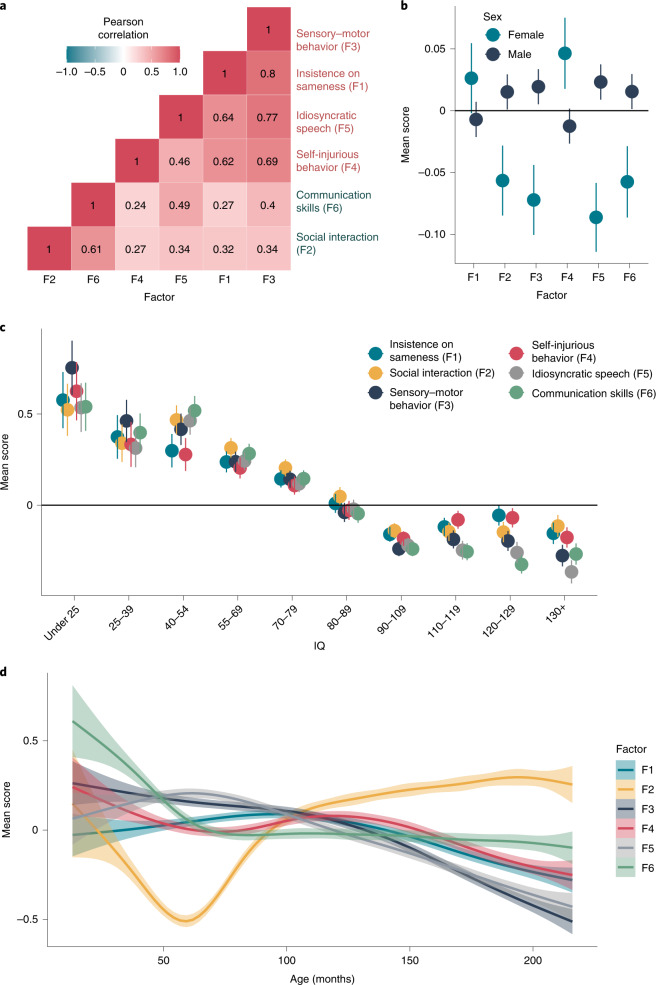
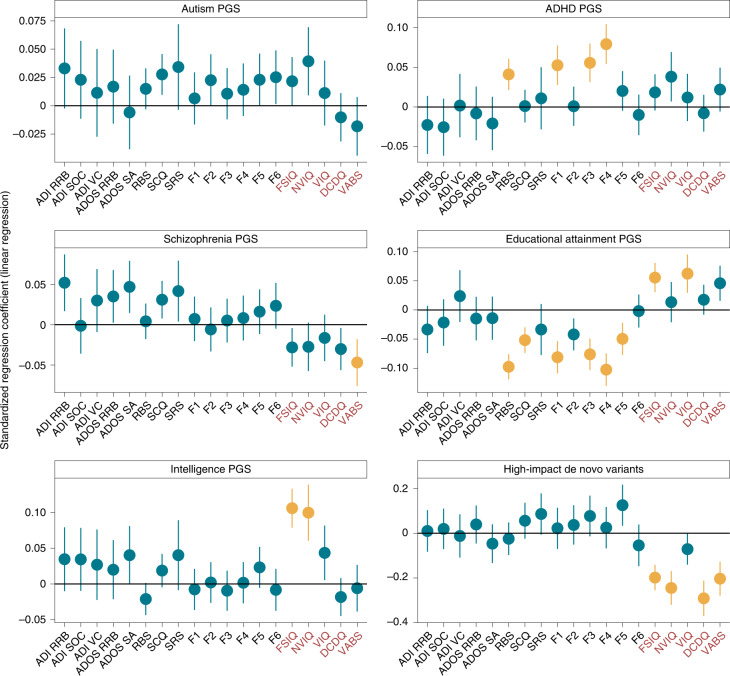
- Factor analysis of SCQ and RBS in 24,420 autistic individuals identified six correlated core autism factors (insistence on sameness, social interaction, sensory–motor behavior, self-injurious behavior, idiosyncratic repetitive speech/behavior, communication skills); common variant PGS were associated with core factors, but high-impact de novo variants were not.
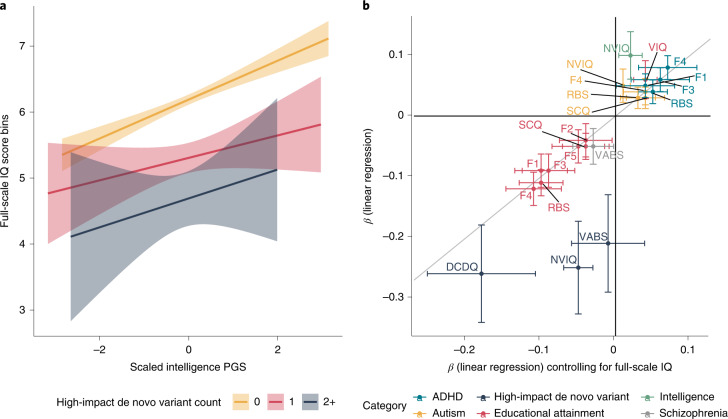
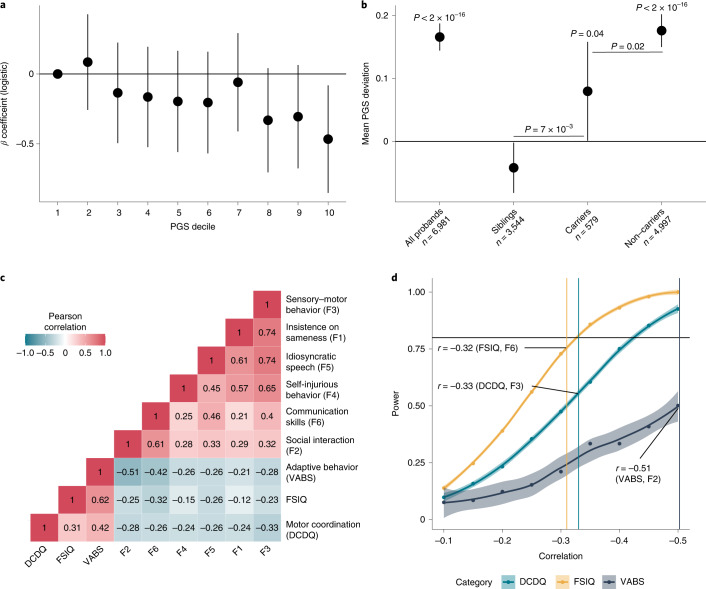
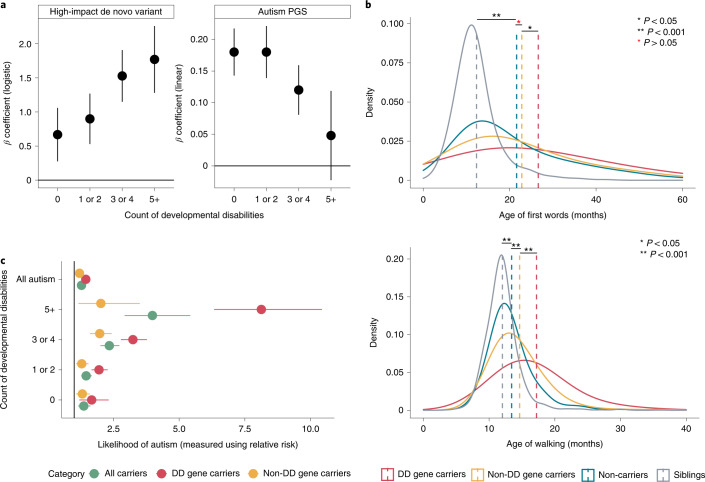
- Higher autism PGS were associated with reduced count of co-occurring developmental disabilities (βPGS = −0.037, s.e. = 0.009, P = 3.91 × 10⁻⁵, n = 13,435), whereas high-impact de novo variants increased them (βde novo = 0.31, s.e. = 0.05, P = 1.55 × 10⁻⁸, n = 3,089).
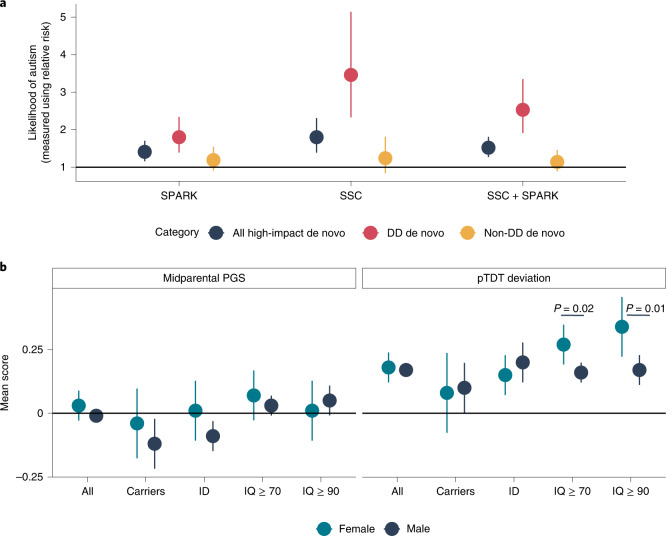
- In autistic individuals without ID, autism PGS were overtransmitted in females ~75% more than males (P = 0.02); after excluding borderline intellectual functioning, females had double the overtransmission (females mean = 0.34, s.e. = 0.06, n = 276; males mean = 0.17, s.e. = 0.03, n = 1,328; P = 0.01).
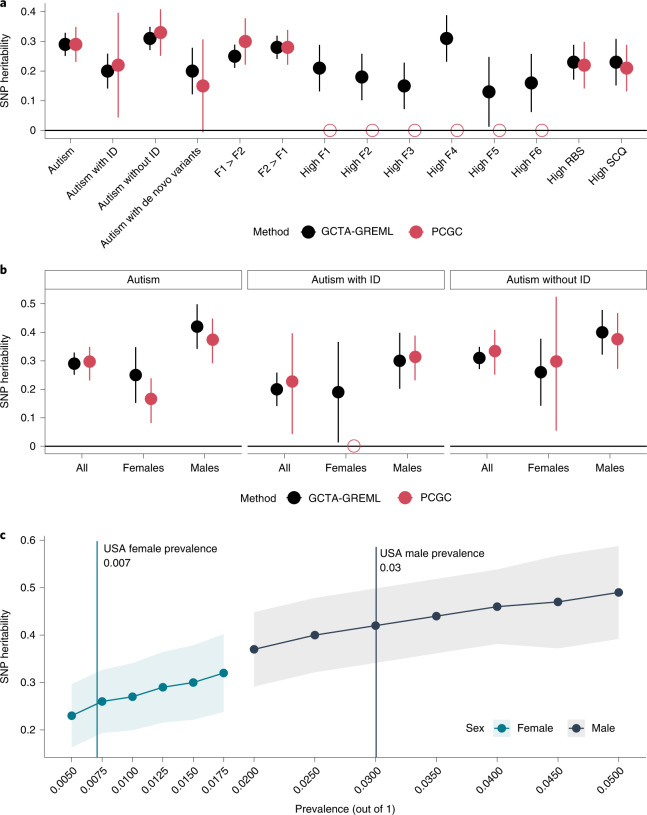
- SNP heritability for autism was h2SNP = 0.29 (GCTA s.e. = 0.02; PCGC s.e. = 0.03), higher in males than females (~70% higher, P = 9.3 × 10⁻³) and higher in autistic individuals without ID than with ID (P = 1.6 × 10⁻³).
Methods
- Combined genetic and phenotypic data from up to 12,893 autistic individuals across SSC, AGRE, AIMS-2-TRIALS LEAP, and SPARK, plus siblings and trios; factor analyses used SCQ and RBS in 24,420 autistic individuals from SSC/SPARK.
- Genetic analyses tested PGS for autism, intelligence, educational attainment, ADHD, schizophrenia, and hair color negative control, and high-impact de novo variants (protein-truncating SNVs/SVs and missense MPC >2 in constrained genes LOEUF <0.37) against 19 core/associated features; used regression, inverse-variance meta-analysis, pTDT, and GREML/PCGC SNP heritability with ABCD population controls.
- Multiple testing corrected with Benjamini–Yekutieli FDR; genetic analyses restricted to European-ancestry individuals passing QC.
Limitations
- Stated: cannot distinguish the female protective effect from diagnostic bias; the negative correlation between high-impact de novo variants and autism PGS may not extend to the general population because only autistic individuals were studied; underpowered (<80%) to detect high-impact de novo variant associations with core autism features.
- Stated: SNP heritability may be affected by fine-scale population stratification, genotyping array differences, and participation bias, though the focus is on subgroup differences.
- Evident: cross-sectional design and caregiver-report measures; the authors note the social interaction factor trajectory likely reflects recall bias, and genetic analyses were restricted to European ancestry, limiting generalizability.
Model-written summary. Check it against the paper before relying on it.
Integrity signals
Registry
Cites
Statistics
Figures
Verification
Claims the paper makes
11 Valid · 2 Not valid · 19 Not checked · 105 Own results and interpretations
Some cited sources support this claim and some don’t — read each source’s verdict below.
In the paper
“yet neither have stratified by ID.”
§ Genetic correlates of phenotypic heterogeneity in autism > Results > Sex differences in common and high-impact de novo variants
What the sources say
- Supportedcites [19] Antaki, D. et al. A phenotypic spectrum of autism is attributable to the combined effects of rare variants, polygenic risk and sex. Nat. Genet.10.1038/s41588-022-01064-5 (2022). PMC9474668 35654974 source
The Methods sections on datasets and behavioral traits describe analyses by case status, cohort, ancestry and sex, but not by intellectual disability (ID). The Results section on behavioral traits likewise lists sex interactions, not ID-stratified analyses. This confirms the claim as it applies to the cited study; this source cannot establish what the other study did. (LLM, conf=0.84)
- Disputedcites [49] Wigdor, E. M. et al. The female protective effect against autism spectrum disorder. Preprint at medRxiv10.1101/2021.03.29.21253866 (2021). sourceExperimental — accuracy not yet measured
The FPE and Sibling Recurrence section says the authors stratified ASD cases by the presence or absence of co-diagnosed intellectual disability. If this paper is one of the two studies meant by “neither,” the claim is contrary to its reported analysis. (LLM, conf=0.90)
Checked by a reasoning model — may be wrong.
plain- Asserted: passes — The authors put it forward as true.
- Checkable: passes — It can be checked against evidence.
- Load-bearing: passes — The paper’s conclusions depend on it.
- Based: passes — The paper gives a reason why it holds.
- Supported
The cited sources support only part of this claim — read each source’s verdict below.
In the paper
“First, existing studies investigating genotype–phenotype associations have been limited to summed scores of core autism features in smaller sample sizes19–21 rather than the underlying latent dimensions.”
§ Genetic correlates of phenotypic heterogeneity in autism > Main
What the sources say
- Partly supportedcites [19] Antaki, D. et al. A phenotypic spectrum of autism is attributable to the combined effects of rare variants, polygenic risk and sex. Nat. Genet.10.1038/s41588-022-01064-5 (2022). PMC9474668 35654974 sourceExperimental — accuracy not yet measured
The Methods section, “Effects of genetic factors on behavioral traits” (page unavailable), says the study tested questionnaire summary scores rather than underlying latent dimensions. But it also included adaptive behavior and motor coordination, not just core autism features. The available text does not establish the claimed smaller sample size; the Results report 37,375 individuals in the overall genetic analysis. (LLM, conf=0.84)
- Partly supportedcites [20] Buja A Damaging de novo mutations diminish motor skills in children on the autism spectrum Proc. Natl Acad. Sci. USA 2018 115 E1859 E1866 10.1073/pnas.1715427115 29434036 PMC5828599 sourceExperimental — accuracy not yet measured
The Methods section lists total scores and other established measures of core autism features, rather than latent dimensions, and reports 2,446 affected children with exome data. But it also says the supplementary analyses examined underlying instrument items, so the study was not strictly limited to summed scores. The paper does not establish that its sample was smaller than the citing study’s. (LLM, conf=0.86)
- Supportedcites [21] Bishop SL Identification of developmental and behavioral markers associated with genetic abnormalities in autism spectrum disorder Am. J. Psychiatry 2017 174 576 585 10.1176/appi.ajp.2017.16101115 28253736 PMC5578709 source
The Methods (Measures; page unavailable) say the study measured core autism features using ADI-R domain total scores, ADOS domain scores, and an overall SRS total score, rather than latent dimensions. The Methods (Genetic Data and Participants; page unavailable) report a matched analysis of 112 probands with high-confidence genetic abnormalities and 112 controls. The paper thus exemplifies the type of study described, though it does not establish that all earlier studies shared those limitations. (LLM, conf=0.88)
plain- Asserted: passes — The authors put it forward as true.
- Checkable: passes — It can be checked against evidence.
- Load-bearing: passes — The paper’s conclusions depend on it.
- Based: passes — The paper gives a reason why it holds.
- Partly supported
The cited sources support only part of this claim — read each source’s verdict below.
In the paper
“Heterogeneity in autism can arise from multiple, partly overlapping sources. This includes differences in core diagnostic features (core features)1,3,4 and associated features such as IQ, adaptive behavior and motor coordination, all of which have an impact on life outcomes3,5,6.”
§ Genetic correlates of phenotypic heterogeneity in autism > Main
What the sources say
- Not checked yetcites [1] Lai M-C Lombardo MV Baron-Cohen S Autism Lancet 2013 383 896 910 10.1016/S0140-6736(13)61539-1 24074734 source
- Supportedcites [3] Lord C Autism spectrum disorder Nat. Rev. Dis. Primers 2020 6 5 10.1038/s41572-019-0138-4 31949163 PMC8900942 source
The Introduction describes ASD as heterogeneous, and Diagnosis, screening and prevention identifies variation across its core diagnostic features. Figure 2 describes heterogeneity in symptom severity, intellectual functioning and daily living skills; Co-occurring disorders identifies motor problems as an associated difficulty. These passages support the attributed description of multiple sources of heterogeneity. (LLM, conf=0.87)
- Partly supportedcites [4] Geschwind DH Advances in autism Annu. Rev. Med. 2009 60 367 380 10.1146/annurev.med.60.053107.121225 19630577 PMC3645857 sourceExperimental — accuracy not yet measured
The Introduction (page unavailable) describes variation in core diagnostic features and IQ among autistic people, and identifies motor abnormalities as common associated features. Our copy does not identify adaptive behavior as a source of heterogeneity or establish that each listed feature affects life outcomes. (LLM, conf=0.84)
- Partly supportedcites [5] Mandell DS Novak MM Zubritsky CD Factors associated with age of diagnosis among children with autism spectrum disorders Pediatrics 2005 116 1480 1486 10.1542/peds.2005-0185 16322174 PMC2861294 sourceExperimental — accuracy not yet measured
The Results and Discussion describe differences among ASD subtypes in symptoms and intellectual functioning, which support part of the heterogeneity claim. The Discussion says IQ was not measured beyond the presence of intellectual disability; our copy does not establish adaptive behavior or motor coordination as sources of heterogeneity, or link these features to life outcomes. (LLM, conf=0.82)
- Not checked yetcites [6] Kanne SM The role of adaptive behavior in autism spectrum disorders: implications for functional outcome J. Autism Dev. Disord. 2011 41 1007 1018 10.1007/s10803-010-1126-4 21042872 source
plainstates a cause- Asserted: passes — The authors put it forward as true.
- Checkable: passes — It can be checked against evidence.
- Load-bearing: passes — The paper’s conclusions depend on it.
- Based: passes — The paper gives a reason why it holds.
Every source the paper cites for this claim was checked and supports it.
In the paper
“However, of the 21 items in the ‘social interaction’ factor, 19 specifically ask about behavior between the ages 4 and 5 years (Methods), and this trajectory likely reflects recall bias, as caregivers are likely to report more severe behaviors retrospectively33.”
§ Genetic correlates of phenotypic heterogeneity in autism > Results > Identifying latent phenotypes in core autism features
What the sources say
- Supportedcites [33] Jones RM How interview questions are placed in time influences caregiver description of social communication symptoms on the ADI-R J. Child Psychol. Psychiatry 2015 56 577 585 10.1111/jcpp.12325 25243378 PMC4369461 source
In Results (Study 3), caregivers rated children’s age-5 symptoms as more severe when recalling them at age 10 than they had when the children were age 5. The Discussion identifies time-dependent recall of symptom severity as a concern for age-related analyses of retrospective ADI-R items; the particular trajectory is the citing authors’ interpretation. (LLM, conf=0.91)
hedgedstates a possible cause- Asserted: passes — The authors put it forward as true.
- Checkable: passes — It can be checked against evidence.
- Load-bearing: unclear — It is unclear whether the paper’s conclusions depend on it.
- Based: passes — The paper gives a reason why it holds.
- Supported
Every source the paper cites for this claim was checked and supports it.
In the paper
“We ran sensitivity analyses using a larger but overlapping list of genes identified from a highly curated database, Developmental Disorder Gene-to-Phenotype45, and identified consistent results (Supplementary Tables 14 and 15).”
§ Genetic correlates of phenotypic heterogeneity in autism > Results > Autism PGS and co-occurring developmental disabilities
What the sources say
- Supportedcites [45] Thormann A Flexible and scalable diagnostic filtering of genomic variants using G2P with Ensembl VEP Nat. Commun. 2019 10 2373 10.1038/s41467-019-10016-3 31147538 PMC6542828 source
The citation identifies the Developmental Disorder Gene-to-Phenotype gene resource used by the citing authors. The Introduction describes DDG2P as a database of known causative developmental-disorder loci, and Methods (LGMDET) describes its clinical and literature-based curation. The sensitivity analyses and consistent results are the citing authors’ own findings, not claims attributed to this source. (LLM, conf=0.92)
plain- Asserted: passes — The authors put it forward as true.
- Checkable: passes — It can be checked against evidence.
- Load-bearing: unclear — It is unclear whether the paper’s conclusions depend on it.
- Based: passes — The paper gives a reason why it holds.
- Supported
79 more claims · 4 with their cited sources checked
Create a free account to see all 137 claims and to verify the 34 references still open.
- It may state two separate claims as one. 38
- Probably not a substantial claim. 20
Claims other papers make about this one
Each is checked against this paper’s own text: does it say what the citing paper says it does?
The cited source says what the claim attributes to it.
In the citing paper
“Polygenic scores for autism, based on the weighted sum of susceptibility alleles present, are increased in autistic females without intellectual disabilities229, in non-autistic mothers and female siblings228, and in mothers with broader subdiagnostic autism phenotypes233.”
From Sex and gender in neurodevelopmental conditions (2023) · cites this paper as [229]
The cited source says what the claim attributes to it.
In the citing paper
“A higher autism polygenic score (PGS) is linked to a lower likelihood of co-occurring developmental disabilities.”
From The Gut–Brain–Microbiota Connection and Its Role in Autism Spectrum Disorders (2025) · cites this paper as [10]
The check wasn’t confident either way, so it gives no verdict — never disputed.
In the citing paper
“Higher autism prevalence (compared with that in the general population) occurs among individuals who have a close autistic female relative and the likelihood of autism increases in later-born offspring siblings of autistic females, compared with autistic males (known as the Carter effect)227–229.”
From Sex and gender in neurodevelopmental conditions (2023) · cites this paper as [229]
Experimental — accuracy not yet measuredThe check wasn’t confident either way, so it gives no verdict — never disputed.
In the citing paper
“Studies investigating the so-called female protective effect in autism have used partly overlapping samples, and independent replication is therefore required225,227–229,236.”
From Sex and gender in neurodevelopmental conditions (2023) · cites this paper as [229]
Experimental — accuracy not yet measuredIn the citing paper
“Molecular genetic studies indicate that autistic females carry more common genetic variants associated with autism than autistic males.”
From Sex and gender in neurodevelopmental conditions (2023) · cites this paper as [229]
3 more claims about this paper
Create a free account to see every claim other papers make about this one.
Self-check
Percentages, sums and reported differences re-computed from the paper’s own numbers.
Each contradiction between two passages listed here was confirmed by an independent check.
Rated minor: it would not touch a result — a value no result rests on, a p-value that stays on the same side of the significance level, or a conflict that is clerical, resolved elsewhere in the paper, or outside its own findings.
In the paper
§ Genetic correlates of phenotypic heterogeneity in autism > Abstract
“genetic differences between autistic individuals (nmax = 12,893)”
§ Genetic correlates of phenotypic heterogeneity in autism > Results > Autism PGS and co-occurring developmental disabilities
“higher PGS for autism was associated with reduced count of co-occurring developmental disabilities (βPGS = −0.037, s.e. = 0.009, P = 3.91 × 10⁻⁵, n = 13,435, quasi-Poisson regression)”
Rated minor: it would not touch a result — a value no result rests on, a p-value that stays on the same side of the significance level, or a conflict that is clerical, resolved elsewhere in the paper, or outside its own findings.
In the paper
§ Genetic correlates of phenotypic heterogeneity in autism > Methods > Genetic analyses
“SNPs with genotyping rate <10% were excluded, or they were excluded if they deviated from Hardy–Weinberg equilibrium (P < 1 × 10⁻⁶).”
§ Genetic correlates of phenotypic heterogeneity in autism > Methods > Heritability analyses
“we excluded multi-allelic SNPs and SNPs with minor allele frequency difference of >5% between the three datasets and, in the combined dataset, were not in Hardy–Weinberg equilibrium (P > 1 × 10⁻⁶) or had genotyping rate <99%.”
Rated minor: it would not touch a result — a value no result rests on, a p-value that stays on the same side of the significance level, or a conflict that is clerical, resolved elsewhere in the paper, or outside its own findings.
In the paper
§ Genetic correlates of phenotypic heterogeneity in autism > Methods > Factor analyses
“nine items from the SCQ”
§ Genetic correlates of phenotypic heterogeneity in autism > Methods > Factor analyses
“(items 8, 11, 12 and 14–18)”
Rated minor: it would not touch a result — a value no result rests on, a p-value that stays on the same side of the significance level, or a conflict that is clerical, resolved elsewhere in the paper, or outside its own findings.
In the paper
§ Genetic correlates of phenotypic heterogeneity in autism > Methods > Genetic analyses
“PGS were generated for three phenotypes using polygenic risk scoring with continuous shrinkage (PRS-CS)84”
§ Genetic correlates of phenotypic heterogeneity in autism > Results > Common genetic variants are associated with core autism features
“PGS for autism, ADHD, schizophrenia, educational attainment and intelligence”
Citations
Cites
Diagnostic and Statistical Manual of Mental Disorders
American Psychiatric Association (2013) · doi:10.1176/appi.books.9780890425596 · Cited by 116,369
lavaan : An R Package for Structural Equation Modeling
Rosseel, Y. (2012) · Journal of Statistical Software · doi:10.18637/jss.v048.i02 · Cited by 27,955
A global reference for human genetic variation
The 1000 Genomes Project Consortium, authors, C., Auton, A., Abecasis, G. R., Steering committee, Altshuler, D. M., Durbin, R. M., Abecasis, G. R., Bentley, D. R., Chakravarti, A., et al. (2015) · Nature · doi:10.1038/nature15393 · Cited by 18,247
Self-citationUMAP: Uniform Manifold Approximation and Projection
McInnes, L., Healy, J., Saul, N., & Großberger, L. (2018) · Journal of Open Source Software · doi:10.21105/joss.00861 · Cited by 9,826
Lord, C., Rutter, M., & Le Couteur, A. (1994) · Journal of Autism and Developmental Disorders · doi:10.1007/bf02172145 · Cited by 9,065
GCTA: a tool for genome-wide complex trait analysis
Yang, J., Lee, S. H., Goddard, M. E., & Visscher, P. M. (2011) · The American Journal of Human Genetics · doi:10.1016/j.ajhg.2010.11.011 · Cited by 8,279
Baio, J., Wiggins, L., Christensen, D. L., Maenner, M. J., Daniels, J., Warren, Z., Kurzius-Spencer, M., Zahorodny, W., Robinson, C., Rosenberg, et al. (2018) · MMWR. Surveillance Summaries · doi:10.15585/mmwr.ss6706a1 · Cited by 6,078
Common SNPs explain a large proportion of the heritability for human height
Yang, J., Benyamin, B., McEvoy, B. P., Gordon, S., Henders, A. K., Nyholt, D. R., Madden, P. A., Heath, A. C., Martin, N. G., Montgomery, G. W., et al. (2010) · Nature Genetics · doi:10.1038/ng.608 · Cited by 4,446
Next-generation genotype imputation service and methods
Das, S., Forer, L., Schönherr, S., Sidore, C., Locke, A. E., Kwong, A., Vrieze, S. I., Chew, E. Y., Levy, S., McGue, M., et al. (2016) · Nature Genetics · doi:10.1038/ng.3656 · Cited by 3,808
Maenner, M. J., Shaw, K. A., Baio, J., EdS1, Washington, A., Patrick, M., DiRienzo, M., Christensen, D. L., Wiggins, L. D., Pettygrove, S., et al. (2020) · MMWR. Surveillance Summaries · doi:10.15585/mmwr.ss6904a1 · Cited by 3,780
Robust relationship inference in genome-wide association studies
Manichaikul, A., Mychaleckyj, J. C., Rich, S. S., Daly, K., Sale, M., & Chen, W.-M. (2010) · Bioinformatics · doi:10.1093/bioinformatics/btq559 · Cited by 3,541
Mapping genomic loci implicates genes and synaptic biology in schizophrenia
Trubetskoy, V., Pardiñas, A. F., Qi, T., Panagiotaropoulou, G., Awasthi, S., Bigdeli, T. B., Bryois, J., Chen, C.-Y., Dennison, C. A., Hall, L. S., et al. (2022) · Nature · doi:10.1038/s41586-022-04434-5 · Cited by 2,964
Self-citationA reference panel of 64,976 haplotypes for genotype imputation
the Haplotype Reference Consortium (2016) · Nature Genetics · doi:10.1038/ng.3643 · Cited by 2,836
What Is the Male-to-Female Ratio in Autism Spectrum Disorder? A Systematic Review and Meta-Analysis
Loomes, R., Hull, L., & Mandy, W. P. L. (2017) · Journal of the American Academy of Child & Adolescent Psychiatry · doi:10.1016/j.jaac.2017.03.013 · Cited by 2,804 · cited 1×
“We cannot, however, distinguish the Female Protective Effect due to common or rare variants from diagnostic bias in the current study.(24,45) Figure 6: Sex differences in rare and common variants”
Background23andMe Research Team, Lee, J. J., COGENT (Cognitive Genomics Consortium), Social Science Genetic Association Consortium, Wedow, R., Okbay, A., Kong, E., Maghzian, O., Zacher, M., Nguyen-Viet, T. A., et al. (2018) · Nature Genetics · doi:10.1038/s41588-018-0147-3 · Cited by 2,470
Identification of common genetic risk variants for autism spectrum disorder
Autism Spectrum Disorder Working Group of the Psychiatric Genomics Consortium, Grove, J., BUPGEN, Major Depressive Disorder Working Group of the Psychiatric Genomics Consortium, 23andMe Research Team, Ripke, S., Als, T. D., Mattheisen, M., Walters, R. K., Won, H., et al. (2019) · Nature Genetics · doi:10.1038/s41588-019-0344-8 · Cited by 2,421
Self-citationLai, M.-C., Lombardo, M. V., & Baron-Cohen, S. (2014) · The Lancet · doi:10.1016/s0140-6736(13)61539-1 · Cited by 2,371
Self-citationSatterstrom, F. K., Kosmicki, J. A., Wang, J., Breen, M. S., De Rubeis, S., An, J.-Y., Peng, M., Collins, R., Grove, J., Klei, L., et al. (2020) · Cell · doi:10.1016/j.cell.2019.12.036 · Cited by 2,321 · cited 1×
“severe developmental disorders (genetically undiagnosed developmental disorders with accompanying ID and/or developmental delays).(17) The lack of detailed phenotypic information in the cohorts assessed renders the previous research hard to interpret.”
BackgroundSelf-citationSequencing of 53,831 diverse genomes from the NHLBI TOPMed Program
Taliun, D., Harris, D. N., Kessler, M. D., Carlson, J., Szpiech, Z. A., Torres, R., Taliun, S. A. G., Corvelo, A., Gogarten, S. M., Kang, H. M., et al. (2021) · Nature · doi:10.1038/s41586-021-03205-y · Cited by 2,213
ADHD Working Group of the Psychiatric Genomics Consortium (PGC), Demontis, D., Early Lifecourse & Genetic Epidemiology (EAGLE) Consortium, 23andMe Research Team, Walters, R. K., Martin, J., Mattheisen, M., Als, T. D., Agerbo, E., Baldursson, G., et al. (2019) · Nature Genetics · doi:10.1038/s41588-018-0269-7 · Cited by 2,203
Self-citationRate of de novo mutations and the importance of father’s age to disease risk
Kong, A., Frigge, M. L., Masson, G., Besenbacher, S., Sulem, P., Magnusson, G., Gudjonsson, S. A., Sigurdsson, A., Jonasdottir, A., Jonasdottir, A., et al. (2012) · Nature · doi:10.1038/nature11396 · Cited by 2,134 · cited 1×
“19), suggesting that the observed SNP heritability for autistic carriers reflects autism rather than factors associated with the generation of germline mutations.(51,52) This result is in line with our pTDT analyses which identify an overtransmission of PGS in carriers, and previous research that has identified a smal…”
Lord, C., Rutter, M., Goode, S., Heemsbergen, J., Jordan, H., Mawhood, L., & Schopler, E. (1989) · Journal of Autism and Developmental Disorders · doi:10.1007/bf02211841 · Cited by 2,030
Polygenic prediction via Bayesian regression and continuous shrinkage priors
Ge, T., Chen, C.-Y., Ni, Y., Feng, Y.-C. A., & Smoller, J. W. (2019) · Nature Communications · doi:10.1038/s41467-019-09718-5 · Cited by 1,922
cocor: A Comprehensive Solution for the Statistical Comparison of Correlations
Diedenhofen, B., & Musch, J. (2015) · PLOS ONE · doi:10.1371/journal.pone.0121945 · Cited by 1,919
Lord, C., Brugha, T. S., Charman, T., Cusack, J., Dumas, G., Frazier, T., Jones, E. J. H., Jones, R. M., Pickles, A., State, M. W., et al. (2020) · Nature Reviews Disease Primers · doi:10.1038/s41572-019-0138-4 · Cited by 1,859 · cited 1×
“This includes differences in core diagnostic features (core features)(1,3,4), and associated features such as IQ, adaptive behaviour, and motor coordination, all of which have an impact on life outcomes.(3,5,6) Furthermore, sex and gender(7,8) and co-occurring intellectual disability (ID) and developmental, behavioura…”
BackgroundSelf-citationFast and accurate genotype imputation in genome-wide association studies through pre-phasing
Howie, B., Fuchsberger, C., Stephens, M., Marchini, J., & Abecasis, G. R. (2012) · Nature Genetics · doi:10.1038/ng.2354 · Cited by 1,737
Shank3 mutant mice display autistic-like behaviours and striatal dysfunction
Peça, J., Feliciano, C., Ting, J. T., Wang, W., Wells, M. F., Venkatraman, T. N., Lascola, C. D., Fu, Z., & Feng, G. (2011) · Nature · doi:10.1038/nature09965 · Cited by 1,570 · cited 1×
“g.(33,34)), as a group they were not robustly associated with core autism features (Figure 2B).”
BackgroundPower and predictive accuracy of polygenic risk scores
Dudbridge, F. (2013) · PLoS Genetics · doi:10.1371/journal.pgen.1003348 · Cited by 1,509 · cited 1×
“22 heritability in females suggests that higher PGS are required to reach the equivalent levels of genetic liability in males.(56) Yet, this raises another important question - why do autistic females have a lower SNP heritability compared to autistic males? Does this reflect ascertainment bias in the GWAS cohorts, di…”
BackgroundPrevalence and architecture of de novo mutations in developmental disorders
Study, D. D. D. (2017) · Nature · doi:10.1038/nature21062 · Cited by 1,480
Insights into autism spectrum disorder genomic architecture and biology from 71 risk loci
Sanders, S. J., He, X., Willsey, A. J., Ercan-Sencicek, A. G., Samocha, K. E., Cicek, A. E., Murtha, M. T., Bal, V. H., Bishop, S. L., Dong, S., et al. (2015) · Neuron · doi:10.1016/j.neuron.2015.09.016 · Cited by 1,430
Self-citationNaarden Braun, K. V., Lopez, M., White, T., et al. (2023) · Carolina Digital Repository (University of North Carolina at Chapel Hill) · doi:10.17615/y3kk-5x30 · Cited by 1,381
A global overview of pleiotropy and genetic architecture in complex traits
Watanabe, K., Stringer, S., Frei, O., Umićević Mirkov, M., de Leeuw, C., Polderman, T. J. C., van der Sluis, S., Andreassen, O. A., Neale, B. M., & Posthuma, D. (2019) · Nature Genetics · doi:10.1038/s41588-019-0481-0 · Cited by 1,332
Savage, J. E., Jansen, P. R., Stringer, S., Watanabe, K., Bryois, J., de Leeuw, C. A., Nagel, M., Awasthi, S., Barr, P. B., Coleman, J. R. I., et al. (2018) · Nature Genetics · doi:10.1038/s41588-018-0152-6 · Cited by 1,267
Sex differences in autism spectrum disorders
Werling, D. M., & Geschwind, D. H. (2013) · Current Opinion in Neurology · doi:10.1097/wco.0b013e32835ee548 · Cited by 1,245
Self-citationMost genetic risk for autism resides with common variation
Gaugler, T., Klei, L., Sanders, S. J., Bodea, C. A., Goldberg, A. P., Lee, A. B., Mahajan, M., Manaa, D., Pawitan, Y., Reichert, J., et al. (2014) · Nature Genetics · doi:10.1038/ng.3039 · Cited by 1,239
Reise, S. P., Moore, T. M., & Haviland, M. G. (2010) · Journal of Personality Assessment · doi:10.1080/00223891.2010.496477 · Cited by 1,187
Self-citationHeritability of autism spectrum disorders: a meta-analysis of twin studies
Tick, B., Bolton, P., Happé, F., Rutter, M., & Rijsdijk, F. (2016) · Journal of Child Psychology and Psychiatry · doi:10.1111/jcpp.12499 · Cited by 1,150
Sex/Gender Differences and Autism: Setting the Scene for Future Research
Lai, M.-C., Lombardo, M. V., Auyeung, B., Chakrabarti, B., & Baron-Cohen, S. (2015) · Journal of the American Academy of Child & Adolescent Psychiatry · doi:10.1016/j.jaac.2014.10.003 · Cited by 1,120
Self-citationEstimating Missing Heritability for Disease from Genome-wide Association Studies
Lee, S. H., Wray, N. R., Goddard, M. E., & Visscher, P. M. (2011) · The American Journal of Human Genetics · doi:10.1016/j.ajhg.2011.02.002 · Cited by 1,064
Time to give up on a single explanation for autism
Happé, F., Ronald, A., & Plomin, R. (2006) · Nature Neuroscience · doi:10.1038/nn1770 · Cited by 987
Factors Associated With Age of Diagnosis Among Children With Autism Spectrum Disorders
Mandell, D. S., Novak, M. M., & Zubritsky, C. D. (2005) · Pediatrics · doi:10.1542/peds.2005-0185 · Cited by 896
Lam, K. S. L., & Aman, M. G. (2007) · Journal of Autism and Developmental Disorders · doi:10.1007/s10803-006-0213-z · Cited by 793
Identifying the lost generation of adults with autism spectrum conditions
Lai, M.-C., & Baron-Cohen, S. (2015) · The Lancet Psychiatry · doi:10.1016/s2215-0366(15)00277-1 · Cited by 756 · cited 1×
“This likely reflects both reproductive stoppage(35) and underdiagnosis of autism in the parental generation but greater awareness and opportunity to receive or exclude a diagnosis in children.(36) Carriers had a modest overtransmission of autism PGS (Mean = 0.”
BackgroundSelf-citationThe Simons Simplex Collection: a resource for identification of autism genetic risk factors
Fischbach, G. D., & Lord, C. (2010) · Neuron · doi:10.1016/j.neuron.2010.10.006 · Cited by 725
Association of Genetic and Environmental Factors With Autism in a 5-Country Cohort
Bai, D., Yip, B. H. K., Windham, G. C., Sourander, A., Francis, R., Yoffe, R., Glasson, E., Mahjani, B., Suominen, A., Leonard, H., et al. (2019) · JAMA Psychiatry · doi:10.1001/jamapsychiatry.2019.1411 · Cited by 683
Evidence for 28 genetic disorders discovered by combining healthcare and research data
Kaplanis, J., Samocha, K. E., Wiel, L., Zhang, Z., Arvai, K. J., Eberhardt, R. Y., Gallone, G., Lelieveld, S. H., Martin, H. C., McRae, J. F., et al. (2020) · Nature · doi:10.1038/s41586-020-2832-5 · Cited by 615
Self-citationJacquemont, S., Coe, B. P., Hersch, M., Duyzend, M. H., Krumm, N., Bergmann, S., Beckmann, J. S., Rosenfeld, J. A., & Eichler, E. E. (2014) · The American Journal of Human Genetics · doi:10.1016/j.ajhg.2014.02.001 · Cited by 605
Warrier, V., Greenberg, D. M., Weir, E., Buckingham, C., Smith, P., Lai, M.-C., Allison, C., & Baron-Cohen, S. (2020) · Nature Communications · doi:10.1038/s41467-020-17794-1 · Cited by 595
Self-citationHeritability of Autism Spectrum Disorder in a UK Population-Based Twin Sample
Colvert, E., Tick, B., McEwen, F., Stewart, C., Curran, S. R., Woodhouse, E., Gillan, N., Hallett, V., Lietz, S., Garnett, T., et al. (2015) · JAMA Psychiatry · doi:10.1001/jamapsychiatry.2014.3028 · Cited by 560
Psychometric Properties of the Revised Developmental Coordination Disorder Questionnaire
Wilson, B. N., Crawford, S. G., Green, D., Roberts, G., Aylott, A., & Kaplan, B. J. (2009) · Physical & Occupational Therapy In Pediatrics · doi:10.1080/01942630902784761 · Cited by 557
Examining and interpreting the female protective effect against autistic behavior
Robinson, E. B., Lichtenstein, P., Anckarsäter, H., Happé, F., & Ronald, A. (2013) · Proceedings of the National Academy of Sciences · doi:10.1073/pnas.1211070110 · Cited by 531
Self-citationiPSYCH-Broad Autism Group, Weiner, D. J., Psychiatric Genomics Consortium Autism Group, Wigdor, E. M., Ripke, S., Walters, R. K., Kosmicki, J. A., Grove, J., Samocha, K. E., Goldstein, J. I., et al. (2017) · Nature Genetics · doi:10.1038/ng.3863 · Cited by 516
Self-citationWhole-genome sequencing of quartet families with autism spectrum disorder
Yuen, R. K. C., Thiruvahindrapuram, B., Merico, D., Walker, S., Tammimies, K., Hoang, N., Chrysler, C., Nalpathamkalam, T., Pellecchia, G., Liu, Y., et al. (2015) · Nature Medicine · doi:10.1038/nm.3792 · Cited by 514
Self-citationGeschwind, D. H. (2009) · Annual Review of Medicine · doi:10.1146/annurev.med.60.053107.121225 · Cited by 512
Self-citationThe Role of Adaptive Behavior in Autism Spectrum Disorders: Implications for Functional Outcome
Kanne, S. M., Gerber, A. J., Quirmbach, L. M., Sparrow, S. S., Cicchetti, D. V., & Saulnier, C. A. (2011) · Journal of Autism and Developmental Disorders · doi:10.1007/s10803-010-1126-4 · Cited by 494
SPARK: A US Cohort of 50,000 Families to Accelerate Autism Research
Feliciano, P., Daniels, A. M., Green Snyder, L., Beaumont, A., Camba, A., Esler, A., Gulsrud, A. G., Mason, A., Gutierrez, A., Nicholson, A., et al. (2018) · Neuron · doi:10.1016/j.neuron.2018.01.015 · Cited by 455
Study, S. S., Singh, T., Study, I., Study, D., UK10 K Consortium, Kurki, M. I., Curtis, D., Purcell, S. M., Crooks, L., McRae, J., et al. (2016) · Nature Neuroscience · doi:10.1038/nn.4267 · Cited by 452
Self-citationHappé, F., & Frith, U. (2020) · Journal of Child Psychology and Psychiatry · doi:10.1111/jcpp.13176 · Cited by 438
Sequencing of 53,831 diverse genomes from the NHLBI TOPMed ProgramPreprint
Taliun, D., Harris, D., Kessler, M. D., et al. (2019) · bioRxiv (Cold Spring Harbor Laboratory) · doi:10.1101/563866 · Cited by 427
Common genetic variants, acting additively, are a major source of risk for autism
Klei, L., Sanders, S. J., Murtha, M. T., Hus, V., Lowe, J. K., Willsey, A. J., Moreno-De-Luca, D., Yu, T. W., Fombonne, E., Geschwind, D., et al. (2012) · Molecular Autism · doi:10.1186/2040-2392-3-9 · Cited by 418
Self-citationAlpha, Dimension-Free, and Model-Based Internal Consistency Reliability
Bentler, P. M. (2009) · Psychometrika · doi:10.1007/s11336-008-9100-1 · Cited by 405
Validation of Proposed DSM-5 Criteria for Autism Spectrum Disorder
Frazier, T. W., Youngstrom, E. A., Speer, L., Embacher, R., Law, P., Constantino, J., Findling, R. L., Hardan, A. Y., & Eng, C. (2012) · Journal of the American Academy of Child & Adolescent Psychiatry · doi:10.1016/j.jaac.2011.09.021 · Cited by 392
Genetic risk for autism spectrum disorders and neuropsychiatric variation in the general population
iPSYCH-SSI-Broad Autism Group, Robinson, E. B., St Pourcain, B., Anttila, V., Kosmicki, J. A., Bulik-Sullivan, B., Grove, J., Maller, J., Samocha, K. E., Sanders, S. J., et al. (2016) · Nature Genetics · doi:10.1038/ng.3529 · Cited by 367
Self-citationMapping genomic loci prioritises genes and implicates synaptic biology in schizophreniaPreprint
Ripke, S., Walters, J., & O'Donovan, M. (2020) · medRxiv · doi:10.1101/2020.09.12.20192922 · Cited by 365
CHD8 haploinsufficiency results in autistic-like phenotypes in mice
Katayama, Y., Nishiyama, M., Shoji, H., Ohkawa, Y., Kawamura, A., Sato, T., Suyama, M., Takumi, T., Miyakawa, T., & Nakayama, K. I. (2016) · Nature · doi:10.1038/nature19357 · Cited by 353 · cited 1×
“g.(33,34)), as a group they were not robustly associated with core autism features (Figure 2B).”
BackgroundRegional missense constraint improves variant deleteriousness prediction
Samocha, K. E., Kosmicki, J. A., Karczewski, K. J., O’Donnell-Luria, A. H., Pierce-Hoffman, E., MacArthur, D. G., Neale, B. M., & Daly, M. J. (2017) · doi:10.1101/148353 · Cited by 351
Kosmicki, J. A., Samocha, K. E., Howrigan, D. P., Sanders, S. J., Slowikowski, K., Lek, M., Karczewski, K. J., Cutler, D. J., Devlin, B., Roeder, K., et al. (2017) · Nature Genetics · doi:10.1038/ng.3789 · Cited by 340
Self-citationCommon genetic variants contribute to risk of rare severe neurodevelopmental disorders
Niemi, M. E. K., Martin, H. C., Rice, D. L., Gallone, G., Gordon, S., Kelemen, M., McAloney, K., McRae, J., Radford, E. J., Yu, S., et al. (2018) · Nature · doi:10.1038/s41586-018-0566-4 · Cited by 340 · cited 1×
“This result is in line with our pTDT analyses which identify an overtransmission of PGS in carriers, and previous research that has identified a smaller, yet significant heritability for severe developmental disorders.(53) Stratifying by sex had the largest effect on SNP heritability (Figure 7B).”
ResultSelf-citationPedersen, C. B., Bybjerg-Grauholm, J., Pedersen, M. G., Grove, J., Agerbo, E., Bækvad-Hansen, M., Poulsen, J. B., Hansen, C. S., McGrath, J. J., Als, T. D., et al. (2018) · Molecular Psychiatry · doi:10.1038/mp.2017.196 · Cited by 338
Self-citationRestricted and Repetitive Behaviors in Young Children with Autism Spectrum Disorders
Richler, J., Bishop, S. L., Kleinke, J. R., & Lord, C. (2007) · Journal of Autism and Developmental Disorders · doi:10.1007/s10803-006-0332-6 · Cited by 329
Geschwind, D. H., Sowinski, J., Lord, C., Iversen, P., Shestack, J., Jones, P., Ducat, L., & Spence, S. J. (2001) · The American Journal of Human Genetics · doi:10.1086/321292 · Cited by 302
Self-citationMeasuring missing heritability: Inferring the contribution of common variants
Golan, D., Lander, E. S., & Rosset, S. (2014) · Proceedings of the National Academy of Sciences · doi:10.1073/pnas.1419064111 · Cited by 288
The hyper-systemizing, assortative mating theory of autism
Baron-Cohen, S. (2006) · Progress in Neuro-Psychopharmacology and Biological Psychiatry · doi:10.1016/j.pnpbp.2006.01.010 · Cited by 287
Self-citationValidity, Invalidity, and Reliability
Heise, D. R., & Bohrnstedt, G. W. (1970) · Sociological Methodology · doi:10.2307/270785 · Cited by 286
Genetic analyses identify widespread sex-differential participation bias
Pirastu, N., Cordioli, M., Nandakumar, P., Mignogna, G., Abdellaoui, A., Hollis, B., Kanai, M., Rajagopal, V. M., Parolo, P. D. B., Baya, N., et al. (2021) · Nature Genetics · doi:10.1038/s41588-021-00846-7 · Cited by 251 · cited 1×
“05 for all comparisons) - factors correlated with participation in research.(44) This suggests that these results are unlikely to be explained by sex differences in participation.”
BackgroundSelf-citationGenome-wide detection of tandem DNA repeats that are expanded in autism
Trost, B., Engchuan, W., Nguyen, C. M., Thiruvahindrapuram, B., Dolzhenko, E., Backstrom, I., Mirceta, M., Mojarad, B. A., Yin, Y., Dov, A., et al. (2020) · Nature · doi:10.1038/s41586-020-2579-z · Cited by 238
Sex and gender impacts on the behavioural presentation and recognition of autism
Lai, M.-C., & Szatmari, P. (2020) · Current Opinion in Psychiatry · doi:10.1097/yco.0000000000000575 · Cited by 237
Self-citationOverlooked roles of DNA damage and maternal age in generating human germline mutations
Gao, Z., Moorjani, P., Sasani, T. A., Pedersen, B. S., Quinlan, A. R., Jorde, L. B., Amster, G., & Przeworski, M. (2019) · Proceedings of the National Academy of Sciences · doi:10.1073/pnas.1901259116 · Cited by 229 · cited 1×
“19), suggesting that the observed SNP heritability for autistic carriers reflects autism rather than factors associated with the generation of germline mutations.(51,52) This result is in line with our pTDT analyses which identify an overtransmission of PGS in carriers, and previous research that has identified a smal…”
ResultWarrier, V., Kwong, A. S. F., Luo, M., Dalvie, S., Croft, J., Sallis, H. M., Baldwin, J., Munafò, M. R., Nievergelt, C. M., Grant, A. J., et al. (2021) · The Lancet Psychiatry · doi:10.1016/s2215-0366(20)30569-1 · Cited by 224
Self-citationiPSYCH-Broad Consortium, Satterstrom, F. K., Walters, R. K., Singh, T., Wigdor, E. M., Lescai, F., Demontis, D., Kosmicki, J. A., Grove, J., Stevens, C., et al. (2019) · Nature Neuroscience · doi:10.1038/s41593-019-0527-8 · Cited by 209
Self-citationAntaki, D., Guevara, J., Maihofer, A. X., Klein, M., Gujral, M., Grove, J., Carey, C. E., Hong, O., Arranz, M. J., Hervas, A., et al. (2022) · Nature Genetics · doi:10.1038/s41588-022-01064-5 · Cited by 206
Self-citationPatterns of de novo tandem repeat mutations and their role in autism
Mitra, I., Huang, B., Mousavi, N., Ma, N., Lamkin, M., Yanicky, R., Shleizer-Burko, S., Lohmueller, K. E., & Gymrek, M. (2021) · Nature · doi:10.1038/s41586-020-03078-7 · Cited by 194
The EU-AIMS Longitudinal European Autism Project (LEAP): clinical characterisation
Charman, T., Loth, E., Tillmann, J., Crawley, D., Wooldridge, C., Goyard, D., Ahmad, J., Auyeung, B., Ambrosino, S., Banaschewski, T., et al. (2017) · Molecular Autism · doi:10.1186/s13229-017-0145-9 · Cited by 183
Self-citationEvaluation of polygenic prediction methodology within a reference-standardized framework
Pain, O., Glanville, K. P., Hagenaars, S. P., Selzam, S., Fürtjes, A. E., Gaspar, H. A., Coleman, J. R. I., Rimfeld, K., Breen, G., Plomin, R., et al. (2021) · PLOS Genetics · doi:10.1371/journal.pgen.1009021 · Cited by 180
Clarke, T.-K., Lupton, M. K., Fernandez-Pujals, A. M., Starr, J., Davies, G., Cox, S., Pattie, A., Liewald, D. C., Hall, L. S., MacIntyre, D. J., et al. (2016) · Molecular Psychiatry · doi:10.1038/mp.2015.12 · Cited by 179
Genetic contributions to autism spectrum disorder
Havdahl, A., Niarchou, M., Starnawska, A., Uddin, M., van der Merwe, C., & Warrier, V. (2021) · Psychological Medicine · doi:10.1017/s0033291721000192 · Cited by 179
Self-citationMandy, W. P. L., & Skuse, D. H. (2008) · Journal of Child Psychology and Psychiatry · doi:10.1111/j.1469-7610.2008.01911.x · Cited by 169
Insufficient Evidence for “Autism-Specific” Genes
Myers, S. M., Challman, T. D., Bernier, R., Bourgeron, T., Chung, W. K., Constantino, J. N., Eichler, E. E., Jacquemont, S., Miller, D. T., Mitchell, K. J., et al. (2020) · The American Journal of Human Genetics · doi:10.1016/j.ajhg.2020.04.004 · Cited by 165
Self-citationA global overview of pleiotropy and genetic architecture in complex traitsPreprint
Watanabe, K., Stringer, S., Frei, O., et al. (2018) · bioRxiv (Cold Spring Harbor Laboratory) · doi:10.1101/500090 · Cited by 162
Flexible and scalable diagnostic filtering of genomic variants using G2P with Ensembl VEP
Thormann, A., Halachev, M., McLaren, W., Moore, D. J., Svinti, V., Campbell, A., Kerr, S. M., Tischkowitz, M., Hunt, S. E., Dunlop, M. G., et al. (2019) · Nature Communications · doi:10.1038/s41467-019-10016-3 · Cited by 151
Self-citationChaste, P., Klei, L., Sanders, S. J., Hus, V., Murtha, M. T., Lowe, J. K., Willsey, A. J., Moreno-De-Luca, D., Yu, T. W., Fombonne, E., et al. (2015) · Biological Psychiatry · doi:10.1016/j.biopsych.2014.09.017 · Cited by 144
Self-citationMultidimensional Influences on Autism Symptom Measures: Implications for Use in Etiological Research
Havdahl, K. A., Hus Bal, V., Huerta, M., Pickles, A., Øyen, A.-S., Stoltenberg, C., Lord, C., & Bishop, S. L. (2016) · Journal of the American Academy of Child & Adolescent Psychiatry · doi:10.1016/j.jaac.2016.09.490 · Cited by 139
The female protective effect against autism spectrum disorder
Wigdor, E. M., Weiner, D. J., Grove, J., Fu, J. M., Thompson, W. K., Carey, C. E., Baya, N., van der Merwe, C., Walters, R. K., Satterstrom, F. K., et al. (2021) · doi:10.1101/2021.03.29.21253866 · Cited by 124
Self-citationThe female protective effect against autism spectrum disorder
Wigdor, E. M., Weiner, D. J., Grove, J., Fu, J. M., Thompson, W. K., Carey, C. E., Baya, N., van der Merwe, C., Walters, R. K., Satterstrom, F. K., et al. (2022) · Cell Genomics · doi:10.1016/j.xgen.2022.100134 · Cited by 124 · cited 1×
“26 details are provided elsewhere.(43) We additionally included GWAS for Educational attainment (N = 766,345, excluding the 23andMe dataset)(77), 2.”
BackgroundSelf-citationSocial and non-social autism symptoms and trait domains are genetically dissociable
Warrier, V., Toro, R., Won, H., Leblond, C. S., Cliquet, F., Delorme, R., De Witte, W., Bralten, J., Chakrabarti, B., Børglum, A. D., et al. (2019) · Communications Biology · doi:10.1038/s42003-019-0558-4 · Cited by 94
Self-citationBishop, S. L., Farmer, C., Bal, V., Robinson, E. B., Willsey, A. J., Werling, D. M., Havdahl, K. A., Sanders, S. J., & Thurm, A. (2017) · American Journal of Psychiatry · doi:10.1176/appi.ajp.2017.16101115 · Cited by 92
Self-citationAuthor Correction: The mutational constraint spectrum quantified from variation in 141,456 humans
Genome Aggregation Database Consortium, Karczewski, K. J., Francioli, L. C., Tiao, G., Cummings, B. B., Alföldi, J., Wang, Q., Collins, R. L., Laricchia, K. M., Ganna, A., et al. (2021) · Nature · doi:10.1038/s41586-020-03174-8 · Cited by 91
Bybjerg-Grauholm, J., Bøcker Pedersen, C., Bækvad-Hansen, M., Giørtz Pedersen, M., Adamsen, D., Søholm Hansen, C., Agerbo, E., Grove, J., Als, T. D., Schork, A. J., et al. (2020) · medRxiv · doi:10.1101/2020.11.30.20237768 · Cited by 86
Self-citationSubdimensions of social‐communication impairment in autism spectrum disorder
Bishop, S. L., Havdahl, K. A., Huerta, M., & Lord, C. (2016) · Journal of Child Psychology and Psychiatry · doi:10.1111/jcpp.12510 · Cited by 71
Self-citationDamaging de novo mutations diminish motor skills in children on the autism spectrum
Buja, A., Volfovsky, N., Krieger, A. M., Lord, C., Lash, A. E., Wigler, M., & Iossifov, I. (2018) · Proceedings of the National Academy of Sciences · doi:10.1073/pnas.1715427115 · Cited by 64
Genetic analyses identify widespread sex-differential participation biasPreprint
Pirastu, N., Cordioli, M., Nandakumar, P., et al. (2020) · bioRxiv (Cold Spring Harbor Laboratory) · doi:10.1101/2020.03.22.001453 · Cited by 56
The longitudinal heterogeneity of autistic traits: A systematic review
Pender, R., Fearon, P., Heron, J., & Mandy, W. (2020) · Research in Autism Spectrum Disorders · doi:10.1016/j.rasd.2020.101671 · Cited by 55
Hoffmann, T. J., Windham, G. C., Anderson, M., Croen, L. A., Grether, J. K., & Risch, N. (2014) · JAMA Psychiatry · doi:10.1001/jamapsychiatry.2014.420 · Cited by 52
Overlooked roles of DNA damage and maternal age in generating human germline mutationsPreprint
Gao, Z., Moorjani, P., Sasani, T. A., et al. (2018) · bioRxiv (Cold Spring Harbor Laboratory) · doi:10.1101/327098 · Cited by 46
Common genetic variants contribute to risk of rare severe neurodevelopmental disordersPreprint
Niemi, M., Martin, H. C., Rice, D. L., et al. (2018) · bioRxiv (Cold Spring Harbor Laboratory) · doi:10.1101/309070 · Cited by 43
Self-citationPeyrot, W. J., Boomsma, D. I., Penninx, B. W. J. H., & Wray, N. R. (2016) · The American Journal of Human Genetics · doi:10.1016/j.ajhg.2015.12.017 · Cited by 42
Demographic and clinical correlates of autism symptom domains and autism spectrum diagnosis
Frazier, T. W., Youngstrom, E. A., Embacher, R., Hardan, A. Y., Constantino, J. N., Law, P., Findling, R. L., & Eng, C. (2014) · Autism · doi:10.1177/1362361313481506 · Cited by 39
Genetic risk for autism spectrum disorders and neuropsychiatric variation in the general populationPreprint
Robinson, E., Pourcain, B. S., Anttila, V., Kosmicki, J. A., Bulik-Sullivan, B. K., Grove, J., Maller, J., Samocha, K. E., Sanders, S., Ripke, S., et al. (2015) · bioRxiv (Cold Spring Harbor Laboratory) · doi:10.1101/027771 · Cited by 34
Self-citationJones, R. M., Risi, S., Wexler, D., Anderson, D., Corsello, C., Pickles, A., & Lord, C. (2015) · Journal of Child Psychology and Psychiatry · doi:10.1111/jcpp.12325 · Cited by 31
Evaluation of Polygenic Prediction Methodology within a Reference-Standardized FrameworkPreprint
Pain, O., Glanville, K. P., Hagenaars, S. P., et al. (2020) · bioRxiv (Cold Spring Harbor Laboratory) · doi:10.1101/2020.07.28.224782 · Cited by 31
Extracting Latent Subdimensions of Social Communication: A Cross-Measure Factor Analysis
Zheng, S., Kaat, A., Farmer, C., Kanne, S., Georgiades, S., Lord, C., Esler, A., & Bishop, S. L. (2021) · Journal of the American Academy of Child & Adolescent Psychiatry · doi:10.1016/j.jaac.2020.08.444 · Cited by 26
Evaluating the latent structure of the non-social domain of autism in autistic adults
Grove, R., Begeer, S., Scheeren, A. M., Weiland, R. F., & Hoekstra, R. A. (2021) · Molecular Autism · doi:10.1186/s13229-020-00401-x · Cited by 23
A global reference for human genetic variation
Guo, X., Tang, M., Lan, T., Li, J., Fang, X., Lee, S., Li, G., Chang, Y., Lü, Y., Korchina, V., et al. (2020) · Carolina Digital Repository (University of North Carolina at Chapel Hill) · doi:10.17615/0ez3-8z76 · Cited by 12
Cited by
Sex and gender in neurodevelopmental conditions
Bölte, S., Neufeld, J., Marschik, P. B., Williams, Z. J., Gallagher, L., & Lai, M.-C. (2023) · Nature Reviews Neurology · doi:10.1038/s41582-023-00774-6 · Cited by 249
Self-citationGenomic findings in schizophrenia and their implications
Owen, M. J., Legge, S. E., Rees, E., Walters, J. T. R., & O’Donovan, M. C. (2023) · Molecular Psychiatry · doi:10.1038/s41380-023-02293-8 · Cited by 180
“…carriers who present with schizophrenia also have an elevated burden of common risk alleles for the disorder [108 – 110] while rare coding variant carriers with ASD have elevated burdens of common risk alleles for ASD and this associates differentially with the observed phenotypic features [111].”
BackgroundRobust estimation of cortical similarity networks from brain MRI
Sebenius, I., Seidlitz, J., Warrier, V., Bethlehem, R. A. I., Alexander‐Bloch, A. F., Mallard, T. T., Romero-García, R., Bullmore, E. T., & Morgan, S. E. (2023) · Nature Neuroscience · doi:10.1038/s41593-023-01376-7 · Cited by 184
Self-citationThe contributions of rare inherited and polygenic risk to ASD in multiplex families
Cirnigliaro, M., Chang, T. S., Arteaga, S. A., Pérez‐Cano, L., Ruzzo, E. K., Gordon, A., Bicks, L. K., Jung, J.-Y., Lowe, J. K., Wall, D. P., et al. (2023) · Proceedings of the National Academy of Sciences · doi:10.1073/pnas.2215632120 · Cited by 151
Self-citationDecomposition of phenotypic heterogeneity in autism reveals underlying genetic programs
Litman, A., Sauerwald, N., Snyder, L. G., Foss‐Feig, J. H., Park, C. Y., Hao, Y., Dinstein, I., Theesfeld, C. L., & Troyanskaya, O. G. (2025) · Nature Genetics · doi:10.1038/s41588-025-02224-z · Cited by 161
Metadata
- Authors
- Warrier, V., Zhang, X., Reed, P., Havdahl, A., Moore, T. M., Cliquet, F., Leblond, C. S., Rolland, T., Rosengren, A., LEAP, E.-A., Caceres, A. S. J., Hayward, H., Crawley, D., Faulkner, J., Sabet, J., Ellis, C., Oakley, B., Loth, E., Charman, T., Murphy, D., Holt, R., Waldman, J., Upadhyay, J., Gunby, N., Lai, M.-C., Renouf, G., Ruigrok, A., Taylor, E., Ziauddeen, H., Deakin, J., di Bruttopilo, S. A., van Dijk, S., Rijks, Y., Koops, T., Douma, M., Spaan, A., Selten, I., Steffers, M., van Themaat, A. V. L., Bast, N., Baumeister, S., O’Dwyer, L., Bours, C., Rausch, A., von Rhein, D., Cornelissen, I., de Bruin, Y., Graauwmans, M., Kostrzewa, E., Cauvet, E., Tammimies, K., Sitnikow, R., Dumas, G., Kim, Y.-M., Bourgeron, T., iPSYCH-Autism Working Group, Hougaard, D. M., Bybjerg-Grauholm, J., Werge, T., Mortensen, P. B., Mors, O., Nordentoft, M., Consortia, S. 1. A. A., Adhya, D., Alamanza, A., Allison, C., Garvey, I., Parsons, T., Smith, P., Tsompanidis, A., Burton, G. J., Heazell, A. E. P., Gabis, L. V., Biron-Shental, T., Lancaster, M. A., Srivastava, D. P., Mill, J., Rowitch, D. H., Hurles, M. E., Geschwind, D. H., Børglum, A. D., Robinson, E. B., Grove, J., Martin, H. C., Bourgeron, T., & Baron-Cohen, S.
- Affiliations
- University of Cambridge (GB)
- Norwegian Institute of Public Health (NO)
- Children's Hospital of Philadelphia (US)
- Centre National de la Recherche Scientifique (FR)
- Copenhagen University Hospital (DK)
- King's College London (GB)
- University Medical Center Utrecht (NL)
- Central Institute of Mental Health (DE)
- Radboud University Medical Center (NL)
- Karolinska Institutet (SE)
- Statens Serum Institut (DK)
- University of Copenhagen (DK)
- Aarhus University Hospital (DK)
- University of Manchester (GB)
- Maccabi Healthcare Services (IL)
- Tel Aviv University (IL)
- MRC Laboratory of Molecular Biology (GB)
- Wellcome Sanger Institute (GB)
- University of California, Los Angeles (US)
- Aarhus University (DK)
- Broad Institute (US)
- Corresponding author
- Warrier, Varun
- ORCID
- Warrier, Varun
- Zhang, Xinhe
- Havdahl, Alexandra
- Moore, Tyler M.
- Cliquet, Freddy
- Leblond, Claire S.
- Rolland, Thomas
- Rosengren, Anders
- Hayward, Hannah
- Crawley, Daisy
- Faulkner, Jessica
- Ellis, Claire
- Oakley, Bethany
- Loth, Eva
- Charman, Tony
- Murphy, Declan
- Holt, Rosemary
- Lai, Meng-Chuan
- Ruigrok, Amber
- Ziauddeen, Hisham
- Deakin, Julia
- Douma, Miriam
- Selten, Iris
- Bast, Nico
- Baumeister, Sarah
- Bours, Carsten
- Tammimies, Kristiina
- Dumas, Guillaume
- Kim, Yang-Min
- Werge, Thomas
- Mortensen, Preben Bo
- Mors, Ole
- Nordentoft, Merete
- Adhya, Dwaipayan
- Allison, Carrie
- Parsons, Tracey
- Smith, Paula
- Tsompanidis, Alex
- Burton, Graham J.
- Heazell, Alexander E. P.
- Gabis, Lidia V.
- Lancaster, Madeline A.
- Mill, Jonathan
- Rowitch, David H.
- Hurles, Matthew E.
- Geschwind, Daniel H.
- Børglum, Anders D.
- Robinson, Elise B.
- Grove, Jakob
- Martin, Hilary C.
- Baron-Cohen, Simon
- Venue
- Nature Genetics
- Published
- 2022-06-02
- Volume
- 54
- Issue
- 9
- Pages
- 1293-1304
- ISSN
- 1061-4036 (ISSN-L)
- 1546-1718
- PMC
- PMC9470531
- OpenAlex
- W4281618351
- Cited by
- 152
- References
- 96
- Citations by year
- 2026: 27 · 2025: 36 · 2024: 37 · 2023: 42 · 2022: 10
- FWCI
- 17.41
- Type
- journal article
- Language
- en
- Open access
- hybrid
- doi.org
- Licence
- cc-by
- creativecommons.org/licenses/by/4.0 (tdm)
- creativecommons.org/licenses/by/4.0 (vor)
- Locations
- Nature Genetics (publishedVersion, cc-by)
- PubMed Central (publishedVersion, cc-by)
- PubMed (publishedVersion)
- Research Portal (King's College London) (publishedVersion, other-oa)
- Research at the University of Copenhagen (University of Copenhagen) (publishedVersion, cc-by)
- HAL (submittedVersion, cc-by)
- NORA - Norwegian Open Research Archives (submittedVersion, cc-by)
- Funders
- Wellcome Trust
- Templeton World Charity Foundation
- Topics
- Life Sciences › Neuroscience › Cognitive Neuroscience › Autism Spectrum Disorder Research
- Life Sciences › Biochemistry, Genetics and Molecular Biology › Genetics › Genetics and Neurodevelopmental Disorders
- Life Sciences › Biochemistry, Genetics and Molecular Biology › Genetics › Genetic Associations and Epidemiology
- Keywords
- autism spectrum disorder, phenotypic heterogeneity, genetic etiology, polygenic risk score, de novo mutations, intellectual disability, sex differences, SNP heritability
- MeSH terms
- Autism Spectrum Disorder, Autistic Disorder, Cognition, Female, Humans, Male, Intellectual Disability
About these checks
Registry, retraction, Cites and statistics results are computed, not judged, with one exception: a printed reference that no index lists is read once by a model before it counts as a citation error. Claims are extracted by a model and kept only when their quote appears verbatim in the text; each cited source is then checked, with a model’s help, for whether it says what the claim relies on. Those verdicts can be wrong — read the claim’s quote and the cited source before relying on one.
The claim verdicts this report counts are experimental: their accuracy is not yet measured.
A language model drew the claims from the paper on 2026-10-05, under version 3 of the claim definition (model deepseek-v4.1-flash, prompt extract-v3).
A second model labelled each claim on 2026-10-05 (model jev-1.13-20260917, definition revision gold-guideline-v0.2).
Cited sources are checked with a language model’s help (gpt-6-sol).
Statistics and arithmetic are recomputed, not judged.
Confidence bands are shown only for fields calibrated on our annotated test set. None is calibrated yet, so no band is shown.
What counts as a claim ›How we measure confidence ›How we check this ›
Are you an author, or do you see a problem with this page? Request a review
Data sources
Bibliographic data: Semantic Scholar, OpenAlex, Crossref.
Contains information from the Semantic Scholar Academic Graph Datasets, made available under the ODC Attribution License (ODC-BY 1.0).
Semantic Scholar’s data is described in: Kinney, R., et al. (2023). The Semantic Scholar Open Data Platform. arXiv:2301.10140.
