

Design principles for cyclin K molecular glue degraders
Open accessThe DOI matches its Crossref record; 66 of the 66 references it cites were found in a registry or an index.
Abstract
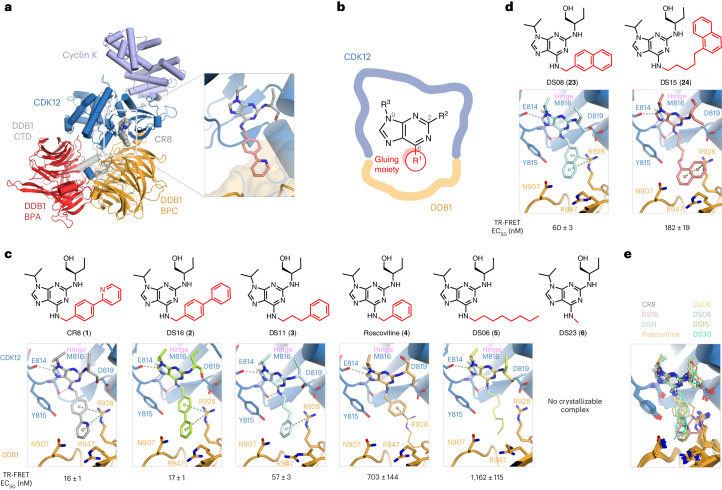
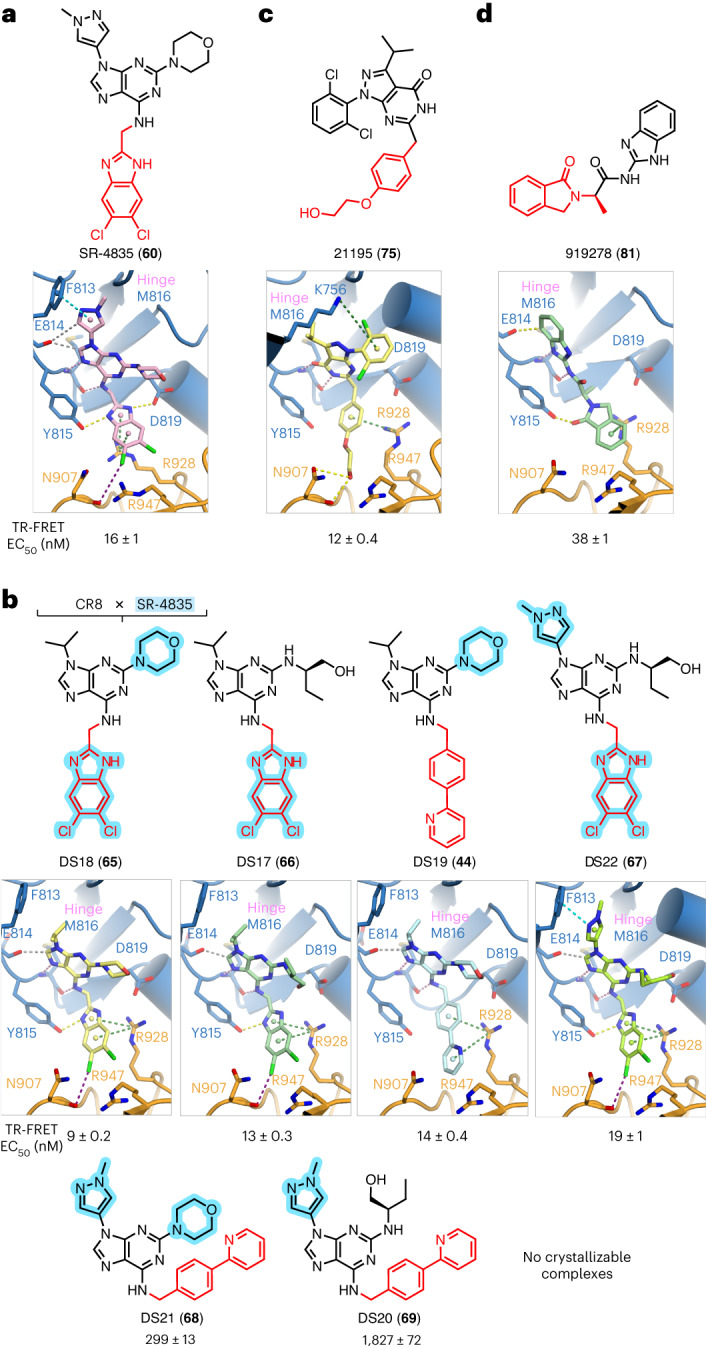
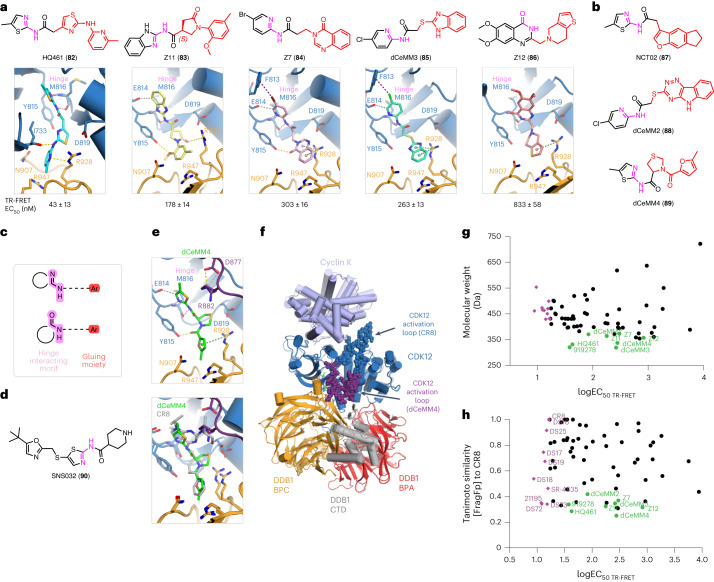
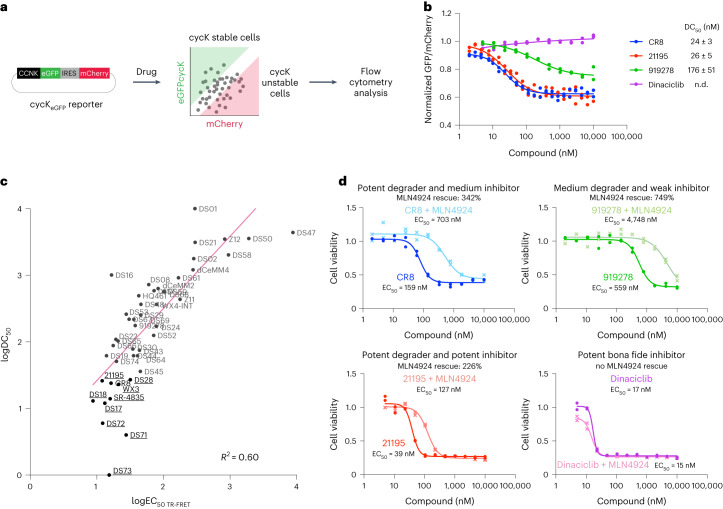
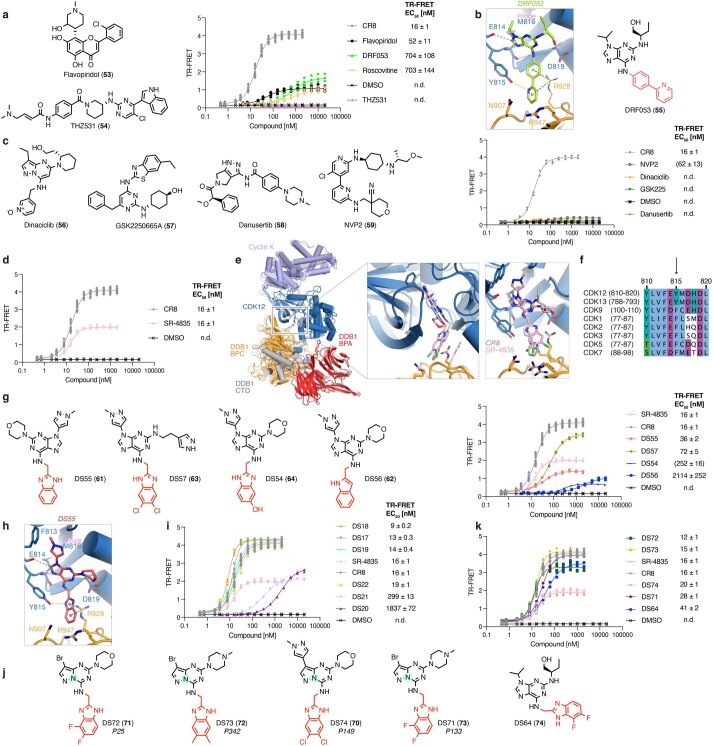
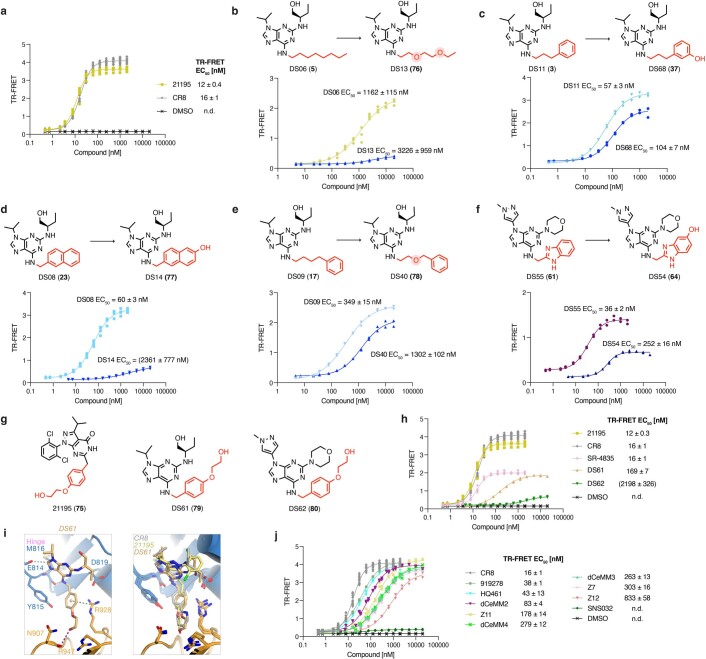
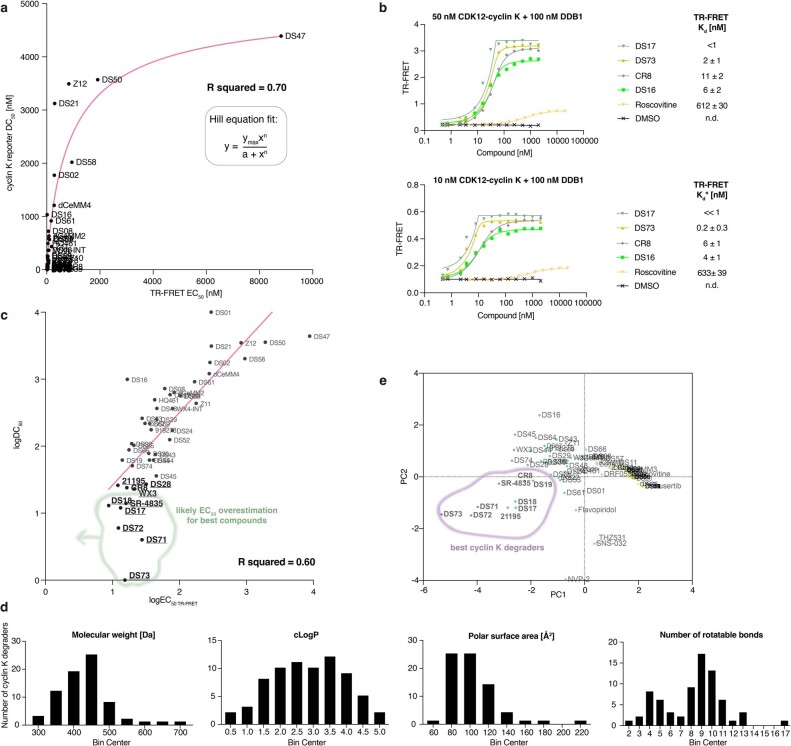
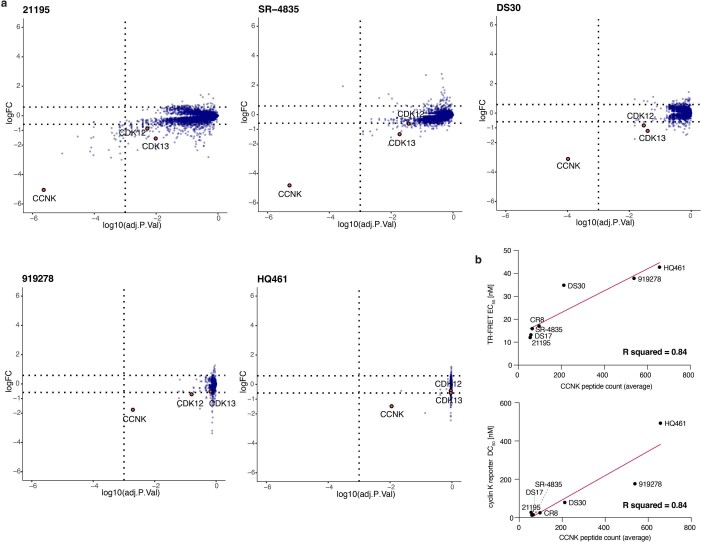
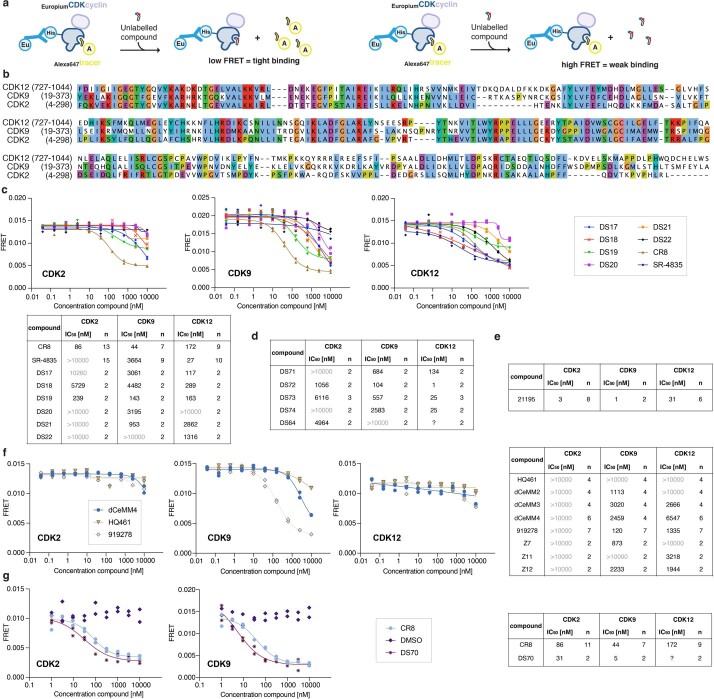
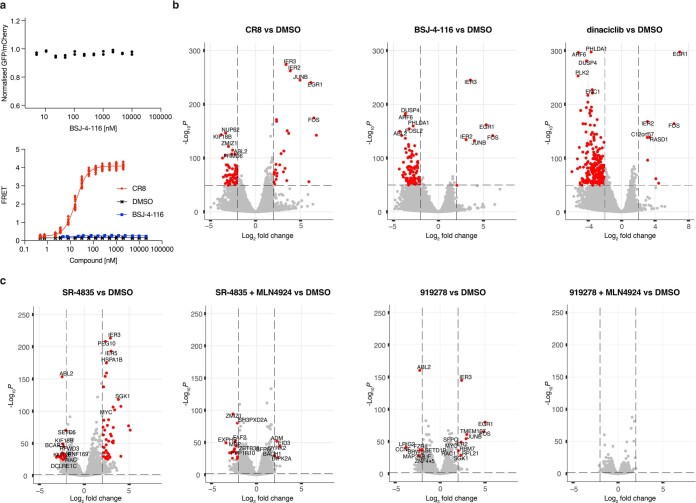
Molecular glue degraders are an effective therapeutic modality, but their design principles are not well understood. Recently, several unexpectedly diverse compounds were reported to deplete cyclin K by linking CDK12–cyclin K to the DDB1–CUL4–RBX1 E3 ligase. Here, to investigate how chemically dissimilar small molecules trigger cyclin K degradation, we evaluated 91 candidate degraders in structural, biophysical and cellular studies and reveal all compounds acquire glue activity via simultaneous CDK12 binding and engagement of DDB1 interfacial residues, in particular Arg928. While we identify multiple published kinase inhibitors as cryptic degraders, we also show that these glues do not require pronounced inhibitory properties for activity and that the relative degree of CDK12 inhibition versus cyclin K degradation is tuneable. We further demonstrate cyclin K degraders have transcriptional signatures distinct from CDK12 inhibitors, thereby offering unique therapeutic opportunities. The systematic structure–activity relationship analysis presented herein provides a conceptual framework for rational molecular glue design.
Overview
The claims and statistics of this paper haven’t been checked yet.
Free: it reads the open-access text and checks the first 5 claims that cite a source we can check. Create a free account to check every claim.
Integrity signals
Registry
Cites
Statistics
Figures
Verification
Claims the paper makes
The claims and statistics of this paper haven’t been checked yet.
Free: it reads the open-access text and checks the first 5 claims that cite a source we can check. Create a free account to check every claim.
Claims other papers make about this one
Each is checked against this paper’s own text: does it say what the citing paper says it does?
The source backs part of the claim, not all of it — or backs it for a different population, condition or comparison.
In the citing paper
“and since then numerous cycK degraders have been discovered in both serendipitous screens and through more targeted approaches (Dieter et al. 2021;Houles et al. 2023;Kozicka et al. 2024).”
From From serendipity to strategy: molecular glue degraders in cancer therapeutics (2025) · cites this paper as Kozicka et al. 2024
Experimental — accuracy not yet measured
Self-check
Percentages, sums and reported differences re-computed from the paper’s own numbers.
The self-check needs the paper’s full text.
Citations
Cites
Moderated estimation of fold change and dispersion for RNA-seq data with DESeq2
Love, M. I., Huber, W., & Anders, S. (2014) · Genome Biology · doi:10.1186/s13059-014-0550-8 · Cited by 95,106
limma powers differential expression analyses for RNA-sequencing and microarray studies
Ritchie, M. E., Phipson, B., Wu, D., Hu, Y., Law, C. W., Shi, W., & Smyth, G. K. (2015) · Nucleic Acids Research · doi:10.1093/nar/gkv007 · Cited by 40,458
Features and development of Coot
Emsley, P., Lohkamp, B., Scott, W. G., & Cowtan, K. (2010) · Acta Crystallographica Section D Biological Crystallography · doi:10.1107/s0907444910007493 · Cited by 29,915 · cited 1×
“Reciprocal space refinement was performed using phenix.refine 54 , followed by iterative real space refinement in COOT 55 .”
Phaser crystallographic software
McCoy, A. J., Grosse-Kunstleve, R. W., Adams, P. D., Winn, M. D., Storoni, L. C., & Read, R. J. (2007) · Journal of Applied Crystallography · doi:10.1107/s0021889807021206 · Cited by 20,612 · cited 2×
“The structures of the different DDB1ΔB–CDK12–cyclin K-compound complexes were solved by means of molecular replacement with PHASER 53 using a previously solved structure of the complex induced by CR8 (Protein Data Bank (PDB) 6TD3 (ref.”
Overview of the CCP 4 suite and current developments
Winn, M. D., Ballard, C. C., Cowtan, K. D., Dodson, E. J., Emsley, P., Evans, P. R., Keegan, R. M., Krissinel, E. B., Leslie, A. G. W., McCoy, A., et al. (2011) · Acta Crystallographica Section D Biological Crystallography · doi:10.1107/s0907444910045749 · Cited by 12,353 · cited 1×
“Space group determination was done with POINTLESS 51 , and datasets were merged and scaled with AIMLESS 51 .”
Friesner, R. A., Banks, J. L., Murphy, R. B., Halgren, T. A., Klicic, J. J., Mainz, D. T., Repasky, M. P., Knoll, E. H., Shelley, M., Perry, J. K., et al. (2004) · Journal of Medicinal Chemistry · doi:10.1021/jm0306430 · Cited by 10,057
Inference of Macromolecular Assemblies from Crystalline State
Krissinel, E., & Henrick, K. (2007) · Journal of Molecular Biology · doi:10.1016/j.jmb.2007.05.022 · Cited by 9,984 · cited 2×
“4a–c, 53 – 59 ), and first focused on the CDK12-selective inhibitor SR-4835 (refs.”
Friesner, R. A., Murphy, R. B., Repasky, M. P., Frye, L. L., Greenwood, J. R., Halgren, T. A., Sanschagrin, P. C., & Mainz, D. T. (2006) · Journal of Medicinal Chemistry · doi:10.1021/jm051256o · Cited by 6,851
Towards automated crystallographic structure refinement with phenix.refine
Afonine, P. V., Grosse-Kunstleve, R. W., Echols, N., Headd, J. J., Moriarty, N. W., Mustyakimov, M., Terwilliger, T. C., Urzhumtsev, A., Zwart, P. H., & Adams, P. D. (2012) · Acta Crystallographica Section D Biological Crystallography · doi:10.1107/s0907444912001308 · Cited by 5,511 · cited 1×
“Reciprocal space refinement was performed using phenix.refine 54 , followed by iterative real space refinement in COOT 55 .”
MolProbity: More and better reference data for improved all‐atom structure validation
Williams, C. J., Headd, J. J., Moriarty, N. W., Prisant, M. G., Videau, L. L., Deis, L. N., Verma, V., Keedy, D. A., Hintze, B. J., Chen, V. B., et al. (2018) · Protein Science · doi:10.1002/pro.3330 · Cited by 4,599 · cited 1×
“Structure validation was carried out with Molprobity 58 , and visualizations were generated with PyMol (Schrödinger).”
Cited by
Targeted protein degradation: from mechanisms to clinic
Tsai, J. M., Nowak, R. P., Ebert, B. L., & Fischer, E. S. (2024) · Nature Reviews Molecular Cell Biology · doi:10.1038/s41580-024-00729-9 · Cited by 438
“This example, and the expansion of CR8 derivatives, highlights an underappreciated flexibility in recruiting CRLs by molecular glues and suggests that multiple interfaces — not necessarily involving the target itself — can be remodelled to induce TPD 101–103 .”
Self-citationTargeted protein degradation for cancer therapy
Hinterndorfer, M., Spiteri, V. A., Ciulli, A., & Winter, G. E. (2025) · Nature Reviews Cancer · doi:10.1038/s41568-025-00817-8 · Cited by 210
“60,61,95).”
Self-citationMolecular glues for protein-protein interactions: Progressing toward a new dream
Konstantinidou, M., & Arkin, M. R. (2024) · Cell Chemical Biology · doi:10.1016/j.chembiol.2024.04.002 · Cited by 187
Induced protein degradation for therapeutics: past, present, and future
Yoon, H., Rutter, J. C., Li, Y.-D., & Ebert, B. L. (2024) · Journal of Clinical Investigation · doi:10.1172/jci175265 · Cited by 67
“Structural studies revealed that the CDK inhibitor CR8 binds the active site of CDK12 and bridges the CDK12-DDB1 interface (68, 71).”
Self-citationMolecular glues and induced proximity: An evolution of tools and discovery
Robinson, S. A., Co, J., & Banik, S. M. (2024) · Cell chemical biology · doi:10.1016/j.chembiol.2024.04.001 · Cited by 63
Metadata
- Authors
- Kozicka, Z., Suchyta, D. J., Focht, V., Kempf, G., Petzold, G., Jentzsch, M., Zou, C., Di Genua, C., Donovan, K. A., Coomar, S., Cigler, M., Mayor-Ruiz, C., Schmid-Burgk, J. L., Häussinger, D., Winter, G. E., Fischer, E. S., Słabicki, M., Gillingham, D., Ebert, B. L., & Thomä, N. H.
- Affiliations
- University of Basel (CH)
- Friedrich Miescher Institute (CH)
- University of Bonn (DE)
- Broad Institute (US)
- Harvard University (US)
- Austrian Academy of Sciences (AT)
- Corresponding author
- Thomä, Nicolas H.
- ORCID
- Venue
- Nature Chemical Biology
- Published
- 2023-09-07
- Volume
- 20
- Issue
- 1
- Pages
- 93-102
- ISSN
- 1552-4450 (ISSN-L)
- 1552-4469
- PMC
- PMC10746543
- OpenAlex
- W4386498961
- Semantic Scholar
- 912980ae640f3301ac42767123794ece6dd660c4
- Cited by
- 113
- References
- 66
- Citations by year
- 2026: 42 · 2025: 45 · 2024: 24 · 2023: 2
- FWCI
- 10.16
- Type
- journal article
- Language
- en
- Open access
- hybrid
- doi.org
- Licence
- cc-by
- creativecommons.org/licenses/by/4.0 (tdm)
- creativecommons.org/licenses/by/4.0 (vor)
- Locations
- Nature Chemical Biology (publishedVersion, cc-by)
- PubMed Central (publishedVersion, cc-by)
- PubMed (publishedVersion)
- DORA PSI (Paul Scherrer Institute) (submittedVersion, other-oa)
- Funders
- Deutsche Forschungsgemeinschaft (KA 3071/6-1, CRC 1035, EXC 2124, X06SA, 1861/10-3, 3071/4-1, TRR261, FP7/2007–2013, 390838134, 201302640, KA 3071/4-1, 398967434, ZUK63)
- Schweizerischer Nationalfonds zur Förderung der Wissenschaftlichen Forschung (301206, 179541, 310030)
- Eberhard Karls Universität Tübingen (ZUK 63)
- Paul Scherrer Institut
- Studienstiftung des Deutschen Volkes
- National Heart, Lung, and Blood Institute (R01HL082945)
- National Cancer Institute (P01CA108631, P50CA206963, R01CA214608, R01CA218278)
- Topics
- Life Sciences › Biochemistry, Genetics and Molecular Biology › Molecular Biology › Protein Degradation and Inhibitors
- Life Sciences › Biochemistry, Genetics and Molecular Biology › Molecular Biology › Ubiquitin and proteasome pathways
- Physical Sciences › Chemistry › Organic Chemistry › Chemical Synthesis and Analysis
- Keywords
- molecular glues, cyclin K, CDK12, protein degradation, structure-activity relationship, kinase inhibitors, gene expression signatures
- MeSH terms
- Structure-Activity Relationship, Cyclins, Ubiquitin-Protein Ligases, Proteolysis
About these checks
Registry, retraction, Cites and statistics results are computed, not judged, with one exception: a printed reference that no index lists is read once by a model before it counts as a citation error. Claims are extracted by a model and kept only when their quote appears verbatim in the text; each cited source is then checked, with a model’s help, for whether it says what the claim relies on. Those verdicts can be wrong — read the claim’s quote and the cited source before relying on one.
Statistics and arithmetic are recomputed, not judged.
Confidence bands are shown only for fields calibrated on our annotated test set. None is calibrated yet, so no band is shown.
What counts as a claim ›How we measure confidence ›How we check this ›
Are you an author, or do you see a problem with this page? Request a review
Data sources
Bibliographic data: Semantic Scholar, OpenAlex, Crossref.
Contains information from the Semantic Scholar Academic Graph Datasets, made available under the ODC Attribution License (ODC-BY 1.0).
Semantic Scholar’s data is described in: Kinney, R., et al. (2023). The Semantic Scholar Open Data Platform. arXiv:2301.10140.
