

The DOI matches its Crossref record; 55 of the 56 references it cites were found in a registry or an index.
Machine learning model to predict mental health crises from electronic health records
Open accessPublished version of a preprint
Abstract
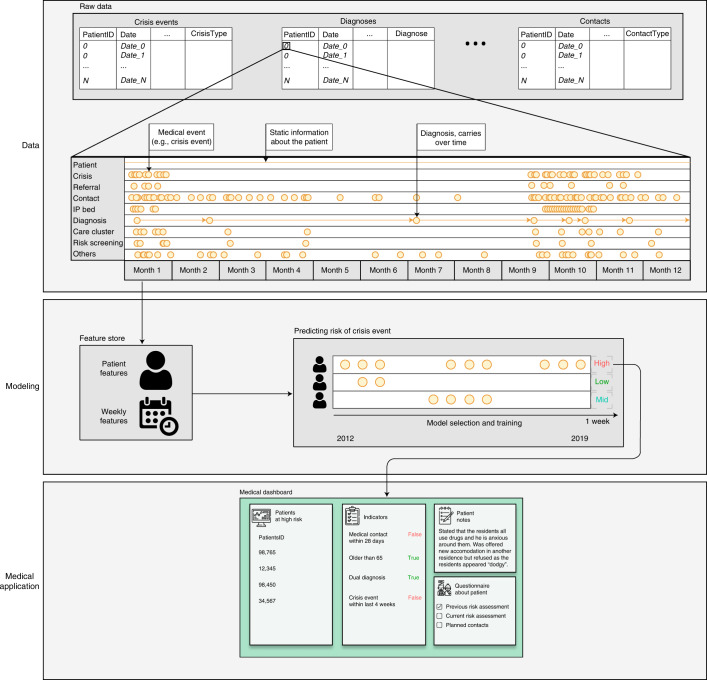
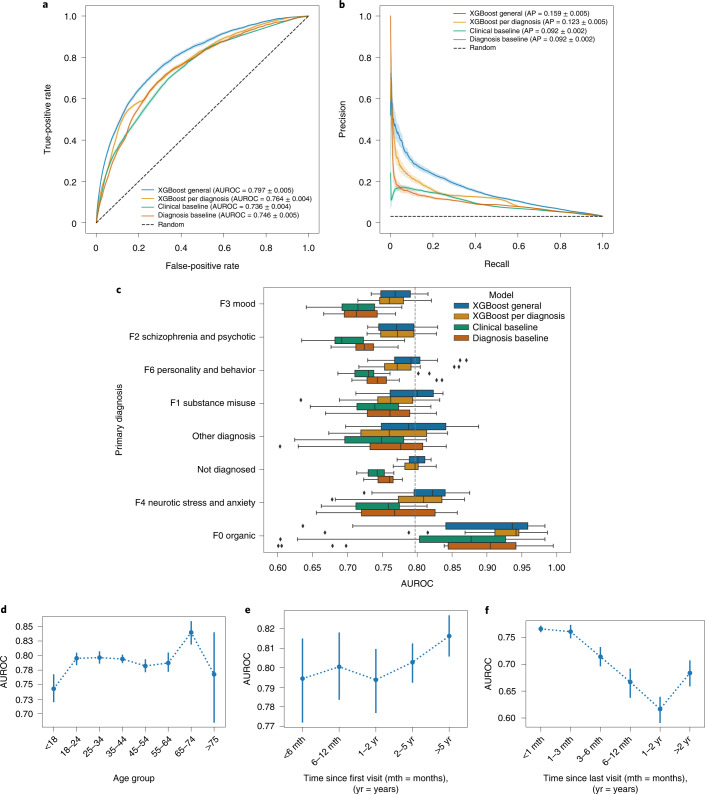
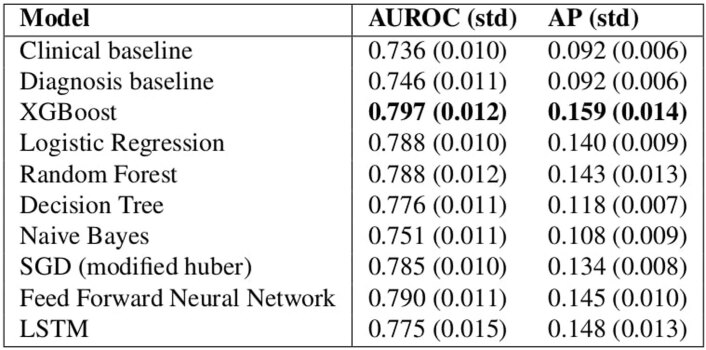
The timely identification of patients who are at risk of a mental health crisis can lead to improved outcomes and to the mitigation of burdens and costs. However, the high prevalence of mental health problems means that the manual review of complex patient records to make proactive care decisions is not feasible in practice. Therefore, we developed a machine learning model that uses electronic health records to continuously monitor patients for risk of a mental health crisis over a period of 28 days. The model achieves an area under the receiver operating characteristic curve of 0.797 and an area under the precision-recall curve of 0.159, predicting crises with a sensitivity of 58% at a specificity of 85%. A follow-up 6-month prospective study evaluated our algorithm's use in clinical practice and observed predictions to be clinically valuable in terms of either managing caseloads or mitigating the risk of crisis in 64% of cases. To our knowledge, this study is the first to continuously predict the risk of a wide range of mental health crises and to explore the added value of such predictions in clinical practice.
Overview
The claims and statistics of this paper haven’t been checked yet.
Run the check — free, no account needed. It reads the open-access text and checks the sources it cites.
Integrity signals
Registry
Cites
Statistics
Figures

Verification
Claims the paper makes
The claims and statistics of this paper haven’t been checked yet.
Run the check — free, no account needed. It reads the open-access text and checks the sources it cites.
Claims other papers make about this one
Each is checked against this paper’s own text: does it say what the citing paper says it does?
The source backs part of the claim, not all of it — or backs it for a different population, condition or comparison.
In the citing paper
“Although predictive models show promise for improving healthcare access and quality,23 evaluative studies in applied settings are limited and primarily focus on predicting outcomes in care, not on improving provider-client fit from the start of care.24-26”
From Using Machine Learning to Match Clients and Therapy Providers: Evaluating Clinical Quality and Cost of Care (2025) · cites this paper as [26]
Experimental — accuracy not yet measured
Self-check
Percentages, sums and reported differences re-computed from the paper’s own numbers.
The self-check needs the paper’s full text.
Citations
Cites
XGBoost: A Scalable Tree Boosting System
Chen, T., & Guestrin, C. (2016) · Proceedings of the 22nd ACM SIGKDD International Conference on Knowledge Discovery and Data Mining · doi:10.1145/2939672.2939785 · Cited by 54,569
Greedy function approximation: A gradient boosting machine
Friedman, J. H. (2001) · The Annals of Statistics · doi:10.1214/aos/1013203451 · Cited by 30,731
A Unified Approach to Interpreting Model Predictions
Lundberg, S., & Lee, S.-I. (2017) · arXiv · doi:10.48550/arxiv.1705.07874 · Cited by 23,707
DeLong, E. R., DeLong, D. M., & Clarke-Pearson, D. L. (1988) · Biometrics · doi:10.2307/2531595 · Cited by 22,649
James, S. L., Abate, D., Abate, K. H., Abay, S. M., Abbafati, C., Abbasi, N., Abbastabar, H., Abd-Allah, F., Abdela, J., Abdelalim, A., et al. (2018) · The Lancet · doi:10.1016/s0140-6736(18)32279-7 · Cited by 13,867
From local explanations to global understanding with explainable AI for trees
Lundberg, S. M., Erion, G., Chen, H., DeGrave, A., Prutkin, J. M., Nair, B., Katz, R., Himmelfarb, J., Bansal, N., & Lee, S.-I. (2020) · Nature Machine Intelligence · doi:10.1038/s42256-019-0138-9 · Cited by 10,551
Decision curve analysis: a novel method for evaluating prediction models
Vickers, A. J., & Elkin, E. B. (2006) · Medical Decision Making · doi:10.1177/0272989x06295361 · Cited by 6,341
Assessing the Performance of Prediction Models: A Framework for Traditional and Novel Measures
Steyerberg, E. W., Vickers, A. J., Cook, N. R., Gerds, T., Gonen, M., Obuchowski, N., Pencina, M. J., & Kattan, M. W. (2010) · Epidemiology · doi:10.1097/ede.0b013e3181c30fb2 · Cited by 5,170
Mental health and the COVID-19 pandemic
Pfefferbaum, B., & North, C. S. (2020) · New England Journal of Medicine · doi:10.1056/nejmp2008017 · Cited by 4,378
Adaptive linear step-up procedures that control the false discovery rate
Benjamini, Y., Krieger, A. M., & Yekutieli, D. (2006) · Biometrika · doi:10.1093/biomet/93.3.491 · Cited by 3,228
Scalable and accurate deep learning with electronic health records
Rajkomar, A., Oren, E., Chen, K., Dai, A. M., Hajaj, N., Hardt, M., Liu, P. J., Liu, X., Marcus, J., Sun, M., et al. (2018) · npj Digital Medicine · doi:10.1038/s41746-018-0029-1 · Cited by 2,648
Scalable and accurate deep learning with electronic health records.
Rajkomar, A., Oren, E., Chen, K., Dai, A. M., Hajaj, N., Hardt, M., Liu, P. J., Liu, X., Marcus, J., Sun, M., et al. (2018) · eScholarship (California Digital Library) · Cited by 2,242
Psychological interventions for people affected by the COVID-19 epidemic
Duan, L., & Zhu, G. (2020) · The Lancet Psychiatry · doi:10.1016/s2215-0366(20)30073-0 · Cited by 1,885
Miotto, R., Li, L., Kidd, B. A., & Dudley, J. T. (2016) · Scientific Reports · doi:10.1038/srep26094 · Cited by 1,710
Transforming classifier scores into accurate multiclass probability estimates
Zadrozny, B., & Elkan, C. (2002) · Proceedings of the eighth ACM SIGKDD international conference on Knowledge discovery and data mining · doi:10.1145/775047.775151 · Cited by 1,280
The consequences of the COVID-19 pandemic on mental health and implications for clinical practice
Fiorillo, A., & Gorwood, P. (2020) · European Psychiatry · doi:10.1192/j.eurpsy.2020.35 · Cited by 1,190
Challenges and opportunities in global mental health: a research-to-practice perspective
Wainberg, M. L., Scorza, P., Shultz, J. M., Helpman, L., Mootz, J. J., Johnson, K. A., Neria, Y., Bradford, J.-M. E., Oquendo, M. A., & Arbuckle, M. R. (2017) · Current Psychiatry Reports · doi:10.1007/s11920-017-0780-z · Cited by 875
Proportion of hospital readmissions deemed avoidable: a systematic review
van Walraven, C., Bennett, C. L., Jennings, A., Austin, P. C., & Forster, A. J. (2011) · Canadian Medical Association Journal · doi:10.1503/cmaj.101860 · Cited by 732
Predicting Risk of Suicide Attempts Over Time Through Machine Learning
Walsh, C. G., Ribeiro, J. D., & Franklin, J. C. (2017) · Clinical Psychological Science · doi:10.1177/2167702617691560 · Cited by 571
Early prediction of circulatory failure in the intensive care unit using machine learning
Hyland, S. L., Faltys, M., Hüser, M., Lyu, X., Gumbsch, T., Esteban, C., Bock, C., Horn, M., Moor, M., Rieck, B., et al. (2020) · Nature Medicine · doi:10.1038/s41591-020-0789-4 · Cited by 477
Area under the Precision-Recall Curve: Point Estimates and Confidence Intervals
Boyd, K., Eng, K. H., & Page, C. D. (2013) · Lecture notes in computer science · doi:10.1007/978-3-642-40994-3_29 · Cited by 470
Kessler, R. C., Warner, C. H., Ivany, C., Petukhova, M. V., Rose, S., Bromet, E. J., Brown, M., Cai, T., Colpe, L. J., Cox, K. L., et al. (2015) · JAMA Psychiatry · doi:10.1001/jamapsychiatry.2014.1754 · Cited by 447
Simon, G. E., Johnson, E., Lawrence, J. M., Rossom, R. C., Ahmedani, B., Lynch, F. L., Beck, A., Waitzfelder, B., Ziebell, R., Penfold, R. B., et al. (2018) · American Journal of Psychiatry · doi:10.1176/appi.ajp.2018.17101167 · Cited by 400
Ozenne, B., Subtil, F., & Maucort-Boulch, D. (2015) · Journal of Clinical Epidemiology · doi:10.1016/j.jclinepi.2015.02.010 · Cited by 379
Deep learning in mental health outcome research: a scoping review
Su, C., Xu, Z., Pathak, J., & Wang, F. (2020) · Translational Psychiatry · doi:10.1038/s41398-020-0780-3 · Cited by 368
Predicting suicidal behavior from longitudinal electronic health records.
Barak-Corren, Y., Castro, V. M., Javitt, S., Hoffnagle, A. G., Dai, Y., Perlis, R. H., Nock, M. K., Smoller, J. W., & Reis, B. Y. (2017) · American Journal of Psychiatry · doi:10.1176/appi.ajp.2016.16010077 · Cited by 339
Deep learning algorithm predicts diabetic retinopathy progression in individual patients
Arcadu, F., Benmansour, F., Maunz, A., Willis, J., Haskova, Z., & Prunotto, M. (2019) · npj Digital Medicine · doi:10.1038/s41746-019-0172-3 · Cited by 305
Explainable AI for Trees: From Local Explanations to Global UnderstandingPreprint
Lundberg, S., Erion, G., Chen, H., DeGrave, A. J., Prutkin, J. M., Nair, B. G., Katz, R., Himmelfarb, J., Bansal, N., & Lee, S. (2019) · arXiv (Cornell University) · doi:10.48550/arxiv.1905.04610 · Cited by 252
Ye, C., Fu, T., Hao, S., Zhang, Y., Wang, O., Jin, B., Xia, M., Liu, M., Zhou, X., Wu, Q., et al. (2018) · Journal of Medical Internet Research · doi:10.2196/jmir.9268 · Cited by 250
Creating a Learning Health System through Rapid-Cycle, Randomized Testing
Horwitz, L. I., Kuznetsova, M., & Jones, S. A. (2019) · New England Journal of Medicine · doi:10.1056/nejmsb1900856 · Cited by 250
Implementation strategies for digital mental health interventions in health care settings.
Graham, A. K., Lattie, E. G., Powell, B. J., Lyon, A. R., Smith, J. D., Schueller, S. M., Stadnick, N. A., Brown, C. H., & Mohr, D. C. (2020) · American Psychologist · doi:10.1037/amp0000686 · Cited by 236
de Pablo, G. S., Studerus, E., Vaquerizo‐Serrano, J., Irving, J., Catalán, A., Oliver, D., Baldwin, H., Danese, A., Fazel, S., Steyerberg, E. W., et al. (2020) · Schizophrenia Bulletin · doi:10.1093/schbul/sbaa120 · Cited by 232
A Solution-Focused Research Approach to Achieve an Implementable Revolution in Digital Mental Health
Mohr, D. C., Riper, H., & Schueller, S. M. (2018) · JAMA Psychiatry · doi:10.1001/jamapsychiatry.2017.3838 · Cited by 204
Lin, Y.-W., Zhou, Y., Faghri, F., Shaw, M. J., & Campbell, R. H. (2019) · PLoS ONE · doi:10.1371/journal.pone.0218942 · Cited by 201
Readmission prediction using deep learning on electronic health records
Ashfaq, A., Sant’Anna, A., Lingman, M., & Nowaczyk, S. (2019) · Journal of Biomedical Informatics · doi:10.1016/j.jbi.2019.103256 · Cited by 194
Predicting the Risk of Suicide by Analyzing the Text of Clinical Notes
Poulin, C., Shiner, B. R., Thompson, P., Vepštas, L., Young‐Xu, Y., Goertzel, B., Watts, B. V., Flashman, L. A., & McAllister, T. W. (2014) · PLoS ONE · doi:10.1371/journal.pone.0085733 · Cited by 168
Fernandes, A. C., Dutta, R., Velupillai, S. U., Sanyal, J., Stewart, R. J., & Chandran, D. (2018) · Scientific Reports · doi:10.1038/s41598-018-25773-2 · Cited by 168
Su, C., Aseltine, R. H., Doshi, R., Chen, K., Rogers, S. C., & Wang, F. (2020) · Translational Psychiatry · doi:10.1038/s41398-020-01100-0 · Cited by 163
Predicting all-cause risk of 30-day hospital readmission using artificial neural networks
Jamei, M., Nisnevich, A., Wetchler, E., Sudat, S. E. K., & Liu, E. V. (2017) · PLoS ONE · doi:10.1371/journal.pone.0181173 · Cited by 145
Paton, F., Wright, K. E., Ayre, N., Dare, C. R. J., Johnson, S., Lloyd‐Evans, B., Simpson, A., Webber, M., & Meader, N. (2016) · Health Technology Assessment · doi:10.3310/hta20030 · Cited by 140
Assessment of Machine Learning vs Standard Prediction Rules for Predicting Hospital Readmissions
Morgan, D. J., Bame, B., Zimand, P., Dooley, P., Thom, K. A., Harris, A. D., Bentzen, S. M., Ettinger, W. H., Garrett-Ray, S., Tracy, J. K., et al. (2019) · JAMA Network Open · doi:10.1001/jamanetworkopen.2019.0348 · Cited by 111
Chen, Q., Zhang‐James, Y., Barnett, E. J., Lichtenstein, P., Jokinen, J., D'Onofrio, B. M., Faraone, S. V., Larsson, H., & Fazel, S. (2020) · PLoS Medicine · doi:10.1371/journal.pmed.1003416 · Cited by 86
A Time-Phased Machine Learning Model for Real-Time Prediction of Sepsis in Critical Care
Li, X., Xu, X., Xie, F., Xu, X., Sun, Y., Liu, X., Jia, X., Kang, Y., Xie, L., Wang, F., et al. (2020) · Critical Care Medicine · doi:10.1097/ccm.0000000000004494 · Cited by 82
A Decade of Ubiquitous Computing Research in Mental Health
Bardram, J. E., & Matic, A. (2020) · IEEE Pervasive Computing · doi:10.1109/mprv.2019.2925338 · Cited by 78
Le, D. V., Montgomery, J., Kirkby, K. C., & Scanlan, J. D. (2018) · Journal of Biomedical Informatics · doi:10.1016/j.jbi.2018.08.007 · Cited by 73
Barnes, T. R. E., Leeson, V. C., Paton, C., Costelloe, C., Simon, J., Kiss, N., Osborn, D., Killaspy, H. T., Craig, T., Lewis, S. W., et al. (2016) · Health Technology Assessment · doi:10.3310/hta20290 · Cited by 65
Raket, L. L., Jaskolowski, J., Kinon, B. J., Brasen, J. C., Jönsson, L., Wehnert, A., & Fusar-Poli, P. (2020) · The Lancet Digital Health · doi:10.1016/s2589-7500(20)30024-8 · Cited by 60
Emergency Department Recognition of Mental Disorders and Short-Term Outcome of Deliberate Self-Harm
Olfson, M., Marcus, S. C., & Bridge, J. A. (2013) · American Journal of Psychiatry · doi:10.1176/appi.ajp.2013.12121506 · Cited by 54
He, Z., Du, L., Zhang, P., Zhao, R., Chen, X., & Fang, Z. (2020) · Critical Care Medicine · doi:10.1097/ccm.0000000000004644 · Cited by 40
Graham, A. K., Greene, C. J., Powell, T., Lieponis, P., Lunsford, A., Peralta, C. D., Orr, L. C., Kaiser, S. M., Alam, N., Berhane, H., et al. (2020) · Translational Behavioral Medicine · doi:10.1093/tbm/ibz140 · Cited by 37
A data science approach to predicting patient aggressive events in a psychiatric hospital
Suchting, R., Green, C. E., Glazier, S., & Lane, S. D. (2018) · Psychiatry Research · doi:10.1016/j.psychres.2018.07.004 · Cited by 36
A Role for Occupational Therapy in Crisis Intervention and Prevention
Miller, V., & Robertson, S. (1991) · Australian Occupational Therapy Journal · doi:10.1111/j.1440-1630.1991.tb01710.x · Cited by 17
Ho, E. T. L., Tan, I. E., Lee, I. Y., Wu, P. Y., & Chong, H.-F. (2017) · International Journal of Integrated Care · doi:10.5334/ijic.3826 · Cited by 5
VERIFICATION OF FORECASTS EXPRESSED IN TERMS OF PROBABILITY
BRIER, G. W. (1950) · Monthly Weather Review · doi:10.1175/1520-0493(1950)078
Verification of forecasts expressed in terms of probability
BRIER, G. W. (1950) · Monthly Weather Review · doi:10.1175/1520-0493(1950)078%3c0001:vofeit%3e2.0.co;2
Research works printed but not linked: 3
- Nielsen, D. Tree Boosting with XGBoost: Why Does XGBoost Win ‘Every’ Machine Learning Competition? Master’s thesis, Norwegian University of Science and Technology (2016).
- Bergstra, J., Yamins, D. & Cox, D. Making a science of model search: hyperparameter optimization in hundreds of dimensions for vision architectures. In: Dasgupta, S. & McAllester, D. (eds) Proc. 30th International Conference on Machine Learning, 115–123 (PMLR, 2013).
- Bergstra, J. S., Bardenet, R., Bengio, Y. & Kégl, B. Algorithms for hyper-parameter optimization. In: Shawe-Taylor, J., Zemel, R. S., Bartlett, P. L., Pereira, F. & Weinberger, K. Q. (eds) Advances in Neural Information Processing Systems 24, 2546–2554 (Curran Associates, 2011).
Cited by
Sorted by citations
Enhancing mental health with Artificial Intelligence: Current trends and future prospects
Olawade, D. B., Wada, O. Z., Odetayo, A., David-Olawade, A. C., Asaolu, F. T., & Eberhardt, J. (2024) · Journal of Medicine Surgery and Public Health · doi:10.1016/j.glmedi.2024.100099 · Cited by 667
Seiferth, C., Vogel, L., Aas, B., Brandhorst, I., Carlbring, P., Conzelmann, A., Esfandiari, N., Finkbeiner, M., Hollmann, K., Lautenbacher, H., et al. (2023) · Nature Mental Health · doi:10.1038/s44220-023-00085-1 · Cited by 105
Terra, M., Baklola, M. I., Ali, S. A. A., & El-Bastawisy, K. (2023) · The Egyptian Journal of Neurology Psychiatry and Neurosurgery · doi:10.1186/s41983-023-00681-z · Cited by 88
Islam, M. M., Hassan, S., Akter, S., Jibon, F. A., & Sahidullah, M. (2024) · Healthcare Analytics · doi:10.1016/j.health.2024.100350 · Cited by 89
Yang, Y., Song, B., Zhang, J., Dan, N., & Gu, H. (2024) · Biomacromolecules · doi:10.1021/acs.biomac.4c00803 · Cited by 69
Metadata
- Authors
- Garriga, R., Mas, J., Abraha, S., Nolan, J., Harrison, O., Tadros, G., & Matic, A.
- Affiliations
- Universitat Pompeu Fabra (ES)
- Birmingham and Solihull Mental Health NHS Foundation Trust (GB)
- Aston University (GB)
- Corresponding author
- Garriga, Roger
- Matic, Aleksandar
- Venue
- Nature Medicine
- Published
- 2022-05-16
- Volume
- 28
- Issue
- 6
- Pages
- 1240-1248
- ISSN
- 1078-8956 (ISSN-L)
- 1546-170X
- PMC
- PMC9205775
- OpenAlex
- W4280536523
- Cited by
- 229
- References
- 56
- Citations by year
- 2026: 56 · 2025: 90 · 2024: 46 · 2023: 33 · 2022: 4
- FWCI
- 14.18
- Type
- journal article
- Language
- en
- Open access
- hybrid
- doi.org
- Locations
- Nature Medicine (publishedVersion, cc-by)
- Research Square (acceptedVersion, cc-by)
- PubMed Central (publishedVersion, cc-by)
- PubMed (publishedVersion)
- Aston Publications Explorer (Aston University) (acceptedVersion)
- Warwick Research Archive Portal (University of Warwick) (acceptedVersion)
- Funders
- Health Foundation (709246)
- Topics
- Physical Sciences › Computer Science › Artificial Intelligence › Machine Learning in Healthcare
- Social Sciences › Psychology › Social Psychology › Mental Health via Writing
- Health Sciences › Health Professions › Health Information Management › Artificial Intelligence in Healthcare
- Keywords
- electronic health records, risk prediction, clinical decision support, continuous patient monitoring, clinical utility, mental health services
- MeSH terms
- Machine Learning, Humans, Mental Health, Prospective Studies, ROC Curve, Electronic Health Records
About these checks
Registry, retraction, Cites and statistics results are computed, not judged, with one exception: a printed reference that no index lists is read once by a model before it counts as a citation error. Claims are extracted by a model and kept only when their quote appears verbatim in the text; each cited source is then checked, with a model’s help, for whether it says what the claim relies on. Those verdicts can be wrong — read the claim’s quote and the cited source before relying on one.
Statistics and arithmetic are recomputed, not judged.
Confidence bands are shown only for fields calibrated on our annotated test set. None is calibrated yet, so no band is shown.
What counts as a claim ›How we measure confidence ›How we check this ›
Are you an author, or do you see a problem with this page? Request a review
