

Mapping neurotransmitter systems to the structural and functional organization of the human neocortex
Open accessPublished version of a preprint
The DOI matches its Crossref record; 140 of the 140 references it cites were found in a registry or an index.
Abstract
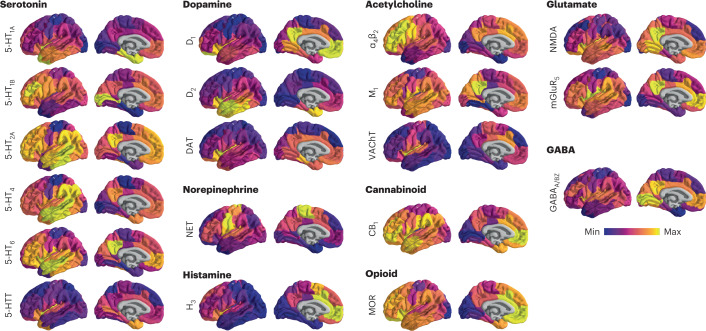
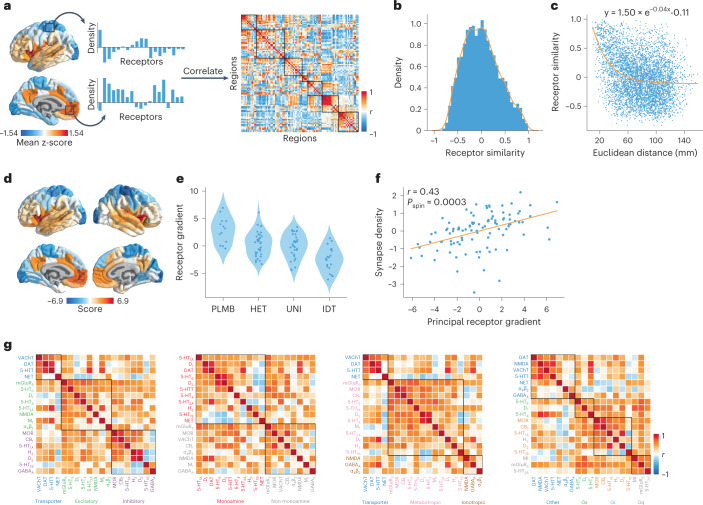
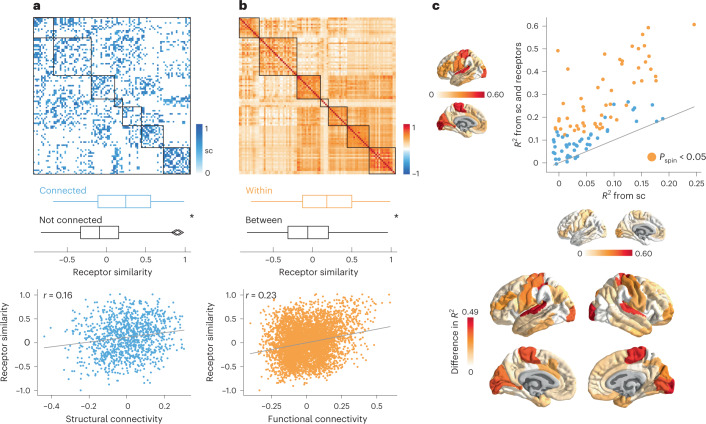
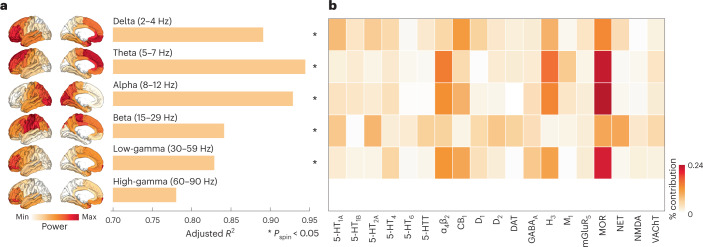
Neurotransmitter receptors support the propagation of signals in the human brain. How receptor systems are situated within macro-scale neuroanatomy and how they shape emergent function remain poorly understood, and there exists no comprehensive atlas of receptors. Here we collate positron emission tomography data from more than 1,200 healthy individuals to construct a whole-brain three-dimensional normative atlas of 19 receptors and transporters across nine different neurotransmitter systems. We found that receptor profiles align with structural connectivity and mediate function, including neurophysiological oscillatory dynamics and resting-state hemodynamic functional connectivity. Using the Neurosynth cognitive atlas, we uncovered a topographic gradient of overlapping receptor distributions that separates extrinsic and intrinsic psychological processes. Finally, we found both expected and novel associations between receptor distributions and cortical abnormality patterns across 13 disorders. We replicated all findings in an independently collected autoradiography dataset. This work demonstrates how chemoarchitecture shapes brain structure and function, providing a new direction for studying multi-scale brain organization.
Overview
The claims and statistics of this paper haven’t been checked yet.
Free: it reads the open-access text and checks the first 5 claims that cite a source we can check. Create a free account to check every claim.
Integrity signals
Registry
Cites
Statistics
Figures
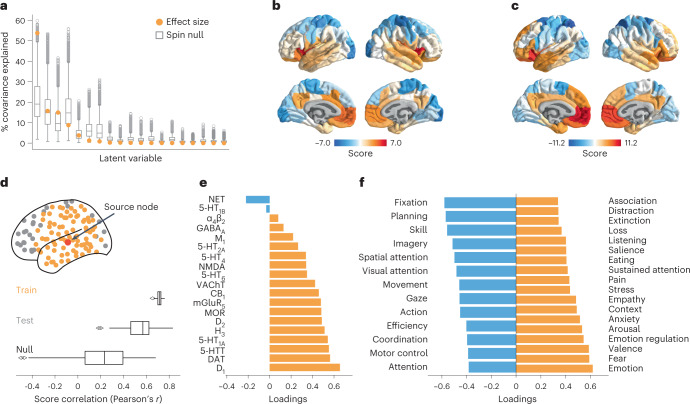
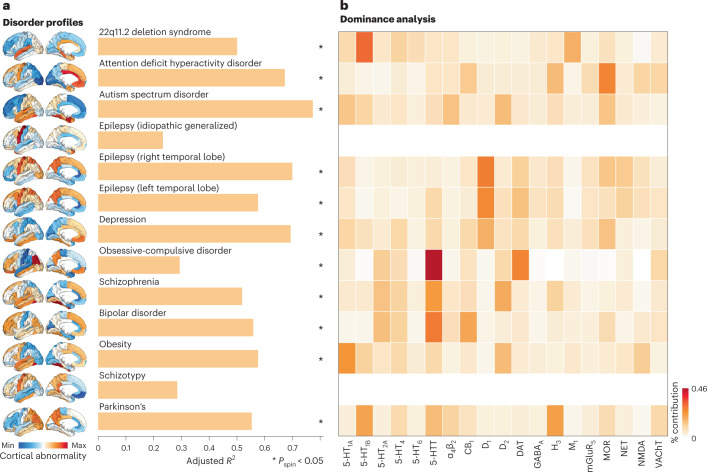
Verification
Claims the paper makes
The claims and statistics of this paper haven’t been checked yet.
Free: it reads the open-access text and checks the first 5 claims that cite a source we can check. Create a free account to check every claim.
Claims other papers make about this one
Each is checked against this paper’s own text: does it say what the citing paper says it does?
The cited source says what the claim attributes to it.
In the citing paper
“These maps can be applied analogously to the Allen Brain Atlas for gene expression and have been shown to align with structural connectivity and neurophysiological dynamics73,75.”
From Deviations in effective connectivity explain different hallucination subtypes in Parkinson's disease psychosis (2026) · cites this paper as [75]
Self-check
Percentages, sums and reported differences re-computed from the paper’s own numbers.
The self-check needs the paper’s full text.
Citations
Cites
Desikan, R. S., Ségonne, F., Fischl, B., Quinn, B. T., Dickerson, B. C., Blacker, D., Buckner, R. L., Dale, A. M., Maguire, R. P., Hyman, B. T., et al. (2006) · NeuroImage · doi:10.1016/j.neuroimage.2006.01.021 · Cited by 13,324
The organization of the human cerebral cortex estimated by intrinsic functional connectivity
Thomas Yeo, B. T., Krienen, F. M., Sepulcre, J., Sabuncu, M. R., Lashkari, D., Hollinshead, M., Roffman, J. L., Smoller, J. W., Zöllei, L., Polimeni, J. R., et al. (2011) · Journal of Neurophysiology · doi:10.1152/jn.00338.2011 · Cited by 9,182
The organization of the human cerebellum estimated by intrinsic functional connectivity
Buckner, R. L., Krienen, F. M., Castellanos, A., Diaz, J. C., & Yeo, B. T. T. (2011) · Journal of Neurophysiology · doi:10.1152/jn.00339.2011 · Cited by 7,304
The WU-Minn Human Connectome Project: An overview
Van Essen, D. C., Smith, S. M., Barch, D. M., Behrens, T. E. J., Yacoub, E., & Ugurbil, K. (2013) · NeuroImage · doi:10.1016/j.neuroimage.2013.05.041 · Cited by 5,651 · cited 2×
“We used MEG power spectra across six canonical frequency bands from 33 unrelated participants in the Human Connectome Project (see Methods for details; [43, 111, 132]).”
MethodThe minimal preprocessing pipelines for the Human Connectome Project
Glasser, M. F., Sotiropoulos, S. N., Wilson, J. A., Coalson, T. S., Fischl, B., Andersson, J. L., Xu, J., Jbabdi, S., Webster, M., Polimeni, J. R., et al. (2013) · NeuroImage · doi:10.1016/j.neuroimage.2013.04.127 · Cited by 5,253
Domingos da Silveira da Luz, A. C., Pereira Dias, G., do Nascimento Bevilaqua, M. C., Cocks, G., Gardino, P. F., Thuret, S., & Nardi, A. E. (2013) · Neuropsychobiology · doi:10.1159/000353269 · Cited by 3,995
Large-scale automated synthesis of human functional neuroimaging data.
Yarkoni, T., Poldrack, R. A., Nichols, T. E., Van Essen, D. C., & Wager, T. D. (2011) · Nature Methods · doi:10.1038/nmeth.1635 · Cited by 3,686
Brainstorm: A User-Friendly Application for MEG/EEG Analysis
Tadel, F., Baillet, S., Mosher, J. C., Pantazis, D., & Leahy, R. M. (2011) · Computational Intelligence and Neuroscience · doi:10.1155/2011/879716 · Cited by 3,677
Self-citationLocal-global parcellation of the human cerebral cortex from intrinsic functional connectivity MRI
Schaefer, A., Kong, R., Gordon, E. M., Laumann, T. O., Zuo, X.-N., Holmes, A. J., Eickhoff, S. B., & Yeo, B. T. T. (2018) · Cerebral Cortex · doi:10.1093/cercor/bhx179 · Cited by 3,657 · cited 8×
“Due to the low spatial resolution of PET tracer binding, we opted to present our main results using a coarse resolution of 100 cortical regions 12 .”
BackgroundMethodInfluentialMRtrix3: A fast, flexible and open software framework for medical image processing and visualisation
Tournier, J.-D., Smith, R., Raffelt, D., Tabbara, R., Dhollander, T., Pietsch, M., Christiaens, D., Jeurissen, B., Yeh, C.-H., & Connelly, A. (2019) · NeuroImage · doi:10.1016/j.neuroimage.2019.116137 · Cited by 2,974
Research works printed but not linked: 3
- Dhollander, T., Raffelt, D. & Connelly, A. Unsupervised 3-tissue response function estimation from single-shell or multi-shell diffusion MR data without a co-registered t1 image. ISMRM Workshop on Breaking the Barriers of Diffusion MRI. https://www.researchgate.net/publication/307863133_Unsupervised_3-tissue_response_function_estimation_from_single-shell_or_multi-shell_diffusion_MR_data_without_a_co-registered_T1_image (ISMRM, 2016).
- Tournier, J. D., Calamante, F. & Connelly, A. Improved probabilistic streamlines tractography by 2nd order integration over fibre orientation distributions. Proc. Int. Soc. Magn. Res. Med. https://cds.ismrm.org/protected/10MProceedings/PDFfiles/1670_4298.pdf (2010).
- Larivière S The ENIGMA Toolbox: multiscale neural contextualization of multisite neuroimaging datasets Nat. Methods 2021 18 698 700 34194050 PMC8983056 · DOI · Paper page
Cited by
Items 201–300 of 873
Qin, K., Ai, C., Zhu, P., Xiang, J., Chen, X., Zhang, L., Wang, C., Zou, L., Chen, F., Pan, X., et al. (2025) · Biological Psychiatry · doi:10.1016/j.biopsych.2025.08.013 · Cited by 14
Distinct neuroimaging subtypes of ADHD among adolescents based on semi-supervised learning
Chen, Y., Li, M., Zhao, Z., Xu, X., Chen, R., Zhao, R., Zhang, Y., Wang, G., & Wu, D. (2025) · Translational Psychiatry · doi:10.1038/s41398-025-03662-3 · Cited by 11
“Neurochemical density maps of average group healthy volunteers were acquired through prior PET and SPECT studies [40].”
Huang, W., Sun, X., Zhang, X., Xu, R., Qian, Y., & Zhu, J. (2024) · Molecular Neurobiology · doi:10.1007/s12035-024-03962-7 · Cited by 12
“These neurotransmitter atlases have provided a new direction for studying how neurochemical substrates shape brain structure and function [31].”
Molecular signatures of attention networks
Schindler, H., Jawinski, P., Arnatkevičiūtė, A., & Markett, S. A. (2024) · Human Brain Mapping · doi:10.1002/hbm.26588 · Cited by 12
“Given that the relationship between receptor/transporter availability and gene expression is not straight-forward (Hansen et al., 2022), the absence of a relationship with either level of observation can be considered complementary evidence.”
BackgroundMethodImaging the structural connectome with hybrid MRI-microscopy tractography
Zhu, S., Huszár, I. N., Cottaar, M., Daubney, G., Eichert, N., Hanayik, T., Khrapitchev, A. A., Mars, R. B., Mollink, J., Sallet, J., et al. (2025) · Medical Image Analysis · doi:10.1016/j.media.2025.103498 · Cited by 11
“Mapping brain structure through multiple modalities can improve our understanding of brain function, development, aging and diseases (Hansen et al., 2022; Smith et al., 2020; Sporns, 2013).”
Hinault, T., Segobin, S. H., Benbrika, S., Carluer, L., Doidy, F., Eustache, F., Viader, F., & Desgranges, B. (2022) · Brain Communications · doi:10.1093/braincomms/fcac228 · Cited by 11
“Although structural and functional brain changes have so far mostly been investigated separately, the complex interplay between brain metabolism and the underlying GM volume can provide a new prognostic indicator of disease progression.(34) Previous work revealed important associations between brain’s structure and fu…”
BackgroundHe, K., Hua, Q., Li, Q., Zhang, Y., Yao, X., Yang, Y., Xu, W., Sun, J., Wang, L., Wang, A., et al. (2023) · Journal of Psychiatry and Neuroscience · doi:10.1503/jpn.230037 · Cited by 11
“28 Subsequently, density values were extracted from each PET atlas, and averaged within 360 regions based on the the HCP-MMP 1.0 atlas (https://cjneu rolab. org/).”
BackgroundMethodInfluentialHeterochronous laminar myelination in the human prefrontal cortexPreprint
Sydnor, V. J., Petrie, D. J., McKeon, S. D., Famalette, A., Foran, W., Calabro, F. J., & Luna, B. (2025) · bioRxiv (Cold Spring Harbor Laboratory) · doi:10.1101/2025.01.30.635751 · Cited by 11
“In accordance with prior work on functional decoding 109,110 , we created meta-analytic maps for 123 psychological terms that were both available in Neurosynth and included in the Cognitive Atlas 111 , an ontology of cognitive neuroscience concepts.”
Mills, E., Bosma, R., Rogachov, A., Cheng, J. C., Osborne, N. R., Kim, J. A., Besik, A., Bhatia, A., & Davis, K. D. (2024) · Journal of Pain · doi:10.1016/j.jpain.2024.104536 · Cited by 6
The Case for Neurosurgical Intervention in Cancer Neuroscience
Bernstock, J. D., Gerstl, J. V. E., Chen, J., Johnston, B. R., Nonnenbroich, L. F., Spanehl, L., Gessler, F. A., Valdes, P. A., Lu, Y., Srinivasan, S. S., et al. (2024) · Neurosurgery · doi:10.1227/neu.0000000000003039 · Cited by 11
Fortier, A., Dumais, A., Boisvert, M., Zouaoui, I., Chung, C.-F., & Potvin, S. (2024) · Journal of Psychiatric Research · doi:10.1016/j.jpsychires.2024.09.012 · Cited by 10
Linking the microarchitecture of neurotransmitter systems to large-scale MEG resting state networks
Siebenhühner, F., Palva, J. M., & Palva, S. (2024) · iScience · doi:10.1016/j.isci.2024.111111 · Cited by 13
Zhu, J., & Yu, Y. (2024) · Biological Psychiatry · doi:10.1016/j.biopsych.2024.10.009 · Cited by 11
Dialogue mechanisms between astrocytic and neuronal networks: A whole-brain modelling approach
Ali, O. B. K., Vidal, A. C., Grova, C., & Benali, H. (2025) · PLoS Computational Biology · doi:10.1371/journal.pcbi.1012683 · Cited by 11
Kwon, M., Bo, K., Botvinik‐Nezer, R., Kragel, P. A., Oudenhove, L. V., Wager, T. D., Ashar, Y. K., Atlas, L. Y., Barrett, L. F., Becker, B., et al. (2026) · Nature Communications · doi:10.1038/s41467-026-71568-9 · Cited by 10
“While right Neurotransmitter receptor and transporter binding patterns from Neuromaps 73,74 revealed distinct neurochemical pro fi les across insular zones.”
InfluentialDecoding the neuroimmune axis in colorectal cancer: From neural circuitry to therapeutic innovation
Li, Y., Yang, S.-Y., Zhang, Y.-R., & Wang, Y. (2025) · Cytokine & Growth Factor Reviews · doi:10.1016/j.cytogfr.2025.04.001 · Cited by 10
Fronto-occipital dyscommunication associates with brain hierarchy in schizophrenia
Pei, H., Li, H., Hou, C., Liu, Y., Liu, J., Duan, M., Yao, D., Jiang, S., & Luo, C. (2025) · Communications Biology · doi:10.1038/s42003-025-08053-4 · Cited by 10
“Compared to examining regression coef fi cients, dominance analysis provides a more comprehensive assessment by accounting for variable in fl uences across different model contexts 25 .”
InfluentialCell-specific mechanisms drive connectivity across the time course of Huntington’s disease
Estevez‐Fraga, C., Sebenius, I., Hansen, J. Y., Hänisch, B., Zeun, P., Scahill, R. I., Gregory, S., Johnson, E. B., Wild, E. J., Byrne, L. M., et al. (2025) · Nature Communications · doi:10.1038/s41467-025-60556-0 · Cited by 11
“Chemoarchitecture is an organizational principle that describes the regional distribution of neurotransmitter systems in the brain, and is related to atrophy in psychiatric diseases 19 .”
InfluentialSelf-citationMapping the coupling between tract reachability and cortical geometry of the human brain
Li, D., Zalesky, A., Wang, Y., Wang, H., Ma, L., Cheng, L., Banaschewski, T., Barker, G. J., Bokde, A. L. W., Brühl, R., et al. (2025) · Nature Communications · doi:10.1038/s41467-025-62812-9 · Cited by 11
“To examine the neurochemical basis of TGC, we analyzed 19 neurotransmitter receptor maps 40 .”
InfluentialTabish, M., Malik, I., Akhtar, A., & Afzal, M. F. (2025) · Biomolecules · doi:10.3390/biom15101405 · Cited by 11
“Neurotransmitters are distributed heterogeneously across various brain regions, each exhibiting distinct neurochemical profiles tailored to their specialized functions [62].”
Cortical hierarchy underlying homeostatic sleep pressure alleviation
Zou, Q., Zou, G., Wang, S., Wang, Y., Xu, J., Long, Y., Zhou, S., Wu, X., Yang, G., Qin, L., et al. (2025) · Nature Communications · doi:10.1038/s41467-025-64989-5 · Cited by 12
“In addition, we validated that the spatial correlation between ALFF changes regulated by dynamics in sleep homeostasis and glycolysis are speci fi c and not signi fi cantly in fl uenced by the principal patterns of gene expression 79 or neurotransmitter receptor patterns 80 .”
Boecker, H., Maurer, A., Daamen, M., Bodensohn, L., Werkhausen, J., Lohaus, M., Manunzio, C., Manunzio, U., Radbruch, A., Attenberger, U. I., et al. (2024) · Frontiers in Neuroimaging · doi:10.3389/fnimg.2024.1332384 · Cited by 12
Shi, Z., Li, X., Todaro, D. R., Cao, W., Lynch, K. G., Detre, J. A., Loughead, J., Langleben, D. D., & Wiers, C. E. (2024) · Translational Psychiatry · doi:10.1038/s41398-024-03061-0 · Cited by 10
Yu, L., Chen, X., He, Y., Hong, X., & Yu, S. (2025) · CNS Neuroscience & Therapeutics · doi:10.1111/cns.70272 · Cited by 12
Dipasquale, O., Cohen, A. D., Martins, D., Zelaya, F. O., Turkheimer, F., Veronese, M., Mehta, M. A., Williams, S., Yang, B., Banerjee, S., et al. (2023) · Scientific Reports · doi:10.1038/s41598-023-38573-0 · Cited by 11
Haier, R. J. (2021) · Intelligence · doi:10.1016/j.intell.2021.101603 · Cited by 10
Yang, Z., Klugah‐Brown, B., Ding, G., Zhou, W., & Biswal, B. B. (2024) · Progress in Neuro-Psychopharmacology and Biological Psychiatry · doi:10.1016/j.pnpbp.2024.111159 · Cited by 10
“Recently, it has been understood that the neurotransmitter chemoarchitecture shapes brain structure and mediates function (Hansen et al., 2022) and was also widely used to study the pathological mechanisms of mental illness (Hahn et al., 2024; Wiesman et al., 2024; Yang et al., 2024).”
BackgroundCirillo, G., Caiazzo, G., Franza, F., Cirillo, M., Papa, M., & Esposito, F. (2025) · Frontiers in Neural Circuits · doi:10.3389/fncir.2024.1522421 · Cited by 9
“…the first principal component map of dopamine receptor densities, as obtained from a normative database of PET images recently made available (Hansen et al., 2022), similar z-score levels were observed across SNc and thalamus masks used for tractography, above the cerebral cortex and below…”
Tang, X., Wei, Y., Pang, J., Xu, L., Cui, H., Liu, X., Hu, Y., Ju, M., Tang, Y., Long, B., et al. (2025) · Schizophrenia · doi:10.1038/s41537-025-00565-6 · Cited by 10
Transient destabilization of whole brain dynamics induced by N,N-Dimethyltryptamine (DMT)
Piccinini, J., Perl, Y. S., Pallavicini, C., Deco, G., Kringelbach, M. L., Nutt, D. J., Carhart-Harris, R. L., Timmermann, C., & Tagliazucchi, E. (2025) · Communications Biology · doi:10.1038/s42003-025-07576-0 · Cited by 9
“For more details on the acquisitions and limitations of the data set see the original publication 86 .”
Xia, J., Yang, S., Li, J., Meng, Y., Niu, J., Chen, H., Zhang, Z., & Liao, W. (2025) · BMC Medicine · doi:10.1186/s12916-025-04099-7 · Cited by 9
“The excitatory-inhibitory ratio for each region was calculated as the ratio between the average density of excitatory receptors and the average density of inhibitory receptors [14, 50].”
Wang, Z., Robbins, B., Zhuang, R., van Bruggen, R., Sandini, T. M., Li, X., & Zhang, Y. (2025) · Scientific Reports · doi:10.1038/s41598-025-03383-z · Cited by 10
“Variations in TrkB expression and the activation of downstream pathways across different brain areas could be due to regional differences in neurotransmitter systems and neural circuitry 85,86,87 .”
Genetic foundations of interindividual neurophysiological variability
Castanheira, J. D. S., Poli, J., Hansen, J. Y., Mišić, B., & Baillet, S. (2025) · Science Advances · doi:10.1126/sciadv.ads7544 · Cited by 9
“The spatial alignment between cortical gene expression and Neurosynth-derived cognitive maps reflects an organization pattern consistent with previously reported functional gradients ( 61 – 64 ).”
Self-citationDing, Y., Kuai, Y., Li, R.-L., Xu, X., Wang, B., Wang, Z., Liu, Y., Dong, Y., Chen, S., Guo, M., et al. (2025) · Advanced Science · doi:10.1002/advs.202509545 · Cited by 11
Network spreading and local biological vulnerability in amyotrophic lateral sclerosis
Farahani, A., Hansen, J. Y., Bazinet, V., Shafiei, G., Collins, D. L., Dadar, M., Kalra, S., Dagher, A., & Mišić, B. (2025) · Communications Biology · doi:10.1038/s42003-025-08561-3 · Cited by 11
“For cortical regions, we apply the Schaefer-400 parcellation [111], and to examine the sub-cortex, specifically the white matter tracts, we use the Johns Hopkins University (JHU) white matter tractography atlas (thresholded at 25 % probability) [60, 146].”
Self-citationMulti‐Channel Neural Interface for Neural Recording and Neuromodulation
Kim, E.-M., Chung, W. G., Kim, E., Oh, M., Paek, J., Lee, T., Kim, D., An, S. H., Kim, S., & Park, J. (2025) · Small Methods · doi:10.1002/smtd.202501227 · Cited by 9
Global network and local vulnerabilities underlie brain atrophy across Parkinson’s disease stages
Vo, A., Tremblay, C., Rahayel, S., Al–Bachari, S., Berendse, H. W., Bright, J. K., Cendes, F., d’Angremont, E., Dalrymple‐Alford, J. C., Debove, I., et al. (2025) · Brain · doi:10.1093/brain/awaf432 · Cited by 9
“51,52 Volumetric radiotracer maps from Structural and functional connectivity was defined by cortico-cortical and subcortico-cortical normative network models derived from an unrelated cohort of healthy participants.”
Self-citationNeurotransmission-modulated whole-brain computation captures full task repertoire
Deco, G., Perl, Y. S., Vohryzek, J., Luppi, A. I., & Kringelbach, M. L. (2026) · Cell Reports · doi:10.1016/j.celrep.2025.116816 · Cited by 14
“43,44 As in Hansen et al. 35 we used the spherical projection of the surface to define spatial coordinates for each parcel by selecting the coordinates of the vertex closest to the center of the mass of each parcel.”
Long, J., Song, X., Wang, C., Peng, L., Niu, L., Li, Q., Huang, R., & Zhang, R. (2023) · Journal of Affective Disorders · doi:10.1016/j.jad.2023.12.052 · Cited by 11
Brain connectivity changes to fast versus slow dopamine increases
Manza, P., Tomasi, D. G., Vines, L., Sotelo, D., Yonga, M.-V., Wang, G., & Volkow, N. D. (2024) · Neuropsychopharmacology · doi:10.1038/s41386-024-01803-8 · Cited by 9
“Broadly, GBC appears to capture changes in large-scale neuronal communication following drug-induced changes in neurotransmitter binding to receptors [61, 62], a fi nding that was recently established in studies of 10 different mind-altering drugs including MP [21].”
Liu, H., Chen, D., Liu, C., Liu, P., Yang, H., & Lu, H. (2024) · Pediatric Research · doi:10.1038/s41390-024-03118-2 · Cited by 9
“To prove the robustness of the abovementioned neurotransmitter results, neurotransmitter receptor atlases provided by Hansen et al. 36,37 (https://github.com/netneurolab/hansen_receptors/tree/main/data/ PET_nifti_images)wereused.”
Computational limits to the legibility of the imaged human brain
Ruffle, J. K., Gray, R., Mohinta, S., Pombo, G., Kaul, C., Hyare, H., Rees, G. E., & Nachev, P. (2024) · NeuroImage · doi:10.1016/j.neuroimage.2024.120600 · Cited by 12
“…structured, replicable variation across the population (Littlejohns et al., 2020; Bethlehem et al., 2022; Elliott et al., 2018; Wang et al., 2022; Bazinet et al., 2023; Hansen et al., 2022; Su ´ arez et al., 2020; Honey et al., 2009; Fischl et al., 2008; Thomas Yeo, 2011; Hansen et al., 2021).”
BackgroundMalamud, J., Lewis, G., Moutoussis, M., Duffy, L., Bone, J. K., Srinivasan, R., Lewis, G., & Huys, Q. J. M. (2024) · Psychological Medicine · doi:10.1017/s0033291724000837 · Cited by 9
“Indeed, the serotonin system is known to be exquisitely complex, with many different serotonin receptors distinctively distributed (Hansen et al., 2022).”
Tang, R., Franz, C. E., Hauger, R. L., Dale, A. M., Dorros, S. M., Eyler, L. T., Fennema‐Notestine, C., Hagler, D. J., Lyons, M. J., Panizzon, M. S., et al. (2024) · Biological Psychiatry Cognitive Neuroscience and Neuroimaging · doi:10.1016/j.bpsc.2024.05.012 · Cited by 9
He, H., Long, J., Song, X., Li, Q., Niu, L., Peng, L., Wei, X., & Zhang, R. (2024) · Schizophrenia Research · doi:10.1016/j.schres.2024.06.031 · Cited by 10
Sassenberg, T. A., Safron, A., & DeYoung, C. G. (2024) · Cerebral Cortex · doi:10.1093/cercor/bhae391 · Cited by 9
Du, Y., Zhang, J., Cao, D., Yang, W., Li, J., Li, D., Song, M., Yang, Z., Zhang, J., Jiang, T., et al. (2024) · NeuroImage · doi:10.1016/j.neuroimage.2024.120883 · Cited by 9
Structural Neuroimaging and Molecular Signatures of Drug‐Naive Depression With Melancholic Features
Yuan, L., Chu, Z., Chen, X., He, M., Lu, Y., Xu, X., & Shen, Z. (2024) · Depression and Anxiety · doi:10.1155/2024/9680180 · Cited by 10
“…SPECT-derived maps of the serotonin systems (5HT1A, 5HT1B, 5HT2a, 5HT4, and serotonin transporter (SERT)) [26, 27], the cannabinoid receptor (CB1r) [28], the dopamine systems (D1, D2, DAT, and FDOPA) [29 – 32], the GABAergic receptor [33], the μ -opioid receptor (MUr) [34], the noradrenaline…”
Early Visual Cortices Reveal Interrelated Item and Category Representations in Aging
Pauley, C., Karlsson, A., & Sander, M. C. (2024) · eNeuro · doi:10.1523/eneuro.0337-23.2023 · Cited by 9
“However, recent evidence showing the wide variation in neurotransmitter concentrations (including dopamine and GABA) across the brain (Hansen et al., 2022) suggests that age-related disruptions in a particular neurotransmitter system could have differential consequences across brain regions.”
BackgroundWang, H. R., Liu, Z.-Q., Nakua, H., Hegarty, C. E., Thies, M. B., Patel, P. K., Schleifer, C. H., Boeck, T. P., McKinney, R. A., Currin, D. L., et al. (2024) · Biological Psychiatry · doi:10.1016/j.biopsych.2024.06.011 · Cited by 10
“As described in our previous work (29), signi fi cant LCs were determined using a permutation test with 5000 iterations with false discovery rate (FDR) correction ( q , .05).”
Yang, W. F. Z., Kadambi, A., Abellaneda‐Pérez, K., Mackin, G., Beslic, I., Potash, R. M., Sparby, T., & Sacchet, M. D. (2025) · bioRxiv (Cold Spring Harbor Laboratory) · doi:10.1101/2025.09.06.674021 · Cited by 12
Geometric influences on the regional organization of the mammalian brainPreprint
Pang, J. C. S., Robinson, P. A., Aquino, K. M., Levi, P. T., Holmes, A., Markicevic, M., Shen, X., Mandino, F., Funck, T., Palomero‐Gallagher, N., et al. (2025) · bioRxiv (Cold Spring Harbor Laboratory) · doi:10.1101/2025.01.30.635820 · Cited by 9
Self-citationFacca, M., Felice, A. D., & Bertoldo, A. (2024) · NeuroImage · doi:10.1016/j.neuroimage.2024.120902 · Cited by 10
Bu, X., Xia, M.-R., Cui, Z.-X., & He, Y. (2025) · Journal of Pacific Rim Psychology · doi:10.1177/18344909241308101 · Cited by 8
Connectome architecture for gray matter atrophy and surgical outcomes in temporal lobe epilepsy
Lin, Q., Cao, D., Li, W., Zhang, Y., Li, Y., Liu, P., Huang, X. Y., Huang, K., Gong, Q., Zhou, D., et al. (2025) · Epilepsia · doi:10.1111/epi.18343 · Cited by 9
“44,45 As a result, these regions may be more likely to be co-regulated by illness-related factors, making them more susceptible to disease-driven changes.”
Uncovering atrophy progression pattern and mechanisms in individuals at risk of Alzheimer's disease
Tremblay, C., Rahayel, S., Pastor‐Bernier, A., St‐Onge, F., Vo, A., Rheault, F., Daneault, V., Morys, F., Rajah, N., Villeneuve, S., et al. (2025) · Brain Communications · doi:10.1093/braincomms/fcaf099 · Cited by 9
Self-citationZhang, J., Du, Y., Jin, L., Yang, W., Cao, D., Luo, N., Yang, Z., Tang, K., Chu, C., Xiao, X., et al. (2025) · Biological Psychiatry · doi:10.1016/j.biopsych.2025.05.010 · Cited by 8
Fedeli, D., Ciullo, G., Demichelis, G., Medina, J. P., Bruzzone, M. G., Ciusani, E., Erbetta, A., Ferraro, S., Grisoli, M., Guastafierro, E., et al. (2025) · Cephalalgia · doi:10.1177/03331024251332561 · Cited by 8
Mapping the psychopathic brain: Divergent neuroimaging findings converge onto a common brain network
Dugre, J. R., & Brito, S. A. D. (2025) · Neuroscience & Biobehavioral Reviews · doi:10.1016/j.neubiorev.2025.106272 · Cited by 10
Churchill, L., Ignatavicius, A., Konuri, A., Anderson, J., Taylor, N. L., Lewis, S. J. G., & Matar, E. (2025) · Movement Disorders · doi:10.1002/mds.70025 · Cited by 9
Grumbach, P., Kasper, J., Hipp, J. F., Forsyth, A., Valk, S. L., Muthukumaraswamy, S. D., Eickhoff, S. B., Schilbach, L., & Dukart, J. (2025) · Nature Communications · doi:10.1038/s41467-025-63857-6 · Cited by 8
“To date, little is known about speci fi c neuro-transmitter properties underlying this functional reorganization in autism and how these alterations relate to speci fi c symptom domains 13 – 15 .”
Jensen, K. M., King, T. Z., Andrés-Camazón, P., Calhoun, V. D., & Iraji, A. (2025) · Frontiers in Neuroimaging · doi:10.3389/fnimg.2025.1650987 · Cited by 9
Ge, Y., Chen, L., Bai, Y., Wei, W., Shen, Y., Li, K., Wang, M., & Wang, M. (2025) · Human Brain Mapping · doi:10.1002/hbm.70383 · Cited by 8
Kang, Y., Jung, J., Han, K., Auer, D. P., & Ham, B. (2025) · Journal of Affective Disorders · doi:10.1016/j.jad.2025.120607 · Cited by 8
Human cortical dynamics reflect graded contributions of local geometry and network topography
Royer, J., Paquola, C., Rodríguez‐Cruces, R., Auer, H., Ngo, A., Sahlas, E., Arafat, T., Abdallah, C., Daniel Mansilla, D., Pana, R., et al. (2025) · Nature Communications · doi:10.1038/s41467-025-67740-2 · Cited by 9
“These properties are inter-dependent as brain wiring constrains neural activity at local and global scales, while functional, modulatory, and plastic processes shape the brain ’ s anatomical connections 74 – 77 .”
Subcortex visualization: A toolbox for custom data visualization in the subcortex and cerebellum
Bryant, A. G. (2026) · Aperture Neuro · doi:10.52294/001c.165884 · Cited by 8
Cortical structural differences following repeated ayahuasca use hold molecular signatures
Mallaroni, P., Mason, N. L., Kloft, L., Reckweg, J. T., van Oorsouw, K. I. M., & Ramaekers, J. G. (2023) · Frontiers in Neuroscience · doi:10.3389/fnins.2023.1217079 · Cited by 9
“…may be reflective of 5-HT 2A -mediated structural plasticity, let alone correspond to an individual participant’s anatomical organisation, which imposes strong constraints on whole-brain dynamics of functional networks (Bullmore and Sporns, 2012; Cabral et al., 2017; Hansen et al., 2022).”
BackgroundZhukovsky, P., Ironside, M., Duda, J. M., Moser, A. D., Null, K. E., Dhaynaut, M., Normandin, M. D., Guehl, N. J., Fakhri, G. E., Alexander, M., et al. (2024) · Biological Psychiatry · doi:10.1016/j.biopsych.2024.02.005 · Cited by 8
“Average receptor distribution maps for [ 11 C]carfentanil and [ 11 C] fl umazenil in MNI152 space were obtained from Hansen et al. (47), who obtained them from (48 – 50).”
MethodNuiten, S. A., de Gee, J. W., Zantvoord, J. B., Fahrenfort, J. J., & van Gaal, S. (2024) · eNeuro · doi:10.1523/eneuro.0019-24.2024 · Cited by 9
“ATX, as mentioned above, primarily targets the NET, which is not homogeneously distributed throughout the cortex but strongly concentrated over central and frontal cortical regions (Hansen et al., 2022).”
BackgroundGell, M., Langner, R., Küppers, V., Cieslik, E. C., Satterthwaite, T. D., Eickhoff, S. B., & Müller, V. I. (2024) · Imaging Neuroscience · doi:10.1162/imag_a_00295 · Cited by 8
“We focus on two cognitive-behavioural dimensions that show consensus across most performance-based models of impulsivity and are most commonly investigated in the neuroimaging literature: delayed consequence sensitivity and response inhibition.”
BackgroundDugre, J. R., Hopfer, C. J., & Winters, D. E. (2025) · Aggression and Violent Behavior · doi:10.1016/j.avb.2025.102035 · Cited by 8
“…neuroimaging studies (see https://neurovault.org/collections/13769/, (Dugré & Potvin, 2023b) as well as 19 receptor/transporter density maps (Hansen et al., 2022) which include serotonin (i.e., 5-HT 1A , 5-HT 1B , 5-HT 2A , 5-HT 4 , 5-HT 6 , 5-HTT), dopamine (i.e., D 1 , D 2 , DAT),…”
Han, S., Tian, Y. Q., Zheng, R., Tao, Q., Song, X., Guo, H., Wen, B., Liu, L., Liu, H., Xiao, J., et al. (2025) · Communications Biology · doi:10.1038/s42003-025-07703-x · Cited by 8
Fang, K., Wen, B., Liu, L., Han, S., & Zhang, W. (2025) · Psychological Medicine · doi:10.1017/s0033291725000078 · Cited by 9
“Neurotransmitter receptors/transporters profiles were obtained from a PET-derived neurotransmitter receptors/transporters atlas (Hansen & Shafiei, 2022b), which includes serotonin (5HT 1A (Savli et al., 2012), 5HT 1B (Baldassarri et al., 2018; Gallezot et al., 2010; Matuskey et al., 2014; Murrough…”
Jo, Y., Liang, X., Nguyen, H. H., Choi, Y., Choi, M., Bae, G.-E., Cho, Y., Woo, J., & Lee, H. J. (2025) · Brain stimulation · doi:10.1016/j.brs.2025.04.008 · Cited by 9
Wasnik, K., Gupta, P. S., Mukherjee, S., Oviya, A., Prakash, R., Pareek, D., Patra, S., Maity, S., Rai, V., Singh, M., et al. (2023) · ACS Applied Bio Materials · doi:10.1021/acsabm.3c00807 · Cited by 8
Macroscale coupling between structural and effective connectivity in the mouse brain
Benozzo, D., Baron, G., Coletta, L., Chiuso, A., Gozzi, A., & Bertoldo, A. (2024) · Scientific Reports · doi:10.1038/s41598-024-51613-7 · Cited by 10
Wu, H., Wu, C., Qin, J., Zhou, C., Tan, S., Duanmu, X., Guan, X., Bai, X., Guo, T., Wu, J., et al. (2023) · Neurobiology of Disease · doi:10.1016/j.nbd.2023.106216 · Cited by 8
Emergence of distributed working memory in a human brain network modelPreprint
Feng, M., Bandyopadhyay, A., & Mejías, J. F. (2023) · bioRxiv (Cold Spring Harbor Laboratory) · doi:10.1101/2023.01.26.525779 · Cited by 10
“This has been achieved by constraining the synaptic efficacies via PET-derived, area-specific density of NMDA receptors 37 .”
BackgroundMethodInfluentialFan, S., Zhang, Y., Qian, R., Hu, J., Zheng, H., Dai, W., Ji, Y., Wu, Y., Xie, X., Xu, S., et al. (2025) · Translational Psychiatry · doi:10.1038/s41398-025-03330-6 · Cited by 8
“This atlas was created using positron emission tomography data collected from over 1200 healthy participants [19].”
Self-citationDopamine alters functional gradients in Parkinson’s disease
Orlando, I. F., Tan, J. B., Taylor, N. L., Medel, V., Wainstein, G., Lewis, S. J. G., Shine, J. M., & O’Callaghan, C. (2025) · Imaging Neuroscience · doi:10.1162/imag_a_00564 · Cited by 10
“…select finding of D2 involvement here may be driven by D2 showing a much lower concentration across the cortex (compared to D1), but relatively higher concentrations in the temporal and visual cortex ( Camps et al., 1989; Hall et al., 1994; Hansen et al., 2022; Palomero-Gallagher & Zilles, 2018).”
Self-citationNeuroimaging and biological markers of different paretic hand outcomes after stroke
Wang, Z., Zheng, M., Yuan, B., Zhang, Y., Hong, W., Tang, C., & Wu, W. I. (2025) · Journal of NeuroEngineering and Rehabilitation · doi:10.1186/s12984-025-01682-0 · Cited by 7
“…tomography studies of healthy participants, including 5-hydroxytryptamine, serotonin transporter, D1 receptor, D2 receptor, dopamine transporter, vesicular acetylcholine transporter, fluorodopa, gamma-aminobutyric acid, metabotropic glutamate receptor 5, and noradrenaline transporter (NAT) [39].”
Gong, X., Li, W., Luo, C., Tian, Y., Wang, J., Gao, Y., Guo, Y., Chen, M., & Meng, Q. (2025) · Neurobiology of Disease · doi:10.1016/j.nbd.2025.107050 · Cited by 7
Mapping cross-modal functional connectivity of major neurotransmitter systems in the human brain
Saiz-Masvidal, C., la Peña‐Arteaga, V. D., Bertolín, S., Diez, I. P., Juaneda‐Seguí, A., Martínez‐Zalacaín, I., Chavarría-Elizondo, P., Subirà, M., Menchón, J. M., Sepulcre, J., et al. (2025) · Brain Structure and Function · doi:10.1007/s00429-025-02996-4 · Cited by 7
“Additionally, we incorporated a nuclear imaging map related to norepinephrine (NE) neurotransmission (Hansen et al. 2022).”
A PROGNOSTIC HUMAN BRAIN NETWORK FOR DIFFUSE MIDLINE GLIOMA
Sidpra, J., Lind, V., Cohen, A. L., Schaper, F. L. W. V. J., Stone, T. J., Grabovska, Y., Biswas, A., Sudhakar, S. V., Sepulveda, F., Peres, B. S., et al. (2025) · Nature · doi:10.1038/s41586-026-10631-3 · Cited by 8
“First, a voxelwise one-sample t test was performed across short-term survivor patient T -maps (as previously defined, n = 106), correcting for tumour volume as a covariate with 2,000 Freedman–Lane sign-flip permutations 77 .”
Xu, T., Zhu, C., Zhou, X., Chen, Z., Gan, X., Cui, X., Zhou, F., Zhang, R., Zhao, W., Zhang, X., et al. (2025) · Journal of Neuroscience · doi:10.1523/jneurosci.0195-25.2025 · Cited by 7
Gan, X., Zhang, R., Zheng, Z., Wang, L., Yang, X., Klugah‐Brown, B., Xu, T., Qiu, N., Kendrick, K. M., Mathiak, K., et al. (2025) · Neuroscience & Biobehavioral Reviews · doi:10.1016/j.neubiorev.2025.106356 · Cited by 8
Beyond networks: Toward adaptive models of biological complexity
Pessoa, L. (2025) · Physics of Life Reviews · doi:10.1016/j.plrev.2025.11.007 · Cited by 10
“For example, linking data obtained with fMRI, structural MRI, magnetoencephalography, and PET receptor data required co-registering them to a common anatomical parcellation with 100 regions because of the limited spatial resolution of the PET data ([53]).”
Methylphenidate reorganizes cortical hierarchy through dopaminergic modulation
Tomasi, D. G., Manza, P., Demiral, Ş. B., Yan, W., Miller, K. B., Veenker, F., Zhao, J., Lildharrie, C., Yonga, M.-V., Abey, S. K., et al. (2025) · Nature Communications · doi:10.1038/s41467-025-67477-y · Cited by 7
“These fi ndings support the idea that DA and other neurochemical systems shape hierarchical brain organization and macroscale functional gradients 65 .”
Chougar, L., Tremblay, C., Delva, A., Filiatrault, M., Vo, A., Hansen, J. Y., Farahani, A., Mišić, B., Khalafi, P., Castonguay, C.-E., et al. (2025) · npj Parkinson s Disease · doi:10.1038/s41531-025-01227-1 · Cited by 8
“Beyond transcriptomics, molecular annotation mapping enables the comparison of neuroimaging patterns with PET-based receptor density maps 19 .”
InfluentialSelf-citationMi, K., Cao, M., Zhang, L., Zhang, Q., Zhou, W., Deng, C., Zhang, Y., Zhao, Q., Wei, Y., Liu, X., et al. (2026) · Cell Reports Medicine · doi:10.1016/j.xcrm.2026.102655 · Cited by 9
“60 The gut microbiota can directly influence the synthesis of neuro-transmitters like serotonin, 61 or indirectly impact neurotransmitter synthesis through mechanisms involving short-chain fatty acids (SCFAs).”
Clinical connectomics: Mapping structural brain networks in disease
Zalesky, A., & Biase, M. A. D. (2026) · Neuron · doi:10.1016/j.neuron.2026.02.007 · Cited by 7
Opportunities and pitfalls of data contextualization in neuroimaging
Royer, J., Paquola, C., Larivière, S., Hansen, J. Y., Valk, S. L., Mišić, B., Leech, R., Smallwood, J., & Bernhardt, B. C. (2026) · Nature reviews. Neuroscience · doi:10.1038/s41583-026-01038-0 · Cited by 8
“In vivo markers of cortical organization are also provided, such as measures of microstructure, morphology, task-based and resting-state function, neurophysiology, glucose metabolism and neurotransmitter receptor systems fetched from different openly available datasets 20–24 , 55 .”
Self-citationQu, J., Qu, Y., Zhu, R., Wu, Y., Xu, G., & Wang, D. (2024) · CNS Neuroscience & Therapeutics · doi:10.1111/cns.14901 · Cited by 8
“We utilized the previous work of Hansen et al. 59 FIGURE 1 Overview of the study design.”
MethodSelf-citationA small‐molecule screen identifies novel aging modulators by targeting 5‐ HT / DA signaling pathway
Ye, S., Song, S., Liu, X. ‐., Luo, Y., & Cai, S. (2024) · Aging Cell · doi:10.1111/acel.14411 · Cited by 7
“Alteration of neurotransmitter signaling, which has been consistently observed in the aging nervous systems (J. Y. Hansen et al., 2022; Makman & Stefano, 1993), contributes to behavioral deterioration associated with the aging process (Braskie et al., 2008 ; Costa et al., 2023; Wong et al., 1984).”
Huang, H., Wang, X., Qin, X., Xu, R., Xiong, Y., Chen, C., Wan, Q., Liu, H., Shu, C., Yuan, W., et al. (2025) · Neuropsychopharmacology · doi:10.1038/s41386-025-02135-x · Cited by 10
“Chemoarchitectural atlases called Neuromaps re fl ect neurotransmitter density [34], providing an indirect means to link TRS-related gray matter changes to the likelihood of aberrations in speci fi c neurotransmitter systems.”
Structural similarity networks reveal brain vulnerability in dementia
Montagnese, M., Ebneabbasi, A., García-San-Martín, N., Pecci-Terroba, C., Romero-García, R., Morgan, S. E., Cole, J. H., Seidlitz, J., Rittman, T., & Bethlehem, R. A. I. (2025) · Alzheimer s & Dementia · doi:10.1002/alz.70973 · Cited by 7
“All thesemapswereretrievedfrompriororiginalwork 48,54–59 orfromthe neuromaps toolbox.”
InfluentialSpatiotemporal mapping of brain organisation following the administration of 2C-B and psilocybin
Mallaroni, P., Singleton, S. P., Mason, N. L., Satterthwaite, T. D., & Ramaekers, J. G. (2026) · Molecular Psychiatry · doi:10.1038/s41380-026-03447-0 · Cited by 7
“For details on each PET dataset, see [52] and Supplementary Table 1.”
Computational model links normalization to chemoarchitecture in the human visual system
Aqil, M., Knapen, T. H. J., & Dumoulin, S. O. (2024) · Science Advances · doi:10.1126/sciadv.adj6102 · Cited by 8
“Chemoarchitecture—the spatial distribution of neurotransmitter receptor densities—is a major contributor to brain dynamics and functional properties in health and disease ( 16 – 19 ).”
BackgroundKasper, J., Caspers, S., Lotter, L. D., Hoffstaedter, F., Eickhoff, S. B., & Dukart, J. (2024) · Biological Psychiatry Cognitive Neuroscience and Neuroimaging · doi:10.1016/j.bpsc.2024.04.010 · Cited by 7
Molecular mechanisms and behavioral relevance underlying neural correlates of childhood neglect
Sun, X., Liu, F., Liu, H., Guo, L., Ma, H., Zhu, J., & Qian, Y. (2024) · Journal of Affective Disorders · doi:10.1016/j.jad.2024.09.020 · Cited by 7
Metadata
- Authors
- Hansen, J. Y., Shafiei, G., Markello, R. D., Smart, K., Cox, S. M. L., Nørgaard, M., Beliveau, V., Wu, Y., Gallezot, J.-D., Aumont, É., Servaes, S., Scala, S. G., DuBois, J. M., Wainstein, G., Bezgin, G., Funck, T., Schmitz, T. W., Spreng, R. N., Galovic, M., Koepp, M. J., Duncan, J. S., Coles, J. P., Fryer, T. D., Aigbirhio, F. I., McGinnity, C. J., Hammers, A., Soucy, J.-P., Baillet, S., Guimond, S., Hietala, J., Bedard, M.-A., Leyton, M., Kobayashi, E., Rosa-Neto, P., Ganz, M., Knudsen, G. M., Palomero-Gallagher, N., Shine, J. M., Carson, R. E., Tuominen, L., Dagher, A., & Misic, B.
- Affiliations
- Montreal Neurological Institute and Hospital (CA)
- Yale University (US)
- McGill University (CA)
- Copenhagen University Hospital (DK)
- Innsbruck Medical University (AT)
- Université du Québec à Montréal (CA)
- Douglas Mental Health University Institute (CA)
- Biogen (United States) (US)
- The University of Sydney (AU)
- Forschungszentrum Jülich (DE)
- Western University (CA)
- University Hospital Zurich (CH)
- UCL Queen Square Institute of Neurology (GB)
- University of Cambridge (GB)
- King's College London (GB)
- University of Ottawa (CA)
- University of Turku (FI)
- University of Copenhagen (DK)
- ORCID
- Hansen, Justine Y.
- Shafiei, Golia
- Markello, Ross D.
- Smart, Kelly
- Cox, Sylvia M. L.
- Nørgaard, Martin
- Beliveau, Vincent
- Wu, Yanjun
- Gallezot, Jean-Dominique
- Aumont, Étienne
- Servaes, Stijn
- Scala, Stephanie G.
- DuBois, Jonathan M.
- Wainstein, Gabriel
- Bezgin, Gleb
- Funck, Thomas
- Schmitz, Taylor W.
- Spreng, R. Nathan
- Galovic, Marian
- Koepp, Matthias J.
- Duncan, John S.
- Coles, Jonathan P.
- Fryer, Tim D.
- Aigbirhio, Franklin I.
- McGinnity, Colm J.
- Hammers, Alexander
- Soucy, Jean-Paul
- Baillet, Sylvain
- Guimond, Synthia
- Hietala, Jarmo
- Leyton, Marco
- Kobayashi, Eliane
- Rosa-Neto, Pedro
- Ganz, Melanie
- Knudsen, Gitte M.
- Shine, James M.
- Carson, Richard E.
- Tuominen, Lauri
- Dagher, Alain
- Misic, Bratislav
- Venue
- Nature Neuroscience
- Published
- 2022-10-27
- Volume
- 25
- Issue
- 11
- Pages
- 1569-1581
- ISSN
- 1097-6256 (ISSN-L)
- 1546-1726
- PMC
- PMC9630096
- OpenAlex
- W4307494802
- Cited by
- 797
- References
- 137
- Citations by year
- 2026: 229 · 2025: 262 · 2024: 198 · 2023: 86 · 2022: 20
- FWCI
- 72.98
- Type
- journal article
- Language
- en
- Open access
- hybrid
- doi.org
- Licence
- cc-by
- creativecommons.org/licenses/by/4.0 (tdm)
- creativecommons.org/licenses/by/4.0 (vor)
- Locations
- Nature Neuroscience (publishedVersion, cc-by)
- PubMed Central (publishedVersion, cc-by)
- PubMed (publishedVersion)
- Research Portal (King's College London) (publishedVersion, other-oa)
- Research at the University of Copenhagen (University of Copenhagen) (publishedVersion, cc-by)
- Zurich Open Repository and Archive (University of Zurich) (submittedVersion, cc-by)
- Funders
- Gouvernement du Canada | Natural Sciences and Engineering Research Council of Canada (017-04265)
- Helmholts International BigBrain Analytics & Learning Laboratory
- Topics
- Life Sciences › Neuroscience › Cognitive Neuroscience › Functional Brain Connectivity Studies
- Life Sciences › Neuroscience › Cellular and Molecular Neuroscience › Neurotransmitter Receptor Influence on Behavior
- Health Sciences › Medicine › Radiology, Nuclear Medicine and Imaging › Advanced Neuroimaging Techniques and Applications
- Keywords
- neurotransmitter receptors, human neocortex, structural connectivity, resting-state functional connectivity, neuropsychiatric disorders, chemoarchitecture, autoradiography, positron emission tomography
- MeSH terms
- Brain, Brain Mapping, Humans, Magnetic Resonance Imaging, Neurotransmitter Agents, Neocortex, Positron-Emission Tomography
About these checks
Registry, retraction, Cites and statistics results are computed, not judged, with one exception: a printed reference that no index lists is read once by a model before it counts as a citation error. Claims are extracted by a model and kept only when their quote appears verbatim in the text; each cited source is then checked, with a model’s help, for whether it says what the claim relies on. Those verdicts can be wrong — read the claim’s quote and the cited source before relying on one.
Statistics and arithmetic are recomputed, not judged.
Confidence bands are shown only for fields calibrated on our annotated test set. None is calibrated yet, so no band is shown.
What counts as a claim ›How we measure confidence ›How we check this ›
Are you an author, or do you see a problem with this page? Request a review
Data sources
Bibliographic data: Semantic Scholar, OpenAlex, Crossref.
Contains information from the Semantic Scholar Academic Graph Datasets, made available under the ODC Attribution License (ODC-BY 1.0).
Semantic Scholar’s data is described in: Kinney, R., et al. (2023). The Semantic Scholar Open Data Platform. arXiv:2301.10140.
