

The Alzheimer’s therapeutic Lecanemab attenuates Aβ pathology by inducing an amyloid-clearing program in microglia
Open accessThe DOI matches its Crossref record; 66 of the 66 references it cites were found in a registry or an index; 1 of the 41 sources its claims cite were checked for support.
Abstract
Controversies over anti-amyloid immunotherapies underscore the need to elucidate their mechanisms of action. Here we demonstrate that Lecanemab, a leading anti-β-amyloid (Aβ) antibody, mediates amyloid clearance by activating microglial effector functions. Using a human microglia xenograft mouse model, we show that Lecanemab significantly reduces Aβ pathology and associated neuritic damage, while neither fragment crystallizable (Fc)-silenced Lecanemab nor microglia deficiency elicits this effect despite intact plaque binding. Single-cell RNA sequencing and spatial transcriptomic analyses reveal that Lecanemab induces a focused transcriptional program that enhances phagocytosis, lysosomal degradation, metabolic reprogramming, interferon γ genes and antigen presentation. Finally, we identify SPP1 /osteopontin as a major factor induced by Lecanemab treatment and demonstrate its role in promoting Aβ clearance. These findings highlight that effective amyloid removal depends on the engagement of microglia through the Fc fragment, providing critical insights for optimizing anti-amyloid therapies in Alzheimer’s disease.
Overview
CoChat Summary
TL;DR
Lecanemab clears amyloid-β plaques by engaging microglia through its Fc fragment, inducing a focused transcriptional program of phagocytosis, lysosomal degradation, metabolic reprogramming, interferon response and antigen presentation. SPP1/osteopontin is identified as a major induced factor that itself promotes Aβ clearance.
Key findings
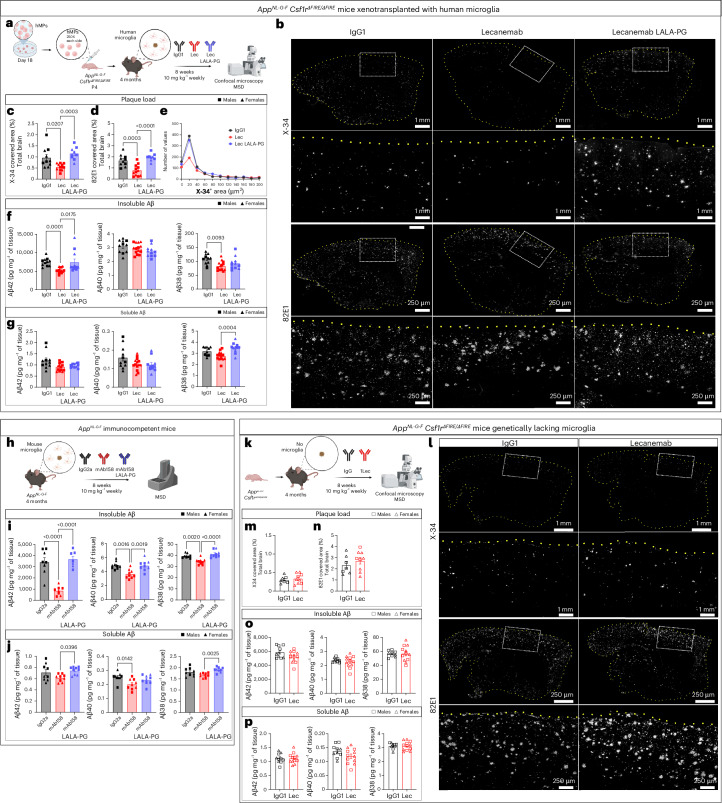
- Lecanemab (10 mg kg⁻¹ weekly i.p. for 8 weeks) significantly reduced plaque area versus IgG1 or Fc-silenced Lecanemab LALA-PG (X-34: Kruskal–Wallis P = 0.0003; 82E1: one-way ANOVA P < 0.0001; IgG1 n = 10, Lecanemab n = 12, LALA-PG n = 9 mice), with the strongest effect on smaller plaques. Insoluble Aβ42 (P = 0.0001) and Aβ38 (P = 0.0117) were reduced; insoluble Aβ40 was unchanged.
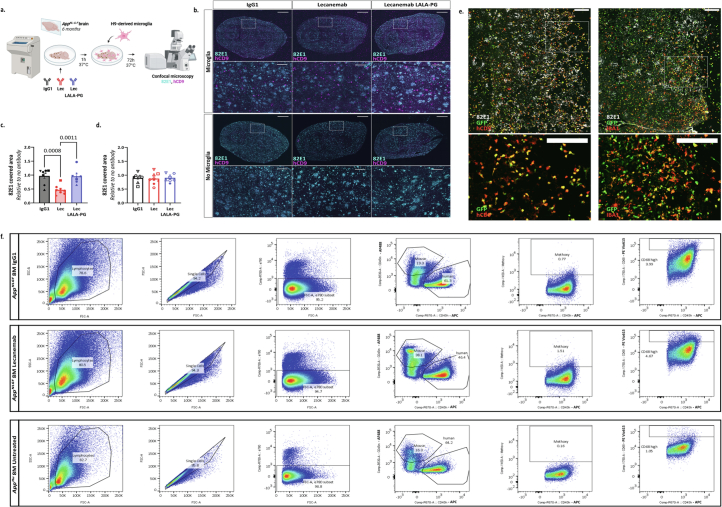
- The effect required both a functional Fc fragment and microglia: LALA-PG showed no clearance despite strong plaque accumulation, and non-xenotransplanted AppNL-G-F Csf1rΔFIRE/ΔFIRE mice (no human microglia) showed no Lecanemab effect on plaque load (all comparisons NS). Immunocompetent mice treated with mAb158 confirmed clearance (insoluble Aβ42 P < 0.0001), which the LALA-PG variant abolished.
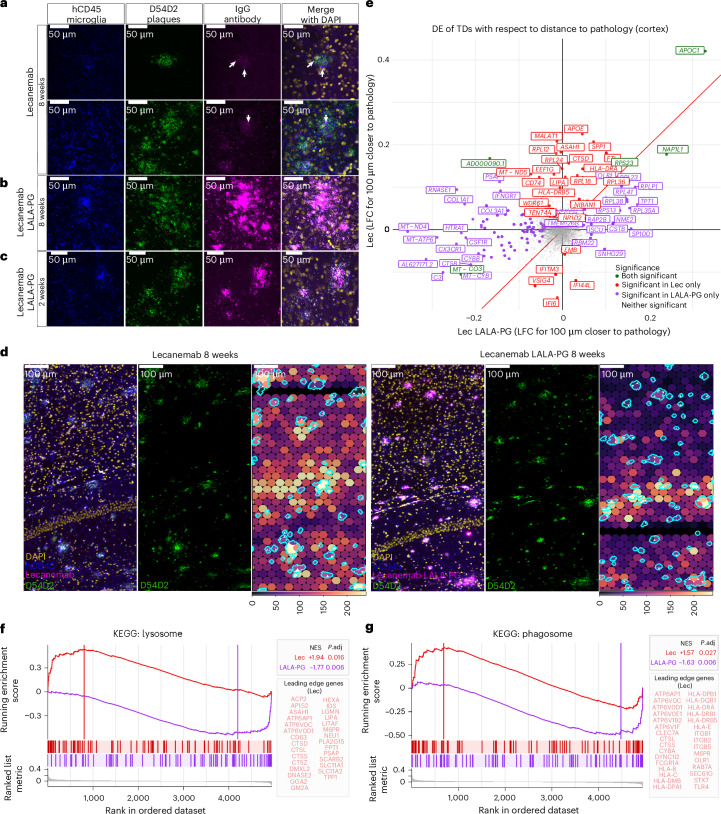
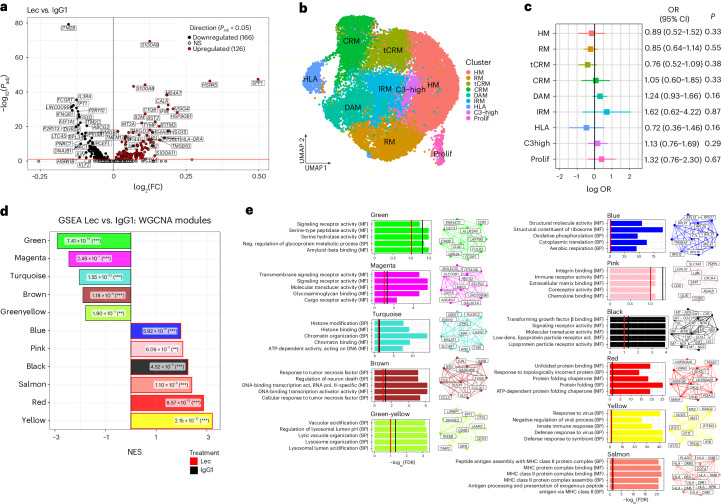
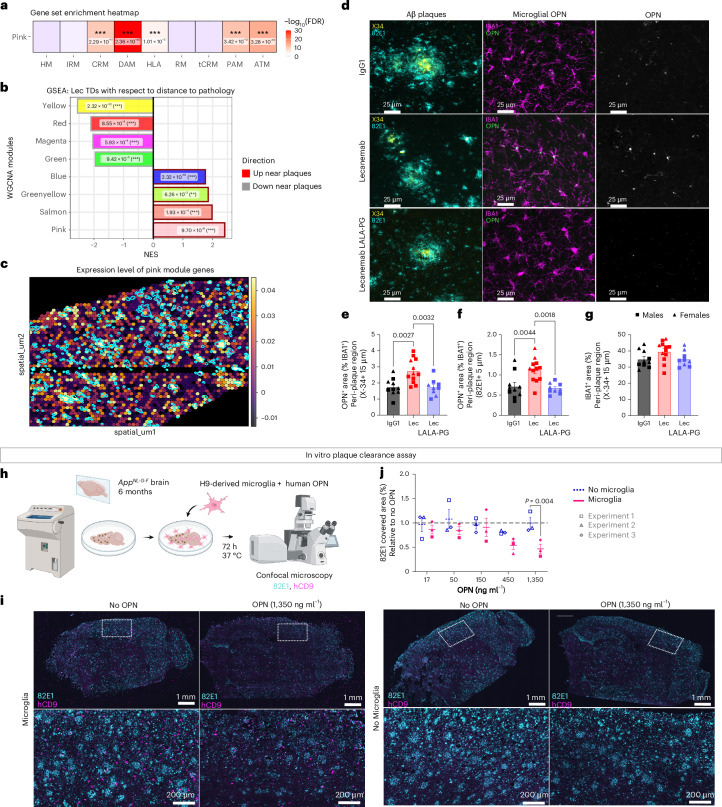
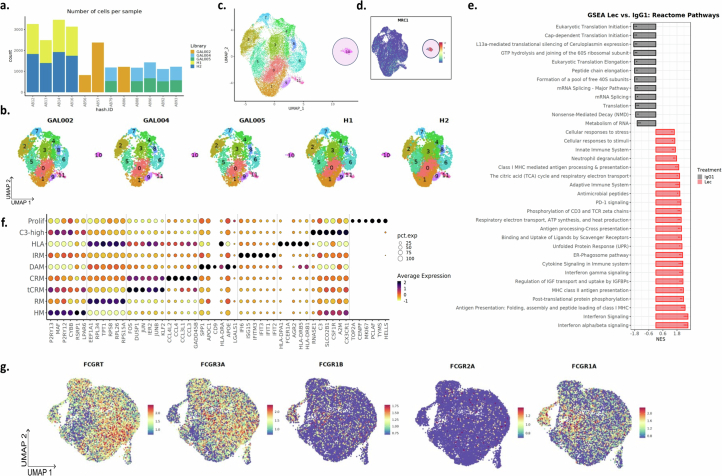
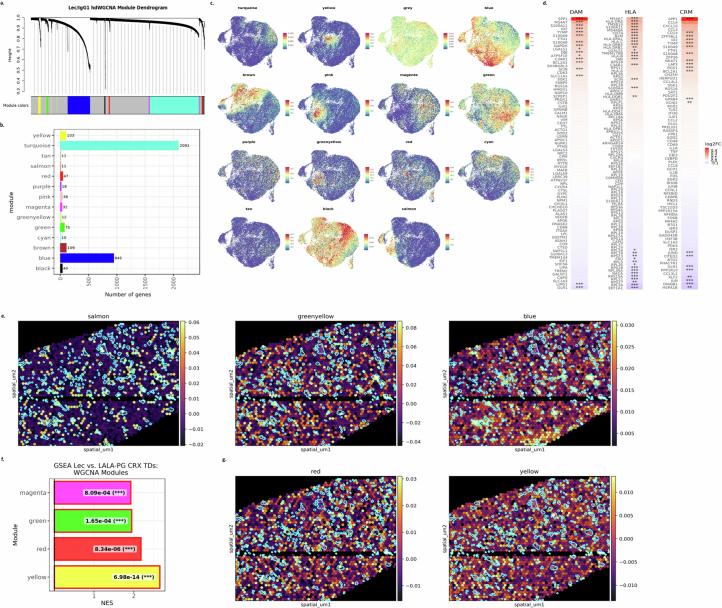
- Spatial (Nova-ST) and single-cell transcriptomics showed Lecanemab-induced enrichment of lysosome and phagosome pathways near plaques, ~300 differentially expressed genes, and 14 WGCNA modules (6 up, 5 down), including interferon, unfolded protein response, antigen presentation, mitochondrial/immune signaling and metabolism modules; the inflammatory brown module was reduced. SPP1 was the most strongly upregulated gene in both analyses.
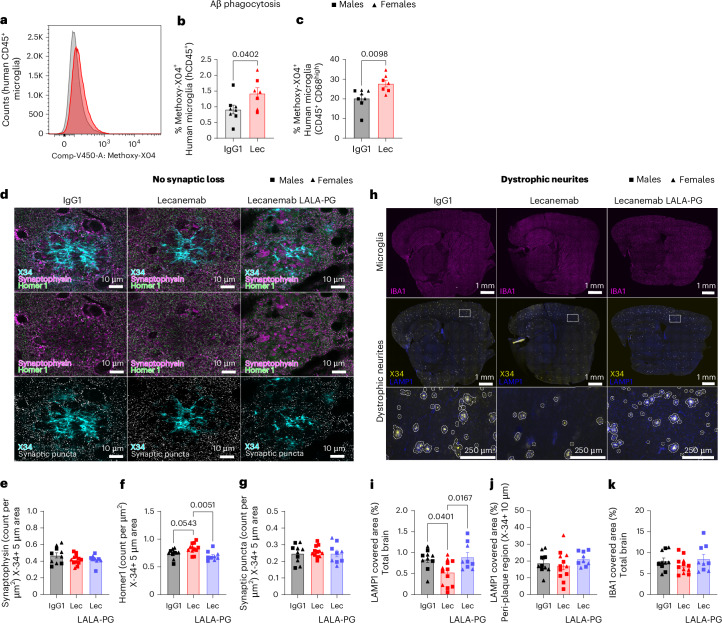
- OPN/SPP1 was elevated in IBA1⁺ microglia around plaques in Lecanemab-treated mice (P = 0.0008 for X-34, P = 0.0007 for 82E1), and OPN stimulation of human microglia in an ex vivo plaque clearance assay reduced 82E1-covered area at the highest dose (1,350 ng ml⁻¹; modified chi-squared P = 0.03, n = 3 independent experiments). Lecanemab also increased Methoxy-X04 uptake in hCD45⁺ microglia and reduced LAMP1⁺ neuritic pathology (P = 0.0091) without changing synaptophysin or synaptic puncta density.
Methods
- Human microglia xenograft model: AppNL-G-F Csf1rΔFIRE/ΔFIRE mice (lacking endogenous microglia) engrafted at P4 with human embryonic stem cell (WA09)-derived microglial progenitors; treated from 4 months of age with weekly i.p. 10 mg kg⁻¹ Lecanemab, Lecanemab LALA-PG or human IgG1 for 8 weeks. Parallel cohorts used immunocompetent AppNL-G-F mice with mAb158/mAb158 LALA-PG/mouse IgG2a, and non-xenotransplanted mice.
- Readouts: immunofluorescence (X-34, 82E1, LAMP1, IBA1, OPN, synaptic markers), MSD ELISA for soluble/insoluble Aβ38/40/42, flow cytometry for in vivo Methoxy-X04 phagocytosis, and an ex vivo cryosection plaque clearance assay with human microglia ± OPN.
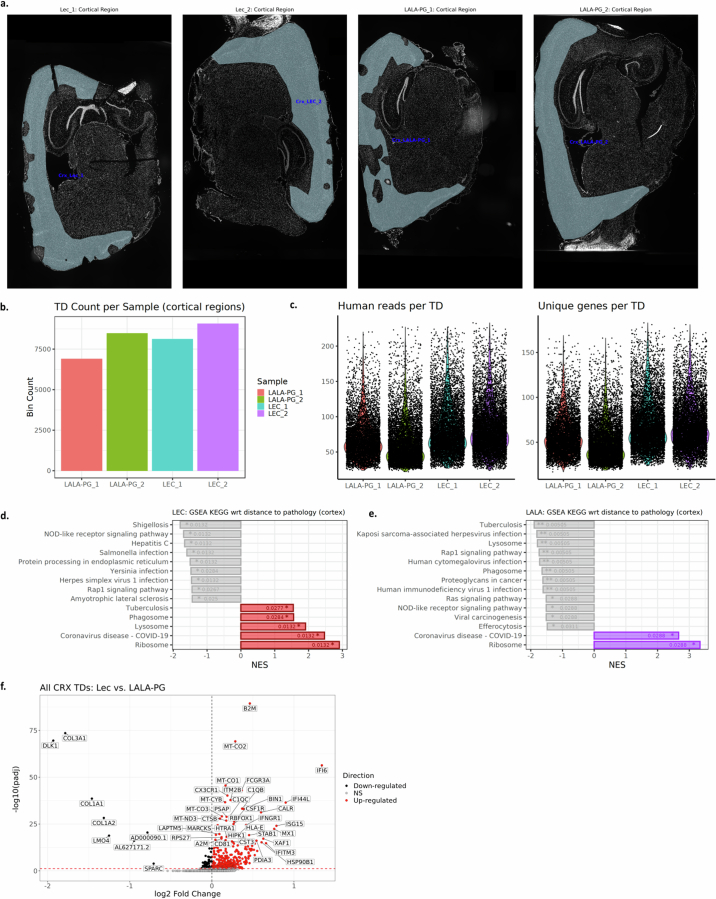
- Transcriptomics: Nova-ST spatial transcriptomics with 40-µm hexbin pseudospots (32,568 TDs; ~61.3 human genes and 74.4 UMIs per TD) analyzed by distance-to-plaque generalized linear models (edgeR QLFTest, BH-adjusted P < 0.05), plus 10x Genomics scRNA-seq of 22,420 human microglia with Seurat integration, MASC differential abundance, GSEA and hdWGCNA.
Limitations
- Stated: the Rag2⁻/⁻ background needed to prevent graft rejection precludes analysis of adaptive immunity (addressed by parallel immunocompetent mouse experiments); the model has reduced capacity to capture vascular pathology or blood–brain barrier dysfunction, as App knock-in mice show no substantial vascular defects at the studied age; the magnitude of transcriptional changes is relatively limited, which the authors attribute to changes being localized to plaque-proximal microglia; the authors cannot rule out that other anti-Aβ antibodies differentially influence microglia by binding distinct Aβ species.
- Evident from the text: the spatial transcriptomics comparison was performed on only two mice per condition (one male, one female) per Nova-ST batch, and the scRNA-seq differential expression used cell-level rather than pseudobulk analysis, a choice the authors acknowledge carries potential biases.
Model-written summary. Check it against the paper before relying on it.
Integrity signals
Registry
Cites
Statistics
Figures
Verification
Claims the paper makes
0 Valid · 0 Not valid · 29 Not checked · 119 Own results and interpretations
None of the sources cited for this claim have been checked yet.
In the paper
“Lecanemab-treated microglia exhibited reduced expression of the inflammatory brown module (Fig. 4e and Supplementary Table 2).”
§ The Alzheimer’s therapeutic Lecanemab attenuates Aβ pathology by inducing an amyloid-clearing program in microglia > Results > Lecanemab remodels microglial transcriptome to activate clearance pathways
What the sources say
- Could not verifycites [6] Cadiz, M. P. et al. Aducanumab anti-amyloid immunotherapy induces sustained microglial and immune alterations. J. Exp. Med. 221, e20231363 (2024). 38226975 PMC10791560 sourceExperimental — accuracy not yet measured
Our copy of 10.1084/jem.20231363 contains no mention of lecanemab: every treatment passage (Materials and methods, 'Aducanumab administration'; Results, 'Microglial activation increases early in aducanumab treatment') describes chimeric aducanumab versus IgG2a control in APP/PS1 mice. It also has no 'inflammatory brown module' or any WGCNA co-expression module analysis — its transcriptomic analyses are Seurat FindMarkers differential expression and Metascape gene ontology (Materials and methods, 'scRNAseq analysis' and 'Metascape gene ontology'), with DEG lists in Supplementary Tables S3, S6 and S10 rather than a module table. Searches for 'lecanemab', 'brown module / WGCNA co-expression module', and 'other anti-Aβ antibodies' returned only aducanumab-related semantic neighbours, so the claim's point is not addressed by our copy (and no alternative source is named in it). (LLM, conf=0.72)
- Not checked yetcites [8] Jung, H. et al. Anti-inflammatory clearance of amyloid-β by a chimeric Gas6 fusion protein. Nat. Med. 28, 1802–1812 (2022). 35927581 source
plainstates a cause- Asserted: passes — The authors put it forward as true.
- Checkable: passes — It can be checked against evidence.
- Load-bearing: passes — The paper’s conclusions depend on it.
- Based: passes — The paper gives a reason why it holds.
- Could not verify
A result the paper reports from its own data — it cites no other source for it, so there is none to check. The quote shows it is in the paper.
In the paper
“Using a human microglia xenograft mouse model, we show that Lecanemab significantly reduces Aβ pathology and associated neuritic damage”
§ The Alzheimer’s therapeutic Lecanemab attenuates Aβ pathology by inducing an amyloid-clearing program in microglia > Abstract
boostedstates a cause- Asserted: passes — The authors put it forward as true.
- Checkable: passes — It can be checked against evidence.
- Load-bearing: passes — The paper’s conclusions depend on it.
- Based: passes — The paper gives a reason why it holds.
A result the paper reports from its own data — it cites no other source for it, so there is none to check. The quote shows it is in the paper.
In the paper
“Quantification of the area covered by IBA1+ cells around X-34+ plaques; one-way ANOVA (NS) (IgG1, n = 10 mice; Lec, n = 12 mice; Lec LALA-PG, n = 9 mice).”
§ The Alzheimer’s therapeutic Lecanemab attenuates Aβ pathology by inducing an amyloid-clearing program in microglia > Results > Lecanemab remodels microglial transcriptome to activate clearance pathways
plainn = 10- Asserted: passes — The authors put it forward as true.
- Checkable: passes — It can be checked against evidence.
- Load-bearing: unclear — It is unclear whether the paper’s conclusions depend on it.
- Based: passes — The paper gives a reason why it holds.
A result the paper reports from its own data — it cites no other source for it, so there is none to check. The quote shows it is in the paper.
In the paper
“The pink module, although not associated with a specific functional signature in gene ontology (GO) databases, was enriched for SPP1, LGALS1, CTSD and ITGAX, core genes of DAM/HLA, as well as the protective axon-tract-associated microglia (ATM)”
§ The Alzheimer’s therapeutic Lecanemab attenuates Aβ pathology by inducing an amyloid-clearing program in microglia > Results > Lecanemab remodels microglial transcriptome to activate clearance pathways
plainstates an association- Asserted: passes — The authors put it forward as true.
- Checkable: passes — It can be checked against evidence.
- Load-bearing: unclear — It is unclear whether the paper’s conclusions depend on it.
- Based: passes — The paper gives a reason why it holds.
A result the paper reports from its own data — it cites no other source for it, so there is none to check. The quote shows it is in the paper.
In the paper
“After 8 weeks of treatment, mAb158 significantly decreased Aβ levels as measured by MSD (Fig. 2i,j)”
§ The Alzheimer’s therapeutic Lecanemab attenuates Aβ pathology by inducing an amyloid-clearing program in microglia > Results > Lecanemab attenuates Aβ pathology through Fc-mediated microglial phagocytosis
plainstates a cause- Asserted: passes — The authors put it forward as true.
- Checkable: passes — It can be checked against evidence.
- Load-bearing: passes — The paper’s conclusions depend on it.
- Based: passes — The paper gives a reason why it holds.
- Rests on an assumption not shown here.
78 more claims
Create a free account to see all 148 claims and to verify the 40 references still open.
- It may state two separate claims as one. 27
- The quote only partly states this claim. 4
- Probably not a substantial claim. 53
Self-check
Percentages, sums and reported differences re-computed from the paper’s own numbers.
Each contradiction between two passages listed here was confirmed by an independent check.
Rated minor: it would not touch a result — a value no result rests on, a p-value that stays on the same side of the significance level, or a conflict that is clerical, resolved elsewhere in the paper, or outside its own findings.
In the paper
“mAb158 (a mouse version of Lecanemab; n = 9, five males and five females), its engineered LALA-PG variant (n = 9, five males and five females) and a control mouse IgG2a (n = 9, five males and five females)”
§ The Alzheimer’s therapeutic Lecanemab attenuates Aβ pathology by inducing an amyloid-clearing program in microglia > Methods > Study design
Reported 9 · recomputed 10
Rated minor: it would not touch a result — a value no result rests on, a p-value that stays on the same side of the significance level, or a conflict that is clerical, resolved elsewhere in the paper, or outside its own findings.
In the paper
§ The Alzheimer’s therapeutic Lecanemab attenuates Aβ pathology by inducing an amyloid-clearing program in microglia > Results > Lecanemab remodels microglial transcriptome to activate clearance pathways
“(j) one-way ANOVA (P = 0.0007; IgG1, n = 10 mice; Lec, n = 12 mice; Lec LALA-PG, n = 9 mice)”
§ The Alzheimer’s therapeutic Lecanemab attenuates Aβ pathology by inducing an amyloid-clearing program in microglia > Results > Lecanemab remodels microglial transcriptome to activate clearance pathways
“j, Quantification of 82E1 covered area (relative to no OPN) in sections plated with or without human microglia; modified chi-squared method (n = 3 independent experiments; P = 0.03).”
Citations
Cites
Subramanian, A., Tamayo, P., Mootha, V. K., Mukherjee, S., Ebert, B. L., Gillette, M. A., Paulovich, A., Pomeroy, S. L., Golub, T. R., Lander, E. S., et al. (2005) · Proceedings of the National Academy of Sciences · doi:10.1073/pnas.0506580102 · Cited by 53,625
Gene Ontology: tool for the unification of biology
Ashburner, M., Ball, C. A., Blake, J. A., Botstein, D., Butler, H., Cherry, J. M., Davis, A. P., Dolinski, K., Dwight, S. S., Eppig, J. T., et al. (2000) · Nature Genetics · doi:10.1038/75556 · Cited by 43,206
Integrated analysis of multimodal single-cell data
Hao, Y., Hao, S., Andersen-Nissen, E., Mauck, W. M., Zheng, S., Butler, A., Lee, M. J., Wilk, A. J., Darby, C., Zagar, M., et al. (2020) · doi:10.1101/2020.10.12.335331 · Cited by 15,508 · cited 1×
“1.1) 51 .”
InfluentialclusterProfiler 4.0: A universal enrichment tool for interpreting omics data
(2021) · doi:10.1016/j.xinn.2021.100141 · Cited by 12,455
UMAP: Uniform Manifold Approximation and Projection
McInnes, L., Healy, J., Saul, N., & Großberger, L. (2018) · Journal of Open Source Software · doi:10.21105/joss.00861 · Cited by 9,826
SCANPY: large-scale single-cell gene expression data analysis
Wolf, F. A., Angerer, P., & Theis, F. J. (2018) · Genome Biology · doi:10.1186/s13059-017-1382-0 · Cited by 8,881
Lecanemab in early Alzheimer's disease
van Dyck, C. H., Swanson, C. J., Aisen, P., Bateman, R. J., Chen, C., Gee, M., Kanekiyo, M., Li, D., Reyderman, L., Cohen, S., et al. (2023) · New England Journal of Medicine · doi:10.1056/nejmoa2212948 · Cited by 5,678 · cited 1×
“Lecanemab stands as the most successful Aβ-plaque-clearing antibody in clinical use 2,13 .”
McGinnis, C. S., Murrow, L. M., & Gartner, Z. J. (2019) · Cell Systems · doi:10.1016/j.cels.2019.03.003 · Cited by 4,521
Hafemeister, C., & Satija, R. (2019) · Genome Biology · doi:10.1186/s13059-019-1874-1 · Cited by 4,479
The antibody aducanumab reduces Aβ plaques in Alzheimer’s disease
Sevigny, J., Chiao, P., Bussière, T., Weinreb, P. H., Williams, L., Maier, M., Dunstan, R., Salloway, S., Chen, T., Ling, Y., et al. (2016) · Nature · doi:10.1038/nature19323 · Cited by 3,059 · cited 1×
“For instance, while some studies report microglia accumulation around amyloid plaques after immunotherapy 5 , such clustering is also observed without the antibody treatment and does not necessarily result in Aβ-plaque removal.”
Research works printed but not linked: 1
- Franklin, K. B. J. & Paxinos, G. Paxinos and Franklin’s the Mouse Brain in Stereotaxic Coordinates, Compact: The Coronal Plates and Diagrams, Fifth Edition (Academic Press, 2019).
Cited by
Lu, A., Chen, W.-T., Dalby, M., García, D. S., Vanheusden, M., de Vries, L. E., van Lieshout, V., Martirosyan, A., Craessaerts, K., Moonen, S., et al. (2026) · Nature Medicine · doi:10.1038/s41591-026-04393-8 · Cited by 31
Self-citationRecent advances in Alzheimer’s disease: From molecular mechanisms to therapeutic strategies
Rudman, M. D., Ulrich, J. D., & Holtzman, D. M. (2026) · Cell · doi:10.1016/j.cell.2026.06.006 · Cited by 21
Selective agonism of GPR34 stimulates microglial uptake and clearance of amyloid β fibrils
Etani, H., Takatori, S., Wang, W., Omi, J., Amiya, Y., Akahori, A., Watanabe, H., Sonn, I., Okano, H., Hara, N., et al. (2025) · Alzheimer s Research & Therapy · doi:10.1186/s13195-025-01891-8 · Cited by 15
Li, E., Zhang, P., & Feng, W. (2026) · Frontiers in Immunology · doi:10.3389/fimmu.2026.1783786 · Cited by 6
“Studies of A b immunization and lecanemab suggest that microglial effector functions contribute to amyloid clearance and plaque-niche remodeling (89, 90).”
Somodji, E. A., & Gowrishankar, S. (2026) · npj Dementia · doi:10.1038/s44400-026-00086-8 · Cited by 6
“Ofbroaderrelevance,a recent study determined that the Alzheimer ’ s therapeutic, Lecanemab, elicited its amyloid clearance through activating clearance pathways in microglia 31 .”
Klimmt, J., Gonçalves, C. C., Montgomery, J. V., Müller, S. A., Bublitz, M., Filser, S., Paeger, L., Nuscher, B., Dannert, A., Roeber, S., et al. (2026) · Nature Neuroscience · doi:10.1038/s41593-026-02367-0 · Cited by 6
Welikovitch, L. A., Oakley, D. H., Bennett, R. E., Serrano‐Pozo, A., Zhu, H., Ruiz‐Uribe, N. E., Zwang, T. J., Chibnik, L. B., Gómez‐Isla, T., Frosch, M. P., et al. (2026) · Acta Neuropathologica · doi:10.1007/s00401-026-03037-y · Cited by 6
“Microglia and astrocytes are key mediators of antibody-induced Aβ clearance [1, 37] and have been implicated in ARIA pathogenesis.”
Integrative analysis reveals generalizable human neurodegenerative disease-associated glial statesPreprint
Horan-Portelance, L., Acri, D. J., Mann, A., Brooks, J., Bailey, H. M., Gibbs, J. R., DeCasien, A. R., & Cookson, M. (2025) · bioRxiv (Cold Spring Harbor Laboratory) · doi:10.1101/2025.09.25.678630 · Cited by 5
Rataj-Baniowska, M., Mumford, P., Prestia, F., Stephan, P., Beament, M., Birling, M., Lanzillotta, C., Ciafardini, L., Barone, E., Lau, G., et al. (2026) · Alzheimer s & Dementia · doi:10.1002/alz.71498 · Cited by 4
Inflection points and transitions in Alzheimer’s disease
Strooper, B. D., & Karran, E. H. (2026) · Nature · doi:10.1038/s41586-026-11110-5 · Cited by 4
“Aβ antibodies remove amyloid pathology through Fc receptor-mediated microglial engagement 52–54 .”
Neurodegeneration as a dysregulation of neuroimmune crosstalk
Bennett, F. C., Hong, S. Y., Jiang, N. J., & Marazzi, I. (2026) · Cell · doi:10.1016/j.cell.2026.07.015 · Cited by 3
“159 Additional agents targeting microglia, e.g., TREM2 agonist antibodies, and other aggregate proteins, like anti-α -synuclein antibodies for PD, are at various stages of clinical development.”
Fang, A., Tang, X., Fleming, M., Tancowny, B. P., Wang, X., Wang, Y., Daude, N., Dorosh, L., Fleck, S. C., Rathod, V., et al. (2026) · Acta Neuropathologica · doi:10.1007/s00401-026-03015-4 · Cited by 3
Abdelaziz, A. M., & Eltyar, F. S. (2026) · Clinical Immunology · doi:10.1016/j.clim.2026.110777 · Cited by 2
Anti-amyloid antibody therapies for Alzheimer's disease: how much do we really understand?
Chen, Y. (2026) · Targetome · doi:10.48130/targetome-0026-0004 · Cited by 2
From consortia discovery to biotech creation: An innovative approach to next‐gen Alzheimer's drugs
Giardina, S. F., Culver, A. E., Ahmed, C., Mirescu, C., Oblak, A. L., Brosch, J. R., Clayton, B., Dage, J. L., Lamb, B. T., Richardson, T. I., et al. (2026) · Alzheimer s & Dementia · doi:10.1002/alz.71165 · Cited by 2
“28 Although lecanemab preferentially binds soluble A β protofibrils and may reduce plaque indirectly, whereas donanemab more directly engages deposited fibrillar A β , both agents stimulate microglial activation via Fc γ receptor signaling.”
Kotah, J. M., Trombetta-Lima, M., Dragt, E. C., Voulgaroglou, A., Brouwer, N., Holtman, I. R., Kooistra, S. M., & Eggen, B. J. L. (2026) · Glia · doi:10.1002/glia.70210 · Cited by 2
Han, Y., Luo, G., Huang, Y., Cai, Z., Su, W., Kuang, X., Huang, L., Wei, L., Ming, F., He, Z., et al. (2026) · Frontiers in Aging · doi:10.3389/fragi.2026.1794820 · Cited by 2
“They further identified Osteopontin as a key factor induced by Lecanemab treatment and demonstrated its active role in promoting A β clearance (Kwon and Koh, 2025; Albertini et al., 2026).”
Jolly, H. A., Seghers, P., Balcomb, K., Smith, A. J., Pearson, L., Agrawal, I., Geary, B., Bennett, D. A., Wısnıewskı, T., Fowler, S. L., et al. (2026) · bioRxiv (Cold Spring Harbor Laboratory) · doi:10.64898/2026.08.20.746004 · Cited by 2
“This set includes numerous proteins previously associated with neurodegeneration, including APP(73,74), APOE(75,76), MAPT(77,78), SMOC1(79), HTT(80), SQSTM1(81,82), STXBP1(83), S100A9(84,85), YWHAG/B(86), DCTN1(87), EIF4G1 and VPS35(88), and ASAP1(89), indicating that established disease biology…”
Zhang, J., Yang, N., Zou, P., & Zong, X. (2026) · Journal of Neuroinflammation · doi:10.1186/s12974-026-03924-x · Cited by 2
“Its association with microglial Fc-receptor engagement and APOE-dependent perivascular handling of cleared amyloid implicates the same immune and vascular circuitry that shapes broader AD pathology [7, 8].”
Choi, M. H., Naia, L., & Ankarcrona, M. (2026) · bioRxiv (Cold Spring Harbor Laboratory) · doi:10.64898/2026.03.10.710773 · Cited by 2
“Anti-Aβ immunotherapies such as Lecanemab (Leqembi © ) have demonstrated that enhancing microglial plaque clearance can slow disease progression, supporting the feasibility of microglial reprogramming as a therapeutic strategy [86, 87].”
Holt, K., Chang, Y. Y., Li, M., Albertini, G., Smith, C., Tulloch, J., Strooper, B. D., Hardingham, G. E., & Spires‐Jones, T. L. (2026) · medRxiv · doi:10.64898/2026.05.08.26352549 · Cited by 1
Self-citationLi, Z., Ming, Q., Fu, L., Yang, J., Lv, Y., Chen, B., & Lu, Z. (2026) · Frontiers in Nutrition · doi:10.3389/fnut.2026.1886340 · Cited by 1
“In a combination framework, anti-amyloid treatment can provide a directly plaque-clearing microglial arm (154).”
Plowey, E. D., Abettan, J., Chou, P. C., Lye‐Barthel, M., Amaral, A. C. S., Sebalusky, J., Hamann, S., Srinivasan, J., Brown, R. Z., Fang, Q., et al. (2026) · bioRxiv (Cold Spring Harbor Laboratory) · doi:10.64898/2026.01.30.702402 · Cited by 1
Ding, Z., Gibson, K. A., Nascari, D. G., Tallant, L., Bouchal, S. M., Dickson, D. W., & Fryer, J. D. (2026) · Alzheimer s & Dementia Translational Research & Clinical Interventions · doi:10.1002/trc2.70269 · Cited by 1
Hill, N., AlMuallim, H. Y. O., Maddock, E., Hobbs, C., Clarke, E. E., Goncalves, M. B. C. V., & Corcoran, J. P. T. (2026) · FEBS Open Bio · doi:10.1002/2211-5463.70284 · Cited by 1
Characterization of the Anti-Alzheimer Drug Lecanemab by Mass Spectrometry
Sha, J., Geng, Z., Xue, S., Qi, S., Hu, Q., Hu, Q., Cai, M., Chen, Y., Chen, Y., Liu, S., et al. (2026) · ACS Omega · doi:10.1021/acsomega.6c02666 · Cited by 1
Chen, Y., Li, F., Junlei, Z., 魏明清, 倪敬年, Li, T., Yao, L., Tian, J., & Shi, J. (2026) · Alzheimer s & Dementia · doi:10.1002/alz.71909 · Cited by 1
“36 In APP-SAA knock-in mice, long-term anti-A β treatment reduces widespread glycolysis-related signals and glucose uptake as overall A β burden declines, while persistent metabolic responses remain around residual plaques.”
Mostowfi, N., Foreman, R. P., Zheng, Z., Ma, Q., 王金良, Khoury, R., Albanese, A., Ma, Q. L., Cohn, W., Wang, Z., et al. (2026) · ACS Omega · doi:10.64898/2026.06.09.731185 · Cited by 1
Dou, X., Hu, D., Wang, J., Zhong, Y., Yu, C., Zhan, H., Chen, Y., Zhou, R., Zhang, X., Zhang, B., et al. (2026) · European Journal of Nuclear Medicine and Molecular Imaging · doi:10.1007/s00259-026-07989-x · Cited by 1
“Anti–β-amyloid (Aβ) monoclonal antibodies have rede-fined therapeutic expectations in early Alzheimer’s disease (AD) [1 , 2].”
Herriott, L., Coles, M. C., Fournier, N., Gaffney, E. A., & Wagg, J. (2026) · CPT Pharmacometrics & Systems Pharmacology · doi:10.1002/psp4.70223 · Cited by 1
“Recent studies have demonstrated that engagement of microglial FcRs by anti-amyloid mAbs is necessary for plaque clearance and suggested microglial pathways that connect antibody action to phagocytosis [38].”
Lin, D., Atkinson, J. R., Wu, W., Chen, M., Jayasekara, S., Segal, B. M., Ma, A., & Gao, J. (2026) · doi:10.64898/2026.09.16.752098
Impact of Sema3A Interference on Cerebellum-Dependent Motor Associative Learning and Memory
Gimenez, G.-A., Zwaag, S. V. D., Geelen, C. M., Hemert, M. V., Vreeken, J., de Winter, F., Canto, C. B., Carulli, D., Zeeuw, C. I. D., & Verhaagen, J. (2026) · International Journal of Molecular Sciences · doi:10.3390/ijms27125304
Han, Y., & He, Z. (2026) · Molecular Neurodegeneration Advances · doi:10.1186/s44477-026-00037-w
“Two transcriptional studies revealed that complement signaling in microglia is critical for Aβ plaque clearance efficacy in antibody treatment [134, 135].”
Bunnell, E., Saltonstall, E., Shanava, E., O’Niel, A., Pederson, A., Marla, S., Llamas, M. L. S., Garg, I., Chaudhari, M., Vodapally, S., et al. (2026) · Frontiers in Immunology · doi:10.3389/fimmu.2026.1899626
Cai, Y., Wang, Y., Huang, W., Su, Y., Lei, M., Jia, R., Wu, C., Zhang, T., Sun, L., Peng, B., et al. (2026) · Alzheimer s & Dementia · doi:10.1002/alz.71655
“12 However,duetolimitedBBBpenetrationfollowingintravenousadmin-istration, a substantial proportion of cerebral A β ( ≈ 40% to 60”
Astrocytes engineered to fight Alzheimer’s plaques
Boles, J. S., & Gate, D. (2026) · Science · doi:10.1126/science.aef8451
Fritz, N., Johannesson, M., Eriksson, F., Osswald, G., Lannfelt, L., Möller, C., & Söderberg, L. (2026) · Neuroscience Letters · doi:10.1016/j.neulet.2026.138645
“Our findings are consistent with previous studies showing decreased microglial phagocytosis of A β both in vivo and ex vivo using A β antibodies carrying a mutation that reduces Fc γ R engagement [25,27].”
Wik, E., Dahlén, A. D., Julku, U. H., Xiong, M., Michno, W., Syvänen, S., & Sehlin, D. (2026) · Neurotherapeutics · doi:10.1016/j.neurot.2026.e00949
“A β complexes [33].”
del Valle, M. L., & Arienzo, D. (2026) · Ibrain · doi:10.1002/ibra.70016
Martínez‐Muriana, A., Fattorelli, N., Wolfs, L., Jutz, L., Pasciuto, E., Denton, H., van Hoek, M., Premereur, J., Zen, G., Bijnens, B., et al. (2026) · Developmental Cell · doi:10.1016/j.devcel.2026.09.005
Self-citationHuang, Y., Liu, X., Fan, G., Gong, G., & Lee, S. M. (2026) · British Journal of Pharmacology · doi:10.1111/bph.70662
Oon, C. H., Levitt, E. M., Shapiro, D. A., O’Brien, C. A., Davis, M. R., Shestova, O., Axsom, J., Yaqoob, F., Lomeikaitė, V., Koumadorakis, D., et al. (2026) · Research Square · doi:10.21203/rs.3.rs-10963419/v1
Targeting microglia: A new strategy for the treatment of Alzheimer's disease
Zheng, M., Yang, M., Su, W., Tian, L., & Gao, W. (2026) · Journal of Neuroimmunology · doi:10.1016/j.jneuroim.2026.578966
Expression of amyloid-β antibody via AAV of CNS tropism alleviates Alzheimer’s disease in micePreprint
Dai, Z., Jiang, M., Yin, W., Wang, Z., Zhu, X., & Qiu, M. S. (2026) · bioRxiv (Cold Spring Harbor Laboratory) · doi:10.64898/2026.03.19.712819
Papageorgopoulou, M., Adair, E., Fancy, N. N., Avot, B., Boulger, S. L., Wülfing, M. S., & Matthews, P. M. (2026) · bioRxiv (Cold Spring Harbor Laboratory) · doi:10.64898/2026.06.18.733103
Tansey, M. G., Bozeat, S., Ackerman, P., Atri, A., Barnum, C. J., Brundin, P., de Carvalho, C. M. A., Fleisher, A., Graf, A., Head, E., et al. (2026) · Alzheimer s & Dementia Translational Research & Clinical Interventions · doi:10.1002/trc2.70287
Gommerman, J. L., Akassoglou, K., Baranzini, S. E., Becher, B., Brilot, F., Castelo‐Branco, G., Dunn, S. E., Faiz, M., Flügel, A., Ghasemlou, N., et al. (2026) · Nature Reviews Neurology · doi:10.1038/s41582-026-01272-1
Human brain cellular xenografts in neuroimmunology and beyond
Fattorelli, N., Martínez‐Muriana, A., Perry, V. H., & Mancuso, R. (2026) · Immunity · doi:10.1016/j.immuni.2026.09.024
Translational modelling of human microglia from cultures to chimeras
Lee, J., & Yoo, Y. (2026) · Experimental & Molecular Medicine · doi:10.1038/s12276-026-01866-1
Microglial autophagy and other LC3-dependent pathways in neurodegeneration
Palmer, J. E., & Rubinsztein, D. C. (2025) · Geromedicine · doi:10.70401/geromedicine.2026.0022
Advances in modified anti-Aβ antibodies for the treatment of Alzheimer’s disease
Li, S., Gu, J., Xu, Z., He, C., & Yu, C. (2026) · BMC Medicine · doi:10.1186/s12916-026-05088-0
“Furthermore, certain antibodies, such as lecanemab, engage the Fcγ receptor on microglia through their Fc fragments, thereby activating cellular phagocytosis and mediating the lysosomal degradation and clearance of Aβ protein [16].”
Righini, C. M., Mantovani, D. B. D. A., & Faria, D. D. P. (2026) · Neural Regeneration Research · doi:10.4103/nrr.nrr-d-25-01403
“…instance, recent work has demonstrated that anti-amyloid immunotherapies such as lecanemab modulate microglial transcriptional programs and phagocytic activity (Albertini et al., 2025), highlighting the potential for neuroinflammation PET imaging to track such therapeutic-induced glial activation.”
Pallerla, A. V., Lucido, C. C., Saito, K., Nolt, G. L., Arbonés-Mainar, J. M., Funnell, J. L., Satish, D., Smith, L. M., Stephens, I. O., Goulding, D. S., et al. (2026) · bioRxiv (Cold Spring Harbor Laboratory) · doi:10.64898/2026.06.26.734793
“…of mice treated with chAdu or other similar anti-amyloid antibodies, the resulting programs are generally overwhelmingly immune focused, a finding that is duplicated in our study as well as others, and generally involve antigen-presenting or polarizing functions ( 14, 19, 20, 25, 26, 28, 57, 58 ).”
Algamal, M., Yokomizo, S., Ndambakuwa, W., Abdallah, S., Sanchez-Mico, M. V., Gillani, R. L., da Silva, P., Rajput, A., Palanivelu, L., Lee, Y., et al. (2026) · bioRxiv (Cold Spring Harbor Laboratory) · doi:10.64898/2026.09.07.749938
“Microglial activation has long been considered a central mechanism underlying antibody-mediated amyloid clearance 2,13 .”
Zhang, W., Wei, X., 陈民铀, Zhang, L. E., & Zou, J. (2026) · Biomolecules · doi:10.3390/biom16070996
“By contrast, during lecanemab treatment or peripheral macrophage-mediated A β clearance, OPN-related responses may support amyloid clearance and tissue remodeling [56,57].”
Chimeric models of neurodegenerative diseases: from disease mechanisms to regenerative therapies
Cáceres-Palomo, L., Alfonso-Triguero, M., Belloso-Iguerategui, A., Santiago-Mujika, E., Miron-Alcala, M., & Arranz, A. M. (2026) · Molecular Neurodegeneration Advances · doi:10.1186/s44477-026-00059-4
“…with human microglia, treatment with lecanemab induced robust phagocytic and lysosomal activation programs, resulting in reduced Aβ burden and attenuation of neuritic dystrophy, demonstrating that transplanted human microglia actively contribute to antibody-mediated amyloid clearance [34].”
Zhan, X., Liu, C., 于长江, Lindblom, N., Deierborg, T., Kobro‐Flatmoen, A., Gouras, G. K., & Wen, G. (2026) · Molecular Neurodegeneration · doi:10.1186/s13024-026-00972-y
“In a human microglia xenograft mouse model, lecanemab markedly reduced amyloid pathology and Lysosome-Associated Membrane Protein (LAMP)+ dystrophies, but only in the presence of microglia expressing functional Fc variants [138].”
McKee, C. A., Port, R., Hofmann, M., Smith, S., Wang, X., Klein, R., & Marino, M. (2026) · bioRxiv (Cold Spring Harbor Laboratory) · doi:10.64898/2026.10.26.761378
Beyond Transcriptomes and Dissociated Cells: Spatial Proteomics for Mechanistic Neurobiology
Orr, T. C., Boles, J. S., Latimer, C. S., Sun, X., Dehkordi, S. K., Wu, Z., Young, L. E. A., Zwang, T. J., Hashoul, D., Keene, C. D., et al. (2026) · Journal of Neuroscience · doi:10.1523/jneurosci.1180-26.2026
Monoclonal antibodies and immunotherapy : theory and applications
Adam, A. A. (2023) · Papyrus : Institutional Repository (Université de Montréal)
Anticorps monoclonaux et immunothérapie : théorie et applications
Adam, A. A. (2023) · Papyrus : Institutional Repository (Université de Montréal)
The gut-brain axis in Parkinson’s disease: A macrophage perspective
Konstantellos, V., de Walle, P. V., & Schepper, S. D. (2026) · doi:10.70401/mc.2026.0008
Herriott, L., Coles, M. C., Gaffney, E. A., Fournier, N., Sanchez, N., Sol, O., Vukicevic, M., Pfeifer, A., Post, A., & Wagg, J. (2025) · Alzheimer s & Dementia · doi:10.1002/alz70859_102996
Havemeister, F. (2026) · Chalmers Research (Chalmers University of Technology) · doi:10.63959/chalmers.dt/5917
Liu, Q., & Lin, R.-R. (2026) · Aging and Disease · doi:10.14336/ad.2026.0292
Wu, J., Xiong, X., & Yang, Z. (2026) · Frontiers in Aging Neuroscience · doi:10.3389/fnagi.2026.2013438
Lam, J. Y. L., & Bu, G. (2026) · Molecular Neurodegeneration · doi:10.1186/s13024-026-00974-w
Tratamiento farmacológico de la enfermedad de Alzheimer: ¿un cambio de paradigma terapéutico?
Martín, G. M. (2026) · e_Buah
Jia, Y., Ding, J., Wu, J., Wang, H., Wang, X., & Cao, Z. (2026) · Molecular Neurobiology · doi:10.1007/s12035-026-06347-0
Rest promotes microglial clearance of degenerating neurons
Xiang, Z., Mou, B., Li, M., Chen, J., Huang, L., & Liu, Y. U. (2026) · doi:10.64898/2026.11.16.766874
Addressing Alzheimer's disease pathology through combinatorial therapeutic interventions
Kilfoyle, C. L., Moreno, J., & Montgomery, T. (2026) · Digital Collections of Colorado (Colorado State University)
Catalytic-Defect Passivation on Amyloid-β Fibrils Using Atomically Precise Gold NanoclustersPreprint
Cisterna, B. A., & Matus, M. F. (2026) · ChemRxiv · doi:10.26434/chemrxiv.15009508/v1
Passive immunotherapy for Parkinson’s disease in 2025: Status and perspective
Gonzalez-Artero, A., Bárcenas, O., Pujols, J., & Ventura, S. (2026) · Neural Regeneration Research · doi:10.4103/nrr.nrr-d-25-01792
“However, recent evidence from Lecanemab (IgG1) underscores the importance of microglia-mediated amyloid plaque clearance, showing that this antibody has superior efficacy compared with engineered variants lacking immune effector function (Albertini et al., 2025).”
Lecanemab: Wirksamkeit beruht auf dem Fc-Fragment des Antikörpers
(2026) · Fortschritte der Neurologie · Psychiatrie · doi:10.1055/a-2861-9919
Pandey, J. P. (2026) · Journal of Alzheimer s Disease · doi:10.1177/13872877261500140
Chen, Y., Pu, M., Jie, W., Yan, S., Ju, Z., Wang, J., Chen, S., Wen, Y., Zhu, L., Li, Y., et al. (2026) · Alzheimer s & Dementia · doi:10.1002/alz.71995
Metadata
- Authors
- Albertini, G., Zielonka, M., Cuypers, M.-L., Snellinx, A., Xu, C., Poovathingal, S., Wojno, M., Davie, K., van Lieshout, V., Craessaerts, K., Wolfs, L., Pasciuto, E., Jaspers, T., Horré, K., Serneels, L., Fiers, M., Dewilde, M., & De Strooper, B.
- Affiliations
- Vlaams Instituut voor Biotechnologie (BE)
- KU Leuven (BE)
- University of Antwerp (BE)
- Corresponding author
- Albertini, Giulia
- ORCID
- Venue
- Nature Neuroscience
- Published
- 2025-11-24
- Volume
- 29
- Issue
- 1
- Pages
- 100-110
- ISSN
- 1097-6256 (ISSN-L)
- 1546-1726
- PMC
- PMC12779577
- OpenAlex
- W4416599633
- Cited by
- 77
- References
- 63
- Citations by year
- 2026: 71 · 2025: 4
- FWCI
- 17.54
- Type
- journal article
- Language
- en
- Open access
- hybrid
- doi.org
- Licence
- cc-by
- creativecommons.org/licenses/by/4.0 (tdm)
- creativecommons.org/licenses/by/4.0 (vor)
- Locations
- Nature Neuroscience (publishedVersion, cc-by)
- bioRxiv (Cold Spring Harbor Laboratory) (submittedVersion)
- PubMed Central (publishedVersion, cc-by)
- PubMed (publishedVersion)
- Lirias (publishedVersion, cc-by)
- Institutional Repository University of Antwerp (University of Antwerp) (submittedVersion, other-oa)
- UCL Discovery (University College London) (submittedVersion, cc-by)
- Funders
- Alzheimer's Association (AARF-22-968623)
- Queen Elisabeth Medical Foundation
- University College London
- European Commission (HORIZON2020, ERC-834682 CELLPHASE_AD, ERC-834682)
- Fonds Wetenschappelijk Onderzoek (G087523N)
- KU Leuven
- Vlaams Instituut voor Biotechnologie
- Deutsches Zentrum für Neurodegenerative Erkrankungen
- Vlaamse regering (METH/21/05)
- National Institutes of Health (IA 52242)
- H2020 European Research Council (834682)
- Topics
- Life Sciences › Neuroscience › Cellular and Molecular Neuroscience › Alzheimer's disease research and treatments
- Life Sciences › Neuroscience › Neurology › Neuroinflammation and Neurodegeneration Mechanisms
- Health Sciences › Medicine › Psychiatry and Mental health › Dementia and Cognitive Impairment Research
- Keywords
- lecanemab, anti-amyloid immunotherapy, amyloid-beta clearance, microglia, Alzheimer's disease, Fc fragment, phagocytosis, lysosomal degradation, metabolic reprogramming, interferon-gamma, antigen presentation, microglial activation, single-cell RNA sequencing, spatial transcriptomics
- MeSH terms
- Alzheimer Disease, Animals, Humans, Mice, Transgenic, Phagocytosis, Amyloid beta-Peptides, Microglia, Mice, Plaque, Amyloid, Antibodies, Monoclonal, Humanized
About these checks
Registry, retraction, Cites and statistics results are computed, not judged, with one exception: a printed reference that no index lists is read once by a model before it counts as a citation error. Claims are extracted by a model and kept only when their quote appears verbatim in the text; each cited source is then checked, with a model’s help, for whether it says what the claim relies on. Those verdicts can be wrong — read the claim’s quote and the cited source before relying on one.
The claim verdicts this report counts are experimental: their accuracy is not yet measured.
A language model drew the claims from the paper on 2026-11-26, under version 3 of the claim definition (model deepseek-v4.1-flash, prompt extract-v3).
A second model labelled each claim on 2026-11-26 (model jev-1.13-20260917, definition revision gold-guideline-v0.2).
Cited sources are checked with a language model’s help (qwen3.8-omni-flash).
Statistics and arithmetic are recomputed, not judged.
Confidence bands are shown only for fields calibrated on our annotated test set. None is calibrated yet, so no band is shown.
What counts as a claim ›How we measure confidence ›How we check this ›
Are you an author, or do you see a problem with this page? Request a review
Data sources
Bibliographic data: Semantic Scholar, OpenAlex, Crossref.
Contains information from the Semantic Scholar Academic Graph Datasets, made available under the ODC Attribution License (ODC-BY 1.0).
Semantic Scholar’s data is described in: Kinney, R., et al. (2023). The Semantic Scholar Open Data Platform. arXiv:2301.10140.
