

The Alzheimer’s therapeutic Lecanemab attenuates Aβ pathology by inducing an amyloid-clearing program in microglia
Open accessThe DOI matches its Crossref record; 66 of the 66 references it cites were found in a registry or an index; 1 of the 41 sources its claims cite were checked for support.
Abstract
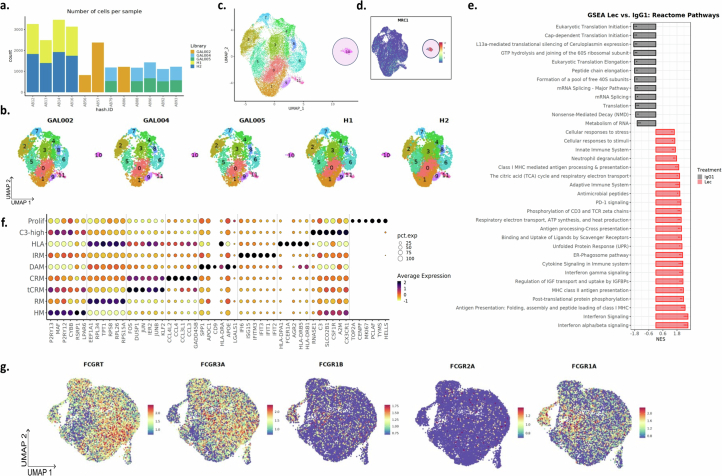
Controversies over anti-amyloid immunotherapies underscore the need to elucidate their mechanisms of action. Here we demonstrate that Lecanemab, a leading anti-β-amyloid (Aβ) antibody, mediates amyloid clearance by activating microglial effector functions. Using a human microglia xenograft mouse model, we show that Lecanemab significantly reduces Aβ pathology and associated neuritic damage, while neither fragment crystallizable (Fc)-silenced Lecanemab nor microglia deficiency elicits this effect despite intact plaque binding. Single-cell RNA sequencing and spatial transcriptomic analyses reveal that Lecanemab induces a focused transcriptional program that enhances phagocytosis, lysosomal degradation, metabolic reprogramming, interferon γ genes and antigen presentation. Finally, we identify SPP1 /osteopontin as a major factor induced by Lecanemab treatment and demonstrate its role in promoting Aβ clearance. These findings highlight that effective amyloid removal depends on the engagement of microglia through the Fc fragment, providing critical insights for optimizing anti-amyloid therapies in Alzheimer’s disease.
Overview
CoChat Summary
TL;DR
Lecanemab clears amyloid-β plaques by engaging microglia through its Fc fragment, inducing a focused transcriptional program of phagocytosis, lysosomal degradation, metabolic reprogramming, interferon response and antigen presentation. SPP1/osteopontin is identified as a major induced factor that itself promotes Aβ clearance.
Key findings
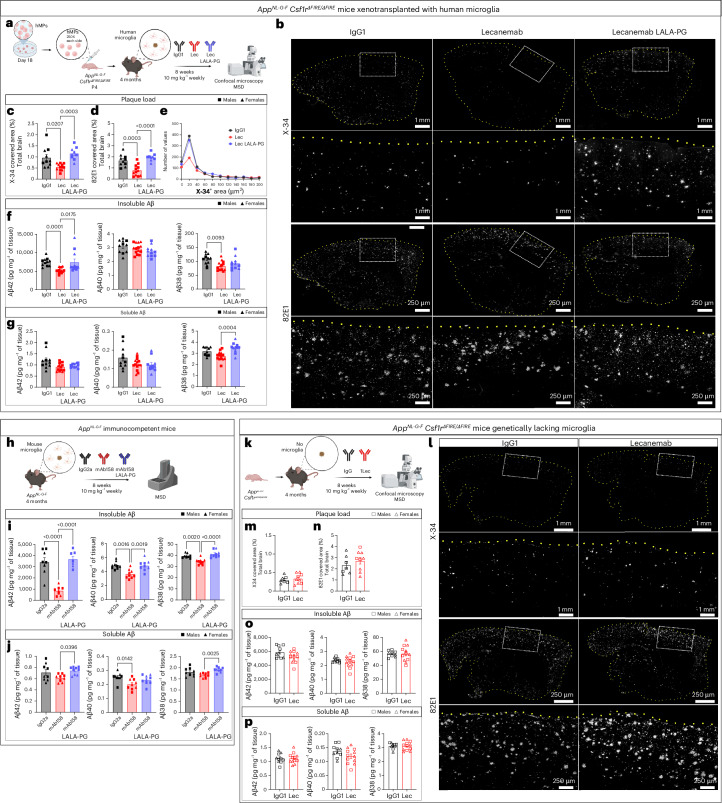
- Lecanemab (10 mg kg⁻¹ weekly i.p. for 8 weeks) significantly reduced plaque area versus IgG1 or Fc-silenced Lecanemab LALA-PG (X-34: Kruskal–Wallis P = 0.0003; 82E1: one-way ANOVA P < 0.0001; IgG1 n = 10, Lecanemab n = 12, LALA-PG n = 9 mice), with the strongest effect on smaller plaques. Insoluble Aβ42 (P = 0.0001) and Aβ38 (P = 0.0117) were reduced; insoluble Aβ40 was unchanged.
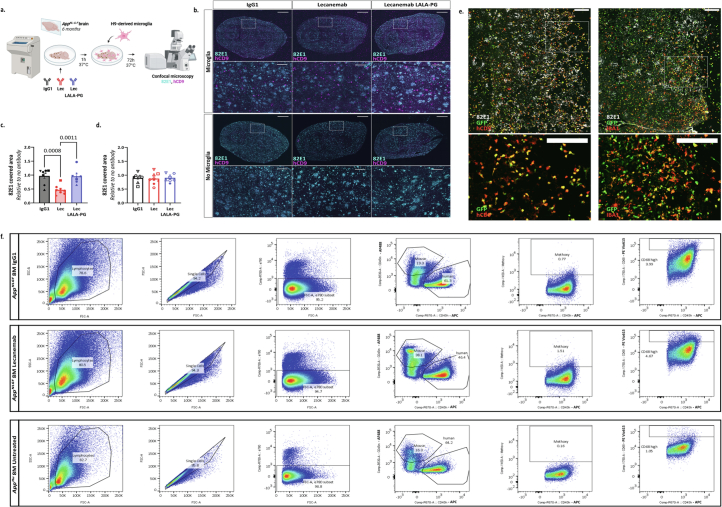
- The effect required both a functional Fc fragment and microglia: LALA-PG showed no clearance despite strong plaque accumulation, and non-xenotransplanted AppNL-G-F Csf1rΔFIRE/ΔFIRE mice (no human microglia) showed no Lecanemab effect on plaque load (all comparisons NS). Immunocompetent mice treated with mAb158 confirmed clearance (insoluble Aβ42 P < 0.0001), which the LALA-PG variant abolished.
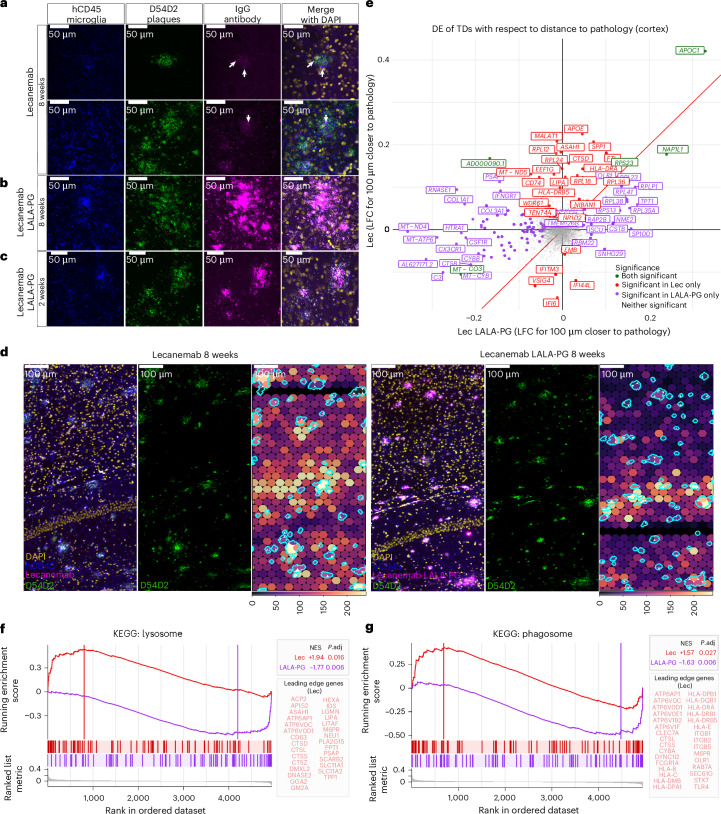
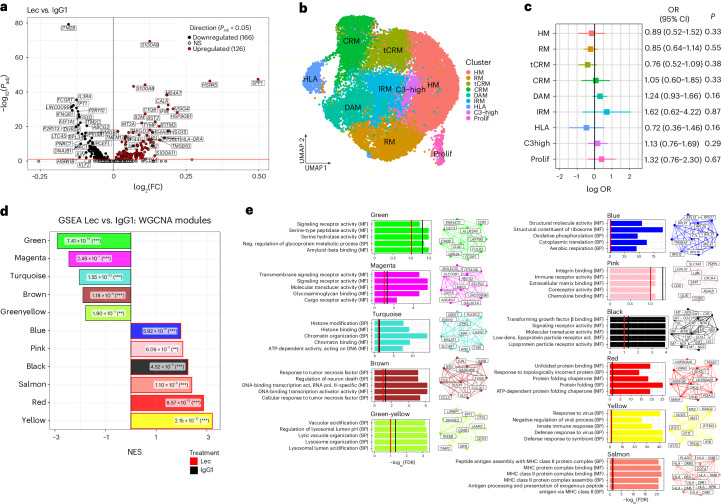
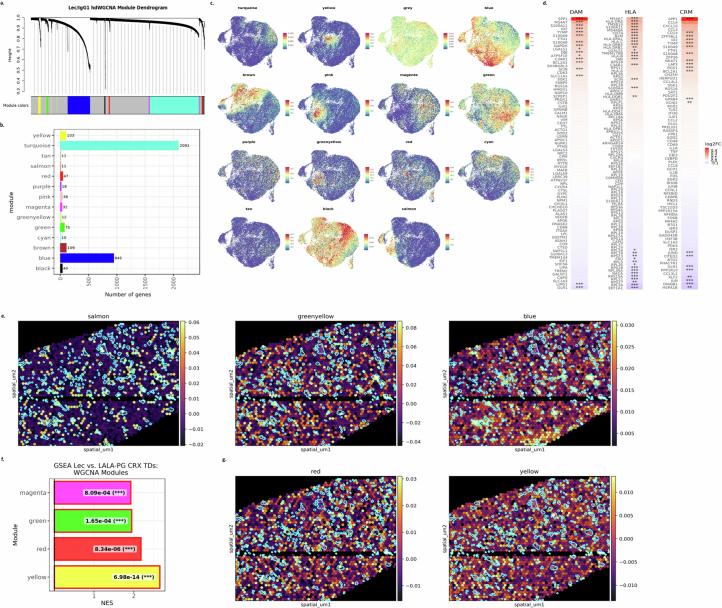
- Spatial (Nova-ST) and single-cell transcriptomics showed Lecanemab-induced enrichment of lysosome and phagosome pathways near plaques, ~300 differentially expressed genes, and 14 WGCNA modules (6 up, 5 down), including interferon, unfolded protein response, antigen presentation, mitochondrial/immune signaling and metabolism modules; the inflammatory brown module was reduced. SPP1 was the most strongly upregulated gene in both analyses.
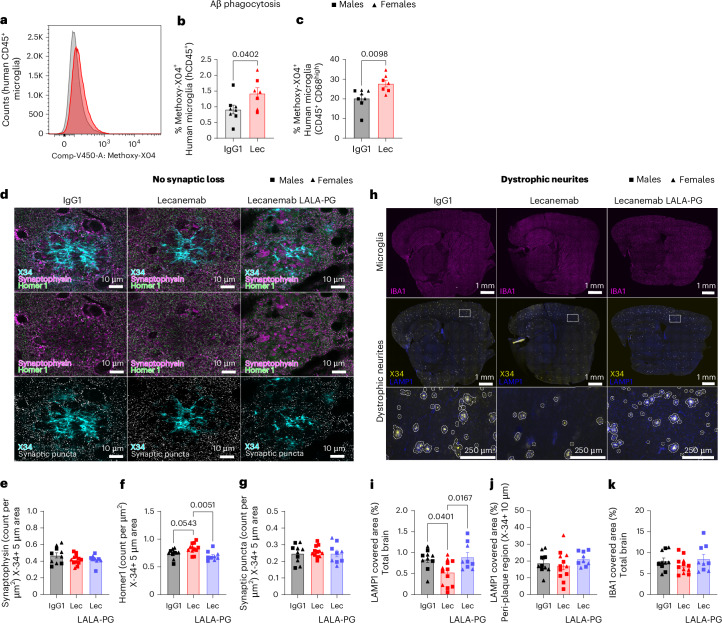
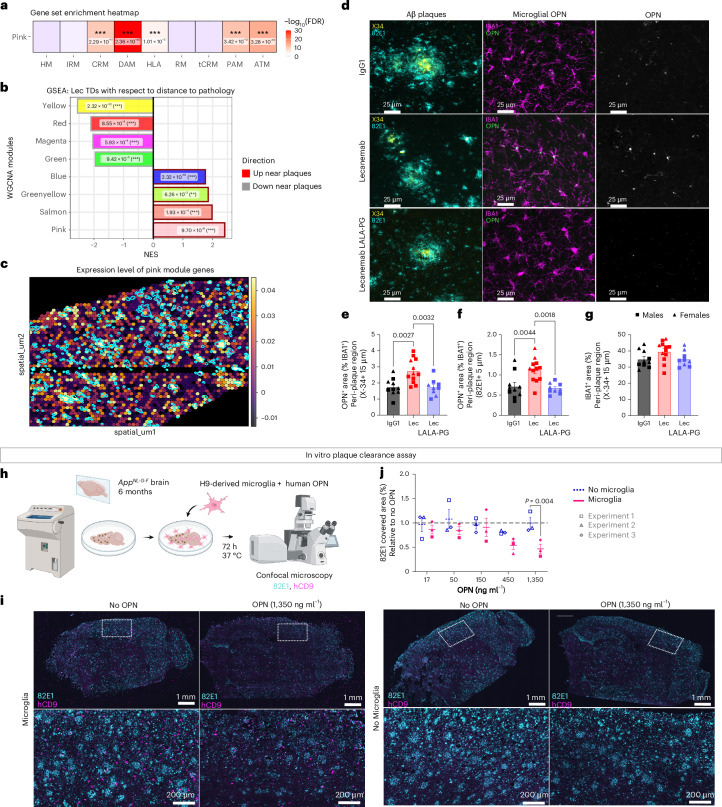
- OPN/SPP1 was elevated in IBA1⁺ microglia around plaques in Lecanemab-treated mice (P = 0.0008 for X-34, P = 0.0007 for 82E1), and OPN stimulation of human microglia in an ex vivo plaque clearance assay reduced 82E1-covered area at the highest dose (1,350 ng ml⁻¹; modified chi-squared P = 0.03, n = 3 independent experiments). Lecanemab also increased Methoxy-X04 uptake in hCD45⁺ microglia and reduced LAMP1⁺ neuritic pathology (P = 0.0091) without changing synaptophysin or synaptic puncta density.
Methods
- Human microglia xenograft model: AppNL-G-F Csf1rΔFIRE/ΔFIRE mice (lacking endogenous microglia) engrafted at P4 with human embryonic stem cell (WA09)-derived microglial progenitors; treated from 4 months of age with weekly i.p. 10 mg kg⁻¹ Lecanemab, Lecanemab LALA-PG or human IgG1 for 8 weeks. Parallel cohorts used immunocompetent AppNL-G-F mice with mAb158/mAb158 LALA-PG/mouse IgG2a, and non-xenotransplanted mice.
- Readouts: immunofluorescence (X-34, 82E1, LAMP1, IBA1, OPN, synaptic markers), MSD ELISA for soluble/insoluble Aβ38/40/42, flow cytometry for in vivo Methoxy-X04 phagocytosis, and an ex vivo cryosection plaque clearance assay with human microglia ± OPN.
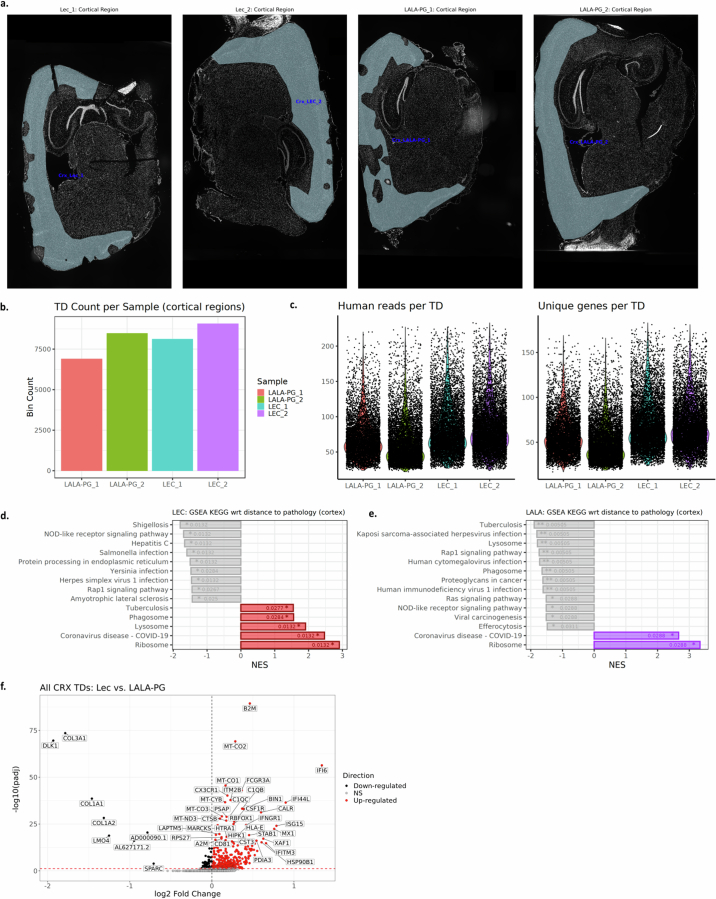
- Transcriptomics: Nova-ST spatial transcriptomics with 40-µm hexbin pseudospots (32,568 TDs; ~61.3 human genes and 74.4 UMIs per TD) analyzed by distance-to-plaque generalized linear models (edgeR QLFTest, BH-adjusted P < 0.05), plus 10x Genomics scRNA-seq of 22,420 human microglia with Seurat integration, MASC differential abundance, GSEA and hdWGCNA.
Limitations
- Stated: the Rag2⁻/⁻ background needed to prevent graft rejection precludes analysis of adaptive immunity (addressed by parallel immunocompetent mouse experiments); the model has reduced capacity to capture vascular pathology or blood–brain barrier dysfunction, as App knock-in mice show no substantial vascular defects at the studied age; the magnitude of transcriptional changes is relatively limited, which the authors attribute to changes being localized to plaque-proximal microglia; the authors cannot rule out that other anti-Aβ antibodies differentially influence microglia by binding distinct Aβ species.
- Evident from the text: the spatial transcriptomics comparison was performed on only two mice per condition (one male, one female) per Nova-ST batch, and the scRNA-seq differential expression used cell-level rather than pseudobulk analysis, a choice the authors acknowledge carries potential biases.
Model-written summary. Check it against the paper before relying on it.
Integrity signals
Registry
Cites
Statistics
Figures
Verification
Claims the paper makes
0 Valid · 0 Not valid · 29 Not checked · 119 Own results and interpretations
None of the sources cited for this claim have been checked yet.
In the paper
“Lecanemab-treated microglia exhibited reduced expression of the inflammatory brown module (Fig. 4e and Supplementary Table 2).”
§ The Alzheimer’s therapeutic Lecanemab attenuates Aβ pathology by inducing an amyloid-clearing program in microglia > Results > Lecanemab remodels microglial transcriptome to activate clearance pathways
What the sources say
- Could not verifycites [6] Cadiz, M. P. et al. Aducanumab anti-amyloid immunotherapy induces sustained microglial and immune alterations. J. Exp. Med. 221, e20231363 (2024). 38226975 PMC10791560 sourceExperimental — accuracy not yet measured
Our copy of 10.1084/jem.20231363 contains no mention of lecanemab: every treatment passage (Materials and methods, 'Aducanumab administration'; Results, 'Microglial activation increases early in aducanumab treatment') describes chimeric aducanumab versus IgG2a control in APP/PS1 mice. It also has no 'inflammatory brown module' or any WGCNA co-expression module analysis — its transcriptomic analyses are Seurat FindMarkers differential expression and Metascape gene ontology (Materials and methods, 'scRNAseq analysis' and 'Metascape gene ontology'), with DEG lists in Supplementary Tables S3, S6 and S10 rather than a module table. Searches for 'lecanemab', 'brown module / WGCNA co-expression module', and 'other anti-Aβ antibodies' returned only aducanumab-related semantic neighbours, so the claim's point is not addressed by our copy (and no alternative source is named in it). (LLM, conf=0.72)
- Not checked yetcites [8] Jung, H. et al. Anti-inflammatory clearance of amyloid-β by a chimeric Gas6 fusion protein. Nat. Med. 28, 1802–1812 (2022). 35927581 source
plainstates a cause- Asserted: passes — The authors put it forward as true.
- Checkable: passes — It can be checked against evidence.
- Load-bearing: passes — The paper’s conclusions depend on it.
- Based: passes — The paper gives a reason why it holds.
- Could not verify
A result the paper reports from its own data — it cites no other source for it, so there is none to check. The quote shows it is in the paper.
In the paper
“Using a human microglia xenograft mouse model, we show that Lecanemab significantly reduces Aβ pathology and associated neuritic damage”
§ The Alzheimer’s therapeutic Lecanemab attenuates Aβ pathology by inducing an amyloid-clearing program in microglia > Abstract
boostedstates a cause- Asserted: passes — The authors put it forward as true.
- Checkable: passes — It can be checked against evidence.
- Load-bearing: passes — The paper’s conclusions depend on it.
- Based: passes — The paper gives a reason why it holds.
A result the paper reports from its own data — it cites no other source for it, so there is none to check. The quote shows it is in the paper.
In the paper
“Quantification of the area covered by IBA1+ cells around X-34+ plaques; one-way ANOVA (NS) (IgG1, n = 10 mice; Lec, n = 12 mice; Lec LALA-PG, n = 9 mice).”
§ The Alzheimer’s therapeutic Lecanemab attenuates Aβ pathology by inducing an amyloid-clearing program in microglia > Results > Lecanemab remodels microglial transcriptome to activate clearance pathways
plainn = 10- Asserted: passes — The authors put it forward as true.
- Checkable: passes — It can be checked against evidence.
- Load-bearing: unclear — It is unclear whether the paper’s conclusions depend on it.
- Based: passes — The paper gives a reason why it holds.
A result the paper reports from its own data — it cites no other source for it, so there is none to check. The quote shows it is in the paper.
In the paper
“The pink module, although not associated with a specific functional signature in gene ontology (GO) databases, was enriched for SPP1, LGALS1, CTSD and ITGAX, core genes of DAM/HLA, as well as the protective axon-tract-associated microglia (ATM)”
§ The Alzheimer’s therapeutic Lecanemab attenuates Aβ pathology by inducing an amyloid-clearing program in microglia > Results > Lecanemab remodels microglial transcriptome to activate clearance pathways
plainstates an association- Asserted: passes — The authors put it forward as true.
- Checkable: passes — It can be checked against evidence.
- Load-bearing: unclear — It is unclear whether the paper’s conclusions depend on it.
- Based: passes — The paper gives a reason why it holds.
A result the paper reports from its own data — it cites no other source for it, so there is none to check. The quote shows it is in the paper.
In the paper
“After 8 weeks of treatment, mAb158 significantly decreased Aβ levels as measured by MSD (Fig. 2i,j)”
§ The Alzheimer’s therapeutic Lecanemab attenuates Aβ pathology by inducing an amyloid-clearing program in microglia > Results > Lecanemab attenuates Aβ pathology through Fc-mediated microglial phagocytosis
plainstates a cause- Asserted: passes — The authors put it forward as true.
- Checkable: passes — It can be checked against evidence.
- Load-bearing: passes — The paper’s conclusions depend on it.
- Based: passes — The paper gives a reason why it holds.
- Rests on an assumption not shown here.
78 more claims
Create a free account to see all 148 claims and to verify the 40 references still open.
- It may state two separate claims as one. 27
- The quote only partly states this claim. 4
- Probably not a substantial claim. 53
Self-check
Percentages, sums and reported differences re-computed from the paper’s own numbers.
Each contradiction between two passages listed here was confirmed by an independent check.
Rated minor: it would not touch a result — a value no result rests on, a p-value that stays on the same side of the significance level, or a conflict that is clerical, resolved elsewhere in the paper, or outside its own findings.
In the paper
“mAb158 (a mouse version of Lecanemab; n = 9, five males and five females), its engineered LALA-PG variant (n = 9, five males and five females) and a control mouse IgG2a (n = 9, five males and five females)”
§ The Alzheimer’s therapeutic Lecanemab attenuates Aβ pathology by inducing an amyloid-clearing program in microglia > Methods > Study design
Reported 9 · recomputed 10
Rated minor: it would not touch a result — a value no result rests on, a p-value that stays on the same side of the significance level, or a conflict that is clerical, resolved elsewhere in the paper, or outside its own findings.
In the paper
§ The Alzheimer’s therapeutic Lecanemab attenuates Aβ pathology by inducing an amyloid-clearing program in microglia > Results > Lecanemab remodels microglial transcriptome to activate clearance pathways
“(j) one-way ANOVA (P = 0.0007; IgG1, n = 10 mice; Lec, n = 12 mice; Lec LALA-PG, n = 9 mice)”
§ The Alzheimer’s therapeutic Lecanemab attenuates Aβ pathology by inducing an amyloid-clearing program in microglia > Results > Lecanemab remodels microglial transcriptome to activate clearance pathways
“j, Quantification of 82E1 covered area (relative to no OPN) in sections plated with or without human microglia; modified chi-squared method (n = 3 independent experiments; P = 0.03).”
Citations
Cites
Subramanian, A., Tamayo, P., Mootha, V. K., Mukherjee, S., Ebert, B. L., Gillette, M. A., Paulovich, A., Pomeroy, S. L., Golub, T. R., Lander, E. S., et al. (2005) · Proceedings of the National Academy of Sciences · doi:10.1073/pnas.0506580102 · Cited by 53,625
Gene Ontology: tool for the unification of biology
Ashburner, M., Ball, C. A., Blake, J. A., Botstein, D., Butler, H., Cherry, J. M., Davis, A. P., Dolinski, K., Dwight, S. S., Eppig, J. T., et al. (2000) · Nature Genetics · doi:10.1038/75556 · Cited by 43,206
Integrated analysis of multimodal single-cell data
Hao, Y., Hao, S., Andersen-Nissen, E., Mauck, W. M., Zheng, S., Butler, A., Lee, M. J., Wilk, A. J., Darby, C., Zagar, M., et al. (2020) · doi:10.1101/2020.10.12.335331 · Cited by 15,508 · cited 1×
“1.1) 51 .”
InfluentialclusterProfiler 4.0: A universal enrichment tool for interpreting omics data
(2021) · doi:10.1016/j.xinn.2021.100141 · Cited by 12,455
UMAP: Uniform Manifold Approximation and Projection
McInnes, L., Healy, J., Saul, N., & Großberger, L. (2018) · Journal of Open Source Software · doi:10.21105/joss.00861 · Cited by 9,826
SCANPY: large-scale single-cell gene expression data analysis
Wolf, F. A., Angerer, P., & Theis, F. J. (2018) · Genome Biology · doi:10.1186/s13059-017-1382-0 · Cited by 8,881
Lecanemab in early Alzheimer's disease
van Dyck, C. H., Swanson, C. J., Aisen, P., Bateman, R. J., Chen, C., Gee, M., Kanekiyo, M., Li, D., Reyderman, L., Cohen, S., et al. (2023) · New England Journal of Medicine · doi:10.1056/nejmoa2212948 · Cited by 5,678 · cited 1×
“Lecanemab stands as the most successful Aβ-plaque-clearing antibody in clinical use 2,13 .”
McGinnis, C. S., Murrow, L. M., & Gartner, Z. J. (2019) · Cell Systems · doi:10.1016/j.cels.2019.03.003 · Cited by 4,521
Hafemeister, C., & Satija, R. (2019) · Genome Biology · doi:10.1186/s13059-019-1874-1 · Cited by 4,479
The antibody aducanumab reduces Aβ plaques in Alzheimer’s disease
Sevigny, J., Chiao, P., Bussière, T., Weinreb, P. H., Williams, L., Maier, M., Dunstan, R., Salloway, S., Chen, T., Ling, Y., et al. (2016) · Nature · doi:10.1038/nature19323 · Cited by 3,059 · cited 1×
“For instance, while some studies report microglia accumulation around amyloid plaques after immunotherapy 5 , such clustering is also observed without the antibody treatment and does not necessarily result in Aβ-plaque removal.”
The Gene Ontology knowledgebase in 2023
The Gene Ontology Consortium, Aleksander, S. A., Balhoff, J., Carbon, S., Cherry, J. M., Drabkin, H. J., Ebert, D., Feuermann, M., Gaudet, P., Harris, N. L., et al. (2023) · GENETICS · doi:10.1093/genetics/iyad031 · Cited by 2,664
Single App knock-in mouse models of Alzheimer’s disease
Saito, T., Matsuba, Y., Mihira, N., Takano, J., Nilsson, P., Itohara, S., Iwata, N., & Saido, T. C. (2014) · Nature Neuroscience · doi:10.1038/nn.3697 · Cited by 1,366 · cited 1×
“Notably, Aβ42 is the predominant Aβ species in App NL-G-F mice 24 .”
iPSC-derived human microglia-like cells to study neurological diseases
Abud, E. M., Ramirez, R. N., Martinez, E. S., Healy, L. M., Nguyen, C. H. H., Newman, S. A., Yeromin, A. V., Scarfone, V. M., Marsh, S. E., Fimbres, C., et al. (2017) · Neuron · doi:10.1016/j.neuron.2017.03.042 · Cited by 1,154
Li, Q., Cheng, Z., Zhou, L., Darmanis, S., Neff, N. F., Okamoto, J., Gulati, G., Bennett, M. L., Sun, L. O., Clarke, L. E., et al. (2019) · Neuron · doi:10.1016/j.neuron.2018.12.006 · Cited by 1,129
Stoeckius, M., Zheng, S., Houck-Loomis, B., Hao, S., Yeung, B. Z., Mauck, W. M., Smibert, P., & Satija, R. (2018) · Genome Biology · doi:10.1186/s13059-018-1603-1 · Cited by 1,046 · cited 1×
“52 and in Supplementary Methods.”
hdWGCNA identifies co-expression networks in high-dimensional transcriptomics data
Morabito, S., Reese, F., Rahimzadeh, N., Miyoshi, E., & Swarup, V. (2023) · Cell Reports Methods · doi:10.1016/j.crmeth.2023.100498 · Cited by 1,027
Spatial Transcriptomics and In Situ Sequencing to Study Alzheimer’s Disease
Chen, W.-T., Lu, A., Craessaerts, K., Pavie, B., Sala Frigerio, C., Corthout, N., Qian, X., Laláková, J., Kühnemund, M., Voytyuk, I., et al. (2020) · Cell · doi:10.1016/j.cell.2020.06.038 · Cited by 949 · cited 1×
“These remarkable findings led us to investigate the potential changes these antibodies might induce in the human microglia surrounding the Aβ plaques 20,21 .”
Self-citationSala Frigerio, C., Wolfs, L., Fattorelli, N., Thrupp, N., Voytyuk, I., Schmidt, I., Mancuso, R., Chen, W.-T., Woodbury, M. E., Srivastava, G., et al. (2019) · Cell Reports · doi:10.1016/j.celrep.2019.03.099 · Cited by 926
Self-citationThe amyloid hypothesis in Alzheimer disease: new insights from new therapeutics
Karran, E., & De Strooper, B. (2022) · Nature Reviews Drug Discovery · doi:10.1038/s41573-022-00391-w · Cited by 742 · cited 2×
“Nonetheless, the precise mechanism by which its binding to Aβ oligomers leads to more effective Aβ-plaque clearance compared to other Aβ-binding antibodies 3 remains unclear.”
A Plaque-Specific Antibody Clears Existing β-amyloid Plaques in Alzheimer's Disease Mice
DeMattos, R. B., Lu, J., Tang, Y., Racke, M. M., DeLong, C. A., Tzaferis, J. A., Hole, J. T., Forster, B. M., McDonnell, P. C., Liu, F., et al. (2012) · Neuron · doi:10.1016/j.neuron.2012.10.029 · Cited by 442
Marsh, S. E., Walker, A. J., Kamath, T., Dissing-Olesen, L., Hammond, T. R., de Soysa, T. Y., Young, A. M. H., Murphy, S., Abdulraouf, A., Nadaf, N., et al. (2022) · Nature Neuroscience · doi:10.1038/s41593-022-01022-8 · Cited by 431 · cited 1×
“After heparinized DPBS perfusion, one hemisphere was immediately processed in fluorescence-activated cell sorting buffer (DPBS, 2-mM EDTA and 2% FBS; Gibco, 10270106) as well as actinomycin-D (5 µM; Sigma-Aldrich, A1410-5MG) to minimize ex vivo activation 50 .”
Marsh, S. E., Kamath, T., Walker, A. J., Dissing-Olesen, L., Hammond, T. R., Young, A. M. H., Abdulraouf, A., Nadaf, N., Dufort, C., Murphy, S., et al. (2020) · doi:10.1101/2020.12.03.408542 · Cited by 430
Söderberg, L., Johannesson, M., Nygren, P., Laudon, H., Eriksson, F., Osswald, G., Möller, C., & Lannfelt, L. (2023) · Neurotherapeutics · doi:10.1007/s13311-022-01308-6 · Cited by 427
Schlothauer, T., Herter, S., Koller, C. F., Grau-Richards, S., Steinhart, V., Spick, C., Kubbies, M., Klein, C., Umaña, P., & Mössner, E. (2016) · Protein Engineering Design and Selection · doi:10.1093/protein/gzw040 · Cited by 425 · cited 1×
“Moreover, FcγR activation can Article https://doi.org/10.1038/s41593-025-02125-8 immunoglobulin G1 (IgG1) variant designed to abolish Fc-mediated effector functions 14,15 , Lecanemab LALA-PG.”
InfluentialTranscriptional signature in microglia associated with Aβ plaque phagocytosis
Grubman, A., Choo, X. Y., Chew, G., Ouyang, J. F., Sun, G., Croft, N. P., Rossello, F. J., Simmons, R., Buckberry, S., Landin, D. V., et al. (2021) · Nature Communications · doi:10.1038/s41467-021-23111-1 · Cited by 395
Rojo, R., Raper, A., Ozdemir, D. D., Lefevre, L., Grabert, K., Wollscheid-Lengeling, E., Bradford, B., Caruso, M., Gazova, I., Sánchez, A., et al. (2019) · Nature Communications · doi:10.1038/s41467-019-11053-8 · Cited by 382 · cited 1×
“1Tcs ; Csf1R em1Bdes mice, named hereafter as App NL-G-F Csf1r ΔFIRE/ΔFIRE mice, which lack endogenous microglia 17,18 , enabled us to assess these clinically relevant human antibodies directly.”
Non-Fc-Mediated Mechanisms Are Involved in Clearance of Amyloid-β In Vivo by Immunotherapy
Bacskai, B. J., Kajdasz, S. T., McLellan, M. E., Games, D., Seubert, P., Schenk, D., & Hyman, B. T. (2002) · The Journal of Neuroscience · doi:10.1523/jneurosci.22-18-07873.2002 · Cited by 323
Effector-attenuating Substitutions That Maintain Antibody Stability and Reduce Toxicity in Mice
Lo, M., Kim, H. S., Tong, R. K., Bainbridge, T. W., Vernes, J.-M., Zhang, Y., Lin, Y. L., Chung, S., Dennis, M. S., Zuchero, Y. J. Y., et al. (2017) · Journal of Biological Chemistry · doi:10.1074/jbc.m116.767749 · Cited by 323 · cited 1×
“Moreover, FcγR activation can Article https://doi.org/10.1038/s41593-025-02125-8 immunoglobulin G1 (IgG1) variant designed to abolish Fc-mediated effector functions 14,15 , Lecanemab LALA-PG.”
InfluentialStem-cell-derived human microglia transplanted in mouse brain to study human disease
Mancuso, R., Van Den Daele, J., Fattorelli, N., Wolfs, L., Balusu, S., Burton, O., Liston, A., Sierksma, A., Fourne, Y., Poovathingal, S., et al. (2019) · Nature Neuroscience · doi:10.1038/s41593-019-0525-x · Cited by 295
Self-citationSensitive ELISA detection of amyloid‐β protofibrils in biological samples
Englund, H., Sehlin, D., Johansson, A., Nilsson, L. N. G., Gellerfors, P., Paulie, S., Lannfelt, L., & Pettersson, F. E. (2007) · Journal of Neurochemistry · doi:10.1111/j.1471-4159.2007.04759.x · Cited by 292
Tucker, S., Möller, C., Tegerstedt, K., Lord, A., Laudon, H., Sjödahl, J., Söderberg, L., Spens, E., Sahlin, C., Waara, E. R., et al. (2015) · Journal of Alzheimer’s Disease · doi:10.3233/jad-140741 · Cited by 272
The MS4A gene cluster is a key modulator of soluble TREM2 and Alzheimer’s disease risk
Deming, Y., Filipello, F., Cignarella, F., Cantoni, C., Hsu, S., Mikesell, R., Li, Z., Del-Aguila, J. L., Dube, U., Farias, F. G., et al. (2019) · Science Translational Medicine · doi:10.1126/scitranslmed.aau2291 · Cited by 271
Hallmarks of Alzheimer’s Disease in Stem-Cell-Derived Human Neurons Transplanted into Mouse Brain
Espuny-Camacho, I., Arranz, A. M., Fiers, M., Snellinx, A., Ando, K., Munck, S., Bonnefont, J., Lambot, L., Corthout, N., Omodho, L., et al. (2017) · Neuron · doi:10.1016/j.neuron.2017.02.001 · Cited by 244 · cited 1×
“Because only the xenotransplanted cells are of human origin, all human-derived reads can be exclusively attributed to microglia 23 .”
Self-citationRosenzweig, N., Dvir-Szternfeld, R., Tsitsou-Kampeli, A., Keren-Shaul, H., Ben-Yehuda, H., Weill-Raynal, P., Cahalon, L., Kertser, A., Baruch, K., Amit, I., et al. (2019) · Nature Communications · doi:10.1038/s41467-019-08352-5 · Cited by 227 · cited 1×
“Finally, Lecanemab may reduce peripheral immune cell infiltration by dampening central nervous system inflammation, potentially contributing to its attenuation of pathology 35,36 .”
Fonseka, C. Y., Rao, D. A., Teslovich, N. C., Korsunsky, I., Hannes, S. K., Slowikowski, K., Gurish, M. F., Donlin, L. T., Lederer, J. A., Weinblatt, M. E., et al. (2018) · Science Translational Medicine · doi:10.1126/scitranslmed.aaq0305 · Cited by 177
A multi-pronged human microglia response to Alzheimer’s disease Aβ pathology
Mancuso, R., Fattorelli, N., Martinez-Muriana, A., Davis, E., Wolfs, L., Van Den Daele, J., Geric, I., Preman, P., Serneels, L., Poovathingal, S., et al. (2022) · doi:10.1101/2022.07.07.499139 · Cited by 169 · cited 9×
“The pink module, although not associated with a specific functional signature in gene ontology (GO) databases, was enriched for SPP1 , LGALS1, CTSD and ITGAX , core genes of DAM/HLA, as well as the protective axon-tract-associated microglia (ATM) and proliferative-region-associated microglia (PAM) identified during ea…”
InfluentialSelf-citationAmyloid-β Immunization Effectively Reduces Amyloid Deposition in FcRγ-/-Knock-Out Mice
Das, P., Howard, V., Loosbrock, N., Dickson, D., Murphy, M. P., & Golde, T. E. (2003) · The Journal of Neuroscience · doi:10.1523/jneurosci.23-24-08532.2003 · Cited by 165 · cited 1×
“Alternative FcγR-independent mechanisms of plaque removal have also been widely proposed 9–12 .”
Lord, A., Gumucio, A., Englund, H., Sehlin, D., Sundquist, V. S., Söderberg, L., Möller, C., Gellerfors, P., Lannfelt, L., Pettersson, F. E., et al. (2009) · Neurobiology of Disease · doi:10.1016/j.nbd.2009.08.007 · Cited by 158
Murphy, A. E., & Skene, N. G. (2022) · Nature Communications · doi:10.1038/s41467-022-35519-4 · Cited by 147 · cited 1×
“For this reason, despite acknowledging the potential biases of cell-level DE analyses, we believe a pseudobulk approach, which has been shown to better control for false discoveries 31 , would mask changes in distinct cell populations.”
Mallach, A., Zielonka, M., van Lieshout, V., An, Y., Khoo, J. H., Vanheusden, M., Chen, W.-T., Moechars, D., Arancibia-Carcamo, I. L., Fiers, M., et al. (2024) · Cell Reports · doi:10.1016/j.celrep.2024.114216 · Cited by 135 · cited 1×
“These remarkable findings led us to investigate the potential changes these antibodies might induce in the human microglia surrounding the Aβ plaques 20,21 .”
Self-citationBaligács, N., Albertini, G., Borrie, S. C., Serneels, L., Pridans, C., Balusu, S., & De Strooper, B. (2024) · Nature Communications · doi:10.1038/s41467-024-54779-w · Cited by 123 · cited 2×
“We leveraged our advanced human microglia xenotransplantation model for AD 16,17 .”
Self-citationImpact of structural modifications of IgG antibodies on effector functions
Damelang, T., Brinkhaus, M., van Osch, T. L. J., Schuurman, J., Labrijn, A. F., Rispens, T., & Vidarsson, G. (2024) · Frontiers in Immunology · doi:10.3389/fimmu.2023.1304365 · Cited by 123
Stem-cell-derived human microglia transplanted into mouse brain to study human disease
Fattorelli, N., Martínez‐Muriana, A., Wolfs, L., Geric, I., Strooper, B. D., & Mancuso, R. (2021) · Nature Protocols · doi:10.1038/s41596-020-00447-4 · Cited by 121
Self-citationMicroglia maintain structural integrity during fetal brain morphogenesis
Lawrence, A. R., Canzi, A., Bridlance, C., Olivié, N., Lansonneur, C., Catale, C., Pizzamiglio, L., Kloeckner, B., Silvin, A., Munro, D. A. D., et al. (2024) · Cell · doi:10.1016/j.cell.2024.01.012 · Cited by 118 · cited 3×
“SPP1 is implicated in phagocytosis 26,28 and has been linked to a protective response in developing microglia 26 .”
Anti-inflammatory clearance of amyloid-β by a chimeric Gas6 fusion protein
Jung, H., Lee, S. Y., Lim, S., Choi, H. R., Choi, Y., Kim, M., Kim, S., Lee, Y., Han, K. H., Chung, W.-S., et al. (2022) · Nature Medicine · doi:10.1038/s41591-022-01926-9 · Cited by 95 · cited 3×
“Finally, in contrast to reports that Aducanumab—another anti-Aβ antibody—induces canonical inflammatory genes ( Tnf , Il1b , Nfkb ) 6,8 , Lecanemab-treated microglia exhibited reduced expression of the inflammatory brown module (Fig.”
Uekawa, K., Hattori, Y., Ahn, S. J., Seo, J., Casey, N., Anfray, A., Zhou, P., Luo, W., Anrather, J., Park, L., et al. (2023) · Molecular Neurodegeneration · doi:10.1186/s13024-023-00660-1 · Cited by 80 · cited 1×
“Alternatively, activation of Fc or complement receptors on border-associated macrophages by the Fc moiety of Lecanemab could also trigger harmful vascular responses 34 .”
Serneels, L., T’Syen, D., Perez-Benito, L., Theys, T., Holt, M. G., & De Strooper, B. (2020) · Molecular Neurodegeneration · doi:10.1186/s13024-020-00399-z · Cited by 78
Self-citationSoejima, N., Ohyagi, Y., Nakamura, N., Himeno, E., M. Iinuma, K., Sakae, N., Yamasaki, R., Tabira, T., Murakami, K., Irie, K., et al. (2013) · Current Alzheimer Research · doi:10.2174/1567205011310010003 · Cited by 71 · cited 1×
“Upregulation of HSPA5 , an ER stress marker, may indicate enhanced Aβ uptake in Lecanemab-treated microglia, triggering the unfolded protein response 30 .”
Aducanumab anti-amyloid immunotherapy induces sustained microglial and immune alterations
Cadiz, M. P., Gibson, K. A., Todd, K. T., Nascari, D. G., Massa, N., Lilley, M. T., Olney, K. C., Al-Amin, M. M., Jiang, H., Holtzman, D. M., et al. (2024) · Journal of Experimental Medicine · doi:10.1084/jem.20231363 · Cited by 55 · cited 2×
“One prevailing hypothesis suggests that plaque clearance is mediated by fragment crystallizable (Fc) γ receptor (FcγR) activation of microglia, triggering phagocytosis of Aβ 4–6 .”
Hristova, K. A., & Wimley, W. C. (2023) · PLoS ONE · doi:10.1371/journal.pone.0289619 · Cited by 53
Evidence on the pathogenic role of auto-antibodies in acute cardiovascular diseases
Carbone, F., Nencioni, A., Mach, F., Vuilleumier, N., & Montecucco, F. (2013) · Thrombosis and Haemostasis · doi:10.1160/th12-10-0768 · Cited by 51 · cited 1×
“Notably, we corroborated our observations in fully induce a pro-inflammatory response with the release of cytokines and other toxic mediators 7,8 , potentially mitigating the benefits of Aβ clearance.”
Li, S., & Jakobs, T. C. (2022) · Cell Reports · doi:10.1016/j.celrep.2022.111880 · Cited by 50 · cited 1×
“SPP1 is implicated in phagocytosis 26,28 and has been linked to a protective response in developing microglia 26 .”
Huang, X., Fowler, C. J., Li, Y., Li, Q.-X., Sun, J., Pan, Y., Jin, L., Perez, K. A., Dubois, C., Lim, Y. Y., et al. (2024) · Nature Communications · doi:10.1038/s41467-024-52396-1 · Cited by 47 · cited 1×
“Finally, Lecanemab may reduce peripheral immune cell infiltration by dampening central nervous system inflammation, potentially contributing to its attenuation of pathology 35,36 .”
Lecanemab preferentially binds to smaller aggregates present at early Alzheimer's disease
Fertan, E., Lam, J. Y. L., Albertini, G., Dewilde, M., Wu, Y., Akingbade, O. E. S., Böken, D., English, E. A., De Strooper, B., & Klenerman, D. (2025) · Alzheimer's & Dementia · doi:10.1002/alz.70086 · Cited by 45 · cited 3×
“Lecanemab stands as the most successful Aβ-plaque-clearing antibody in clinical use 2,13 .”
Self-citationSeq-Scope: Repurposing Illumina sequencing flow cells for high-resolution spatial transcriptomics
Kim, Y., Cheng, W., Cho, C.-S., Hwang, Y., Si, Y., Park, A., Schrank, M., Hsu, J.-E., Anacleto, A., Xi, J., et al. (2025) · Nature Protocols · doi:10.1038/s41596-024-01065-0 · Cited by 44 · cited 1×
“1) 46 , using spatula (v1.”
Jana, A., Wang, X., Leasure, J. W., Magana, L., Wang, L., Kim, Y.-M., Dodiya, H., Toth, P. T., Sisodia, S. S., & Rehman, J. (2022) · Scientific Reports · doi:10.1038/s41598-022-20889-y · Cited by 43
A limited role for microglia in antibody mediated plaque clearance in APP mice
Garcia-Alloza, M., Ferrara, B. J., Dodwell, S. A., Hickey, G. A., Hyman, B. T., & Bacskai, B. J. (2007) · Neurobiology of Disease · doi:10.1016/j.nbd.2007.07.019 · Cited by 43
Sun, X.-Y., Yu, X.-L., Zhu, J., Li, L.-J., Zhang, L., Huang, Y.-R., Liu, D.-Q., Ji, M., Sun, X., Zhang, L.-X., et al. (2023) · Signal Transduction and Targeted Therapy · doi:10.1038/s41392-022-01273-8 · Cited by 42 · cited 3×
“Transcriptomic and functional analyses reveal that Lecanemab induces a distinct program in microglia that enhances phagocytosis and lysosomal activity without triggering the synaptophagy observed in other studies 9 .”
Nova-ST: Nano-patterned ultra-dense platform for spatial transcriptomics
Poovathingal, S., Davie, K., Borm, L. E., Vandepoel, R., Poulvellarie, N., Verfaillie, A., Corthout, N., & Aerts, S. (2024) · Cell Reports Methods · doi:10.1016/j.crmeth.2024.100831 · Cited by 37 · cited 12×
“Tissue collection and permeabilization for Nova-ST with immunofluorescence .”
InfluentialSelf-citationTachida, Y., Miura, S., Muto, Y., Takuwa, H., Sahara, N., Shindo, A., Matsuba, Y., Saito, T., Taniguchi, N., Kawaguchi, Y., et al. (2022) · Journal of Biological Chemistry · doi:10.1016/j.jbc.2022.101880 · Cited by 28
Grubman, A., Choo, X. Y., Chew, G., Ouyang, J. F., Sun, G., Croft, N. P., Rossello, F. J., Simmons, R., Buckberry, S., Landin, D. V., et al. (2019) · doi:10.1101/639054 · Cited by 7
Fertan, E., Lam, J. Y. L., Albertini, G., Dewilde, M., Wu, Y., Akingbade, O. E. S., Böken, D., English, E. A., Strooper, B. D., & Klenerman, D. (2024) · bioRxiv (Cold Spring Harbor Laboratory) · doi:10.1101/2024.10.11.617910 · Cited by 5
Self-citationNova-ST Chip Preparation Protocol v1Preprint
Poovathingal, S. K., Davie, K., & Aerts, S. (2024) · doi:10.17504/protocols.io.n92ld835ov5b/v1 · Cited by 2
Self-citationNova-ST Spatial Transcriptomics protocol v1Preprint
Poovathingal, S. K., Davie, K., & Aerts, S. (2024) · doi:10.17504/protocols.io.3byl4925jgo5/v1 · Cited by 1
Self-citationZielonka, M., & Albertini, G. (2025) · Zenodo (CERN European Organization for Nuclear Research) · doi:10.5281/zenodo.17098381 · Cited by 1
Self-citationZielonka, M., & Albertini, G. (2025) · Zenodo · doi:10.5281/zenodo.17098382
Self-citation
Research works printed but not linked: 1
- Franklin, K. B. J. & Paxinos, G. Paxinos and Franklin’s the Mouse Brain in Stereotaxic Coordinates, Compact: The Coronal Plates and Diagrams, Fifth Edition (Academic Press, 2019).
Cited by
Lu, A., Chen, W.-T., Dalby, M., García, D. S., Vanheusden, M., de Vries, L. E., van Lieshout, V., Martirosyan, A., Craessaerts, K., Moonen, S., et al. (2026) · Nature Medicine · doi:10.1038/s41591-026-04393-8 · Cited by 31
Self-citationRecent advances in Alzheimer’s disease: From molecular mechanisms to therapeutic strategies
Rudman, M. D., Ulrich, J. D., & Holtzman, D. M. (2026) · Cell · doi:10.1016/j.cell.2026.06.006 · Cited by 21
Selective agonism of GPR34 stimulates microglial uptake and clearance of amyloid β fibrils
Etani, H., Takatori, S., Wang, W., Omi, J., Amiya, Y., Akahori, A., Watanabe, H., Sonn, I., Okano, H., Hara, N., et al. (2025) · Alzheimer s Research & Therapy · doi:10.1186/s13195-025-01891-8 · Cited by 15
Li, E., Zhang, P., & Feng, W. (2026) · Frontiers in Immunology · doi:10.3389/fimmu.2026.1783786 · Cited by 6
“Studies of A b immunization and lecanemab suggest that microglial effector functions contribute to amyloid clearance and plaque-niche remodeling (89, 90).”
Somodji, E. A., & Gowrishankar, S. (2026) · npj Dementia · doi:10.1038/s44400-026-00086-8 · Cited by 6
“Ofbroaderrelevance,a recent study determined that the Alzheimer ’ s therapeutic, Lecanemab, elicited its amyloid clearance through activating clearance pathways in microglia 31 .”
Metadata
- Authors
- Albertini, G., Zielonka, M., Cuypers, M.-L., Snellinx, A., Xu, C., Poovathingal, S., Wojno, M., Davie, K., van Lieshout, V., Craessaerts, K., Wolfs, L., Pasciuto, E., Jaspers, T., Horré, K., Serneels, L., Fiers, M., Dewilde, M., & De Strooper, B.
- Affiliations
- Vlaams Instituut voor Biotechnologie (BE)
- KU Leuven (BE)
- University of Antwerp (BE)
- Corresponding author
- Albertini, Giulia
- ORCID
- Venue
- Nature Neuroscience
- Published
- 2025-11-24
- Volume
- 29
- Issue
- 1
- Pages
- 100-110
- ISSN
- 1097-6256 (ISSN-L)
- 1546-1726
- PMC
- PMC12779577
- OpenAlex
- W4416599633
- Cited by
- 77
- References
- 63
- Citations by year
- 2026: 71 · 2025: 4
- FWCI
- 17.54
- Type
- journal article
- Language
- en
- Open access
- hybrid
- doi.org
- Licence
- cc-by
- creativecommons.org/licenses/by/4.0 (tdm)
- creativecommons.org/licenses/by/4.0 (vor)
- Locations
- Nature Neuroscience (publishedVersion, cc-by)
- bioRxiv (Cold Spring Harbor Laboratory) (submittedVersion)
- PubMed Central (publishedVersion, cc-by)
- PubMed (publishedVersion)
- Lirias (publishedVersion, cc-by)
- Institutional Repository University of Antwerp (University of Antwerp) (submittedVersion, other-oa)
- UCL Discovery (University College London) (submittedVersion, cc-by)
- Funders
- Alzheimer's Association (AARF-22-968623)
- Queen Elisabeth Medical Foundation
- University College London
- European Commission (HORIZON2020, ERC-834682 CELLPHASE_AD, ERC-834682)
- Fonds Wetenschappelijk Onderzoek (G087523N)
- KU Leuven
- Vlaams Instituut voor Biotechnologie
- Deutsches Zentrum für Neurodegenerative Erkrankungen
- Vlaamse regering (METH/21/05)
- National Institutes of Health (IA 52242)
- H2020 European Research Council (834682)
- Topics
- Life Sciences › Neuroscience › Cellular and Molecular Neuroscience › Alzheimer's disease research and treatments
- Life Sciences › Neuroscience › Neurology › Neuroinflammation and Neurodegeneration Mechanisms
- Health Sciences › Medicine › Psychiatry and Mental health › Dementia and Cognitive Impairment Research
- Keywords
- lecanemab, anti-amyloid immunotherapy, amyloid-beta clearance, microglia, Alzheimer's disease, Fc fragment, phagocytosis, lysosomal degradation, metabolic reprogramming, interferon-gamma, antigen presentation, microglial activation, single-cell RNA sequencing, spatial transcriptomics
- MeSH terms
- Alzheimer Disease, Animals, Humans, Mice, Transgenic, Phagocytosis, Amyloid beta-Peptides, Microglia, Mice, Plaque, Amyloid, Antibodies, Monoclonal, Humanized
About these checks
Registry, retraction, Cites and statistics results are computed, not judged, with one exception: a printed reference that no index lists is read once by a model before it counts as a citation error. Claims are extracted by a model and kept only when their quote appears verbatim in the text; each cited source is then checked, with a model’s help, for whether it says what the claim relies on. Those verdicts can be wrong — read the claim’s quote and the cited source before relying on one.
The claim verdicts this report counts are experimental: their accuracy is not yet measured.
A language model drew the claims from the paper on 2026-11-26, under version 3 of the claim definition (model deepseek-v4.1-flash, prompt extract-v3).
A second model labelled each claim on 2026-11-26 (model jev-1.13-20260917, definition revision gold-guideline-v0.2).
Cited sources are checked with a language model’s help (qwen3.8-omni-flash).
Statistics and arithmetic are recomputed, not judged.
Confidence bands are shown only for fields calibrated on our annotated test set. None is calibrated yet, so no band is shown.
What counts as a claim ›How we measure confidence ›How we check this ›
Are you an author, or do you see a problem with this page? Request a review
Data sources
Bibliographic data: Semantic Scholar, OpenAlex, Crossref.
Contains information from the Semantic Scholar Academic Graph Datasets, made available under the ODC Attribution License (ODC-BY 1.0).
Semantic Scholar’s data is described in: Kinney, R., et al. (2023). The Semantic Scholar Open Data Platform. arXiv:2301.10140.
