

BioWordVec, improving biomedical word embeddings with subword information and MeSH
Open accessThe DOI matches its Crossref record; 39 of the 40 references it cites were found in a registry or an index.
Abstract
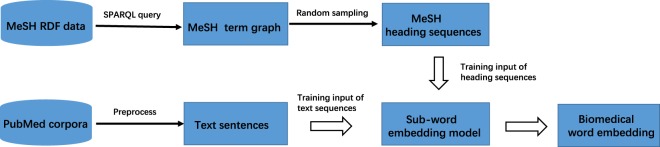
Distributed word representations have become an essential foundation for biomedical natural language processing (BioNLP), text mining and information retrieval. Word embeddings are traditionally computed at the word level from a large corpus of unlabeled text, ignoring the information present in the internal structure of words or any information available in domain specific structured resources such as ontologies. However, such information holds potentials for greatly improving the quality of the word representation, as suggested in some recent studies in the general domain. Here we present BioWordVec: an open set of biomedical word vectors/embeddings that combines subword information from unlabeled biomedical text with a widely-used biomedical controlled vocabulary called Medical Subject Headings (MeSH). We assess both the validity and utility of our generated word embeddings over multiple NLP tasks in the biomedical domain. Our benchmarking results demonstrate that our word embeddings can result in significantly improved performance over the previous state of the art in those challenging tasks.
Overview
The claims and statistics of this paper haven’t been checked yet.
Free: it reads the open-access text and checks the first 5 claims that cite a source we can check. Create a free account to check every claim.
Integrity signals
Registry
Cites
Statistics
Figures
Verification
Claims the paper makes
The claims and statistics of this paper haven’t been checked yet.
Free: it reads the open-access text and checks the first 5 claims that cite a source we can check. Create a free account to check every claim.
Claims other papers make about this one
Each is checked against this paper’s own text: does it say what the citing paper says it does?
The cited source says what the claim attributes to it.
In the citing paper
“Finally, while recent studies including our own (13,25) have shown promise in improving classification performance with deep learning, such algorithms are not implemented due to the bottleneck of model efficiency in practical use.”
From LitSuggest: a web-based system for literature recommendation and curation using machine learning (2021) · cites this paper as [25]
Self-check
Percentages, sums and reported differences re-computed from the paper’s own numbers.
The self-check needs the paper’s full text.
Citations
Cites
Glove: Global Vectors for Word Representation
Pennington, J., Socher, R., & Manning, C. (2014) · Proceedings of the 2014 Conference on Empirical Methods in Natural Language Processing (EMNLP) · doi:10.3115/v1/d14-1162 · Cited by 34,071 · cited 2×
“In recent years, several word embedding models and pre-trained word embeddings 1,7,8 have been made publicly available and successfully applied to many biomedical NLP (BioNLP) tasks.”
MethodAdvances in neural information processing systems 7
Cios, K., & Shields, M. (1997) · Neurocomputing · doi:10.1016/s0925-2312(97)90018-7 · Cited by 22,059
node2vec: Scalable Feature Learning for Networks
Grover, A., & Leskovec, J. (2016) · Proceedings of the 22nd ACM SIGKDD International Conference on Knowledge Discovery and Data Mining · doi:10.1145/2939672.2939754 · Cited by 10,926
DeepWalk: online learning of social representations
Perozzi, B., Al-Rfou, R., & Skiena, S. (2014) · Proceedings of the 20th ACM SIGKDD international conference on Knowledge discovery and data mining · doi:10.1145/2623330.2623732 · Cited by 10,123 · cited 1×
“Recent studies (e.g. 16,17 ) inspired by the skip-gram model 16,17 have proposed to translate network/graphs into nodes sequences to learn networks embeddings.”
BackgroundEnriching Word Vectors with Subword Information
Bojanowski, P., Grave, E., Joulin, A., & Mikolov, T. (2017) · Transactions of the Association for Computational Linguistics · doi:10.1162/tacl_a_00051 · Cited by 9,645 · cited 4×
“Bojanowski et al . recently proposed a novel embedding model 11 , which can effectively use the subword information to enrich the final word embedding results.”
BackgroundMethodInfluentialLINE: Large-scale Information Network Embedding
Tang, J., Qu, M., Wang, M., Zhang, M., Yan, J., & Mei, Q. (2015) · Proceedings of the 24th International Conference on World Wide Web · doi:10.1145/2736277.2741093 · Cited by 5,416
Advances in Neural Information Processing Systems 27 (NIPS 2014)
Zhong, M., Goddard, N., & Sutton, C. A. (2014) · Cited by 2,636
SemEval-2017 Task 1: Semantic Textual Similarity Multilingual and Crosslingual Focused Evaluation
Cer, D., Diab, M., Agirre, E., Lopez-Gazpio, I., & Specia, L. (2017) · Proceedings of the 11th International Workshop on Semantic Evaluation (SemEval-2017) · doi:10.18653/v1/s17-2001 · Cited by 1,562 · cited 1×
“In the general domain, the SemEval Semantic Textual Similarity (SemEval STS) challenge has been organized for over five years, which calls for effective models to measure sentence similarity 23 .”
MethodLearning Sentiment-Specific Word Embedding for Twitter Sentiment Classification
Tang, D., Wei, F., Yang, N., Zhou, M., Liu, T., & Qin, B. (2014) · Proceedings of the 52nd Annual Meeting of the Association for Computational Linguistics (Volume 1: Long Papers) · doi:10.3115/v1/p14-1146 · Cited by 1,181 · cited 1×
“The training of our model is to maximize the above objective function in (5), which will learn the joint PubMed text sequences and MeSH term sequences in word embedding.”
MethodRetrofitting Word Vectors to Semantic Lexicons
Faruqui, M., Dodge, J., Jauhar, S. K., Dyer, C., Hovy, E., & Smith, N. A. (2015) · Proceedings of the 2015 Conference of the North American Chapter of the Association for Computational Linguistics: Human Language Technologies · doi:10.3115/v1/n15-1184 · Cited by 721
Research works printed but not linked: 4
- Mikolov, T., Sutskever, I., Chen, K., Corrado, G. S. & Dean, J. Distributed representations of words and phrases and their compositionality. In Advances in Neural Information Processing systems26, 3111–3119 (NIPS, 2013).
- Bengio Y Ducharme R Vincent P Jauvin C A neural probabilistic language model Journal of Machine Learning Research 2003 3 1137 1155
- Yanshan, W. et al. Overview of the BioCreative/OHNLP challenge 2018 task 2: clinical semantic textual similarity. In Proceedings of the BioCreative/OHNLP Challenge. 1–4 (2018).
- Chen, Q., Du, J., Kim, S., Wilbur, W. J. & Lu, Z. Combining rich features and deep learning for finding similar sentences in electronic medical records. In Proceedings of the BioCreative/OHNLP Challenge. 5–8 (2018).
Cited by
Items 301–400 of 453
Targeting GPCRs Via Multi-Platform Arrays and AI
Preto, A. J., Marques-Pereira, C., Baptista, S. J., Bueschbell, B., Barreto, C. A. V., Gaspar, A. T., Pinheiro, I., Pereira, N. N., Pires, M., Ramalhão, D., et al. (2021) · Elsevier eBooks · doi:10.1016/b978-0-12-820472-6.00048-7 · Cited by 3
Recommendation System for Clinical Concept Mapping
Pal, S., Gaur, M., Chaudhuri, R., Anto, O. B., Kalaivanan, R., Chetan, K. V., & Pradhan, P. (2023) · International Conference on Computational Intelligence, Networks and Security (ICCINS) · doi:10.1109/iccins58907.2023.10450023 · Cited by 2
“It is an extension of the original BioWordVec which provides fastText word embeddings trained using PubMed and MeSH [24].”
MethodKurniasari, D., Warsono, W., Usman, M., Lumbanraja, F. R., & Wamiliana, W. (2024) · Science & Technology Indonesia · doi:10.26554/sti.2024.9.2.273-283 · Cited by 4
Fundamentals of Vector-Based Text Representation and Word Embeddings
Malik, N., Singh, S., Biswas, P., & Sharan, A. (2024) · Transactions on computer systems and networks · doi:10.1007/978-981-97-3962-2_9 · Cited by 3
Mostafa, A. M., Alaerjan, A., Allahem, H., Aldughayfiq, B., Alruily, M., Tantawy, A. A., & Ezz, M. M. (2025) · IEEE Access · doi:10.1109/access.2025.3552239 · Cited by 2
“This model improves biomedical word embedding with sub-word information and MeSH [30] is particularly adept at encoding semantic similarities and relationships between biomedical terms.”
Gupta, P., Chaudhary, Y., & Schütze, H. (2019) · Workshop on BioNLP Open Shared Tasks (BioNLP-OST) · doi:10.18653/v1/d19-5730 · Cited by 2
“…with RDoC constructs is very small, we use an external source of semantical knowledge by incorporating pretrained distributional word embeddings (Zhang et al., 2019) from FastText model (Bojanowski et al., 2017) trained on the entire corpus of PubMed and MIMIC III Clinical notes (Johnson et…”
MethodCoordination Boundary Identification without Labeled Data for Compound Terms Disambiguation
Sawada, Y., Wada, T., Shibahara, T., Teranishi, H., Kondo, S., Shindo, H., Watanabe, T., & Matsumoto, Y. (2020) · International Conference on Computational Linguistics · doi:10.18653/v1/2020.coling-main.271 · Cited by 2
“2We used word embeddings pre-trained in bio-domain corpora, namely SciBERT (Beltagy et al., 2019) and Biowordvec (Yijia et al., 2019).”
MethodLearning Dynamic Coherence with Graph Attention Network for Biomedical Entity Linking
Bo, M., & Zhang, M. (2021) · International Joint Conference on Neural Networks (IJCNN) · doi:10.1109/ijcnn52387.2021.9533687 · Cited by 5
“We set h = 200 as representation dimen-sion and used BioWordVec [41] word embeddings trained on large unlabeled biomedical text.”
BackgroundMethodInfluentialProtein-Protein Interaction Extraction using Attention-based Tree-Structured Neural Network Models
Roy, S. S., & Mercer, R. E. (2022) · Proceedings of the ... International Florida Artificial Intelligence Research Society Conference · doi:10.32473/flairs.v35i.130660 · Cited by 2
“We also tried fasttext (Bojanowski et al. 2017) and Bio-WordVec (Zhang et al. 2019) embeddings.”
MethodAnalysis of Subword based Word Representations Case Study: Fasttext Malayalam
Vivek, M., & Chandran, P. (2022) · IEEE India Conference · doi:10.1109/indicon56171.2022.10040147 · Cited by 2
“FastText [20] embeddings for the biomedical domain using specific data have been proposed by Zhang et al. [22].”
MethodInvestigation of Biomedical Named Entity Recognition Methods
Çelikten, A., Onan, A., & Bulut, H. (2023) · Engineering cyber-physical systems and critical infrastructures · doi:10.1007/978-3-031-31956-3_18 · Cited by 1
Protein feature engineering framework for AMPylation site prediction
Prabhu, H., Bhosale, H., Sane, A., Dhadwal, R., Ramakrishnan, V., & Valadi, J. K. (2024) · Scientific Reports · doi:10.1038/s41598-024-58450-8 · Cited by 2
Medical Visual Question Answering: A Systematic Review
Le, H., Quan, A., Ly, T. T., Le, T. D., & Huynh, K. T. (2025) · Lecture notes in networks and systems · doi:10.1007/978-3-031-92545-0_20 · Cited by 2
Intrinsic and Extrinsic Evaluation of the Quality of Biomedical Embeddings in Different Languages
Franceschini, P. M., dos Santos, H. D. P., & Vieira, R. L. R. (2020) · Proceedings - IEEE Symposium on Computer-Based Medical Systems · doi:10.1109/cbms49503.2020.00058 · Cited by 2
“[18]. c) WikipediaENG: is a 300-dimensional word vector trained with English Wikipedia using FastText and the skip-gram model described in [19], with default parameters. d) EHR-Notes: is a 300-dimensional Portuguese word embedding proposed by [20].”
MethodTechniques for Medical Concept Detection from Multi-Modal Images.
Sonker, R., Mishra, A., Bansal, P., & Pattnaik, A. (2020) · CLEF (Working Notes) · Cited by 2
Expanding Our Understanding of COVID-19 from Biomedical Literature Using Word Embedding
Yang, H., & Sohn, E. (2021) · International Journal of Environmental Research and Public Health · doi:10.3390/ijerph18063005 · Cited by 2
“The model by [27] at NCBI showed a similarity of 0.”
MethodTurtling: a time-aware neural topic model on NIH grant data
Zhang, R., Duan, Z., Lee, C.-Y., Riffle, D., Min, M. R., & Zhang, J. (2023) · Bioinformatics Advances · doi:10.1093/bioadv/vbad096 · Cited by 4
“We utilize BioWordVec as the word embeddings for our method (Zhang et al. 2019).”
MethodSearching for LINCS to Stress: Using Text Mining to Automate Reference Chemical Curation
Chambers, B. A., Basili, D., Word, L. J., Baker, N., Middleton, A., Judson, R., & Shah, I. (2024) · Chemical Research in Toxicology · doi:10.1021/acs.chemrestox.3c00335 · Cited by 2
NormCG: A Novel Deep Learning Model for Medical Entity Linking
Tang, C., Chen, W., Wang, T., Sun, C. Y., Jiang, J., & Guan, Y. (2020) · Advances in intelligent systems and computing · doi:10.1007/978-981-15-5679-1_54 · Cited by 2
Text Generation with Content and Structure-Based Preprocessing in Imbalanced Data of Product Review
Nopember, I. T. S., Zaqiyah, A. A., Purwitasari, D., Nopember, I. T. S., Fatichah, C., & Nopember, I. T. S. (2021) · International journal of intelligent engineering and systems · doi:10.22266/ijies2021.0228.48 · Cited by 2
On Using Composite Word Embeddings To Improve Biomedical Term Similarity
Singh, A., & Jin, W. (2020) · IEEE International Conference on Bioinformatics and Bioengineering (BIBE) · doi:10.1109/bibe50027.2020.00053 · Cited by 2
Discovering Gene-Disease Associations with Biomedical Word Embeddings
Mitra, P., Pijnenburg, T., & Sazonau, V. (2020) · International Conference on Machine Learning and Applications · doi:10.1109/icmla51294.2020.00035 · Cited by 2
“In [8] and [9], the authors evaluated and released word vectors trained on public PubMed abstracts using Word2Vec and fastText , respectively.”
BackgroundMethodImproving biomedical word representation with locally linear embedding
Zhao, D., Wang, J., Chu, Y., Zhang, Y., Yang, Z., & Lin, H. (2021) · Neurocomputing · doi:10.1016/j.neucom.2021.02.071 · Cited by 3
Self-citationManifold biomedical text sentence embedding
Wang, B., Sun, Y., Chu, Y., Lin, H., Zhao, D., Yang, L., Shen, C., Yang, Z., & Wang, J. (2022) · Neurocomputing · doi:10.1016/j.neucom.2022.04.009 · Cited by 2
Self-citationIdentifying Early Warning Signals from News Using Network Community Detection
Vine, N. L., Boxer, E., Dinani, M., Tortora, P., & Das, S. (2022) · Proceedings of the AAAI Conference on Artificial Intelligence · doi:10.1609/aaai.v36i11.21503 · Cited by 3
“Link novelty is defined as link nov : C × C → [0 , 1] such that for a given pair of concepts c i , c j ∈ C , link nov ( c i , c j ) is the maximum of trained link prediction model’s probability and the other two semantic similarity scores (from GloVe and BioWordVec).”
MethodGextext: Disease Network Extraction from Biomedical LiteraturePreprint
O'Shea, R. (2019) · arXiv (Cornell University) · doi:10.48550/arxiv.1911.02562 · Cited by 2
Faithful and Plausible Explanations of Medical Code PredictionsPreprint
Wood-Doughty, Z., Cachola, I. A., & Dredze, M. H. (2021) · arXiv (Cornell University) · doi:10.48550/arxiv.2104.07894 · Cited by 6
“Using the BioWordVec embeddings released by Zhang et al. (2019), we embed each both the explanation and code description into a 200-dimensional vector, concatenate the two vectors, and pass it to the logistic regression.”
MethodBiomedical Knowledge Discovery From Unstructured Text Corpora Using Contextual Word EmbeddingsPreprint
Panesar, S. S. (2022) · Research Square · doi:10.21203/rs.3.rs-2286334/v1 · Cited by 3
Trust it or Not: Confidence-Guided Automatic Radiology Report GenerationPreprint
Wang, Y., Lin, Z., Xu, Z., Dong, H., Luo, J. D., Tian, J., Shi, Z., Zhang, Y., Fan, J., & He, Z. (2023) · SSRN Electronic Journal · doi:10.2139/ssrn.4482859 · Cited by 2
Self-citationObtaining Better Static Word Embeddings Using Contextual Embedding Models
Gupta, P., & Jaggi, M. (2021) · Zenodo (CERN European Organization for Nuclear Research) · doi:10.5281/zenodo.5055754 · Cited by 2
Solving the Right Problem is Key for Translational NLP: A Case Study in UMLS Vocabulary Insertion
Gutiérrez, B. J., Mao, Y., Nguyen, V., Fung, K. W., Su, Y., & Bodenreider, O. (2023) · Findings of the Association for Computational Linguistics: EMNLP (Findings of EMNLP) · doi:10.18653/v1/2023.findings-emnlp.51 · Cited by 1
Mishra, A. K., Chappell, M. J., Emerson, S., & Skubic, M. (2023) · Annual International Conference of the IEEE Engineering in Medicine and Biology Society (EMBC) · doi:10.1109/embc40787.2023.10341127 · Cited by 2
M’hamdi, Z. E., Lazaar, M., & Mahboub, O. (2025) · Engineering Applications of Artificial Intelligence · doi:10.1016/j.engappai.2025.110827 · Cited by 1
Rayabharam, N. V. S. M., Rahman, M. M., Hoque, R., Reza, S. M., & Kabir, M. F. (2025) · IEEE International Conference on Big Data (BigData) · doi:10.1109/bigdata66926.2025.11402491 · Cited by 1
“Zhang et al. [18] create a new word embedding model which outperforms current state-of-the-art embedding models in all bench-marking tests.”
iS2C2: a cointelligent platform for mechanistic discovery of disease cellular crosstalk
Sheng, J., Ahn, J. Y., Yang, L., Wan, Z., Qi, S., Yu, X., Xu, Z., Cao, Y., Vasquez, M., Irfan, A., et al. (2026) · Signal Transduction and Targeted Therapy · doi:10.1038/s41392-026-02691-8 · Cited by 2
Biomedical Entity Linking Based on Global and Local Feature Fusion
Tohti, T., Abdurxit, M., & Hamdulla, A. (2022) · International Conference on Asian Language Processing · doi:10.1109/ialp57159.2022.9961242 · Cited by 1
Yoshizaki, M., Kuriya, Y., Yamamoto, M., Watanabe, N., & Araki, M. (2024) · British Journal of Clinical Pharmacology · doi:10.1111/bcp.16032 · Cited by 2
“32,33 Using the BioWordVec model, which was pretrained from a clinical database, a 200-dimensional vector for the drug, enzyme and HFP names was generated, reflecting features such as their association with life science terms.”
Methodhaq, M. I. U., Li, Q., Mahmood, K., Shafique, A., & Ullah, R. (2024) · The Computer Journal · doi:10.1093/comjnl/bxae132 · Cited by 1
Clinical Analogy Resolution Performance for Foundation Language Models
Villena, F., Quiroga, T., & Dunstan, J. (2024) · ACM Transactions on Computing for Healthcare · doi:10.1145/3709155 · Cited by 1
Balogh, O. M., Pétervári, M., Csernák, Á. M., Puhl, E., Horváth, A., Ferdinandy, P., & Ágg, B. (2026) · Briefings in Bioinformatics · doi:10.1093/bib/bbag463 · Cited by 1
Du, X., Jena, R., Farrahi, K., & Niranjan, M. (2025) · Neural Computing and Applications · doi:10.1007/s00521-025-11613-8 · Cited by 1
“First, it captures the inherent relationships among labels by embedding them into a continuous vector space where semantic similarity is preserved [3, 4].”
Towards early and automatic detection of Urinary Infection during pregnancy
Escobedo, L., & Hirales-Carbajal, A. (2019) · EAI Endorsed Transactions on Pervasive Health and Technology · doi:10.4108/eai.13-7-2018.162810 · Cited by 1
“Word embeddings are used to calculate or predict semantic similarity between words, terms or sentences [20].”
MethodIwuorie, K., & Mohammed, S. (2020) · Asia-Pacific Journal of Neural Networks and Its Applications · doi:10.21742/ajnnia.2020.4.1.01 · Cited by 1
“[ 13] Research the use of Long-Short Term Memory (LSTM) based neural networks as opposed to the use of CNN.”
MethodEarly Detection of Severe Flu Outbreaks using Contextual Word Embeddings
Karsi, R., Zaim, M., & El, J. (2021) · International Journal of Advanced Computer Science and Applications · doi:10.14569/ijacsa.2021.0120227 · Cited by 1
“The problem of rare and out of vocabulary words is addressed in [23], a biomedical word embedding is created by exploiting the subword information.”
BackgroundExtraction of Union and Intersection Axioms from Biomedical Text
Sachdeva, N., Jain, M., & Mutharaju, R. (2021) · Lecture notes in computer science · doi:10.1007/978-3-030-80418-3_27 · Cited by 1
“Although there have been attempts at identifying concepts and relations in the text with the help of an ontology [3] and word embeddings [6], to the best of our knowledge, this is the first attempt at extracting complex (nontaxonomic) ontology axioms from the text.”
BackgroundComparison of Machine Learning and Deep Learning model for Medical Subject Headings Indexation
Heryawan, L., & Bukhori, A. (2022) · International Conference on Computer, Control, Informatics and its Applications · doi:10.1145/3575882.3575938 · Cited by 1
“Use this word vector/Word2Vec Other studies include BioWordVec [10], an open set of word vectors/embedding that combines sub-word information from unlabeled biomedical texts with MeSH keywords.”
MethodIdentification Semantic Text of Indonesian Medical Terms from Question-Answer Data
Purwitasari, D., Juanita, S., Purnama, I. K. E., Raihan, M., & Purnomo, M. H. (2022) · International Conference on Information Technology, Information Systems and Electrical Engineering (ICITISEE) · doi:10.1109/icitisee57756.2022.10057601 · Cited by 1
“The first model BioWordVec is an open set of biomedical word vectors/ embeddings that combines unlabeled biomedical textual sub-word information with a widely used biomedical controlled vocabulary called Medical Subject Headings (MeSH) [15].”
BackgroundMethodNeves, M., Schadock, I., Eusemann, B., Schnfelder, G., Bert, B., & Butzke, D. (2023) · Workshop on Biomedical Language Processing (BioNLP) · doi:10.18653/v1/2023.bionlp-1.11 · Cited by 2
“For the text similarity based on word embeddings, we vectorized the text using embeddings which are specific for the biomedical domain, namely: NCBI (Zhang et al., 2019), BioNLP-EVEX 8 , Cambridge (Chiu et al., 2016), and ChemPatent (Zhai et al., 2019).”
MethodConcept2Vec: concept vector generation for biomedical literature using concept modelling
Vazrala, S., & Mohammed, T. K. (2023) · Indonesian Journal of Electrical Engineering and Computer Science · doi:10.11591/ijeecs.v32.i1.pp579-586 · Cited by 1
“…more than 7 billion words are available because of the advancements in language processing applications this unlabeled large corpus can be used for generating the statistical WordNet models for various applications such as text classification, named entity recognition, query processing [10].”
MethodWijesinghe, Y. V., Xu, Y., Li, Y., & Zhang, Q. (2024) · Computers in Biology and Medicine · doi:10.1016/j.compbiomed.2024.108043 · Cited by 2
AI-Powered Online Symptom Checkers: Enhancing Accuracy and Guiding Users to Appropriate Medical Care
Amballa, D. P. (2024) · Journal of Artificial Intelligence & Cloud Computing · doi:10.47363/jaicc/2024(3)292 · Cited by 1
Clinical Note Structural Knowledge Improves Word Sense Disambiguation.
Chen, F., Zhang, G., Chen, S., Callahan, T. J., & Weng, C. (2024) · PubMed Central · Cited by 2
Scholarly recommendation system for NIH funded grants based on biomedical word embedding models
Zhang, Z., Yaseen, A. S., & Wu, H. (2024) · Natural Language Processing Journal · doi:10.1016/j.nlp.2024.100095 · Cited by 3
OntoDrug: Enhancing Brazilian Health System Interoperability with a National Medication Ontology
Miranda, N., Machado, M. M., & Moreira, D. D. A. (2024) · Brazilian Symposium on Multimedia and the Web · doi:10.5753/webmedia.2024.242062 · Cited by 1
Deciphering Abbreviations in Malaysian Clinical Notes Using Machine Learning
Sulaiman, I. M., Bulgiba, A. M., Kareem, S. A., & Latip, A. A. (2024) · Methods of Information in Medicine · doi:10.1055/a-2521-4372 · Cited by 2
“26 Several state-of-the-art word embeddings using BERT have also been made available, such as BioBERT using PubMed abstracts and PMC full-text articles 17 and SciBERT using random samples from Semantic Scholar papers.”
Development of Predictive Model for Patient Triaging at Emergency Department
Kang, K., Annathurai, A., Leow, Y. K., Chia, E., & Fu, Z. (2025) · IEEE Conference on Artificial Intelligence (CAI) · doi:10.1109/cai64502.2025.00103 · Cited by 1
Mining Semantic Subspaces to Express Discipline-Specific Similarities
Wawrzinek, J., Pinto, J. M. G., & Balke, W. (2020) · ACM/IEEE Joint Conference on Digital Libraries · doi:10.1145/3383583.3398523 · Cited by 1
“Today word embeddings [5, 31-33] are an often used natural language processing (NLP) technique in biomedicine [34-37].”
BackgroundGupta, S., Belouali, A., Shah, N. J., Atkins, M. B., & Madhavan, S. (2020) · IEEE International Conference on Healthcare Informatics (ICHI) · doi:10.1109/ichi48887.2020.9374360 · Cited by 1
“For our deep learning models, we used the publicly available pre-trained word embeddings from NCBI: BioWordVec [7].”
MethodCOS: A new MeSH term embedding incorporating corpus, ontology, and semantic predications
Ding, J., & Jin, W. (2021) · PLoS ONE · doi:10.1371/journal.pone.0251094 · Cited by 2
Gharaibeh, T., & de Doncker, E. (2020) · International Conference on Computational Science and Computational Intelligence (CSCI) · doi:10.1109/csci51800.2020.00081 · Cited by 1
“They used the BioWordVec5 model [20], the most recent prebuilt available biomedical word embedding that performed well on several benchmark tasks.”
MethodBioTMPy: A Deep Learning-Based Tool to Classify Biomedical Literature
Alves, N., Rodrigues, R., & Rocha, M. (2021) · Lecture notes in networks and systems · doi:10.1007/978-3-030-86258-9_12 · Cited by 1
Improving the Quality of Suggestions for Medical Text Simplification Tools.
Kauchak, D., Apricio, J., & Gondy Leroy, A. (2022) · PubMed Central · Cited by 1
Lara-Clares, A., Lastra-Díaz, J. J., & García-Serrano, A. M. (2022) · PLoS ONE · doi:10.1371/journal.pone.0276539 · Cited by 2
Lee, S., Kim, N., Kwon, J.-H., Choi, H. D., Lee, S.-B., & Kim, E. (2022) · IEEE Global Conference on Consumer Electronics (GCCE) · doi:10.1109/gcce56475.2022.10014242 · Cited by 1
A Cloud Cluster Test Framework for English Machine Translation based on Prior Information
Wang, Y. (2023) · International Conference on Inventive Computation Technologies (ICICT) · doi:10.1109/icict57646.2023.10134230 · Cited by 1
“Labeling, the word embedding [18-21] and position encoding can be regarded as a preprocessing stage before model training.”
BackgroundMultiple Convolutional Neural Networks with Stratified K Fold Strategy for ICD Code Classification
Conag, E. J. T., Quisel, M. L. S., & Pepito, G. B. (2023) · International Conference on Information Technology and Digital Applications (ICITDA) · doi:10.1109/icitda60835.2023.10427174 · Cited by 1
“The researchers then used an embedding called BioWordVec which was developed by Zhang Y, Chen Q, Yang Z, Lin H, and Lu Z. [18], a word embedding that was trained to be able to analyze medical words into their corresponding weights so that they would be the values that the ML model would depend on.”
MethodReichmann, L. G., Valdés, G., Pirrachio, R., & Interian, Y. (2020) · medRxiv · doi:10.1101/2020.06.30.20143677 · Cited by 2
“We used pre-trained, 200 dimension word embeddings (Zhang et al. 2019) to initialize the model after tokenizing the words in the vocabulary (see our repository for more details on the text normalization).”
MethodEvaluating Biomedical BERT Models for Vocabulary Alignment at Scale in the UMLS MetathesaurusPreprint
Bajaj, G., Nguyen, V., Wijesiriwardene, T., Yip, H. Y., Javangula, V., Parthasarathy, S., Sheth, A., & Bodenreider, O. (2021) · arXiv (Cornell University) · doi:10.48550/arxiv.2109.13348 · Cited by 2
Mishra, A. K. (2021) · MOspace Institutional Repository (University of Missouri) · doi:10.32469/10355/90073 · Cited by 1
Impact of translation on biomedical information extraction from real-life clinical notesPreprint
Gérardin, C., Xiong, Y., Wajsbürt, P., Carrat, F., & Tannier, X. (2023) · Research Square · doi:10.21203/rs.3.rs-2728780/v1 · Cited by 1
Harnessing PubMed User Query Logs for Post Hoc Explanations of Recommended Similar ArticlesPreprint
Shin, A., Jin, Q., Anibal, J., & Lu, Z. (2024) · PubMed · doi:10.48550/arxiv.2402.03484 · Cited by 1
“TheBioWord2Vec model [41] we use is from the NCBI and trained on PubMed and MIMIC-III clinical notes.”
MethodInfluentialSelf-citationLi, Y., Tao, W., Dang, Y., Chen, Y., & Tao, C. (2025) · Research Square · doi:10.21203/rs.3.rs-6096098/v1 · Cited by 1
“It bene�ts from subword details and integrates the extensive PubMed and MIMIC-III datasets to produce embeddings that grasp the intricate interpretations of biomedical terms [33], [34].”
Knowledge Discovery and Hypothesis Generation from Online Patient Forums: A Research Proposal
Dirkson, A. R. (2019) · Annual Meeting of the Association for Computational Linguistics: Student Research Workshop (ACL SRW) · doi:10.18653/v1/p19-2009 · Cited by 1
“We may also incorporate domain knowledge from structured databases in our embeddings, as this was shown to improve their quality (Zhang et al., 2019).”
MethodGextext: Unsupervised Knowledge Modelling in Biomedical Literature.Preprint
O’Shea, R. (2019) · arXiv (Cornell University)
Drug-Drug Interaction Detection (DDI) Over the Social Media using Convolutional Neural NetworksPreprint
Iwuorie, K., & Mohammed, S. (2020) · doi:10.36227/techrxiv.12055998.v1
Towards user friendly medication mapping using entity-boosted twin modeling
Yuan, S., Bhatia, P., Celikkaya, B., Liu, H., & Choi, K. (2020)
Gupta, S., Rao, S., Miglani, T., Iyer, Y., Lin, J., Saiyed, A. M., Ikwuemesi, I., McNulty, S. M., Thaxton, C., & Madhavan, S. (2020) · bioRxiv (Cold Spring Harbor Laboratory) · doi:10.1101/2020.12.03.409094
“For our deep learning models, we used the publicly available pre-trained word embeddings from NCBI: BioWordVec [24,25].”
MethodWord2vec and its application to examining the changes in word contexts over time
Saastamoinen, T. (2020) · Helda - University of Helsinki Institutional Repository · Cited by 1
Corpora as Evolving Entities: Embedding Corpora in Biomedical Ontologies.
Hobbs, E., Goralski, S. M., Mitchell, A., Simpson, A., Leka, D., Kotey, E., Sekira, M., Munro, J. B., Nadendla, S., Jackson, R., et al. (2020)
Learning Similarity-Preserving Meta-Embedding for Text Mining
Thadajarassiri, J., Şen, C., Hartvigsen, T., Kong, X., & Rundensteiner, E. A. (2020) · IEEE International Conference on Big Data (BigData) · doi:10.1109/bigdata50022.2020.9378312
“Such embeddings are trained using one of many proposed methods [2], [6], [9], [19] and are often made publicly available [2], [7], [20], [21].”
MethodTao, J., Brayton, K. A., & Broschat, S. L. (2021) · Frontiers in Bioinformatics · doi:10.3389/fbinf.2021.749008
“The NLP is based on word embeddings and uses BioWordVec (Zhang et al., 2019) and BioSentVec (Chen et al., 2019).”
MethodBhosale, H., Lahorkar, A., Singh, D., Sane, A., & Valadi, J. K. (2021) · SN Computer Science · doi:10.1007/s42979-021-00948-3
Weak Supervision for Scientific Document Relevance Tagging
Herrmannová, D., Gunaratne, C., Walker, V. R., Rooney, A. A., Patton, R. M., Wolfe, M. S., & Schmitt, C. (2021) · ACM/IEEE Joint Conference on Digital Libraries · doi:10.1109/jcdl52503.2021.00060
An Analysis of Relation Extraction within Sentences from Wet Lab Protocols
Yang, X., Zhang, X., Zuo, J. L., Wilson, S. D., & Petzold, L. R. (2021) · IEEE International Conference on Big Data (BigData) · doi:10.1109/bigdata52589.2021.9671781
“In this paper, we conduct comprehensive experiments by incorporating the aforementioned GP-GNNs and Context-Aware methods [20], [21] with biomedical domain-specific word embeddings [22], [23] and achieve significant improvements on all WLPs corpora.”
MethodCoordinate Structure Analysis without Labeled Data for Recognizing Compound Named Entities
Sawada, Y., Teranishi, H., Matsumoto, Y., & Watanabe, T. (2021) · Journal of Natural Language Processing · doi:10.5715/jnlp.28.1089
“3.2.1 実験設定 教師あり手法である寺西ら (2020)の手法と教師なし手法である提案手法の性能を比較するた め,GENIA Treebank (beta) での実験を行った.先行研究との比較のため,対象の等位接続詞 を “and”, “or”, “but”とし,前処理で使用する品詞タグはコーパスに付与されている品詞を 使用した.また,Penn Treebankを用いた予備実験と同様に事前学習された FastText,ELMo, BERT に基づいた単語分散表現を使用して,それぞれの解析性能について比較した.これら の単語分散表現には,GENIA…”
InfluentialSchulz, S. (2019) · Faculty Opinions – Post-Publication Peer Review of the Biomedical Literature · doi:10.3410/f.736596838.793567597
Large-scale literature mining to assess the relation between anti-cancer drugs and cancer types.Preprint
Bauer, C., Herwig, R., Lienhard, M., Prasse, P., Scheffer, T., & Schuchhardt, J. (2021) · Research Square · doi:10.21203/rs.3.rs-332487/v1
Drug-Drug Interaction Detection (DDI) Over the Social Media using Convolutional Neural NetworksPreprint
Iwuorie, K., & Mohammed, S. (2020) · doi:10.36227/techrxiv.12055998
Intrinsic Evaluation of Contextual and Non-contextual Word Embeddings using Radiology Reports.
Khan, M. S., Landman, B. A., Deppen, S. A., & Matheny, M. E. (2021) · PubMed Central
Grissette, H., & Nfaoui, E. H. (2022) · Revista Tecnología en Marcha · doi:10.18845/tm.v35i8.6441
“Biomedical Word embeddings with subword information and MeSH (named BioWordVec) [15] An open set of biomedical word vectors/ embeddings that combines subword information from unlabeled biomedical text with a widely-used biomedical controlled vocabulary called Medical Subject Headings (MeSH) Biomedical Word and sentenc…”
MethodCOVID-19 Deep Clustering: An Ontology construction clustering method with dynamic medical labeling
Phan, C. P., & Chiang, J.-H. (2022) · International Symposium on Information and Communication Technology · doi:10.1145/3568562.3568564
“For more details, there are four steps in this phase as follows: • Transfer learning model : In this step, a deep learning model is additionally trained with the existing LitCovid dataset by transfer learning from the previous pretrained model, the purpose of this step is to enrich the BioSentVec model and enlarge the…”
MethodInfluentialA Residual CNN Model for ICD Assignment
Cheng, D. L. W., Ting, C., & Ho, C. C. (2022) · doi:10.2991/978-94-6463-094-7_26
Improving Diachronic Word Sense Induction with a Nonparametric Bayesian method
Alsulaimani, A., & Moreau, E. (2023) · Findings of the Association for Computational Linguistics: ACL (Findings of ACL) · doi:10.18653/v1/2023.findings-acl.567 · Cited by 3
Biomedical Knowledge Representation Learning
Zeng, Z., Liu, Z., Lin, Y., & Sun, M. (2023) · Springer eBooks · doi:10.1007/978-981-99-1600-9_12
Vazrala, S., & Mohammed, T. K. (2023) · Smart innovation, systems and technologies · doi:10.1007/978-981-99-4717-1_26
A GCN-based approach to uncover misaligned synonymous terms in the UMLS Metathesaurus.
Hao, X., Abeysinghe, R., Shi, J., & Cui, L. (2023) · PubMed Central · Cited by 1
Metadata
- Authors
- Zhang, Y., Chen, Q., Yang, Z., Lin, H., & Lu, Z.
- Affiliations
- National Institutes of Health (US)
- Dalian University of Technology (CN)
- Corresponding author
- Lu, Zhiyong
- Venue
- Scientific Data
- Published
- 2019-05-10
- Volume
- 6
- Issue
- 1
- Pages
- 52-52
- ISSN
- 2052-4463 (ISSN-L)
- PMC
- PMC6510737
- OpenAlex
- W2944400536
- Cited by
- 455
- References
- 40
- Citations by year
- 2026: 28 · 2025: 49 · 2024: 57 · 2023: 70 · 2022: 74 · 2021: 96 · 2020: 62 · 2019: 19
- Type
- data paper
- Language
- en
- Open access
- gold
- doi.org
- Licence
- cc-by
- creativecommons.org/licenses/by/4.0 (tdm)
- creativecommons.org/licenses/by/4.0 (vor)
- Locations
- Scientific Data (publishedVersion, cc-by)
- PubMed Central (publishedVersion, cc-by)
- PubMed (publishedVersion)
- Funders
- the NIH Intramural Research Program, National Library of Medicine
- Topics
- Health Sciences › Medicine › Health Informatics › Biomedical Text Mining and Ontologies
- Physical Sciences › Computer Science › Artificial Intelligence › Topic Modeling
- Physical Sciences › Computer Science › Artificial Intelligence › Machine Learning in Healthcare
- Keywords
- Medical Subject Headings, controlled vocabulary, distributed word representations, biomedical natural language processing, word representation learning, ontology integration
- MeSH terms
- Algorithms, Natural Language Processing, Medical Subject Headings, Data Mining
About these checks
Registry, retraction, Cites and statistics results are computed, not judged, with one exception: a printed reference that no index lists is read once by a model before it counts as a citation error. Claims are extracted by a model and kept only when their quote appears verbatim in the text; each cited source is then checked, with a model’s help, for whether it says what the claim relies on. Those verdicts can be wrong — read the claim’s quote and the cited source before relying on one.
Statistics and arithmetic are recomputed, not judged.
Confidence bands are shown only for fields calibrated on our annotated test set. None is calibrated yet, so no band is shown.
What counts as a claim ›How we measure confidence ›How we check this ›
Are you an author, or do you see a problem with this page? Request a review
Data sources
Bibliographic data: Semantic Scholar, OpenAlex, Crossref.
Contains information from the Semantic Scholar Academic Graph Datasets, made available under the ODC Attribution License (ODC-BY 1.0).
Semantic Scholar’s data is described in: Kinney, R., et al. (2023). The Semantic Scholar Open Data Platform. arXiv:2301.10140.
