

A multimodal driver monitoring benchmark dataset for driver modeling in assisted driving automation
Open accessThe DOI matches its Crossref record; 63 of the 63 references it cites were found in a registry or an index.
Abstract
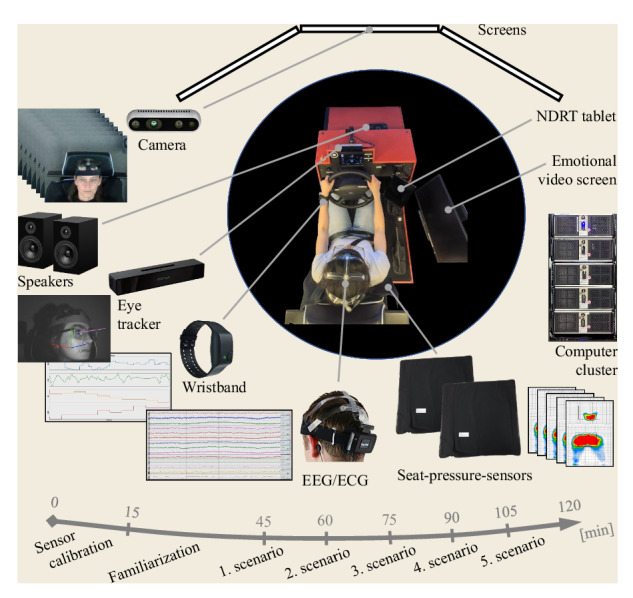
In driver monitoring various data types are collected from drivers and used for interpreting, modeling, and predicting driver behavior, and designing interactions. Aim of this contribution is to introduce manD 1.0, a multimodal dataset that can be used as a benchmark for driver monitoring in the context of automated driving. manD is the short form of human dimension in automated driving. manD 1.0 refers to a dataset that contains data from multiple driver monitoring sensors collected from 50 participants, gender-balanced, aged between 21 to 65 years. They drove through five different driving scenarios in a static driving simulator under controlled laboratory conditions. The automation level (SAE International, Standard J3016) ranged from SAE L0 (no automation, manual) to SAE L3 (conditional automation, temporal). To capture data reflecting various mental and physical states of the subjects, the scenarios encompassed a range of distinct driving events and conditions. manD 1.0 includes environmental data such as traffic and weather conditions, vehicle data like the SAE level and driving parameters, and driver state that covers physiology, body movements, activities, gaze, and facial information, all synchronized. This dataset supports applications like data-driven modeling, prediction of driver reactions, crafting of interaction strategies, and research into motion sickness.
Overview
The claims and statistics of this paper haven’t been checked yet.
Free: it reads the open-access text and checks the first 5 claims that cite a source we can check. Create a free account to check every claim.
Integrity signals
Registry
Cites
Statistics
Figures
Verification
Claims the paper makes
The claims and statistics of this paper haven’t been checked yet.
Free: it reads the open-access text and checks the first 5 claims that cite a source we can check. Create a free account to check every claim.
Self-check
Percentages, sums and reported differences re-computed from the paper’s own numbers.
The self-check needs the paper’s full text.
Citations
Cites
SciPy 1.0: fundamental algorithms for scientific computing in Python
Virtanen, P., Gommers, R., Oliphant, T. E., Haberland, M., Reddy, T., Cournapeau, D., Burovski, E., Peterson, P., Weckesser, W., Bright, J., et al. (2020) · Nature Methods · doi:10.1038/s41592-019-0686-2 · Cited by 38,430 · cited 1×
“This is achieved by identifying the peaks in the BVP using the scipy.signal package 36 , taking 240 BPM as the maximum acceptable HR .”
MethodSciPy 1.0: fundamental algorithms for scientific computing in Python
Virtanen, P., Gommers, R., Oliphant, T. E., Haberland, M., Reddy, T., Cournapeau, D., Burovski, E., Peterson, P., Weckesser, W., Bright, J., et al. (2019) · Apollo - University of Cambridge Repository · doi:10.17863/cam.64134 · Cited by 10,460
Measuring emotion: The self-assessment manikin and the semantic differential
Bradley, M. M., & Lang, P. J. (1994) · Journal of Behavior Therapy and Experimental Psychiatry · doi:10.1016/0005-7916(94)90063-9 · Cited by 9,538
Pearson, K. (1900) · The London, Edinburgh, and Dublin Philosophical Magazine and Journal of Science · doi:10.1080/14786440009463897 · Cited by 4,069
Detecting Stress During Real-World Driving Tasks Using Physiological Sensors
Healey, J. A., & Picard, R. W. (2005) · IEEE Transactions on Intelligent Transportation Systems · doi:10.1109/tits.2005.848368 · Cited by 2,207
The Atomic Components of Thought
Anderson, J. R., & Lebiere, C. J. (2014) · Psychology Press eBooks · doi:10.4324/9781315805696 · Cited by 2,173 · cited 2×
“Adaptive Control of Thought-Rational (ACT-R) 21 , Queueing Network-Model Human Processor (QN-MHP) 22 , and CLARION 23 are a few models recurrently employed for both qualitative and computational research 24 .”
BackgroundAge differences in short-term retention of rapidly changing information.
Kirchner, W. K. (1958) · Journal of Experimental Psychology · doi:10.1037/h0043688 · Cited by 1,798 · cited 1×
“Three activities are selected as NDRT: the auditory digit-span task 27 requested by the automated system during the experiment, the n-back game 28 , and the Subway Surfers game (co-developed by Kiloo and SYBO Games, released 2012), which are available on the fixed tablet for the driver at any time…”
MethodGorgolewski, K. J., Auer, T., Calhoun, V. D., Craddock, R. C., Das, S., Duff, E. P., Flandin, G., Ghosh, S. S., Glatard, T., Halchenko, Y. O., et al. (2016) · Scientific Data · doi:10.1038/sdata.2016.44 · Cited by 1,775
Working memory and language comprehension: A meta-analysis
Daneman, M., & Merikle, P. M. (1996) · Psychonomic Bulletin & Review · doi:10.3758/bf03214546 · Cited by 1,432
NeuroKit2: A Python toolbox for neurophysiological signal processing
Makowski, D., Pham, T., Lau, Z. J., Brammer, J. C., Lespinasse, F., Pham, H., Schölzel, C., & Chen, S. H. A. (2021) · Behavior Research Methods · doi:10.3758/s13428-020-01516-y · Cited by 1,388 · cited 1×
“The EDA data is then used to derive skin conductance level ( SCL ) and skin conductance response ( SCR ) values using the neurokit2 library 37 .”
Method
Research works printed but not linked: 3
- Bradski G The OpenCV Library Dr. Dobb’s Journal: software tools for the professional programmer 2000 25 120 123
- Young K Regan M Driver distraction: a review of the literature Distracted driving 2007 2007 379 405
- Dargahi Nobari, K., Hugenroth, A. & Bertram, T. Position classification and in-vehicle activity detection using seat-pressure-sensor in automated driving. In AmE 2022-Automotive meets Electronics; 13. GMM-Symposium, 1–6 (VDE, 2022).
Cited by
Dual Radar: A Multi-modal Dataset with Dual 4D Radar for Autononous Driving
Zhang, X., Wang, L., Chen, J., Fang, C., Yang, G., Wang, Y., Yang, L., Song, Z., Liu, L., Zhang, X., et al. (2025) · Scientific Data · doi:10.1038/s41597-025-04698-2 · Cited by 82
Data set for UWB Cooperative Navigation and Positioning of UAV Cluster
Zhang, C., Tang, C., Wang, H., Lian, B., & Zhang, L. (2025) · Scientific Data · doi:10.1038/s41597-025-04808-0 · Cited by 19
Aravinth, S. S., Nagamani, G. M., Kumar, C. K., Lasisi, A., Naveed, Q. N., Bhowmik, A., & Khan, W. A. (2025) · Scientific Reports · doi:10.1038/s41598-025-92701-6 · Cited by 16
“Fatigue-specific driving patterns adapted in the system have also been considered by Dargahi Nobari et al. 45 and Xu et al. 20 , who forwarded EEG-based biometric systems toward fatigue detection.”
Chen, S., Peng, C., Yang, B., Lin, J., Zhou, L., Jiang, Z., Liu, Z., Liu, Y., & Tang, L. (2026) · npj Artificial Intelligence · doi:10.1038/s44387-026-00083-5 · Cited by 9
Alharasees, O., & Kale, U. (2025) · Journal of Transport & Health · doi:10.1016/j.jth.2025.102088 · Cited by 8
A Dataset on Takeover during Distracted L2 Automated Driving
Hwang, J., Choi, W., Lee, J., Kim, W., Rhim, J., & Kim, A. (2025) · Scientific Data · doi:10.1038/s41597-025-04781-8 · Cited by 10
Lee, G., Lee, K., & Hou, J. (2025) · Sensors · doi:10.3390/s25196139 · Cited by 10
“However, they are often collected using static simulators, thereby lacking real-world vehicle dynamics [18].”
Chang, M., Jang, E. H., Kim, W., Yoon, D., & Kang, D. W. (2025) · Decision Support Systems · doi:10.1016/j.dss.2025.114559 · Cited by 3
Personalized driving stress assessment for enhanced safety: An explainable multimodal framework
Yang, L., Liu, W., Wen, J., Zhao, S., & Song, Y. (2026) · Safety Science · doi:10.1016/j.ssci.2026.107164 · Cited by 6
Liu, T., Qin, Y., Zhang, S., Duan, Y., & Tao, X. (2025) · IEEE Internet of Things Journal · doi:10.1109/jiot.2025.3585116 · Cited by 6
“0 [39], which is a benchmark dataset for large-scale driver monitoring.”
Enhancing Driver Safety With ResNet-RG—A Deep Learning-Based Distraction Detection Approach
Mohsin, A. R., Khalid, M., Ali, J., & Byeong-hee, R. (2025) · IEEE Sensors Journal · doi:10.1109/jsen.2025.3640661 · Cited by 2
“For instance, Dargahi Nobari and Bertram [50] introduced the manD 1.0 benchmark dataset, which collects multimodal driver-monitoring data under diverse real-world conditions to facilitate comprehensive evaluation.”
InfluentialOptimal HUD illuminance perception modeling under ambient light and weather variations
Wu, W., Hu, Y., Peng, G., Li, Y., Xiang, Y., Lu, J., Xue, C., & Fan, H. B. (2026) · International Journal of Industrial Ergonomics · doi:10.1016/j.ergon.2026.103880 · Cited by 2
No One at the Wheel? Advancing Reliability and Trust for the Autonomous Driving Era
Taghavifar, H., Mohammadi, A., Doroudian, E., Falk, T. H., Hou, M., & Plataniotis, K. N. (2025) · IEEE reliability magazine · doi:10.1109/mrl.2025.3556633 · Cited by 3
“What is novel in this approach from traditional pipelines is the inclusion of visio-psycho-physiological (VPP) data [22], [23], [24], which gives a more detailed description of how expert drivers react emotionally [25] and cognitively in complex traffic conditions.”
Dynamic Multi-Biosignal Fusion for Detecting the Mental States of Drivers and Passengers in Vehicles
Park, S.-H., Han, D., Jang, G.-D., & Lee, S. (2025) · IEEE Journal of Biomedical and Health Informatics · doi:10.1109/jbhi.2025.3570363 · Cited by 2
“[29].”
InfluentialMansourian, N., Mohammadi, A., Ahmad, M. O., & Swamy, M. N. S. (2025) · Annual International Conference of the IEEE Engineering in Medicine and Biology Society (EMBC) · doi:10.1109/embc58623.2025.11254389 · Cited by 3
Aguilar, B. A. J., Cervantes, I., & Ruiz-Torres, M. F. (2025) · IEEE Latin American Conference on Computational Intelligence (LA-CCI) · doi:10.1109/la-cci66231.2025.11270466
“…data acquisition under this plug-and-play framework, the MCSS facilitates direct comparison with emerging datasets such as DPV-MFD [3] and manD 1.0 [8], and enables studies that go beyond fatigue detection—for example, modeling levels of stress or cognitive engagement in assisted driving scenarios.”
InfluentialChen, K., Li, X., Cheng, J., Guo, G., & Li, W. L. W. (2025) · SAE technical papers on CD-ROM/SAE technical paper series · doi:10.4271/2025-01-7346
Driver Road Rage Detection and Event Perception Analysis Based on Eeg Functional Connectivity
Liu, T., Qin, Y., Zhang, S., & Tao, X. (2025) · IEEE International Conference on Intelligent Transportation Systems (ITSC) · doi:10.1109/itsc60802.2025.11423508
A Comprehensive Review on Driver Distraction Detection and Monitoring
Crasto, E. P., Ganapathy, D., Sai, D., Dayal, D., & Ladwani, V. M. (2025) · doi:10.1145/3783862.3783908
An EEG dataset for understanding driving expertise from naturalistic urban road experiments
Gong, J., Yu, Y., Cao, Y., Yang, R., Chang, X., Tang, H., Zheng, X., Liu, Y., You, S., Zheng, C., et al. (2026) · Scientific Data · doi:10.1038/s41597-026-07223-1
“It is not simply about “hours behind the wheel” but rather the quality and specificity of training received 6,10 .”
InfluentialDong, Z., Qi, G., Hao, Y., Zheng, S., Jiang, R., & Guan, W. (2026) · Expert Systems with Applications · doi:10.1016/j.eswa.2026.133093
Fernández-Matellán, R., Gomez, D. M., & de la Escalera, A. (2026) · IEEE Conference on Artificial Intelligence (CAI) · doi:10.1109/cai68641.2026.11536580
“This is because each modality degrades differently under changes in illumination, occlusions, posture, and inter-subject variability [9], [10].”
Dao, M.-S., Nguyen, T. M. P., Tran, A.-K. N., Wenbin, G., Ito, S., & Zettsu, K. (2026) · ACM Symposium on Applied Computing · doi:10.1145/3748522.3779902
Li, X. D., Guo, G., Sun, Q., Wu, Y., & Li, W. (2026) · Multimodal Technologies and Interaction · doi:10.3390/mti10070073
“For example, existing commercial driver distraction monitoring systems, while effective for basic safety warnings, typically rely only on visual cues (e.g., eyelid closure, head posture) and do not support monitoring the nuanced impact of IVMI on driving [10].”
Razm, S., & Olawoyin, R. (2026) · Reliability Engineering & System Safety · doi:10.1016/j.ress.2026.113375
Battel, K., Gideon, J., Applegate-Kenton, M., Gomez, P. R. C., Gupta, A., Rowell, T., Balch, T. M., Sumner, E. S., & Rosman, G. (2026) · International Conference on Automotive User Interfaces and Interactive Vehicular Applications (AutomotiveUI) · doi:10.1145/3828157.3828775
Multimodal Physiological Assessment of Attentional States and Driving Styles in Simulated Driving
Zhu, W., & Lin, Y. (2026) · Sensors · doi:10.3390/s26185883
A Subject-Independent Temporal Framework for Behavioural Eye-Based Driver Drowsiness Detection
Ajayi, O. O., Kurien, A. M., Djouani, K., & Dieng, L. (2026) · Sensors · doi:10.3390/s26196193
“Dataset resources such as FatigueView [48] and manD 1.0 [49] increasingly emphasise participant diversity, multiple acquisition conditions, and multimodal driver states, reflecting the need to evaluate systems beyond narrowly controlled or participant-overlapping samples.”
InfluentialEm, P. P., & Teoh, T. S. (2026) · Sensors · doi:10.3390/s26196202
“…extends this line of research to electric vehicle driving confidence monitoring [60], IoT-connected truck driver stress monitoring [61], integrated facial-plus-physiological driver behavior monitoring [62], and a multimodal driver monitoring benchmark dataset for assisted driving research [63].”
Metadata
- Authors
- Dargahi Nobari, K., & Bertram, T.
- Affiliations
- TU Dortmund University (DE)
- Venue
- Scientific Data
- Published
- 2024-03-30
- Volume
- 11
- Issue
- 1
- Pages
- 327-327
- ISSN
- 2052-4463 (ISSN-L)
- PMC
- PMC10981655
- OpenAlex
- W4393342802
- Semantic Scholar
- 4ce8b3fb6bfccf8025f1ef0f90204481139d5a7c
- Cited by
- 29
- References
- 62
- Citations by year
- 2026: 13 · 2025: 16
- Type
- data paper
- Language
- en
- Open access
- gold
- doi.org
- Licence
- cc-by
- creativecommons.org/licenses/by/4.0 (tdm)
- creativecommons.org/licenses/by/4.0 (vor)
- Locations
- Scientific Data (publishedVersion, cc-by)
- PubMed Central (publishedVersion, cc-by)
- PubMed (publishedVersion)
- DOAJ (DOAJ: Directory of Open Access Journals) (submittedVersion, cc-by-sa)
- Topics
- Social Sciences › Human Factors and Ergonomics › Human-Automation Interaction and Safety
- Physical Sciences › Engineering › Automotive Engineering › Autonomous Vehicle Technology and Safety
- Physical Sciences › Computer Science › Artificial Intelligence › Emotion and Mood Recognition
- Keywords
- driver monitoring, multimodal dataset, driver modeling, driving simulator, driver state, physiological signals, gaze tracking, facial analysis, body movement, motion sickness, SAE levels of driving automation
- MeSH terms
- Adult, Aged, Automation, Automobile Driving, Humans, Middle Aged, Young Adult
About these checks
Registry, retraction, Cites and statistics results are computed, not judged, with one exception: a printed reference that no index lists is read once by a model before it counts as a citation error. Claims are extracted by a model and kept only when their quote appears verbatim in the text; each cited source is then checked, with a model’s help, for whether it says what the claim relies on. Those verdicts can be wrong — read the claim’s quote and the cited source before relying on one.
Statistics and arithmetic are recomputed, not judged.
Confidence bands are shown only for fields calibrated on our annotated test set. None is calibrated yet, so no band is shown.
What counts as a claim ›How we measure confidence ›How we check this ›
Are you an author, or do you see a problem with this page? Request a review
Data sources
Bibliographic data: Semantic Scholar, OpenAlex, Crossref.
Contains information from the Semantic Scholar Academic Graph Datasets, made available under the ODC Attribution License (ODC-BY 1.0).
Semantic Scholar’s data is described in: Kinney, R., et al. (2023). The Semantic Scholar Open Data Platform. arXiv:2301.10140.
