

The DOI matches its Crossref record; 88 of the 90 references it cites were found in a registry or an index.
Augmentation of working memory training by transcranial direct current stimulation (tDCS)
Open accessAbstract
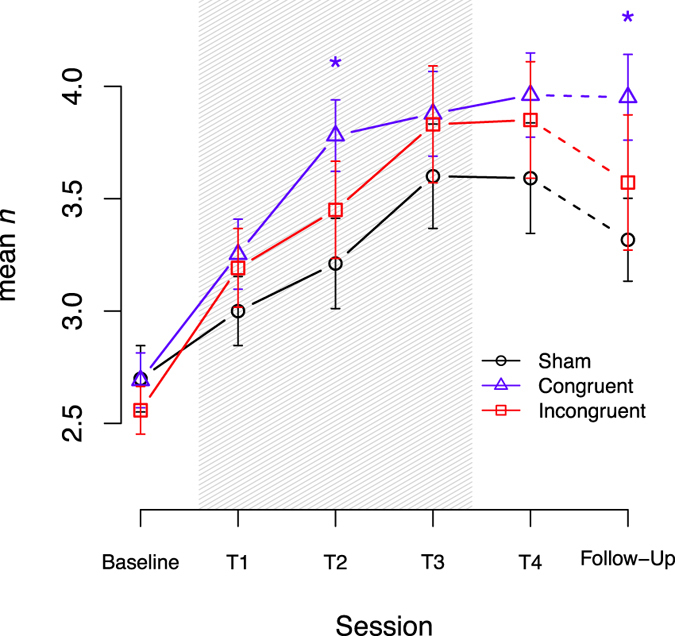
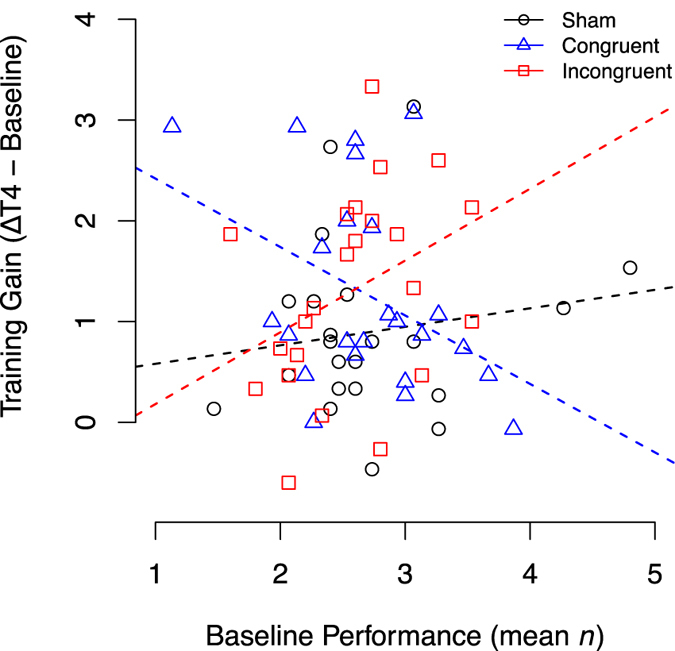
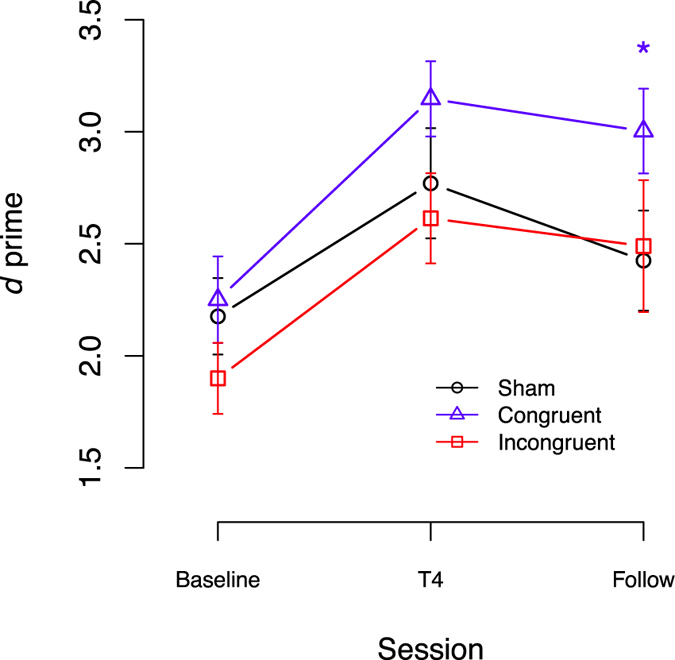
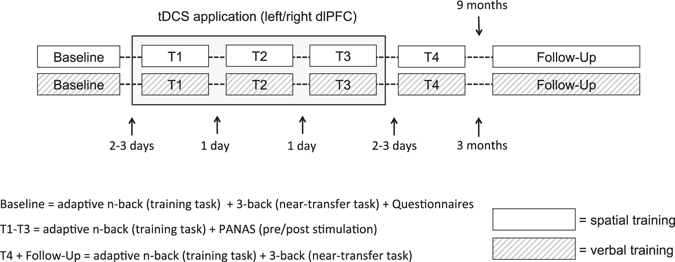
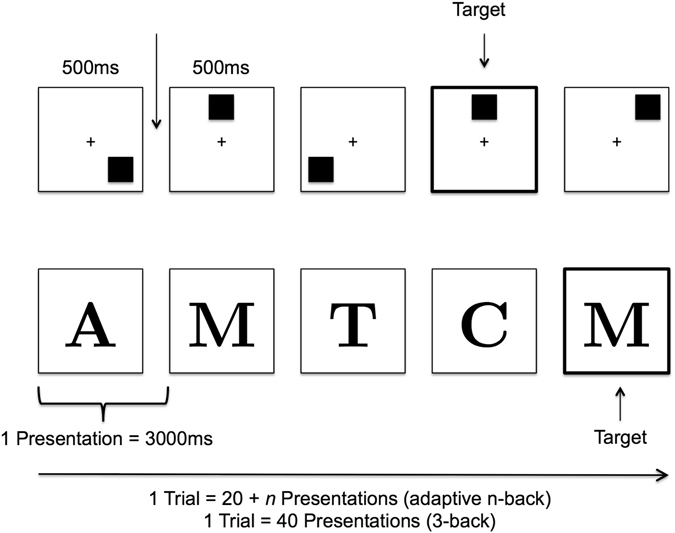
Transcranial direct current stimulation (tDCS) to the dorsolateral prefrontal cortex (dlPFC) can modulate working memory (WM) performance. However, evidence regarding the enhancement of WM training, its sustainability and transferability is ambiguous. Since WM functioning appears to be lateralized in respect to stimulus characteristics, this study examined the difference between task-congruent (spatial-right, verbal-left), task-incongruent (spatial-left, verbal-right) and sham tDCS in regards to the efficacy of WM training. In a randomized, sham-controlled experiment, 71 healthy adults trained on a spatial or verbal adaptive n-back task. After a baseline session, anodal or sham tDCS (1 mA) to the right or left dlPFC was applied during the next three training sessions. Sustainability of training gains and near-transfer (verbal or spatial 3-back task) were tested in a fourth training and a follow-up session. Compared to sham stimulation, we found a steeper learning curve when WM training was combined with task-congruent tDCS. This advantage was also present compared to task-incongruent tDCS. Moreover, these effects lasted for up to nine months and transferred to the respective untrained task. These long-lasting, transferable, task-specific effects demonstrate a behaviorally relevant and sustainable facilitation of neuroplastic processes by tDCS that could be harnessed for the treatment of disorders associated with deficient WM.
Overview
The claims and statistics of this paper haven’t been checked yet.
Run the check — free, no account needed. It reads the open-access text and checks the sources it cites.
Integrity signals
Registry
Cites
Statistics
Figures
Verification
Claims the paper makes
The claims and statistics of this paper haven’t been checked yet.
Run the check — free, no account needed. It reads the open-access text and checks the sources it cites.
Claims other papers make about this one
Each is checked against this paper’s own text: does it say what the citing paper says it does?
The source backs part of the claim, not all of it — or backs it for a different population, condition or comparison.
In the citing paper
“Combining tDCS with cognitive training has demonstrated additive effects on cognitive and functional abilities in younger [30–32] and older adults [33–36].”
From Primary outcome from the augmenting cognitive training in older adults study (ACT): A tDCS and cognitive training randomized clinical trial (2023) · cites this paper as [30]
Experimental — accuracy not yet measured
Self-check
Percentages, sums and reported differences re-computed from the paper’s own numbers.
The self-check needs the paper’s full text.
Citations
Cites
R: A Language and Environment for Statistical Computing
R Core Team (2000) · doi:10.32614/r.manuals · Cited by 355,893
Fitting Linear Mixed-Effects Models Using lme4
Bates, D., Mächler, M., Bolker, B., & Walker, S. (2015) · Journal of Statistical Software · doi:10.18637/jss.v067.i01 · Cited by 86,835
The assessment and analysis of handedness: The Edinburgh inventory
Oldfield, R. C. (1971) · Neuropsychologia · doi:10.1016/0028-3932(71)90067-4 · Cited by 35,900
Development and validation of brief measures of positive and negative affect: The PANAS scales.
Watson, D., Clark, L. A., & Tellegen, A. (1988) · Journal of Personality and Social Psychology · doi:10.1037/0022-3514.54.6.1063 · Cited by 32,433
Simultaneous Inference in General Parametric Models
Hothorn, T., Bretz, F., & Westfall, P. H. (2008) · Biometrical Journal · doi:10.1002/bimj.200810425 · Cited by 14,265
Nitsche, M. A., & Paulus, W. (2000) · The Journal of Physiology · doi:10.1111/j.1469-7793.2000.t01-1-00633.x · Cited by 5,656
Report of the committee on methods of clinical examination in electroencephalography
(1958) · Electroencephalography and Clinical Neurophysiology · doi:10.1016/0013-4694(58)90053-1 · Cited by 2,717
Calculation of signal detection theory measures
Stanislaw, H., & Todorov, N. (1999) · Behavior Research Methods, Instruments, & Computers · doi:10.3758/bf03207704 · Cited by 2,673
Sustained excitability elevations induced by transcranial DC motor cortex stimulation in humans
Nitsche, M. A., & Paulus, W. (2001) · Neurology · doi:10.1212/wnl.57.10.1899 · Cited by 2,617
Improving fluid intelligence with training on working memory
Jaeggi, S. M., Buschkuehl, M., Jonides, J., & Perrig, W. J. (2008) · Proceedings of the National Academy of Sciences · doi:10.1073/pnas.0801268105 · Cited by 2,187
Research works printed but not linked: 1
- Hoskinson, P. & Toomim, J. Brain Workshop (Version 4.8.4). (2012).
Cited by
Sorted by citations
Imburgio, M. J., & Orr, J. M. (2018) · Neuropsychologia · doi:10.1016/j.neuropsychologia.2018.04.022 · Cited by 161
Westwood, S. J., Raduà, J., & Rubia, K. (2021) · Journal of Psychiatry and Neuroscience · doi:10.1503/jpn.190179 · Cited by 114
Ke, Y., Wang, N., Du, J., Kong, L., Liu, S., Xu, M., An, X., & Ming, D. (2019) · Frontiers in Human Neuroscience · doi:10.3389/fnhum.2019.00019 · Cited by 109
Randomized controlled trial of TDCS on cognition in 201 seniors with mild neurocognitive disorder
Lu, H., Chan, S. S. M., Chan, W. C., Lin, C., Cheng, C. P. W., & Wa, L. L. C. (2019) · Annals of Clinical and Translational Neurology · doi:10.1002/acn3.50823 · Cited by 101
Cognitive Effects of Transcranial Direct Current Stimulation in Healthy and Clinical Populations
Berryhill, M. E., & Martin, D. M. (2018) · Journal of Ect · doi:10.1097/yct.0000000000000534 · Cited by 95
Metadata
- Authors
- Ruf, S. P., Fallgatter, A. J., & Plewnia, C.
- Affiliations
- University of Tübingen (DE)
- Corresponding author
- Plewnia, Christian
- Venue
- Scientific Reports
- Published
- 2017-04-21
- Volume
- 7
- Issue
- 1
- Pages
- 876-876
- ISSN
- 2045-2322 (ISSN-L)
- PMC
- PMC5430723
- OpenAlex
- W2604508934
- Cited by
- 167
- References
- 90
- Citations by year
- 2026: 8 · 2025: 15 · 2024: 11 · 2023: 12 · 2022: 22 · 2021: 29 · 2020: 27 · 2019: 21 · 2018: 15 · 2017: 7
- FWCI
- 9.54
- Type
- journal article
- Language
- en
- Open access
- gold
- doi.org
- Locations
- Scientific Reports (publishedVersion, cc-by)
- PubMed Central (publishedVersion, cc-by)
- PubMed (publishedVersion)
- DOAJ (DOAJ: Directory of Open Access Journals) (submittedVersion, cc-by-sa)
- Funders
- Deutsche Forschungsgemeinschaft
- Bundesministerium für Bildung und Forschung (GCBS/FKZ01EE1403D, ESPRIT/FKZ 01EE1407H, FKZ 01EE1407H, 01EE1407H, FKZ 01EE1403D, 01EE1403D)
- Topics
- Life Sciences › Neuroscience › Neurology › Transcranial Magnetic Stimulation Studies
- Social Sciences › Psychology › Experimental and Cognitive Psychology › Cognitive Abilities and Testing
- Life Sciences › Neuroscience › Cognitive Neuroscience › Neural and Behavioral Psychology Studies
- Keywords
- transcranial direct current stimulation, working memory training, dorsolateral prefrontal cortex, n-back task, transfer of training, neuroplasticity, learning curve, sham stimulation
- MeSH terms
- Adult, Female, Humans, Learning, Male, Memory, Short-Term, Prefrontal Cortex, Transcranial Direct Current Stimulation
About these checks
Registry, retraction, Cites and statistics results are computed, not judged, with one exception: a printed reference that no index lists is read once by a model before it counts as a citation error. Claims are extracted by a model and kept only when their quote appears verbatim in the text; each cited source is then checked, with a model’s help, for whether it says what the claim relies on. Those verdicts can be wrong — read the claim’s quote and the cited source before relying on one.
Statistics and arithmetic are recomputed, not judged.
Confidence bands are shown only for fields calibrated on our annotated test set. None is calibrated yet, so no band is shown.
What counts as a claim ›How we measure confidence ›How we check this ›
Are you an author, or do you see a problem with this page? Request a review
