

The DOI matches its Crossref record; 88 of the 90 references it cites were found in a registry or an index.
Augmentation of working memory training by transcranial direct current stimulation (tDCS)
Open accessAbstract
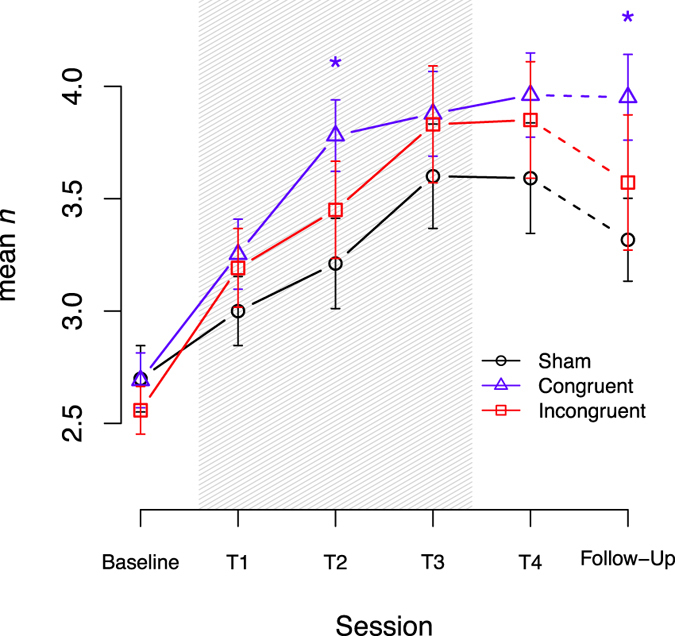
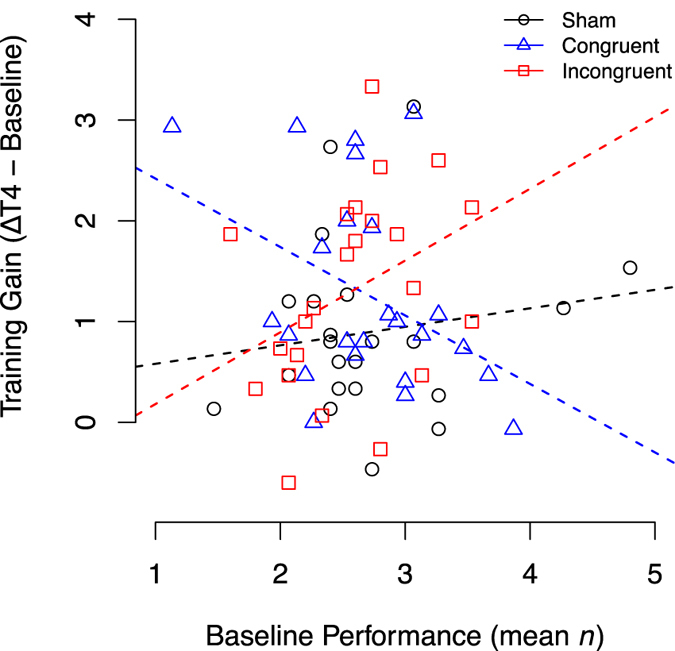
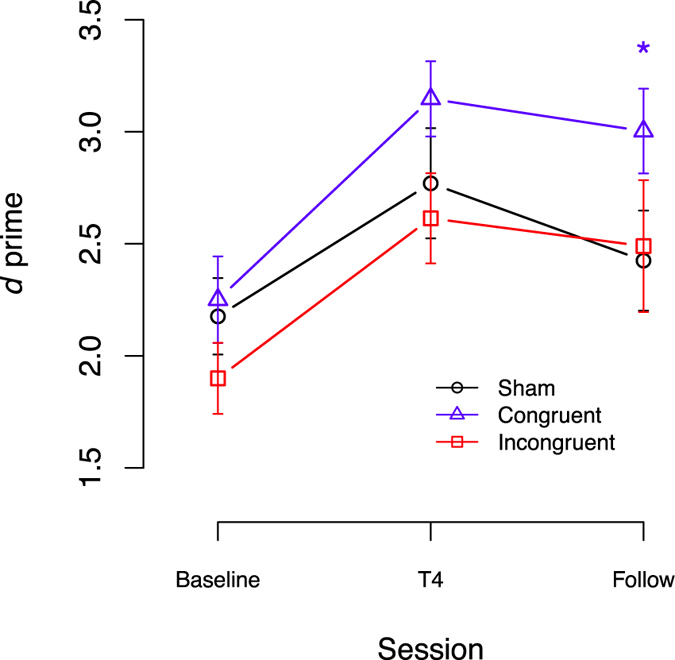
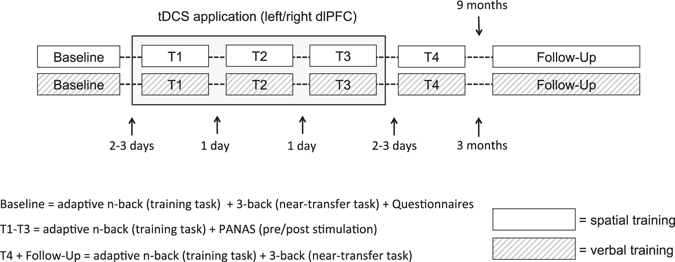
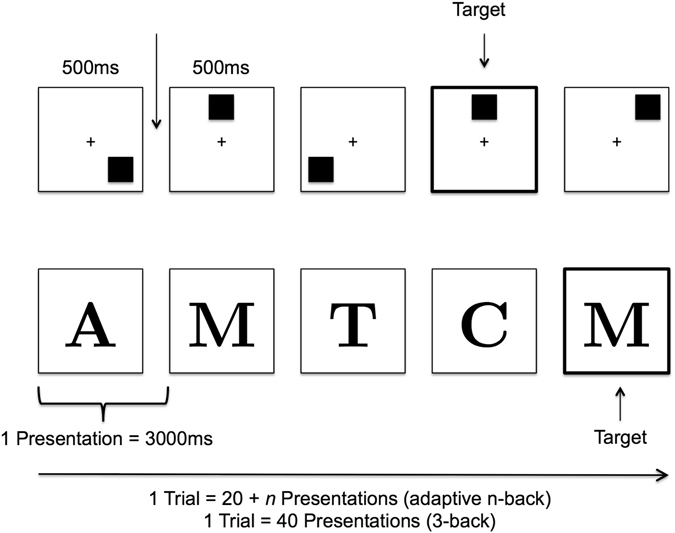
Transcranial direct current stimulation (tDCS) to the dorsolateral prefrontal cortex (dlPFC) can modulate working memory (WM) performance. However, evidence regarding the enhancement of WM training, its sustainability and transferability is ambiguous. Since WM functioning appears to be lateralized in respect to stimulus characteristics, this study examined the difference between task-congruent (spatial-right, verbal-left), task-incongruent (spatial-left, verbal-right) and sham tDCS in regards to the efficacy of WM training. In a randomized, sham-controlled experiment, 71 healthy adults trained on a spatial or verbal adaptive n-back task. After a baseline session, anodal or sham tDCS (1 mA) to the right or left dlPFC was applied during the next three training sessions. Sustainability of training gains and near-transfer (verbal or spatial 3-back task) were tested in a fourth training and a follow-up session. Compared to sham stimulation, we found a steeper learning curve when WM training was combined with task-congruent tDCS. This advantage was also present compared to task-incongruent tDCS. Moreover, these effects lasted for up to nine months and transferred to the respective untrained task. These long-lasting, transferable, task-specific effects demonstrate a behaviorally relevant and sustainable facilitation of neuroplastic processes by tDCS that could be harnessed for the treatment of disorders associated with deficient WM.
Overview
The claims and statistics of this paper haven’t been checked yet.
Run the check — free, no account needed. It reads the open-access text and checks the sources it cites.
Integrity signals
Registry
Cites
Statistics
Figures
Verification
Claims the paper makes
The claims and statistics of this paper haven’t been checked yet.
Run the check — free, no account needed. It reads the open-access text and checks the sources it cites.
Claims other papers make about this one
Each is checked against this paper’s own text: does it say what the citing paper says it does?
The source backs part of the claim, not all of it — or backs it for a different population, condition or comparison.
In the citing paper
“Combining tDCS with cognitive training has demonstrated additive effects on cognitive and functional abilities in younger [30–32] and older adults [33–36].”
From Primary outcome from the augmenting cognitive training in older adults study (ACT): A tDCS and cognitive training randomized clinical trial (2023) · cites this paper as [30]
Experimental — accuracy not yet measured
Self-check
Percentages, sums and reported differences re-computed from the paper’s own numbers.
The self-check needs the paper’s full text.
Citations
Cites
R: A Language and Environment for Statistical Computing
R Core Team (2000) · doi:10.32614/r.manuals · Cited by 355,893
Fitting Linear Mixed-Effects Models Using lme4
Bates, D., Mächler, M., Bolker, B., & Walker, S. (2015) · Journal of Statistical Software · doi:10.18637/jss.v067.i01 · Cited by 86,835
The assessment and analysis of handedness: The Edinburgh inventory
Oldfield, R. C. (1971) · Neuropsychologia · doi:10.1016/0028-3932(71)90067-4 · Cited by 35,900
Development and validation of brief measures of positive and negative affect: The PANAS scales.
Watson, D., Clark, L. A., & Tellegen, A. (1988) · Journal of Personality and Social Psychology · doi:10.1037/0022-3514.54.6.1063 · Cited by 32,433
Simultaneous Inference in General Parametric Models
Hothorn, T., Bretz, F., & Westfall, P. H. (2008) · Biometrical Journal · doi:10.1002/bimj.200810425 · Cited by 14,265
Nitsche, M. A., & Paulus, W. (2000) · The Journal of Physiology · doi:10.1111/j.1469-7793.2000.t01-1-00633.x · Cited by 5,656
Report of the committee on methods of clinical examination in electroencephalography
(1958) · Electroencephalography and Clinical Neurophysiology · doi:10.1016/0013-4694(58)90053-1 · Cited by 2,717
Calculation of signal detection theory measures
Stanislaw, H., & Todorov, N. (1999) · Behavior Research Methods, Instruments, & Computers · doi:10.3758/bf03207704 · Cited by 2,673
Sustained excitability elevations induced by transcranial DC motor cortex stimulation in humans
Nitsche, M. A., & Paulus, W. (2001) · Neurology · doi:10.1212/wnl.57.10.1899 · Cited by 2,617
Improving fluid intelligence with training on working memory
Jaeggi, S. M., Buschkuehl, M., Jonides, J., & Perrig, W. J. (2008) · Proceedings of the National Academy of Sciences · doi:10.1073/pnas.0801268105 · Cited by 2,187
Analysing controlled trials with baseline and follow up measurements
Vickers, A. J., & Altman, D. G. (2001) · BMJ · doi:10.1136/bmj.323.7321.1123 · Cited by 2,116
Neuroimaging studies of working memory:
Wager, T. D., & Smith, E. E. (2003) · Cognitive, Affective, & Behavioral Neuroscience · doi:10.3758/cabn.3.4.255 · Cited by 1,889
Generating stimuli for neuroscience using PsychoPy
Peirce, J. W. (2008) · Frontiers in Neuroinformatics · doi:10.3389/neuro.11.010.2008 · Cited by 1,664
The Cognitive Neuroscience of Working Memory
D'Esposito, M., & Postle, B. R. (2015) · Annual Review of Psychology · doi:10.1146/annurev-psych-010814-015031 · Cited by 1,653
Millan, M. J., Agid, Y., Brüne, M., Bullmore, E. T., Carter, C. S., Clayton, N. S., Connor, R., Davis, S., Deakin, B., DeRubeis, R. J., et al. (2012) · Nature Reviews Drug Discovery · doi:10.1038/nrd3628 · Cited by 1,292
Brunoni, A. R., Amadera, J. E. D., Berbel, B., Volz, M. S., Rizzerio, B. G., & Fregni, F. (2011) · The International Journal of Neuropsychopharmacology · doi:10.1017/s1461145710001690 · Cited by 1,219
Spatial working memory in humans as revealed by PET
Jonides, J. J., Smith, E. E., Koeppe, R. A., Awh, E., Minoshima, S., & Mintun, M. A. (1993) · Nature · doi:10.1038/363623a0 · Cited by 1,198
Anodal transcranial direct current stimulation of prefrontal cortex enhances working memory
Fregni, F., Boggio, P. S., Nitsche, M., Bermpohl, F., Antal, A., Feredoes, E., Marcolin, M. A., Rigonatti, S. P., Silva, M. T. A., Paulus, W., et al. (2005) · Experimental Brain Research · doi:10.1007/s00221-005-2334-6 · Cited by 1,159
Is working memory training effective?
Shipstead, Z., Redick, T. S., & Engle, R. W. (2012) · Psychological Bulletin · doi:10.1037/a0027473 · Cited by 1,101
Working Memory: A View from Neuroimaging
Smith, E. E., & Jonides, J. (1997) · Cognitive Psychology · doi:10.1006/cogp.1997.0658 · Cited by 1,046
Nitsche, M. A., Schauenburg, A., Lang, N., Liebetanz, D., Exner, C., Paulus, W., & Tergau, F. (2003) · Journal of Cognitive Neuroscience · doi:10.1162/089892903321662994 · Cited by 1,032
Batsikadze, G., Moliadze, V., Paulus, W., Kuo, M. ‐., & Nitsche, M. A. (2013) · The Journal of Physiology · doi:10.1113/jphysiol.2012.249730 · Cited by 1,017
Functional MRI studies of spatial and nonspatial working memory
D’Esposito, M., Aguirre, G. K., Zarahn, E., Ballard, D., Shin, R. K., & Lease, J. (1998) · Cognitive Brain Research · doi:10.1016/s0926-6410(98)00004-4 · Cited by 1,016
An ERP study on L2 syntax processing: When do learners fail?
Meulman, N., Stowe, L. A., Sprenger, S., Bresser, M., & Schmid, M. S. (2014) · Frontiers in Psychology · doi:10.3389/fpsyg.2014.01072 · Cited by 1,011
The concurrent validity of the N -back task as a working memory measure
Jaeggi, S. M., Buschkuehl, M., Perrig, W. J., & Meier, B. (2010) · Memory · doi:10.1080/09658211003702171 · Cited by 981
Dissociating Verbal and Spatial Working Memory Using PET
Smith, E. E., Jonides, J., & Koeppe, R. A. (1996) · Cerebral Cortex · doi:10.1093/cercor/6.1.11 · Cited by 962
Modelling neural correlates of working memory: A coordinate-based meta-analysis
Rottschy, C., Langner, R., Dogan, I., Reetz, K., Laird, A. R., Schulz, J. B., Fox, P. T., & Eickhoff, S. B. (2012) · NeuroImage · doi:10.1016/j.neuroimage.2011.11.050 · Cited by 951
Dorsolateral prefrontal contributions to human working memory
Barbey, A. K., Koenigs, M., & Grafman, J. (2013) · Cortex · doi:10.1016/j.cortex.2012.05.022 · Cited by 940
Variability in Response to Transcranial Direct Current Stimulation of the Motor Cortex
Wiethoff, S., Hamada, M., & Rothwell, J. C. (2014) · Brain stimulation · doi:10.1016/j.brs.2014.02.003 · Cited by 786
Brunoni, A. R., & Vanderhasselt, M.-A. (2014) · Brain and Cognition · doi:10.1016/j.bandc.2014.01.008 · Cited by 669
Boggio, P. S., Ferrucci, R., Rigonatti, S. P., Covre, P., Nitsche, M. A., Pascual‐Leone, Á., & Fregni, F. (2006) · Journal of the Neurological Sciences · doi:10.1016/j.jns.2006.05.062 · Cited by 642
Horvath, J. C., Forte, J. D., & Carter, O. (2015) · Brain Stimulation · doi:10.1016/j.brs.2015.01.400 · Cited by 609
Cautionary note on reporting eta-squared values from multifactor ANOVA designs.
Pierce, C. A., Block, R. A., & Aguinis, H. (2004) · Educational and Psychological Measurement · doi:10.1177/0013164404264848 · Cited by 584
State-dependency in brain stimulation studies of perception and cognition
Silvanto, J., Muggleton, N., & Walsh, V. (2008) · Trends in Cognitive Sciences · doi:10.1016/j.tics.2008.09.004 · Cited by 572
Macmillan, N. A., & Kaplan, H. L. (1985) · Psychological Bulletin · doi:10.1037/0033-2909.98.1.185 · Cited by 556
Applications of transcranial direct current stimulation for understanding brain function
Filmer, H. L., Dux, P. E., & Mattingley, J. B. (2014) · Trends in Neurosciences · doi:10.1016/j.tins.2014.08.003 · Cited by 539
Modelling non-invasive brain stimulation in cognitive neuroscience
Miniussi, C., Harris, J. A., & Ruzzoli, M. (2013) · Neuroscience & Biobehavioral Reviews · doi:10.1016/j.neubiorev.2013.06.014 · Cited by 536
Jaeggi, S. M., Studer-Luethi, B., Buschkuehl, M., Su, Y.-F., Jonides, J., & Perrig, W. J. (2010) · Intelligence · doi:10.1016/j.intell.2010.09.001 · Cited by 509
Hill, A. T., Fitzgerald, P. B., & Hoy, K. E. (2015) · Brain stimulation · doi:10.1016/j.brs.2015.10.006 · Cited by 446
The role of individual differences in cognitive training and transfer
Jaeggi, S. M., Buschkuehl, M., Shah, P., & Jonides, J. (2014) · Memory & Cognition · doi:10.3758/s13421-013-0364-z · Cited by 432
Zaehle, T., Sandmann, P., Thorne, J. D., Jäncke, L., & Herrmann, C. S. (2011) · BMC Neuroscience · doi:10.1186/1471-2202-12-2 · Cited by 426
Kuo, M.-F., Paulus, W., & Nitsche, M. A. (2014) · NeuroImage · doi:10.1016/j.neuroimage.2013.05.117 · Cited by 415
tDCS-enhanced motor and cognitive function in neurological diseases
Flöel, A. (2013) · NeuroImage · doi:10.1016/j.neuroimage.2013.05.098 · Cited by 414
Training the Emotional Brain: Improving Affective Control through Emotional Working Memory Training
Schweizer, S., Grahn, J. A., Hampshire, A., Mobbs, D., & Dalgleish, T. (2013) · Journal of Neuroscience · doi:10.1523/jneurosci.2593-12.2013 · Cited by 388
Ohn, S., Park, C.-I., Yoo, W., Ko, M.-H., Choi, K. P., Kim, G.-M., Lee, Y. T., & Kim, Y. (2008) · NeuroReport · doi:10.1097/wnr.0b013e3282f2adfd · Cited by 386
Enhancement of Planning Ability by Transcranial Direct Current Stimulation
Dockery, C. A., Hueckel-Weng, R., Birbaumer, N., & Plewnia, C. (2009) · The Journal of Neuroscience · doi:10.1523/jneurosci.0065-09.2009 · Cited by 380
Self-citationWorking memory training revisited: A multi-level meta-analysis of n-back training studies
Soveri, A., Antfolk, J., Karlsson, L., Salo, B., & Laine, M. (2017) · Psychonomic Bulletin & Review · doi:10.3758/s13423-016-1217-0 · Cited by 371
The validity of d prime as a working memory index: Results from the “Bergen n -back task”
Haatveit, B. C., Sundet, K. S., Hugdahl, K., Ueland, T., Melle, I. S., & Andreassen, O. A. (2010) · Journal of Clinical and Experimental Neuropsychology · doi:10.1080/13803391003596421 · Cited by 328
tDCS selectively improves working memory in older adults with more education
Berryhill, M. E., & Jones, K. T. (2012) · Neuroscience Letters · doi:10.1016/j.neulet.2012.05.074 · Cited by 325
Long-Term Enhancement of Brain Function and Cognition Using Cognitive Training and Brain Stimulation
Snowball, A., Tachtsidis, I., Popescu, T., Thompson, J., Delazer, M., Zamarian, L., Zhu, T., & Kadosh, R. C. (2013) · Current Biology · doi:10.1016/j.cub.2013.04.045 · Cited by 323
Does Transcranial Direct Current Stimulation Improve Healthy Working Memory?: A Meta-analytic Review
Mancuso, L., Ilieva, I. P., Hamilton, R. H., & Farah, M. J. (2016) · Journal of Cognitive Neuroscience · doi:10.1162/jocn_a_00956 · Cited by 302
Martin, D. M., Liu, R., Alonzo, A., Green, M. J., & Loo, C. K. A. (2014) · Experimental Brain Research · doi:10.1007/s00221-014-4022-x · Cited by 272
Hoy, K. E., Emonson, M., Arnold, S. L., Thomson, R. H., Daskalakis, Z. J., & Fitzgerald, P. B. (2013) · Neuropsychologia · doi:10.1016/j.neuropsychologia.2013.05.018 · Cited by 233
Martin, D. M., Liu, R., Alonzo, A., Green, M., Player, M. J., Sachdev, P., & Loo, C. K. (2013) · International Journal of Neuropsychopharmacology · doi:10.1017/s1461145713000539 · Cited by 218
Amelioration of Cognitive Control in Depression by Transcranial Direct Current Stimulation
Wolkenstein, L., & Plewnia, C. (2013) · Biological Psychiatry · doi:10.1016/j.biopsych.2012.10.010 · Cited by 213
Self-citationTeo, F., Hoy, K. E., Daskalakis, Z. J., & Fitzgerald, P. B. (2011) · Frontiers in Psychiatry · doi:10.3389/fpsyt.2011.00045 · Cited by 191
Park, S.-H., Seo, J.-H., Kim, Y.-H., & Ko, M.-H. (2014) · NeuroReport · doi:10.1097/wnr.0000000000000080 · Cited by 180
Longitudinal Neurostimulation in Older Adults Improves Working Memory
Jones, K. T., Stephens, J. A., Alam, M., Bikson, M., & Berryhill, M. E. (2015) · PLoS ONE · doi:10.1371/journal.pone.0121904 · Cited by 172
Meinzer, M., Jähnigen, S., Copland, D. A., Darkow, R., Grittner, U., Avirame, K., Rodriguez, A. D., Lindenberg, R., & Flöel, A. (2013) · Cortex · doi:10.1016/j.cortex.2013.07.013 · Cited by 171
Enhancing Working Memory Training with Transcranial Direct Current Stimulation
Au, J., Katz, B., Buschkuehl, M., Bunarjo, K., Senger, T., Zabel, C., Jaeggi, S. M., & Jonides, J. (2016) · Journal of Cognitive Neuroscience · doi:10.1162/jocn_a_00979 · Cited by 156
Large-scale modeling – a tool for conquering the complexity of the brain
Djurfeldt, M. (2008) · Frontiers in Neuroinformatics · doi:10.3389/neuro.11.001.2008 · Cited by 148
Transcranial magnetic stimulation of left prefrontal cortex impairs working memory
Mull, B. R., & Seyal, M. (2001) · Clinical Neurophysiology · doi:10.1016/s1388-2457(01)00606-x · Cited by 144
Richmond, L. L., Wolk, D., Chein, J., & Olson, I. R. (2014) · Journal of Cognitive Neuroscience · doi:10.1162/jocn_a_00657 · Cited by 143
Hoy, K. E., Arnold, S. L., Emonson, M., Daskalakis, Z. J., & Fitzgerald, P. B. (2014) · Schizophrenia Research · doi:10.1016/j.schres.2014.03.006 · Cited by 137
Hemispheric lateralization of verbal and spatial working memory during adolescence
Nagel, B. J., Herting, M. M., Maxwell, E. C., Bruno, R. L., & Fair, D. A. (2013) · Brain and Cognition · doi:10.1016/j.bandc.2013.02.007 · Cited by 137
Older adults improve on everyday tasks after working memory training and neurostimulation
Stephens, J. A., & Berryhill, M. E. (2016) · Brain Stimulation · doi:10.1016/j.brs.2016.04.001 · Cited by 130
Hits and misses: leveraging tDCS to advance cognitive research
Berryhill, M. E. (2014) · Frontiers in Psychology · doi:10.3389/fpsyg.2014.00800 · Cited by 128
Correlates of cognitive impairment in first episode schizophrenia: The EUFEST study
Galderisi, S., Davidson, M., Kahn, R. S., Mucci, A., Boter, H., Gheorghe, M., RYBAKOWSKI, J. K., Libiger, J., Dollfus, S., López-Ibor, J. J., et al. (2009) · Schizophrenia Research · doi:10.1016/j.schres.2009.09.022 · Cited by 126
Neural effects of short-term training on working memory
Buschkuehl, M., Hernandez-Garcia, L., Jaeggi, S. M., Bernard, J. A., & Jonides, J. (2014) · Cognitive, Affective, & Behavioral Neuroscience · doi:10.3758/s13415-013-0244-9 · Cited by 117
Wu, Y., Tseng, P. H., Chang, C.-F., Pai, M., Hsu, K., Lin, C. K., & Juan, C.-H. (2014) · Brain and Cognition · doi:10.1016/j.bandc.2014.09.002 · Cited by 104
Jones, K. T., Gözenman, F., & Berryhill, M. E. (2014) · NeuroImage · doi:10.1016/j.neuroimage.2014.11.012 · Cited by 101
Shaping Memory Accuracy by Left Prefrontal Transcranial Direct Current Stimulation
Zwissler, B., Sperber, C., Aigeldinger, S., Schindler, S., Kissler, J., & Plewnia, C. (2014) · Journal of Neuroscience · doi:10.1523/jneurosci.5407-13.2014 · Cited by 96
Self-citationIndividual differences and long-term consequences of tdcs-augmented cognitive training
Katz, B., Au, J., Buschkuehl, M., Abagis, T., Zabel, C., Jaeggi, S. M., & Jonides, J. (2017) · Journal of Cognitive Neuroscience · doi:10.1162/jocn_a_01115 · Cited by 93
Time Course of Corticospinal Excitability and Intracortical Inhibition Just before Muscle Relaxation
Suzuki, T., Sugawara, K., Ogahara, K., & Higashi, T. (2016) · Frontiers in Human Neuroscience · doi:10.3389/fnhum.2016.00001 · Cited by 92
The COMT Val/Met Polymorphism Modulates Effects of tDCS on Response Inhibition
Nieratschker, V., Kiefer, C., Giel, K. E., Krüger, R., & Plewnia, C. (2014) · Brain stimulation · doi:10.1016/j.brs.2014.11.009 · Cited by 83
Self-citationTargeting the biased brain: non-invasive brain stimulation to ameliorate cognitive control.
Plewnia, C., Schroeder, P. A., & Wolkenstein, L. (2015) · Lancet psychiatry · doi:10.1016/s2215-0366(15)00056-5 · Cited by 82
Self-citationDockery, C. A., Liebetanz, D., Birbaumer, N., Malinowska, M., & Wesierska, M. (2011) · Neurobiology of Learning and Memory · doi:10.1016/j.nlm.2011.06.018 · Cited by 76
Fried, P. J., Rushmore, J., Moss, M. B., Valero‐Cabré, A., & Pascual‐Leone, Á. (2014) · European Journal of Neuroscience · doi:10.1111/ejn.12584 · Cited by 70
Trumbo, M., Matzen, L. E., Coffman, B. A., Hunter, M. A., Jones, A. P., Robinson, C. S. H., & Clark, V. P. (2016) · Neuropsychologia · doi:10.1016/j.neuropsychologia.2016.10.011 · Cited by 67
Plewnia, C., Schroeder, P. A., Kunze, R., Faehling, F., & Wolkenstein, L. (2015) · PLOS ONE · doi:10.1371/journal.pone.0122578 · Cited by 61
Self-citationGiglia, G., Brighina, F., Rizzo, S., Puma, A. R., Indovino, S., Maccora, S., Baschi, R., Cosentino, G., & Fierro, B. (2014) · Europe PMC (PubMed Central) · Cited by 58
Does excitatory fronto-extracephalic tDCS lead to improved working memory performance?
Lally, N., Nord, C. L., Walsh, V., & Roiser, J. P. (2013) · F1000Research · doi:10.12688/f1000research.2-219.v2 · Cited by 56
Genetic Modulation of Transcranial Direct Current Stimulation Effects on Cognition
Wiegand, A., Nieratschker, V., & Plewnia, C. (2016) · Frontiers in Human Neuroscience · doi:10.3389/fnhum.2016.00651 · Cited by 52
Zmigrod, S., Colzato, L. S., & Hommel, B. (2014) · Brain stimulation · doi:10.1016/j.brs.2014.03.004 · Cited by 48
Induction of a depression-like negativity bias by cathodal transcranial direct current stimulation
Wolkenstein, L., Zeiller, M., Kanske, P., & Plewnia, C. (2014) · Cortex · doi:10.1016/j.cortex.2014.07.011 · Cited by 47
Self-citationPutter, L. M. S. D., Vanderhasselt, M., Baeken, C., Raedt, R. D., & Koster, E. H. W. (2015) · Cognitive Therapy and Research · doi:10.1007/s10608-015-9710-8 · Cited by 27
Duecker, F., de Graaf, T. A., & Sack, A. T. (2014) · Frontiers in Systems Neuroscience · doi:10.3389/fnsys.2014.00071 · Cited by 17
Hill, A. T., Fitzgerald, P. B., & Hoy, K. E. (2015) · Brain stimulation · doi:10.1016/j.brs.2015.01.072 · Cited by 14
Research works printed but not linked: 1
- Hoskinson, P. & Toomim, J. Brain Workshop (Version 4.8.4). (2012).
Cited by
Sorted by citations
Imburgio, M. J., & Orr, J. M. (2018) · Neuropsychologia · doi:10.1016/j.neuropsychologia.2018.04.022 · Cited by 161
Westwood, S. J., Raduà, J., & Rubia, K. (2021) · Journal of Psychiatry and Neuroscience · doi:10.1503/jpn.190179 · Cited by 114
Ke, Y., Wang, N., Du, J., Kong, L., Liu, S., Xu, M., An, X., & Ming, D. (2019) · Frontiers in Human Neuroscience · doi:10.3389/fnhum.2019.00019 · Cited by 109
Randomized controlled trial of TDCS on cognition in 201 seniors with mild neurocognitive disorder
Lu, H., Chan, S. S. M., Chan, W. C., Lin, C., Cheng, C. P. W., & Wa, L. L. C. (2019) · Annals of Clinical and Translational Neurology · doi:10.1002/acn3.50823 · Cited by 101
Cognitive Effects of Transcranial Direct Current Stimulation in Healthy and Clinical Populations
Berryhill, M. E., & Martin, D. M. (2018) · Journal of Ect · doi:10.1097/yct.0000000000000534 · Cited by 95
Metadata
- Authors
- Ruf, S. P., Fallgatter, A. J., & Plewnia, C.
- Affiliations
- University of Tübingen (DE)
- Corresponding author
- Plewnia, Christian
- Venue
- Scientific Reports
- Published
- 2017-04-21
- Volume
- 7
- Issue
- 1
- Pages
- 876-876
- ISSN
- 2045-2322 (ISSN-L)
- PMC
- PMC5430723
- OpenAlex
- W2604508934
- Cited by
- 167
- References
- 90
- Citations by year
- 2026: 8 · 2025: 15 · 2024: 11 · 2023: 12 · 2022: 22 · 2021: 29 · 2020: 27 · 2019: 21 · 2018: 15 · 2017: 7
- FWCI
- 9.54
- Type
- journal article
- Language
- en
- Open access
- gold
- doi.org
- Locations
- Scientific Reports (publishedVersion, cc-by)
- PubMed Central (publishedVersion, cc-by)
- PubMed (publishedVersion)
- DOAJ (DOAJ: Directory of Open Access Journals) (submittedVersion, cc-by-sa)
- Funders
- Deutsche Forschungsgemeinschaft
- Bundesministerium für Bildung und Forschung (GCBS/FKZ01EE1403D, ESPRIT/FKZ 01EE1407H, FKZ 01EE1407H, 01EE1407H, FKZ 01EE1403D, 01EE1403D)
- Topics
- Life Sciences › Neuroscience › Neurology › Transcranial Magnetic Stimulation Studies
- Social Sciences › Psychology › Experimental and Cognitive Psychology › Cognitive Abilities and Testing
- Life Sciences › Neuroscience › Cognitive Neuroscience › Neural and Behavioral Psychology Studies
- Keywords
- transcranial direct current stimulation, working memory training, dorsolateral prefrontal cortex, n-back task, transfer of training, neuroplasticity, learning curve, sham stimulation
- MeSH terms
- Adult, Female, Humans, Learning, Male, Memory, Short-Term, Prefrontal Cortex, Transcranial Direct Current Stimulation
About these checks
Registry, retraction, Cites and statistics results are computed, not judged, with one exception: a printed reference that no index lists is read once by a model before it counts as a citation error. Claims are extracted by a model and kept only when their quote appears verbatim in the text; each cited source is then checked, with a model’s help, for whether it says what the claim relies on. Those verdicts can be wrong — read the claim’s quote and the cited source before relying on one.
Statistics and arithmetic are recomputed, not judged.
Confidence bands are shown only for fields calibrated on our annotated test set. None is calibrated yet, so no band is shown.
What counts as a claim ›How we measure confidence ›How we check this ›
Are you an author, or do you see a problem with this page? Request a review
