

Forecasting the onset and course of mental illness with Twitter data
Open accessThe DOI matches its Crossref record; 50 of the 50 references it cites were found in a registry or an index.
Abstract
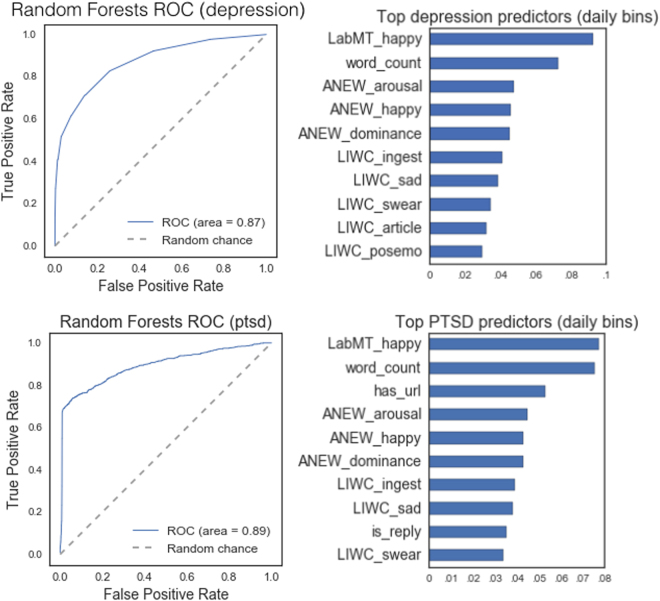
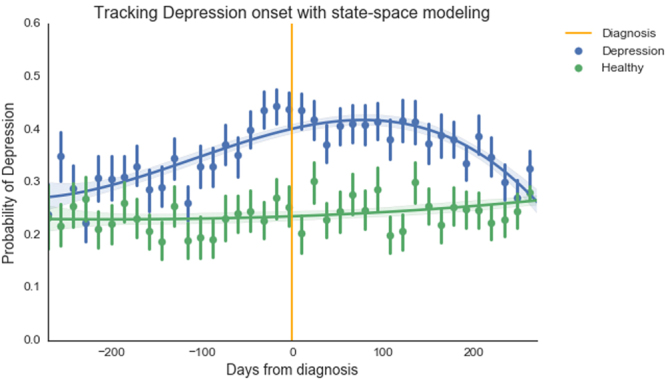
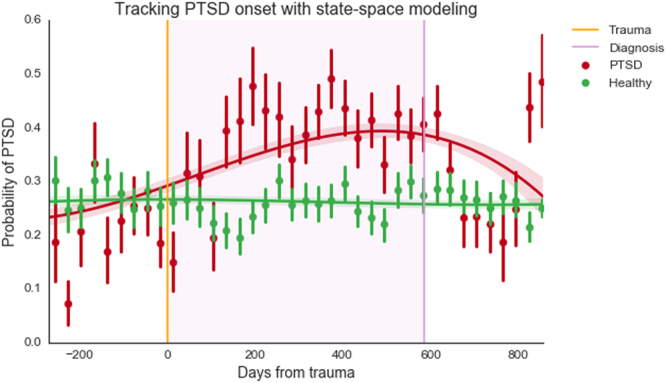
We developed computational models to predict the emergence of depression and Post-Traumatic Stress Disorder in Twitter users. Twitter data and details of depression history were collected from 204 individuals (105 depressed, 99 healthy). We extracted predictive features measuring affect, linguistic style, and context from participant tweets (N = 279,951) and built models using these features with supervised learning algorithms. Resulting models successfully discriminated between depressed and healthy content, and compared favorably to general practitioners’ average success rates in diagnosing depression, albeit in a separate population. Results held even when the analysis was restricted to content posted before first depression diagnosis. State-space temporal analysis suggests that onset of depression may be detectable from Twitter data several months prior to diagnosis. Predictive results were replicated with a separate sample of individuals diagnosed with PTSD (N users = 174, N tweets = 243,775). A state-space time series model revealed indicators of PTSD almost immediately post-trauma, often many months prior to clinical diagnosis. These methods suggest a data-driven, predictive approach for early screening and detection of mental illness.
Overview
The claims and statistics of this paper haven’t been checked yet.
Free: it reads the open-access text and checks the first 5 claims that cite a source we can check. Create a free account to check every claim.
Integrity signals
Registry
Cites
Statistics
Figures
Verification
Claims the paper makes
The claims and statistics of this paper haven’t been checked yet.
Free: it reads the open-access text and checks the first 5 claims that cite a source we can check. Create a free account to check every claim.
Claims other papers make about this one
Each is checked against this paper’s own text: does it say what the citing paper says it does?
The source backs part of the claim, not all of it — or backs it for a different population, condition or comparison.
In the citing paper
“For PTSD in particular, although studies have yet to validate models in a clinical setting, past work has shown that AI-based language techniques can distinguish Twitter users that have publicly disclosed a diagnosis of the condition from random selections of users (e.g. Coppersmith, Dredze, & Harman, 2014; Preotiuc-Pietro, Sap, Schwartz, & Ungar, 2015; Reece et al. 2017).”
From World Trade Center responders in their own words: predicting PTSD symptom trajectories with AI-based language analyses of interviews (2023) · cites this paper as Reece et al. 2017
Experimental — accuracy not yet measuredThe cited source says what the claim attributes to it.
In the citing paper
“In Reece et al, 52 the LabMT was the first predictor in the random forest model to detect PTSD on Twitter data.”
From Linguistic markers for identifying post-traumatic stress disorder and associated symptoms: a systematic literature review (2025) · cites this paper as [52]
The cited source says what the claim attributes to it.
In the citing paper
“The first 2 studies leverage social media data and rely on selfreported PTSD diagnoses, which may contribute to their higher AUC values.”
From Linguistic markers for identifying post-traumatic stress disorder and associated symptoms: a systematic literature review (2025) · cites this paper as [52]
The check wasn’t confident either way, so it gives no verdict — never disputed.
In the citing paper
“From the forest plot highlights studies with notably higher AUC scores, particularly Reece et al, 52 Kirinde Gamaarachchige and Inkpen, 84 and Schultebraucks et al. 43”
From Linguistic markers for identifying post-traumatic stress disorder and associated symptoms: a systematic literature review (2025) · cites this paper as [52]
Experimental — accuracy not yet measured
Self-check
Percentages, sums and reported differences re-computed from the paper’s own numbers.
The self-check needs the paper’s full text.
Citations
Cites
The CES-D Scale: A Self-Report Depression Scale for Research in the General Population
Radloff, L. S. (1977) · Applied Psychological Measurement · doi:10.1177/014662167700100306 · Cited by 53,267
The Parable of Google Flu: Traps in Big Data Analysis
Lazer, D., Kennedy, R., King, G., & Vespignani, A. (2014) · Science · doi:10.1126/science.1248506 · Cited by 2,523
Reputation as a sufficient condition for data quality on Amazon Mechanical Turk
Peer, E., Vosgerau, J., & Acquisti, A. (2014) · Behavior Research Methods · doi:10.3758/s13428-013-0434-y · Cited by 1,618 · cited 1×
“MTurk workers who have completed at least 100 tasks, with a minimum 95% approval rating, have been found to provide reliable, valid survey responses (32).”
BackgroundPredicting Depression via Social Media
De Choudhury, M., Gamon, M., Counts, S., & Horvitz, E. (2021) · Proceedings of the International AAAI Conference on Web and Social Media · doi:10.1609/icwsm.v7i1.14432 · Cited by 1,579
Clinical diagnosis of depression in primary care: a meta-analysis
Mitchell, A. J., Vaze, A., & Rao, S. (2009) · The Lancet · doi:10.1016/s0140-6736(09)60879-5 · Cited by 1,251 · cited 6×
“Precision, recall, specificity, negative predictive value, and F1 accuracy scores are reported, and general practitioners’ unassisted diagnostic accuracy rates as reported in Mitchell, Vaze, and Rao28 (MVR) and Taubman-Ben-Ari et al.22 (TBA) are used as informal benchmarks for depression and PTSD, respectively.”
BackgroundInfluentialFerrari, A. J., Somerville, A. J., Baxter, A. J., Norman, R., Patten, S. B., Vos, T., & Whiteford, H. A. (2013) · Psychological Medicine · doi:10.1017/s0033291712001511 · Cited by 1,230 · cited 1×
“Depression has emerged as the leading mental health condition of interest among computational social scientists (712), as it is a relatively common mental disorder (16) and influences a range of behaviors and patterns of communication (17).”
BackgroundLanguage use of depressed and depression-vulnerable college students
Rude, S., Gortner, E.-M., & Pennebaker, J. (2004) · Cognition & Emotion · doi:10.1080/02699930441000030 · Cited by 1,018 · cited 1×
“This trajectory matches closely with average improvement time frames observed in therapeutic programs (45).”
BackgroundTemporal patterns of happiness and information in a global social network: hedonometrics and Twitter
Dodds, P. S., Harris, K. D., Kloumann, I. M., Bliss, C. A., & Danforth, C. M. (2011) · PLoS ONE · doi:10.1371/journal.pone.0026752 · Cited by 809 · cited 2×
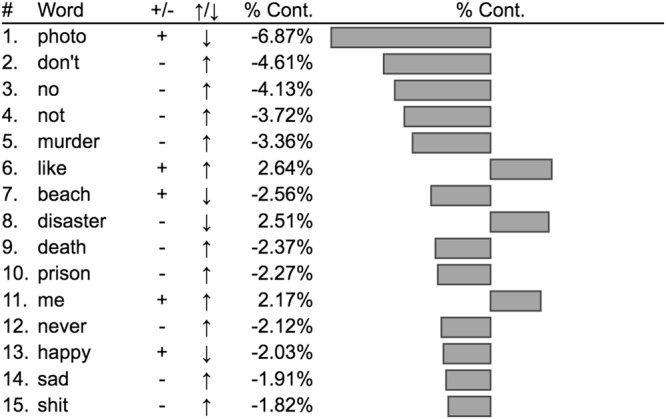
“Word shift graphs We averaged labMT happiness scores across observations in each class, after the removal of common neutral words and retweeted promotional material (38) , .”
BackgroundMethodSelf-citationDiscovering Shifts to Suicidal Ideation from Mental Health Content in Social Media
De Choudhury, M., Kiciman, E., Dredze, M., Coppersmith, G., & Kumar, M. (2016) · Proceedings of the 2016 CHI Conference on Human Factors in Computing Systems · doi:10.1145/2858036.2858207 · Cited by 683 · cited 1×
“In addition to physical ailments, predictive screening methods have successfully identified markers in social media data for a number of mental health issues, including addiction (6), depression (712), PostTraumatic Stress Disorder (PTSD) (13,14), and suicidal ideation (15).”
BackgroundBrief screening instrument for post-traumatic stress disorder
Brewin, C. R., Rose, S., Andrews, B., Green, J., Tata, P., McEvedy, C., Turner, S., & Foa, E. B. (2002) · British Journal of Psychiatry · doi:10.1192/bjp.181.2.158 · Cited by 623 · cited 2×
“The Trauma Screening Questionnaire (TSQ) was used to screen for PTSD (31).”
BackgroundMethod
Research works printed but not linked: 1
- Park, M., Cha, C. & Cha, M. Depressive moods of users portrayed in Twitter. In Proceedings of the ACM SIGKDD Workshop on healthcare informatics (HI-KDD) (pp. 1–8) (2012).
Cited by
Items 201–300 of 402
Effective Techniques for Depression Detection on Social Media: A Comprehensive Review
Begum, S. R., & Sait, S. Y. (2022) · International Conference on Computer Communication and Informatics (ICCCI) · doi:10.1109/iccci54379.2022.9740754 · Cited by 9
Exploring the Risk of Suicide in Real Time on Spanish Twitter: Observational Study
García-Martínez, C., Oliván‐Blázquez, B., Fabra, J., Martínez, A., Pérez-Yus, M. C., & del Hoyo, Y. L. (2022) · JMIR Public Health and Surveillance · doi:10.2196/31800 · Cited by 18
“Specifically, Twitter has been proven useful in predicting depression [23-25], postpartum depression [24], and even posttraumatic stress disorder [26,27].”
BackgroundDepression Detection Using Hybrid Transformer Networks
Daru, D., Surani, H., Koladia, H., Parmar, K., & Srivastava, K. (2023) · Lecture notes in networks and systems · doi:10.1007/978-981-99-1414-2_44 · Cited by 8
Unveiling shadows: A data-driven insight on depression among Bangladeshi university students
Sen, S. K., Apurba, M. S. A., Mrittika, A. P., Anwar, M. T., Islam, A. B. M. A. A., & Noor, J. (2024) · Heliyon · doi:10.1016/j.heliyon.2024.e41110 · Cited by 7
Does Yoga Make You Happy? Analyzing Twitter User Happiness using Textual and Temporal Information
Islam, T., & Goldwasser, D. (2020) · IEEE International Conference on Big Data (BigData) · doi:10.1109/bigdata50022.2020.9378461 · Cited by 12
“research has demonstrated that by analyzing the information in a user’s social media account, we can infer many latent user characteristics like personality [7], [8], emotions [9], mental health [10], mental disorders [11], [12].”
BackgroundPredicting Depression Through Social Media
Biswas, S., & Hasija, Y. (2022) · Lecture notes on data engineering and communications technologies · doi:10.1007/978-981-19-1724-0_6 · Cited by 12
Basterfield, C., & Newman, M. G. (2025) · Journal of Anxiety Disorders · doi:10.1016/j.janxdis.2025.102978 · Cited by 7
“Notably, prior machine learning research has demonstrated the potential of social media data, such as Twitter, to predict the onset and duration of emotional disorders, as well as neuroimaging data to predict treatment response (Reece et al., 2017; Shin et al., 2013).”
Nesbitt, B., Virgadamo, D. S., Aguirre, C. A., DeCamp, M. W., Dredze, M. H., Harrigian, K., Lhaksampa, T. C., Meuchel, J. M., Meyer, A. M., Walker, A., et al. (2025) · JMIR Research Protocols · doi:10.2196/63279 · Cited by 6
Deep learning-based detection of depression by fusing auditory, visual and textual clues
Xu, C., Chen, Y., Tao, Y., Xie, W., Liu, X., Lin, Y., Liang, C., Du, F., Lin, Z., & Shi, C. (2025) · Journal of Affective Disorders · doi:10.1016/j.jad.2025.119860 · Cited by 11
Shen, Z., & Paik, I. (2025) · Applied Sciences · doi:10.3390/app152011274 · Cited by 7
Singh, A., & Singh, J. (2022) · International Journal of Mental Health and Addiction · doi:10.1007/s11469-022-00966-z · Cited by 9
Twitter User Representation Using Weakly Supervised Graph Embedding
Islam, T., & Goldwasser, D. (2022) · Proceedings of the International AAAI Conference on Web and Social Media · doi:10.1609/icwsm.v16i1.19298 · Cited by 7
“Twitter is a highly influential and relevant resource for understanding lifestyle choices, health, and well-being (Schwartz et al. 2016; Yang and Srinivasan 2016; Amir et al. 2017; Reece et al. 2017; Islam 2019).”
BackgroundLeveraging twitter data to understand nurses’ emotion dynamics during the COVID-19 pandemic
Zhou, J. J., Sheppard‐Law, S., Xiao, C., Smith, J., Lamb, A., Axisa, C., & Chen, F. (2023) · Health Information Science and Systems · doi:10.1007/s13755-023-00228-9 · Cited by 6
ARTIFICIAL INTELLIGENCE AND MENTAL HEALTH SERVICES: A SYSTEMATIC REVIEW
Majeed, S., & Khan, A. Q. (2024) · Pakistan Postgraduate Medical Journal · doi:10.51642/ppmj.v35i01.603 · Cited by 9
Detecting Mental Health Illness Using Short Comments
Baba, T., Baba, K., & Ikeda, D. (2019) · Advances in intelligent systems and computing · doi:10.1007/978-3-030-15032-7_23 · Cited by 7
User Centric Social Opinion and Clinical Behavioural Model for Depression Detection
Ibitoye, A., Famutimi, R. F., Olanloye, O. D., & Akioyamen, E. (2021) · International Journal of Intelligent Information Systems · doi:10.11648/j.ijiis.20211004.15 · Cited by 10
Zaman, A., Zhang, B., Silenzio, V., Hoque, M. E., & Kautz, H. (2020) · arXiv (Cornell University) · doi:10.48550/arxiv.2007.00613 · Cited by 11
“Tweets, one of the most explored social media platform, has been used to detect depressed individuals [16] and identify language related to depression and PTSD [17, 18, 19, 20, 21].”
BackgroundThe relationship between language features and PTSD symptoms: a systematic review and meta-analysis
Yu, Z., Gu, Z., Shen, Y., & Lu, J. (2025) · Frontiers in Psychiatry · doi:10.3389/fpsyt.2025.1476978 · Cited by 13
“However, among individuals who have witnessed traumatic events, only 5% receive diagnoses of trauma-related disorders in electronic health records (7), and the time from trauma to diagnosis can exceed 586 days (8).”
Depression Detection on Social Media Posts Using BERT and Support Vector Machine
Shoaib, H., Ali, R., Khan, S., & Adil, M. (2025) · IEEE International Conference on Communication Systems and Network Technologies (CSNT) · doi:10.1109/csnt64827.2025.10967659 · Cited by 7
“It is commonly linked to underlying mental health conditions and may trigger dormant disorders [1], [2].”
Lekkas, D., Collins, A. C., Heinz, M. V., Griffin, T. Z., Pillai, A., Nepal, S. K., Mackin, D. M., Campbell, A. T., & Jacobson, N. C. (2025) · BMC Psychiatry · doi:10.1186/s12888-025-07108-4 · Cited by 4
Premenstrual dysphoric disorder in online peer support communities: a Reddit case study
Evkoski, B., Letina, S., Novak, P. K., & Riddell, J. (2025) · Scientific Reports · doi:10.1038/s41598-025-19220-2 · Cited by 5
Okesanya, O. J., Adebayo, U. O., Ngwoke, I., Agboola, A. O., Atewologun, F. A., Ajayi, S. B., Olaleke, N. O., Oso, T. A., & Lucero‐Prisno, D. E. (2025) · Exploration of Digital Health Technologies · doi:10.37349/edht.2025.101174 · Cited by 7
Shoib, S., Siddiqui, M. F., Turan, S., Chandradasa, M., Armiya’u, A. Y., Saeed, F., Berardis, D. D., Islam, S. M. S., & Zaidi, I. (2025) · Preventive Medicine Research & Reviews · doi:10.4103/pmrr.pmrr_121_24 · Cited by 9
Tushar, A. K., Kabir, M. A., & Ahmed, S. I. (2020) · Intelligent systems reference library · doi:10.1007/978-3-030-54932-9_11 · Cited by 5
The language of healthcare worker emotional exhaustion: A linguistic analysis of longitudinal survey
Belz, F. F., Adair, K. C., Proulx, J., Frankel, A. S., & Sexton, J. B. (2022) · Frontiers in Psychiatry · doi:10.3389/fpsyt.2022.1044378 · Cited by 6
PsychNet: Explainable Deep Neural Networks for Psychiatric Disorders and Mental Illness
Kasyap, V. L. V. S. K. B., & Dasari, C. M. (2022) · IEEE Conference on Information and Communication Technology (CICT) · doi:10.1109/cict56698.2022.9997832 · Cited by 5
“Many researchers are working on generating a multi-modal neural network to predict the psychic activity of the brain from the EEG signals and thereby predict the schizophrenia disease [20], [23], [22].”
BackgroundA Machine-Learning Approach to Classify Depressive Posts from Reddit Social Media
Quader, A. W., Jamil, M. S., Uddin, M. I., & Patwary, M. J. A. (2023) · International Conference on Next-Generation Computing, IoT and Machine Learning (NCIM) · doi:10.1109/ncim59001.2023.10212779 · Cited by 5
“Reece et al. [16] found that there is a 0.87 AUC of performance probability that Twitter data can be used to detect the early stages of depression months before a diagnosis.”
MethodInfluentialReddy, C. K. K., Satvika, P., Doss, S., & Hanafiah, M. M. (2023) · Advances in civil and industrial engineering book series · doi:10.4018/979-8-3693-0044-2.ch008 · Cited by 7
Mental Health Analysis of Students in Major Cities of India During COVID-19
Agarwal, A., Agarwal, B., Harjule, P., & Agarwal, A. K. (2021) · Algorithms for intelligent systems · doi:10.1007/978-981-33-4236-1_4 · Cited by 5
Technological Advances in Clinical Assessment
Heinz, M. V., Thomas, N., Nguyen, N. D., Griffin, T. Z., & Jacobson, N. C. (2021) · Elsevier eBooks · doi:10.1016/b978-0-12-818697-8.00171-0 · Cited by 7
Hate Speech Detection using ML algorithms
Razdan, A., & Shridevi, S. (2021) · International Conference on Artificial Intelligence and Machine Vision (AIMV) · doi:10.1109/aimv53313.2021.9670987 · Cited by 6
Information technology and electronic health record to improve behavioral health services
Hilty, D. M., Naslund, J. A., Ahuja, S., Torous, J. B., Kishimoto, T., & Crawford, A. S. (2021) · Elsevier eBooks · doi:10.1016/b978-0-12-822201-0.00005-8 · Cited by 5
Laroia, G., Horne, B. D., Esplin, S. M., & Ramaswamy, V. K. (2022) · Digital Health · doi:10.1177/20552076221074126 · Cited by 5
“We are beginning an era of care delivery where the progression of these algorithms is towards the consumption of signals that go from reference diagnostics and known chemical markers to social phenotypes that health conditions seem to shape.(19,20) If the ownership and custody of such a unified health algorithm is wit…”
BackgroundProspects of machine learning applications in affective disorders
Mosolova, E., Alfimov, A. Е., Kostyukova, E. G., & Mosolov, S. N. (2025) · Digital Diagnostics · doi:10.17816/dd634885 · Cited by 6
Evolutionary AdaBoost ensemble: A machine learning framework for depression detection
Sayeri, R., Barzegar, B., Bozorgi-Rad, Y., Mikaeilvand, N., & Najaran, M. H. T. (2025) · Machine Learning with Applications · doi:10.1016/j.mlwa.2025.100748 · Cited by 8
Yokotani, K. (2021) · Journal of Medical Internet Research · doi:10.2196/24088 · Cited by 3
“This study advances previous findings regarding language classifiers in mental health fields [42,43] in 2 ways.”
MethodResultA RoBERTa-based model on measuring the severity of the signs of depression.
Wu, S.-H., & Qiu, Z.-J. (2021) · CLEF (Working Notes) · Cited by 4
Baqir, A., Ali, M., Jaffar, S., Sherazi, H. H. R., Lee, M. G., Bashir, A. K., & Dabel, M. M. A. (2024) · Scientific Reports · doi:10.1038/s41598-024-69687-8 · Cited by 4
D₂X: Depression Detection System Through X Using Hybrid Machine Learning
Angskun, T., Tipprasert, S., Thippongtorn, A., & Angskun, J. (2024) · IEEE Access · doi:10.1109/access.2024.3502241 · Cited by 4
“Reece et al. [24] developed a mental illness prediction model using X data.”
Discovering Latent Depression Patterns in Online Social Media.
Ríssola, E. A., Losada, D. E., & Crestani, F. (2019) · IIR eBooks · Cited by 6
Mining Twitter Data for Signs of Depression in Brazil
Sperling, O. V., & Ladeira, M. (2019) · Anais do Symposium on Knowledge Discovery, Mining and Learning (KDMiLe) · doi:10.5753/kdmile.2019.8785 · Cited by 4
“Interpretability of models is yet another strong argument made by Reece et al. 2017, and Word Shift Graphs together with Hidden Markov Models (precision = 0.852, recall = 0.518, F1 = 0.644) are employed as an alternative that identifies signs not fully captured by either Linguistic Inquiry Word…”
MethodInfluentialAbdo, M. S., Ali, A., & Sarhan, N. N. (2019) · The Egyptian Journal of Language Engineering /The Egyptian Journal of Language Engineering · doi:10.21608/ejle.2019.59103 · Cited by 5
“Obviously, our findings go hand in hand with the relevant corpus-based studies which promote corpus tools as effective in applying syntactic patterns to retrieve attitudinal evaluations [6-7].”
BackgroundTypes of Data with Algorithms for Assessing Mental Health Conditions
Gore, E., & Rathi, S. (2019) · International Conference on Computing Communication Control and automation · doi:10.1109/iccubea47591.2019.9128667 · Cited by 4
“The Twitter developer’s API was used in writing Twitter data collection apps using Python [31].”
MethodHealth-Related Digital Autonomy. A Response to the Commentaries
Laacke, S., Mueller, R., Schomerus, G., & Salloch, S. (2021) · The American Journal of Bioethics · doi:10.1080/15265161.2021.1965257 · Cited by 6
Then and Now: Quantifying the Longitudinal Validity of Self-Disclosed Depression Diagnoses
Harrigian, K., & Dredze, M. H. (2022) · Workshop on Computational Linguistics and Clinical Psychology (CLPsych) · doi:10.18653/v1/2022.clpsych-1.6 · Cited by 9
I don’t feel so good! Detecting Depressive Tendencies using Transformer-based Multimodal Frameworks
Suri, M., Semwal, N., Chaudhary, D., Gorton, I., & Kumar, B. (2022) · International Conference on Machine Learning and Natural Language Processing (MLNLP) · doi:10.1145/3578741.3578817 · Cited by 6
“Several works [17] have worked with a set of users with a confirmed medical diagnosis of depression.”
BackgroundCritical Discourse Analysis on Representation of Racism and Solidarity in Adidas's Tweets
Indrawati, D. (2021) · Lingua Cultura · doi:10.21512/lc.v15i1.7108 · Cited by 7
“People might be mindful that they should dodge writing tweets that convey stereotype emotionality (Reece et al., 2017).”
BackgroundMining Complex Biomedical Literature for Actionable Knowledge on Rare Diseases
Alves, V. M., Capuzzi, S. J., Baker, N., Muratov, E. N., Tropsha, A., & Hickey, A. J. (2020) · Human perspectives in health sciences and technology · doi:10.1007/978-3-030-32857-3_4 · Cited by 4
The Impact of Public Mood on the Cross-Section of Stock ReturnsPreprint
Marsh, I. W., & Liu, J. (2018) · SSRN Electronic Journal · doi:10.2139/ssrn.3170954 · Cited by 5
“4A more detailed discussion of the fundamental work on the Twitter mood index can be found in Dodds and Danforth (2010), Cody et al. (2016), Reagan et al. (2016) and Reece et al. (2017).”
BackgroundQuantifying language changes surrounding mental health on TwitterPreprint
Stupinski, A. M., Alshaabi, T., Arnold, M. V., Adams, J. L., Minot, J. R., Price, M., Dodds, P., & Danforth, C. (2021) · arXiv.org · doi:10.48550/arxiv.2106.01481 · Cited by 5
“[34] T. Alshaabi, J. L. Adams, M. V. Arnold, J. R. Minot, D. R. Dewhurst, A. J. Reagan, C. M. Danforth, and P. S. Dodds.”
MethodInfluentialSelf-citationThe Right to Contest AI Profiling Based on Social Media Data
Ploug, T., & Holm, S. (2021) · The American Journal of Bioethics · doi:10.1080/15265161.2021.1926585 · Cited by 4
“Thus, for instance, machine learning models may be used to screen for depression by analyzing posts on Instagram or other social media (Reece et al. 2017; Reece and Danforth 2017).”
BackgroundOn the incidence of depression symptoms on social media
Ríssola, E. A., Aragón, M. E., Losada, D. E., & Crestani, F. (2025) · Journal of Computational Social Science · doi:10.1007/s42001-025-00377-9 · Cited by 7
“Similarly, the CES-D self-assessment questionnaire was exploited by Reece et al. [36], who collected several Twitter users who were diagnosed with either depression or post-traumatic stress disorder (PTSD).”
Identifying PTSD Symptoms Using Machine Learning Techniques on Social Media
Ibrahim, M. A., Ismail, N. H., Kamarudin, N. S., Nafis, N. S. M., & Nasir, A. F. A. (2023) · International Conference on Software Engineering and Computer Systems · doi:10.1109/icsecs58457.2023.10256290 · Cited by 5
Societal Implications of Recommendation Systems: A Technical Perspective
Gonçalves-Sá, J., & Pinheiro, F. L. (2023) · Law, governance and technology series · doi:10.1007/978-3-031-41264-6_3 · Cited by 8
Mental Health and Mobile Communication Profiles of Crowdsourced Participants
Tlachac, M., & Heinz, M. V. (2024) · IEEE Journal of Biomedical and Health Informatics · doi:10.1109/jbhi.2024.3436654 · Cited by 5
Stress Analysis for Students in Online Classes
Sharma, C., & Saxena, P. (2021) · Grace Hopper Celebration India (GHCI) · doi:10.1109/ghci50508.2021.9514059 · Cited by 4
Nishat, M. M., Mahbub, M. A., Ahmed, A., & Mamun, M. A. A. (2021) · IEEE International Conference on Recent Advances and Innovations in Engineering (ICRAIE) · doi:10.1109/icraie52900.2021.9703997 · Cited by 4
A Real-time Visualization of Global Sentiment Analysis on Declaration of Pandemic
Addepalli, L., Ali, W., Lloret, J., Sagar, V., D, S. A. C., & Bharadwaj, C. (2022) · International Journal of Computer Engineering in Research Trends · doi:10.22362/ijcert/2022/v9/i06/v9i0602 · Cited by 4
The Expression of Happiness in Social Media of Individuals Reporting Depression
Bucur, A.-M., Chulvi, B., Cosma, A., & Rosso, P. (2024) · IEEE Transactions on Affective Computing · doi:10.1109/taffc.2024.3434482 · Cited by 7
“The ,suchasdepression[14], [15],[16],self-harm[17],[18],suicideideation[19],eatingdis-orders[20],pathologicalgambling[21],[22]andpost-traumatic stressdisorder[23].”
Social Behavior and Mental Health: A Snapshot Survey under COVID-19 PandemicPreprint
Dhelim, S., Chen, L., Ning, H., Das, S. K., Nugent, C., Burns, D., Leavey, G., Pesch, D., & White, E. B. (2021) · arXiv (Cornell University) · doi:10.48550/arxiv.2105.08165 · Cited by 8
“A few works have asked the users to answer self-report depression questionnaires and used their answers as the ground truth to measure the accuracy of their schemes ([25][105][106]).”
BackgroundReddy, C. K. K., & Satvika, P. (2023) · Research Square · doi:10.21203/rs.3.rs-2912222/v1 · Cited by 3
Quillivic, R., Auxéméry, Y., Gayraud, F., Dayan, J., & Mesmoudi, S. (2025) · Journal of the American Medical Informatics Association · doi:10.1093/jamia/ocaf075 · Cited by 3
Sentiment Analysis and Emotion Detection of COVID-19 Geo-Tagged Twitter Data
Wang, S., Dhakal, S., & Upadhyay, B. P. (2024) · IEEE International Conference on Big Data Analytics (ICBDA) · doi:10.1109/icbda61153.2024.10607368 · Cited by 3
“Reece et al. [10] introduced an approach for Post-Traumatic Stress Disorder (PTSD) and Massive Depression Disorder (MDD) detection based on 204 identified individuals’ mental health profiles and about 280k tweets.”
MethodO’Dea, B., Batterham, P. J., Braund, T. A., Chakouch, C., Larsen, M. E., Berk, M., Torok, M. H., Christensen, H. M., & Glozier, N. (2025) · npj Mental Health Research · doi:10.1038/s44184-025-00140-y · Cited by 6
Miller, L., Lhaksampa, T. C., Walker, A., Aguirre, C. A., DeCamp, M. W., Harrigian, K., Meuchel, J. M., Meyer, A. M., Nesbitt, B., Sthapit, S., et al. (2025) · JMIR Mental Health · doi:10.2196/74212 · Cited by 2
Bao, E., Pérez, A., Otero, D., & Parapar, J. (2025) · Online Social Networks and Media · doi:10.1016/j.osnem.2025.100339 · Cited by 3
Wan, Y., Dong, Z., Li, M., Jiang, B., Zhu, J., & Ju, S. (2025) · Expert Systems with Applications · doi:10.1016/j.eswa.2025.130194 · Cited by 2
Implementation of the Internet of Medical Things (IoMT): Clinical and Policy Implications
D'Souza, R. D. (2021) · Internet of things · doi:10.1007/978-3-030-66633-0_14 · Cited by 3
Hilty, D. M., Ahuja, S., Naslund, J. A., & Crawford, A. S. (2022) · Springer eBooks · doi:10.1007/978-3-031-11984-2_7 · Cited by 3
Detection of Mental Health Using Deep Learning Technique
Jayapal, C., Yamuna, S. M., Manavallan, S., & Devasenan, M. (2023) · Lecture notes in networks and systems · doi:10.1007/978-981-99-2322-9_37 · Cited by 2
Açıkel, S. B., & Artık, A. (2023) · Psychiatria Danubina · doi:10.24869/psyd.2023.220 · Cited by 4
“Moreover, some studies use Twitter as a screening and early intervention tool for psychiatric disorders (Reece et al. 2017).”
BackgroundLiu, Z., Ma, X., Zhang, P., Hao, C., Zhang, S., & Wang, L. (2023) · International Joint Conference on Neural Networks (IJCNN) · doi:10.1109/ijcnn54540.2023.10191660 · Cited by 2
“• RF [11]: A non-contextual approach that applies the RF-based classifier with the language-based vector (LBFs) generated above.”
MethodReddy, C. K. K. (2023) · Practice, progress, and proficiency in sustainability · doi:10.4018/979-8-3693-1186-8.ch002 · Cited by 2
Tweet Analysis of Mental Illness Using K-Means Clustering and Support Vector Machine
Kusumaningtyas, K., Habibi, M., Dwijayanti, I., & Sumiyarini, R. (2023) · Telematika · doi:10.31315/telematika.v20i3.9820 · Cited by 5
“Tujuan dari penelitian ini adalah untuk untuk menganalisis tweet terkait gangguan kesehatan mental di Indonesia, sehingga dapat diketahui topik pembahasan dan kecenderungan polaritas yang dimiliki oleh tweet-tweet tersebut [5].”
BackgroundBERT-based RNN for Effective Detection of Depression with Severity Levels from Text Data
Saraswat, P., & Beniwal, R. (2024) · IEEE Symposium on Wireless Technology & Applications (ISWTA) · doi:10.1109/iswta62130.2024.10651873 · Cited by 2
Jiang, W., Zhang, M., Wu, C. Y. H., & Dong, W. (2024) · Population Space and Place · doi:10.1002/psp.2861 · Cited by 3
AlSumait, L., Alfarhan, A., & AlHeneidi, H. H. (2025) · PeerJ Computer Science · doi:10.7717/peerj-cs.2828 · Cited by 3
“…detectors (see Vioules et al., 2018 ; Shing et al., 2018 ; Rabani et al., 2023 ), stress, anxiety or post-traumatic stress disorder detectors (see Reece et al., 2017 ; Guntuku et al., 2019 ; Yang et al., 2022 ; Juhng et al., 2023 ), and bipolar disorder detectors (see Huang et al., 2021 ;…”
Tejaswini, V., Sahoo, B., & Babu, K. S. (2025) · IEEE Transactions on Computational Social Systems · doi:10.1109/tcss.2025.3579300 · Cited by 3
“Reece et al. [15] insight the depressive patterns from the tweets to categorize the depressed users.”
Rani, S., & Mangla, N. (2025) · Lecture notes in networks and systems · doi:10.1007/978-981-96-7137-3_19 · Cited by 2
Digitale Phänotypisierung. Kontra
Gründer, G. (2020) · Der Nervenarzt · doi:10.1007/s00115-020-00902-3 · Cited by 3
Public wellbeing analytics framework using social media chatter data
Ismail, H., Serhani, M. A., Hussien, N., Elabyad, R., & Navaz, A. N. (2022) · Social Network Analysis and Mining · doi:10.1007/s13278-022-00987-5 · Cited by 3
“Reece et al. (2016) explored the combination of multiple emotion lexicons with a more comprehensive set of behavioral and metadata features in addition to time series features.”
BackgroundSheikh, S., & Shaban, K. B. (2020) · IEEE International Conference on Informatics, IoT, and Enabling Technologies (ICIoT) · doi:10.1109/iciot48696.2020.9089576 · Cited by 2
“On similar lines a study published in 2017 indicated how twitter users expressed their feelings in tweets which could be used to detect depression using text mining, at a very early stage [13].”
BackgroundDepression discovery in cancer communities using deep learning
Sharma, S., Kalra, V., & Agrawal, R. (2020) · Elsevier eBooks · doi:10.1016/b978-0-12-823014-5.00004-1 · Cited by 2
Emerging Role of Intelligent Techniques for Effective Detection and Prediction of Mental Disorders
Jain, P. R., & Quadri, S. M. K. (2021) · Lecture notes on data engineering and communications technologies · doi:10.1007/978-981-15-9509-7_16 · Cited by 6
Kuzmina, T. I. (2021) · Российский психологический журнал · doi:10.21702/rpj.2021.1.1 · Cited by 5
Digitalisierte Psychiatrie: Kritische Überlegungen zu einem neuen Paradigma
Fuchs, T. A. E. (2021) · Der Nervenarzt · doi:10.1007/s00115-021-01188-9 · Cited by 3
Depression Identification Through Tweet Clusters
Masand, A., Chauhan, S., & Jain, T. K. (2022) · International Journal of Software Innovation · doi:10.4018/ijsi.297916 · Cited by 2
Early Detection of Mental Disorder Via Social Media Posts Using Deep Learning Models
Sun, A., & Wu, Z. (2023) · Lecture notes in electrical engineering · doi:10.1007/978-981-19-7904-0_13 · Cited by 2
A psychological evaluation method incorporating noisy label correction mechanism
Jin, Z., Su, R., Liu, Y., & Duan, C. (2024) · Soft Computing · doi:10.1007/s00500-023-09479-w · Cited by 7
“For example, Reece et al. (2017) collected information from participants’ twitter accounts, extracted features from their contents, and used these features with supervised learning algorithms to construct models to predict the presence of users with depression and Post-Traumatic Stress Disorder…”
Chai, Y., Wu, F., Sun, R., Zhang, Z.-L., Bao, J., Ma, R., Peng, Q., Wu, D., Wan, Y., & Li, K. (2019) · IEEE International Symposium on Parallel and Distributed Processing with Applications (ISPA) · doi:10.1109/ispa-bdcloud-sustaincom-socialcom48970.2019.00230 · Cited by 4
Emery, B. F., Niles, M. T., Danforth, C. M., & Dodds, P. S. (2021) · PLoS ONE · doi:10.1371/journal.pone.0251704 · Cited by 2
Self-citationHillcoat, A., Jeon, E. D., Shrestha, M., Jha, S. C., Kang, J. H., Rich-Edwards, J. W., & Denckla, C. A. (2025) · American Journal of Epidemiology · doi:10.1093/aje/kwaf056
Zhang, H., Liu, Z., Wu, Y., Yuan, J., Li, G., Ding, Z., & Hu, B. (2025) · Information Processing & Management · doi:10.1016/j.ipm.2025.104575 · Cited by 1
Enhancing Depression Detection With Cognitive Distortion and User-Level Information
Wan, Y., Dong, Z., Jiang, B., Li, M., & Ju, S. (2026) · IEEE Journal of Biomedical and Health Informatics · doi:10.1109/jbhi.2026.3665518 · Cited by 1
“Thisisbecauseleveragingtheanonymity andinteractivenatureofonlineplatforms,individualswith depressionaremorelikelytoexpresspsychologicaldistressand seekhelpontheseplatforms[5],[6].”
Villa-Pérez, M. E., Valencia-Segura, K. M., Moctezuma, D., Villaseñor-Pineda, L., & Trejo, L. A. (2026) · Social Network Analysis and Mining · doi:10.1007/s13278-026-01589-1 · Cited by 1
“On the other hand, Reece et al. (2017 ) explored the detection of depression using only tweets posted before clinical diagnosis.”
Rohei, M. S., Varathan, K. D., Shivakumara, P., & Anuar, N. B. (2026) · PeerJ Computer Science · doi:10.7717/peerj-cs.3559 · Cited by 2
Shah, S., Dodiya, T., & Prajapati, N. K. (2026) · Neurocomputing · doi:10.1016/j.neucom.2026.133395 · Cited by 1
Cahutay, C. R., & Vicente, A. J. (2017) · Institutional Repositories DataBase (IRDB) · Cited by 2
Leis, Á., Ronzano, F., Mayer, M. Á., Furlong, L. I., & Sanz, F. (2020) · Journal of Medical Internet Research · doi:10.2196/20920 · Cited by 4
“The massive data from social media can be monitored and analyzed by using natural language processing and machine learning technologies, providing new possibilities to better understand users’behavior [30], including automatic identification of early signs of mental disorders [38-40].”
Background
Metadata
- Authors
- Reece, A. G., Reagan, A. J., Lix, K. L. M., Dodds, P. S., Danforth, C. M., & Langer, E. J.
- Affiliations
- Harvard University (US)
- University of Vermont (US)
- Stanford University (US)
- Corresponding author
- Reece, Andrew G.
- Danforth, Christopher M.
- ORCID
- Venue
- Scientific Reports
- Published
- 2017-10-11
- Volume
- 7
- Issue
- 1
- Pages
- 13006-13006
- ISSN
- 2045-2322 (ISSN-L)
- PMC
- PMC5636873
- OpenAlex
- W2512937600
- Semantic Scholar
- 1290aa325025d705edc3b04d244eab2766779755
- Cited by
- 401
- References
- 49
- Citations by year
- 2026: 21 · 2025: 48 · 2024: 44 · 2023: 57 · 2022: 65 · 2021: 68 · 2020: 41 · 2019: 36 · 2018: 15 · 2017: 6
- FWCI
- 38.39
- Type
- journal article
- Language
- en
- Open access
- gold
- doi.org
- Licence
- cc-by
- creativecommons.org/licenses/by/4.0 (tdm)
- creativecommons.org/licenses/by/4.0 (vor)
- Locations
- Scientific Reports (publishedVersion, cc-by)
- PubMed Central (publishedVersion, cc-by)
- PubMed (publishedVersion)
- arXiv (Cornell University) (submittedVersion)
- Digital Access to Scholarship at Harvard (DASH) (Harvard University) (submittedVersion, cc-by)
- ScholarWorks -A service of University of Vermont Libraries (University of Vermont) (submittedVersion, cc-by)
- DOAJ (DOAJ: Directory of Open Access Journals) (submittedVersion)
- arXiv (Cornell University)
- Funders
- National Science Foundation (1447634)
- Harvard University
- Topics
- Social Sciences › Psychology › Social Psychology › Mental Health via Writing
- Physical Sciences › Computer Science › Artificial Intelligence › Emotion and Mood Recognition
- Social Sciences › Psychology › Experimental and Cognitive Psychology › Mental Health Research Topics
- Keywords
- depression, post-traumatic stress disorder, Twitter, social media, early detection, language style, affect, computational psychiatry, early screening
- MeSH terms
- Depression, Humans, Stress Disorders, Post-Traumatic, Disease Progression, Social Media
About these checks
Registry, retraction, Cites and statistics results are computed, not judged, with one exception: a printed reference that no index lists is read once by a model before it counts as a citation error. Claims are extracted by a model and kept only when their quote appears verbatim in the text; each cited source is then checked, with a model’s help, for whether it says what the claim relies on. Those verdicts can be wrong — read the claim’s quote and the cited source before relying on one.
Statistics and arithmetic are recomputed, not judged.
Confidence bands are shown only for fields calibrated on our annotated test set. None is calibrated yet, so no band is shown.
What counts as a claim ›How we measure confidence ›How we check this ›
Are you an author, or do you see a problem with this page? Request a review
Data sources
Bibliographic data: Semantic Scholar, OpenAlex, Crossref.
Contains information from the Semantic Scholar Academic Graph Datasets, made available under the ODC Attribution License (ODC-BY 1.0).
Semantic Scholar’s data is described in: Kinney, R., et al. (2023). The Semantic Scholar Open Data Platform. arXiv:2301.10140.
