

Forecasting the onset and course of mental illness with Twitter data
Open accessThe DOI matches its Crossref record; 50 of the 50 references it cites were found in a registry or an index.
Abstract
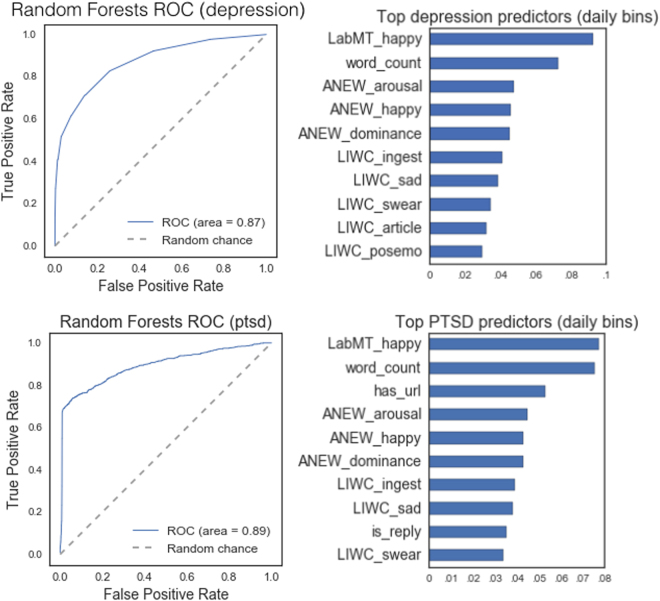
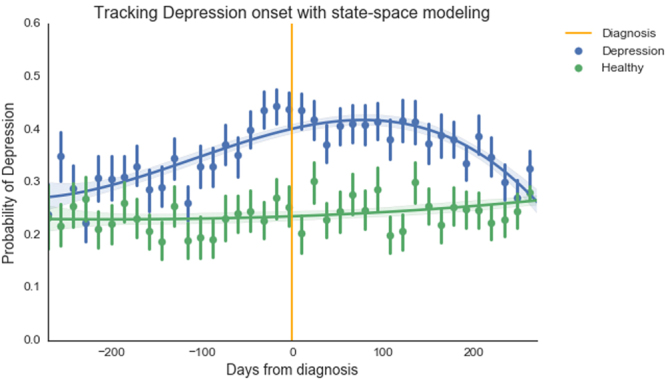
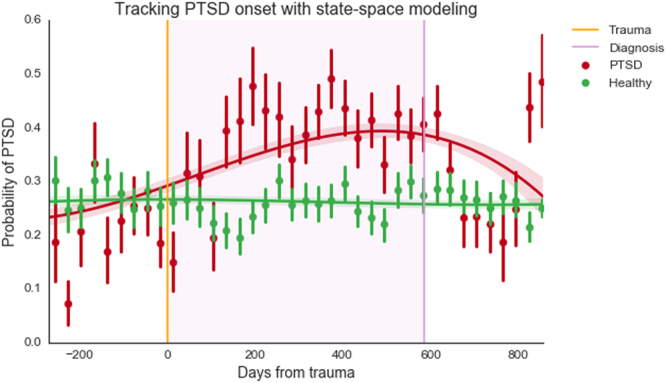
We developed computational models to predict the emergence of depression and Post-Traumatic Stress Disorder in Twitter users. Twitter data and details of depression history were collected from 204 individuals (105 depressed, 99 healthy). We extracted predictive features measuring affect, linguistic style, and context from participant tweets (N = 279,951) and built models using these features with supervised learning algorithms. Resulting models successfully discriminated between depressed and healthy content, and compared favorably to general practitioners’ average success rates in diagnosing depression, albeit in a separate population. Results held even when the analysis was restricted to content posted before first depression diagnosis. State-space temporal analysis suggests that onset of depression may be detectable from Twitter data several months prior to diagnosis. Predictive results were replicated with a separate sample of individuals diagnosed with PTSD (N users = 174, N tweets = 243,775). A state-space time series model revealed indicators of PTSD almost immediately post-trauma, often many months prior to clinical diagnosis. These methods suggest a data-driven, predictive approach for early screening and detection of mental illness.
Overview
The claims and statistics of this paper haven’t been checked yet.
Free: it reads the open-access text and checks the first 5 claims that cite a source we can check. Create a free account to check every claim.
Integrity signals
Registry
Cites
Statistics
Figures
Verification
Claims the paper makes
The claims and statistics of this paper haven’t been checked yet.
Free: it reads the open-access text and checks the first 5 claims that cite a source we can check. Create a free account to check every claim.
Claims other papers make about this one
Each is checked against this paper’s own text: does it say what the citing paper says it does?
The source backs part of the claim, not all of it — or backs it for a different population, condition or comparison.
In the citing paper
“For PTSD in particular, although studies have yet to validate models in a clinical setting, past work has shown that AI-based language techniques can distinguish Twitter users that have publicly disclosed a diagnosis of the condition from random selections of users (e.g. Coppersmith, Dredze, & Harman, 2014; Preotiuc-Pietro, Sap, Schwartz, & Ungar, 2015; Reece et al. 2017).”
From World Trade Center responders in their own words: predicting PTSD symptom trajectories with AI-based language analyses of interviews (2023) · cites this paper as Reece et al. 2017
Experimental — accuracy not yet measuredThe cited source says what the claim attributes to it.
In the citing paper
“In Reece et al, 52 the LabMT was the first predictor in the random forest model to detect PTSD on Twitter data.”
From Linguistic markers for identifying post-traumatic stress disorder and associated symptoms: a systematic literature review (2025) · cites this paper as [52]
The cited source says what the claim attributes to it.
In the citing paper
“The first 2 studies leverage social media data and rely on selfreported PTSD diagnoses, which may contribute to their higher AUC values.”
From Linguistic markers for identifying post-traumatic stress disorder and associated symptoms: a systematic literature review (2025) · cites this paper as [52]
The check wasn’t confident either way, so it gives no verdict — never disputed.
In the citing paper
“From the forest plot highlights studies with notably higher AUC scores, particularly Reece et al, 52 Kirinde Gamaarachchige and Inkpen, 84 and Schultebraucks et al. 43”
From Linguistic markers for identifying post-traumatic stress disorder and associated symptoms: a systematic literature review (2025) · cites this paper as [52]
Experimental — accuracy not yet measured
Self-check
Percentages, sums and reported differences re-computed from the paper’s own numbers.
The self-check needs the paper’s full text.
Citations
Cites
The CES-D Scale: A Self-Report Depression Scale for Research in the General Population
Radloff, L. S. (1977) · Applied Psychological Measurement · doi:10.1177/014662167700100306 · Cited by 53,267
The Parable of Google Flu: Traps in Big Data Analysis
Lazer, D., Kennedy, R., King, G., & Vespignani, A. (2014) · Science · doi:10.1126/science.1248506 · Cited by 2,523
Reputation as a sufficient condition for data quality on Amazon Mechanical Turk
Peer, E., Vosgerau, J., & Acquisti, A. (2014) · Behavior Research Methods · doi:10.3758/s13428-013-0434-y · Cited by 1,618 · cited 1×
“MTurk workers who have completed at least 100 tasks, with a minimum 95% approval rating, have been found to provide reliable, valid survey responses (32).”
BackgroundPredicting Depression via Social Media
De Choudhury, M., Gamon, M., Counts, S., & Horvitz, E. (2021) · Proceedings of the International AAAI Conference on Web and Social Media · doi:10.1609/icwsm.v7i1.14432 · Cited by 1,579
Clinical diagnosis of depression in primary care: a meta-analysis
Mitchell, A. J., Vaze, A., & Rao, S. (2009) · The Lancet · doi:10.1016/s0140-6736(09)60879-5 · Cited by 1,251 · cited 6×
“Precision, recall, specificity, negative predictive value, and F1 accuracy scores are reported, and general practitioners’ unassisted diagnostic accuracy rates as reported in Mitchell, Vaze, and Rao28 (MVR) and Taubman-Ben-Ari et al.22 (TBA) are used as informal benchmarks for depression and PTSD, respectively.”
BackgroundInfluentialFerrari, A. J., Somerville, A. J., Baxter, A. J., Norman, R., Patten, S. B., Vos, T., & Whiteford, H. A. (2013) · Psychological Medicine · doi:10.1017/s0033291712001511 · Cited by 1,230 · cited 1×
“Depression has emerged as the leading mental health condition of interest among computational social scientists (712), as it is a relatively common mental disorder (16) and influences a range of behaviors and patterns of communication (17).”
BackgroundLanguage use of depressed and depression-vulnerable college students
Rude, S., Gortner, E.-M., & Pennebaker, J. (2004) · Cognition & Emotion · doi:10.1080/02699930441000030 · Cited by 1,018 · cited 1×
“This trajectory matches closely with average improvement time frames observed in therapeutic programs (45).”
BackgroundTemporal patterns of happiness and information in a global social network: hedonometrics and Twitter
Dodds, P. S., Harris, K. D., Kloumann, I. M., Bliss, C. A., & Danforth, C. M. (2011) · PLoS ONE · doi:10.1371/journal.pone.0026752 · Cited by 809 · cited 2×
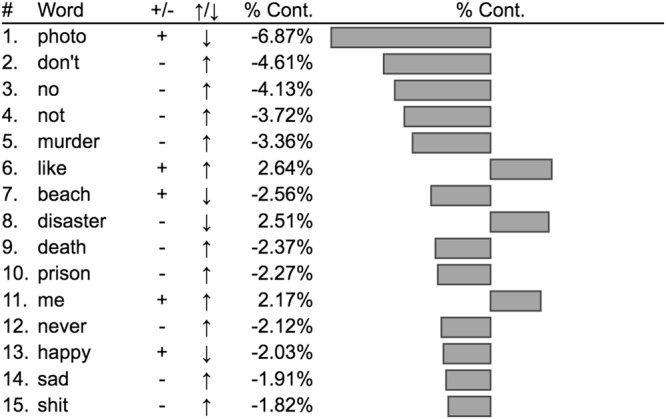
“Word shift graphs We averaged labMT happiness scores across observations in each class, after the removal of common neutral words and retweeted promotional material (38) , .”
BackgroundMethodSelf-citationDiscovering Shifts to Suicidal Ideation from Mental Health Content in Social Media
De Choudhury, M., Kiciman, E., Dredze, M., Coppersmith, G., & Kumar, M. (2016) · Proceedings of the 2016 CHI Conference on Human Factors in Computing Systems · doi:10.1145/2858036.2858207 · Cited by 683 · cited 1×
“In addition to physical ailments, predictive screening methods have successfully identified markers in social media data for a number of mental health issues, including addiction (6), depression (712), PostTraumatic Stress Disorder (PTSD) (13,14), and suicidal ideation (15).”
BackgroundBrief screening instrument for post-traumatic stress disorder
Brewin, C. R., Rose, S., Andrews, B., Green, J., Tata, P., McEvedy, C., Turner, S., & Foa, E. B. (2002) · British Journal of Psychiatry · doi:10.1192/bjp.181.2.158 · Cited by 623 · cited 2×
“The Trauma Screening Questionnaire (TSQ) was used to screen for PTSD (31).”
BackgroundMethodFeeling bad on Facebook: depression disclosures by college students on a social networking site
Moreno, M. A., Jelenchick, L. A., Egan, K. G., Cox, E., Young, H., Gannon, K. E., & Becker, T. (2011) · Depression and Anxiety · doi:10.1002/da.20805 · Cited by 603
Screening for Depression in Primary Care Clinics: The CES-D and the BDI
Zich, J. M., Attkisson, C. C., & Greenfield, T. K. (1990) · The International Journal of Psychiatry in Medicine · doi:10.2190/lykr-7vhp-yjem-mkm2 · Cited by 569 · cited 2×
“CESD assessment quality has been demonstrated as onpar with other depression inventories, including the Beck Depression Inventory and the Kellner Symptom Questionnaire (29,30).”
MethodSocial Network Sensors for Early Detection of Contagious Outbreaks
Christakis, N. A., & Fowler, J. H. (2010) · PLoS ONE · doi:10.1371/journal.pone.0012948 · Cited by 535
Instagram photos reveal predictive markers of depression
Reece, A. G., & Danforth, C. M. (2017) · EPJ Data Science · doi:10.1140/epjds/s13688-017-0110-z · Cited by 519 · cited 4×
“The methods used in recruitment, data collection, and analysis are adopted from Reece and Danforth12.”
BackgroundMethodInfluentialSelf-citationPredicting postpartum changes in emotion and behavior via social media
De Choudhury, M., Counts, S., & Horvitz, E. (2013) · Proceedings of the SIGCHI Conference on Human Factors in Computing Systems · doi:10.1145/2470654.2466447 · Cited by 462 · cited 4×
“While earlier research identified depression predictors in Twitter data for Major Depressive Disorder and postpartum depression (7,8), we used a more general category in”
BackgroundMethodInfluentialSchulberg, H. C., Katon, W., Simon, G. E., & Rush, A. J. (1998) · Archives of General Psychiatry · doi:10.1001/archpsyc.55.12.1121 · Cited by 459 · cited 1×
“The increased usage of negativelyvalenced language by depressed individuals is congruent with previous research (46).”
ResultCampbell, D. G., Felker, B. L., Liu, C.-F., Yano, E. M., Kirchner, J. E., Chan, D., Rubenstein, L. V., & Chaney, E. F. (2007) · Journal of General Internal Medicine · doi:10.1007/s11606-006-0101-4 · Cited by 458
Human language reveals a universal positivity bias
Dodds, P. S., Clark, E. M., Desu, S., Frank, M. R., Reagan, A. J., Williams, J. R., Mitchell, L., Harris, K. D., Kloumann, I. M., Bagrow, J. P., et al. (2015) · Proceedings of the National Academy of Sciences · doi:10.1073/pnas.1411678112 · Cited by 401
Self-citationCharacterizing and predicting postpartum depression from shared facebook data
De Choudhury, M., Counts, S., Horvitz, E. J., & Hoff, A. (2014) · Proceedings of the 17th ACM conference on Computer supported cooperative work & social computing · doi:10.1145/2531602.2531675 · Cited by 379
Eaton, W. W., Neufeld, K., Chen, L.-S., & Cai, G. (2000) · Archives of General Psychiatry · doi:10.1001/archpsyc.57.3.217 · Cited by 339 · cited 1×
“First, selfreported information about depressive symptoms is often inaccurate (23).”
BackgroundPosttraumatic stress disorder in the primary care medical setting
Stein, M. B., McQuaid, J. R., Pedrelli, P., Lenox, R., & McCahill, M. E. (2000) · General Hospital Psychiatry · doi:10.1016/s0163-8343(00)00080-3 · Cited by 333 · cited 1×
“PTSD, while less common (19), is frequently comorbid with major depression (20).”
BackgroundMeasuring post traumatic stress disorder in Twitter
Coppersmith, G., Harman, C., & Dredze, M. (2014) · Proceedings of the International AAAI Conference on Web and Social Media · doi:10.1609/icwsm.v8i1.14574 · Cited by 316 · cited 5×
“In addition to physical ailments, predictive screening methods have successfully identified markers in social media data for a number of mental health issues, including addiction (6), depression (712), PostTraumatic Stress Disorder (PTSD) (13,14), and suicidal ideation (15).”
BackgroundMethodInfluentialClimate Change Sentiment on Twitter: An Unsolicited Public Opinion Poll
Cody, E. M., Reagan, A. J., Mitchell, L., Dodds, P. S., & Danforth, C. M. (2015) · PLOS ONE · doi:10.1371/journal.pone.0136092 · Cited by 302 · cited 1×
“The use of labMT, which has shown strong prior performance in analyzing happiness on Twitter (40, 41), is novel with respect to depression screening; ANEW and LIWC have been successfully applied in previous studies on depression and Twitter (7,8,14).”
MethodSelf-citationComplex network analysis of time series
Gao, Z.-K., Small, M., & Kurths, J. (2016) · EPL (Europhysics Letters) · doi:10.1209/0295-5075/116/50001 · Cited by 301
Haringsma, R., Engels, G. I., Beekman, A. T. F., & Spinhoven, P. (2004) · International Journal of Geriatric Psychiatry · doi:10.1002/gps.1130 · Cited by 299 · cited 1×
“Studies have indicated that a CESD score of 22 represents an optimal cutoff for identifying clinically relevant depression (34,35); an equivalent TSQ cutoff of 6 has been found to be optimal in the case of PTSD (31).”
BackgroundLitman, L., Robinson, J., & Rosenzweig, C. (2015) · Behavior Research Methods · doi:10.3758/s13428-014-0483-x · Cited by 275 · cited 1×
“IP addresses, as MTurk data collected from outside the United States are generally of poorer quality (33).”
BackgroundMoreno, M. A. (2012) · Archives of Pediatrics & Adolescent Medicine · doi:10.1001/archpediatrics.2011.180 · Cited by 235 · cited 1×
“In addition to physical ailments, predictive screening methods have successfully identified markers in social media data for a number of mental health issues, including addiction (6), depression (712), PostTraumatic Stress Disorder (PTSD) (13,14), and suicidal ideation (15).”
BackgroundMultiscale limited penetrable horizontal visibility graph for analyzing nonlinear time series
Gao, Z.-K., Cai, Q., Yang, Y.-X., Dang, W.-D., & Zhang, S.-S. (2016) · Scientific Reports · doi:10.1038/srep35622 · Cited by 185
Happiness and the Patterns of Life: A Study of Geolocated Tweets
Frank, M. R., Mitchell, L., Dodds, P. S., & Danforth, C. M. (2013) · Scientific Reports · doi:10.1038/srep02625 · Cited by 169 · cited 1×
“The use of labMT, which has shown strong prior performance in analyzing happiness on Twitter (40, 41), is novel with respect to depression screening; ANEW and LIWC have been successfully applied in previous studies on depression and Twitter (7,8,14).”
MethodSelf-citationCuijpers, P. J., Boluijt, P., & van Straten, A. (2007) · European Child & Adolescent Psychiatry · doi:10.1007/s00787-007-0631-2 · Cited by 168
Twitter reciprocal reply networks exhibit assortativity with respect to happiness
Bliss, C. A., Kloumann, I. M., Harris, K. D., Danforth, C. M., & Dodds, P. S. (2012) · Journal of Computational Science · doi:10.1016/j.jocs.2012.05.001 · Cited by 150
Self-citationPaparrizos, J., White, R. W., & Horvitz, E. (2016) · Journal of Oncology Practice · doi:10.1200/jop.2015.010504 · Cited by 134 · cited 1×
“For example, searching for information on certain health symptoms has been shown to provide accurate earlywarning indicators for hardtodetect cancers (1).”
BackgroundTrending Now: Using Social Media to Predict and Track Disease Outbreaks
Schmidt, C. W. (2012) · Environmental Health Perspectives · doi:10.1289/ehp.120-a30 · Cited by 131
Living with Depression: Illness and Identity Turning Points
Karp, D. A. (1994) · Qualitative Health Research · doi:10.1177/104973239400400102 · Cited by 131 · cited 1×
“Second, individuals diagnosed with depression often come to identify with their diagnosis (24,25), and subsequent choices, including how to portray oneself on social media, may be influenced by this identification.”
BackgroundEpstein, R. M., Duberstein, P. R., Feldman, M. D., Rochlen, A. B., Bell, R. A., Kravitz, R. L., Cipri, C. S., Becker, J. D., Bamonti, P. M., & Paterniti, D. A. (2010) · Journal of General Internal Medicine · doi:10.1007/s11606-010-1367-0 · Cited by 127
Post-traumatic stress disorder in primary-care settings: prevalence and physicians' detection
TAUBMAN-BEN-ARI, O., RABINOWITZ, J., FELDMAN, D., & VATURI, R. (2001) · Psychological Medicine · doi:10.1017/s0033291701003658 · Cited by 109
Identifying Depression on Twitter
Nadeem, M. (2016) · arXiv (Cornell University) · doi:10.48550/arxiv.1607.07384 · Cited by 98 · cited 6×
“In addition to physical ailments, predictive screening methods have successfully identified markers in social media data for a number of mental health issues, including addiction (6), depression (712), PostTraumatic Stress Disorder (PTSD) (13,14), and suicidal ideation (15).”
BackgroundMethodInfluentialAssociating internet usage with depressive behavior among college students
Katikalapudi, R., Chellappan, S., Montgomery, F., Wunsch, D., & Lutzen, K. (2012) · IEEE Technology and Society Magazine · doi:10.1109/mts.2012.2225462 · Cited by 81
How patients with depressive symptoms view their condition: a qualitative study
Cornford, C. S., Hill, A., & Reilly, J. (2007) · Family Practice · doi:10.1093/fampra/cmm032 · Cited by 77 · cited 1×
“Second, individuals diagnosed with depression often come to identify with their diagnosis (24,25), and subsequent choices, including how to portray oneself on social media, may be influenced by this identification.”
BackgroundGwynn, R. C., McQuistion, H. L., McVeigh, K. H., Garg, R. K., Frieden, T. R., & Thorpe, L. E. (2008) · Psychiatric Services · doi:10.1176/ps.2008.59.6.641 · Cited by 76 · cited 1×
“Underdiagnosis of depression remains a persistent problem; a recent survey of a major metropolitan area found nearly half (45%) of all cases of major depression were undiagnosed (18).”
BackgroundProtecting human research participants in the age of big data
Fiske, S. T., & Hauser, R. M. (2014) · Proceedings of the National Academy of Sciences · doi:10.1073/pnas.1414626111 · Cited by 72 · cited 1×
“Data privacy and ethical research practices are of particular concern, given recent admissions that individuals’ Facebook and dating profile data were experimentally manipulated or exposed without permission (49,50).”
BackgroundEarly Stage Influenza Detection from TwitterPreprint
Li, J., & Cardie, C. (2013) · arXiv (Cornell University) · doi:10.48550/arxiv.1309.7340 · Cited by 71
Fountoulakis, K. Ν., Bech, P., Panagiotidis, P., Siamouli, M., Kantartzis, S., Papadopoulou, A., Papadopoulou, M., Kaprinis, S. G., Kourila, E., Iacovides, A., et al. (2006) · Journal of Affective Disorders · doi:10.1016/j.jad.2006.06.015 · Cited by 69 · cited 2×
“CESD assessment quality has been demonstrated as onpar with other depression inventories, including the Beck Depression Inventory and the Kellner Symptom Questionnaire (29,30).”
MethodReagan, A. J., Danforth, C. M., Tivnan, B., Williams, J. R., & Dodds, P. S. (2017) · EPJ Data Science · doi:10.1140/epjds/s13688-017-0121-9 · Cited by 69
Self-citationThe scope and concerns of public health
Detels, R. (2009) · Oxford University Press eBooks · doi:10.1093/med/9780199218707.003.0001 · Cited by 46
Duration of Illness prior to Hospitalization (Onset) in the Affective Disorders
Winokur, G. (2008) · Neuropsychobiology · doi:10.1159/000117535 · Cited by 45 · cited 1×
“Winokur (26) found that over 50% of depression patients experienced first onset at least 6 months prior to diagnosis.”
BackgroundGeneral practitioners' knowledge of post-traumatic stress disorder: a controlled study.
Munro, C., Freeman, C. P. L., & Law, R. (2004) · Europe PMC (PubMed Central) · Cited by 43
The Lexicocalorimeter: Gauging public health through caloric input and output on social media
Alajajian, S. E., Williams, J. R., Reagan, A. J., Alajajian, S., Frank, M. R., Mitchell, L., Lahne, J., Danforth, C. M., & Dodds, P. S. (2017) · PLoS ONE · doi:10.1371/journal.pone.0168893 · Cited by 35 · cited 1×
“Social media networks have been used to plot the trajectory of disease outbreaks ( 24 ), and to track regional dietary health (5).”
Self-citationSearch and Breast Cancer: On Episodic Shifts of Attention over Life Histories of an Illness
Paul, M. J., White, R. W., & Horvitz, E. (2016) · ACM Transactions on the Web · doi:10.1145/2893481 · Cited by 25
The Lexicocalorimeter: Gauging public health through caloric input and output on social mediaPreprint
Alajajian, S. E., Williams, J. R., Reagan, A. J., et al. (2015) · arXiv (Cornell University) · doi:10.48550/arxiv.1507.05098 · Cited by 2 · cited 1×
“Social media networks have been used to plot the trajectory of disease outbreaks ( 24 ), and to track regional dietary health (5).”
Self-citation
Research works printed but not linked: 1
- Park, M., Cha, C. & Cha, M. Depressive moods of users portrayed in Twitter. In Proceedings of the ACM SIGKDD Workshop on healthcare informatics (HI-KDD) (pp. 1–8) (2012).
Cited by
Social Media and Mental Health: Benefits, Risks, and Opportunities for Research and Practice
Naslund, J. A., Bondre, A., Torous, J., & Aschbrenner, K. A. (2020) · Journal of Technology in Behavioral Science · doi:10.1007/s41347-020-00134-x · Cited by 1,194
Detecting depression and mental illness on social media: an integrative review
Guntuku, S. C., Yaden, D. B., Kern, M. L., Ungar, L. H., & Eichstaedt, J. C. (2017) · Current Opinion in Behavioral Sciences · doi:10.1016/j.cobeha.2017.07.005 · Cited by 722
“[11] predicted user depression and posttraumatic stress-disorder (PTSD) status from text and Twitter meta-data that preceded a reported first episode (see Figure 2 for examples of meta-data) with relatively high Areas under the Receiver Operating Characteristic (ROC) curve (AUCs) of .”
BackgroundFacebook language predicts depression in medical records
Eichstaedt, J. C., Smith, R. J., Merchant, R. M., Ungar, L. H., Crutchley, P., Preoţiuc-Pietro, D., Asch, D. A., & Schwartz, H. A. (2018) · Proceedings of the National Academy of Sciences · doi:10.1073/pnas.1802331115 · Cited by 643
“The fact that language content captures the depressionrelated variance in the other feature groups is consistent with what has been seen in previous work (6, 7, 18).”
BackgroundResultInfluentialMethods in predictive techniques for mental health status on social media: a critical review
Chancellor, S., & De Choudhury, M. (2020) · npj Digital Medicine · doi:10.1038/s41746-020-0233-7 · Cited by 557
Instagram photos reveal predictive markers of depression
Reece, A. G., & Danforth, C. M. (2017) · EPJ Data Science · doi:10.1140/epjds/s13688-017-0110-z · Cited by 519
Self-citation
Metadata
- Authors
- Reece, A. G., Reagan, A. J., Lix, K. L. M., Dodds, P. S., Danforth, C. M., & Langer, E. J.
- Affiliations
- Harvard University (US)
- University of Vermont (US)
- Stanford University (US)
- Corresponding author
- Reece, Andrew G.
- Danforth, Christopher M.
- ORCID
- Venue
- Scientific Reports
- Published
- 2017-10-11
- Volume
- 7
- Issue
- 1
- Pages
- 13006-13006
- ISSN
- 2045-2322 (ISSN-L)
- PMC
- PMC5636873
- OpenAlex
- W2512937600
- Semantic Scholar
- 1290aa325025d705edc3b04d244eab2766779755
- Cited by
- 401
- References
- 49
- Citations by year
- 2026: 21 · 2025: 48 · 2024: 44 · 2023: 57 · 2022: 65 · 2021: 68 · 2020: 41 · 2019: 36 · 2018: 15 · 2017: 6
- FWCI
- 38.39
- Type
- journal article
- Language
- en
- Open access
- gold
- doi.org
- Licence
- cc-by
- creativecommons.org/licenses/by/4.0 (tdm)
- creativecommons.org/licenses/by/4.0 (vor)
- Locations
- Scientific Reports (publishedVersion, cc-by)
- PubMed Central (publishedVersion, cc-by)
- PubMed (publishedVersion)
- arXiv (Cornell University) (submittedVersion)
- Digital Access to Scholarship at Harvard (DASH) (Harvard University) (submittedVersion, cc-by)
- ScholarWorks -A service of University of Vermont Libraries (University of Vermont) (submittedVersion, cc-by)
- DOAJ (DOAJ: Directory of Open Access Journals) (submittedVersion)
- arXiv (Cornell University)
- Funders
- National Science Foundation (1447634)
- Harvard University
- Topics
- Social Sciences › Psychology › Social Psychology › Mental Health via Writing
- Physical Sciences › Computer Science › Artificial Intelligence › Emotion and Mood Recognition
- Social Sciences › Psychology › Experimental and Cognitive Psychology › Mental Health Research Topics
- Keywords
- depression, post-traumatic stress disorder, Twitter, social media, early detection, language style, affect, computational psychiatry, early screening
- MeSH terms
- Depression, Humans, Stress Disorders, Post-Traumatic, Disease Progression, Social Media
About these checks
Registry, retraction, Cites and statistics results are computed, not judged, with one exception: a printed reference that no index lists is read once by a model before it counts as a citation error. Claims are extracted by a model and kept only when their quote appears verbatim in the text; each cited source is then checked, with a model’s help, for whether it says what the claim relies on. Those verdicts can be wrong — read the claim’s quote and the cited source before relying on one.
Statistics and arithmetic are recomputed, not judged.
Confidence bands are shown only for fields calibrated on our annotated test set. None is calibrated yet, so no band is shown.
What counts as a claim ›How we measure confidence ›How we check this ›
Are you an author, or do you see a problem with this page? Request a review
Data sources
Bibliographic data: Semantic Scholar, OpenAlex, Crossref.
Contains information from the Semantic Scholar Academic Graph Datasets, made available under the ODC Attribution License (ODC-BY 1.0).
Semantic Scholar’s data is described in: Kinney, R., et al. (2023). The Semantic Scholar Open Data Platform. arXiv:2301.10140.
