

The DOI matches its Crossref record; 68 of the 69 references it cites were found in a registry or an index.
Feeding type and development drive the ingestion of microplastics by freshwater invertebrates
Open accessAbstract
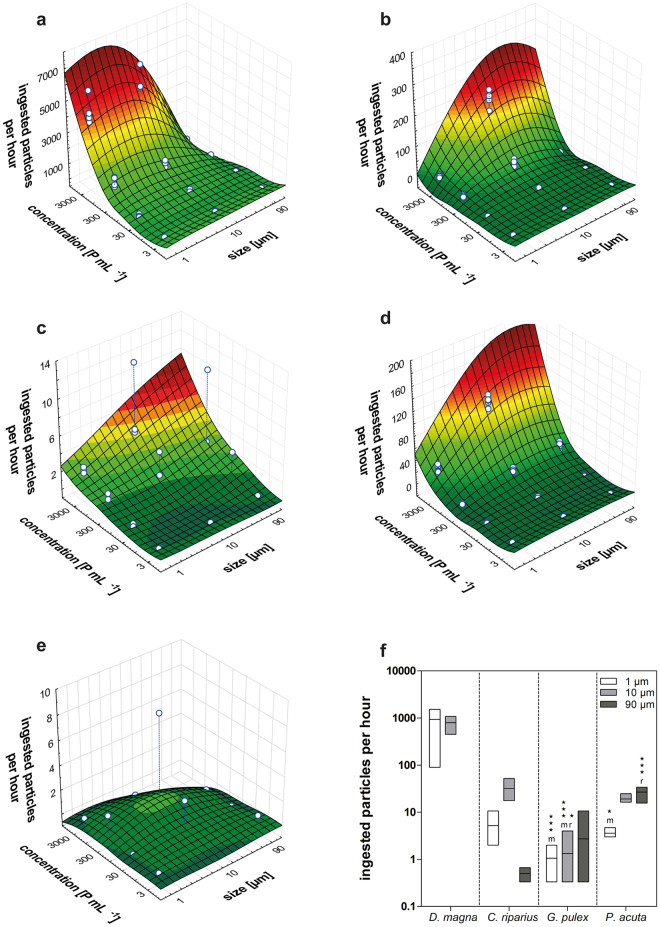
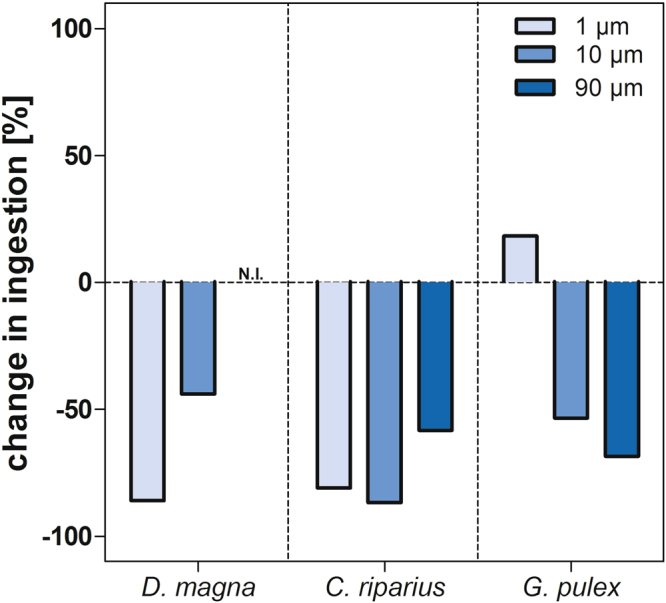
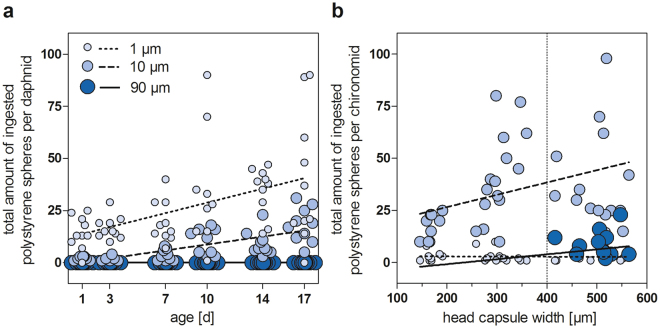
Abstract Microscopic plastic items (microplastics) are ubiquitously present in aquatic ecosystems. With decreasing size their availability and potential to accumulate throughout food webs increase. However, little is known on the uptake of microplastics by freshwater invertebrates. To address this, we exposed species with different feeding strategies to 1, 10 and 90 µm fluorescent polystyrene spheres (3–3 000 particles mL−1). Additionally, we investigated how developmental stages and a co-exposure to natural particles (e.g., food) modulate microplastic ingestion. All species ingested microplastics in a concentration-dependent manner with Daphnia magna consuming up to 6 180 particles h−1, followed by Chironomus riparius (226 particles h−1), Physella acuta (118 particles h−1), Gammarus pulex (10 particles h−1) and Lumbriculus variegatus (8 particles h−1). D. magna did not ingest 90 µm microplastics whereas the other species preferred larger microplastics over 1 µm in size. In C. riparius and D. magna, size preference depended on the life stage with larger specimens ingesting more and larger microplastics. The presence of natural particles generally reduced the microplastics uptake. Our results demonstrate that freshwater invertebrates have the capacity to ingest microplastics. However, the quantity of uptake depends on their feeding type and morphology as well as on the availability of microplastics.
Overview
The claims and statistics of this paper haven’t been checked yet.
Run the check — free, no account needed. It reads the open-access text and checks the sources it cites.
Integrity signals
Registry
Cites
Statistics
Figures
Verification
Claims the paper makes
The claims and statistics of this paper haven’t been checked yet.
Run the check — free, no account needed. It reads the open-access text and checks the sources it cites.
Claims other papers make about this one
Each is checked against this paper’s own text: does it say what the citing paper says it does?
The source backs part of the claim, not all of it — or backs it for a different population, condition or comparison.
In the citing paper
“Previous studies have indeed demonstrated that microplastics are taken up from sediments by freshwater species10−15 and that the capacity of freshwater invertebrates to ingest microplastics depends on their feeding type.15”
From Microplastic Effect Thresholds for Freshwater Benthic Macroinvertebrates (2018) · cites this paper as [15]
Experimental — accuracy not yet measuredThe source backs part of the claim, not all of it — or backs it for a different population, condition or comparison.
In the citing paper
“This is in accordance with previous studies showing that microplastic uptake by freshwater invertebrates is size- specific and feeding type dependent and that irregularly shaped microplastics need a significant longer clearance time in comparison to spherical microplastics.11,15”
From Microplastic Effect Thresholds for Freshwater Benthic Macroinvertebrates (2018) · cites this paper as [15]
Experimental — accuracy not yet measuredThe source backs part of the claim, not all of it — or backs it for a different population, condition or comparison.
In the citing paper
“Both laboratory experiments and in situ observations have confirmed that organisms of various trophic levels ingest or uptake microplastics, either directly or indirectly (Cole et al., 2013;Provencher et al., 2018;Scherer et al., 2017;Setälä et al., 2014).”
From No Effect of Realistic Concentrations of Polyester Microplastic Fibers on Freshwater Zooplankton Communities (2024) · cites this paper as Scherer et al., 2017
Experimental — accuracy not yet measuredThe cited source says what the claim attributes to it.
In the citing paper
“Such differences between study outcomes may relate to (a) differences in the exposure medium, as the presence of natural particles seems to reduce the ingestion of microplastics in freshwater invertebrates,15 and (b) to a higher bioavailability of particles in suspension as compared to particles mixed in the sediment as in the present bioassays.”
From Microplastic Effect Thresholds for Freshwater Benthic Macroinvertebrates (2018) · cites this paper as [15]
Self-check
Percentages, sums and reported differences re-computed from the paper’s own numbers.
The self-check needs the paper’s full text.
Citations
Cites
Lost at sea: where is all the plastic?
Thompson, R. C., Olsen, Y., Mitchell, R. P., Davis, A., Rowland, S. J., John, A. W. G., McGonigle, D., & Russell, A. E. (2004) · Science · doi:10.1126/science.1094559 · Cited by 7,765
Eerkes-Medrano, D., Thompson, R. C., & Aldridge, D. C. (2015) · Water Research · doi:10.1016/j.watres.2015.02.012 · Cited by 2,638
Lu, Y., Zhang, Y., Deng, Y., Jiang, W., Zhao, Y., Geng, J., Ding, L., & Ren, H. (2016) · Environmental Science & Technology · doi:10.1021/acs.est.6b00183 · Cited by 2,125
Microplastics in bivalves cultured for human consumption
Cauwenberghe, L. V., & Janssen, C. (2014) · Environmental Pollution · doi:10.1016/j.envpol.2014.06.010 · Cited by 2,105
von Moos, N., Burkhardt-Holm, P., & Köhler, A. (2012) · Environmental Science & Technology · doi:10.1021/es302332w · Cited by 1,697
Microplastics in freshwater ecosystems: what we know and what we need to know
Wagner, M., Scherer, C., Alvarez-Muñoz, D., Brennholt, N., Bourrain, X., Buchinger, S., Fries, E., Grosbois, C., Klasmeier, J., Marti, T., et al. (2014) · Environmental Sciences Europe · doi:10.1186/s12302-014-0012-7 · Cited by 1,543
Self-citationCole, M., Lindeque, P., Fileman, E., Halsband, C., & Galloway, T. S. (2015) · Environmental Science & Technology · doi:10.1021/es504525u · Cited by 1,308
Klein, S., Worch, E., & Knepper, T. P. (2015) · Environmental Science & Technology · doi:10.1021/acs.est.5b00492 · Cited by 1,181
Nanoplastic Affects Growth of S. obliquus and Reproduction of D. magna
Besseling, E., Wang, B., Lürling, M., & Koelmans, A. A. (2014) · Environmental Science & Technology · doi:10.1021/es503001d · Cited by 1,138
Characterisation of nanoplastics during the degradation of polystyrene
Lambert, S., & Wagner, M. (2016) · Chemosphere · doi:10.1016/j.chemosphere.2015.11.078 · Cited by 1,075
Self-citation
Cited by
Sorted by citations
Hartmann, N. B., Hüffer, T., Thompson, R. C., Hassellöv, M., Verschoor, A., Daugaard, A. E., Rist, S., Karlsson, T., Brennholt, N., Cole, M., et al. (2019) · Environmental Science & Technology · doi:10.1021/acs.est.8b05297 · Cited by 2,881
Self-citationAkdoğan, Z., & Güven, B. (2019) · Environmental Pollution · doi:10.1016/j.envpol.2019.113011 · Cited by 863
Burns, E. E., & Boxall, A. B. A. (2018) · Environmental Toxicology and Chemistry · doi:10.1002/etc.4268 · Cited by 713
Li, B., Ding, Y., Cheng, X., Sheng, D., Xu, Z., Rong, Q., Wu, Y., Zhao, H., Ji, X., & Zhang, Y. (2019) · Chemosphere · doi:10.1016/j.chemosphere.2019.125492 · Cited by 729
Spatiotemporal distribution and annual load of microplastics in the Nakdong River, South Korea
Eo, S., Hong, S. H., Song, Y. K., Han, G. M., & Shim, W. J. (2019) · Water Research · doi:10.1016/j.watres.2019.05.053 · Cited by 608
Metadata
- Authors
- Scherer, C., Brennholt, N., Reifferscheid, G., & Wagner, M.
- Affiliations
- Goethe University Frankfurt (DE)
- Federal Institute of Hydrology (DE)
- Corresponding author
- Scherer, Christian
- Venue
- Scientific Reports
- Published
- 2017-12-05
- Volume
- 7
- Issue
- 1
- Pages
- 17006-17006
- ISSN
- 2045-2322 (ISSN-L)
- PMC
- PMC5717137
- OpenAlex
- W2770802549
- Cited by
- 448
- References
- 69
- Citations by year
- 2026: 45 · 2025: 48 · 2024: 66 · 2023: 58 · 2022: 64 · 2021: 63 · 2020: 52 · 2019: 37 · 2018: 13 · 2017: 1
- FWCI
- 12.68
- Type
- journal article
- Language
- en
- Open access
- gold
- doi.org
- Locations
- Scientific Reports (publishedVersion, cc-by)
- Europe PMC (PubMed Central) (publishedVersion, cc-by)
- PubMed Central (publishedVersion, cc-by)
- PubMed (publishedVersion)
- BIBSYS Brage (BIBSYS (Norway)) (acceptedVersion, cc-by)
- DOAJ (DOAJ: Directory of Open Access Journals) (submittedVersion)
- NORA - Norwegian Open Research Archives (submittedVersion, cc-by)
- Publication Server of Goethe University Frankfurt am Main (Goethe University Frankfurt) (submittedVersion, cc-by)
- Funders
- Bundesministerium für Bildung und Forschung
- Topics
- Physical Sciences › Environmental Science › Pollution › Microplastics and Plastic Pollution
- Physical Sciences › Environmental Science › Health, Toxicology and Mutagenesis › Environmental Toxicology and Ecotoxicology
- Physical Sciences › Environmental Science › Pollution › Pharmaceutical and Antibiotic Environmental Impacts
- Keywords
- microplastics, microplastic ingestion, freshwater invertebrates, feeding type, developmental stages, Daphnia magna, Chironomus riparius, Physella acuta, Gammarus pulex, Lumbriculus variegatus, polystyrene microspheres
- MeSH terms
- Animals, Chironomidae, Daphnia, Eating, Fresh Water, Invertebrates, Plastics, Water Pollutants, Chemical, Ecosystem, Food Chain, Amphipoda
About these checks
Registry, retraction, Cites and statistics results are computed, not judged, with one exception: a printed reference that no index lists is read once by a model before it counts as a citation error. Claims are extracted by a model and kept only when their quote appears verbatim in the text; each cited source is then checked, with a model’s help, for whether it says what the claim relies on. Those verdicts can be wrong — read the claim’s quote and the cited source before relying on one.
Statistics and arithmetic are recomputed, not judged.
Confidence bands are shown only for fields calibrated on our annotated test set. None is calibrated yet, so no band is shown.
What counts as a claim ›How we measure confidence ›How we check this ›
Are you an author, or do you see a problem with this page? Request a review
