

The Effect of Time, Roasting Temperature, and Grind Size on Caffeine and Chlorogenic Acid Concentrations in Cold Brew Coffee
Open accessThe DOI matches its Crossref record; 40 of the 41 references it cites were found in a registry or an index; 4 of the 20 sources its claims cite were checked for support.
Abstract
The extraction kinetics and equilibrium concentrations of caffeine and 3-chlorogenic acid (3-CGA) in cold brew coffee were investigated by brewing four coffee samples (dark roast/medium grind, dark roast/coarse grind, medium roast/medium grind, medium roast/coarse grind) using cold and hot methods. 3-CGA and caffeine were found at higher concentrations in cold brew coffee made with medium roast coffees, rather than dark roast. The grind size did not impact 3-CGA and caffeine concentrations of cold brew samples significantly, indicating that the rate determining step in extraction for these compounds did not depend on surface area. Caffeine concentrations in cold brew coarse grind samples were substantially higher than their hot brew counterparts. 3-CGA concentrations and pH were comparable between cold and hot brews. This work suggests that the difference in acidity of cold brew coffee is likely not due to 3-CGA or caffeine concentrations considering that most acids in coffee are highly soluble and extract quickly. It was determined that caffeine and 3-CGA concentrations reached equilibrium according to first order kinetics between 6 and 7 hours in all cold brew samples instead of 10 to 24 hours outlined in typical cold brew methods.
Overview
CoChat Summary
## TL;DR
This study compared cold and hot brewing of Kona Arabica coffee to see how roast level, grind size, and time affect caffeine, 3-chlorogenic acid (3-CGA), and pH. It found that both caffeine and 3-CGA reached equilibrium in cold brew by about 400 minutes (6.7 hours), medium roasts had higher concentrations than dark roasts, and grind size had little effect on equilibrium concentrations.
## Key findings
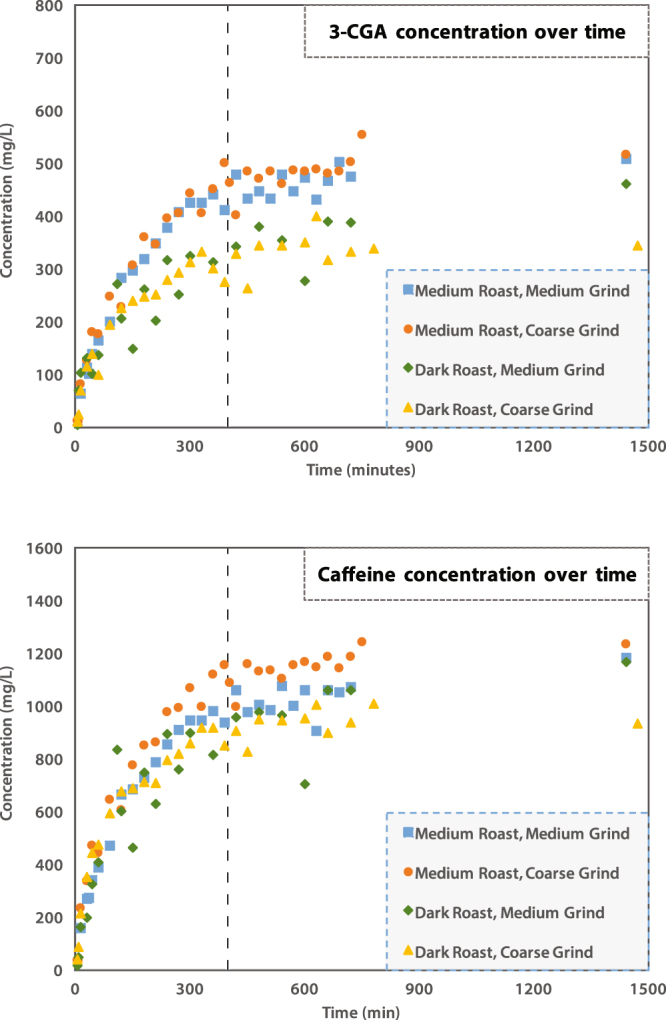
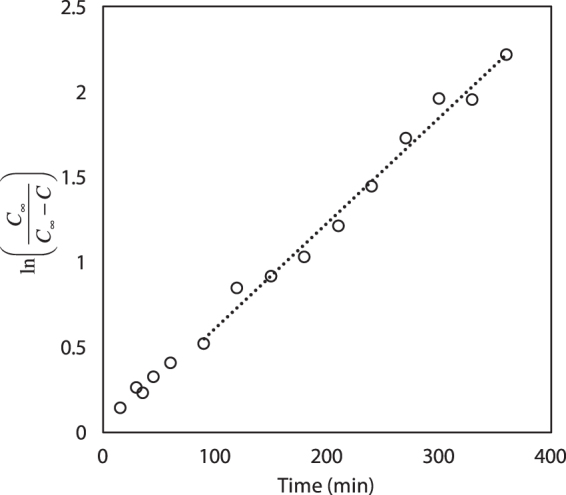
- In all cold brew samples, caffeine and 3-CGA followed first-order kinetics and reached nearly steady-state concentrations after about 400 minutes; the abstract says equilibrium was reached between 6 and 7 hours.
- Medium roast coffees had higher 3-CGA and caffeine concentrations than dark roast coffees.
- Grind size did not significantly impact 3-CGA or caffeine concentrations in cold brew; the paper says this suggests the rate-determining step did not depend on surface area.
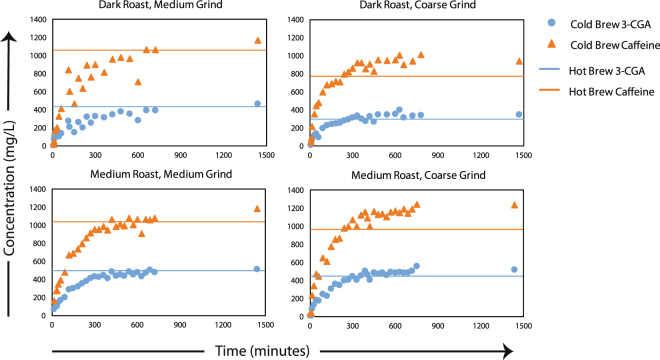
- For coarse grind samples, caffeine concentrations were substantially higher in cold brew than hot brew, while 3-CGA concentrations and pH were comparable between cold and hot brews.
- The measured pH ranged from 5.40 to 5.63, and the paper says this was not enough evidence to support a link between high 3-CGA and low pH.
## Methods
- Experimental comparison of four coffee conditions: dark roast/medium grind, dark roast/coarse grind, medium roast/medium grind, and medium roast/coarse grind; each was brewed by both cold and hot methods.
- Coffee source and setup: single-origin Arabica (Kona Typica) from Kona Joe Coffee; brewed at a 35.0 g coffee / 350 mL water ratio for cold brew, with hot brew at 98 °C for 6 minutes.
- Main analyses: HPLC measurement of caffeine and 3-CGA, pH measurement, sieve analysis for particle size distribution, and two-tailed t-tests and ANOVA for equilibrium comparisons.
## Limitations
- The paper states that grind size was not well controlled because it used commercially available coffee “without any size separation prior to extraction.”
- The authors note that high standard deviations were likely caused by heterogeneous grind size distributions and settling of finer particles during handling.
- Evidence from the text suggests limited generalizability beyond this setup: the study used one single-origin coffee and brewing conditions intended to mimic home brewing (this is evident from the text).
Model-written summary. Check it against the paper before relying on it.
Integrity signals
Registry
Cites
Statistics
Figures
Verification
Claims the paper makes
4 Valid · 0 Not valid · 9 Not checked · 47 Own results and interpretations
A result the paper reports from its own data — it cites no other source for it, so there is none to check. The quote shows it is in the paper.
In the paper
“The grind size did not impact 3-CGA and caffeine concentrations of cold brew samples significantly, indicating that the rate determining step in extraction for these compounds did not depend on surface area.”
- Also stated in: § Discussion and Conclusional Remarks · hedged
“Furthermore, our analysis indicates that the grind size does not have significant impact the observed equilibrium concentrations for both CGA and caffeine.”
§ The Effect of Time, Roasting Temperature, and Grind Size on Caffeine and Chlorogenic Acid Concentrations in Cold Brew Coffee > Abstract
hedgedn = 4- Asserted: passes — The authors put it forward as true.
- Checkable: passes — It can be checked against evidence.
- Load-bearing: passes — The paper’s conclusions depend on it.
- Based: passes — The paper gives a reason why it holds.
- Also stated in: § Discussion and Conclusional Remarks · hedged
A result the paper reports from its own data — it cites no other source for it, so there is none to check. The quote shows it is in the paper.
In the paper
“It was determined that caffeine and 3-CGA concentrations reached equilibrium according to first order kinetics between 6 and 7 hours in all cold brew samples instead of 10 to 24 hours outlined in typical cold brew methods.”
- Also stated in: § Kinetics of cold brew coffee extraction · plain
“Initial 3-CGA concentration increased rapidly over the first 180 minutes and slowed until reaching equilibrium at approximately 400 minutes for all coffee roasts and grinds (see Fig. 1).”
- Also stated in: § Kinetics of cold brew coffee extraction · hedged
“Similar to 3-CGA, caffeine also reaches nearly steady-state concentrations after 400 minutes (see Fig. 1).”
§ The Effect of Time, Roasting Temperature, and Grind Size on Caffeine and Chlorogenic Acid Concentrations in Cold Brew Coffee > Abstract
plainstates a causen = 4- Asserted: passes — The authors put it forward as true.
- Checkable: passes — It can be checked against evidence.
- Load-bearing: passes — The paper’s conclusions depend on it.
- Based: passes — The paper gives a reason why it holds.
- Also stated in: § Kinetics of cold brew coffee extraction · plain
A result the paper reports from its own data — it cites no other source for it, so there is none to check. The quote shows it is in the paper.
In the paper
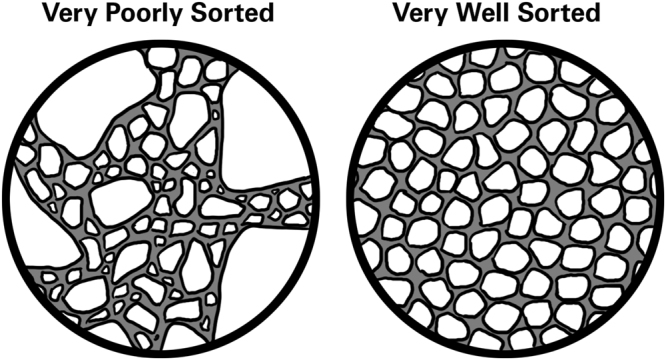
“The grain size distributions of the four samples show that the “medium” grind coffees had wider particle distributions, both containing about 5% of particles, by mass, that are larger than 3350 µm.”
§ The Effect of Time, Roasting Temperature, and Grind Size on Caffeine and Chlorogenic Acid Concentrations in Cold Brew Coffee > Results > Kinetics of cold brew coffee extraction
plainn = 4- Asserted: passes — The authors put it forward as true.
- Checkable: passes — It can be checked against evidence.
- Load-bearing: unclear — It is unclear whether the paper’s conclusions depend on it.
- Based: passes — The paper gives a reason why it holds.
A result the paper reports from its own data — it cites no other source for it, so there is none to check. The quote shows it is in the paper.
In the paper
“3-CGA concentrations and pH were comparable between cold and hot brews.”
- Also stated in: § Comparison of hot brew and cold brew coffee · plain
“In both hot and cold brew extractions, all samples show comparable average 3-CGA concentrations and pH, regardless of water temperature.”
- Also stated in: § Discussion and Conclusional Remarks · plain
“No significant differences were seen in CGA concentrations between cold and hot brews.”
§ The Effect of Time, Roasting Temperature, and Grind Size on Caffeine and Chlorogenic Acid Concentrations in Cold Brew Coffee > Abstract
plainn = 4- Asserted: passes — The authors put it forward as true.
- Checkable: passes — It can be checked against evidence.
- Load-bearing: passes — The paper’s conclusions depend on it.
- Based: passes — The paper gives a reason why it holds.
- Also stated in: § Comparison of hot brew and cold brew coffee · plain
A result the paper reports from its own data — it cites no other source for it, so there is none to check. The quote shows it is in the paper.
In the paper
“Caffeine concentrations in cold brew coarse grind samples were substantially higher than their hot brew counterparts.”
- Also stated in: § Caffeine · plain
“Coarse grain samples, both medium and dark roast, showed a considerable deviation in caffeine concentrations between hot and cold brew extractions (Table 3). In both samples, the cold brew coffee was found to have the higher concentration of caffeine.”
- Also stated in: § Discussion and Conclusional Remarks · plain
“Moreover, coarse grain samples, both medium and dark roast, showed a substantial increase in caffeine concentrations than their hot brew counterparts.”
§ The Effect of Time, Roasting Temperature, and Grind Size on Caffeine and Chlorogenic Acid Concentrations in Cold Brew Coffee > Abstract
plainstates an association- Asserted: passes — The authors put it forward as true.
- Checkable: passes — It can be checked against evidence.
- Load-bearing: passes — The paper’s conclusions depend on it.
- Based: passes — The paper gives a reason why it holds.
- Also stated in: § Caffeine · plain
31 more claims
Create a free account to see all 60 claims and every source verdict.
- Probably not a substantial claim. 12
- It may state two separate claims as one. 14
Claims other papers make about this one
Each is checked against this paper’s own text: does it say what the citing paper says it does?
The source backs part of the claim, not all of it — or backs it for a different population, condition or comparison.
In the citing paper
“The current general practice of cold brew falls between 12 to 24 h12,28,32,33.”
From Sensory analysis of the flavor profile of full immersion hot, room temperature, and cold brewed coffee over time (2024) · cites this paper as [33]
Experimental — accuracy not yet measuredThe source backs part of the claim, not all of it — or backs it for a different population, condition or comparison.
In the citing paper
“An exhaustive literature search returned only four peer-reviewed studies related to cold brew coffee29–32.”
From Acidity and Antioxidant Activity of Cold Brew Coffee (2018) · cites this paper as [32]
Experimental — accuracy not yet measured
Citations
Cites
Chlorogenic acid (CGA): A pharmacological review and call for further research
Naveed, M., Hejazi, V., Abbas, M., Kamboh, A. A., Khan, G. J., Shumzaid, M., Ahmad, F., Babazadeh, D., FangFang, X., Modarresi-Ghazani, F., et al. (2018) · Biomedicine & Pharmacotherapy · doi:10.1016/j.biopha.2017.10.064 · Cited by 1,586
In vitro and in vivo antioxidant properties of chlorogenic acid and caffeic acid
Sato, Y., Itagaki, S., Kurokawa, T., Ogura, J., Kobayashi, M., Hirano, T., Sugawara, M., & Iseki, K. (2011) · International Journal of Pharmaceutics · doi:10.1016/j.ijpharm.2010.09.035 · Cited by 965
Engineering plants with increased levels of the antioxidant chlorogenic acid
Niggeweg, R., Michael, A. J., & Martin, C. (2004) · Nature Biotechnology · doi:10.1038/nbt966 · Cited by 814
Effect of Roasting on the Formation of Chlorogenic Acid Lactones in Coffee
Farah, A., de Paulis, T., Trugo, L. C., & Martin, P. R. (2005) · Journal of Agricultural and Food Chemistry · doi:10.1021/jf048701t · Cited by 540
Effect of Roasting on the Antioxidant Activity of Coffee Brews
del Castillo, M. D., Ames, J. M., & Gordon, M. H. (2002) · Journal of Agricultural and Food Chemistry · doi:10.1021/jf011702q · Cited by 372
Coffee in Health and Disease Prevention
(2015) · Elsevier eBooks · doi:10.1016/c2012-0-06959-1 · Cited by 338
Hečimović, I., Belščak-Cvitanović, A., Horžić, D., & Komes, D. (2011) · Food Chemistry · doi:10.1016/j.foodchem.2011.05.059 · Cited by 334
Comparison of nine common coffee extraction methods: Instrumental and sensory analysis
Gloess, A. N., Schönbächler, B., Klopprogge, B., D`Ambrosio, L., Chatelain, K., Bongartz, A., Strittmatter, A., Rast, M., & Yeretzian, C. (2013) · European Food Research and Technology · doi:10.1007/s00217-013-1917-x · Cited by 311
Potent odorants of the roasted powder and brew of Arabica coffee
Blank, I., Sen, A., & Grosch, W. (1992) · Zeitschrift f�r Lebensmittel-Untersuchung und -Forschung · doi:10.1007/bf01202802 · Cited by 280
Chlorogenic acid and caffeine contents in various commercial brewed coffees
Fujioka, K., & Shibamoto, T. (2008) · Food Chemistry · doi:10.1016/j.foodchem.2007.05.091 · Cited by 258
Research works printed but not linked: 4
- Chu, Y.-F. Coffee: Emerging Health Effects and Disease Prevention. (John Wiley & Sons, 2012).
- Kim AR Kim JS Flavor Contributing Nonvolatile Chemical and Sensory Characterization of Cold Water Extraction-based Coffee by Different ExtractionMethods (Dripping vs Steeping) and Time Journal of The Korea Society for Coffee Industry 2014 3 1 9
- Budavari, S., O’Neil, M., Smith, A., Heckelman, P. & Obenchain, J. The Merck Index, Print Version, Twelfth Edition. (CRC Press, 1996).
- Spiro M Selwood RM The kinetics and mechanism of caffeine infusion from coffee: The effect of particle size J. Sci. Food Agric. 1984 35 915 924 10.1002/jsfa.2740350817 · DOI · Paper page
Cited by
Items 101–179 of 179
Barroso, L. A., Viegas, C., Stančiauskaitė, M., Macedo, A. S., Lemos, I. L., da Costa, J. M. G., Schmiele, M. M., da Silveira, J. V. W., Brandão, P., Amaral, T. N., et al. (2024) · Food and Bioprocess Technology · doi:10.1007/s11947-024-03387-z · Cited by 9
“And similar results were reported by Fuller and Rao (2017), who found values of approximately 1.2 mg/mL for extraction of 5 h at a temperature of 24 °C.”
InfluentialPutro, A. W., Zulkarnaen, F. M., Sari, A., Anggrahini, S., & Setyaningsih, W. (2022) · Indonesian Food and Nutrition Progress · doi:10.22146/ifnp.65741 · Cited by 5
Phenolic Compounds in Coffee and Tea Beverages
Jeszka‐Skowron, M., Zgoła‐Grześkowiak, A., & Grześkowiak, T. (2021) · Food bioactive ingredients · doi:10.1007/978-3-030-61879-7_3 · Cited by 15
Otsogile, K., Seifu, E., & Bultosa, G. (2022) · Heliyon · doi:10.1016/j.heliyon.2022.e10829 · Cited by 9
“It was determined that increased roasting temperatures results in degradation of chlorogenic acid precursors and lower extractable total chlorogenic acid concentrations (Blumberg et al., 2010; Fuller and Rao, 2017).”
Chongsrimsirisakhol, O., Jangchud, K., Wilde, P. J., & Pirak, T. (2025) · Food Science & Nutrition · doi:10.1002/fsn3.70131 · Cited by 6
Zwicker, M., Phillips, J., & Lim, L. (2024) · Journal of Food Engineering · doi:10.1016/j.jfoodeng.2024.112242 · Cited by 7
Effect of ultraviolet irradiation on the shelf life and chemical composition of cold brew coffee
Orjuela, M. A., Moreno, F. L., Córdoba, N., Osorio, C., & Ruiz-Pardo, R. Y. (2024) · Food and Bioproducts Processing · doi:10.1016/j.fbp.2024.11.007 · Cited by 4
Impact of pH and Temperature on Foodborne Pathogens’ Survival in Cold Brew Coffee
Singh, A., Sawale, M., Kaur, H., Benyathiar, P., & Mishra, D. K. (2025) · Journal of Food Safety · doi:10.1111/jfs.70024 · Cited by 4
Chlorogenic acids in different coffees
Oussou, K. F., Büyükkurt, Ö. K., Güçlü, G., Kelebek, H., & Selli, S. (2024) · Elsevier eBooks · doi:10.1016/b978-0-443-13868-3.00036-3 · Cited by 7
Wang, Z., Zhou, Y., Zong, Y., Wu, J., & Lao, F. (2025) · Foods · doi:10.3390/foods14162840 · Cited by 4
Morresi, A. M., Truglio, K., Specchio, J., & Kerrihard, A. L. (2020) · International Journal of Food Science & Technology · doi:10.1111/ijfs.14824 · Cited by 7
Sensory Quality Profile of Ranah Minang Arabica Coffee Specialty
Fadri, R. A., Sayuti, K., Nazir, N., & Suliansyah, I. (2021) · International Journal on Advanced Science Engineering and Information Technology · doi:10.18517/ijaseit.11.1.11179 · Cited by 7
Intelligent Electrochemical Sensing: A New Frontier in On-the-Fly Coffee Quality Assessment
Grasso, S., Loreto, M. V. D., Zompanti, A., Ciarrocchi, D., Gara, L. D., Pennazza, G., Vollero, L., & Santonico, M. (2025) · Chemosensors · doi:10.3390/chemosensors13010024 · Cited by 5
Foster, J. M., Lee, W. T., Moroney, K. M., Prjamkov, D., Salamon, M., Smith, A. P., Petrassem-de-Sousa, J., & Vynnycky, M. (2025) · Physics of Fluids · doi:10.1063/5.0245167 · Cited by 3
Hęś, M., Kucharski, J. J., Alves, R. C., Machado, S., de Oliveira, M. B., Ariyarathna, P., Walkowiak, J., & Dziedzic, K. (2025) · Future Foods · doi:10.1016/j.fufo.2025.100885 · Cited by 3
Mohamed, A. I., Olofinsan, K. A., Salau, V. F., Erukainure, O. L., & Islam, M. S. (2024) · Food Production Processing and Nutrition · doi:10.1186/s43014-024-00247-3 · Cited by 4
“However, considering potential chemical variations between hot and cold coffee, it has previously been stated that a reduction in chlorogenic acid content is associated with increased coffee temperature (Fuller & Rao, 2017).”
BackgroundProcessing and Shelf Life of Cold Brew Organic Coffee
Soares, E. A., Bento, G. P., Nogueira, L., Arismendes, T. L. C., Machado, C. L. D. O., Guerra, E. L., Verruma-Bernardi, M. R., & Petrus, R. R. (2025) · Processes · doi:10.3390/pr13010243 · Cited by 4
Gök, İ. (2021) · Food and Health · doi:10.3153/fh21032 · Cited by 7
DÖNERKAYALI, A., & Türker, T. (2021) · TURKISH JOURNAL OF ELECTRICAL ENGINEERING & COMPUTER SCIENCES · doi:10.3906/elk-2009-20 · Cited by 3
Zwicker, M., & Lim, L. (2023) · Journal of Food Process Engineering · doi:10.1111/jfpe.14509 · Cited by 5
Assessment of the physical stability of cold brew coffee in retorted beverages
Kazes, S., Sanchez, J., Quintero, M., Velásquez, S., Restrepo, T., & Casanova, H. (2024) · Journal of Food Composition and Analysis · doi:10.1016/j.jfca.2024.106210 · Cited by 5
Physicochemical, Antioxidant and Mineral Composition of Cascara Beverage Prepared by Cold Brewing
Muriqi, S., Červenka, L., Česlová, L., Kašpar, M., Řezková, S., Husáková, L., Patočka, J., Česla, P., & Velichová, H. (2025) · Food Technology and Biotechnology · doi:10.17113/ftb.63.01.25.8605 · Cited by 3
Coffee beverage sedimentation: From roasting effects to storage stability
Seo, D., Kang, J.-U., So, Y.-S., & Yoo, S.-H. (2025) · Food Chemistry · doi:10.1016/j.foodchem.2025.147387 · Cited by 4
Effects of grind size and brewing time on properties of cold brewed Robusta Ijen coffee
JAYUS, J., Darmajana, D. A., Fitria, A. N., & Afriliana, A. (2026) · Journal of Food Science and Technology · doi:10.1007/s13197-026-06628-5 · Cited by 3
Fatolahi, H., Farahmand, A. H. T., & Rezakhani, S. (2020) · Nutrition and Food Sciences Research · doi:10.29252/nfsr.7.2.1 · Cited by 2
“Fuller and Rao, 2017 [33] Research article/ Coffee samples Cold and hot methods 3-CGA concentrations and pH were comparable between cold and hot brews.”
BackgroundWHAT PHYSICIANS SHOULD KNOW ABOUT COFFEE
Khalifa, A. A. (2022) · TURKISH MEDICAL STUDENT JOURNAL · doi:10.4274/tmsj.galenos.2022.09.01.02 · Cited by 2
“Second- Cold brew coffee (different from iced coffee) can be prepared by steeping the coffee grounds in water at room temperature between 8 and 24 hours and then served with ice in it (48).”
Lim, G. C. W., Hou, C., Hsieh, L., Wu, S., & Ciou, J. (2022) · Journal of Food Processing and Preservation · doi:10.1111/jfpp.17273 · Cited by 2
Comparison of caffeine content in different types of coffee in Saudi Arabia
Baz, L., Alghifari, R. M., Nafadi, S. K., Alharbi, A. A., Al-Zahrani, M. H., Alazdi, F. A., & Balgoon, M. J. (2024) · Journal Of Advanced Pharmacy Education And Research · doi:10.51847/8gklderiih · Cited by 3
Nugrahini, N. I. P., Wardani, A. K., Martati, E., & Rohman, M. S. (2024) · Trends in Sciences · doi:10.48048/tis.2024.7265 · Cited by 3
“The decrease in the caffeine content might be due to the prolonged extraction time, which leads to increased temperature in the extraction medium and degrades the caffeine [35,36].”
BackgroundChen, N., Xie, K., Jiao, Z., Zhang, W. Y., Deng, H., Ashaolu, T. J., Cheng, K., & Zhao, C. (2025) · Journal of Dairy Science · doi:10.3168/jds.2025-26795 · Cited by 4
Inhibition of Candida albicans growth by steeping freeze-dried robusta ground coffee
Purwanto, P., Sagita, Y. A., Lestari, P. E., et al. (2020) · Coffee Science · doi:10.25186/cs.v15i.1638 · Cited by 2
Caffeine extraction from Arabic coffee: The role of brewing and roasting
AlShareef, S. M. (2021) · Imam Journal of Applied Sciences · doi:10.4103/ijas.ijas_6_21 · Cited by 3
Determining the Efficiency and Yield of Caffeine Extraction for Robusta and Arabica Coffee Beans
Yu, Z., Reddy, A. J., & Wagh, H. (2021) · Applied Cell Biology · doi:10.53043/2320-1991.acb90013 · Cited by 2
Kouli, G.-M., Panagiotakos, D. B., Georgousopoulou, E. N., Mellor, D. D., Chrysohoou, C. A., Zana, A., Tsigos, C., Tousoulis, D. M., Stefanadis, C., & Pitsavos, C. E. (2017) · European Journal of Nutrition · doi:10.1007/s00394-017-1487-y · Cited by 2
Karpova, M. O., Makarova, N. V., Ignatova, D. F., & Budylin, D. V. (2021) · Научный журнал НИУ ИТМО. Серия «Процессы и аппараты пищевых производств» · doi:10.17586/2310-1164-2021-14-3-49-59 · Cited by 2
Food Processing and Its Impact on Phenolic and other Bioactive Constituents in Food
Oszmiański, J., & Lachowicz, S. (2022) · MDPI eBooks · doi:10.3390/books978-3-0365-4459-5 · Cited by 1
Rahmawati, I., & Asrori, S. H. (2024) · JKPK (Jurnal Kimia dan Pendidikan Kimia) · doi:10.20961/jkpk.v9i1.84991 · Cited by 2
Cold Brew Coffee: Profile and Preservation
Soares, E. A., & Petrus, R. R. (2024) · Food Reviews International · doi:10.1080/87559129.2024.2438301 · Cited by 2
“Fuller and Rao [44] compared the caffeine concentration in CBC made using the immersion method and in hot drinks, both with medium roast beans, reporting a higher concentration in CBC. Conversely, Lane et al. [88] found no significant difference in caffeine concentration when analyzing hot drinks…”
InfluentialNILOVA, L. P., Malyutenkova, S. M., & Tverskoy, V. (2025) · New Technologies · doi:10.47370/2072-0920-2024-20-4-35-44 · Cited by 1
Córdoba, N., Moreno, F. L., Osorio, M., Osorio, C., & Ruiz-Pardo, R. Y. (2025) · European Food Research and Technology · doi:10.1007/s00217-025-04871-2 · Cited by 1
“A temperature of 19 °C was chosen to align with industry standards, preserve the sensory attributes characteristic of cold brew beverages, and facilitate direct comparison with existing studies on low-temperature coffee extraction [10,27].”
Gulshan, A., Yiasmin, M. N., Zeb, M., Mushtaq, A., Cao, W., Lu, R., Li, X., & Hua, X. (2025) · Food Chemistry · doi:10.1016/j.foodchem.2025.147716 · Cited by 5
Baek, J. Y., Lee, J. Y., Han, S. O., & Hyeon, J. E. (2026) · Biotechnology and Bioprocess Engineering · doi:10.1007/s12257-026-00280-8 · Cited by 1
“Cold brew coffee tends to contain higher caffeine concentrations due to its extrac - tion characteristics, sometimes exceeding 200 mg per cup [67].”
Differences in chemical characteristics due to different roasting of robusta coffee beans
Ramadhani, A. F., Nisa, F. C., & Yunianta, Y. (2023) · Coffee Science · doi:10.25186/.v18i.2116 · Cited by 2
von Heynitz, C., Ohlmann, K., Schmieder, B. K. L., Hofmann, T., & Glas, K. (2023) · Journal of Food Process Engineering · doi:10.1111/jfpe.14473 · Cited by 2
Jeong, H.-S., Lee, S.-Y., Kim, K.-H., Lee, M.-Y., Choi, J., Ahn, J.-S., Oh, J.-M., Kwon, K., & Lee, H. (2024) · Journal of Food Hygiene and Safety · doi:10.13103/jfhs.2024.39.2.61 · Cited by 1
Lee, S., Eun-Mee, H., Kang, J., Kwon, S., Sung, M., Kim, M., Cho, H., & Lee, G. (2025) · Beverages · doi:10.3390/beverages11010010 · Cited by 2
Laily, N., Wijayanti, S. P., Alfakar, M. A., et al. (2025) · IOP Conference Series Earth and Environmental Science · doi:10.1088/1755-1315/1485/1/012007 · Cited by 1
Cubbage, T. (2019) · The Science Teacher · doi:10.2505/4/tst19_086_07_35 · Cited by 1
Ryu, K.-Y., Gang, G., Park, H., et al. (2021) · Journal of Food Hygiene and Safety · doi:10.13103/jfhs.2021.36.2.172 · Cited by 1
Violin, J. L., Acre, L. B., Francisco, J. S., Mori, A. L. B., & Benassi, M. D. T. (2021) · Coffee Science · doi:10.25186/.v16i.1911 · Cited by 2
Santoso, F., Oktavianti, N., Pandiangan, F. I., Nion, Y. A., & Puteri, M. D. P. T. G. (2022) · Advances in biological sciences research/Advances in Biological Sciences Research · doi:10.2991/absr.k.220101.013 · Cited by 3
Inhibition of Candida albicans growth by steeping freeze-dried robusta ground coffee
Purwanto, P., Sagita, Y. A., Lestari, P. E., Praharani, D., Jani, Y., & Yaro, A. (2020) · Coffee Science · doi:10.25186/.v15i.1638 · Cited by 2
Green synthesis of fuel grade hydrocarbons from spent coffee grounds
Mkhonto, B. (2021) · DUT Open Scholar (Durban University of Technology) · doi:10.51415/10321/4113
Eshete, F. A., Tola, Y. B., Kuyu, C. G., et al. (2023) · SSRN Electronic Journal · doi:10.2139/ssrn.4640293
Conformance of Caffeine Content and Labeling of Ready-to-drink Coffee
Seo, Y. E., Lee, Y., & Kim, J. H. (2023) · Journal of Food Hygiene and Safety · doi:10.13103/jfhs.2023.38.6.537
Characterization of Cold Brew Coffee Sediment by Optical Microscopy and Quantitative AnalyticsPreprint
Kazes, S., Sanchez, J., Quintero, M., Velásquez, S., Restrepo, T., & Casanova, H. (2024) · SSRN Electronic Journal · doi:10.2139/ssrn.4726033
Head and neck cancer and the protective associations with coffee consumption
Salaroli, L. B., Martins, C. A., do Prado, C. B., Ferreira, J. R. S., Podestá, O. P. G. D., & Pires, L. B. C. (2024) · Elsevier eBooks · doi:10.1016/b978-0-443-13868-3.00048-x
Coffee Preparations and Roasting
Honda, M. (2025) · Royal Society of Chemistry eBooks · doi:10.1039/9781839166853-00021
Friedenauer, T., Kordhishte, S., Narz, W. L. M., Bessel, T., Tintrop, L. K., Vosough, M., Salemi, A., Thom, C., Meckelmann, S. W., Spellauge, M., et al. (2025) · Advanced Photonics Research · doi:10.1002/adpr.202500115
Coffee and Non-metabolic Liver Diseases
Cicero, A. F. G., & Micoli, V. D. (2025) · Springer eBooks · doi:10.1007/978-3-031-93459-9_23
Bacil, G. P., Romualdo, G. R., & Barbisan, L. F. (2025) · Springer eBooks · doi:10.1007/978-3-031-93459-9_21
Jeon, H., Park, H.-J., & Lee, K. (2025) · SSRN Electronic Journal · doi:10.2139/ssrn.5518301
Uslu, N., & Özcan, M. M. (2025) · International Journal of Gastronomy and Food Science · doi:10.1016/j.ijgfs.2025.101362
حبوبة, ف., الباقرمي, م. ا., & معيوف, ج. م. (2020) · مجلة البحوث الأكاديمية · doi:10.65540/jar.v15i.199
Margono, M., Jamil, M. A., & Ramadhan, G. (2026) · Open Engineering · doi:10.1515/eng-2025-0168
Liu, C., Chen, W., Cao, M., Deng, H., Li, D., Liu, Y., Zhu, C., Jing, J., & Wang, X. (2026) · Innovative Food Science & Emerging Technologies · doi:10.1016/j.ifset.2026.104597 · Cited by 1
Ranking descriptive analysis and preference of cold brew coffee: Impact of roasting degree
Soares, E. C., Bento, G. P., Verruma-Bernardi, M. R., & Petrus, R. R. (2026) · Journal of Food Measurement & Characterization · doi:10.1007/s11694-026-04500-w · Cited by 1
“Four kilograms of roasted-ground coffee beans were soaked into 40 L of drinking water (Welpe, Rio Claro/SP, Brazil); this proportion (1 kg/10 L) is widely used in CBC [ 30 – 33 ].”
Awwad, S. H., Nasereddin, L., Al-Tamimi, O. H., Daraosheh, A. Q., Elrashidi, A., Al-Shayeb, L. A., Shannag, M., Mohammad, B. A., Issa, R. A., & Abu-Samak, M. (2026) · Molecules · doi:10.3390/molecules31111890 · Cited by 2
Cifte, N. E., Görgişen, G., Taskin, E., Bızıkcı, B., Sonmez, B., Namlı, S., & Öztop, M. H. (2026) · Frontiers in Nutrition · doi:10.3389/fnut.2026.1861937
Qiu, Y., Xu, Z., Chen, Y., Li, J., Hu, L., Xu, L., Liu, W., Cai, J., Huang, J., & Luo, Z. (2026) · Journal of Functional Foods · doi:10.1016/j.jff.2026.107485
Kim, S. Y. (2026) · Journal of the East Asian Society of Dietary Life · doi:10.17495/easdl.2026.8.36.4.205
Fragale, D. J., Ghirardelli, I., Simón, M. E., Villarreal, M., Smersu, C. S. S., Verta, M., & Cirio, M. (2026) · Beverages · doi:10.3390/beverages12090112
Mejía, K. J. (2026) · Revista Multidisciplinar Epistemología de las Ciencias · doi:10.71112/699hm149
Coffee Consumption in MASLD: From Clinical Associations to Molecular Mechanisms
Cao, J., Majumdar, A., Testro, A., & Sinclair, M. J. (2026) · Dietetics · doi:10.3390/dietetics5040060
“The brewing method impacts caffeine concentrations, with cold brewing yielding higher concentrations compared to hot brewing [22].”
Komnick, K. E., Carmona-Hernández, J. C., & Bolling, B. W. (2026) · ACS Food Science & Technology · doi:10.1021/acsfoodscitech.6c00629
Üçok, G. (2026) · Ömer Halisdemir Üniversitesi Mühendislik Bilimleri Dergisi · doi:10.28948/ngumuh.2003569
Metadata
- Authors
- Fuller, M., & Rao, N. Z.
- Affiliations
- Thomas Jefferson University (US)
- Corresponding author
- Fuller, Megan
- Venue
- Scientific Reports
- Published
- 2017-12-21
- Volume
- 7
- Issue
- 1
- Pages
- 17979-17979
- ISSN
- 2045-2322 (ISSN-L)
- PMC
- PMC5740146
- OpenAlex
- W2771234797
- Semantic Scholar
- bcdb59ef1cd2c90ddde3179087b7f38bc751ddba
- Cited by
- 180
- References
- 41
- Citations by year
- 2026: 15 · 2025: 23 · 2024: 25 · 2023: 21 · 2022: 29 · 2021: 30 · 2020: 21 · 2019: 13 · 2018: 2 · 2017: 1
- FWCI
- 7.07
- Type
- journal article
- Language
- en
- Open access
- gold
- doi.org
- Licence
- cc-by
- creativecommons.org/licenses/by/4.0 (tdm)
- creativecommons.org/licenses/by/4.0 (vor)
- Locations
- Scientific Reports (publishedVersion, cc-by)
- Europe PMC (PubMed Central) (publishedVersion, cc-by)
- PubMed Central (publishedVersion, cc-by)
- PubMed (publishedVersion)
- The Medicine Forum (submittedVersion, cc-by)
- DOAJ (DOAJ: Directory of Open Access Journals) (submittedVersion)
- Funders
- Thomas Jefferson University
- Topics
- Health Sciences › Medicine › Pharmacology (medical) › Coffee research and impacts
- Life Sciences › Agricultural and Biological Sciences › Food Science › Food Chemistry and Fat Analysis
- Life Sciences › Agricultural and Biological Sciences › Food Science › Fermentation and Sensory Analysis
- Keywords
- cold brew coffee, caffeine, coffee roasting, grind size, extraction kinetics, equilibrium concentration, coffee acidity, brewing temperature, first-order kinetics
About these checks
Registry, retraction, Cites and statistics results are computed, not judged, with one exception: a printed reference that no index lists is read once by a model before it counts as a citation error. Claims are extracted by a model and kept only when their quote appears verbatim in the text; each cited source is then checked, with a model’s help, for whether it says what the claim relies on. Those verdicts can be wrong — read the claim’s quote and the cited source before relying on one.
The claim verdicts this report counts are experimental: their accuracy is not yet measured.
A language model drew the claims from the paper on 2026-10-10, under version 3 of the claim definition (model deepseek-v4.1-flash, prompt extract-v3).
A second model labelled each claim on 2026-10-10 (model jev-1.13-20260917, definition revision gold-guideline-v0.2).
Statistics and arithmetic are recomputed, not judged.
Confidence bands are shown only for fields calibrated on our annotated test set. None is calibrated yet, so no band is shown.
What counts as a claim ›How we measure confidence ›How we check this ›
Are you an author, or do you see a problem with this page? Request a review
Data sources
Bibliographic data: Semantic Scholar, OpenAlex, Crossref.
Contains information from the Semantic Scholar Academic Graph Datasets, made available under the ODC Attribution License (ODC-BY 1.0).
Semantic Scholar’s data is described in: Kinney, R., et al. (2023). The Semantic Scholar Open Data Platform. arXiv:2301.10140.
