

Impact of genetically engineered maize on agronomic, environmental and toxicological traits: a meta-analysis of 21 years of field data
Open accessThe DOI matches its Crossref record; 63 of the 63 references it cites were found in a registry or an index; 9 of the 34 sources its claims cite were checked for support.
Abstract
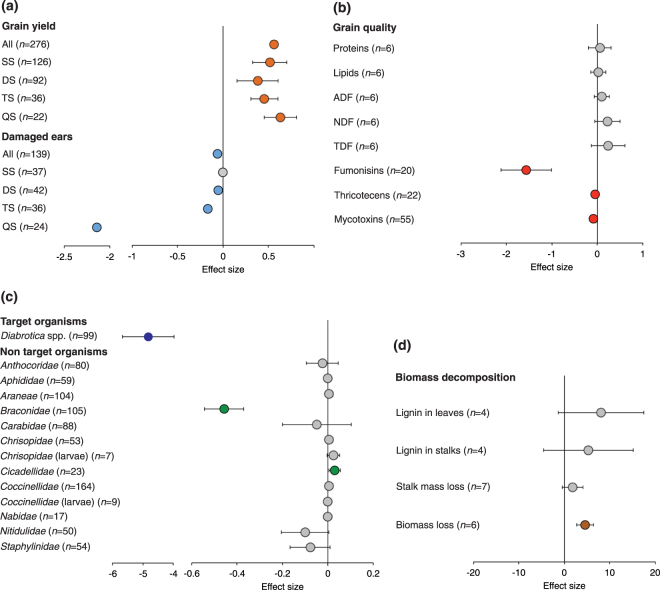
Despite the extensive cultivation of genetically engineered (GE) maize and considerable number of scientific reports on its agro-environmental impact, the risks and benefits of GE maize are still being debated and concerns about safety remain. This meta-analysis aimed at increasing knowledge on agronomic, environmental and toxicological traits of GE maize by analyzing the peer-reviewed literature (from 1996 to 2016) on yield, grain quality, non-target organisms (NTOs), target organisms (TOs) and soil biomass decomposition. Results provided strong evidence that GE maize performed better than its near isogenic line: grain yield was 5.6 to 24.5% higher with lower concentrations of mycotoxins (−28.8%), fumonisin (−30.6%) and thricotecens (−36.5%). The NTOs analyzed were not affected by GE maize, except for Braconidae, represented by a parasitoid of European corn borer, the target of Lepidoptera active Bt maize. Biogeochemical cycle parameters such as lignin content in stalks and leaves did not vary, whereas biomass decomposition was higher in GE maize. The results support the cultivation of GE maize, mainly due to enhanced grain quality and reduction of human exposure to mycotoxins. Furthermore, the reduction of the parasitoid of the target and the lack of consistent effects on other NTOs are confirmed.
Overview
CoChat Summary
TL;DR
This meta-analysis of 21 years of field data found that genetically engineered maize generally outperformed near-isogenic non-GE maize, with higher grain yield and lower mycotoxin contamination, while most non-target organism families were unaffected. It also reports reduced abundance of the target *Diabrotica* spp. and of Braconidae parasitoids, plus increased residue biomass decomposition.
Key findings
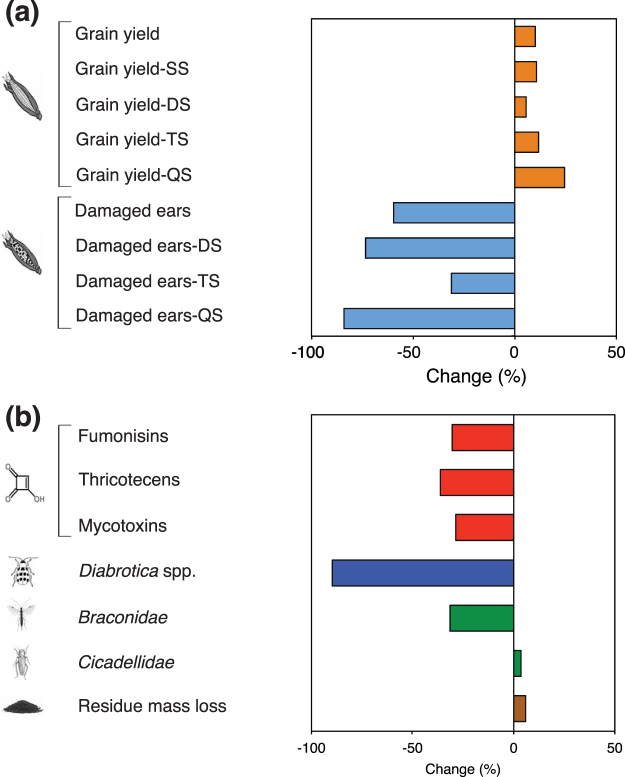
- Grain yield was 10.1% higher overall in GE maize; by stack type, increases ranged from 5.6% to 24.5%, with quadruple-stacked hybrids showing the largest increase.
- Damaged ears were reduced by 59.6% overall, and grain concentrations of mycotoxins, fumonisin, and thricotecens were lower by 28.8%, 30.6%, and 36.5%, respectively.
- *Diabrotica* spp. abundance fell by 89.7%; Braconidae decreased by 31.5%, while Cicadellidae increased (g+ = 0.030) but this result was not robust to sensitivity analysis. Other analyzed NTO families were not significantly affected.
- Lignin in leaves and stalks and stalk mass loss did not differ, but total biomass loss increased by 5.9%; protein, lipid, ADF, NDF, and TDF concentrations did not vary.
Methods
- Meta-analysis of peer-reviewed field studies from November 1996 to September 2016, selected from Web of Science, comparing GE maize with true non-GE isolines or near isolines grown under identical field conditions.
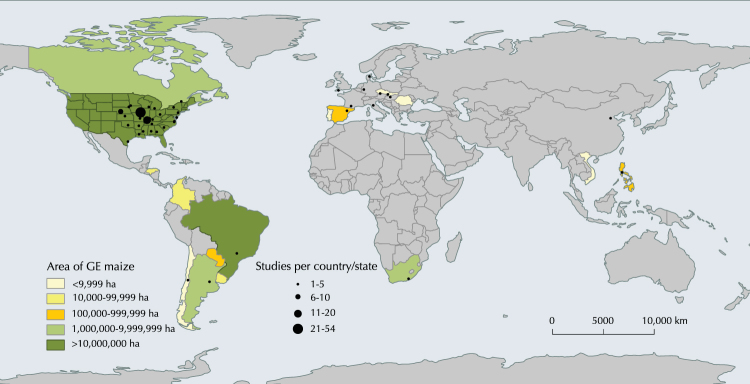
- From 6,006 publications screened, 76 publications were eligible; databases comprised 542 observations for grain yield and quality, 99 for target organisms, 813 for non-target organisms, and 29 for biogeochemical cycles.
- Effect sizes used weighted Hedges’ g under a random-effects model, with 95% bootstrap confidence intervals (999 iterations), sensitivity analysis removing one observation per article, and fail-safe number tests against a 5n + 10 threshold.
Limitations
- Stated: only 76 of 6,006 publications met the selection criteria; the authors call for more field research with wider geographic coverage, appropriate comparators, and standardized raw data with at least three replicates.
- Stated: data were insufficient for insecticide/herbicide quantity and economic analysis; no papers were selected for biodiversity or CO2 emission, and single-event herbicide-tolerant hybrids were missing from the grain yield dataset.
- Stated/evident: some results were not robust—Cicadellidae increase was not supported by sensitivity analysis, lignin results were not supported by sensitivity analysis due to small n = 4, and *Diabrotica* adult counts were described as a not entirely reliable indicator because damage is mostly caused by larvae.
Model-written summary. Check it against the paper before relying on it.
Integrity signals
Registry
Cites
Statistics
Figures
Verification
Claims the paper makes
6 Valid · 1 Not valid · 11 Not checked · 54 Own results and interpretations
At least one cited source doesn’t support this claim or points to a different paper, and none confirmed it — see the verdicts below.
In the paper
“Therefore, in the case of nematodes that utilise as a food resource bacteria, fungi or plants, GE maize seems to have a direct effect on specific food resources rather than to have an indirect effect54.”
§ Impact of genetically engineered maize on agronomic, environmental and toxicological traits: a meta-analysis of 21 years of field data > Discussion > Impact on biomass decomposition
What the sources say
- Disputedcites [54] Griffiths BS A comparison of soil microbial community structure, protozoa and nematodes in field plots of conventional and genetically modified maize expressing the Bacillus thuringiensis CryIAb toxin Plant Soil 2005 275 135 146 10.1007/s11104-005-1093-2 sourceExperimental — accuracy not yet measured
The Discussion (p. 10) draws the opposite distinction: because reduced nematode numbers spanned bacterial-, fungal-, and plant-feeders, the authors suggest an effect of Bt maize that is direct rather than indirect through a specific food resource. They add that the cause of the effect cannot be determined from their data. (LLM, conf=0.90)
Checked by a reasoning model — may be wrong.
hedgedstates a possible cause- Asserted: passes — The authors put it forward as true.
- Checkable: passes — It can be checked against evidence.
- Load-bearing: unclear — It is unclear whether the paper’s conclusions depend on it.
- Based: passes — The paper gives a reason why it holds.
- Disputed
Every source the paper cites for this claim was checked and supports it.
In the paper
“The observed decrease of Braconidae, mostly represented by M. cingulum (98% of observations), in GE crops is in line with other findings18 that showed a decrease of populations belonging to the functional guild of parasitoids.”
§ Impact of genetically engineered maize on agronomic, environmental and toxicological traits: a meta-analysis of 21 years of field data > Discussion > Impact on TOs and NTOs
What the sources say
- Supportedcites [18] Wolfenbarger LL Naranjo SE Lundgren JG Bitzer RJ Watrud LS Bt crop effects on functional guilds of non-target arthropods: a meta-analysis PLoS One 2008 3 e2118 10.1371/journal.pone.0002118 18461164 PMC2346550 source
The Results section reports a large reduction in parasitoid abundance in Bt maize compared with unsprayed non-Bt maize. This supports the cited comparison with other findings of a decrease in the parasitoid guild. The paper qualifies that the reduction was driven largely by Macrocentrus grandii; it found no significant effect on other parasitoids. (LLM, conf=0.91)
plainstates an association- Asserted: passes — The authors put it forward as true.
- Checkable: passes — It can be checked against evidence.
- Load-bearing: unclear — It is unclear whether the paper’s conclusions depend on it.
- Based: passes — The paper gives a reason why it holds.
- Supported
The cited sources support only part of this claim — read each source’s verdict below.
In the paper
“In addition soil microbial biomass and activity did not change between GE and non-GE maize54,55,57.”
§ Impact of genetically engineered maize on agronomic, environmental and toxicological traits: a meta-analysis of 21 years of field data > Discussion > Impact on biomass decomposition
What the sources say
- Partly supportedcites [54] Griffiths BS A comparison of soil microbial community structure, protozoa and nematodes in field plots of conventional and genetically modified maize expressing the Bacillus thuringiensis CryIAb toxin Plant Soil 2005 275 135 146 10.1007/s11104-005-1093-2 sourceExperimental — accuracy not yet measured
The Discussion (p. 11) says microbial biomass was not affected by Bt maize. The Microbial community structure results (p. 9) found no overall Bt–non-Bt difference in community-level physiological profiles, but these profiles are not a direct measure of soil microbial activity, so the activity claim is broader than the evidence. (LLM, conf=0.82)
- Not checked — no full text of the sourcecites [55] Griffiths BS Microbial and microfaunal community structure in cropping systems with genetically modified plants Pedobiologia 2007 51 195 206 10.1016/j.pedobi.2007.04.002 source
- Not checked — no full text of the sourcecites [57] Devare MH Jones CM Thies JE Effect of Cry3Bb transgenic corn and tefluthrin on the soil microbial community J. Environ. Qual. 2004 33 837 843 10.2134/jeq2004.0837 15224918 source
plain- Asserted: passes — The authors put it forward as true.
- Checkable: passes — It can be checked against evidence.
- Load-bearing: passes — The paper’s conclusions depend on it.
- Based: passes — The paper gives a reason why it holds.
- Partly supported
The cited sources support only part of this claim — read each source’s verdict below.
In the paper
“This disagreement might be due to differences between GE and their isolines in the proportion and composition of the plant organs in the residue, i.e. stalks and leaves which have a distinct rate of degradation50,51.”
§ Impact of genetically engineered maize on agronomic, environmental and toxicological traits: a meta-analysis of 21 years of field data > Discussion > Impact on biomass decomposition
What the sources say
- Partly supportedcites [50] Tarkalson DD Kachman SD Knops JM Thies JE Wortmann CS Decomposition of Bt and non-Bt corn hybrid residues in the field Nutr. Cycl. Agroecosys. 2008 80 211 222 10.1007/s10705-007-9135-1 sourceExperimental — accuracy not yet measured
Split into 2 atoms — 1 confirmed, 1 partially supported, 0 disputed, 0 misattributed, 0 unverifiable. Expand the claim to see per-atom verdicts.
- Not checked — no full text of the sourcecites [51] Yanni SF Whalen JK Ma BL Crop residue chemistry, decomposition rates, and CO2 evolution in Bt and non-Bt corn agroecosystems in North America: a review Nutr. Cycl. Agroecosys. 2010 87 277 293 10.1007/s10705-009-9338-8 source
hedgedstates a possible cause- Asserted: passes — The authors put it forward as true.
- Checkable: passes — It can be checked against evidence.
- Load-bearing: unclear — It is unclear whether the paper’s conclusions depend on it.
- Based: passes — The paper gives a reason why it holds.
- Partly supported
A result the paper reports from its own data — it cites no other source for it, so there is none to check. The quote shows it is in the paper.
In the paper
“The abundance of Diabrotica spp. was highly sensitive to GE cultivation with −5.007 mean effect size and 89.7% reduction (Figs 2 and 3; Supplementary 1 Table 6).”
§ Impact of genetically engineered maize on agronomic, environmental and toxicological traits: a meta-analysis of 21 years of field data > Results > Effects on target and non-target organisms
plainstates a cause- Asserted: passes — The authors put it forward as true.
- Checkable: passes — It can be checked against evidence.
- Load-bearing: passes — The paper’s conclusions depend on it.
- Based: passes — The paper gives a reason why it holds.
32 more claims
Create a free account to see all 72 claims and to verify the 1 reference still open.
- It may state two separate claims as one. 24
- The quote only partly states this claim. 1
- Probably not a substantial claim. 13
Claims other papers make about this one
Each is checked against this paper’s own text: does it say what the citing paper says it does?
The source backs part of the claim, not all of it — or backs it for a different population, condition or comparison.
In the citing paper
“Genetic modification that enables the transfer of genes into elite cultivars has its own drawbacks due to safety and health concerns (Pellegrino et al., 2018).”
From Genetic resources and precise gene editing for targeted improvement of barley abiotic stress tolerance (2023) · cites this paper as Pellegrino et al., 2018
Experimental — accuracy not yet measuredThe cited source says what the claim attributes to it.
In the citing paper
“Analyses (Lepidoptera- and Coleoptera-active Bt maize combined) revealed no significant effect sizes on Anthocoridae, Aphididae, Araneae, Carabidae, Chrysopidae (larvae and adults), Coccinellidae (larvae and adults), Nabidae, Nitidulidae, a strong negative effect of Bt maize on Braconidae, and a weak positive effect on Cicadellidae.”
From Does the growing of Bt maize change abundance or ecological function of non-target animals compared to the growing of non-GM maize? A systematic review (2022) · cites this paper as [16]
In the citing paper
“Effects of Lepidoptera-active Bt maize on M. cingulum also have been reported in previous meta-analyses [13, 14, 16].”
From Does the growing of Bt maize change abundance or ecological function of non-target animals compared to the growing of non-GM maize? A systematic review (2022) · cites this paper as [16]
Self-check
Percentages, sums and reported differences re-computed from the paper’s own numbers.
Each contradiction between two passages listed here was confirmed by an independent check.
Rated minor: it would not touch a result — a value no result rests on, a p-value that stays on the same side of the significance level, or a conflict that is clerical, resolved elsewhere in the paper, or outside its own findings.
In the paper
§ Impact of genetically engineered maize on agronomic, environmental and toxicological traits: a meta-analysis of 21 years of field data > Results > Composition of the database
“| Grain quality | Mycotoxins | 9 | 55 |”
§ Impact of genetically engineered maize on agronomic, environmental and toxicological traits: a meta-analysis of 21 years of field data > Results > Effects on grain yield and quality
“| Grain yield and quality | Mycotoxins | 7287 | 11 | 65 |”
Rated minor: it would not touch a result — a value no result rests on, a p-value that stays on the same side of the significance level, or a conflict that is clerical, resolved elsewhere in the paper, or outside its own findings.
In the paper
§ Impact of genetically engineered maize on agronomic, environmental and toxicological traits: a meta-analysis of 21 years of field data > Results > Composition of the database
“No papers were selected for the biodiversity category and for CO2 emission trait.”
§ Impact of genetically engineered maize on agronomic, environmental and toxicological traits: a meta-analysis of 21 years of field data > Results > Composition of the database
“| Biomass decompostition | CO2 emission | 3 | 8 |”
Citations
Cites
Borenstein, M., Hedges, L. V., Higgins, J. P. T., & Rothstein, H. R. (2009) · doi:10.1002/9780470743386 · Cited by 14,225
Borenstein, M., Hedges, L. V., Higgins, J. P. T., & Rothstein, H. R. (2021) · doi:10.1002/9781119558378 · Cited by 9,799
Distribution Theory for Glass's Estimator of Effect Size and Related Estimators
Hedges, L. V. (1981) · Journal of Educational Statistics · doi:10.2307/1164588 · Cited by 5,695
OERKE, E.-C. (2006) · The Journal of Agricultural Science · doi:10.1017/s0021859605005708 · Cited by 5,283
Nitrogen and Lignin Control of Hardwood Leaf Litter Decomposition Dynamics
Melillo, J. M., Aber, J. D., & Muratore, J. F. (1982) · Ecology · doi:10.2307/1936780 · Cited by 2,641
Sustainability of Transgenic Insecticidal Cultivars: Integrating Pest Genetics and Ecology
Gould, F. (1998) · Annual Review of Entomology · doi:10.1146/annurev.ento.43.1.701 · Cited by 1,392
Rosenberg, M. S. (2005) · Evolution · doi:10.1111/j.0014-3820.2005.tb01004.x · Cited by 1,285
Rosenzweig, C., Iglesias, A., Yang, X. B., Epstein, P. R., & Chivian, E. (2001) · Global Change and Human Health · doi:10.1023/a:1015086831467 · Cited by 1,089
Insect resistance to Bt crops: lessons from the first billion acres
Tabashnik, B. E., Brévault, T., & Carrière, Y. (2013) · Nature Biotechnology · doi:10.1038/nbt.2597 · Cited by 1,086
A Meta-Analysis of the Impacts of Genetically Modified Crops
Klümper, W., & Qaim, M. (2014) · PLoS ONE · doi:10.1371/journal.pone.0111629 · Cited by 869
Research works printed but not linked: 1
- Watanabe C Further revision of the genus Macrocentrus Curtis in Japan, with descriptions of two new species (Hymenoptera, Braconidae) Insecta Matsumurana 1967 30 1 16
Cited by
Global maize production, consumption and trade: trends and R&D implications
Erenstein, O., Jaleta, M., Sonder, K., Mottaleb, K., & Prasanna, B. M. (2022) · Food Security · doi:10.1007/s12571-022-01288-7 · Cited by 1,330
Genetically engineered crops help support conservation biological control
Romeis, J., Naranjo, S. E., Meissle, M., & Shelton, A. M. (2019) · Biological Control · doi:10.1016/j.biocontrol.2018.10.001 · Cited by 231
“, 2009) and several quantitative syntheses (Comas et al., 2014; Dang et al., 2017; Marvier et al., 2007; Naranjo, 2009; Pellegrino et al., 2018; Peterson et al., 2011; Wolfenbarger et al., 2008).”
BackgroundGenetically engineered crops for sustainably enhanced food production systems
Abdul Aziz, M., Brini, F., Rouached, H., & Masmoudi, K. (2022) · Frontiers in Plant Science · doi:10.3389/fpls.2022.1027828 · Cited by 187
“It showed a substantive positive impact on health due to the presence of lower mycotoxins in crops (Pellegrino et al., 2018).”
BackgroundTowards Food Security: Current State and Future Prospects of Agrobiotechnology
Tyczewska, A., Woźniak, E., Gracz, J., Kuczyński, J., & Twardowski, T. (2018) · Trends in Biotechnology · doi:10.1016/j.tibtech.2018.07.008 · Cited by 166
Eriksson, D., Kershen, D. L., Nepomuceno, A. L., Pogson, B. J., Prieto, H., Purnhagen, K. P., Smyth, S. J., Wesseler, J., & Whelan, A. I. (2019) · New Phytologist · doi:10.1111/nph.15627 · Cited by 177
Júnior, P. A. S., Kumar, L., da Silva, R. S., et al. (2019) · Pest Management Science · doi:10.1002/ps.5379 · Cited by 129
Agricultural GMOs—What We Know and Where Scientists Disagree
Zilberman, D., Holland, T. G., & Trilnick, I. (2018) · Sustainability · doi:10.3390/su10051514 · Cited by 119
Contaminants in Grain—A Major Risk for Whole Grain Safety?
Thielecke, F., & Nugent, A. P. (2018) · Nutrients · doi:10.3390/nu10091213 · Cited by 133
Pixley, K. V., Falck‐Zepeda, J. B., Giller, K. E., Glenna, L., Gould, F. L., Mallory-Smith, C. A., Stelly, D. M., & Stewart, C. N. (2019) · Annual Review of Phytopathology · doi:10.1146/annurev-phyto-080417-045954 · Cited by 118
Green Revolution to Gene Revolution: Technological Advances in Agriculture to Feed the World
Hamdan, M. F., Noor, S. N. M., Abd-Aziz, N., Pua, T., & Tan, B. C. (2022) · Plants · doi:10.3390/plants11101297 · Cited by 127
Improving C4 photosynthesis to increase productivity under optimal and suboptimal conditions
Sales, C. R. G., Wang, Y., Evers, J. B., & Kromdijk, J. (2021) · Journal of Experimental Botany · doi:10.1093/jxb/erab327 · Cited by 94
KhokharVoytas, A., Shahbaz, M., Maqsood, M. F., Zulfiqar, U., Naz, N., Iqbal, U. Z., Sara, M., Aqeel, M., Khalid, N., Noman, A., et al. (2023) · Functional & Integrative Genomics · doi:10.1007/s10142-023-01202-0 · Cited by 113
Bt maize can provide non‐chemical pest control and enhance food safety in China
Yang, X., Zhao, S., Liu, B., Gao, Y., Hu, C., Li, W., Yang, Y., Li, G., Wang, L., Yang, X., et al. (2022) · Plant Biotechnology Journal · doi:10.1111/pbi.13960 · Cited by 66
Bioeconomy development factors in the European Union and Poland
Woźniak, E., Tyczewska, A., & Twardowski, T. (2020) · New Biotechnology · doi:10.1016/j.nbt.2020.07.004 · Cited by 70
Phlobaphenes modify pericarp thickness in maize and accumulation of the fumonisin mycotoxins
Landoni, M., Puglisi, D., Cassani, E., et al. (2020) · Scientific Reports · doi:10.1038/s41598-020-58341-8 · Cited by 60
The human health benefits from GM crops
Smyth, S. J. (2020) · Plant Biotechnology Journal · doi:10.1111/pbi.13261 · Cited by 60
“A study of 21 years of maize production quantified that Bt maize contained lower concentrations of mycotoxins (29%), fumonisins (31%) and thricotecens (37%) (Pellegrino et al., 2018).”
BackgroundCaradus, J. R. (2023) · New Zealand Journal of Agricultural Research · doi:10.1080/00288233.2022.2141273 · Cited by 73
Corn Stunt Pathosystem and Its Leafhopper Vector in Brazil
Pozebon, H., Stürmer, G. R., & Arnemann, J. A. (2022) · Journal of Economic Entomology · doi:10.1093/jee/toac147 · Cited by 66
Transforming agricultural land use through marginal gains in the food system
Alexander, P., Reddy, A., Brown, C., Henry, R., & Rounsevell, M. (2019) · Global Environmental Change · doi:10.1016/j.gloenvcha.2019.101932 · Cited by 58
McFarland, F. L., Collier, R., Walter, N., Martinell, B. J., Kaeppler, S. M., & Kaeppler, H. F. (2023) · Plant Biotechnology Journal · doi:10.1111/pbi.14098 · Cited by 55
Eco‐friendly biomolecule‐nanomaterial hybrids as next‐generation agrochemicals for topical delivery
Li, P., Huang, Y. H., Fu, C., Jiang, S. X., Peng, W., Jia, Y. A., Peng, H., Zhang, P., Manzie, N., Mitter, N., et al. (2021) · EcoMat · doi:10.1002/eom2.12132 · Cited by 54
Bedair, M., & Glenn, K. C. (2020) · Metabolomics · doi:10.1007/s11306-020-01733-8 · Cited by 53
Genetic approaches to enhance multiple stress tolerance in maize
Malenica, N., Dunić, J. A., Vukadinović, L., Cesar, V., & Šimić, D. (2021) · Genes · doi:10.3390/genes12111760 · Cited by 48
Scaling up interactive argumentation by providing counterarguments with a chatbot
Altay, S., Schwartz, M., Hacquin, A.-S., Allard, A., Blancke, S., & Mercier, H. (2022) · Nature Human Behaviour · doi:10.1038/s41562-021-01271-w · Cited by 50
Are current EU policies on GMOs justified?
Christiansen, A. T., Andersen, M. M., & Kappel, K. (2019) · Transgenic Research · doi:10.1007/s11248-019-00120-x · Cited by 46
Meissle, M., Naranjo, S. E., & Romeis, J. (2022) · Environmental Evidence · doi:10.1186/s13750-022-00272-0 · Cited by 41
“[16] conducted meta-analyses on field data of agronomic, environmental, and toxicological traits of GM maize and non-target organisms were part of this work.”
MethodResultPest Management for Agronomic Crops
Razaq, M., Shah, F. M., Ahmad, S., & Afzal, M. (2019) · Springer eBooks · doi:10.1007/978-981-32-9783-8_18 · Cited by 48
Smyth, S. J. (2022) · Frontiers in Genome Editing · doi:10.3389/fgeed.2022.863193 · Cited by 46
Kaçar, G., Butrón, A., Kontogiannatos, D., Han, P., Peñaflor, M. F. G. V., Farinós, G. P., Huang, F., Hutchison, W. D., de Souza, B. H. S., Pintos, R. A. M., et al. (2023) · Journal of Pest Science · doi:10.1007/s10340-023-01595-8 · Cited by 40
Garland, S., & Curry, H. A. (2022) · PLoS Biology · doi:10.1371/journal.pbio.3001716 · Cited by 40
Yassitepe, J. É. D. C. T., da Silva, V. C. H., Hernandes‐Lopes, J., Dante, R. A., Gerhardt, I. R., Fernandes, F. R., da Silva, P. A., Vieira, L. R., Bonatti, V., & Arruda, P. (2021) · Frontiers in Plant Science · doi:10.3389/fpls.2021.766702 · Cited by 50
The Political Debate on Climate Change in Italy: A Discourse Network Analysis
Ghinoi, S., & Steiner, B. (2020) · Politics and Governance · doi:10.17645/pag.v8i2.2577 · Cited by 46
Ongu, I., Olayide, P., Alexandersson, E., Zawedde, B. M., & Eriksson, D. (2023) · GM crops & food · doi:10.1080/21645698.2023.2194221 · Cited by 37
Adegbaju, M. S., Ajose, T., Adegbaju, I. E., Omosebi, T., Ajenifujah‐Solebo, S. O., Olaitan, F. Y., Shittu, O. B., Adetunji, C. O., & Akinbo, O. (2024) · Frontiers in Genome Editing · doi:10.3389/fgeed.2024.1398813 · Cited by 47
CRISPR-Cas technology opens a new era for the creation of novel maize germplasms
Wang, Y., Tang, Q., Pu, L., Zhang, H., & Li, X. (2022) · Frontiers in Plant Science · doi:10.3389/fpls.2022.1049803 · Cited by 38
Mycotoxin risks are lower in biotech corn
Wu, F. (2022) · Current Opinion in Biotechnology · doi:10.1016/j.copbio.2022.102792 · Cited by 32
The future of plant biotechnology in a globalized and environmentally endangered world
MONTAGU, M. V. (2020) · Genetics and Molecular Biology · doi:10.1590/1678-4685-gmb-2019-0040 · Cited by 49
Modern Plant Biotechnology: An Antidote against Global Food Insecurity
Animasaun, D. A., Adedibu, P. A., Shkryl, Y., Emmanuel, F. O., Tekutyeva, L., & Balabanova, L. (2023) · Agronomy · doi:10.3390/agronomy13082038 · Cited by 41
Removing politics from innovations that improve food security
Smyth, S. J., McHughen, A., Entine, J., Kershen, D. L., Ramage, C., & Parrott, W. A. (2021) · Transgenic Research · doi:10.1007/s11248-021-00261-y · Cited by 39
Anand, A., & Jones, T. J. (2018) · Current topics in microbiology and immunology · doi:10.1007/82_2018_97 · Cited by 25
Fungal diversity and metabolomic profiles in GM and isogenic non-GM maize cultivars from Brazil
Gasperini, A. M., García‐Cela, E., Sulyok, M., Medina, Á., & Magan, N. (2020) · Mycotoxin Research · doi:10.1007/s12550-020-00414-8 · Cited by 26
Kersey, P. J., Collemare, J., Cockel, C. P., Das, D., Dulloo, E. M., Kelly, L. J., Lettice, E. P., Malécot, V., Maxted, N., Metheringham, C. L., et al. (2020) · Plants People Planet · doi:10.1002/ppp3.10136 · Cited by 34
Risk-Only Assessment of Genetically Engineered Crops Is Risky
Herman, R. A., Zhuang, M., Storer, N. P., Cnudde, F., & Delaney, B. (2018) · Trends in Plant Science · doi:10.1016/j.tplants.2018.10.001 · Cited by 31
Creating Future People: The Ethics of Genetic Enhancement
Anomaly, J. (2020) · Routledge eBooks · doi:10.4324/9781003014805 · Cited by 39
Spendrup, S., Eriksson, D., & Fernqvist, F. (2021) · GM crops & food · doi:10.1080/21645698.2021.1921544 · Cited by 30
Bueno, A. D. F., Braz-Zini, E. C., Horikoshi, R. J., Bernardi, O., Andrade, G., & Sutil, W. P. (2025) · Neotropical Entomology · doi:10.1007/s13744-025-01275-5 · Cited by 24
Karunarathne, S., Walker, E., Sharma, D., Li, C., & Han, Y. (2023) · Journal of Zhejiang University-SCIENCE B · doi:10.1631/jzus.b2200552 · Cited by 18
“Genetic modification that enables the transfer of genes into elite cultivars has its own drawbacks due to safety and health con‐ cerns (Pellegrino et al., 2018).”
Public Acceptance of GM Foods: A Global Perspective (1999–2019)
Sikora, D., & Rzymski, P. (2021) · Elsevier eBooks · doi:10.1016/b978-0-12-820780-2.00013-3 · Cited by 32
Stacked Bt Proteins Pose No New Risks to Nontarget Arthropods
Romeis, J., & Meissle, M. (2020) · Trends in Biotechnology · doi:10.1016/j.tibtech.2019.12.001 · Cited by 19
Microplastic in situ detection based on a portable triboelectric microfluidic sensor
Motalebizadeh, A., Fardindoost, S., Jungwirth, J., Tasnim, N., & Hoorfar, M. (2023) · Analytical Methods · doi:10.1039/d3ay01286g · Cited by 21
Bertho, L., Schmidt, K., Schmidtke, J., Brants, I., Cantón, R. F., Novillo, C., & Head, G. (2020) · PLoS ONE · doi:10.1371/journal.pone.0217272 · Cited by 19
da Cunha, T. G., Veloso, R. V. D. S., de Araújo, M. M. M., Tavares, L. G., Ribeiro, L. F. B., Tormen, G. P., Campos, D. S., Picanço, M. C., Lopes, E. A., Pereira, R. R., et al. (2023) · Pest Management Science · doi:10.1002/ps.7408 · Cited by 21
Arias‐Martín, M., Haidukowski, M., Farinós, G. P., & Patiño, B. (2021) · Toxins · doi:10.3390/toxins13110780 · Cited by 19
Options to Reform the European Union Legislation on GMOs: Post-authorization and Beyond
Eriksson, D., Custers, R., Björnberg, K. E., Hansson, S. O., Purnhagen, K. P., Qaim, M., Romeis, J., Schiemann, J., Schleissing, S., Tosun, J., et al. (2020) · Trends in biotechnology · doi:10.1016/j.tibtech.2019.12.015 · Cited by 19
Rethinking progress: harmonizing the discourse on genetically modified crops
Bekele‐Alemu, A., Dessalegn, O., Jarso, T. S., & Ligaba‐Osena, A. (2025) · Frontiers in Plant Science · doi:10.3389/fpls.2025.1547928 · Cited by 22
Akhtar, A., Rizvi, Z., Irfan, M., Maqbool, A., Bashir, A., & Malik, K. A. (2019) · Journal of Cereal Science · doi:10.1016/j.jcs.2019.102881 · Cited by 15
Bueno, A. D. F., Sutil, W. P., Cingolani, M. F., & Colmenárez, Y. C. (2024) · Insects · doi:10.3390/insects15110869 · Cited by 17
Assessing environmental impact of genetically modified seeds in Brazilian agriculture
Seixas, R. N. D. L., da Silveira, J. M. F. J., & Ferrari, V. E. (2022) · Frontiers in Bioengineering and Biotechnology · doi:10.3389/fbioe.2022.977793 · Cited by 23
Managing resistance evolution to transgenicBtmaize in corn borers in Spain
Álvarez‐Alfageme, F., Devos, Y., Camargo, A. M., Arpaia, S., & Messéan, A. (2021) · Critical Reviews in Biotechnology · doi:10.1080/07388551.2021.1931018 · Cited by 16
Identifying sustainability assessment parameters for genetically engineered agrifoods
Wei, W., Grieger, K., Cummings, C. L., Loschin, N., & Kuzma, J. (2023) · Plants People Planet · doi:10.1002/ppp3.10411 · Cited by 16
Visser, A., & den Berg, J. V. (2020) · Journal of Integrated Pest Management · doi:10.1093/jipm/pmaa014 · Cited by 13
Current risk assessment approaches for environmental and food and feed safety assessment
Wolt, J. D. (2019) · Transgenic Research · doi:10.1007/s11248-019-00140-7 · Cited by 14
Mukarumbwa, P., & Taruvinga, A. (2023) · GM crops & food · doi:10.1080/21645698.2023.2215146 · Cited by 15
Liu, L., Zhang, L., Fu, J., Shen, W., Fang, Z., Dai, Y., Jia, R., Liu, B., & Liang, J. (2022) · Frontiers in Plant Science · doi:10.3389/fpls.2022.922215 · Cited by 12
Nboyine, J. A., Adazebra, G. A., Owusu, E. Y., Agrengsore, P., Seidu, A., Lamini, S., Zakaria, M., Kwabena, J. Y., Ali, H. K., Akaogu, I. C., et al. (2024) · Agronomy · doi:10.3390/agronomy14123055 · Cited by 12
Arthropod food webs associated with cotton: Does Bt cotton mediate community stress?
Luz, C. E. A., Zuim, V., Oliveira, A. A. S., dos Santos, P. D. J., Campos, K. L., Haro, M. M., Vivan, L. M., Bastos, C. S., & Guedes, R. N. C. (2021) · Journal of Applied Entomology · doi:10.1111/jen.12928 · Cited by 13
Does Physical Activity Influence Consumer Acceptance of Gene Edited Food?
Pruitt, J. R., Melton, K. M., & Palma, M. A. (2021) · Sustainability · doi:10.3390/su13147759 · Cited by 15
Ichim, M. C. (2018) · Transgenic Research · doi:10.1007/s11248-018-0095-9 · Cited by 12
The framing effect of the media in the regulation of GMOs: a case study of Russia
Bickell, E. G. (2019) · Russian Journal of Communication · doi:10.1080/19409419.2019.1678348 · Cited by 17
Genome editing in plants as a key technology in sustainable bioeconomy
Woźniak, E., & Tyczewska, A. (2023) · EFB Bioeconomy Journal · doi:10.1016/j.bioeco.2023.100057 · Cited by 11
Genetic resources and breeding of maize for Striga resistance: a review
Dossa, E. N., Shimelis, H., Mrema, E. J., Shayanowako, A. I. T., & Laing, M. D. (2023) · Frontiers in Plant Science · doi:10.3389/fpls.2023.1163785 · Cited by 17
Bt‐maize in neotropical arthropod food webs: community‐stress or lack thereof?
Zuim, V., Godoi, C. T. D., Marques, V. M., Haro, M. M., Gontijo, L. M., & Guedes, R. N. C. (2022) · Entomologia Experimentalis et Applicata · doi:10.1111/eea.13254 · Cited by 10
Fu, W., Zhu, P., Qu, M., Zhi, W., Zhang, Y., Li, F., & Zhu, S. (2021) · Scientific Reports · doi:10.1038/s41598-021-81637-2 · Cited by 12
Engineering Plants for the Future: Farming with Value-Added Harvest
Massa, S., Presenti, O., & Benvenuto, E. (2018) · Progress in botany · doi:10.1007/124_2018_20 · Cited by 15
Gibbons, W. J., McKinney, M. G., O’Dell, P. J., Bollinger, B. A., & Jones, J. A. (2021) · Bioengineered · doi:10.1080/21655979.2021.1987090 · Cited by 10
Genetically modified maize impacts in Honduras: production and social issues
Macall, D. M., Trabanino, C. R., Hernández-Soto, A., & Smyth, S. J. (2020) · Transgenic Research · doi:10.1007/s11248-020-00221-y · Cited by 10
Fungi and mycotoxin types, toxicity, mechanisms, and control of mycotoxin contamination: a review
Zhang, Z.-Z., Qi, X., Wang, Y., Li, Y., Cheng, L., Yang, Q., Yan, X., Li, X., & Luo, J. (2025) · Food Additives & Contaminants Part A · doi:10.1080/19440049.2025.2575980 · Cited by 9
Fan, Z., Song, H., Qi, M., Wang, M., Bai, Y., Sun, Y., & Yu, H. (2025) · International Journal of Molecular Sciences · doi:10.3390/ijms26031283 · Cited by 15
Ecological Consequences of Genetically Modified Crops on Soil Biodiversity
Jha, A. K., Chakraborty, S., Kumari, K., & Bauddh, K. (2020) · Springer eBooks · doi:10.1007/978-981-15-3372-3_5 · Cited by 10
Creating Future People: The Science and Ethics of Genetic Enhancement
Anomaly, J. (2024) · Routledge eBooks · doi:10.4324/9781003464266 · Cited by 10
Fusarium and fumonisin in GM maize grown by small-scale farmers in KwaZulu-Natal, South Africa
Rheeder, J. P., & Westhuizen, L. V. D. (2024) · South African Journal of Science · doi:10.17159/sajs.2024/15905 · Cited by 9
Cai, R., Xue, J., Tan, L., et al. (2021) · Journal of soil science and plant nutrition · doi:10.1007/s42729-021-00575-0 · Cited by 7
García‐Ruiz, E., Cobos, G., Sánchez‐Ramos, I., Pascual, S., Chueca, M. C., Escorial, M. C., Montanyá, I. S., Loureiro, Í., & González, M. (2020) · Insect Science · doi:10.1111/1744-7917.12825 · Cited by 7
Novel Biotechnological Interventions in Plant Nematode Management Technologies
Khan, M. R., Haque, Z., & Sharma, R. (2023) · Springer eBooks · doi:10.1007/978-981-99-2893-4_7 · Cited by 6
Wang, C., Bean, G. J., Chen, C. J., Kessenich, C. R., Peng, J., Visconti, N. R., Milligan, J. S., Moore, R. G., Tan, J., Edrington, T. C., et al. (2022) · PLoS ONE · doi:10.1371/journal.pone.0274204 · Cited by 7
Economic surplus implications of Mexico’s decision to phaseout genetically modified maize imports
Macall, D. M., Kerr, W. A., & Smyth, S. J. (2022) · GM crops & food · doi:10.1080/21645698.2021.2020028 · Cited by 5
Effects of GE Crops on Non-target Organisms
Naranjo, S. E. (2021) · Springer eBooks · doi:10.1007/978-3-030-68345-0_10 · Cited by 10
GM Crops: Resistance Development and Impact on Biodiversity
Lombardo, L., Trenti, M., & Zelasco, S. (2020) · Topics in biodiversity and conservation · doi:10.1007/978-3-030-53183-6_3 · Cited by 6
Abscisic acid as a gateway for the crops of tomorrow
Dejonghe, W., & Cutler, S. R. (2019) · Advances in botanical research · doi:10.1016/bs.abr.2019.09.015 · Cited by 7
dos Santos, T. P., de Menezes, C. W. G., Batista, C. H., et al. (2019) · Ciência e Agrotecnologia · doi:10.1590/1413-7054201943020719 · Cited by 6
Gamlath, C. J., & Wu, F. (2025) · Toxins · doi:10.3390/toxins17110524 · Cited by 6
Genetic improvement in grain yield and kernel traits of 103- vs. 111-day maize hybrids
King, K. A., Vyn, T. J., Trifunović, S., Eudy, D., Lamkey, K. R., & Archontoulis, S. V. (2025) · Field Crops Research · doi:10.1016/j.fcr.2025.110125 · Cited by 7
Is co‐existence and/or containment of genetically modified plants possible, and is it important?
Caradus, J. R. (2025) · New Zealand Journal of Agricultural Research · doi:10.1080/00288233.2025.2479724 · Cited by 10
Liu, L., Zhang, L., Fang, Z., Shen, W., Yin, X., Ren, Z., Qi, Y., Liang, J., & Liu, B. (2024) · BMC Plant Biology · doi:10.1186/s12870-024-05559-7 · Cited by 7
From Grain to Gain: Revolutionizing Maize NutritionPreprint
Mandal, S., Singh, V. K., Chaudhary, D., Kaur, A., Kumar, R., Panwar, A., Ojre, A., Singh, R., & Kaushik, P. (2023) · Preprints.org · doi:10.20944/preprints202309.2089.v1 · Cited by 4
Interactions between Bacillus thuringiensis and entomophagous insects
Abbas, M. S. T. (2020) · Egyptian Journal of Biological Pest Control · doi:10.1186/s41938-020-00255-8 · Cited by 6
José, M., Vertuan, H., Soares, D. J., de Sordi, D., Bellini, L. F., Kotsubo, R. M., & Berger, G. U. (2020) · PLoS ONE · doi:10.1371/journal.pone.0231733 · Cited by 8
Blair, R. M., & Regenstein, J. M. (2020) · Elsevier eBooks · doi:10.1016/b978-0-12-817240-7.00005-x · Cited by 8
Johnson, P., Bennartz, R., & Camp, J. S. (2019) · Applied Geography · doi:10.1016/j.apgeog.2019.102058 · Cited by 5
РАН, Ф. И. Б. И. Ф. Р. И. М., Chumakov, M. I., Гусев, Ю. С., Bogatyreva, N. V., СОКОЛОВ, А. Ю., & академия, Ф. В. С. Г. Ю. (2019) · Sel skokhozyaistvennaya Biologiya · doi:10.15389/agrobiology.2019.3.426rus · Cited by 5
Metadata
- Authors
- Pellegrino, E., Bedini, S., Nuti, M., & Ercoli, L.
- Affiliations
- Scuola Superiore Sant'Anna (IT)
- University of Pisa (IT)
- Corresponding author
- Ercoli, Laura
- Venue
- Scientific Reports
- Published
- 2018-02-15
- Volume
- 8
- Issue
- 1
- Pages
- 3113-3113
- ISSN
- 2045-2322 (ISSN-L)
- PMC
- PMC5814441
- OpenAlex
- W2791112841
- Cited by
- 177
- References
- 62
- Citations by year
- 2026: 4 · 2025: 17 · 2024: 12 · 2023: 24 · 2022: 27 · 2021: 28 · 2020: 31 · 2019: 24 · 2018: 10
- FWCI
- 2.38
- Type
- journal article
- Language
- en
- Update notices
- correction (2018-04-19)
- Open access
- gold
- doi.org
- Licence
- cc-by
- creativecommons.org/licenses/by/4.0 (tdm)
- creativecommons.org/licenses/by/4.0 (vor)
- Locations
- Scientific Reports (publishedVersion, cc-by)
- PubMed Central (publishedVersion, cc-by)
- PubMed (publishedVersion)
- DOAJ (DOAJ: Directory of Open Access Journals) (acceptedVersion)
- CINECA IRIS Institutional Research Information System (Sant'Anna School of Advanced Studies) (submittedVersion, other-oa)
- CINECA IRIS Institutial research information system (University of Pisa) (submittedVersion)
- Topics
- Life Sciences › Agricultural and Biological Sciences › Plant Science › Genetically Modified Organisms Research
- Life Sciences › Biochemistry, Genetics and Molecular Biology › Molecular Biology › Insect Resistance and Genetics
- Life Sciences › Agricultural and Biological Sciences › Agronomy and Crop Science › Crop Yield and Soil Fertility
- Keywords
- Bt maize, mycotoxins, fumonisins, trichothecenes, grain yield, grain quality, non-target organisms, parasitoids, Braconidae, Ostrinia nubilalis, lignin, biogeochemical cycles, near-isogenic lines, environmental impact of GM crops, toxicology
- MeSH terms
- Agriculture, Animals, Zea mays, Genetic Engineering, Humans, Mycotoxins, Pest Control, Biological, Plant Diseases, Soil, Plants, Genetically Modified
About these checks
Registry, retraction, Cites and statistics results are computed, not judged, with one exception: a printed reference that no index lists is read once by a model before it counts as a citation error. Claims are extracted by a model and kept only when their quote appears verbatim in the text; each cited source is then checked, with a model’s help, for whether it says what the claim relies on. Those verdicts can be wrong — read the claim’s quote and the cited source before relying on one.
The claim verdicts this report counts are experimental: their accuracy is not yet measured.
A language model drew the claims from the paper on 2026-10-10, under version 3 of the claim definition (model deepseek-v4.1-flash, prompt extract-v3).
A second model labelled each claim on 2026-10-10 (model jev-1.13-20260917, definition revision gold-guideline-v0.2).
Cited sources are checked with a language model’s help (gpt-6-sol).
Statistics and arithmetic are recomputed, not judged.
Confidence bands are shown only for fields calibrated on our annotated test set. None is calibrated yet, so no band is shown.
What counts as a claim ›How we measure confidence ›How we check this ›
Are you an author, or do you see a problem with this page? Request a review
Data sources
Bibliographic data: Semantic Scholar, OpenAlex, Crossref.
Contains information from the Semantic Scholar Academic Graph Datasets, made available under the ODC Attribution License (ODC-BY 1.0).
Semantic Scholar’s data is described in: Kinney, R., et al. (2023). The Semantic Scholar Open Data Platform. arXiv:2301.10140.
