

Impact of genetically engineered maize on agronomic, environmental and toxicological traits: a meta-analysis of 21 years of field data
Open accessThe DOI matches its Crossref record; 63 of the 63 references it cites were found in a registry or an index; 9 of the 34 sources its claims cite were checked for support.
Abstract
Despite the extensive cultivation of genetically engineered (GE) maize and considerable number of scientific reports on its agro-environmental impact, the risks and benefits of GE maize are still being debated and concerns about safety remain. This meta-analysis aimed at increasing knowledge on agronomic, environmental and toxicological traits of GE maize by analyzing the peer-reviewed literature (from 1996 to 2016) on yield, grain quality, non-target organisms (NTOs), target organisms (TOs) and soil biomass decomposition. Results provided strong evidence that GE maize performed better than its near isogenic line: grain yield was 5.6 to 24.5% higher with lower concentrations of mycotoxins (−28.8%), fumonisin (−30.6%) and thricotecens (−36.5%). The NTOs analyzed were not affected by GE maize, except for Braconidae, represented by a parasitoid of European corn borer, the target of Lepidoptera active Bt maize. Biogeochemical cycle parameters such as lignin content in stalks and leaves did not vary, whereas biomass decomposition was higher in GE maize. The results support the cultivation of GE maize, mainly due to enhanced grain quality and reduction of human exposure to mycotoxins. Furthermore, the reduction of the parasitoid of the target and the lack of consistent effects on other NTOs are confirmed.
Overview
CoChat Summary
TL;DR
This meta-analysis of 21 years of field data found that genetically engineered maize generally outperformed near-isogenic non-GE maize, with higher grain yield and lower mycotoxin contamination, while most non-target organism families were unaffected. It also reports reduced abundance of the target *Diabrotica* spp. and of Braconidae parasitoids, plus increased residue biomass decomposition.
Key findings
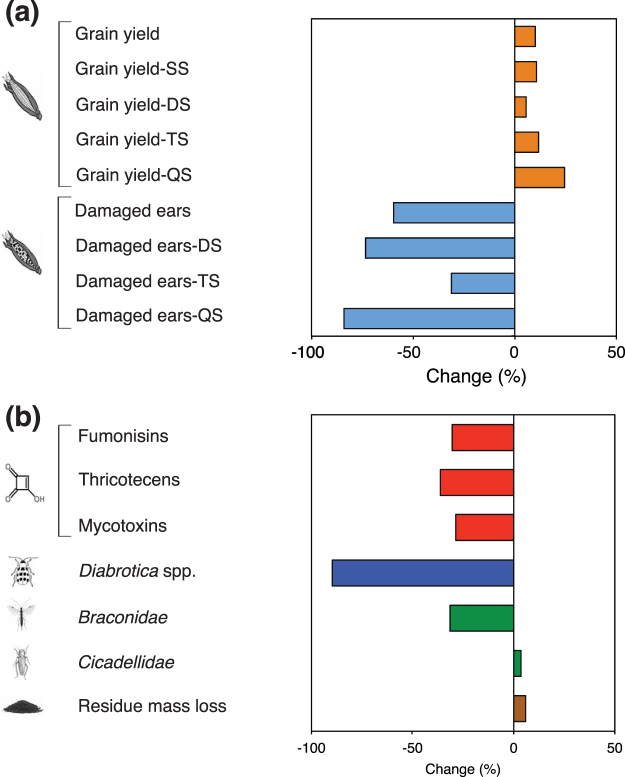
- Grain yield was 10.1% higher overall in GE maize; by stack type, increases ranged from 5.6% to 24.5%, with quadruple-stacked hybrids showing the largest increase.
- Damaged ears were reduced by 59.6% overall, and grain concentrations of mycotoxins, fumonisin, and thricotecens were lower by 28.8%, 30.6%, and 36.5%, respectively.
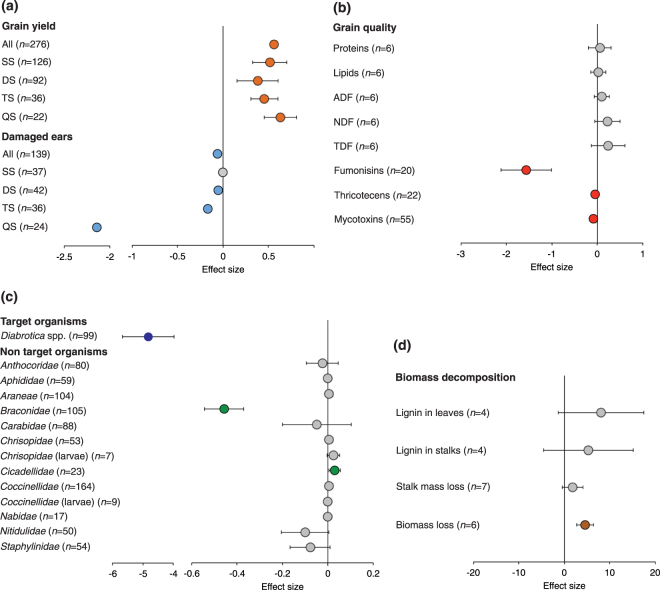
- *Diabrotica* spp. abundance fell by 89.7%; Braconidae decreased by 31.5%, while Cicadellidae increased (g+ = 0.030) but this result was not robust to sensitivity analysis. Other analyzed NTO families were not significantly affected.
- Lignin in leaves and stalks and stalk mass loss did not differ, but total biomass loss increased by 5.9%; protein, lipid, ADF, NDF, and TDF concentrations did not vary.
Methods
- Meta-analysis of peer-reviewed field studies from November 1996 to September 2016, selected from Web of Science, comparing GE maize with true non-GE isolines or near isolines grown under identical field conditions.
- From 6,006 publications screened, 76 publications were eligible; databases comprised 542 observations for grain yield and quality, 99 for target organisms, 813 for non-target organisms, and 29 for biogeochemical cycles.
- Effect sizes used weighted Hedges’ g under a random-effects model, with 95% bootstrap confidence intervals (999 iterations), sensitivity analysis removing one observation per article, and fail-safe number tests against a 5n + 10 threshold.
Limitations
- Stated: only 76 of 6,006 publications met the selection criteria; the authors call for more field research with wider geographic coverage, appropriate comparators, and standardized raw data with at least three replicates.
- Stated: data were insufficient for insecticide/herbicide quantity and economic analysis; no papers were selected for biodiversity or CO2 emission, and single-event herbicide-tolerant hybrids were missing from the grain yield dataset.
- Stated/evident: some results were not robust—Cicadellidae increase was not supported by sensitivity analysis, lignin results were not supported by sensitivity analysis due to small n = 4, and *Diabrotica* adult counts were described as a not entirely reliable indicator because damage is mostly caused by larvae.
Model-written summary. Check it against the paper before relying on it.
Integrity signals
Registry
Cites
Statistics
Figures
Verification
Claims the paper makes
6 Valid · 1 Not valid · 11 Not checked · 54 Own results and interpretations
At least one cited source doesn’t support this claim or points to a different paper, and none confirmed it — see the verdicts below.
In the paper
“Therefore, in the case of nematodes that utilise as a food resource bacteria, fungi or plants, GE maize seems to have a direct effect on specific food resources rather than to have an indirect effect54.”
§ Impact of genetically engineered maize on agronomic, environmental and toxicological traits: a meta-analysis of 21 years of field data > Discussion > Impact on biomass decomposition
What the sources say
- Disputedcites [54] Griffiths BS A comparison of soil microbial community structure, protozoa and nematodes in field plots of conventional and genetically modified maize expressing the Bacillus thuringiensis CryIAb toxin Plant Soil 2005 275 135 146 10.1007/s11104-005-1093-2 sourceExperimental — accuracy not yet measured
The Discussion (p. 10) draws the opposite distinction: because reduced nematode numbers spanned bacterial-, fungal-, and plant-feeders, the authors suggest an effect of Bt maize that is direct rather than indirect through a specific food resource. They add that the cause of the effect cannot be determined from their data. (LLM, conf=0.90)
Checked by a reasoning model — may be wrong.
hedgedstates a possible cause- Asserted: passes — The authors put it forward as true.
- Checkable: passes — It can be checked against evidence.
- Load-bearing: unclear — It is unclear whether the paper’s conclusions depend on it.
- Based: passes — The paper gives a reason why it holds.
- Disputed
Every source the paper cites for this claim was checked and supports it.
In the paper
“The observed decrease of Braconidae, mostly represented by M. cingulum (98% of observations), in GE crops is in line with other findings18 that showed a decrease of populations belonging to the functional guild of parasitoids.”
§ Impact of genetically engineered maize on agronomic, environmental and toxicological traits: a meta-analysis of 21 years of field data > Discussion > Impact on TOs and NTOs
What the sources say
- Supportedcites [18] Wolfenbarger LL Naranjo SE Lundgren JG Bitzer RJ Watrud LS Bt crop effects on functional guilds of non-target arthropods: a meta-analysis PLoS One 2008 3 e2118 10.1371/journal.pone.0002118 18461164 PMC2346550 source
The Results section reports a large reduction in parasitoid abundance in Bt maize compared with unsprayed non-Bt maize. This supports the cited comparison with other findings of a decrease in the parasitoid guild. The paper qualifies that the reduction was driven largely by Macrocentrus grandii; it found no significant effect on other parasitoids. (LLM, conf=0.91)
plainstates an association- Asserted: passes — The authors put it forward as true.
- Checkable: passes — It can be checked against evidence.
- Load-bearing: unclear — It is unclear whether the paper’s conclusions depend on it.
- Based: passes — The paper gives a reason why it holds.
- Supported
The cited sources support only part of this claim — read each source’s verdict below.
In the paper
“In addition soil microbial biomass and activity did not change between GE and non-GE maize54,55,57.”
§ Impact of genetically engineered maize on agronomic, environmental and toxicological traits: a meta-analysis of 21 years of field data > Discussion > Impact on biomass decomposition
What the sources say
- Partly supportedcites [54] Griffiths BS A comparison of soil microbial community structure, protozoa and nematodes in field plots of conventional and genetically modified maize expressing the Bacillus thuringiensis CryIAb toxin Plant Soil 2005 275 135 146 10.1007/s11104-005-1093-2 sourceExperimental — accuracy not yet measured
The Discussion (p. 11) says microbial biomass was not affected by Bt maize. The Microbial community structure results (p. 9) found no overall Bt–non-Bt difference in community-level physiological profiles, but these profiles are not a direct measure of soil microbial activity, so the activity claim is broader than the evidence. (LLM, conf=0.82)
- Not checked — no full text of the sourcecites [55] Griffiths BS Microbial and microfaunal community structure in cropping systems with genetically modified plants Pedobiologia 2007 51 195 206 10.1016/j.pedobi.2007.04.002 source
- Not checked — no full text of the sourcecites [57] Devare MH Jones CM Thies JE Effect of Cry3Bb transgenic corn and tefluthrin on the soil microbial community J. Environ. Qual. 2004 33 837 843 10.2134/jeq2004.0837 15224918 source
plain- Asserted: passes — The authors put it forward as true.
- Checkable: passes — It can be checked against evidence.
- Load-bearing: passes — The paper’s conclusions depend on it.
- Based: passes — The paper gives a reason why it holds.
- Partly supported
The cited sources support only part of this claim — read each source’s verdict below.
In the paper
“This disagreement might be due to differences between GE and their isolines in the proportion and composition of the plant organs in the residue, i.e. stalks and leaves which have a distinct rate of degradation50,51.”
§ Impact of genetically engineered maize on agronomic, environmental and toxicological traits: a meta-analysis of 21 years of field data > Discussion > Impact on biomass decomposition
What the sources say
- Partly supportedcites [50] Tarkalson DD Kachman SD Knops JM Thies JE Wortmann CS Decomposition of Bt and non-Bt corn hybrid residues in the field Nutr. Cycl. Agroecosys. 2008 80 211 222 10.1007/s10705-007-9135-1 sourceExperimental — accuracy not yet measured
Split into 2 atoms — 1 confirmed, 1 partially supported, 0 disputed, 0 misattributed, 0 unverifiable. Expand the claim to see per-atom verdicts.
- Not checked — no full text of the sourcecites [51] Yanni SF Whalen JK Ma BL Crop residue chemistry, decomposition rates, and CO2 evolution in Bt and non-Bt corn agroecosystems in North America: a review Nutr. Cycl. Agroecosys. 2010 87 277 293 10.1007/s10705-009-9338-8 source
hedgedstates a possible cause- Asserted: passes — The authors put it forward as true.
- Checkable: passes — It can be checked against evidence.
- Load-bearing: unclear — It is unclear whether the paper’s conclusions depend on it.
- Based: passes — The paper gives a reason why it holds.
- Partly supported
A result the paper reports from its own data — it cites no other source for it, so there is none to check. The quote shows it is in the paper.
In the paper
“The abundance of Diabrotica spp. was highly sensitive to GE cultivation with −5.007 mean effect size and 89.7% reduction (Figs 2 and 3; Supplementary 1 Table 6).”
§ Impact of genetically engineered maize on agronomic, environmental and toxicological traits: a meta-analysis of 21 years of field data > Results > Effects on target and non-target organisms
plainstates a cause- Asserted: passes — The authors put it forward as true.
- Checkable: passes — It can be checked against evidence.
- Load-bearing: passes — The paper’s conclusions depend on it.
- Based: passes — The paper gives a reason why it holds.
32 more claims
Create a free account to see all 72 claims and to verify the 1 reference still open.
- It may state two separate claims as one. 24
- The quote only partly states this claim. 1
- Probably not a substantial claim. 13
Claims other papers make about this one
Each is checked against this paper’s own text: does it say what the citing paper says it does?
The source backs part of the claim, not all of it — or backs it for a different population, condition or comparison.
In the citing paper
“Genetic modification that enables the transfer of genes into elite cultivars has its own drawbacks due to safety and health concerns (Pellegrino et al., 2018).”
From Genetic resources and precise gene editing for targeted improvement of barley abiotic stress tolerance (2023) · cites this paper as Pellegrino et al., 2018
Experimental — accuracy not yet measuredThe cited source says what the claim attributes to it.
In the citing paper
“Analyses (Lepidoptera- and Coleoptera-active Bt maize combined) revealed no significant effect sizes on Anthocoridae, Aphididae, Araneae, Carabidae, Chrysopidae (larvae and adults), Coccinellidae (larvae and adults), Nabidae, Nitidulidae, a strong negative effect of Bt maize on Braconidae, and a weak positive effect on Cicadellidae.”
From Does the growing of Bt maize change abundance or ecological function of non-target animals compared to the growing of non-GM maize? A systematic review (2022) · cites this paper as [16]
In the citing paper
“Effects of Lepidoptera-active Bt maize on M. cingulum also have been reported in previous meta-analyses [13, 14, 16].”
From Does the growing of Bt maize change abundance or ecological function of non-target animals compared to the growing of non-GM maize? A systematic review (2022) · cites this paper as [16]
Self-check
Percentages, sums and reported differences re-computed from the paper’s own numbers.
Each contradiction between two passages listed here was confirmed by an independent check.
Rated minor: it would not touch a result — a value no result rests on, a p-value that stays on the same side of the significance level, or a conflict that is clerical, resolved elsewhere in the paper, or outside its own findings.
In the paper
§ Impact of genetically engineered maize on agronomic, environmental and toxicological traits: a meta-analysis of 21 years of field data > Results > Composition of the database
“| Grain quality | Mycotoxins | 9 | 55 |”
§ Impact of genetically engineered maize on agronomic, environmental and toxicological traits: a meta-analysis of 21 years of field data > Results > Effects on grain yield and quality
“| Grain yield and quality | Mycotoxins | 7287 | 11 | 65 |”
Rated minor: it would not touch a result — a value no result rests on, a p-value that stays on the same side of the significance level, or a conflict that is clerical, resolved elsewhere in the paper, or outside its own findings.
In the paper
§ Impact of genetically engineered maize on agronomic, environmental and toxicological traits: a meta-analysis of 21 years of field data > Results > Composition of the database
“No papers were selected for the biodiversity category and for CO2 emission trait.”
§ Impact of genetically engineered maize on agronomic, environmental and toxicological traits: a meta-analysis of 21 years of field data > Results > Composition of the database
“| Biomass decompostition | CO2 emission | 3 | 8 |”
Citations
Cites
Borenstein, M., Hedges, L. V., Higgins, J. P. T., & Rothstein, H. R. (2009) · doi:10.1002/9780470743386 · Cited by 14,225
Borenstein, M., Hedges, L. V., Higgins, J. P. T., & Rothstein, H. R. (2021) · doi:10.1002/9781119558378 · Cited by 9,799
Distribution Theory for Glass's Estimator of Effect Size and Related Estimators
Hedges, L. V. (1981) · Journal of Educational Statistics · doi:10.2307/1164588 · Cited by 5,695
OERKE, E.-C. (2006) · The Journal of Agricultural Science · doi:10.1017/s0021859605005708 · Cited by 5,283
Nitrogen and Lignin Control of Hardwood Leaf Litter Decomposition Dynamics
Melillo, J. M., Aber, J. D., & Muratore, J. F. (1982) · Ecology · doi:10.2307/1936780 · Cited by 2,641
Sustainability of Transgenic Insecticidal Cultivars: Integrating Pest Genetics and Ecology
Gould, F. (1998) · Annual Review of Entomology · doi:10.1146/annurev.ento.43.1.701 · Cited by 1,392
Rosenberg, M. S. (2005) · Evolution · doi:10.1111/j.0014-3820.2005.tb01004.x · Cited by 1,285
Rosenzweig, C., Iglesias, A., Yang, X. B., Epstein, P. R., & Chivian, E. (2001) · Global Change and Human Health · doi:10.1023/a:1015086831467 · Cited by 1,089
Insect resistance to Bt crops: lessons from the first billion acres
Tabashnik, B. E., Brévault, T., & Carrière, Y. (2013) · Nature Biotechnology · doi:10.1038/nbt.2597 · Cited by 1,086
A Meta-Analysis of the Impacts of Genetically Modified Crops
Klümper, W., & Qaim, M. (2014) · PLoS ONE · doi:10.1371/journal.pone.0111629 · Cited by 869
Field-Evolved Resistance to Bt Maize by Western Corn Rootworm
Gassmann, A. J., Petzold-Maxwell, J. L., Keweshan, R. S., & Dunbar, M. W. (2011) · PLoS ONE · doi:10.1371/journal.pone.0022629 · Cited by 666
Storer, N. P., Babcock, J. M., Schlenz, M., Meade, T., Thompson, G. D., Bing, J. W., & Huckaba, R. M. (2010) · Journal of Economic Entomology · doi:10.1603/ec10040 · Cited by 641
Workgroup Report: Public Health Strategies for Reducing Aflatoxin Exposure in Developing Countries
Strosnider, H., Azziz-Baumgartner, E., Banziger, M., Bhat, R. V., Breiman, R., Brune, M.-N., DeCock, K., Dilley, A., Groopman, J., Hell, K., et al. (2006) · Environmental Health Perspectives · doi:10.1289/ehp.9302 · Cited by 538
The economics of genetically modified crops
Qaim, M. (2009) · Annual Review of Resource Economics · doi:10.1146/annurev.resource.050708.144203 · Cited by 465
The increasing importance of herbicides in worldwide crop production
Gianessi, L. P. (2013) · Pest Management Science · doi:10.1002/ps.3598 · Cited by 461
A Meta-Analysis of Effects of Bt Cotton and Maize on Nontarget Invertebrates
Marvier, M., McCreedy, C., Regetz, J., & Kareiva, P. (2007) · Science · doi:10.1126/science.1139208 · Cited by 445 · cited 3×
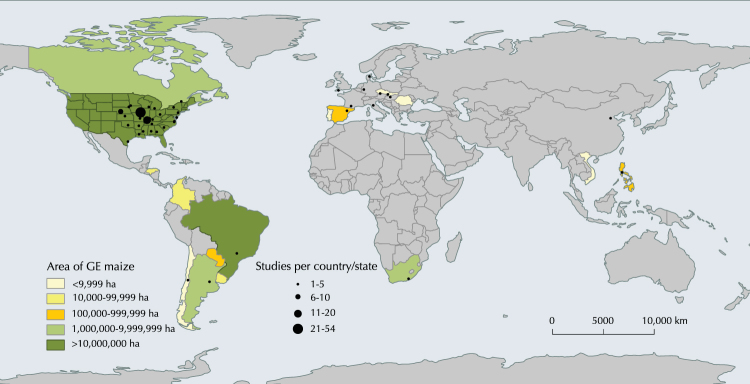
“Regarding the geographic distribution of the field studies, the majority of them were performed in North America (202), followed by Europe (52), and South America (17) (Supplementary 1 Tables 2–5).”
BackgroundGuidance on the environmental risk assessment of genetically modified plants
(GMO), E. P. O. G. M. O. (2010) · EFSA Journal · doi:10.2903/j.efsa.2010.1879 · Cited by 428
Impacts of genetically engineered crops on pesticide use in the U.S. -- the first sixteen years
Benbrook, C. M. (2012) · Environmental Sciences Europe · doi:10.1186/2190-4715-24-24 · Cited by 415
An overview of the last 10 years of genetically engineered crop safety research
Nicolia, A., Manzo, A., Veronesi, F., & Rosellini, D. (2014) · Critical Reviews in Biotechnology · doi:10.3109/07388551.2013.823595 · Cited by 413
Aber, J. D., & Melillo, J. M. (1982) · Canadian Journal of Botany · doi:10.1139/b82-277 · Cited by 398
Optimizing pyramided transgenic Bt crops for sustainable pest management
Carrière, Y., Crickmore, N., & Tabashnik, B. E. (2015) · Nature Biotechnology · doi:10.1038/nbt.3099 · Cited by 388
Saxena, D., & Stotzky, G. (2001) · Soil Biology and Biochemistry · doi:10.1016/s0038-0717(01)00027-x · Cited by 384
Fate and effects of insect-resistant Bt crops in soil ecosystems
Icoz, I., & Stotzky, G. (2008) · Soil Biology and Biochemistry · doi:10.1016/j.soilbio.2007.11.002 · Cited by 354
First report of field resistance by the stem borer, Busseola fusca (Fuller) to Bt-transgenic maize
van Rensburg, J. B. J. (2007) · South African Journal of Plant and Soil · doi:10.1080/02571862.2007.10634798 · Cited by 334
Bt Crop Effects on Functional Guilds of Non-Target Arthropods: A Meta-Analysis
Wolfenbarger, L. L., Naranjo, S. E., Lundgren, J. G., Bitzer, R. J., & Watrud, L. S. (2008) · PLoS ONE · doi:10.1371/journal.pone.0002118 · Cited by 324
Genetically Engineered Crops: Experiences and Prospects
Committee on Genetically Engineered Crops: Past Experience and Future Prospects, Board on Agriculture and Natural Resources, Studies, D. O. E. A. L., & National Academies of Sciences, E. (2016) · doi:10.17226/23395 · Cited by 320
Mycotoxin Reduction in Bt Corn: Potential Economic, Health, and Regulatory Impacts
Wu, F. (2006) · Transgenic Research · doi:10.1007/s11248-005-5237-1 · Cited by 295
Commercialization of Transgenic Plants: Potential Ecological Risks
Snow, A. A. (1997) · BioScience · doi:10.2307/1313019 · Cited by 285
Genetically Engineered Crops in the United States
Fernandez Cornejo, J., Wechsler, S., Livingston, M. J., & Mitchell, L. (2014) · doi:10.2139/ssrn.2503388 · Cited by 274
Impacts of Bt crops on non-target invertebrates and insecticide use patterns.
Naranjo, S. E. (2009) · CABI Reviews · doi:10.1079/pavsnnr20094011 · Cited by 252
b'Climate Change and Extreme Weather Events'
b'Vellinga, P. '., & van Verseveld, W. J. (2000) · University of North Texas Digital Library (University of North Texas) · Cited by 246
Transgenic Bt plants decompose less in soil than non-Bt plants
Flores, S., Saxena, D., & Stotzky, G. (2005) · Soil Biology and Biochemistry · doi:10.1016/j.soilbio.2004.11.006 · Cited by 208
Western corn rootworm ( Diabrotica virgifera virgifera LeConte) population dynamics
Meinke, L. J., Sappington, T. W., Onstad, D. W., Guillemaud, T., Miller, N. J., Komáromi, J., Levay, N., Furlan, L., Kiss, J., & Toth, F. (2009) · Agricultural and Forest Entomology · doi:10.1111/j.1461-9563.2008.00419.x · Cited by 186
A social–ecological approach to managing multiple agro-ecosystem services
Lescourret, F., Magda, D., Richard, G., Adam-Blondon, A.-F., Bardy, M., Baudry, J., Doussan, I., Dumont, B., Lefèvre, F., Litrico, I., et al. (2015) · Current Opinion in Environmental Sustainability · doi:10.1016/j.cosust.2015.04.001 · Cited by 182
Unintended compositional changes in genetically modified (GM) crops: 20 years of research
Herman, R. A., & Price, W. D. (2013) · Journal of Agricultural and Food Chemistry · doi:10.1021/jf400135r · Cited by 156
Delaying insect resistance to transgenic crops
Tabashnik, B. E. (2008) · Proceedings of the National Academy of Sciences · doi:10.1073/pnas.0810763106 · Cited by 146
Schmalenberger, A., & Tebbe, C. C. (2002) · FEMS Microbiology Ecology · doi:10.1111/j.1574-6941.2002.tb00933.x · Cited by 145
Detection and decay of the Bt endotoxin in soil from a field trial with genetically modified maize
Hopkins, D. W., & Gregorich, E. G. (2003) · European Journal of Soil Science · doi:10.1046/j.1351-0754.2003.0563.x · Cited by 142
Comas, C., Lumbierres, B., Pons, X., & Albajes, R. (2014) · Transgenic Research · doi:10.1007/s11248-013-9737-0 · Cited by 129
A Meta Analysis on Farm-Level Costs and Benefits of GM Crops
Finger, R., El Benni, N., Kaphengst, T., Evans, C., Herbert, S., Lehmann, B., Morse, S., & Stupak, N. (2011) · Sustainability · doi:10.3390/su3050743 · Cited by 129
Griffiths, B. S., Caul, S., Thompson, J., Birch, A. N. E., Scrimgeour, C., Andersen, M. N., Cortet, J., Messéan, A., Sausse, C., Lacroix, B., et al. (2005) · Plant and Soil · doi:10.1007/s11104-005-1093-2 · Cited by 124
Devare, M. H., Jones, C. M., & Thies, J. E. (2004) · Journal of Environmental Quality · doi:10.2134/jeq2004.0837 · Cited by 114
Economic and agronomic impact of commercialized GM crops: a meta-analysis
AREAL, F. J., RIESGO, L., & RODRÍGUEZ-CEREZO, E. (2013) · The Journal of Agricultural Science · doi:10.1017/s0021859612000111 · Cited by 112
The Realized Yield Effect of Genetically Engineered Crops: U.S. Maize and Soybean
Xu, Z., Hennessy, D. A., Sardana, K., & Moschini, G. (2013) · Crop Science · doi:10.2135/cropsci2012.06.0399 · Cited by 85
Key environmental impacts of global genetically modified (GM) crop use 1996–2011
Brookes, G., & Barfoot, P. (2013) · GM crops & food · doi:10.4161/gmcr.24459 · Cited by 82
Vallebona, C., Pellegrino, E., Frumento, P., & Bonari, E. (2014) · Climatic Change · doi:10.1007/s10584-014-1287-9 · Cited by 78
Self-citationMicrobial and microfaunal community structure in cropping systems with genetically modified plants
Griffiths, B. S., Caul, S., Thompson, J., Birch, A. N. E., Cortet, J., Andersen, M. N., & Krogh, P. H. (2007) · Pedobiologia · doi:10.1016/j.pedobi.2007.04.002 · Cited by 74
Trends in global approvals of biotech crops (1992–2014)
Aldemita, R. R., Reaño, I. M. E., Solis, R. O., et al. (2015) · GM crops & food · doi:10.1080/21645698.2015.1056972 · Cited by 65
Abbas, H. K., Zablotowicz, R. M., Weaver, M. A., Shier, W. T., Bruns, H. A., Bellaloui, N., Accinelli, C., & Abel, C. A. (2013) · Journal of Agricultural and Food Chemistry · doi:10.1021/jf400754g · Cited by 61
A review on comparative data concerning Fusarium mycotoxins in Bt maize and non-Bt isogenic maize
Ostry, V., Ovesna, J., Skarkova, J., Pouchova, V., & Ruprich, J. (2010) · Mycotoxin Research · doi:10.1007/s12550-010-0056-5 · Cited by 60
Decomposition of Bt and Non-Bt Corn Hybrid Residues in the Field
Tarkalson, D. D., Kachman, S. D., Knops, J. M. N., Thies, J. E., & Wortmann, C. S. (2008) · Nutrient Cycling in Agroecosystems · doi:10.1007/s10705-007-9135-1 · Cited by 59
Durum wheat grain yield and quality as affected by S rate under Mediterranean conditions
Ercoli, L., Lulli, L., Arduini, I., Mariotti, M., & Masoni, A. (2011) · European Journal of Agronomy · doi:10.1016/j.eja.2011.03.007 · Cited by 53
Self-citationResponses by earthworms to reduced tillage in herbicide tolerant maize and Bt maize cropping systems
Krogh, P. H., Griffiths, B., Demšar, D., Bohanec, M., Debeljak, M., Andersen, M. N., Sausse, C., Birch, A. N. E., Caul, S., Holmstrup, M., et al. (2007) · Pedobiologia · doi:10.1016/j.pedobi.2007.04.003 · Cited by 46
Experience from use of GMOs in Argentinian agriculture, economy and environment
Burachik, M. (2010) · New Biotechnology · doi:10.1016/j.nbt.2010.05.011 · Cited by 43
Cheeke, T. E., Cruzan, M. B., & Rosenstiel, T. N. (2013) · Applied and Environmental Microbiology · doi:10.1128/aem.00702-13 · Cited by 30
In situ degradation kinetics of maize hybrid stalks
Tovar-Gómez, M. R., Emile, J. C., Michalet-Doreau, B., & Barrière, Y. (1997) · Animal Feed Science and Technology · doi:10.1016/s0377-8401(97)00036-9 · Cited by 29
Ercoli, L., Masoni, A., Pampana, S., et al. (2007) · CINECA IRIS Institutional Research Information System (Sant'Anna School of Advanced Studies) · Cited by 27
Self-citationYanni, S. F., Whalen, J. K., & Ma, B. L. (2010) · Nutrient Cycling in Agroecosystems · doi:10.1007/s10705-009-9338-8 · Cited by 26
COCCINELLIDAE COLLECTED BY THE HOKKAIDO UNIVERSITY EXPEDITION TO NEPAL HIMALAYA, 1968 (COLEOPTERA)
Watanabe, C. (1967) · Insecta Matsumurana · Cited by 24
Field performance of 'Bt' transgenic crops: A review
Wang, F., Peng, S., Cui, K., et al. (2014) · Australian Journal of Crop Science · Cited by 16
European Commercial Genetically Modified Plantings and Field Trials
Ortego, F., Pons, X., Albajes, R., & Castañera, P. (2009) · Environmental Impact of Genetically Modified Crops · doi:10.1079/9781845934095.0327 · Cited by 13
Arthur, G. D. (2011) · AFRICAN JOURNAL OF BIOTECHNOLOGY · doi:10.5897/ajb11.1245 · Cited by 9
Research works printed but not linked: 1
- Watanabe C Further revision of the genus Macrocentrus Curtis in Japan, with descriptions of two new species (Hymenoptera, Braconidae) Insecta Matsumurana 1967 30 1 16
Cited by
Global maize production, consumption and trade: trends and R&D implications
Erenstein, O., Jaleta, M., Sonder, K., Mottaleb, K., & Prasanna, B. M. (2022) · Food Security · doi:10.1007/s12571-022-01288-7 · Cited by 1,330
Genetically engineered crops help support conservation biological control
Romeis, J., Naranjo, S. E., Meissle, M., & Shelton, A. M. (2019) · Biological Control · doi:10.1016/j.biocontrol.2018.10.001 · Cited by 231
“, 2009) and several quantitative syntheses (Comas et al., 2014; Dang et al., 2017; Marvier et al., 2007; Naranjo, 2009; Pellegrino et al., 2018; Peterson et al., 2011; Wolfenbarger et al., 2008).”
BackgroundGenetically engineered crops for sustainably enhanced food production systems
Abdul Aziz, M., Brini, F., Rouached, H., & Masmoudi, K. (2022) · Frontiers in Plant Science · doi:10.3389/fpls.2022.1027828 · Cited by 187
“It showed a substantive positive impact on health due to the presence of lower mycotoxins in crops (Pellegrino et al., 2018).”
BackgroundTowards Food Security: Current State and Future Prospects of Agrobiotechnology
Tyczewska, A., Woźniak, E., Gracz, J., Kuczyński, J., & Twardowski, T. (2018) · Trends in Biotechnology · doi:10.1016/j.tibtech.2018.07.008 · Cited by 166
Eriksson, D., Kershen, D. L., Nepomuceno, A. L., Pogson, B. J., Prieto, H., Purnhagen, K. P., Smyth, S. J., Wesseler, J., & Whelan, A. I. (2019) · New Phytologist · doi:10.1111/nph.15627 · Cited by 177
Metadata
- Authors
- Pellegrino, E., Bedini, S., Nuti, M., & Ercoli, L.
- Affiliations
- Scuola Superiore Sant'Anna (IT)
- University of Pisa (IT)
- Corresponding author
- Ercoli, Laura
- Venue
- Scientific Reports
- Published
- 2018-02-15
- Volume
- 8
- Issue
- 1
- Pages
- 3113-3113
- ISSN
- 2045-2322 (ISSN-L)
- PMC
- PMC5814441
- OpenAlex
- W2791112841
- Cited by
- 177
- References
- 62
- Citations by year
- 2026: 4 · 2025: 17 · 2024: 12 · 2023: 24 · 2022: 27 · 2021: 28 · 2020: 31 · 2019: 24 · 2018: 10
- FWCI
- 2.38
- Type
- journal article
- Language
- en
- Update notices
- correction (2018-04-19)
- Open access
- gold
- doi.org
- Licence
- cc-by
- creativecommons.org/licenses/by/4.0 (tdm)
- creativecommons.org/licenses/by/4.0 (vor)
- Locations
- Scientific Reports (publishedVersion, cc-by)
- PubMed Central (publishedVersion, cc-by)
- PubMed (publishedVersion)
- DOAJ (DOAJ: Directory of Open Access Journals) (acceptedVersion)
- CINECA IRIS Institutional Research Information System (Sant'Anna School of Advanced Studies) (submittedVersion, other-oa)
- CINECA IRIS Institutial research information system (University of Pisa) (submittedVersion)
- Topics
- Life Sciences › Agricultural and Biological Sciences › Plant Science › Genetically Modified Organisms Research
- Life Sciences › Biochemistry, Genetics and Molecular Biology › Molecular Biology › Insect Resistance and Genetics
- Life Sciences › Agricultural and Biological Sciences › Agronomy and Crop Science › Crop Yield and Soil Fertility
- Keywords
- Bt maize, mycotoxins, fumonisins, trichothecenes, grain yield, grain quality, non-target organisms, parasitoids, Braconidae, Ostrinia nubilalis, lignin, biogeochemical cycles, near-isogenic lines, environmental impact of GM crops, toxicology
- MeSH terms
- Agriculture, Animals, Zea mays, Genetic Engineering, Humans, Mycotoxins, Pest Control, Biological, Plant Diseases, Soil, Plants, Genetically Modified
About these checks
Registry, retraction, Cites and statistics results are computed, not judged, with one exception: a printed reference that no index lists is read once by a model before it counts as a citation error. Claims are extracted by a model and kept only when their quote appears verbatim in the text; each cited source is then checked, with a model’s help, for whether it says what the claim relies on. Those verdicts can be wrong — read the claim’s quote and the cited source before relying on one.
The claim verdicts this report counts are experimental: their accuracy is not yet measured.
A language model drew the claims from the paper on 2026-10-10, under version 3 of the claim definition (model deepseek-v4.1-flash, prompt extract-v3).
A second model labelled each claim on 2026-10-10 (model jev-1.13-20260917, definition revision gold-guideline-v0.2).
Cited sources are checked with a language model’s help (gpt-6-sol).
Statistics and arithmetic are recomputed, not judged.
Confidence bands are shown only for fields calibrated on our annotated test set. None is calibrated yet, so no band is shown.
What counts as a claim ›How we measure confidence ›How we check this ›
Are you an author, or do you see a problem with this page? Request a review
Data sources
Bibliographic data: Semantic Scholar, OpenAlex, Crossref.
Contains information from the Semantic Scholar Academic Graph Datasets, made available under the ODC Attribution License (ODC-BY 1.0).
Semantic Scholar’s data is described in: Kinney, R., et al. (2023). The Semantic Scholar Open Data Platform. arXiv:2301.10140.
