

Statistical machine learning of sleep and physical activity phenotypes from sensor data in 96,220 UK Biobank participants
Open accessPublished version of a preprint
The DOI matches its Crossref record; 52 of the 54 references it cites were found in a registry or an index; 3 of the 7 sources its claims cite were checked for support.
Abstract
Current public health guidelines on physical activity and sleep duration are limited by a reliance on subjective self-reported evidence. Using data from simple wrist-worn activity monitors, we developed a tailored machine learning model, using balanced random forests with Hidden Markov Models, to reliably detect a number of activity modes. We show that physical activity and sleep behaviours can be classified with 87% accuracy in 159,504 minutes of recorded free-living behaviours from 132 adults. These trained models can be used to infer fine resolution activity patterns at the population scale in 96,220 participants. For example, we find that men spend more time in both low- and high- intensity behaviours, while women spend more time in mixed behaviours. Walking time is highest in spring and sleep time lowest during the summer. This work opens the possibility of future public health guidelines informed by the health consequences associated with specific, objectively measured, physical activity and sleep behaviours.
Overview
CoChat Summary
TL;DR
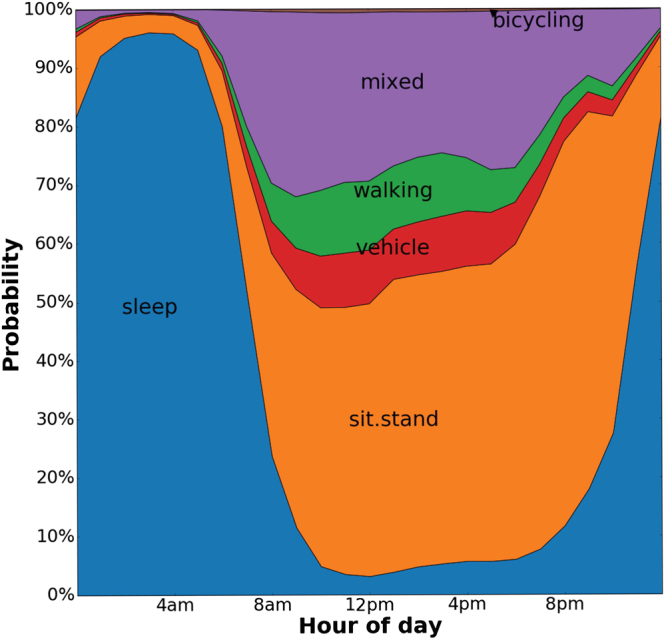
The paper develops a wrist-accelerometer machine-learning pipeline, trained on free-living ground truth from 132 adults, to classify six behaviors and estimate METs. Applied to 96,220 UK Biobank participants, it showed behavior patterns that aligned with self-reported traits such as chronotype, transport mode, occupation, age, and season.
Key findings
- In leave-one-subject-out validation on 132 participants, the activity model achieved a mean accuracy of 87% and kappa = 0.81 over 30-second windows; sleep/wake classification was the most robust.
- Adding hidden Markov model time smoothing improved overall classification from kappa = 0.69 to 0.81.
- For energy expenditure prediction, the model achieved RMSE = 1.75 MET hours/day with r = 0.85, outperforming random forests for regression on the same dataset (RMSE = 2.16, r = 0.81).
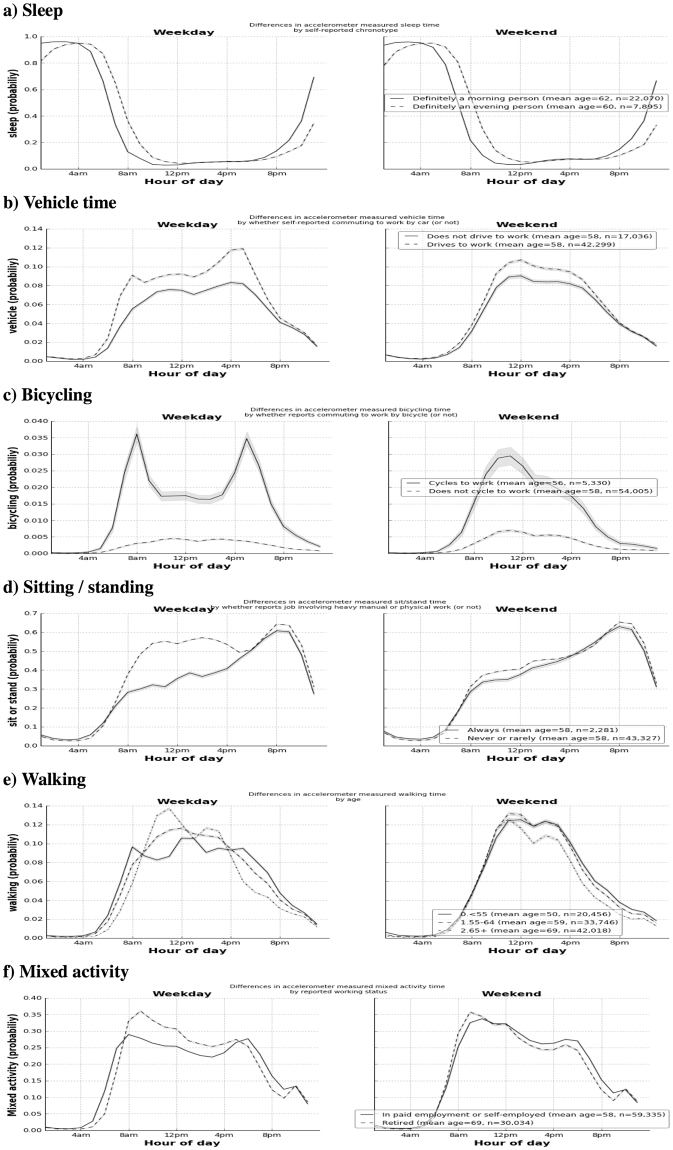
- In UK Biobank, several associations were reported, including: evening types were more likely to be sleeping at 8am on weekends (55% vs. 22%, p < 10^-100), car users were more likely to be classified as driving at 8am on weekdays (9.1% vs. 5.5%, p < 10^-100), and older adults (65+) were more likely to be walking at 11am on weekdays than those <55 (14% vs. 9%, p = 3 × 10^-18).
Methods
- Development/evaluation used the CAPTURE-24 study: 143 Oxford-region adults aged 18–91 recruited in 2014–2015; after removing 11 with missing or misaligned data, 132 participants remained for classifier development.
- Participants wore an Axivity AX3 wrist accelerometer at 100 Hz and a Vicon Autographer wearable camera; sleep was additionally labeled from a sleep diary and, when needed, a HETUS time-use diary.
- The analysis used balanced random forests on 126-dimensional features from non-overlapping 30-second windows, followed by a hidden Markov model and Viterbi decoding for temporal smoothing; performance was assessed with leave-one-subject-out cross-validation and kappa.
- The trained model was then applied to 103,712 UK Biobank participants; after exclusions for insufficient wear time and device errors, 96,220 participants were analyzed.
Limitations
- The paper states that the free-living training participants were not a random subsample of UK Biobank, so descriptive findings were not generalized to the UK population because UK Biobank was designed as an etiological study, not population surveillance.
- The paper notes that direct comparison across studies is difficult because of heterogeneity in populations, devices, and behavior definitions.
- Evident from the text: sleep and energy expenditure ground truth were not collected with traditional gold-standard methods; instead, the study relied on proxy reference methods (wearable camera, diaries) for free-living assessment at scale.
Model-written summary. Check it against the paper before relying on it.
Integrity signals
Registry
Cites
Statistics
Figures
Verification
Claims the paper makes
2 Valid · 1 Not valid · 3 Not checked · 30 Own results and interpretations
The cited sources support only part of this claim — read each source’s verdict below.
In the paper
“Our study shows that bicycling can be reliably detected from accelerometer data, an activity previously difficult to classify in laboratory studies 15 , 19 .”
What the sources say
- Supportedcites [15] Mannini, A., Intille, S. S., Rosenberger, M., Sabatini, A. M. & Haskell, W. Activity recognition using a single accelerometer placed at the wrist or ankle. Med. Sci. Sports Exerc. 45, 2193–203 (2013). source
The citation supports the background point that bicycling was difficult to classify: the Discussion says cycling was harder to detect than other activity classes from wrist accelerometer data in this laboratory-based study. The statement that bicycling can be reliably detected is framed as the citing authors’ own finding, not a finding attributed to this source. (LLM, conf=0.88)
- Partly supportedcites [19] Staudenmayer, J., Pober, D., Crouter, S., Bassett, D. & Freedson, P. An artificial neural network to estimate physical activity energy expenditure and identify physical activity type from an accelerometer. J. Appl. Physiol. 107, 1300–1307 (2009). sourceExperimental — accuracy not yet measured
The Discussion (page unavailable) describes stationary cycling as producing little body movement and says the method was not reliably accurate at identifying specific activity modes. That supports the cited point that cycling was challenging, but the paper does not report cycling-specific classification accuracy. The citing authors’ claim that their own study reliably detected bicycling is not a finding attributed to this source. (LLM, conf=0.76)
plainstates an association- Asserted: passes — The authors put it forward as true.
- Checkable: passes — It can be checked against evidence.
- Load-bearing: unclear — It is unclear whether the paper’s conclusions depend on it.
- Based: passes — The paper gives a reason why it holds.
- Supported
The cited sources support only part of this claim — read each source’s verdict below.
In the paper
“However, our data and that from Ellis et al 30 . shows that walking is challenging to classify in free-living conditions (sensitivity = 0.71, specificity = 0.96), probably due to it being part of many everyday activities.”
What the sources say
- Partly supportedcites [30] Ellis, K., Kerr, J., Godbole, S., Staudenmayer, J. & Lanckriet, G. Hip and Wrist Accelerometer Algorithms for Free-Living Behavior Classification. Med. Sci. Sports Exerc. 48, 933–40 (2016). sourceExperimental — accuracy not yet measured
Our copy does address walking classification in free-living conditions and its difficulty — the Discussion (p. n/a) states that 'observational protocol data can be classified with higher accuracy than free-living data' and that 'classifiers trained on both laboratory and observational protocol data perform poorly when applied to free-living data', and the Results (ML behavior classification) note walking/standing confusion ('Standing was most commonly confused for sitting by the hip classifier and most commonly confused for walking by the wrist classifier') and that cut-point/GGIR methods underestimated walking by 10–16 min/day. However, the specific figures the claim attributes (sensitivity = 0.71, specificity = 0.96) are not stated anywhere in our copy: the text only refers the reader to Table 1 for per-activity sensitivity/specificity, and the table values are not reproduced. Our copy also frames walking performance positively at the group level ('both classifiers correctly estimated minutes in sedentary behaviors and walking time'; hip classifier 'showed no significant difference in minutes of walking predicted'), and it is limited to 40 overweight/obese women with walking and running merged into one class, so the unqualified generalisation 'walking is challenging to classify' overstates what the source asserts. (LLM, conf=0.62)
hedged- Asserted: passes — The authors put it forward as true.
- Checkable: passes — It can be checked against evidence.
- Load-bearing: passes — The paper’s conclusions depend on it.
- Based: passes — The paper gives a reason why it holds.
- Partly supported
A result the paper reports from its own data — it cites no other source for it, so there is none to check. The quote shows it is in the paper.
In the paper
“Apart from mixed-activity and METs (r = 0.75), the different activity types are weakly correlated (absolute overall mean r = 0.37), indicating their utility as new sources of information (Fig. S 5 ).”
plainstates an associationn = 96,220- Asserted: passes — The authors put it forward as true.
- Checkable: passes — It can be checked against evidence.
- Load-bearing: passes — The paper’s conclusions depend on it.
- Based: passes — The paper gives a reason why it holds.
A result the paper reports from its own data — it cites no other source for it, so there is none to check. The quote shows it is in the paper.
In the paper
“Women spent more time engaged in mixed activity behaviours than men (18.9% vs. 14.5%, p < 10 −100 ).”
plainstates an association- Asserted: passes — The authors put it forward as true.
- Checkable: passes — It can be checked against evidence.
- Load-bearing: unclear — It is unclear whether the paper’s conclusions depend on it.
- Based: passes — The paper gives a reason why it holds.
A result the paper reports from its own data — it cites no other source for it, so there is none to check. The quote shows it is in the paper.
In the paper
“Self-reported car users were more likely to be classified as driving at 8am on weekdays (9.1% vs. 5.5%, p < 10 −100 after adjustment for other factors) (see Fig. 1b ).”
plainstates an association- Asserted: passes — The authors put it forward as true.
- Checkable: passes — It can be checked against evidence.
- Load-bearing: unclear — It is unclear whether the paper’s conclusions depend on it.
- Based: passes — The paper gives a reason why it holds.
- Rests on an assumption not shown here.
16 more claims
Create a free account to see all 36 claims and to verify the 4 references still open.
- It may state two separate claims as one. 10
- Probably not a substantial claim. 11
Claims other papers make about this one
Each is checked against this paper’s own text: does it say what the citing paper says it does?
The cited source doesn’t support the claim as written.
In the citing paper
“This allowed us to train a model using all free-living ground truth data, achieving 79% accuracy (kappa = 0.68) across classes of interest14 (Supplementary Table 1).”
From GWAS identifies 14 loci for device-measured physical activity and sleep duration (2018) · cites this paper as [14]
Checked by a reasoning model — may be wrong.
Experimental — accuracy not yet measuredThe source backs part of the claim, not all of it — or backs it for a different population, condition or comparison.
In the citing paper
“This protocol was, for example, utilized in the UK Biobank study, which recorded accelerometer data from approx.90𝑘 participants, resulting in around 20TB of sensor data [46,198].”
From Past, Present, and Future of Sensor-based Human Activity Recognition Using Wearables: A Surveying Tutorial on a Still Challenging Task (2025) · cites this paper as [198]
Experimental — accuracy not yet measuredThe source backs part of the claim, not all of it — or backs it for a different population, condition or comparison.
In the citing paper
“a strong random forest model with tried-and-tested time series features, which has often been neglected in baseline model comparisons8,48–50.”
From Self-supervised learning for human activity recognition using 700,000 person-days of wearable data (2024) · cites this paper as [8]
Experimental — accuracy not yet measuredThe source backs part of the claim, not all of it — or backs it for a different population, condition or comparison.
In the citing paper
“the machine-learned phenotypes demonstrated face validity14 with clear and expected differences in sleep duration by self-reported chronotype status (Supplementary Fig. 1).”
From GWAS identifies 14 loci for device-measured physical activity and sleep duration (2018) · cites this paper as [14]
Experimental — accuracy not yet measuredThe source backs part of the claim, not all of it — or backs it for a different population, condition or comparison.
In the citing paper
“As detailed in a previous publication14 this model was considered suitable for population inference in UK Biobank as the performance was not materially affected by age and sex characteristics (difference in kappa score: sex < 0.0001; age < 0.05).”
From GWAS identifies 14 loci for device-measured physical activity and sleep duration (2018) · cites this paper as [14]
Experimental — accuracy not yet measured
15 more claims about this paper
Create a free account to see every claim other papers make about this one.
Citations
Cites
Breiman, L. (2001) · Machine Learning · doi:10.1023/a:1010933404324 · Cited by 133,538
The Measurement of Observer Agreement for Categorical Data
Landis, J. R., & Koch, G. G. (1977) · Biometrics · doi:10.2307/2529310 · Cited by 81,148
Sudlow, C., Gallacher, J., Allen, N., Beral, V., Burton, P., Danesh, J., Downey, P., Elliott, P., Green, J., Landray, M., et al. (2015) · PLOS Medicine · doi:10.1371/journal.pmed.1001779 · Cited by 12,728 · cited 2×
“We firstly assessed its performance in free-living scenarios using a dataset of 132 adults, 84 of which are female, aged 18–91 who wore an accelerometer and wearable camera (a method comparable to direct-observation 21 ).”
BackgroundMethodLee, I.-M., Shiroma, E. J., Lobelo, F., Puska, P., Blair, S. N., & Katzmarzyk, P. T. (2012) · The Lancet · doi:10.1016/s0140-6736(12)61031-9 · Cited by 8,215
(2005) · PubMed · Cited by 7,011
2011 Compendium of Physical Activities: A Second Update of Codes and MET Values
AINSWORTH, B. E., HASKELL, W. L., HERRMANN, S. D., MECKES, N., BASSETT, D. R., TUDOR-LOCKE, C., GREER, J. L., VEZINA, J., WHITT-GLOVER, M. C., & LEON, A. S. (2011) · Medicine & Science in Sports & Exercise · doi:10.1249/mss.0b013e31821ece12 · Cited by 6,317 · cited 1×
“Images were annotated by human annotators using codes from the compendium of physical activities 25 , using specific wearable camera browsing software 45 (Doc S1).”
MethodForney, G. D. (1973) · Proceedings of the IEEE · doi:10.1109/proc.1973.9030 · Cited by 5,647 · cited 1×
“Finally, the predicted MET score for each 30-second chunk is calculated as the assigned MET scores for each of the 11 states, weighted by the marginal probabilities of being in each of those states.”
MethodAn introduction to hidden Markov models
Rabiner, L., & Juang, B. (1986) · IEEE ASSP Magazine · doi:10.1109/massp.1986.1165342 · Cited by 4,775 · cited 1×
“To predict the MET score we follow the same process of feature extraction, random forest training and HMM definition, but for the eleven-class MET-relevant behaviour labels.”
MethodFit Yourself and Take Your Lungs to Heart
Palange, P., & Bonini, M. (2013) · Respiration · doi:10.1159/000350831 · Cited by 2,779
Wilmot, E. G., Edwardson, C. L., Achana, F. A., Davies, M. J., Gorely, T., Gray, L. J., Khunti, K., Yates, T., & Biddle, S. J. H. (2012) · Diabetologia · doi:10.1007/s00125-012-2677-z · Cited by 1,789 · cited 1×
“learning methods have not been assessed in large scale health sensor datasets for face validity or investigated to evaluate if they offer behavioural insight.”
Background
Research works printed but not linked: 3
- Ladha, C., Ladha, K., Jackson, D. & Olivier, P. Shaker Table Validation Of Openmovement Ax3 Accelerometer. in 3rd International Conference on Ambulatory Monitoring of Physical Activity and Movement 69–70 (2013).
- Doherty, A. R. et al. Using wearable cameras to categorise type and context of accelerometer-identified episodes of physical activity. Int. J. Behav. Nutr. Phys. Act. 10 (2013). · DOI · Paper page
- Fernández-Delgado, M., Cernadas, E., Barro, S. & Amorim, D. Do we Need Hundreds of Classifiers to Solve Real World Classification Problems? J. Mach. Learn. Res. 15, 3133–3181 (2014).
Cited by
Items 101–200 of 256
Haresamudram, H., Essa, I., & Plötz, T. (2024) · Sensors · doi:10.3390/s24041238 · Cited by 14
“The representations are derived using wrist-based accelerometer data from Capture-24 [31–33]—a large-scale dataset that was collected in-the-wild and, as such, is representative for real-world Ubicomp applications of HAR.”
MethodWalmsley, R., Chan, S., Smith-Byrne, K., Ramakrishnan, R., Woodward, M., Rahimi, K., Dwyer, T., Bennett, D., & Doherty, A. (2020) · doi:10.1101/2020.11.10.20227769 · Cited by 12
Self-citationBeyer, K. B., Weber, K. S., Cornish, B. F., Vert, A., Thai, V., Godkin, F. E., McIlroy, W. E., & Ooteghem, K. V. (2024) · BMC Digital Health · doi:10.1186/s44247-024-00062-3 · Cited by 17
Liu, Y., Ku, P., Li, Z., Yang, H., Zhang, T., Chen, L., Xia, Y., & Bai, S. (2024) · American Journal of Kidney Diseases · doi:10.1053/j.ajkd.2024.03.022 · Cited by 13
Goallec, A. L., Collin, S., Jabri, M., Diai, S., Vincent, T., & Patel, C. J. (2023) · PLOS Digital Health · doi:10.1371/journal.pdig.0000176 · Cited by 15
AutoML for On-Sensor Tiny Machine Learning
Chowdhary, M., Lilienthal, D., Saha, S. S., & Palle, K. C. (2023) · IEEE Sensors Letters · doi:10.1109/lsens.2023.3327914 · Cited by 16
Weaver, R. G., White, J., Finnegan, O., Nelakuditi, S., Zhu, X., Burkart, S. A., Beets, M. W., Brown, T., PATE, R. R., Welk, G. J., et al. (2023) · Medicine & Science in Sports & Exercise · doi:10.1249/mss.0000000000003294 · Cited by 17
“Adopting a device-agnostic approach offers one solution to this problem (7,8).”
BackgroundTowards LLMs for Sensor Data: Multi-Task Self-Supervised Learning
Okita, T., Ukita, K., Matsuishi, K., Kagiyama, M., Hirata, K., & Miyazaki, A. (2023) · ACM International Joint Conference on Pervasive and Ubiquitous Computing (UbiComp) · doi:10.1145/3594739.3610745 · Cited by 18
Connection between sleeping patterns and cognitive deterioration in women with Alzheimer’s disease
Corbí, A., & Burgos, D. (2021) · Sleep And Breathing · doi:10.1007/s11325-021-02327-x · Cited by 12
“Artificial intelligence clustering methods (and EM in particular) have already been used for activity recognition [30], including sleep detection [31, 32].”
MethodPontin, F. L., Lomax, N., Clarke, G., & Morris, M. A. (2021) · International Journal of Environmental Research and Public Health · doi:10.3390/ijerph182111476 · Cited by 13
Wang, J., Battioui, C., McCarthy, A. P., Dang, X., Zhang, H., Man, A., Zou, J. F., Kyle, J. A., Munsie, L. M., Pugh, M., et al. (2022) · Journal of Parkinson s Disease · doi:10.3233/jpd-213126 · Cited by 15
“Although the actigraphy-measured sleep appeared to be more sensitive than clinical measurements, it is important to note that sleep was measured using an actigraphybased algorithm [22, 32, 33]; in future studies, the use of devices that measure other physiological measures related to sleep, such as heart rate variabil…”
MethodMcDonald, L., Oguz, M., Carroll, R., Thakkar, P. K., Yang, F., Dhalwani, N. N., Cox, A., Merinopoulou, E., Malcolm, B., Mehmud, F., et al. (2019) · Future Oncology · doi:10.2217/fon-2019-0443 · Cited by 16
Proniewska, K. K., Pręgowska, A., & Malinowski, K. P. (2020) · IRBM · doi:10.1016/j.irbm.2020.02.006 · Cited by 12
Workplace activity classification from shoe-based movement sensors
Fridolfsson, J., Arvidsson, D., Doerks, F., Kreidler, T. J., & Grau, S. (2020) · BMC Biomedical Engineering · doi:10.1186/s42490-020-00042-4 · Cited by 13
Cavallo, F. R., & Toumazou, C. (2023) · PLOS Digital Health · doi:10.1371/journal.pdig.0000333 · Cited by 16
“Firstly, we classified the raw accelerometer data into SB, light PA, walking, moderate-to-vigorous PA (MVPA) and sleep with balanced random forests and Hidden Markov models (with the accelerometer package by [44]).”
MethodGait Monitoring and Analysis: A Mathematical Approach
Canonico, M., Desimoni, F., Ferrero, A., Grassi, P. A., Irwin, C., Campani, D., Molin, A. D., Panella, M., & Magistrelli, L. (2023) · Sensors · doi:10.3390/s23187743 · Cited by 12
“Consequently, we adopted the publicly available Capture24 dataset [39].”
MethodPopham, S. F., Burq, M., Rainaldi, E., Shin, S., Dunn, J., & Kapur, R. (2023) · JMIR Biomedical Engineering · doi:10.2196/43726 · Cited by 10
“All existing validation studies of ambulatory status classification from wrist-worn sensors have been either performed on young and healthy populations [25] or in the laboratory or clinic [20,21].”
BackgroundMethodRigny, L., Fletcher‐Lloyd, N., Capstick, A., Nilforooshan, R., & Barnaghi, P. M. (2024) · Communications Medicine · doi:10.1038/s43856-024-00646-0 · Cited by 15
Physical activity in relation to circulating hormone concentrations in 117,100 men in UK Biobank
Watts, E. L., Perez‐Cornago, A., Doherty, A., Allen, N. E., Fensom, G. K., Tin, S. T., Key, T. J., & Travis, R. C. (2021) · Cancer Causes & Control · doi:10.1007/s10552-021-01466-6 · Cited by 11
Self-citationZhou, H., Zhu, R., Ung, A., & Schatz, B. R. (2022) · PLOS Digital Health · doi:10.1371/journal.pdig.0000045 · Cited by 11
“UK Biobank provides accurate datasets for sensor input with physical activity and status output with health outcomes [19].”
BackgroundMethodInfluentialWang, L., Luo, Z., & Zhang, T. (2025) · BMC Biomedical Engineering · doi:10.1186/s42490-025-00088-2 · Cited by 8
Validation of Wearable Camera Still Images to Assess Posture in Free-Living Conditions
Martinez, J., Decker, A. E., Cho, C. C., Doherty, A., Swartz, A. M., STAUDENMAYER, J. W., & Strath, S. J. (2021) · Journal for the Measurement of Physical Behaviour · doi:10.1123/jmpb.2020-0038 · Cited by 8
“The OIB allows users, or coders, to click and drag annotation codes to a sequence of images within an IMG set (Figure 1).”
MethodInfluentialSelf-citationFenton, S. A. M., O’Brien, C. M., Kitas, G. D., Duda, J. L., Zanten, J. V., & Metsios, G. S. (2022) · Rheumatology Advances in Practice · doi:10.1093/rap/rkac097 · Cited by 6
“For example, machine learning is being used to develop classification algorithms able to measure volumes, patterns and types of sedentary behaviours (and physical activities) from raw accelerometer data in non-inflammatory arthritis populations [69].”
MethodAnand, A., Dixit, R. J., Verma, A., & Basu, S. (2023) · Energy Technology · doi:10.1002/ente.202300698 · Cited by 8
Lin, F., Shi, Y., Song, W., Weng, Y., Zou, X., Chen, X., Zheng, J., Chen, K., Ye, Q., Wu, X., et al. (2024) · BMC Medicine · doi:10.1186/s12916-024-03497-7 · Cited by 9
“The sleep state was calculated using a combination of data sources and methodologies [12].”
MethodOgasawara, T., Mukaino, M., Otaka, Y., Matsuura, H., Aoshima, Y., Suzuki, T., Togo, H., Nakashima, H., Yamaguchi, M., Tsukada, S., et al. (2021) · Journal of Medical and Biological Engineering · doi:10.1007/s40846-021-00622-2 · Cited by 10
Correlates of poor sleep based upon wrist actigraphy data in bipolar disorder
Kaufmann, C. N., Lee, E., Wing, D., Sutherland, A. N., Christensen, C., Ancoli‐Israel, S., Depp, C. A., Yoon, H., Soontornniyomkij, B., & Eyler, L. T. (2021) · Journal of Psychiatric Research · doi:10.1016/j.jpsychires.2021.06.038 · Cited by 8
Wang, L., Luo, Z., & Zhang, T. (2024) · doi:10.21203/rs.3.rs-4696057/v1 · Cited by 8
Lendt, C., Hettiarachchi, P., Johansson, P. J., Duncan, S., Rasmussen, C. L., Narayanan, A., & Stewart, T. I. (2024) · Journal of Physical Activity and Health · doi:10.1123/jpah.2024-0259 · Cited by 11
Wearable device-measured physical activity and incident cardiovascular disease in cancer survivors
Jiang, C., Li, Z., Guo, B., Chen, L., Zhu, L., Liang, Y., Shen, Y., Long, T., Zhai, M., Shi, J., et al. (2025) · British Journal of Sports Medicine · doi:10.1136/bjsports-2024-108734 · Cited by 8
Quantified Canine: Inferring Dog Personality From Wearables
Meegahapola, L., Constantinides, M., Radivojević, Z., Li, H., Quercia, D., & Eggleston, M. S. (2023) · CHI Conference on Human Factors in Computing Systems · doi:10.1145/3544548.3581088 · Cited by 13
“The processing included four steps: a) ten-second samples from static sections (no movement) of accelerometer data were obtained to optimize the gain and offset for each of the X, Y, and Z axes to fit a unit gravity sphere [99]; b) data were re-sampled at 100Hz using linear interpolation, and acceleration was calculat…”
MethodUsing Computer Vision to Annotate Video-Recoded Direct Observation of Physical Behavior
Keadle, S. K., Eglowski, S., Ylarregui, K., Strath, S. J., Martinez, J., Dekhtyar, A., & Kagan, V. (2024) · Sensors · doi:10.3390/s24072359 · Cited by 11
CARL: a running recognition algorithm for free-living accelerometer data
Davis, J. J., Strączkiewicz, M., Harezlak, J., & Gruber, A. H. (2021) · Physiological Measurement · doi:10.1088/1361-6579/ac41b8 · Cited by 6
Emotions and Activity Recognition System Using Wearable Device Sensors
Rumiantcev, M. (2021) · Conference of Open Innovations Association (FRUCT) · doi:10.23919/fruct50888.2021.9347652 · Cited by 9
Sleep Monitoring With Hidden Markov Model for Physical Conditions Tracking
Peng, L., Yin, A., Song, W., Yao, W., Ren, H., & Yang, L. (2020) · IEEE Sensors Journal · doi:10.1109/jsen.2020.3007153 · Cited by 7
Assessment of physical activity patterns in patients with rheumatoid arthritis using the UK Biobank
Hamy, V., Creagh, A. P., & Garcia‐Gancedo, L. (2025) · PLoS ONE · doi:10.1371/journal.pone.0319908 · Cited by 5
“Identification of sustained walking periods or ambulatory bouts were based on walking as detected using an alternative version of the HAR model [29].”
InfluentialNshimyimana, D., Rey, V. F., Suh, S., Zhou, B., & Lukowicz, P. (2025) · International Conference on Activity and Behavior Computing (ABC) · doi:10.1109/abc64332.2025.11118365 · Cited by 7
Megaritis, D., Alcock, L., Scott, K., Hiden, H., Cereatti, A., Vogiatzis, I., & Din, S. D. (2025) · Bioengineering · doi:10.3390/bioengineering12101108 · Cited by 5
“…published AI/ML gait models lack the necessary temporal resolution for direct comparison with our reference methods, which support precision (gait detection) per sample, as opposed to published models including gait detection at 10 s windows [44] or total ambulation time per recording periods [45].”
Trust in Artificial Intelligence: Clinicians Are Essential
Bhatt, U., & Shams, Z. (2021) · Health informatics · doi:10.1007/978-3-030-81030-6_10 · Cited by 5
On convex decision regions in deep network representations
Tětková, L., Brüsch, T., Dorszewski, T., Mager, F. M., Aagaard, R. Ø., Foldager, J., Alstrøm, T. S., & Hansen, L. K. (2025) · Nature Communications · doi:10.1038/s41467-025-60809-y · Cited by 18
“In the human activity domain, we applied our methods to the Capture24 dataset (Willetts et al., 2018).”
Ogasawara, T., Mukaino, M., Matsuura, H., Aoshima, Y., Suzuki, T., Togo, H., Nakashima, H., Saitoh, E., Yamaguchi, M., Otaka, Y., et al. (2023) · Frontiers in Physiology · doi:10.3389/fphys.2023.1094946 · Cited by 5
“The activity patterns on weekdays are generally different from those on the weekend (Willetts et al., 2018; Matsuura et al., 2019), and the effect of the day of the week on the proposed imputation method should be further investigated in the future.”
MethodResponse to: One size does not fit all—application of accelerometer thresholds in chronic disease
Barker, J., Smith-Byrne, K., Doherty, A., Foster, C. E., Rahimi, K., Ramakrishnan, R., Woodward, M., & Dwyer, T. (2019) · International Journal of Epidemiology · doi:10.1093/ije/dyz165 · Cited by 6
“validated in large studies of healthy and diseased individuals, ideally in free-living scenarios.(5) However, for now, we”
BackgroundSelf-citationPanomics: New Databases for Advancing Cardiology
Vakili, D., Radenković, D., Chawla, S., & Bhatt, D. L. (2021) · Frontiers in Cardiovascular Medicine · doi:10.3389/fcvm.2021.587768 · Cited by 7
“A total of 103,578 UK BioBank participants aged between 45 and 79 years had wrist-worn accelerometers that record daily physical activities (83) and automatically categorize these activities into groups, such as cycling or walking and record sleep cycle stage (84).”
BackgroundRey, V. F., Rezende, P. M. B., Zhou, B., Suh, S., & Lukowicz, P. (2025) · Expert Systems with Applications · doi:10.1016/j.eswa.2025.129288 · Cited by 14
Musbahi, O., Sousi, S., Al-Saadawi, A., Glynou, S. P., Bottle, A., Cobb, J. P., & Jones, G. G. (2025) · Arthroplasty · doi:10.1186/s42836-025-00339-6 · Cited by 6
“…data collected beyond the first 12 post-operative months; 4) insufficient valid accelerometery data (defined as less than 72 h of wear time with a minimum of 16 h per day), in accordance with established quality control protocols [13]; or 5) missing data on key clinical and demographic variables.”
The rise of large language models in wearable health sensing
Farrahi, V. (2025) · Intelligent Medicine · doi:10.1016/j.imed.2025.12.003 · Cited by 5
Osuka, Y., Chan, L. L. Y., Brodie, M. A. D., Okubo, Y., & Lord, S. R. (2025) · Age and Ageing · doi:10.1093/ageing/afaf210 · Cited by 5
Activity Mapping of Children in Play Using Multivariate Analysis of Movement Events
Rocha, J., Barnes, C. M., Rees, P. C. T., Clark, C. C. T., Stratton, G., & Summers, H. D. (2019) · Medicine & Science in Sports & Exercise · doi:10.1249/mss.0000000000002119 · Cited by 5
Modelling Similarity for Comparing Physical Activity Profiles - A Data-Driven Approach
Verma, D., Bach, K., & Mork, P. J. (2018) · Lecture notes in computer science · doi:10.1007/978-3-030-01081-2_28 · Cited by 5
“Similarly, in [32], authors proposed a statistical machine learning model to identify different sleep and physical activity phenotypes.”
BackgroundMethodBig Data: Knowledge Discovery and Data Repositories
Velupillai, S. U., Davis, K. A. S., & Rozenblit, L. (2021) · Health informatics · doi:10.1007/978-3-030-70558-9_15 · Cited by 4
Wei, L., Ahmadi, M. N., Hamer, M., Blodgett, J. M., Small, S., Trost, S. G., & Stamatakis, E. (2024) · Journal of science and medicine in sport · doi:10.1016/j.jsams.2024.05.002 · Cited by 4
Jang, B., & Kim, I. A. (2021) · Biomarkers in Medicine · doi:10.2217/bmm-2021-0280 · Cited by 5
Beach, C., & Casson, A. J. (2023) · IEEE Internet of Things Journal · doi:10.1109/jiot.2023.3288212 · Cited by 4
“[23], [29]) plot one hour epochs of the accelerometry data, whereas we summarise results on a minute-by-minute basis.”
MethodParaschiakos, S., Bogaards, F. A., Knobbe, A., Slagboom, P. E., & Beekman, M. (2023) · medRxiv · doi:10.1101/2023.11.26.23299026 · Cited by 5
“While these models have been successfully used in other studies [13], they have not yet been applied in the context of health benefits for older adults.”
BackgroundMethodResultInfluentialTowards Customizable Foundation Models for Human Activity Recognition with Wearable Devices
Qiu, M., Weng, C., Fan, M., & Wu, K. (2025) · Proceedings of the ACM on Interactive Mobile Wearable and Ubiquitous Technologies · doi:10.1145/3749479 · Cited by 4
Kasimu, A., Zhou, W., Meng, Q., Wang, Y., Wang, Z., Zhang, Q., & Peng, Y. K. (2025) · Alexandria Engineering Journal · doi:10.1016/j.aej.2025.01.007 · Cited by 5
Ma, Q., Dunton, G. F., & Hedeker, D. (2025) · Biometrics · doi:10.1093/biomtc/ujaf099 · Cited by 5
Bridging the digital divide in the pharmaceutical industry: A future research agenda
Miozza, M., Lombardo, S. M., Galvagno, M., & Magni, L. (2025) · Social Science & Medicine · doi:10.1016/j.socscimed.2025.118832 · Cited by 11
Brand, Y. E., Buchman, A. S., Kluge, F., Palmerini, L., Becker, C., Cereatti, A., Maetzler, W., Vereijken, B., Yarnall, A. J., Rochester, L., et al. (2026) · npj Digital Medicine · doi:10.1038/s41746-026-02528-2 · Cited by 6
“The framework comprises two main steps: an initial SSL-based pretraining using the large unlabeled UK Biobank dataset 6,9,26 (Dataset 1) followed by additional SSL training on the RUSH Memory and Aging Project (MAP) dataset 37,38 (Dataset 2) tailored toward older populations with diverse mobility…”
InfluentialLuo, M., Clare, P. J., Tarp, J., Dalene, K. E., Sánchez-Lastra, M. A., Nguyen, B., Owen, K., Nau, T., Chen, L., Ekelund, U., et al. (2026) · British Journal of Sports Medicine · doi:10.1136/bjsports-2025-110782 · Cited by 4
Stark, B., & Samarah, M. (2019) · IEEE International Conference on Computer and Communications (ICCC) · doi:10.1109/iccc47050.2019.9064080 · Cited by 4
Lin, Z., Chen, J., Cai, Y., Wang, Z., Xu, J., Shi, Y., Li, J., Xu, P., Shen, J., Chen, G., et al. (2025) · BMC Public Health · doi:10.1186/s12889-025-24662-4 · Cited by 2
“Further information regarding the collection, validation, and processing of the data can be found in other sources [8, 34].”
Rahimi-Eichi, H., Baker, J. T., Fjell, A. M., & Buckner, R. L. (2025) · SLEEP Advances · doi:10.1093/sleepadvances/zpaf079 · Cited by 6
“…raises concerns about its potential long-term effects on health, as chronic sleep deprivation has been linked to a variety of health problems, including metabolic disorders and cardiovascular disease [28, 31, 32], although the relation of sleep duration and health consequences is nuanced [33].”
Wearable Accelerometers in Cancer Patients
Dadhania, S., & Williams, M. (2021) · Intelligent systems reference library · doi:10.1007/978-3-030-83620-7_5 · Cited by 3
Davis, J. J., Oeding, B. E., & Gruber, A. H. (2022) · Journal for the Measurement of Physical Behaviour · doi:10.1123/jmpb.2022-0011 · Cited by 5
Andrews, J. A., Craven, M. P., Guo, B., Weyer, J., Lees, S., Zormpas, S. I., Thorpe, S., Devonshire, J., Antonio‐Arce, V. S., Whitehouse, W. P., et al. (2023) · JMIR Neurotechnology · doi:10.2196/41439 · Cited by 3
“The UK Biobank now includes data on sleep and physical activity from wearable devices, and researchers have begun to analyze these data for various purposes [37].”
BackgroundOverview of methods and available tools used in complex brain disorders
Ilias, L., Doukas, G. S., Kontoulis, M., Alexakis, K., Michalitsi-Psarrou, A., Ntanos, C., & Askounis, D. (2023) · Open Research Europe · doi:10.12688/openreseurope.16244.1 · Cited by 3
“It can be installed via Python and also needs Java to be installed 83–86 .”
BackgroundElhakeem, A., Gregson, C. L., Tobias, J. H., & Lawlor, D. A. (2020) · Annals of Human Biology · doi:10.1080/03014460.2019.1707284 · Cited by 4
“Future studies could make use of recent advances in accelerometer output analyses to derive more detailed activity outcomes (Millard et al. 2017; Willetts et al. 2018).”
BackgroundSemi-unsupervised Learning of Human Activity using Deep Generative ModelsPreprint
Willetts, M., Doherty, A., Roberts, S., & Holmes, C. C. (2018) · arXiv (Cornell University) · doi:10.48550/arxiv.1810.12176 · Cited by 6
Self-citationYuan, H., Plekhanova, T., Walmsley, R., Reynolds, A. C., Maddison, K. J., Bucan, M., Gehrman, P., Rowlands, A., Ray, D. W., Bennett, D., et al. (2023) · doi:10.1101/2023.07.07.23292251 · Cited by 3
Self-citationThe Use of Wearable Cameras to Capture Physical Activity and Sedentary Behavior: A Scoping Review
Martinez, J., Steinbrink, G. M., Kate, R. J., Cho, C. C., Swartz, A. M., & Strath, S. J. (2025) · Journal for the Measurement of Physical Behaviour · doi:10.1123/jmpb.2024-0045 · Cited by 3
He, Z., Sun, Y., Huang, H., Wellens, J., Liu, Y., Dan, L., Ruan, X., Fu, T., Li, Z., Wang, X., et al. (2025) · International Journal of Surgery · doi:10.1097/js9.0000000000003255 · Cited by 4
Frequency-Aware Masked Autoencoders for Human Activity Recognition using Accelerometers
Lorenzen, N. R., Jennum, P. J., Mignot, E., & Brink-Kjaer, A. (2025) · 2025 47th Annual International Conference of the IEEE Engineering in Medicine and Biology Society (EMBC) · doi:10.1109/embc58623.2025.11252605 · Cited by 2
“The labels are reduced to the six categories bicycling, walking, mixed, vehicle, sit-stand, and sleep following previous research [1], [11].”
Sánchez-Lastra, M. A., Cruz, B. D. P., Tarp, J., Dalene, K. E., Nilsen, T. S., Ding, D., & Ekelund, U. (2025) · Journal of sport and health science/Journal of Sport and Health Science · doi:10.1016/j.jshs.2025.101116 · Cited by 2
“Time spent in MVPA and light physical activity (LPA) was derived from a machine learning tool, 27 and total PA was the measured average vector magnitude in mg (Supplementary Table 3).”
Zhu, Y., Liu, D., Yin, X., Zhang, T. J., & Wu, N. (2026) · Journal of Exercise Science & Fitness · doi:10.1016/j.jesf.2026.200458 · Cited by 3
Beaupre, L. M., Wainberg, M., Zai, C. C. H., Milic, M. S., Felsky, D., Brown, G. M., Goldstein, B. I., Tripathy, S. J., Kennedy, J. L., & Gonçalves, V. F. (2022) · Journal of Psychiatric Research · doi:10.1016/j.jpsychires.2022.11.010 · Cited by 2
Yuan, Y., Hu, W., Zhang, X., Borchert, G., Wang, W., Zhu, Z., & He, M. (2022) · Asia-Pacific Journal of Ophthalmology · doi:10.1097/apo.0000000000000578 · Cited by 2
Sedentary Behaviour and Cancer
Swain, C. T. V., Boyle, T., Mahmood, S., & Lynch, B. M. (2023) · Springer series on epidemiology and public health · doi:10.1007/978-3-031-41881-5_9 · Cited by 2
Unsupervised Bayesian change point detection model to track acute stress responses
Shishavan, H. H., Gossett, E. W., Bi, J., Henning, R. A., Cherniack, M. C., & Kim, I.-S. (2024) · Biomedical Signal Processing and Control · doi:10.1016/j.bspc.2024.106415 · Cited by 3
Liu, P. Z., Raizen, D. M., Skarke, C., Brooks, T. G., & Anafi, R. C. (2024) · SLEEP · doi:10.1093/sleep/zsae243 · Cited by 2
Bürki, C., Tian, C., Westerman, K. E., & Patel, C. J. (2025) · JMIR mhealth and uhealth · doi:10.2196/54820 · Cited by 3
“The measured PA data values were extracted and categorized from the freely available software [12,13,19].”
Reducing annotation burden in physical activity research using vision language models
Schönfeldt, A., Maylor, B. D., Chen, X., Clark, R., & Doherty, A. (2025) · Scientific Reports · doi:10.1038/s41598-025-21350-6 · Cited by 7
“…behaviour measurement approaches and developing novel machine learning approaches (Logacjov et al., 2024; Yuan et al., 2024; Walmsley et al., 2022; Willetts et al., 2018; Doherty et al., 2017) is in diverse populations of people living their everyday lives, highlighting the need for large,…”
Self-citationRuan, X. (2022) · Wireless Communications and Mobile Computing · doi:10.1155/2022/4506025 · Cited by 2
“Accordingly, a classification model with better classification accuracy and performance can be obtained after continuous training and learning [16].”
BackgroundRetractedUnsupervised Classification of Human Activity with Hidden Semi-Markov Models
Cavallo, F. R., Toumazou, C., & Nikolić, K. (2022) · Applied System Innovation · doi:10.3390/asi5040083 · Cited by 2
Machine Learning Applications for Therapeutic Tasks with Genomics DataPreprint
Huang, K., Xiao, C., Glass, L. M., et al. (2021) · arXiv (Cornell University) · doi:10.48550/arxiv.2105.01171 · Cited by 2
TremTrack: Mobile Classification of Parkinsonian Hand Tremors Using Accelerometer Data
Davay, S., Muppa, A., & Liotta, L. A. (2024) · IEEE MIT Undergraduate Research Technology Conference (URTC) · doi:10.1109/urtc65039.2024.10937599 · Cited by 1
“These time and frequency domain features were selected based on previous studies on activity classification through accelerometer data [7,8,9,10].”
Putica, A., Yurtbasi, M., & Khanna, R. (2025) · AI & Society · doi:10.1007/s00146-025-02336-4 · Cited by 5
Chronic inflammation mediates the relationship between physical activity and telomere length
Nanda, A., Aslan, D. H., Sayre, M. K., Bharadwaj, P. K., Ally, M., Song, H., Arora, A., Maltagliati, S., Lai, M. H. C., Wilcox, R. R., et al. (2025) · GeroScience · doi:10.1007/s11357-025-01818-z · Cited by 4
“The algorithm was developed and validated by Walmsley et al. [28] in a separate study in which 152 adults from 18 to 91 years old wore an AX3 accelerometer, a wearable camera while awake, and maintained an activity diary.”
Towards Practical, Best Practice Video Annotation to Support Human Activity Recognition
Tran, H., Potter, V., Mazzucchelli, U., John, D., & Intille, S. S. (2025) · Communications in computer and information science · doi:10.1007/978-3-032-09117-8_6 · Cited by 2
Quantifying sleep wake rhythms in the hospital environment with digital technologies
Skarke, C., Jamal, N. E., Genuardi, M. V., Brooks, T. G., Mrčela, A., Lahens, N. F., Cordoza, M. L., Sarles, S., Mbadugha, A., Karunamuni, D. R., et al. (2026) · npj Digital Medicine · doi:10.1038/s41746-026-02639-w · Cited by 1
“Toaddress the limitation that PSG recordings were only available in a subset of patients (6 out of 13), we derived sleep-wake estimates from wrist actigraphy using published machine learning algorithms 16 in a post-hoc analysis.”
Maylor, B. D., Small, S. R., Plekhanova, T., Brocklebank, L. A., van Duijvenboden, S., Sharman, R. L., Hill, E. A., Karpe, F., Kyle, S. D., & Doherty, A. (2025) · JMIR Research Protocols · doi:10.2196/78779 · Cited by 1
“For example, some validation studies have collected wrist-based accelerometer data paired with first-person camera images for behavior classification [6,7], and these methods have subsequently been adopted in large epidemiological studies for health research [8,9].”
Self-citationSleep and activity patterns in autism
Weissenkampen, J. D., Ghorai, A., Carneiro, T. N. R., Fasolino, M., Gehringer, B. N., Rajan, M., Dow, H. C., Kunatharaju, S., Roenneberg, T., Sebro, R., et al. (2026) · Autism · doi:10.1177/13623613251413538 · Cited by 1
“Activity data, sampled at a frequency of 30 Hz, was processed using three algorithms: GGIR (Migueles et al., 2019), Accelerometer (Doherty et al., 2017; Willetts et al., 2018), and ChronoSapiens (Roenneberg et al., 2015).”
Kumar, N., & Krishnamurthy, S. (2026) · Journal of Internal Medicine · doi:10.1111/joim.70133 · Cited by 2
“Such tools provide an opportunity to more accurately evaluate how habitual circadian disruption contributes to long-term disease risk and are increasingly recognized as important components of digital medicine and population health research [16, 17].”
Liu, W., Liu, J. X., Shao, Y., & Guo, L. (2026) · Behavioral Sciences · doi:10.3390/bs16071210 · Cited by 1
“…studies have primarily used accelerometers, activity-tracker, or continuous physiological data to classify activity types and intensity levels (Willetts et al., 2018; Ahmadi et al., 2020; Thornton et al., 2023), identify temporal patterns of daily activity (Nawrin et al., 2024), and predict…”
Wie körpernahe und implantierte Systeme die Medizin und die Gesundheitsversorgung verändern
Marschollek, M., & Wolf, K.-H. (2021) · Springer eBooks · doi:10.1007/978-3-658-30882-7_7 · Cited by 3
“Aus diesem Grund setzen epidemiologische Studien schon seit geraumer Zeit Sensorgeräte ein, so z. B. bereits im National Health and Nutrition Examination Survey 2005/2006 und der UK Biobank Studie mit 100.000 ProbandInnen (Willetts et al. 2018).”
BackgroundInfluentialNovel automated detection of sports activities using shadow videos
Barua, P. D., Tuncer, T., Doğan, Ş., et al. (2023) · Multimedia Tools and Applications · doi:10.1007/s11042-023-17407-1 · Cited by 1
“Willetts et al. [31] applied hidden Markov models to detect sleep and physical activity phenotypes in 132 subjects (159.504 min).”
InfluentialDistinguishing Passive and Active Standing Behaviors From Accelerometry
Kowalsky, R. J., van Werkhoven, H., Meucci, M., Quinn, T. D., Stoner, L. R., Hearon, C. M., & Gibbs, B. B. (2024) · Journal for the Measurement of Physical Behaviour · doi:10.1123/jmpb.2024-0004 · Cited by 4
Steps for Stopping Kidney Stones: Physical Activity Triumphant Over Genetics
Katkam, N., & Beddhu, S. (2024) · American Journal of Kidney Diseases · doi:10.1053/j.ajkd.2024.07.001 · Cited by 3
Wei, L., Ahmadi, M. N., Biswas, R. K., Trost, S. G., & Stamatakis, E. (2024) · Scandinavian Journal of Medicine and Science in Sports · doi:10.1111/sms.14719 · Cited by 1
Siebra, C., & Wac, K. (2024) · Biomedical Signal Processing and Control · doi:10.1016/j.bspc.2024.106858 · Cited by 2
Metadata
- Authors
- Willetts, M., Hollowell, S., Aslett, L., Holmes, C., & Doherty, A.
- Affiliations
- University of Oxford (GB)
- Durham University (GB)
- Corresponding author
- Doherty, Aiden
- Venue
- Scientific Reports
- Published
- 2018-05-21
- Volume
- 8
- Issue
- 1
- Pages
- 7961-7961
- ISSN
- 2045-2322 (ISSN-L)
- PMC
- PMC5962537
- OpenAlex
- W2756121211
- Semantic Scholar
- 2150fe696e6d755f8685e6734824ea528ac78f46
- Cited by
- 250
- References
- 54
- Citations by year
- 2026: 30 · 2025: 38 · 2024: 40 · 2023: 32 · 2022: 22 · 2021: 40 · 2020: 28 · 2019: 15 · 2018: 5
- FWCI
- 11.00
- Type
- journal article
- Language
- en
- Update notices
- correction (2022-04-11)
- Open access
- gold
- doi.org
- Licence
- cc-by
- creativecommons.org/licenses/by/4.0 (tdm)
- creativecommons.org/licenses/by/4.0 (vor)
- Locations
- Scientific Reports (publishedVersion, cc-by)
- Europe PMC (PubMed Central) (publishedVersion, other-oa)
- PubMed Central (publishedVersion, cc-by)
- PubMed (publishedVersion)
- Durham Research Online (Durham University) (acceptedVersion, other-oa)
- Durham Research Online (Durham University) (submittedVersion, cc-by)
- DOAJ (DOAJ: Directory of Open Access Journals) (submittedVersion)
- Funders
- Wellcome Trust
- Alan Turing Institute (TU/B/000062)
- Medical Research Council (MC_PC_17228)
- Economic and Social Research Council (ES/L011662/1)
- Topics
- Physical Sciences › Computer Science › Computer Vision and Pattern Recognition › Context-Aware Activity Recognition Systems
- Health Sciences › Medicine › Public Health, Environmental and Occupational Health › Physical Activity and Health
- Social Sciences › Transportation › Human Mobility and Location-Based Analysis
- Keywords
- physical activity, sleep duration, wearable activity trackers, balanced random forest, hidden Markov models, sex differences, seasonal variation, walking time, UK Biobank, public health recommendations
- MeSH terms
- Machine Learning, Activities of Daily Living, Adolescent, Adult, Aged, Aged, 80 and over, Female, United Kingdom, Humans, Male, Middle Aged, Phenotype, Sleep, Exercise, Biological Specimen Banks, Young Adult, Sedentary Behavior, Self Report, Accelerometry
About these checks
Registry, retraction, Cites and statistics results are computed, not judged, with one exception: a printed reference that no index lists is read once by a model before it counts as a citation error. Claims are extracted by a model and kept only when their quote appears verbatim in the text; each cited source is then checked, with a model’s help, for whether it says what the claim relies on. Those verdicts can be wrong — read the claim’s quote and the cited source before relying on one.
The claim verdicts this report counts are experimental: their accuracy is not yet measured.
A language model drew the claims from the paper on 2026-10-11, under version 3 of the claim definition (model deepseek-v4.1-flash, prompt extract-v3).
A second model labelled each claim on 2026-10-11 (model jev-1.13-20260917, definition revision gold-guideline-v0.2).
Cited sources are checked with a language model’s help (gpt-6-sol and qwen3.8-omni-flash).
Statistics and arithmetic are recomputed, not judged.
Confidence bands are shown only for fields calibrated on our annotated test set. None is calibrated yet, so no band is shown.
What counts as a claim ›How we measure confidence ›How we check this ›
Are you an author, or do you see a problem with this page? Request a review
Data sources
Bibliographic data: Semantic Scholar, OpenAlex, Crossref.
Contains information from the Semantic Scholar Academic Graph Datasets, made available under the ODC Attribution License (ODC-BY 1.0).
Semantic Scholar’s data is described in: Kinney, R., et al. (2023). The Semantic Scholar Open Data Platform. arXiv:2301.10140.
