

Statistical machine learning of sleep and physical activity phenotypes from sensor data in 96,220 UK Biobank participants
Open accessPublished version of a preprint
The DOI matches its Crossref record; 52 of the 54 references it cites were found in a registry or an index; 3 of the 7 sources its claims cite were checked for support.
Abstract
Current public health guidelines on physical activity and sleep duration are limited by a reliance on subjective self-reported evidence. Using data from simple wrist-worn activity monitors, we developed a tailored machine learning model, using balanced random forests with Hidden Markov Models, to reliably detect a number of activity modes. We show that physical activity and sleep behaviours can be classified with 87% accuracy in 159,504 minutes of recorded free-living behaviours from 132 adults. These trained models can be used to infer fine resolution activity patterns at the population scale in 96,220 participants. For example, we find that men spend more time in both low- and high- intensity behaviours, while women spend more time in mixed behaviours. Walking time is highest in spring and sleep time lowest during the summer. This work opens the possibility of future public health guidelines informed by the health consequences associated with specific, objectively measured, physical activity and sleep behaviours.
Overview
CoChat Summary
TL;DR
The paper develops a wrist-accelerometer machine-learning pipeline, trained on free-living ground truth from 132 adults, to classify six behaviors and estimate METs. Applied to 96,220 UK Biobank participants, it showed behavior patterns that aligned with self-reported traits such as chronotype, transport mode, occupation, age, and season.
Key findings
- In leave-one-subject-out validation on 132 participants, the activity model achieved a mean accuracy of 87% and kappa = 0.81 over 30-second windows; sleep/wake classification was the most robust.
- Adding hidden Markov model time smoothing improved overall classification from kappa = 0.69 to 0.81.
- For energy expenditure prediction, the model achieved RMSE = 1.75 MET hours/day with r = 0.85, outperforming random forests for regression on the same dataset (RMSE = 2.16, r = 0.81).
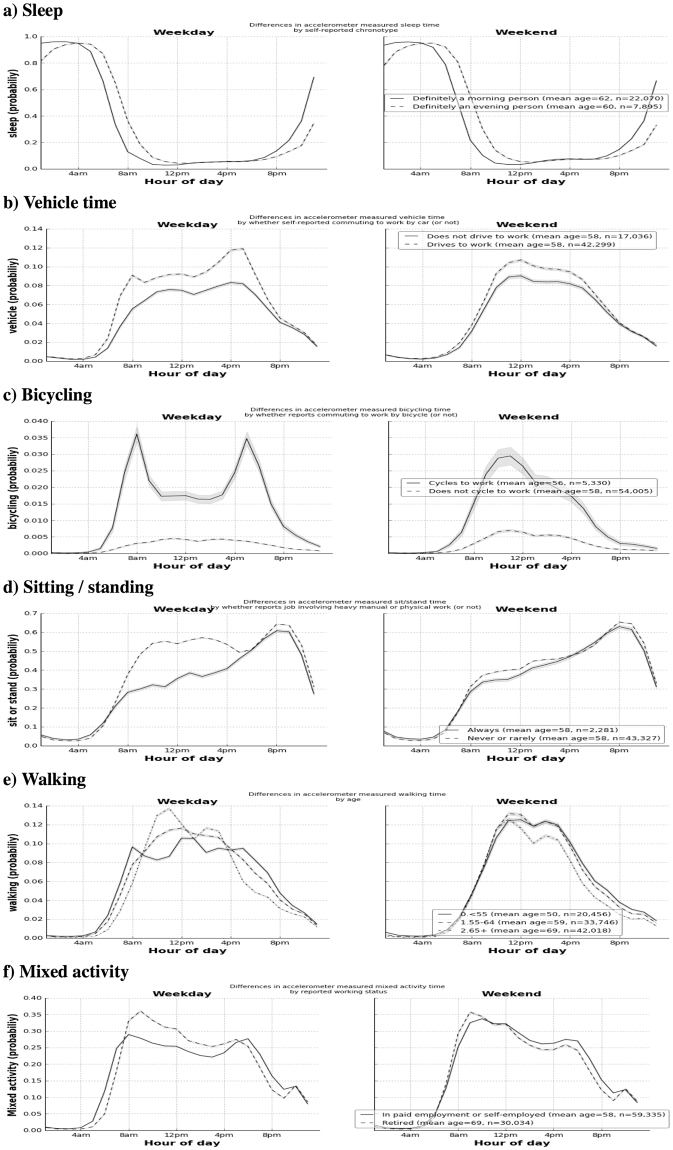
- In UK Biobank, several associations were reported, including: evening types were more likely to be sleeping at 8am on weekends (55% vs. 22%, p < 10^-100), car users were more likely to be classified as driving at 8am on weekdays (9.1% vs. 5.5%, p < 10^-100), and older adults (65+) were more likely to be walking at 11am on weekdays than those <55 (14% vs. 9%, p = 3 × 10^-18).
Methods
- Development/evaluation used the CAPTURE-24 study: 143 Oxford-region adults aged 18–91 recruited in 2014–2015; after removing 11 with missing or misaligned data, 132 participants remained for classifier development.
- Participants wore an Axivity AX3 wrist accelerometer at 100 Hz and a Vicon Autographer wearable camera; sleep was additionally labeled from a sleep diary and, when needed, a HETUS time-use diary.
- The analysis used balanced random forests on 126-dimensional features from non-overlapping 30-second windows, followed by a hidden Markov model and Viterbi decoding for temporal smoothing; performance was assessed with leave-one-subject-out cross-validation and kappa.
- The trained model was then applied to 103,712 UK Biobank participants; after exclusions for insufficient wear time and device errors, 96,220 participants were analyzed.
Limitations
- The paper states that the free-living training participants were not a random subsample of UK Biobank, so descriptive findings were not generalized to the UK population because UK Biobank was designed as an etiological study, not population surveillance.
- The paper notes that direct comparison across studies is difficult because of heterogeneity in populations, devices, and behavior definitions.
- Evident from the text: sleep and energy expenditure ground truth were not collected with traditional gold-standard methods; instead, the study relied on proxy reference methods (wearable camera, diaries) for free-living assessment at scale.
Model-written summary. Check it against the paper before relying on it.
Integrity signals
Registry
Cites
Statistics
Figures
Verification
Claims the paper makes
2 Valid · 1 Not valid · 3 Not checked · 30 Own results and interpretations
The cited sources support only part of this claim — read each source’s verdict below.
In the paper
“Our study shows that bicycling can be reliably detected from accelerometer data, an activity previously difficult to classify in laboratory studies 15 , 19 .”
What the sources say
- Supportedcites [15] Mannini, A., Intille, S. S., Rosenberger, M., Sabatini, A. M. & Haskell, W. Activity recognition using a single accelerometer placed at the wrist or ankle. Med. Sci. Sports Exerc. 45, 2193–203 (2013). source
The citation supports the background point that bicycling was difficult to classify: the Discussion says cycling was harder to detect than other activity classes from wrist accelerometer data in this laboratory-based study. The statement that bicycling can be reliably detected is framed as the citing authors’ own finding, not a finding attributed to this source. (LLM, conf=0.88)
- Partly supportedcites [19] Staudenmayer, J., Pober, D., Crouter, S., Bassett, D. & Freedson, P. An artificial neural network to estimate physical activity energy expenditure and identify physical activity type from an accelerometer. J. Appl. Physiol. 107, 1300–1307 (2009). sourceExperimental — accuracy not yet measured
The Discussion (page unavailable) describes stationary cycling as producing little body movement and says the method was not reliably accurate at identifying specific activity modes. That supports the cited point that cycling was challenging, but the paper does not report cycling-specific classification accuracy. The citing authors’ claim that their own study reliably detected bicycling is not a finding attributed to this source. (LLM, conf=0.76)
plainstates an association- Asserted: passes — The authors put it forward as true.
- Checkable: passes — It can be checked against evidence.
- Load-bearing: unclear — It is unclear whether the paper’s conclusions depend on it.
- Based: passes — The paper gives a reason why it holds.
- Supported
The cited sources support only part of this claim — read each source’s verdict below.
In the paper
“However, our data and that from Ellis et al 30 . shows that walking is challenging to classify in free-living conditions (sensitivity = 0.71, specificity = 0.96), probably due to it being part of many everyday activities.”
What the sources say
- Partly supportedcites [30] Ellis, K., Kerr, J., Godbole, S., Staudenmayer, J. & Lanckriet, G. Hip and Wrist Accelerometer Algorithms for Free-Living Behavior Classification. Med. Sci. Sports Exerc. 48, 933–40 (2016). sourceExperimental — accuracy not yet measured
Our copy does address walking classification in free-living conditions and its difficulty — the Discussion (p. n/a) states that 'observational protocol data can be classified with higher accuracy than free-living data' and that 'classifiers trained on both laboratory and observational protocol data perform poorly when applied to free-living data', and the Results (ML behavior classification) note walking/standing confusion ('Standing was most commonly confused for sitting by the hip classifier and most commonly confused for walking by the wrist classifier') and that cut-point/GGIR methods underestimated walking by 10–16 min/day. However, the specific figures the claim attributes (sensitivity = 0.71, specificity = 0.96) are not stated anywhere in our copy: the text only refers the reader to Table 1 for per-activity sensitivity/specificity, and the table values are not reproduced. Our copy also frames walking performance positively at the group level ('both classifiers correctly estimated minutes in sedentary behaviors and walking time'; hip classifier 'showed no significant difference in minutes of walking predicted'), and it is limited to 40 overweight/obese women with walking and running merged into one class, so the unqualified generalisation 'walking is challenging to classify' overstates what the source asserts. (LLM, conf=0.62)
hedged- Asserted: passes — The authors put it forward as true.
- Checkable: passes — It can be checked against evidence.
- Load-bearing: passes — The paper’s conclusions depend on it.
- Based: passes — The paper gives a reason why it holds.
- Partly supported
A result the paper reports from its own data — it cites no other source for it, so there is none to check. The quote shows it is in the paper.
In the paper
“Apart from mixed-activity and METs (r = 0.75), the different activity types are weakly correlated (absolute overall mean r = 0.37), indicating their utility as new sources of information (Fig. S 5 ).”
plainstates an associationn = 96,220- Asserted: passes — The authors put it forward as true.
- Checkable: passes — It can be checked against evidence.
- Load-bearing: passes — The paper’s conclusions depend on it.
- Based: passes — The paper gives a reason why it holds.
A result the paper reports from its own data — it cites no other source for it, so there is none to check. The quote shows it is in the paper.
In the paper
“Women spent more time engaged in mixed activity behaviours than men (18.9% vs. 14.5%, p < 10 −100 ).”
plainstates an association- Asserted: passes — The authors put it forward as true.
- Checkable: passes — It can be checked against evidence.
- Load-bearing: unclear — It is unclear whether the paper’s conclusions depend on it.
- Based: passes — The paper gives a reason why it holds.
A result the paper reports from its own data — it cites no other source for it, so there is none to check. The quote shows it is in the paper.
In the paper
“Self-reported car users were more likely to be classified as driving at 8am on weekdays (9.1% vs. 5.5%, p < 10 −100 after adjustment for other factors) (see Fig. 1b ).”
plainstates an association- Asserted: passes — The authors put it forward as true.
- Checkable: passes — It can be checked against evidence.
- Load-bearing: unclear — It is unclear whether the paper’s conclusions depend on it.
- Based: passes — The paper gives a reason why it holds.
- Rests on an assumption not shown here.
16 more claims
Create a free account to see all 36 claims and to verify the 4 references still open.
- It may state two separate claims as one. 10
- Probably not a substantial claim. 11
Claims other papers make about this one
Each is checked against this paper’s own text: does it say what the citing paper says it does?
The cited source doesn’t support the claim as written.
In the citing paper
“This allowed us to train a model using all free-living ground truth data, achieving 79% accuracy (kappa = 0.68) across classes of interest14 (Supplementary Table 1).”
From GWAS identifies 14 loci for device-measured physical activity and sleep duration (2018) · cites this paper as [14]
Checked by a reasoning model — may be wrong.
Experimental — accuracy not yet measuredThe source backs part of the claim, not all of it — or backs it for a different population, condition or comparison.
In the citing paper
“This protocol was, for example, utilized in the UK Biobank study, which recorded accelerometer data from approx.90𝑘 participants, resulting in around 20TB of sensor data [46,198].”
From Past, Present, and Future of Sensor-based Human Activity Recognition Using Wearables: A Surveying Tutorial on a Still Challenging Task (2025) · cites this paper as [198]
Experimental — accuracy not yet measuredThe source backs part of the claim, not all of it — or backs it for a different population, condition or comparison.
In the citing paper
“a strong random forest model with tried-and-tested time series features, which has often been neglected in baseline model comparisons8,48–50.”
From Self-supervised learning for human activity recognition using 700,000 person-days of wearable data (2024) · cites this paper as [8]
Experimental — accuracy not yet measuredThe source backs part of the claim, not all of it — or backs it for a different population, condition or comparison.
In the citing paper
“the machine-learned phenotypes demonstrated face validity14 with clear and expected differences in sleep duration by self-reported chronotype status (Supplementary Fig. 1).”
From GWAS identifies 14 loci for device-measured physical activity and sleep duration (2018) · cites this paper as [14]
Experimental — accuracy not yet measuredThe source backs part of the claim, not all of it — or backs it for a different population, condition or comparison.
In the citing paper
“As detailed in a previous publication14 this model was considered suitable for population inference in UK Biobank as the performance was not materially affected by age and sex characteristics (difference in kappa score: sex < 0.0001; age < 0.05).”
From GWAS identifies 14 loci for device-measured physical activity and sleep duration (2018) · cites this paper as [14]
Experimental — accuracy not yet measured
15 more claims about this paper
Create a free account to see every claim other papers make about this one.
Citations
Cites
Breiman, L. (2001) · Machine Learning · doi:10.1023/a:1010933404324 · Cited by 133,538
The Measurement of Observer Agreement for Categorical Data
Landis, J. R., & Koch, G. G. (1977) · Biometrics · doi:10.2307/2529310 · Cited by 81,148
Sudlow, C., Gallacher, J., Allen, N., Beral, V., Burton, P., Danesh, J., Downey, P., Elliott, P., Green, J., Landray, M., et al. (2015) · PLOS Medicine · doi:10.1371/journal.pmed.1001779 · Cited by 12,728 · cited 2×
“We firstly assessed its performance in free-living scenarios using a dataset of 132 adults, 84 of which are female, aged 18–91 who wore an accelerometer and wearable camera (a method comparable to direct-observation 21 ).”
BackgroundMethodLee, I.-M., Shiroma, E. J., Lobelo, F., Puska, P., Blair, S. N., & Katzmarzyk, P. T. (2012) · The Lancet · doi:10.1016/s0140-6736(12)61031-9 · Cited by 8,215
(2005) · PubMed · Cited by 7,011
2011 Compendium of Physical Activities: A Second Update of Codes and MET Values
AINSWORTH, B. E., HASKELL, W. L., HERRMANN, S. D., MECKES, N., BASSETT, D. R., TUDOR-LOCKE, C., GREER, J. L., VEZINA, J., WHITT-GLOVER, M. C., & LEON, A. S. (2011) · Medicine & Science in Sports & Exercise · doi:10.1249/mss.0b013e31821ece12 · Cited by 6,317 · cited 1×
“Images were annotated by human annotators using codes from the compendium of physical activities 25 , using specific wearable camera browsing software 45 (Doc S1).”
MethodForney, G. D. (1973) · Proceedings of the IEEE · doi:10.1109/proc.1973.9030 · Cited by 5,647 · cited 1×
“Finally, the predicted MET score for each 30-second chunk is calculated as the assigned MET scores for each of the 11 states, weighted by the marginal probabilities of being in each of those states.”
MethodAn introduction to hidden Markov models
Rabiner, L., & Juang, B. (1986) · IEEE ASSP Magazine · doi:10.1109/massp.1986.1165342 · Cited by 4,775 · cited 1×
“To predict the MET score we follow the same process of feature extraction, random forest training and HMM definition, but for the eleven-class MET-relevant behaviour labels.”
MethodFit Yourself and Take Your Lungs to Heart
Palange, P., & Bonini, M. (2013) · Respiration · doi:10.1159/000350831 · Cited by 2,779
Wilmot, E. G., Edwardson, C. L., Achana, F. A., Davies, M. J., Gorely, T., Gray, L. J., Khunti, K., Yates, T., & Biddle, S. J. H. (2012) · Diabetologia · doi:10.1007/s00125-012-2677-z · Cited by 1,789 · cited 1×
“learning methods have not been assessed in large scale health sensor datasets for face validity or investigated to evaluate if they offer behavioural insight.”
Background
Research works printed but not linked: 3
- Ladha, C., Ladha, K., Jackson, D. & Olivier, P. Shaker Table Validation Of Openmovement Ax3 Accelerometer. in 3rd International Conference on Ambulatory Monitoring of Physical Activity and Movement 69–70 (2013).
- Doherty, A. R. et al. Using wearable cameras to categorise type and context of accelerometer-identified episodes of physical activity. Int. J. Behav. Nutr. Phys. Act. 10 (2013). · DOI · Paper page
- Fernández-Delgado, M., Cernadas, E., Barro, S. & Amorim, D. Do we Need Hundreds of Classifiers to Solve Real World Classification Problems? J. Mach. Learn. Res. 15, 3133–3181 (2014).
Cited by
Migueles, J. H., Rowlands, A. V., Huber, F., Sabia, S., & van Hees, V. T. (2019) · Journal for the Measurement of Physical Behaviour · doi:10.1123/jmpb.2018-0063 · Cited by 955
The promise of machine learning in predicting treatment outcomes in psychiatry
Chekroud, A. M., Bondar, J., Delgadillo, J., Doherty, G., Wasil, A., Fokkema, M., Cohen, Z., Belgrave, D., DeRubeis, R., Iniesta, R., et al. (2021) · World Psychiatry · doi:10.1002/wps.20882 · Cited by 531
“Ma chine learning methods are indispensable for dealing with com plex patterns in these sensor data 105 .”
MethodVollmer, S., Mateen, B. A., Bohner, G., Király, F. J., Ghani, R., Jonsson, P., Cumbers, S., Jonas, A., McAllister, K. S. L., Myles, P., et al. (2020) · BMJ · doi:10.1136/bmj.l6927 · Cited by 497
Self-citationGWAS identifies 14 loci for device-measured physical activity and sleep duration
Doherty, A., Smith-Byrne, K., Ferreira, T., Holmes, M. V., Holmes, C., Pulit, S. L., & Lindgren, C. M. (2018) · Nature Communications · doi:10.1038/s41467-018-07743-4 · Cited by 408
Self-citationStamatakis, E., Ahmadi, M. N., Gill, J. M. R., Thøgersen-Ntoumani, C., Gibala, M. J., Doherty, A., & Hamer, M. (2022) · Nature Medicine · doi:10.1038/s41591-022-02100-x · Cited by 336
“The picture-based activity coding scheme has been previously described 34 .”
Self-citationThe future of sleep health: a data-driven revolution in sleep science and medicine
Perez-Pozuelo, I., Zhai, B., Palotti, J., Mall, R., Aupetit, M., Garcia-Gomez, J. M., Taheri, S., Guan, Y., & Fernandez-Luque, L. (2020) · npj Digital Medicine · doi:10.1038/s41746-020-0244-4 · Cited by 311
Walmsley, R., Chan, S., Smith-Byrne, K., Ramakrishnan, R., Woodward, M., Rahimi, K., Dwyer, T., Bennett, D., & Doherty, A. (2022) · British Journal of Sports Medicine · doi:10.1136/bjsports-2021-104050 · Cited by 238
Self-citationUK Biobank: a globally important resource for cancer research
Conroy, M. C., Lacey, B., Bešević, J., Omiyale, W., Feng, Q., Effingham, M., Sellers, J., Sheard, S., Pancholi, M., Gregory, G., et al. (2023) · British Journal of Cancer · doi:10.1038/s41416-022-02053-5 · Cited by 168
Wearable movement-tracking data identify Parkinson’s disease years before clinical diagnosis
Schalkamp, A.-K., Peall, K. J., Harrison, N. A., & Sandor, C. (2023) · Nature Medicine · doi:10.1038/s41591-023-02440-2 · Cited by 168
“based data in a (3) large sample size (4) while comparing its performance to other established markers and (5) its generalizability to the general population.”
BackgroundSelf-supervised learning for human activity recognition using 700,000 person-days of wearable data
Yuan, H., Chan, S., Creagh, A. P., Tong, C., Acquah, A., Clifton, D. A., & Doherty, A. (2024) · npj Digital Medicine · doi:10.1038/s41746-024-01062-3 · Cited by 166
“Indeed, some studies found that earlier approaches, such as random forests, tended to generalise better than deep learning models in certain small data regimes (Willetts et al., 2018; Kwon et al., 2020).”
Self-citationTesting Self-Report Time-Use Diaries against Objective Instruments in Real Time
Gershuny, J., Harms, T., Doherty, A., Thomas, E., Milton, K., Kelly, P., & Foster, C. (2020) · Sociological Methodology · doi:10.1177/0081175019884591 · Cited by 124
Self-citationHearables: Automatic Overnight Sleep Monitoring With Standardized In-Ear EEG Sensor
Nakamura, T., Alqurashi, Y. D., Morrell, M. J., & Mandic, D. P. (2020) · IEEE Transactions on Biomedical Engineering · doi:10.1109/tbme.2019.2911423 · Cited by 147
“actigraphy) [24], [25].”
Sedentary Behavior and Chronic Disease: Mechanisms and Future Directions
Dempsey, P. C., Matthews, C. E., Dashti, S. G., Doherty, A., Bergouignan, A., van Roekel, E. H., Dunstan, D. W., Wareham, N. J., Yates, T. E., Wijndaele, K., et al. (2019) · Journal of Physical Activity and Health · doi:10.1123/jpah.2019-0377 · Cited by 167
Self-citationA Framework to Evaluate Devices That Assess Physical Behavior
Keadle, S. K., Lyden, K. A., Strath, S. J., STAUDENMAYER, J. W., & Freedson, P. S. (2019) · Exercise and Sport Sciences Reviews · doi:10.1249/jes.0000000000000206 · Cited by 124
“, driving, walking/running, housework, stationary vs sitting vs standing) (40,55,57).”
BackgroundStevens, M. L., Gupta, N., Inan Eroglu, E., Crowley, P. J., Eroglu, B., Bauman, A., Granat, M., Straker, L., Palm, P., Stenholm, S., et al. (2020) · BMJ Open Sport & Exercise Medicine · doi:10.1136/bmjsem-2020-000874 · Cited by 110
“12 15 An emerging accelerometer placement location is the thigh.”
BackgroundClinical applications of artificial intelligence in sleep medicine: A sleep clinician’s perspective
Bandyopadhyay, A., & Goldstein, C. (2023) · Sleep And Breathing · doi:10.1007/s11325-022-02592-4 · Cited by 108
“For instance, the random forest techniques utilizes the principle of simple regression [16].”
MethodSleep classification from wrist-worn accelerometer data using random forests
Sundararajan, K., Georgievska, S., te Lindert, B. H. W., Gehrman, P. R., Ramautar, J., Mazzotti, D. R., Sabia, S., Weedon, M. N., van Someren, E. J. W., Ridder, L., et al. (2021) · Scientific Reports · doi:10.1038/s41598-020-79217-x · Cited by 106
Assessing the State of Self-Supervised Human Activity Recognition Using Wearables
Haresamudram, H., Essa, I., & Plötz, T. (2022) · Proceedings of the ACM on Interactive, Mobile, Wearable and Ubiquitous Technologies · doi:10.1145/3550299 · Cited by 107
Assessment of Physical Activity in Adults Using Wrist Accelerometers
Liu, F., Wanigatunga, A. A., & Schrack, J. A. (2021) · Epidemiologic Reviews · doi:10.1093/epirev/mxab004 · Cited by 126
Kandola, A. A., del Pozo Cruz, B., Osborn, D. P. J., Stubbs, B., Choi, K. W., & Hayes, J. F. (2021) · BMC Medicine · doi:10.1186/s12916-021-02007-3 · Cited by 91
“Novel methods for estimating sleep using accelerometer data only are promising but still require further validation for large-scale studies [72, 73].”
MethodPhysical activity, sedentary time and breast cancer risk: a Mendelian randomisation study
Dixon‐Suen, S. C., Lewis, S. J., Martin, R. M., English, D. R., Boyle, T., Giles, G. G., Michailidou, K., Bolla, M. K., Wang, Q., Dennis, J., et al. (2022) · British Journal of Sports Medicine · doi:10.1136/bjsports-2021-105132 · Cited by 107
Guo, W., Key, T. J., & Reeves, G. K. (2019) · BMJ Open · doi:10.1136/bmjopen-2018-024206 · Cited by 82
“However, Willetts et al have recently developed physical activity phenotypes using a machine learning model with reference behaviours provided by data from a subset of participants who wore a camera along with the accelerometer.(29) Once these variables are made publicly available in UK Biobank, research using these m…”
MethodPhysical activity and breast cancer risk: results from the UK Biobank prospective cohort
Guo, W., Fensom, G. K., REEVES, G. K., & Key, T. J. (2020) · British Journal of Cancer · doi:10.1038/s41416-019-0700-6 · Cited by 110
Narayanan, A., Desai, F., Stewart, T. I., Duncan, S., & Mackay, L. M. (2020) · Journal of Physical Activity and Health · doi:10.1123/jpah.2019-0088 · Cited by 98
pyActigraphy: Open-source python package for actigraphy data visualization and analysis
Hammad, G. H., Reyt, M., Beliy, N., Baillet, M., Deantoni, M., Lesoinne, A., Muto, V., & Schmidt, C. (2021) · PLoS Computational Biology · doi:10.1371/journal.pcbi.1009514 · Cited by 93
Luo, M., Yu, C., Cruz, B. D. P., Chen, L., & Ding, D. (2023) · British Journal of Sports Medicine · doi:10.1136/bjsports-2022-106653 · Cited by 86
“31 Third, we included 424 selected SNPs for the genetic risk of T2D, which is the most comprehensive genetic study on physical activity and T2D available to date.”
BackgroundWennman, H., Pietilä, A., Rissanen, H. A., Valkeinen, H., Partonen, T., Mäki-Opas, T. E., & Borodulin, K. (2019) · Scientific Reports · doi:10.1038/s41598-019-43007-x · Cited by 86
Bach, K., Kongsvold, A., Bårdstu, H. B., Bardal, E. M., Kjærnli, H. S., Herland, S., Logacjov, A., & Mork, P. J. (2021) · Journal for the Measurement of Physical Behaviour · doi:10.1123/jmpb.2021-0015 · Cited by 85
“However, it should be noted that a longer window size can provide accurate measurement of physical activity with other sensor placements (Farrahi et al., 2019; Willetts et al., 2018).”
BackgroundCasanova, F., O’Loughlin, J., Karageorgiou, V., Beaumont, R. N., Bowden, J., Wood, A. R., & Tyrrell, J. (2023) · BMC Medicine · doi:10.1186/s12916-023-03211-z · Cited by 88
“We derived ST from accelerometery data using a machine learning algorithm (https:// github. com/ activ ityMo nitor ing/ bioba nkAcc elero meter Analy sis) as described elsewhere [21, 28].”
MethodAccelerometer-Measured Sedentary Behavior and Risk of Future Cardiovascular Disease
Ajufo, E. C., Kany, S., Rämö, J. T., Churchill, T. W., Guseh, J. S., Aragam, K. G., Ellinor, P. T., & Khurshid, S. S. (2024) · Journal of the American College of Cardiology · doi:10.1016/j.jacc.2024.10.065 · Cited by 277
Wainberg, M., Jones, S. E., Beaupre, L. M., Hill, S. L., Felsky, D., Rivas, M. A., Lim, A. S. P., Ollila, H. M., & Tripathy, S. J. (2021) · PLOS Medicine · doi:10.1371/journal.pmed.1003782 · Cited by 64
Creagh, A. P., Hamy, V., Yuan, H., Mertes, G., Tomlinson, R., Chen, W.-H., Williams, R., Llop, C., Yee, C., Duh, M. S., et al. (2024) · npj Digital Medicine · doi:10.1038/s41746-024-01013-y · Cited by 64
“…allowed our model to be pre-trained on 100,000 participants with 700,000 days of diverse, unlabelled wearable sensor data in the uk biobank 27 , which combined with HMM temporal smoothing, signi fi cantly improved activity prediction compared to our previous established RF-HMM based methods 28,30 .”
BackgroundMethodInfluentialSelf-citationCreagh, A. P., Hamy, V., Yuan, H., Mertes, G., Tomlinson, R., Chen, W.-H., Williams, R., Llop, C., Yee, C., Duh, M. S., et al. (2022) · doi:10.1101/2022.11.18.22282305 · Cited by 64
Self-citationChan, S., Hang, Y., Tong, C., Acquah, A., Schonfeldt, A., Gershuny, J., & Doherty, A. (2024) · Scientific Data · doi:10.1038/s41597-024-03960-3 · Cited by 61
“CSV” to provide the annotation mapping from fine-grained activity to high-level classes that be for machine learning, genetics and population health studies 5,38,39 .”
Self-citationA Dual-Accelerometer System for Detecting Human Movement in a Free-living Environment
Narayanan, A., Stewart, T. I., & Mackay, L. M. (2019) · Medicine & Science in Sports & Exercise · doi:10.1249/mss.0000000000002107 · Cited by 72
“Similarly, another free-living study in 132 adults achieved an overall accuracy of 87% in classifying six distinct activity classes (sleep, vehicle time, sitting/standing, bicycling,walking,mixed activity) from a singlewrist-worn sensor (20).”
BackgroundPetermann-Rocha, F., Lyall, D. M., Gray, S. R., Gill, J. M. R., Sattar, N., Welsh, P., Quinn, T. J., Stewart, W., Pell, J. P., Ho, F. K., et al. (2021) · BMC Medicine · doi:10.1186/s12916-021-02172-5 · Cited by 60
“More details about data collection, validation and processing can be found elsewhere [22, 23].”
BackgroundWearable technology and systems modeling for personalized chronotherapy
Kim, D. W., Zavala, E., & Kim, J. K. (2020) · Current Opinion in Systems Biology · doi:10.1016/j.coisb.2020.07.007 · Cited by 63
Diurnal rhythms of wrist temperature are associated with future disease risk in the UK Biobank
Brooks, T. G., Lahens, N. F., Grant, G. R., Sheline, Y. I., FitzGerald, G. A., & Skarke, C. (2023) · Nature Communications · doi:10.1038/s41467-023-40977-5 · Cited by 57
“The data were calibrated and processed using an existing pipeline 20,63 – 65 modi fi ed slightly to better accommodate daylight savings time changes and to output light and temperature readings from an on-device thermometer.”
Husu, P., Tokola, K., Vähä‐Ypyä, H., Sievänen, H. T., Suni, J. H., Heinonen, O. J., Heiskanen, J., Kaikkonen, K., Savonen, K. P., Kokko, S. P., et al. (2021) · Journal for the Measurement of Physical Behaviour · doi:10.1123/jmpb.2020-0056 · Cited by 72
Palmerini, L., Reggi, L., Bonci, T., Del Din, S., Micó-Amigo, M. E., Salis, F., Bertuletti, S., Caruso, M., Cereatti, A., Gazit, E., et al. (2023) · Scientific Data · doi:10.1038/s41597-023-01930-9 · Cited by 52
Muse, E. D., & Topol, E. J. (2024) · Cell Metabolism · doi:10.1016/j.cmet.2024.02.002 · Cited by 50
Sexual dimorphism in the response to chronic circadian misalignment on a high-fat diet
Anderson, S. T., Meng, H., Brooks, T. G., Tang, S. Y., Lordan, R., Sengupta, A., Nayak, S., Mřela, A., Sarantopoulou, D., Lahens, N. F., et al. (2023) · Science Translational Medicine · doi:10.1126/scitranslmed.abo2022 · Cited by 57
Ekelund, U., Tarp, J., Ding, D., Sánchez-Lastra, M. A., Dalene, K. E., Anderssen, S. A., Steene‐Johannessen, J., Hansen, B., Morseth, B., Hopstock, L. A., et al. (2026) · The Lancet · doi:10.1016/s0140-6736(25)02219-6 · Cited by 90
On the Challenges and Potential of Using Barometric Sensors to Track Human Activity
Manivannan, A., Chin, W. C. B., Barrat, A., & Bouffanais, R. (2020) · Sensors · doi:10.3390/s20236786 · Cited by 63
“Abbreviations The following abbreviations are used in this manuscript: MEMS Microelectromechanical System GPS Global Positioning System ADL Activities of Daily Living UAV Unmanned Aerial Vehicle IoT Internet of Things IMU Inertial Measurement Unit Pa Pascal (unit) Hz Hertz (unit) PCA Principal Component Analysis VDA V…”
BackgroundMethodInfluentialWearables, smartphones, and artificial intelligence for digital phenotyping and health
Perez-Pozuelo, I., Spathis, D., Clifton, E. A., & Mascolo, C. (2020) · Elsevier · doi:10.17863/cam.60922 · Cited by 47
Machine learning applications for therapeutic tasks with genomics data
Huang, K., Xiao, C., Glass, L. M., Critchlow, C. W., Gibson, G. C., & Sun, J. (2021) · Patterns · doi:10.1016/j.patter.2021.100328 · Cited by 52
Wearables, smartphones, and artificial intelligence for digital phenotyping and health
Perez-Pozuelo, I., Spathis, D., Clifton, E. A. D., & Mascolo, C. (2020) · Elsevier eBooks · doi:10.1016/b978-0-12-820077-3.00003-1 · Cited by 70
Detecting Parkinson’s Disease from Wrist-Worn Accelerometry in the U.K. Biobank
Williamson, J. R., Telfer, B. A., Mullany, R., & Friedl, K. E. (2021) · Sensors · doi:10.3390/s21062047 · Cited by 53
Dose Response of Incidental Physical Activity Against Cardiovascular Events and Mortality
Stamatakis, E., Biswas, R. K., Koemel, N. A., Sabag, A., Pulsford, R. M., Atkin, A. J., Stathi, A., Cheng, S. W. M., Thøgersen‐Ntoumani, C., Blodgett, J. M., et al. (2025) · Circulation · doi:10.1161/circulationaha.124.072253 · Cited by 60
Preatoni, E., Nodari, S., & Lopomo, N. F. (2020) · Frontiers in Bioengineering and Biotechnology · doi:10.3389/fbioe.2020.00664 · Cited by 45
Yuan, H., Plekhanova, T., Walmsley, R., Reynolds, A. C., Maddison, K. J., Bucan, M., Gehrman, P., Rowlands, A., Ray, D. W., Bennett, D., et al. (2024) · npj Digital Medicine · doi:10.1038/s41746-024-01065-0 · Cited by 40
Self-citationFairclough, S. J., Christian, D. L., Saint‐Maurice, P. F., Hibbing, P. R., Noonan, R. J., Welk, G. J., Dixon, P. M., & Boddy, L. M. (2019) · International Journal of Environmental Research and Public Health · doi:10.3390/ijerph16193711 · Cited by 48
“, wearable cameras) to label activity behaviours [61] (although unsupervised machine learning methods are now emerging, which may remove the need for criterion measures [15]).”
BackgroundReal-World Gait Detection Using a Wrist-Worn Inertial Sensor: Validation Study
Kluge, F., Brand, Y. E., Micó-Amigo, M. E., Bertuletti, S., D’Ascanio, I., Gazit, E., Bonci, T., Kirk, C., Küderle, A., Palmerini, L., et al. (2024) · JMIR Formative Research · doi:10.2196/50035 · Cited by 49
“Accordingly, there is also a rising interest in the use of wrist-worn sensors for gait assessment in the real world, ranging from gait and stride detection [17-20] to the estimation of spatiotemporal gait parameters [21,22].”
BackgroundDiffusion tensor imaging analysis along the perivascular space in the UK biobank
Clark, O. J., Delgado-Sánchez, A., Cullell, N., Corrêa, S. A. L., Krupiński, J., & Ray, N. J. (2024) · Sleep Medicine · doi:10.1016/j.sleep.2024.05.007 · Cited by 37
Analysis of real-world data on growth hormone therapy adherence using a connected injection device
Koledova, E. B., Tornincasa, V., & van Dommelen, P. (2020) · BMC Medical Informatics and Decision Making · doi:10.1186/s12911-020-01183-1 · Cited by 39
Sleep duration: A review of genome-wide association studies (GWAS) in adults from 2007 to 2020
Garfield, V. (2020) · Sleep Medicine Reviews · doi:10.1016/j.smrv.2020.101413 · Cited by 38
Small, S. R., Khalid, S., Dhiman, P., Chan, S., Jackson, D., Doherty, A., & Price, A. J. (2021) · Journal for the Measurement of Physical Behaviour · doi:10.1123/jmpb.2020-0061 · Cited by 44
Self-citationLam, B., Catt, M., Cassidy, S., Bacardit, J., Darke, P., Butterfield, S., Alshabrawy, O. S., Trenell, M. I., & Missier, P. (2021) · JMIR Diabetes · doi:10.2196/23364 · Cited by 41
“The open-source accelerometer analysis toolkit developed at the University of Oxford, available on GitHub [15], was used to annotate timelines for each raw activity trace [16].”
MethodSymptom tracking in endometriosis using digital technologies: Knowns, unknowns, and future prospects
Edgley, K., Horne, A. W., Saunders, P. T. K., & Tsanas, A. (2023) · Cell Reports Medicine · doi:10.1016/j.xcrm.2023.101192 · Cited by 39
Sun, H., Gao, X., Que, X., Liu, L., Ma, J., He, S., Gao, Q., & Wang, T. (2020) · Journal of Affective Disorders · doi:10.1016/j.jad.2019.11.034 · Cited by 33
Automated Method for Detecting Acute Insomnia Using Multi-Night Actigraphy Data
Angelova, M. N., Karmakar, C. K., Zhu, Y., Drummond, S. P. A., & Ellis, J. G. (2020) · IEEE Access · doi:10.1109/access.2020.2988722 · Cited by 39
Sleep differences in the UK between 1974 and 2015: Insights from detailed time diaries
Pérez, J. L. D. G., Gershuny, J., Foster, F., & Vos, M. D. (2018) · Journal of Sleep Research · doi:10.1111/jsr.12753 · Cited by 34
Haresamudram, H., Tang, C. I., Suh, S., Lukowicz, P., & Plötz, T. (2025) · Proceedings of the ACM on Interactive Mobile Wearable and Ubiquitous Technologies · doi:10.1145/3729467 · Cited by 33
Millard, L. A. C., Tilling, K., Gaunt, T. R., Carslake, D., & Lawlor, D. A. (2021) · PLOS Medicine · doi:10.1371/journal.pmed.1003757 · Cited by 31
“com/ activityMonitoring/biobankAccelerometerAnalysis/) [19,21,22] to preprocess the accelerometer data and derive summary activity variables for each 1-minute epoch in each participant’s accelerometer time series.”
MethodDevelopment and large-scale validation of the Watch Walk wrist-worn digital gait biomarkers
Chan, L. L. Y., Choi, T. C. M., Lord, S. R., & Brodie, M. A. D. (2022) · Scientific Reports · doi:10.1038/s41598-022-20327-z · Cited by 39
Brand, Y. E., Schwartz, D., Gazit, E., Buchman, A. S., Gilad-Bachrach, R., & Hausdorff, J. M. (2022) · Sensors · doi:10.3390/s22187094 · Cited by 35
A Survey on the Role of Artificial Intelligence in Biobanking Studies: A Systematic Review
Battineni, G., Hossain, M. A., Chintalapudi, N., & Amenta, F. (2022) · Diagnostics · doi:10.3390/diagnostics12051179 · Cited by 33
“These models can predict the risk of developing hypertension [40] and track it to identify the physical activity of patients [43].”
BackgroundCao, Z., Hou, Y., Yang, H., Huang, X., Wang, X., & Xu, C. (2023) · Journal of Affective Disorders · doi:10.1016/j.jad.2023.06.048 · Cited by 31
Zhukovsky, P., Coughlan, G., Buckley, R., Grady, C., & Voineskos, A. N. (2023) · Human Brain Mapping · doi:10.1002/hbm.26148 · Cited by 26
“, 2021), physical activity, and sleep (Willetts et al., 2018).”
BackgroundWhite, J. W., Finnegan, O., Tindall, N., Nelakuditi, S., Brown, D. E., Pate, R. R., Welk, G. J., de Zambotti, M., Ghosal, R., Wang, Y., et al. (2024) · PLoS ONE · doi:10.1371/journal.pone.0286898 · Cited by 30
O’Driscoll, R., Turicchi, J., Hopkins, M., Duarte, C., Horgan, G. W., Finlayson, G., & Stubbs, R. J. (2021) · JMIR mhealth and uhealth · doi:10.2196/23938 · Cited by 33
“Previous studies have used out-of-sample validation or validation in free-living environments [10,42,43], and when compared with laboratory validations, errors may increase.”
MethodInvestigating Enhancements to Contrastive Predictive Coding for Human Activity Recognition
Haresamudram, H., Essa, I., & Plötz, T. (2023) · 2023 IEEE International Conference on Pervasive Computing and Communications (PerCom) · doi:10.1109/percom56429.2023.10099197 · Cited by 27
“A Vicon Actigraph wearable camera was utilized for post-hoc labeling, resulting in around 2,500 hours of coarsely labeled data and six broad labels [40], namely sleep, sit-stand, mixed, walking, vehicle, and bicycling, as well as 200 fine-grained activities.”
MethodMorning diurnal preference and food intake: a Mendelian randomization study
Dashti, H. S., Chen, A., Daghlas, I., & Saxena, R. (2020) · American Journal of Clinical Nutrition · doi:10.1093/ajcn/nqaa219 · Cited by 28
“limited the number of food items and the diet quality and timing metrices considered (54).”
BackgroundMeisinger, C., Linseisen, J., Leitzmann, M. F., Baurecht, H., & Baumeister, S. E. (2020) · BMJ Open Diabetes Research & Care · doi:10.1136/bmjdrc-2020-001896 · Cited by 33
Li, X., & Zhao, H. (2020) · PLoS Genetics · doi:10.1371/journal.pgen.1009089 · Cited by 27
Beyond the Sleep Lab: A Narrative Review of Wearable Sleep Monitoring
Mogavero, M. P., Lanza, G., Bruni, O., Ferini‐Strambi, L., Silvani, A., Faraguna, U., & Ferri, R. (2025) · Bioengineering · doi:10.3390/bioengineering12111191 · Cited by 36
“Major initiatives such as the UK Biobank [64] and the U.S.”
Accounting for Time: Circadian Rhythms in the Time of COVID-19
Sengupta, S., Brooks, T. G., Grant, G. R., & FitzGerald, G. A. (2020) · Journal of Biological Rhythms · doi:10.1177/0748730420953335 · Cited by 23
“Activity was classified using a machine-learning algorithm (Willetts et al., 2018) and summarized to participantlevel measures of sleep, activity, and rhythmic patterns.”
MethodKusmakar, S., Karmakar, C. K., Zhu, Y., Shelyag, S., Drummond, S. P. A., Ellis, J. G., & Angelova, M. N. (2021) · Royal Society Open Science · doi:10.1098/rsos.202264 · Cited by 29
“Furthermore, deriving sleep parameters without any additional information from patient sleep diaries is a challenging problem in actigraphy research [20,21].”
BackgroundTsanas, A. (2022) · Sensors · doi:10.3390/s22166152 · Cited by 19
“This explains why it is practically the default option in actigraphy packages (such as GGIR) and its widespread use, including in the study that reported on the CAPTURE-24 data [31] and many other studies in the research literature [3,33,44].”
BackgroundMethodResultInfluentialClustering Accelerometer Activity Patterns from the UK Biobank Cohort
Clark, S., Lomax, N., Morris, M. A., Pontin, F. L., & Birkin, M. H. (2021) · Sensors · doi:10.3390/s21248220 · Cited by 21
“In a study by Willetts, Hollowell [51], 132 non-UK Biobank adult volunteers were asked to wear both wrist accelerometers and cameras, and these ‘ground truth’ data were used to train a random forest algorithm to identify periods in the day that the volunteer was undertaking certain classes of activity.”
MethodFive million nights: temporal dynamics in human sleep phenotypes
Viswanath, V. K., Hartogenesis, W., Dilchert, S., Pandya, L., Hecht, F. M., Mason, A. E., Wang, E. J., & Smarr, B. L. (2024) · npj Digital Medicine · doi:10.1038/s41746-024-01125-5 · Cited by 20
Brand, Y. E., Kluge, F., Palmerini, L., Paraschiv-Ionescu, A., Becker, C., Cereatti, A., Maetzler, W., Sharrack, B., Vereijken, B., Yarnall, A. J., et al. (2024) · Scientific Reports · doi:10.1038/s41598-024-71491-3 · Cited by 19
Gorodetsky, C., Mithani, K., Breitbart, S. C., Yan, H., Zhang, K., Gouveia, F. V., Warsi, N. M., Suresh, H., Wong, S. M., Huber, J. F., et al. (2024) · Biological Psychiatry · doi:10.1016/j.biopsych.2024.12.001 · Cited by 27
Farrahi, V., Muhammad, U., Rostami, M., & Oussalah, M. (2023) · International Journal of Medical Informatics · doi:10.1016/j.ijmedinf.2023.105004 · Cited by 21
Shishavan, H. H., Garza, J. L. B., Henning, R. A., Cherniack, M. C., Hirabayashi, L., Scott, E., & Kim, I.-S. (2022) · Applied Ergonomics · doi:10.1016/j.apergo.2022.103937 · Cited by 24
Circadian regulation of lung repair and regeneration
Naik, A. S., Forrest, K. M., Paul, O., Issah, Y., Valekunja, U. K., Tang, S. Y., Reddy, A. B., Hennessy, E. J., Brooks, T. G., Chaudhry, F. N., et al. (2023) · JCI Insight · doi:10.1172/jci.insight.164720 · Cited by 22
Weber, A., van Hees, V. T., Stein, M. J., Gastell, S., Steindorf, K., Herbolsheimer, F., Ostrzinski, S., Pischon, T., Brandes, M., Krist, L., et al. (2024) · Scientific Reports · doi:10.1038/s41598-024-58461-5 · Cited by 30
Osuka, Y., Chan, L. L. Y., Brodie, M. A. D., Okubo, Y., & Lord, S. R. (2024) · Journal of the American Medical Directors Association · doi:10.1016/j.jamda.2024.105196 · Cited by 23
Machine learning sleep duration classification in Preschoolers using waist-worn ActiGraphs
Kuzik, N., Spence, J. C., & Carson, V. (2021) · Sleep Medicine · doi:10.1016/j.sleep.2020.12.019 · Cited by 19
Physical Activity, Sedentary Behavior, and Pancreatic Cancer Risk: A Mendelian Randomization Study
Gentiluomo, M., Dixon‐Suen, S. C., Farinella, R., Peduzzi, G., Canzian, F., Milne, R. L., Lynch, B. M., & Campa, D. (2024) · Journal of the Endocrine Society · doi:10.1210/jendso/bvae017 · Cited by 18
“…as the ratio of the time spent on sedentary behaviors to the total period for which the accelerometer was worn, considering 30-second intervals [36, 39], and vigorous activity was measured with an accelerometer as the fraction of 30-second intervals containing accelerations over 425…”
MethodSyed, S., Morseth, B., Hopstock, L. A., & Horsch, A. (2021) · Scientific Reports · doi:10.1038/s41598-021-87757-z · Cited by 22
Meng, L., Treem, W., Heap, G., & Chen, J. (2022) · Scientific Reports · doi:10.1038/s41598-022-21389-9 · Cited by 20
Agarwal, V., Smuck, M. W., Tomkins‐Lane, C., & Shah, N. H. (2018) · JMIR mhealth and uhealth · doi:10.2196/11315 · Cited by 20
“Evaluation of measurement reliability and validity and characterizing activity phenotypes by patterns in free-living activity data [20,30-33].”
Seasonality and season of birth effect in the UK Biobank cohort
Didikoğlu, A., Canal, M. M., Pendleton, N., & Payton, A. (2020) · American Journal of Human Biology · doi:10.1002/ajhb.23417 · Cited by 15
Accelerometer-measured physical activity and functional behaviours among people on dialysis
Nawab, K., Storey, B. C., Staplin, N., Walmsley, R., Haynes, R., Sutherland, S., Crosbie, S., Pugh, C. W., Harper, C., Landray, M., et al. (2020) · Clinical Kidney Journal · doi:10.1093/ckj/sfaa045 · Cited by 16
“These existing methods use balanced random forests with hidden Markov model time smoothing [13] to identify functional behaviours (i.e. walking, performing light tasks, engaging in moderate-intensity activity, remaining sedentary or sleeping).”
Self-citationHopstock, L. A., Deraas, T., Henriksen, A., Martiny-Huenger, T., & Grimsgaard, S. (2021) · PLoS ONE · doi:10.1371/journal.pone.0256631 · Cited by 19
“Seasonal variation in physical activity including lower prevalence of walking and higher total energy expenditure in winter have previously been described in high-precision accelerometer data from a cross-sectional study in a large free-living population [34].”
BackgroundGOAT: A Generalized Cross-Dataset Activity Recognition Framework with Natural Language Supervision
Miao, S., & Chen, L. (2024) · Proceedings of the ACM on Interactive Mobile Wearable and Ubiquitous Technologies · doi:10.1145/3699736 · Cited by 27
Campos-Garzón, P., Saucedo‐Araujo, R. G., Sevil‐Serrano, J., Migueles, J. H., Barranco-Ruíz, Y., & Chillón, P. (2023) · Transport Reviews · doi:10.1080/01441647.2023.2175276 · Cited by 17
“…in recognising activities (e.g. sitting, walking, cycling, or sleeping) using machine-learning models and accelerometry data (Walmsley et al., 2021; Willetts et al., 2018) or the variability of accelerometer angles (Crowley et al., 2019), none of the studies included in this systematic review used…”
BackgroundMethodLogacjov, A., Skarpsno, E. S., Kongsvold, A., Bach, K., & Mork, P. J. (2024) · Nature and Science of Sleep · doi:10.2147/nss.s452799 · Cited by 17
Craemer, M. D., Decraene, M., Willems, I., Buysse, F., Driessche, E. V., & Verbestel, V. (2021) · International Journal of Environmental Research and Public Health · doi:10.3390/ijerph18189482 · Cited by 17
“(2018) used a Vicon Autographer wearable camera during waking hours [17].”
Method
Metadata
- Authors
- Willetts, M., Hollowell, S., Aslett, L., Holmes, C., & Doherty, A.
- Affiliations
- University of Oxford (GB)
- Durham University (GB)
- Corresponding author
- Doherty, Aiden
- Venue
- Scientific Reports
- Published
- 2018-05-21
- Volume
- 8
- Issue
- 1
- Pages
- 7961-7961
- ISSN
- 2045-2322 (ISSN-L)
- PMC
- PMC5962537
- OpenAlex
- W2756121211
- Semantic Scholar
- 2150fe696e6d755f8685e6734824ea528ac78f46
- Cited by
- 250
- References
- 54
- Citations by year
- 2026: 30 · 2025: 38 · 2024: 40 · 2023: 32 · 2022: 22 · 2021: 40 · 2020: 28 · 2019: 15 · 2018: 5
- FWCI
- 11.00
- Type
- journal article
- Language
- en
- Update notices
- correction (2022-04-11)
- Open access
- gold
- doi.org
- Licence
- cc-by
- creativecommons.org/licenses/by/4.0 (tdm)
- creativecommons.org/licenses/by/4.0 (vor)
- Locations
- Scientific Reports (publishedVersion, cc-by)
- Europe PMC (PubMed Central) (publishedVersion, other-oa)
- PubMed Central (publishedVersion, cc-by)
- PubMed (publishedVersion)
- Durham Research Online (Durham University) (acceptedVersion, other-oa)
- Durham Research Online (Durham University) (submittedVersion, cc-by)
- DOAJ (DOAJ: Directory of Open Access Journals) (submittedVersion)
- Funders
- Wellcome Trust
- Alan Turing Institute (TU/B/000062)
- Medical Research Council (MC_PC_17228)
- Economic and Social Research Council (ES/L011662/1)
- Topics
- Physical Sciences › Computer Science › Computer Vision and Pattern Recognition › Context-Aware Activity Recognition Systems
- Health Sciences › Medicine › Public Health, Environmental and Occupational Health › Physical Activity and Health
- Social Sciences › Transportation › Human Mobility and Location-Based Analysis
- Keywords
- physical activity, sleep duration, wearable activity trackers, balanced random forest, hidden Markov models, sex differences, seasonal variation, walking time, UK Biobank, public health recommendations
- MeSH terms
- Machine Learning, Activities of Daily Living, Adolescent, Adult, Aged, Aged, 80 and over, Female, United Kingdom, Humans, Male, Middle Aged, Phenotype, Sleep, Exercise, Biological Specimen Banks, Young Adult, Sedentary Behavior, Self Report, Accelerometry
About these checks
Registry, retraction, Cites and statistics results are computed, not judged, with one exception: a printed reference that no index lists is read once by a model before it counts as a citation error. Claims are extracted by a model and kept only when their quote appears verbatim in the text; each cited source is then checked, with a model’s help, for whether it says what the claim relies on. Those verdicts can be wrong — read the claim’s quote and the cited source before relying on one.
The claim verdicts this report counts are experimental: their accuracy is not yet measured.
A language model drew the claims from the paper on 2026-10-11, under version 3 of the claim definition (model deepseek-v4.1-flash, prompt extract-v3).
A second model labelled each claim on 2026-10-11 (model jev-1.13-20260917, definition revision gold-guideline-v0.2).
Cited sources are checked with a language model’s help (gpt-6-sol and qwen3.8-omni-flash).
Statistics and arithmetic are recomputed, not judged.
Confidence bands are shown only for fields calibrated on our annotated test set. None is calibrated yet, so no band is shown.
What counts as a claim ›How we measure confidence ›How we check this ›
Are you an author, or do you see a problem with this page? Request a review
Data sources
Bibliographic data: Semantic Scholar, OpenAlex, Crossref.
Contains information from the Semantic Scholar Academic Graph Datasets, made available under the ODC Attribution License (ODC-BY 1.0).
Semantic Scholar’s data is described in: Kinney, R., et al. (2023). The Semantic Scholar Open Data Platform. arXiv:2301.10140.
