

Distinct mental trainings differentially affect altruistically motivated, norm motivated, and self-reported prosocial behaviour
Open accessThe DOI matches its Crossref record; 82 of the 83 references it cites were found in a registry or an index.
Abstract
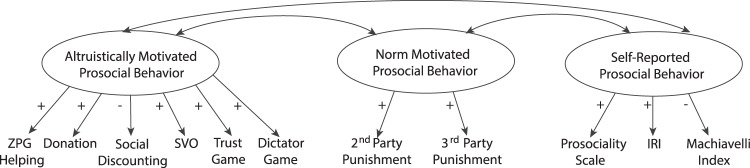
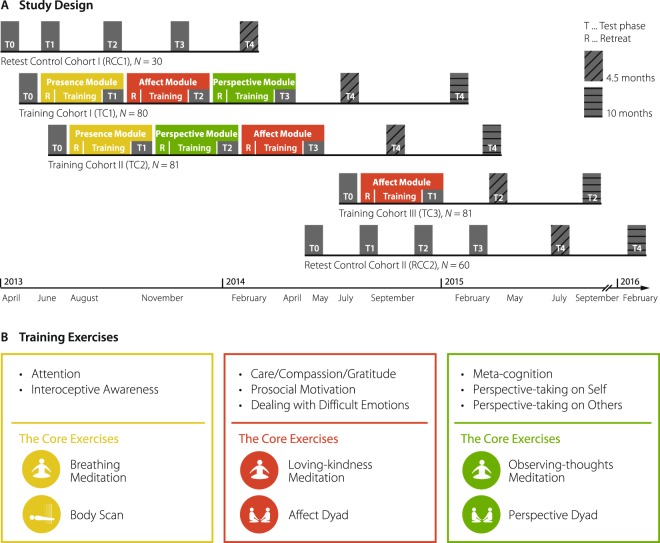
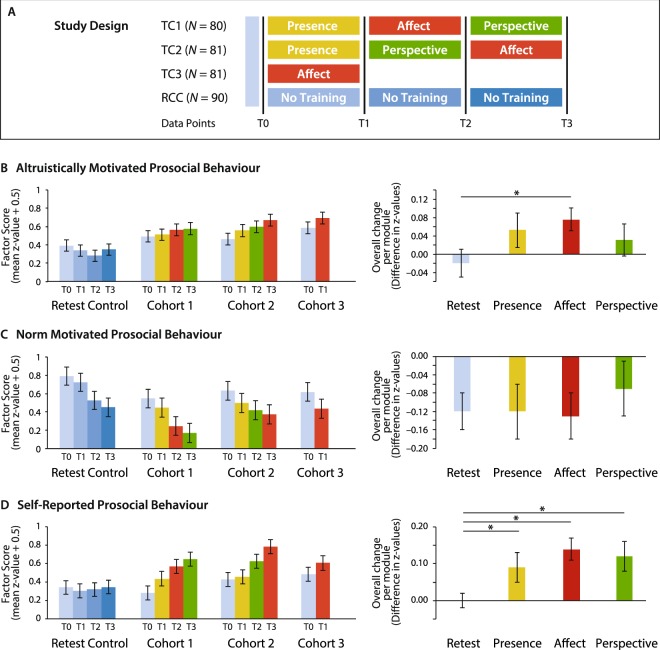
Global challenges such as climate change or the refugee crises emphasize the necessity of altruism and cooperation. In a large-scale 9-month intervention study, we investigated the malleability of prosociality by three distinct mental trainings cultivating attention, socio-affective, or socio-cognitive skills. We assessed numerous established measures of prosociality that capture three core facets: Altruistically motivated behaviours, norm motivated behaviours, and self-reported prosociality. Results of multiple time point confirmatory factor analyses support the validity and temporal stability of this model. Furthermore, linear mixed effects models reveal differential effects of mental trainings on the subcomponents of prosociality: Only training care and compassion effectively boosted altruistically motivated behaviour. No effects were revealed for norm-based behaviour. Self-reported prosociality increased with all training modules; this increase was, however, unrelated to changes in task-based measures of altruistic behaviour. These findings corroborate our motivation-based framework of prosociality, challenge economic views of fixed preferences by showing that socio-affective training boosts altruism, and inform policy makers and society about how to increase global cooperation.
Overview
The claims and statistics of this paper haven’t been checked yet.
Free: it reads the open-access text and checks the first 5 claims that cite a source we can check. Create a free account to check every claim.
Integrity signals
Registry
Cites
Statistics
Figures
Verification
Claims the paper makes
The claims and statistics of this paper haven’t been checked yet.
Free: it reads the open-access text and checks the first 5 claims that cite a source we can check. Create a free account to check every claim.
Claims other papers make about this one
Each is checked against this paper’s own text: does it say what the citing paper says it does?
The source backs part of the claim, not all of it — or backs it for a different population, condition or comparison.
In the citing paper
“There is some evidence for specific effects of different forms of meditation practice on both the brain and behavior with longer and more intensive practice163–167.”
From A common factors perspective on mindfulness-based interventions (2022) · cites this paper as [164]
Experimental — accuracy not yet measuredThe source backs part of the claim, not all of it — or backs it for a different population, condition or comparison.
In the citing paper
“socio-affective practices led to increases in compassion and prosocial behavior and reductions in social stress [31,32,33].”
From 10-Week Trajectories of Candidate Psychological Processes Differentially Predict Mental Health Gains from Online Dyadic versus Mindfulness Interventions: A Randomized Clinical Trial (2024) · cites this paper as [32]
Experimental — accuracy not yet measuredThe source backs part of the claim, not all of it — or backs it for a different population, condition or comparison.
In the citing paper
“Our results are in line with those of previous studies (Böckler et al., 2018; Ata & Artan, 2021) confirming the efficacy of programmes focused on prosocial behaviour development.”
From The benefits of a school intervention for prosocial behaviour and psychological well-being in early adolescents (2025) · cites this paper as Böckler et al., 2018
Experimental — accuracy not yet measuredThe source backs part of the claim, not all of it — or backs it for a different population, condition or comparison.
In the citing paper
“Thus, the evidence validating H 2 is in line with that from previous studies (Böckler et al., 2018; Laguna et al., 2020; Montgomery & Maunders, 2015) which highlight the effectiveness of interventions that use strategies cognitive, behavioural and emotional effects on altruism.”
From The benefits of a school intervention for prosocial behaviour and psychological well-being in early adolescents (2025) · cites this paper as Böckler et al., 2018
Experimental — accuracy not yet measuredThe cited source says what the claim attributes to it.
In the citing paper
“The programme was rigorously developed, having as its theoretical framing the theory of the malleability of altruistic behaviours (Böckler et al., 2018), the PERMA model described by Seligman (2012), and the psychological wellbeing model introduced by Ryff (1989) in positive psychology.”
From The benefits of a school intervention for prosocial behaviour and psychological well-being in early adolescents (2025) · cites this paper as Böckler et al., 2018
1 more claim about this paper
Create a free account to see every claim other papers make about this one.
Self-check
Percentages, sums and reported differences re-computed from the paper’s own numbers.
The self-check needs the paper’s full text.
Citations
Cites
Controlling the False Discovery Rate: A Practical and Powerful Approach to Multiple Testing
Benjamini, Y., & Hochberg, Y. (1995) · Journal of the Royal Statistical Society Series B: Statistical Methodology · doi:10.1111/j.2517-6161.1995.tb02031.x · Cited by 109,482
Confirmatory factor analysis for applied research
(2007) · Choice Reviews Online · doi:10.5860/choice.44-2769 · Cited by 15,614
Missing data: our view of the state of the art
Schafer, J. L., & Graham, J. W. (2002) · Psychological Methods · doi:10.1037/1082-989x.7.2.147 · Cited by 11,638
(2019) · AEA Papers and Proceedings · doi:10.1257/pandp.109.612 · Cited by 10,902
Measuring individual differences in empathy: Evidence for a multidimensional approach.
Davis, M. H. (1983) · Journal of Personality and Social Psychology · doi:10.1037/0022-3514.44.1.113 · Cited by 10,272
Cohen, J. (1992) · Psychological Bulletin · doi:10.1037//0033-2909.112.1.155 · Cited by 8,771
Power failure: why small sample size undermines the reliability of neuroscience
Button, K. S., Ioannidis, J. P. A., Mokrysz, C., Nosek, B. A., Flint, J., Robinson, E. S. J., & Munafò, M. R. (2013) · Nature Reviews Neuroscience · doi:10.1038/nrn3475 · Cited by 7,641
Trust, Reciprocity, and Social History
Berg, J., Dickhaut, J., & McCabe, K. (1995) · Games and Economic Behavior · doi:10.1006/game.1995.1027 · Cited by 5,548
Cooperation and Punishment in Public Goods Experiments
Fehr, E., & Gächter, S. (2000) · American Economic Review · doi:10.1257/aer.90.4.980 · Cited by 4,547
Longitudinal Structural Equation Modeling
Little, T. D. (2013) · Cited by 4,278
Research works printed but not linked: 3
- Mas-Colell, A., Whinston, M. D. & Green, J. R. Microeconomic theory. (Oxford University Press, 1995).
- Neff, K. & Germer, C. The Oxford Handbook of Compassion Science. (2004).
- Holmes, T. Parts Work: An Illustrated Guide to Your Inner Life. (Winged Heart Press, 2007).
Cited by
Singer, T., & Engert, V. (2019) · Current Opinion in Psychology · doi:10.1016/j.copsyc.2018.12.005 · Cited by 176
Self-citationThe Way Forward in Mindfulness and Sustainability: a Critical Review and Research Agenda
Thiermann, U. B., & Sheate, W. R. (2020) · Journal of Cognitive Enhancement · doi:10.1007/s41465-020-00180-6 · Cited by 149
“…et al. 2018 Grabow et al. 2018 EX Aspy and Proeve 2017 CS Jacob et al. 2009 Jacob et al. 2009 Combination trait + practice IN Böhme et al. 2018 Böhme et al. 2018 IN Stanszus et al. 2019 Stanszus et al. 2019 IN Geiger et al. 2019a Geiger et al. 2019a CS Loy and Reese 2019 Loy and Reese 2019 CS…”
BackgroundMethodInfluentialNadler, R., Carswell, J. J., & Minda, J. P. (2020) · Frontiers in Psychology · doi:10.3389/fpsyg.2020.00255 · Cited by 83
A common factors perspective on mindfulness-based interventions
Goldberg, S. B. (2022) · Nature Reviews Psychology · doi:10.1038/s44159-022-00090-8 · Cited by 75
Thiermann, U. B., & Sheate, W. R. (2020) · Ecological Economics · doi:10.1016/j.ecolecon.2020.106668 · Cited by 100
The relation of mindfulness and prosocial behavior: What do we (not) know?
Schindler, S., & Friese, M. (2021) · Current Opinion in Psychology · doi:10.1016/j.copsyc.2021.09.010 · Cited by 76
Interventions stimulating prosocial helping behavior: A systematic review
Laguna, M., Mazur, Z., Kędra, M., & Ostrowski, K. (2020) · Journal of Applied Social Psychology · doi:10.1111/jasp.12704 · Cited by 57
Godara, M., Silveira, S., Matthäus, H., Heim, C., Voelkle, M., Hecht, M., Binder, E. B., & Singer, T. (2021) · PLOS ONE · doi:10.1371/journal.pone.0256323 · Cited by 38
Self-citationEgocentric biases and atypical generosity in autistic individuals
Tei, S., Fujino, J., Itahashi, T., Aoki, Y. Y., Ohta, H., Kubota, M., Hashimoto, R., Nakamura, M., Kato, N., & Takahashi, H. (2019) · Autism Research · doi:10.1002/aur.2130 · Cited by 43
“…selfish behavior has been investigated by these approaches, selfish behavior in social situations has been also measured by the social discounting [Bockler et al., 2018; Soutschek, Ruff, Strombach, Kalenscher, & Tobler, 2016], which has emerged from the field of behavioral economics [Hill, Yi,…”
BackgroundMcDonald, B., Böckler, A., & Kanske, P. (2022) · Emotion · doi:10.1037/emo0001036 · Cited by 47
Self-citationThiermann, U. B., Sheate, W. R., & Vercammen, A. (2020) · Frontiers in Psychology · doi:10.3389/fpsyg.2020.584353 · Cited by 42
“In a rigorous large-scale trial that studied the effect of three groups of practices in a “presence,” “affect” and “perspective” module, researchers found that affect-oriented practices such as loving-kindness and compassion meditation were most effective in promoting pro-social behaviors and altruistic tendencies (Bö…”
BackgroundTusche, A., & Bas, L. M. (2021) · Wiley Interdisciplinary Reviews Cognitive Science · doi:10.1002/wcs.1571 · Cited by 41
“Recent findings also suggest that behavior in this task can indicate people's more general propensity to engage in altru-istically motivated behaviors (Böckler et al., 2016; Böckler, Tusche, Schmidt, et al., 2018; Böckler, Tusche, & Singer, 2018).”
BackgroundMethodInfluentialSelf-citationSchulreich, S., Tusche, A., Kanske, P., & Schwabe, L. (2022) · Journal of Neuroscience · doi:10.1523/jneurosci.1870-21.2022 · Cited by 43
Self-citationEffects of compassion training on brain responses to suffering others
Ashar, Y. K., Andrews‐Hanna, J. R., Halifax, J. S., Dimidjian, S., & Wager, T. D. (2021) · Social Cognitive and Affective Neuroscience · doi:10.1093/scan/nsab052 · Cited by 39
“CM-based interventions have also been found to promote a range of helping behaviors such as charitable donations and offering one’s seat to a suffering person on crutches (Condon et al., 2013; Weng et al., 2013, 2015; Lim et al., 2015; Ashar et al., 2016b; Böckler et al., 2018).”
BackgroundPerkins, N., Sehmbi, T., & Smith, P. A. (2022) · Mindfulness · doi:10.1007/s12671-022-01925-4 · Cited by 47
How does mindfulness relate to sustainable attitude and behavior? The role of possible mediators
Jansen, P., Rahe, M., & Wolff, F. (2024) · Current Psychology · doi:10.1007/s12144-024-05741-y · Cited by 41
Jung, J. H., Brown, T. J., & Zablah, A. R. (2021) · Journal of Retailing · doi:10.1016/j.jretai.2021.03.005 · Cited by 30
Age differences in prosociality across the adult lifespan: A meta-analysis
Pollerhoff, L., Reindel, D. F., Kanske, P., Li, S., & Reiter, A. M. F. (2024) · Neuroscience & Biobehavioral Reviews · doi:10.1016/j.neubiorev.2024.105843 · Cited by 32
“Previous findings (B ¨ ockler et al., 2016, 2018a, 2018b; Dang et al., 2020; Tusche and Bas, 2021; Wilhelm et al., 2018), suggested trait/self-reported prosociality and behavioral prosociality as two fairly independent dimensions of prosociality.”
BackgroundResultInfluentialWisdom-Based Buddhist-Derived Meditation Practices for Prosocial Behaviour: A Systematic Review
Furnell, M., Gordon, W. V., & Elander, J. (2024) · Mindfulness · doi:10.1007/s12671-024-02323-8 · Cited by 29
“Additionally, there was a noteworthy emphasis on assessing tangible expressions of prosocial behaviour, such as the actual donation of time, money, or possessions (Böckler et al., 2018; Chen & Jordan, 2020; Flook et al., 2015; Xiao et al., 2020).”
InfluentialSchulreich, S., Tusche, A., Kanske, P., & Schwabe, L. (2023) · NeuroImage · doi:10.1016/j.neuroimage.2023.120315 · Cited by 22
Self-citationCalmer, Kinder, Wiser: A Novel Threefold Categorization for Mindfulness-Based Interventions
Furnell, M., Gordon, W. V., & Elander, J. (2023) · Mindfulness · doi:10.1007/s12671-023-02273-7 · Cited by 25
“…to ethics-based and finally to wisdom-based practices, which is consistent with research showing that it is not just the type of practice that can impact the effectiveness of an MBI, but also the sequential order in which the mindfulness practices are introduced (Böckler et al., 2018).”
Kumar, S., & Panda, T. (2024) · Journal of Consumer Marketing · doi:10.1108/jcm-02-2023-5857 · Cited by 18
Tusche, A., Spunt, R. P., Paul, L. K., Tyszka, J. M., & Adolphs, R. (2023) · Nature Communications · doi:10.1038/s41467-023-40078-3 · Cited by 21
“It will be interesting in this respect also to investigate the effects oftrainingpeople ’ ssocialskills 77,78 toseehowtherelationshipbetween neural markers and social networks can be modi fi ed.”
Self-citationThe relationship between the aspects of connectedness and sustainable consumption
Jansen, P., Hoja, S., & Rahe, M. (2024) · Frontiers in Psychology · doi:10.3389/fpsyg.2023.1216944 · Cited by 18
“The complexity of this phenomenon is also expressed in the diversity of the measurements, which range from self-reports and game theoretical paradigms to computerized interactions which resemble real-life scenarios (Böckler et al., 2018).”
BackgroundWinkelmair, A., Siebertz, M., Jost, L., Schroter, F. A., Bartenschlager, C. T. J., & Jansen, P. (2023) · International Journal of Applied Positive Psychology · doi:10.1007/s41042-023-00107-4 · Cited by 20
“It can be differentiated into altruistically motivated, norm-motivated, and self-reported prosocial behavior, which can be improved by distinct mental training (Böckler et al., 2018).”
Connectedness and sustainable attitudes and behavior in athletes
Jansen, P., Hoja, S., & Rahe, M. (2023) · German Journal of Exercise and Sport Research · doi:10.1007/s12662-023-00899-2 · Cited by 17
“For determining pro-socialness, a wide range of measurements, e.g., self-report questionnaires, or computer-controlled interactions can be used (Böckler et al., 2018).”
Winkelmair, A., & Jansen, P. (2023) · Frontiers in Psychology · doi:10.3389/fpsyg.2023.1158410 · Cited by 17
Yousefi, M., Crowe, S. E., Hoermann, S., Sharifi, M., Romera, A. J. J., Shahi, A., & Piumsomboon, T. (2024) · Frontiers in Virtual Reality · doi:10.3389/frvir.2024.1386460 · Cited by 21
Feruglio, S., Panasiti, M. S., Crescentini, C., Aglioti, S. M., & Ponsi, G. (2022) · Frontiers in Integrative Neuroscience · doi:10.3389/fnint.2022.963422 · Cited by 15
Furnell, M., Gordon, W. V., & Elander, J. (2024) · Mindfulness · doi:10.1007/s12671-024-02488-2 · Cited by 14
“While each type of practice primarily affects a specific outcome—such as concentration practices enhancing “presence”, ethical practices influencing “affect”, and wisdom practices shaping “per-spective”—each practice also impacts all three outcomes to some extent (Böckler et al., 2018).”
Visualizing Compassion: Episodic Simulation as Contemplative Practice
Wilson‐Mendenhall, C. D., Dunne, J. D., & Davidson, R. J. (2022) · Mindfulness · doi:10.1007/s12671-022-01842-6 · Cited by 15
“Initial evidence suggests that CBIs impact prosocial behavior in normative helping situations (e.g., charitable giving) (Böckler et al., 2018).”
Spreading positive change: Societal benefits of meditation
Engert, V., Klimecki, O., & Kanske, P. (2023) · Frontiers in Psychiatry · doi:10.3389/fpsyt.2023.1038051 · Cited by 25
“For instance, after extensive training of up to nine months, Böckler and colleagues (22) showed that compassion-based practice increased altruistically motivated, prosocial behavior.”
BackgroundDo contemplative practices make us more moral?
Berryman, K., Lazar, S. W., & Hohwy, J. (2023) · Trends in Cognitive Sciences · doi:10.1016/j.tics.2023.07.005 · Cited by 21
Exploring the relationship between mindfulness, compassion and unfamiliar face identification
Giannou, K., Taylor, J. R., & Lander, K. (2020) · Journal of Cognitive Psychology · doi:10.1080/20445911.2020.1739693 · Cited by 12
“Therefore, compassion is not only beneficial for the person experiencing it by shielding them against burnout but may be beneficial for others by increasing helping behaviours (e.g. Böckler et al., 2018).”
BackgroundA neuroscience perspective on the plasticity of the social and relational brain
Singer, T. (2025) · Annals of the New York Academy of Sciences · doi:10.1111/nyas.15319 · Cited by 18
“2,7,219 Specifically, reductions in depression and anxiety and increases in resilience were best predicted by weekly increases assessed over the 10 training weeks in acceptance and affective control in the dyadic group and by weekly reductions in rumination and worry in the mindfulness group.”
Self-citationActing on observed social exclusion and pro-social behaviour in autism spectrum disorder
Silva, C., Jover, C., Fonséca, D. D., Esteves, F. G., & Deruelle, C. (2019) · Autism · doi:10.1177/1362361319857578 · Cited by 15
“…as well as their families (e.g. Baker-Ericzén et al., 2018; Böckler, Tusche, Schmidt, & Singer, 2018; Stichter, O’Connor, Herzog, Lierheimer, & McGhee, 2012), but also in developing people’s altruistic motivation and behaviour, increasing thereby global cooperation (Böckler et al., 2018).”
BackgroundKonrad, A. C., Förster, K., Stretton, J., Dalgleish, T., Böckler, A., Trautwein, F., Singer, T., & Kanske, P. (2024) · Human Brain Mapping · doi:10.1002/hbm.26576 · Cited by 11
“Many of the present measures and data have already been published in different contexts in previous ReSource project publications (Böckler et al., 2017, 2018; Engert et al., 2017, 2018; Hildebrandt et al., 2019; Kanske et al., 2015; Liebmann et al., 2023; Puhlmann et al., 2021; Tholen et al., 2020;…”
MethodSelf-citationLombardi, E., Valle, A., Rinaldi, T., Massaro, D., & Marchetti, A. (2021) · Europe’s Journal of Psychology · doi:10.5964/ejop.2453 · Cited by 10
“This conversational training applies methods used by financial education programs, such as group discussion and guided readings (Amagir et al., 2018), and focuses on metacognitive ability to think about self and perspective-taking ability (Böckler et al., 2018).”
BackgroundMethodWesarg, C., Gallistl, M., Niconchuk, M., Böckler, A., O’Malley, B., & Engert, V. (2024) · Psychoneuroendocrinology · doi:10.1016/j.psyneuen.2024.107036 · Cited by 12
Self-citationCampbell, D. S., Tusche, A., & O’Connor, B. B. (2022) · Applied Cognitive Psychology · doi:10.1002/acp.3954 · Cited by 9
Self-citationPetzold, P., Silveira, S., Godara, M., Matthaeus, H., & Singer, T. (2023) · Scientific Reports · doi:10.1038/s41598-023-40636-1 · Cited by 7
Self-citationStenfors, C. U. D., Osika, W., Luis Mundaca, T., Ruprecht, S., Ramstetter, L., & Wamsler, C. (2025) · Global Sustainability · doi:10.1017/sus.2025.15 · Cited by 9
“For instance, Böckler et al. (2018) showed that distinct mental trainings differentially affect altruistically motivated behavior.”
Petruța, R. T.-R., & Stănculescu, E. (2025) · Current Psychology · doi:10.1007/s12144-025-07353-6 · Cited by 8
“The programme was rigorously developed, having as its theoretical framing the theory of the malleability of altruistic behaviours (Böckler et al., 2018), the PERMA model described by Seligman (2012), and the psychological well-being model introduced by Ryff (1989) in positive psychology.”
InfluentialMatthaeus, H., Heim, C., Voelkle, M. C., & Singer, T. (2024) · Frontiers in Endocrinology · doi:10.3389/fendo.2024.1277929 · Cited by 6
“Further, self-report measures have previously been shown to be less sensitive to depict differences between mental practice types as compared to their objective counterpart measures (16, 71).”
ResultSelf-citationSecurely stressed: association between attachment and empathic stress in romantic couples
Gallistl, M., Handke, L., Kungl, M., Gabler, S., Croy, I., Vrtička, P., & Engert, V. (2025) · Scientific Reports · doi:10.1038/s41598-025-13970-9 · Cited by 7
Young Children’s Conceptualisations of Kindness: A Thematic Analysis
Perkins, N., Smith, P. A., & Chadwick, P. (2022) · Frontiers in Psychology · doi:10.3389/fpsyg.2022.909613 · Cited by 10
Liebmann, C., Konrad, A. C., Singer, T., & Kanske, P. (2023) · International Journal of Clinical and Health Psychology · doi:10.1016/j.ijchp.2023.100388 · Cited by 9
Self-citationGloster, A. T., Haller, E., & Greifeneder, R. (2021) · Zeitschrift für Psychologie · doi:10.1027/2151-2604/a000445 · Cited by 7
Godara, M., & Singer, T. (2024) · Journal of Clinical Medicine · doi:10.3390/jcm13113295 · Cited by 5
Self-citationLoh, K. J., Othman, A., & Phang, C. K. (2022) · Education in Medicine Journal · doi:10.21315/eimj2022.14.2.1 · Cited by 10
“Besides, to successfully increase social awareness (empathy), more time and practice of compassion-based mindfulness practices might be required (82–83).”
Our Brains at War: The Neuroscience of Conflict and Peacebuilding
Fitzduff, M. (2021) · doi:10.1093/oso/9780197512654.001.0001 · Cited by 15
Antisocial and prosocial behaviors as predictors of subsequent substance use in adolescence
Jangard, S., Olsson, A., Molero, Y., Jayaram‐Lindström, N., & Raninen, J. (2025) · Addictive Behaviors · doi:10.1016/j.addbeh.2025.108308 · Cited by 6
Łaguna, M., Kędra, M., & Mazur‐Socha, Z. (2021) · Frontiers in Psychology · doi:10.3389/fpsyg.2021.661336 · Cited by 4
“Self-report measures may nevertheless be more likely to detect changes (Laguna and Alessandri, 2020), and the way of measuring prosocial behavior may influence the results (Böckler et al., 2018; Laguna et al., 2020c).”
ResultAhmed, A. M., Rasool, S., Prentice, C., & Ahmad, M. H. (2022) · Journal of Social Issues · doi:10.1111/josi.12506 · Cited by 4
“An online study conducted by Böckler et al. (2018) indicated that the traits of players in online gaming platforms, such as care and compassion, motivated prosocial behavior.”
MethodThe Effectiveness of the Prosocial Goals Intervention: A Randomized Controlled Trial
Łaguna, M., Kędra, M., & Mazur‐Socha, Z. (2023) · Social Psychology · doi:10.1027/1864-9335/a000526 · Cited by 3
Ludwig, V. U., Prieur, L., Rennie, S. M., Beswerchij, A., Weintraub, D., Berry, B., Wey, J., Candido, K., & Platt, M. L. (2025) · Mindfulness · doi:10.1007/s12671-025-02588-7 · Cited by 5
“On the bio-behavioral level, increased activation and structural plasticity in brain regions associated with socio-emotional processing may play a role in mediating the beneficial effects of dyads and related practices (Böckler et al., 2018; Valk et al., 2017).”
InfluentialEffects of mirroring-based DMT intervention on kinesthetic empathy and prosocial behavior
Chen, F., Muhamad, H. B., & Luo, J. (2025) · The Arts in Psychotherapy · doi:10.1016/j.aip.2025.102341 · Cited by 2
Matthaeus, H., & Singer, T. (2025) · Cambridge University Press eBooks · doi:10.1017/9781009342919.031 · Cited by 2
Self-citationUnger, F., Sann, U., & Martin, C. (2022) · Basiswissen Sozialwirtschaft und Sozialmanagement · doi:10.1007/978-3-658-36119-8_4 · Cited by 2
Bayle‐Cordier, J., Berger, L., Elatmani, R., & Tavoni, M. (2023) · Sustainability · doi:10.3390/su151310491 · Cited by 5
Sharghi, M. J. (2023) · Journal of European Psychology Students · doi:10.59477/jeps.537 · Cited by 5
How sharp is the compassion–sympathy distinction?
Vaish, A., & Großmann, T. (2024) · Trends in Cognitive Sciences · doi:10.1016/j.tics.2024.08.006 · Cited by 3
Khasanah, A. R., Nusantoro, E., & Hartati, M. T. S. (2019) · Psychocentrum Review · doi:10.30998/pcr.113 · Cited by 3
Dinámica Cerebral de Varones con Estrés tras una Intervención en Línea de Atención Plena Compasiva
Martínez-Pelayo, M., Carrillo, E. R., González‐Santoyo, I., & Moreno-Coutiño, A. B. (2024) · PSICUMEX · doi:10.36793/psicumex.v14i1.654 · Cited by 1
Russo, C., Zagrean, I., Cavagnis, L., Cristalli, S., Valtulini, V., Danioni, F., & Barni, D. (2025) · Adolescents · doi:10.3390/adolescents5030040 · Cited by 3
“Several recent studies report that kindness has a positive impact on prosociality, improving empathy, perspective-taking, compassion, and altruism [52,53].”
The neurophysiological correlates of altruism: A scoping review of fMRI, EEG, and autonomic studies
Orui, J., Inoue, T., Shiraiwa, K., Ueda, M., Naito, Y., & Ishii, R. (2025) · Cognitive Affective & Behavioral Neuroscience · doi:10.3758/s13415-025-01380-3 · Cited by 6
“…suggests that altruistic tendencies and related socio-emotional capacities can be cultivated and enhanced through targeted training programs (Böckler et al., 2018; Klimecki et al., 2014; Weng et al., 2013), underscoring the potential societal relevance and translational implications of this…”
Dark Personality, Empathy, and Prosocial Behavior in Convicted Offenders
Hurezan, L., Miu, A. C., Costea, A. R., & Visu‐Petra, L. (2026) · Scientific Reports · doi:10.1038/s41598-025-34229-3 · Cited by 1
“A care and compassion training program selectively boosted altruistically motivated (and not norm-based) prosocial behavior, while various mental training programs all enhanced self-reported prosociality, but not actual task-based prosocial behavior 28 .”
Fu, K., Ruanggoon, J., & Thavorn, J. (2026) · PLoS ONE · doi:10.1371/journal.pone.0339484 · Cited by 1
Caring Economics und Entrepreneurship
Singer, T. (2025) · Springer eBooks · doi:10.1007/978-3-658-48710-2_41 · Cited by 1
Self-citationCasado‐Aranda, L., Fernández‐Aguilar, C., Sánchez‐Fernández, J., Martín, J. J. M., & Minué-Lorenzo, S. (2020) · Advances in human resources management and organizational development book series · doi:10.4018/978-1-7998-3515-8.ch013 · Cited by 2
Deréky, A., Hare, T. A., Martinez, D. L., & Brusoni, S. (2021) · Research Square · doi:10.21203/rs.3.rs-1126657/v1 · Cited by 1
Pulickal, A., & Chakravarty, S. (2022) · SSRN Electronic Journal · doi:10.2139/ssrn.4184279 · Cited by 1
Tusche, A., Spunt, R. P., Paul, L. K., Tyszka, J. M., & Adolphs, R. (2022) · Research Square · doi:10.21203/rs.3.rs-2072358/v1 · Cited by 1
Self-citationSocio-cognitive Processes Training
Thompson, A., & Steinbeis, N. (2020) · Springer eBooks · doi:10.1007/978-3-030-39292-5_19
Fitzduff, M. (2021) · Oxford University Press eBooks · doi:10.1093/oso/9780197512654.003.0007
Fitzduff, M. (2021) · Oxford University Press eBooks · doi:10.1093/oso/9780197512654.003.0009
Fitzduff, M. (2021) · Oxford University Press eBooks · doi:10.1093/oso/9780197512654.003.0010
Fitzduff, M. (2021) · Oxford University Press eBooks · doi:10.1093/oso/9780197512654.003.0003
Fitzduff, M. (2021) · Oxford University Press eBooks · doi:10.1093/oso/9780197512654.003.0005
Fitzduff, M. (2021) · Oxford University Press eBooks · doi:10.1093/oso/9780197512654.003.0001
(2021) · Emerald Group Publishing Limited eBooks · doi:10.1108/978-1-80071-260-720211015
Fitzduff, M. (2021) · Oxford University Press eBooks · doi:10.1093/oso/9780197512654.003.0002
Peacebuilding More Successfully?
Fitzduff, M. (2021) · Oxford University Press eBooks · doi:10.1093/oso/9780197512654.003.0011
An Empirical Argument for Mencius’ Theory of Human Nature
Mäkelä, I. (2022) · Dao · doi:10.1007/s11712-022-09827-x · Cited by 2
Fitzduff, M. (2021) · Oxford University Press eBooks · doi:10.1093/oso/9780197512654.003.0006
Fitzduff, M. (2021) · Oxford University Press eBooks · doi:10.1093/oso/9780197512654.003.0004
The Relation of Mindfulness and Prosocial Behavior: What Do We (Not) Know?Preprint
Schindler, S., & Friese, M. (2021) · PsyArXiv (OSF Preprints) · doi:10.31234/osf.io/fpgca
Fitzduff, M. (2021) · Oxford University Press eBooks · doi:10.1093/oso/9780197512654.003.0008
Box, P., & Capraro, A. (2019) · BJPsych International · doi:10.1192/bji.2018.32
Training socio-affective and -cognitive processesPreprint
Thompson, A., & Steinbeis, N. (2020) · OSF Preprints (OSF Preprints) · doi:10.31219/osf.io/f26ue
A Behavioral and Cognitive View of Social Innovation
Deréky, A., & Brusoni, S. (2022) · Issues in business ethics · doi:10.1007/978-3-030-96596-9_4
Fitzduff, M. (2021) · Oxford University Press eBooks · doi:10.1093/oso/9780197512654.002.0003
Fitzduff, M. (2021) · Oxford University Press eBooks · doi:10.1093/oso/9780197512654.002.0006
Fitzduff, M. (2021) · Oxford University Press eBooks · doi:10.1093/oso/9780197512654.002.0004
Israelashvili, J., Sun, R., Chen, C., & Sauter, D. A. (2024) · OSF Preprints (OSF Preprints) · doi:10.31219/osf.io/829md
Self-Reports of Prosocial Behavior
Sereno, M. (2024) · Springer eBooks · doi:10.1007/978-3-031-38971-9_1073-1
Caring Economics und Entrepreneurship
Singer, T. (2025) · Springer eBooks · doi:10.1007/978-3-658-05263-8_41-1
Self-citationBehan, C., & Kelly, B. (2025) · Cambridge University Press eBooks · doi:10.1017/9781009390217.007
The Social Mind: Scientific Investigation and Spiritual Interventions
Böckler, A. (2025) · Religions · doi:10.3390/rel16081045
Self-citationArmony, J. L., & Vuilleumier, P. O. (2025) · Cambridge University Press eBooks · doi:10.1017/9781009342919.030
Metadata
- Authors
- Böckler, A., Tusche, A., Schmidt, P., & Singer, T.
- Affiliations
- University of Würzburg (DE)
- California Institute of Technology (US)
- Justus-Liebig-Universität Gießen (DE)
- Max Planck Institute for Human Cognitive and Brain Sciences (DE)
- Corresponding author
- Böckler, Anne
- Venue
- Scientific Reports
- Published
- 2018-09-10
- Volume
- 8
- Issue
- 1
- Pages
- 13560-13560
- ISSN
- 2045-2322 (ISSN-L)
- PMC
- PMC6131389
- OpenAlex
- W2889792718
- Semantic Scholar
- 5a2b5c5e62e11703a9f8ca83fc2ae889d8efd43d
- Cited by
- 107
- References
- 83
- Citations by year
- 2026: 9 · 2025: 15 · 2024: 15 · 2023: 13 · 2022: 15 · 2021: 26 · 2020: 9 · 2019: 4 · 2018: 1
- FWCI
- 13.57
- Type
- journal article
- Language
- en
- Open access
- gold
- doi.org
- Licence
- cc-by
- creativecommons.org/licenses/by/4.0 (tdm)
- creativecommons.org/licenses/by/4.0 (vor)
- Locations
- Scientific Reports (publishedVersion, cc-by)
- Europe PMC (PubMed Central) (publishedVersion, other-oa)
- PubMed Central (publishedVersion, cc-by)
- PubMed (publishedVersion)
- CaltechAUTHORS (California Institute of Technology) (submittedVersion, cc-by)
- DOAJ (DOAJ: Directory of Open Access Journals) (submittedVersion, cc-by-sa)
- Max Planck Digital Library (submittedVersion, other-oa)
- MPG.PuRe (Max Planck Society) (submittedVersion, other-oa)
- Funders
- EC | European Research Council (205557)
- Topics
- Social Sciences › Psychology › Social Psychology › Psychological Well-being and Life Satisfaction
- Social Sciences › Psychology › Clinical Psychology › Mindfulness and Compassion Interventions
- Social Sciences › Economics, Econometrics and Finance › Economics and Econometrics › Experimental Behavioral Economics Studies
- Keywords
- prosocial behavior, altruism, mental training, attention training, compassion, care, international cooperation
- MeSH terms
- Adult, Altruism, Cooperative Behavior, Female, Humans, Interpersonal Relations, Longitudinal Studies, Male, Middle Aged, Models, Psychological, Motivation, Cognitive Science, Young Adult, Self Report
About these checks
Registry, retraction, Cites and statistics results are computed, not judged, with one exception: a printed reference that no index lists is read once by a model before it counts as a citation error. Claims are extracted by a model and kept only when their quote appears verbatim in the text; each cited source is then checked, with a model’s help, for whether it says what the claim relies on. Those verdicts can be wrong — read the claim’s quote and the cited source before relying on one.
Statistics and arithmetic are recomputed, not judged.
Confidence bands are shown only for fields calibrated on our annotated test set. None is calibrated yet, so no band is shown.
What counts as a claim ›How we measure confidence ›How we check this ›
Are you an author, or do you see a problem with this page? Request a review
Data sources
Bibliographic data: Semantic Scholar, OpenAlex, Crossref.
Contains information from the Semantic Scholar Academic Graph Datasets, made available under the ODC Attribution License (ODC-BY 1.0).
Semantic Scholar’s data is described in: Kinney, R., et al. (2023). The Semantic Scholar Open Data Platform. arXiv:2301.10140.
