

Distinct mental trainings differentially affect altruistically motivated, norm motivated, and self-reported prosocial behaviour
Open accessThe DOI matches its Crossref record; 82 of the 83 references it cites were found in a registry or an index.
Abstract
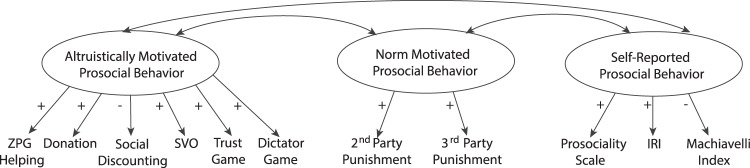
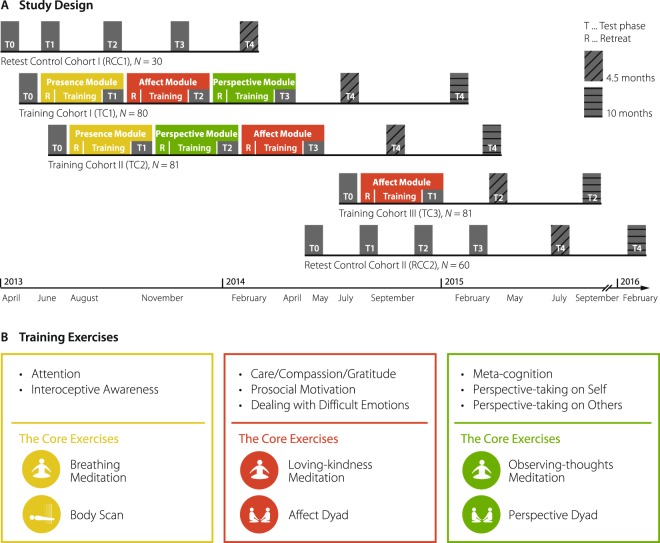
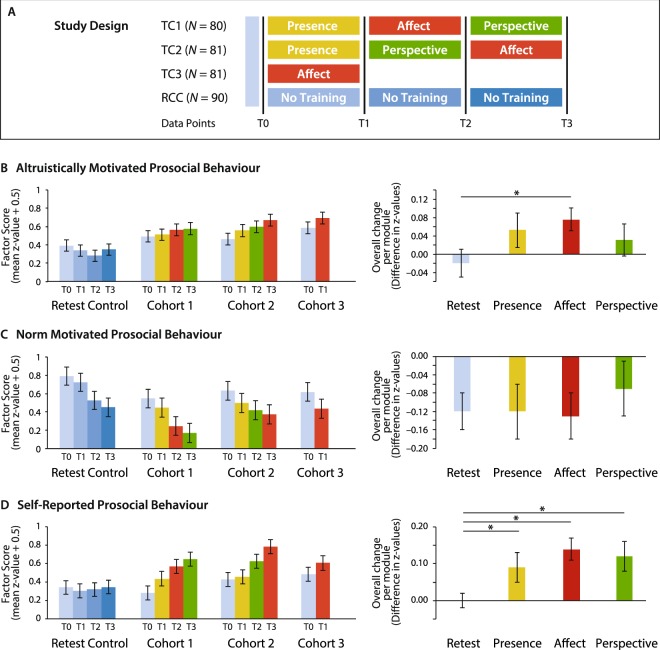
Global challenges such as climate change or the refugee crises emphasize the necessity of altruism and cooperation. In a large-scale 9-month intervention study, we investigated the malleability of prosociality by three distinct mental trainings cultivating attention, socio-affective, or socio-cognitive skills. We assessed numerous established measures of prosociality that capture three core facets: Altruistically motivated behaviours, norm motivated behaviours, and self-reported prosociality. Results of multiple time point confirmatory factor analyses support the validity and temporal stability of this model. Furthermore, linear mixed effects models reveal differential effects of mental trainings on the subcomponents of prosociality: Only training care and compassion effectively boosted altruistically motivated behaviour. No effects were revealed for norm-based behaviour. Self-reported prosociality increased with all training modules; this increase was, however, unrelated to changes in task-based measures of altruistic behaviour. These findings corroborate our motivation-based framework of prosociality, challenge economic views of fixed preferences by showing that socio-affective training boosts altruism, and inform policy makers and society about how to increase global cooperation.
Overview
The claims and statistics of this paper haven’t been checked yet.
Free: it reads the open-access text and checks the first 5 claims that cite a source we can check. Create a free account to check every claim.
Integrity signals
Registry
Cites
Statistics
Figures
Verification
Claims the paper makes
The claims and statistics of this paper haven’t been checked yet.
Free: it reads the open-access text and checks the first 5 claims that cite a source we can check. Create a free account to check every claim.
Claims other papers make about this one
Each is checked against this paper’s own text: does it say what the citing paper says it does?
The source backs part of the claim, not all of it — or backs it for a different population, condition or comparison.
In the citing paper
“There is some evidence for specific effects of different forms of meditation practice on both the brain and behavior with longer and more intensive practice163–167.”
From A common factors perspective on mindfulness-based interventions (2022) · cites this paper as [164]
Experimental — accuracy not yet measuredThe source backs part of the claim, not all of it — or backs it for a different population, condition or comparison.
In the citing paper
“socio-affective practices led to increases in compassion and prosocial behavior and reductions in social stress [31,32,33].”
From 10-Week Trajectories of Candidate Psychological Processes Differentially Predict Mental Health Gains from Online Dyadic versus Mindfulness Interventions: A Randomized Clinical Trial (2024) · cites this paper as [32]
Experimental — accuracy not yet measuredThe source backs part of the claim, not all of it — or backs it for a different population, condition or comparison.
In the citing paper
“Our results are in line with those of previous studies (Böckler et al., 2018; Ata & Artan, 2021) confirming the efficacy of programmes focused on prosocial behaviour development.”
From The benefits of a school intervention for prosocial behaviour and psychological well-being in early adolescents (2025) · cites this paper as Böckler et al., 2018
Experimental — accuracy not yet measuredThe source backs part of the claim, not all of it — or backs it for a different population, condition or comparison.
In the citing paper
“Thus, the evidence validating H 2 is in line with that from previous studies (Böckler et al., 2018; Laguna et al., 2020; Montgomery & Maunders, 2015) which highlight the effectiveness of interventions that use strategies cognitive, behavioural and emotional effects on altruism.”
From The benefits of a school intervention for prosocial behaviour and psychological well-being in early adolescents (2025) · cites this paper as Böckler et al., 2018
Experimental — accuracy not yet measuredThe cited source says what the claim attributes to it.
In the citing paper
“The programme was rigorously developed, having as its theoretical framing the theory of the malleability of altruistic behaviours (Böckler et al., 2018), the PERMA model described by Seligman (2012), and the psychological wellbeing model introduced by Ryff (1989) in positive psychology.”
From The benefits of a school intervention for prosocial behaviour and psychological well-being in early adolescents (2025) · cites this paper as Böckler et al., 2018
1 more claim about this paper
Create a free account to see every claim other papers make about this one.
Self-check
Percentages, sums and reported differences re-computed from the paper’s own numbers.
The self-check needs the paper’s full text.
Citations
Cites
Controlling the False Discovery Rate: A Practical and Powerful Approach to Multiple Testing
Benjamini, Y., & Hochberg, Y. (1995) · Journal of the Royal Statistical Society Series B: Statistical Methodology · doi:10.1111/j.2517-6161.1995.tb02031.x · Cited by 109,482
Confirmatory factor analysis for applied research
(2007) · Choice Reviews Online · doi:10.5860/choice.44-2769 · Cited by 15,614
Missing data: our view of the state of the art
Schafer, J. L., & Graham, J. W. (2002) · Psychological Methods · doi:10.1037/1082-989x.7.2.147 · Cited by 11,638
(2019) · AEA Papers and Proceedings · doi:10.1257/pandp.109.612 · Cited by 10,902
Measuring individual differences in empathy: Evidence for a multidimensional approach.
Davis, M. H. (1983) · Journal of Personality and Social Psychology · doi:10.1037/0022-3514.44.1.113 · Cited by 10,272
Cohen, J. (1992) · Psychological Bulletin · doi:10.1037//0033-2909.112.1.155 · Cited by 8,771
Power failure: why small sample size undermines the reliability of neuroscience
Button, K. S., Ioannidis, J. P. A., Mokrysz, C., Nosek, B. A., Flint, J., Robinson, E. S. J., & Munafò, M. R. (2013) · Nature Reviews Neuroscience · doi:10.1038/nrn3475 · Cited by 7,641
Trust, Reciprocity, and Social History
Berg, J., Dickhaut, J., & McCabe, K. (1995) · Games and Economic Behavior · doi:10.1006/game.1995.1027 · Cited by 5,548
Cooperation and Punishment in Public Goods Experiments
Fehr, E., & Gächter, S. (2000) · American Economic Review · doi:10.1257/aer.90.4.980 · Cited by 4,547
Longitudinal Structural Equation Modeling
Little, T. D. (2013) · Cited by 4,278
Behavioral Game Theory: Experiments in Strategic Interaction
Camerer, C. F. (2003) · Cited by 3,722
Oxytocin increases trust in humans
Kosfeld, M., Heinrichs, M., Zak, P. J., Fischbacher, U., & Fehr, E. (2005) · Nature · doi:10.1038/nature03701 · Cited by 3,690
Fehr, E., & Fischbacher, U. (2003) · Nature · doi:10.1038/nature02043 · Cited by 3,475
Alterations in brain and immune function produced by mindfulness meditation
Davidson, R. J., Kabat-Zinn, J., Schumacher, J., Rosenkranz, M., Muller, D., Santorelli, S. F., Urbanowski, F., Harrington, A., Bonus, K., & Sheridan, J. F. (2003) · Psychosomatic Medicine · doi:10.1097/01.psy.0000077505.67574.e3 · Cited by 2,925
Evolution of indirect reciprocity
Nowak, M. A., & Sigmund, K. (2005) · Nature · doi:10.1038/nature04131 · Cited by 2,762
The relation of empathy to prosocial and related behaviors
Eisenberg, N., & Miller, P. A. (1987) · Psychological Bulletin · doi:10.1037/0033-2909.101.1.91 · Cited by 2,672
Meditation Programs for Psychological Stress and Well-being: A Systematic Review and Meta-analysis
Goyal, M., Singh, S., Sibinga, E. M. S., Gould, N. F., Rowland-Seymour, A., Sharma, R., Berger, Z., Sleicher, D., Maron, D. D., Shihab, H. M., et al. (2014) · JAMA Internal Medicine · doi:10.1001/jamainternmed.2013.13018 · Cited by 2,380
De gustibus non est disputandum
Stigler, G. J., & Becker, G. S. (2010) · Idées économiques et sociales · doi:10.3917/idee.159.0054 · Cited by 2,282
A simple rule for the evolution of cooperation on graphs and social networks
Ohtsuki, H., Hauert, C., Lieberman, E., & Nowak, M. A. (2006) · Nature · doi:10.1038/nature04605 · Cited by 2,208
Costly Punishment Across Human Societies
Henrich, J., McElreath, R., Barr, A., Ensminger, J., Barrett, C., Bolyanatz, A., Cardenas, J. C., Gurven, M., Gwako, E., Henrich, N., et al. (2006) · Science · doi:10.1126/science.1127333 · Cited by 1,771
Short-term meditation training improves attention and self-regulation
Tang, Y.-Y., Ma, Y., Wang, J., Fan, Y., Feng, S., Lu, Q., Yu, Q., Sui, D., Rothbart, M. K., Fan, M., et al. (2007) · Proceedings of the National Academy of Sciences · doi:10.1073/pnas.0707678104 · Cited by 1,597
Entrepreneurship, Social Mobility, and Income Redistribution in South India
Nafziger, E. W. (2016) · American Economic Review · Cited by 1,572
Training, Wages, and Sample Selection: Estimating Sharp Bounds on Treatment Effects
LEE, D. S. (2009) · Review of Economic Studies · doi:10.1111/j.1467-937x.2009.00536.x · Cited by 1,399
Linear Mixed Models: A Practical Guide Using Statistical Software
West, B. T., Welch, K. B., & Gałecki, A. T. (2006) · Thammasat University Digital Collections · Cited by 1,382
Social exclusion decreases prosocial behavior
Twenge, J. M., Baumeister, R. F., DeWall, C. N., Ciarocco, N. J., & Bartels, J. M. (2007) · Journal of Personality and Social Psychology · doi:10.1037/0022-3514.92.1.56 · Cited by 1,271
The neurobiology of attachment
Insel, T. R., & Young, L. J. (2001) · Nature Reviews Neuroscience · doi:10.1038/35053579 · Cited by 1,173
Van Lange, P. A. M. (1999) · Journal of Personality and Social Psychology · doi:10.1037/0022-3514.77.2.337 · Cited by 1,127
Self‐Compassion, Self‐Esteem, and Well‐Being
Neff, K. D. (2011) · Social and Personality Psychology Compass · doi:10.1111/j.1751-9004.2010.00330.x · Cited by 1,118
Singer, T. (2006) · Neuroscience & Biobehavioral Reviews · doi:10.1016/j.neubiorev.2006.06.011 · Cited by 1,079
Self-citationBatson, C. D. (2010) · doi:10.1093/acprof:oso/9780195341065.001.0001 · Cited by 1,039 · cited 3×
“Continuous time was added as a repeated statement with the AR(1) covariance structure.”
BackgroundMethodCulture and the evolution of human cooperation
Boyd, R., & Richerson, P. J. (2009) · Philosophical Transactions of the Royal Society B: Biological Sciences · doi:10.1098/rstb.2009.0134 · Cited by 1,034
Solutions manual for Microeconomic theory : Mas-Colell, Whinston and Green
Hara, C., Segal, I., & Tadelis, S. (1997) · Oxford University Press eBooks · Cited by 992
depue, R. A., & morrone-strupinsky, J. V. (2005) · Behavioral and Brain Sciences · doi:10.1017/s0140525x05000063 · Cited by 958
Human fronto–mesolimbic networks guide decisions about charitable donation
Moll, J., Krueger, F., Zahn, R., Pardini, M., de Oliveira-Souza, R., & Grafman, J. (2006) · Proceedings of the National Academy of Sciences · doi:10.1073/pnas.0604475103 · Cited by 900
Reconstructing and deconstructing the self: cognitive mechanisms in meditation practice
Dahl, C. J., Lutz, A., & Davidson, R. J. (2015) · Trends in Cognitive Sciences · doi:10.1016/j.tics.2015.07.001 · Cited by 809
Handbook of structural equation modeling
Hoyle, R. H. (2012) · Cited by 808
The Science of Self-report: Implications for Research and Practice
(1999) · Psychology Press eBooks · doi:10.4324/9781410601261 · Cited by 764
(2005) · Medical Entomology and Zoology · Cited by 671
Functional Neural Plasticity and Associated Changes in Positive Affect After Compassion Training
Klimecki, O. M., Leiberg, S., Lamm, C., & Singer, T. (2013) · Cerebral Cortex · doi:10.1093/cercor/bhs142 · Cited by 634
Self-citationCompassion training alters altruism and neural responses to suffering.
Weng, H. Y., Fox, A. S., Shackman, A. J., Stodola, D. E., Caldwell, J. Z. K., Olson, M. C., Rogers, G. M., & Davidson, R. J. (2013) · Psychological Science · doi:10.1177/0956797612469537 · Cited by 602
A New Scale for Measuring Adults' Prosocialness
Caprara, G. V., Steca, P., Zelli, A., & Capanna, C. (2005) · European Journal of Psychological Assessment · doi:10.1027/1015-5759.21.2.77 · Cited by 566
Mindfulness, by any other name…: trials and tribulations of sati in western psychology and science
Grossman, P., & Van Dam, N. T. (2011) · Contemporary Buddhism · doi:10.1080/14639947.2011.564841 · Cited by 548
Hare, T. A., Camerer, C. F., Knoepfle, D. T., O'Doherty, J. P., & Rangel, A. (2010) · The Journal of Neuroscience · doi:10.1523/jneurosci.4089-09.2010 · Cited by 527
An fMRI investigation of empathy for ‘social pain’ and subsequent prosocial behavior
Masten, C. L., Morelli, S. A., & Eisenberger, N. I. (2011) · NeuroImage · doi:10.1016/j.neuroimage.2010.11.060 · Cited by 490
Mental training enhances attentional stability: Neural and behavioral evidence
Lutz, A., Slagter, H. A., Rawlings, N. B., Francis, A. D., Greischar, L. L., & Davidson, R. J. (2009) · The Journal of Neuroscience · doi:10.1523/jneurosci.1614-09.2009 · Cited by 489
Linear Mixed Models: A Practical Guide Using Statistical Software, Second Edition
West, B. T., Welch, K. B., & Galecki, A. T. (2014) · Chapman & Hall/CRC eBooks · doi:10.1201/b17198 · Cited by 476
Altruistic punishment and the origin of cooperation
Fowler, J. H. (2005) · Proceedings of the National Academy of Sciences · doi:10.1073/pnas.0500938102 · Cited by 473
Genetic Variation in Preferences for Giving and Risk Taking*
Cesarini, D., Dawes, C. T., Johannesson, M., Lichtenstein, P., & Wallace, B. (2009) · Quarterly Journal of Economics · doi:10.1162/qjec.2009.124.2.809 · Cited by 458
Meditation increases compassionate responses to suffering.
Condon, P., Desbordes, G., Miller, W. B., & DeSteno, D. (2013) · Psychological Science · doi:10.1177/0956797613485603 · Cited by 451
Jones, B., & Rachlin, H. (2006) · Psychological Science · doi:10.1111/j.1467-9280.2006.01699.x · Cited by 444 · cited 1×
“Continuous time was added as a repeated statement with the AR(1) covariance structure.”
Short-term compassion training increases prosocial behavior in a newly developed prosocial game
Leiberg, S., Klimecki, O., & Singer, T. (2011) · PLoS ONE · doi:10.1371/journal.pone.0017798 · Cited by 442
Self-citationHumans display a ‘cooperative phenotype’ that is domain general and temporally stable
Peysakhovich, A., Nowak, M. A., & Rand, D. G. (2014) · Nature Communications · doi:10.1038/ncomms5939 · Cited by 426
Kanske, P., Böckler, A., Trautwein, F.-M., & Singer, T. (2015) · NeuroImage · doi:10.1016/j.neuroimage.2015.07.082 · Cited by 421
Self-citationHeritability of cooperative behavior in the trust game
Cesarini, D., Dawes, C. T., Fowler, J. H., Johannesson, M., Lichtenstein, P., & Wallace, B. (2008) · Proceedings of the National Academy of Sciences · doi:10.1073/pnas.0710069105 · Cited by 371
The Formation of Prosociality: Causal Evidence on the Role of Social Environment
Kosse, F., Deckers, T., Pinger, P., Schildberg-Hörisch, H., & Falk, A. (2020) · Journal of Political Economy · doi:10.1086/704386 · Cited by 347
Tusche, A., Böckler, A., Kanske, P., Trautwein, F.-M., & Singer, T. (2016) · The Journal of Neuroscience · doi:10.1523/jneurosci.3392-15.2016 · Cited by 309
Self-citationSteinbeis, N., Bernhardt, B. C., & Singer, T. (2012) · Neuron · doi:10.1016/j.neuron.2011.12.027 · Cited by 298
Self-citationCompetition and cooperation among different punishing strategies in the spatial public goods game
Chen, X., Szolnoki, A., & Perc, M. (2015) · Physical Review E · doi:10.1103/physreve.92.012819 · Cited by 285
Valk, S. L., Bernhardt, B. C., Trautwein, F.-M., Böckler, A., Kanske, P., Guizard, N., Collins, D. L., & Singer, T. (2017) · Science Advances · doi:10.1126/sciadv.1700489 · Cited by 264
Self-citationRejection of unfair offers in the ultimatum game is no evidence of strong reciprocity
Yamagishi, T., Horita, Y., Mifune, N., Hashimoto, H., Li, Y., Shinada, M., Miura, A., Inukai, K., Takagishi, H., & Simunovic, D. (2012) · Proceedings of the National Academy of Sciences · doi:10.1073/pnas.1212126109 · Cited by 234
The limited prosocial effects of meditation: A systematic review and meta-analysis
Kreplin, U., Farias, M., & Brazil, I. A. (2018) · Scientific Reports · doi:10.1038/s41598-018-20299-z · Cited by 211
Zeitschrift für Sozialpsychologie
(1983) · 1983 · doi:10.1515/9783112468647-toc · Cited by 209
Happiness: A Guide to Developing Life's Most Important Skill
Ricard, M. (2006) · Cited by 207
Böckler, A., Tusche, A., & Singer, T. (2016) · Social Psychological and Personality Science · doi:10.1177/1948550616639650 · Cited by 189 · cited 2×
“The original model of human prosociality also included measures assessing strategic prosocial behaviour, related to the inclination to make prosocial choices dependent upon whether they benefit oneself (2).”
BackgroundSelf-citationEngert, V., Kok, B. E., Papassotiriou, I., Chrousos, G. P., & Singer, T. (2017) · Science Advances · doi:10.1126/sciadv.1700495 · Cited by 151
Self-citationTusche, A., & Hutcherson, C. A. C. (2018) · eLife · doi:10.7554/elife.31185 · Cited by 102
Self-citationKok, B. E., & Singer, T. (2017) · JAMA Psychiatry · doi:10.1001/jamapsychiatry.2016.3360 · Cited by 99
Self-citationHildebrandt, L. K., McCall, C., & Singer, T. (2017) · Mindfulness · doi:10.1007/s12671-017-0716-z · Cited by 96
Self-citationParadoxes of Rationality and Cooperation: Prisoner's Dilemma and Newcomb's Problem
(1985) · University of British Columbia Press eBooks · doi:10.59962/9780774857154 · Cited by 94
Effects of compassion meditation on a psychological model of charitable donation.
Ashar, Y. K., Andrews-Hanna, J. R., Yarkoni, T., Sills, J., Halifax, J., Dimidjian, S., & Wager, T. D. (2016) · Emotion · doi:10.1037/emo0000119 · Cited by 78
Moving From Acceptance Toward Transformation With Internal Family Systems Therapy (IFS)
Schwartz, R. C. (2013) · Journal of Clinical Psychology · doi:10.1002/jclp.22016 · Cited by 72
Is there a “Socratic Effect” in Nonexperimental Panel Studies?
Jagodzinski, W., Kühnel, S., & Schmidt, P. (1987) · Sociological Methods & Research · doi:10.1177/0049124187015003004 · Cited by 67
Self-citationMcCall, C., Steinbeis, N., Ricard, M., & Singer, T. (2014) · Frontiers in Behavioral Neuroscience · doi:10.3389/fnbeh.2014.00424 · Cited by 59
The effect of the stake size on the evolution of fairness
Zhang, Y., Chen, X., Liu, A., & Sun, C. (2017) · Applied Mathematics and Computation · doi:10.1016/j.amc.2017.11.013 · Cited by 58
Böckler, A., Tusche, A., & Singer, T. (2017) · Social Psychological and Personality Science · doi:10.1177/1948550617722200 · Cited by 56
Self-citationWilhelm, O., Kaltwasser, L., & Hildebrandt, A. (2017) · Social Psychological and Personality Science · doi:10.1177/1948550617707021 · Cited by 56
Estimation of Reliability and Stability in Single-Indicator Multiple-Wave Models
JAGODZINSKI, W., & KÜHNEL, S. M. (1987) · Sociological Methods & Research · doi:10.1177/0049124187015003003 · Cited by 48
Konstruktion einer Machiavellismus-Skala
Henning, H. J., & Six, B. (1977) · De Gruyter eBooks · doi:10.1515/9783112468340-004 · Cited by 36
Affect and motivation are critical in constructive meditation
Engen, H. G., & Singer, T. (2016) · Trends in Cognitive Sciences · doi:10.1016/j.tics.2015.11.004 · Cited by 31
Self-citationFrom Faces to Prosocial Behavior: Cues, Tools, and Mechanisms
Adolphs, R., & Tusche, A. (2017) · Current Directions in Psychological Science · doi:10.1177/0963721417694656 · Cited by 30
Self-citationSosu, E., & Schmidt, P. (2016) · Journal of Psychoeducational Assessment · doi:10.1177/0734282916655503 · Cited by 29
Self-citationCooperation, Motivation and Social Balance
Bosworth, S., Singer, T., & Snower, D. J. (2015) · Journal of Economic Behavior & Organization · doi:10.1016/j.jebo.2015.12.005 · Cited by 4
Self-citation
Research works printed but not linked: 3
- Mas-Colell, A., Whinston, M. D. & Green, J. R. Microeconomic theory. (Oxford University Press, 1995).
- Neff, K. & Germer, C. The Oxford Handbook of Compassion Science. (2004).
- Holmes, T. Parts Work: An Illustrated Guide to Your Inner Life. (Winged Heart Press, 2007).
Cited by
Singer, T., & Engert, V. (2019) · Current Opinion in Psychology · doi:10.1016/j.copsyc.2018.12.005 · Cited by 176
Self-citationThe Way Forward in Mindfulness and Sustainability: a Critical Review and Research Agenda
Thiermann, U. B., & Sheate, W. R. (2020) · Journal of Cognitive Enhancement · doi:10.1007/s41465-020-00180-6 · Cited by 149
“…et al. 2018 Grabow et al. 2018 EX Aspy and Proeve 2017 CS Jacob et al. 2009 Jacob et al. 2009 Combination trait + practice IN Böhme et al. 2018 Böhme et al. 2018 IN Stanszus et al. 2019 Stanszus et al. 2019 IN Geiger et al. 2019a Geiger et al. 2019a CS Loy and Reese 2019 Loy and Reese 2019 CS…”
BackgroundMethodInfluentialNadler, R., Carswell, J. J., & Minda, J. P. (2020) · Frontiers in Psychology · doi:10.3389/fpsyg.2020.00255 · Cited by 83
A common factors perspective on mindfulness-based interventions
Goldberg, S. B. (2022) · Nature Reviews Psychology · doi:10.1038/s44159-022-00090-8 · Cited by 75
Thiermann, U. B., & Sheate, W. R. (2020) · Ecological Economics · doi:10.1016/j.ecolecon.2020.106668 · Cited by 100
Metadata
- Authors
- Böckler, A., Tusche, A., Schmidt, P., & Singer, T.
- Affiliations
- University of Würzburg (DE)
- California Institute of Technology (US)
- Justus-Liebig-Universität Gießen (DE)
- Max Planck Institute for Human Cognitive and Brain Sciences (DE)
- Corresponding author
- Böckler, Anne
- Venue
- Scientific Reports
- Published
- 2018-09-10
- Volume
- 8
- Issue
- 1
- Pages
- 13560-13560
- ISSN
- 2045-2322 (ISSN-L)
- PMC
- PMC6131389
- OpenAlex
- W2889792718
- Cited by
- 107
- References
- 83
- Citations by year
- 2026: 9 · 2025: 15 · 2024: 15 · 2023: 13 · 2022: 15 · 2021: 26 · 2020: 9 · 2019: 4 · 2018: 1
- FWCI
- 13.57
- Type
- journal article
- Language
- en
- Open access
- gold
- doi.org
- Licence
- cc-by
- creativecommons.org/licenses/by/4.0 (tdm)
- creativecommons.org/licenses/by/4.0 (vor)
- Locations
- Scientific Reports (publishedVersion, cc-by)
- Europe PMC (PubMed Central) (publishedVersion, other-oa)
- PubMed Central (publishedVersion, cc-by)
- PubMed (publishedVersion)
- CaltechAUTHORS (California Institute of Technology) (submittedVersion, cc-by)
- DOAJ (DOAJ: Directory of Open Access Journals) (submittedVersion, cc-by-sa)
- Max Planck Digital Library (submittedVersion, other-oa)
- MPG.PuRe (Max Planck Society) (submittedVersion, other-oa)
- Funders
- EC | European Research Council (205557)
- Topics
- Social Sciences › Psychology › Social Psychology › Psychological Well-being and Life Satisfaction
- Social Sciences › Psychology › Clinical Psychology › Mindfulness and Compassion Interventions
- Social Sciences › Economics, Econometrics and Finance › Economics and Econometrics › Experimental Behavioral Economics Studies
- Keywords
- prosocial behavior, altruism, mental training, attention training, compassion, care, international cooperation
- MeSH terms
- Adult, Altruism, Cooperative Behavior, Female, Humans, Interpersonal Relations, Longitudinal Studies, Male, Middle Aged, Models, Psychological, Motivation, Cognitive Science, Young Adult, Self Report
About these checks
Registry, retraction, Cites and statistics results are computed, not judged, with one exception: a printed reference that no index lists is read once by a model before it counts as a citation error. Claims are extracted by a model and kept only when their quote appears verbatim in the text; each cited source is then checked, with a model’s help, for whether it says what the claim relies on. Those verdicts can be wrong — read the claim’s quote and the cited source before relying on one.
Statistics and arithmetic are recomputed, not judged.
Confidence bands are shown only for fields calibrated on our annotated test set. None is calibrated yet, so no band is shown.
What counts as a claim ›How we measure confidence ›How we check this ›
Are you an author, or do you see a problem with this page? Request a review
Data sources
Bibliographic data: Semantic Scholar, OpenAlex, Crossref.
Contains information from the Semantic Scholar Academic Graph Datasets, made available under the ODC Attribution License (ODC-BY 1.0).
Semantic Scholar’s data is described in: Kinney, R., et al. (2023). The Semantic Scholar Open Data Platform. arXiv:2301.10140.
