

Peri-hand space expands beyond reach in the context of walk-and-reach movements
Open accessThe DOI matches its Crossref record; 50 of the 50 references it cites were found in a registry or an index.
Abstract
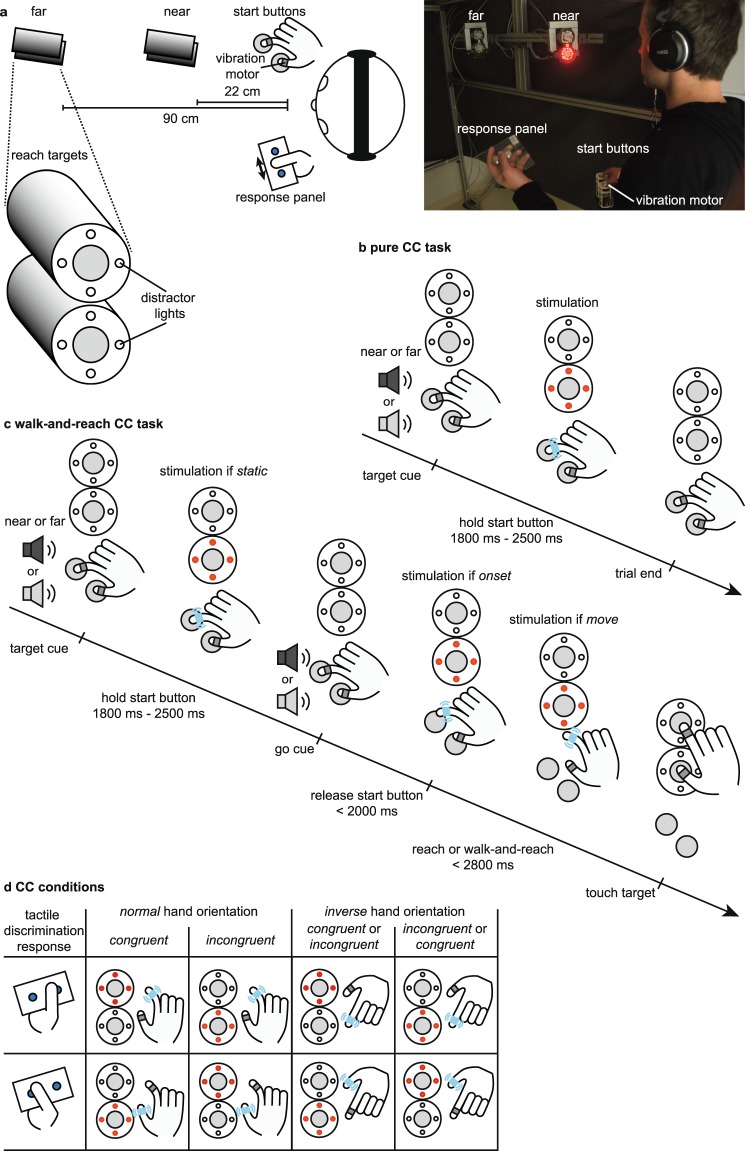
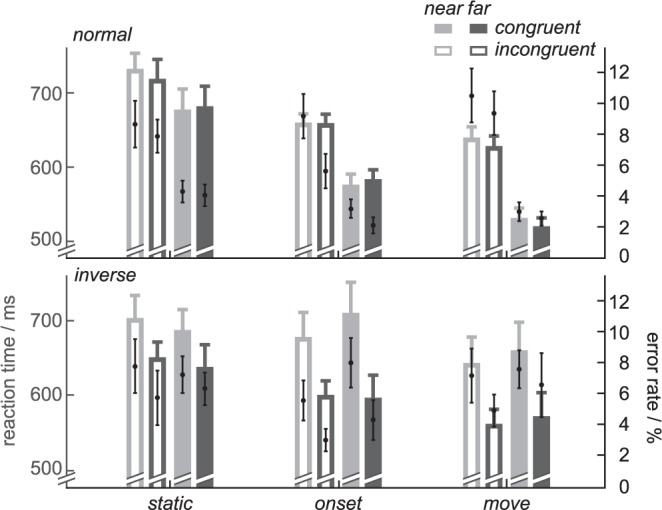
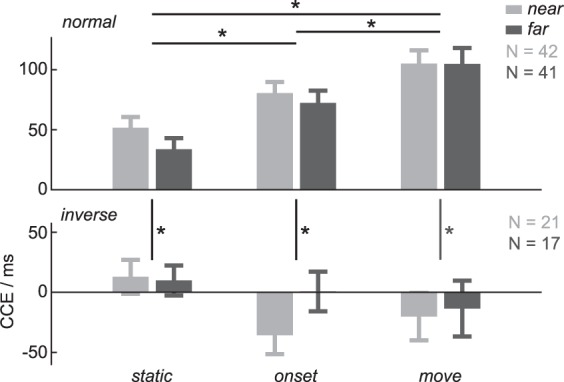
The brain incorporates sensory information across modalities to be able to interact with our environment. The peripersonal space (PPS), defined by a high level of crossmodal interaction, is centered on the relevant body part, e.g. the hand, but can spatially expand to encompass tools or reach targets during goal-directed behavior. Previous studies considered expansion of the PPS towards goals within immediate or tool-mediated reach, but not the translocation of the body as during walking. Here, we used the crossmodal congruency effect (CCE) to quantify the extension of the PPS and test if PPS can also expand further to include far located walk-and-reach targets accessible only by translocation of the body. We tested for orientation specificity of the hand-centered reference frame, asking if the CCE inverts with inversion of the hand orientation during reach. We show a high CCE with onset of the movement not only towards reach targets but also walk-and-reach targets. When participants must change hand orientation, the CCE decreases, if not vanishes, and does not simply invert. We conclude that the PPS can expand to the action space beyond immediate or tool-mediated reaching distance but is not purely hand-centered with respect to orientation.
Overview
The claims and statistics of this paper haven’t been checked yet.
Free: it reads the open-access text and checks the first 5 claims that cite a source we can check. Create a free account to check every claim.
Integrity signals
Registry
Cites
Statistics
Figures
Verification
Claims the paper makes
The claims and statistics of this paper haven’t been checked yet.
Free: it reads the open-access text and checks the first 5 claims that cite a source we can check. Create a free account to check every claim.
Claims other papers make about this one
Each is checked against this paper’s own text: does it say what the citing paper says it does?
The source backs part of the claim, not all of it — or backs it for a different population, condition or comparison.
In the citing paper
“As such, illusory or real changes in body dimensions, or body position in space may change PPS representation (Berger et al., 2019;Cardini, Fatemi-Ghomi, Gajewska-Knapik, Gooch, & Aspell, 2019;D'Angelo et al., 2017;Noel, Grivaz, et al., 2015;Pfeiffer, Noel, Serino, & Blanke, 2018).”
From The Peripersonal Space in a social world (2021) · cites this paper as Berger et al., 2019
Experimental — accuracy not yet measuredThe cited source says what the claim attributes to it.
In the citing paper
“have also been reported during motion (Berger, Neumann, & Gail, 2019;Noel, Grivaz, et al., 2015), or in the presence of other individuals”
From The Peripersonal Space in a social world (2021) · cites this paper as Berger, Neumann, & Gail, 2019
Self-check
Percentages, sums and reported differences re-computed from the paper’s own numbers.
The self-check needs the paper’s full text.
Citations
Cites
Simultaneous Inference in General Parametric Models
Hothorn, T., Bretz, F., & Westfall, P. (2008) · Biometrical Journal · doi:10.1002/bimj.200810425 · Cited by 13,847
Rubber hands ‘feel’ touch that eyes see
Botvinick, M., & Cohen, J. (1998) · Nature · doi:10.1038/35784 · Cited by 4,410
Coding of modified body schema during tool use by macaque postcentral neurones
lriki, A., Tanaka, M., & Iwamura, Y. (1996) · NeuroReport · doi:10.1097/00001756-199610020-00010 · Cited by 1,274
Maravita, A., & Iriki, A. (2004) · Trends in Cognitive Sciences · doi:10.1016/j.tics.2003.12.008 · Cited by 1,214
Afferent properties of periarcuate neurons in macaque monkeys. II. Visual responses
Rizzolatti, G., Scandolara, C., Matelli, M., & Gentilucci, M. (1981) · Behavioural Brain Research · doi:10.1016/0166-4328(81)90053-x · Cited by 766
When Far Becomes Near: Remapping of Space by Tool Use
Berti, A., & Frassinetti, F. (2000) · Journal of Cognitive Neuroscience · doi:10.1162/089892900562237 · Cited by 731 · cited 1×
“(3) For some participants, RT in the static condition was unreasonably higher than in all other conditions.”
BackgroundRizzolatti, G., Fadiga, L., Fogassi, L., & Gallese, V. (1997) · Science · doi:10.1126/science.277.5323.190 · Cited by 712
Behavioral, Neural, and Computational Principles of Bodily Self-Consciousness
Blanke, O., Slater, M., & Serino, A. (2015) · Neuron · doi:10.1016/j.neuron.2015.09.029 · Cited by 698
Coding of peripersonal space in inferior premotor cortex (area F4).
Fogassi, L., Gallese, V., Fadiga, L., Luppino, G., Matelli, M., & Rizzolatti, G. (1996) · Journal of Neurophysiology · doi:10.1152/jn.1996.76.1.141 · Cited by 688
Visual Capture of Touch: Out-of-the-Body Experiences With Rubber Gloves.
Pavani, F., Spence, C., & Driver, J. (2000) · Psychological Science · doi:10.1111/1467-9280.00270 · Cited by 608
Left neglect for near but not far space in man
Halligan, P. W., & Marshall, J. C. (1991) · Nature · doi:10.1038/350498a0 · Cited by 578
Multisensory integration and the body schema: Close to hand and within reach
Maravita, A., Spence, C., & Driver, J. (2003) · Current Biology · doi:10.1016/s0960-9822(03)00449-4 · Cited by 578
Coding the location of the arm by sight
Graziano, M. S. A., Cooke, D. F., & Taylor, C. S. R. (2000) · Science · doi:10.1126/science.290.5497.1782 · Cited by 550
Afferent properties of periarcuate neurons in macaque monkeys. I. Somatosensory responses
Rizzolatti, G., Scandolara, C., Matelli, M., & Gentilucci, M. (1981) · Behavioural Brain Research · doi:10.1016/0166-4328(81)90052-8 · Cited by 501
Makin, T. R., Holmes, N. P., & Zohary, E. (2007) · The Journal of Neuroscience · doi:10.1523/jneurosci.3653-06.2007 · Cited by 381
Mirror Neurons Differentially Encode the Peripersonal and Extrapersonal Space of Monkeys
Caggiano, V., Fogassi, L., Rizzolatti, G., Thier, P., & Casile, A. (2009) · Science · doi:10.1126/science.1166818 · Cited by 361
Tool-use changes multimodal spatial interactions between vision and touch in normal humans
Maravita, A., Spence, C., Kennett, S., & Driver, J. (2002) · Cognition · doi:10.1016/s0010-0277(02)00003-3 · Cited by 323
Brozzoli, C., Gentile, G., & Ehrsson, H. H. (2012) · The Journal of Neuroscience · doi:10.1523/jneurosci.2660-12.2012 · Cited by 293
Spatial constraints on visual-tactile cross-modal distractor congruency effects
SPENCE, C., PAVANI, F., & DRIVER, J. (2004) · Cognitive, Affective, & Behavioral Neuroscience · doi:10.3758/cabn.4.2.148 · Cited by 282
The representation of extrapersonal space: A possible role for bimodal, visual-tactile neurons
Graziano, M. S. A., & Gross, C. G. (1995) · Cited by 275
Cléry, J., Guipponi, O., Wardak, C., & Ben Hamed, S. (2015) · Neuropsychologia · doi:10.1016/j.neuropsychologia.2014.10.022 · Cited by 261
Self-images in the video monitor coded by monkey intraparietal neurons
Iriki, A., Tanaka, M., Obayashi, S., & Iwamura, Y. (2001) · Neuroscience Research · doi:10.1016/s0168-0102(01)00225-5 · Cited by 229
Body part-centered and full body-centered peripersonal space representations
Serino, A., Noel, J.-P., Galli, G., Canzoneri, E., Marmaroli, P., Lissek, H., & Blanke, O. (2015) · Scientific Reports · doi:10.1038/srep18603 · Cited by 215
Near and far visual space in unilateral neglect
Vuilleumier, P., Valenza, N., Mayer, E., Reverdin, A., & Landis, T. (1998) · Annals of Neurology · doi:10.1002/ana.410430324 · Cited by 213
Spence, C., Pavani, F., Maravita, A., & Holmes, N. (2004) · Journal of Physiology-Paris · doi:10.1016/j.jphysparis.2004.03.008 · Cited by 205
Gramm: grammar of graphics plotting in Matlab
Morel, P. (2018) · The Journal of Open Source Software · doi:10.21105/joss.00568 · Cited by 202
Action-specific remapping of peripersonal space
Brozzoli, C., Cardinali, L., Pavani, F., & Farnè, A. (2009) · Neuropsychologia · doi:10.1016/j.neuropsychologia.2009.10.009 · Cited by 161
Grasping actions remap peripersonal space
Brozzoli, C., Pavani, F., Urquizar, C., Cardinali, L., & Farnè, A. (2009) · NeuroReport · doi:10.1097/wnr.0b013e32832c0b9b · Cited by 129
Brozzoli, C., Ehrsson, H. H., & Farnè, A. (2014) · The Neuroscientist · doi:10.1177/1073858413511153 · Cited by 125
Does tool use extend peripersonal space? A review and re-analysis
Holmes, N. P. (2012) · Experimental Brain Research · doi:10.1007/s00221-012-3042-7 · Cited by 124
Soto‐Faraco, S., Ronald, A., & Spence, C. J. (2004) · Perception & Psychophysics · doi:10.3758/bf03196837 · Cited by 116
Temporal aspects of the visuotactile congruency effect.
Shore, D. I., Barnes, M. E., & Spence, C. (2006) · Neuroscience Letters · doi:10.1016/j.neulet.2005.09.001 · Cited by 105
Seeing Your Own Touched Hands in a Mirror Modulates Cross-modal Interactions
Maravita, A., Spence, C., Sergent, C., & Driver, J. (2002) · Psychological Science · doi:10.1111/1467-9280.00463 · Cited by 104
The wheelchair as a full-body tool extending the peripersonal space
Galli, G., Noel, J. P., Canzoneri, E., Blanke, O., & Serino, A. (2015) · Frontiers in Psychology · doi:10.3389/fpsyg.2015.00639 · Cited by 85
Expanding the primate body schema in sensorimotor cortex by virtual touches of an avatar
Shokur, S., O’Doherty, J. E., Winans, J. A., Bleuler, H., Lebedev, M. A., & Nicolelis, M. A. L. (2013) · Proceedings of the National Academy of Sciences · doi:10.1073/pnas.1308459110 · Cited by 85
Tactile suppression in goal-directed movement
Juravle, G., Binsted, G., & Spence, C. J. (2016) · Psychonomic Bulletin & Review · doi:10.3758/s13423-016-1203-6 · Cited by 80
Multisensory interactions in the depth plane in front and rear space: A review
der Stoep, N. V., Nijboer, T. C. W., der Stigchel, S. V., & Spence, C. J. (2014) · Neuropsychologia · doi:10.1016/j.neuropsychologia.2014.12.007 · Cited by 71
Changes in tactile sensitivity over the time-course of a goal-directed movement
Juravle, G., Deubel, H., Tan, H. Z., & Spence, C. J. (2009) · Behavioural Brain Research · doi:10.1016/j.bbr.2009.12.009 · Cited by 70
Berger, M., Agha, N. S., & Gail, A. (2020) · eLife · doi:10.7554/elife.51322 · Cited by 68
Self-citationResponse requirements modulate tactile spatial congruency effects
Gallace, A., Soto‐Faraco, S., Dalton, P., Kreukniet, B., & Spence, C. J. (2008) · Experimental Brain Research · doi:10.1007/s00221-008-1510-x · Cited by 54
Context-dependent changes in tactile perception during movement execution
Juravle, G., McGlone, F. P., & Spence, C. J. (2013) · Frontiers in Psychology · doi:10.3389/fpsyg.2013.00913 · Cited by 46
Far Space Remapping by Tool Use: A rTMS Study Over the Right Posterior Parietal Cortex
Giglia, G., Pia, L., Folegatti, A., Puma, A. R., Fierro, B., Cosentino, G., Berti, A., & Brighina, F. (2015) · Brain stimulation · doi:10.1016/j.brs.2015.01.412 · Cited by 39
Depth: the Forgotten Dimension in Multisensory Research
van der Stoep, N., Serino, A., Farnè, A., Di Luca, M., & Spence, C. (2016) · Multisensory Research · doi:10.1163/22134808-00002525 · Cited by 38
Understanding the Correspondences: Introduction to the Special Issue on Crossmodal Correspondences
Parise, C., Spence, C. J., & Deroy, O. D. (2015) · Multisensory Research · doi:10.1163/22134808-00002517 · Cited by 20
Mental space maps into the future
Belardinelli, A., Lohmann, J., Farnè, A., & Butz, M. V. (2018) · Cognition · doi:10.1016/j.cognition.2018.03.007 · Cited by 19
Crossmodal congruency effect scores decrease with repeat test exposure
Satinder, G., Gill, S. S., Wilson, A. W., & Sensinger, J. W. (2019) · PeerJ · doi:10.7717/peerj.6976 · Cited by 12
Speed of reaction to sensory stimulation is enhanced during movement
Juravle, G., & Spence, C. J. (2015) · Acta Psychologica · doi:10.1016/j.actpsy.2015.09.002 · Cited by 11
Berger, M., Agha, N. S., & Gail, A. (2018) · bioRxiv (Cold Spring Harbor Laboratory) · doi:10.1101/305334 · Cited by 6
Self-citationCrossmodal congruency effect scores decrease with repeat test exposurePreprint
Gill, S. S., Blustein, D. H., Wilson, A. W., & Sensinger, J. W. (2017) · bioRxiv (Cold Spring Harbor Laboratory) · doi:10.1101/186825 · Cited by 3
Gill, S. S., Wilson, A. W., Blustein, D. H., & Sensinger, J. W. (2017) · bioRxiv (Cold Spring Harbor Laboratory) · Cited by 3
Cited by
The Peripersonal Space in a social world
Bogdanova, O. V., Bogdanov, V. B., Dureux, A., Farnè, A., & Hadj-Bouziane, F. (2021) · Cortex · doi:10.1016/j.cortex.2021.05.005 · Cited by 86
“, 2015) have also been reported during motion (Berger et al., 2019; Noel, Grivaz, et al., 2015), or in the presence of other individuals (Pellencin et al.”
BackgroundBerger, M., Agha, N. S., & Gail, A. (2020) · eLife · doi:10.7554/elife.51322 · Cited by 68
“382 Correspondingly, we could show that peripersonal space, as defined by the occurrence of visuo-tactile 383 integration, in human participants expands to reach goals beyond immediate reach when subjects 384 performed a walk-and-reach task similar to here (Berger et al. 2019).”
BackgroundMethodInfluentialSelf-citationInterpersonal Motor Interactions Shape Multisensory Representations of the Peripersonal Space
Fanghella, M., Era, V., & Candidi, M. (2021) · Brain Sciences · doi:10.3390/brainsci11020255 · Cited by 22
“Moreover, by combining reaching movements with walking toward the to-be-grasped object, Berger and colleagues [118] were able to show higher CCE at movement’s onset not only towards reaching targets, but also for walk-and-reach targets.”
BackgroundPeripersonal space: why so last-second?
de Vignemont, F., & Farnè, A. (2024) · Philosophical Transactions of the Royal Society B Biological Sciences · doi:10.1098/rstb.2023.0159 · Cited by 14
“Thus, despite being at the same distance from the hand, visual stimuli become more effective to alter tactile processing in agentive situations (see also [43,44]).”
Egocentric value maps of the near-body environment
Bufacchi, R. J., Somervail, R., Fitzpatrick, A. M., Murayama, Y., Logothetis, N. K., Caminiti, R., & Iannetti, G. D. (2025) · Nature Neuroscience · doi:10.1038/s41593-025-01958-7 · Cited by 12
Metadata
- Authors
- Berger, M., Neumann, P., & Gail, A.
- Affiliations
- German Primate Center (DE)
- Corresponding author
- Berger, Michael
- Venue
- Scientific Reports
- Published
- 2019-02-28
- Volume
- 9
- Issue
- 1
- Pages
- 3013-3013
- ISSN
- 2045-2322 (ISSN-L)
- PMC
- PMC6395760
- OpenAlex
- W2916911991
- Cited by
- 13
- References
- 49
- Citations by year
- 2025: 1 · 2024: 4 · 2022: 1 · 2021: 6 · 2020: 1
- FWCI
- 2.35
- Type
- journal article
- Language
- en
- Open access
- gold
- doi.org
- Licence
- cc-by
- creativecommons.org/licenses/by/4.0 (tdm)
- creativecommons.org/licenses/by/4.0 (vor)
- Locations
- Scientific Reports (publishedVersion, cc-by)
- Europe PMC (PubMed Central) (publishedVersion, other-oa)
- PubMed Central (publishedVersion, cc-by)
- PubMed (publishedVersion)
- DOAJ (DOAJ: Directory of Open Access Journals) (submittedVersion)
- GoeScholar The Publication Server of the Georg-August-Universität Göttingen (Georg-August-Universität Göttingen) (submittedVersion, cc-by)
- Funders
- Deutsche Forschungsgemeinschaft (GA1475-C1)
- European Commission (EC-H2020-FETPROACT-16 732266 WP1)
- Topics
- Social Sciences › Psychology › Experimental and Cognitive Psychology › Multisensory perception and integration
- Life Sciences › Neuroscience › Cognitive Neuroscience › Tactile and Sensory Interactions
- Life Sciences › Neuroscience › Cognitive Neuroscience › Motor Control and Adaptation
- Keywords
- peripersonal space, hand orientation, walking, reach-to-grasp, cross-modal interaction, spatial representation
- MeSH terms
- Acoustic Stimulation, Adult, Female, Hand, Humans, Male, Movement, Orientation, Personal Space, Psychomotor Performance, Space Perception, Walking
About these checks
Registry, retraction, Cites and statistics results are computed, not judged, with one exception: a printed reference that no index lists is read once by a model before it counts as a citation error. Claims are extracted by a model and kept only when their quote appears verbatim in the text; each cited source is then checked, with a model’s help, for whether it says what the claim relies on. Those verdicts can be wrong — read the claim’s quote and the cited source before relying on one.
Statistics and arithmetic are recomputed, not judged.
Confidence bands are shown only for fields calibrated on our annotated test set. None is calibrated yet, so no band is shown.
What counts as a claim ›How we measure confidence ›How we check this ›
Are you an author, or do you see a problem with this page? Request a review
Data sources
Bibliographic data: Semantic Scholar, OpenAlex, Crossref.
Contains information from the Semantic Scholar Academic Graph Datasets, made available under the ODC Attribution License (ODC-BY 1.0).
Semantic Scholar’s data is described in: Kinney, R., et al. (2023). The Semantic Scholar Open Data Platform. arXiv:2301.10140.
