

The DOI matches its Crossref record; 17 of the 17 references it cites were found in a registry or an index.
Demonstration of End-to-End Automation of DNA Data Storage.
Open accessPublished version of a preprint
Abstract
Synthetic DNA has emerged as a novel substrate to encode computer data with the potential to be orders of magnitude denser than contemporary cutting edge techniques. However, even with the help of automated synthesis and sequencing devices, many intermediate steps still require expert laboratory technicians to execute. We have developed an automated end-to-end DNA data storage device to explore the challenges of automation within the constraints of this unique application. Our device encodes data into a DNA sequence, which is then written to a DNA oligonucleotide using a custom DNA synthesizer, pooled for liquid storage, and read using a nanopore sequencer and a novel, minimal preparation protocol. We demonstrate an automated 5-byte write, store, and read cycle with a modular design enabling expansion as new technology becomes available.
Overview
The claims and statistics of this paper haven’t been checked yet.
Run the check — free, no account needed. It reads the open-access text and checks the sources it cites.
Integrity signals
Registry
Cites
Statistics
Figures
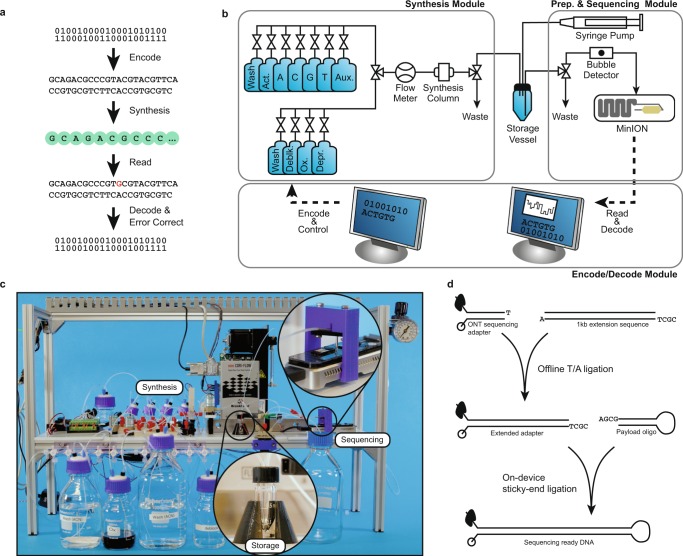
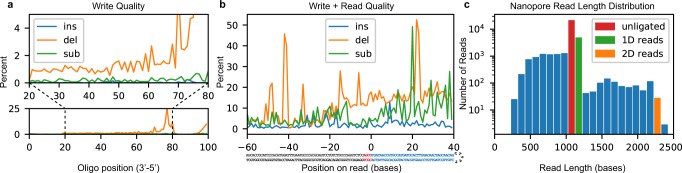
Verification
Claims the paper makes
The claims and statistics of this paper haven’t been checked yet.
Run the check — free, no account needed. It reads the open-access text and checks the sources it cites.
Claims other papers make about this one
Each is checked against this paper’s own text: does it say what the citing paper says it does?
The cited source says what the claim attributes to it.
In the citing paper
“Takahashi et al. (2018) developed a complete end-to-end DNA data storage device.”
From Large-Scale de Novo Oligonucleotide Synthesis for Whole-Genome Synthesis and Data Storage: Challenges and Opportunities (2021) · cites this paper as Takahashi et al., 2018
In the citing paper
“Both chemical and enzymatic syntheses are severely limited by the low speed of these processes.29,39”
From Emerging Approaches to DNA Data Storage: Challenges and Prospects (2022) · cites this paper as [39]
In the citing paper
“Therefore, it is still challenging to develop a DNA-based database of full integration, high efficiency, and practical applicability, even using an automatic fluidic system (30).”
From Electrochemical DNA synthesis and sequencing on a single electrode with scalability for integrated data storage (2021) · cites this paper as [30]
In the citing paper
“Last, the small dead volume of the SlipChip device can save the expensive reagents to make it more cost-effective to write and read a large volume of data compared with conventional systems (30).”
From Electrochemical DNA synthesis and sequencing on a single electrode with scalability for integrated data storage (2021) · cites this paper as [30]
In the citing paper
“Recent work on the automation of a synthesisto-sequencing process has shown, that an automated writeread-cycle is feasible”
From Integrating DNA Encapsulates and Digital Microfluidics for Automated Data Storage in DNA (2022) · cites this paper as [13]
Self-check
Percentages, sums and reported differences re-computed from the paper’s own numbers.
The self-check needs the paper’s full text.
Citations
Cites
Error Detecting and Error Correcting Codes
Hamming, R. W. (1950) · Bell System Technical Journal · doi:10.1002/j.1538-7305.1950.tb00463.x · Cited by 5,377
ERROR DETECTING AND ERROR CORRECTING CODES
Chauhan, N., Yadav, P., & Kumari, P. (2014) · Cited by 3,270
Light-Directed, Spatially Addressable Parallel Chemical Synthesis
Fodor, S. P. A., Read, J., Pirrung, M. C., Stryer, L., Lu, A. T., & Solas, D. W. (1991) · Science · doi:10.1126/science.1990438 · Cited by 2,697
The Oxford Nanopore MinION: delivery of nanopore sequencing to the genomics community
Jain, M., Olsen, H. E., Paten, B., & Akeson, M. (2016) · Genome Biology · doi:10.1186/s13059-016-1103-0 · Cited by 1,588
Next-Generation Digital Information Storage in DNA
Church, G. M., Gao, Y., & Kosuri, S. (2012) · Science · doi:10.1126/science.1226355 · Cited by 1,441
DNA Fountain enables a robust and efficient storage architecture
Erlich, Y., & Zielinski, D. (2017) · Science · doi:10.1126/science.aaj2038 · Cited by 898
Large-scale de novo DNA synthesis: technologies and applications
Kosuri, S., & Church, G. M. (2014) · Nature Methods · doi:10.1038/nmeth.2918 · Cited by 869
Random access in large-scale DNA data storage
Organick, L., Ang, S. D., Chen, Y.-J., Lopez, R., Yekhanin, S., Makarychev, K., Racz, M. Z., Kamath, G., Gopalan, P., Nguyen, B., et al. (2018) · Nature Biotechnology · doi:10.1038/nbt.4079 · Cited by 775
Self-citationPortable and Error-Free DNA-Based Data Storage
Yazdi, S. M. H. T., Gabrys, R., & Milenkovic, O. (2017) · Scientific Reports · doi:10.1038/s41598-017-05188-1 · Cited by 361
LeProust, E. M., Peck, B. J., Spirin, K., McCuen, H. B., Moore, B., Namsaraev, E., & Caruthers, M. H. (2010) · Nucleic Acids Research · doi:10.1093/nar/gkq163 · Cited by 326
Cited by
Sorted by citations
Items 101–137 of 137
Image Storage on Synthetic DNA Using Compressive Autoencoders and DNA-Adapted Entropy Coders
Pic, X., Antonio, E. G. S., Dimopoulou, M., & Antonini, M. (2023) · IEEE International Workshop on Multimedia Signal Processing (MMSP) · doi:10.1109/mmsp59012.2023.10337673 · Cited by 3
Zhang, S., Li, Y.-H., Zhang, R., Li, B., & Wang, Q. (2024) · Engineering · doi:10.1016/j.eng.2023.10.021 · Cited by 3
A Converse For the Capacity of the Shotgun Sequencing Channel with Erasures
Ali, M. I., Narayanan, H., & Krishnan, P. (2025) · IEEE Information Theory Workshop (ITW) · doi:10.1109/itw62417.2025.11240437 · Cited by 2
Leveraging nature to advance data storage: DNA as a storage medium
Abram, K. Z., & Udaondo, Z. (2023) · Microbial Biotechnology · doi:10.1111/1751-7915.14291 · Cited by 2
Low-Bias Amplification for Robust DNA Data ReadoutPreprint
Gao, Y., Chen, X., Hao, J., Zhang, C., Qiao, H., Ke, Y., & Qi, H. (2020) · bioRxiv (Cold Spring Harbor Laboratory) · doi:10.1101/2020.02.09.940411 · Cited by 2
The Research Assistant and AI in eScience
Gannon, D. B. (2019) · International Conference on e-Science · doi:10.1109/escience.2019.00059 · Cited by 2
DNA Data Storage Security: How to Detect a DNA Pool has been Copied
Gasnier, H., Coatrieux, G., Genot, A. J., Berton, C., & Bellafqira, R. (2025) · International Conference on Emerging Technologies and Computing (IC_ETC) · doi:10.1109/ic_etc65981.2025.11141190 · Cited by 1
DNA Helix Bundle‐Encoded Multi‐Bit Information Readout by Sapphire‐Supported Nanopores
Xia, P., Satyabola, D., Bamrah, N. K., Laskar, M. A. R., Mamun, A. A., Zhou, X., Wisna, G. B. M., Zhang, Y., Ikbal, A., Kemeklis, A., et al. (2025) · Advanced Functional Materials · doi:10.1002/adfm.202523998 · Cited by 3
Seo, S., Tandon, A., Uyen, N. K., Le, Q. N., Lee, J., & Park, S. H. (2025) · Advanced Intelligent Discovery · doi:10.1002/aidi.202500166 · Cited by 1
Deoxyribonucleic Acid (DNA): The Magician in the Field of the Digital Data Storage
Sun, L. (2019) · Research and Reviews on Healthcare Open Access Journal · doi:10.32474/rrhoaj.2019.03.000163 · Cited by 1
System Design Considerations for Automated Digital Data Storage in DNA
Takahashi, C. N. (2022) · Technical digest - International Electron Devices Meeting/Technical digest · doi:10.1109/iedm45625.2022.10019442 · Cited by 1
Dynamic DNA-based information storagePreprint
Lin, K. N., Keung, A. J., & Tuck, J. M. (2019) · bioRxiv (Cold Spring Harbor Laboratory) · doi:10.1101/836429 · Cited by 1
An Overview of DNA ‐Based Digital Data Storage
Song, X., Shah, S., & Reif, J. H. (2021) · Wiley eBooks · doi:10.1002/9783527825424.ch18 · Cited by 1
A super robust and efficient DNA storage architecture based on modulation encoding and decodingPreprint
Zan, X., Xie, R., Yao, X., Xu, P., & Liu, W. (2022) · Research Square · doi:10.21203/rs.3.rs-1691759/v1 · Cited by 1
A Scalable 3-D Printed Biological Assembly Technology
Chu, S., Brown, A., Culver, J. N., & Reza Ghodssi, A. (2019) · International Conference on Solid-State Sensors, Actuators and Microsystems · doi:10.1109/transducers.2019.8808405
Addressing Information Using Data Hiding for DNA-based Storage Systems
Ota, T., & Manada, A. (2020) · International Symposium on Information Theory and its Applications
Archiver les mégadonnées numériques à l’échelle moléculaire
Képès, F. (2021) · Reflets de la physique · doi:10.1051/refdp/202170032
Kawamata, I. (2022) · Wiley eBooks · doi:10.1002/9781119682561.ch4
Bargiotas, T. (2021) · Louisiana State University · doi:10.31390/gradschool_dissertations.5462
DNA computing-based Big Data storage
Sharma, D., & Ramteke, M. (2022) · Advances in computers · doi:10.1016/bs.adcom.2022.08.005
Design of DNA Storage Coding and Encoding System Based on Transformer
Kong, S. (2023) · Lecture notes on data engineering and communications technologies · doi:10.1007/978-3-031-31775-0_54
de Lima, E. G. (2023) · Research Square · doi:10.21203/rs.3.rs-3240050/v1
Muttaqin, M. R., Herdiyeni, Y., Buono, A., Priandana, K., & Siregar, I. Z. (2023) · International Journal of Advances in Intelligent Informatics · doi:10.26555/ijain.v9i3.1063 · Cited by 2
Demonstration of a Scalable DNA Computing Platform: Writing and Selection
Bhatia, S. P., Ramliden, M. S., Rao, V., Vezeau, G. E., Katz‐Christy, N., Tolkamp, S., O’Leary, M., Jayne, H., Rockwood, T., Pradeep, R. R. K., et al. (2025) · ACM Journal on Emerging Technologies in Computing Systems · doi:10.1145/3744562
Research Progress on Nucleic Acid Information Material
Song, L., Li, M., & Zuo, X. (2025) · 中国科学基金 · doi:10.3724/bnsfc-2025.02.19.0002
DNA Data Storage Architecture via Ligation of Dynamic DNA BytesPreprint
Jia, L., Shi, Y., Yang, J., Li, S., Yang, W., Li, W., Zhang, M., Li, Q., Zhang, Y., Wang, X., et al. (2025) · bioRxiv (Cold Spring Harbor Laboratory) · doi:10.1101/2025.09.15.676197
Randomized DNA Base Sequence Design by Using Degenerate Bases for DNA Data Storage
Seo, S., Tandon, A., Nguyen, T. B. N., Vu, T. H. N., Lee, K. W., & Park, S. H. (2025) · ACS Applied Bio Materials · doi:10.1021/acsabm.5c01680
Majority‐Voting Overlapping Method for Error Correction in DNA Data Storage
Nguyen, T. B. N., Seo, S., Tandon, A., Uyen, N. K., Vu, T. H. N., & Park, S. H. (2026) · Advanced Intelligent Discovery · doi:10.1002/aidi.202500209
Synthesis of new alkoxyamine spacers for the elaboration of encoded polymers
Launay, K. (2020) · theses.fr (ABES) · doi:10.70675/b32012b4zca6az4075z86f4zd547cd9d0ab8
Encoding techniques for long-term storage of digital images into synthetic DNA
Dimopoulou, M. (2020) · theses.fr (ABES) · doi:10.70675/d039c47cz06a8z4c12z9699zc8aefdd17f10 · Cited by 2
Intelligent storage on synthetic DNA for archiving digital images
Antonio, E. G. S. (2023) · theses.fr (ABES) · doi:10.70675/a5a9506ez5449z453az87d1zc49a18ec3fd5
DNA data storage algorithms and synchronization
Hamoum, B. (2022) · theses.fr (ABES) · doi:10.70675/7722069cz1034z4e64z8238z6126d6f7f792
Sécurité des données stockées sur molécules d’ADN
Berton, C. (2024) · theses.fr (ABES) · doi:10.70675/0f5289f1z1beaz4311z8029za15b04416483
Shield, Repair, Reconstruct: An Integrated Framework for Long-Term DNA Data Storage
Liu, L., Wu, J., Huang, Y., Wang, M., He, B., Song, L., & Sun, J. (2026) · Springer eBooks · doi:10.1007/978-981-95-9450-4_10
Tools Boost Data Operation at the Molecular Level
Li, J., Zhang, H., Gao, J., Cm, Z., Sun, F., & Qian, L. (2026) · Springer eBooks · doi:10.1007/978-981-95-9450-4_5
ProbeFS: Hierarchical DNA File Systems via Biochemical Content Addressability and Parallelism
Li, R., Zhang, Y., Dong, M., Hao, Y., Wang, F., Fan, C., & Chen, H. (2026) · ACM SIGOPS Symposium on Operating Systems Principles (SOSP) · doi:10.1145/3830418.3843890
Metadata
- Authors
- Takahashi, C. N., Nguyen, B. H., Strauss, K., & Ceze, L.
- Affiliations
- University of Washington (US)
- Microsoft (United States) (US)
- Corresponding author
- Takahashi, Christopher N.
- Venue
- Scientific Reports
- Published
- 2019-03-21
- Volume
- 9
- Issue
- 1
- Pages
- 4998-4998
- ISSN
- 2045-2322 (ISSN-L)
- PMC
- PMC6428863
- OpenAlex
- W2897609915
- Cited by
- 137
- References
- 17
- Citations by year
- 2026: 6 · 2025: 16 · 2024: 21 · 2023: 27 · 2022: 22 · 2021: 19 · 2020: 16 · 2019: 10
- FWCI
- 5.54
- Type
- journal article
- Language
- en
- Open access
- gold
- doi.org
- Locations
- Scientific Reports (publishedVersion, cc-by)
- bioRxiv (Cold Spring Harbor Laboratory) (acceptedVersion)
- Europe PMC (PubMed Central) (publishedVersion, cc-by)
- PubMed Central (publishedVersion, cc-by)
- PubMed (publishedVersion)
- DOAJ (DOAJ: Directory of Open Access Journals) (submittedVersion)
- Funders
- Microsoft Research
- United States Department of Defense | Defense Advanced Research Projects Agency (W911-NF-18-2-0034)
- Defense Sciences Office, DARPA (W911-NF-18-2-0034)
- Topics
- Physical Sciences › Mathematics › Theoretical Computer Science › DNA and Biological Computing
- Physical Sciences › Computer Science › Computer Networks and Communications › Advanced Data Storage Technologies
- Physical Sciences › Mathematics › Theoretical Computer Science › Algorithms and Data Compression
- Keywords
- DNA data storage, synthetic DNA, end-to-end automation, nanopore sequencing, data encoding
- MeSH terms
- Automation, DNA, Humans, Information Storage and Retrieval, Sequence Analysis, DNA, Computational Biology
About these checks
Registry, retraction, Cites and statistics results are computed, not judged, with one exception: a printed reference that no index lists is read once by a model before it counts as a citation error. Claims are extracted by a model and kept only when their quote appears verbatim in the text; each cited source is then checked, with a model’s help, for whether it says what the claim relies on. Those verdicts can be wrong — read the claim’s quote and the cited source before relying on one.
Statistics and arithmetic are recomputed, not judged.
Confidence bands are shown only for fields calibrated on our annotated test set. None is calibrated yet, so no band is shown.
What counts as a claim ›How we measure confidence ›How we check this ›
Are you an author, or do you see a problem with this page? Request a review
