

From Louvain to Leiden: guaranteeing well-connected communities
Open accessThe DOI matches its Crossref record; 30 of the 30 references it cites were found in a registry or an index; 1 of the 26 sources its claims cite were checked for support.
Abstract
Community detection is often used to understand the structure of large and complex networks. One of the most popular algorithms for uncovering community structure is the so-called Louvain algorithm. We show that this algorithm has a major defect that largely went unnoticed until now: the Louvain algorithm may yield arbitrarily badly connected communities. In the worst case, communities may even be disconnected, especially when running the algorithm iteratively. In our experimental analysis, we observe that up to 25% of the communities are badly connected and up to 16% are disconnected. To address this problem, we introduce the Leiden algorithm. We prove that the Leiden algorithm yields communities that are guaranteed to be connected. In addition, we prove that, when the Leiden algorithm is applied iteratively, it converges to a partition in which all subsets of all communities are locally optimally assigned. Furthermore, by relying on a fast local move approach, the Leiden algorithm runs faster than the Louvain algorithm. We demonstrate the performance of the Leiden algorithm for several benchmark and real-world networks. We find that the Leiden algorithm is faster than the Louvain algorithm and uncovers better partitions, in addition to providing explicit guarantees.
Overview
CoChat Summary
TL;DR
The Louvain algorithm can yield arbitrarily badly connected communities, including disconnected ones, especially when iterated. The Leiden algorithm guarantees connected communities and, under iteration, converges to subset-optimal partitions while running faster and finding higher-quality partitions.
Key findings
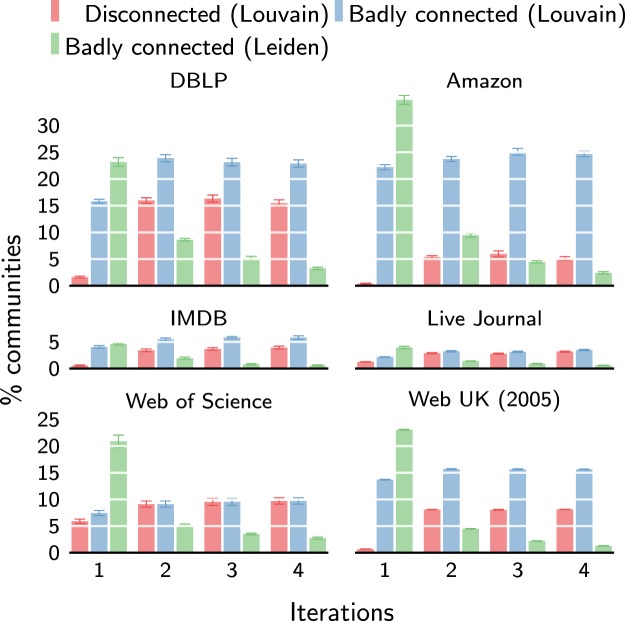
- Louvain may produce arbitrarily badly connected communities; in experiments up to 25% of communities were badly connected and up to 16% were disconnected. First-iteration badly connected percentages included Amazon 23%, DBLP 16%, and Web UK 14%; disconnected communities were usually around 1%, but exceeded 5% for Web of Science in the first iteration and jumped to 16% for DBLP in later iterations. After four iterations, Amazon had 5% disconnected but 25% badly connected communities.
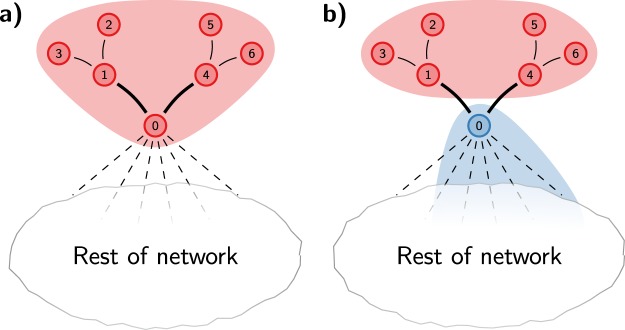
- Leiden guarantees all communities are connected after each iteration, and also γ-separated and γ-connected. After a stable iteration, all nodes are locally optimally assigned and all communities are subpartition γ-dense; asymptotically, all communities are uniformly γ-dense and subset optimal.
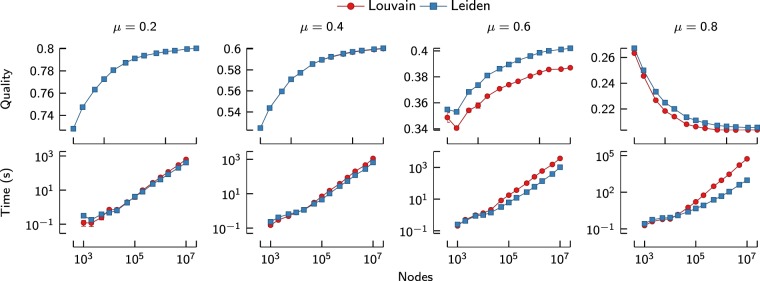
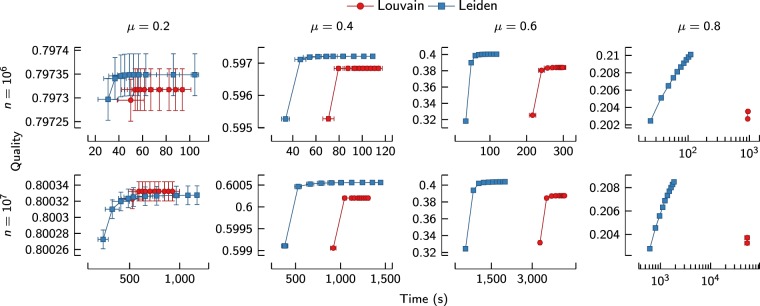
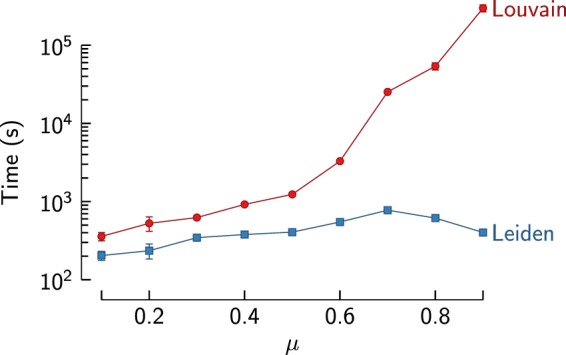
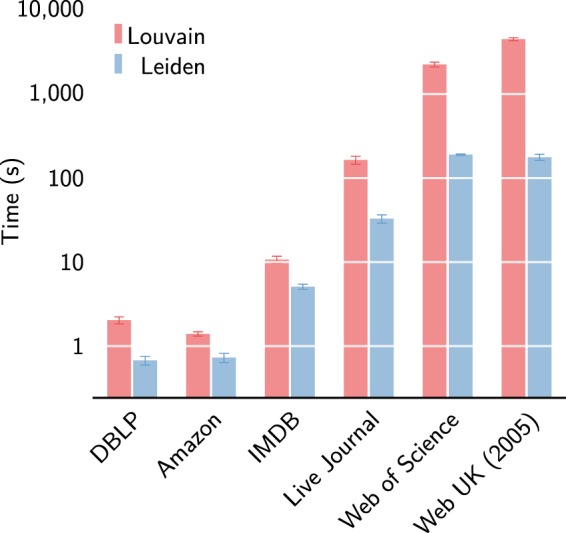
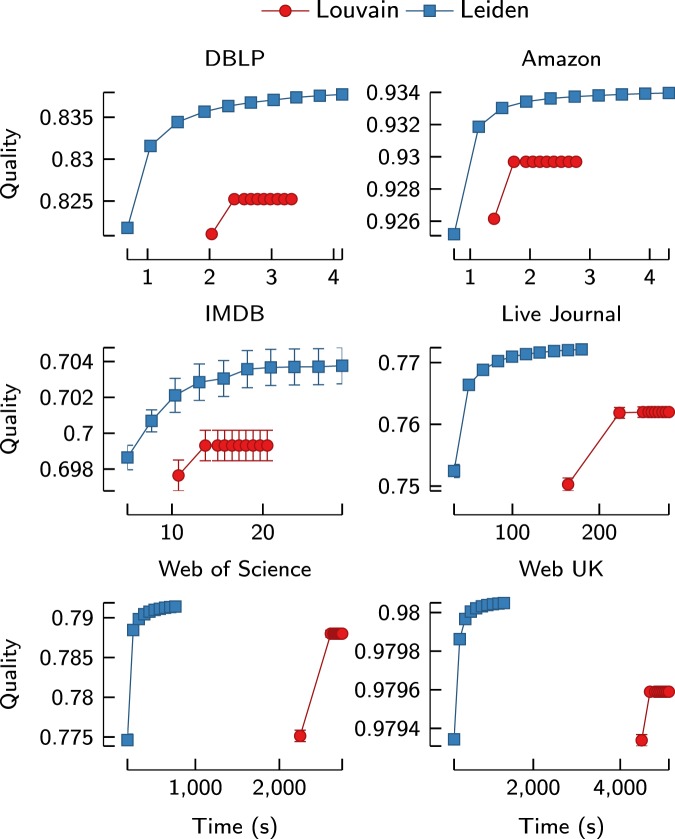
- Leiden was faster than Louvain: first iteration roughly 2–20 times faster on empirical networks, including more than 7× faster for Live Journal, more than 11× for Web of Science, and more than 20× for Web UK. On benchmark networks with difficult partitions (μ = 0.9), Louvain required almost 2.5 days while Leiden needed fewer than 10 minutes; for largest networks Leiden reached 10–100 times faster runtimes.
- Leiden found higher modularity on all six empirical networks: DBLP 0.8387 vs 0.8262, Amazon 0.9341 vs 0.9301, IMDB 0.7069 vs 0.7062, Live Journal 0.7739 vs 0.7653, Web of Science 0.7951 vs 0.7911, and Web UK 0.9801 vs 0.9796.
Methods
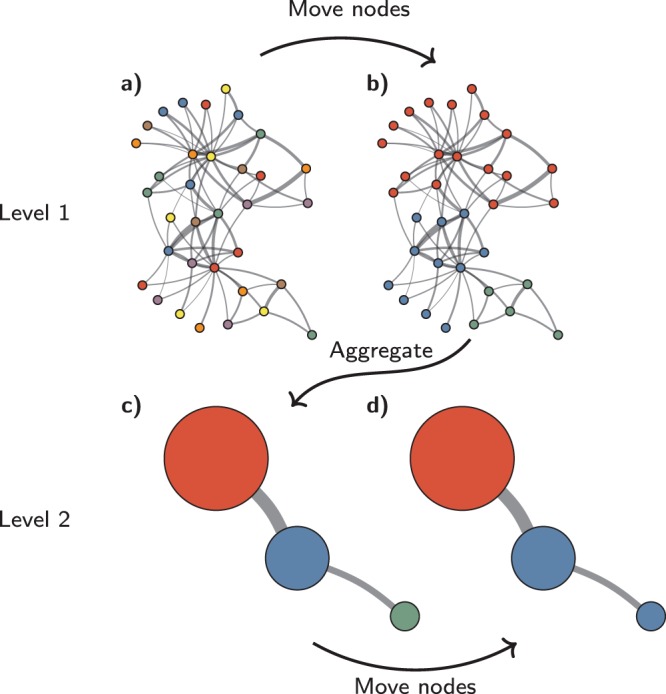
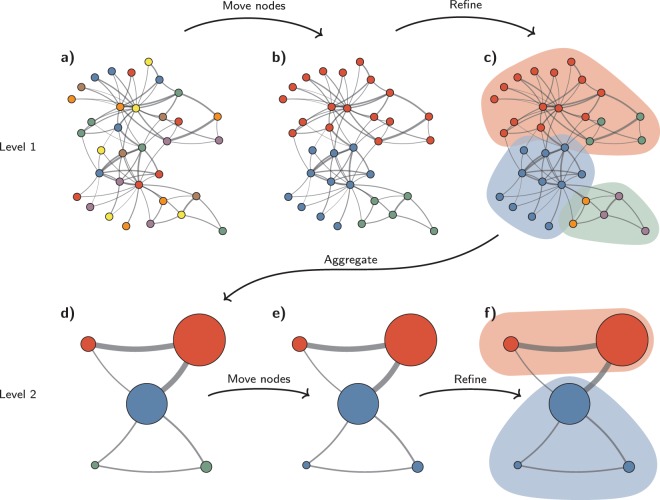
- The paper introduces the Leiden algorithm, which combines local moving, refinement of the partition, and aggregation; proofs of guarantees are relegated to Supplementary Information. It compares Leiden with Louvain on six empirical networks and on benchmark networks.
- Empirical networks: DBLP (317,080 nodes, degree 6.6), Amazon (334,863, 5.6), IMDB (374,511, 80.2), Live Journal (3,997,962, 17.4), Web of Science (9,811,130, 21.2), and Web UK (39,252,879, 39.8). Modularity was used with γ = 1; Table 2 reports maximal modularity after 10 replications of 10 iterations each. Badly connected community analysis was repeated 10 times, with Leiden run on each community’s subnetwork until a stable iteration.
- Benchmark networks ranged from n = 10^3 to n = 10^7 nodes, with community size 50 and CPM as the quality function; the mixing parameter μ varied, 10 iterations were performed, and each parameter set was repeated 10 times. The refinement randomness parameter was θ = 0.01.
Limitations
- The paper states that benchmark networks have only limited value because they are not representative of empirical real-world networks and have a rather simple structure.
- The paper states that counting communities split by Leiden gives only a lower bound on the number of badly connected communities; if Leiden does not find subcommunities, there is no guarantee that modularity cannot be increased by splitting the community.
- Evident from the text: there is no dedicated limitations section; technical details and proofs are relegated to Supplementary Information, and the experimental analysis fixes θ = 0.01 although values roughly in [0.0005, 0.1] are said to provide reasonable results.
Model-written summary. Check it against the paper before relying on it.
Integrity signals
Registry
Cites
Statistics
Figures
Verification
Claims the paper makes
1 Valid · 2 Not valid · 17 Not checked · 142 Own results and interpretations
The cited sources support only part of this claim — read each source’s verdict below.
In the paper
“Hence, the problem of Louvain outlined above is independent from the issue of the resolution limit.”
§ From Louvain to Leiden: guaranteeing well-connected communities > Louvain Algorithm > Badly connected communities
What the sources say
- Partly supportedcites [14] Fortunato S Barthélemy M Resolution Limit in Community Detection Proc. Natl. Acad. Sci. USA 2007 104 36 10.1073/pnas.0605965104 17190818 PMC1765466 sourceExperimental — accuracy not yet measured
Our copy supports the resolution-limit side of the sentence: the Conclusions (VI, p. 7) state that 'the resolution limit of modularity does not rely on particular network structures, but only on the comparison between the sizes of interconnected communities and that of the whole network', the Introduction (p. 1) calls it an 'intrinsic scale' of modularity, and Section V (pp. 5-6) shows the failure persists with simulated annealing, i.e. it is a property of the quality function rather than of one particular optimizer. What the source does not contain is the other term of the comparison: Louvain is never mentioned anywhere in the paper (the Introduction, p. 1, lists only generic greedy procedures [19,20], extremal optimization [21] and simulated annealing [22,23]), and no passage contrasts the resolution limit with an algorithm-specific defect. The independence claim is therefore the citing authors' own inference built on this paper's characterization of the resolution limit. (LLM, conf=0.70)
plain- Asserted: passes — The authors put it forward as true.
- Checkable: passes — It can be checked against evidence.
- Load-bearing: passes — The paper’s conclusions depend on it.
- Based: passes — The paper gives a reason why it holds.
- Partly supported
A result the paper states — it cites no source for it, so there is none to check. The quote shows it is in the paper.
In the paper
“The percentage of badly connected communities is less affected by the number of iterations of the Louvain algorithm.”
§ From Louvain to Leiden: guaranteeing well-connected communities > Experimental Analysis > Badly connected communities
plain- Asserted: passes — The authors put it forward as true.
- Checkable: passes — It can be checked against evidence.
- Load-bearing: unclear — It is unclear whether the paper’s conclusions depend on it.
- Based: passes — The paper gives a reason why it holds.
A result the paper states — it cites no source for it, so there is none to check. The quote shows it is in the paper.
In the paper
“In addition, we prove that, when the Leiden algorithm is applied iteratively, it converges to a partition in which all subsets of all communities are locally optimally assigned.”
- Also stated in: § Introduction · boosted
“In addition, we prove that the algorithm converges to an asymptotically stable partition in which all subsets of all communities are locally optimally assigned.”
§ From Louvain to Leiden: guaranteeing well-connected communities > Abstract
boostedstates a cause- Asserted: passes — The authors put it forward as true.
- Checkable: passes — It can be checked against evidence.
- Load-bearing: passes — The paper’s conclusions depend on it.
- Based: passes — The paper gives a reason why it holds.
- Also stated in: § Introduction · boosted
A result the paper reports from its own data — it cites no other source for it, so there is none to check. The quote shows it is in the paper.
In the paper
“The second iteration of Louvain shows a large increase in the percentage of disconnected communities.”
§ From Louvain to Leiden: guaranteeing well-connected communities > Experimental Analysis > Badly connected communities
plainstates a cause- Asserted: passes — The authors put it forward as true.
- Checkable: passes — It can be checked against evidence.
- Load-bearing: passes — The paper’s conclusions depend on it.
- Based: passes — The paper gives a reason why it holds.
A result the paper reports from its own data — it cites no other source for it, so there is none to check. The quote shows it is in the paper.
In the paper
“In terms of the percentage of badly connected communities in the first iteration, Leiden performs even worse than Louvain, as can be seen in Fig. 4.”
§ From Louvain to Leiden: guaranteeing well-connected communities > Experimental Analysis > Badly connected communities
plain- Asserted: passes — The authors put it forward as true.
- Checkable: passes — It can be checked against evidence.
- Load-bearing: unclear — It is unclear whether the paper’s conclusions depend on it.
- Based: passes — The paper gives a reason why it holds.
115 more claims
Create a free account to see all 162 claims and to verify the 24 references still open.
- Probably not a substantial claim. 23
- It may state two separate claims as one. 23
- The quote only partly states this claim. 1
Claims other papers make about this one
Each is checked against this paper’s own text: does it say what the citing paper says it does?
The cited source says what the claim attributes to it.
In the citing paper
“When compared to six common clustering algorithms, including Leiden25 and CellHarmony26, VFC was the top performing algorithm on every simulation on the T cell data and best performing, on average, on the zebrafish dataset, with a 57% increase in average performance over Louvain, which was the next best algorithm”
From Quantifying the effect of experimental perturbations at single-cell resolution (2021) · cites this paper as [25]
The cited source says what the claim attributes to it.
In the citing paper
“Louvain’s successor Leiden circumvents this issue by yielding guaranteed connected communities and is computationally more efficient52.”
From Best practices for single-cell analysis across modalities (2023) · cites this paper as [52]
The cited source says what the claim attributes to it.
In the citing paper
“However, the Louvain algorithm can lead to arbitrarily poorly connected communities52.”
From Best practices for single-cell analysis across modalities (2023) · cites this paper as [52]
The cited source says what the claim attributes to it.
In the citing paper
“We found that many t-types had total variance substantially above the variances of the k-means clusters (Fig. 5b) and an alternative analysis using entropies of Leiden clustering35 often highlighted the same t-types as variable (Extended Data Fig. 8).”
From Phenotypic variation of transcriptomic cell types in mouse motor cortex (2021) · cites this paper as [35]
The cited source says what the claim attributes to it.
In the citing paper
“Community detection uses the Leiden algorithm [28] with ModularityVertexPartition, producing hierarchical subclustering to depth 3.”
From SuperLocalMemory: Privacy-Preserving Multi-Agent Memory with Bayesian Trust Defense Against Memory Poisoning (2026) · cites this paper as [28]
6 more claims about this paper
Create a free account to see every claim other papers make about this one.
Citations
Cites
Fast unfolding of communities in large networks
Blondel, V. D., Guillaume, J.-L., Lambiotte, R., & Lefebvre, E. (2008) · Journal of Statistical Mechanics: Theory and Experiment · doi:10.1088/1742-5468/2008/10/p10008 · Cited by 21,424 · cited 3×
“The Louvain algorithm 10 is very simple and elegant.”
MethodFinding and evaluating community structure in networks
Newman, M. E. J., & Girvan, M. (2004) · Physical Review E · doi:10.1103/physreve.69.026113 · Cited by 13,931 · cited 2×
“The Leiden algorithm consists of three phases: (1) local moving of nodes, (2) refinement of the partition and (3) aggregation of the network based on the refined partition, using the non-refined partition to create an initial partition for the aggregate network.”
BackgroundMethodComplex brain networks: graph theoretical analysis of structural and functional systems
Bullmore, E., & Sporns, O. (2009) · Nature Reviews Neuroscience · doi:10.1038/nrn2575 · Cited by 11,820
Fortunato, S. (2010) · Physics Reports · doi:10.1016/j.physrep.2009.11.002 · Cited by 11,293 · cited 4×
“The Leiden algorithm consists of three phases: (1) local moving of nodes, (2) refinement of the partition and (3) aggregation of the network based on the refined partition, using the non-refined partition to create an initial partition for the aggregate network.”
BackgroundMethodInfluentialFinding community structure in very large networks
Clauset, A., Newman, M. E. J., & Moore, C. (2004) · Physical Review E · doi:10.1103/physreve.70.066111 · Cited by 7,390 · cited 1×
“Optimising modularity is NP-hard 5 , and consequentially many heuristic algorithms have been proposed, such as hierarchical agglomeration 6 , extremal optimisation 7 , simulated annealing 4,8 and spectral 9 algorithms.”
MethodFinding community structure in networks using the eigenvectors of matrices
Newman, M. E. J. (2006) · Physical Review E · doi:10.1103/physreve.74.036104 · Cited by 4,761
Functional cartography of complex metabolic networks
Guimerà, R., & Nunes Amaral, L. A. (2005) · Nature · doi:10.1038/nature03288 · Cited by 3,983 · cited 2×
“Optimising modularity is NP-hard 5 , and consequentially many heuristic algorithms have been proposed, such as hierarchical agglomeration 6 , extremal optimisation 7 , simulated annealing 4,8 and spectral 9 algorithms.”
MethodNear linear time algorithm to detect community structures in large-scale networks
Raghavan, U. N., Albert, R., & Kumara, S. (2007) · Physical Review E · doi:10.1103/physreve.76.036106 · Cited by 3,502 · cited 2×
“Trying to fix the problem by simply considering the connected components of communities 19–21 is unsatisfactory because it addresses only the most extreme case and does not resolve the more fundamental problem.”
BackgroundBenchmark graphs for testing community detection algorithms
Lancichinetti, A., Fortunato, S., & Radicchi, F. (2008) · Physical Review E · doi:10.1103/physreve.78.046110 · Cited by 3,051 · cited 1×
“To study the scaling of the Louvain and the Leiden algorithm, we rely on a variant of a well-known approach for constructing benchmark networks 28 .”
MethodResolution limit in community detection
Fortunato, S., & Barthélemy, M. (2007) · Proceedings of the National Academy of Sciences · doi:10.1073/pnas.0605965104 · Cited by 3,024 · cited 2×
“The algorithm may yield arbitrarily badly connected communities, over and above the well-known issue of the resolution limit 14 .”
Background
Research works printed but not linked: 2
- Porter MA Onnela J-P Mucha PJ Communities in Networks Not. AMS 2009 56 1082 1097
- Luecken, M. D. Application of multi-resolution partitioning of interaction networks to the study of complex disease. Ph.D. thesis, (University of Oxford, 2016).
Cited by
Items 901–1,000 of 7,288
Community Detection with the Map Equation and Infomap: Theory and Applications
Smiljanić, J., Blöcker, C., Holmgren, A., Edler, D., Neuman, M., & Rosvall, M. (2026) · ACM Computing Surveys · doi:10.1145/3779648 · Cited by 36
“The Infomap search algorithm is inspired by the Louvain algorithm for modularity maximization [10] but uses additional fine-tuning and coarse-tuning steps, similar to how the Leiden algorithm later refined Louvain [82].”
Revealing the recent demographic history of Europe via haplotype sharing in the UK Biobank
Gilbert, E. H., Shanmugam, A., & Cavalleri, G. L. (2022) · Proceedings of the National Academy of Sciences · doi:10.1073/pnas.2119281119 · Cited by 36
Wang, L., Maletić‐Savatić, M., & Liu, Z. (2022) · Nature Communications · doi:10.1038/s41467-022-34567-0 · Cited by 36
Truc, A. (2021) · Journal of Economic Methodology · doi:10.1080/1350178x.2021.2011374 · Cited by 36
“We then proceeded to use the Leiden modularity-based algorithm (Traag et al., 2019) to assign nodes to different communities.”
Qin, J., Zhang, J., Jiang, J., Zhang, B., Li, J., Lin, X., Wang, S., Zhu, M., Fan, Z., Lv, Y., et al. (2022) · Cell stem cell · doi:10.1016/j.stem.2022.07.004 · Cited by 36
Arroyo‐Machado, W., Torres‐Salinas, D., & Robinson‐García, N. (2021) · Scientometrics · doi:10.1007/s11192-021-04167-8 · Cited by 36
“Both social and semantic networks were tested with the Leiden algorithm (Traag et al., 2019) in Gephi and igraph.”
MethodCross-species multiomic atlas of the primate basal ganglia
Johansen, N., Fu, Y., Schmitz, M. T., Dubuc, A., Kempynck, N., Wirthlin, M. E., Garcia, A. D., Hewitt, M. N., Turner, M. A., Seeman, S. C., et al. (2026) · Cell · doi:10.64898/2025.12.15.694496 · Cited by 36
Extracting complements and substitutes from sales data: a network perspective
Tian, Y., Lautz, S., Wallis, A. O. G., & Lambiotte, R. (2021) · EPJ Data Science · doi:10.1140/epjds/s13688-021-00297-4 · Cited by 36
Conserved brain-wide emergence of emotional response from sensory experience in humans and mice
Kauvar, I., Richman, E. B., Liu, T. X., Li, C., Vesuna, S. S., Chibukhchyan, A., Yamada, L., Fogarty, A. S., Solomon, E. A., Choi, E. Y., et al. (2025) · Science · doi:10.1126/science.adt3971 · Cited by 36
Lee, D., Koutrouli, M., Masse, N. Y., Hoffman, G. E., Kinrot, S., Wang, X., Prashant, N. M., Pjanic, M., Clarence, T., Tsetsos, F., et al. (2025) · Alzheimer s & Dementia · doi:10.1002/alz70855_097915 · Cited by 36
A complex network approach to political analysis: Application to the Brazilian Chamber of Deputies
Brito, A. C. M., Silva, F. N., & Amancio, D. R. (2020) · PLoS ONE · doi:10.1371/journal.pone.0229928 · Cited by 36
Flow stability for dynamic community detection
Bovet, A., Delvenne, J., & Lambiotte, R. (2022) · Science Advances · doi:10.1126/sciadv.abj3063 · Cited by 36
Littman, R., Cheng, M., Wang, N., Peng, C., & Yang, X. (2023) · iScience · doi:10.1016/j.isci.2023.107124 · Cited by 35
“Using the Leiden clustering algo-rithm, 40 we partitioned the SCING microglia GRN into 21 network modules.”
MethodABCA7 variants impact phosphatidylcholine and mitochondria in neurons
von Maydell, D., Wright, S. E., Pao, P.-C., Staab, C., King, O., Spitaleri, A., Bonner, J. M., Liu, L., Yu, C. J., Chiu, C.-C., et al. (2025) · Nature · doi:10.1038/s41586-025-09520-y · Cited by 35
Nelde, A., Schuster, H., Heitmann, J. S., Bauer, J., Maringer, Y., Zwick, M., Volkmer, J.-P., Chen, J. Y., Stanger, A. M. P., Lehmann, A., et al. (2023) · Blood Cancer Discovery · doi:10.1158/2643-3230.bcd-23-0020 · Cited by 35
Soucy, J. R., Todd, L. J., Kriukov, E., Phay, M., Malechka, V. V., Rivera, J. D., Reh, T. A., & Baranov, P. Y. (2023) · Proceedings of the National Academy of Sciences · doi:10.1073/pnas.2302089120 · Cited by 35
Arokiaraj, C. M., Leone, M. J., Kleyman, M., Chamessian, A. G., Noh, M., Phan, B. N., Lopes, B. C., Corrigan, K. A., Cherupally, V. K., Yeramosu, D., et al. (2024) · Cell Reports · doi:10.1016/j.celrep.2024.114876 · Cited by 35
Johnson, K. E., Howard, G. R., Morgan, D., Brenner, E. A., Gardner, A. L., Durrett, R., Mo, W., Al’Khafaji, A. M., Sontag, E. D., Jarrett, A. M., et al. (2020) · Physical Biology · doi:10.1088/1478-3975/abb09c · Cited by 35
“In brief, three steps were performed: (a) preliminary clustering of cells by constructing a nearest network graph and using scanpy’s implementation of Leiden community detection [50], (b) calculating size factors using the R package scran [51], and (c) dividing counts by the respective size factor assigned to each cel…”
MethodYang, H., Wei, S., Zhou, H., Hu, F., Chen, Y., & Hu, H. (2025) · Systems · doi:10.3390/systems13050361 · Cited by 35
Cristiani, J., Rubidge, E. M., Forbes, C., Moore-Maley, B., & O’Connor, M. I. (2021) · Frontiers in Marine Science · doi:10.3389/fmars.2021.717469 · Cited by 35
Kayvanjoo, A. H., Šplíchalová, I., Bejarano, D. A., Huang, H., Mauel, K., Makdissi, N., Heider, D., Tew, H. M., Balzer, N. R., Greto, E., et al. (2024) · eLife · doi:10.7554/elife.86493 · Cited by 35
“After the filtration, cells were processed further and clustered using the Leiden algorithm ( Traag et al., 2019 ).”
Stem cell-derived vessels-on-chip for cardiovascular disease modeling
Marder, M., Remmert, C., Perschel, J. A., Otgonbayar, M., von Toerne, C., Hauck, S. M., Bushe, J., Feuchtinger, A., Sheikh, B. N., Moussus, M., et al. (2024) · Cell Reports · doi:10.1016/j.celrep.2024.114008 · Cited by 35
PITX2 deficiency leads to atrial mitochondrial dysfunction
Reyat, J. S., Sommerfeld, L. C., O’Reilly, M., Cardoso, V. R., Thiemann, E., Khan, A. O., O’Shea, C., Harder, S., Müller, C., Barlow, J. P., et al. (2024) · Cardiovascular Research · doi:10.1093/cvr/cvae169 · Cited by 35
Jarosch, S., Köhlen, J., Sarker, R. S. J., Steiger, K., Janssen, K., Christians, A., Hennig, C., Holler, E., D’Ippolito, E., & Busch, D. H. (2021) · Cell Reports Methods · doi:10.1016/j.crmeth.2021.100104 · Cited by 35
“Without correction of spatial spillover, Leiden clustering (Traag et al., 2019) of the neighborhood graph revealed a total of 10 clusters, with some faint clusters mainly obscured by and overlapping with other clusters (e.”
BackgroundBeard, D. C., Zhang, X., Wu, D. Y., Martin, J. R., Erickson, A., Boua, J.-V. K., Hamagami, N., Swift, R. G., McCullough, K. B., Ge, X., et al. (2023) · Cell Reports · doi:10.1016/j.celrep.2023.113411 · Cited by 35
Cell cycle duration determines oncogenic transformation capacity
Chen, D., Lü, S., Huang, K., Pearson, J. D., Pacal, M., Peidis, P., McCurdy, S. R., Yu, T., Sangwan, M., Nguyen, A., et al. (2025) · Nature · doi:10.1038/s41586-025-08935-x · Cited by 35
Global Container Port Network Linkages and Topology in 2021
Kang, L., Wu, W., Yu, H., & Su, F. (2022) · Sensors · doi:10.3390/s22155889 · Cited by 35
“Community detection: The Leiden algorithm package for Python [33] was used for the shipping community detection.”
MethodNeutrophil Conversion to a Tumor-Killing Phenotype Underpins Effective Microbial Therapy
Yam, A. O. W., Bailey, J., Lin, F., Jakovija, A., Youlten, S. E., Counoupas, C., Gunzer, M., Bald, T., Woodruff, T. M., Triccas, J. A., et al. (2023) · Cancer Research · doi:10.1158/0008-5472.can-21-4025 · Cited by 35
Measuring Societal Impact Is as Complex as ABC
Noyons, E. (2019) · Journal of Data and Information Science · doi:10.2478/jdis-2019-0012 · Cited by 35
van Ineveld, R. L., Kleinnijenhuis, M., Alieva, M., de Blank, S., Román, M. B., van Vliet, E. J., Mir, C. M., Johnson, H. R., Bos, F. L., Heukers, R., et al. (2021) · Nature Biotechnology · doi:10.1038/s41587-021-00926-3 · Cited by 35
A comparison of large-scale science models based on textual, direct citation and hybrid relatedness
Boyack, K. W., & Klavans, R. (2020) · Quantitative Science Studies · doi:10.1162/qss_a_00085 · Cited by 35
Attention-based deep clustering method for scRNA-seq cell type identification
Li, S., Guo, H., Zhang, S., Li, Y., & Li, M. (2023) · PLoS Computational Biology · doi:10.1371/journal.pcbi.1011641 · Cited by 35
“We selected several state-of-art scRNA-seq clustering methods as baseline methods, including DESC [18], Leiden (scanpy) [4, 15], SC3 [13], scGNN [10], scGAC [11], graph-sc [21], scDeepCluster [9], scvi-tools [20], and SCEA [24].”
MethodMcFaline‐Figueroa, J. L., Srivatsan, S. R., Hill, A. J., Gasperini, M. J., Jackson, D. L., Saunders, L. M., Domcke, S., Regalado, S. G., Lazarchuck, P., Alvarez, S., et al. (2024) · Cell Genomics · doi:10.1016/j.xgen.2023.100487 · Cited by 35
Community Awareness Personalized Federated Learning for Defect Detection
Zhao, H., Liu, Q., Sun, H., Xu, L., Zhang, W., Zhao, Y., & Wang, F. (2024) · IEEE Transactions on Computational Social Systems · doi:10.1109/tcss.2024.3405556 · Cited by 35
Sun, Y., Kong, L., Huang, J., Deng, H., Bian, X., Li, X., Cui, F., Dou, L., Cao, C., Zou, Q., et al. (2024) · Briefings in Functional Genomics · doi:10.1093/bfgp/elae023 · Cited by 35
Fleischman, T., Dini, P., & Littera, G. (2020) · Journal of risk and financial management · doi:10.3390/jrfm13120295 · Cited by 35
Metabolomics and metabolites in cancer diagnosis and treatment
Cai, M., Liu, H., Shao, C., Li, T., Jin, J., Liang, Y., Wang, J., Cao, J., Yang, B. K., He, Q., et al. (2025) · Molecular Biomedicine · doi:10.1186/s43556-025-00362-8 · Cited by 34
“The Leiden algorithm can achieve stable and high-resolution community detection in the similarity network, and often cooperate with UMAP to define sample subgroups in the low-dimensional space [142].”
Smeekens, J. M., Johnson‐Weaver, B. T., Hinton, A. L., Azcárate-Peril, M. A., Moran, T. P., Immormino, R. M., Kesselring, J., Steinbach, E. C., Orgel, K., Staats, H. F., et al. (2021) · Frontiers in Immunology · doi:10.3389/fimmu.2020.599637 · Cited by 34
Mair, D., Witz, G., do Prado, A. H., Garefalakis, P., & Schlunegger, F. (2023) · Earth Surface Processes and Landforms · doi:10.1002/esp.5755 · Cited by 34
“We employed a resolution of 0.8 for higher-dimension clustering (Traag, Waltman, & van Eck, 2019) and a t-distributed stochastic neighbour embedding (t-SNE) with dimensionality reduction for visualization (Poli ˇ car, Stra ˇ zar, & Zupan, 2019; Van der Maaten & Hinton, 2008).”
MethodInfluentialScarf enables a highly memory-efficient analysis of large-scale single-cell genomics data
Dhapola, P., Rodhe, J., Olofzon, R., Bonald, T., Erlandsson, E., Soneji, S., & Karlsson, G. (2022) · Nature Communications · doi:10.1038/s41467-022-32097-3 · Cited by 34
Mutant Phosphodiesterase 3A Protects From Hypertension-Induced Cardiac Damage
Ercu, M., Mücke, M. B., Pallien, T., Markó, L., Sholokh, A., Schächterle, C., Aydın, A., Kidd, A., Walter, S., Esmati, Y., et al. (2022) · Circulation · doi:10.1161/circulationaha.122.060210 · Cited by 34
Li, K., Ouyang, Z., Chen, Y., Gagnon, J., Lin, D., Mingueneau, M., Chen, W., Sexton, D., & Zhang, B. (2020) · Research Square · doi:10.1101/2020.08.28.270652 · Cited by 34
Wang, Y., Liu, Z., & Ma, X. (2024) · Genome biology · doi:10.1186/s13059-024-03272-0 · Cited by 34
“The Leiden algorithm [11] is deployed on the affinity graph to obtain spatial domains.”
MethodPrummel, K. D., Woods, K., Kholmatov, M. M., Schmitt, E. C., Vlachou, E. P., Labyadh, M., Wehner, R., Poschmann, G., Stühler, K., Winter, S., et al. (2025) · Nature Communications · doi:10.1038/s41467-025-65803-y · Cited by 34
Economic methodology: a bibliometric perspective
Truc, A., Claveau, F., & Santerre, O. (2021) · Journal of Economic Methodology · doi:10.1080/1350178x.2020.1868774 · Cited by 34
“We detect clusters of nodes in our co-citation networks by applying the Leiden detection algorithm (Traag et al., 2019), which is a recent refinement of the well-known Louvain algorithm (Blondel et al., 2008).”
MethodSjögårde, P., & Ahlgren, P. (2019) · Quantitative Science Studies · doi:10.1162/qss_a_00004 · Cited by 34
Linna-Kuosmanen, S., Schmauch, E., Galani, K., Ojanen, J., Boix, C. A., Örd, T., Toropainen, A., Singha, P., Moreau, P. R., Harju, K., et al. (2024) · Cell Reports Medicine · doi:10.1016/j.xcrm.2024.101556 · Cited by 34
A detailed open access model of the PubMed literature
Boyack, K. W., Smith, C., & Klavans, R. (2020) · Scientific Data · doi:10.1038/s41597-020-00749-y · Cited by 34
Leary, J. R., Xu, Y., Morrison, A. B., Jin, C., Shen, E. C., Kuhlers, P. C., Su, Y., Rashid, N. U., Yeh, J. J., & Peng, X. L. (2023) · Bioinformatics · doi:10.1093/bioinformatics/btad449 · Cited by 34
“…representative basic algorithms (k-means, hierarchical, and DBSCAN), and Leiden clustering, which is generally comparable to Louvain clustering (Ward 1963, Hartigan and Wong 1979, Ester et al. 1996, Blondel et al. 2008, Traag et al. 2019, Wegmann et al. 2019, Dong and Yuan 2020, Hao et al. 2021).”
MethodAdvancing skeletal health and disease research with single-cell RNA sequencing
Lin, P., Gan, Y., He, J., Lin, S., Xu, J., Chang, L., Zhao, L., Zhu, J. J., Zhang, L., Huang, S., et al. (2024) · Military Medical Research · doi:10.1186/s40779-024-00538-3 · Cited by 34
Wavefront-Based Multiple Rumor Sources Identification by Multi-Task Learning
Dong, M., Zheng, B., Li, G., Li, C., Zheng, K., & Zhou, X. (2022) · IEEE Transactions on Emerging Topics in Computational Intelligence · doi:10.1109/tetci.2022.3142627 · Cited by 34
Multimodal human thymic profiling reveals trajectories and cellular milieu for T agonist selection
Heimli, M., Flåm, S. T., Hjorthaug, H. S., Trinh, D., Frisk, M., Dumont, K.-A., Ribarska, T., Tekpli, X., Saare, M., & Lie, B. A. (2023) · Frontiers in Immunology · doi:10.3389/fimmu.2022.1092028 · Cited by 34
Graph deep learning enabled spatial domains identification for spatial transcriptomics
Liu, T., Fang, Z., Li, X., Zhang, L., Cao, D., & Yin, M. (2023) · Briefings in Bioinformatics · doi:10.1093/bib/bbad146 · Cited by 34
van der Geest, A. T., Jakobs, C. E., Ljubikj, T., Huffels, C. F. M., Luna, M. C., de Sá, R. V., Adolfs, Y., de Wit, M., Rutten, D. H., Kaal, M., et al. (2024) · Acta Neuropathologica Communications · doi:10.1186/s40478-024-01857-1 · Cited by 34
A genomic atlas of the human gut virome elucidates genetic factors shaping host interactionsPreprint
Camargo, A. P., Baltoumas, F. A., Ndela, É. O., Fiamenghi, M. B., Merrill, B. D., Carter, M. M., Pinto, Y., Chakraborty, M., Andreeva, A. E., Ghiotto, G., et al. (2025) · bioRxiv (Cold Spring Harbor Laboratory) · doi:10.1101/2025.11.01.686033 · Cited by 34
Euclidean Mirrors and Dynamics in Network Time Series
Athreya, A., Lubberts, Z., Park, Y., & Priebe, C. E. (2025) · Journal of the American Statistical Association · doi:10.1080/01621459.2024.2392912 · Cited by 34
The secreted neuronal signal Spock1 promotes blood-brain barrier development
O’Brown, N. M., Patel, N. B., Hartmann, U., Klein, A. M., Gu, C., & Megason, S. G. (2023) · Developmental Cell · doi:10.1016/j.devcel.2023.06.005 · Cited by 33
“85 The neighborhood graph was embedded and visualized using UMAP and the data was explored interactively with SPRING 76 to aid in cell cluster annotation.”
Lin, Y.-H., Wei, Y., Zeng, Q., Wang, Y., Pagani, C. A., Li, L., Zhu, M., Wang, Z., Hsieh, M.-H., Corbitt, N., et al. (2023) · Cell Stem Cell · doi:10.1016/j.stem.2023.04.007 · Cited by 33
A Single-Cell Transcriptomic Analysis of the Mouse Hippocampus After Voluntary Exercise
Methi, A., Islam, M. R., Kaurani, L., Sakib, M. S., Krüger, D. M., Pena, T., Burkhardt, S., Liebetanz, D., & Fischer, A. (2024) · Molecular Neurobiology · doi:10.1007/s12035-023-03869-9 · Cited by 33
“Leiden clustering [48] was performed using the FindNeighbors() and FindClusters() functions in Seurat with 50 principal components and a resolution parameter of 0.2.”
InfluentialZinchenko, V., Hugger, J., Uhlmann, V., Arendt, D., & Kreshuk, A. (2023) · eLife · doi:10.7554/elife.80918 · Cited by 33
“Afterwards the Leiden algorithm ( Traag et al., 2019 ) for community detection was used to partition the resulting graph, using the CPMVertexPartition method and a resolution parameter of 0.004.”
MethodInfluentialProks, M., Salehin, N., & Brickman, J. M. (2024) · Nature Methods · doi:10.1038/s41592-024-02511-3 · Cited by 33
“Finally, we identified populations of cells using unsupervised Leiden clustering 59 and inferred differentiation trajectories 1g and 2g).”
InfluentialWeb content mining analysis of e-scooter crash causes and implications in Germany
Brauner, T., Heumann, M., Kraschewski, T., Prahlow, O., Rehse, J., Kiehne, C., & Breitner, M. H. (2022) · Accident Analysis & Prevention · doi:10.1016/j.aap.2022.106833 · Cited by 33
Progress in Discovering Transcriptional Noise in Aging
Bartz, J., Jung, H., Wasiluk, K. R., Zhang, L. J., & Dong, X. (2023) · International Journal of Molecular Sciences · doi:10.3390/ijms24043701 · Cited by 33
“, Leiden [54]); and finally, the two steps above are repeated multiple times (i.”
BackgroundAn integrated transcription factor framework for Treg identity and diversity
Chowdhary, K., Léon, J., Ramanan, D., Mathis, D., & Benoist, C. O. (2024) · Proceedings of the National Academy of Sciences · doi:10.1073/pnas.2411301121 · Cited by 33
Rosales-Alvarez, R. E., Rettkowski, J., Herman, J. S., Dumbović, G., Cabezas‐Wallscheid, N., & Grün, D. (2023) · Genome biology · doi:10.1186/s13059-023-02974-1 · Cited by 33
“Clustering was performed with the Leiden algorithm for community detection [52] implemented in the graphCluster function.”
MethodA transcriptomic atlas of astrocyte heterogeneity across space and time in mouse and marmoset
Schroeder, M. E., McCormack, D. M., Metzner, L. R., Kang, J., Li, K. X., Yu, E., Melamed, L., Levandowski, K. M., Zaniewski, H., Zhang, Q., et al. (2025) · Neuron · doi:10.1016/j.neuron.2025.09.011 · Cited by 33
Italian sociologists: a community of disconnected groups
Akbaritabar, A., Traag, V., Caimo, A., & Squazzoni, F. (2020) · Scientometrics · doi:10.1007/s11192-020-03555-w · Cited by 33
Self-citationExternal signals regulate continuous transcriptional states in hematopoietic stem cells
Fast, E. M., Sporrij, A., Manning, M. E., da Rocha, E. L., Yang, S. P., Zhou, Y., Guo, J., Baryawno, N., Barkas, N., Scadden, D. T., et al. (2021) · eLife · doi:10.7554/elife.66512 · Cited by 33
“To reveal the structure in the data, we built a neighborhood graph and used the leiden community detection algorithm (Traag et al., 2019) to identify communities or clusters of related cells (see also below).”
MethodHing, Z. A., Walker, J. S., Whipp, E. C., Brinton, L. T., Cannon, M. J., Zhang, P., Sher, S., Cempre, C. B., Brown-Burke, F., Smith, P. L., et al. (2023) · Nature Communications · doi:10.1038/s41467-022-35778-1 · Cited by 33
Cryobiopsy: A Breakthrough Strategy for Clinical Utilization of Lung Cancer Organoids
Park, D., Lee, D., Kim, Y., Park, Y., Lee, Y.-J., Lee, J. E., Yeo, M., Kang, M., Chong, Y., Han, S. J., et al. (2023) · Cells · doi:10.3390/cells12141854 · Cited by 33
“Clustering was performed using the Leiden method [31] at 2.”
MethodIslet-autoreactive CD4+ T cells are linked with response to alefacept in type 1 diabetes
Balmas, E., Chen, J., Hu, A. K., DeBerg, H. A., Rosasco, M. G., Gersuk, V. H., Serti, E., Speake, C., Greenbaum, C. J., Nepom, G. T., et al. (2023) · JCI Insight · doi:10.1172/jci.insight.167881 · Cited by 33
“Cell profiles were clustered (54) and subjected to dimensionality reduction using UMAP (55).”
A Large-Scale Mixed-Methods Analysis of Blind and Low-vision Research in ACM and IEEE
Thoo, Y.-J., Medina, M. J., Froehlich, J. E., Ruffieux, N., & Lalanne, D. (2023) · International ACM SIGACCESS Conference on Computers and Accessibility (ASSETS) · doi:10.1145/3597638.3608412 · Cited by 33
“The combination of such techniques is the most suitable way to identify research commonalities [116, 125].”
BackgroundWang, P., Xiao, W., Li, H., Peng, L., Li, S., Lei, Y., Shu, H., Gao, L., Zhao, D. Y., & Zeng, J. (2023) · Nature Communications · doi:10.1038/s41467-023-44103-3 · Cited by 33
“To further demonstrate the reasonableness of the driver regulators identi fi ed by CEFCON, we also used UMAP 58 to visualize the gene embeddings derived from CEFCON and clustered them using the Leiden method 59 on the hESC dataset.”
Madrigal, P., Thanki, A. S., Fexova, S. K., Uy, I. D., Chatzigeorgiou, A., Zucchi, I., Calles, J. C. M., Haim-Vilmovsky, L., Khen, A., Zhao, L., et al. (2025) · Nucleic Acids Research · doi:10.1093/nar/gkaf1238 · Cited by 33
“Key improvements include automated testing, updated clustering algorithms [ 38 ], and the adoption of semantic versioning.”
Chavalarias, D., Bouchaud, P., & Panahi, M. (2024) · Journal of Artificial Societies and Social Simulation · doi:10.18564/jasss.5203 · Cited by 33
Jiang, X., Sengupta, R., Demmel, J. W., & Williams, S. (2024) · Transportation Research Part C Emerging Technologies · doi:10.1016/j.trc.2024.104873 · Cited by 33
AI‐Assisted Drug Re‐Purposing for Human Liver Fibrosis
Guan, Y., Cui, L., Inchai, J., Fang, Z., Law, J., Brito, A. A. G., Pawlosky, A., Gottweis, J., Daryin, A., Myaskovsky, A., et al. (2025) · Advanced Science · doi:10.1002/advs.202508751 · Cited by 33
Legal document recommendation system: A cluster based pairwise similarity computation
Dhanani, J., Mehta, R. G., & Rana, D. P. (2021) · Journal of Intelligent & Fuzzy Systems · doi:10.3233/jifs-189871 · Cited by 33
Quantifying Grover speed-ups beyond asymptotic analysis
Cade, C., Folkertsma, M., Niesen, I., & Weggemans, J. R. (2023) · Quantum · doi:10.22331/q-2023-10-10-1133 · Cited by 33
Center–periphery structure in research communities
Wedell, E., Park, M., Korobskiy, D., Warnow, T. J., & Chacko, G. W. (2022) · Quantitative Science Studies · doi:10.1162/qss_a_00184 · Cited by 33
Liu, H., Zhao, R., Qin, R., Sun, H., Huang, Q., Liu, L., Tian, Z., Nashan, B., Sun, C., & Sun, R. (2022) · Cancer Biology and Medicine · doi:10.20892/j.issn.2095-3941.2022.0050 · Cited by 33
Byl, W. V. D., Nüssing, S., Peters, T. J., Ahn, A., Li, H., Ledergor, G., David, E., Koh, A. S., Wagle, M. V., Deguit, C. D. T., et al. (2024) · Immunity · doi:10.1016/j.immuni.2024.04.026 · Cited by 32
Extrathymic Aire -expressing cells support maternal-fetal tolerance
Gillis-Buck, E. M., Miller, H. S., Sirota, M., Sanders, S., Ntranos, V., Anderson, M. S., Gardner, J. M., & MacKenzie, T. C. (2021) · Science Immunology · doi:10.1126/sciimmunol.abf1968 · Cited by 32
“The batch-corrected cells were clustered using the Leiden algorithm (44) and projected into two dimensions with uniform manifold approximation and projection (UMAP) (45) for visualization.”
MethodThe Russian invasion of Ukraine selectively depolarized the Finnish NATO discussion on Twitter
Xia, Y. R., Gronow, A., Malkamäki, A., Ylä‐Anttila, T., Keller, B., & Kivelä, M. (2024) · EPJ Data Science · doi:10.1140/epjds/s13688-023-00441-2 · Cited by 32
“Using the Leiden graph partitioning al-gorithm [38], we find clusters of users in the before network who retweet mainly within their cluster, and inspect how these users change their behavior and stances in the subsequent periods.”
MethodWang, B., Starr, A. L., & Fraser, H. B. (2024) · eLife · doi:10.7554/elife.89594 · Cited by 32
“We then ran Leiden clustering with resolution = 0.5 to identify 7 subclusters (one of which appeared to be a technical artifact with very low counts that was removed) ( Traag et al., 2019 ).”
MethodInfluentialSingle-cell and spatial transcriptomics: Bridging current technologies with long-read sequencing
Yuan, C. U., Quah, F. X., & Hemberg, M. (2024) · Molecular Aspects of Medicine · doi:10.1016/j.mam.2024.101255 · Cited by 32
Serine Protease Inhibitors Restrict Host Susceptibility to SARS-CoV-2 Infections
Rosendal, E., Mihai, I. S., Becker, M., Das, D., Frängsmyr, L., Persson, B. D., Rankin, G. D., Gröning, R., Trygg, J., Forsell, M. N. E., et al. (2022) · mBio · doi:10.1128/mbio.00892-22 · Cited by 32
“The Leiden algorithm (49) was used to compute a cell clustering graph (scanpy.”
MethodPopova, G., Retallack, H., Kim, C. N., Wang, A., Shin, D. S., DeRisi, J. L., & Nowakowski, T. J. (2023) · eLife · doi:10.7554/elife.87696 · Cited by 32
“, 2018) embeddings and neighbors for Leiden clustering (Traag et al., 2019) were used for clustering and visualization.”
MethodAuerbach, B. J., FitzGerald, G. A., & Li, M. (2022) · Nature Communications · doi:10.1038/s41467-022-34185-w · Cited by 32
“A low-dimensional representation forthe cells was obtainedusing UMAP 29 using z -scorelog1plibrary size normalized counts of the aorta cell type markers from Pan et al. Using the UMAP representation as input, cells were then clustered using the ScanPy 30 implementation of the Leiden algorithm 31 .”
MethodCui, X., Chen, X., Li, Z., Gao, Z., Chen, S., & Jiang, R. (2024) · Nature Computational Science · doi:10.1038/s43588-024-00625-4 · Cited by 32
“63–65).”
Kan, Z., Wen, J., Bonato, V., Webster, J., Yang, W., Ivanov, V., Kim, K. H., Roh, W., Liu, C., Mu, X. J., et al. (2025) · Nature Communications · doi:10.1038/s41467-025-55914-x · Cited by 32
“Samples werethenclusteredusingcluster_cells(),basedacommunitydetection technique called “ Leiden algorithm ” 55 and visualized in the UMAP space.”
Revealing microRNA regulation in single cells
Maji, R. K., Leisegang, M. S., Boon, R. A., & Schulz, M. H. (2025) · Trends in Genetics · doi:10.1016/j.tig.2024.12.009 · Cited by 32
Wu, L., Xue, Z., Jin, S., Zhang, J., Guo, Y., Bai, Y., Jin, X., Wang, C., Wang, L., Liu, Z., et al. (2021) · Nucleic Acids Research · doi:10.1093/nar/gkab857 · Cited by 32
“To avoid cell subtype mis-annotation, huARdb also provides unsupervised clustering results based on the Leiden algorithm (30).”
MethodThe Affiliative Use of Emoji and Hashtags in the Black Lives Matter Movement in Twitter
Alfano, M., Reimann, R., Quintana, I. O., Chan, A., Cheong, M., & Klein, C. (2022) · Social Science Computer Review · doi:10.1177/08944393221131928 · Cited by 32
“To fi nd clusters, we used igraph (Csardi & Nepusz, 2005) and the Python leidenalg package which implements the Leiden community detection algorithm (Traag et al., 2019).”
MethodAn Integrated Bibliometric Tool to Efficiently Conduct Quality Literature Reviews
Walsh, I., Renaud, A., Medina, M. J., Baudet, C., & Mourmant, G. (2022) · Systèmes d information & management · doi:10.3917/sim.224.0005 · Cited by 32
Terabase-Scale Coassembly of a Tropical Soil Microbiome
Riley, R. W., Bowers, R. M., Camargo, A. P., Campbell, A., Egan, R. S., Eloe‐Fadrosh, E. A., Foster, B., Hofmeyr, S. A., Huntemann, M., Kellom, M., et al. (2023) · Microbiology Spectrum · doi:10.1128/spectrum.00200-23 · Cited by 32
“Last, sequences were clustered into vOTUs using the Leiden algorithm (76) (from the igraph Python library, version 0.”
MethodCAJAL enables analysis and integration of single-cell morphological data using metric geometry
Govek, K. W., Nicodemus, P., Lin, Y., Crawford, J., Saturnino, A. B., Cui, H., Zoga, K., Hart, M. P., & Cámara, P. G. (2023) · Nature Communications · doi:10.1038/s41467-023-39424-2 · Cited by 32
Hu, Z., & Ma, W. (2023) · Transportation Research Part C Emerging Technologies · doi:10.1016/j.trc.2023.104461 · Cited by 32
A Large-Scale Single-Cell Atlas Reveals the Peripheral Immune Panorama of Bacterial Pneumonia
Xiao, K., Cao, Y., Yan, P., Hu, Y., Luu, L. D. W., Pan, P., Gu, H., Duan, Z., Wang, J., Chen, W., et al. (2025) · American Journal of Respiratory and Critical Care Medicine · doi:10.1164/rccm.202501-0217oc · Cited by 32
Metadata
- Authors
- Traag, V. A., Waltman, L., & van Eck, N. J.
- Affiliations
- Leiden University (NL)
- Corresponding author
- Traag, V. A.
- Venue
- Scientific Reports
- Published
- 2019-03-26
- Volume
- 9
- Issue
- 1
- Pages
- 5233-5233
- ISSN
- 2045-2322 (ISSN-L)
- PMC
- PMC6435756
- OpenAlex
- W2897249806
- Semantic Scholar
- 79cdbabb22ef80074f5659430fe6fc97932798f5
- Cited by
- 5,635
- References
- 27
- Citations by year
- 2026: 1250 · 2025: 1281 · 2024: 980 · 2023: 757 · 2022: 639 · 2021: 466 · 2020: 213 · 2019: 46
- FWCI
- 158.78
- Type
- journal article
- Language
- en
- Open access
- gold
- doi.org
- Licence
- cc-by
- creativecommons.org/licenses/by/4.0 (tdm)
- creativecommons.org/licenses/by/4.0 (vor)
- Locations
- Scientific Reports (publishedVersion, cc-by)
- Europe PMC (PubMed Central) (publishedVersion, other-oa)
- PubMed Central (publishedVersion, cc-by)
- PubMed (publishedVersion)
- arXiv (Cornell University) (submittedVersion)
- Leiden Repository (Leiden University) (submittedVersion, cc-by)
- Data Archiving and Networked Services (DANS) (submittedVersion, cc-by)
- DOAJ (DOAJ: Directory of Open Access Journals) (submittedVersion)
- Leiden Repository (Leiden University) (submittedVersion)
- arXiv (Cornell University)
- Topics
- Physical Sciences › Physics and Astronomy › Statistical and Nonlinear Physics › Complex Network Analysis Techniques
- Physical Sciences › Computer Science › Artificial Intelligence › Advanced Clustering Algorithms Research
- Life Sciences › Biochemistry, Genetics and Molecular Biology › Molecular Biology › Bioinformatics and Genomic Networks
- Keywords
- community detection, Louvain algorithm, Leiden algorithm, network partitioning, community connectivity, complex networks
About these checks
Registry, retraction, Cites and statistics results are computed, not judged, with one exception: a printed reference that no index lists is read once by a model before it counts as a citation error. Claims are extracted by a model and kept only when their quote appears verbatim in the text; each cited source is then checked, with a model’s help, for whether it says what the claim relies on. Those verdicts can be wrong — read the claim’s quote and the cited source before relying on one.
The claim verdicts this report counts are experimental: their accuracy is not yet measured.
A language model drew the claims from the paper on 2026-11-23, under version 3 of the claim definition (model deepseek-v4.1-flash, prompt extract-v3).
A second model labelled each claim on 2026-11-23 (model jev-1.13-20260917, definition revision gold-guideline-v0.2).
Cited sources are checked with a language model’s help (qwen3.8-omni-flash).
Statistics and arithmetic are recomputed, not judged.
Confidence bands are shown only for fields calibrated on our annotated test set. None is calibrated yet, so no band is shown.
What counts as a claim ›How we measure confidence ›How we check this ›
Are you an author, or do you see a problem with this page? Request a review
Data sources
Bibliographic data: Semantic Scholar, OpenAlex, Crossref.
Contains information from the Semantic Scholar Academic Graph Datasets, made available under the ODC Attribution License (ODC-BY 1.0).
Semantic Scholar’s data is described in: Kinney, R., et al. (2023). The Semantic Scholar Open Data Platform. arXiv:2301.10140.
