

From Louvain to Leiden: guaranteeing well-connected communities
Open accessThe DOI matches its Crossref record; 30 of the 30 references it cites were found in a registry or an index; 1 of the 26 sources its claims cite were checked for support.
Abstract
Community detection is often used to understand the structure of large and complex networks. One of the most popular algorithms for uncovering community structure is the so-called Louvain algorithm. We show that this algorithm has a major defect that largely went unnoticed until now: the Louvain algorithm may yield arbitrarily badly connected communities. In the worst case, communities may even be disconnected, especially when running the algorithm iteratively. In our experimental analysis, we observe that up to 25% of the communities are badly connected and up to 16% are disconnected. To address this problem, we introduce the Leiden algorithm. We prove that the Leiden algorithm yields communities that are guaranteed to be connected. In addition, we prove that, when the Leiden algorithm is applied iteratively, it converges to a partition in which all subsets of all communities are locally optimally assigned. Furthermore, by relying on a fast local move approach, the Leiden algorithm runs faster than the Louvain algorithm. We demonstrate the performance of the Leiden algorithm for several benchmark and real-world networks. We find that the Leiden algorithm is faster than the Louvain algorithm and uncovers better partitions, in addition to providing explicit guarantees.
Overview
CoChat Summary
TL;DR
The Louvain algorithm can yield arbitrarily badly connected communities, including disconnected ones, especially when iterated. The Leiden algorithm guarantees connected communities and, under iteration, converges to subset-optimal partitions while running faster and finding higher-quality partitions.
Key findings
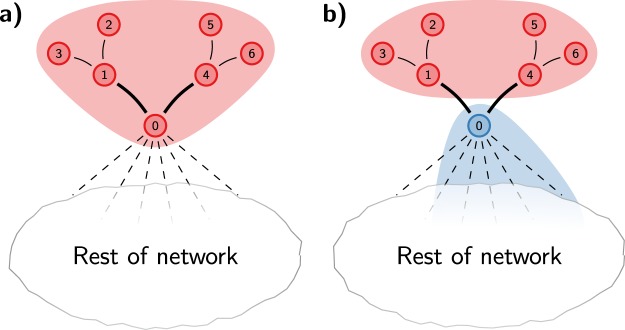
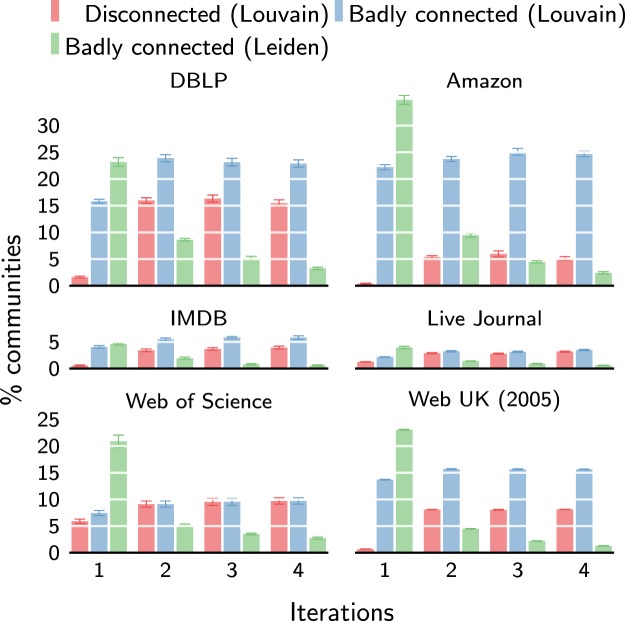
- Louvain may produce arbitrarily badly connected communities; in experiments up to 25% of communities were badly connected and up to 16% were disconnected. First-iteration badly connected percentages included Amazon 23%, DBLP 16%, and Web UK 14%; disconnected communities were usually around 1%, but exceeded 5% for Web of Science in the first iteration and jumped to 16% for DBLP in later iterations. After four iterations, Amazon had 5% disconnected but 25% badly connected communities.
- Leiden guarantees all communities are connected after each iteration, and also γ-separated and γ-connected. After a stable iteration, all nodes are locally optimally assigned and all communities are subpartition γ-dense; asymptotically, all communities are uniformly γ-dense and subset optimal.
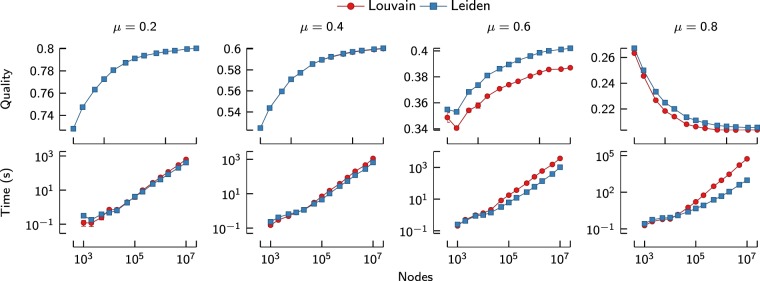
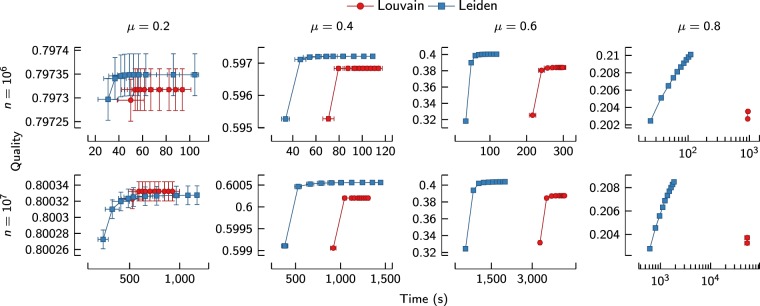
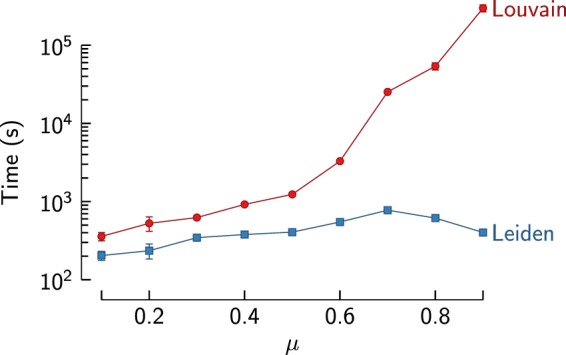
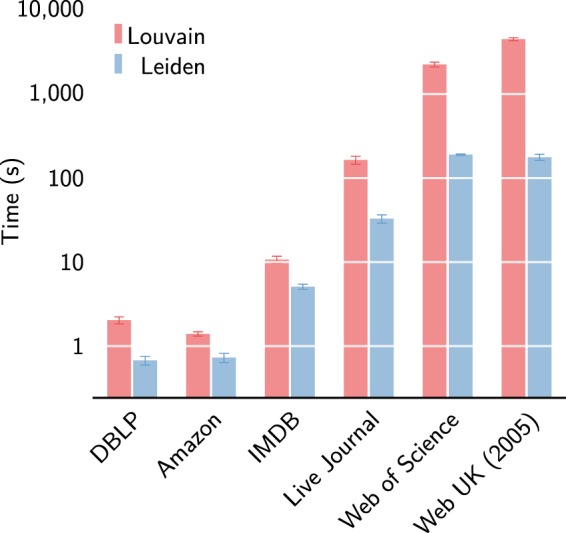
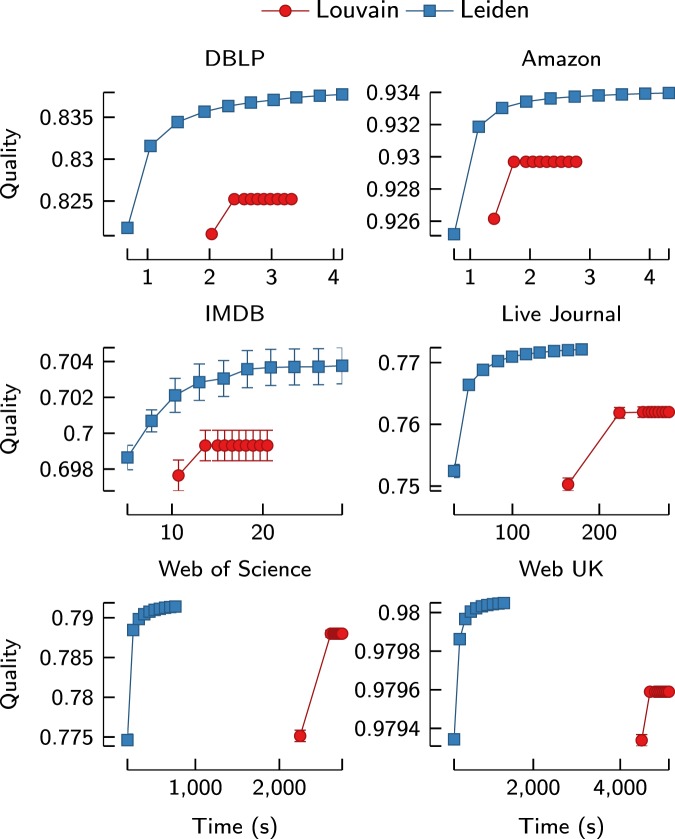
- Leiden was faster than Louvain: first iteration roughly 2–20 times faster on empirical networks, including more than 7× faster for Live Journal, more than 11× for Web of Science, and more than 20× for Web UK. On benchmark networks with difficult partitions (μ = 0.9), Louvain required almost 2.5 days while Leiden needed fewer than 10 minutes; for largest networks Leiden reached 10–100 times faster runtimes.
- Leiden found higher modularity on all six empirical networks: DBLP 0.8387 vs 0.8262, Amazon 0.9341 vs 0.9301, IMDB 0.7069 vs 0.7062, Live Journal 0.7739 vs 0.7653, Web of Science 0.7951 vs 0.7911, and Web UK 0.9801 vs 0.9796.
Methods
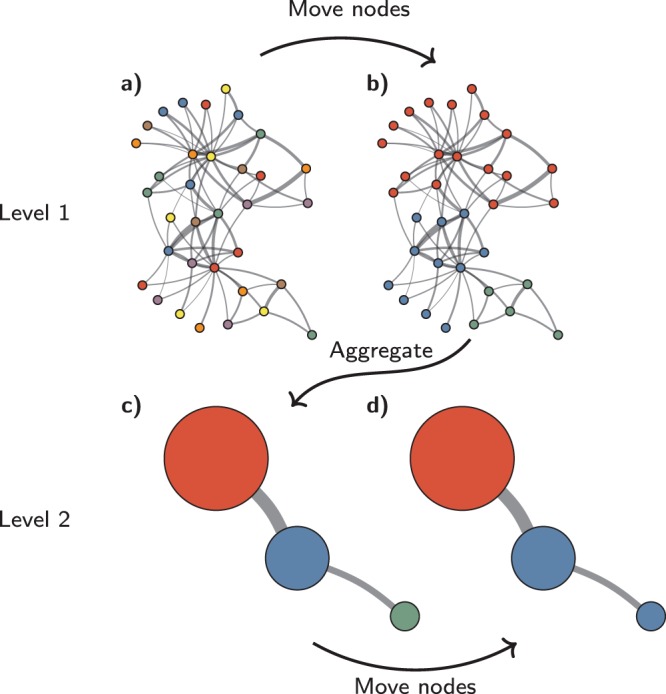
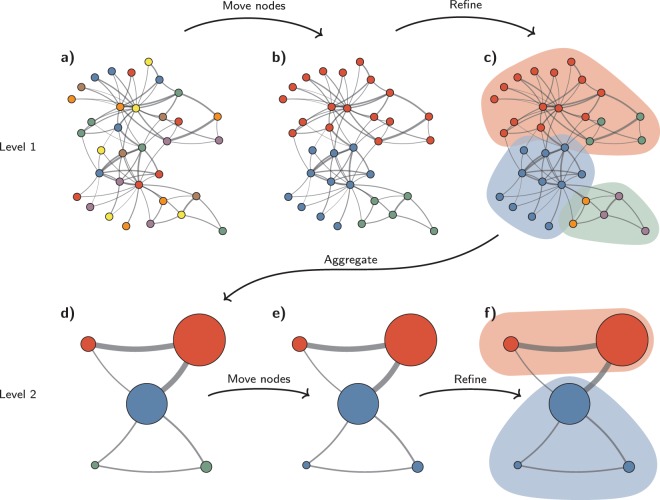
- The paper introduces the Leiden algorithm, which combines local moving, refinement of the partition, and aggregation; proofs of guarantees are relegated to Supplementary Information. It compares Leiden with Louvain on six empirical networks and on benchmark networks.
- Empirical networks: DBLP (317,080 nodes, degree 6.6), Amazon (334,863, 5.6), IMDB (374,511, 80.2), Live Journal (3,997,962, 17.4), Web of Science (9,811,130, 21.2), and Web UK (39,252,879, 39.8). Modularity was used with γ = 1; Table 2 reports maximal modularity after 10 replications of 10 iterations each. Badly connected community analysis was repeated 10 times, with Leiden run on each community’s subnetwork until a stable iteration.
- Benchmark networks ranged from n = 10^3 to n = 10^7 nodes, with community size 50 and CPM as the quality function; the mixing parameter μ varied, 10 iterations were performed, and each parameter set was repeated 10 times. The refinement randomness parameter was θ = 0.01.
Limitations
- The paper states that benchmark networks have only limited value because they are not representative of empirical real-world networks and have a rather simple structure.
- The paper states that counting communities split by Leiden gives only a lower bound on the number of badly connected communities; if Leiden does not find subcommunities, there is no guarantee that modularity cannot be increased by splitting the community.
- Evident from the text: there is no dedicated limitations section; technical details and proofs are relegated to Supplementary Information, and the experimental analysis fixes θ = 0.01 although values roughly in [0.0005, 0.1] are said to provide reasonable results.
Model-written summary. Check it against the paper before relying on it.
Integrity signals
Registry
Cites
Statistics
Figures
Verification
Claims the paper makes
1 Valid · 2 Not valid · 17 Not checked · 142 Own results and interpretations
The cited sources support only part of this claim — read each source’s verdict below.
In the paper
“Hence, the problem of Louvain outlined above is independent from the issue of the resolution limit.”
§ From Louvain to Leiden: guaranteeing well-connected communities > Louvain Algorithm > Badly connected communities
What the sources say
- Partly supportedcites [14] Fortunato S Barthélemy M Resolution Limit in Community Detection Proc. Natl. Acad. Sci. USA 2007 104 36 10.1073/pnas.0605965104 17190818 PMC1765466 sourceExperimental — accuracy not yet measured
Our copy supports the resolution-limit side of the sentence: the Conclusions (VI, p. 7) state that 'the resolution limit of modularity does not rely on particular network structures, but only on the comparison between the sizes of interconnected communities and that of the whole network', the Introduction (p. 1) calls it an 'intrinsic scale' of modularity, and Section V (pp. 5-6) shows the failure persists with simulated annealing, i.e. it is a property of the quality function rather than of one particular optimizer. What the source does not contain is the other term of the comparison: Louvain is never mentioned anywhere in the paper (the Introduction, p. 1, lists only generic greedy procedures [19,20], extremal optimization [21] and simulated annealing [22,23]), and no passage contrasts the resolution limit with an algorithm-specific defect. The independence claim is therefore the citing authors' own inference built on this paper's characterization of the resolution limit. (LLM, conf=0.70)
plain- Asserted: passes — The authors put it forward as true.
- Checkable: passes — It can be checked against evidence.
- Load-bearing: passes — The paper’s conclusions depend on it.
- Based: passes — The paper gives a reason why it holds.
- Partly supported
A result the paper states — it cites no source for it, so there is none to check. The quote shows it is in the paper.
In the paper
“The percentage of badly connected communities is less affected by the number of iterations of the Louvain algorithm.”
§ From Louvain to Leiden: guaranteeing well-connected communities > Experimental Analysis > Badly connected communities
plain- Asserted: passes — The authors put it forward as true.
- Checkable: passes — It can be checked against evidence.
- Load-bearing: unclear — It is unclear whether the paper’s conclusions depend on it.
- Based: passes — The paper gives a reason why it holds.
A result the paper states — it cites no source for it, so there is none to check. The quote shows it is in the paper.
In the paper
“In addition, we prove that, when the Leiden algorithm is applied iteratively, it converges to a partition in which all subsets of all communities are locally optimally assigned.”
- Also stated in: § Introduction · boosted
“In addition, we prove that the algorithm converges to an asymptotically stable partition in which all subsets of all communities are locally optimally assigned.”
§ From Louvain to Leiden: guaranteeing well-connected communities > Abstract
boostedstates a cause- Asserted: passes — The authors put it forward as true.
- Checkable: passes — It can be checked against evidence.
- Load-bearing: passes — The paper’s conclusions depend on it.
- Based: passes — The paper gives a reason why it holds.
- Also stated in: § Introduction · boosted
A result the paper reports from its own data — it cites no other source for it, so there is none to check. The quote shows it is in the paper.
In the paper
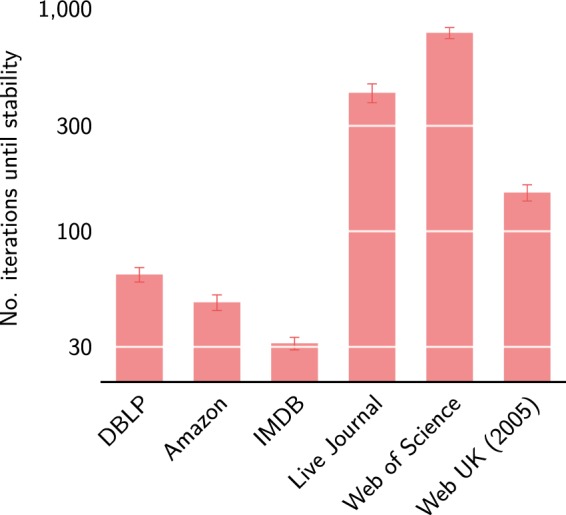
“The second iteration of Louvain shows a large increase in the percentage of disconnected communities.”
§ From Louvain to Leiden: guaranteeing well-connected communities > Experimental Analysis > Badly connected communities
plainstates a cause- Asserted: passes — The authors put it forward as true.
- Checkable: passes — It can be checked against evidence.
- Load-bearing: passes — The paper’s conclusions depend on it.
- Based: passes — The paper gives a reason why it holds.
A result the paper reports from its own data — it cites no other source for it, so there is none to check. The quote shows it is in the paper.
In the paper
“In terms of the percentage of badly connected communities in the first iteration, Leiden performs even worse than Louvain, as can be seen in Fig. 4.”
§ From Louvain to Leiden: guaranteeing well-connected communities > Experimental Analysis > Badly connected communities
plain- Asserted: passes — The authors put it forward as true.
- Checkable: passes — It can be checked against evidence.
- Load-bearing: unclear — It is unclear whether the paper’s conclusions depend on it.
- Based: passes — The paper gives a reason why it holds.
115 more claims
Create a free account to see all 162 claims and to verify the 24 references still open.
- Probably not a substantial claim. 23
- It may state two separate claims as one. 23
- The quote only partly states this claim. 1
Claims other papers make about this one
Each is checked against this paper’s own text: does it say what the citing paper says it does?
The cited source says what the claim attributes to it.
In the citing paper
“When compared to six common clustering algorithms, including Leiden25 and CellHarmony26, VFC was the top performing algorithm on every simulation on the T cell data and best performing, on average, on the zebrafish dataset, with a 57% increase in average performance over Louvain, which was the next best algorithm”
From Quantifying the effect of experimental perturbations at single-cell resolution (2021) · cites this paper as [25]
The cited source says what the claim attributes to it.
In the citing paper
“Louvain’s successor Leiden circumvents this issue by yielding guaranteed connected communities and is computationally more efficient52.”
From Best practices for single-cell analysis across modalities (2023) · cites this paper as [52]
The cited source says what the claim attributes to it.
In the citing paper
“However, the Louvain algorithm can lead to arbitrarily poorly connected communities52.”
From Best practices for single-cell analysis across modalities (2023) · cites this paper as [52]
The cited source says what the claim attributes to it.
In the citing paper
“We found that many t-types had total variance substantially above the variances of the k-means clusters (Fig. 5b) and an alternative analysis using entropies of Leiden clustering35 often highlighted the same t-types as variable (Extended Data Fig. 8).”
From Phenotypic variation of transcriptomic cell types in mouse motor cortex (2021) · cites this paper as [35]
The cited source says what the claim attributes to it.
In the citing paper
“Community detection uses the Leiden algorithm [28] with ModularityVertexPartition, producing hierarchical subclustering to depth 3.”
From SuperLocalMemory: Privacy-Preserving Multi-Agent Memory with Bayesian Trust Defense Against Memory Poisoning (2026) · cites this paper as [28]
6 more claims about this paper
Create a free account to see every claim other papers make about this one.
Citations
Cites
Fast unfolding of communities in large networks
Blondel, V. D., Guillaume, J.-L., Lambiotte, R., & Lefebvre, E. (2008) · Journal of Statistical Mechanics: Theory and Experiment · doi:10.1088/1742-5468/2008/10/p10008 · Cited by 21,424 · cited 3×
“The Louvain algorithm 10 is very simple and elegant.”
MethodFinding and evaluating community structure in networks
Newman, M. E. J., & Girvan, M. (2004) · Physical Review E · doi:10.1103/physreve.69.026113 · Cited by 13,931 · cited 2×
“The Leiden algorithm consists of three phases: (1) local moving of nodes, (2) refinement of the partition and (3) aggregation of the network based on the refined partition, using the non-refined partition to create an initial partition for the aggregate network.”
BackgroundMethodComplex brain networks: graph theoretical analysis of structural and functional systems
Bullmore, E., & Sporns, O. (2009) · Nature Reviews Neuroscience · doi:10.1038/nrn2575 · Cited by 11,820
Fortunato, S. (2010) · Physics Reports · doi:10.1016/j.physrep.2009.11.002 · Cited by 11,293 · cited 4×
“The Leiden algorithm consists of three phases: (1) local moving of nodes, (2) refinement of the partition and (3) aggregation of the network based on the refined partition, using the non-refined partition to create an initial partition for the aggregate network.”
BackgroundMethodInfluentialFinding community structure in very large networks
Clauset, A., Newman, M. E. J., & Moore, C. (2004) · Physical Review E · doi:10.1103/physreve.70.066111 · Cited by 7,390 · cited 1×
“Optimising modularity is NP-hard 5 , and consequentially many heuristic algorithms have been proposed, such as hierarchical agglomeration 6 , extremal optimisation 7 , simulated annealing 4,8 and spectral 9 algorithms.”
MethodFinding community structure in networks using the eigenvectors of matrices
Newman, M. E. J. (2006) · Physical Review E · doi:10.1103/physreve.74.036104 · Cited by 4,761
Functional cartography of complex metabolic networks
Guimerà, R., & Nunes Amaral, L. A. (2005) · Nature · doi:10.1038/nature03288 · Cited by 3,983 · cited 2×
“Optimising modularity is NP-hard 5 , and consequentially many heuristic algorithms have been proposed, such as hierarchical agglomeration 6 , extremal optimisation 7 , simulated annealing 4,8 and spectral 9 algorithms.”
MethodNear linear time algorithm to detect community structures in large-scale networks
Raghavan, U. N., Albert, R., & Kumara, S. (2007) · Physical Review E · doi:10.1103/physreve.76.036106 · Cited by 3,502 · cited 2×
“Trying to fix the problem by simply considering the connected components of communities 19–21 is unsatisfactory because it addresses only the most extreme case and does not resolve the more fundamental problem.”
BackgroundBenchmark graphs for testing community detection algorithms
Lancichinetti, A., Fortunato, S., & Radicchi, F. (2008) · Physical Review E · doi:10.1103/physreve.78.046110 · Cited by 3,051 · cited 1×
“To study the scaling of the Louvain and the Leiden algorithm, we rely on a variant of a well-known approach for constructing benchmark networks 28 .”
MethodResolution limit in community detection
Fortunato, S., & Barthélemy, M. (2007) · Proceedings of the National Academy of Sciences · doi:10.1073/pnas.0605965104 · Cited by 3,024 · cited 2×
“The algorithm may yield arbitrarily badly connected communities, over and above the well-known issue of the resolution limit 14 .”
Background
Research works printed but not linked: 2
- Porter MA Onnela J-P Mucha PJ Communities in Networks Not. AMS 2009 56 1082 1097
- Luecken, M. D. Application of multi-resolution partitioning of interaction networks to the study of complex disease. Ph.D. thesis, (University of Oxford, 2016).
Cited by
Items 1,001–1,100 of 7,288
From pirates to subscribers: 20 years of music consumption research
Montoro‐Pons, J. D., Caballer‐Tarazona, M., & García, M. C. (2021) · International Journal of Consumer Studies · doi:10.1111/ijcs.12660 · Cited by 32
“This work uses a modified version known as the Leiden algorithm (Traag et al., 2019).”
MethodGerstner, N., Fröhlich, A. S., Matosin, N., Gagliardi, M., Cruceanu, C., Ködel, M., Rex‐Haffner, M., Tu, X., Mostafavi, S., Ziller, M. J., et al. (2025) · Science Advances · doi:10.1126/sciadv.adq2290 · Cited by 32
Qin, Y., Liu, Z., Gao, S., Martínez-Vasallo, C., Long, Y., Zhu, X., Liu, B., Gao, Y., Xu, X., Nohales, M. A., et al. (2025) · Nature Communications · doi:10.1038/s41467-025-59424-8 · Cited by 32
Unbiased integration of single cell multi-omics dataPreprint
Dou, J., Liang, S., Mohanty, V., Cheng, X., Kim, S., Choi, J., Li, Y., Rezvani, K., Chen, R., & Chen, K. (2020) · Research Square · doi:10.1101/2020.12.11.422014 · Cited by 32
Grant, R. A., Poor, T. A., Sichizya, L., Diaz, E., Bailey, J. I., Soni, S., Senkow, K. J., Pérez-Leonor, X. G., Abdala‐Valencia, H., Lu, Z., et al. (2024) · JCI Insight · doi:10.1172/jci.insight.178859 · Cited by 32
Charting the Constellation of Science Reform
Field, S. M. (2022) · University of Groningen research database (University of Groningen / Centre for Information Technology) · doi:10.33612/diss.229114775 · Cited by 32
Lilja, S., Li, X., Smelik, M., Lee, E. J., Loscalzo, J., Marthanda, P. B., Hu, L., Magnusson, M., Sysoev, O., Zhang, H., et al. (2022) · Cell Reports Medicine · doi:10.1016/j.xcrm.2023.100956 · Cited by 32
Single-cell RNA sequencing reveals developmental heterogeneity among Plasmodium berghei sporozoites
Ruberto, A. A., Bourke, C., Mérienne, N., Obadia, T., Amino, R., & Müeller, I. (2021) · Scientific Reports · doi:10.1038/s41598-021-82914-w · Cited by 32
Mann, V., & Venkatasubramanian, V. (2023) · Reaction Chemistry & Engineering · doi:10.1039/d2re00309k · Cited by 32
Akartuna, E. A., Johnson, S. D., & Thornton, A. E. (2024) · Journal of Quantitative Criminology · doi:10.1007/s10940-024-09594-3 · Cited by 32
The promise of single-cell genomics in plants
McFaline‐Figueroa, J. L., Trapnell, C., & Cuperus, J. T. (2020) · Current Opinion in Plant Biology · doi:10.1016/j.pbi.2020.04.002 · Cited by 31
Mass Cytometry Phenotyping of Human Granulocytes Reveals Novel Basophil Functional Heterogeneity
Gonzalez, N. V., Oliveria, J. P., Tebaykin, D., Ivison, G. T., Mukai, K., Tsai, M. M., Borges, L., Nadeau, K. C., Galli, S. J., Tsai, A. G., et al. (2020) · iScience · doi:10.1016/j.isci.2020.101724 · Cited by 31
“In addition, we used the Leiden (Traag et al., 2019) clustering algorithm to identify subpopulations within CD45HLA-DRCD123 cells based on the expression of CD16, FcεRI, CD244, CD53, CD305, and CD193.”
MethodComplex regulatory networks influence pluripotent cell state transitions in human iPSCs
Arthur, T. D., Nguyen, J., D’Antonio‐Chronowska, A., Matsui, H., da Silva, N. S., Joshua, I. N., Aguiar, L. R., Arias, A. D., Benaglio, P., Berggren, W. T., et al. (2024) · Nature Communications · doi:10.1038/s41467-024-45506-6 · Cited by 31
“We applied the unsupervised Leiden community detection algorithm 24,25 to the RN and identi fi ed 13 major regulatory network modules (RNMs) each consisting of at least 500 ATAC-seq peaks (mean = 3673.9 ± 1261.9 peaks) (Fig.”
InfluentialTracing the spread of Germanic languages using ancient genomics
McColl, H., Kroonen, G., Moreno-Mayar, J. V., Seersholm, F. V., Scorrano, G., Pinotti, T., Vimala, T., Sindbæk, S. M., Ethelberg, P., Fyfe, R., et al. (2026) · Nature · doi:10.1101/2024.03.13.584607 · Cited by 31
Analysis of single-cell RNA sequencing data based on autoencoders
Tangherloni, A., Ricciuti, F., Besozzi, D., Lió, P., & Cvejic, A. (2021) · BMC Bioinformatics · doi:10.1186/s12859-021-04150-3 · Cited by 31
A bibliometric analysis of off-line handwritten document analysis literature (1990–2020)
Ruiz-Parrado, V., Heradio, R., Aranda‐Escolástico, E., Sánchez, Á., & Vélez, J. F. (2021) · Pattern Recognition · doi:10.1016/j.patcog.2021.108513 · Cited by 31
Single-cell transcriptomics reveals the identity and regulators of human mast cell progenitors
Wu, C., Boey, D. Z. H., Bril, O., Grootens, J., Vijayabaskar, M. S., Sorini, C., Ekoff, M., Wilson, N. K., Ungerstedt, J. S., Nilsson, G. P., et al. (2022) · Blood Advances · doi:10.1182/bloodadvances.2022006969 · Cited by 31
Ferreira, I. A. T. M., Lee, C. Y. C., Foster, W. S., Abdullahi, A., Dratva, L. M., Tuong, Z. K., Stewart, B. J., Ferdinand, J. R., Guillaume, S. M., Potts, M., et al. (2023) · Cell Reports · doi:10.1016/j.celrep.2023.112991 · Cited by 31
Aging Clocks, Entropy, and the Challenge of Age Reversal
Tarkhov, A. E., Denisov, K. A., & Fedichev, P. O. (2024) · doi:10.59368/agingbio.20240031 · Cited by 31
Single-cell colocalization analysis using a deep generative model
Kojima, Y., Mii, S., Hayashi, S., Hirose, H., Ishikawa, M., Akiyama, M., Enomoto, A., & Shimamura, T. (2024) · Cell Systems · doi:10.1016/j.cels.2024.01.007 · Cited by 31
Stem-cell states converge in multistage cutaneous squamous cell carcinoma development
Taylor, M. A., Kandyba, E. E., Halliwill, K. D., Delrosario, R., Khoroshkin, M., Goodarzi, H., Quigley, D. A., Li, Y. R., Wu, D., Bollam, S., et al. (2024) · Science · doi:10.1126/science.adi7453 · Cited by 31
“…of cells on different scales of transcriptomic similarity, we implemented the Leiden community detection algorithm within Monocle3 to call low-resolution clusters (referred to as “ partitions ” by the monocle software suite) and high-resolution clusters (referred to as “ clusters ” ) ( 77 ).”
MethodCell type and cell signalling innovations underlying mammalian pregnancy
Stadtmauer, D. J., Basanta, S., Maziarz, J. D., Cole, A. G., Dagdas, G., Smith, G. R., van Breukelen, F., Pavličev, M., & Wagner, G. P. (2025) · Nature Ecology & Evolution · doi:10.1038/s41559-025-02748-x · Cited by 31
Thomson, E., Tran, M., Robevska, G., Ayers, K. L., van den Bergen, J., Bhaskaran, P. G., Haan, E., Cereghini, S., Vash‐Margita, A., Margetts, M., et al. (2022) · Human Molecular Genetics · doi:10.1093/hmg/ddac262 · Cited by 31
“Next, we clustered the cells using the Louvain algorithm (85) by running the FindNeighbors() and FindClusters() functions.”
Frugal alignment-free identification of FLT3-internal tandem duplications with FiLT3r
Boudry, A., Darmon, S., Duployez, N., Figeac, M., Geffroy, S., Bucci, M., Celli‐Lebras, K., Duchmann, M., Joudinaud, R., Fenwarth, L., et al. (2022) · BMC Bioinformatics · doi:10.1186/s12859-022-04983-6 · Cited by 31
Zhao, W., Luo, J., Fan, T., Ren, Y., & Xia, Y. (2021) · Pattern Recognition Letters · doi:10.1016/j.patrec.2021.01.007 · Cited by 31
Clustering biological sequences with dynamic sequence similarity threshold
Chiu, J. K. H., & Ong, R. T. (2022) · BMC Bioinformatics · doi:10.1186/s12859-022-04643-9 · Cited by 29
“Leiden algorithm [27] to partition the graph into communities [28] of raw graph clusters; 3.”
MethodShen, X., Jin, Z., Chen, X., Wang, Z., Lu, Y., Ou, Y., Gong, L., Zhu, C., Xu, G., & Wang, Y. (2024) · MedComm · doi:10.1002/mco2.748 · Cited by 31
Practical bioinformatics pipelines for single-cell RNA-seq data analysis
He, J., Lihui, L., & Jiekai, C. (2022) · Biophysics Reports · doi:10.52601/bpr.2022.210041 · Cited by 31
Why more social interactions lead to more polarization in societies
Thurner, S., Hofer, M., & Korbel, J. (2025) · Proceedings of the National Academy of Sciences · doi:10.1073/pnas.2517530122 · Cited by 31
LoxCode in vivo barcoding reveals epiblast clonal fate bias to fetal organs
Weber, T., Biben, C., Miles, D. C., Glaser, S. P., Tomei, S., Lin, C., Kueh, A. J., Pál, M., Zhang, S., Tam, P., et al. (2025) · Cell · doi:10.1016/j.cell.2025.04.026 · Cited by 31
Sheinin, R., Sharan, R., & Madi, A. (2025) · Nature Methods · doi:10.1038/s41592-025-02627-0 · Cited by 31
Lee, K.-J., Choi, D., Tae, N., Song, H. W., Kang, Y., Lee, M., Moon, D., Oh, Y., Park, S., Kim, J., et al. (2024) · Cell Reports Medicine · doi:10.1016/j.xcrm.2024.101567 · Cited by 31
KDM3B inhibitors disrupt the oncogenic activity of PAX3-FOXO1 in fusion-positive rhabdomyosarcoma
Kim, Y. Y., Gryder, B. E., Sinniah, R., Peach, M. L., Shern, J. F., Abdelmaksoud, A. A., Pomella, S., Woldemichael, G. M., Stanton, B. Z., Milewski, D., et al. (2024) · Nature Communications · doi:10.1038/s41467-024-45902-y · Cited by 31
Modularity based community detection in hypergraphs
Kamiński, B., Misiorek, P., Prałat, P., & Théberge, F. (2024) · Journal of Complex Networks · doi:10.1093/comnet/cnae041 · Cited by 31
Aman, A. J., Saunders, L. M., Carr, A. A., Srivatasan, S., Eberhard, C., Carrington, B., Watkins-Chow, D., Pavan, W. J., Trapnell, C., & Parichy, D. M. (2023) · eLife · doi:10.7554/elife.86670 · Cited by 30
“Clustering was performed with “cluster_cells” (wild-type resolution = 2e-4; all-background resolution = 1e-4), which uses the Leiden community detection algorithm (Traag et al., 2019).”
MethodAutomated identification of the mouse brain’s spatial compartments from in situ sequencing data
Partel, G., Hilscher, M. M., Milli, G., Solorzano, L., Klemm, A. H., Nilsson, M. F., & Wählby, C. (2020) · BMC Biology · doi:10.1186/s12915-020-00874-5 · Cited by 30
“A 50-dimensional UMAP representation of the data from the full gene panel was clustered using the Leiden clustering algorithm [20] resulting in the definition of 17 to 32 regions in the four different brain sections.”
MethodWu, H., Saito‐Diaz, K., Huang, C., McAlpine, J. L., Seo, D. E., Magruder, D. S., Ishan, M., Bergeron, H. C., Delaney, W. H., Santori, F. R., et al. (2024) · Cell stem cell · doi:10.1016/j.stem.2024.03.011 · Cited by 30
de la Fuente, L. A., Zamberlán, F., Ferrán, A. S., Carrillo, F., Tagliazucchi, E., & Pallavicini, C. (2020) · Journal of Cannabis Research · doi:10.1186/s42238-020-00028-y · Cited by 30
Kuciński, I., Wilson, N. K., Hannah, R., Kinston, S., Cauchy, P., Lenaerts, A., Grosschedl, R., & Göttgens, B. (2020) · The EMBO Journal · doi:10.15252/embj.2020104983 · Cited by 30
“After scaling, the expression values of the highly variable genes were used to compute 50 principal components, and these were used to identify 15 nearest neighbours and compute clusters (Leiden algorithm) (Traag et al , 2019) and the UMAP embedding (Preprint: McInnes et al , 2018).”
Ramazzotti, D., Angaroni, F., Maspero, D., Gambacorti-Passerini, C. B., Antoniotti, M., Graudenzi, A., & Piazza, R. (2021) · Patterns · doi:10.1016/j.patter.2021.100212 · Cited by 30
“Such variant identifies a large clade including 11 clonal genotypes: G15 (493 samples), G16 (1), G17 (512), G18 (25), G19 (118), G20 (94), G21 (648), G22 (90),G23 (127), G24 (4), G25 (86), for a total of 2198 total samples, distributed especially in Australia (971), USA (841), South Africa (257) and Israel (125).”
BackgroundCoCoNet: an efficient deep learning tool for viral metagenome binning
Arisdakessian, C. G., Nigro, O. D., Steward, G. F., Poisson, G., & Belcaid, M. (2021) · Bioinformatics · doi:10.1093/bioinformatics/btab213 · Cited by 30
Song, H., Li, Y., Fu, C., Xue, F., Zhao, Q.-Y., Zheng, X., Jiang, K., & Liu, T. (2023) · Chaos Solitons & Fractals · doi:10.1016/j.chaos.2023.114343 · Cited by 30
Kuzmin, I. V., Soto-Acosta, R., Pruitt, L., Wasdin, P. T., Kedarinath, K., Hernandez, K. R., Gonzales, K. A., Hill, K., Weidner, N. G., Mire, C. E., et al. (2024) · Nature Communications · doi:10.1038/s41467-024-50774-3 · Cited by 30
“UMAP was used to obtain a two-dimensional representa-tionofthedatafordownstreamanalysesandvisualization,followedby unsupervised clustering using the Scanpy implementation of the Leiden algorithm 100 with a resolution of 0.5.”
InfluentialAdvances in single-cell transcriptomics in animal research
Yan, Y., Zhu, S., Jia, M., Chen, X., Qi, W., Gu, F., Valencak, T. G., Liu, J., & Sun, H. (2024) · Journal of Animal Science and Biotechnology/Journal of animal science and biotechnology · doi:10.1186/s40104-024-01063-y · Cited by 30
“Moreover, the Louvain and Leiden algorithms are normally used for single-cell datasets with more than 100,000 cells, with the number of clusters determined by the resolution set by the analyser [139, 140].”
MethodAi, L., Binek, A., Zhemkov, V., Cho, J. H., Haghani, A., Kreimer, S. D., Israely, E., Arzt, M., Chazarin, B., Sundararaman, N., et al. (2025) · Molecular & Cellular Proteomics · doi:10.1016/j.mcpro.2025.100910 · Cited by 30
“Unbiased Leiden clustering, which identi fi es communities or clusters of cells based on their connectivity (23), showed that single-cell proteomes were driven by timepoint differences and were independent of total protein count per cell, indicating the cell proteome was distinct at each…”
Deconvolution of cell types and states in spatial multiomics utilizing TACIT
Huynh, K., Tyc, K. M., Matuck, B. F., Easter, Q. T., Pratapa, A., Kumar, N. V., Pérez, P., Kulchar, R. J., Pranzatelli, T. J. F., de Souza, D., et al. (2025) · Nature Communications · doi:10.1038/s41467-025-58874-4 · Cited by 30
“These cells were initially grouped using Leiden clustering and subsequently annotated under the supervision of the authors 54 .”
Tracing the evolution of single-cell 3D genomes in Kras-driven cancers
Liu, M., Jin, S., Agabiti, S. S., Jensen, T. B., Yang, T., Radda, J. S. D., Ruiz, C. F., Baldissera, G., Rajaei, M., Li, F., et al. (2025) · Nature Genetics · doi:10.1038/s41588-025-02297-w · Cited by 30
“Leiden clustering 40 segmented the low-dimensional space into adenoma-like and LUAD-like regions and revealed that more AdenomaG cells (versus other adenoma cells) adopted LUAD-like 3D conformations (Fig.”
PKCλ/ι inhibition activates an ULK2-mediated interferon response to repress tumorigenesis
Linares, J. F., Zhang, X., Martínez-Ordóñez, A., Durán, Á., Kinoshita, H., Kasashima, H., Nakanishi, N., Nakanishi, Y., Carelli, R., Cappelli, L. V., et al. (2021) · Molecular Cell · doi:10.1016/j.molcel.2021.08.039 · Cited by 30
Neirijnck, Y., Sararols, P., Kühne, F., Mayère, C., Arachchige, L. C. W., Regard, V., Nef, S., & Schedl, A. (2023) · Cell Reports · doi:10.1016/j.celrep.2023.112191 · Cited by 30
An Integrative Multiomics Framework for Identification of Therapeutic Targets in Pulmonary Fibrosis
Arif, M., Basu, A., Wolf, K. M., Park, J. K., Pommerolle, L., Behee, M., Gochuico, B. R., & Çınar, R. (2023) · Advanced Science · doi:10.1002/advs.202207454 · Cited by 30
PGF2α signaling drives fibrotic remodeling and fibroblast population dynamics in mice
Rodríguez, L. R., Tang, S. Y., Barboza, W. R., Murthy, A., Tomer, Y., Cai, T., Iyer, S., Chavez, K., Das, U. S., Ghosh, S., et al. (2023) · JCI Insight · doi:10.1172/jci.insight.172977 · Cited by 30
Panpipes: a pipeline for multiomic single-cell and spatial transcriptomic data analysis
Curion, F., Rich‐Griffin, C., Agarwal, D., Ouologuem, S., Rue-Albrecht, K., May, L., Garcia, G. E. L., Heumos, L., Thomas, T. R., Lason, W., et al. (2024) · Genome biology · doi:10.1186/s13059-024-03322-7 · Cited by 30
Mesecar, M. E., Duffy, M. F., Acri, D. J., Ding, J., Langston, R. G., Shah, S. I., Nalls, M. A., Reed, X., Scholz, S. W., Whitaker, D. T., et al. (2026) · npj Aging · doi:10.1038/s41514-026-00391-9 · Cited by 30
How do scientific papers from different journal tiers gain attention on social media?
Cao, R., Liu, X. F., Fang, Z., Xu, X.-K., & Wang, X. (2022) · Information Processing & Management · doi:10.1016/j.ipm.2022.103152 · Cited by 30
Population-scale cross-disorder atlas of the human prefrontal cortex at single-cell resolution
Fullard, J. F., NM, P., Lee, D., Mathur, D., Therrien, K., Hong, A., Casey, C., Shao, Z., Alvia, M., Argyriou, S., et al. (2025) · Scientific Data · doi:10.1038/s41597-025-04687-5 · Cited by 23
Maatz, H., Lindberg, E. L., Adami, E., López-Anguita, N., Perdomo-Sabogal, Á., Ortega, L. C., Patone, G., Reichart, D., Myronova, A., Schmidt, S., et al. (2025) · Nature Cardiovascular Research · doi:10.1038/s44161-025-00612-6 · Cited by 30
A comparison of citation-based clustering and topic modeling for science mapping
Xie, Q., & Waltman, L. (2025) · Scientometrics · doi:10.1007/s11192-025-05324-z · Cited by 30
Self-citationYoutu-GraphRAG: Vertically Unified Agents for Graph Retrieval-Augmented Complex Reasoning
Dong, J., An, S., Yu, Y., Zhang, Q.-W., Luo, L., Huang, X., Wu, Y., Yin, D., & Sun, X. (2026) · International Conference on Learning Representations · doi:10.48550/arxiv.2508.19855 · Cited by 30
Lalman, C., Yang, Y., & Walker, J. L. (2025) · Cells · doi:10.3390/cells14171315 · Cited by 30
Zanotelli, V. R., Leutenegger, M., Lun, X., Georgi, F., de Souza, N., & Bodenmiller, B. (2020) · Molecular Systems Biology · doi:10.15252/msb.20209798 · Cited by 30
Aref, S., & Mostajabdaveh, M. (2024) · Journal of Computational Science · doi:10.1016/j.jocs.2024.102283 · Cited by 31
Hatje, K., Schneider, K., Danilin, S., Köchl, F., Giroud, N., Juglair, L., Marbach, D., Knuckles, P., Bergauer, T., Metruccio, M. M. E., et al. (2025) · Cell Reports Methods · doi:10.1016/j.crmeth.2025.101173 · Cited by 30
He, Y., Zhang, X., Huang, J., Rózemberczki, B., Cucuringu, M., & Reinert, G. (2024) · Proceedings of Machine Learning Research · doi:10.48550/arxiv.2202.10793 · Cited by 30
Fast Think-on-Graph: Wider, Deeper and Faster Reasoning of Large Language Model on Knowledge Graph
Liang, X., & Gu, Z. (2025) · Proceedings of the AAAI Conference on Artificial Intelligence · doi:10.1609/aaai.v39i23.34635 · Cited by 30
Wang, S., Zhou, Y., & Fang, Y. (2026) · Proceedings of the VLDB Endowment · doi:10.14778/3819518.3819556 · Cited by 30
Minor, B., LeMoine, D., Seger, C., Gibbons, E. P., Koudouovoh, J., Taya, M., Kurtz, D., Xu, Y. J., & Hammes, S. R. (2023) · Endocrinology · doi:10.1210/endocr/bqad061 · Cited by 30
Mikaeloff, F., Akusjärvi, S. S., Ikomey, G. M., Krishnan, S., Sperk, M., Gupta, S., Magdaleno, G. D. V., Escós, A., Lyonga, E., Okomo, M. C. A., et al. (2022) · Communications Biology · doi:10.1038/s42003-021-02985-3 · Cited by 30
Unfolding Community Homophily in U.S. Metropolitans Via Fine-Grained Mobile Phone Location Data
Huang, X., Zhao, Y., Wang, S., Li, X., Yang, D., Feng, Y., Xu, Y., Zhu, L., & Chen, B. Y. (2022) · Cities · doi:10.1016/j.cities.2022.103929 · Cited by 30
A Review of the Application of Spatial Transcriptomics in Neuroscience
Zhang, L., Xiong, Z., & Xiao, M. (2024) · Interdisciplinary Sciences: Computational Life Sciences · doi:10.1007/s12539-024-00603-4 · Cited by 29
“Currently, several common and popular algorithms group cells in an unbiased way, such as hierarchical clustering [56] and Leiden [57], but these methods do not use the spatial information [9] to cluster data.”
Ibañez-Solé, O., Barrio, I., & Izeta, A. (2023) · iScience · doi:10.1016/j.isci.2023.106368 · Cited by 29
Chen, T., Guo, J., Ai, L., Wang, Y., Wang, Y., Chen, B., Liu, M., Zhuang, S., Liu, K., Zhao, Z., et al. (2023) · Computational and Structural Biotechnology Journal · doi:10.1016/j.csbj.2023.11.018 · Cited by 29
“Unsupervised clustering of cells was performed using the Leiden algorithm [48].”
MethodKaminski, J., Fleming, R. A., Calderon, F. A., Winschel, M., McGuckin, C., Ho, E. E., Eng, F., Rui, X., Keskula, P., Cagnin, L. S., et al. (2024) · Blood · doi:10.1182/blood.2023022717 · Cited by 29
Cardeira-da-Silva, J., Wang, Q., Sagvekar, P., Mintcheva, J., Latting, S., Günther, S., Ramadass, R., Yekelchyk, M., Preussner, J., Looso, M., et al. (2024) · Nature Communications · doi:10.1038/s41467-024-47430-1 · Cited by 29
Krzak, M., Alegbe, T., Taylor, D. L., Jones, G., Ghouraba, M., Strickland, M., Harris, B. T., Satti, R., Arestang, K., Ramirez-Navarro, L., et al. (2026) · Nature Genetics · doi:10.1038/s41588-026-02634-7 · Cited by 29
Besca, a single-cell transcriptomics analysis toolkit to accelerate translational research
Mädler, S. C., Julien-Laferrière, A., Wyss, L., Phan, M., Sonrel, A., Kang, A. S. W., Ulrich, E., Schmucki, R., Zhang, J. D., Ebeling, M., et al. (2021) · NAR Genomics and Bioinformatics · doi:10.1093/nargab/lqab102 · Cited by 30
A Single Cell Analysis of Thymopoiesis and Thymic iNKT Cell Development in Pigs
Gu, W., Madrid, D. M. D. C., Joyce, S., & Driver, J. P. (2022) · Cell Reports · doi:10.1016/j.celrep.2022.111050 · Cited by 29
Parikh, B. H., Blakeley, P., Regha, K., Liu, Z., Yang, B., Bhargava, M., Wong, D. S. L., Tan, Q. S. W., Wong, C. S. W., Wang, H., et al. (2023) · Proceedings of the National Academy of Sciences · doi:10.1073/pnas.2214842120 · Cited by 29
Tangeman, J. A., Rebull, S. M., Grajales‐Esquivel, E., Weaver, J. M., Bendezu-Sayas, S., Robinson, M. L., Lachke, S. A., & Rio‐Tsonis, K. D. (2024) · Development · doi:10.1242/dev.202249 · Cited by 29
Kotov, A., Seal, S., Alkobtawi, M., Kappès, V., Ruiz, S. M., Arbès, H., Harland, R. M., Peshkin, L., & Monsoro-Burq, A. H. (2024) · Proceedings of the National Academy of Sciences · doi:10.1073/pnas.2311685121 · Cited by 29
“For each stage, we obtained independent standard dimensionality reduction with PCA, computing a neighborhood graph and UMAP (60) followed by clustering, [Leiden algorithm, (21)].”
Cell atlas of the regenerating human liver after portal vein embolization
Brazovskaja, A., Gomes, T., Holtackers, R., Wahle, P., Körner, C., He, Z., Schaffer, T., Eckel, J. C., Hänsel, R., Santel, M., et al. (2024) · Nature Communications · doi:10.1038/s41467-024-49236-7 · Cited by 29
Emanuelsson, E. B., Arif, M., Reitzner, S. M., Perez, S., Lindholm, M. E., Mardinoğlu, A., Daub, C. O., Sundberg, C. J., & Chapman, M. A. (2023) · iScience · doi:10.1016/j.isci.2023.108638 · Cited by 29
Analyzing Spatial Transcriptomics Data Using Giotto
Rossi, N. D., Chen, J. G., Yuan, G., & Dries, R. (2022) · Current Protocols · doi:10.1002/cpz1.405 · Cited by 29
Murphy, A. E., Fancy, N. N., & Skene, N. (2023) · eLife · doi:10.7554/elife.90214 · Cited by 29
Building a unified model for drug synergy analysis powered by large language models
Liu, T., Chu, T., Luo, X., & Zhao, H. (2025) · Nature Communications · doi:10.1038/s41467-025-59822-y · Cited by 29
Interpretable inflammation landscape of circulating immune cells
Jiménez-Gracia, L., Maspero, D., Aguilar-Fernández, S., Craighero, F., Boulougouri, M., Ruiz, M., Marchese, D., Caratù, G., Liñares-Blanco, J., Berasategi, M., et al. (2026) · Nature Medicine · doi:10.1038/s41591-025-04126-3 · Cited by 29
Chung, H., Melnikov, A., Aubin, C., Drokhlyansky, E., Wittenberghe, N. V., Magee, E. M., Waldman, J., Spira, A. E., Chen, F., Mazzilli, S. A., et al. (2022) · bioRxiv (Cold Spring Harbor Laboratory) · doi:10.1101/2022.08.25.505257 · Cited by 29
Hippocampal Engrams Generate Variable Behavioral Responses and Brain-Wide Network States
Dorst, K. E., Senne, R. A., Diep, A. H., de Boer, A. R., Suthard, R. L., Leblanc, H., Ruesch, E. A., Pyo, A. Y., Skelton, S., Carstensen, L. C., et al. (2023) · Journal of Neuroscience · doi:10.1523/jneurosci.0340-23.2023 · Cited by 29
Deciphering Organoids: High-Dimensional Analysis of Biomimetic Cultures
Qin, X., & Tape, C. J. (2020) · Trends in biotechnology · doi:10.1016/j.tibtech.2020.10.013 · Cited by 29
Love, N. R., Williams, C., Killingbeck, E. E., Merleev, A. A., Doost, M. S., Yu, L., McPherson, J. D., Mori, H., Borowsky, A. D., Maverakis, E., et al. (2024) · Science Advances · doi:10.1126/sciadv.adm8206 · Cited by 29
CALLR: a semi-supervised cell-type annotation method for single-cell RNA sequencing data
Wei, Z., & Zhang, S. (2021) · Bioinformatics · doi:10.1093/bioinformatics/btab286 · Cited by 29
Combinatorial expression motifs in signaling pathways
Granados, A. A., Kanrar, N., & Elowitz, M. B. (2024) · Cell Genomics · doi:10.1016/j.xgen.2023.100463 · Cited by 29
xSiGra: explainable model for single-cell spatial data elucidation
Budhkar, A., Tang, Z., Liu, X., Zhang, X., Su, J., & Song, Q. (2024) · Briefings in Bioinformatics · doi:10.1093/bib/bbae388 · Cited by 29
Single-Cell Analysis of the Transcriptome and Epigenome
Mazan-Mamczarz, K., Ha, J., De, S., & Sen, P. (2022) · Methods in molecular biology · doi:10.1007/978-1-0716-1831-8_3 · Cited by 29
Réale, D. J. F., Khelfaoui, M., Montiglio, P., & Gingras, Y. (2020) · Scientometrics · doi:10.1007/s11192-019-03340-4 · Cited by 29
Rao, S. B., Sun, Z., Brundu, F. G., Chen, Y., Sun, Y., Zhu, H., Shprintzen, R. J., Tomer, R., Rabadán, R., Leong, K. W., et al. (2025) · Nature Communications · doi:10.1038/s41467-025-62187-x · Cited by 29
McGillivray, B., Jenset, G. B., Salama, K. M., & Schut, D. (2022) · Humanities and Social Sciences Communications · doi:10.1057/s41599-022-01267-5 · Cited by 29
Borgström, E. W., Edvinsson, M., Peña‐Pérez, L., Norlin, A.-C., Enoksson, S. L., Hansen, S., Fasth, A. L., Friman, V., Kämpe, O., Månsson, R., et al. (2022) · Journal of Clinical Immunology · doi:10.1007/s10875-022-01351-0 · Cited by 29
Bascur, J. P., Verberne, S., van Eck, N. J., & Waltman, L. (2025) · Scientometrics · doi:10.1007/s11192-024-05218-6 · Cited by 29
Self-citationRefining esports: A quantitative cartography of esports literature
Jeong, D., & Youk, S. (2023) · Entertainment Computing · doi:10.1016/j.entcom.2023.100597 · Cited by 29
A novel approach to predicting exceptional growth in research
Klavans, R., Boyack, K. W., & Murdick, D. A. (2020) · PLoS ONE · doi:10.1371/journal.pone.0239177 · Cited by 29
Metadata
- Authors
- Traag, V. A., Waltman, L., & van Eck, N. J.
- Affiliations
- Leiden University (NL)
- Corresponding author
- Traag, V. A.
- Venue
- Scientific Reports
- Published
- 2019-03-26
- Volume
- 9
- Issue
- 1
- Pages
- 5233-5233
- ISSN
- 2045-2322 (ISSN-L)
- PMC
- PMC6435756
- OpenAlex
- W2897249806
- Semantic Scholar
- 79cdbabb22ef80074f5659430fe6fc97932798f5
- Cited by
- 5,635
- References
- 27
- Citations by year
- 2026: 1250 · 2025: 1281 · 2024: 980 · 2023: 757 · 2022: 639 · 2021: 466 · 2020: 213 · 2019: 46
- FWCI
- 158.78
- Type
- journal article
- Language
- en
- Open access
- gold
- doi.org
- Licence
- cc-by
- creativecommons.org/licenses/by/4.0 (tdm)
- creativecommons.org/licenses/by/4.0 (vor)
- Locations
- Scientific Reports (publishedVersion, cc-by)
- Europe PMC (PubMed Central) (publishedVersion, other-oa)
- PubMed Central (publishedVersion, cc-by)
- PubMed (publishedVersion)
- arXiv (Cornell University) (submittedVersion)
- Leiden Repository (Leiden University) (submittedVersion, cc-by)
- Data Archiving and Networked Services (DANS) (submittedVersion, cc-by)
- DOAJ (DOAJ: Directory of Open Access Journals) (submittedVersion)
- Leiden Repository (Leiden University) (submittedVersion)
- arXiv (Cornell University)
- Topics
- Physical Sciences › Physics and Astronomy › Statistical and Nonlinear Physics › Complex Network Analysis Techniques
- Physical Sciences › Computer Science › Artificial Intelligence › Advanced Clustering Algorithms Research
- Life Sciences › Biochemistry, Genetics and Molecular Biology › Molecular Biology › Bioinformatics and Genomic Networks
- Keywords
- community detection, Louvain algorithm, Leiden algorithm, network partitioning, community connectivity, complex networks
About these checks
Registry, retraction, Cites and statistics results are computed, not judged, with one exception: a printed reference that no index lists is read once by a model before it counts as a citation error. Claims are extracted by a model and kept only when their quote appears verbatim in the text; each cited source is then checked, with a model’s help, for whether it says what the claim relies on. Those verdicts can be wrong — read the claim’s quote and the cited source before relying on one.
The claim verdicts this report counts are experimental: their accuracy is not yet measured.
A language model drew the claims from the paper on 2026-11-23, under version 3 of the claim definition (model deepseek-v4.1-flash, prompt extract-v3).
A second model labelled each claim on 2026-11-23 (model jev-1.13-20260917, definition revision gold-guideline-v0.2).
Cited sources are checked with a language model’s help (qwen3.8-omni-flash).
Statistics and arithmetic are recomputed, not judged.
Confidence bands are shown only for fields calibrated on our annotated test set. None is calibrated yet, so no band is shown.
What counts as a claim ›How we measure confidence ›How we check this ›
Are you an author, or do you see a problem with this page? Request a review
Data sources
Bibliographic data: Semantic Scholar, OpenAlex, Crossref.
Contains information from the Semantic Scholar Academic Graph Datasets, made available under the ODC Attribution License (ODC-BY 1.0).
Semantic Scholar’s data is described in: Kinney, R., et al. (2023). The Semantic Scholar Open Data Platform. arXiv:2301.10140.
