

From Louvain to Leiden: guaranteeing well-connected communities
Open accessThe DOI matches its Crossref record; 30 of the 30 references it cites were found in a registry or an index; 1 of the 26 sources its claims cite were checked for support.
Abstract
Community detection is often used to understand the structure of large and complex networks. One of the most popular algorithms for uncovering community structure is the so-called Louvain algorithm. We show that this algorithm has a major defect that largely went unnoticed until now: the Louvain algorithm may yield arbitrarily badly connected communities. In the worst case, communities may even be disconnected, especially when running the algorithm iteratively. In our experimental analysis, we observe that up to 25% of the communities are badly connected and up to 16% are disconnected. To address this problem, we introduce the Leiden algorithm. We prove that the Leiden algorithm yields communities that are guaranteed to be connected. In addition, we prove that, when the Leiden algorithm is applied iteratively, it converges to a partition in which all subsets of all communities are locally optimally assigned. Furthermore, by relying on a fast local move approach, the Leiden algorithm runs faster than the Louvain algorithm. We demonstrate the performance of the Leiden algorithm for several benchmark and real-world networks. We find that the Leiden algorithm is faster than the Louvain algorithm and uncovers better partitions, in addition to providing explicit guarantees.
Overview
CoChat Summary
TL;DR
The Louvain algorithm can yield arbitrarily badly connected communities, including disconnected ones, especially when iterated. The Leiden algorithm guarantees connected communities and, under iteration, converges to subset-optimal partitions while running faster and finding higher-quality partitions.
Key findings
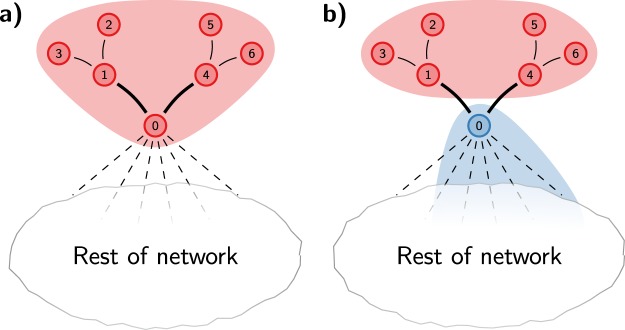
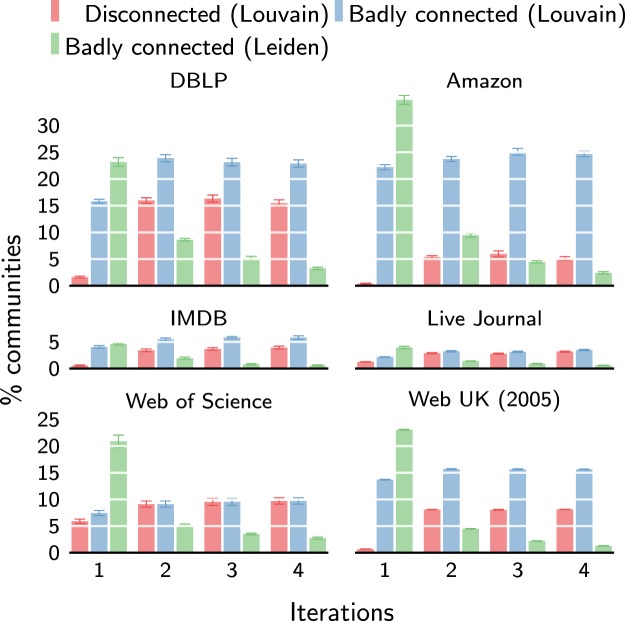
- Louvain may produce arbitrarily badly connected communities; in experiments up to 25% of communities were badly connected and up to 16% were disconnected. First-iteration badly connected percentages included Amazon 23%, DBLP 16%, and Web UK 14%; disconnected communities were usually around 1%, but exceeded 5% for Web of Science in the first iteration and jumped to 16% for DBLP in later iterations. After four iterations, Amazon had 5% disconnected but 25% badly connected communities.
- Leiden guarantees all communities are connected after each iteration, and also γ-separated and γ-connected. After a stable iteration, all nodes are locally optimally assigned and all communities are subpartition γ-dense; asymptotically, all communities are uniformly γ-dense and subset optimal.
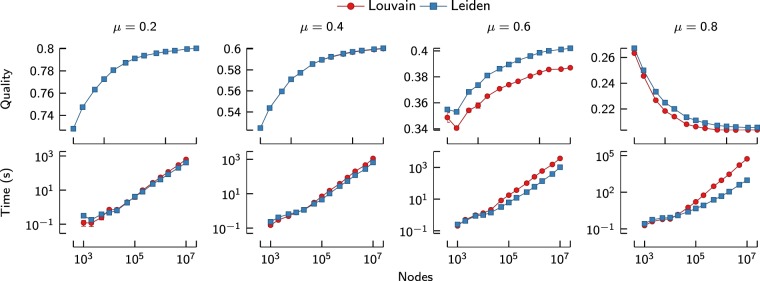
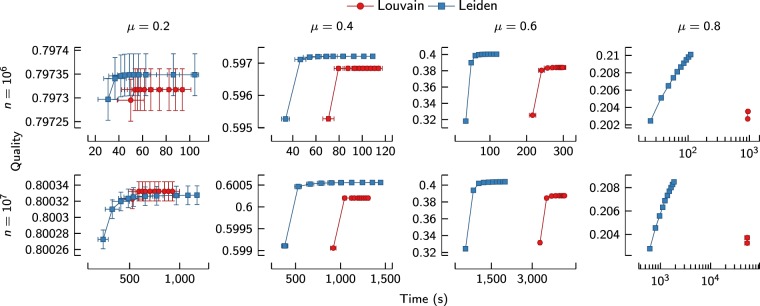
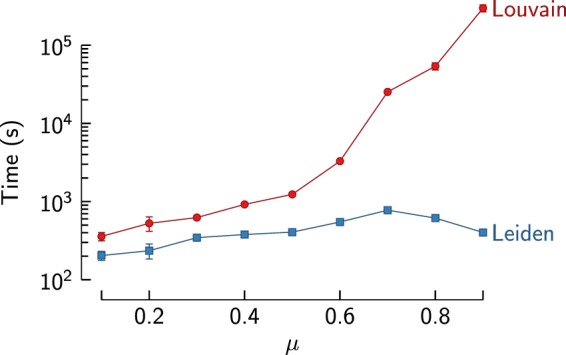
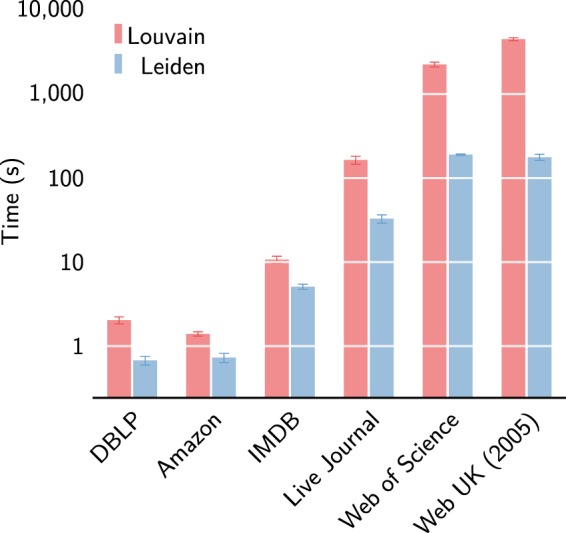
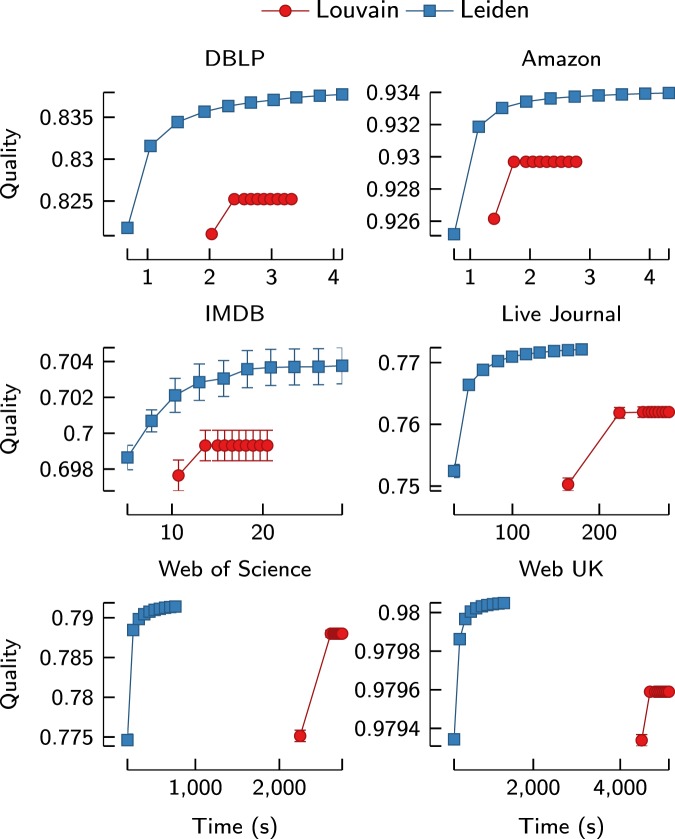
- Leiden was faster than Louvain: first iteration roughly 2–20 times faster on empirical networks, including more than 7× faster for Live Journal, more than 11× for Web of Science, and more than 20× for Web UK. On benchmark networks with difficult partitions (μ = 0.9), Louvain required almost 2.5 days while Leiden needed fewer than 10 minutes; for largest networks Leiden reached 10–100 times faster runtimes.
- Leiden found higher modularity on all six empirical networks: DBLP 0.8387 vs 0.8262, Amazon 0.9341 vs 0.9301, IMDB 0.7069 vs 0.7062, Live Journal 0.7739 vs 0.7653, Web of Science 0.7951 vs 0.7911, and Web UK 0.9801 vs 0.9796.
Methods
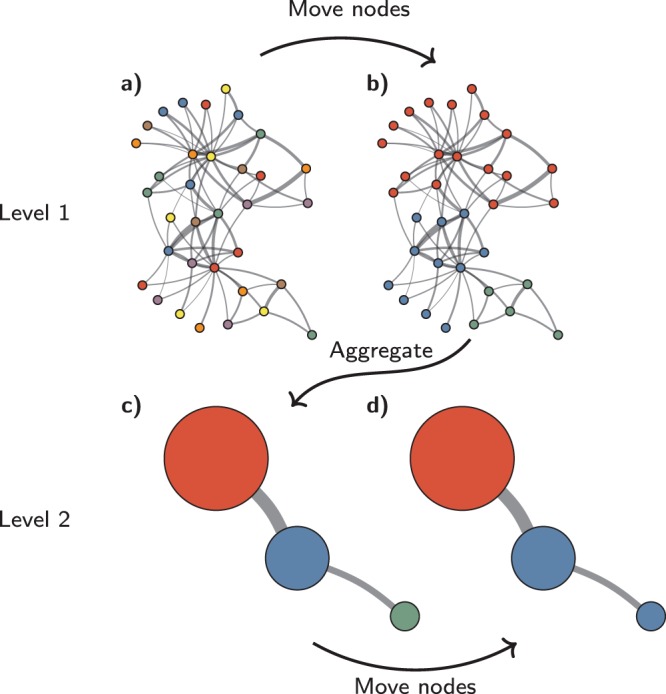
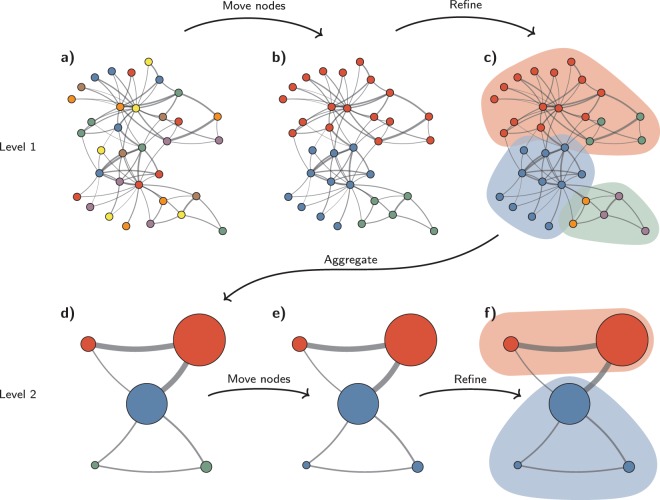
- The paper introduces the Leiden algorithm, which combines local moving, refinement of the partition, and aggregation; proofs of guarantees are relegated to Supplementary Information. It compares Leiden with Louvain on six empirical networks and on benchmark networks.
- Empirical networks: DBLP (317,080 nodes, degree 6.6), Amazon (334,863, 5.6), IMDB (374,511, 80.2), Live Journal (3,997,962, 17.4), Web of Science (9,811,130, 21.2), and Web UK (39,252,879, 39.8). Modularity was used with γ = 1; Table 2 reports maximal modularity after 10 replications of 10 iterations each. Badly connected community analysis was repeated 10 times, with Leiden run on each community’s subnetwork until a stable iteration.
- Benchmark networks ranged from n = 10^3 to n = 10^7 nodes, with community size 50 and CPM as the quality function; the mixing parameter μ varied, 10 iterations were performed, and each parameter set was repeated 10 times. The refinement randomness parameter was θ = 0.01.
Limitations
- The paper states that benchmark networks have only limited value because they are not representative of empirical real-world networks and have a rather simple structure.
- The paper states that counting communities split by Leiden gives only a lower bound on the number of badly connected communities; if Leiden does not find subcommunities, there is no guarantee that modularity cannot be increased by splitting the community.
- Evident from the text: there is no dedicated limitations section; technical details and proofs are relegated to Supplementary Information, and the experimental analysis fixes θ = 0.01 although values roughly in [0.0005, 0.1] are said to provide reasonable results.
Model-written summary. Check it against the paper before relying on it.
Integrity signals
Registry
Cites
Statistics
Figures
Verification
Claims the paper makes
1 Valid · 2 Not valid · 17 Not checked · 142 Own results and interpretations
The cited sources support only part of this claim — read each source’s verdict below.
In the paper
“Hence, the problem of Louvain outlined above is independent from the issue of the resolution limit.”
§ From Louvain to Leiden: guaranteeing well-connected communities > Louvain Algorithm > Badly connected communities
What the sources say
- Partly supportedcites [14] Fortunato S Barthélemy M Resolution Limit in Community Detection Proc. Natl. Acad. Sci. USA 2007 104 36 10.1073/pnas.0605965104 17190818 PMC1765466 sourceExperimental — accuracy not yet measured
Our copy supports the resolution-limit side of the sentence: the Conclusions (VI, p. 7) state that 'the resolution limit of modularity does not rely on particular network structures, but only on the comparison between the sizes of interconnected communities and that of the whole network', the Introduction (p. 1) calls it an 'intrinsic scale' of modularity, and Section V (pp. 5-6) shows the failure persists with simulated annealing, i.e. it is a property of the quality function rather than of one particular optimizer. What the source does not contain is the other term of the comparison: Louvain is never mentioned anywhere in the paper (the Introduction, p. 1, lists only generic greedy procedures [19,20], extremal optimization [21] and simulated annealing [22,23]), and no passage contrasts the resolution limit with an algorithm-specific defect. The independence claim is therefore the citing authors' own inference built on this paper's characterization of the resolution limit. (LLM, conf=0.70)
plain- Asserted: passes — The authors put it forward as true.
- Checkable: passes — It can be checked against evidence.
- Load-bearing: passes — The paper’s conclusions depend on it.
- Based: passes — The paper gives a reason why it holds.
- Partly supported
A result the paper states — it cites no source for it, so there is none to check. The quote shows it is in the paper.
In the paper
“The percentage of badly connected communities is less affected by the number of iterations of the Louvain algorithm.”
§ From Louvain to Leiden: guaranteeing well-connected communities > Experimental Analysis > Badly connected communities
plain- Asserted: passes — The authors put it forward as true.
- Checkable: passes — It can be checked against evidence.
- Load-bearing: unclear — It is unclear whether the paper’s conclusions depend on it.
- Based: passes — The paper gives a reason why it holds.
A result the paper states — it cites no source for it, so there is none to check. The quote shows it is in the paper.
In the paper
“In addition, we prove that, when the Leiden algorithm is applied iteratively, it converges to a partition in which all subsets of all communities are locally optimally assigned.”
- Also stated in: § Introduction · boosted
“In addition, we prove that the algorithm converges to an asymptotically stable partition in which all subsets of all communities are locally optimally assigned.”
§ From Louvain to Leiden: guaranteeing well-connected communities > Abstract
boostedstates a cause- Asserted: passes — The authors put it forward as true.
- Checkable: passes — It can be checked against evidence.
- Load-bearing: passes — The paper’s conclusions depend on it.
- Based: passes — The paper gives a reason why it holds.
- Also stated in: § Introduction · boosted
A result the paper reports from its own data — it cites no other source for it, so there is none to check. The quote shows it is in the paper.
In the paper
“The second iteration of Louvain shows a large increase in the percentage of disconnected communities.”
§ From Louvain to Leiden: guaranteeing well-connected communities > Experimental Analysis > Badly connected communities
plainstates a cause- Asserted: passes — The authors put it forward as true.
- Checkable: passes — It can be checked against evidence.
- Load-bearing: passes — The paper’s conclusions depend on it.
- Based: passes — The paper gives a reason why it holds.
A result the paper reports from its own data — it cites no other source for it, so there is none to check. The quote shows it is in the paper.
In the paper
“In terms of the percentage of badly connected communities in the first iteration, Leiden performs even worse than Louvain, as can be seen in Fig. 4.”
§ From Louvain to Leiden: guaranteeing well-connected communities > Experimental Analysis > Badly connected communities
plain- Asserted: passes — The authors put it forward as true.
- Checkable: passes — It can be checked against evidence.
- Load-bearing: unclear — It is unclear whether the paper’s conclusions depend on it.
- Based: passes — The paper gives a reason why it holds.
115 more claims
Create a free account to see all 162 claims and to verify the 24 references still open.
- Probably not a substantial claim. 23
- It may state two separate claims as one. 23
- The quote only partly states this claim. 1
Claims other papers make about this one
Each is checked against this paper’s own text: does it say what the citing paper says it does?
The cited source says what the claim attributes to it.
In the citing paper
“When compared to six common clustering algorithms, including Leiden25 and CellHarmony26, VFC was the top performing algorithm on every simulation on the T cell data and best performing, on average, on the zebrafish dataset, with a 57% increase in average performance over Louvain, which was the next best algorithm”
From Quantifying the effect of experimental perturbations at single-cell resolution (2021) · cites this paper as [25]
The cited source says what the claim attributes to it.
In the citing paper
“Louvain’s successor Leiden circumvents this issue by yielding guaranteed connected communities and is computationally more efficient52.”
From Best practices for single-cell analysis across modalities (2023) · cites this paper as [52]
The cited source says what the claim attributes to it.
In the citing paper
“However, the Louvain algorithm can lead to arbitrarily poorly connected communities52.”
From Best practices for single-cell analysis across modalities (2023) · cites this paper as [52]
The cited source says what the claim attributes to it.
In the citing paper
“We found that many t-types had total variance substantially above the variances of the k-means clusters (Fig. 5b) and an alternative analysis using entropies of Leiden clustering35 often highlighted the same t-types as variable (Extended Data Fig. 8).”
From Phenotypic variation of transcriptomic cell types in mouse motor cortex (2021) · cites this paper as [35]
The cited source says what the claim attributes to it.
In the citing paper
“Community detection uses the Leiden algorithm [28] with ModularityVertexPartition, producing hierarchical subclustering to depth 3.”
From SuperLocalMemory: Privacy-Preserving Multi-Agent Memory with Bayesian Trust Defense Against Memory Poisoning (2026) · cites this paper as [28]
6 more claims about this paper
Create a free account to see every claim other papers make about this one.
Citations
Cites
Fast unfolding of communities in large networks
Blondel, V. D., Guillaume, J.-L., Lambiotte, R., & Lefebvre, E. (2008) · Journal of Statistical Mechanics: Theory and Experiment · doi:10.1088/1742-5468/2008/10/p10008 · Cited by 21,424 · cited 3×
“The Louvain algorithm 10 is very simple and elegant.”
MethodFinding and evaluating community structure in networks
Newman, M. E. J., & Girvan, M. (2004) · Physical Review E · doi:10.1103/physreve.69.026113 · Cited by 13,931 · cited 2×
“The Leiden algorithm consists of three phases: (1) local moving of nodes, (2) refinement of the partition and (3) aggregation of the network based on the refined partition, using the non-refined partition to create an initial partition for the aggregate network.”
BackgroundMethodComplex brain networks: graph theoretical analysis of structural and functional systems
Bullmore, E., & Sporns, O. (2009) · Nature Reviews Neuroscience · doi:10.1038/nrn2575 · Cited by 11,820
Fortunato, S. (2010) · Physics Reports · doi:10.1016/j.physrep.2009.11.002 · Cited by 11,293 · cited 4×
“The Leiden algorithm consists of three phases: (1) local moving of nodes, (2) refinement of the partition and (3) aggregation of the network based on the refined partition, using the non-refined partition to create an initial partition for the aggregate network.”
BackgroundMethodInfluentialFinding community structure in very large networks
Clauset, A., Newman, M. E. J., & Moore, C. (2004) · Physical Review E · doi:10.1103/physreve.70.066111 · Cited by 7,390 · cited 1×
“Optimising modularity is NP-hard 5 , and consequentially many heuristic algorithms have been proposed, such as hierarchical agglomeration 6 , extremal optimisation 7 , simulated annealing 4,8 and spectral 9 algorithms.”
MethodFinding community structure in networks using the eigenvectors of matrices
Newman, M. E. J. (2006) · Physical Review E · doi:10.1103/physreve.74.036104 · Cited by 4,761
Functional cartography of complex metabolic networks
Guimerà, R., & Nunes Amaral, L. A. (2005) · Nature · doi:10.1038/nature03288 · Cited by 3,983 · cited 2×
“Optimising modularity is NP-hard 5 , and consequentially many heuristic algorithms have been proposed, such as hierarchical agglomeration 6 , extremal optimisation 7 , simulated annealing 4,8 and spectral 9 algorithms.”
MethodNear linear time algorithm to detect community structures in large-scale networks
Raghavan, U. N., Albert, R., & Kumara, S. (2007) · Physical Review E · doi:10.1103/physreve.76.036106 · Cited by 3,502 · cited 2×
“Trying to fix the problem by simply considering the connected components of communities 19–21 is unsatisfactory because it addresses only the most extreme case and does not resolve the more fundamental problem.”
BackgroundBenchmark graphs for testing community detection algorithms
Lancichinetti, A., Fortunato, S., & Radicchi, F. (2008) · Physical Review E · doi:10.1103/physreve.78.046110 · Cited by 3,051 · cited 1×
“To study the scaling of the Louvain and the Leiden algorithm, we rely on a variant of a well-known approach for constructing benchmark networks 28 .”
MethodResolution limit in community detection
Fortunato, S., & Barthélemy, M. (2007) · Proceedings of the National Academy of Sciences · doi:10.1073/pnas.0605965104 · Cited by 3,024 · cited 2×
“The algorithm may yield arbitrarily badly connected communities, over and above the well-known issue of the resolution limit 14 .”
Background
Research works printed but not linked: 2
- Porter MA Onnela J-P Mucha PJ Communities in Networks Not. AMS 2009 56 1082 1097
- Luecken, M. D. Application of multi-resolution partitioning of interaction networks to the study of complex disease. Ph.D. thesis, (University of Oxford, 2016).
Cited by
Items 501–600 of 7,288
DNA methylation controls stemness of astrocytes in health and ischaemia
Kremer, L. P. M., Cerrizuela, S., El‐Sammak, H., Shukairi, M. E. A., Ellinger, T., Straub, J., Korkmaz, A., Volk, K., Brunken, J., Kleber, S., et al. (2024) · Nature · doi:10.1038/s41586-024-07898-9 · Cited by 67
Comparative science mapping: a novel conceptual structure analysis with metadata
Aria, M., Cuccurullo, C., D’Aniello, L., Misuraca, M., & Spano, M. (2024) · Scientometrics · doi:10.1007/s11192-024-05161-6 · Cited by 67
“An improvement of the Louvain algorithm, known as Leiden algorithm, has been more recently proposed by Traag et al. (2019), overcoming some known limitations concerning the quality of detected communities and the robustness of results but, on the other hand, introducing additional complexity and…”
Li, E., Cheung, H. C., & Ma, S. (2024) · Scientific Reports · doi:10.1038/s41598-024-68109-z · Cited by 67
Bi-order multimodal integration of single-cell data
Dou, J., Liang, S., Mohanty, V., Miao, Q., Huang, Y., Liang, Q., Cheng, X., Kim, S., Choi, J., Li, Y., et al. (2022) · Genome Biology · doi:10.1186/s13059-022-02679-x · Cited by 66
“Leiden algorithm [56] is used to group cells into interconnected clusters (termed meta-cluster) based on constructed SNN graph with a resolution parameter set by users (default 0.5).”
MethodInfluentialNeuronal identity defines α-synuclein and tau toxicity
Praschberger, R., Kuenen, S., Schoovaerts, N., Kaempf, N., Singh, J., Janssens, J., Swerts, J., Nachman, E., Calatayud, C., Aerts, S., et al. (2023) · Neuron · doi:10.1016/j.neuron.2023.02.033 · Cited by 64
A multiresolution framework to characterize single-cell state landscapes
Mohammadi, S., Davila-Velderrain, J., & Kellis, M. (2020) · Nature Communications · doi:10.1038/s41467-020-18416-6 · Cited by 66
Cuevas-Diaz Duran, R., González-Orozco, J. C., Velasco, I., & Wu, J. Q. (2022) · Frontiers in Cell and Developmental Biology · doi:10.3389/fcell.2022.884748 · Cited by 66
“Although the Louvain logarithm is very popular, some authors have identified flaws, resulting in badly connected communities, so the use of the Leiden algorithm has been proposed as an alternative (Traag et al., 2019).”
BackgroundIntegration and Querying of Multimodal Single-Cell Data with PoE-VAE
Litinetskaya, A., Shulman, M., Curion, F., Szałata, A., Omidi, A., Lotfollahi, M., & Theis, F. J. (2025) · Lecture notes in computer science · doi:10.1007/978-3-031-90252-9_36 · Cited by 66
Hammer, Q., Dunst, J., Christ, W., Picarazzi, F., Wendorff, M., Momayyezi, P., Huhn, O., Netskar, H., Maleki, K. T., García, M., et al. (2022) · Cell Reports · doi:10.1016/j.celrep.2022.110503 · Cited by 66
“Uniform Manifold Approximation and Projection (UMAP) embedding was computed in SCANPY and clustering was performed using the Leiden algorithm (Traag et al., 2019).”
Perdigoto, A. L., Deng, S., Du, K., Kuchroo, M. R., Burkhardt, D. B., Tong, A., Israel, G. M., Robert, M., Weisberg, S. P., Kirkiles-Smith, N. C., et al. (2022) · JCI Insight · doi:10.1172/jci.insight.156330 · Cited by 66
Jorssen, J., Hulst, G. V., Mollers, K., Pujol, J., Petrellis, G., Baptista, A. P., Schetters, S. T. T., Baron, F., Caers, J., Lambrecht, B. N., et al. (2024) · Immunity · doi:10.1016/j.immuni.2024.04.027 · Cited by 66
Characterizing the impacts of dataset imbalance on single-cell data integration
Maan, H., Zhang, L., Yu, C., Geuenich, M. J., Campbell, K. R., & Wang, B. (2024) · Nature Biotechnology · doi:10.1038/s41587-023-02097-9 · Cited by 66
“Performance in integration and downstream tasks was assessed using the integrated embeddings and Leiden clustering 48 results from each integration technique.”
Leclercq-Cohen, G., Steinhoff, N., Albertí Servera, L., Nassiri, S., Danilin, S., Piccione, E., Yángüez, E., Hüsser, T., Herter, S., Schmeing, S., et al. (2023) · Clinical Cancer Research · doi:10.1158/1078-0432.ccr-22-3667 · Cited by 65
Characterization of HIV-1 Infection in Microglia-Containing Human Cerebral Organoids
Gumbs, S. B. H., Berdenis van Berlekom, A., Kübler, R., Schipper, P. J., Gharu, L., Boks, M. P., Ormel, P. R., Wensing, A. M. J., de Witte, L. D., & Nijhuis, M. (2022) · Viruses · doi:10.3390/v14040829 · Cited by 65
Age-specific nasal epithelial responses to SARS-CoV-2 infection
Woodall, M. N. J., Cujba, A.-M., Worlock, K. B., Case, K., Masonou, T., Yoshida, M., Polański, K., Huang, N., Lindeboom, R. G. H., Mamanova, L., et al. (2024) · Nature Microbiology · doi:10.1038/s41564-024-01658-1 · Cited by 65
“Leiden clustering with a resolution of 1 was used to separate broad cell types (basal, goblet, secretory).”
InfluentialDrugs of abuse hijack a mesolimbic pathway that processes homeostatic need
Tan, B., Browne, C. J., Nöbauer, T., Vaziri, A., Friedman, J. M., & Nestler, E. J. (2024) · Science · doi:10.1126/science.adk6742 · Cited by 65
“Then, the clustering was calculated with Leiden algorithm (92).”
A streamlined whole blood CyTOF workflow defines a circulating immune cell signature of COVID ‐19
Geanon, D., Lee, B. H., Gonzalez‐Kozlova, E., Kelly, G., Handler, D., Upadhyaya, B., Leech, J. M., de Real, R. M., Herbinet, M., Magen, A., et al. (2021) · Cytometry Part A · doi:10.1002/cyto.a.24317 · Cited by 65
“These highly granular clusters were then re-clustered on a per-sample basis using the SCANPY(10) implementation of the Leiden community detection algorithm.(11) This approach overcomes the computational limitations of implementing the Leiden algorithm directly on millions of”
MethodDeciphering the spatial-temporal transcriptional landscape of human hypothalamus development
Zhou, X., Lu, Y., Zhao, F., Dong, J., Ma, W., Zhong, S., Wang, M., Wang, B., Zhao, Y., Shi, Y., et al. (2021) · Cell stem cell · doi:10.1016/j.stem.2021.11.009 · Cited by 65
Bascur, J. P., Verberne, S., van Eck, N. J., & Waltman, L. (2023) · Scientometrics · doi:10.1007/s11192-023-04681-x · Cited by 65
“We performed the clustering using the Leiden algorithm (Traag et al., 2019) inspired by the methodology developed by Waltman and van Eck (2012).”
MethodSelf-citationSang-aram, C., Browaeys, R., Seurinck, R., & Saeys, Y. (2024) · eLife · doi:10.7554/elife.88431 · Cited by 65
“Leiden clustering ( Traag et al., 2019 ) was performed using 17 principal components and 35 neighbors, and cells were annotated using scanpy. tl. score_ genes with a curated marker gene list.”
MethodThe single-cell transcriptome program of nodule development cellular lineages in Medicago truncatula
Pereira, W. J., Boyd, J., Conde, D., Triozzi, P. M., Balmant, K. M., Dervinis, C., Schmidt, H. W., Novaes, C. R. D. B., Chakraborty, S., Knaack, S., et al. (2024) · Cell Reports · doi:10.1016/j.celrep.2024.113747 · Cited by 64
Ledergor, G., Fan, Z., Wu, K., McCarthy, E. E., Wittsten, A. H., Starzinski, A., Chang, H., Bridge, M., Kwek, S. S., Cheung, A., et al. (2024) · Blood Advances · doi:10.1182/bloodadvances.2023012416 · Cited by 64
Modeling and analyzing single-cell multimodal data with deep parametric inference
Hu, H., Feng, Z., Lin, H., Zhao, J., Zhang, Y., Xu, F., Chen, L., Chen, F., Ma, Y., Su, J., et al. (2023) · Briefings in Bioinformatics · doi:10.1093/bib/bbad005 · Cited by 64
Phase I Study of ROR1-Specific CAR-T Cells in Advanced Hematopoietic and Epithelial Malignancies
Jaeger-Ruckstuhl, C. A., Specht, J. M., Voutsinas, J. M., Macmillan, H., Wu, Q. V., Muhunthan, V., Berger, C., Pullarkat, S., Wright, J. H., Yeung, C. C. S., et al. (2024) · Clinical Cancer Research · doi:10.1158/1078-0432.ccr-24-2172 · Cited by 64
“40, 41).”
Epigenetic priming by Dppa2 and 4 in pluripotency facilitates multi-lineage commitment
Eckersley-Maslin, M. A., Parry, A., Blotenburg, M., Krueger, C., Ito, Y., Franklin, V. N. R., Narita, M., D’Santos, C. S., & Reik, W. (2020) · Nature Structural & Molecular Biology · doi:10.1038/s41594-020-0443-3 · Cited by 64
Kefalakes, H., Horgan, X. J., Jung, M. K., Amanakis, G., Kapuria, D., Bolte, F. J., Kleiner, D. E., Koh, C., Heller, T., & Rehermann, B. (2021) · Gastroenterology · doi:10.1053/j.gastro.2021.07.027 · Cited by 64
Drost, F., An, Y., Bonafonte-Pardàs, I., Dratva, L. M., Lindeboom, R. G. H., Haniffa, M. A., Teichmann, S. A., Theis, F. J., Lotfollahi, M., & Schubert, B. (2024) · Nature Communications · doi:10.1038/s41467-024-49806-9 · Cited by 64
“The resulting representations were clustered viatheLeidenalgorithm 21 , wheretheresolutionwaschosentomaximize the NMI between pMHC speci fi city and cluster annotation.”
NKG2A is a late immune checkpoint on CD8 T cells and marks repeated stimulation and cell division
Borst, L., Sluijter, M., Sturm, G., Charoentong, P., Santegoets, S. J. A. M., van Gulijk, M., van Elsas, M. J., Groeneveldt, C., van Montfoort, N., Finotello, F., et al. (2021) · International Journal of Cancer · doi:10.1002/ijc.33859 · Cited by 64
“The 6000 most highly variable genes were selected and used for unsupervised Leiden-clustering.(25) Embeddings were visualized using UMAP.”
MethodCruickshank, I. J., & Carley, K. M. (2020) · Applied Network Science · doi:10.1007/s41109-020-00317-8 · Cited by 64
“For the second requirement, we use network modularity due to its effectiveness as a clustering quality function for networks or graphs and because many fast, scalable heuristics already exist for maximizing network modularity (i.e. Louvain (Blondel et al. 2008), Leiden (Traag et al. 2019), etc.).”
MethodInfluentialModularity and Dynamics on Complex Networks
Lambiotte, R., & Schaub, M. T. (2021) · Cambridge University Press eBooks · doi:10.1017/9781108774116 · Cited by 64
Maltracker: A Fine-Grained NPM Malware Tracker Copiloted by LLM-Enhanced Dataset
Yu, Z., Wen, M., Guo, X., & Jin, H. (2024) · ACM SIGSOFT International Symposium on Software Testing and Analysis (ISSTA) · doi:10.1145/3650212.3680397 · Cited by 64
“Specifically, we leverage the Leiden algorithm [43] to achieve community detection .”
Molecular characterization of projection neuron subtypes in the mouse olfactory bulb
Zeppilli, S., Ackels, T., Attey, R., Klimpert, N., Ritola, K., Boeing, S., Crombach, A., Schaefer, A. T., & Fleischmann, A. (2021) · eLife · doi:10.7554/elife.65445 · Cited by 63
Deep profiling deconstructs features associated with memory CD8+ T cell tissue residence
Scott, M. C., Steier, Z., Pierson, M. J., Stolley, J. M., O’Flanagan, S. D., Soerens, A. G., Wijeyesinghe, S., Beura, L. K., Dileepan, G., Burbach, B. J., et al. (2024) · Immunity · doi:10.1016/j.immuni.2024.11.007 · Cited by 63
Domingo-Gonzalez, R., Zanini, F., Che, X., Liu, M., Jones, R. C., Swift, M. A., Quake, S. R., Cornfield, D. N., & Alvira, C. M. (2020) · eLife · doi:10.7554/elife.56890 · Cited by 63
“Fifteen cell clusters were identified via Leiden community detection (Traag et al., 2019) and verified by t-distributed stochastic neighbor embedding (t-SNE) (van der Maaten and Hinton, 2008; Figure 1B).”
MethodMadden, D. J., Jain, S., Monge, Z. A., Cook, A. D., Lee, A., Huang, H., Howard, C. M., & Cohen, J. R. (2020) · Neurobiology of Aging · doi:10.1016/j.neurobiolaging.2020.09.010 · Cited by 63
“Module definition is an estimate of the community structure of the network and is influenced by many variables, including the resolution of the partitioning algorithm and the degree of interconnectedness between pairs of communities (Fortunato and Barthélemy, 2007; Traag et al., 2019).”
BackgroundMorrison, J. K., DeRossi, C., Alter, I. L., Nayar, S., Giri, M., Zhang, C., Cho, J. H., & Chu, J. (2022) · Hepatology Communications · doi:10.1002/hep4.1930 · Cited by 63
Ruberto, A. A., Maher, S. P., Vantaux, A., Joyner, C. J., Bourke, C., Balan, B., Jex, A. R., Müeller, I., Witkowski, B., & Kyle, D. E. (2022) · Frontiers in Cellular and Infection Microbiology · doi:10.3389/fcimb.2022.986314 · Cited by 63
“Consistent with our reasoning, an unsupervised clustering algorithm (Traag et al., 2019) unbiasedly assigned the cells to one of the two clusters”
MethodBennett, S., Cucuringu, M., & Reinert, G. (2022) · Machine Learning · doi:10.1007/s10994-022-06250-4 · Cited by 63
“State-of-the-art modularity clustering algorithms such as the Leiden algorithm [Traag et al., 2019] may be used on directed graphs using a directed modularity metric [Dugué and Perez, 2015].”
Evaluating the Utilities of Foundation Models in Single-cell Data Analysis
Liu, T., Li, K., Wang, Y., Li, H., & Zhao, H. (2023) · doi:10.1101/2023.09.08.555192 · Cited by 62
mbkmeans: Fast clustering for single cell data using mini-batch k-means
Hicks, S. C., Liu, R., Ni, Y., Purdom, E., & Risso, D. (2021) · PLOS Computational Biology · doi:10.1371/journal.pcbi.1008625 · Cited by 62
“Alternatively, after normalization and PCA, we performed batch correction using the BBKNN method [42] and Leiden clustering [27] on the resulting network.”
InfluentialVornholz, L., Isay, S. E., Kurgyis, Z., Strobl, D. C., Loll, P., Mosa, M. H., Luecken, M. D., Sterr, M., Lickert, H., Winter, C., et al. (2023) · Science Advances · doi:10.1126/sciadv.add8564 · Cited by 62
Wang, C., Wang, F., & Onega, T. (2020) · Transactions in GIS · doi:10.1111/tgis.12722 · Cited by 62
“The recent development of the Leiden algorithm is clearly motivated by remedies to the aforementioned deficiencies in the Louvain algorithm (Traag et al., 2019).”
BackgroundMethodResultInfluentialscMAE: a masked autoencoder for single-cell RNA-seq clustering
Fang, Z., Zheng, R., & Li, M. (2024) · Bioinformatics · doi:10.1093/bioinformatics/btae020 · Cited by 62
“In this paper, we use two general clustering methods: K-means (Hartigan and Wong 1979) scMAE and Leiden (Traag et al. 2019) clustering.”
MethodInfluentialNg, L. H. X., & Carley, K. M. (2022) · ACM Web Science Conference (WebSci) · doi:10.1145/3501247.3531542 · Cited by 62
Single-cell sequencing deconvolutes cellular responses to exercise in human skeletal muscle
Lovrić, A., Rassolie, A., Alam, S., Mandić, M., Saini, A. S., Altun, M., Fernandez‐Gonzalo, R., Gustafsson, T. P., & Rullman, E. (2022) · Communications Biology · doi:10.1038/s42003-022-04088-z · Cited by 62
ArchRAG: Attributed Community-based Hierarchical Retrieval-Augmented Generation
Wang, S., Fang, Y., Zhou, Y., Liu, X., & Ma, Y. (2026) · Proceedings of the AAAI Conference on Artificial Intelligence · doi:10.1609/aaai.v40i19.38619 · Cited by 62
Retrieval-Augmented Generation with Hierarchical KnowledgePreprint
Huang, H., Huang, Y., Yang, J., Pan, Z., Chen, Y., Ma, K., Chen, H., & Cheng, J. S.-C. (2025) · arXiv (Cornell University) · doi:10.48550/arxiv.2503.10150 · Cited by 62
Marras, C., Passarotti, M., Franzini, G., & Litta, E. (2020) · Lirias (KU Leuven) · doi:10.17613/nrq0-b075 · Cited by 62
Evaluating the Utilities of Foundation Models in Single‐Cell Data Analysis
Liu, T., Li, K., Wang, Y., Li, H., & Zhao, H. (2026) · Advanced Science · doi:10.1002/advs.202514490 · Cited by 61
Fetahu, I. S., Esser‐Skala, W., Dnyansagar, R., Sindelar, S., Rifatbegovic, F., Bileck, A., Skos, L., Bozsaky, E., Lazic, D., Shaw, L. E., et al. (2023) · Nature Communications · doi:10.1038/s41467-023-39210-0 · Cited by 61
“Finally, Leiden clustering 85 was performed on UMAP coordinates.”
Kreimer, S. D., Binek, A., Chazarin, B., Cho, J. H., Haghani, A., Hutton, A., Marbán, E., Mastali, M., Meyer, J. G., Mesquita, T., et al. (2023) · Analytical Chemistry · doi:10.1021/acs.analchem.3c00213 · Cited by 61
Salim, S., Turnbull, B., & Moustafa, N. (2021) · IEEE Transactions on Computational Social Systems · doi:10.1109/tcss.2021.3134463 · Cited by 61
“For this, we use the Leiden algorithm [38].”
MethodO’Neill, K., Shaw, R., Bolger, I., Tam, O. H., Phatnani, H. P., & Hammell, M. (2025) · Cell Reports · doi:10.1016/j.celrep.2025.115402 · Cited by 61
“A UMAP of all motor cortex astrocytes is given in Figure 6A, where Leiden clustering 43 identified 14 astrocyte clusters, nine of which showed no evidence of doublets or cell-type assignment errors (Table S6).”
The genomic history of the indigenous people of the Canary Islands
Serrano, J. G., Ordóñez, A. C., Santana, J., Sánchez‐Cañadillas, E., Arnay, M., Rodríguez, A. R., Morales, J., Vázquez, J. V., Barroso, V. A., Delgado‐Darias, T., et al. (2023) · Nature Communications · doi:10.1038/s41467-023-40198-w · Cited by 61
Kupffer cell programming by maternal obesity triggers fatty liver disease
Huang, H., Balzer, N. R., Seep, L., Šplíchalová, I., Blank-Stein, N., Viola, M. F., Taveras, E. F., Acil, K., Fink, D., Petrovic, F., et al. (2025) · Nature · doi:10.1038/s41586-025-09190-w · Cited by 61
“The resulting network, with 4,214 nodes and 286,853 edges, was then clustered using the Leiden algorithm 69 .”
Marteau, V., Nemati, N., Handler, K., Raju, D., Kirchmair, A., Rieder, D., Soto, E. K., Fotakis, G., de Lange, G., Carollo, S., et al. (2026) · Cancer Cell · doi:10.1016/j.ccell.2025.12.003 · Cited by 61
Single-cell transcriptome landscape of circulating CD4+ T cell populations in autoimmune diseases
Yasumizu, Y., Takeuchi, D., Morimoto, R., Takeshima, Y., Okuno, T., Kinoshita, M., Morita, T., Kato, Y., Wang, M., Motooka, D., et al. (2024) · Cell Genomics · doi:10.1016/j.xgen.2023.100473 · Cited by 60
Wang, K., He, Q., Yang, M., Qiao, Q., Chen, J., Song, J., Zang, N., Hu, H., Xia, L., Xiang, Y., et al. (2024) · Journal of Extracellular Vesicles · doi:10.1002/jev2.70013 · Cited by 60
A Single Cell Transcriptomic Atlas Characterizes Aging Tissues in the MousePreprint
Pisco, A. O., McGeever, A., Schaum, N., Karkanias, J., Neff, N. F., Darmanis, S., Wyss‐Coray, T., & Quake, S. R. (2019) · bioRxiv (Cold Spring Harbor Laboratory) · doi:10.1101/661728 · Cited by 60
Correlation-Based Feature Selection to Identify Functional Dynamics in Proteins
Diez, G., Nagel, D., & Stock, G. (2022) · Journal of Chemical Theory and Computation · doi:10.1021/acs.jctc.2c00337 · Cited by 60
Valkiers, S., de Vrij, N., Gielis, S., Verbandt, S., Ogunjimi, B., Laukens, K., & Meysman, P. (2022) · ImmunoInformatics · doi:10.1016/j.immuno.2022.100009 · Cited by 61
Žužul, T., Pahnke, E. C., Larson, J., Bourke, P., Caurvina, N., Shah, N. P., Amini, F., Weston, J., Park, Y., Vogelstein, J. T., et al. (2024) · Management Science · doi:10.1287/mnsc.2022.02797 · Cited by 60
Neural-Symbolic Dual-Indexing Architectures for Scalable Retrieval-Augmented Generation
Yang, J.-S., Zeng, Z., & Shen, Z. (2025) · IEEE Access · doi:10.1109/access.2025.3638761 · Cited by 60
Hartmann, D., Wang, S. M., Pohlmann, L., & Berendt, B. (2025) · Journal of Computational Social Science · doi:10.1007/s42001-025-00381-z · Cited by 59
“The modularity score measures the degree to which nodes within a community are more densely connected than nodes outside the community [199].”
BackgroundMethodZhu, J., Pang, K., Hu, B., He, R., Wang, N., Jiang, Z., Ji, P., & Zhao, F. (2024) · Nature Genetics · doi:10.1038/s41588-024-01906-4 · Cited by 59
“Clustering was performed by constructing a shared nearest-neighbor graph based on the transcriptomic data using established components and clusters identified through the Louvain 53 or Leiden algorithm 54 .”
Maximally selective single-cell target for circuit control in epilepsy models
Hadjiabadi, D. H., Lovett-Barron, M., Raikov, I., Sparks, F. T., Liao, Z., Baraban, S. C., Leskovec, J., Losonczy, A., Deisseroth, K. A., & Soltész, I. (2021) · Neuron · doi:10.1016/j.neuron.2021.06.007 · Cited by 59
Vanuytsel, K., Villacorta-Martín, C., Lindstrom-Vautrin, J., Wang, Z., García-Beltrán, W. F., Vrbanac, V. D., Parsons, D., Lam, E. C., Matte, T. M., Dowrey, T. W., et al. (2022) · Nature Communications · doi:10.1038/s41467-022-28616-x · Cited by 59
An open-source framework for end-to-end analysis of electronic health record data
Heumos, L., Ehmele, P., Treis, T., zu Belzen, J. U., Roellin, E., May, L., Namsaraeva, A., Horlava, N., Shitov, V. A., Zhang, X., et al. (2024) · Nature Medicine · doi:10.1038/s41591-024-03214-0 · Cited by 59
“Leiden clustering 62 identified four patient groupings with distinct clinical features that we annotated (Fig.”
Rebboah, E., Reese, F., Williams, K., Balderrama-Gutierrez, G., McGill, C., Trout, D., Rodriguez, I., Liang, H., Wold, B. J., & Mortazavi, A. (2021) · Genome Biology · doi:10.1186/s13059-021-02505-w · Cited by 58
“Clustering using the Leiden algorithm (v. 0.8.0) resulted in 20 clusters [58].”
MethodInfluentialA hitchhiker's guide to single-cell transcriptomics and data analysis pipelines
Nayak, R., & Hasija, Y. (2021) · Genomics · doi:10.1016/j.ygeno.2021.01.007 · Cited by 58
Whytock, K. L., Sun, Y., Divoux, A., Yu, G., Smith, S. R., Walsh, M. J., & Sparks, L. M. (2022) · iScience · doi:10.1016/j.isci.2022.104772 · Cited by 58
“Monocle 3 was used for trajectory analysis (Cao et al., 2019; Levine et al., 2015; Qiu et al., 2017; Traag et al., 2019; Trapnell et al., 2014).”
MethodInfluentialCao, S., Feng, H., Yi, H., Pan, M., Lin, L., Zhang, Y. S., Feng, Z., Liang, W., Cai, B., Li, Q., et al. (2023) · Cell Research · doi:10.1038/s41422-023-00802-6 · Cited by 58
Library size confounds biology in spatial transcriptomics data
Bhuva, D. D., Tan, C. W., Salim, A., Marceaux, C., Pickering, M. A., Chen, J., Kharbanda, M., Jin, X., Liu, N., Feher, K., et al. (2024) · Genome biology · doi:10.1186/s13059-024-03241-7 · Cited by 58
“Next, community detection was performed using the walktrap, Louvain [31], or Leiden [32] approaches.”
MethodJia, T., Cai, C., Li, X., Luo, X., Zhang, Y., & Yu, X. (2022) · International Journal of Geographical Information Science · doi:10.1080/13658816.2022.2055037 · Cited by 58
“The Leiden technique is used to identify the well-connected and locally optimal dynamical urban mobility communities (Traag et al. 2019), which mainly comprises the following steps as shown in Figure 3.”
MethodImmunosuppressive niche engineering at the onset of human colorectal cancer
Gatenbee, C., Baker, A., Schenck, R. O., Strobl, M. A. R., West, J., Neves, M. P., Hasan, S. Y., Lakatos, E., Martinez, P., Cross, W. C. H., et al. (2022) · Nature Communications · doi:10.1038/s41467-022-29027-8 · Cited by 58
Multimodal Charting of Molecular and Functional Cell States via in situ Electro-Seq
Li, Q., Lin, Z., Liu, R., Tang, X., Huang, J., He, Y., Sui, X., Tian, W., Shen, H., Zhou, H., et al. (2022) · Cell · doi:10.1016/j.cell.2023.03.023 · Cited by 58
Munz, M., Bharioke, A., Kosche, G., Moreno‐Juan, V., Brignall, A. C., Rodrigues, T. M., Graff-Meyer, A., Ulmer, T., Haeuselmann, S., Pavlinić, D., et al. (2023) · Cell · doi:10.1016/j.cell.2023.03.025 · Cited by 58
“Color: Leiden clusters.(72) (E) Top: Rbp4-Cre types (colored as in D) embedded in a triangle representing the similarity between each cell’s expression profile from the three adult L5-PN types (NP, IT, and PT)(8) (Figure S1).”
MENDER: fast and scalable tissue structure identification in spatial omics data
Yuan, Z. (2024) · Nature Communications · doi:10.1038/s41467-023-44367-9 · Cited by 58
“We benchmarked MENDER against4 spatialmethods (i.e., STAGATE 19 , BASS 23 , CNC 12 , and SOTIP 27 ) that supported multi-slice analysis, 2 non-spatial algorithms (i.e.,LouvainandLeiden 36 ),and1methodthatissingle-rangeversionof MENDER (i.e., SingleRange).”
Continental influx and pervasive matrilocality in Iron Age Britain
Cassidy, L. M., Russell, M., Smith, M. J., Delbarre, G., Cheetham, P., Manley, H., Mattiangeli, V., Breslin, E. M., Jackson, I., McCann, M., et al. (2025) · Nature · doi:10.1038/s41586-024-08409-6 · Cited by 58
Advances and challenges in single-cell RNA sequencing data analysis: a comprehensive review
Nesari, A. M., MotieGhader, H., & Ghorbian, . (2026) · Briefings in Bioinformatics · doi:10.1093/bib/bbaf723 · Cited by 58
“Louvain detects cell clusters by optimizing modularity in cell– cell similarity graphs, while Leiden extends Louvain to better resolve complex, hierarchical structures [39].”
Reasoning-Enhanced Healthcare Predictions with Knowledge Graph Community Retrieval
Jiang, P., Xiao, C., Jiang, M., Bhatia, P., Kass‐Hout, T., Sun, J., & Han, J. (2025) · International Conference on Learning Representations · doi:10.48550/arxiv.2410.04585 · Cited by 58
Age-dependent immune and lymphatic responses after spinal cord injury
Salvador, A. F., Dykstra, T., Rustenhoven, J., Gao, W., Blackburn, S. M., Bhasiin, K., Dong, M. Q., Guimarães, R. M., Gonuguntla, S., Smirnov, I., et al. (2023) · Neuron · doi:10.1016/j.neuron.2023.04.011 · Cited by 57
Du, Y., & Sun, F. (2022) · Genome biology · doi:10.1186/s13059-022-02626-w · Cited by 57
Xu, Y., Jiang, K., Su, F., Deng, R., Cheng, Z., Wang, D., Yu, Y., & Xiang, Y. (2023) · Cell Reports · doi:10.1016/j.celrep.2023.113174 · Cited by 57
Single-cell manifold-preserving feature selection for detecting rare cell populations
Liang, S., Mohanty, V., Dou, J., Miao, Q., Huang, Y., Müftüoğlu, M., Ding, L., Peng, W., & Chen, K. (2021) · Nature Computational Science · doi:10.1038/s43588-021-00070-7 · Cited by 57
“For the unsupervised run, we used the Leiden algorithm 63 for clustering, which is the recommended method in SCANPY.”
MethodMehtonen, J., Teppo, S., Lahnalampi, M., Kokko, A., Kaukonen, R., Oksa, L., Bouvy‐Liivrand, M., Malyukova, A., Mäkinen, A., Laukkanen, S., et al. (2020) · Genome Medicine · doi:10.1186/s13073-020-00799-2 · Cited by 57
Modularity maximization as a flexible and generic framework for brain network exploratory analysis
Esfahlani, F. Z., Jo, Y., Puxeddu, M. G., Merritt, H., Tanner, J., Greenwell, S. A., Patel, R., Faskowitz, J., & Betzel, R. F. (2021) · NeuroImage · doi:10.1016/j.neuroimage.2021.118607 · Cited by 57
Kim, S. S., Truong, B., Jagadeesh, K., Dey, K. K., Shen, A. Z., Raychaudhuri, S., Kellis, M., & Price, A. L. (2024) · Nature Communications · doi:10.1038/s41467-024-44742-0 · Cited by 56
igraph 1.0 enables fast and robust network analysis across programming languages
Antonov, M., Csárdi, G., Horvát, S., Müller, K., Nepusz, T., Noom, D., Salmon, M., Traag, V., Welles, B. F., & Zanini, F. (2026) · PLOS One · doi:10.1371/journal.pone.0355108 · Cited by 56
“Community detection includes, among others, Leiden [26], multilevel (or Louvain) [30] and fluid communities [31].”
Self-citationA review of computational strategies for denoising and imputation of single-cell transcriptomic data
Patruno, L., Maspero, D., Craighero, F., Angaroni, F., Antoniotti, M., & Graudenzi, A. (2020) · Briefings in Bioinformatics · doi:10.1093/bib/bbaa222 · Cited by 56
Ackerman, J. E., Best, K. T., Muscat, S. N., Pritchett, E. M., Nichols, A. E. C., Wu, C., & Loiselle, A. E. (2022) · Cell Reports · doi:10.1016/j.celrep.2022.111706 · Cited by 56
Qin, J., Wang, D., & Liang, Y. (2023) · Information Sciences · doi:10.1016/j.ins.2023.119678 · Cited by 56
Bone marrow plasma cells require P2RX4 to sense extracellular ATP
Ishikawa, M., Hasanali, Z. S., Zhao, Y., Das, A., Lavaert, M., Roman, C. J., Londregan, J., Allman, D., & Bhandoola, A. (2024) · Nature · doi:10.1038/s41586-024-07047-2 · Cited by 56
Four Core Genotypes mice harbour a 3.2MB X-Y translocation that perturbs Tlr7 dosage
Panten, J., Prete, S., Cleland, J., Saunders, L. M., van Riet, J., Schneider, A., Ginno, P. A., Schneider, N., Koch, M.-L., Chen, X., et al. (2024) · Nature Communications · doi:10.1038/s41467-024-52640-8 · Cited by 56
“Initial major cell-type clusters were identi fi ed by Leiden clustering ( k =20, resolution =1 e – 6 ) 28 .”
BackgroundEpigenetic alterations in skin homing CD4+CLA+ T cells of atopic dermatitis patients
Acevedo, N., Benfeitas, R., Katayama, S., Bruhn, S., Andersson, A., Wikberg, G., Lundeberg, L., Lindvall, J. M., Greco, D., Kere, J., et al. (2020) · Scientific Reports · doi:10.1038/s41598-020-74798-z · Cited by 56
B-Cell Compartmental Features and Molecular Basis for Therapy in Autoimmune Disease
Zhang, C., Zhang, T., Liu, Y., Jia, D., Zeng, P., Chen, D., Yuan, M., Liu, Q., Wang, Y., & Shi, F. (2021) · Neurology Neuroimmunology & Neuroinflammation · doi:10.1212/nxi.0000000000001070 · Cited by 56
Spatial transcriptomics using multiplexed deterministic barcoding in tissue
Wirth, J., Huber, N., Yin, K., Brood, S., Chang, S., Martinez‐Jimenez, C. P., & Meier, M. (2023) · Nature Communications · doi:10.1038/s41467-023-37111-w · Cited by 56
“Colors denote clusters which were determined using the Leiden algorithm (Traag et al., 2019).”
MethodInfluentialWeng, Y., Wang, H., Wu, D., Xu, S., Chen, X., Huang, J., Feng, Y., Li, L., & Wang, Z. (2022) · Cell Research · doi:10.1038/s41422-022-00687-x · Cited by 56
Sympathetic Innervation Regulates Osteocyte‐Mediated Cortical Bone Resorption during Lactation
Guo, Q., Chen, N., Cheng, Q., Qi, C., Noller, K., Wan, M., Liu, X., Zhang, W., Cahan, P., & Cao, X. (2023) · Advanced Science · doi:10.1002/advs.202207602 · Cited by 56
T-bet+ CXCR3+ B cells drive hyperreactive B-T cell interactions in multiple sclerosis
Jelčić, I., Naghavian, R., Fanaswala, I., Macnair, W., Esposito, C., Calini, D., Han, Y., Marti, Z., Raposo, C., del Castillo, J. S., et al. (2025) · Cell Reports Medicine · doi:10.1016/j.xcrm.2025.102027 · Cited by 56
Metadata
- Authors
- Traag, V. A., Waltman, L., & van Eck, N. J.
- Affiliations
- Leiden University (NL)
- Corresponding author
- Traag, V. A.
- Venue
- Scientific Reports
- Published
- 2019-03-26
- Volume
- 9
- Issue
- 1
- Pages
- 5233-5233
- ISSN
- 2045-2322 (ISSN-L)
- PMC
- PMC6435756
- OpenAlex
- W2897249806
- Semantic Scholar
- 79cdbabb22ef80074f5659430fe6fc97932798f5
- Cited by
- 5,635
- References
- 27
- Citations by year
- 2026: 1250 · 2025: 1281 · 2024: 980 · 2023: 757 · 2022: 639 · 2021: 466 · 2020: 213 · 2019: 46
- FWCI
- 158.78
- Type
- journal article
- Language
- en
- Open access
- gold
- doi.org
- Licence
- cc-by
- creativecommons.org/licenses/by/4.0 (tdm)
- creativecommons.org/licenses/by/4.0 (vor)
- Locations
- Scientific Reports (publishedVersion, cc-by)
- Europe PMC (PubMed Central) (publishedVersion, other-oa)
- PubMed Central (publishedVersion, cc-by)
- PubMed (publishedVersion)
- arXiv (Cornell University) (submittedVersion)
- Leiden Repository (Leiden University) (submittedVersion, cc-by)
- Data Archiving and Networked Services (DANS) (submittedVersion, cc-by)
- DOAJ (DOAJ: Directory of Open Access Journals) (submittedVersion)
- Leiden Repository (Leiden University) (submittedVersion)
- arXiv (Cornell University)
- Topics
- Physical Sciences › Physics and Astronomy › Statistical and Nonlinear Physics › Complex Network Analysis Techniques
- Physical Sciences › Computer Science › Artificial Intelligence › Advanced Clustering Algorithms Research
- Life Sciences › Biochemistry, Genetics and Molecular Biology › Molecular Biology › Bioinformatics and Genomic Networks
- Keywords
- community detection, Louvain algorithm, Leiden algorithm, network partitioning, community connectivity, complex networks
About these checks
Registry, retraction, Cites and statistics results are computed, not judged, with one exception: a printed reference that no index lists is read once by a model before it counts as a citation error. Claims are extracted by a model and kept only when their quote appears verbatim in the text; each cited source is then checked, with a model’s help, for whether it says what the claim relies on. Those verdicts can be wrong — read the claim’s quote and the cited source before relying on one.
The claim verdicts this report counts are experimental: their accuracy is not yet measured.
A language model drew the claims from the paper on 2026-11-23, under version 3 of the claim definition (model deepseek-v4.1-flash, prompt extract-v3).
A second model labelled each claim on 2026-11-23 (model jev-1.13-20260917, definition revision gold-guideline-v0.2).
Cited sources are checked with a language model’s help (qwen3.8-omni-flash).
Statistics and arithmetic are recomputed, not judged.
Confidence bands are shown only for fields calibrated on our annotated test set. None is calibrated yet, so no band is shown.
What counts as a claim ›How we measure confidence ›How we check this ›
Are you an author, or do you see a problem with this page? Request a review
Data sources
Bibliographic data: Semantic Scholar, OpenAlex, Crossref.
Contains information from the Semantic Scholar Academic Graph Datasets, made available under the ODC Attribution License (ODC-BY 1.0).
Semantic Scholar’s data is described in: Kinney, R., et al. (2023). The Semantic Scholar Open Data Platform. arXiv:2301.10140.
