

From Louvain to Leiden: guaranteeing well-connected communities
Open accessThe DOI matches its Crossref record; 30 of the 30 references it cites were found in a registry or an index; 1 of the 26 sources its claims cite were checked for support.
Abstract
Community detection is often used to understand the structure of large and complex networks. One of the most popular algorithms for uncovering community structure is the so-called Louvain algorithm. We show that this algorithm has a major defect that largely went unnoticed until now: the Louvain algorithm may yield arbitrarily badly connected communities. In the worst case, communities may even be disconnected, especially when running the algorithm iteratively. In our experimental analysis, we observe that up to 25% of the communities are badly connected and up to 16% are disconnected. To address this problem, we introduce the Leiden algorithm. We prove that the Leiden algorithm yields communities that are guaranteed to be connected. In addition, we prove that, when the Leiden algorithm is applied iteratively, it converges to a partition in which all subsets of all communities are locally optimally assigned. Furthermore, by relying on a fast local move approach, the Leiden algorithm runs faster than the Louvain algorithm. We demonstrate the performance of the Leiden algorithm for several benchmark and real-world networks. We find that the Leiden algorithm is faster than the Louvain algorithm and uncovers better partitions, in addition to providing explicit guarantees.
Overview
CoChat Summary
TL;DR
The Louvain algorithm can yield arbitrarily badly connected communities, including disconnected ones, especially when iterated. The Leiden algorithm guarantees connected communities and, under iteration, converges to subset-optimal partitions while running faster and finding higher-quality partitions.
Key findings
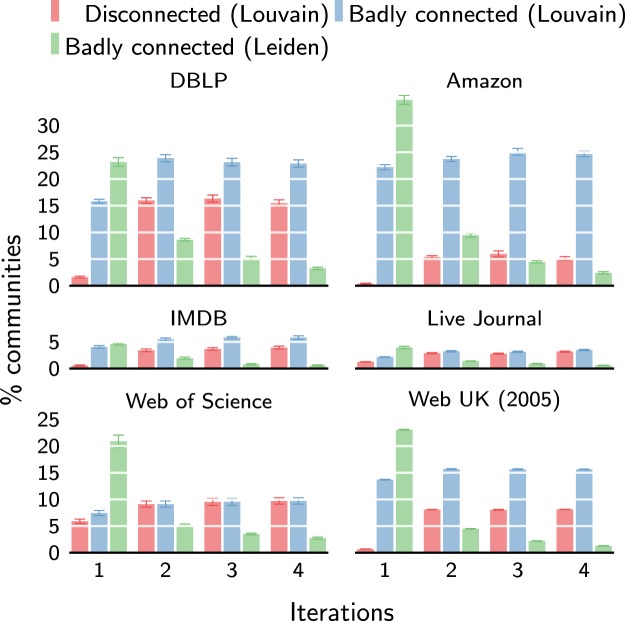
- Louvain may produce arbitrarily badly connected communities; in experiments up to 25% of communities were badly connected and up to 16% were disconnected. First-iteration badly connected percentages included Amazon 23%, DBLP 16%, and Web UK 14%; disconnected communities were usually around 1%, but exceeded 5% for Web of Science in the first iteration and jumped to 16% for DBLP in later iterations. After four iterations, Amazon had 5% disconnected but 25% badly connected communities.
- Leiden guarantees all communities are connected after each iteration, and also γ-separated and γ-connected. After a stable iteration, all nodes are locally optimally assigned and all communities are subpartition γ-dense; asymptotically, all communities are uniformly γ-dense and subset optimal.
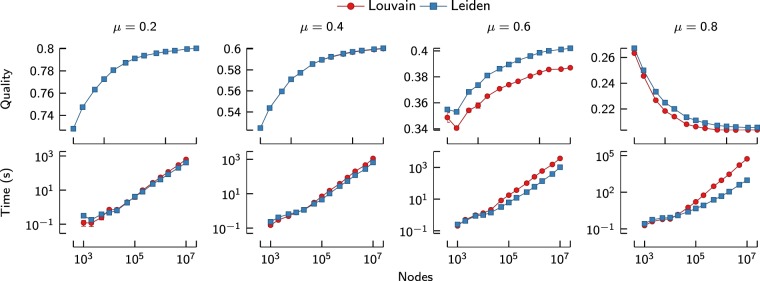
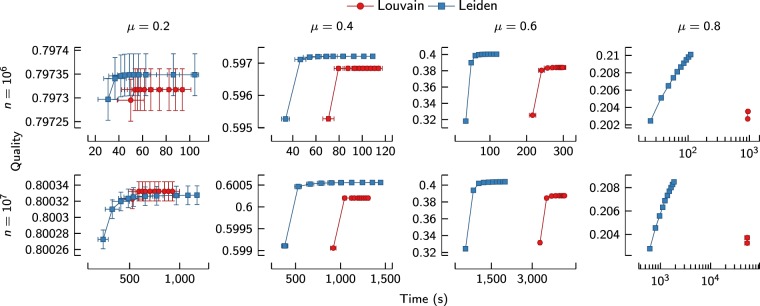
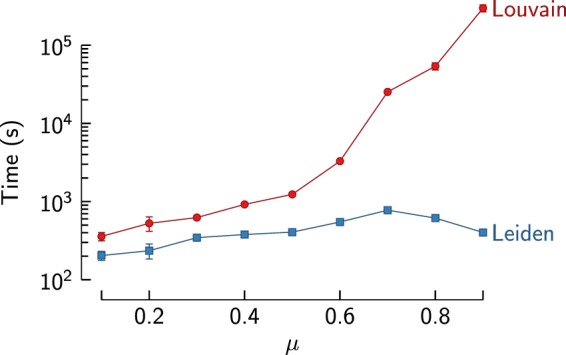
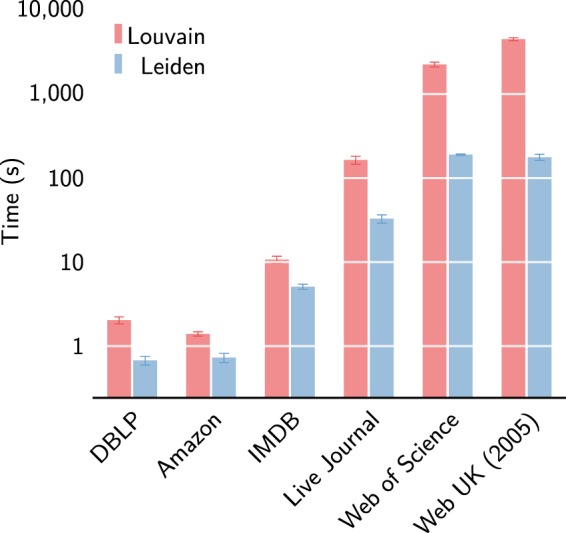
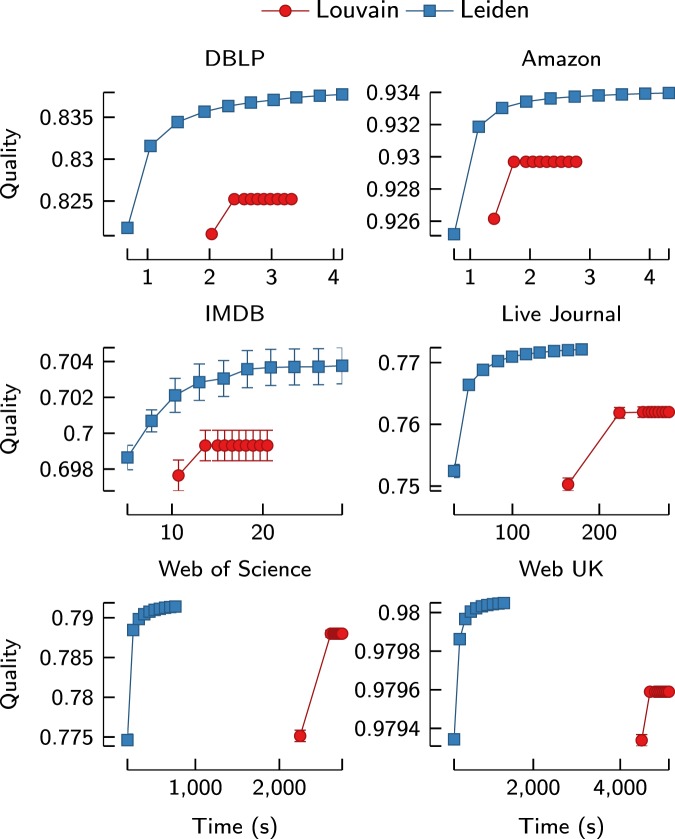
- Leiden was faster than Louvain: first iteration roughly 2–20 times faster on empirical networks, including more than 7× faster for Live Journal, more than 11× for Web of Science, and more than 20× for Web UK. On benchmark networks with difficult partitions (μ = 0.9), Louvain required almost 2.5 days while Leiden needed fewer than 10 minutes; for largest networks Leiden reached 10–100 times faster runtimes.
- Leiden found higher modularity on all six empirical networks: DBLP 0.8387 vs 0.8262, Amazon 0.9341 vs 0.9301, IMDB 0.7069 vs 0.7062, Live Journal 0.7739 vs 0.7653, Web of Science 0.7951 vs 0.7911, and Web UK 0.9801 vs 0.9796.
Methods
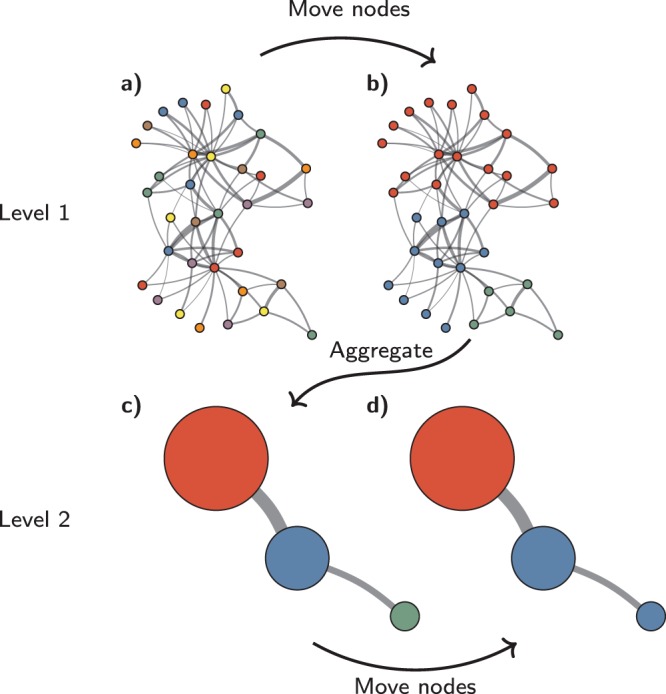
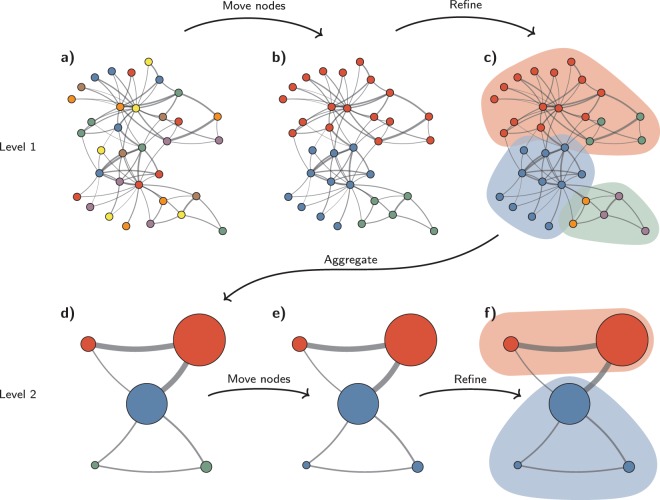
- The paper introduces the Leiden algorithm, which combines local moving, refinement of the partition, and aggregation; proofs of guarantees are relegated to Supplementary Information. It compares Leiden with Louvain on six empirical networks and on benchmark networks.
- Empirical networks: DBLP (317,080 nodes, degree 6.6), Amazon (334,863, 5.6), IMDB (374,511, 80.2), Live Journal (3,997,962, 17.4), Web of Science (9,811,130, 21.2), and Web UK (39,252,879, 39.8). Modularity was used with γ = 1; Table 2 reports maximal modularity after 10 replications of 10 iterations each. Badly connected community analysis was repeated 10 times, with Leiden run on each community’s subnetwork until a stable iteration.
- Benchmark networks ranged from n = 10^3 to n = 10^7 nodes, with community size 50 and CPM as the quality function; the mixing parameter μ varied, 10 iterations were performed, and each parameter set was repeated 10 times. The refinement randomness parameter was θ = 0.01.
Limitations
- The paper states that benchmark networks have only limited value because they are not representative of empirical real-world networks and have a rather simple structure.
- The paper states that counting communities split by Leiden gives only a lower bound on the number of badly connected communities; if Leiden does not find subcommunities, there is no guarantee that modularity cannot be increased by splitting the community.
- Evident from the text: there is no dedicated limitations section; technical details and proofs are relegated to Supplementary Information, and the experimental analysis fixes θ = 0.01 although values roughly in [0.0005, 0.1] are said to provide reasonable results.
Model-written summary. Check it against the paper before relying on it.
Integrity signals
Registry
Cites
Statistics
Figures
Verification
Claims the paper makes
1 Valid · 2 Not valid · 17 Not checked · 142 Own results and interpretations
The cited sources support only part of this claim — read each source’s verdict below.
In the paper
“Hence, the problem of Louvain outlined above is independent from the issue of the resolution limit.”
§ From Louvain to Leiden: guaranteeing well-connected communities > Louvain Algorithm > Badly connected communities
What the sources say
- Partly supportedcites [14] Fortunato S Barthélemy M Resolution Limit in Community Detection Proc. Natl. Acad. Sci. USA 2007 104 36 10.1073/pnas.0605965104 17190818 PMC1765466 sourceExperimental — accuracy not yet measured
Our copy supports the resolution-limit side of the sentence: the Conclusions (VI, p. 7) state that 'the resolution limit of modularity does not rely on particular network structures, but only on the comparison between the sizes of interconnected communities and that of the whole network', the Introduction (p. 1) calls it an 'intrinsic scale' of modularity, and Section V (pp. 5-6) shows the failure persists with simulated annealing, i.e. it is a property of the quality function rather than of one particular optimizer. What the source does not contain is the other term of the comparison: Louvain is never mentioned anywhere in the paper (the Introduction, p. 1, lists only generic greedy procedures [19,20], extremal optimization [21] and simulated annealing [22,23]), and no passage contrasts the resolution limit with an algorithm-specific defect. The independence claim is therefore the citing authors' own inference built on this paper's characterization of the resolution limit. (LLM, conf=0.70)
plain- Asserted: passes — The authors put it forward as true.
- Checkable: passes — It can be checked against evidence.
- Load-bearing: passes — The paper’s conclusions depend on it.
- Based: passes — The paper gives a reason why it holds.
- Partly supported
A result the paper states — it cites no source for it, so there is none to check. The quote shows it is in the paper.
In the paper
“The percentage of badly connected communities is less affected by the number of iterations of the Louvain algorithm.”
§ From Louvain to Leiden: guaranteeing well-connected communities > Experimental Analysis > Badly connected communities
plain- Asserted: passes — The authors put it forward as true.
- Checkable: passes — It can be checked against evidence.
- Load-bearing: unclear — It is unclear whether the paper’s conclusions depend on it.
- Based: passes — The paper gives a reason why it holds.
A result the paper states — it cites no source for it, so there is none to check. The quote shows it is in the paper.
In the paper
“In addition, we prove that, when the Leiden algorithm is applied iteratively, it converges to a partition in which all subsets of all communities are locally optimally assigned.”
- Also stated in: § Introduction · boosted
“In addition, we prove that the algorithm converges to an asymptotically stable partition in which all subsets of all communities are locally optimally assigned.”
§ From Louvain to Leiden: guaranteeing well-connected communities > Abstract
boostedstates a cause- Asserted: passes — The authors put it forward as true.
- Checkable: passes — It can be checked against evidence.
- Load-bearing: passes — The paper’s conclusions depend on it.
- Based: passes — The paper gives a reason why it holds.
- Also stated in: § Introduction · boosted
A result the paper reports from its own data — it cites no other source for it, so there is none to check. The quote shows it is in the paper.
In the paper
“The second iteration of Louvain shows a large increase in the percentage of disconnected communities.”
§ From Louvain to Leiden: guaranteeing well-connected communities > Experimental Analysis > Badly connected communities
plainstates a cause- Asserted: passes — The authors put it forward as true.
- Checkable: passes — It can be checked against evidence.
- Load-bearing: passes — The paper’s conclusions depend on it.
- Based: passes — The paper gives a reason why it holds.
A result the paper reports from its own data — it cites no other source for it, so there is none to check. The quote shows it is in the paper.
In the paper
“In terms of the percentage of badly connected communities in the first iteration, Leiden performs even worse than Louvain, as can be seen in Fig. 4.”
§ From Louvain to Leiden: guaranteeing well-connected communities > Experimental Analysis > Badly connected communities
plain- Asserted: passes — The authors put it forward as true.
- Checkable: passes — It can be checked against evidence.
- Load-bearing: unclear — It is unclear whether the paper’s conclusions depend on it.
- Based: passes — The paper gives a reason why it holds.
115 more claims
Create a free account to see all 162 claims and to verify the 24 references still open.
- Probably not a substantial claim. 23
- It may state two separate claims as one. 23
- The quote only partly states this claim. 1
Claims other papers make about this one
Each is checked against this paper’s own text: does it say what the citing paper says it does?
The cited source says what the claim attributes to it.
In the citing paper
“When compared to six common clustering algorithms, including Leiden25 and CellHarmony26, VFC was the top performing algorithm on every simulation on the T cell data and best performing, on average, on the zebrafish dataset, with a 57% increase in average performance over Louvain, which was the next best algorithm”
From Quantifying the effect of experimental perturbations at single-cell resolution (2021) · cites this paper as [25]
The cited source says what the claim attributes to it.
In the citing paper
“Louvain’s successor Leiden circumvents this issue by yielding guaranteed connected communities and is computationally more efficient52.”
From Best practices for single-cell analysis across modalities (2023) · cites this paper as [52]
The cited source says what the claim attributes to it.
In the citing paper
“However, the Louvain algorithm can lead to arbitrarily poorly connected communities52.”
From Best practices for single-cell analysis across modalities (2023) · cites this paper as [52]
The cited source says what the claim attributes to it.
In the citing paper
“We found that many t-types had total variance substantially above the variances of the k-means clusters (Fig. 5b) and an alternative analysis using entropies of Leiden clustering35 often highlighted the same t-types as variable (Extended Data Fig. 8).”
From Phenotypic variation of transcriptomic cell types in mouse motor cortex (2021) · cites this paper as [35]
The cited source says what the claim attributes to it.
In the citing paper
“Community detection uses the Leiden algorithm [28] with ModularityVertexPartition, producing hierarchical subclustering to depth 3.”
From SuperLocalMemory: Privacy-Preserving Multi-Agent Memory with Bayesian Trust Defense Against Memory Poisoning (2026) · cites this paper as [28]
6 more claims about this paper
Create a free account to see every claim other papers make about this one.
Citations
Cites
Fast unfolding of communities in large networks
Blondel, V. D., Guillaume, J.-L., Lambiotte, R., & Lefebvre, E. (2008) · Journal of Statistical Mechanics: Theory and Experiment · doi:10.1088/1742-5468/2008/10/p10008 · Cited by 21,424 · cited 3×
“The Louvain algorithm 10 is very simple and elegant.”
MethodFinding and evaluating community structure in networks
Newman, M. E. J., & Girvan, M. (2004) · Physical Review E · doi:10.1103/physreve.69.026113 · Cited by 13,931 · cited 2×
“The Leiden algorithm consists of three phases: (1) local moving of nodes, (2) refinement of the partition and (3) aggregation of the network based on the refined partition, using the non-refined partition to create an initial partition for the aggregate network.”
BackgroundMethodComplex brain networks: graph theoretical analysis of structural and functional systems
Bullmore, E., & Sporns, O. (2009) · Nature Reviews Neuroscience · doi:10.1038/nrn2575 · Cited by 11,820
Fortunato, S. (2010) · Physics Reports · doi:10.1016/j.physrep.2009.11.002 · Cited by 11,293 · cited 4×
“The Leiden algorithm consists of three phases: (1) local moving of nodes, (2) refinement of the partition and (3) aggregation of the network based on the refined partition, using the non-refined partition to create an initial partition for the aggregate network.”
BackgroundMethodInfluentialFinding community structure in very large networks
Clauset, A., Newman, M. E. J., & Moore, C. (2004) · Physical Review E · doi:10.1103/physreve.70.066111 · Cited by 7,390 · cited 1×
“Optimising modularity is NP-hard 5 , and consequentially many heuristic algorithms have been proposed, such as hierarchical agglomeration 6 , extremal optimisation 7 , simulated annealing 4,8 and spectral 9 algorithms.”
MethodFinding community structure in networks using the eigenvectors of matrices
Newman, M. E. J. (2006) · Physical Review E · doi:10.1103/physreve.74.036104 · Cited by 4,761
Functional cartography of complex metabolic networks
Guimerà, R., & Nunes Amaral, L. A. (2005) · Nature · doi:10.1038/nature03288 · Cited by 3,983 · cited 2×
“Optimising modularity is NP-hard 5 , and consequentially many heuristic algorithms have been proposed, such as hierarchical agglomeration 6 , extremal optimisation 7 , simulated annealing 4,8 and spectral 9 algorithms.”
MethodNear linear time algorithm to detect community structures in large-scale networks
Raghavan, U. N., Albert, R., & Kumara, S. (2007) · Physical Review E · doi:10.1103/physreve.76.036106 · Cited by 3,502 · cited 2×
“Trying to fix the problem by simply considering the connected components of communities 19–21 is unsatisfactory because it addresses only the most extreme case and does not resolve the more fundamental problem.”
BackgroundBenchmark graphs for testing community detection algorithms
Lancichinetti, A., Fortunato, S., & Radicchi, F. (2008) · Physical Review E · doi:10.1103/physreve.78.046110 · Cited by 3,051 · cited 1×
“To study the scaling of the Louvain and the Leiden algorithm, we rely on a variant of a well-known approach for constructing benchmark networks 28 .”
MethodResolution limit in community detection
Fortunato, S., & Barthélemy, M. (2007) · Proceedings of the National Academy of Sciences · doi:10.1073/pnas.0605965104 · Cited by 3,024 · cited 2×
“The algorithm may yield arbitrarily badly connected communities, over and above the well-known issue of the resolution limit 14 .”
Background
Research works printed but not linked: 2
- Porter MA Onnela J-P Mucha PJ Communities in Networks Not. AMS 2009 56 1082 1097
- Luecken, M. D. Application of multi-resolution partitioning of interaction networks to the study of complex disease. Ph.D. thesis, (University of Oxford, 2016).
Cited by
Items 6,401–6,500 of 7,288
InsightFlow: LLM-Driven Synthesis of Patient Narratives for Mental Health into Causal ModelsPreprint
Gupta, S., Adhikary, P. K., Dave, B., Singh, S. M., Deroy, A., & Chakraborty, T. (2026) · arXiv (Cornell University) · doi:10.48550/arxiv.2604.12721
Ryan, Z., Ritschel, J. D., & White, E. D. (2026) · Defense Acquisition Research Journal · doi:10.22594/dau.25-960.33.02
A system-of-systems approach to US space sustainability governance
Shi, Q., Huang, Y., Arnas, D., & DeLaurentis, D. A. (2026) · Acta Astronautica · doi:10.1016/j.actaastro.2026.04.026
Technology Analysis of Extended Reality Using Machine Learning and Statistical Models
Jun, S. (2026) · Virtual Worlds · doi:10.3390/virtualworlds5020019
Hoang, T., Wang, Z., Zerrouki, L., & Delahaye, D. (2026) · arXiv (Cornell University) · doi:10.48550/arxiv.2604.19641
CycleScape: A Deterministic Optimization Framework for Large-Scale Road Network PartitioningPreprint
Guo, D., & Jin, H. (2026) · SSRN Electronic Journal · doi:10.2139/ssrn.6626996
Detecting Communities Using Time Stamp-Based Leiden Approach in Dynamic Social Networks
Choudhury, D., Doari, K., Banerjee, A., Patra, I., Nath, M. K., & Chowdhury, T. (2026) · Lecture notes in networks and systems · doi:10.1007/978-3-032-20253-6_5
MediaGraph: A Network Theoretic Framework to Analyze Reporting Preferences in Indian News MediaPreprint
Bali, A., Rupsha, Kaushik, V., & Sen, A. (2026) · arXiv (Cornell University) · doi:10.48550/arxiv.2604.20982
NIH-MPINet: A Large-Scale Feature-Rich Network Dataset for Mapping the Frontiers of Team SciencePreprint
Shi, C., Han, S., Kusumanchi, S., Zhou, M., & Li, D. (2026) · arXiv (Cornell University) · doi:10.48550/arxiv.2604.22802
Generating synthetic citation networks with communities
Brzozowski, Ł., Ga̧golewski, M., & Siudem, G. (2026) · Information Sciences · doi:10.1016/j.ins.2026.124196
Rupérez, M. C. (2021) · Repositorio de Patentes de la Universidad de Almería (Universidad de Almería)
A Survey of Graph Clustering Approaches
Xu, Y., Cao, X., Li, M., Han, R., & Wang, H. (2026) · Journal of Physics Conference Series · doi:10.1088/1742-6596/3212/1/012016
Chen, M., Liu, Q., Yang, J., Chen, Y., Zhou, Z., & Deng, M. (2026) · International Journal of Geographical Information Science · doi:10.1080/13658816.2026.2660985
Towards Robust and Scalable Density-based Clustering via Graph PropagationPreprint
Zheng, Y., Phibbs, H., & Pham, N. (2026) · arXiv · doi:10.48550/arxiv.2605.00390
Cell Type Weighted Dimensionality ReductionPreprint
Putta, S., Jensen, W., Devakonda, S., Pennell, L., & Croteau, J. (2026) · bioRxiv (Cold Spring Harbor Laboratory) · doi:10.64898/2026.04.30.721796
Siminea, N., Florea, D., Păun, M., Păun, A., & Petre, I. (2026) · bioRxiv (Cold Spring Harbor Laboratory) · doi:10.64898/2026.04.30.721983
Nurwahyudi, R. I. P., Xia, H., Zhong, J., Gao, J., Xia, Q., Qi, J., Guan, Q., & Victor, K. (2026) · Expert Systems with Applications · doi:10.1016/j.eswa.2026.132639
Community-Aware Graph Contrastive Learning for Long-Tail Crowdsourcing Truth Inference
Fang, X., Liang, H., Yi, Y., Huang, X., Sun, G., & Zhang, G. (2026) · Lecture notes in computer science · doi:10.1007/978-981-92-0369-7_41
Cartographier les constellations d’Études de Lettres
Xanthos, A. (2026) · Études de lettres · doi:10.4000/167if
Bouyer, A., Arasteh, B., Liu, X., Sefati, S. S., & Kusetoğulları, H. (2026) · Information Processing & Management · doi:10.1016/j.ipm.2026.104874
Kusuma, W. A., Rustamaji, H. C., Heryanto, R., & Batubara, I. (2026) · Springer eBooks · doi:10.1007/978-3-032-20428-8_7
Li, D., Sang, G., Liu, Y., & Wang, H. (2026) · Journal of Hydrologic Engineering · doi:10.1061/jhyeff.heeng-6793
GUT-IS: A Data-Driven Approach to Integrating Constructs and Their Relations in Information Systems
Reinhardt, M., Scharfenberger, J., & Funk, B. (2026) · Multilingual Matters (Channel View Publications) · doi:10.48550/arxiv.2605.18567
Editorial Trajectories in Wikipedia Reflect Underlying Hyperlink Structure
Seo, Y., Lee, M. J., Son, S.-W., Jo, H.-H., & Murase, Y. (2026) · arXiv (Cornell University) · doi:10.48550/arxiv.2605.16850
Single-nucleus RNA sequencing reveals a spatiotemporal pattern of H2S signaling in Chinese cabbage
Zhang, J., Chen, Y., Liu, B., Qin, Y., Luan, Y., Yin, H., Liu, W., Chen, L., Zhai, J., Pei, Y., et al. (2026) · Science China Life Sciences · doi:10.1007/s11427-025-3306-6
Sparse Contextual Coupling Reshapes Diffusion Geometry in Multilayer HypergraphsPreprint
Ding, H., & Krishnagopal, S. (2026) · arXiv (Cornell University) · doi:10.48550/arxiv.2605.20454
SSGCNCD: Self-supervised community detection based on GCN
Cheng, J., Ren, B., & Ma, Z. (2026) · Tsinghua Science & Technology · doi:10.26599/tst.2026.9010053
Liu, M. M., Wang, H., Guo, J., Li, X., Liu, C., Wang, J., Yi, Z., Xue, W., Fang, Q., Wang, H., et al. (2026) · Neuro-Oncology · doi:10.1093/neuonc/noag113
Wilsenach, J., Fonseca, S., Ahnert, S. E., & Wojtowicz, E. E. (2026) · bioRxiv (Cold Spring Harbor Laboratory) · doi:10.64898/2026.05.19.725920
Dubuisson, J. (2026) · arXiv (Cornell University) · doi:10.48550/arxiv.2605.21510
CQGen-MAS: A Multi-Agent System for Competency Questions Generation from Ontology
Du, F., Huilong, A., Li, F., Li, C., & Liu, W. J. (2026) · Adaptive Agents and Multi-Agents Systems · doi:10.65109/rrye6579
Hybrid Deep Clustering Framework for Unsupervised Pattern Recognition in Complex Datasets
BOYMURODOVA, N., Yuldasheva, D., Ganiev, D., Ostonova, S., & Urinova, M. (2026) · Lecture notes in networks and systems · doi:10.1007/978-3-032-24402-4_32
G2+D: A High Performance Distributed Graph Mining System
Hu, S., Ding, Y., Liu, C.-H., Zhang, Z., Yitao, W., Wang, C., Chen, A., Ma, X., Zhou, X., Chen, C., et al. (2026) · ACM SIGMOD International Conference on Management of Data (SIGMOD) · doi:10.1145/3788853.3803086
Gao, T., & Blekanov, I. S. (2026) · Physica A Statistical Mechanics and its Applications · doi:10.1016/j.physa.2026.131677
Chen, W., Kang, J., Cheng, L., Cao, M., & Wu, L. (2026) · IEEE Transactions on Intelligent Transportation Systems · doi:10.1109/tits.2026.3694354
Wang, X., Liu, H., Li, J., & Wang, Y. (2026) · Food Research International · doi:10.1016/j.foodres.2026.119538
Extremal Dependence and Community-Structured Risk Propagation in Complex Social Information Networks
Wei, L., Wang, H., & Sun, Y. W. (2026) · Mathematics · doi:10.3390/math14112017
Community Detection on a Randomly Growing NetworkPreprint
Wang, J., & Xu, M. (2026) · arXiv (Cornell University) · doi:10.48550/arxiv.2606.07447
mstknnclust: An R package for graph-based clustering via MST-kNN intersection
Parraga-Alava, J., Inostroza-Ponta, M., & Moscato, P. (2026) · Software Impacts · doi:10.1016/j.simpa.2026.100845
Roh, K., Lee, S., Cho, S.-J., & Hwang, Y.-S. (2026) · ACM Symposium on Applied Computing · doi:10.1145/3748522.3779797
Improving community detection with CVC, a new cluster ensemble method
Vu-Le, T.-A., Park, M., Chen, I. C., Lamy, J. A. C., Alessi, T., Harb, E., Chacko, G., & Warnow, T. J. (2026) · Applied Network Science · doi:10.1007/s41109-026-00809-z
Mahr, F., Franke, J. E., & Ockel, M. (2026) · International Conference on Electronics Packaging (ICEP) · doi:10.23919/icep-hbs69241.2026.11550728
Echo chamber index: a GNN-based metric for detecting echo chambers in multiagent AI networks
Pham, V. T., Qu, Q., Lee, J. S., Shelton, J. A., & Chen, Y. (2026) · Sensors and Systems for Space Applications · doi:10.1117/12.3115130
Montaño, M. A. P., & Taboh, S. V. (2026) · arXiv (Cornell University) · doi:10.48550/arxiv.2606.13031
Unnoticeable Community Deception Based on Comprehensive Modularity
Li, N., Chen, H., Mu, L., & Zhang, Y. (2026) · IEEE Transactions on Computational Social Systems · doi:10.1109/tcss.2026.3689778
DIVCOM: Adaptive graph division for scalable detection of overlapping communities
Lu, Y., Chen, W., He, P., Gan, Y., Jiang, P., Liu, Y., & Liu, Q. (2026) · Knowledge-Based Systems · doi:10.1016/j.knosys.2026.116416
PURE: Probabilistic Utility for Robust Evidence in Multimodal Recommendation
Jinguo, H., Qi, Y., Yu, S., Liao, Z., & Zhang, W. (2026) · International Conference on Multimedia Retrieval · doi:10.1145/3805622.3810790
Rosalino, S. M., CURADO, A., & Pinheiro, F. L. (2026) · Applied Network Science · doi:10.1007/s41109-026-00807-1
Shahriar, M., Islam, M. Z., Zhang, W., & Lin, Y. (2026) · ACM International Conference on Future Energy Systems (e-Energy) · doi:10.1145/3744255.3811721
Structured Nonparametric Variational Inference for Dependent Latent ModelingPreprint
Shao, Y., Gu, Z.-L., & Yu, S. (2026) · arXiv.org · doi:10.48550/arxiv.2606.15458
MOSAIC (morphology-oriented spatial attention for inferring cell expression)
Sousa, T., Vesco, M. F. [., de-Mira, G. R., Fernandes, D., de Morais, M., Simizo, A., Nakaya, H. I., & Camilo, C. (2026) · Scientific Reports · doi:10.1038/s41598-026-77072-w
Sender--Receiver Community Detection in Directed Networks via Node-Role-Constrained Edge ClusteringPreprint
Hieu, D. D. (2026) · arXiv (Cornell University) · doi:10.48550/arxiv.2606.17411
Do Gaussian Scenes Contain Enough Structure for Intrinsic Segmentation?Preprint
Barhdadi, M. R., Yazar, H., Serpedin, E., Tunçel, M., & Kurban, H. (2026) · arXiv (Cornell University) · doi:10.48550/arxiv.2606.18623
AXI Marks the Spot: Towards Automated Reverse Engineering in SoC Netlists
Suresh, A., Albartus, N., & Holcomb, D. E. (2026) · ACM Great Lakes Symposium on VLSI (GLSVLSI) · doi:10.1145/3787109.3815226
Paredes, R., & Reis, M. S. (2026) · Systems and Control Transactions · doi:10.69997/sct.144303
He, N., Jian, M., Zhang, H., Cao, J., Liu, S., & Li, G. (2026) · Journal of Transport Geography · doi:10.1016/j.jtrangeo.2026.104742
Clustering guided dense context sensitive structure extractor: A relaxation induced approach
Hoque, A., Mandal, S., Barman, D., & Dutta, P. (2026) · Information Sciences · doi:10.1016/j.ins.2026.123827
ABUSO DIGITAL EM RELACIONAMENTOS ÍNTIMOS: ANÁLISE CIENCIOMÉTRICA DA LITERATURA
Bernardo, A. M. C. S., Pontes, F. A. R., Ramos, É. M. L. S., Almeida, L. S., & Silva, S. S. D. C. (2026) · Veredas do Direito Direito Ambiental e Desenvolvimento Sustentável · doi:10.18623/rvd.v23.6528
Attention shapes collective decisions for the Antarctic global commonsPreprint
van Elteren, C., Lippert, F., Carter, Z. J., Kleshnina, M., Bode, M., & de Vasconcelos, V. V. L. (2026) · arXiv (Cornell University) · doi:10.48550/arxiv.2606.25286
Motif–aware graph masked autoencoder for community detection
Wang, C., Li, D., Qiu, R., Tang, Z., & Liang, W. (2026) · Journal of King Saud University - Computer and Information Sciences · doi:10.1007/s44443-026-00962-6
Wang, Z., Zhu, Y., Yang, J., Wang, X., Zhang, Y., Deng, H., Liu, Q., & Zhou, D. (2026) · Defence Technology · doi:10.1016/j.dt.2026.06.016
Use of genetic algorithms for community detention in social networks
Αμπντό, Γ. (2026) · Dione (University of Piraeus)
Parallel Louvain Algorithms with Convergence Guarantee
Niu, J., Özkaya, M. Y., Sarıyüce, A. E., & Çatalyürek, Ü. V. (2026) · IEEE International Parallel and Distributed Processing Symposium (IPDPS) · doi:10.1109/ipdps65963.2026.00019
GPU-Accelerated Multilevel Graph Clustering: A Parallel Perspective on Louvain and Leiden
Gilbert, M. S., & Madduri, K. (2026) · IEEE International Parallel and Distributed Processing Symposium (IPDPS) · doi:10.1109/ipdps65963.2026.00020
Socioeconomic mixing in urban parks: A complex systems perspective on three Argentine citiesPreprint
Salgado, A., Ermann, L., & Caridi, I. (2026) · Research Square · doi:10.21203/rs.3.rs-9905023/v1
Beyond Genre Categories: How Narrative Pattern Coherence and Spanning Distance Shape Film Success
Wang, Z., & Lyu, Z. (2026) · International Conference on Natural Language Processing for Digital Humanities (NLP4DH) · doi:10.18653/v1/2026.nlp4dh-1.13
Mantri, Y. K., Sriraja, Y., Hartley, J., Cowan, G. A., Khraishi, R., & Gupta, A. (2026) · Proceedings of the conference - Association for Computational Linguistics. Meeting · doi:10.18653/v1/2026.acl-industry.108
Fuzzy k-anonymity in complex networks
Jong, R., van der Loo, M., & Takes, F. W. (2026) · Scientific Reports · doi:10.1038/s41598-026-59941-6
Langner, C., Paliyenko, Y., Rehberg, M., Miller, F., Roth, D., & Kreimeyer, M. (2026) · Proceedings of the Design Society · doi:10.1017/pds.2026.10638
Wang, Q., Zhang, S., Wu, B., Zhou, J., Wu, C., Zeng, Y., Sun, K., & Liu, C. X. (2026) · Entropy · doi:10.3390/e28070763
Single-cell dissection of immune system aging and acute myeloid leukemia
Karakaslar, E. O. (2026) · Leiden Repository (Leiden University) · doi:10.60602/1887-4306748
LGV-MKC: Large-Scale Graph Visualization through Mutual K-Core Identification
Chen, Y., Gong, U., Yang, Y., & Gong, Z. (2026) · International Conference on Computer Supported Cooperative Work in Design (CSCWD) · doi:10.1109/cscwd68734.2026.11582349
Fu, C., Hu, L., Tang, F., Zhou, Y., & Lin, R. (2026) · International Conference on Machine Intelligence Theory and Applications (MiTA) · doi:10.1109/mita69365.2026.11582825
Li, H., & Wu, H. (2026) · IEEE Transactions on Artificial Intelligence · doi:10.1109/tai.2026.3710881
Wei, W. R., & Wu, H. (2026) · Wiley eBooks · doi:10.1002/9781394374717.ch06
Network-Based Integration of Multi-omics Data for Biomarker Discovery in Acute Coronary Syndromes
Marinello, E., Noei, S., Chierici, M., Amigó, N., Cvijanović, D., Davidović, A., Dragisic, D., Giglione, C., Kardassis, D., Milanov, M., et al. (2026) · Lecture notes in computer science · doi:10.1007/978-3-032-30813-9_20
A generalized feedforward loop model and its applications
Wang, Q., & Wei, D. (2026) · Physica Scripta · doi:10.1088/1402-4896/ae87d8
Gene Program Negotiation Defines Cellular Identity in Single-Cell TranscriptomesPreprint
Sung, J., & Cheong, J. (2026) · bioRxiv (Cold Spring Harbor Laboratory) · doi:10.64898/2026.07.05.736629
Clustering Analysis of Russian Drug-Related Discourse Using the Louvain Algorithm
Mamaev, I. D., & Rybak-Franko, E. A. (2026) · Lecture notes in networks and systems · doi:10.1007/978-3-032-20897-2_68
Graph Diffusion Gated Embeddings for Recommender Systems
Lee, S., Roh, T., Seo, J., & Lim, S. (2026) · International ACM SIGIR Conference on Research and Development in Information Retrieval (SIGIR) · doi:10.1145/3805712.3809569
Vorobeva, I., Lenormand, M., Berlantini, G., & Gargiulo, F. (2026) · arXiv (Cornell University) · doi:10.48550/arxiv.2607.08512
Balanced Co-Clustering of Users and Items for Embedding Table Compression in Recommender Systems
Jiang, R., Yang, R., & Wu, D. (2026) · International ACM SIGIR Conference on Research and Development in Information Retrieval (SIGIR) · doi:10.1145/3805712.3809729
Sahu, S. (2026) · ACM International Symposium on High-Performance Parallel and Distributed Computing (HPDC) · doi:10.1145/3806645.3807602
Toward Automated Security Risk Detection in Large Software Using Call Graph Analysis
Pecka, N., Othmane, L. B., & Bryce, R. C. (2026) · Lecture notes in computer science · doi:10.1007/978-3-032-20732-6_22
Causal Estimation of Share-Induced Engagement with Flywheel EffectsPreprint
Cheng, W., Li, Y., Wang, Y., & Si, N. (2026) · arXiv (Cornell University) · doi:10.48550/arxiv.2607.10820
Exploring ‘New Hanbok’ trends: a big-data analysis of Korean news media discourse
Lee, N., & Suh, S. (2026) · Humanities and Social Sciences Communications · doi:10.1057/s41599-026-08313-6
Sajan, A. K. (2026) · Research Square · doi:10.21203/rs.3.rs-10179967/v1
Analysis of the connection conditions of illegal and harmful websites
Lee, S. K., Kim, T., Yoon, J., & Kim, K. (2025) · Journal of Data Forensics Research · doi:10.12972/jdfr.2025.2.1.2
Santos, G. O., Ferreira, C. H. G., & Moreira, G. J. P. (2026) · Revista Eletrônica de Iniciação Científica em Computação · doi:10.5753/reic.2026.8488
LATTICE: Graph Self-Supervised Learning for Multimodal Spatial Omics IntegrationPreprint
Dwarampudi, J. M. R., Kochat, V., Satpati, S., Nguyen, H. S., Rai, K., & Banerjee, T. (2026) · arXiv (Cornell University) · doi:10.48550/arxiv.2607.14410
Wang, M., Xie, L., Sun, G., Huang, Y., Xie, J., Lv, W., Zhao, S. P., Wan, Y., Zhang, M., Zhang, Z., et al. (2026) · Scientific Reports · doi:10.1038/s41598-026-61487-6
DHCom-NAS: Dynamic Heterogeneous Community Detection via Neural Architecture Search
Yu, M., Wu, Z. W., & He, C. (2026) · Lecture notes in computer science · doi:10.1007/978-981-92-3391-5_18
Kılıç, A. F. (2026) · Educational and Psychological Measurement · doi:10.1177/00131644261465917
Chen, L., Lv, X., Yang, W., Zhou, Y., Wang, K., & Zhang, Y. (2026) · Energy Reports · doi:10.1016/j.egyr.2026.109559
Liao, W., Liao, X., Xie, N., Chen, H., & Ghazal, K. H. B. (2026) · IEEE International Conference on Electronics, Communications and Intelligent Science (ECIS) · doi:10.1109/ecis69634.2026.11604344
Multitask Hierarchical Spatiotemporal Graph Modeling for Multifunction Radar Behavior Recognition
Wang, G., Fang, M., Li, X. X., & Wang, Y. (2026) · IEEE Transactions on Aerospace and Electronic Systems · doi:10.1109/taes.2026.3716638
Ramos, Y. F., Sayedipour, S. S., Shaw, G., Tuerlings, M., Schomann, T., Suchiman, H. E. D., Cats, D., Barry, F., Mahdad, R., Mei, H., et al. (2026) · bioRxiv (Cold Spring Harbor Laboratory) · doi:10.64898/2026.07.22.740000
slang.gr as a Large-Scale Crowdsourced Resource for Non-Standard GreekPreprint
Papadakos, P., Papantoniou, K., & Plexousakis, D. (2026) · arXiv (Cornell University) · doi:10.48550/arxiv.2607.21255
Community Detection as Adaptive Diffusion
Ferrara, E. (2026) · ACM AI Letters · doi:10.1145/3832782
Computer vision tools for geophysicists
Schaap, T., Grujic, M., Voutharoja, B., & Paknezhad, M. (2024) · ASEG Extended Abstracts · doi:10.63929/22020586.2024.1.084
Metadata
- Authors
- Traag, V. A., Waltman, L., & van Eck, N. J.
- Affiliations
- Leiden University (NL)
- Corresponding author
- Traag, V. A.
- Venue
- Scientific Reports
- Published
- 2019-03-26
- Volume
- 9
- Issue
- 1
- Pages
- 5233-5233
- ISSN
- 2045-2322 (ISSN-L)
- PMC
- PMC6435756
- OpenAlex
- W2897249806
- Semantic Scholar
- 79cdbabb22ef80074f5659430fe6fc97932798f5
- Cited by
- 5,635
- References
- 27
- Citations by year
- 2026: 1250 · 2025: 1281 · 2024: 980 · 2023: 757 · 2022: 639 · 2021: 466 · 2020: 213 · 2019: 46
- FWCI
- 158.78
- Type
- journal article
- Language
- en
- Open access
- gold
- doi.org
- Licence
- cc-by
- creativecommons.org/licenses/by/4.0 (tdm)
- creativecommons.org/licenses/by/4.0 (vor)
- Locations
- Scientific Reports (publishedVersion, cc-by)
- Europe PMC (PubMed Central) (publishedVersion, other-oa)
- PubMed Central (publishedVersion, cc-by)
- PubMed (publishedVersion)
- arXiv (Cornell University) (submittedVersion)
- Leiden Repository (Leiden University) (submittedVersion, cc-by)
- Data Archiving and Networked Services (DANS) (submittedVersion, cc-by)
- DOAJ (DOAJ: Directory of Open Access Journals) (submittedVersion)
- Leiden Repository (Leiden University) (submittedVersion)
- arXiv (Cornell University)
- Topics
- Physical Sciences › Physics and Astronomy › Statistical and Nonlinear Physics › Complex Network Analysis Techniques
- Physical Sciences › Computer Science › Artificial Intelligence › Advanced Clustering Algorithms Research
- Life Sciences › Biochemistry, Genetics and Molecular Biology › Molecular Biology › Bioinformatics and Genomic Networks
- Keywords
- community detection, Louvain algorithm, Leiden algorithm, network partitioning, community connectivity, complex networks
About these checks
Registry, retraction, Cites and statistics results are computed, not judged, with one exception: a printed reference that no index lists is read once by a model before it counts as a citation error. Claims are extracted by a model and kept only when their quote appears verbatim in the text; each cited source is then checked, with a model’s help, for whether it says what the claim relies on. Those verdicts can be wrong — read the claim’s quote and the cited source before relying on one.
The claim verdicts this report counts are experimental: their accuracy is not yet measured.
A language model drew the claims from the paper on 2026-11-23, under version 3 of the claim definition (model deepseek-v4.1-flash, prompt extract-v3).
A second model labelled each claim on 2026-11-23 (model jev-1.13-20260917, definition revision gold-guideline-v0.2).
Cited sources are checked with a language model’s help (qwen3.8-omni-flash).
Statistics and arithmetic are recomputed, not judged.
Confidence bands are shown only for fields calibrated on our annotated test set. None is calibrated yet, so no band is shown.
What counts as a claim ›How we measure confidence ›How we check this ›
Are you an author, or do you see a problem with this page? Request a review
Data sources
Bibliographic data: Semantic Scholar, OpenAlex, Crossref.
Contains information from the Semantic Scholar Academic Graph Datasets, made available under the ODC Attribution License (ODC-BY 1.0).
Semantic Scholar’s data is described in: Kinney, R., et al. (2023). The Semantic Scholar Open Data Platform. arXiv:2301.10140.
