

From Louvain to Leiden: guaranteeing well-connected communities
Open accessThe DOI matches its Crossref record; 30 of the 30 references it cites were found in a registry or an index; 1 of the 26 sources its claims cite were checked for support.
Abstract
Community detection is often used to understand the structure of large and complex networks. One of the most popular algorithms for uncovering community structure is the so-called Louvain algorithm. We show that this algorithm has a major defect that largely went unnoticed until now: the Louvain algorithm may yield arbitrarily badly connected communities. In the worst case, communities may even be disconnected, especially when running the algorithm iteratively. In our experimental analysis, we observe that up to 25% of the communities are badly connected and up to 16% are disconnected. To address this problem, we introduce the Leiden algorithm. We prove that the Leiden algorithm yields communities that are guaranteed to be connected. In addition, we prove that, when the Leiden algorithm is applied iteratively, it converges to a partition in which all subsets of all communities are locally optimally assigned. Furthermore, by relying on a fast local move approach, the Leiden algorithm runs faster than the Louvain algorithm. We demonstrate the performance of the Leiden algorithm for several benchmark and real-world networks. We find that the Leiden algorithm is faster than the Louvain algorithm and uncovers better partitions, in addition to providing explicit guarantees.
Overview
CoChat Summary
TL;DR
The Louvain algorithm can yield arbitrarily badly connected communities, including disconnected ones, especially when iterated. The Leiden algorithm guarantees connected communities and, under iteration, converges to subset-optimal partitions while running faster and finding higher-quality partitions.
Key findings
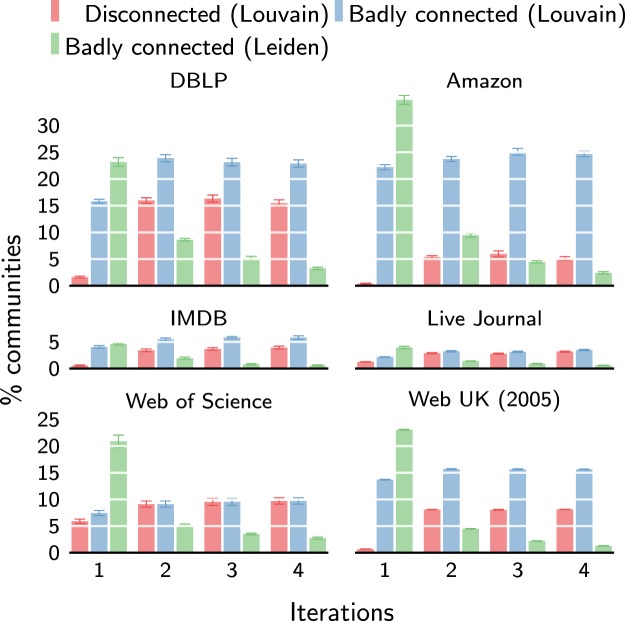
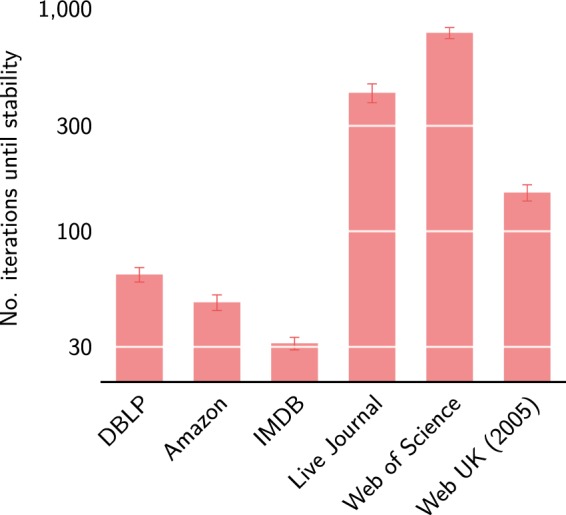
- Louvain may produce arbitrarily badly connected communities; in experiments up to 25% of communities were badly connected and up to 16% were disconnected. First-iteration badly connected percentages included Amazon 23%, DBLP 16%, and Web UK 14%; disconnected communities were usually around 1%, but exceeded 5% for Web of Science in the first iteration and jumped to 16% for DBLP in later iterations. After four iterations, Amazon had 5% disconnected but 25% badly connected communities.
- Leiden guarantees all communities are connected after each iteration, and also γ-separated and γ-connected. After a stable iteration, all nodes are locally optimally assigned and all communities are subpartition γ-dense; asymptotically, all communities are uniformly γ-dense and subset optimal.
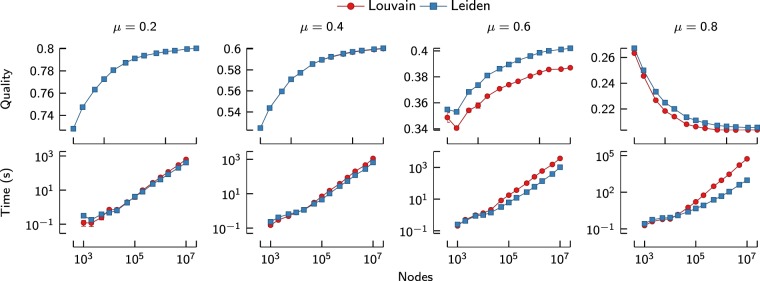
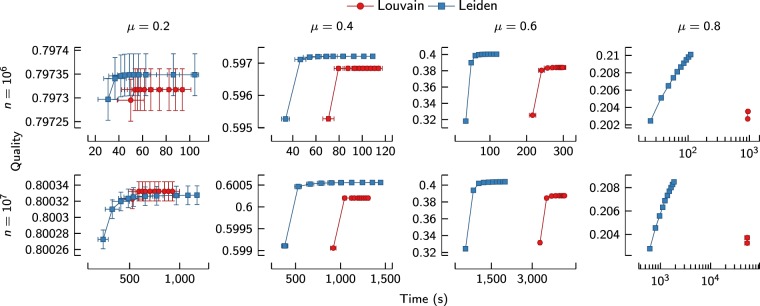
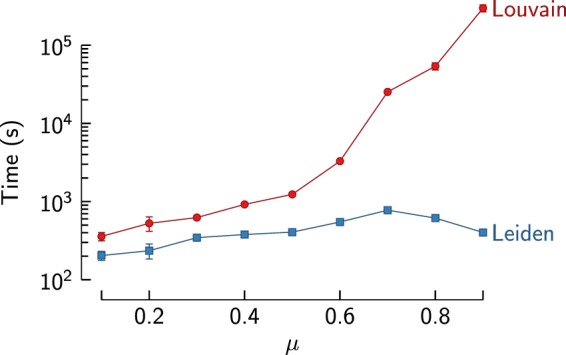
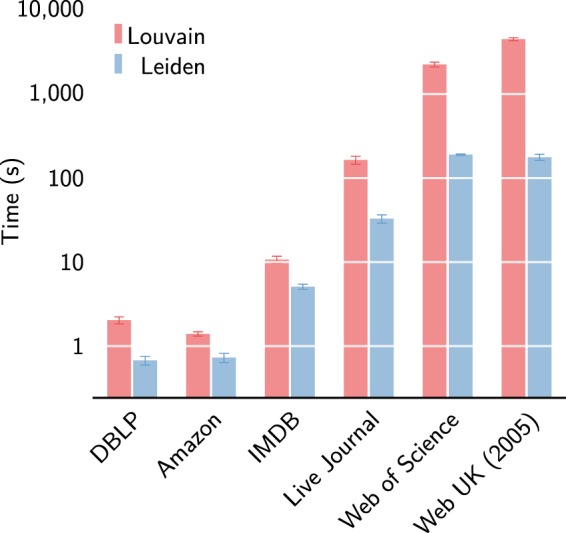
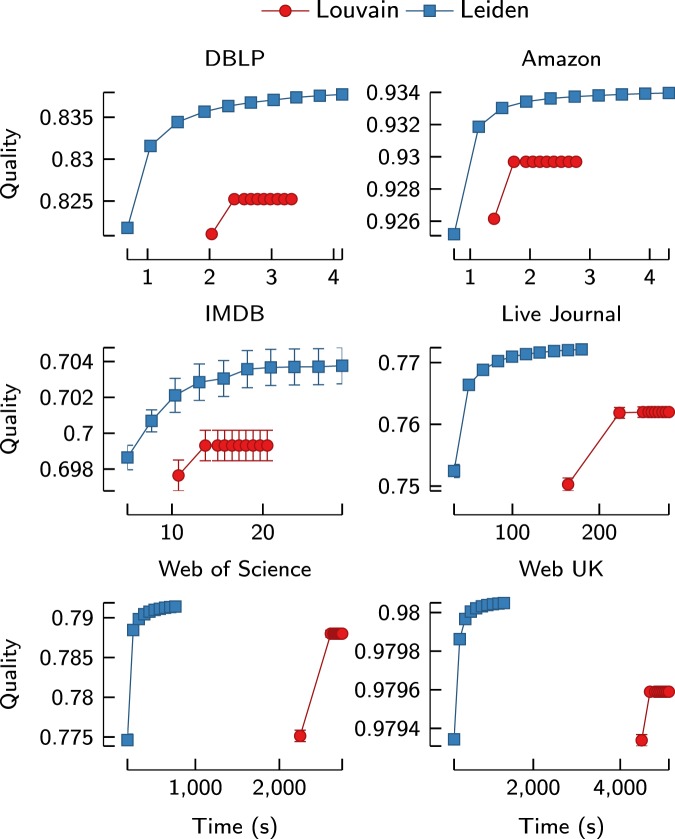
- Leiden was faster than Louvain: first iteration roughly 2–20 times faster on empirical networks, including more than 7× faster for Live Journal, more than 11× for Web of Science, and more than 20× for Web UK. On benchmark networks with difficult partitions (μ = 0.9), Louvain required almost 2.5 days while Leiden needed fewer than 10 minutes; for largest networks Leiden reached 10–100 times faster runtimes.
- Leiden found higher modularity on all six empirical networks: DBLP 0.8387 vs 0.8262, Amazon 0.9341 vs 0.9301, IMDB 0.7069 vs 0.7062, Live Journal 0.7739 vs 0.7653, Web of Science 0.7951 vs 0.7911, and Web UK 0.9801 vs 0.9796.
Methods
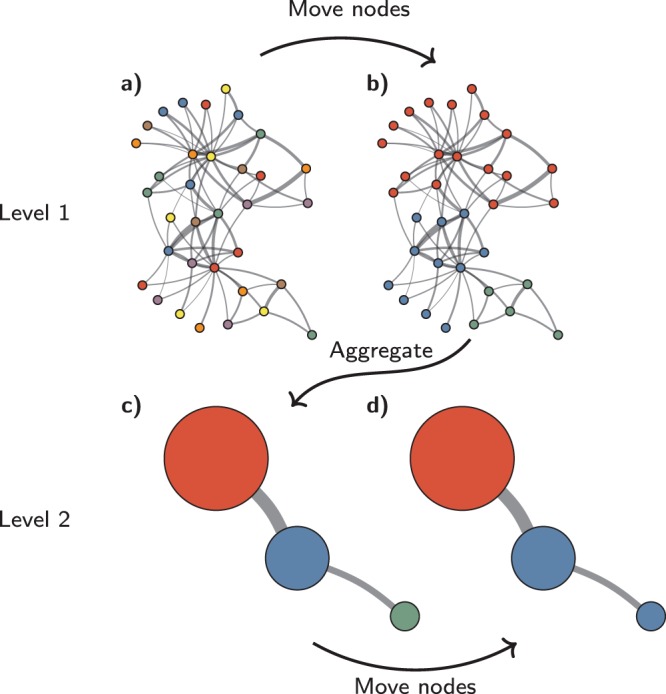
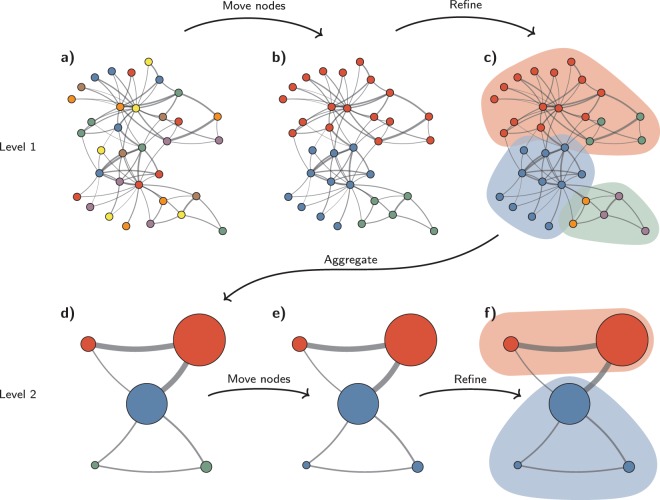
- The paper introduces the Leiden algorithm, which combines local moving, refinement of the partition, and aggregation; proofs of guarantees are relegated to Supplementary Information. It compares Leiden with Louvain on six empirical networks and on benchmark networks.
- Empirical networks: DBLP (317,080 nodes, degree 6.6), Amazon (334,863, 5.6), IMDB (374,511, 80.2), Live Journal (3,997,962, 17.4), Web of Science (9,811,130, 21.2), and Web UK (39,252,879, 39.8). Modularity was used with γ = 1; Table 2 reports maximal modularity after 10 replications of 10 iterations each. Badly connected community analysis was repeated 10 times, with Leiden run on each community’s subnetwork until a stable iteration.
- Benchmark networks ranged from n = 10^3 to n = 10^7 nodes, with community size 50 and CPM as the quality function; the mixing parameter μ varied, 10 iterations were performed, and each parameter set was repeated 10 times. The refinement randomness parameter was θ = 0.01.
Limitations
- The paper states that benchmark networks have only limited value because they are not representative of empirical real-world networks and have a rather simple structure.
- The paper states that counting communities split by Leiden gives only a lower bound on the number of badly connected communities; if Leiden does not find subcommunities, there is no guarantee that modularity cannot be increased by splitting the community.
- Evident from the text: there is no dedicated limitations section; technical details and proofs are relegated to Supplementary Information, and the experimental analysis fixes θ = 0.01 although values roughly in [0.0005, 0.1] are said to provide reasonable results.
Model-written summary. Check it against the paper before relying on it.
Integrity signals
Registry
Cites
Statistics
Figures
Verification
Claims the paper makes
1 Valid · 2 Not valid · 17 Not checked · 142 Own results and interpretations
The cited sources support only part of this claim — read each source’s verdict below.
In the paper
“Hence, the problem of Louvain outlined above is independent from the issue of the resolution limit.”
§ From Louvain to Leiden: guaranteeing well-connected communities > Louvain Algorithm > Badly connected communities
What the sources say
- Partly supportedcites [14] Fortunato S Barthélemy M Resolution Limit in Community Detection Proc. Natl. Acad. Sci. USA 2007 104 36 10.1073/pnas.0605965104 17190818 PMC1765466 sourceExperimental — accuracy not yet measured
Our copy supports the resolution-limit side of the sentence: the Conclusions (VI, p. 7) state that 'the resolution limit of modularity does not rely on particular network structures, but only on the comparison between the sizes of interconnected communities and that of the whole network', the Introduction (p. 1) calls it an 'intrinsic scale' of modularity, and Section V (pp. 5-6) shows the failure persists with simulated annealing, i.e. it is a property of the quality function rather than of one particular optimizer. What the source does not contain is the other term of the comparison: Louvain is never mentioned anywhere in the paper (the Introduction, p. 1, lists only generic greedy procedures [19,20], extremal optimization [21] and simulated annealing [22,23]), and no passage contrasts the resolution limit with an algorithm-specific defect. The independence claim is therefore the citing authors' own inference built on this paper's characterization of the resolution limit. (LLM, conf=0.70)
plain- Asserted: passes — The authors put it forward as true.
- Checkable: passes — It can be checked against evidence.
- Load-bearing: passes — The paper’s conclusions depend on it.
- Based: passes — The paper gives a reason why it holds.
- Partly supported
A result the paper states — it cites no source for it, so there is none to check. The quote shows it is in the paper.
In the paper
“The percentage of badly connected communities is less affected by the number of iterations of the Louvain algorithm.”
§ From Louvain to Leiden: guaranteeing well-connected communities > Experimental Analysis > Badly connected communities
plain- Asserted: passes — The authors put it forward as true.
- Checkable: passes — It can be checked against evidence.
- Load-bearing: unclear — It is unclear whether the paper’s conclusions depend on it.
- Based: passes — The paper gives a reason why it holds.
A result the paper states — it cites no source for it, so there is none to check. The quote shows it is in the paper.
In the paper
“In addition, we prove that, when the Leiden algorithm is applied iteratively, it converges to a partition in which all subsets of all communities are locally optimally assigned.”
- Also stated in: § Introduction · boosted
“In addition, we prove that the algorithm converges to an asymptotically stable partition in which all subsets of all communities are locally optimally assigned.”
§ From Louvain to Leiden: guaranteeing well-connected communities > Abstract
boostedstates a cause- Asserted: passes — The authors put it forward as true.
- Checkable: passes — It can be checked against evidence.
- Load-bearing: passes — The paper’s conclusions depend on it.
- Based: passes — The paper gives a reason why it holds.
- Also stated in: § Introduction · boosted
A result the paper reports from its own data — it cites no other source for it, so there is none to check. The quote shows it is in the paper.
In the paper
“The second iteration of Louvain shows a large increase in the percentage of disconnected communities.”
§ From Louvain to Leiden: guaranteeing well-connected communities > Experimental Analysis > Badly connected communities
plainstates a cause- Asserted: passes — The authors put it forward as true.
- Checkable: passes — It can be checked against evidence.
- Load-bearing: passes — The paper’s conclusions depend on it.
- Based: passes — The paper gives a reason why it holds.
A result the paper reports from its own data — it cites no other source for it, so there is none to check. The quote shows it is in the paper.
In the paper
“In terms of the percentage of badly connected communities in the first iteration, Leiden performs even worse than Louvain, as can be seen in Fig. 4.”
§ From Louvain to Leiden: guaranteeing well-connected communities > Experimental Analysis > Badly connected communities
plain- Asserted: passes — The authors put it forward as true.
- Checkable: passes — It can be checked against evidence.
- Load-bearing: unclear — It is unclear whether the paper’s conclusions depend on it.
- Based: passes — The paper gives a reason why it holds.
115 more claims
Create a free account to see all 162 claims and to verify the 24 references still open.
- Probably not a substantial claim. 23
- It may state two separate claims as one. 23
- The quote only partly states this claim. 1
Claims other papers make about this one
Each is checked against this paper’s own text: does it say what the citing paper says it does?
The cited source says what the claim attributes to it.
In the citing paper
“When compared to six common clustering algorithms, including Leiden25 and CellHarmony26, VFC was the top performing algorithm on every simulation on the T cell data and best performing, on average, on the zebrafish dataset, with a 57% increase in average performance over Louvain, which was the next best algorithm”
From Quantifying the effect of experimental perturbations at single-cell resolution (2021) · cites this paper as [25]
The cited source says what the claim attributes to it.
In the citing paper
“Louvain’s successor Leiden circumvents this issue by yielding guaranteed connected communities and is computationally more efficient52.”
From Best practices for single-cell analysis across modalities (2023) · cites this paper as [52]
The cited source says what the claim attributes to it.
In the citing paper
“However, the Louvain algorithm can lead to arbitrarily poorly connected communities52.”
From Best practices for single-cell analysis across modalities (2023) · cites this paper as [52]
The cited source says what the claim attributes to it.
In the citing paper
“We found that many t-types had total variance substantially above the variances of the k-means clusters (Fig. 5b) and an alternative analysis using entropies of Leiden clustering35 often highlighted the same t-types as variable (Extended Data Fig. 8).”
From Phenotypic variation of transcriptomic cell types in mouse motor cortex (2021) · cites this paper as [35]
The cited source says what the claim attributes to it.
In the citing paper
“Community detection uses the Leiden algorithm [28] with ModularityVertexPartition, producing hierarchical subclustering to depth 3.”
From SuperLocalMemory: Privacy-Preserving Multi-Agent Memory with Bayesian Trust Defense Against Memory Poisoning (2026) · cites this paper as [28]
6 more claims about this paper
Create a free account to see every claim other papers make about this one.
Citations
Cites
Fast unfolding of communities in large networks
Blondel, V. D., Guillaume, J.-L., Lambiotte, R., & Lefebvre, E. (2008) · Journal of Statistical Mechanics: Theory and Experiment · doi:10.1088/1742-5468/2008/10/p10008 · Cited by 21,424 · cited 3×
“The Louvain algorithm 10 is very simple and elegant.”
MethodFinding and evaluating community structure in networks
Newman, M. E. J., & Girvan, M. (2004) · Physical Review E · doi:10.1103/physreve.69.026113 · Cited by 13,931 · cited 2×
“The Leiden algorithm consists of three phases: (1) local moving of nodes, (2) refinement of the partition and (3) aggregation of the network based on the refined partition, using the non-refined partition to create an initial partition for the aggregate network.”
BackgroundMethodComplex brain networks: graph theoretical analysis of structural and functional systems
Bullmore, E., & Sporns, O. (2009) · Nature Reviews Neuroscience · doi:10.1038/nrn2575 · Cited by 11,820
Fortunato, S. (2010) · Physics Reports · doi:10.1016/j.physrep.2009.11.002 · Cited by 11,293 · cited 4×
“The Leiden algorithm consists of three phases: (1) local moving of nodes, (2) refinement of the partition and (3) aggregation of the network based on the refined partition, using the non-refined partition to create an initial partition for the aggregate network.”
BackgroundMethodInfluentialFinding community structure in very large networks
Clauset, A., Newman, M. E. J., & Moore, C. (2004) · Physical Review E · doi:10.1103/physreve.70.066111 · Cited by 7,390 · cited 1×
“Optimising modularity is NP-hard 5 , and consequentially many heuristic algorithms have been proposed, such as hierarchical agglomeration 6 , extremal optimisation 7 , simulated annealing 4,8 and spectral 9 algorithms.”
MethodFinding community structure in networks using the eigenvectors of matrices
Newman, M. E. J. (2006) · Physical Review E · doi:10.1103/physreve.74.036104 · Cited by 4,761
Functional cartography of complex metabolic networks
Guimerà, R., & Nunes Amaral, L. A. (2005) · Nature · doi:10.1038/nature03288 · Cited by 3,983 · cited 2×
“Optimising modularity is NP-hard 5 , and consequentially many heuristic algorithms have been proposed, such as hierarchical agglomeration 6 , extremal optimisation 7 , simulated annealing 4,8 and spectral 9 algorithms.”
MethodNear linear time algorithm to detect community structures in large-scale networks
Raghavan, U. N., Albert, R., & Kumara, S. (2007) · Physical Review E · doi:10.1103/physreve.76.036106 · Cited by 3,502 · cited 2×
“Trying to fix the problem by simply considering the connected components of communities 19–21 is unsatisfactory because it addresses only the most extreme case and does not resolve the more fundamental problem.”
BackgroundBenchmark graphs for testing community detection algorithms
Lancichinetti, A., Fortunato, S., & Radicchi, F. (2008) · Physical Review E · doi:10.1103/physreve.78.046110 · Cited by 3,051 · cited 1×
“To study the scaling of the Louvain and the Leiden algorithm, we rely on a variant of a well-known approach for constructing benchmark networks 28 .”
MethodResolution limit in community detection
Fortunato, S., & Barthélemy, M. (2007) · Proceedings of the National Academy of Sciences · doi:10.1073/pnas.0605965104 · Cited by 3,024 · cited 2×
“The algorithm may yield arbitrarily badly connected communities, over and above the well-known issue of the resolution limit 14 .”
Background
Research works printed but not linked: 2
- Porter MA Onnela J-P Mucha PJ Communities in Networks Not. AMS 2009 56 1082 1097
- Luecken, M. D. Application of multi-resolution partitioning of interaction networks to the study of complex disease. Ph.D. thesis, (University of Oxford, 2016).
Cited by
Items 6,701–6,800 of 7,288
Li, Y., Ma, D., Wang, C., & Li, X. (2026) · Journal of Management in Engineering · doi:10.1061/jmenea.meeng-7764
Inferring cascade drivers of VEXAS syndrome by a causal machine learning tool CauNagiPreprint
Bao, D., Yao, H., Liu, J., Dong, G., Xu, S., & Cai, Z. (2026) · bioRxiv (Cold Spring Harbor Laboratory) · doi:10.64898/2026.09.23.753348
Alzheimer’s disease diagnosis based on gene selection and cross-tissue validation
Zhang, X., Tang, X., Bo, Q., Ma, Y., Fang, S., & Hou, H. (2026) · Frontiers in Genetics · doi:10.3389/fgene.2026.1890236
Modelling interpretable patient-level representations from structured and simple multimodal dataPreprint
Oksza-Orzechowski, K., Łazȩcka, M., Koperski, Ł., Wójtowicz, D., Możejko, M., Schulz, D., Liechti, R., Marzetta, F., Morfouace, M., Hong, H. S., et al. (2026) · bioRxiv (Cold Spring Harbor Laboratory) · doi:10.64898/2026.08.31.748244
Single-cell epigenomics in plants
Tong, C., Liu, C., Liang, Z., & Gu, X. (2026) · The Plant Cell · doi:10.1093/plcell/koag298
The south Congo Basin was critical to Bantu settlement of south central AfricaPreprint
Choin, J., de Luna, K. M., Fleisher, J., Sawchuk, E., Goldstein, S. T., Kaliba, P. M., Katongo, M., Morris, A. G., Mudenda, G., Welling, M., et al. (2026) · bioRxiv (Cold Spring Harbor Laboratory) · doi:10.64898/2026.08.14.741591
Song, L. (2026) · bioRxiv (Cold Spring Harbor Laboratory) · doi:10.64898/2026.09.17.752512
MoBC-Net: computing network inter-module distance and module-based betweenness centrality
Lee, H., Lee, H., Baek, Y., Choi, A., & Shin, H. (2026) · Bioinformatics Advances · doi:10.1093/bioadv/vbag279
Coordinated cellular responses track cognitive outcomes in Alzheimer’s diseasePreprint
Roussos, P., Dong, P., Cao, X., Kinrot, S., Casey, C., Hong, A., Alvia, M., Shao, Z., Krause-Massaguer, J., Haroutunian, V. H., et al. (2026) · Research Square · doi:10.21203/rs.3.rs-11296978/v1
Buršić, V., Luo, H., Henon, C., Mao, L., Ehlers, A. C., Yershova, A., Lego, J.-A. M., Li, J., Gonzalez, M. J. C., Arndt, R., et al. (2026) · bioRxiv (Cold Spring Harbor Laboratory) · doi:10.64898/2026.08.27.747513
Detection of Spatially Aberrant Cells in Spatial Transcriptomics Data by Conformal PredictionPreprint
Zhang, Z., Zheng, X., Yuan, Q., & Luo, R. (2026) · bioRxiv (Cold Spring Harbor Laboratory) · doi:10.64898/2026.08.12.744448
Kousnetsov, R., Pirogovsky, K. M., & Hawiger, D. (2026) · iScience · doi:10.1016/j.isci.2026.118067
Ye, F., Yin, M., & Sun, S. (2026) · Sustainability · doi:10.3390/su182110735
A framework for genome-wide characterization of DNA methylation and variant effect prediction
Mao, W., Chen, K., Park, C. Y., Theesfeld, C. L., & Troyanskaya, O. G. (2026) · Nature Genetics · doi:10.1038/s41588-026-02807-4
Phylogeny and ecosystem jointly shape metabolite sensing by structured noncoding RNAs
Kailasam, S., & Panigrahi, R. (2026) · Genome · doi:10.1139/gen-2026-0048
Mapping Uterine Remodeling from Pregnancy to a New Homeostatic StatePreprint
Teves, J. M., Wienskowska, O., Mularoni, L., Arozamena, B., & Guiu, J. (2026) · bioRxiv (Cold Spring Harbor Laboratory) · doi:10.64898/2026.09.07.749876
Clustering Co-Speech Gestures Using Morphological Representations
Nyatsanga, S., Dong, H., Habibie, I., Theobalt, C., & Neff, M. (2026) · INTERNATIONAL CONFERENCE ON MULTIMODAL INTERACTION · doi:10.1145/3776574.3831171
Genovese, B. N., Randhawa, N., Neely, B. A., Grigorean, G., Schuh, A. J., Amman, B. R., Elbert, J. A., Anthony, S. J., Mazet, J. A. K., Towner, J. S., et al. (2026) · bioRxiv (Cold Spring Harbor Laboratory) · doi:10.64898/2026.09.28.755161
A hierarchical attributed graph rag framework for biomedical literature retrieval
Rani, M., Mishra, B. K., Thakker, D., & Khan, J. A. (2026) · Machine Learning Science and Technology · doi:10.1088/2632-2153/ae9af2
蒋, 涵., Liu, P., Gao, F., Jie, Y., Li, Y., & Jiang, Y. (2026) · bioRxiv (Cold Spring Harbor Laboratory) · doi:10.64898/2026.10.21.760309
Exploring Romanian Misinformation with GraphRAG: Community-Level Narratives of COVID-19
Ispas, A., Iorga, D., Terian, S.-M., & Dascălu, M. (2026) · AI · doi:10.3390/ai7100429
Nearest Neighbors Need Better Neighborhoods (Position)
Röchner, P., Míč, V., & Campello, R. J. G. B. (2026) · Lecture notes in computer science · doi:10.1007/978-3-032-42224-8_9
Yeşilkaya, Ü. B., & Yeşilkaya, İ. (2026) · Procedia Computer Science · doi:10.1016/j.procs.2026.09.241
Yeşilkaya, Ü. B., & Yeşilkaya, İ. (2026) · Procedia Computer Science · doi:10.1016/j.procs.2026.09.240
Zhao, Z. (2026) · Research Square · doi:10.21203/rs.3.rs-10811686/v1
Graph Contrastive Learning for Deciphering Spatial Heterogeneity in Breast Cancer
乔英飒 (2026) · Theoretical and Natural Science · doi:10.54254/2753-8818/2026.36921
Fan, L. (2026) · Applied and Computational Engineering · doi:10.54254/2755-2721/2026.36973
Zhi, D., Guan, X., Wang, L., & Chen, W. (2026) · Physiologia Plantarum · doi:10.1111/ppl.71143
AMVN: A Multi-View Spatial Domain Identification Framework Based on Multi-Level Attention Mechanism
Qi, M., & Xu, X. (2026) · International Conference on Cyber-Physical Social Intelligence (ICCSI) · doi:10.1109/cpsi70510.2026.11734619
Xu, X., & Qi, M. (2026) · International Conference on Cyber-Physical Social Intelligence (ICCSI) · doi:10.1109/cpsi70510.2026.11734650
3D tissue model to patient atlas: dynamic network topology reveals PDAC chemoresistance bottlenecks
ALMASI, M., Pereira, J. G. N., Dandekar, T., Dandekar, G., & Balkenhol, J. (2026) · npj Systems Biology and Applications · doi:10.1038/s41540-026-00830-z
Reed, X., Acri, D. J., Beilina, A. G., Ding, J., Sáez-Atiénzar, S., Kaileh, M., Bromberek, S., Hu, F., Lerner, G., Ramos, D. M., et al. (2026) · bioRxiv (Cold Spring Harbor Laboratory) · doi:10.64898/2026.09.15.751821
Mapping Gene Expression to an Interpretable Semantic SpacePreprint
Duan, X., Aggarwal, M., & Periwal, V. (2026) · bioRxiv (Cold Spring Harbor Laboratory) · doi:10.64898/2026.09.11.750957
RNAdex: graph-based 3D RNA Motif library incorporating non-Watson–Crick interactions
Li, J., Wang, J., Ekambaram, S., & Dokholyan, N. V. (2026) · Journal of Molecular Biology · doi:10.1016/j.jmb.2026.170047
Jat, R., & Ejaz, S. R. (2026) · bioRxiv (Cold Spring Harbor Laboratory) · doi:10.64898/2026.10.31.763384
Wang, Y., Xu, J., Contractor, A., & Savas, J. N. (2026) · bioRxiv (Cold Spring Harbor Laboratory) · doi:10.64898/2026.09.16.752161
Semantic similarity score: A new method for mapping intellectual structures in business research
Bekamiri, H., Østergaard, C. R., & Timmermans, B. (2026) · Journal of Business Research · doi:10.1016/j.jbusres.2026.116582
Contrast multimodal graph clustering of latent labor market segments
Kamanin, I. E., & Кисляков, А. Н. (2026) · Vestnik NSUEM · doi:10.34020/2073-6495-2026-3-166-182
Rahoman, M. M., Qureshi, K. A., & Siddiqui, M. S. (2026) · Information · doi:10.3390/info17101049
A Graph-Theoretic Framework for Semantic Clustering of Open-Ended Educational Responses
Osuna-Galán, I., Pérez-Pimentel, Y., Negrete-Aguayo, N. E., & Víveros-García, J. F. (2026) · Lecture notes in computer science · doi:10.1007/978-3-032-44176-8_29
Evidence-constrained LLM reasoning framework: emerging technology evolution and rupture detection
Yang, M., Zhao, X., Wu, Y., & Cui, Y. (2026) · Scientometrics · doi:10.1007/s11192-026-05835-3
Anand, A., & Natarajan, E. (2026) · bioRxiv (Cold Spring Harbor Laboratory) · doi:10.64898/2026.09.30.755581
Kannan, P., Helzer, D., Mokhonova, E. I., Marcotte, G. R., Fleser, T. S., Afsharinia, M. H., Reynolds, J. C., Walker, J., Guo, W., Deng, C. Y., et al. (2026) · bioRxiv (Cold Spring Harbor Laboratory) · doi:10.64898/2026.08.11.739868
Multi-scale microenvironment covariance for unsupervised spatial domain identificationPreprint
Du, B., & Kiryu, H. (2026) · bioRxiv (Cold Spring Harbor Laboratory) · doi:10.64898/2026.10.20.760373
Myelonets define spatiotemporal immunosuppressive programs in ovarian cancerPreprint
Niemiec, I., Shabanova, A., Ruuska, E., Tissarinen, M., Liang, Z., Anandagoda, G., Shah, S., Kang, Z., Junquera, A., Salko, M., et al. (2026) · medRxiv · doi:10.64898/2026.08.26.26361128
Lim, S. O., Park, J., Lee, K., Kim, M., Lee, J., Lee, J.-W., Lee, D. W., Kang, H. J., & Lee, J. (2026) · Experimental & Molecular Medicine · doi:10.1038/s12276-026-01879-w
From passive tools to autonomous partners: the rise of AI agents in bioinformatics
Peng, J., Zeng, F.-R., Yang, J.-M., Lin, Y., Lei, Q., & Guo, A.-Y. (2026) · AI Biology & Medicine · doi:10.1016/j.aibm.2026.100002
Modularity-Based Linkage Model Assisted Gradient Descent for Neural Network Training
Qiao, Y., & Gallagher, M. R. (2026) · Lecture notes in computer science · doi:10.1007/978-3-032-36226-1_29
Heikkinen, S., & Sarpo, V. (2026) · Research Square · doi:10.21203/rs.3.rs-11150277/v1
Characterization of cross-family conserved fragmentsPreprint
Chen, X., & Tian, P. (2026) · bioRxiv (Cold Spring Harbor Laboratory) · doi:10.64898/2026.09.28.754887
Arehart, C. H., & Evans, L. M. (2026) · medRxiv · doi:10.64898/2026.10.05.26364047
Brain state locks silent memories in a trained fly connectomePreprint
Wang, H., YEONG, J. P. S., Zhao, Y., Zhao, Y., Yu, Z., Liu, X., He, R., Chen, H., Liu, T., Tian, Y., et al. (2026) · bioRxiv (Cold Spring Harbor Laboratory) · doi:10.64898/2026.10.24.761586
Moguel, B., Cerca, M., Sánchez‐Sánchez, J., Muñoz‐Velasco, I., Vega-González, M., & Olmedo‐Álvarez, G. (2026) · Journal of Eukaryotic Microbiology · doi:10.1111/jeu.70127
Defensive networks provide basis for late pre-Hispanic Andean polities
Kohut, L. E., Arkush, E. N., Smith, R. D., Housse, R., Suarez, N., & Wernke, S. A. (2026) · Proceedings of the National Academy of Sciences · doi:10.1073/pnas.2617622123
Structural Exposure to Research Retraction in the Global Scientific Citation NetworkPreprint
Zhang, B. (2026) · Research Square · doi:10.21203/rs.3.rs-10731415/v1
Rovatti, P. E. (n.d.) · Archivio Istituzionale della Ricerca - Università Vita-Salute San Raffaele
Constructing the Field of Philanthropic and Nonprofit Studies: Evidence from Citation NetworksPreprint
Ai, J., Steinberg, R., Guo, C., & Silva, F. N. (2026) · arXiv (Cornell University) · doi:10.48550/arxiv.2609.03291
IL-4 Licenses B Cell Activation Through Cholesterol SynthesisPreprint
York, A. G., Steach, H. R., Mattingly, J. R., Skadow, M. H., Wu, A. Y., Li, M., Wang, F., Chen, S., Brewer, J., Mowel, W. K., et al. (2026) · Research Square · doi:10.21203/rs.3.rs-11393609/v1
Predictive Biomarkers to Immune Checkpoint Inhibitors in Lung Cancer
Russo, A., Santarpia, M., & Rolfo, C. (2026) · Frontiers research topics · doi:10.3389/978-2-8325-8971-7
From Stories to Features: Scaling Concept Vectors for AI Alignment & InterpretabilityPreprint
Scherbakov, D., Chernikov, O., Khamash, V., Afendulev, K., Dontsov, A., Oseledets, I., Tutubalina, E., & Korznikov, A. (2026) · arXiv (Cornell University) · doi:10.48550/arxiv.2610.24556
STRATA: Self-Maintaining Structured Experience Graphs for Self-Evolving Language AgentsPreprint
Zhu, G., Li, H., Wei, Z., Du, M., & Yuan, C. (2026) · arXiv (Cornell University) · doi:10.48550/arxiv.2610.19386
SkillGATE: Gate-Aware Monte Carlo Tree Search for Skill RetrievalPreprint
Zhao, R., Chen, Y., Yang, Y., Xu, S., Wang, J., Xu, J., Zheng, Z., & Liu, J. (2026) · arXiv (Cornell University) · doi:10.48550/arxiv.2610.05489
ReLaG: A Scalable Framework Generalizing Random Splits to Data with Latent RelationsPreprint
Lavertu, A., Cote, J., Gobeil, S., Corbeil, J., Prémont-Schwarz, I., & Germain, P. (2026) · arXiv · doi:10.48550/arxiv.2609.38538
Semantic-Aware Hierarchical Negative Label Selection for Zero-Shot Out-of-Distribution Detection
Ding, F., Zhang, F., Chen, W., Wang, T., & Zhang, Y. (2026) · International Joint Conference on Neural Networks (IJCNN) · doi:10.1109/ijcnn69854.2026.11728942
Verifiable abstention makes AI leak diagnosis accountable in urban water distribution networksPreprint
Mu, T., Wang, Y., Yuan, M., Huang, M., Wang, W., Yin, X., Luo, Q., Xiao, M., Yang, H., Li, J., et al. (2026) · arXiv (Cornell University) · doi:10.48550/arxiv.2608.18836
Attractors in Protein-Protein Interaction Networks as Content Addressable Memories
Margüenda, C. G., & de Ciències, U. A. D. B. F. (2026) · Dipòsit Digital de Documents de la UAB (Universitat Autònoma de Barcelona)
Denis, R., Kishor Kumar Reddy, C., Anisha, P. R., Anthonysamy, L., & Mohd-Isa, W.-N. (2026) · SSRN Electronic Journal · doi:10.2139/ssrn.7450766
Analysis of socio-technical systems: from data to complex networks models
Urbinati, A. (n.d.) · Institutional Research Information System University of Turin (University of Turin)
A Tri-Dimensional Network Perspective on Social Media Framing and Polarization in Climate Disasters
Liang, W., Dissanayake, I., & Tarafdar, M. (n.d.) · AIS Electronic Library (AISeL)
Beyond Adjacent Layers: Graph-Guided Layer Fusion for Compressing Large Language ModelsPreprint
Usama, M., & Jung, Y. (2026) · arXiv (Cornell University) · doi:10.48550/arxiv.2610.15159
Hu, X., Liu, M., Wang, Z., Zhang, X., Huang, Y., Wang, Z., Anmahapong, K., Li, Y., Chen, Y., Yang, H., et al. (2026) · arXiv (Cornell University) · doi:10.48550/arxiv.2610.05247
Malkamäki, A., & Gronow, A. (2026) · arXiv (Cornell University) · doi:10.48550/arxiv.2608.13864
Kovi, M. R., Guevarra, P., Thu, S., Kragholm, E. T. M., Pashapu, A. R., Nohr, F. H., da Costa, I. F., Steinkopf, M., Gylstrøm, K. H., Amdahl, H., et al. (2026) · bioRxiv (Cold Spring Harbor Laboratory) · doi:10.64898/2026.10.12.758384
Ruiz-Amezcua, P. (2026) · RUJA (Universidad de Jaén)
Dosage-dependent disruption of corticofugal neuron development by Fezf2 lossPreprint
Hossain, M. J., Abhi, S. N. I., Islam, M. M., Shahjahan, M., Tasnim, U. M., & Das, S. (2026) · bioRxiv (Cold Spring Harbor Laboratory) · doi:10.64898/2026.10.21.760692
Zhang, J., Luo, S., Jing, X., Lu, X., & Xiong, Y. (2026) · Frontiers in Pharmacology · doi:10.3389/fphar.2026.1940144
Pennsieve (University of Pennsylvania) (2026) · Pennsieve Discover · doi:10.26275/mxl7-cgc1
Pennsieve (University of Pennsylvania) (2026) · Pennsieve Discover · doi:10.26275/avxm-sjmc
Hong, S., Ma, X., Li, Y., Wu, J., Jin, S., & Zhang, X. (2026) · Research Square · doi:10.21203/rs.3.rs-11103947/v1
Deep learning-based integrative single-cell transcriptomic analysis of vitiligo
Xiang, F., Ding, Y., Zhang, J., Yu, S., xiangyue, Z., Wang, H., Qiu, Y., Yin, H., & Kang, X. (2026) · Frontiers in Immunology · doi:10.3389/fimmu.2026.1962144
Uncovering Cell State Transition Driver Genes Through Applied Critical Transition Theory
Silkwood, K. (2026) · eScholarship (California Digital Library)
Castro, D. C. (2023) · Illinois Digital Environment for Access to Learning and Scholarship (University of Illinois at Urbana-Champaign)
Detecting Audience Overlap and Narrative Transfer in Telegram Comments
Lipianina-Honcharenko, K., Melnyk, N., Komar, M., Zahorodnia, D., Yurkiv, K., & Soia, M. (2026) · International Conference on Advanced Computer Information Technologies (ACIT) · doi:10.1109/acit69831.2026.11699976
brisc: a multithreaded CPU toolkit for single-cell analysisPreprint
Arbabi, K., Luquez, T., Jeeson, J., Lam, M., Heydari, H., Bader, G. D., Menon, V., & Wainberg, M. (2026) · bioRxiv (Cold Spring Harbor Laboratory) · doi:10.64898/2026.11.03.764120
Polygenic hierarchies of macroscale brain structural organisationPreprint
Gu, Y., Ebneabbasi, A., He, Y., Pecci-Terroba, C., Kumar, K., Jacquemonth, S., Baron‐Cohen, S., Min, H., Won, H., Bullmore, E. T., et al. (2026) · bioRxiv (Cold Spring Harbor Laboratory) · doi:10.64898/2026.09.19.752830
Dynamic Supervised Prelabel Diffusion for Single-Cell Clustering
Tan, J., Li, C., & Peng, J. (2026) · Journal of Computational Biology · doi:10.1177/15578666261484978
Montgomery, K. D., Werner, J. M., Eagles, N. J., Liu, C., Cardinault, C. S., Bach, S. V., Chandra, A., Zhang, R., Maguire, S. E., Divecha, H. R., et al. (2026) · bioRxiv (Cold Spring Harbor Laboratory) · doi:10.64898/2026.09.30.755667
Dou, L., Qi, W., Li, J., 田延豹, Ao, Y., Hu, S., & Li, X. (2026) · Frontiers in Pharmacology · doi:10.3389/fphar.2026.1941671
Şenses, R. B., & Azar, N. A. N. (2026) · Systems · doi:10.3390/systems14101252
Ağralı, H. (2026) · Applied Psychology Health and Well-Being · doi:10.1111/aphw.70245
Where Is a Prediction Model Miscalibrated, and for Whom? Local Audits in Outcome-Learned PocketsPreprint
Modenesi, B., Chen, T., Najafzadehkhoei, S., Wang, L., Diwan, A., & Knudsen, B. (2026) · arXiv · doi:10.48550/arxiv.2611.02639
Robust and accessible in situ sequencing with an open-source automated sequencerPreprint
Zhang, A., Maltzer, Z., Lapka, J., Cheng, S., Guthrie, A., Slaughterbeck, C., Fan, A. Y., Goswami, N., Rue, M. C. P., Majeed, M., et al. (2026) · bioRxiv (Cold Spring Harbor Laboratory) · doi:10.64898/2026.10.18.759961
A MultiOmics time-resolved systems map of gene regulation in Toxoplasma gondiiPreprint
Wu, Y., Arriojas, A., Shankar, N., Aggarwal, S., Lou, J., Prathap, P., Dua, S., Diffendall, G., Li, J., Pamunuwa, P., et al. (2026) · bioRxiv (Cold Spring Harbor Laboratory) · doi:10.64898/2026.10.29.762658
Ota, K., & Tsuda, K. (2026) · Lecture notes in computer science · doi:10.1007/978-981-92-7708-7_13
Uncovering Cellular Resolution in scRNAseq via Unbiased Cell and Gene Network AnalysisPreprint
Lanzetta, O., Cutillo, L., Andrew, B., & Angelini, C. (2026) · arXiv (Cornell University) · doi:10.48550/arxiv.2608.22982
Making multi-axis methods feasible for multi-omics data
Andrew, E. B. (2026) · White Rose eTheses Online (University of Leeds, The University of Sheffield, University of York)
SCKAR is a reference-free method for scRNA-seq data analysis
Ratul, M. R. Z., Karim, M. R., Samee, M. A. H., & Rahman, A. H. (2026) · Communications Biology · doi:10.1038/s42003-026-09942-y
Calderbank, E. F., Bastos, H. P., Magnani, L., Foster, H. R., Sham, K., Wu, C., Mantica, G., Johnson, C., Mende, N., Hayler, D., et al. (2026) · bioRxiv (Cold Spring Harbor Laboratory) · doi:10.64898/2026.09.01.748535
Zhao, H., Wang, Y., Wang, Q., Ma, X., Zhao, K., Zhai, X., Wang, R., Han, M., Cui, L., & Sun, Y. (2026) · Hearing Research · doi:10.1016/j.heares.2026.109851
Metadata
- Authors
- Traag, V. A., Waltman, L., & van Eck, N. J.
- Affiliations
- Leiden University (NL)
- Corresponding author
- Traag, V. A.
- Venue
- Scientific Reports
- Published
- 2019-03-26
- Volume
- 9
- Issue
- 1
- Pages
- 5233-5233
- ISSN
- 2045-2322 (ISSN-L)
- PMC
- PMC6435756
- OpenAlex
- W2897249806
- Semantic Scholar
- 79cdbabb22ef80074f5659430fe6fc97932798f5
- Cited by
- 5,635
- References
- 27
- Citations by year
- 2026: 1250 · 2025: 1281 · 2024: 980 · 2023: 757 · 2022: 639 · 2021: 466 · 2020: 213 · 2019: 46
- FWCI
- 158.78
- Type
- journal article
- Language
- en
- Open access
- gold
- doi.org
- Licence
- cc-by
- creativecommons.org/licenses/by/4.0 (tdm)
- creativecommons.org/licenses/by/4.0 (vor)
- Locations
- Scientific Reports (publishedVersion, cc-by)
- Europe PMC (PubMed Central) (publishedVersion, other-oa)
- PubMed Central (publishedVersion, cc-by)
- PubMed (publishedVersion)
- arXiv (Cornell University) (submittedVersion)
- Leiden Repository (Leiden University) (submittedVersion, cc-by)
- Data Archiving and Networked Services (DANS) (submittedVersion, cc-by)
- DOAJ (DOAJ: Directory of Open Access Journals) (submittedVersion)
- Leiden Repository (Leiden University) (submittedVersion)
- arXiv (Cornell University)
- Topics
- Physical Sciences › Physics and Astronomy › Statistical and Nonlinear Physics › Complex Network Analysis Techniques
- Physical Sciences › Computer Science › Artificial Intelligence › Advanced Clustering Algorithms Research
- Life Sciences › Biochemistry, Genetics and Molecular Biology › Molecular Biology › Bioinformatics and Genomic Networks
- Keywords
- community detection, Louvain algorithm, Leiden algorithm, network partitioning, community connectivity, complex networks
About these checks
Registry, retraction, Cites and statistics results are computed, not judged, with one exception: a printed reference that no index lists is read once by a model before it counts as a citation error. Claims are extracted by a model and kept only when their quote appears verbatim in the text; each cited source is then checked, with a model’s help, for whether it says what the claim relies on. Those verdicts can be wrong — read the claim’s quote and the cited source before relying on one.
The claim verdicts this report counts are experimental: their accuracy is not yet measured.
A language model drew the claims from the paper on 2026-11-23, under version 3 of the claim definition (model deepseek-v4.1-flash, prompt extract-v3).
A second model labelled each claim on 2026-11-23 (model jev-1.13-20260917, definition revision gold-guideline-v0.2).
Cited sources are checked with a language model’s help (qwen3.8-omni-flash).
Statistics and arithmetic are recomputed, not judged.
Confidence bands are shown only for fields calibrated on our annotated test set. None is calibrated yet, so no band is shown.
What counts as a claim ›How we measure confidence ›How we check this ›
Are you an author, or do you see a problem with this page? Request a review
Data sources
Bibliographic data: Semantic Scholar, OpenAlex, Crossref.
Contains information from the Semantic Scholar Academic Graph Datasets, made available under the ODC Attribution License (ODC-BY 1.0).
Semantic Scholar’s data is described in: Kinney, R., et al. (2023). The Semantic Scholar Open Data Platform. arXiv:2301.10140.
