

From Louvain to Leiden: guaranteeing well-connected communities
Open accessThe DOI matches its Crossref record; 30 of the 30 references it cites were found in a registry or an index; 1 of the 26 sources its claims cite were checked for support.
Abstract
Community detection is often used to understand the structure of large and complex networks. One of the most popular algorithms for uncovering community structure is the so-called Louvain algorithm. We show that this algorithm has a major defect that largely went unnoticed until now: the Louvain algorithm may yield arbitrarily badly connected communities. In the worst case, communities may even be disconnected, especially when running the algorithm iteratively. In our experimental analysis, we observe that up to 25% of the communities are badly connected and up to 16% are disconnected. To address this problem, we introduce the Leiden algorithm. We prove that the Leiden algorithm yields communities that are guaranteed to be connected. In addition, we prove that, when the Leiden algorithm is applied iteratively, it converges to a partition in which all subsets of all communities are locally optimally assigned. Furthermore, by relying on a fast local move approach, the Leiden algorithm runs faster than the Louvain algorithm. We demonstrate the performance of the Leiden algorithm for several benchmark and real-world networks. We find that the Leiden algorithm is faster than the Louvain algorithm and uncovers better partitions, in addition to providing explicit guarantees.
Overview
CoChat Summary
TL;DR
The Louvain algorithm can yield arbitrarily badly connected communities, including disconnected ones, especially when iterated. The Leiden algorithm guarantees connected communities and, under iteration, converges to subset-optimal partitions while running faster and finding higher-quality partitions.
Key findings
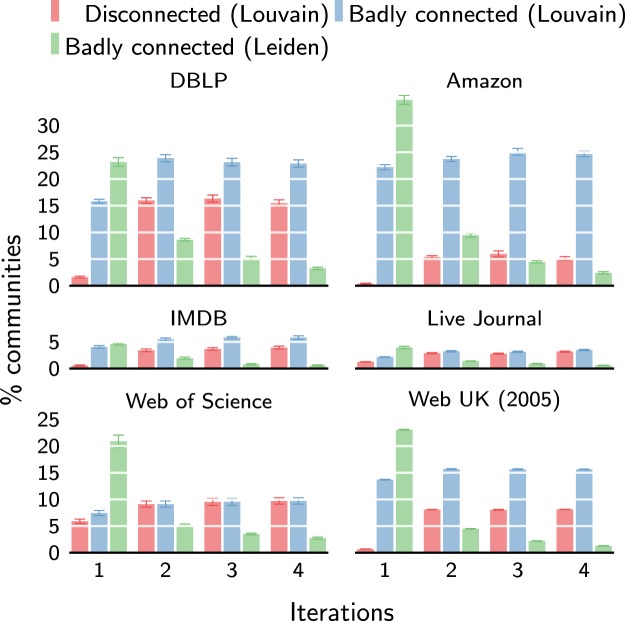
- Louvain may produce arbitrarily badly connected communities; in experiments up to 25% of communities were badly connected and up to 16% were disconnected. First-iteration badly connected percentages included Amazon 23%, DBLP 16%, and Web UK 14%; disconnected communities were usually around 1%, but exceeded 5% for Web of Science in the first iteration and jumped to 16% for DBLP in later iterations. After four iterations, Amazon had 5% disconnected but 25% badly connected communities.
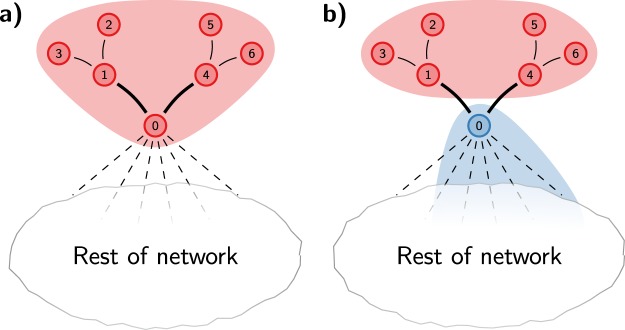
- Leiden guarantees all communities are connected after each iteration, and also γ-separated and γ-connected. After a stable iteration, all nodes are locally optimally assigned and all communities are subpartition γ-dense; asymptotically, all communities are uniformly γ-dense and subset optimal.
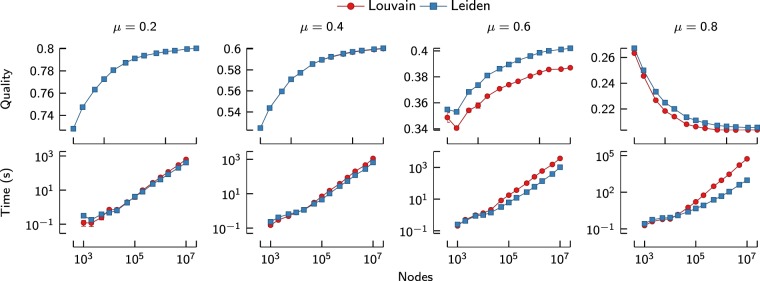
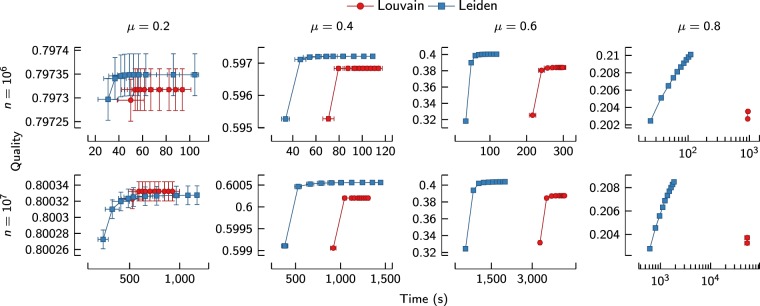
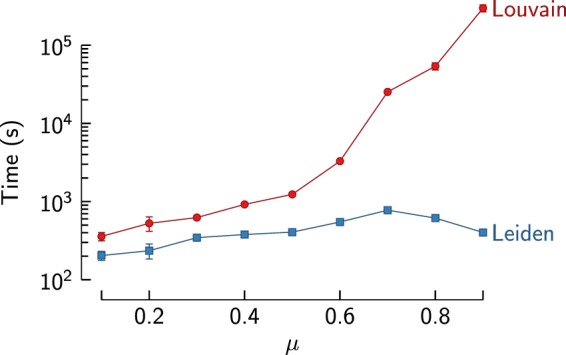
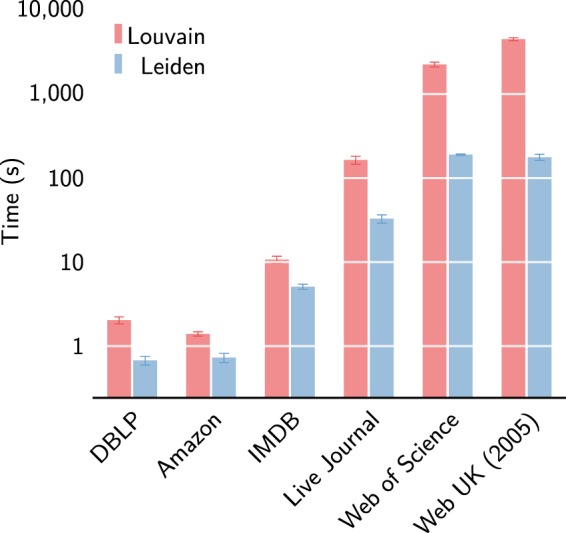
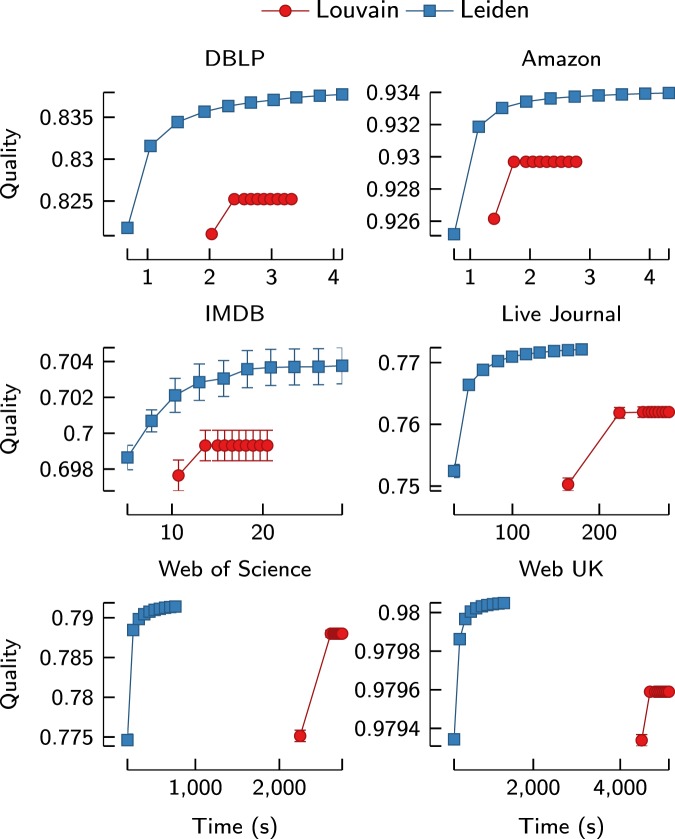
- Leiden was faster than Louvain: first iteration roughly 2–20 times faster on empirical networks, including more than 7× faster for Live Journal, more than 11× for Web of Science, and more than 20× for Web UK. On benchmark networks with difficult partitions (μ = 0.9), Louvain required almost 2.5 days while Leiden needed fewer than 10 minutes; for largest networks Leiden reached 10–100 times faster runtimes.
- Leiden found higher modularity on all six empirical networks: DBLP 0.8387 vs 0.8262, Amazon 0.9341 vs 0.9301, IMDB 0.7069 vs 0.7062, Live Journal 0.7739 vs 0.7653, Web of Science 0.7951 vs 0.7911, and Web UK 0.9801 vs 0.9796.
Methods
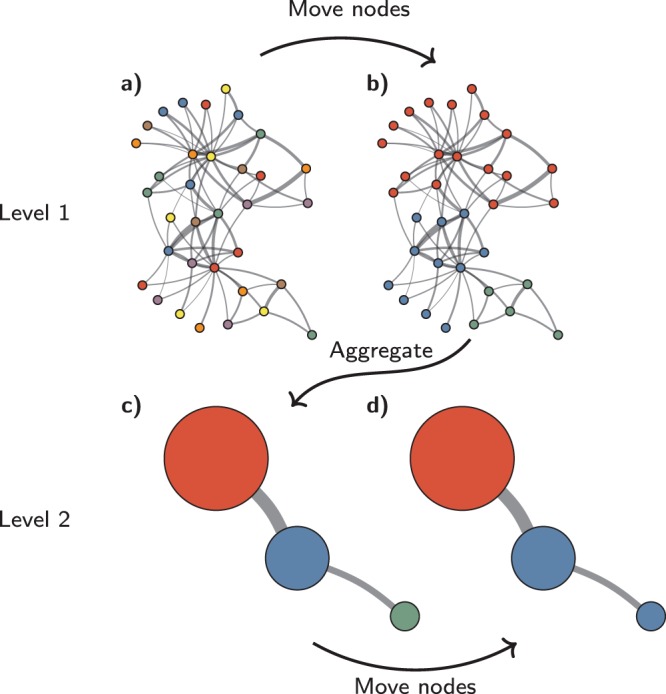
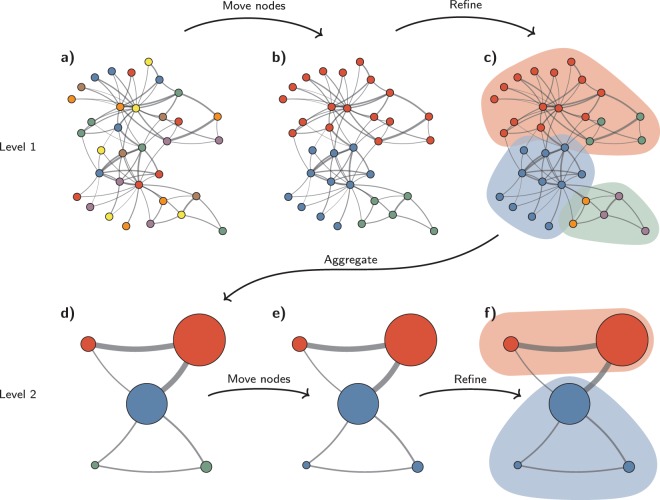
- The paper introduces the Leiden algorithm, which combines local moving, refinement of the partition, and aggregation; proofs of guarantees are relegated to Supplementary Information. It compares Leiden with Louvain on six empirical networks and on benchmark networks.
- Empirical networks: DBLP (317,080 nodes, degree 6.6), Amazon (334,863, 5.6), IMDB (374,511, 80.2), Live Journal (3,997,962, 17.4), Web of Science (9,811,130, 21.2), and Web UK (39,252,879, 39.8). Modularity was used with γ = 1; Table 2 reports maximal modularity after 10 replications of 10 iterations each. Badly connected community analysis was repeated 10 times, with Leiden run on each community’s subnetwork until a stable iteration.
- Benchmark networks ranged from n = 10^3 to n = 10^7 nodes, with community size 50 and CPM as the quality function; the mixing parameter μ varied, 10 iterations were performed, and each parameter set was repeated 10 times. The refinement randomness parameter was θ = 0.01.
Limitations
- The paper states that benchmark networks have only limited value because they are not representative of empirical real-world networks and have a rather simple structure.
- The paper states that counting communities split by Leiden gives only a lower bound on the number of badly connected communities; if Leiden does not find subcommunities, there is no guarantee that modularity cannot be increased by splitting the community.
- Evident from the text: there is no dedicated limitations section; technical details and proofs are relegated to Supplementary Information, and the experimental analysis fixes θ = 0.01 although values roughly in [0.0005, 0.1] are said to provide reasonable results.
Model-written summary. Check it against the paper before relying on it.
Integrity signals
Registry
Cites
Statistics
Figures
Verification
Claims the paper makes
1 Valid · 2 Not valid · 17 Not checked · 142 Own results and interpretations
The cited sources support only part of this claim — read each source’s verdict below.
In the paper
“Hence, the problem of Louvain outlined above is independent from the issue of the resolution limit.”
§ From Louvain to Leiden: guaranteeing well-connected communities > Louvain Algorithm > Badly connected communities
What the sources say
- Partly supportedcites [14] Fortunato S Barthélemy M Resolution Limit in Community Detection Proc. Natl. Acad. Sci. USA 2007 104 36 10.1073/pnas.0605965104 17190818 PMC1765466 sourceExperimental — accuracy not yet measured
Our copy supports the resolution-limit side of the sentence: the Conclusions (VI, p. 7) state that 'the resolution limit of modularity does not rely on particular network structures, but only on the comparison between the sizes of interconnected communities and that of the whole network', the Introduction (p. 1) calls it an 'intrinsic scale' of modularity, and Section V (pp. 5-6) shows the failure persists with simulated annealing, i.e. it is a property of the quality function rather than of one particular optimizer. What the source does not contain is the other term of the comparison: Louvain is never mentioned anywhere in the paper (the Introduction, p. 1, lists only generic greedy procedures [19,20], extremal optimization [21] and simulated annealing [22,23]), and no passage contrasts the resolution limit with an algorithm-specific defect. The independence claim is therefore the citing authors' own inference built on this paper's characterization of the resolution limit. (LLM, conf=0.70)
plain- Asserted: passes — The authors put it forward as true.
- Checkable: passes — It can be checked against evidence.
- Load-bearing: passes — The paper’s conclusions depend on it.
- Based: passes — The paper gives a reason why it holds.
- Partly supported
A result the paper states — it cites no source for it, so there is none to check. The quote shows it is in the paper.
In the paper
“The percentage of badly connected communities is less affected by the number of iterations of the Louvain algorithm.”
§ From Louvain to Leiden: guaranteeing well-connected communities > Experimental Analysis > Badly connected communities
plain- Asserted: passes — The authors put it forward as true.
- Checkable: passes — It can be checked against evidence.
- Load-bearing: unclear — It is unclear whether the paper’s conclusions depend on it.
- Based: passes — The paper gives a reason why it holds.
A result the paper states — it cites no source for it, so there is none to check. The quote shows it is in the paper.
In the paper
“In addition, we prove that, when the Leiden algorithm is applied iteratively, it converges to a partition in which all subsets of all communities are locally optimally assigned.”
- Also stated in: § Introduction · boosted
“In addition, we prove that the algorithm converges to an asymptotically stable partition in which all subsets of all communities are locally optimally assigned.”
§ From Louvain to Leiden: guaranteeing well-connected communities > Abstract
boostedstates a cause- Asserted: passes — The authors put it forward as true.
- Checkable: passes — It can be checked against evidence.
- Load-bearing: passes — The paper’s conclusions depend on it.
- Based: passes — The paper gives a reason why it holds.
- Also stated in: § Introduction · boosted
A result the paper reports from its own data — it cites no other source for it, so there is none to check. The quote shows it is in the paper.
In the paper
“The second iteration of Louvain shows a large increase in the percentage of disconnected communities.”
§ From Louvain to Leiden: guaranteeing well-connected communities > Experimental Analysis > Badly connected communities
plainstates a cause- Asserted: passes — The authors put it forward as true.
- Checkable: passes — It can be checked against evidence.
- Load-bearing: passes — The paper’s conclusions depend on it.
- Based: passes — The paper gives a reason why it holds.
A result the paper reports from its own data — it cites no other source for it, so there is none to check. The quote shows it is in the paper.
In the paper
“In terms of the percentage of badly connected communities in the first iteration, Leiden performs even worse than Louvain, as can be seen in Fig. 4.”
§ From Louvain to Leiden: guaranteeing well-connected communities > Experimental Analysis > Badly connected communities
plain- Asserted: passes — The authors put it forward as true.
- Checkable: passes — It can be checked against evidence.
- Load-bearing: unclear — It is unclear whether the paper’s conclusions depend on it.
- Based: passes — The paper gives a reason why it holds.
115 more claims
Create a free account to see all 162 claims and to verify the 24 references still open.
- Probably not a substantial claim. 23
- It may state two separate claims as one. 23
- The quote only partly states this claim. 1
Claims other papers make about this one
Each is checked against this paper’s own text: does it say what the citing paper says it does?
The cited source says what the claim attributes to it.
In the citing paper
“When compared to six common clustering algorithms, including Leiden25 and CellHarmony26, VFC was the top performing algorithm on every simulation on the T cell data and best performing, on average, on the zebrafish dataset, with a 57% increase in average performance over Louvain, which was the next best algorithm”
From Quantifying the effect of experimental perturbations at single-cell resolution (2021) · cites this paper as [25]
The cited source says what the claim attributes to it.
In the citing paper
“Louvain’s successor Leiden circumvents this issue by yielding guaranteed connected communities and is computationally more efficient52.”
From Best practices for single-cell analysis across modalities (2023) · cites this paper as [52]
The cited source says what the claim attributes to it.
In the citing paper
“However, the Louvain algorithm can lead to arbitrarily poorly connected communities52.”
From Best practices for single-cell analysis across modalities (2023) · cites this paper as [52]
The cited source says what the claim attributes to it.
In the citing paper
“We found that many t-types had total variance substantially above the variances of the k-means clusters (Fig. 5b) and an alternative analysis using entropies of Leiden clustering35 often highlighted the same t-types as variable (Extended Data Fig. 8).”
From Phenotypic variation of transcriptomic cell types in mouse motor cortex (2021) · cites this paper as [35]
The cited source says what the claim attributes to it.
In the citing paper
“Community detection uses the Leiden algorithm [28] with ModularityVertexPartition, producing hierarchical subclustering to depth 3.”
From SuperLocalMemory: Privacy-Preserving Multi-Agent Memory with Bayesian Trust Defense Against Memory Poisoning (2026) · cites this paper as [28]
6 more claims about this paper
Create a free account to see every claim other papers make about this one.
Citations
Cites
Fast unfolding of communities in large networks
Blondel, V. D., Guillaume, J.-L., Lambiotte, R., & Lefebvre, E. (2008) · Journal of Statistical Mechanics: Theory and Experiment · doi:10.1088/1742-5468/2008/10/p10008 · Cited by 21,424 · cited 3×
“The Louvain algorithm 10 is very simple and elegant.”
MethodFinding and evaluating community structure in networks
Newman, M. E. J., & Girvan, M. (2004) · Physical Review E · doi:10.1103/physreve.69.026113 · Cited by 13,931 · cited 2×
“The Leiden algorithm consists of three phases: (1) local moving of nodes, (2) refinement of the partition and (3) aggregation of the network based on the refined partition, using the non-refined partition to create an initial partition for the aggregate network.”
BackgroundMethodComplex brain networks: graph theoretical analysis of structural and functional systems
Bullmore, E., & Sporns, O. (2009) · Nature Reviews Neuroscience · doi:10.1038/nrn2575 · Cited by 11,820
Fortunato, S. (2010) · Physics Reports · doi:10.1016/j.physrep.2009.11.002 · Cited by 11,293 · cited 4×
“The Leiden algorithm consists of three phases: (1) local moving of nodes, (2) refinement of the partition and (3) aggregation of the network based on the refined partition, using the non-refined partition to create an initial partition for the aggregate network.”
BackgroundMethodInfluentialFinding community structure in very large networks
Clauset, A., Newman, M. E. J., & Moore, C. (2004) · Physical Review E · doi:10.1103/physreve.70.066111 · Cited by 7,390 · cited 1×
“Optimising modularity is NP-hard 5 , and consequentially many heuristic algorithms have been proposed, such as hierarchical agglomeration 6 , extremal optimisation 7 , simulated annealing 4,8 and spectral 9 algorithms.”
MethodFinding community structure in networks using the eigenvectors of matrices
Newman, M. E. J. (2006) · Physical Review E · doi:10.1103/physreve.74.036104 · Cited by 4,761
Functional cartography of complex metabolic networks
Guimerà, R., & Nunes Amaral, L. A. (2005) · Nature · doi:10.1038/nature03288 · Cited by 3,983 · cited 2×
“Optimising modularity is NP-hard 5 , and consequentially many heuristic algorithms have been proposed, such as hierarchical agglomeration 6 , extremal optimisation 7 , simulated annealing 4,8 and spectral 9 algorithms.”
MethodNear linear time algorithm to detect community structures in large-scale networks
Raghavan, U. N., Albert, R., & Kumara, S. (2007) · Physical Review E · doi:10.1103/physreve.76.036106 · Cited by 3,502 · cited 2×
“Trying to fix the problem by simply considering the connected components of communities 19–21 is unsatisfactory because it addresses only the most extreme case and does not resolve the more fundamental problem.”
BackgroundBenchmark graphs for testing community detection algorithms
Lancichinetti, A., Fortunato, S., & Radicchi, F. (2008) · Physical Review E · doi:10.1103/physreve.78.046110 · Cited by 3,051 · cited 1×
“To study the scaling of the Louvain and the Leiden algorithm, we rely on a variant of a well-known approach for constructing benchmark networks 28 .”
MethodResolution limit in community detection
Fortunato, S., & Barthélemy, M. (2007) · Proceedings of the National Academy of Sciences · doi:10.1073/pnas.0605965104 · Cited by 3,024 · cited 2×
“The algorithm may yield arbitrarily badly connected communities, over and above the well-known issue of the resolution limit 14 .”
Background
Research works printed but not linked: 2
- Porter MA Onnela J-P Mucha PJ Communities in Networks Not. AMS 2009 56 1082 1097
- Luecken, M. D. Application of multi-resolution partitioning of interaction networks to the study of complex disease. Ph.D. thesis, (University of Oxford, 2016).
Cited by
Items 6,801–6,900 of 7,288
Bonagiri, N., & Natarajan, E. (2026) · International Journal of Oncology Research · doi:10.64823/ijor.2601004
IBDex: A Frozen Patient-Scale Atlas for Bulk Transcriptomics in Inflammatory Bowel DiseasePreprint
Madeswaran, A. K., & Acharjee, A. (2026) · medRxiv · doi:10.64898/2026.10.20.26365993
A transcriptional and cellular exploration of obesity and type II diabetes in human adipose tissues
Trim, W. V., Petrova, K., Healy, K., Stevens, B. M., Scanlan, J., Faust, H. J., Akusjärvi, S. S., O’Brien, K., O'Shea, D. B., Brenner, M. B., et al. (2026) · Science Advances · doi:10.1126/sciadv.aee1641
Xue, J., Cao, X., Zhou, J., Cao, Y., Shi, F., Du, F., & Yu, Z. (2026) · Bioinformatics · doi:10.1093/bioinformatics/btag610
An actionable GPCR restores phosphoinositide homeostasis and kidney function in Lowe syndrome
Staiano, L., Testa, M., Vicinanza, M., Cervellini, F., Giaquinto, L., Patanella, L., Tullio, G. D., Santoro, M., Carissimo, A., Giordano, A., et al. (2026) · Signal Transduction and Targeted Therapy · doi:10.1038/s41392-026-03054-z
Redd, D. M., Green, S. G., & Terooatea, T. W. (2026) · bioRxiv (Cold Spring Harbor Laboratory) · doi:10.64898/2026.11.05.764643
MOCHI: Motif-Based Community Search Over Large Heterogeneous Information Networks
Zhou, Y., Liu, Q., Huang, X., Xu, J., & Gao, Y. (2026) · IEEE International Conference on Data Engineering (ICDE) · doi:10.1109/icde65706.2026.00059
Ding, C., Wang, J., Li, H., & Xue, X. (2026) · AI Engineering · doi:10.53941/aieng.2026.100018
Sallam, A., & Gillis, J. (2026) · bioRxiv (Cold Spring Harbor Laboratory) · doi:10.64898/2026.08.22.746357
Whose Polarization Is It? Auditing Fairness in Network Polarization MeasuresPreprint
Stępień, S., Janik, M., Saxena, A., & Michalski, R. (2026) · arXiv (Cornell University) · doi:10.48550/arxiv.2610.22677
Carcanholo, F. P., Cassiano, M. H. A., Panepucci, E. M., Laurini, M. P., & Malta, T. M. (2026) · bioRxiv (Cold Spring Harbor Laboratory) · doi:10.64898/2026.10.02.756019
Scale-resolved correlation functions unify spatial omics across platforms and resolutionsPreprint
Ilin, M., Singh, Y., & Mages, S. (2026) · bioRxiv (Cold Spring Harbor Laboratory) · doi:10.64898/2026.10.09.757915
Harnessing single-cell omics for farmed animal improvement and human health
Li, H., & Fang, L. (2026) · Journal of Animal Science and Biotechnology/Journal of animal science and biotechnology · doi:10.1186/s40104-026-01516-6
Closing the fusion-detection gap in single-cell RNA-seq with a scalable, probe-based workflowPreprint
Maksimovic, J., Streeton-Cook, V., Grima, C. V., Hanna, D. T., Tawfic, N., Ludlow, L. E. A., Brown, L. M., Ekert, P. G., Alaei, S., Yoannidis, D., et al. (2026) · bioRxiv (Cold Spring Harbor Laboratory) · doi:10.64898/2026.08.26.747171
‘Science of Science’: the thematic landscape and historical roots
Archana, S. N., Padmakumar, P. K., & Shajitha, C. (2026) · Information Research · doi:10.47989/ir31358091
Straub, A., An, Y., Drost, F., Heyer, K., Abedi, Z., Hammel, M., Delahoussaye, A., Wagner, S., Mühlbauer, A., Hönninger, J., et al. (2026) · bioRxiv (Cold Spring Harbor Laboratory) · doi:10.64898/2026.08.20.745957
Single-cell multi-ancestry regulatory map of systemic lupus erythematosusPreprint
Jang, H., Sutherland, C., Lee, W., de Klein, N., Rupall, T. S., Chau, B. L., Buyamin, E. V., Buang, N. B., West, M., Wincup, C., et al. (2026) · bioRxiv (Cold Spring Harbor Laboratory) · doi:10.64898/2026.09.18.752560
Frigo, A., Terzoli, S., Marzano, P., Coianiz, N., Calvi, M., Orlandi, L., Balin, S., Cazzetta, V., Carletti, A., Bella, S. D., et al. (2026) · Frontiers in Immunology · doi:10.3389/fimmu.2026.1972608
U-Chrom: a unified framework for single-cell and spatial 3D genome dataPreprint
Zhang, L., Chen, Y., Zhong, Q., & Xu, W. (2026) · bioRxiv (Cold Spring Harbor Laboratory) · doi:10.64898/2026.10.18.759996
XplainTDA: Explaining the topological structure of single-cell multi-omics data through perturbationPreprint
Giray, I., Malagoli, G., Schmid, K., & Colomé‐Tatché, M. (2026) · bioRxiv (Cold Spring Harbor Laboratory) · doi:10.64898/2026.10.14.759129
Look What You Made Us Cluster: Hate Narrative Extraction from Reddit DiscoursePreprint
Chua, A. K. L., Khoo, F. J., Tan, J. C. R., Ang, H. T., Tan, K. H., Sim, J. Y. A., Ow, S. W. H., Mundhra, R., Toh, E. C. K., Xu, Y., et al. (2026) · arXiv (Cornell University) · doi:10.48550/arxiv.2609.37408
CNVSIM: an interpretable cross-study copy-number reference atlas for cancer subtypingPreprint
Yu, J., Bardet-Trouilloud, J., Jaeger, S., & Baudis, M. (2026) · bioRxiv (Cold Spring Harbor Laboratory) · doi:10.64898/2026.10.26.761332
Systematic mapping of the prokaryotic noncoding sequence space with a genomic language modelPreprint
Sun, G., Hudelmaier, T., Gilligan, J. C., Gonzalez, G. A., Yin, P., Wan, F., Ma, Z. (., Durrant, M. G., Ricci-Tam, C., Pawluk, A., et al. (2026) · bioRxiv (Cold Spring Harbor Laboratory) · doi:10.64898/2026.10.21.760802
Network approaches to community detection in nanoscale connectomics
Wang, Q., Gutierrez, G. J., Kunin, A. B., Vogelstein, J. T., Bassler, K. E., Josic, K., & Betzel, R. F. (2026) · Nature reviews. Neuroscience · doi:10.1038/s41583-026-01094-6
Evidence-grounded large language models guide perovskite solar cell design and optimizationPreprint
Chen, Y., Wan, Z., Li, Z., & Jing, T. (2026) · arXiv (Cornell University) · doi:10.48550/arxiv.2611.00633
Monge-Asensio, M., Demirtaş, M., Pfeffer, T. A., Zamora‐López, G., Vohryzek, J., Sanz-Perl, Y., van den Brink, R. L., Donner, T. H., Kringelbach, M. L., & Deco, G. (2026) · Frontiers in Computational Neuroscience · doi:10.3389/fncom.2026.1854866
Extracellular cGAMP transmission exacerbates neuroinflammation in aging and multiple sclerosisPreprint
Carvalho, D. R., Wang, R., Liu, N., Li, Y., Younis, T., Sclip, A., Muthusamy, A., Shin, S., Pawluk, A., Thaiss, C., et al. (2026) · bioRxiv (Cold Spring Harbor Laboratory) · doi:10.64898/2026.09.30.754737
Nguyen, T. C., King, H. D., Amgalan, D., Pushkarev, O., Mo, Y. A., Munger, C. J., McCreery, C. V., Gupta, R., Zeng, T., Zhou, R., et al. (2026) · bioRxiv (Cold Spring Harbor Laboratory) · doi:10.64898/2026.11.04.763740
Effects of the strait of Hormuz disruption on the global crude oil shipping network
Wang, M., Ma, T., & Zhao, P. (2026) · Ocean & Coastal Management · doi:10.1016/j.ocecoaman.2026.108400
Enhancing robustness and assessing ideological influence in retrieval-augmented generation systems.
Amadou, H. (2026) · EspaceINRS (National Institute for Scientific Research (Canada))
From Repetition to Recognition: Inductive Discovery of Disinformation Narratives
Upravitelev, M., Solopova, V., Yang, J., Jakob, C., Tsiakalou, A., Foroutan, N., & Schmitt, V. (2026) · Findings of the Association for Computational Linguistics: EMNLP (Findings of EMNLP) · doi:10.18653/2026.findings-emnlp.1821
Ozaki, H. (2026) · Research Square · doi:10.21203/rs.3.rs-11558063/v1
The Error Is the Signal: Misconception Discovery via Step-Error Annotation Clustering
Ferrer, R. V., Sachan, M., & Sonkar, S. (2026) · International Joint Conference on Natural Language Processing and Conference of the Asia-Pacific Chapter of the Association for Computational Linguistics (IJCNLP-AACL) · doi:10.18653/2026.aacl-long.221
FluxSprout: Single-cell metabolic modeling of vascular sprouting in zebrafishPreprint
Zargar, M. R., & Chowdhury, R. (2026) · bioRxiv (Cold Spring Harbor Laboratory) · doi:10.64898/2026.10.24.761567
Tan, X., Simon, M., Rosebrock, D., Firulyova, M. M., Gruber-Schoffnegger, D., Fuerst, M., Aldisi, R. S., Heilmann-Heimbach, S., Bechter, K., Schnellbächer, G. J., et al. (2026) · bioRxiv (Cold Spring Harbor Laboratory) · doi:10.64898/2026.09.24.753662
A clinically annotated proteomic and histological resource of 1,000 colorectal cancersPreprint
Qoku, A., Ullrich, N., Miranda, F., Rosenthal, T., Keil, A., Vowinckel, J., Dueker, M. S., Ruengeling, S., Rosen, L.-A., Gaetje, F. B., et al. (2026) · bioRxiv (Cold Spring Harbor Laboratory) · doi:10.64898/2026.10.20.757714
Li, M., Safavi, A., Samir, J., Louie, R. H. Y., Basmenj, E. R., Bonomi, M., Adikari, T. N., Gloss, B., Xing, J., Jackson, K., et al. (2026) · bioRxiv (Cold Spring Harbor Laboratory) · doi:10.64898/2026.08.30.747985
Roncalli, T., Rémy, É., & Paulevé, L. (2026) · bioRxiv (Cold Spring Harbor Laboratory) · doi:10.64898/2026.10.02.756175
A human transcriptomic deletion links cortical expansion and cancerPreprint
Starr, A. L., Villalba, A., Rever, J., Chen, Y., Pauler, F. M., Magtanong, L., Maxwell, C. A., Hippenmeyer, S., & Fraser, H. B. (2026) · bioRxiv (Cold Spring Harbor Laboratory) · doi:10.64898/2026.09.16.752114
EBV Reprograms B Cells in an Autoimmune-Like Fashion in Patients with COVID-19Preprint
Chen, D. G., Yuan, D., Su, Y., Magis, A. T., Chu, H. Y., Goldman, J. D., & Heath, J. R. (2026) · bioRxiv (Cold Spring Harbor Laboratory) · doi:10.64898/2026.08.17.745245
Inferring Latent Structures in Social Systems: From Network Patterns to Subjective Judgments
Narimanzadeh, H. (2026) · Aaltodoc (Aalto University)
Wen, H., Shen, Q., Yuan, Z., & Zhang, S. (2026) · bioRxiv (Cold Spring Harbor Laboratory) · doi:10.64898/2026.10.04.756473
Uncertainty-aware quantitative analysis of the structure and dynamics of T cell receptor repertoiresPreprint
Kitanovski, S., Wollek, K., & Hoffmann, D. E. (2026) · eLife · doi:10.7554/elife.112537.1
Yu, S., Shi, Z., Song, Z., Arroyave, E., Saldarriaga, O., Stevenson, H. L., Guan, D., Dong, B., & Zhao, H. (2026) · bioRxiv (Cold Spring Harbor Laboratory) · doi:10.64898/2026.10.20.755227
Cross-lingual Clustering of News Stories using Embeddings-based Community Detection
Nikolaidis, N., Kovacikova, K., & Androutsopoulos, I. (2026) · Findings of the Association for Computational Linguistics: EMNLP (Findings of EMNLP) · doi:10.18653/2026.findings-emnlp.104
Operationalizing Cyber Threat Intelligence with GraphRAGPreprint
Kabra, A., Paliwal, P., & Hanawal, M. K. (2026) · arXiv (Cornell University) · doi:10.48550/arxiv.2608.13050
Medical Large Language Model Based on Dynamic Retrieval-Augmented Generation Strategy
Zheng, Y., & Xu, Y. (2026) · International Conference on Bioinformatics and Intelligent Computing (BIC) · doi:10.1145/3809986.3810081
A Matryoshka Hierarchical RAG for Efficient Multi-Hop Question AnsweringPreprint
Bonifazi, G., Buratti, C., Marchetti, M., Parlapiano, F., Quaglieri, G., Traini, D., Ursino, D., & Virgili, L. (2026) · arXiv (Cornell University) · doi:10.48550/arxiv.2610.01767
Куренков, А. Л., & Куренкова, Д. А. (2026) · Vestnik of the Plekhanov Russian University of Economics
HyperRAG-IHM: Incremental Hyperedge Maintenance for Hypergraph RAG under Corpus Expansion
Chen, H., Zhu, J., Jia, T., Zhao, S., Chen, L., & Mu, X. (2026) · Conference on Empirical Methods in Natural Language Processing (EMNLP) · doi:10.18653/2026.emnlp-main.898
AI, U., & Kandasamy, S. (2026) · e-Journal of Nondestructive Testing · doi:10.58286/35106
Gerber, A. O., Lipenkova, J., Rao, S. X., & Lu, G. (2026) · Frontiers in Artificial Intelligence · doi:10.3389/frai.2026.1890105
Path-Aware Evidence Stitching for Budgeted Dual-Index Retrieval: A Controlled Multi-Hop Study
Davis, S., & Tran, J. (2026) · International Journal of Information and Communication Technology Trends · doi:10.66525/ijictt143
CHORD: Clustering Hyperedging to Organize Relevant Documents for Multimodal Document Understanding
Ma, W., & Han, K. (2026) · ACM International Conference on Multimedia (ACM MM) · doi:10.1145/3767308.3835785
Bao, X., Zhu, J., Song, X., Zhang, X., Zeng, H., Vu, H. T. H., Zhang, H., Zhang, Z., Yao, M., Liang, M., et al. (2026) · bioRxiv (Cold Spring Harbor Laboratory) · doi:10.64898/2026.10.28.762297
Zhang, S., Hongru, H., Wang, X., Xiong, C., Kanekiyo, T., Asmann, Y. W., & Ren, Y. (2026) · NAR Genomics and Bioinformatics · doi:10.1093/nargab/lqag140
Zhang, A., Moon, S., Marathe, S. A., Bhattacharya, R., & Camp, E. R. (2026) · Cancers · doi:10.3390/cancers18223607
Hippocampal information topology breaks down in a mouse model of Alzheimer’s diseasePreprint
Yu, J. J., Rajpal, H., Go, M. A., & Schultz, S. R. (2026) · bioRxiv (Cold Spring Harbor Laboratory) · doi:10.64898/2026.08.14.744888
CourtStyle: Unified Self-Supervised Framework for Tennis Playing Style Discovery
Jouini, A., Chaieb, F., & Loth, A. (2026) · Procedia Computer Science · doi:10.1016/j.procs.2026.09.173
Pan, T. Y., Liu, Y. J., Sun, H. M., Yang, Z. L., & Feng, B. (2026) · Mycorrhiza · doi:10.1007/s00572-026-01309-9
AmbiDose: per-cell removal budgets for ambient RNA contaminationPreprint
Li, Z., James, A. W., & Li, S. (2026) · bioRxiv (Cold Spring Harbor Laboratory) · doi:10.64898/2026.09.27.754849
Gralinska, E., Scirgolea, C., Manchala, A., Karagianni, M., Durini, G., Hüsser, T., Yángüez, E., Nicolini, V., Aktas, S., & Deak, L. C. (2026) · bioRxiv (Cold Spring Harbor Laboratory) · doi:10.64898/2026.08.17.745170
Katsura, H., Yamaoka, A., Nomura, N., Kim, J., Nishimura, O., Cho, D., Kadota, M., Kondo, T., Abe, T., Kiyonari, H., et al. (2026) · bioRxiv (Cold Spring Harbor Laboratory) · doi:10.64898/2026.09.23.753969
Zou, K., Wan, R., Liu, X., Pan, Y., Shi, J., Cao, W., Yang, F., Cheng, Z., & Zhu, Q. (2026) · Briefings in Bioinformatics · doi:10.1093/bib/bbag623
Li, C. H., Quah, H. S., Arcinas, C., Alagappan, L., Suteja, L., Bhuvaneswari, H., Leong, H. S., Chong, F. T., Toh, D., Wong, S., et al. (2026) · bioRxiv (Cold Spring Harbor Laboratory) · doi:10.64898/2026.09.02.748952
ProxiNet transfers spatially learned cellular proximity to dissociated single-cell transcriptomesPreprint
Zhan, Y., Yan, B., Zhang, A., Kellis, M., & Sun, N. (2026) · bioRxiv (Cold Spring Harbor Laboratory) · doi:10.64898/2026.09.25.754372
Dogra, D., Fong, H., Zhang, S., Sumi, T., Rosin, N. L., Collao, N., Gordon, M., Korver, A., Gavrilovici, C., Noble, D., et al. (2026) · bioRxiv (Cold Spring Harbor Laboratory) · doi:10.64898/2026.10.14.758626
Finarelli, Rochel, L. A., Evéquoz, J. A., Florian, & Rizzo, G. (2025) · Institutional Research Information System University of Turin (University of Turin)
Lee, K. C., Pitchford, J. W., Vila‐Concejo, A., & Hill, J. (2026) · Journal of Geophysical Research Oceans · doi:10.1029/2025jc023633
Clemente‐Larramendi, I., Gliozzo, J., Velo‐Suárez, L., Bocher, O., Foulquier, N., Hernandez-Valladares, M., Legault, M., Cornec, D., Jamin, C., Gil-de-la-Fuente, A., et al. (2026) · bioRxiv (Cold Spring Harbor Laboratory) · doi:10.64898/2026.09.22.753185
Interpretable Dynamic Graph Learning via Dual‐Granularity Large Language Model Alignment
Xie, Y., Wang, W., Li, T., Li, X., & Wu, L. Y. (2026) · Expert Systems · doi:10.1111/exsy.70454
Tung, K.-C., Tu, Y.-H., Hsieh, K.-Y., Juan, H., & Huang, H.-C. (2026) · bioRxiv (Cold Spring Harbor Laboratory) · doi:10.64898/2026.10.24.761531
Cell cycling throttles epithelial--mesenchymal transitionPreprint
McDermott, M., Dey, A., Mehta, R., & MacLean, A. L. (2026) · bioRxiv (Cold Spring Harbor Laboratory) · doi:10.64898/2026.11.05.764762
Zhang, L., Zheng, Y., Shi, X., Li, N., Tian, J., & Duan, S. (2026) · Toxicology · doi:10.1016/j.tox.2026.154623
Kim, S., Cheong, S., Lee, S., Kim, Y., Xie, R., Koh, I. G., La, J., Hwa, C., An, H., Park, J., et al. (2026) · Nature Methods · doi:10.1038/s41592-026-03295-4
Cheng, G., Shan, L., Shi, W., Liu, X., Tao, X., & Han, J. (2026) · Frontiers in Cardiovascular Medicine · doi:10.3389/fcvm.2026.1929802
Spatialsnake: a flexible workflow for spatial transcriptomics analysis across platformsPreprint
Lin, Z., Zhang, Z., Huang, N., Lu, Z., & Xu, S. (2026) · bioRxiv (Cold Spring Harbor Laboratory) · doi:10.64898/2026.10.27.762082
GMP-Cor: Quantifying Transcriptional Dysregulation in Antibiotic Tolerance and PersistencePreprint
Gutfreund, A., Rotem, A., Ronin, I., Rosenthal, A. Z., Agam, O., & Balaban, N. Q. (2026) · bioRxiv (Cold Spring Harbor Laboratory) · doi:10.64898/2026.11.02.763672
He, D., Gao, Y., & Patro, R. (2026) · bioRxiv (Cold Spring Harbor Laboratory) · doi:10.64898/2026.11.05.764594
Gerasymchuk, D., Talvio, K., House, A. H., Meistermann, D., Pospelov, A. S., Kousa, I., Ruhanen, H., Koskuvi, M., Paavola, J., Holopainen, M., et al. (2026) · iScience · doi:10.1016/j.isci.2026.118176
Dynamic Generalized Gromov-Wasserstein Optimal TransportPreprint
Ying, J., Zeng, Z., Zhou, P., & Zhang, L. (2026) · arXiv (Cornell University) · doi:10.48550/arxiv.2609.20008
(2026) · Herald of Advanced Information Technology · doi:10.15276/hait.09.2026.34
Synthetic network generation with realistic cluster connectivity
Anne, L. (2025) · Illinois Digital Environment for Access to Learning and Scholarship (University of Illinois at Urbana-Champaign)
Baraibar, I., Morabito, S., Deuner-Cos, G., Caratù, G., Melero, J. L., Berasategi, M., Soto, M., Grzelak, M., Nieto, P., Maspero, D., et al. (2026) · medRxiv · doi:10.64898/2026.10.23.26365904
COMPASS: Steering Distributed Vector Search with Scientific Knowledge GraphsPreprint
Oh, S. Y., Gueroudji, A., Ockerman, S., Latham, R., Yildiz, O., Foster, I. T., Chard, K., & Ross, R. (2026) · arXiv (Cornell University) · doi:10.48550/arxiv.2609.13452
Vahdat, Z., Sharma, S., Truong, K., Koirala, A., Rankothgedera, S., Thevasagayampillai, S., Kandasamy, A., Grimm, S. L., Zhou, S., Gunaratne, P. H., et al. (2026) · mBio · doi:10.1128/mbio.02365-26
A single-cell transcriptomic atlas of the pigtail macaque lungPreprint
Kim, T., Cornelius, J., Sindhu, V., Duell, T., Sun, S. C., Chima, S. C., Huang, H., Cervantes, O., Kapur, R. P., Zhao, H., et al. (2026) · bioRxiv (Cold Spring Harbor Laboratory) · doi:10.64898/2026.11.05.764748
scPCIP: cross-species annotation of plant cell types with conserved gene programsPreprint
Yang, S., Chen, S., Wu, Y., Sun, Z., Yao, C., 孙雪梅, Wang, L., Li, W., & Zhong, Q. (2026) · bioRxiv (Cold Spring Harbor Laboratory) · doi:10.64898/2026.11.02.763657
Zhu, Y., Li, X., Zhao, X., Ma, Z., Li, K., Yuan, H., Zou, Y., & Xie, B. (2026) · ACM Transactions on Software Engineering and Methodology · doi:10.1145/3862475
Rahmani, L., Benaradj, A., Bouarroudj, R., Kadri, S., Biara, W. R., & Messafri, N. (2026) · Diversity · doi:10.3390/d18110689
Bird, K. A., Zhao, K., Kliebenstein, D., & Monroe, J. G. (2026) · bioRxiv (Cold Spring Harbor Laboratory) · doi:10.64898/2026.10.08.757691
“Double-dipping” in testing for phenotypic differences with scRNA-SeqPreprint
Sanchez, N., Etourneau, L., & Purdom, E. A. (2026) · bioRxiv (Cold Spring Harbor Laboratory) · doi:10.64898/2026.10.02.756269
Huang, Y., Wu, C., & Wang, W. W. (2026) · IEEE International Conference on Smart Internet of Things (SmartIoT) · doi:10.1109/smartiot70864.2026.00043
Cruz, C., Ghanem, H., Jabbar, S., Kbir, A., & Cherifi, H. (2026) · arXiv (Cornell University) · doi:10.48550/arxiv.2611.12222
FERDINAND: An Open Framework for Download and AI-ready Preprocessing of IMPC 2D RadiographsPreprint
Steinkamp, R., Maier, H., de Angelis, M. H., & Schneltzer, E. (2026) · bioRxiv (Cold Spring Harbor Laboratory) · doi:10.64898/2026.10.07.757287
Lei, X., Xu, J., Yue, S., & Zhao, Y. (2026) · Journal of Risk and Financial Management · doi:10.3390/jrfm19110911
TRPV4-driven ATP release activates CFTR through ADORA2B and P2RY2 receptors in the airway epithelium
Genovese, M., Santis, M. D., Giordano, A., Marotta, P., & Galietta, L. J. V. (2026) · iScience · doi:10.1016/j.isci.2026.117304
Metadata
- Authors
- Traag, V. A., Waltman, L., & van Eck, N. J.
- Affiliations
- Leiden University (NL)
- Corresponding author
- Traag, V. A.
- Venue
- Scientific Reports
- Published
- 2019-03-26
- Volume
- 9
- Issue
- 1
- Pages
- 5233-5233
- ISSN
- 2045-2322 (ISSN-L)
- PMC
- PMC6435756
- OpenAlex
- W2897249806
- Semantic Scholar
- 79cdbabb22ef80074f5659430fe6fc97932798f5
- Cited by
- 5,635
- References
- 27
- Citations by year
- 2026: 1250 · 2025: 1281 · 2024: 980 · 2023: 757 · 2022: 639 · 2021: 466 · 2020: 213 · 2019: 46
- FWCI
- 158.78
- Type
- journal article
- Language
- en
- Open access
- gold
- doi.org
- Licence
- cc-by
- creativecommons.org/licenses/by/4.0 (tdm)
- creativecommons.org/licenses/by/4.0 (vor)
- Locations
- Scientific Reports (publishedVersion, cc-by)
- Europe PMC (PubMed Central) (publishedVersion, other-oa)
- PubMed Central (publishedVersion, cc-by)
- PubMed (publishedVersion)
- arXiv (Cornell University) (submittedVersion)
- Leiden Repository (Leiden University) (submittedVersion, cc-by)
- Data Archiving and Networked Services (DANS) (submittedVersion, cc-by)
- DOAJ (DOAJ: Directory of Open Access Journals) (submittedVersion)
- Leiden Repository (Leiden University) (submittedVersion)
- arXiv (Cornell University)
- Topics
- Physical Sciences › Physics and Astronomy › Statistical and Nonlinear Physics › Complex Network Analysis Techniques
- Physical Sciences › Computer Science › Artificial Intelligence › Advanced Clustering Algorithms Research
- Life Sciences › Biochemistry, Genetics and Molecular Biology › Molecular Biology › Bioinformatics and Genomic Networks
- Keywords
- community detection, Louvain algorithm, Leiden algorithm, network partitioning, community connectivity, complex networks
About these checks
Registry, retraction, Cites and statistics results are computed, not judged, with one exception: a printed reference that no index lists is read once by a model before it counts as a citation error. Claims are extracted by a model and kept only when their quote appears verbatim in the text; each cited source is then checked, with a model’s help, for whether it says what the claim relies on. Those verdicts can be wrong — read the claim’s quote and the cited source before relying on one.
The claim verdicts this report counts are experimental: their accuracy is not yet measured.
A language model drew the claims from the paper on 2026-11-23, under version 3 of the claim definition (model deepseek-v4.1-flash, prompt extract-v3).
A second model labelled each claim on 2026-11-23 (model jev-1.13-20260917, definition revision gold-guideline-v0.2).
Cited sources are checked with a language model’s help (qwen3.8-omni-flash).
Statistics and arithmetic are recomputed, not judged.
Confidence bands are shown only for fields calibrated on our annotated test set. None is calibrated yet, so no band is shown.
What counts as a claim ›How we measure confidence ›How we check this ›
Are you an author, or do you see a problem with this page? Request a review
Data sources
Bibliographic data: Semantic Scholar, OpenAlex, Crossref.
Contains information from the Semantic Scholar Academic Graph Datasets, made available under the ODC Attribution License (ODC-BY 1.0).
Semantic Scholar’s data is described in: Kinney, R., et al. (2023). The Semantic Scholar Open Data Platform. arXiv:2301.10140.
