

Spending at least 120 minutes a week in nature is associated with good health and wellbeing
Open accessThe DOI matches its Crossref record; 51 of the 51 references it cites were found in a registry or an index; 12 of the 35 sources its claims cite were checked for support.
Abstract
Study of weekly nature exposure and self-reported health and wellbeing in a nationally representative sample.
Overview
CoChat Summary
## TL;DR
Using a nationally representative sample of adults in England (n = 19,806 weighted; n = 20,264 total sample), the paper finds that spending at least 120 minutes per week in natural environments is associated with higher odds of self-reported good health and high well-being. The association appears to level off around 200–300 minutes per week, and the authors caution that the study is cross-sectional and cannot establish causality.
## Key findings
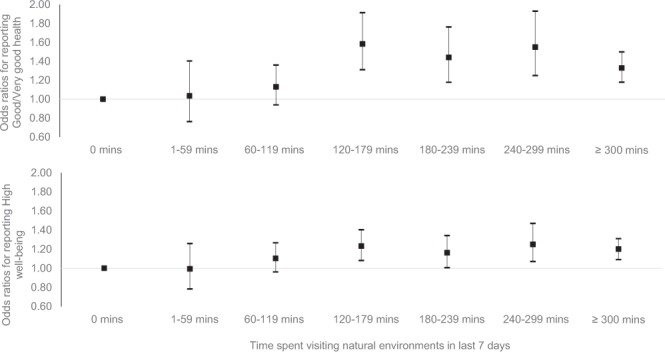
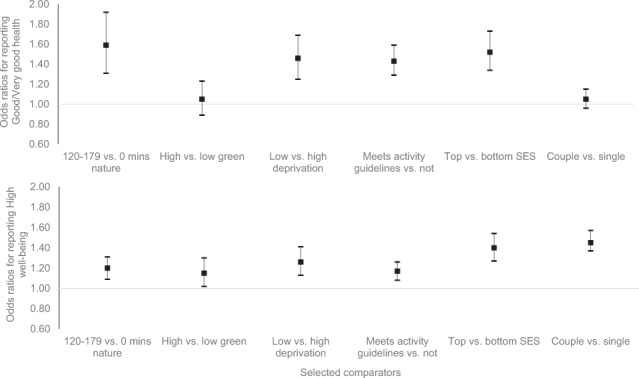
- In adjusted binomial logistic regression models, the association with good health and high well-being became significant only at ≥120 minutes per week in nature; for example, at 120–179 minutes, ORs were 1.59 [1.31–1.92] for health and 1.23 [1.08–1.40] for well-being, compared with 0 minutes.
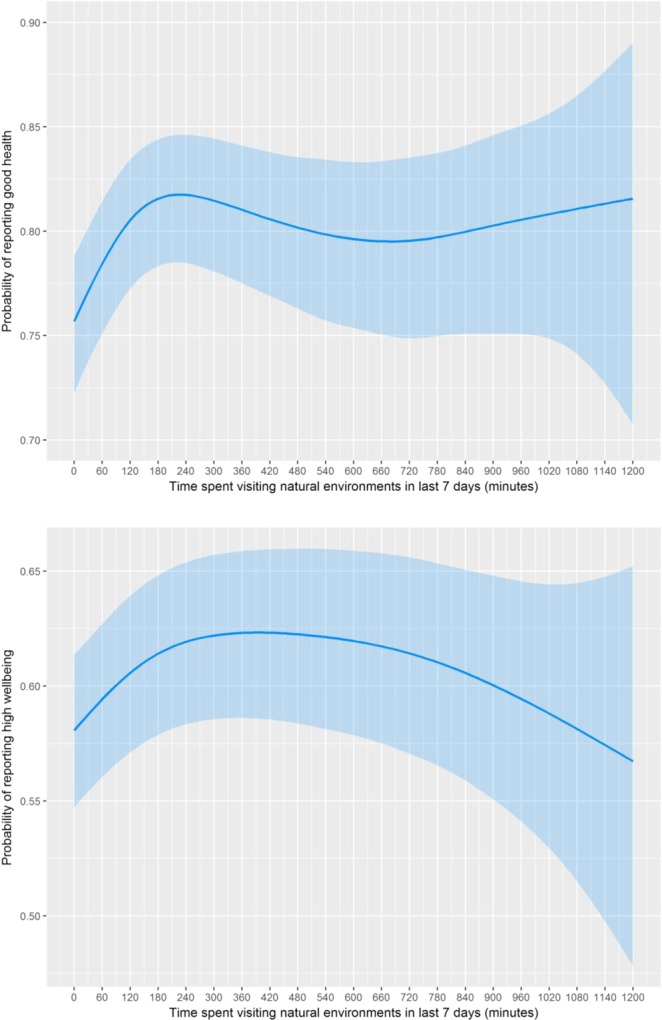
- The positive association was strongest up to about 200 minutes per week for health and 300 minutes per week for well-being, after which the relationship flattened or declined in spline analyses.
- The pattern was reported as consistent across key groups, including older adults and people with long-term health issues/disability; the paper also reports that the ≥120-minute “threshold” was seen across many stratified analyses.
- It did not matter how the 120 minutes were accumulated: additional analyses found no difference in health or well-being between one 120+ minute visit, two 60+ minute visits, or three or more ≤40 minute visits.
## Methods
- Design: Secondary analysis of a repeat cross-sectional survey; the study used survey weights to represent the adult population of England.
- Sample/data: Adults from Waves 6 and 7 of the Monitor of Engagement with the Natural Environment (MENE) survey (n = 20,264 total; n = 19,806 estimation sample for adjusted models; n = 19,808 for adjusted models with missing area-level data excluded).
- Main analysis: Survey-weighted binomial logistic regressions predicting binary health and well-being outcomes from weekly nature-contact duration categories; models adjusted for area- and individual-level covariates, with sensitivity analyses using splines and ordinal/continuous outcome specifications, plus a priori stratified analyses.
## Limitations
- The authors explicitly state the study is observational and cross-sectional, so they cannot rule out reverse causality or make causal claims.
- They note the weekly exposure estimate was based on one randomly selected visit in the last week, and that the data rely on self-reports, which may reduce accuracy.
- They caution that the apparent ≥120-minute threshold may partly reflect clustering of responses around hour marks and the way the data were categorized; this is an evident limitation from the text, alongside the very small variance explained by nature contact (about 1% in unadjusted models).
Model-written summary. Check it against the paper before relying on it.
Integrity signals
Registry
Cites
Statistics
Figures
Verification
Claims the paper makes
8 Valid · 1 Not valid · 15 Not checked · 60 Own results and interpretations
The cited sources support only part of this claim — read each source’s verdict below.
In the paper
“In other words, direct exposure, or more specifically in the current context, recreational time spent in natural environments per week, cannot accurately be inferred from neighbourhood greenspace near the home.”
§ Spending at least 120 minutes a week in nature is associated with good health and wellbeing > Introduction
What the sources say
- Partly supportedcites [23] Hillsdon, M., Coombes, E., Griew, P. & Jones, A. An assessment of the relevance of the home neighbourhood for understanding environmental influences on physical activity: how far from home do people roam? Int J Behav Nutr Phy 12, 100 (2015). sourceExperimental — accuracy not yet measured
The Conclusions and Discussion report that much outdoor physical activity occurs beyond the proximal home neighbourhood, so nearby neighbourhood characteristics may poorly represent the environments people use. The paper does not establish this specifically for weekly recreational time in natural environments or for neighbourhood greenspace; the Discussion says the researchers did not know which activities participants undertook. (LLM, conf=0.88)
- Could not verifycites [24] Sijtsma, F. J., de Vries, S., van Hinsberg, A. & Diederiks, J. Does ‘grey’ urban living lead to more ‘green’ holiday nights? A Netherlands Case Study. Landscape Urban Plan 105, 250–257 (2012). sourceExperimental — accuracy not yet measured
Our copy of Sijtsma et al. (2012) contains only repository/metadata records plus the Abstract; no body sections (Introduction, Methods, Discussion) are indexed. The Abstract (p. n/a) describes a GIS model of 'recreational shortages' — the shortage of locally available green space for recreational walking — linked to holiday nights away from home, but nowhere states that recreational time spent in natural environments per week cannot be inferred from neighbourhood greenspace near the home. Four searches (inference from neighbourhood greenspace, shortage of locally available green space for recreational walking, exposure vs. actual use, compensating behaviour/limitations) returned only the same abstract and citation blocks, so the claim's point is not addressed in the text we hold. (LLM, conf=0.65)
plain- Asserted: passes — The authors put it forward as true.
- Checkable: passes — It can be checked against evidence.
- Load-bearing: passes — The paper’s conclusions depend on it.
- Based: passes — The paper gives a reason why it holds.
- Partly supported
The cited sources support only part of this claim — read each source’s verdict below.
In the paper
“People travel beyond their local neighbourhoods to access recreational nature experiences, and indeed in our own data those who lived in the least green areas had higher odds of spending ≥120 mins in nature than those living in greener neighbourhoods (Appendix C).”
§ Spending at least 120 minutes a week in nature is associated with good health and wellbeing > Discussion
What the sources say
- Partly supportedcites [23] Hillsdon, M., Coombes, E., Griew, P. & Jones, A. An assessment of the relevance of the home neighbourhood for understanding environmental influences on physical activity: how far from home do people roam? Int J Behav Nutr Phy 12, 100 (2015). sourceExperimental — accuracy not yet measured
The Results report that 60.5% of recorded outdoor physical activity occurred beyond an 800 m home-neighbourhood boundary, and the Conclusions say adults undertook most outdoor physical activity outside their proximal home neighbourhood (page not provided). The paper does not establish that people travelled beyond their neighbourhoods specifically to access recreational nature experiences; it measured where activity occurred, not its purpose or whether it took place in nature. (LLM, conf=0.86)
plain- Asserted: passes — The authors put it forward as true.
- Checkable: passes — It can be checked against evidence.
- Load-bearing: passes — The paper’s conclusions depend on it.
- Based: passes — The paper gives a reason why it holds.
- Partly supported
Every source the paper cites for this claim was checked and supports it.
In the paper
“Research into shinrin-yoku (Japanese “forest bathing”)35, for instance, suggested that various psycho-physiological benefits can be gained from merely sitting passively in natural vs. urban settings.”
§ Spending at least 120 minutes a week in nature is associated with good health and wellbeing > Discussion
What the sources say
- Supportedcites [35] Park, B. J., Tsunetsugu, Y., Kasetani, T., Kagawa, T. & Miyazaki, Y. The physiological effects of Shinrin-yoku (taking in the forest atmosphere or forest bathing): evidence from field experiments in 24 forests across Japan. Environ Health Prev 15, 18–26 (2010). source
The Experimental design (p. 2) says subjects sat on chairs to view forest or city landscapes. The physiological results (p. 4) report more favorable stress-related measures after forest viewing, while the psychological results (p. 7) report better mood scores than after city viewing. (LLM, conf=0.93)
hedgedstates a possible cause- Asserted: passes — The authors put it forward as true.
- Checkable: passes — It can be checked against evidence.
- Load-bearing: passes — The paper’s conclusions depend on it.
- Based: passes — The paper gives a reason why it holds.
- Supported
Every source the paper cites for this claim was checked and supports it.
In the paper
“Experimental research, however, indicates that some benefits cannot be due solely to physical activity.”
§ Spending at least 120 minutes a week in nature is associated with good health and wellbeing > Discussion
What the sources say
- Supportedcites [35] Park, B. J., Tsunetsugu, Y., Kasetani, T., Kagawa, T. & Miyazaki, Y. The physiological effects of Shinrin-yoku (taking in the forest atmosphere or forest bathing): evidence from field experiments in 24 forests across Japan. Environ Health Prev 15, 18–26 (2010). source
The Experimental design (p. 2) reports no difference in exercise load between forest and city walks. The Results (p. 4) also report physiological benefits from viewing forest landscapes while seated, supporting the conclusion that physical activity alone cannot explain some benefits. (LLM, conf=0.93)
hedgedstates a cause- Asserted: passes — The authors put it forward as true.
- Checkable: passes — It can be checked against evidence.
- Load-bearing: passes — The paper’s conclusions depend on it.
- Based: passes — The paper gives a reason why it holds.
- Supported
The cited sources support only part of this claim — read each source’s verdict below.
In the paper
“Impoverished local opportunities need not be a barrier to nature exposure23,24.”
§ Spending at least 120 minutes a week in nature is associated with good health and wellbeing > Discussion
What the sources say
- Partly supportedcites [23] Hillsdon, M., Coombes, E., Griew, P. & Jones, A. An assessment of the relevance of the home neighbourhood for understanding environmental influences on physical activity: how far from home do people roam? Int J Behav Nutr Phy 12, 100 (2015). sourceExperimental — accuracy not yet measured
The Results and Conclusions (page numbers unavailable) show that adults undertook much of their outdoor physical activity beyond their proximal home neighbourhood, supporting the idea that nearby opportunities do not define where people go. The paper does not establish that those destinations provided nature exposure or that impoverished local nature opportunities were not a barrier to it. (LLM, conf=0.78)
- Partly supportedcites [24] Sijtsma, F. J., de Vries, S., van Hinsberg, A. & Diederiks, J. Does ‘grey’ urban living lead to more ‘green’ holiday nights? A Netherlands Case Study. Landscape Urban Plan 105, 250–257 (2012). sourceExperimental — accuracy not yet measured
Our copy of Sijtsma et al. (2012) holds only the repository record — the Abstract plus bibliographic metadata, with no body sections (searches on 'recreational shortage', 'nature exposure', 'compensating behaviour', 'discussion/conclusion' all returned the same abstract and citation blocks). The Abstract does support the compensatory mechanism behind the claim: 'the higher the greyness of the living environment – i.e. the higher the shortage of locally available green space for recreational walking – the more people spend nights away from home', with ~20% of holiday nights of the greyest residents related to that shortage. But the source measures holiday nights away from home and frames the shortage as a cost of agglomeration for well-being; it nowhere asserts 'nature exposure' or that a local shortage is not a barrier to nature contact, so the claim's generalisation to 'nature exposure' goes beyond what this source states. (LLM, conf=0.72)
plain- Asserted: passes — The authors put it forward as true.
- Checkable: passes — It can be checked against evidence.
- Load-bearing: unclear — It is unclear whether the paper’s conclusions depend on it.
- Based: passes — The paper gives a reason why it holds.
- Partly supported
21 more claims · 1 with their cited sources checked
Create a free account to see all 84 claims and to verify the 9 references still open.
- It may state two separate claims as one. 18
- Probably not a substantial claim. 46
Claims other papers make about this one
Each is checked against this paper’s own text: does it say what the citing paper says it does?
The cited source says what the claim attributes to it.
In the citing paper
“spending at least 120 min a week in nature was associated with good health [82].”
From EAACI Guidelines on the Importance of Green Space in Urban Environments for Allergy and Asthma Prevention (2026) · cites this paper as [82]
Citations
Cites
Hartig, T., Mitchell, R., de Vries, S., & Frumkin, H. (2014) · Annual Review of Public Health · doi:10.1146/annurev-publhealth-032013-182443 · Cited by 3,638
Self-citationEffect of exposure to natural environment on health inequalities: an observational population study
Mitchell, R., & Popham, F. (2008) · The Lancet · doi:10.1016/s0140-6736(08)61689-x · Cited by 2,099
Green space, urbanity, and health: how strong is the relation?
Maas, J., Verheij, R. A., Groenewegen, P. P., de Vries, S., & Spreeuwenberg, P. (2006) · Journal of Epidemiology and Community Health · doi:10.1136/jech.2005.043125 · Cited by 1,976
The Science of Mind Wandering: Empirically Navigating the Stream of Consciousness
Smallwood, J., & Schooler, J. W. (2015) · Annual Review of Psychology · doi:10.1146/annurev-psych-010814-015331 · Cited by 1,685
Barton, J., & Pretty, J. (2010) · Environmental Science & Technology · doi:10.1021/es903183r · Cited by 1,592
Miilunpalo, S., Vuori, I., Oja, P., Pasanen, M., & Urponen, H. (1997) · Journal of Clinical Epidemiology · doi:10.1016/s0895-4356(97)00045-0 · Cited by 1,473
Thompson Coon, J., Boddy, K., Stein, K., Whear, R., Barton, J., & Depledge, M. H. (2011) · Environmental Science & Technology · doi:10.1021/es102947t · Cited by 1,391
Self-citationNature Contact and Human Health: A Research Agenda
Frumkin, H., Bratman, G. N., Breslow, S. J., Cochran, B., Kahn Jr, P. H., Lawler, J. J., Levin, P. S., Tandon, P. S., Varanasi, U., Wolf, K. L., et al. (2017) · Environmental Health Perspectives · doi:10.1289/ehp1663 · Cited by 1,237
What are the benefits of interacting with nature?
Keniger, L., Gaston, K., Irvine, K., & Fuller, R. (2013) · International Journal of Environmental Research and Public Health · doi:10.3390/ijerph10030913 · Cited by 1,204
Ward Thompson, C., Roe, J., Aspinall, P., Mitchell, R., Clow, A., & Miller, D. (2012) · Landscape and Urban Planning · doi:10.1016/j.landurbplan.2011.12.015 · Cited by 1,132
Park, B. J., Tsunetsugu, Y., Kasetani, T., Kagawa, T., & Miyazaki, Y. (2010) · Environmental Health and Preventive Medicine · doi:10.1007/s12199-009-0086-9 · Cited by 1,116
Streetscape greenery and health: Stress, social cohesion and physical activity as mediators
de Vries, S., van Dillen, S. M. E., Groenewegen, P. P., & Spreeuwenberg, P. (2013) · Social Science & Medicine · doi:10.1016/j.socscimed.2013.06.030 · Cited by 991
Grahn, P., & Stigsdotter, U. A. (2003) · Urban Forestry & Urban Greening · doi:10.1078/1618-8667-00019 · Cited by 969
Green spaces and cognitive development in primary schoolchildren
Dadvand, P., Nieuwenhuijsen, M. J., Esnaola, M., Forns, J., Basagaña, X., Alvarez-Pedrerol, M., Rivas, I., López-Vicente, M., De Castro Pascual, M., Su, J., et al. (2015) · Proceedings of the National Academy of Sciences · doi:10.1073/pnas.1503402112 · Cited by 942
Would You Be Happier Living in a Greener Urban Area? A Fixed-Effects Analysis of Panel Data
White, M. P., Alcock, I., Wheeler, B. W., & Depledge, M. H. (2013) · Psychological Science · doi:10.1177/0956797612464659 · Cited by 906
Self-citationHealth Benefits from Nature Experiences Depend on Dose
Shanahan, D. F., Bush, R., Gaston, K. J., Lin, B. B., Dean, J., Barber, E., & Fuller, R. A. (2016) · Scientific Reports · doi:10.1038/srep28551 · Cited by 809
Residential green spaces and mortality: A systematic review
Gascon, M., Triguero-Mas, M., Martínez, D., Dadvand, P., Rojas-Rueda, D., Plasència, A., & Nieuwenhuijsen, M. J. (2016) · Environment International · doi:10.1016/j.envint.2015.10.013 · Cited by 790
Nearby green space and human health: Evaluating accessibility metrics
Ekkel, E. D., & de Vries, S. (2017) · Landscape and Urban Planning · doi:10.1016/j.landurbplan.2016.06.008 · Cited by 753
Greenspace, urbanity and health: relationships in England
Mitchell, R., & Popham, F. (2007) · Journal of Epidemiology and Community Health · doi:10.1136/jech.2006.053553 · Cited by 504
The Health Benefits of Urban Nature: How Much Do We Need?
Shanahan, D. F., Fuller, R. A., Bush, R., Lin, B. B., & Gaston, K. J. (2015) · BioScience · doi:10.1093/biosci/biv032 · Cited by 497
Gender differences in relationships between urban green space and health in the United Kingdom
Richardson, E. A., & Mitchell, R. (2010) · Social Science & Medicine · doi:10.1016/j.socscimed.2010.04.015 · Cited by 487
Neighborhood greenspace and health in a large urban center
Kardan, O., Gozdyra, P., Misic, B., Moola, F., Palmer, L. J., Paus, T., & Berman, M. G. (2015) · Scientific Reports · doi:10.1038/srep11610 · Cited by 454
Neighborhood Environments and Socioeconomic Inequalities in Mental Well-Being
Mitchell, R. J., Richardson, E. A., Shortt, N. K., & Pearce, J. R. (2015) · American Journal of Preventive Medicine · doi:10.1016/j.amepre.2015.01.017 · Cited by 408
Astell-Burt, T., Mitchell, R., & Hartig, T. (2014) · Journal of Epidemiology and Community Health · doi:10.1136/jech-2013-203767 · Cited by 398
Self-citationHartig, T., & Kahn, P. H. (2016) · Science · doi:10.1126/science.aaf3759 · Cited by 398
Self-citationLuo, N., Johnson, J. A., Shaw, J. W., Feeny, D., & Coons, S. J. (2005) · Medical Care · doi:10.1097/01.mlr.0000182493.57090.c1 · Cited by 383
Nutsford, D., Pearson, A. L., Kingham, S., & Reitsma, F. (2016) · Health & Place · doi:10.1016/j.healthplace.2016.03.002 · Cited by 379
Wheeler, B. W., Lovell, R., Higgins, S. L., White, M. P., Alcock, I., Osborne, N. J., Husk, K., Sabel, C. E., & Depledge, M. H. (2015) · International Journal of Health Geographics · doi:10.1186/s12942-015-0009-5 · Cited by 369
Self-citationHealth Benefits of Nature Experience: Psychological, Social and Cultural Processes
Hartig, T., van den Berg, A. E., Hagerhall, C. M., Tomalak, M., Bauer, N., Hansmann, R., Ojala, A., Syngollitou, E., Carrus, G., van Herzele, A., et al. (2011) · Forests, Trees and Human Health · doi:10.1007/978-90-481-9806-1_5 · Cited by 366
Self-citationKorpela, K. M., Ylen, M., Tyrvainen, L., & Silvennoinen, H. (2010) · Health Promotion International · doi:10.1093/heapro/daq007 · Cited by 321
White, M. P., Pahl, S., Wheeler, B. W., Depledge, M. H., & Fleming, L. E. (2017) · Health & Place · doi:10.1016/j.healthplace.2017.03.008 · Cited by 299
Self-citationVölker, S., & Kistemann, T. (2015) · Health & Place · doi:10.1016/j.healthplace.2014.10.015 · Cited by 294
Doses of Nearby Nature Simultaneously Associated with Multiple Health Benefits
Cox, D., Shanahan, D., Hudson, H., Fuller, R., Anderson, K., Hancock, S., & Gaston, K. (2017) · International Journal of Environmental Research and Public Health · doi:10.3390/ijerph14020172 · Cited by 292
An environmental intervention to restore attention in women with newly diagnosed breast cancer
Cimprich, B., & Ronis, D. L. (2003) · Cancer Nursing · doi:10.1097/00002820-200308000-00005 · Cited by 272
Surrounding Greenness and Pregnancy Outcomes in Four Spanish Birth Cohorts
Dadvand, P., Sunyer, J., Basagaña, X., Ballester, F., Lertxundi, A., Fernández-Somoano, A., Estarlich, M., García-Esteban, R., Mendez, M. A., & Nieuwenhuijsen, M. J. (2012) · Environmental Health Perspectives · doi:10.1289/ehp.1205244 · Cited by 269
Astell-Burt, T., Feng, X., & Kolt, G. S. (2014) · Diabetes Care · doi:10.2337/dc13-1325 · Cited by 229
Cooper, A. R., Page, A. S., Wheeler, B. W., Hillsdon, M., Griew, P., & Jago, R. (2010) · International Journal of Behavioral Nutrition and Physical Activity · doi:10.1186/1479-5868-7-31 · Cited by 189
Self-citationOutdoor recreation and ethnicity in Europe—A review
Gentin, S. (2011) · Urban forestry & urban greening · doi:10.1016/j.ufug.2011.05.002 · Cited by 166
White, M. P., Elliott, L. R., Taylor, T., Wheeler, B. W., Spencer, A., Bone, A., Depledge, M. H., & Fleming, L. E. (2016) · Preventive Medicine · doi:10.1016/j.ypmed.2016.08.023 · Cited by 144
Self-citationFlowers, E. P., Freeman, P., & Gladwell, V. F. (2016) · BMC Public Health · doi:10.1186/s12889-016-3050-9 · Cited by 130
Land cover and air pollution are associated with asthma hospitalisations: A cross-sectional study
Alcock, I., White, M., Cherrie, M., Wheeler, B., Taylor, J., McInnes, R., Otte im Kampe, E., Vardoulakis, S., Sarran, C., Soyiri, I., et al. (2017) · Environment International · doi:10.1016/j.envint.2017.08.009 · Cited by 124
Self-citationQuantifying the Impact of Scenic Environments on Health
Seresinhe, C. I., Preis, T., & Moat, H. S. (2015) · Scientific Reports · doi:10.1038/srep16899 · Cited by 118
Bell, S. L., Phoenix, C., Lovell, R., & Wheeler, B. W. (2015) · Area · doi:10.1111/area.12152 · Cited by 111
Self-citationDoherty, S. T., Lemieux, C. J., & Canally, C. (2014) · Social Science & Medicine · doi:10.1016/j.socscimed.2014.01.048 · Cited by 110
Mortality rates and self reported health: database analysis by English local authority area
Kyffin, R. G. E., Goldacre, M. J., & Gill, M. (2004) · BMJ · doi:10.1136/bmj.38238.508021.f7 · Cited by 106
Hillsdon, M., Coombes, E., Griew, P., & Jones, A. (2015) · International Journal of Behavioral Nutrition and Physical Activity · doi:10.1186/s12966-015-0260-y · Cited by 78
Green spaces and spectacles use in schoolchildren in Barcelona
Dadvand, P., Sunyer, J., Álvarez‐Pedrerol, M., Dalmau-Bueno, A., Esnaola, M., Gascón, M., de Castro, M., Basagaña, X., Morgan, I. G., & Nieuwenhuijsen, M. J. (2016) · Environmental Research · doi:10.1016/j.envres.2016.10.026 · Cited by 77
Green and blue areas as predictors of overweight and obesity in an 8‐year follow‐up study
Halonen, J. I., Kivimäki, M., Pentti, J., Stenholm, S., Kawachi, I., Subramanian, S. V., & Vahtera, J. (2014) · Obesity · doi:10.1002/oby.20772 · Cited by 70
Wood, S., Demougin, P. R., Higgins, S., Husk, K., Wheeler, B. W., & White, M. P. (2016) · Health & Place · doi:10.1016/j.healthplace.2016.05.010 · Cited by 47
Self-citationDoes ‘grey’ urban living lead to more ‘green’ holiday nights? A Netherlands Case Study
Sijtsma, F. J., de Vries, S., van Hinsberg, A., & Diederiks, J. (2012) · Landscape and Urban Planning · doi:10.1016/j.landurbplan.2011.12.021 · Cited by 36
Research works printed but not linked: 1
- Stigsdotter, U. & Grahn, P. What makes a garden a healing garden. J Thera Hort 13, 60–69 (2002).
Cited by
Martin, L., White, M. P., Hunt, A., Richardson, M., Pahl, S., & Burt, J. (2020) · Journal of Environmental Psychology · doi:10.1016/j.jenvp.2020.101389 · Cited by 928
“Indeed, previous analysis of a different set of MENE data observed that people in England living in the least green areas spend significantly more time in nature than those living in greener areas, contrary to common assumptions about greener areas facilitating more time in nature (White et al., 2019), emphasising the…”
BackgroundResultSelf-citationAssociations between nature exposure and health: a review of the evidence
Jimenez, M. P., DeVille, N. V., Elliott, E. G., Schiff, J. E., Wilt, G. E., Hart, J. E., & James, P. (2021) · International Journal of Environmental Research and Public Health · doi:10.3390/ijerph18094790 · Cited by 726
Contact with blue-green spaces during the COVID-19 pandemic lockdown beneficial for mental health.
Pouso, S., Borja, Á., Fleming, L. E., Gómez-Baggethun, E., White, M. P., & Uyarra, M. C. (2021) · Science of The Total Environment · doi:10.1016/j.scitotenv.2020.143984 · Cited by 604
Blue space, health and well-being: A narrative overview and synthesis of potential benefits
White, M. P., Elliott, L. R., Gascon, M., Roberts, B., & Fleming, L. E. (2020) · Environmental Research · doi:10.1016/j.envres.2020.110169 · Cited by 579
Self-citationPathways linking biodiversity to human health: A conceptual framework
Marselle, M. R., Hartig, T., Cox, D. T. C., de Bell, S., Knapp, S., Lindley, S., Triguero-Mas, M., Böhning-Gaese, K., Braubach, M., Cook, P. A., et al. (2021) · Environment International · doi:10.1016/j.envint.2021.106420 · Cited by 578
Self-citation
Metadata
- Authors
- White, M. P., Alcock, I., Grellier, J., Wheeler, B. W., Hartig, T., Warber, S. L., Bone, A., Depledge, M. H., & Fleming, L. E.
- Affiliations
- University of Exeter (GB)
- Uppsala University (SE)
- Corresponding author
- White, Mathew P.
- ORCID
- Venue
- Scientific Reports
- Published
- 2019-06-13
- Volume
- 9
- Issue
- 1
- Pages
- 7730-7730
- ISSN
- 2045-2322 (ISSN-L)
- PMC
- PMC6565732
- OpenAlex
- W2952548366
- Cited by
- 1,125
- References
- 51
- Citations by year
- 2026: 186 · 2025: 168 · 2024: 170 · 2023: 181 · 2022: 138 · 2021: 164 · 2020: 94 · 2019: 23
- FWCI
- 45.19
- Type
- journal article
- Language
- en
- Open access
- gold
- doi.org
- Licence
- cc-by
- creativecommons.org/licenses/by/4.0 (tdm)
- creativecommons.org/licenses/by/4.0 (vor)
- Locations
- Scientific Reports (publishedVersion, cc-by)
- PubMed Central (publishedVersion, cc-by)
- PubMed (publishedVersion)
- KTH Publication Database DiVA (KTH Royal Institute of Technology) (submittedVersion, other-oa)
- DOAJ (DOAJ: Directory of Open Access Journals) (submittedVersion)
- Figshare (submittedVersion, cc-by)
- Open Research Exeter (University of Exeter) (submittedVersion, cc-by)
- Funders
- DH | National Institute for Health Research (HPRU: Environmental Change & Health)
- Topics
- Social Sciences › Urban Studies › Urban Green Space and Health
- Social Sciences › Business, Management and Accounting › Tourism, Leisure and Hospitality Management › Recreation, Leisure, Wilderness Management
- Health Sciences › Medicine › Public Health, Environmental and Occupational Health › Physical Activity and Health
- Keywords
- nature contact, exposure-response relationship, self-reported health, well-being, green spaces, older adults, chronic disease
- MeSH terms
- Adolescent, Adult, Environment, Female, Health, Humans, Male, Middle Aged, Residence Characteristics, Exercise, Walking, Young Adult, Self Report
About these checks
Registry, retraction, Cites and statistics results are computed, not judged, with one exception: a printed reference that no index lists is read once by a model before it counts as a citation error. Claims are extracted by a model and kept only when their quote appears verbatim in the text; each cited source is then checked, with a model’s help, for whether it says what the claim relies on. Those verdicts can be wrong — read the claim’s quote and the cited source before relying on one.
The claim verdicts this report counts are experimental: their accuracy is not yet measured.
A language model drew the claims from the paper on 2026-10-10, under version 3 of the claim definition (model deepseek-v4.1-flash, prompt extract-v3).
A second model labelled each claim on 2026-10-10 (model jev-1.13-20260917, definition revision gold-guideline-v0.2).
Cited sources are checked with a language model’s help (gpt-6-sol and qwen3.8-omni-flash).
Statistics and arithmetic are recomputed, not judged.
Confidence bands are shown only for fields calibrated on our annotated test set. None is calibrated yet, so no band is shown.
What counts as a claim ›How we measure confidence ›How we check this ›
Are you an author, or do you see a problem with this page? Request a review
Data sources
Bibliographic data: Semantic Scholar, OpenAlex, Crossref.
Contains information from the Semantic Scholar Academic Graph Datasets, made available under the ODC Attribution License (ODC-BY 1.0).
Semantic Scholar’s data is described in: Kinney, R., et al. (2023). The Semantic Scholar Open Data Platform. arXiv:2301.10140.
