

Spending at least 120 minutes a week in nature is associated with good health and wellbeing
Open accessThe DOI matches its Crossref record; 51 of the 51 references it cites were found in a registry or an index; 12 of the 35 sources its claims cite were checked for support.
Abstract
Study of weekly nature exposure and self-reported health and wellbeing in a nationally representative sample.
Overview
CoChat Summary
## TL;DR
Using a nationally representative sample of adults in England (n = 19,806 weighted; n = 20,264 total sample), the paper finds that spending at least 120 minutes per week in natural environments is associated with higher odds of self-reported good health and high well-being. The association appears to level off around 200–300 minutes per week, and the authors caution that the study is cross-sectional and cannot establish causality.
## Key findings
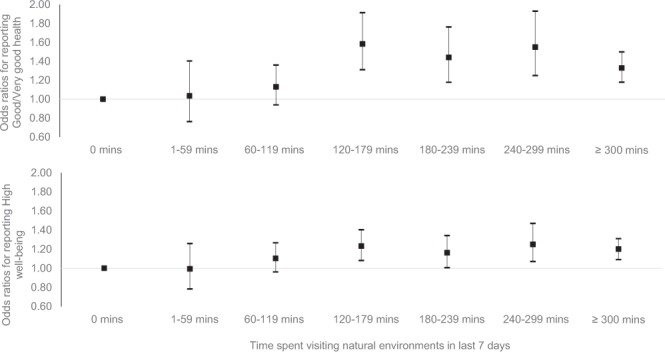
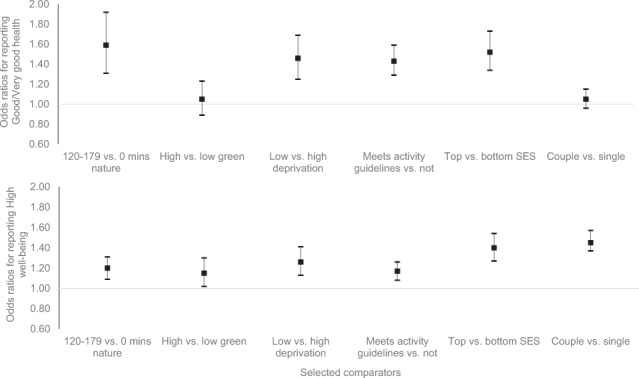
- In adjusted binomial logistic regression models, the association with good health and high well-being became significant only at ≥120 minutes per week in nature; for example, at 120–179 minutes, ORs were 1.59 [1.31–1.92] for health and 1.23 [1.08–1.40] for well-being, compared with 0 minutes.
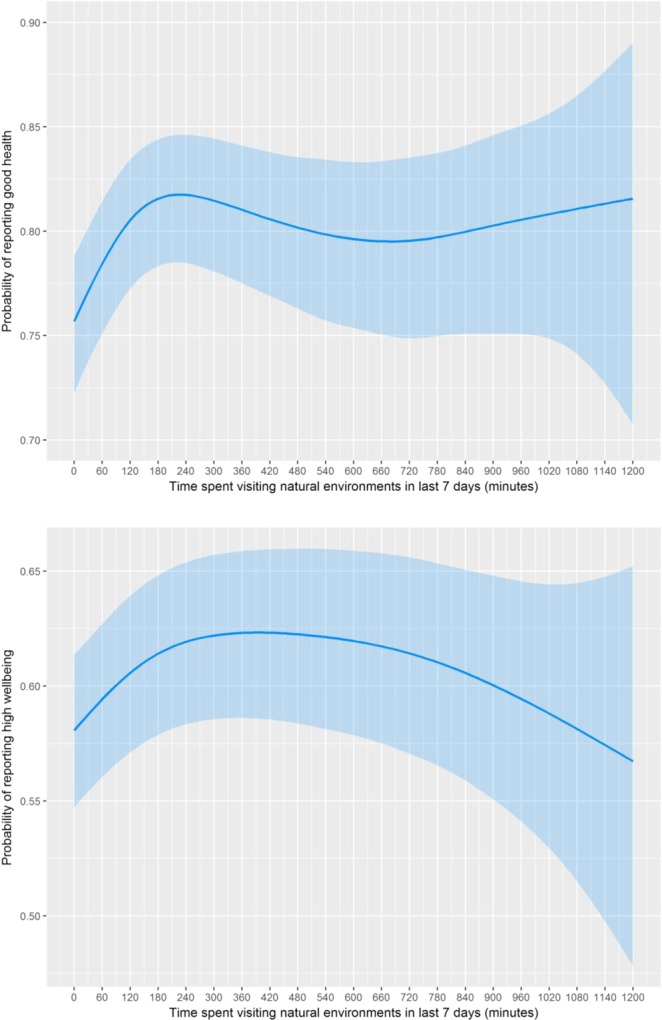
- The positive association was strongest up to about 200 minutes per week for health and 300 minutes per week for well-being, after which the relationship flattened or declined in spline analyses.
- The pattern was reported as consistent across key groups, including older adults and people with long-term health issues/disability; the paper also reports that the ≥120-minute “threshold” was seen across many stratified analyses.
- It did not matter how the 120 minutes were accumulated: additional analyses found no difference in health or well-being between one 120+ minute visit, two 60+ minute visits, or three or more ≤40 minute visits.
## Methods
- Design: Secondary analysis of a repeat cross-sectional survey; the study used survey weights to represent the adult population of England.
- Sample/data: Adults from Waves 6 and 7 of the Monitor of Engagement with the Natural Environment (MENE) survey (n = 20,264 total; n = 19,806 estimation sample for adjusted models; n = 19,808 for adjusted models with missing area-level data excluded).
- Main analysis: Survey-weighted binomial logistic regressions predicting binary health and well-being outcomes from weekly nature-contact duration categories; models adjusted for area- and individual-level covariates, with sensitivity analyses using splines and ordinal/continuous outcome specifications, plus a priori stratified analyses.
## Limitations
- The authors explicitly state the study is observational and cross-sectional, so they cannot rule out reverse causality or make causal claims.
- They note the weekly exposure estimate was based on one randomly selected visit in the last week, and that the data rely on self-reports, which may reduce accuracy.
- They caution that the apparent ≥120-minute threshold may partly reflect clustering of responses around hour marks and the way the data were categorized; this is an evident limitation from the text, alongside the very small variance explained by nature contact (about 1% in unadjusted models).
Model-written summary. Check it against the paper before relying on it.
Integrity signals
Registry
Cites
Statistics
Figures
Verification
Claims the paper makes
8 Valid · 1 Not valid · 15 Not checked · 60 Own results and interpretations
The cited sources support only part of this claim — read each source’s verdict below.
In the paper
“In other words, direct exposure, or more specifically in the current context, recreational time spent in natural environments per week, cannot accurately be inferred from neighbourhood greenspace near the home.”
§ Spending at least 120 minutes a week in nature is associated with good health and wellbeing > Introduction
What the sources say
- Partly supportedcites [23] Hillsdon, M., Coombes, E., Griew, P. & Jones, A. An assessment of the relevance of the home neighbourhood for understanding environmental influences on physical activity: how far from home do people roam? Int J Behav Nutr Phy 12, 100 (2015). sourceExperimental — accuracy not yet measured
The Conclusions and Discussion report that much outdoor physical activity occurs beyond the proximal home neighbourhood, so nearby neighbourhood characteristics may poorly represent the environments people use. The paper does not establish this specifically for weekly recreational time in natural environments or for neighbourhood greenspace; the Discussion says the researchers did not know which activities participants undertook. (LLM, conf=0.88)
- Could not verifycites [24] Sijtsma, F. J., de Vries, S., van Hinsberg, A. & Diederiks, J. Does ‘grey’ urban living lead to more ‘green’ holiday nights? A Netherlands Case Study. Landscape Urban Plan 105, 250–257 (2012). sourceExperimental — accuracy not yet measured
Our copy of Sijtsma et al. (2012) contains only repository/metadata records plus the Abstract; no body sections (Introduction, Methods, Discussion) are indexed. The Abstract (p. n/a) describes a GIS model of 'recreational shortages' — the shortage of locally available green space for recreational walking — linked to holiday nights away from home, but nowhere states that recreational time spent in natural environments per week cannot be inferred from neighbourhood greenspace near the home. Four searches (inference from neighbourhood greenspace, shortage of locally available green space for recreational walking, exposure vs. actual use, compensating behaviour/limitations) returned only the same abstract and citation blocks, so the claim's point is not addressed in the text we hold. (LLM, conf=0.65)
plain- Asserted: passes — The authors put it forward as true.
- Checkable: passes — It can be checked against evidence.
- Load-bearing: passes — The paper’s conclusions depend on it.
- Based: passes — The paper gives a reason why it holds.
- Partly supported
The cited sources support only part of this claim — read each source’s verdict below.
In the paper
“People travel beyond their local neighbourhoods to access recreational nature experiences, and indeed in our own data those who lived in the least green areas had higher odds of spending ≥120 mins in nature than those living in greener neighbourhoods (Appendix C).”
§ Spending at least 120 minutes a week in nature is associated with good health and wellbeing > Discussion
What the sources say
- Partly supportedcites [23] Hillsdon, M., Coombes, E., Griew, P. & Jones, A. An assessment of the relevance of the home neighbourhood for understanding environmental influences on physical activity: how far from home do people roam? Int J Behav Nutr Phy 12, 100 (2015). sourceExperimental — accuracy not yet measured
The Results report that 60.5% of recorded outdoor physical activity occurred beyond an 800 m home-neighbourhood boundary, and the Conclusions say adults undertook most outdoor physical activity outside their proximal home neighbourhood (page not provided). The paper does not establish that people travelled beyond their neighbourhoods specifically to access recreational nature experiences; it measured where activity occurred, not its purpose or whether it took place in nature. (LLM, conf=0.86)
plain- Asserted: passes — The authors put it forward as true.
- Checkable: passes — It can be checked against evidence.
- Load-bearing: passes — The paper’s conclusions depend on it.
- Based: passes — The paper gives a reason why it holds.
- Partly supported
Every source the paper cites for this claim was checked and supports it.
In the paper
“Research into shinrin-yoku (Japanese “forest bathing”)35, for instance, suggested that various psycho-physiological benefits can be gained from merely sitting passively in natural vs. urban settings.”
§ Spending at least 120 minutes a week in nature is associated with good health and wellbeing > Discussion
What the sources say
- Supportedcites [35] Park, B. J., Tsunetsugu, Y., Kasetani, T., Kagawa, T. & Miyazaki, Y. The physiological effects of Shinrin-yoku (taking in the forest atmosphere or forest bathing): evidence from field experiments in 24 forests across Japan. Environ Health Prev 15, 18–26 (2010). source
The Experimental design (p. 2) says subjects sat on chairs to view forest or city landscapes. The physiological results (p. 4) report more favorable stress-related measures after forest viewing, while the psychological results (p. 7) report better mood scores than after city viewing. (LLM, conf=0.93)
hedgedstates a possible cause- Asserted: passes — The authors put it forward as true.
- Checkable: passes — It can be checked against evidence.
- Load-bearing: passes — The paper’s conclusions depend on it.
- Based: passes — The paper gives a reason why it holds.
- Supported
Every source the paper cites for this claim was checked and supports it.
In the paper
“Experimental research, however, indicates that some benefits cannot be due solely to physical activity.”
§ Spending at least 120 minutes a week in nature is associated with good health and wellbeing > Discussion
What the sources say
- Supportedcites [35] Park, B. J., Tsunetsugu, Y., Kasetani, T., Kagawa, T. & Miyazaki, Y. The physiological effects of Shinrin-yoku (taking in the forest atmosphere or forest bathing): evidence from field experiments in 24 forests across Japan. Environ Health Prev 15, 18–26 (2010). source
The Experimental design (p. 2) reports no difference in exercise load between forest and city walks. The Results (p. 4) also report physiological benefits from viewing forest landscapes while seated, supporting the conclusion that physical activity alone cannot explain some benefits. (LLM, conf=0.93)
hedgedstates a cause- Asserted: passes — The authors put it forward as true.
- Checkable: passes — It can be checked against evidence.
- Load-bearing: passes — The paper’s conclusions depend on it.
- Based: passes — The paper gives a reason why it holds.
- Supported
The cited sources support only part of this claim — read each source’s verdict below.
In the paper
“Impoverished local opportunities need not be a barrier to nature exposure23,24.”
§ Spending at least 120 minutes a week in nature is associated with good health and wellbeing > Discussion
What the sources say
- Partly supportedcites [23] Hillsdon, M., Coombes, E., Griew, P. & Jones, A. An assessment of the relevance of the home neighbourhood for understanding environmental influences on physical activity: how far from home do people roam? Int J Behav Nutr Phy 12, 100 (2015). sourceExperimental — accuracy not yet measured
The Results and Conclusions (page numbers unavailable) show that adults undertook much of their outdoor physical activity beyond their proximal home neighbourhood, supporting the idea that nearby opportunities do not define where people go. The paper does not establish that those destinations provided nature exposure or that impoverished local nature opportunities were not a barrier to it. (LLM, conf=0.78)
- Partly supportedcites [24] Sijtsma, F. J., de Vries, S., van Hinsberg, A. & Diederiks, J. Does ‘grey’ urban living lead to more ‘green’ holiday nights? A Netherlands Case Study. Landscape Urban Plan 105, 250–257 (2012). sourceExperimental — accuracy not yet measured
Our copy of Sijtsma et al. (2012) holds only the repository record — the Abstract plus bibliographic metadata, with no body sections (searches on 'recreational shortage', 'nature exposure', 'compensating behaviour', 'discussion/conclusion' all returned the same abstract and citation blocks). The Abstract does support the compensatory mechanism behind the claim: 'the higher the greyness of the living environment – i.e. the higher the shortage of locally available green space for recreational walking – the more people spend nights away from home', with ~20% of holiday nights of the greyest residents related to that shortage. But the source measures holiday nights away from home and frames the shortage as a cost of agglomeration for well-being; it nowhere asserts 'nature exposure' or that a local shortage is not a barrier to nature contact, so the claim's generalisation to 'nature exposure' goes beyond what this source states. (LLM, conf=0.72)
plain- Asserted: passes — The authors put it forward as true.
- Checkable: passes — It can be checked against evidence.
- Load-bearing: unclear — It is unclear whether the paper’s conclusions depend on it.
- Based: passes — The paper gives a reason why it holds.
- Partly supported
21 more claims · 1 with their cited sources checked
Create a free account to see all 84 claims and to verify the 9 references still open.
- It may state two separate claims as one. 18
- Probably not a substantial claim. 46
Claims other papers make about this one
Each is checked against this paper’s own text: does it say what the citing paper says it does?
The cited source says what the claim attributes to it.
In the citing paper
“spending at least 120 min a week in nature was associated with good health [82].”
From EAACI Guidelines on the Importance of Green Space in Urban Environments for Allergy and Asthma Prevention (2026) · cites this paper as [82]
Citations
Cites
Hartig, T., Mitchell, R., de Vries, S., & Frumkin, H. (2014) · Annual Review of Public Health · doi:10.1146/annurev-publhealth-032013-182443 · Cited by 3,638
Self-citationEffect of exposure to natural environment on health inequalities: an observational population study
Mitchell, R., & Popham, F. (2008) · The Lancet · doi:10.1016/s0140-6736(08)61689-x · Cited by 2,099
Green space, urbanity, and health: how strong is the relation?
Maas, J., Verheij, R. A., Groenewegen, P. P., de Vries, S., & Spreeuwenberg, P. (2006) · Journal of Epidemiology and Community Health · doi:10.1136/jech.2005.043125 · Cited by 1,976
The Science of Mind Wandering: Empirically Navigating the Stream of Consciousness
Smallwood, J., & Schooler, J. W. (2015) · Annual Review of Psychology · doi:10.1146/annurev-psych-010814-015331 · Cited by 1,685
Barton, J., & Pretty, J. (2010) · Environmental Science & Technology · doi:10.1021/es903183r · Cited by 1,592
Miilunpalo, S., Vuori, I., Oja, P., Pasanen, M., & Urponen, H. (1997) · Journal of Clinical Epidemiology · doi:10.1016/s0895-4356(97)00045-0 · Cited by 1,473
Thompson Coon, J., Boddy, K., Stein, K., Whear, R., Barton, J., & Depledge, M. H. (2011) · Environmental Science & Technology · doi:10.1021/es102947t · Cited by 1,391
Self-citationNature Contact and Human Health: A Research Agenda
Frumkin, H., Bratman, G. N., Breslow, S. J., Cochran, B., Kahn Jr, P. H., Lawler, J. J., Levin, P. S., Tandon, P. S., Varanasi, U., Wolf, K. L., et al. (2017) · Environmental Health Perspectives · doi:10.1289/ehp1663 · Cited by 1,237
What are the benefits of interacting with nature?
Keniger, L., Gaston, K., Irvine, K., & Fuller, R. (2013) · International Journal of Environmental Research and Public Health · doi:10.3390/ijerph10030913 · Cited by 1,204
Research works printed but not linked: 1
- Stigsdotter, U. & Grahn, P. What makes a garden a healing garden. J Thera Hort 13, 60–69 (2002).
Cited by
Martin, L., White, M. P., Hunt, A., Richardson, M., Pahl, S., & Burt, J. (2020) · Journal of Environmental Psychology · doi:10.1016/j.jenvp.2020.101389 · Cited by 928
“Indeed, previous analysis of a different set of MENE data observed that people in England living in the least green areas spend significantly more time in nature than those living in greener areas, contrary to common assumptions about greener areas facilitating more time in nature (White et al., 2019), emphasising the…”
BackgroundResultSelf-citationAssociations between nature exposure and health: a review of the evidence
Jimenez, M. P., DeVille, N. V., Elliott, E. G., Schiff, J. E., Wilt, G. E., Hart, J. E., & James, P. (2021) · International Journal of Environmental Research and Public Health · doi:10.3390/ijerph18094790 · Cited by 726
Contact with blue-green spaces during the COVID-19 pandemic lockdown beneficial for mental health.
Pouso, S., Borja, Á., Fleming, L. E., Gómez-Baggethun, E., White, M. P., & Uyarra, M. C. (2021) · Science of The Total Environment · doi:10.1016/j.scitotenv.2020.143984 · Cited by 604
Blue space, health and well-being: A narrative overview and synthesis of potential benefits
White, M. P., Elliott, L. R., Gascon, M., Roberts, B., & Fleming, L. E. (2020) · Environmental Research · doi:10.1016/j.envres.2020.110169 · Cited by 579
Self-citationPathways linking biodiversity to human health: A conceptual framework
Marselle, M. R., Hartig, T., Cox, D. T. C., de Bell, S., Knapp, S., Lindley, S., Triguero-Mas, M., Böhning-Gaese, K., Braubach, M., Cook, P. A., et al. (2021) · Environment International · doi:10.1016/j.envint.2021.106420 · Cited by 578
Self-citationCOVID-19 Lockdown: Housing Built Environment’s Effects on Mental Health
Amerio, A., Brambilla, A., Morganti, A., Aguglia, A., Bianchi, D., Santi, F., Costantini, L., Odone, A., Costanza, A., Signorelli, C., et al. (2020) · International Journal of Environmental Research and Public Health · doi:10.3390/ijerph17165973 · Cited by 494
Associations between green/blue spaces and mental health across 18 countries
White, M. P., Elliott, L. R., Grellier, J., Economou, T., Bell, S., Bratman, G. N., Cirach, M., Gascon, M., Lima, M. L., Lõhmus, M., et al. (2021) · Scientific Reports · doi:10.1038/s41598-021-87675-0 · Cited by 484
Self-citationNature-based outdoor activities for mental and physical health: Systematic review and meta-analysis
Coventry, P. A., Brown, J. E., Pervin, J., Brabyn, S., Pateman, R., Breedvelt, J., Gilbody, S., Stancliffe, R., McEachan, R., & White, P. L. (2021) · SSM - Population Health · doi:10.1016/j.ssmph.2021.100934 · Cited by 453
“Spending 120 min a week in nature has also been associated at population level with good health and high wellbeing (White et al., 2019).”
BackgroundZhong, W., Schröder, T., & Bekkering, J. (2022) · Frontiers of Architectural Research · doi:10.1016/j.foar.2021.07.006 · Cited by 444
“Spending at least 120 min a week in urban green spaces improves people’s health and well-being (White et al., 2019), while the 40-s viewing of green roofs produces micro-breaks that can restore attention (Lee et al.”
BackgroundOswald, T. K., Rumbold, A. R., Kedzior, S. G. E., & Moore, V. M. (2020) · PLoS ONE · doi:10.1371/journal.pone.0237725 · Cited by 367
Nieuwenhuijsen, M. J. (2021) · Environment International · doi:10.1016/j.envint.2021.106850 · Cited by 343
“better health and well-being and suggested at least 2 h per week of visits (White et al., 2019; Kruize et al., 2020).”
BackgroundHome garden use during COVID-19: Associations with physical and mental wellbeing in older adults
Corley, J., Okely, J. A., Taylor, A. M., Page, D., Welstead, M., Skarabela, B., Redmond, P., Cox, S. R., & Russ, T. C. (2021) · Journal of Environmental Psychology · doi:10.1016/j.jenvp.2020.101545 · Cited by 261
“Exposure to nature benefits psychological health, wellbeing, and quality of life (Cox & Gaston, 2016; Dean et al., 2018; Maller, Townsend, Pryor, Brown, & St Leger, 2006; White et al., 2019) through mechanistic pathways established by classic early research, namely attention restoration theory (Kaplan, 2001) and stres…”
BackgroundThe use of virtual reality in environment experiences and the importance of realism
Newman, M., Gatersleben, B., Wyles, K. J., & Ratcliffe, E. (2022) · Journal of Environmental Psychology · doi:10.1016/j.jenvp.2021.101733 · Cited by 236
Nature tourism and mental health: parks, happiness, and causation
Buckley, R. (2020) · Journal of Sustainable Tourism · doi:10.1080/09669582.2020.1742725 · Cited by 221
Birch, J., Rishbeth, C., & Payne, S. R. (2020) · Health & Place · doi:10.1016/j.healthplace.2020.102296 · Cited by 215
“These expressions tie in with the notion of a perhaps spiritual ‘force of nature’ (Wilson, 2003 endorsed by Boucher et al., 2019:67).”
Backgroundde Bell, S., White, M., Griffiths, A., Darlow, A., Taylor, T., Wheeler, B., & Lovell, R. (2020) · Landscape and Urban Planning · doi:10.1016/j.landurbplan.2020.103836 · Cited by 217
Self-citationEconomic value of protected areas via visitor mental health
Buckley, R., Brough, P., Hague, L., Chauvenet, A., Fleming, C., Roche, E., Sofija, E., & Harris, N. (2019) · Nature Communications · doi:10.1038/s41467-019-12631-6 · Cited by 203
Moments, not minutes: The nature-wellbeing relationship
Richardson, M., Passmore, H.-A., Lumber, R., Thomas, R., & Hunt, A. (2021) · International Journal of Wellbeing · doi:10.5502/ijw.v11i1.1267 · Cited by 205
“They noted that previous research evidencing the importance of time in nature have not also considered individual factors such as levels of nature connectedness (e.g., Meredith et al., 2020; White et al., 2019).”
BackgroundInfluentialRamkissoon, H. (2020) · Frontiers in Psychology · doi:10.3389/fpsyg.2020.02248 · Cited by 198
“There is growing evidence that engaging in pro-environmental behaviors contributes to health and wellbeing (e.g., Townsend et al., 2018; White et al., 2019) lending further support to using place confinement as a context for individuals to engage in more environmentally sustainable household behaviors.”
BackgroundMeredith, G. R., Rakow, D. A., Eldermire, E. R. B., Madsen, C. G., Shelley, S. P., & Sachs, N. A. (2020) · Frontiers in Psychology · doi:10.3389/fpsyg.2019.02942 · Cited by 192
“These researchers found that spending at least 120min in nature per week led to significantly higher self-reports of positive health and well-being (White et al., 2019).”
BackgroundBiophilia as Evolutionary Adaptation: An Onto- and Phylogenetic Framework for Biophilic Design
Barbiero, G., & Berto, R. (2021) · Frontiers in Psychology · doi:10.3389/fpsyg.2021.700709 · Cited by 188
Mental health rescue effects of women's outdoor tourism: A role in COVID-19 recovery
Buckley, R., & Westaway, D. (2020) · Annals of Tourism Research · doi:10.1016/j.annals.2020.103041 · Cited by 185
Can positive and self-transcendent emotions promote pro-environmental behavior?
Zelenski, J. M., & Desrochers, J. E. (2021) · Current Opinion in Psychology · doi:10.1016/j.copsyc.2021.02.009 · Cited by 182
Zhong, Q., Ma, J., Zhao, B., Wang, X., Zong, J., & Xiao, X. (2019) · Remote Sensing of Environment · doi:10.1016/j.rse.2019.111374 · Cited by 179
“However, we can still maximize urbanization-induced environmental changes to promote carbon sequestration in urban ecosystems through effective protection, management and design, as urban green spaces have a range of benefits for human health and well-being under the potential pressure brought by urbanization (Douglas…”
BackgroundMarx, W., Manger, S. H., Blencowe, M., Murray, G., Ho, F. Y.-Y., Lawn, S., Blumenthal, J. A., Schuch, F., Stubbs, B., Ruusunen, A., et al. (2023) · The World Journal of Biological Psychiatry · doi:10.1080/15622975.2022.2112074 · Cited by 179
“A recent longitudinal study found that wellbeing increased significantly with weekly contact with nature 120min (White et al. 2019).”
BackgroundThe affective benefits of nature exposure
Bratman, G. N., Olvera‐Alvarez, H. A., & Gross, J. J. (2021) · Social and Personality Psychology Compass · doi:10.1111/spc3.12630 · Cited by 177
Selway, C. A., Mills, J. G., Weinstein, P., Skelly, C., Yadav, S., Lowe, A., Breed, M. F., & Weyrich, L. S. (2020) · Environment International · doi:10.1016/j.envint.2020.106084 · Cited by 172
Promoting youth mental health during the COVID-19 pandemic: A longitudinal study
Rosen, M. L., Rodman, A. M., Kasparek, S. W., Mayes, M., Freeman, M. M., Lengua, L. J., Meltzoff, A. N., & McLaughlin, K. A. (2021) · PLOS ONE · doi:10.1371/journal.pone.0255294 · Cited by 159
“These findings are broadly consistent with prior evidence that spending at least two hours in nature per week is associated with greater well-being in adults [31] and better mental health in children [76].”
ResultKettner, H., Gandy, S., Haijen, E. C. H. M., & Carhart-Harris, R. L. (2019) · International Journal of Environmental Research and Public Health · doi:10.3390/ijerph16245147 · Cited by 157
“A recent large‐scale (N = 19,806) UK population study found that regular contact with nature is associated with good physical health and high subjective well‐being, with a minimum time of 120 min per week of nature exposure being optimal for good health [71].”
BackgroundWhite, M. P., Hartig, T., Martin, L., Pahl, S., van den Berg, A. E., Wells, N. M., Costongs, C., Dzhambov, A. M., Elliott, L. R., Godfrey, A., et al. (2023) · Environment International · doi:10.1016/j.envint.2023.108234 · Cited by 158
Self-citationFine, A. H., Beck, A. M., & Ng, Z. (2019) · International Journal of Environmental Research and Public Health · doi:10.3390/ijerph16203997 · Cited by 157
Public park attributes, park visits, and associated health status
Grilli, G., Mohan, G., & Curtis, J. A. (2020) · Landscape and Urban Planning · doi:10.1016/j.landurbplan.2020.103814 · Cited by 177
The evaluation of the 3-30-300 green space rule and mental health
Nieuwenhuijsen, M. J., Dadvand, P., Márquez, S., Bartoll, X., Barboza, E. P., Cirach, M., Borrell, C., & Zijlema, W. L. (2022) · Environmental Research · doi:10.1016/j.envres.2022.114387 · Cited by 204
Biophilic office design: Exploring the impact of a multisensory approach on human well-being
Aristizabal, S., Byun, K., Porter, P., Clements, N. S., Campanella, C., Li, L., Mullan, A. F., Ly, S., Senerat, A. M., Nenadic, I., et al. (2021) · Journal of Environmental Psychology · doi:10.1016/j.jenvp.2021.101682 · Cited by 192
Restoration in Nature: Beyond the Conventional Narrative
Hartig, T. (2021) · Nebraska Symposium on Motivation/The Nebraska symposium on motivation · doi:10.1007/978-3-030-69020-5_5 · Cited by 227
Self-citationNature Exposure and Its Effects on Immune System Functioning: A Systematic Review
Andersen, L., Corazon, S. S., & Stigsdotter, U. K. (2021) · International Journal of Environmental Research and Public Health · doi:10.3390/ijerph18041416 · Cited by 145
“One study showed that spending a minimum of two hours a week in nature improved overall health and wellbeing, with positive associations peaking at approximately four hours of exposure [83].”
BackgroundLife satisfaction linked to the diversity of nature experiences and nature views from the window
Chang, C.-C., Oh, R. R. Y., Nghiem, T. P. L., Zhang, Y., Tan, C. L. Y., Lin, B. B., Gaston, K. J., Fuller, R. A., & Carrasco, L. R. (2020) · Landscape and Urban Planning · doi:10.1016/j.landurbplan.2020.103874 · Cited by 140
‘Into the Wild’: A meta-synthesis of talking therapy in natural outdoor spaces
Cooley, S. J., Jones, C. R., Kurtz, A., & Robertson, N. (2020) · Clinical Psychology Review · doi:10.1016/j.cpr.2020.101841 · Cited by 173
Forest and Wellbeing: Bridging Medical and Forest Research for Effective Forest-Based Initiatives
Doimo, I., Masiero, M., & Gatto, P. (2020) · Forests · doi:10.3390/f11080791 · Cited by 156
“However, the optimal “dose” of exposure has been investigated in the literature dealing with exposure to nature and outdoor green in general, suggesting the existence of effective time thresholds beyond which there are no additional benefits [120,121].”
BackgroundFreshwater blue space and population health: An emerging research agenda
McDougall, C. W., Quilliam, R. S., Hanley, N. D., & Oliver, D. M. (2020) · The Science of The Total Environment · doi:10.1016/j.scitotenv.2020.140196 · Cited by 142
“…an understanding of how frequency and duration of freshwater blue space exposure and the type of activity carried out in or around blue space relate to health outcomes, there are opportunities to quantitatively understand dose-response relationships (Shanahan et al., 2015;White et al., 2019).”
BackgroundThe Role of Nature-Based Solutions for Improving Environmental Quality, Health and Well-Being
Liu, H.-Y., Jay, M., & Chen, X. (2021) · Sustainability · doi:10.3390/su131910950 · Cited by 193
Astell‐Burt, T., & Feng, X. (2021) · International Journal of Environmental Research and Public Health · doi:10.3390/ijerph18052757 · Cited by 146
“, Melbourne, Australia [18,19]) may have restricted time in nature to less than might be ideal for generating health benefits [20,21].”
BackgroundWang, R., Feng, Z., Pearce, J. R., Zhou, S., Zhang, L., & Liu, Y. (2021) · Landscape and Urban Planning · doi:10.1016/j.landurbplan.2021.104230 · Cited by 138
Safeguarding marine life: conservation of biodiversity and ecosystems
Ward, D. F. L., Melbourne-Thomas, J., Pecl, G. T., Evans, K., Green, M. E., McCormack, P. C., Novaglio, C., Trebilco, R., Bax, N., Brasier, M., et al. (2022) · Reviews in Fish Biology and Fisheries · doi:10.1007/s11160-022-09700-3 · Cited by 167
Nghiem, T. P. L., Wong, K. L., Jeevanandam, L., Chang, C., Tan, C. L. Y., Goh, Y., & Carrasco, L. R. (2021) · Urban forestry & urban greening · doi:10.1016/j.ufug.2021.127030 · Cited by 142
Measuring Nature Contact: A Narrative Review
Holland, I., DeVille, N. V., Browning, M. H. E. M., Buehler, R. M., Hart, J. E., Hipp, J. A., Mitchell, R., Rakow, D. A., Schiff, J. E., White, M. P., et al. (2021) · International Journal of Environmental Research and Public Health · doi:10.3390/ijerph18084092 · Cited by 133
Self-citationVirtual nature, psychological and psychophysiological outcomes: A systematic review
Spano, G., Theodorou, A., Reese, G., Carrus, G., Sanesi, G., & Panno, A. (2023) · Journal of Environmental Psychology · doi:10.1016/j.jenvp.2023.102044 · Cited by 182
Tourism and Mental Health: Foundations, Frameworks, and Futures
Buckley, R. (2022) · Journal of Travel Research · doi:10.1177/00472875221087669 · Cited by 154
“2019, 2021), for different durations (Bélanger et al. 2019; Chen, Zou, and Gao 2020; Labudek et al. 2021; Legrand and Mille 2009; Sanz-Remacha et al. 2021; White et al. 2019), in different environments (Biedenweg, Scott, and Scott 2017; Bielinis et al.”
BackgroundThe phantom chorus: birdsong boosts human well-being in protected areas
Ferraro, D. M., Miller, Z. D., Ferguson, L. A., Taff, B. D., Barber, J. R., Newman, P., & Francis, C. D. (2020) · Proceedings of the Royal Society B Biological Sciences · doi:10.1098/rspb.2020.1811 · Cited by 154
“Other recent work suggests that increases in self-reported well-being become apparent only for people that spent at least 120 min in a natural area on a single visit during the last seven days [61], although it was unclear how multiple visits to natural areas and the time interval between the natural experience and su…”
BackgroundHow do different types and characteristics of green space impact mental health? A scoping review
Beute, F., Marselle, M. R., Olszewska-Guizzo, A., Andreucci, M. B., Lammel, A., Davies, Z. G., Glanville, J., Keune, H., O’Brien, L., Remmen, R., et al. (2023) · People and Nature · doi:10.1002/pan3.10529 · Cited by 180
Fagerholm, N., Martín‐López, B., Torralba, M., Oteros‐Rozas, E., Lechner, A. M., Bieling, C., Olafsson, A. S., Albert, C., Raymond, C. M., Martin, M. G., et al. (2020) · People and Nature · doi:10.1002/pan3.10067 · Cited by 144
“…that nature generally makes people happier and healthier (both physically and mentally; see e.g. Annerstedt & Währborg, 2011; Hartig, Mitchell, de Vries, & Frumkin, 2014; Russell et al., 2013; van den Bosch & Ode Sang, 2017; Wendelboe-Nelson, Kelly, Kennedy, & Cherrie, 2019; White et al., 2019).”
BackgroundBrain activity, underlying mood and the environment: A systematic review
Norwood, M. F., Lakhani, A., Maujean, A., Zeeman, H., Creux, O., & Kendall, E. A. (2019) · Journal of Environmental Psychology · doi:10.1016/j.jenvp.2019.101321 · Cited by 137
Actively Noticing Nature (Not Just Time in Nature) Helps Promote Nature Connectedness
Richardson, M., Hamlin, I., Butler, C. W., Thomas, R., & Hunt, A. (2021) · Ecopsychology · doi:10.1089/eco.2021.0023 · Cited by 142
“…has shown a relationship between nature contact and improvements in well-being (Bratman et al., 2019; Bratman, Olvera-Alvarez, & Gross, 2021; Cox et al., 2017; Frumkin et al., 2017; McMahan & Estes, 2015; Meredith et al., 2020; Shanahan et al., 2016; White et al., 2019; White et al., 2021).”
A geographical detector study on factors influencing urban park use in Nanjing, China
Fan, Z., Duan, J., Lu, Y., Zou, W., & Lan, W. (2021) · Urban forestry & urban greening · doi:10.1016/j.ufug.2021.126996 · Cited by 113
What future/s for outdoor and environmental education in a world that has contended with COVID-19?
Quay, J., Gray, T. L., Thomas, G. J., Allen-Craig, S., Asfeldt, M., Andkjær, S., Beames, S. K., Cosgriff, M., Dyment, J. E., Higgins, P., et al. (2020) · Journal of Outdoor and Environmental Education · doi:10.1007/s42322-020-00059-2 · Cited by 140
Effects of forest bathing (shinrin-yoku) on individual well-being: an umbrella review
Antonelli, M., Donelli, D., Carlone, L., Maggini, V., Firenzuoli, F., & Bedeschi, E. (2021) · International Journal of Environmental Health Research · doi:10.1080/09603123.2021.1919293 · Cited by 134
“With regard to the overall population, it is estimated that spending at least 120 minutes/week in a natural environment can be associated with significantly better self-reported well-being if compared with spending less time in green spaces (White et al. 2019).”
BackgroundEnable, Reconnect and Augment: A New ERA of Virtual Nature Research and Application
Litleskare, S., Macintyre, T. E., & Calogiuri, G. (2020) · International Journal of Environmental Research and Public Health · doi:10.3390/ijerph17051738 · Cited by 124
“[3] reported positive associations between recreational nature contact in the last seven days and self-reported health and well-being in a sample consisting of almost 20,000 participants.”
BackgroundLehberger, M., Kleih, A., & Sparke, K. (2021) · Landscape and Urban Planning · doi:10.1016/j.landurbplan.2021.104108 · Cited by 118
Laumann, F., von Kügelgen, J., Uehara, T. K., & Barahona, M. (2021) · The Lancet Planetary Health · doi:10.1016/s2542-5196(22)00070-5 · Cited by 124
A brief review on the mental health for select elements of the built environment
Beemer, C. J., Stearns‐Yoder, K. A., Schuldt, S., Kinney, K. A., Lowry, C. A., Postolache, T. T., Brenner, L. A., & Hoisington, A. J. (2019) · Indoor and Built Environment · doi:10.1177/1420326x19889653 · Cited by 125
Yu, Z., Yang, G., Lin, T., Zhao, B., Xu, Y., Yao, X., Ma, W., Vejre, H., & Jiang, B. (2024) · Ecosystem Health and Sustainability · doi:10.34133/ehs.0165 · Cited by 104
Visitors to urban greenspace have higher sentiment and lower negativity on Twitter
Schwartz, A. J., Dodds, P. S., O'Neil‐Dunne, J. P. M., Danforth, C. M., & Ricketts, T. H. (2019) · People and Nature · doi:10.1002/pan3.10045 · Cited by 92
Let Nature Be Thy Medicine: A Socioecological Exploration of Green Prescribing in the UK
Robinson, J. M., Jørgensen, A., Cameron, R. W. F., & Brindley, P. (2020) · International Journal of Environmental Research and Public Health · doi:10.3390/ijerph17103460 · Cited by 118
Pocock, M. J. O., Hamlin, I., Christelow, J., Passmore, H., & Richardson, M. (2023) · People and Nature · doi:10.1002/pan3.10432 · Cited by 120
Kip, E., & Parr‐Brownlie, L. C. (2023) · Frontiers in Neuroscience · doi:10.3389/fnins.2023.1092537 · Cited by 113
“Conversely, populations with higher greenspace exposure are more likely to have good overall health (Lee and Maheswaran, 2011; White et al., 2019).”
BackgroundThe Interplay of Environmental Exposures and Mental Health: Setting an Agenda
Reuben, A., Manczak, E. M., Cabrera, L. Y., Alegria, M. M., Bucher, M. L., Freeman, E. C., Miller, G. W., Solomon, G. M., & Perry, M. J. (2022) · Environmental Health Perspectives · doi:10.1289/ehp9889 · Cited by 124
“Another study found that self-reported mental health improves with every hour of contact with natural settings each week, with peak mental health reported after 3–5 h of weekly contact (White et al. 2019).”
BackgroundMuch More Than a Pleasant Scent: A Review on Essential Oils Supporting the Immune System
Péterfalvi, Á., Mikó, É., Nagy, T., Réger, B., Simon, D., Miseta, A., Czéh, B., & Szereday, L. (2019) · Molecules · doi:10.3390/molecules24244530 · Cited by 92
“Moreover, not only the presence of these factors but also the duration and frequency of exposure to outdoor green spaces influence the health-promoting effect [93,94].”
BackgroundHow did outdoor biking and walking change during COVID-19?: A case study of three U.S. cities
Doubleday, A., Choe, Y., Isaksen, T. B., Miles, S. B., & Errett, N. A. (2021) · PLoS ONE · doi:10.1371/journal.pone.0245514 · Cited by 88
“Prior research has suggested that physical activity [1] and time spent outside [2] are both associated with increased wellbeing.”
BackgroundHubbard, G., den Daas, C., Johnston, M., Murchie, P., Thompson, C. W., & Dixon, D. L. (2021) · International Journal of Environmental Research and Public Health · doi:10.3390/ijerph18083869 · Cited by 100
Can we live within environmental limits and still reduce poverty? Degrowth or decoupling?
Hickel, J., & Hallegatte, S. (2021) · Development Policy Review · doi:10.1111/dpr.12584 · Cited by 127
Tourist Mental Health Drives Destination Choice, Marketing, and Matching
Cooper, M., & Buckley, R. (2021) · Journal of Travel Research · doi:10.1177/00472875211011548 · Cited by 92
Levinger, P., Cerin, E., Milner, C., & Hill, K. (2021) · International Journal of Environmental Health Research · doi:10.1080/09603123.2021.1879739 · Cited by 98
“…street trees, private gardens, and aquatic and marine environments) has been associated with better health and well-being (Bowler et al. 2010; Dadvand et al. 2016; Hartig and Kahn 2016), with residents who spent at least 120 min a week in nature accruing substantial benefits (White et al. 2019).”
BackgroundSia, A., Tan, P. Y., Wong, J. C. M., Araib, S., Ang, W. F., & Er, K. B. H. (2021) · Urban forestry & urban greening · doi:10.1016/j.ufug.2021.127448 · Cited by 88
“, 2019) and at least two hours in nature significantly greater health and well-being (White et al., 2019), the question of interest is how various levels of engagement with nature can be enhanced during this challenging period, whether through viewing nature, functional engagement or incidental exposure, and active pa…”
Dynamic thermal pleasure in outdoor environments - temporal alliesthesia
Liu, S., Nazarian, N., Hart, M., Niu, J., Xie, Y., & de Dear, R. (2021) · The Science of The Total Environment · doi:10.1016/j.scitotenv.2020.144910 · Cited by 82
Tomasso, L. P., Yin, J., Laurent, J. G. C., Chen, J. T., Catalano, P. J., & Spengler, J. D. (2021) · International Journal of Environmental Research and Public Health · doi:10.3390/ijerph18041511 · Cited by 86
“Variability of nature exposure differentiates one’s experience in nature as well as response to nature contact, such that health outcomes are influenced by appropriate “dose” [18, 19], frequency of contact [20, 21], quality of nature exposure [22, 23], biodiversity level [24-27], aesthetic preference [28, 29] and urba…”
BackgroundTeixeira, A. S., Gabriel, R., Martinho, J., Santos, M., Faria, A. M., Oliveira, I., & Moreira, H. (2022) · American Journal of Health Promotion · doi:10.1177/08901171221119089 · Cited by 89
Elliott, L. R., White, M. P., Grellier, J., Garrett, J. K., Cirach, M., Wheeler, B. W., Bratman, G. N., van den Bosch, M. A., Ojala, A., Roiko, A., et al. (2020) · Landscape and Urban Planning · doi:10.1016/j.landurbplan.2020.103800 · Cited by 75
Self-citationDavis, Z., Guhn, M., Jarvis, I., Jerrett, M., Nesbitt, L., Oberlander, T. F., Sbihi, H., Su, J. G., & van den Bosch, M. A. (2021) · International Journal of Hygiene and Environmental Health · doi:10.1016/j.ijheh.2021.113767 · Cited by 107
Residential greenspace and lung function up to 24 years of age: The ALSPAC birth cohort
Fuertes, E., Markevych, I., Thomas, R., Boyd, A., Granell, R., Mahmoud, O., Heinrich, J., García‐Aymerich, J., Roda, C., Henderson, J., et al. (2020) · Environment International · doi:10.1016/j.envint.2020.105749 · Cited by 76
Health Benefits Derived from Forest: A Review
Grilli, G., & Sacchelli, S. (2020) · International Journal of Environmental Research and Public Health · doi:10.3390/ijerph17176125 · Cited by 90
“More recently, a study in England found that spending 120 min per week in nature is sufficient to maintain good health and well-being levels [10].”
BackgroundUrban agriculture may change food consumption towards low carbon diets
Bartolomé, I. P., Aguilera, E., Cruz, J. L., Iglesias, A., & Sanz-Cobeña, A. (2021) · Global Food Security · doi:10.1016/j.gfs.2021.100507 · Cited by 92
Moving beyond disciplinary silos towards a transdisciplinary model of wellbeing: an invited review
Mead, J., Fisher, Z., & Kemp, A. H. (2021) · Frontiers in Psychology · doi:10.3389/fpsyg.2021.642093 · Cited by 71
“Researchers have even argued that one should consider spending up to 2 h per week in nature to experience wellbeing (White et al., 2019).”
BackgroundNewbold, S. C., Finnoff, D., Thunström, L., Ashworth, M., & Shogren, J. F. (2020) · Environmental and Resource Economics · doi:10.1007/s10640-020-00440-1 · Cited by 76
Waite, S. (2020) · Education Sciences · doi:10.3390/educsci10110311 · Cited by 123
“Concern about these reductions in children’s exposure to natural environments [29] is gathering momentum internationally because it has been demonstrated that time spent outdoors impacts positively on physical and mental health and well-being [30] and “character capabilities” such as engagement with and self-regulatio…”
BackgroundSilva, A. L., de Matos, M. A. V., & Gonçalves, M. (2023) · Journal of Environmental Planning and Management · doi:10.1080/09640568.2023.2227761 · Cited by 88
The magic of the mundane: The vulnerable web of connections between urban nature and wellbeing
Dobson, J., Birch, J., Brindley, P., Henneberry, J., McEwan, K., Mears, M., Richardson, M., & Jørgensen, A. (2020) · Cities · doi:10.1016/j.cities.2020.102989 · Cited by 89
“One study suggests 120 minutes as an appropriate ‘nature dose’ (White et al. 2019).”
BackgroundHealth benefits of evidence-based biophilic-designed environments: A review
Hung, S.-H., & Chang, C. (2021) · Journal of people, plants, and environment · doi:10.11628/ksppe.2021.24.1.1 · Cited by 87
Howard, C., MacNeill, A. J., Hughes, F., Alqodmani, L., Charlesworth, K., Almeida, R. D. A., Harris, R. D., Jochum, B., Maibach, E. W., Maki, L., et al. (2023) · The Lancet Planetary Health · doi:10.1016/s2542-5196(23)00022-0 · Cited by 234
Effects of a sensory garden on workplace wellbeing: A randomised control trial
Souter-Brown, G., Hinckson, E. A., & Duncan, S. (2020) · Landscape and Urban Planning · doi:10.1016/j.landurbplan.2020.103997 · Cited by 80
Mohamed, A., DeClerck, F., Verburg, P. H., Obura, D. O., Abrams, J. F., Zafra‐Calvo, N., Rocha, J., Estrada-Carmona, N., Fremier, A. K., Jones, S. K., et al. (2024) · One Earth · doi:10.1016/j.oneear.2023.12.008 · Cited by 79
Reeves, J. P., Knight, A. T., Strong, E. A., Heng, V., Neale, C., Cromie, R., & Vercammen, A. (2019) · Frontiers in Psychology · doi:10.3389/fpsyg.2019.01840 · Cited by 71
“For example what dose or exposure (Barton and Pretty, 2010; Cox et al., 2017; White et al., 2019) or level of biodiversity (Aerts et al.”
BackgroundPerry, M., Cotes, L., Horton, B. P., Kunac, R., Snell, I., Taylor, B., Wright, A., & Devan, H. (2021) · International Journal of Environmental Research and Public Health · doi:10.3390/ijerph18020552 · Cited by 75
Aznar, A., Sowden, P. T., Bayless, S. J., Ross, K. M., Warhurst, A., & Pachi, D. (2021) · Couple and Family Psychology Research and Practice · doi:10.1037/cfp0000182 · Cited by 79
Tourism as a Tool in Nature-Based Mental Health: Progress and Prospects Post-Pandemic
Buckley, R., & Cooper, M. (2022) · International Journal of Environmental Research and Public Health · doi:10.3390/ijerph192013112 · Cited by 83
“Evidence to date indicates that a minimum of 2 hr/wk nature contact is required to achieve any therapeutic effect [66].”
BackgroundWang, H., & Tassinary, L. G. (2023) · Landscape and Urban Planning · doi:10.1016/j.landurbplan.2023.104934 · Cited by 68
Coventry, P. A., Neale, C., Dyke, A., Pateman, R. M., & Cinderby, S. (2019) · International Journal of Environmental Research and Public Health · doi:10.3390/ijerph16152712 · Cited by 75
Garrett, J. K., White, M. P., Elliott, L. R., Grellier, J., Bell, S., Bratman, G. N., Economou, T., Gascón, M., Lõhmus, M., Nieuwenhuijsen, M. J., et al. (2023) · Scientific Reports · doi:10.1038/s41598-023-28544-w · Cited by 77
Self-citationWhere birds felt louder: The garden as a refuge during COVID-19
Marsh, P., Diekmann, L. O., Egerer, M., Lin, B. B., Ossola, A., & Kingsley, J. (2021) · Wellbeing Space and Society · doi:10.1016/j.wss.2021.100055 · Cited by 60
Gonzales‐Inca, C., Pentti, J., Stenholm, S., Suominen, S., Vahtera, J., & Käyhkö, N. (2022) · Health & Place · doi:10.1016/j.healthplace.2022.102760 · Cited by 68
Helsinki by nature: The Nature Step to Respiratory Health
Haahtela, T., von Hertzen, L., Antó, J. M., Bai, C., Baigenzhin, A. K., Bateman, E., Behera, D., Bennoor, K. S., Camargos, P. A. M., Chavannes, N. H., et al. (2019) · Clinical and Translational Allergy · doi:10.1186/s13601-019-0295-2 · Cited by 71
Metadata
- Authors
- White, M. P., Alcock, I., Grellier, J., Wheeler, B. W., Hartig, T., Warber, S. L., Bone, A., Depledge, M. H., & Fleming, L. E.
- Affiliations
- University of Exeter (GB)
- Uppsala University (SE)
- Corresponding author
- White, Mathew P.
- ORCID
- Venue
- Scientific Reports
- Published
- 2019-06-13
- Volume
- 9
- Issue
- 1
- Pages
- 7730-7730
- ISSN
- 2045-2322 (ISSN-L)
- PMC
- PMC6565732
- OpenAlex
- W2952548366
- Cited by
- 1,125
- References
- 51
- Citations by year
- 2026: 186 · 2025: 168 · 2024: 170 · 2023: 181 · 2022: 138 · 2021: 164 · 2020: 94 · 2019: 23
- FWCI
- 45.19
- Type
- journal article
- Language
- en
- Open access
- gold
- doi.org
- Licence
- cc-by
- creativecommons.org/licenses/by/4.0 (tdm)
- creativecommons.org/licenses/by/4.0 (vor)
- Locations
- Scientific Reports (publishedVersion, cc-by)
- PubMed Central (publishedVersion, cc-by)
- PubMed (publishedVersion)
- KTH Publication Database DiVA (KTH Royal Institute of Technology) (submittedVersion, other-oa)
- DOAJ (DOAJ: Directory of Open Access Journals) (submittedVersion)
- Figshare (submittedVersion, cc-by)
- Open Research Exeter (University of Exeter) (submittedVersion, cc-by)
- Funders
- DH | National Institute for Health Research (HPRU: Environmental Change & Health)
- Topics
- Social Sciences › Urban Studies › Urban Green Space and Health
- Social Sciences › Business, Management and Accounting › Tourism, Leisure and Hospitality Management › Recreation, Leisure, Wilderness Management
- Health Sciences › Medicine › Public Health, Environmental and Occupational Health › Physical Activity and Health
- Keywords
- nature contact, exposure-response relationship, self-reported health, well-being, green spaces, older adults, chronic disease
- MeSH terms
- Adolescent, Adult, Environment, Female, Health, Humans, Male, Middle Aged, Residence Characteristics, Exercise, Walking, Young Adult, Self Report
About these checks
Registry, retraction, Cites and statistics results are computed, not judged, with one exception: a printed reference that no index lists is read once by a model before it counts as a citation error. Claims are extracted by a model and kept only when their quote appears verbatim in the text; each cited source is then checked, with a model’s help, for whether it says what the claim relies on. Those verdicts can be wrong — read the claim’s quote and the cited source before relying on one.
The claim verdicts this report counts are experimental: their accuracy is not yet measured.
A language model drew the claims from the paper on 2026-10-10, under version 3 of the claim definition (model deepseek-v4.1-flash, prompt extract-v3).
A second model labelled each claim on 2026-10-10 (model jev-1.13-20260917, definition revision gold-guideline-v0.2).
Cited sources are checked with a language model’s help (gpt-6-sol and qwen3.8-omni-flash).
Statistics and arithmetic are recomputed, not judged.
Confidence bands are shown only for fields calibrated on our annotated test set. None is calibrated yet, so no band is shown.
What counts as a claim ›How we measure confidence ›How we check this ›
Are you an author, or do you see a problem with this page? Request a review
Data sources
Bibliographic data: Semantic Scholar, OpenAlex, Crossref.
Contains information from the Semantic Scholar Academic Graph Datasets, made available under the ODC Attribution License (ODC-BY 1.0).
Semantic Scholar’s data is described in: Kinney, R., et al. (2023). The Semantic Scholar Open Data Platform. arXiv:2301.10140.
