

The DOI matches its Crossref record; 10 of the 10 references it cites were found in a registry or an index.
The Northern Route for Human dispersal in Central and Northeast Asia: New evidence from the site of Tolbor-16, Mongolia
Abstract
The fossil record suggests that at least two major human dispersals occurred across the Eurasian steppe during the Late Pleistocene. Neanderthals and Modern Humans moved eastward into Central Asia, a region intermittently occupied by the enigmatic Denisovans. Genetic data indicates that the Denisovans interbred with Neanderthals near the Altai Mountains (South Siberia) but where and when they met H. sapiens is yet to be determined. Here we present archaeological evidence that document the timing and environmental context of a third long-distance population movement in Central Asia, during a temperate climatic event around 45,000 years ago. The early occurrence of the Initial Upper Palaeolithic, a techno-complex whose sudden appearance coincides with the first occurrence of H. sapiens in the Eurasian steppes, establishes an essential archaeological link between the Siberian Altai and Northwestern China . Such connection between regions provides empirical ground to discuss contacts between local and exogenous populations in Central and Northeast Asia during the Late Pleistocene.
Overview
The claims and statistics of this paper haven’t been checked yet.
Run the check — free, no account needed. It reads the open-access text and checks the sources it cites.
Integrity signals
Registry
Cites
Statistics
Figures
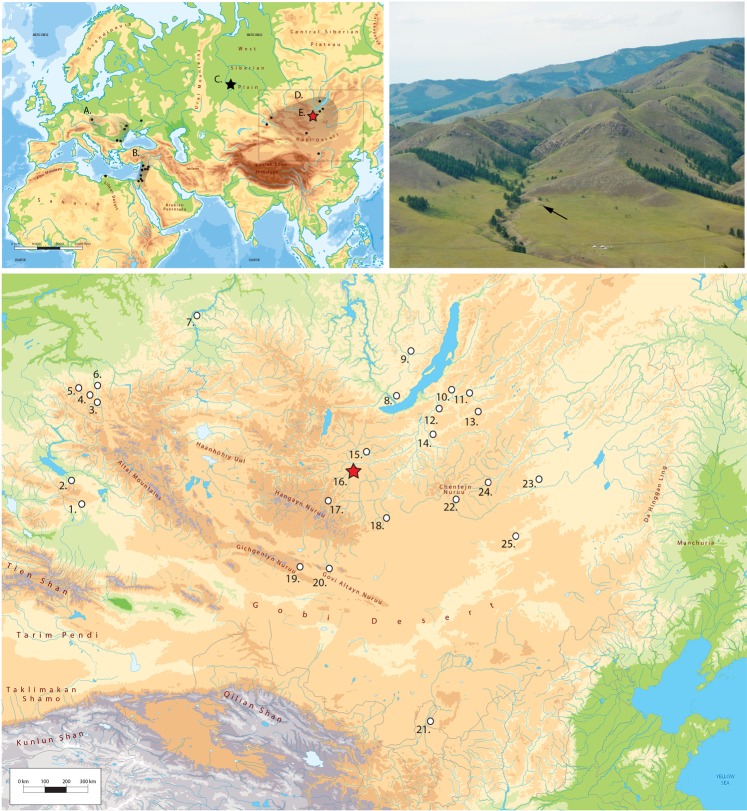
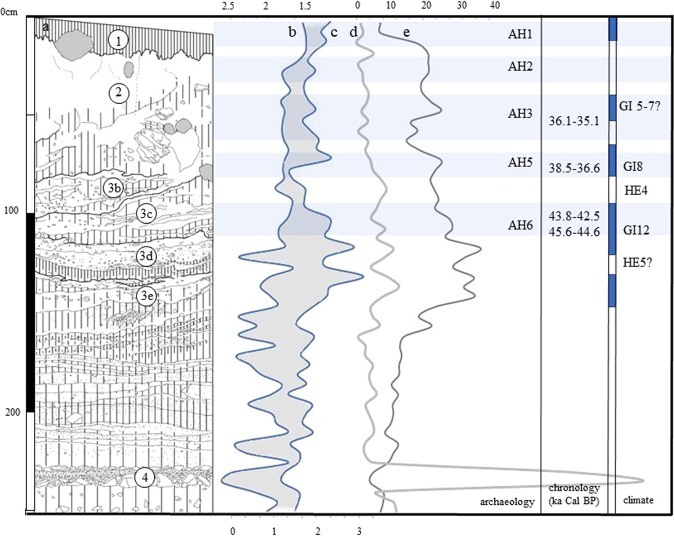
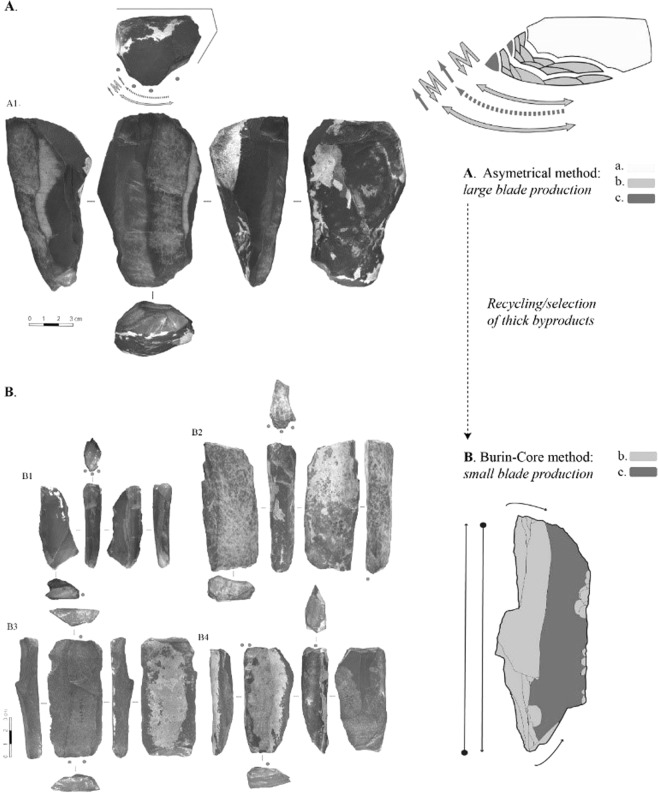
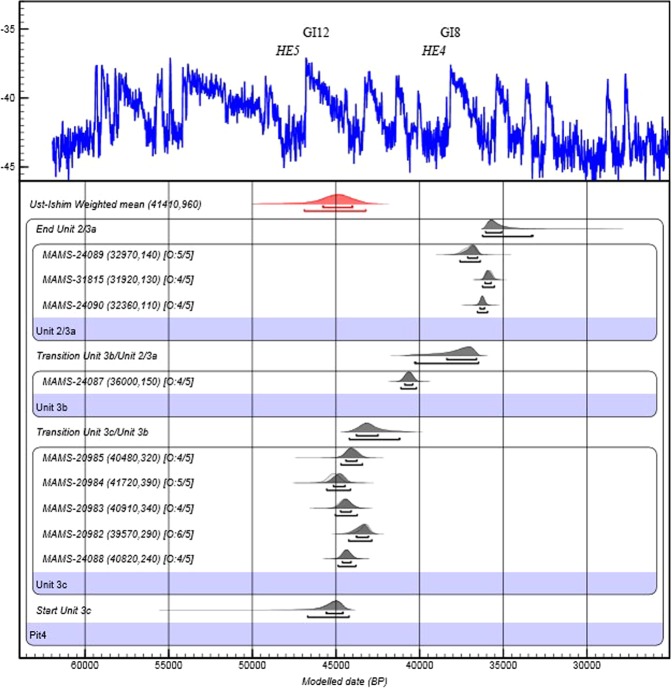
Verification
Claims the paper makes
The claims and statistics of this paper haven’t been checked yet.
Run the check — free, no account needed. It reads the open-access text and checks the sources it cites.
Claims other papers make about this one
Each is checked against this paper’s own text: does it say what the citing paper says it does?
In the citing paper
“While occasional finds provide direct evidence of anatomically modern humans in Mongolia as far back as the Early Upper Paleolithic (Devièse et al., 2019; Zwyns et al., 2019)”
From A Dynamic 6,000-Year Genetic History of Eurasia’s Eastern Steppe (2020) · cites this paper as Zwyns et al., 2019
Self-check
Percentages, sums and reported differences re-computed from the paper’s own numbers.
The self-check needs the paper’s full text.
Citations
Cites
IntCal13 and Marine13 radiocarbon age calibration curves 0–50,000 years cal BP
Reimer, P. J., Bard, E., Bayliss, A., Beck, J. W., Blackwell, P. G., Ramsey, C. B., Buck, C. E., Cheng, H., Edwards, R. L., Friedrich, M., et al. (2013) · Radiocarbon · doi:10.2458/azu_js_rc.55.16947 · Cited by 14,591
IntCal09 and Marine09 radiocarbon age calibration curves, 0–50,000 years cal BP
Reimer, P. J., Baillie, M. G. L., Bard, E., Bayliss, A., Beck, J. W., Blackwell, P. G., Bronk Ramsey, C., Buck, C. E., Burr, G. S., Edwards, R. L., et al. (2009) · Radiocarbon · doi:10.1017/s0033822200034202 · Cited by 4,290
Self-citationThe complete genome sequence of a Neanderthal from the Altai Mountains
Prüfer, K., Racimo, F., Patterson, N., Jay, F., Sankararaman, S., Sawyer, S., Heinze, A., Renaud, G., Sudmant, P. H., de Filippo, C., et al. (2014) · Nature · doi:10.1038/nature12886 · Cited by 2,254
Genetic history of an archaic hominin group from Denisova Cave in Siberia
Reich, D., Green, R. E., Kircher, M., Krause, J., Patterson, N., Durand, E. Y., Viola, B., Briggs, A. W., Stenzel, U., Johnson, P. L. F., et al. (2010) · Nature · doi:10.1038/nature09710 · Cited by 1,991
Self-citationAltitude adaptation in Tibetans caused by introgression of Denisovan-like DNA
Huerta-Sánchez, E., Jin, X., Asan, Bianba, Z., Peter, B. M., Vinckenbosch, N., Liang, Y., Yi, X., He, M., Somel, M., et al. (2014) · Nature · doi:10.1038/nature13408 · Cited by 1,208
Dealing with outliers and offsets in radiocarbon dating
Bronk Ramsey, C. (2009) · Radiocarbon · doi:10.1017/s0033822200034093 · Cited by 1,204
Genome sequence of a 45,000-year-old modern human from western Siberia
Fu, Q., Li, H., Moorjani, P., Jay, F., Slepchenko, S. M., Bondarev, A. A., Johnson, P. L. F., Aximu-Petri, A., Prüfer, K., de Filippo, C., et al. (2014) · Nature · doi:10.1038/nature13810 · Cited by 1,023
Self-citationAn aboriginal Australian genome reveals separate human dispersals into Asia
Rasmussen, M., Guo, X., Wang, Y., Lohmueller, K. E., Rasmussen, S., Albrechtsen, A., Skotte, L., Lindgreen, S., Metspalu, M., Jombart, T., et al. (2011) · Science · doi:10.1126/science.1211177 · Cited by 787
Multiple Deeply Divergent Denisovan Ancestries in Papuans
Jacobs, G. S., Hudjashov, G., Saag, L., Kusuma, P., Darusallam, C. C., Lawson, D. J., Mondal, M., Pagani, L., Ricaut, F.-X., Stoneking, M., et al. (2019) · Cell · doi:10.1016/j.cell.2019.02.035 · Cited by 346
Neanderthals in central Asia and Siberia
Krause, J., Orlando, L., Serre, D., Viola, B., Prüfer, K., Richards, M. P., Hublin, J.-J., Hänni, C., Derevianko, A. P., & Pääbo, S. (2007) · Nature · doi:10.1038/nature06193 · Cited by 333
Self-citation
Research works printed but not linked: 66
- Lahr, M. M. & Foley, R. Multiple dispersals and modern human origins. Evol Anthropol 3(2), 48–60 (1994). · DOI
- Stringer, C. Palaeoanthropology. Coasting out of Africa. Nature 405(6782), 24–25 (2000). · DOI
- Field, J. S. & Lahr, M. M. Assessment of the Southern Dispersal: GIS-Based Analyses of Potential Routes at Oxygen Isotopic Stage 4. Journal of World Prehistory 19(1), 1–45 (2006). · DOI · Paper page
- Petraglia, M. D., Haslam, M., Fuller, D. Q., Boivin, N. & Clarkson, C. Out of Africa: New hypotheses and evidence for the dispersal of Homo sapiens along the Indian Ocean rim. Ann Hum Biol 37(3), 288–311 (2010). · DOI
- Mellars, P., Gori, K. C., Carr, M., Soares, P. A. & Richards, M. B. Genetic and archaeological perspectives on the initial modern human colonization of southern Asia. Proc Natl Acad Sci USA 110(26), 10699–10704 (2013). · DOI · Paper page
- Slon, V. et al. The genome of the offspring of a Neanderthal mother and a Denisovan father. Nature 561, 113–116 (2018). · DOI · Paper page
- Goebel, T. The Middle to Upper Paleolithic transition in Siberia [PhD dissertation]. Department of Anthropology, University of Alaska Fairbanks (1993). · DOI
- Brantingham, P. J., Krivoshapkin, A. I., Jinzeng, L. & Tserendagva, Y. The Initial Upper Paleolithic in Northeast Asia. Curr Anthropol 42(5), 735–47 (2001). · DOI
- Goebel, T. The Early Upper Paleolithic of Siberia. In The Early Upper Paleolithic Beyond Western Europe. eds Brantingham, P. J., Kuhn, S. L. & Kerry, K. W. (Los Angeles: University of California Press), 162–195 (2004). · DOI
- Hoffecker, J. F. The spread of modern humans in Europe. Proc Natl Acad Sci USA 106(38), 16040–16045 (2009). · DOI
- Zwyns, N. Laminar technology and the onset of Upper Paleolithic in the Altai (Siberia) (Leiden Univ Press, Leiden, The Netherlands) (2012).
- Hublin, J.-J. The earliest modern human colonization of Europe. Proc Natl Acad Sci USA 109(34), 13471–13472 (2012). · DOI
- Rybin, E. P. Tools, beads, and migrations: Specific cultural traits in the Initial Upper Paleolithic of Southern Siberia and Central Asia. Quat Int 347, 39–52 (2014). · DOI
- Kuhn, S. L. & Zwyns, N. Rethinking the Initial Upper Paleolithic. Quat Int 347, 29–38 (2014). · DOI
- Zwyns, N. et al. The open-air site of Tolbor 16 (Northern Mongolia): preliminary results and perspectives. Quat Int 347, 53–65 (2014). · DOI
- Gillespie, A. R., Burke, R. M., Komatsu, G. & Bayasgalan, A. Late Pleistocene glaciers in Darhad basin, northern Mongolia. Quat Res 69, 169–187 (2008). · DOI
- Rother, H., Lehmkuhl, F., Fink, D. & Nottebaum, V. Surface exposure dating reveals MIS-3 glacial maximum in the Khangai Mountains of Mongolia. Quat Res 82, 297–308 (2014). · DOI
- Batbaatar, J., Gillespie, A. R., Fink, D., Matmon, A. & Fujioka, T. Asynchronous glaciations in arid continental climate. Quat Sci Rev 182, 1–19 (2018). · DOI
- Lehmkuhl, F., Klinge, M., Rother, H. & Hülle, D. Distribution and timing of Holocene and late Pleistocene glacier fluctuations in western Mongolia. Annals of Glaciology 57(71), 169–178 (2016). · DOI
- Herzschuh, U. Palaeo-moisture evolution in monsoonal Central Asia during the last 50,000 years. Quaternary Science Reviews 25, 163–178 (2006). · DOI
- Yu, K. et al. Late Quaternary environments in the Gobi Desert of Mongolia: Vegetation, hydrological, and palaeoclimate evolution. Palaeogeography, Palaeoclimatology, Palaeoecology 514, 77–91 (2019). · DOI
- Ma, Y. et al. Vegetation changes and associated climate variations during the past ~38,000 years reconstructed from the Shaamar eolian-paleosol section, northern Mongolia. Quaternary International 311, 25–35 (2013). · DOI
- Wen, X., Li, B., Zheng, Y., Zhang, D. D. & Ye, J. Climate variability in the Salawusu River valley of the Ordos Plateau (Inner Mongolia, China) during Marine Isotope Stage 3. Journal of Quaternary Science 24(1), 61–74 (2008). · DOI
- Yao, T. Climate variation since the Last Interglaciation recorded in the Guliya ice core. Science in China (series D) 40(6), 662–668 (1997). · DOI
- Wang, Y. J. A high-resolution absolute-dated late Pleistocene Monsoon record from Hulu Cave, China. Science 294(5550), 2345–8 (2001). · DOI
- Buckley, M., Collins, M., Thomas‐Oates, J. & Wilson, J. C. Species identification by analysis of bone collagen using matrix‐assisted laser desorption/ionisation time‐of‐flight mass spectrometry. Rapid Commun. Mass Spectrom. 23, 3843–3854 (2009). · DOI · Paper page
- Welker, F. et al. Palaeoproteomic evidence identifies archaic hominins associated with the Châtelperronian at the Grotte du Renne. Proc. Natl Acad. Sci. USA 113, 1162–1167 (2016). · DOI · Paper page
- Vasiliev, S. A. Faunal exploitation, subsistence practices and Pleistocene extinctions in Paleolithic Siberia. Deinsea 9, 513–556 (2003).
- Zwyns, N., Rybin, E. P., Hublin, J.-J. & Derevianko, A. P. Burin-core technology & laminar reduction sequence in the initial Upper Paleolithic from Kara-Bom (Gorny-Altai, Siberia). Quat Int 259, 33–47 (2012). · DOI
- Derevianko, A. P., Petrin, V. T. & Rybin, E. P. The Kara-Bom site and the characteristics of the Middle-Upper Paleolithic transition in the Altai. Archaeol Ethnol Anthropol Eurasia 2(2), 33–52 (2000).
- Goebel, T., Derevianko, A. P. & Petrin, V. T. Dating the Middle-to-Upper-Paleolithic transition at Kara-Bom. Curr Anthropol 34(4), 452–8 (1993). · DOI
- Zwyns, N. & Lbova, L. V. The Initial Upper Paleolithic of Kamenka site, Zabaikal region (Siberia): A closer look at the blade technology. Archaeol Res Asia 17, 24–29 (2019). · DOI
- Goebel, T. & Aksenov, M. Accelerator radiocarbon dating of the Initial Upper Palaeolithic in Southeast Siberia. Antiquity 69(263), 349–57 (1995). · DOI
- Derevianko, A. P. et al. The technology of early Upper Paleolithic lithic reduction in Northern Mongolia: The Tolbor-4 site. Archaeol Ethnol Anthropol Eurasia 29(1), 16–38 (2007). · DOI
- Gladyshev, S. A., Olsen, J. W., Tabarev, A. V. & Kuzmin, Y. V. Chronology and periodization of Upper Paleolithic sites in Mongolia. Archaeol Ethnol Anthropol Eurasia 38(3), 33–40 (2010). · DOI
- Gladyshev, S. A. Radiocarbon dating of Paleolithic sites in the Ikh-Tulberiin-Gol River Valley, Northern Mongolia. Vestnik 12(5), 44–48 (2013).
- Bar-Yosef, O. & Belfer-Cohen, A. Following Pleistocene road signs of human dispersals across Eurasia. Quat Int 285, 30–43 (2011). · DOI
- Goebel, T. The overland dispersal of modern humans to eastern Asia: an alternative, northern route from Africa. Emergence and Diversity of Modern Human Behavior in Paleolithic Asia eds Kaifu, Y., Izuho, M., Goebel, T., Sato, H. & Ono, A. (Texas A&M University Press, College Station), 437–452 (2015).
- Brantingham, P. J., Gao, X., Madsen, D. B., Bettinger, R. L. & Elston, R. G. The Initial Upper Paleolithic at Shuidonggou, northwestern China. The Early Upper Paleolithic Beyond Western Europe. eds Brantingham, P. J., Kuhn, S. L. & Kerry, K. W. (Los Angeles: University of California Press), 233–241 (2004).
- Li, F., Kuhn, S. L., Gao, X. & Chen, F. Re-examination of the dates of large blade technology in China: a comparison of Shuidonggou locality 1 and locality 2. J Hum Evol 64, 161–68 (2013). · DOI
- Peng, F., Wang, H. & Gao, X. Blade production of Shuidonggou locality 1 (northwest China): a technological perspective. Quat Int 347, 12–20 (2014). · DOI
- Zhang, X. L. et al. The earliest human occupation of the high-altitude Tibetan Plateau 40 thousand to 30 thousand years ago. Science 362(6418), 1049–1051 (2018). · DOI
- Svensson, A. et al. A 60,000-year Greenland stratigraphic ice core chronology. Clim Past 4, 47–57 (2008). · DOI
- Haesaerts, P., Borziac, I. & Chekha, V. Climatic signature and radiocarbon chronology of Middle and Late Pleniglacial loess from Eurasia: comparison with the marine and Greenland records. Radiocarbon 51(1), 201–318 (2009). · DOI
- Müller, U. C., Pross, J., Tzedakis, P. C., Gamble, C. & Kotthoff, U. The role of climate in the spread of modern humans into Europe. Quat Sci Rev 30, 273–279 (2011). · DOI
- Svoboda, J. A. Continuities, discontinuities, and interactions in Early Upper Paleolithic technologies: a view from the Middle Danube. The Early Upper Paleolithic Beyond Western Europe. eds Brantingham PJ, Kuhn SL, Kerry KW (Los Angeles: University of California Press), 30–49 (2004). · DOI
- Škrdla, P. The Bohunician in Moravia and adjoining regions. Archaeol Ethnol Anthropol Eurasia 41(3), 2–13 (2013). · DOI
- Pitulko, V. V. et al. Early human presence in the Arctic: Evidence from 45,000-year-old mammoth remains. Science 351(6270), 260–263 (2016). · DOI
- Heinrich, H. Origin and consequences of cyclic ice rafting in the Northeast Atlantic Ocean during the past 130,000 years. Quat Res 29(2), 142–152 (1988). · DOI
- Evans, M. E., Rutter, N. W., Catto, N., Chlachula, J. & Nyvlt, D. Magnetoclimatology: teleconnection between the Siberian loess record and North Atlantic Heinrich events. Geology 31(6), 537–540 (2003). · DOI
- Begzsurena, S., Ellis, J. E., Ojima, D. S., Coughenourb, M. B. & Chuluun, T. Livestock responses to droughts and severe winter weather in the Gobi Three Beauty National Park, Mongolia. Journal of Arid Environments 59(4), 785–796 (2003). · DOI
- Devièse, T. et al. Compound-specific radiocarbon dating and mitochondrial DNA analysis of the Pleistocene hominin from Salkhit Mongolia. Nature Communications 10, 274 (2019). · DOI · Paper page
- Lbova, L. Evidence of Modern Human Behavior in the Baikal Zone during the Early Upper Paleolithic Period. Bulletin of the Indo-Pacific Prehistory Association 30, 9–13 (2011). · DOI
- Jaubert, J. et al. Le Paléolithique supérieur ancien de Mongolie: Dörölj 1 (Egiïn Gol). Analogies avec les données de l’Altaï et de Sibérie. Secrétariat général du Congrès (éd.), Section 6. Le Paléolithique supérieur/The Upper Paleolithic. Sessions générales et posters / General Sessions and Posters, Actes du XIVe Congrès UISPP, Université de Liège, 2–8 sept. 2001, Archaeopress, pp. 225–241., BAR International Series, 1240 (2004).
- Janz, L., Elston, R. G. & Burr, G. S. Dating North Asian surface assemblages with ostrich eggshell: implications for palaeoecology and extirpation. J. Arch Sci 36(9), 1982–1989 (2009). · DOI
- Derevianko, A. P., Markin, S. V. & Shunkov, M. V. The Sibiryachikha Facies of the Middle Paleolithic of the Altai. Archaeol Ethnol Anthropol Eurasia 41(1), 89–103 (2013). · DOI
- Douka, K. et al. Age estimates for hominin fossils and the onset of the Upper Palaeolithic at Denisova Cave. Nature 565, 640–644 (2019). · DOI · Paper page
- Jacobs, Z. et al. Timing of archaic hominin occupation of Denisova Cave in southern Siberia. Nature 565(7741), 594–599 (2019). · DOI
- Slon, V. et al. A fourth Denisovan individual. Sci Adv 3(7), e1700186 (2017). · DOI
- Chen, F. et al. A late Middle Pleistocene Denisovan mandible from the Tibetan Plateau. Nature 569(7756), 409–412 (2019). · DOI · Paper page
- Fitzsimmons, K. E. et al. Loess accumulation in the Tian Shan piedmont: implications for palaeoenvironmental change in arid Central Asia. Quat Int 469, 30–43 (2018). · DOI
- Hoffecker, J. F. Modern Humans: Their African Origin and Global Dispersal (New York: Columbia University Press) (2017). · DOI
- Skoglund, P. & Jakobsson, M. Archaic human ancestry in East Asia. Proc Natl Acad Sci USA 108, 18301–18306 (2011). · DOI
- Reich, D. et al. Denisova admixture and the first modern human dispersals into Southeast Asia and oceania. Am J Hum Genet 89(4), 516–28 (2011). · DOI · Paper page
- Weaver, T. Tracing the paths of modern humans from Africa. Proc Natl Acad Sci USA 111(20), 7170–7171 (2014). · DOI
- Bronk Ramsey, C. Bayesian analysis of radiocarbon dates. Radiocarbon 51(1), 337–360 (2009). · DOI · Paper page
Cited by
A Dynamic 6,000-Year Genetic History of Eurasia’s Eastern Steppe
Jeong, C., Wang, K., Wilkin, S., Taylor, W. T. T., Miller, B. K., Bemmann, J. H., Stahl, R., Chiovelli, C., Knolle, F., Ulziibayar, S., et al. (2020) · Cell · doi:10.1016/j.cell.2020.10.015 · Cited by 328
Metadata
- Authors
- Zwyns, N., Paine, C. H., Tsedendorj, B., Talamo, S., Fitzsimmons, K. E., Gantumur, A., Guunii, L., Davakhuu, O., Flas, D., Dogandžić, T., Doerschner, N., Welker, F., Gillam, J. C., Noyer, J. B., Bakhtiary, R. S., Allshouse, A. F., Smith, K. N., Khatsenovich, A. M., Rybin, E. P., Byambaa, G., & Hublin, J.-J.
- Venue
- Scientific Reports
- Published
- 2019-08-13
- Volume
- 9
- Issue
- 1
- ISSN
- 2045-2322
- PMC
- PMC6692324
- Cited by
- 82
- References
- 10
- Language
- en
- Funders
- Leakey Foundation
- Hellman Foundation
- Max-Planck-Gesellschaft
- National Science Foundation
- Villum Fonden (17649)
About these checks
Registry, retraction, Cites and statistics results are computed, not judged, with one exception: a printed reference that no index lists is read once by a model before it counts as a citation error. Claims are extracted by a model and kept only when their quote appears verbatim in the text; each cited source is then checked, with a model’s help, for whether it says what the claim relies on. Those verdicts can be wrong — read the claim’s quote and the cited source before relying on one.
Statistics and arithmetic are recomputed, not judged.
Confidence bands are shown only for fields calibrated on our annotated test set. None is calibrated yet, so no band is shown.
What counts as a claim ›How we measure confidence ›How we check this ›
Are you an author, or do you see a problem with this page? Request a review
