

Secondary Metabolites Profiled in Cannabis Inflorescences, Leaves, Stem Barks, and Roots for Medicinal Purposes
Open accessThe DOI matches its Crossref record; 100 of the 102 references it cites were found in a registry or an index.
Abstract
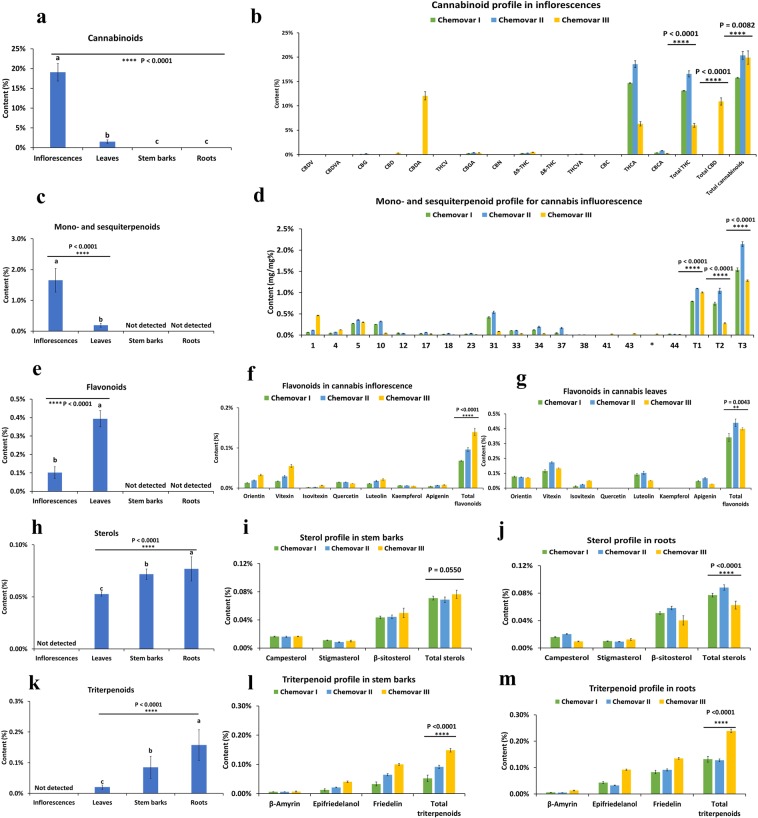
Cannabis research has historically focused on the most prevalent cannabinoids. However, extracts with a broad spectrum of secondary metabolites may have increased efficacy and decreased adverse effects compared to cannabinoids in isolation. Cannabis’s complexity contributes to the length and breadth of its historical usage, including the individual application of the leaves, stem barks, and roots, for which modern research has not fully developed its therapeutic potential. This study is the first attempt to profile secondary metabolites groups in individual plant parts comprehensively. We profiled 14 cannabinoids, 47 terpenoids (29 monoterpenoids, 15 sesquiterpenoids, and 3 triterpenoids), 3 sterols, and 7 flavonoids in cannabis flowers, leaves, stem barks, and roots in three chemovars available. Cannabis inflorescence was characterized by cannabinoids (15.77–20.37%), terpenoids (1.28–2.14%), and flavonoids (0.07–0.14%); the leaf by cannabinoids (1.10–2.10%), terpenoids (0.13–0.28%), and flavonoids (0.34–0.44%); stem barks by sterols (0.07–0.08%) and triterpenoids (0.05–0.15%); roots by sterols (0.06–0.09%) and triterpenoids (0.13–0.24%). This comprehensive profile of bioactive compounds can form a baseline of reference values useful for research and clinical studies to understand the “entourage effect” of cannabis as a whole, and also to rediscover therapeutic potential for each part of cannabis from their traditional use by applying modern scientific methodologies.
Overview
The claims and statistics of this paper haven’t been checked yet.
Free: it reads the open-access text and checks the first 5 claims that cite a source we can check. Create a free account to check every claim.
Integrity signals
Registry
Cites
Statistics
Figures
Verification
Claims the paper makes
The claims and statistics of this paper haven’t been checked yet.
Free: it reads the open-access text and checks the first 5 claims that cite a source we can check. Create a free account to check every claim.
Claims other papers make about this one
Each is checked against this paper’s own text: does it say what the citing paper says it does?
The source backs part of the claim, not all of it — or backs it for a different population, condition or comparison.
In the citing paper
“The most notorious specialized metabolites from Cannabis are cannabinoids—meroterpenoids (i.e., partial terpenoid derivative, also known as terpenophenolics) [1,2,3,4]—which are predominantly found in female flowers, although trace amounts may be present in other tissues like leaves and stems, with seeds and roots generally lacking psychoactive cannabinoids [5,6].”
From Exploring the Lesser-Known Bioactive Natural Products of Plant Species of the Genus Cannabis L.: Alkaloids, Phenolic Compounds, and Their Therapeutic Potential (2025) · cites this paper as [6]
Experimental — accuracy not yet measuredThe cited source says what the claim attributes to it.
In the citing paper
“These molecules, which vary significantly in their structure, biosynthetic pathways, and bioactivities, may offer therapeutic potential as anti-inflammatory, antioxidant, neuroprotective, and antimicrobial agents [5,6].”
Self-check
Percentages, sums and reported differences re-computed from the paper’s own numbers.
The self-check needs the paper’s full text.
Citations
Cites
The Endocannabinoid System as an Emerging Target of Pharmacotherapy
Pacher, P., Bátkai, S., & Kunos, G. (2006) · Pharmacological Reviews · doi:10.1124/pr.58.3.2 · Cited by 2,077
Cannabis sativa: The Plant of the Thousand and One Molecules
Andre, C. M., Hausman, J.-F., & Guerriero, G. (2016) · Frontiers in Plant Science · doi:10.3389/fpls.2016.00019 · Cited by 1,544
Taming THC: potential cannabis synergy and phytocannabinoid-terpenoid entourage effects.
Russo, E. B. (2011) · British Journal of Pharmacology · doi:10.1111/j.1476-5381.2011.01238.x · Cited by 1,535
Chemical constituents of marijuana: The complex mixture of natural cannabinoids
ElSohly, M. A., & Slade, D. (2005) · Life Sciences · doi:10.1016/j.lfs.2005.09.011 · Cited by 1,094
De Petrocellis, L., Ligresti, A., Moriello, A. S., Allarà, M., Bisogno, T., Petrosino, S., Stott, C. G., & Di Marzo, V. (2011) · British Journal of Pharmacology · doi:10.1111/j.1476-5381.2010.01166.x · Cited by 946
Agonistic properties of cannabidiol at 5-HT1a receptors
Russo, E. B., Burnett, A., Hall, B., & Parker, K. K. (2005) · Neurochemical Research · doi:10.1007/s11064-005-6978-1 · Cited by 878
Cannabidiol and (−)Δ 9 -tetrahydrocannabinol are neuroprotective antioxidants
Hampson, A. J., Grimaldi, M., Axelrod, J., & Wink, D. (1998) · Proceedings of the National Academy of Sciences · doi:10.1073/pnas.95.14.8268 · Cited by 850
History of cannabis as a medicine: a review
Zuardi, A. W. (2006) · Revista Brasileira de Psiquiatria · doi:10.1590/s1516-44462006000200015 · Cited by 730
Constituents of Cannabis sativa L. XVII. A review of the natural constituents
Turner, C. E., Elsohly, M. A., & Boeren, E. G. (1980) · Journal of Natural Products · doi:10.1021/np50008a001 · Cited by 599
Cannabinoids in medicine: A review of their therapeutic potential
Ben Amar, M. (2006) · Journal of Ethnopharmacology · doi:10.1016/j.jep.2006.02.001 · Cited by 543
Research works printed but not linked: 5
- 2. Ross, S. A. et al. Flavonoid glycosides and cannabinoids from the pollen of Cannabis sativa L. Phytochemical Analysis: An International. Journal of Plant Chemical and Biochemical Techniques 16, 45-48 (2005).
- 16. Deyo, R. & Musty, R. A cannabichromene (CBC) extract alters behavioral despair on the mouse tail suspension test of depression. In Proceedings 2003 Symposium on the Cannabinoids. International Cannabinoid Research Society: Cornwall, ON 146 (2003).
- 37. Turner, C. E., Elsohly, H. N., Lewis, G. S., Lopez-Santibanez, I. & Carranza, J. Constituents of Cannabis sativa L., XX: the cannabinoid content of Mexican variants grown in Mexico and in Mississippi, United States of America. Bulletin On Narcotics 34, 45-59 (1982).
- 57. Hillig, K. W. A systematic investigation of Cannabis, PhD thesis, Indiana University. (2005).
- 81. Vázquez, L. H., Palazon, J. & Navarro-Ocaña, A. The Pentacyclic Triterpenes α, β-amyrins: A Review of Sources and Biological Activities. In: Venketeshwer Rao (Eds.), Phytochemicals -A Global Perspective of Their Role in Nutrition and Health, (2012).
Cited by
Items 301–348 of 348
Actividad antioxidante de variedades de cannabis del Norte del Cauca, Colombia
Arango, P. A., Delgado, J. C., Muñoz, S. M., Llanos, L., & Benítez, R. B. (2024) · CIENCIA EN DESARROLLO · doi:10.19053/01217488.v15.n1.2024.15214
Traditional Uses of Seven Medicinal Plants for Malaria Treatment in Bobo-Dioulasso, Burkina Faso
Kabré, Z., Yerbanga, R. S., Meda, R. N.-T., Haro, A., Fofana, A., Kam, S. E., Zongo, E., Koama, B. K., Belèm, H., Kagambéga, W., et al. (2025) · Advances in Infectious Diseases · doi:10.4236/aid.2025.151007 · Cited by 2
Terpene und Flavonoide: Ätherisches Cannabisöl
Hughston, L., & Conarton, M. (2024) · Springer eBooks · doi:10.1007/978-3-031-67821-9_4
Effect of Hemp Root Extract on α-Glucosidase Inhibition and Glucose Uptake Regulatio
Kim, Y., Kim, W., Yun, T. J., Lee, J. J., Kim, T., & Kim, J. H. (2025) · Journal of the Korean Society of Food Science and Nutrition · doi:10.3746/jkfn.2025.54.1.34
Cannabis sativa L. e a produção do canabidiol
Viana, C. D. S. (2025) · Medicinae Plantae · doi:10.36517/mp.v1i2.95358
Endophytic Fungi Associated With Cannabis Sativa: A Literature Review
Laanaya, J., Touhami, A. O., & Douira, A. (2025) · Advances in bioinformatics and biomedical engineering book series · doi:10.4018/979-8-3693-9450-2.ch008 · Cited by 4
Yao, W., Su, L., Lu, Z., Xu, S., Duan, L., Sun, W., Meng, X., Wan, H., Wang, S., Cao, X., et al. (2025) · Chinese Herbal Medicines · doi:10.1016/j.chmed.2025.06.001 · Cited by 2
Self-citationGatti, F., Albani, C. M., Ramírez, C. L., Pensel, P. E., Albanese, A. A., Fuentes, G., Orallo, D. E., Nutter, D., & Elissondo, M. C. (2025) · Acta Parasitologica · doi:10.1007/s11686-025-01090-3 · Cited by 1
ПЕРСПЕКТИВИ СТВОРЕННЯ ЛІКАРСЬКИХ ПРЕПАРАТІВ НА ОСНОВІ ЛІКАРСЬКО-РОСЛИННОЇ СИРОВИНИ ВИДІВ CANNABIS
Оксенюк, О. Є., & Мялюк, О. П. (2025) · Medical and Clinical Chemistry · doi:10.11603/mcch.2410-681x.2025.i1.15433
Optimizing simplified growing media to enhance cannabis cultivation
Tebdoie, C., Khana, A., Pajareeyanont, S., Deewatthanawong, R., Kongchinda, P., & Montri, N. (2025) · International Journal of Agricultural Technology · doi:10.63369/ijat.2025.21.4.1521-1534 · Cited by 2
Ethnopharmacology of Cannabis sativa: Unveiling the Medicinal Heritage and Modern Applications
Laxmi, V., & Martolia, J. (2025) · Journal of Natural Remedies · doi:10.18311/jnr/2025/47860
Inhibitory Effects of Cannabis sativa Seed Extract on the Pancreatic Cancer Cell Line PANC-1
Salah, F., Masoudi, M., Roudsari, F. G., & Ramezani, S. (2026) · Journal of Human Environment and Health Promotion · doi:10.1101/2025.07.27.667016
“(Jin et al., 2020).”
Moodi, M., Hammami, H., & Fallahi, H.-R. (2025) · Journal of Applied Research on Medicinal and Aromatic Plants · doi:10.1016/j.jarmap.2025.100650
O IMPACTO DO USO DO CANABIDIOL NO TRATAMENTO DA ANSIEDADE: UM OLHAR PARA A SAÚDE MENTAL
Alencar, E. N., de Souza, A. C., Casimiro, M. R. A., Rego, M. T. D. O., Freitas, C. D. S., & Bezerra, Y. C. P. (2025) · Revista Contemporânea · doi:10.56083/rcv5n8-049
Zárate, J. C. C., & Alzamora, S. B. (2016) · Advocatus · doi:10.26439/advocatus2016.n034.4450
Odieka, A. E., Oriola, A. O., Miya, G. M., Kar, P., Oyedeji, O. O., Gondwe, M. M., Hosu, Y. S., Madliwa, T., & Oyedeji, A. O. (2025) · International Journal of Molecular Sciences · doi:10.3390/ijms26178552
“Cannabis stems may contain phytochemicals of medicinal interest since quantities above 0.05% are pharmaceutically intriguing [17].”
InfluentialEXTRAÇÃO E ANÁLISE DE TERPENOS DO ÓLEO ESSENCIAL DE FOLHAS E HASTES DE CANNABIS SATIVA L.
Rose, C. E., Comin, G. R., Conterato, G. M. M., Soldi, C., & Amazonas, E. D. A. (2025) · Revista Brasileira de Cannabis · doi:10.58731/2965-0771.2025.105
Maneesai, P., Duangjinda, M., Labjit, C., Khamseekaew, J., Potue, P., Poasakate, A., & Pakdeechote, P. (2025) · Pharmaceuticals · doi:10.3390/ph18101437 · Cited by 1
“[10].”
Cannabis sativa extracts reduce inclusion formation in a cell model of alpha-synuclein aggregation
Cruz, T. D. A., Osorio, R. D. P., Epifânio, N. M. D. M., Merghani, M. M., Pereira, M. D., Chaves, D. S. D. A., Outeiro, T. F., & Riger, C. J. (2025) · Fitoterapia · doi:10.1016/j.fitote.2025.106968
Gomes, A. P., Vicente, S., Rosa, J., Vinhas, I., da Costa, A. M., Sassano, M., Rodrigues, L. M., Rijo, P. M., Trindade, H., & Costa, M. D. C. (2025) · Journal of Cannabis Research · doi:10.1186/s42238-025-00357-w
“…polyphenols, flavonoids, chlorophylls, and fatty acids, among other bioactive compounds (Committee on Herbal Medicinal Products (HMPC), 2021; Jin et al. 2020; Pattnaik et al. 2022) totaling over 200 phytocan-nabinoids identified to date (Govindarajan et al. 2023; Hussain et al. 2021;…”
Collado, C. E., & Hernández, R. (2025) · Scientific Reports · doi:10.1038/s41598-025-27437-4
Orsi, V. D. C., Silva, L. R. C. D., da Silva, G. B. D. O., Pasiani, R. O., & Oshima-Franco, Y. (2025) · Aracê. · doi:10.56238/arev7n12-128
Cannabinoids in Cannabis sativa l. and oil: Method validation and analysis by LC-MS/MS
Drobnjak, P. D. S. M., Zacca, J. J., & Caldas, E. D. (2025) · Forensic Science International · doi:10.1016/j.forsciint.2025.112781
Tims, M. C., Courie, J., & Betz, J. M. (2025) · Cannabis and Cannabinoid Research · doi:10.1177/25785125251391985 · Cited by 1
“16 This suggests that trichomes are useful for detecting biotic and abiotic in fl uences on their secondary metabolite production in varied ecosystems.”
Hydrothermal deconstruction of medicinal Cannabis sativa waste
Robertson, K. J., Randhawa, P. S., & Baroutian, S. (2026) · Clean Technologies and Environmental Policy · doi:10.1007/s10098-026-03422-x
“The THC content of this waste is in the realm of < 0.03% to 2% (Jin et al. 2020).”
InfluentialAw, B., Smith, D. M., & Goniewicz, M. L. (2026) · Expert Review of Clinical Pharmacology · doi:10.1080/17512433.2026.2630756
“However, these effects are often weak [107,112], and flavonoid concentrations in plant material relative to Δ 9 -THC are very low [113].”
The toxicology of orally administered Δ9-tetrahydrocannabinol in sheep
Stevens, S. A., Edwards, S., Noble, G. K., Scrivener, C. J., Petzel, C. E., May, C. D., Tai, Z. X., Blake, B. L., Dods, K., Warne, L. N., et al. (2026) · Toxicology Reports · doi:10.1016/j.toxrep.2026.102221
“…utilised in the current study were comprised of a cannabinoid resin and effects from other plant secondary metabolites normally present in iHemp biomass, may influence the levels of Δ 9 -THC that ruminants can graze before an adverse effect is observed, with potential varietal differences [36].”
Chalkiadaki, M., Grigoraki, L., Tsakireli, D., Vasalaki, G., Tzimas, P. S., Chen, M., Remadi, L., Ragno, R., Akrani, I., Mikros, E., et al. (2026) · bioRxiv (Cold Spring Harbor Laboratory) · doi:10.64898/2026.02.10.705034
“Cannabis exhibits a highly complex phytochemistry, with over 545 identified secondary metabolites, including cannabinoids, terpenoids, flavonoids, sterols and lipids (Jin et al., 2020).”
Cagliero, C., Marengo, A., Sgorbini, B., & Rubiolo, P. (2026) · Planta Medica · doi:10.1055/s-0045-1814922
Jaafar, D. M. B., Mahou, Y., Chda, A., Chebaibi, M., Oliveira, A. P., Gomes, N. G. M., Andrade, P. B., & Bencheikh, R. (2026) · Scientific African · doi:10.1016/j.sciaf.2026.e03294
Khoury, A. A. (2021) · theses.fr (ABES) · doi:10.70675/02efdf11zbdc5z4a9dz8401z0d85e4e9d823
Bodnar, U. K. C., Villemaire-McCutcheon, J. J., Boddington, K. F., Soubeyrand, E., Al-Abdul-Wahid, M. S., Robeson, H. N., Lalonde, J., Casaretto, J. A., & Akhtar, T. A. (2026) · Journal of Cannabis Research · doi:10.1186/s42238-026-00438-4
“Indeed, while CsPT3 was originally described to prenylate the widespread flavone known as chrysoeriol into cannflavins A and B, our data indicate that it can also utilize the equally abundant apigenin as a substrate to synthesize 6-PA and 6-GA (Jin et al. 2020; Rea et al. 2019).”
Duringer, J. M., Saindon, A., Irawan, A., Ateş, S., Brownstein, K. J., Gude, K. M., Ringo, C. D., Kinney, C. A., Berhow, M. A., & Steiner, J. (2026) · Journal of Agricultural and Food Chemistry · doi:10.1021/acs.jafc.5c16989
HPLC-DAD Method for Cannabinoid Quantification in Brazilian Cannabis Oils and ExtractsPreprint
Bande, M. V. D. S. V., Almeida, F. V., da Costa-Oliveira, C., Gouvêa-Silva, J. G., & Dias, A. C. B. (2026) · Research Square · doi:10.21203/rs.3.rs-9224291/v1
El-Mernissi, R., Menyiy, N. E., Zouhri, A., El-Mernissi, Y., Barnossi, A. E., Amhamdi, H., Abboussi, O., Siddique, F., Dawoud, T. M. S., Younous, Y. A., et al. (2026) · Open Chemistry · doi:10.1515/chem-2025-0247
Sequeira, A. F., Spotorno, R. Á., Pochettino, J. J., Delfino, M. R., & Morales, W. G. (2026) · Revista Científica de la UCSA · doi:10.18004/ucsa/2409-8752/2026.013.01.073
Jahromi, H. K., Khalafi, V., Mirzaei, V., Ebrahimi-Zadeh, F., Azami, P., Abdolahy, T., & Razeghian‐Jahromi, I. (2026) · Iranian journal of pharmaceutical research · doi:10.5812/ijpr-168324
“In addition to THC and CBD, C. sativa contains a range of secondary metabolites (46).”
Cannabinoid-Based Classification of Ghanaian Cannabis for Regulatory and Commercial ApplicationsPreprint
Bentil, E., Ayensu, I., Adu, J., Addotey, J. N., & Eckenrode, B. (2026) · Research Square · doi:10.21203/rs.3.rs-9953080/v1
Cannabis sativa Linn.: A Medicinal Plant with Promising Muscle Relaxant-related Constituents
Matuka, T., Oriola, A. O., Kar, P., Gondwe, M. M., Apalata, T. R., & Oyedeji, A. O. (2026) · Journal of Applied Pharmaceutical Science · doi:10.1177/22313354261436144 · Cited by 1
“19,38 Chemistry of Cannabis C. sativa contains more than 500 identified chemical compounds.”
Contreras-Avilés, W., Ortega, L. R. T., Heuvelink, E., Marcelis, L. F. M., van der Hooft, J. J. J., & Kappers, I. F. (2026) · Metabolomics · doi:10.1007/s11306-026-02500-x
“Cannabis sativa L. is a medicinal plant producing health-affecting specialized metabolites including cannabinoids, terpenoids, flavonoids, as well as unique flavol-alkaloids and prenylated flavones (cannflavins) (Jin et al., 2020; Muller & De Villiers, 2025; Rea et al., 2019).”
Choi, H. W. (2026) · Recent Progress in Nutrition · doi:10.21926/rpn.2603012
Cvetanov, A., Bogevski, K., Maksimova, V., & Janevik-Ivanovska, E. (2026) · Journal of Agriculture and Plant Sciences · doi:10.46763/japs2624123c · Cited by 1
Karamanova, D., Erin, N., Bodrov, A., Tkachenko, V., Safronov, V., & Fedorov, M. V. (2026) · International Journal of Molecular Sciences · doi:10.3390/ijms27188000
“More than 500 compounds have been experimentally characterized, including cannabinoids, terpenoids, flavonoids, phenolic acids, and lipids [4,5].”
Ahmed, E. M., Alshahrani, T. S., Al-Mefarrg, H. A., Alqarawi, A. A., Abd‐ElGawad, A. M., Salih, A. M., & Abdelmalik, A. M. (2026) · Diversity · doi:10.3390/d18100582
Jeong, D.-H., Jeon, S. H., Hong, D. E., Lee, S., Park, Y., Kim, J., Park, Y., & Lee, H. (2026) · Ecotoxicology and Environmental Safety · doi:10.1016/j.ecoenv.2026.120832
Cannabis phytochemicals as emerging botanical biopesticides in sustainable agriculture
Fordjour, E., Manful, C. F., Asei, R., Aidoo, O. F., Mun, B., Osekre, E. A., & Thomas, R. (2026) · Journal of Natural Pesticide Research · doi:10.1016/j.napere.2026.100240
Thiry, M., Sergeant, K., Legay, S., Iken, M., Renaut, J., Lutts, S., & Guerriero, G. (2026) · Frontiers in Plant Science · doi:10.3389/fpls.2026.1923697 · Cited by 1
Behne, S., & Lachenmeier, D. W. (2026) · Metabolites · doi:10.3390/metabo16110834
Metadata
- Authors
- Jin, D., Dai, K., Xie, Z., & Chen, J.
- Affiliations
- University of Alberta (CA)
- Corresponding author
- Chen, Jie
- Venue
- Scientific Reports
- Published
- 2020-02-24
- Volume
- 10
- Issue
- 1
- Pages
- 3309-3309
- ISSN
- 2045-2322 (ISSN-L)
- PMC
- PMC7039888
- OpenAlex
- W3007489329
- Semantic Scholar
- 350db17e8d81860488fb15419de5070fe0b0e95e
- Cited by
- 348
- References
- 102
- Citations by year
- 2026: 39 · 2025: 68 · 2024: 70 · 2023: 64 · 2022: 56 · 2021: 38 · 2020: 11
- FWCI
- 25.36
- Type
- journal article
- Language
- en
- Open access
- gold
- doi.org
- Licence
- cc-by
- creativecommons.org/licenses/by/4.0 (tdm)
- creativecommons.org/licenses/by/4.0 (vor)
- Locations
- Scientific Reports (publishedVersion, cc-by)
- PubMed Central (publishedVersion, cc-by)
- PubMed (publishedVersion)
- DOAJ (DOAJ: Directory of Open Access Journals) (submittedVersion, cc-by-sa)
- Topics
- Health Sciences › Medicine › Pharmacology (medical) › Cannabis and Cannabinoid Research
- Life Sciences › Agricultural and Biological Sciences › Plant Science › Medicinal Plant Research
- Life Sciences › Agricultural and Biological Sciences › Plant Science › Phytochemistry and Biological Activities
- Keywords
- Cannabis sativa, secondary metabolites, cannabinoids, terpenoids, flavonoids, sterols, triterpenoids, monoterpenoids, sesquiterpenes, inflorescence, leaves, stem bark, roots, entourage effect, medical cannabis, traditional uses
- MeSH terms
- Cannabinoids, Cannabis, Flavonoids, Sesquiterpenes, Sterols, Reproducibility of Results, Plant Leaves, Plant Roots, Plant Bark, Biosynthetic Pathways, Inflorescence, Secondary Metabolism
About these checks
Registry, retraction, Cites and statistics results are computed, not judged, with one exception: a printed reference that no index lists is read once by a model before it counts as a citation error. Claims are extracted by a model and kept only when their quote appears verbatim in the text; each cited source is then checked, with a model’s help, for whether it says what the claim relies on. Those verdicts can be wrong — read the claim’s quote and the cited source before relying on one.
Statistics and arithmetic are recomputed, not judged.
Confidence bands are shown only for fields calibrated on our annotated test set. None is calibrated yet, so no band is shown.
What counts as a claim ›How we measure confidence ›How we check this ›
Are you an author, or do you see a problem with this page? Request a review
Data sources
Bibliographic data: Semantic Scholar, OpenAlex, Crossref.
Contains information from the Semantic Scholar Academic Graph Datasets, made available under the ODC Attribution License (ODC-BY 1.0).
Semantic Scholar’s data is described in: Kinney, R., et al. (2023). The Semantic Scholar Open Data Platform. arXiv:2301.10140.
